

Amidst the COVID-19 crisis, a moment for science
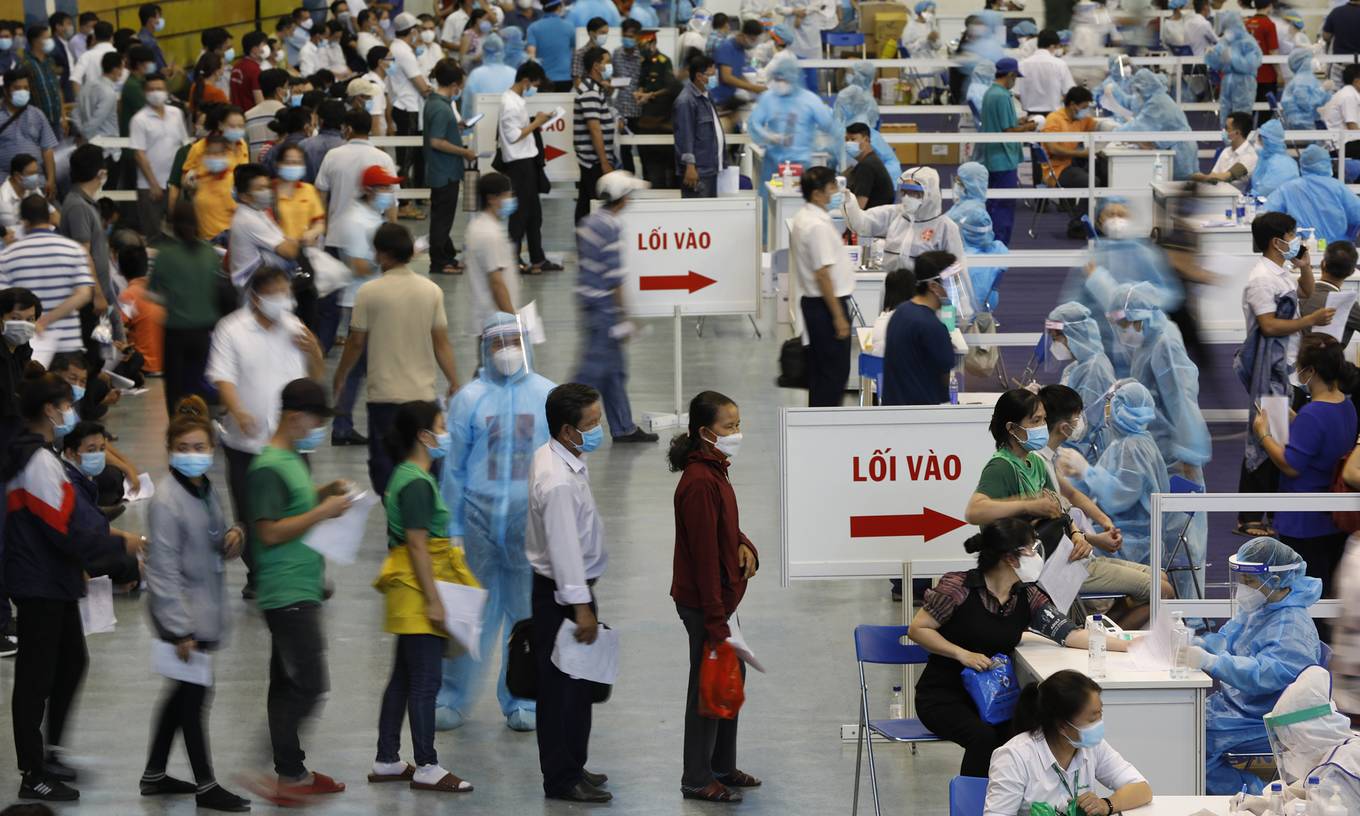
The escalation of COVID-19 in Vietnam, especially in Saigon (officially known as Ho Chi Minh City), is sending millions of people into crisis. They have struggled on multiple fronts, from healthcare and making sense of varying isolation requirements to obtaining food and necessities amidst strict yet incoherent travel bans and supply shortages.
The double target of trying to contain COVID-19 while simultaneously continuing economic activities that the government persistently defended and adhered to since the start of the pandemic has been abandoned. This is indicative of how serious the situation has become. Over the past few weeks, Saigonese have experienced life in a way they could never have imagined.
In this grim picture, Tuoi Tre Online reported on July 10, 2021, that Ho Chi Minh City’s Party Committee Secretary Nguyen Van Nen is now looking to scientists for advice.[1] The secretary’s words were quoted widely in the news:
I feel that we need to consult the scientists…. At any time, I want specialists and scientists to see flaws in our strategy to fight the pandemic and contact me; I will consider their advice and respond timely.
A Facebook influencer reacted to this news with a sense of irony and bitterness:[2]
So what expertise have you relied on to fight the pandemic? Anything but science? Have you been kidding your citizens all along? For one and a half years now, have you been playing with the life and death of millions of people? So, after all, is it true that the tools you have taken to fight a pandemic are simply government decrees and [the manpower of] the Communist Youth League? I feel so ashamed of being led by national leaders who are both blind and arrogant.
It is rather apparent that in a pandemic, one had better look to the scientists. So, why is a government official only bringing them to the table now? The next question is, how critical can scientists be, with a government that does not like criticism? At the highest level, one must wonder where science and scientists are in the decision-making concerning public matters in non-democratic Vietnam? A look into the Vietnamese Communist Party’s (VCP) ideology that it has followed and its practices could explain this conundrum.
In ideology: the suppression of civil society and communicative rationality
In the United Kingdom, at the start of the pandemic, the Scientific Advisory Group for Emergencies was activated. Since then, it has been working closely with the government as an external body to advise on making appropriate decisions regarding COVID-19 in the country. The importance and weight of scientific advice cannot be underestimated; UK scientists successfully convinced Prime Minister Boris Johnson and his cabinet to abandon their herd immunity strategy and adopt a nationwide lockdown in March 2020.
Without this lockdown, the United Kingdom could have seen 80 percent of its people infected and 500,000 deaths.[3] On the other side of the Atlantic Ocean, the physician-scientist and immunologist Anthony Fauci, in his role as the chief medical advisor to the US president, has been a pillar in handling COVID-19 in the United States.
Liberal democracy entails the practice of taking advice from scientists and not restraining those who deliver honest yet uncomfortable truths to people in positions of power. The two hallmarks of liberal democracy that shape this practice are civil society and communicative rationality.[4]
Civil society in a liberal democracy comprises actors and institutions that are supposed to be independent of the state and who act to balance state power. Therefore, universities and the myriad of civil associations in democratic countries are autonomous and can freely critique the conduct of the government or oppose laws and policies they view as problematic without fear of punishment.
On the other hand, communicative rationality, an ideal of liberal democracy, means that people arrive at a collective agreement about something via genuine, intelligible conversations. Thus parliamentary debate and rebuttal in classroom discussions are part and parcel of a healthy democratic life and politics.
Nowhere in the ideological textbook of the VCP can one find any sign of friendliness towards the idea of an autonomous, independent civil society, nor communicative rationality in the way the state relates to other estates in society. The Vietnamese government condemns independent civil society as a strategy of ‘hostile forces’ to undermine political stability.[5] Following the Marxist-Leninist ideology, the Communist leaders control civil society and use civil society organizations, such as the press, schools, and mass associations, to garner consent from the people for its rule.[6] Likewise, the Party believes in ‘self-criticism,’ rather than opposition or open, genuine debate in the National Assembly or in other venues where the state and citizens can talk to each other.[7]
In practice: the strategic mobilization of scientists while confining them within governable spaces
Since 1975, the Vietnamese State could be described as developmental. In the pursuit of economic growth and technological and social development, the state needs the expertise of scientists and intellectuals. This is evidenced by the existence of a wide range of research and scientific centers and institutions funded by the State that operate within the scope prescribed for them by the government. However, the system ensures that scientists and intellectuals employed in these research centres do not threaten the state.[8]
Despite these state-employed scientists and intellectuals, the Vietnamese government rarely describes its style of governance as “evidence/science-based.” This suggests that the VCP still aspires to be a good disciple of Marxism-Leninism when it comes to organizing the political system and governance. “The Party knows best” is apparently its motto. In other words, the Party sees itself as the supreme source of authority and expertise. This also makes Vietnam’s developmentalism different from, for example, Japan’s. Japan’s developmentalism is based on rationality, whereas Vietnam’s is based on ideology.[9]
Speaking of rationality, communicative rationality still has no place in Vietnam’s politics nor in the civil sphere. The National Assembly has shown little sign of becoming a place for open, genuine debate about public matters. Critical thinking is still lacking in the way students are educated. The free press is still a wild dream for Vietnam.
I interviewed the head of Luat Khoa Tap Chi not long ago. He described the prominent culture in Vietnam as a “culture of obedience and singular thinking” rather than critical thinking and genuine, intelligible debate. Last but not least, we shall not forget that in 2007, when the Institute of Development Studies was established by renowned intellectuals and scientists of the country to speak truth to power, it went into so much trouble with the government and was eventually disbanded.[10]
Prospects of the VCP democratizing itself?
Not so much. In Saigon, what the Party Committee Secretary Nguyen Van Nen said about consulting scientists is most likely just a moment of him forgetting the Party’s line he should be toeing. Indeed, just a week after his statement, a Facebook influencer reposted on his Facebook page a VNExpress interview with Vu Thanh Tu Anh of Fulbright University Vietnam, which reportedly was removed from VNExpress’s website immediately after it was posted.[11] In this interview, Tu Anh discusses some failures in the government’s strategy to contain COVID-19.[12]
In conclusion, for scientists to speak truth to power, or at least to save Vietnam from this deadly pandemic, they require a change in both ideology and politics, which the VCP seems to be neither willing nor ready to take.
Bibliography:
- Bí thư Thành ủy TP.HCM gặp gỡ các chuyên gia, nhà khoa học cùng bàn cách chống dịch COVID-19, 10 July 2021. Tuổi Trẻ Online. Available at: https://tuoitre.vn/bi-thu-thanh-uy-tp-hcm-gap-go-cac-chuyen-gia-nha-khoa-hoc-cung-ban-cach-chong-dich-covid-19-20210710120636333.htm
- Thai Hao’s Facebook page, 10 July 2021. The full post is available at: https://www.facebook.com/permalink.php?story_fbid=1029231357886052&id=100023975920044
- Grey, Stephen & MacAskill, Andrew, 7 April 2020. Special Report: Johnson listened to his scientists about coronavirus – but they were slow to sound the alarm. Reuters. Available at: https://www.reuters.com/article/us-health-coronavirus-britain-path-speci-idUSKBN21P1VF
- The background of my understanding of liberal democracy in this paragraph comes from Alexis de Tocqueville (on civil society) and Jurgen Habermas (on communicative rationality).
- See, for example, an article in Cong an Nhan dan, available at: http://cand.com.vn/Chong-dien-bien-hoa-binh/Canh-giac-thu-doan-loi-dung-xa-hoi-dan-su-de-chong-pha-che-do-581991/; another one in Nhan dan, available at: https://nhandan.vn/tin-tuc-su-kien/xa-hoi-dan-su-mot-thu-doan-cua-dien-bien-hoa-binh-392081/
- The reality of ‘state-led civil society’ in Vietnam, most prominent before the late 1980s, is discussed widely in the academic literature. For example, I suggest Landau, I. (2008). Law and civil society in Cambodia and Vietnam: A Gramscian perspective. Journal of Contemporary Asia, 38(2), 244–258; and Salemink, O. (2006). Translating, interpreting, and practicing civil society in Vietnam: A tale of calculated misunderstanding. In D. Lewis & D. Mosse (Eds.), Development Brokers and Translators: The Ethnography of Aid and Agencies (pp. 101–126). Kumarian Press.
- See, for example, a discussion session organized by a mass organization, in Tortosa, A. (2012). Grassroots democracy in rural Vietnam: A Gramscian analysis. Socialism and Democracy, 26(1), 103–126. https://doi.org/10.1080/08854300.2011.645661
- See Morris-Jung, J. (2017). Reflections on governable spaces of activism and expertise in Vietnam. Critical Asian Studies, 49(3), 441–443. https://doi.org/10.1080/14672715.2017.1339448
- For more on developmentalism and plan-rationality versus plan-ideology, see Johnson, C. (1993). The Japanese miracle. In MITI and the Japanese miracle: The growth of industrial policy, 1925-1975 (pp. 1–34). Stanford University Press; and Woo-Cumings, M. (Ed.). (1999). Introduction: Chalmers Johnson and the politics of nationalism and development. In The developmental state (pp. 1–31). Cornell University Press.
- Morris-Jung, J. (2015). The Vietnamese bauxite controversy: Towards a more oppositional politics. Journal of Vietnamese Studies, 10(1), 63–109.
- Thanh Nguyen’s Facebook post, 17 July 2021. Available at: https://www.facebook.com/paulothanhnguyen/posts/4395856270458582
- On 20 July 2021, another scientist, Vu Hong Nguyen, also shared on his Facebook page that his contribution to a TV program in Vietnam about COVID-19 vaccines was abruptly removed. He explains that his skeptical view of the Chinese vaccine Sinopharm, which he planned to talk about in the TV program, was not welcome. He titles this post on his Facebook page as ‘Do not let politics interfere with science’. Nguyen’s Facebook post is available at: https://www.facebook.com/vu.nguyen.758/posts/4726456800701987