Tag: Opinion-Section

  • Vietnamese Vision Of A “Clean Newspaper” And The Government’s Intolerance To Press Freedom

    Vietnamese Vision Of A “Clean Newspaper” And The Government’s Intolerance To Press Freedom

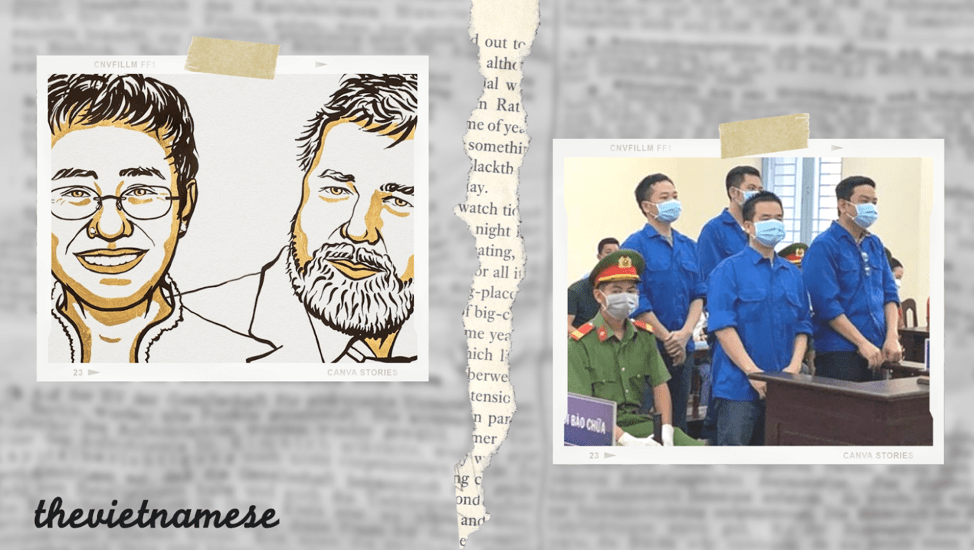
    This year as the world triumphs the importance of free speech with the award of the Nobel Peace Prize to two journalists, Maria Ressa and Dmitry Muratov, for their “efforts to safeguard freedom of expression,” Vietnam has taken a step backward in its respect for press freedom by arresting and imprisoning independent journalists.

    On October 26, the local Court of Can Tho City began to try five members of the Bao Sach (Clean Newspaper) group, a Facebook-based journalism project, for allegedly “abusing the rights to freedom and democracy” that the government deemed “threatening” to state interests and security. Two days later, on October 28, five members of Bao Sach were sentenced to a total of 14 years and six months in prison.

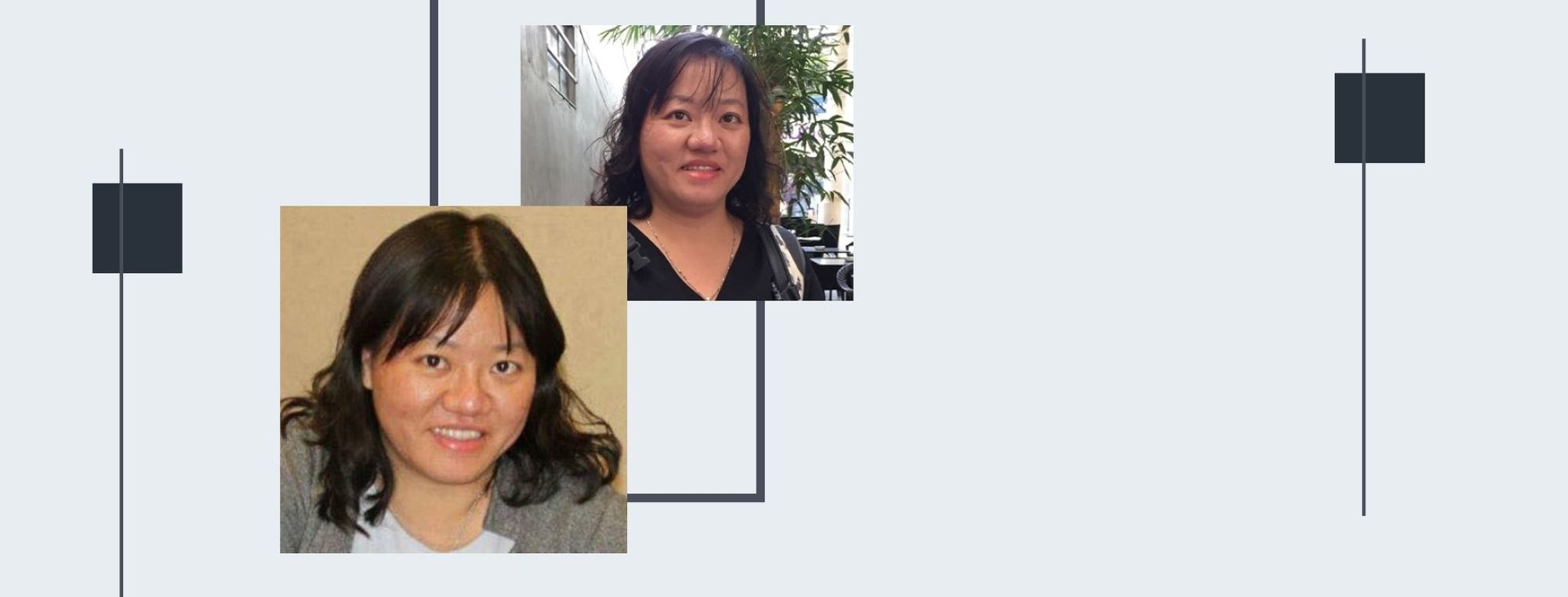
    Meanwhile, the Court of Hanoi City is also expected to try prominent journalist Pham Doan Trang for “propagandizing against the Socialist Republic of Vietnam;” the evidence used to prosecute Doan Trang includes her written reports and assessment regarding environmental issues, the human rights situation, and religious freedom in Vietnam.

    In some ways, when we congratulate the two journalists who were awarded the prestigious Nobel Peace Prize in 2021, Maria Ressa of the Philippines and Dmitry Muratov of Russia, we also feel saddened to think about the Bao Sach members and Pham Doan Trang. These Vietnamese journalists have been facing never-ending hurdles reporting the truth under the repressive hands of authoritarian leaders.

    Vision for a better journalistic environment in Vietnam

    Established in 2019, Bao Sach started off as a Facebook-based project which investigated and reported on the alleged corruption and misconduct of Vietnamese government officials and state-owned companies. Corruption and mismanagement are ubiquitous in Vietnam’s governance system. The project quickly attracted a substantial number of followers in its fan page on Facebook, as the role of the social network in Vietnam is similar to its neighbor, the Philippines, where it is essentially viewed as the Internet.[1]

    The journalistic group’s name, Clean Newspaper, refers to its commitment to journalism ethics by truth and impartiality rather than becoming another mouthpiece of the Communist government. Bao Sach gained popularity through its fact-based and accurate reporting that helped expose and provide insights into the many social issues to which the Vietnamese public pay attention, most notably the case of Ho Duy Hai, who was given the death penalty in an unfair trial.

    However, being a vocal critic in a tightly controlled media environment comes with a cost. Not much different from what Rappler Founder Maria Ressa [2] faced as a journalist in the Philippines, independent journalists, and human rights activists in Vietnam also live in constant fear of harassment by government-funded online trolls and arbitrary arrests and charges under vague laws, which have no purpose other than to curb freedom of expression.
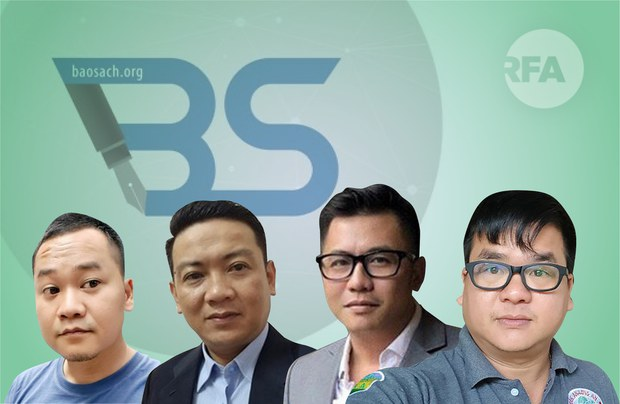
    Bao Sach’s (Clean Newspaper) members. Photo: RFA.

    Late last year, Truong Chau Huu Danh, one of the co-founders of Bao Sach, was arrested by the police, which marked the end of one of the promising independent media projects in Vietnam. Bao Sach’s Facebook page was shortly suspended after Danh’s apprehension; three members were arrested earlier in April this year.

    Subsequently, they were charged with “abusing the rights to freedom and democracy to infringe on state interests” under Article 331 of Vietnam’s 2015 Penal Code, which has been strongly criticized [3] by the international community and legal authorities for its vagueness and lack of clear definitions of the actual conduct.

    Similarly, Doan Trang’s vision [4] of a journalism project to provide Vietnamese people with an understanding of law, politics, and human rights also led to her arrest and detention. She was charged with “propagandizing against the State,” another criminal charge commonly used by the Vietnamese government to suppress dissenting opinions in the country.

    The Vietnamese government’s intolerance to press freedom

    Nevertheless, the Bao Sach members and Doan Trang are among dozens of independent reporters, journalists, and broadcasters constantly harassed or detained by the Communist authorities. Critical reporting of online bloggers and live-streamers also meets with increasing censorship as Facebook, Vietnam’s most popular social media site has in recent years reportedly complied with the government to remove “anti-state” posts. According to local activists and free-speech advocates, [5] the tech giant’s compliance is giving the Vietnamese authorities “near-total control over the platform.”

    Despite the Vietnamese Communist Party trying to boast and propagandize [6] about its state of press freedom and its respect for human rights, Vietnam scores poorly on almost every international ranking regarding press freedom and fundamental civil rights.

    Vietnam ranks [7] at 175th out of 180 countries on the 2021 World Press Freedom Index from Reporters Without Borders in terms of free press. It is also among those countries with the highest number of detained journalists, according to figures [8] compiled by the Committee to Protect Journalists (CPJ) in 2020.
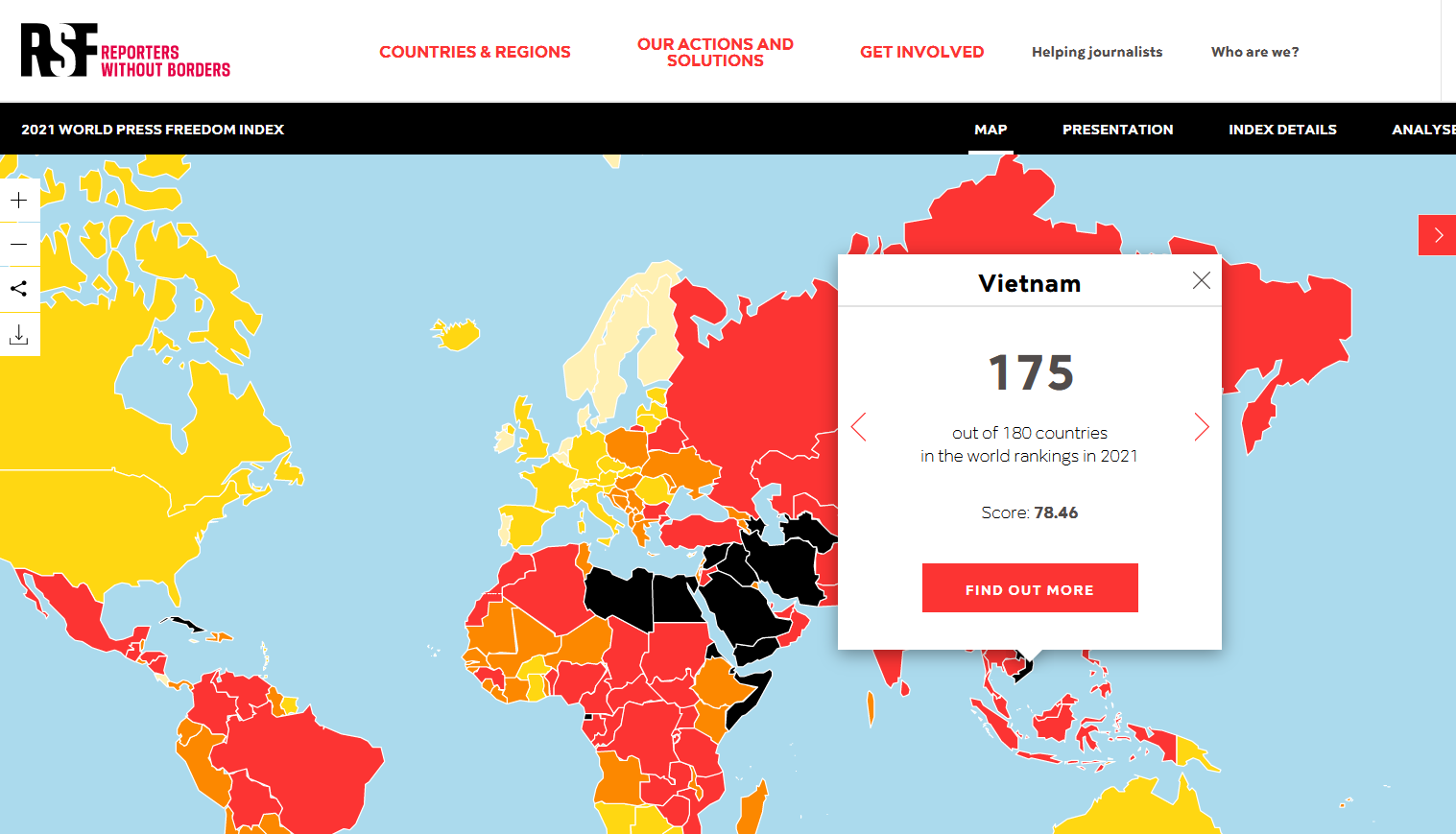
    Vietnam ranks 175th out of 180 countries in terms of press freedom. Photo: screenshot/ Reporters Without Borders.

    On civil rights, Freedom House, a non-partisan organization working to promote freedom and democracy, declared that Vietnam was “not free” when it comes to internet freedom. The Vietnamese government later criticized the results, allegedly requesting Freedom House to “stop making groundless assessments” [9] on the situation of internet freedom in the country. However, the government failed to provide concrete evidence to explain its alleged repression of internet users’ rights, other than a few fragmented pieces of information bragging about the country’s growth in internet users and its Human Development Index.

    The journey to a truly free, progressive, and independent media environment in Vietnam is still long and arduous, given the arbitrary arrests of independent journalists in recent years and an increasingly restricted social media space. However, if Prime Minister Pham Minh Chinh wants to realize his pledge [10] to “listen to dissenting opinions [and] debates,” then Vietnam must respect freedom of the press and allow journalists to express their viewpoints freely. It would also contribute to the long-term development of both Vietnam as a country and its journalistic environment.

    References:

    1. Vick, K. (2021, October 8). “It Is a Battle for Facts.” What Nobel Peace Prize Winner Maria Ressa Understands About Why She Was Chosen. Time. https://time.com/6105407/maria-ressa-nobel-prize-interview/
    2. Andrew Yeo, Enrico Gloria. (2021, October 21). In a first, the Nobel Peace Prize went to a Filipina. Her government isn’t happy. The Washington Post. https://www.washingtonpost.com/politics/2021/10/21/first-nobel-peace-prize-went-filipina-her-government-isnt-happy/
    3. The Vietnamese Magazine. (2021, October 26). Statement On The Upcoming Trial Of Bao Sach (Clean Newspaper). The Vietnamese Magazine. https://www.thevietnamese.org/2021/10/statement-on-the-upcoming-trial-of-bao-sach-clean-newspaper/
    4. Tran Phuong, Will Nguyen. (2021, February 14). Who Is Pham Doan Trang? The Vietnamese Magazine. https://www.thevietnamese.org/2021/02/who-is-pham-doan-trang/
    5. Elizabeth Dwoskin, Tory Newmyer, Shibani Mahtani. (2021, October 25). The case against Mark Zuckerberg: Insiders say Facebook’s CEO chose growth over safety. The Washington Post. https://www.washingtonpost.com/technology/2021/10/25/mark-zuckerberg-facebook-whistleblower/
    6. Đối diện: Nhân quyền. (2021, October 27). VTV. https://vtv.vn/video/doi-dien-nhan-quyen-527961.htm
    7. Vietnam – Reporters Without Borders. (n.d.). Reporters Without Borders. Retrieved October 28, 2021, from https://rsf.org/en/vietnam
    8. Record number of journalists jailed worldwide. (2020, December 15). Committee to Protect Journalists. https://cpj.org/reports/2020/12/record-number-journalists-jailed-imprisoned/
    9. VNA, (2021, September 29). Freedom House should stop making groundless assessments on internet freedom in Vietnam. VietnamPlus. https://en.vietnamplus.vn/freedom-house-should-stop-making-groundless-assessments-on-internet-freedom-in-vietnam/208842.vnp
    10. Tuan, V. (2021, April 15). Thủ tướng Phạm Minh Chính: “Chính phủ phải lắng nghe ý kiến phản biện.” VnExpress. https://vnexpress.net/thu-tuong-pham-minh-chinh-chinh-phu-phai-lang-nghe-y-kien-phan-bien-4263570.html
  • Biden’s Emphasis On Soft Power And What It Means For Vietnam’s Democracy Movement

    Biden’s Emphasis On Soft Power And What It Means For Vietnam’s Democracy Movement

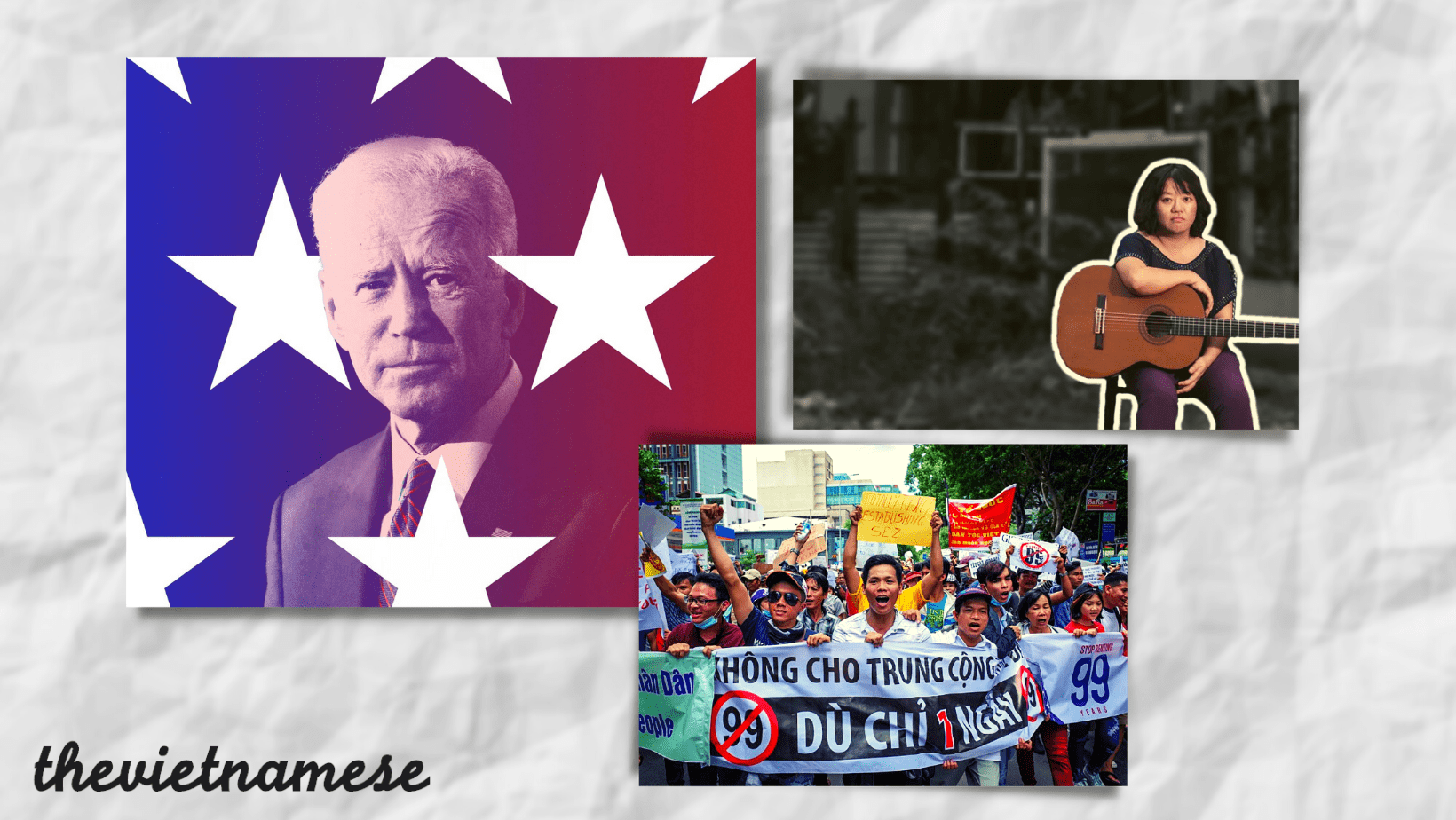
    President Joe Biden has repeatedly emphasised “soft power” in his foreign policy speeches. Will this policy work in Vietnam? And how will it affect Vietnam’s democracy movement?

    Biden’s emphasis on soft power: what’s in store for Vietnam and should one believe it?

    It’s almost a year into Joe Biden’s presidency. Throughout his tenure, two keywords, “relentless diplomacy” and “soft power,” have echoed in every corner where US foreign policy is concerned: from the ending of the “forever war” in Afghanistan to the reorganisation of trans-Atlantic relations, and to engagement with Asia. The challenges for which President Biden will implement his “relentless diplomacy” and “soft power” approach are, in short, the covid pandemic, climate change, and China[1].

    Vietnamese readers can be assured of Biden’s serious interest in Asia by, amongst others, the appointment of a competent expert Kurt Campbell [2] as the White House coordinator for the Indo-Pacific region, US support for Taiwan and its alliance with Japan, vaccine donations, and, most recently, Vice President Kamala Harris’ visit to the region and Vietnam specifically.

    Regarding China, Biden’s promise [3] of “fighting corruption, defending against authoritarianism, and advancing human rights” will be arguably the most effective tool for the United States in the realm of soft power. Economic and military strength notwithstanding, the Chinese regime is infamous for its authoritarian governance and long record of human rights violations. Ironically, China’s military strength, as observed in its actions in the South China Sea, makes its draconian image even more despicable.

    By contrast, the era of Pax Americana, despite criticisms of US imperialism, has built an overall image of the United States as a promoter of human rights and democracy. Although the recent Afghanistan debacle has damaged the reputation of the United States, Biden has been quick to assert [4] that the new era of US foreign policy will be about “lifting people up around the world” and “renewing and defending democracy”.

    Speaking of Pax Americana, Biden’s emphasis on “soft power” and “relentless diplomacy” happens in a context different than that of American leaders of the past who boasted about a US “moral imperative” and “doing the right thing” only to turn a cold shoulder to their allies when the tide of geopolitics turned. In the post-Americana era, despite Biden’s denial/rejection [5] of the imminent “China-US Cold War”,  it is widely recognised (as indicated by the US “pivot to Asia”[6]) that US national interests depend on whether or not the United States can counter China’s plays in Asia. As such, one can expect Biden’s words to have substance rather than just simply paying lip service.

    Biden’s “soft power” in Vietnam: the state-versus-people conundrum

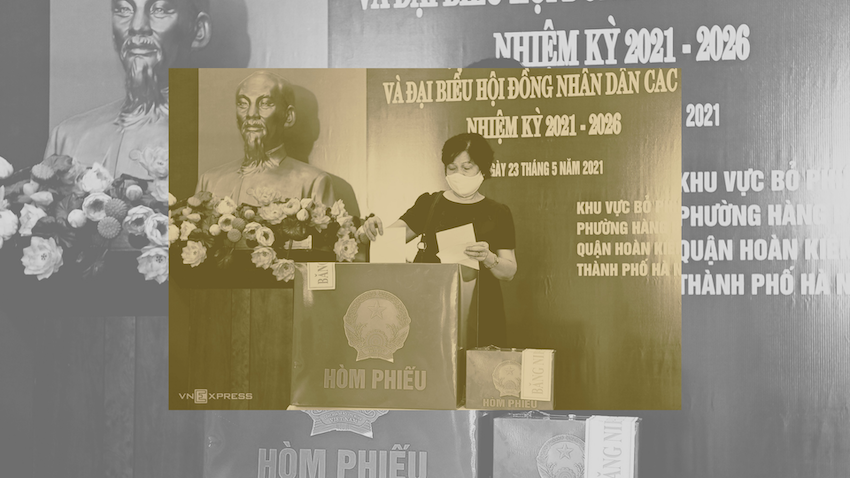
    When it comes to China and human rights, there is a clear distinction between the perspectives of the Vietnamese state and the Vietnamese people. At the most basic level, Vietnamese leaders have little to no concern for the interests of their people because their positions are not determined by voters. Vietnam’s election is well known for being a farce [7].

    The divergence between the Vietnamese public and the Vietnamese government on China could not be clearer. When the government approved a bauxite project related to China in 2009, the Vietnamese people signed a petition to oppose it. When the people took to the streets in the early years of the 2010s to oppose China’s territorial claims in the South China Sea, the government cracked down on these protests and detained several protesters. When the Special Economic Zone bill was announced, it was perceived by the Vietnamese public as giving questionable privileges to China and also was seen as a threat to Vietnam’s national security. As a result, massive protests broke out in the streets in 2018 and the bill was shelved as a result.

    Most recently, the use of China’s COVID vaccines in Vietnam has been met with public resistance and fierce criticism of the government. Anti-China protesters’ shouts of, “Coward to the enemy, cruel to the people!” (“Hèn với giặc, ác với dân!”), is precisely the Vietnamese people’s attitude towards their government on China.

    At this point, one may argue: “But the Vietnamese government has also spoken up against China many times, so it cannot be as pro-China as the above-mentioned events indicate.” This is true and quite a few analyses [8] have highlighted the stake for the Vietnamese government in playing US-China politics wisely instead of simply bowing to China. However, it is important to understand that when Vietnamese leaders do stand up to China, it is often “all bark and no bite.”[9] More importantly, whether Vietnamese leaders shake hands with Biden or with Xi, or play the superpowers off against each other, they do so first and foremost based on their, or the Communist Party’s, own interest [10], rather than on the interests of the country and the people.

    Thus, it is highly unlikely that the United States will find a true ally in the Vietnamese government in its state-to-state diplomacy against China. Because of this, the US will also find it difficult to tap into the Vietnamese public’s anti-China sentiment. Hanoi has shown little to no concern about how Vietnamese citizens feel or about what they want, and it has unreservedly deployed force to quell anti-China protests and online dissent in the past.

    The road to promoting human rights in Vietnam does not seem promising either, especially the rights to free speech, peaceful assembly, association, and fair trial. The promise of US leaders to “respect Vietnam’s political system” [11] seems rather odd because the very existence and stability of Vietnam’s political system rest on the suppression of exactly those rights. The relentless arrests of people who speak critically of the government on their Facebook pages and of those who ran as independent candidates in the lead-up to the May 2021 national election are just some examples.

    What has played out so far in the field of human rights does not show much innovation. State-to-state talks about the situation of human rights in the country, assistance for specific high-profile activists who have been arrested and who are on trial, and US leaders holding meetings with local activists are all par for the course. It remains to be seen if Biden’s administration will open a new chapter of human rights promotion through public diplomacy or if it will lead to more of the same: the worsening of human rights and democratic freedoms in Vietnam.

    Public diplomacy and soft power: a look into the books

    The term “public diplomacy” was first coined in 1965 by Edmund Gullion, founder of the Edward R. Murrow Center of Public Diplomacy at Tufts University (Cull, 2009) [12]. Definitions vary but all agree that public diplomacy is a foreign policy practice entailing nation A engaging with the public of nation B in order to influence B’s foreign policy through bottom-up pressure to A’s advantage (Bettie, 2014) [13]. In short, it is about image projection and national branding, which is distinctly different from traditional diplomacy which consists of state-to-state engagement.

    In the work of historian Nicholas J. Cull (2008) [14], activities that count as public diplomacy include (1) presenting new policy ideas to the foreign public (i.e., advocacy), (2) exportation of culture to foreign countries as well as two-way cultural exchanges, and (3) international broadcasting (i.e., reaching a foreign public through mass media).

    While public diplomacy can be understood as a channel of persuasion, soft power is the content that gives a nation the power to persuade the foreign public. Prominent soft power scholar, Joseph S. Nye Jr., defines soft power as the attractiveness of a nation that lies in its culture, including its language, arts, cuisine, institutions, brands, and moral values (Nye, 2008) [15]. Soft power goes hand-in-hand with public diplomacy, as “public diplomacy tries to attract by drawing attention to these potential resources through broadcasting, subsidizing cultural exports, arranging exchanges, and so forth” (Nye, 2008, p. 95) [16].

    Soft power may also be drawn from hard power. The presence of US military forces in the South China Sea to aid countries bullied by China communicates certain moral values to the people of those countries. However, underlying such a presence in the more complex and pragmatic interests of the United States than simply a normative or moral stance.

    Using the above discussion on public diplomacy and soft power, how would President Biden’s plans for Vietnam measure up? What would his roadmap navigating the state-versus-people conundrum in the country look like?

    Evaluating Biden’s diplomacy and navigating Vietnam’s state-versus-people conundrum

    Biden’s words promise a new era of US diplomacy, but his actions so far still seem to be following classic state-to-state diplomacy and militaristic intervention more than what is prescribed for public diplomacy and soft power.

    Furthermore, public diplomacy has always been a component in US foreign policy in previous administrations through supporting local registered civil society organisations and non-formal oppositional actors. Thus, with Biden’s emphasis on “soft power,” his administration will disappoint if over the next few years it rehashes many or most of the previous administrations’ actions; this old approach is effectively circumscribed by the state-versus-people conundrum mentioned earlier.

    However, the good news for the United States is that despite the disastrous presidency of Donald Trump and the many upheavals in US politics and society, public opinion [17] in Vietnam is still in favour of the United States, especially when compared to China. The soft power is already there.

    As Vietnamese people have grown increasingly more concerned about Hong Kong and Taiwan, their opinion will also be shaped by how the United States intervenes in the Taiwan – China situation. The collapse of Hong Kong has done serious damage to the image of the West, but it is still looking good on the Taiwan front. In addition, the story of Taiwan is not just about standing up to China; it is also about nation-building and the nationalistic pride of a people who chose democracy over dictatorship.

    In summary, US soft power in/over Vietnam will come from the stories of human rights, democracy of the US itself, and its defence of Taiwan against China. This soft power will come across even stronger if US public diplomacy also promotes Taiwan as the protagonist in the region, as a counter to Chinese politics, and as an inspiring story of Asian democratisation. These narratives will further widen the gap between Vietnamese hearts and minds and China, while simultaneously raising aspirations for democratisation amongst the Vietnamese people. In doing so, the United States will also not give a reason for the Vietnamese state-owned media to be hostile towards democratisation and the Vietnamese democracy movement. State propaganda cannot accuse America of imposing Western political ideas and values, nor of hypocrisy and one-upmanship if the US approaches the issue in this way.

    Having said earlier that the Vietnamese government has shown little to no concern about the Vietnamese people’s anti-China sentiments and that it uses brute force against human rights and democracy activists, what is the point of raising aspirations for democratisation and being critical of China? The point to be made is precisely about the kind of mass awareness and feeling of efficacy that will translate into the political agency and oppositional collective action. Old school public diplomacy has come short of this task and has failed to help the Vietnam democracy movement gain strength in numbers.

    My conversations with prominent activists in Vietnam’s human rights and democracy movement show that the seemingly invincible power of the Vietnamese government to repress dissent, the crackdown on protests, and carry on with unpopular policies, comes from the fact that the human rights and democracy movement is small in number and that the majority of the public lack the theoretical scaffolding to help them translate their discontent with the government and nationalistic sentiment into coherent and organised demand for democratisation.

    This article, written from my perspective as a Vietnamese, a scholar, and a supporter of collective action towards democracy for Vietnam, has suggested a few ways for American diplomats and foreign policy experts to walk President Biden’s talk.

    Meanwhile, Luat Khoa Tap Chi, a well-respected independent news outlet that serves Vietnamese readers, has already beefed up its column on Taiwan as an inspiring example of democracy for the Vietnamese. The comrades of Luat Khoa are also planning their next step, with Taiwan and mass awareness at the core of their strategy. The Biden administration, with the aim of utilizing soft power, should not miss this opportunity to work with them.

    Bibliography:

    1. Ash, T., G. (2020, 7 Nov). What will President Biden’s United States look like to the rest of the world? The Guardian.
    2. Green, M., J. (2021, 13 Jan). Biden makes his first bold move on Asia. The Guardian.
    3. Tran, B., T. (2021, 3 Jun). No Trade-off: Biden can both Deepen US-Vietnam Ties and Promote Human Rights. United States: Center for Strategic and International Studies.
    4. Borger, J. (2021, 21 Sep). Biden promises end to ‘relentless war’ and start of ‘relentless diplomacy’. The Guardian.
    5. ibid.
    6. ibid.
    7. Vu, A. & Gerin, R. (2021, 21 May). Vietnam goes to the polls with state-approved candidates offering little choice. Radio Free Asia.
    8. Nguyen, T., T., Q. (2021, 30 Sep). Trans-Pacific partner membership and the love triangle of Vietnam – Taiwan – China. The Vietnamese.
    9. Reed, A. (2021, 14 Mar). The enemy of my enemy: tensions between the US, China, and Vietnam. The Vietnamese.
    10. ibid.
    11. Tran, B., T. (2021, 3 Jun). No Trade-off: Biden can both Deepen US-Vietnam Ties and Promote Human Rights. United States: Center for Strategic and International Studies.
    12. Cull, N. (2009). Public Diplomacy Before Gullion: the Evolution of a Phrase. In: Snow, N. and Taylor, P. (eds). Routledge Handbook of Public Diplomacy (pp. 19-23). Tayler & Francis.
    13. Bettie, M., L. (2014). The Fulbright program and American public diplomacy (unpublished doctoral thesis). The University of Leeds, Leeds, United Kingdom.
    14. Cull, N. (2008). The Cold War and the United States Information Agency. Cambridge:Cambridge University Press.
    15. Nye, J. (2008). Public diplomacy and soft power. The Annals of the American Academy of Political and Social Science, 616, pp. 94-109.
    16. ibid.
    17. Seah, S. et al., (2021). The state of Southeast Asia: 2021. Singapore: ISEAS Yusof Ishak Institute.
  • Pham Doan Trang Is A Journalist, Her Profession Is Not A Crime

    Pham Doan Trang Is A Journalist, Her Profession Is Not A Crime

    As I am writing this beginning line, my mind is flooded with memories of Pham Doan Trang. I also realize that it has been almost seven years since I said goodbye to her before she left the United States to return to Vietnam. We had become friends and spent seven months together in the United States, and I have not seen her since December 2014. I also have not been able to contact her or speak with her on the phone since October 6, 2020. Vietnamese police arrested her near midnight that day in Saigon. My last text message to her was “Trang, answer me,” which I sent the night she was detained.

    Doan Trang can be classified as many things, depending on the person you speak with. She is a journalist, an activist, a teacher, a political person who opposes the Vietnamese Communist Party, a prominent figure of the democracy movement in Vietnam, and more. Yet, for me, Doan Trang is a friend, a very close friend, and that’s it. My only hope is to help set my friend free because she has not done anything wrong. She deserves to be free so that she can continue to write.

    And yet, sadly, her writing is precisely the reason that has put her in prison in Vietnam.

    In Vietnam, writing or producing verbal speech (YouTube, TikTok, etc.) can be a severe crime when you refuse to obey the government’s censorship system or self-censor on your own. If you look at the details of any political case in Vietnam, I guarantee that you will only find the alleged wrongdoings to be the uncensored writings and speeches produced by these defendants. It does not matter how the Vietnam government classifies their crimes as “abusing democratic rights” or “propagandizing against the state,” their crimes are always their writing and speech.

    For Doan Trang, I can also think of another aspect in which she has irritated the Vietnamese authorities even more. She was not just a journalist; she was also trying to encourage more people to write and be more aware of politics in Vietnam. I was one of the people she inspired to take writing as a profession and focus more on Vietnam’s human rights and political affairs.

    In my writing career, I have two people to be grateful for: my two co-founders of Legal Initiatives for Vietnam (LIV), Trinh Huu Long and Pham Doan Trang. If I had not met them in life, I don’t think I would have been confident enough to write in either Vietnamese or English, especially as a journalist.

    I left Vietnam and came to the United States when I was 12-years-old. I was not too young to think of myself as a native speaker in English, but I was not too old to be confident in my ability to write in Vietnamese either. However, after meeting Trinh Huu Long and Pham Doan Trang in 2014, they changed my life as I believed in their cause and decided to co-found LIV. Starting from that point, I began to promote human rights, democracy, and the rule of law in Vietnam through journalism. Trinh Huu Long may be the first teacher in journalism for me, but Doan Trang is the inspiration for my decision to change my career from law to journalism.

    Many people have asked me why I decided to quit my legal profession and started working for a non-profit organization that focuses on Vietnam. Maybe this career change was not advantageous for them and could be stepping down in life. But Doan Trang’s last words before she left the United States stuck with me throughout these years: “Every country needs a generation of young people who will sacrifice their lives to build a better society for others. If our generation refuses to take up this job for Vietnam, then who else will? Do we wait for the next generation to sacrifice for our country and choose an easier life now?”

    Doan Trang chose to take up this task to promote human rights in Vietnam, and she left America to go back to Vietnam, knowing that she would be imprisoned in the future. Then, for me, the decision of giving up my life as a litigation lawyer to write about human rights and political issues in Vietnam seemed to be a much easier job when I compared myself with Doan Trang.

    She’s inspired me, and we both have the same goal: to put Vietnam on the map for international audiences and encourage more Vietnamese people to care about human rights and democracy. To write about these issues should not be a crime in any nation because we only want to educate the public. What did we do so wrong that my friend Pham Doan Trang has spent one year incommunicado in Vietnam?

    The Vietnamese government cannot explain away Pham Doan Trang’s case or any political cases that have sent hundreds of dissidents to decades in jail. However, I hope the international community and foreign governments can speak up louder and be more explicit against this injustice.

    Journalism is not a crime; writing about politics and human rights is not a crime. Vietnam continues to suppress the free press and the freedom of speech much harder now, which is not an action the international community should condone. Please speak up for those imprisoned by the Vietnam government, such as Pham Doan Trang, because we are on the right side of history.

  • Journey To The West: Vietnamese Top Leaders’ Recent Vaccine Diplomacy

    Journey To The West: Vietnamese Top Leaders’ Recent Vaccine Diplomacy

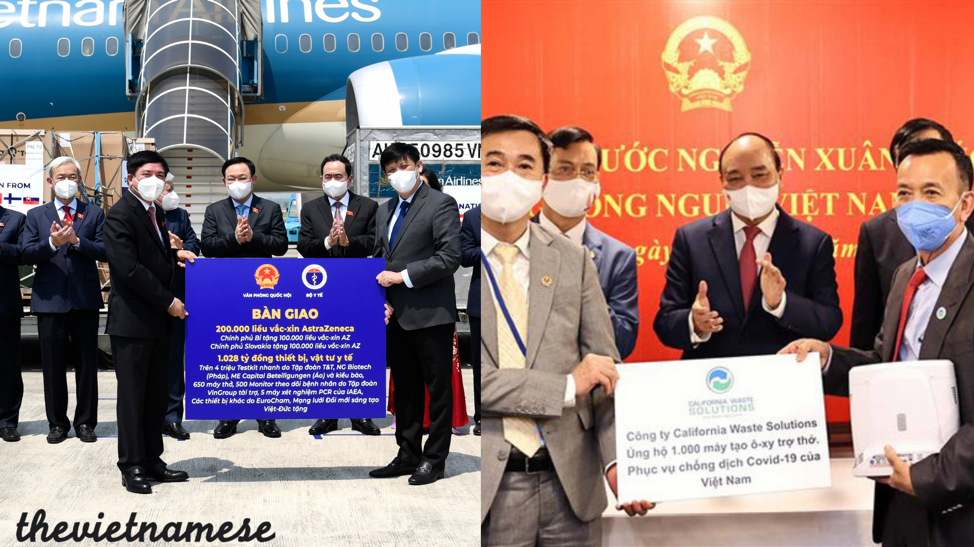
    In the past month, newly-elected Vietnamese leaders have been seen “touring” Western countries, from Europe to the Americas. From the chairman of the National Assembly Vuong Dinh Hue, who went to Europe, to President Nguyen Xuan Phuc, who went to the United States and Cuba, both are parts of the “four pillars” (tứ trụ) leaders – those at the very top of the Vietnamese political system.

    Not only are they two of the most important leaders of Vietnam; they are also newly-elected: although they have re-sworn their terms in the office about three months ago in July, they have held power since April of this year. But that is a different topic for another day.

    In other words, these trips are important. National leaders who were just elected do not just go to other countries on official trips for no reason at all. Whatever they were doing in Western countries, it must have been calculated to yield significant political impact on their new term in office.

    But what exactly were they doing, or hoping to achieve from these trips?

    Despite what the Vietnamese state media is telling you about “comprehensively promoting economic and international cooperation,” the most important reason is very simple: getting more COVID vaccines for Vietnam. Is it to genuinely help the people back home to access vaccines or rather it is to save face after the government’s poor handling of the crisis in recent months?

    Vuong Dinh Hue in Europe

    On the occasion of the fifth session of the World Conference of Speakers of Parliament in Austria and the ongoing European Union – Vietnam Free Trade Agreement (EVFTA), Chairman Hue’s six-day trip to Europe in early September seems to serve multiple purposes as he mainly visited Austria, Belgium, and Finland.

    However, upon the conclusion of the trip, the most important highlights according to Vietnam’s state-controlled media were all COVID-related. In an article published by Vietnamnet about Hue’s achievements during the trip, it was all about him successfully bringing back foreign-donated COVID vaccines or equipment, with the exception of buying 50 million COVID vaccine doses HIPRA from Spain (this vaccine is still in trial, so the doses are not being delivered immediately to Vietnam). In an interview with a high-ranking diplomat accompanying Hue on the trip, more than half of Vietnam Plus’ article is about Hue asking the EU to send more vaccines to Vietnam. VTV coverage of his trip reflects similar patterns.

    Nguyen Xuan Phuc in the Americas

    While Vuong Dinh Hue might have had more reasons to go to Europe than Nguyen Xuan Phuc, the COVID vaccine agenda in Phuc’s trip to the Americas – the United States and Cuba – is significantly more obvious. According to the deputy minister of foreign affairs Dang Hoang Giang, President Phuc’s main objective in the United States was to give a speech in the United Nations General Assembly and to meet with pharmaceutical companies to talk about vaccine supplies. Additionally, Phuc’s trip to Cuba also coincided with Vietnam’s very recent approval of Cuba’s Abdala vaccine.

    Questions arise about Vietnam’s plan to battle COVID

    COVID vaccines being the priority of the two leaders’ foreign trips makes even more sense as we take into account the role of Prime Minister Pham Minh Chinh, another of the four pillars, who at the moment holds direct decision-making power over domestic COVID policy.

    As we know that the COVID pandemic is shaping the “four pillars” priorities during their new terms, I believe that there are two questions that arise.

    First, why did the Vietnamese government have to wait so long to actually conduct vaccine negotiations abroad?

    Vaccine diplomacy is good for a rising middle power like Vietnam, and the country had an advantage last year as it had an extremely low infection and mortality rates. While the mentioned leaders did not hold de-facto power until April 2021, they seemingly inherited little concrete plans from their predecessors about obtaining the vaccines or conducting early vaccine diplomacy. This is why the government’s abrupt fundraising plan for a “COVID vaccine fund” in June seems to reflect a lack of preparation at least and systematic governmental incompetence at most.

    This lack of preparedness eventually resulted in the newly-elected leaders literally begging for vaccines in foreign countries after Vietnam suffered from months of restrictions with the number of total cases approaching 1 million. Though the vaccination rates in Vietnam are getting better, and more vaccine supplies are always better for the people, it is definitely not a good look for these leaders and the government itself, despite what the state-controlled media tries to tell us.

    Second, I believe that we should also ask the question: What is Nguyen Phu Trong, the remaining member of the “four pillars” elite club, and arguably the most powerful, contributing to the government’s COVID plans?

    He is the oldest and longest-serving of the “four pillars” leaders. He also held the Communist Party’s secretary-general position over the past decade. While Chinh is tasked with the heavy-lifting duty of curbing domestic infections and Hue and Phuc are busy abroad, Nguyen Phu Trong seems to remain hidden behind the curtain. His most recent public appearances include an official meeting with leaders from Laos and Cambodia and speeches about corruption.

    While this makes sense because, in theory, the leader of the Communist Party cannot interfere in the executive function of the government, we must ask ourselves if this is really the case, and whether secretary-general Trong is dodging responsibility for the most serious national and legitimacy crisis that the Communist Party and the Vietnamese government have faced in recent years.

    Citations

    Ban Thời Sự. (2021, September 12). Chuyến thăm châu Âu của Chủ tịch Quốc hội – Sự khẳng định về “một Quốc hội hành động, một Việt Nam chủ động, nỗ lực.”Báo Điện Tử VTV. https://vtv.vn/chinh-tri/chuyen-tham-chau-au-cua-chu-tich-quoc-hoi-su-khang-dinh-ve-mot-quoc-hoi-hanh-dong-mot-viet-nam-chu-dong-no-luc-20210912192101944.htm

    Bhatia, G., Dutta, P. K., & McClure, J. (2021, October 3). Vietnam: the latest coronavirus counts, charts and maps. Reuters. https://graphics.reuters.com/world-coronavirus-tracker-and-maps/countries-and-territories/vietnam/

    Hoang T. H. (2021, September 13). Kết quả quan trọng chuyến thăm các nước châu Âu của Chủ tịch Quốc hội. VietnamPlus. https://www.vietnamplus.vn/ket-qua-quan-trong-chuyen-tham-cac-nuoc-chau-au-cua-chu-tich-quoc-hoi/740268.vnp

    M.H. (2021a, September 10). Chuyến thăm châu Âu của Chủ tịch Quốc hội Vương Đình Huệ thể hiện chính sách đa dạng và độc lập của Việt Nam. Thông Tấn Xã Việt Nam. https://baotintuc.vn/thoi-su/chuyen-tham-chau-au-cua-chu-tich-quoc-hoi-vuong-dinh-hue-the-hien-chinh-sach-da-dang-va-doc-lap-cua-viet-nam-20210910194112584.htm

    Ministry of Health Online Portal. (2021, September 25). Thủ tướng chủ trì cuộc họp Ban Chỉ đạo Quốc gia phòng, chống dịch COVID-19. Ministry of Health. https://moh.gov.vn/tin-noi-bat/-/asset_publisher/3Yst7YhbkA5j/content/thu-tuong-chu-tri-cuoc-hop-ban-chi-ao-quoc-gia-phong-chong-dich-covid-19

    N.D. (2021b, September 16). Chủ tịch nước Nguyễn Xuân Phúc sẽ gặp doanh nghiệp sản xuất vắc xin của Mỹ. Tuổi Trẻ Online. https://tuoitre.vn/chu-tich-nuoc-nguyen-xuan-phuc-se-gap-doanh-nghiep-san-xuat-vac-xin-cua-my-20210916123224642.htm

    Nguyen, D. (2021, June 30). Vietnam’s Unprecedented COVID-19 Challenge Compounded By A Deficit Of Trust In The Government. The Vietnamese Magazine. https://www.thevietnamese.org/2021/06/vietnams-unprecedented-covid-19-challenge-compounded-by-a-deficit-of-trust-in-the-government/

    Reuters. (2021, September 18). Vietnam approves Abdala vaccine as president visits Cuba. https://www.reuters.com/world/asia-pacific/vietnam-approves-cubas-abdala-vaccine-use-against-covid-19-2021-09-18/

    T.H. (2021c, September 22). Ban Chỉ đạo được kiến nghị Bộ Chính trị xử lý cán bộ, đảng viên tham nhũng, tiêu cực. Vietnamnet. https://vietnamnet.vn/vn/thoi-su/chong-tham-nhung/ban-chi-dao-duoc-kien-nghi-bo-chinh-tri-xu-ly-can-bo-dang-vien-tham-nhung-tieu-cuc-777124.html

    T.H., & P.H. (2021d, September 12). 70 hoạt động dày đặc tại 3 nước Châu Âu của Chủ tịch Quốc hội Vương Đình Huệ. Vietnamnet. https://vietnamnet.vn/vn/thoi-su/quoc-hoi/70-hoat-dong-day-dac-tai-3-nuoc-chau-au-cua-chu-tich-quoc-hoi-vuong-dinh-hue-774198.html

    The Vietnamese Magazine. (2021, July 26). Vietnam Briefing: COVID-19 Crisis Deepening While The National Assembly Convened To Elect State Leadership. https://www.thevietnamese.org/2021/07/vietnam-briefing-covid-19-crisis-deepening-while-the-national-assembly-convened-to-elect-state-leadership/

    Thông Tấn Xã Việt Nam. (2021, September 26). Cuộc gặp cấp cao Việt Nam – Campuchia – Lào. Vietnamnet. https://vietnamnet.vn/vn/thoi-su/chinh-tri/cuoc-gap-cap-cao-viet-nam-campuchia-lao-778199.html

  • Trans-Pacific Partner Membership And The Love Triangle Of Vietnam – Taiwan – China

    Trans-Pacific Partner Membership And The Love Triangle Of Vietnam – Taiwan – China

    A discussion with some students in my Theory on State and Law class back in 2020 led me to a surprising revelation: over 50 percent of them have visited Taiwan. They could remember and name their favourite tourist attractions, either Sun Moon Lake near Taichung, the “Spirited Away” Jiufen to the country’s northwest, or the vibrant streets of Ximending in Taipei. For them, Taiwan seemed to be a lively place – an exemplar of modernity, politeness, and peacefulness.

    Not only that, many of them had paid a visit to the Chiang Kai-Shek Memorial Hall and took pictures with his infamous Lincoln-like statue. Most unexpectedly, they knew that Taiwan was not China, or at least Mainland China. One student mentioned that her Chinese visa was useless for visiting Taiwan, and she suggested that the Taiwanese visa application process was more straightforward. And Chiang Kai-Shek, as they described, could be someone akin to their “Uncle Ho” in Vietnam.

    For a country where the youth hardly know the Vietnamese heads of state – the president, the prime minister, or the general secretary – their knowledge of Taiwan was astonishing.

    ***

    I have come to realize that the depiction of Taiwan in Vietnam has changed dramatically over the past 20 years.

    During the 90s, Taiwan was infamously known in Vietnam for the poor and old Taiwanese farmers who could not get married in their hometowns, wandering the most disenfranchised areas of Vietnam’s rural areas to look for brides.

    Nowadays, Taiwan is considered a cultural, economic, and intellectual hub of the region – a place worth living in, especially in the eyes of Vietnamese youth. What has caused this distinct shift in perspective? Perhaps it is the billions of US dollars worth of investments pouring into Vietnam from Taiwan since the 1990s.

    Dubbed by Professor Samuel C. Y. Ku as the “Southward Policy” of Taiwan, at the beginning of 1993, Taiwanese presidents started to privately visit and form business ties with Southeast Asian countries that had no formal diplomatic relations with the Republic of China (ROC) before.

    The objectives on the surface were clear: (1) expanding two-way economic, trade, and investment relations with these countries; and (2) expanding the production size of Taiwanese enterprises, while at the same time reducing the trade and human resource dependence on mainland China.

    More importantly, Taiwanese leadership hoped that such a close connection between economies would strengthen substantive relations between governments, allowing them to participate in other international and regional commercial and political activities.

    In Vietnam, Taiwan succeeded in certain aspects. Taiwan has a decisive say in the contemporary economic stability of Vietnam. Taiwanese enterprises ownroughly 2,500 projects, and they have invested over US$30 billion in the country. Bilateral trade between Vietnam and Taiwan has just exceeded US$16 billion, and most of Vietnam’s exported labor is directed towards Taiwan. Any political instability or economic issues that are not in favor of this arrangement will impact Vietnam’s performance.

    On the other hand, China continues to be seen as a taboo in Vietnamese cultural and intellectual discussions. The recent promotion of the Chinese propaganda military drama named Ace Troops (Chinese: 王牌部队; Vietnamese: Vương bài) has again sparked debates and serious boycotts in Vietnam. Focusing on stories about the establishment and the development of the Chinese People’s Liberation Army, Ace Troops glorifies the Sino-Vietnam War of 1979 and the continuous border/maritime skirmishes during the 80s. By praising the conflicts that led to hundreds of thousands of Vietnamese casualties as heroic and patriotic wars, it can be seen why this drama infuriates China’s southern neighbour.

    Even though Taiwan has the same claims as to the People’s Republic of China regarding the South China Sea, it appears to be a much milder, friendlier, and negotiable partner to the Vietnamese public.

    ***

    One week after China expressed its desire to be a part of the Comprehensive and Progressive Agreement for Trans-Pacific Partnership (CPTPP), Taiwan also formally applied for a seat in this organisation.

    Taiwan has reasons to hasten its membership in this organization. If it fails to secure a seat in time, it would have to go through the consultation process with all the signatories, which would, at this point, include China, and then protect its interests before a CPTPP Council where Beijing would already hold a seat.

    Taiwan had experienced this kind of stubbornness and tantrum-throwing behaviour of China when it dealt with the WTO. During the 2000s, Beijing had repeatedly refused to attend any dispute resolution proceedings between themselves and Taiwan, justifying this on the grounds that these issues were solely the internal affairs of China.

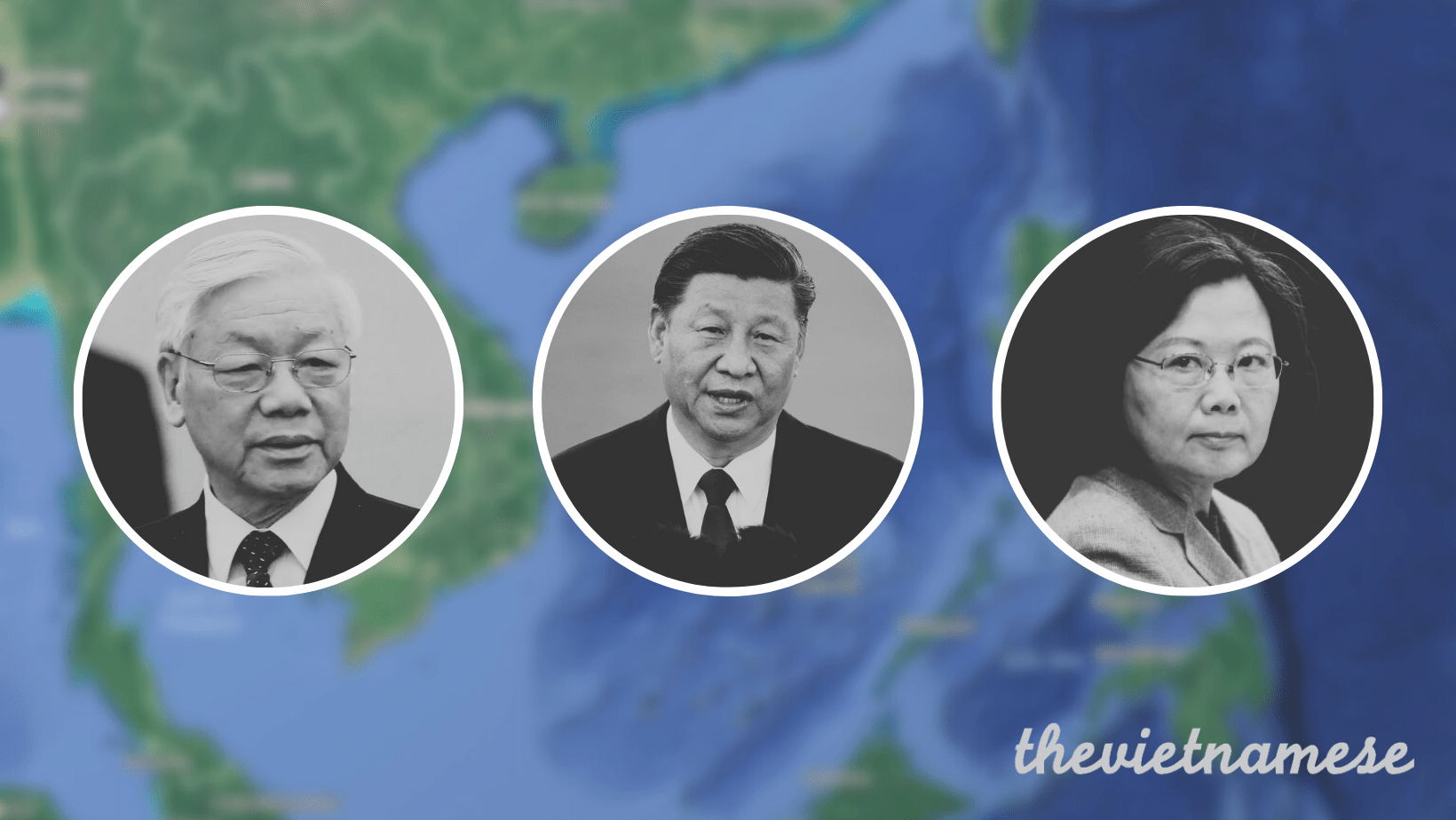
    A couple of days after China’s and Taiwan’s announcements on the CPTPP, President Xi Jinping had a phone call with General Secretary Nguyen Phu Trong. This action raised some questions on whether Vietnam would act as an agent of China inside the CPTPP to prevent the accession effort of Taiwan.

    If it has to, the Vietnamese government is very unlikely to side with Taiwan; no country has ever dared to, including the United States.

    But upon understanding the socioeconomic situation between Vietnam, Taiwan, and China, it is also reasonable to argue that Vietnam gains nothing by explicitly objecting to Taiwan’s membership in the CPTPP. The economic ties between Taiwan and Vietnam are too significant to be sacrificed.

    Moreover, such an effort requires fierce political commitment and diplomatic loyalty to mainland China, and Vietnam rarely exhibits this in the international arena. Recently, at the 48th session of the Human Rights Council, a declaration of 65 countries denounced the interference in China’s internal affairs by several actors under the pretext of human rights. Vietnam, however, did not participate. Vietnam’s action is a bit cold for two socialist neighbouring countries that claim to have a golden friendship.

    Yet, this action illustrates one essential facet of Vietnam’s diplomatic playbook: pragmatism. Taiwan has been a beneficial friend to the Vietnamese government and remains hopeful for the country’s economic recovery and internal stability after the pandemic.

  • September, School, And The Politics Of Memory

    September, School, And The Politics Of Memory

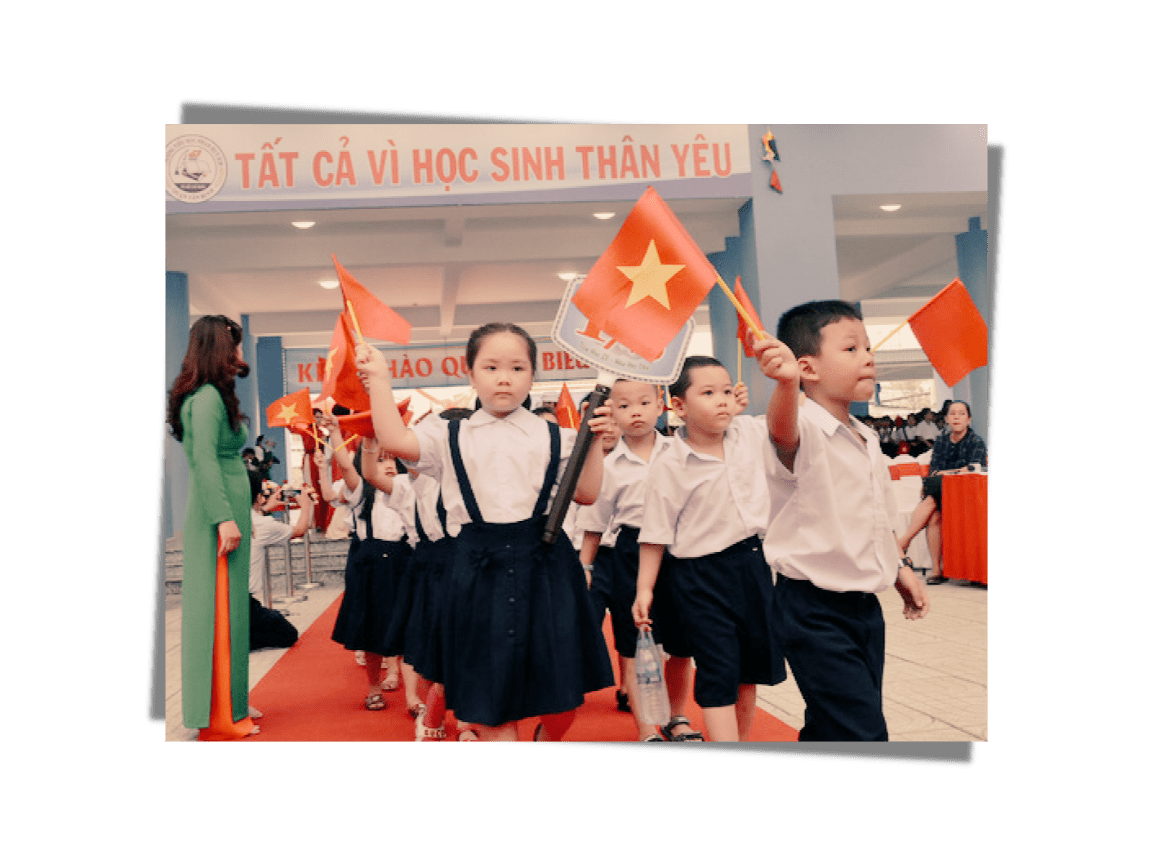
    September is when the school year starts in Vietnam. However, this academic cycle is like no other, as the country is struggling with a deadly virus that claimed more than 10,000 lives last month. [1] How will this pandemic be remembered by those who survive? How will it be taught in schools in the years to come? Who will remember the missteps of the government, and will they demand justice for those whose deaths should have been avoided? We must not forget that a large part of Vietnam’s political landscape is the politics of memory, because as George Orwell once said in 1984, ‘he who controls the past controls the future; he who controls the present controls the past.’ My journey through schools, first in Vietnam and then overseas, illustrates why education and the politics of memory are intimately connected.

    ‘Under the roof of the socialist school’

    I am a researcher, and most of the people I interview for my research are activists and supporters of various social and political movements in contemporary Vietnam. These people are also around my age and come from Vietnam’s post-war generation. Every time I ask about their school experience, they almost always jokingly start with “under the roof of the socialist school”; they then tell me about a time when they were completely unaware of, or even lied to, about many historical events, including the 1968 Hue massacre, the fall of Saigon, the existence of re-education camps, the boat people exodus, or the border war with China. If the truth of these events was widely known, it would raise serious questions about the crimes North Vietnam’s government committed against central and southern Vietnamese and the legitimacy of the Vietnamese Communist Party (VCP).

    For us who come from the post-war generation [2], our education has been entirely engineered by the government under the leadership of the VCP. Thus, there is little surprise that some people and events were glorified while others were vilified or completely erased from public consciousness [3]. After all, one cannot secure one’s rule without being seen as legitimate, and in the case of the VCP, the spectre of the past is a constant threat to its contested legitimacy. The singular narrative in which the VCP is portrayed as the brave and glorious liberator of the Vietnamese people was told and repeated throughout the 12 years of our education through textbooks, symbols, rituals, and an elaborate system of rewards and punishments to reinforce these ideas.

    Needless to say, I grew-up to become a VCP-nationalist – someone who equates loving Vietnam with believing blindly in the VCP. Likewise, I also ended up believing that modern-day Vietnam was the culmination of the VCP’s countless victories, especially during the ‘War Against America to Save the Country’ (Kháng chiến chống Mỹ cứu nước); I was made to believe that the VCP was “on the right side of history.” This singular narrative is easy to digest for children and teenagers because of its simple dichotomy of hero and villain, supported by a complex system of other institutions – especially the media – that echoes the same story.

    Looking back, I can still vividly recall how proud I was when I became a member of the Communist Youth League at the age of 15. I remember humming one of the Party’s hymns as I walked home after attending the membership ceremony. It was not easy for me to escape the preconceptions of my childhood and the sad reality is that many Vietnamese people cannot.

    Pedagogy of the oppressed [4]

    When I left Vietnam to pursue my bachelor’s degree, my sociology and history classes challenged this singular narrative from my childhood and managed to deconstruct the VCP’s simplified and skewed perspective of the world. Yet, my most eye-opening experience did not happen in the classroom.

    I remember stumbling upon a stack of books in the university library. They were a collection of stories about the Vietnamese Boat People who survived their exodus. These pages held more than just tales of tragedy and of sinking ships. They held the sorrow of husbands and wives separated by circumstance with little to no hope of ever seeing each other again. They carried the rage and despair of fathers watching their daughters being raped and killed right in front of their eyes. They contained the hopelessness and ennui of throwing corpses into the sea and of the countless lives left broken even after rescue. These stories stood in stark contrast to the image of Vietnam peddled by the VCP. Yet, I could not deny them; the pain and suffering of my countrymen were too raw and too real. The Vietnam I once knew, a Vietnam built on a shoddy foundation of strategically crafted lies and upfront deception, slowly began to crumble.

    It was this evening in the library that changed me forever. Since then, I have become my own educator, gradually undoing what had been done to me “under the roof of the socialist school.” After getting my bachelor’s degree, I continued my education and had the opportunity to study the history of the Vietnam War (instead of the “War Against America”). I also write about contemporary events in Vietnam with the knowledge of how the past helps shape the present. This path I have chosen, albeit not easy, is nonetheless deeply rewarding. Its reward is both personal, as it gives me an avenue to re-build and express my authentic self and collective because I can speak for those whose stories have been erased from history.

    Having said all this, education is not confined within formal institutions; I just happen to follow an academic path. Most of my research interviewees have learned through their own means. While I found my first moment of truth in the library, they may have found theirs as they participated in the street protests of the early 2010s in Vietnam, read blogs and websites that have become widely accessible thanks to the rise of the internet in the country, talked to their church members, or met with people of the Vietnamese diaspora. Regardless of the different routes we took, what we share in common is the self-awareness we gain as members of disenfranchised groups: Catholics, “the losing side,” southern Vietnamese, northerners who did not side with the victors, or protesters who were beaten up simply because they peacefully exercised their rights. We also share our role as keepers of the stories the powerful would rather erase.

    Free schools and revolutionary journalism

    I do not foresee the education system in Vietnam undergoing any radical change. I anticipate that the pictures of the long line of vans waiting in front of the crematorium in Saigon, the thousands of faces behind the death statistics, the grief of their loved ones, the indignation of those who have been pushed further into poverty because of the collapsed welfare system, and countless others whose lives have been overturned in the past weeks with endless confusing and incoherent decisions made by the government, will once again be at risk of being written off of history. It is likely that students will not be told about the year 2021 the way it has happened. Thus, no difficult questions will be raised about the (lack of) competency, accountability, and morality of those in power [5].

    However, if history – the history of the oppressed – has anything to teach us, it is the power of Free Schools and revolutionary journalism. We must not forget that Phan Chu Trinh established Free Schools across Vietnam to teach what the French did not allow us – their subjugated people – to learn. We must not also forget that Phan Boi Chau spent his entire life conducting revolutionary journalism, not only to educate and inform but also to cultivate a sense of authentic identity for the Vietnamese people, without which we would not have had the basis to organize ourselves and achieve national independence [6]. I trust that if we could revive the spirit and practices of the days of the two Phans, with Free Schools and revolutionary journalism being once again a vibrant part of civic life in Vietnam, we will not only do justice to the past and to those whose stories would otherwise not be told, but also to our future generations and to the prospects of a better Vietnam we all deserve.

    References:

    1. Johns Hopkins Coronavirus Resource Center. “New deaths” for August was 10,067. Available at: https://coronavirus.jhu.edu/region/vietnam. Retrieved on 3 September 2021.
    2. Vietnam’s post-war generation is defined as people born between the end of Vietnam War in 1975 and the years of Đổi Mới 1986-1989.
    3. See Vu, T. (2014). Triumphs or tragedies: A new perspective on the Vietnamese revolution. Journal of Southeast Asian Studies, 45(2), pp 236–257. Reviewing the contents of textbooks used in the cultural revolution led by the VCP, Vu concludes that such education “sought to indoctrinate people, not to enlighten them in the normal sense of the word”, and one of the consequences could be “enslav[ing] people by limiting their information to one particular way of thinking in order to create obedient subjects of the state” (p. 252).
    4. We borrow the name of Brazilian educator Paulo Freire’s famous work Pedagogy of the Oppressed, first written in 1968, for this section.
    5. We suggest readers to also read Bia Dua’s article Chúng ta còn lại gì nếu ngày mai hết dịch?, published on Luat Khoa on 1 September 2021, to get a more detailed picture of the devastation in Vietnam, and the author’s thoughts and sentiments as a resident of Saigon in these sad and difficult days. Available at: https://www.luatkhoa.org/2021/09/chung-ta-con-lai-gi-neu-ngay-mai-het-dich/?fbclid=IwAR1FtFrxrw3aHp_Pii1D3S2mOMh2muTbjThwIZ4VeLLDGi_JOZcEJN_-Zdk
    6. See Duiker, W. (1976). The rise of nationalism in Vietnam, 1900-1941. Ithaca & London: Cornell University Press. An elaborate discussion of Phan Chu Trinh’s Free Schools, Phan Boi Chau’s journalism, and the significance of these works in creating the identity of the Vietnamese people, can be found in Part 1 Scholar-Patriots (pp. 21-101) of the book.
  • Panorama of Flags, Panorama of Lies

    Panorama of Flags, Panorama of Lies

    The panorama of flags

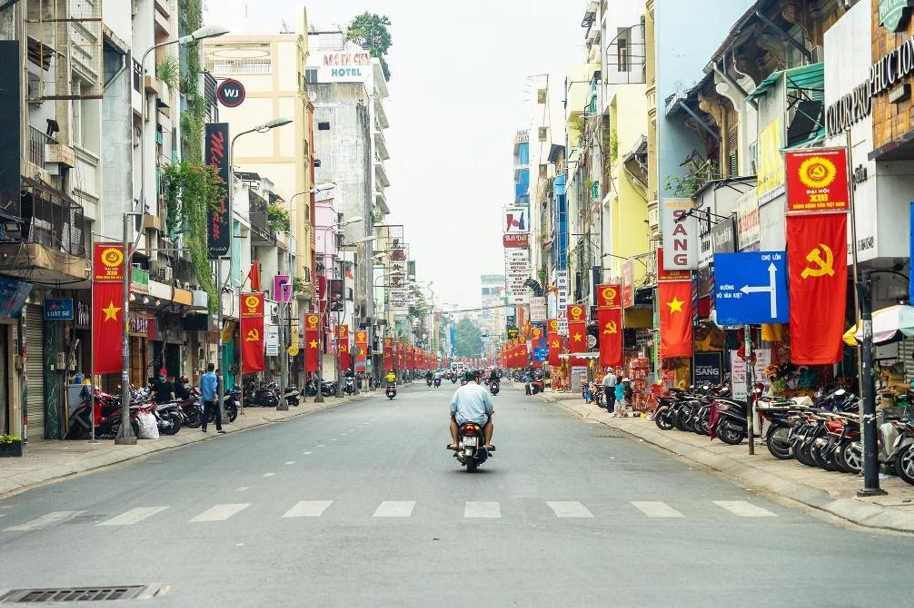
    Foreigners visiting Vietnam can hardly miss the abundance of flags, posters, statues, and slogans that remind them of who is leading Vietnam and of the Communists’ “glorious” struggle against the French, Americans, and the South Vietnam regime throughout the last century.

    However, isn’t it a bit too archaic to still flash the symbol of the hammer and sickle these days, when the means of production and the economy no longer rely on these tools? Farmers and factory workers neither drive nor fuel modern-day politics as well. Likewise, what is the point of having the statues of Ho Chi Minh, Karl Marx, and Lenin in public parks and in the meeting rooms of schools, universities, and governmental departments? Do ordinary people who showcase the red and yellow flag in front of their houses every April 30 cherish the fact that the country was “reunited” in 1975?[1] Do police officers–who check and remind households that fail to do so–love the flag so much and wholeheartedly believe in the cause? In essence, what is the significance of this panorama of symbols?

    Vaclav Havel, the dissident intellectual of communist Czechoslovakia and later president of post-communist Czechoslovakia/the Czech Republic,[2] can point us to the answer.

    The panorama of lies

    Following the end of World War II, Czechoslovakia was ruled by the Communists. The iron fist of Communist rule drove dissidents out of the country and clamped down on those who remained. Other than the Prague Spring of 1968, an unsuccessful effort to steer Czechoslovakia back towards democracy, there was hardly any resistance.

    However, communist Czechoslovakia was not just about who held the government; life itself had to adjust in a way that fit the current political climate. Vaclav Havel (1936-2011), who is arguably one of the most respected dissidents in the history of Czechoslovakia, lived most of his life under Communist rule. He grew up to become a playwright, and at the same time, he established himself as a prominent and well-loved politician. A high point of Havel’s dissident writing, The Power of the Powerless, [3] does not concern itself with formal politics; rather, it deals with the “hearts and minds” of the people.

    A significant character in The Power of the Powerless is the greengrocer who puts the slogan “Workers of the World Unite!” in his front window every day, along with his vegetables. He is neither passionate nor concerned about whether or not the workers of the world unite, but he does this anyway. This irony reminds me of my family who obediently and diligently displays the Vietnamese flag at times in the year when they should, but remains so apathetic that they do not even care if the flag is hanging upside down. There also seems to be other households quite similar to my own which led to the government’s legal guidelines (3420/HD-BVHTTDL) that specifically address this violation.[4]

    The greengrocer’s act is the observable tip of the iceberg of how the hearts and minds of the people work in communist Czechoslovakia; they want to avoid trouble with those who have power. By displaying the slogan, the greengrocer implies:

    I, greengrocer XY, live here and I know what I must do. I behave in the manner expected of me. I can be depended upon and am beyond reproach. I am obedient and therefore I have the right to be left in peace.  (Havel, 1978, p. 6)

    I am once again reminded of my family. I recall that every time my father was late in hanging the flag, my mother would berate him. She would constantly tell him to do it now because she didn’t want the hassle of dealing with the police. When I asked my parents about this, they said that they just wanted to be “left in peace” (yên thân). Likewise, if you ask teachers, students, or employees of governmental departments about the statues of Ho Chi Minh and Karl Marx in their buildings, they would probably tell you something similar.

    But, why do the authorities punish such a trivial thing? Whether or not the greengrocer displays the slogan would certainly have little to no effect on the workers’ movement, nor does it pose any tangible threat to the existence of a government that possesses the hard power of the courts, the military, and the police. The greengrocer does not even replace the slogan with another one that is critical about the regime.

    To address this question, Havel points out that, in fact, people would ignore the greengrocer’s slogan, but they do so precisely because such sayings are everywhere – in other shop windows, on lampposts, bulletins, and buildings. The key here is that while they ignore individual slogans, the people are well aware of the panorama of these slogans as a whole. The existence of this panorama tells people that dishonesty goes hand-in-hand with obedience here; this is normal, everyone does it, and so must you. In the same vein, transgressions must be punished because “anything which leads people to overstep their predetermined roles is regarded by the system as an attack upon itself” (Havel, 1978, p. 8).

    Therefore, if a Vietnamese policeman, school administrator, or government official reproaches someone who questions the phrase: “Live, fight, work, and study like our great Uncle Ho” (Sống, chiến đấu, lao động, và học tập theo gương bác Hồ vĩ đại), it is extremely likely that this policeman/school administrator/government official himself has also questioned, albeit in private, the very same slogan! Yet, they also believe that nobody should disrupt the rules of the game and that everyone should blindly follow what the system demands.

    My next question is, how do people live with themselves when their existence is surrounded by so many lies, ironies, contradictions, and hypocrisies, including those of their own making? Would they feel embarrassed and ashamed of themselves for being so afraid and thus becoming unquestionably obedient? These questions, Havel argues, boil down to man’s dignity and authentic identity. To be able to live in lies, the greengrocer deludes himself into believing that there is nothing wrong with the workers of the world unite; he separates the part of himself that questions the slogan from the other half that accepts the excuse. Living in a world of lies and deceit for so long warps our perspective and this bastardized reality becomes our “new normal;” the greengrocer becomes accustomed to the state of his compromised dignity and comes to accept the deception and inauthenticity of the system as part and parcel of life. In effect, he loses his authentic self.

    On the question of dignity and identity, it is interesting that the slogan “Sacrifice for the country and serve the people” (Vì nước quên thân, vì dân phục vụ) is hung in every police station, in a country where police, alongside tax officials, are seen as the most corrupt group (Towards Transparency and Transparency International, 2017). A few years ago, when I passed by one of Vietnam’s border checkpoints, I was baffled by the contradiction between the arrogance of the border control officer and the fact that he was sitting right under a “serve the people” banner. My subsequent conversations with poor Vietnamese migrants who often cross the border for work revealed that this was how they were always treated; they often bribed these arrogant officers and kept their heads down to avoid trouble.

    As I listened to these migrants and recalled my own experience, I wondered how these officers could look at themselves in the mirror. They see the “serve the people” banner in their office every day but shamelessly extend their hand through the small window of the checkpoint to receive bribes from the people they look at with disdain – the “lowly” people they are supposed to serve. On the other hand, the migrants are left with little choice but to comply and are forced to accept being treated with less than half the dignity they should be afforded by the simple virtue of being alive.

    Furthermore, Havel argues that the panorama of lies is internally solid, for there is a “metaphysical order binding all its components together,” thus “guarantee[ing] the inner coherence of the totalitarian power structure” (Havel, 1978, p. 10). Through all the examples I have provided, isn’t there a sense of such order emanating from Vietnam’s panorama of (pseudo) symbols? The checkpoint officers and those who bribe them, my parents’ disinterested flag-hanging, the equally disinterested policeman who checks the flags, and the people who put the statues of Ho and Marx in their meeting rooms are all parts of a system that everyone who lives or has lived in Vietnam knows all too well; it is a system where “the working class is enslaved in the name of the working class, [where] the complete degradation of the individual is presented as his ultimate liberation, […] [and where] the arbitrary abuse of power is called observing the legal code” (Havel, 1978, p. 10).

    In fact, one of my interviewees [5] told me that before he left Vietnam and started to look at the country from a distance, life there was quite “smooth” for him, because “things hung together…everything I heard in school, in the newspaper, in the street etc. was in harmony with each other…I didn’t feel the urge to question things.” This “harmony” is the glue that holds the panorama of lies together. Secondly, as my interviewee’s response also points out, this panorama is solid because those who lack the individual will and instead excel in the use of empty phrases are the ones who thrive (Havel, 1978, p. 13).

    Havel thus concludes that “individuals confirm the system, fulfill the system, make the system, are the system” (Havel, 1978, p. 9). This conclusion runs contrary to what many intellectuals and laymen alike often think about authoritarianism as entailing an evil ruler and people who are controlled against their will, or a class that oppresses all other classes, and where the line of struggle is between the oppressor and the oppressed. The concept of “the panorama of lies” goes beyond such binary definitions and shows that the line of struggle “runs de facto through each person, for everyone in his own way is both a victim and a supporter of the system” (Havel, 1978, p. 16-17).

    Conclusion

    I work with and observe a wide range of activists who work tirelessly and voice their opinions hoping to one day make Vietnam a liveable country for ALL and not just for those with unearned privileges and unchecked power. They pursue different paths of change; some try to run for seats in the National Assembly, others focus on analysing the actions of the government, and there are those who try to nurture a different kind of Vietnamese. For them, a different kind of Vietnamese means Vietnamese citizens who feel anger when their own dignity, or the dignity of others,’ is negated; they are those who strive for “what should be,” instead of settling for “what is.” They are those who are honest with themselves about right versus wrong, instead of surrendering their own judgement, mindlessly obeying the state and condemning those who do not conform.

    Vaclav Havel and his people saw the end of Communist rule in Czechoslovakia in 1989, but the democratic miracle did not immediately follow. Havel, then in the position of president, argued that democratic politics and the market economy, both carrying the promise of a good life, cannot happen in the face of “post-communist morass” (Havel, 1997). The ghost that kept haunting post-communist Czechoslovakia/the Czech Republic was called out in Havel’s speech before Parliament in 1997:

    Many people believe that democracy or no democracy, the people in power are again people who cannot be trusted and who are more concerned about helping themselves than about the greater good….The prevalent opinion is that it pays off in this country to lie and to steal; that many politicians and civil servants are corruptible; that political parties – though they all declare honest intentions in lofty words – are covertly manipulated by suspicious financial groupings.(Havel, 1997)

    I understand that the different paths of change I mentioned above ultimately feed into each other. However, with the lesson from Czechoslovakia/the Czech Republic and Havel’s thoughts, I cannot help but wonder how best to prioritise these tasks and decide when to pursue which.

    I would also like to believe that Havel’s thoughts give Vietnamese activists hope, especially during the present time when a relentless crackdown makes revolutionary change seem like an utterly unreachable dream. After reading Havel’s work, I see the sparks of our own “Vietnam Spring” starting not in the places representing the power of the system – the National Assembly, the election, state-owned media, or the police – but in the very hearts and minds of ordinary Vietnamese people. The revolutionary Vietnamese of the present day are those who dare to live in truth.

    Bibliography:

    1. On April 30, 1975, North Vietnam forces entered Saigon and officially ended the existence of the Republic of Vietnam as a nation. North Vietnam and South Vietnam were then joined and ruled by the Vietnamese Communist Party (VCP), and Hanoi became the capital of the whole of Vietnam. In the narrative of the VCP, April 30 is called reunification day and a cause to celebrate, whereas people who sided with South Vietnam call it ‘Black April,’ amongst other names that convey pain and sadness for the loss of their country.
    2. Czechoslovakia split into the Czech Republic and Slovakia in 1992-1993. Vaclav Havel’s presidency was from 1989 to 2003, with some intervals in between.
    3. To be fair to this great work of Havel, I should be clear that the panorama of lies is only a small part of it. I focus particularly on this concept in order to unpack the omnipresence of (pseudo-) symbols in Vietnam.
    4. I am not saying that all Vietnamese display the red and yellow flag in the same disinterested way as Havel’s greengrocer. We will not know unless we ask every single Vietnamese. However, we can always make an educated guess. In Vietnam, there are pockets of the population who resent or distrust the regime for many good reasons, from the historic 1975 event and family members lost at sea during the Boat People exodus to forced evictions and rampant corruption. Growing inequality and poverty drive young people from rural areas to cities or overseas, and also expose even more the lies about the socialist utopia which the VCP claims it pursues and which it trumpets with slogans and posters in public places.
    5. This interview is part of my PhD research on activism under authoritarian rule in the 2010-2019 period in Vietnam.

    References

    Havel, V. (1979). The Power of the Powerless. Available at: https://www.nonviolent-conflict.org/resource/the-power-of-the-powerless/

    Havel, V. (1997). Address to the Czech Parliament. Available at: https://www.rferl.org/a/1087560.html

    Towards Transparency & Transparency International (2017). 2017 Global Corruption Barometer: Vietnam. Hong Duc Publishing House.

  • The Intertwining Of Science, Politics, And Ideology In Vietnam’s COVID-19 Crisis

    The Intertwining Of Science, Politics, And Ideology In Vietnam’s COVID-19 Crisis

    Amidst the COVID-19 crisis, a moment for science

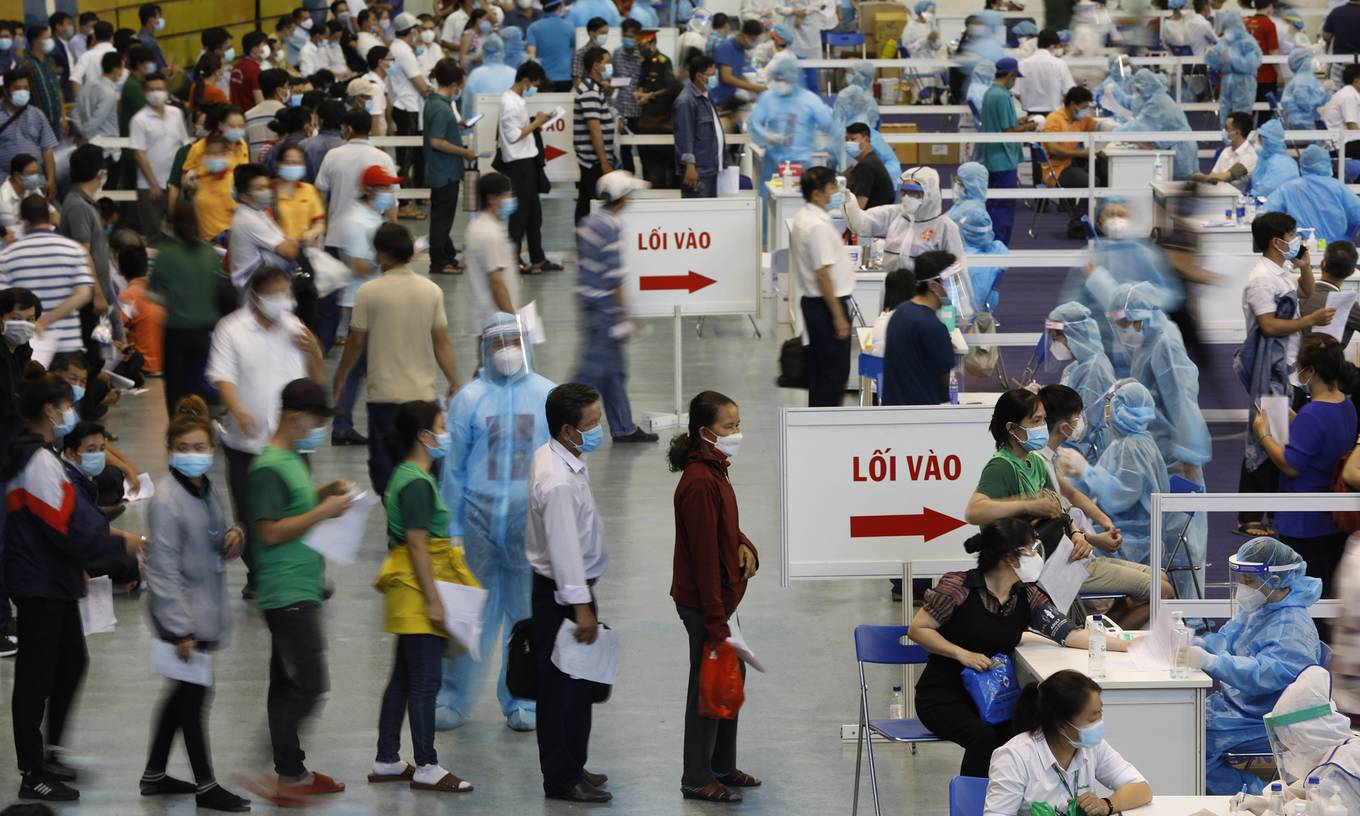
    The escalation of COVID-19 in Vietnam, especially in Saigon (officially known as Ho Chi Minh City), is sending millions of people into crisis. They have struggled on multiple fronts, from healthcare and making sense of varying isolation requirements to obtaining food and necessities amidst strict yet incoherent travel bans and supply shortages.

    The double target of trying to contain COVID-19 while simultaneously continuing economic activities that the government persistently defended and adhered to since the start of the pandemic has been abandoned. This is indicative of how serious the situation has become. Over the past few weeks, Saigonese have experienced life in a way they could never have imagined.

    In this grim picture, Tuoi Tre Online reported on July 10, 2021, that Ho Chi Minh City’s Party Committee Secretary Nguyen Van Nen is now looking to scientists for advice.[1] The secretary’s words were quoted widely in the news:

    I feel that we need to consult the scientists…. At any time, I want specialists and scientists to see flaws in our strategy to fight the pandemic and contact me; I will consider their advice and respond timely.

    A Facebook influencer reacted to this news with a sense of irony and bitterness:[2]

    So what expertise have you relied on to fight the pandemic? Anything but science? Have you been kidding your citizens all along? For one and a half years now, have you been playing with the life and death of millions of people? So, after all, is it true that the tools you have taken to fight a pandemic are simply government decrees and [the manpower of] the Communist Youth League? I feel so ashamed of being led by national leaders who are both blind and arrogant.

    It is rather apparent that in a pandemic, one had better look to the scientists. So, why is a government official only bringing them to the table now? The next question is, how critical can scientists be, with a government that does not like criticism? At the highest level, one must wonder where science and scientists are in the decision-making concerning public matters in non-democratic Vietnam? A look into the Vietnamese Communist Party’s (VCP) ideology that it has followed and its practices could explain this conundrum.

    In ideology: the suppression of civil society and communicative rationality

    In the United Kingdom, at the start of the pandemic, the Scientific Advisory Group for Emergencies was activated. Since then, it has been working closely with the government as an external body to advise on making appropriate decisions regarding COVID-19 in the country. The importance and weight of scientific advice cannot be underestimated; UK scientists successfully convinced Prime Minister Boris Johnson and his cabinet to abandon their herd immunity strategy and adopt a nationwide lockdown in March 2020.

    Without this lockdown, the United Kingdom could have seen 80 percent of its people infected and 500,000 deaths.[3] On the other side of the Atlantic Ocean, the physician-scientist and immunologist Anthony Fauci, in his role as the chief medical advisor to the US president, has been a pillar in handling COVID-19 in the United States.

    Liberal democracy entails the practice of taking advice from scientists and not restraining those who deliver honest yet uncomfortable truths to people in positions of power. The two hallmarks of liberal democracy that shape this practice are civil society and communicative rationality.[4]

    Civil society in a liberal democracy comprises actors and institutions that are supposed to be independent of the state and who act to balance state power. Therefore, universities and the myriad of civil associations in democratic countries are autonomous and can freely critique the conduct of the government or oppose laws and policies they view as problematic without fear of punishment.

    On the other hand, communicative rationality, an ideal of liberal democracy, means that people arrive at a collective agreement about something via genuine, intelligible conversations. Thus parliamentary debate and rebuttal in classroom discussions are part and parcel of a healthy democratic life and politics.

    Nowhere in the ideological textbook of the VCP can one find any sign of friendliness towards the idea of an autonomous, independent civil society, nor communicative rationality in the way the state relates to other estates in society. The Vietnamese government condemns independent civil society as a strategy of ‘hostile forces’ to undermine political stability.[5] Following the Marxist-Leninist ideology, the Communist leaders control civil society and use civil society organizations, such as the press, schools, and mass associations, to garner consent from the people for its rule.[6] Likewise, the Party believes in ‘self-criticism,’ rather than opposition or open, genuine debate in the National Assembly or in other venues where the state and citizens can talk to each other.[7]

    In practice: the strategic mobilization of scientists while confining them within governable spaces

    Since 1975, the Vietnamese State could be described as developmental. In the pursuit of economic growth and technological and social development, the state needs the expertise of scientists and intellectuals. This is evidenced by the existence of a wide range of research and scientific centers and institutions funded by the State that operate within the scope prescribed for them by the government. However, the system ensures that scientists and intellectuals employed in these research centres do not threaten the state.[8]

    Despite these state-employed scientists and intellectuals, the Vietnamese government rarely describes its style of governance as “evidence/science-based.” This suggests that the VCP still aspires to be a good disciple of Marxism-Leninism when it comes to organizing the political system and governance. “The Party knows best” is apparently its motto. In other words, the Party sees itself as the supreme source of authority and expertise. This also makes Vietnam’s developmentalism different from, for example, Japan’s.  Japan’s developmentalism is based on rationality, whereas Vietnam’s is based on ideology.[9]

    Speaking of rationality, communicative rationality still has no place in Vietnam’s politics nor in the civil sphere. The National Assembly has shown little sign of becoming a place for open, genuine debate about public matters. Critical thinking is still lacking in the way students are educated. The free press is still a wild dream for Vietnam.

    I interviewed the head of Luat Khoa Tap Chi not long ago. He described the prominent culture in Vietnam as a “culture of obedience and singular thinking” rather than critical thinking and genuine, intelligible debate. Last but not least, we shall not forget that in 2007, when the Institute of Development Studies was established by renowned intellectuals and scientists of the country to speak truth to power, it went into so much trouble with the government and was eventually disbanded.[10]

    Prospects of the VCP democratizing itself?

    Not so much. In Saigon, what the Party Committee Secretary Nguyen Van Nen said about consulting scientists is most likely just a moment of him forgetting the Party’s line he should be toeing. Indeed, just a week after his statement, a Facebook influencer reposted on his Facebook page a VNExpress interview with Vu Thanh Tu Anh of Fulbright University Vietnam, which reportedly was removed from VNExpress’s website immediately after it was posted.[11] In this interview, Tu Anh discusses some failures in the government’s strategy to contain COVID-19.[12]

    In conclusion, for scientists to speak truth to power, or at least to save Vietnam from this deadly pandemic, they require a change in both ideology and politics, which the VCP seems to be neither willing nor ready to take.

    Bibliography:

    1. Bí thư Thành ủy TP.HCM gặp gỡ các chuyên gia, nhà khoa học cùng bàn cách chống dịch COVID-19, 10 July 2021. Tuổi Trẻ Online. Available at: https://tuoitre.vn/bi-thu-thanh-uy-tp-hcm-gap-go-cac-chuyen-gia-nha-khoa-hoc-cung-ban-cach-chong-dich-covid-19-20210710120636333.htm
    2. Thai Hao’s Facebook page, 10 July 2021. The full post is available at: https://www.facebook.com/permalink.php?story_fbid=1029231357886052&id=100023975920044
    3. Grey, Stephen & MacAskill, Andrew, 7 April 2020. Special Report: Johnson listened to his scientists about coronavirus – but they were slow to sound the alarm. Reuters. Available at: https://www.reuters.com/article/us-health-coronavirus-britain-path-speci-idUSKBN21P1VF
    4. The background of my understanding of liberal democracy in this paragraph comes from Alexis de Tocqueville (on civil society) and Jurgen Habermas (on communicative rationality).
    5. See, for example, an article in Cong an Nhan dan, available at: http://cand.com.vn/Chong-dien-bien-hoa-binh/Canh-giac-thu-doan-loi-dung-xa-hoi-dan-su-de-chong-pha-che-do-581991/; another one in Nhan dan, available at: https://nhandan.vn/tin-tuc-su-kien/xa-hoi-dan-su-mot-thu-doan-cua-dien-bien-hoa-binh-392081/
    6. The reality of ‘state-led civil society’ in Vietnam, most prominent before the late 1980s, is discussed widely in the academic literature. For example, I suggest Landau, I. (2008). Law and civil society in Cambodia and Vietnam: A Gramscian perspective. Journal of Contemporary Asia, 38(2), 244–258; and Salemink, O. (2006). Translating, interpreting, and practicing civil society in Vietnam: A tale of calculated misunderstanding. In D. Lewis & D. Mosse (Eds.), Development Brokers and Translators: The Ethnography of Aid and Agencies (pp. 101–126). Kumarian Press.
    7. See, for example, a discussion session organized by a mass organization, in Tortosa, A. (2012). Grassroots democracy in rural Vietnam: A Gramscian analysis. Socialism and Democracy, 26(1), 103–126. https://doi.org/10.1080/08854300.2011.645661
    8. See Morris-Jung, J. (2017). Reflections on governable spaces of activism and expertise in Vietnam. Critical Asian Studies, 49(3), 441–443. https://doi.org/10.1080/14672715.2017.1339448
    9. For more on developmentalism and plan-rationality versus plan-ideology, see Johnson, C. (1993). The Japanese miracle. In MITI and the Japanese miracle: The growth of industrial policy, 1925-1975 (pp. 1–34). Stanford University Press; and Woo-Cumings, M. (Ed.). (1999). Introduction: Chalmers Johnson and the politics of nationalism and development. In The developmental state (pp. 1–31). Cornell University Press.
    10. Morris-Jung, J. (2015). The Vietnamese bauxite controversy: Towards a more oppositional politics. Journal of Vietnamese Studies, 10(1), 63–109.
    11. Thanh Nguyen’s Facebook post, 17 July 2021. Available at: https://www.facebook.com/paulothanhnguyen/posts/4395856270458582
    12. On 20 July 2021, another scientist, Vu Hong Nguyen, also shared on his Facebook page that his contribution to a TV program in Vietnam about COVID-19 vaccines was abruptly removed. He explains that his skeptical view of the Chinese vaccine Sinopharm, which he planned to talk about in the TV program, was not welcome. He titles this post on his Facebook page as ‘Do not let politics interfere with science’. Nguyen’s Facebook post is available at: https://www.facebook.com/vu.nguyen.758/posts/4726456800701987
  • Vietnam’s Unprecedented COVID-19 Challenge Compounded By A Deficit Of Trust In The Government

    Vietnam’s Unprecedented COVID-19 Challenge Compounded By A Deficit Of Trust In The Government

    Vietnamese people are no strangers to natural disasters or political calamities that demand personal sacrifice and collective effort. Yet, why is the government’s‘COVID-19 Vaccine Fund’ being met with so much public backlash? A closer look into these criticisms reveals a deficit of trust in the government, in more ways than one, with nobody taking the initiative to deal with this problem.


    June 2021 saw Vietnam facing a massive COVID-19 outbreak, especially in Saigon (Ho Chi Minh City). By the end of the month, the number of cases remained relatively high. The implications of the government’s difficulty in containing COVID-19 in Saigon are considerable.

    First, it is the largest city in Vietnam and the economic flagship of the country. Thus, placing the entire city of Saigon under lockdown is arguably not an option the government would want to entertain. This is evidenced by government officials still stubbornly clinging to their “double target” goal [1] of attempting to suppress COVID-19 while at the same time maintaining economic activities. Time will tell if Vietnam will pull through or if this “double target” will turn into a “double failure.”

    Second, the bitter history between Saigon, South Vietnam’s former capital during Vietnam War, and the Communists from Hanoi often resurfaces at times like this. This has cultivated a persistent lack of trust between many Saigonese and government leaders in Hanoi. Thus, it is not surprising to see many angry comparisons by Saigonese. They speak of the government’s unfair treatment of Saigon, as they perceive that less support has been given to the city to cope with the outbreak than was the case with northern provinces. When economic and political concerns are put together, they believe that Saigon is merely seen by the government as a cash cow – heavily milked yet poorly treated by Hanoi leaders.

    However, this troubled past between the north and south regions is far from being the only reason for the lack of trust between the state and the people in Vietnam. With the unprecedented high number of daily cases and deaths, the Vietnamese finally realize the urgency of acquiring vaccines. Yet, the government’s COVID-19 Vaccine Fund, which calls for voluntary donations from individual citizens and the corporate sector to buy vaccines from overseas, has been met with strong criticism.

    As expressed on social media, these objections seem to boil down to “I can’t trust the government with my money” or “I don’t trust the government to act in my best interest.” This lack of faith in the state is situated against a backdrop of multiple corruption scandals and a lack of transparency throughout the 2010s and taxpayers’ increasing scrutiny of public spending in recent years, which has resulted in their frustration.

    To wit, the government announced in late June its plans to build more public statues, with the one in Thanh Hoa province alone costing approximately 255 billion dong (US$11 million).[2] The government could not have chosen a better time, or a better way, to add fuel to the fire.[3]

    In a country where anti-China sentiment runs high, the government’s approval of the Sinopharm vaccine and putting it into use only worsens the situation.[4] Skeptics of the VCP and China have every reason to be worried about the money in the COVID-19 Vaccine Fund being used to purchase only the Sinopharm vaccine.

    With this perfect opportunity for public intellectuals to speak truth to power, economists Vu Thanh Tu Anh (from the Fulbright School of Public Policy and Management) and Vu Tu Thanh (deputy regional managing director and Vietnam representative for the US-ASEAN Business Council), regrettably miss the point. Tu Anh’s Facebook post on June 8 rightly explained that the COVID-19 Vaccine Fund is a way to correct “government failure.” [5]

    However, he mainly focused on the technical workings of the government’s budgeting related to COVID-19. Likewise, Tu Thanh’s post on his own Facebook page, posted on the same day, defends the COVID-19 Vaccine Fund, stating that no vaccine manufacturer in the world can sell its vaccines to non-state actors at the moment and that the government is still responsible for the lion’s share of the amount used to purchase them.[6]

    Mistaking politics for policy, both Tu Anh and Tu Thanh fail to address the issues underlying the criticisms of the COVID-19 Vaccine Fund, which are the deficit of trust between Saigon and the north, the lack of confidence of the Vietnamese people towards their government, the bitter irony of billions of Vietnamese dong going to statue-building amidst a pandemic, and concerns about China’s vaccine. They also miss how the government should be held accountable for the “failure” Tu Anh mentioned, a failure of the government’s own making. While these issues are not dealt with, the deficit of trust remains and could worsen over time.

    June 2021 has seen Saigon’s neighbourhoods barricaded, one after another, as more and more new cases emerged. A local man poetically, but sadly, called the city, “Thương thành” (City of Pain).[7] Meanwhile, other cities and provinces are nervously watching. The shortage of vaccines alone is challenging to deal with. Yet this summer sees the Vietnamese government running short of both vaccines and the trust of many of its people.

    Bibliography:

    [1] T.H. (2021, June 3). Sáng tạo trong thực hiện “‘nhiệm vụ kép.’” Hanoi Moi. https://hanoimoi.com.vn/tin-tuc/Doanh-nghiep/1001503/sang-tao-trong-thuc-hien-nhiem-vu-kep

    [2] L.H. (2021a, June 25). Thanh Hóa chọn mẫu xây tượng đài, khu lưu niệm 255 tỷ đồng. VNExpress. https://vnexpress.net/thanh-hoa-chon-mau-xay-tuong-dai-khu-luu-niem-255-ty-dong-4299756.html

    [3] Facebook user’s criticism of the government’s handling of COVID-19 in Saigon, including its spending on building statues amidst. (2021, June 25). [Status]. Facebook. https://www.facebook.com/manhcuongvu/posts/10208783322656000

    [4] Facebook user’s criticism of the Ministry of Health’s approval of the Sinopharm vaccine. (2021, June 4). [Status]. Facebook. https://www.facebook.com/photo?fbid=4596848240329511&set=a.121001917914188

    [5] Có nên lập quỹ vaccine phòng covid-19. (2021, June 7). [Status]. Facebook. https://www.facebook.com/permalink.php?story_fbid=5787526994651583&id=100001830205620

    [6] Hiểu đúng về Quỹ vắc xin phòng chống COVID-19. (2021, June 8). [Status]. Facebook. https://www.facebook.com/vututhanh/posts/10222662130960010

    [7] Thương Thành (2021, June 13). [Status]. Facebook. https://www.facebook.com/le.h.lam/posts/10220397389070232

  • The Power Of Your Ballot

    The Power Of Your Ballot

    As election day approaches for seats in the Vietnamese National Assembly, it is important to take a step back and reflect on the significance of this political exercise as a whole and on our role as voters.

    It is common knowledge that several aspects of this entire electoral process are suspicious or perhaps even fraudulent. As such, a large portion of the Vietnamese population may choose not to vote at all, even though they seem to care greatly about the politics and elections of other foreign nations. At first glance, their actions are logical and make total sense.

    Why should Vietnamese citizens continue to take part in a rigged electoral system where their votes will not matter in the end? Why should they take time off from their day and exert effort to indulge in the whims of a government that hardly even cares about the well-being of its people? After all, non-participation is a form of civil disobedience in itself, and in most cases, it is effective and it works.

    Yet, in the context of Vietnam, perhaps another way to express discontent might be more effective in bringing about lasting social and political change.

    A History of Fraud and Deception

    The Vietnamese government has constantly alleged a remarkable voter turnout since the 2002 election for the National Assembly, according to the IFES Election Guide. To be specific, Vietnam tallied 98.85 percent in 2002, 99.52 percent in 2011, and 99.35 percent in 2016. It is also expected that government claims for the turnout for the upcoming election will remain in a similar range.

    Yet, according to some experts, election results in Vietnam come as no surprise as these tallies could be mere fabrications, highly exaggerated, and may not accurately reflect reality. To support their opinions, these experts – such as Mu Sochua, a board member of ASEAN Parliamentarians for Human Rights (APHR), and a former Cambodian Member of Parliament – state that the VCP will enlarge these numbers by relying on proxy voting – wherein one person can vote for his/her entire family – and pressuring local authorities to ensure high voter turnouts in their regions.

    Contrived voter statistics is not the only thing the Vietnamese government is guilty of; its claim of free and fair elections is also deceptive. Candidates for the National Assembly are closely scrutinized and vetted by the Vietnamese Fatherland Front, an arm of the VCP. In the upcoming elections, out of 868 candidates vying for 500 seats, only nine are self-nominated, with six of these also reported to be members of the VCP as well. From this, we can see that pluralism and choice are all but non-existent.

    Prior elections also illustrate this phenomenon and the distinct lack of choice. A report by Freedom House states that out of the 500 seats available for the National Assembly in 2016, 473 were taken by Vietnamese Community Party members while “independent” candidates, who were also vetted by the VCP, took 21.

    Independent candidates and those who are not part of the Communist Party also face an uphill battle in their bid to be candidates in the elections. While most don’t even pass the Vietnamese Fatherland Front’s scrutiny, some are imprisoned or pressured into rescinding their intention to run.

    The arrests of Le Trong Hung, Nguyen Quang Tuan, and Tran Quoc Khanh, as reported by Amnesty International, stand as recent examples.

    Le Trong Hung was a citizen journalist who worked for Chan Hung TV and Nguyen Quang Tuan was a medical doctor. Tran Quoc Khanh ran a popular social media account, which he used to comment on social issues and to criticize the Vietnamese government. All three were independent candidates running for seats in the National Assembly in the upcoming election. However, they were arrested for allegedly violating Article 117 of Vietnam’s penal code, a statute which Amnesty International claims in the report, “ …violates Viet Nam’s international human rights obligations” and that Article 117 “should be repealed or substantially amended…”

    To top all of this, the result of the National Assembly elections is more or less carved-in-stone and predetermined months in advance. This can be seen in the “tentative proportion” or “tentative allocation” data released by the National Assembly’s Standing Committee. The committee has portioned the number of available seats and through this, we can get a fairly clear picture of who will get “elected” and what the priorities of the National Assembly will be over the next five years.

    To Vote or Not to Vote

    Hence, we are faced with a conundrum.

    Given the state of elections in Vietnam with all the deceit, manipulation, and unfairness involved, would it be proper and appropriate to still vote come election day, or would non-participation in the system itself be the better alternative?

    The usual reaction, when faced with such a situation, would, of course, be the road of passivity and non-compliance. Ergo, to choose not to participate in the elections at all.

    This perspective is all well and good. After all, a lack of voters usually implies a government’s lack of legitimacy and the absence of its citizens’ trust. However, legitimacy does not seem to be the VCP’s concern and they would be more than happy to pad the actual number of voters through the use of various statistical anomalies.

    On the other hand, choosing to vote seems to be a fruitless and purposeless course of action when the result is more or less predetermined several months in advance.

    At the end of the day, it appears that no matter what we decide to do with regards to the elections, the Vietnamese government and the Communist Party emerge as the true victors.

    Rays of Hope

    And yet, you have someone like Luong The Huy, an openly homosexual man, civil society activist, and gender expert, who is one of the few self-nominated candidates who somehow managed to slip through the Vietnamese Fatherland Front’s obscure vetting process.

    On election day, May 23, he and a few other candidates will take on a seemingly hopeless fight for a slim chance at winning a single seat in the National Assembly. The odds and the deck are stacked against them, but they still continue to push back; they refuse to remain silent in passive acceptance.

    And while most of us cannot run for any government position, choosing to vote is the next best thing; even though it feels like an exercise in futility, we should still force ourselves to vote come election day.

    Even though our choice may not matter, our mere participation in the simplest of democratic freedoms given to us shows the VCP that we are concerned and invested in the direction the country is moving towards. Even if the election is rigged from the start, the mere act of supporting a candidate that does not agree with the Party’s schemes shows the Party that we will not take kindly to the government’s machinations and ploys. Even the act of submitting a blank ballot carries much more weight than simply not voting at all.

    The VCP thrives on the growing apathy and passivity of its people and could care less about legitimacy. Hence, choosing to vote and then deciding to vote properly becomes an act of rebellion; it becomes revolutionary in that it respects the concept and sanctity of the democratic process itself rather than the Vietnamese government as an institution. And if enough people unite and vote for those actually deserving of a seat in the National Assembly, there is a minuscule chance that perhaps true and lasting change and reform can slowly come from within.

    The strength of your ballot lasts beyond election day and extends far into the uncertain future. And when your time comes to make a decision, we hope you make the right choice.