Tag: Opinion-Section

  • Has Vietnam Already Violated the To-Be-Ratified Free Trade Agreement with the EU?

    Has Vietnam Already Violated the To-Be-Ratified Free Trade Agreement with the EU?

    After Hoàng Đức Bình’s 14-year sentence was affirmed by an appellate court in Vietnam on April 24, 2018, one of the state-owned newspapers, Người Lao Động (NLD), published a story about Bình’s case on the same day, explaining the government’s reasons behind his harsh sentence.

    In one paragraph, NLD wrote:

    “Taking advantage of the marine life environmental incident in the Central, and as the Vice-Chairman of Viet Labor Movement, Hoàng Đức Bình began to organize The Association of Fishermen in the Central with the intent to form an external organization, mobilizing forces, attracting Catholics, fishermen in the Central to join that organization; selecting ‘nucleus’ who could incite demonstration to disturb the peace and security.”

    Not only international human rights laws protect the right of the people to form associations and organize protests, Vietnam repeatedly acknowledges and agrees to not infringe on these rights of its people in various international treaties and agreements. One of the more recent ones is the free trade agreement (FTA) with the European Union (EU).

    About two and a half years before Bình’s trial, in October 2015, Vietnam and the EU have agreed on the text concerning the terms of the FTA between them.

    At the same time, EU and its member countries have repeatedly maintained, that they are “fully committed to implementing the 2030 Agenda and its Sustainable Development Goals into EU policies.”

    One of EU’s commitments to implementing the 2030 Agenda is to include in their free trade agreements, rules on trade and sustainable development as well as a human rights clause.

    In the case of the Vietnam-EU FTA, that language is under Chapter 15 of the agreement, entitles Trade and Sustainable Development.


    Article 3, Paragraph 2, Sub-paragraph (a) of Chapter 15 states:

    “Each Party reaffirms its commitments, in accordance with its obligations deriving from the membership of the ILO and the ILO Declaration on Fundamental Principles and Rights at Work and its Follow-up, adopted by the International Labour Conference at its 86th Session in 1998, to respect, promote and effectively implement the principles concerning the fundamental rights at work, namely:

    a) the freedom of association and the effective recognition of the right to collective bargaining;”

    The importance of this chapter and the human rights clause are also highlighted by the Chair of the European Parliament’s Committee for International Trade, Bernd Lange, during his visit to Hanoi in September 2017. That human rights and labor rights are at the center of the continued discussions about the FTA between Vietnam and EU.

    Many could imply that the criminalization of Hoàng Đức Bình’s conduct for organizing people and forming an association of fishermen in the Central of Vietnam appears to be in direct violation of the Trade and Sustainable Development Chapter and the human rights clause of the Vietnam-EU FTA.

    The European Parliament Think Tank assessed in February 2018, that the FTA with Vietnam “has been described as the most ambitious deal of its type ever concluded between the EU and a developing country. Not only will it eliminate over 99 % of customs duties on goods, but it will also open up Vietnamese services markets to EU companies and strengthen protection of EU investments in the country.”

    They also opined that the Vietnam-EU FTA is estimated to boost Vietnam’s economy as much as 15 % of GDP, with Vietnamese exports to Europe growing by over one third.

    The parties are hopeful that the FTA will be ratified by EU Parliament (and also by its member-states on issues involving investment) by the end of this year, or by 2019 at the latest.

    However, the recent affirmation of Vietnam’s court regarding Hoàng Đức Bình’s 14-year sentence for organizing and participating in protests against Taiwan’s Formosa Hà Tĩnh Steel Corporation raises questions over the good faith of Hanoi in keeping up their end of the bargain when it comes to human rights and labor rights.

    If Vietnamese government is sending people to prison with a very harsh sentence for exercising their freedom of association before the FTA is ratified, then what and how does EU plan to keep them in check once the dust is all settled?

    Perhaps, this is a legitimate question for the EU-Vietnam Human Rights Dialogue to provide the public with a more definitive answer later this year?
  • “Piss on Trump” Opens Up Much Needed Debates on Individual Rights Among Vietnamese

    “Piss on Trump” Opens Up Much Needed Debates on Individual Rights Among Vietnamese

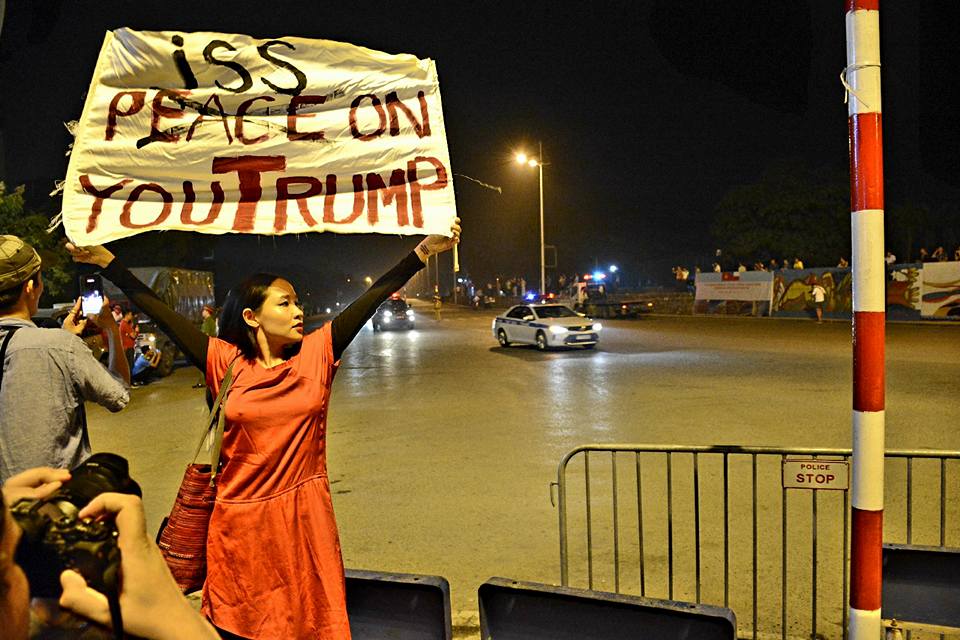
    In the late night of November 11, 2017, I saw the picture of Vietnamese singer Mai Khoi, a pro-democracy artist who has been dubbed “the Vietnamese Lady Gaga” by Western media in the past two years, holding a sign saying, “Piss on you, Trump” where the word “peace” was crossed out and written over by “piss”.

    She was protesting President Trump, who, in her words, was “a misogynistic man”, and unlike his predecessor Barack Obama, had failed to mention the critical conditions of human rights defenders in Vietnam during his trip for the APEC 2017 meetings.

    2017 marks the year that the pro-democracy movement there has experienced some of the worst crackdowns in recent times. During Trump’s visit, activists reported that they were being followed and that police guarded their houses, many also had to take refuge from their homes temporarily. Even before the trip, rumors have been circulating around that more arrests were to be made in the coming days, which worried many observers.

    Yet, for Mai Khoi’s one-person protest, I did not think much of it at first. I chuckled at her sign, and then because of the report on Twitter by American journalist Bennett Murray, who works for German media, that police had started to harass her, I became a bit worried. But still, I went to bed hoping she would not get into too many troubles with the government. She is a public figure, the police would have been a bit more careful, I thought.

    What I would never expect was to wake up the next day and found out not only that she was still being harassed by the police, but a backlash against Mai Khoi on social media in Vietnam also began. Even more perplexed was the fact that the critics not only were members of the general public or the government’s Internet trolls but also from some of the pro-democracy and pro-human rights camps inside and outside the country. And there were so many arguments being thrown around from everyone, myself included.

    Mai Khoi was criticized for protesting against Trump instead of Xi Jinping who also in Hanoi at the same time because some thought Xi is the bigger enemy of all Vietnamese. Afterall, it was China that went after our sea waters, not the U.S.

    There were people who complained that her message was too crude, or that it was not good manners to treat Trump that way. People even suspected that the Vietnamese government had allowed her to protest to make the U.S. president to “lose face.” Had she replaced the word Trump with Xi, she would have been beaten up right then and there by the Vietnamese authorities, some said.

    The worst criticism probably was about her choice of fashion. Mai Khoi was also scolded for not wearing a bra. No proper woman would dress like that, so she did not deserve the right to protest, was the explanation of one critic. Many people demanded that she must give a reason to protest Trump. Not liking Trump or just hating his guts was not good enough, they argued, we hated Xi Jinping because the Chinese took our islands, but why did you have to hate Trump? What did Trump ever do to Vietnam and Vietnamese people?

    Those who supported her simply stated that it was her right to protest and that it did not matter what her reasons were. Mai Khoi had the right to choose whom to protest against, and she did not have to offer a reason for why she picked Trump and not Xi.

    So you can see how one could come to tear her hair out, trying to understand the phenomenon, like I was. And as the events unfolding before my own eyes, with each and every Facebook status and comment of people debating over Mai Khoi’s conduct, it started to dawn on me. We, the current generation of Vietnamese, have all been scrambling for pieces of information on human rights and individual freedoms without any guiding light for so long. And as such, each person was trying to scratch the architecture of those concepts based on his or her own understanding, which may or may not be in line with the already existed international standards.

    And because the difference in understanding the very same concepts among us was so large that it seems as if everyone was fighting with each other, one way or another, about whether Mai Khoi had the right to protest the way she did. It was then that I could see why our thoughts and arguments were so different from each other, or why we had spent so much time to debate.

    But who could blame us for wanting to go through such lengthy debates to get to the bottom of our arguments with one another? We were born and raised in an extremely closed society for such a long time. And for about half of our population, it has also been two, three generations living under a one party’s rule, one way of life, where individualism was banished from society to give space to communal and collective living.

    Today, we are still living in a society that values uniformity and conformity over diversity, because our totalitarian political system controls our every single move. Worse, our ancestors also preserved a culture of obedience and filial piety and passed it on to us, where individual expressions were neither encouraged nor welcomed.

    Not only that none of us was taught about human rights and freedom in school, books on these subjects were not that easy to get printed and sold in Vietnam. We also have not experienced using suitable platforms to engage in meaningful debates or learn how to agree to disagree. Engaging in political debates was not something that we could claim we were particularly trained for.

    We had no experience living with different political views and diverse ways of life. In other words, we all thought we wanted to live in pluralistic society while in fact, we had no idea what it meant.

    The Internet was the miracle that arrived and took many of us to a different world when it introduced us to new, and at the time could have been somewhat strange to some, concepts.

    Nevertheless, instinctively, many of us knew that we wanted to experience living with the values of liberty, freedom, and individual rights. With every single aspect of our life, from our homes to our schools, from our bedrooms to our classrooms, from family life to society, being kept under a tight control, the pressure to take off the lid was unstoppable.

    And with that, in the past twenty years since the Internet was first introduced in Vietnam, each of us had slowly learned – mostly by ourselves – how to push up that lid, so that we could reach the definition of human rights and liberty that many societies had long been established as universal and common values.

    And though these values could have tasted like fresh dews in the early morning to us when we first had them, we also need to learn how not to choke on them.

    The Mai Khoi’s incident was just another example of us still learning how to best apply the definitions of individual rights and freedom in our everyday’s life. Pro-democracy activist Paulo Nguyễn Hồ Nhật Thành wrote on his Facebook this morning: “Mai Khoi (unintentionally) created a debate where both sides, for and against her, had to utilize all that they had learned in order to create their best arguments, while members of the public could watch and learn … Only by having more debatable incidents like this, could us then, as a society, truly absorb the concepts of individual rights and freedom”.

    I happen to agree with Paulo. As painful and uncomfortable as we are in having to debate with other people, including our dear friends who do not agree with us, we must continue this practice. At least, we are doing something that the generations before us were not afforded the opportunity to do so, and that is to open up dialogues and to engage each other in discussing our individual rights with our social issues as the backdrop.

    Only through practice then we can come to have a common, better, and more thorough understanding of the freedoms we are all fighting for. This, I believe, is something Vietnamese people and activists can agree on.

    We may disagree what freedom and individual rights mean, but nevertheless, we all want to have them and practice them. We may fight about what is the definition of pluralism, but there is no doubt that many of us do not want to continue living under the current one country-one leading party’s regime.