Blog

  • Vietnamese Vision Of A “Clean Newspaper” And The Government’s Intolerance To Press Freedom

    Vietnamese Vision Of A “Clean Newspaper” And The Government’s Intolerance To Press Freedom

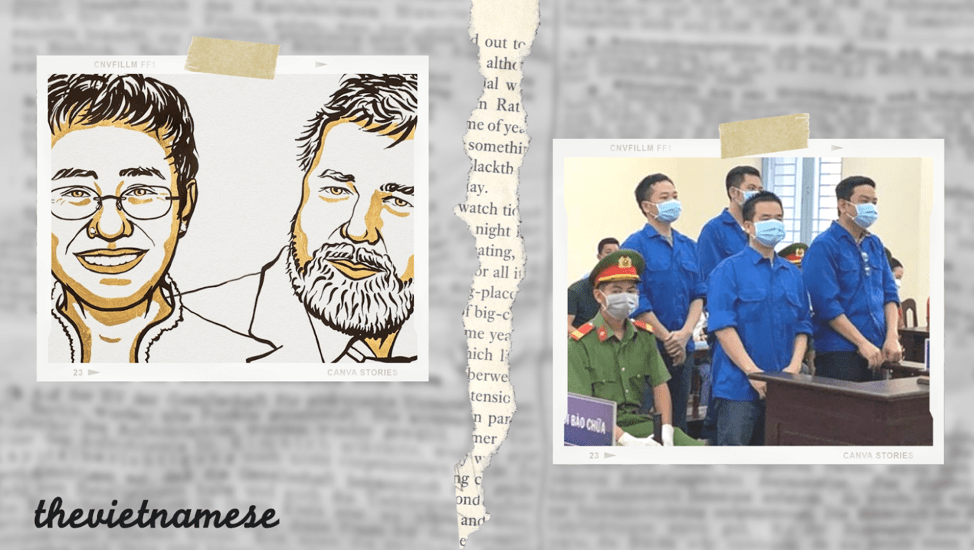
    This year as the world triumphs the importance of free speech with the award of the Nobel Peace Prize to two journalists, Maria Ressa and Dmitry Muratov, for their “efforts to safeguard freedom of expression,” Vietnam has taken a step backward in its respect for press freedom by arresting and imprisoning independent journalists.

    On October 26, the local Court of Can Tho City began to try five members of the Bao Sach (Clean Newspaper) group, a Facebook-based journalism project, for allegedly “abusing the rights to freedom and democracy” that the government deemed “threatening” to state interests and security. Two days later, on October 28, five members of Bao Sach were sentenced to a total of 14 years and six months in prison.

    Meanwhile, the Court of Hanoi City is also expected to try prominent journalist Pham Doan Trang for “propagandizing against the Socialist Republic of Vietnam;” the evidence used to prosecute Doan Trang includes her written reports and assessment regarding environmental issues, the human rights situation, and religious freedom in Vietnam.

    In some ways, when we congratulate the two journalists who were awarded the prestigious Nobel Peace Prize in 2021, Maria Ressa of the Philippines and Dmitry Muratov of Russia, we also feel saddened to think about the Bao Sach members and Pham Doan Trang. These Vietnamese journalists have been facing never-ending hurdles reporting the truth under the repressive hands of authoritarian leaders.

    Vision for a better journalistic environment in Vietnam

    Established in 2019, Bao Sach started off as a Facebook-based project which investigated and reported on the alleged corruption and misconduct of Vietnamese government officials and state-owned companies. Corruption and mismanagement are ubiquitous in Vietnam’s governance system. The project quickly attracted a substantial number of followers in its fan page on Facebook, as the role of the social network in Vietnam is similar to its neighbor, the Philippines, where it is essentially viewed as the Internet.[1]

    The journalistic group’s name, Clean Newspaper, refers to its commitment to journalism ethics by truth and impartiality rather than becoming another mouthpiece of the Communist government. Bao Sach gained popularity through its fact-based and accurate reporting that helped expose and provide insights into the many social issues to which the Vietnamese public pay attention, most notably the case of Ho Duy Hai, who was given the death penalty in an unfair trial.

    However, being a vocal critic in a tightly controlled media environment comes with a cost. Not much different from what Rappler Founder Maria Ressa [2] faced as a journalist in the Philippines, independent journalists, and human rights activists in Vietnam also live in constant fear of harassment by government-funded online trolls and arbitrary arrests and charges under vague laws, which have no purpose other than to curb freedom of expression.

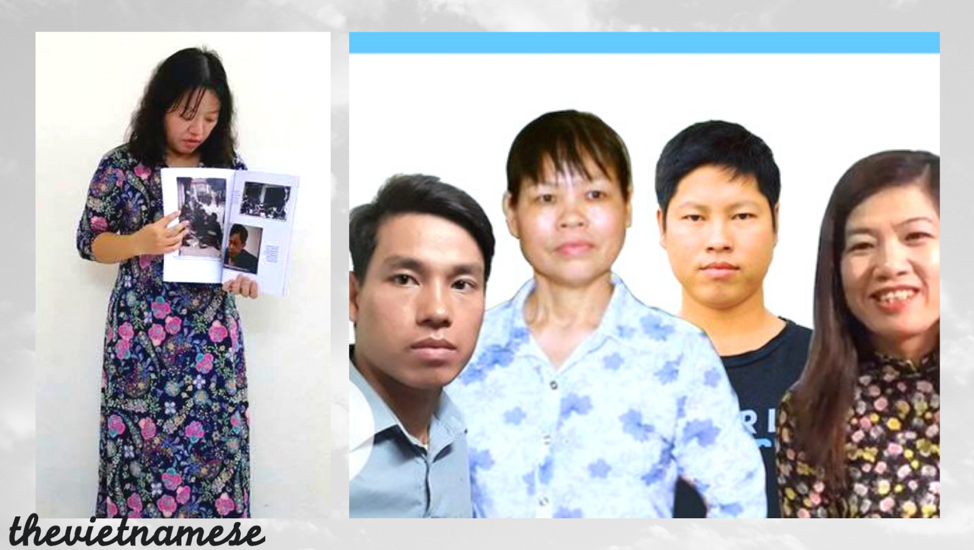
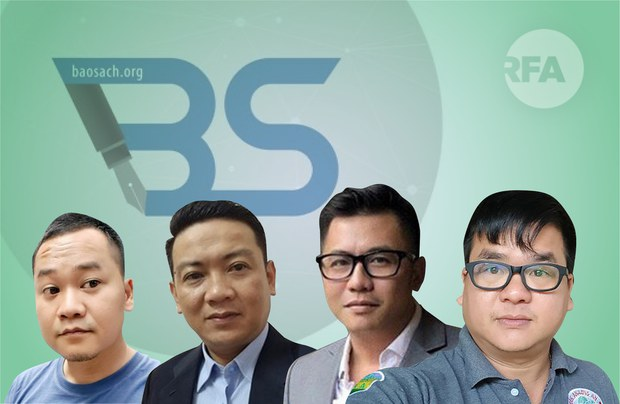
    Bao Sach’s (Clean Newspaper) members. Photo: RFA.

    Late last year, Truong Chau Huu Danh, one of the co-founders of Bao Sach, was arrested by the police, which marked the end of one of the promising independent media projects in Vietnam. Bao Sach’s Facebook page was shortly suspended after Danh’s apprehension; three members were arrested earlier in April this year.

    Subsequently, they were charged with “abusing the rights to freedom and democracy to infringe on state interests” under Article 331 of Vietnam’s 2015 Penal Code, which has been strongly criticized [3] by the international community and legal authorities for its vagueness and lack of clear definitions of the actual conduct.

    Similarly, Doan Trang’s vision [4] of a journalism project to provide Vietnamese people with an understanding of law, politics, and human rights also led to her arrest and detention. She was charged with “propagandizing against the State,” another criminal charge commonly used by the Vietnamese government to suppress dissenting opinions in the country.

    The Vietnamese government’s intolerance to press freedom

    Nevertheless, the Bao Sach members and Doan Trang are among dozens of independent reporters, journalists, and broadcasters constantly harassed or detained by the Communist authorities. Critical reporting of online bloggers and live-streamers also meets with increasing censorship as Facebook, Vietnam’s most popular social media site has in recent years reportedly complied with the government to remove “anti-state” posts. According to local activists and free-speech advocates, [5] the tech giant’s compliance is giving the Vietnamese authorities “near-total control over the platform.”

    Despite the Vietnamese Communist Party trying to boast and propagandize [6] about its state of press freedom and its respect for human rights, Vietnam scores poorly on almost every international ranking regarding press freedom and fundamental civil rights.

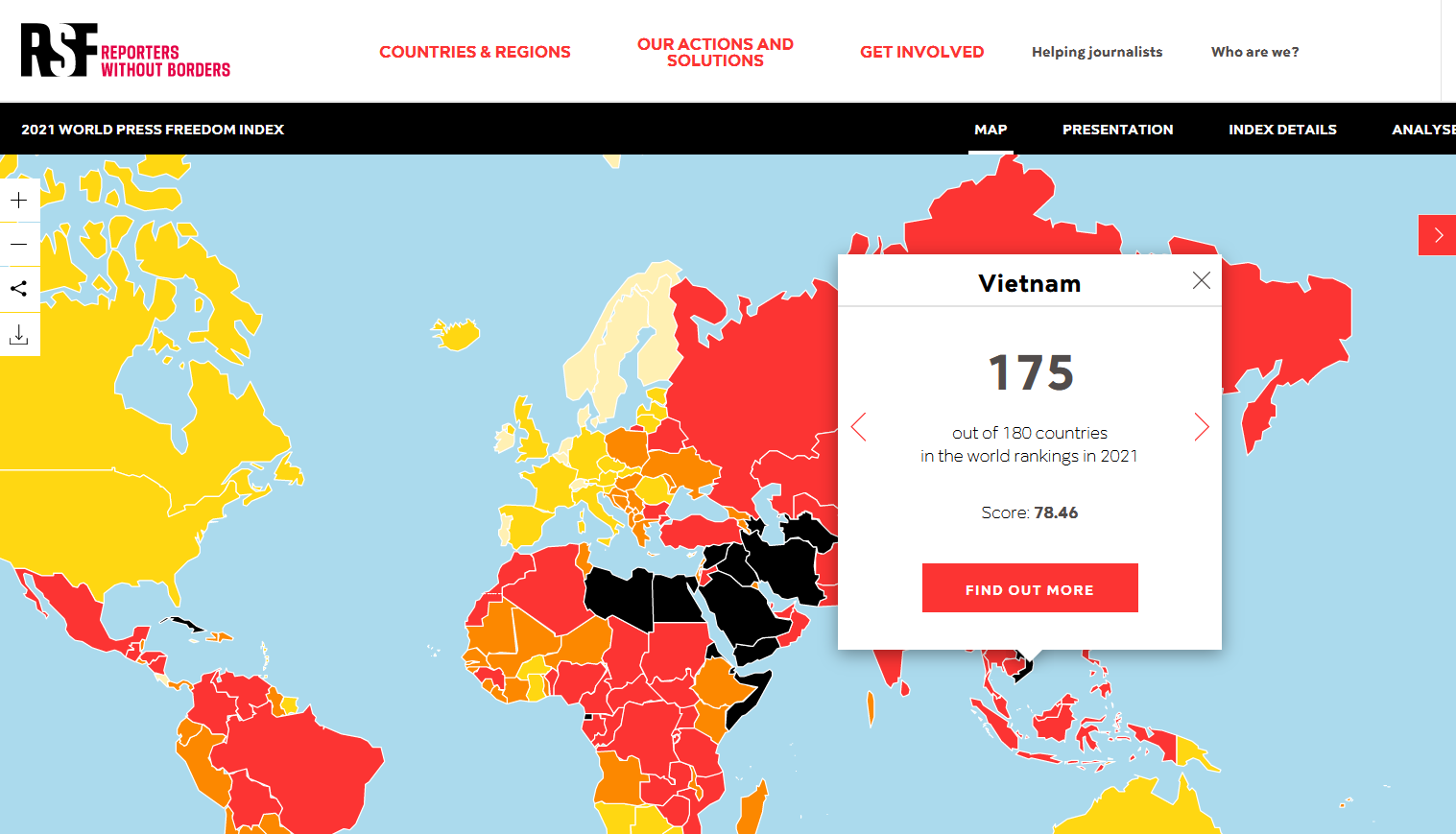
    Vietnam ranks [7] at 175th out of 180 countries on the 2021 World Press Freedom Index from Reporters Without Borders in terms of free press. It is also among those countries with the highest number of detained journalists, according to figures [8] compiled by the Committee to Protect Journalists (CPJ) in 2020.

    Vietnam ranks 175th out of 180 countries in terms of press freedom. Photo: screenshot/ Reporters Without Borders.

    On civil rights, Freedom House, a non-partisan organization working to promote freedom and democracy, declared that Vietnam was “not free” when it comes to internet freedom. The Vietnamese government later criticized the results, allegedly requesting Freedom House to “stop making groundless assessments” [9] on the situation of internet freedom in the country. However, the government failed to provide concrete evidence to explain its alleged repression of internet users’ rights, other than a few fragmented pieces of information bragging about the country’s growth in internet users and its Human Development Index.

    The journey to a truly free, progressive, and independent media environment in Vietnam is still long and arduous, given the arbitrary arrests of independent journalists in recent years and an increasingly restricted social media space. However, if Prime Minister Pham Minh Chinh wants to realize his pledge [10] to “listen to dissenting opinions [and] debates,” then Vietnam must respect freedom of the press and allow journalists to express their viewpoints freely. It would also contribute to the long-term development of both Vietnam as a country and its journalistic environment.

    References:

    1. Vick, K. (2021, October 8). “It Is a Battle for Facts.” What Nobel Peace Prize Winner Maria Ressa Understands About Why She Was Chosen. Time. https://time.com/6105407/maria-ressa-nobel-prize-interview/
    2. Andrew Yeo, Enrico Gloria. (2021, October 21). In a first, the Nobel Peace Prize went to a Filipina. Her government isn’t happy. The Washington Post. https://www.washingtonpost.com/politics/2021/10/21/first-nobel-peace-prize-went-filipina-her-government-isnt-happy/
    3. The Vietnamese Magazine. (2021, October 26). Statement On The Upcoming Trial Of Bao Sach (Clean Newspaper). The Vietnamese Magazine. https://www.thevietnamese.org/2021/10/statement-on-the-upcoming-trial-of-bao-sach-clean-newspaper/
    4. Tran Phuong, Will Nguyen. (2021, February 14). Who Is Pham Doan Trang? The Vietnamese Magazine. https://www.thevietnamese.org/2021/02/who-is-pham-doan-trang/
    5. Elizabeth Dwoskin, Tory Newmyer, Shibani Mahtani. (2021, October 25). The case against Mark Zuckerberg: Insiders say Facebook’s CEO chose growth over safety. The Washington Post. https://www.washingtonpost.com/technology/2021/10/25/mark-zuckerberg-facebook-whistleblower/
    6. Đối diện: Nhân quyền. (2021, October 27). VTV. https://vtv.vn/video/doi-dien-nhan-quyen-527961.htm
    7. Vietnam – Reporters Without Borders. (n.d.). Reporters Without Borders. Retrieved October 28, 2021, from https://rsf.org/en/vietnam
    8. Record number of journalists jailed worldwide. (2020, December 15). Committee to Protect Journalists. https://cpj.org/reports/2020/12/record-number-journalists-jailed-imprisoned/
    9. VNA, (2021, September 29). Freedom House should stop making groundless assessments on internet freedom in Vietnam. VietnamPlus. https://en.vietnamplus.vn/freedom-house-should-stop-making-groundless-assessments-on-internet-freedom-in-vietnam/208842.vnp
    10. Tuan, V. (2021, April 15). Thủ tướng Phạm Minh Chính: “Chính phủ phải lắng nghe ý kiến phản biện.” VnExpress. https://vnexpress.net/thu-tuong-pham-minh-chinh-chinh-phu-phai-lang-nghe-y-kien-phan-bien-4263570.html
  • Pham Doan Trang’s Trial Postponed While UN Working Group On Arbitrary Detention Called For Her Immediate Release

    Pham Doan Trang’s Trial Postponed While UN Working Group On Arbitrary Detention Called For Her Immediate Release

    Vietnam arrested Pham Doan Trang on October 7, 2020, and charged her under Article 88 of its 1999 Penal Code for allegedly “making, storing, distributing or disseminating information, documents, and items against the Socialist Republic of Vietnam.” Her trial was originally scheduled to take place on November 4, 2021, but the court postponed her trial due to the prosecutors having come into contact with COVID-19.

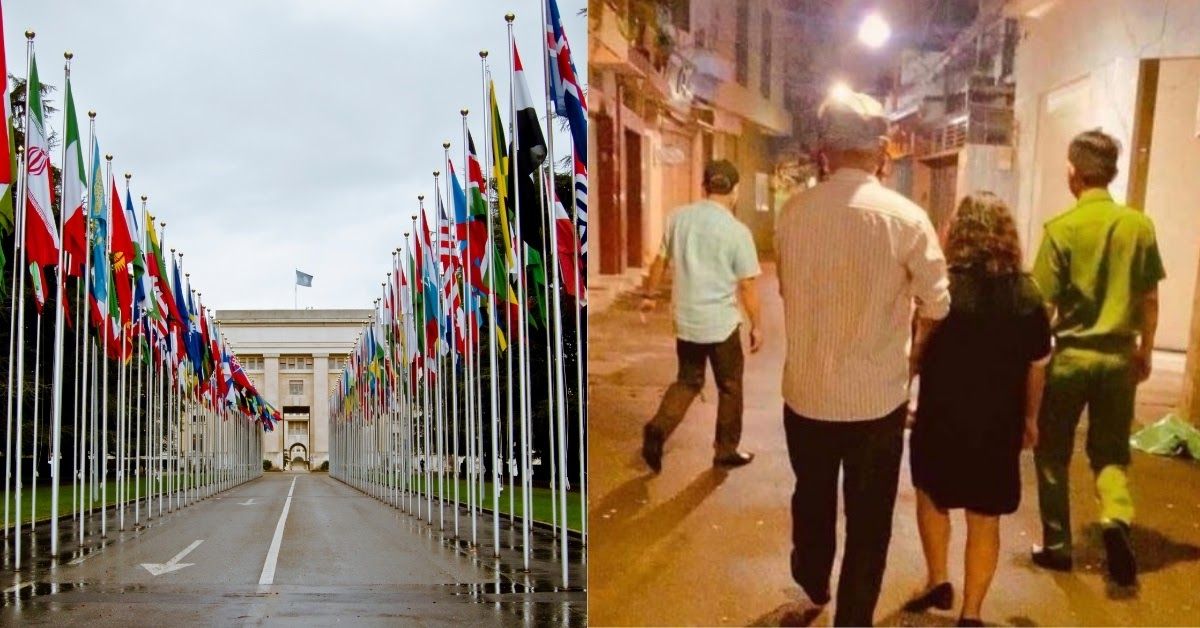
    However, on October 25, 2021, the United Nations Working Group on Arbitrary Detention (WGAD), a team of five independent experts tasked with investigating “cases of deprivation of liberty imposed arbitrarily or inconsistently with the international standards set forth in the Universal Declaration of Human Rights,” released their opinions regarding the arrest, detention, and treatment by the Vietnamese state of internationally recognized independent journalist and human rights defender Pham Doan Trang.

    In this document, WGAD scrutinizes the formal statements given by the side of Doan Trang and that of the Vietnamese government in order to verify the authenticity of the claims regarding her situation in custody and to provide recommendations for the Vietnamese government.

    WGAD also stated that even though the Vietnamese government vehemently rejects the accusations alleged by the side of Doan Trang and that “[the Vietnamese government] cannot provide detailed information regarding this case to the press and other irrelevant parties,” WGAD will still continue with its investigation as part of its mandate “to serve the needs of victims of arbitrary arrest and detention worldwide.”

    WGAD concluded that “the deprivation of liberty of Pham Doan Trang, being in contravention of articles 2, 6, 7, 8, 9, 11, 19, 20 and 21 of the Universal Declaration of Human Rights and articles 2, 9, 14, 15, 16, 19, 21, 22, 25 and 26 of the International Covenant on Civil and Political Rights, is arbitrary and falls within categories I, II, III, and V.”

    Regarding Doan Trang’s arrest by state forces, WGAD believes that the Vietnamese authorities failed to present a warrant for her arrest and that Doan Trang was not informed of the charges lodged against her. She was also never brought before an independent judicial authority in order to challenge her detention.

    Likewise, WGAD upholds that Doan Trang was put under Incommunicado Detention which “is an environment conducive to torture and cruel inhumane treatment, as it may be used to coerce the individual to confess to the commission of the alleged crimes and admit guilt.” Furthermore, WGAD states that the initial charge under Article 117 of the Vietnamese Criminal Code is “so vague that it is impossible to invoke a legal basis for her detention.” Hence, WGAD concludes that the Vietnamese government failed to establish a legal basis for Doan Trang’s arrest and detention.

    WGAD also believed that she was detained for “peacefully exercising her rights to freedom of opinion, expression, and association.”. As such, it has referred this case to the Special Rapporteur on the promotion and protection of the right to freedom of opinion and expression and to the Special Rapporteur on the rights to freedom of peaceful assembly and of association.

    WGAD also stated that because Doan Trang was not allowed to speak to her defense lawyers until recently, and was denied legal counsel, her right to a fair and just trial has been violated.

    Likewise, WGAD found that Doan Trang was “deprived of her liberty on discriminatory grounds” due to her being a vocal human rights defender and because of her political stance and opinions.

    In light of all the information presented, WGAD requests that the Vietnamese government take all the necessary steps needed in order to remedy Doan Trang’s situation in order to “bring it into conformity with the relevant international norms.”

    WGAD believes that the best remedy would be to urgently and immediately release Doan Trang and compensate her in accordance with international law. WGAD also urges the Vietnamese government to ensure a “full and independent investigation” of Doan Trang’s arbitrary detention and to “take appropriate measures against those responsible for the violation of her rights.”


    The UN WGAD’s full statement can be found here

  • LIV Joins 27 Other NGOs In Issuing A Joint Statement Demanding The Immediate Release Of Pham Doan Trang

    LIV Joins 27 Other NGOs In Issuing A Joint Statement Demanding The Immediate Release Of Pham Doan Trang

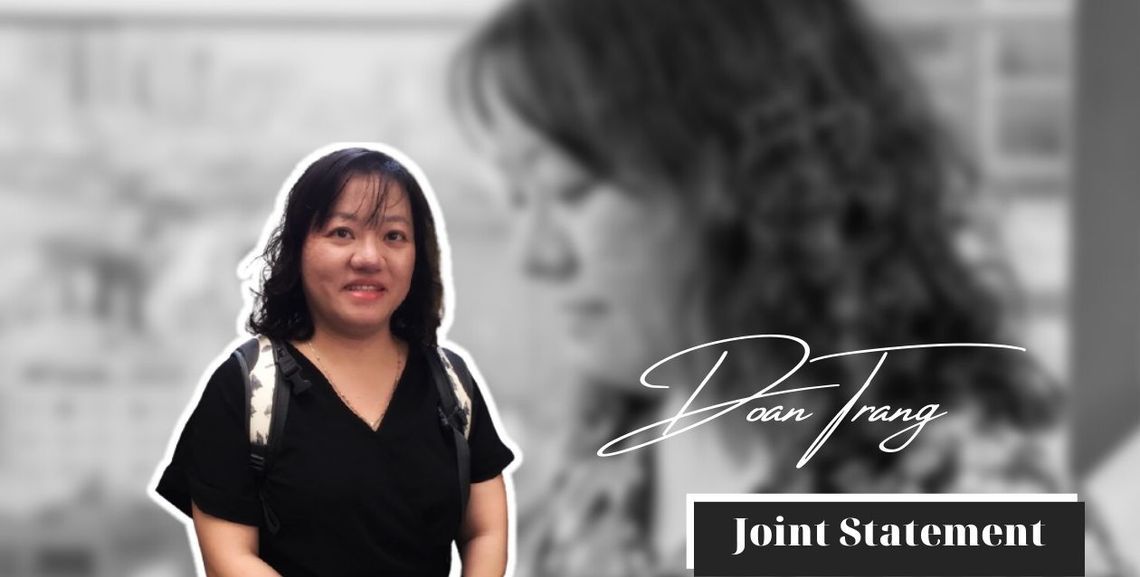
    OCT 26 2021– Legal Initiatives for Vietnam (LIV), alongside 27 other non-governmental organizations (NGOs) released a joint statement calling for the immediate release of independent journalist and human rights advocate, Pham Doan Trang. Trang, one of the “best-known independent writers in Vietnamese civil society” who is also “recognized internationally for her human rights advocacy,” was arrested at her home in Ho Chi Minh City on October 7, 2020. She is currently being charged under Article 88 of the 1999 Penal Code which criminalizes ‘making, storing, distributing or disseminating information, documents, and items against the Socialist Republic of Vietnam.’

    The statement comes ahead of Trang’s upcoming trial which is scheduled to take place on November 4, 2021. However, information about her trial was only made public on October 18, 2021, more than a year after her arrest.

    The joint statement claims that Pham Doan Trang’s persecution is due to her “long-standing work as an independent journalist, book publisher, and human rights defender, known for writing about topics ranging from environmental rights to police violence, as well as for her advocacy for press freedom.”

    Since her arrest, she has also been held incommunicado and has been denied contact with her family and her lawyers, only being allowed to get in touch with them on October 19, 2021, a day after the public announcement of her trial. Trang’s lawyer also notes that his client’s legs, which were broken in the past by the police in 2015, were in greater pain due to Trang being denied adequate medical care during her detention; she has also lost a lot of weight and has not been allowed to see any doctors to treat her other pre-existing medical conditions.

    In light of this information, LIV and its allies unanimously call for the Vietnamese government to:

    • Immediately and unconditionally release and drop all charges against Pham Doan Trang and all other human rights defenders currently imprisoned solely for the peaceful exercise of their human rights and fundamental freedoms;
    • Pending her immediate and unconditional release, guarantee humane treatment and conditions, and ensure prompt access to medical attention;
    • Guarantee Doan Trang unrestricted access to and regular communication with her family and confidential access to legal assistance of her choosing;
    • Ensure that her chosen lawyers are promptly provided with timely access to all relevant legal documentation and granted unrestricted communication and access in confidentiality with Doan Trang and adequate time and facilities to prepare for her defense;
    • Ensure the trial is open to the public, including diplomatic and human rights civil society observers and the media, and refrain from any arbitrary restriction on travel or interference of trial observers, media, and civil society preceding and during the trial;
    • Repeal or substantially amend the Penal Code and other non-human rights compliant legislation, used to harass and imprison individuals—including independent journalists and human rights defenders—for the exercise of their fundamental rights, and bring them in conformity with the International Covenant on Civil and Political Rights to which Vietnam has been a State Party since 1982, and other applicable international law and standards.

    ———-

    The full English text for the joint statement can be found here.

    The Vietnamese language version can be found here.

  • Statement On The Upcoming Trial Of Bao Sach (Clean Newspaper)

    Statement On The Upcoming Trial Of Bao Sach (Clean Newspaper)

    Legal Initiatives for Vietnam (LIV) – the operator of Luat Khoa Magazine and The Vietnamese Magazine – strongly condemns the Vietnamese government for criminalizing the activities of Bao Sach (Clean Newspaper) and the five members of the group.

    Vietnam prosecuted the Bao Sach group members under Article 331 of the 2015 Penal Code (the revision of Article 258 of the 1999 Penal Code). The international community and legal authorities have strongly criticized these two penal codes because they arbitrarily criminalize the act of “abusing democratic freedoms to infringe upon the interests of the State, lawful rights and interests of organizations and/or citizens” without defining the actual conduct of the offense. Previous cases being prosecuted under Articles 331/258 – including this Bao Sach case – illustrate that Vietnam criminalizes certain acts and conduct that should have been in the jurisdiction of the civil court system.

    We declare that the investigation, arrest, and prosecution of the members of Bao Sach show that Vietnam violates its citizens’ freedom of speech, free press, and economic freedoms. When we read the formal indictment against Bao Sach members, we can clearly see that even if these members have infringed upon the interests of the State, another individual, or another entity, the legal issue should be under the civil court system or a judicial arbitration rather than prosecuting them criminally.

    A person being silenced, a newspaper, or a media organization being closed down arbitrarily is a danger for any society. As a non-profit organization that works in journalism, LIV strongly condemns these violations that Vietnam commits and demands that the government release immediately and unconditionally all of the Bao Sach members and cease all of the criminal allegations against them.

    We also call on other journalists and the public in general to join with us and support the rights and freedoms of all of the Bao Sach group members and demand Vietnam abolish Article 331 of the 2015 Penal Code.

    Trinh Huu Long, Co-Director

    Tran Quynh Vi, Co-Director

  • Vietnam Briefing: Indictment Against Journalist Pham Doan Trang Made Available; Vietnam Arrests Another Facebook User For Criticizing Its COVID-19 Policy

    Vietnam Briefing: Indictment Against Journalist Pham Doan Trang Made Available; Vietnam Arrests Another Facebook User For Criticizing Its COVID-19 Policy

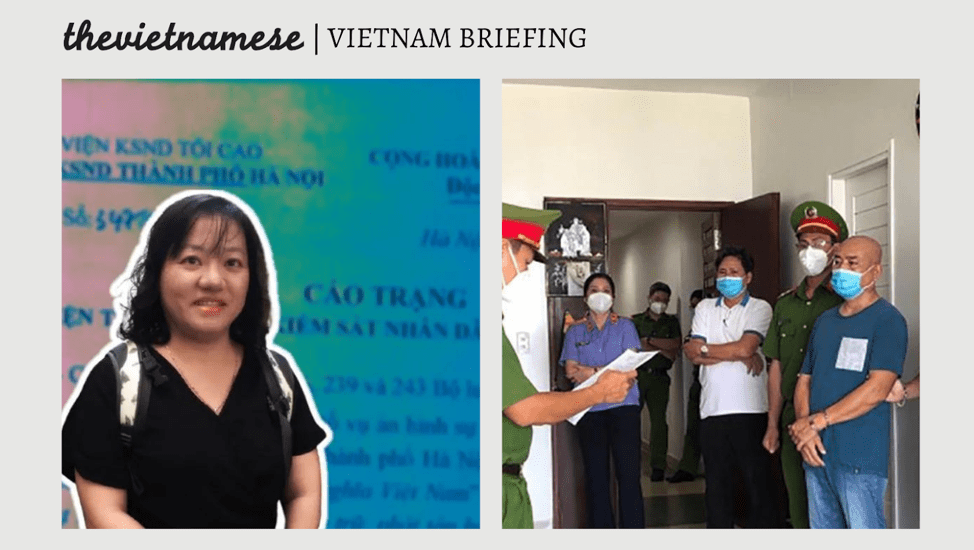
    The formal indictment against journalist Pham Doan Trang made available for public, reports The Vietnamese Magazine

    Main points:

    • According to the indictment, the investigation was done between September 22, 2016 and October 7, 2020, which was also the day that the authorities arrested Doan Trang.
    • Doan Trang refused to provide the police with her laptop password and so the police could not access its data. She also refused to acknowledge her possession of the Facebook account named “Pham Doan Trang,” and therefore the investigative unit could not charge her in connection with the information posted via that account on social media.
    • Doan Trang acknowledged that she was one of the authors of the “Report Assessment of the 2016 Law on Belief and Religion in Relation to the Exercise of Freedom of Religion and Belief in Vietnam” in both English and Vietnamese. This report was published on the website of Luat Khoa Magazine.
    • As of the conclusion of the investigation into Doan Trang’s case on August 26, 2021, the authorities had not yet found any evidence to reduce her punishment.
    • The indictment stated that both the 1999 Penal Code and the 2015 Penal Code (which took effect on January 1, 2018) could be used to prosecute Doan Trang since she continued her unlawful conduct from 2017 to 2019. However, the government dropped charges under Article 117 and only prosecuted Doan Trang under Article 88 because it stated that Doan Trang did not provide any statement during her interrogations.
    • The 1999 Penal Code would be more beneficial to the defendant since Article 88 of that penal code starts the sentence at 3 years imprisonment versus 5 years imprisonment under Article 117 of the 2015 Penal Code.

    Evidence and final indictment:

    • English documents titled “A brief report on marine life disasters in Vietnam” and “General Assessment of the human rights situation in Vietnam;”
    • English and Vietnamese versions of the “Report Assessment of the 2016 Law on Belief and Religion in Relation to the Exercise of the Right to Freedom of Religion and Belief in Vietnam;”
    • Two interviews with Pham Doan Trang by BBC News Vietnamese and Radio Free Asia – Vietnamese (RFA) in 2018.
    • The Hanoi People’s Procuracy Office prosecuted Doan Trang under Article 88, Section 1, subsections a, b, and c for “propagandizing against the Socialist Republic of Vietnam” of the 1999 Penal Code. The sentencing for this crime will be three to 12 years imprisonment.

    Pham Doan Trang’s lawyers and family raise concerns over the deterioration of her health while in custody

    • On October 19, 2021, Le Van Luan, one of Pham Doan Trang’s defending attorneys, announced on social media that he had a formal meeting with his client and subsequently raised concerns about her deteriorating health conditions after a year of detention while pending trial. However, he said that she still maintains an optimistic and percipient mentality.
    • In his Facebook post, Luan shared that Doan Trang had lost 10 kilograms (around 22 pounds) over the past year due to suffering ovarian cysts and menorrhagia, a condition which has caused her periods to last as long as 15 days. The long periods and her low blood pressure have resulted in constant fatigue. According to Trang, the changing cold weather also made her legs feel painful; her legs were broken when she was attacked by security forces a few years ago. Trang said she had not received proper medical checkups or treatment while in custody.
    • On October 20, 2021, Doan Trang’s lawyers co-wrote a petition that they sent to the Hanoi authorities, requesting that they confirm the state of her declining health conditions and assist her with proper medical checkups and treatment. On October 22, Pham Chinh Truc, Doan Trang’s brother, sent an urgent petition regarding her health issues to the detention facility, demanding the officials in charge provide her with urgent medical care as well as improve her conditions in detention. Truc also requested the Hanoi authorities allow her a family visitation this October, followed by regular visitations every two weeks afterwards.

    Trinh Ba Phuong’s wife could not have visitation with him

    As we have previously published, the trial of two Duong Noi farmers, Trinh Ba Phuong and Nguyen Thi Tam, will be on November 3, 2021. They are both charged under Article 117 of the 2015 Penal Code for “propagandizing against the Socialist Republic of Vietnam.” The 88 Project reported on October 25, 2021, that Trinh Ba Phuong’s wife, Thu Do, could not have visitation with him even the Hanoi’s People Court had allowed her.

    Accordingly, Thu Do received a letter from the Hanoi’s People Court informing her that she could visit her husband on October 21. “But when she got to the prison, she was turned away by prison officials who told her she could not see him due to COVID-19. When she asked to see the official paperwork with that decision, they produced an old order from April. They also refused to give her an explanation on paper. She has sent a complaint to the Court and the Ministry of Public Security about this and vowed to return next week,” The 88 Project stated.


    Detained blogger Bui Van Thuan’s family expresses concerns over his possible torture in detention

    RFA reports:

    • On October 15, Trinh Thi Nhung, Bui Van Thuan’s wife, received a notice from Thanh Hoa Province detention center, where Thuan is being held, regarding her husband’s health. The authorities informed Nhung that her husband had been admitted to a hospital for treatment of possible development of gout, liver infection and plantar fasciitis.
    • However, Nhung expressed concerns that Thuan might have been tortured while in custody since her husband has always had good health. The detention center officials declined to provide further information.
    • Bui Van Thuan was arrested on August 30, 2021 by Thanh Hoa Province police, just after U.S. Vice President Kamala Harris’ visit to Vietnam, where she raised concerns about human rights issues in the country. He was charged with “storing publications and materials against the Socialist Republic of Vietnam” under Article 117 of Vietnam’s Penal Code.

    Vietnamese Facebook user arrested for posting “distorted information on COVID-19 policy”

    VOA Vietnamese reports:

    • Vietnamese police in the city of Vung Tau arrested a Facebook user on October 21 for posting and sharing “false information on COVID-19 prevention policy” on his social media account.
    • Nguyen Thien Nghia, 50, was allegedly accused by the local public security department of posting “fabricated, false and distorted information on the government’s COVID-19 prevention policy.” His posts were seen criticizing the Ho Chi Minh City authorities’ coronavirus policies and the activities of Vietnamese Fatherland Front, a state-controlled political mass organization, for its fiscal misconduct and lack of support for the citizens financially affected by the COVID-19 pandemic.
    • He was detained and prosecuted under Article 179 of the Penal Code for “illegally transferring or utilizing information of computer and telecommunications networks.” Nghia is among dozens of people who were fined or prosecuted for criticizing the Vietnamese government regarding its controversial coronavirus policies.

    Bao Sach (Clean Newspaper) group’s trial is expected to begin on October 26

    • Last week, several state-run news outlets, including the military-owned People’s Army Newspaper, reported that the trial against the Bao Sach group, an independent journalism project, was expected to begin on October 26. Previously, the trial was due on October 12, but was subsequently postponed due to Vietnam’s COVID-19 pandemic situation.
    • Bao Sach members, including the former state journalist Truong Chau Huu Danh, were indicted last September by the People’s Procuracy of Can Tho City on charges of “abusing the rights to freedom and democracy to infringe on state interests” under Article 331 of Vietnam’s 2015 Penal Code.

    COVID-19 situation in Vietnam

    • Vietnamese prime minister promises economic revival after the COVID-19 pandemic, reports Reuters. On October 20, Prime Minister Pham Minh Chinh told the National Assembly that Vietnam’s economy would rebound after the pandemic ended, with exports expected to rise 10.7 percent in 2021 and with annual inflation expected to fall below 4 percent. His statement came as a fast-spreading outbreak of the Delta variant led to mass lockdowns in the country’s key industrial provinces, causing disruptions in supply chains and labor shortages.
    • Vietnam resorts to China’s vaccine diplomacy supplies to ease COVID-19 infections in Ho Chi Minh City, despite reluctance from residents, writes Nikkei Asia: “China has announced donations of 5.7 million doses of its Sinopharm vaccine. The shot is not the preferred one for many Vietnamese, but it is helping to fill local supply gaps and is playing an increasing role in Vietnam’s inoculation campaign, which started later than those in some other countries.”
    • Vietnam’s labor paradox: Manufacturing industry caught in labor shortage problem after COVID-19 restrictions force workers to rush back to their hometowns, writes Nikkei Asia: “The summer brought pandemic-driven lockdowns to much of the country, which had forced workers to sleep at factories and prevented travel between provinces. As soon as officials pulled the barricades and barbed wire off the roads, tens of thousands of migrants rushed back to their hometowns.”
    • The 2021 Southeast Asian Games (SEA Games), which were planned to be held in Vietnam in November, have been postponed until 2022 due to the spread of COVID-19, reports the South China Morning Post. The biennial multi-sport event will be held in Hanoi during an unspecified two-week period in May, 2020.

    Satellite imagery shows Vietnam’s construction and land-filling in disputed Spratly islands

    RFA reports:

    • Commercial satellite imagery shows that Vietnam appears to be doing new construction and land-filling on the remote Pearson Reef, which it has occupied since 1978, and which it had previously reclaimed about six acres of land there.
    • The imagery, which was taken by Planet Labs on Friday, shows new work has been underway at the southern tip of the northern part of the reef when compared with a picture from March. The difference is even clearer when compared with an image from June 2020.
    • Pearson Reef is classified by the Washington D.C.-based Asia Maritime Transparency Initiative (AMTI) as a rock, 300 nautical miles east of Cam Ranh in central Vietnam. In Vietnamese, it bears the name of Phan Vinh, after Nguyen Phan Vinh, a hero soldier who died in 1968 during the Vietnam War.
    • On October 21, state media quoted a Vietnamese Ministry of Foreign Affairs spokeswoman as saying that Vietnam adheres to international law and principles of peace, stability and cooperation regarding the South China Sea disputes. The statement came after Chinese state media CGTN publicly released footage on October 19 showing its military exercises in the disputed waters between two countries.

    Vietnam Insight: Learn more about Vietnam

    What’s Next for Indonesia-Vietnam Defense Relations?

    The Diplomat/ Prashanth Parameswaran/ October 20

    “Both countries [Indonesia and Vietnam] also addressed the future issues that they should prioritize in advancing their defense ties. According to the official account of the deliberations, these included areas such as technical cooperation between their coast guards, the development of military medicine amid the continued challenge of COVID-19, and other training exercises and high-level delegation exchanges. Indonesia’s defense ministry also highlighted the participation of defense industry companies in the virtual meeting, spotlighting an aspect that Jakarta has emphasized previously in defense ties.”

    Vietnam’s Economic Reopening: Finding the Right Balance

    Fulcrum/ Tuan Ho/ October 18

    “This presents Vietnam with the challenging task of ‘finding the right balance’ in its economic reopening process. On the one hand, Vietnam needs to ease social distancing measures as much as possible to revitalise the economy, which has been hard hit by the fourth wave of Covid-19 since late April.  Vietnam’s GDP contracted 6.2 percent in the third quarter, the largest quarterly decline recorded since 2000. The Asian Development Bank (ADB) has lowered Vietnam’s GDP growth forecast to 3.8 percent in 2021, a drop of 2 percentage points from a previous estimate made in July. Nguyen Kim Anh, the deputy governor of the State Bank of Vietnam, has warned that banks’ non-performing loans could reach between 7.1 and 7.7 percent of total outstanding loans, almost twice the estimate of 3.8 percent at the end of 2020. Further delays to full reopening will impede economic recovery and put further stress on the banking system.”

    Pacific Nations Have an Interest in Challenging China’s Expansive Maritime Claims

    The Diplomat/ Phuong Vu/ October 18

    “This is where small and non-claimant states, which benefit the most from a law-based international order in general and UNCLOS in particular, matter.  If they fail to form a consensus that views the South China Sea disputes and China’s interpretation of the law as a national threat, the repercussions will not stop at the water’s edge of current claimants such as Vietnam, the Philippines, Indonesia, Malaysia or Brunei. Small coastal and archipelagic states will incur expensive long-term costs for inaction. Through inaction, small states can effectively pave the way for a future where China will interpret the law for them.”

  • Pham Doan Trang’s Indictment Is Public Today; What Do We Know About Her Case?

    Pham Doan Trang’s Indictment Is Public Today; What Do We Know About Her Case?

    The indictment against journalist and democracy activist Pham Doan Trang was made public on October 18, Vietnam time. We are summarizing the main issues from the 15-page indictment, which you can read here in Vietnamese.

    The main points of the indictment are:

    • The indictment stated that the investigation was done between September 22, 2016 and October 7, 2020. October 7, 2020 was also the day that the authorities arrested Doan Trang.
    • The Department of Cyber Security and High Tech Crimes under the Ministry of Public Security (MPS), the national police in Vietnam, petitioned the investigation department to pursue legal proceedings against Doan Trang on May 4, 2020 and October 7, 2020 and included its documents and materials against her.
    • The Department of Information and Communications of Hanoi City also submitted two petitions with documents and materials to the MPS on December 26, 2017 and January 7, 2019, requesting legal proceedings against Doan Trang.
    • The Investigation Unit of Hanoi City’s Police formally opened the investigation on September 10, 2020.
    • The decision to initiate criminal proceedings against Doan Trang was issued on September 28, 2020.
    • Doan Trang was arrested under a warrant on October 7, 2020 in Ho Chi Minh City.
    • She refused to provide her laptop’s password to the police and accordingly, the police could not access its data.
    • She also refused to acknowledge the Facebook account of the name “Pham Doan Trang” belonged to her, and the investigative unit could not charge her for the information posted via that account on social media.
    • Doan Trang acknowledged that she was one of the authors of the “Report Assessment of the 2016 Law on Belief and Religion in relation to the exercise to Freedom of Religion and Belief in Vietnam” in both English and Vietnamese. This report was published on the website of Luat Khoa Magazine.
    • On February 19, 2021, the Authority of Information Security (under the Ministry of Information and Communications) submitted a document to the investigative unit which stated that it could not determine who owned and managed the domain name luatkhoa.org to pursue further legal proceedings against it.
    • The indictment stated that Doan Trang repeatedly committed unlawful conduct which can be used to increase her punishment.
    • The indictment also did not find any facts to reduce the punishment against her.
    • The investigation of her case was concluded on August 26, 2021.
    • The indictment stated that Doan Trang continued her unlawful conduct from 2017 to 2019 so both the 1999 Penal Code and the 2015 Penal Code (which took effect on January 1, 2018) could be used to prosecute her.
    • However, the indictment also stated that Doan Trang did not confess to any of these crimes and that the 1999 Penal Code would be more beneficial to the defendant since Article 88 of that penal code starts the sentence at 3 years imprisonment versus 5 years imprisonment under Article 117 of the 2015 Penal Code. Therefore, the government dropped charges under Article 117 and only prosecuted Doan Trang under Article 88.

    The Evidence against Pham Doan Trang under the indictment:

    • English document named “Brief report on the marine life disaster in Vietnam”;
    • English document named “General Assessments of the human rights situation in Vietnam”;
    • English and Vietnamese versions of the “Report Assessment of the 2016 Law on Belief and Religion in relation to the exercise of the right to Freedom of Religion and Belief in Vietnam”;
    • Two interviews with Pham Doan Trang by BBC News  Vietnamese and Radio Free Asia – Vietnamese (RFA) in 2018.

    Formal indictment:

    The Hanoi People’s Procuracy Office prosecuted Doan Trang under Article 88, Section 1, subsections a, b, and c for “propagandizing against the Socialist Republic of Vietnam ” of the 1999 Penal Code. The sentencing for this crime will be 3 to 12 years imprisonment.

    The indictment is dated August 30, 2021. However, it was only made public on October 18, 2021, in Vietnam, just more than two weeks before Pham Doan Trang’s trial. For almost two months, Doan Trang’s family and her attorneys, as well as the public, have been kept in the dark about the case Vietnam has against her.

  • Vietnam Briefing: Pham Doan Trang’s Trial Expected To Begin In November; Vietnam Slowly Reopening Its Economy After Long-Running COVID-19 Lockdowns

    Vietnam Briefing: Pham Doan Trang’s Trial Expected To Begin In November; Vietnam Slowly Reopening Its Economy After Long-Running COVID-19 Lockdowns

    Vietnamese court to try Pham Doan Trang and two farmer activists this November

    The Vietnamese Magazine reports:

    • On October 14, 2021, attorney Dang Dinh Manh, one of Pham Doan Trang’s lawyers, posted on his Facebook that the People’s Court of Hanoi will try the prominent journalist and writer on November 4, 2021. Also, according to Manh, the same court will try two of the Duong Noi land activists, Trinh Ba Phuong and Nguyen Thi Tam, one day earlier, on November 3, 2021.
    • Earlier, on October 6, the Hanoi People’s Procuracy Office notified Doan Trang’s family that they had decided to transfer the case to the People’s Court of Hanoi after recommending her indictment on August 30, 2021.
    • As of October 15, the government has not officially recognized or appointed any of the lawyers to be her legal representatives. As a result, both Doan Trang’s family and her attorneys have not received her indictment and still do not know what evidence the government has or the details of the charges against her. Doan Trang’s attorneys will file a motion to delay her trial so that they can better prepare for her defense
    • Pham Doan Trang marked her first year being held incommunicado last week. She is being charged with “conducting propaganda against the Socialist Republic of Vietnam,” which falls under Article 88 of the 1999 Penal Code. She faces the possibility of a 20-year sentence if convicted.

    Jailed Vietnamese land activist tortured to extract a confession

    RFA reports:

    • Jailed Vietnamese land activist Trinh Ba Tu was brutally tortured in detention as part of a bid by authorities to force him to plead guilty to charges of “anti-state activities,” according to his elder sister, Trinh Thi Thao. The alleged action by the Vietnamese authorities has prompted calls by human rights groups for an immediate investigation into his case.
    • On October 14, Thao told RFA Vietnamese that she met with her brother’s lawyers on Monday and learned that he had been badly beaten during an interrogation following his June 24, 2020 arrest. Tu laso reportedly required hospitalization for a kidney inflammation. “My brother Tu said that the prosecutor insulted him during the interrogation—the prosecutor’s name is Minh and he’s a prosecutor from Hoa Binh Province,” Thao said.
    • After receiving treatment, Tu was returned to detention and told to sign a false statement confessing to the crime of “creating, storing, disseminating anti-State materials” under Article 117 of Vietnam’s Criminal Code. The accusation is related to his online posts criticizing the government’s brutal handling of a long-running land dispute with Dong Tam villagers. “During the investigation process, investigators promised Tu that if he pleaded guilty, he would be jailed for only six years, but that otherwise he would have to serve eight,” Thao added.
    • Tu and his mother, Can Thi Theu, who was arrested the same day and similarly charged, were both sentenced on May 5 to eight years in prison and three years on probation. His brother Trinh Ba Phuong and land activist Nguyen Thi Tam were separately arrested on June 24 on the same charges of “propagandizing against the state.” Phuong and Tam remain in detention pending trial, which is expected to begin on November 3.

    A Protestant follower in Vietnam was arrested for “insulting” the Communist leader Ho Chi Minh

    VOA Vietnamese reports:

    • On October 14, Tra Vinh Province police arrested Thach Rine, a Khmer Protestant, for posting an edited portrait of late Communist leader Ho Chi Minh on his Facebook account, which was regarded as “defamatory” by the Vietnamese authorities.
    • However, according to some observers, the alleged arrest of Thach Rine was due to his religious beliefs and his activism for the human rights of indigenous Khmer Krom people. The local police had reportedly been watching Thach’s online political activities and periodically harassed and detained him.
    • On July 1, 2021, the Belgium-based Unrepresented Nations and Peoples Organization (UNPO) criticized the Vietnamese government for the detention of Thach Rine for wearing a T-shirt with the United Nations’ Sustainable Development Goals logo advocating for indigenous people’s rights.

    Vietnam arrested and charged another member of the U.S.-based Provisional Government of Vietnam

    RFA reports:

    • On October 15, Vietnamese authorities arrested and charged a man with “carrying out activities to overthrow the government,” making him at least the fourth person this year apprehended for joining the Provisional Government of Vietnam, a U.S.-based exile Vietnamese organization branded by Hanoi as an overseas terrorist group.
    • Nguyen Doan Quang Vien, 39, of Lam Dong Province and Ho Chi Minh City, had asked to join the Provisional Government of Vietnam after learning of its existence on social media in 2017, according to a police investigation.
    • Authorities have this year arrested and convicted at least three people for allegedly joining the political group. In August, the court sentenced Tran Huu Duc of Nghe An Province to three years in prison and Ngo Cong Tru from Phu Yen Province to 10 years. Police detained another member, Le Thi Kim Phi from An Giang Province in September, but she has not yet been sentenced.

    COVID-19 situation in Vietnam

    • Several Vietnamese cities began to relax the months-long strict lockdowns and reopen their economies, while citizens were required to continue to follow pandemic preventive guidelines: Starting from 6 a.m., October 14, Hanoi will allow on-site dining and reopening of parks, hotels and public transportation as companies, offices and businesses resume operations as normal. Meanwhile, from October 6, the city of Da Nang will resume almost all of its production, tourism and service businesses, including indoor activities such as museums, cinemas, sports centers and amusement venues. The slow reopening takes place amid Vietnam switching from its zero-COVID policy to “living with the virus.”
    • Ho Chi Minh City police summoned members of Revival Ekklesia Mission, a Protestant organization, including juveniles aged from 11 to 13 years old, over its alleged accusation of “transmitting dangerous infectious diseases.” According to RFA and VOA Vietnamese, the church founders and its members were summoned on October 14 for further investigations regarding the incident on May 26, when a coronavirus cluster in the religious group was detected and believed to infect a large number of people. The local authorities later indicted the group for failing to follow health guidelines and causing the virus to spread, but its founders said that they had always properly complied with antivirus measures.
    • South Korea to donate over 1.1 million vaccine doses to Vietnam, writes The New York Times: “South Korea plans to ship almost 1.6 million doses of AstraZeneca’s coronavirus vaccine to Vietnam and Thailand this week, the foreign ministry announced Tuesday, as the Southeast Asian nations struggle to contain the spread of the virus. […] About 1.1 million doses will go to Vietnam and 470,000 to Thailand, South Korea’s government said.”
    • Vietnam received nearly another two million Pfizer-BioNTech COVID-19 vaccines from the United States, bringing the total number of doses that the country received from the United States to 9.5 million. The U.S. Department of Defense also provided Vietnam with 111 ultra-low temperature freezers for vaccine storage, according to a statement by the U.S. Embassy in Hanoi.
    • Vietnamese factory workers hesitate to return to work amid the COVID-19 pandemic, worsening the problem of global supply chains, writes Bloomberg: “Now staff-starved companies are imploring workers like My to return for what would normally be peak production for winter clothing and Christmas gifts. The government is offering transportation back and companies are upping pay and benefits, but little is working.” It was estimated that around 1.3 million migrant workers had returned to their hometowns between July and September due to the COVID-19 pandemic and harsh lockdown mandates.

    Vietnam’s coal-fired electric generation may double by 2030 under draft power plan

    Reuters report:

    “Vietnam may double the amount of coal-fired electric generation it installs by 2030 under a draft power development plan submitted to the prime minister for approval this week.

    The draft plan guarantees that Vietnam will become more reliant on coal to power its fast-growing economy at a time when financiers and insurers are refusing to back new projects because of fuel’s large climate change impact.

    Coal-fired power plants will account for up to 31.4% of as much as 143.8 gigawatts (GW) of installed generation capacity planned in 2030, according to a copy of the so-called Power Development Plan 8 (PDP 8) reviewed by Reuters.”


    Vietnam Insight: Learn more about Vietnam

    COVID-19 Made Life Even Worse for Japan’s Foreign Trainees

    The Diplomat/ Moeka Iida/ October 15

    “The trainee program depends upon the recruitment of young people from less developed economies who are desperate to work in advanced environments and eager to earn Japanese yen. However, there is a risk of exploitation even before these young recruits leave for Japan. Vietnamese trainees must pay a slew of pre-departure fees to brokers and sending organizations that push many to secure loans and mortgage assets. Although this amount varies, trainees can pay up to 1 million yen (around $9,000), plunging them into substantial debt.”

    How Asia’s Rice Producers Can Help Limit Global Warming

    The Diplomat/ Oliver Frith, Reiner Wassmann, Bjoern Ole Sander/ October 13

    “There are already several validated management options to mitigate methane emissions in rice, which maintain or improve yields, enhance profitability, and increase climate resilience. For example, integrating locally adapted best management practices with water-saving techniques, such as Alternate Wetting and Drying (AWD), reduces methane emissions by 30-70 percent. In Vietnam, this has also improved farm profitability by up to 13 percent (around $100 per hectare).”

    Time is right for Vietnam’s digital transformation

    Asia Times/ Minh Ha Truong/ October 7

    “The timing couldn’t be better. With a population of 97 million, the Internet penetration in Vietnam is high, standing at 70% and increasing by 6.2 million in a single year. The nation is set to see its mobile transactions increase by 300% between 2021 and 2025 due to the strong growth anticipated in mobile payments.”

    Vietnam and Economic Reopening: Roadmap Needed

    Fulcrum/ Tuan Ho/ September 16

    “Facing economic slowdown pressures while still unable to control the pandemic, Vietnam is currently at a crossroads regarding its pandemic fighting strategy. While Prime Minister Chinh has suggested that Vietnam is shifting away from a ‘zero Covid’ strategy and preparing to ‘live with it’, the delay in reopening Ho Chi Minh City implies that some Vietnamese leaders are still embracing the idea of completely suppressing the pandemic, out of both public health concerns and possibly considerations about their political prospects. Their decision was also based on concerns that reopening the economy prematurely may be counter-productive.”

  • The Yin And Yang Of Vietnamese Nationalism: Phan Chau Trinh And Phan Boi Chau’s Thoughts On Vietnam’s Independence

    The Yin And Yang Of Vietnamese Nationalism: Phan Chau Trinh And Phan Boi Chau’s Thoughts On Vietnam’s Independence

    Why Should We Care About Non-Communist Discourse of Vietnamese Nationhood?

    While issues on Vietnamese nationalism have been widely discussed in academia, the English scholarship on Vietnam’s politics and political history since the 1950s has remained ambivalent toward what constitutes the authenticity of modern Vietnamese nationalism.

    The old historiography of the Vietnam War has mistakenly represented Marxist-Leninism as the authentic discourse of Vietnamese nationhood. Prominent Vietnam War historian William Duiker criticized the republican nationalism of Phan Boi Chau as theoretically immature and inherently gullible [1]. As a leading scholar of the new generation of Vietnam War historians, Tuong Vu notes that there was the tendency to allow “the Cần Vương, Đông Du and Việt Minh (the front organization for the Indochinese during the war years) to be lumped together.”[2]

    Under the pervasive influence of party propaganda, the local historiography of Vietnamese nationhood has been dominated by the Marxist dialectical materialist interpretation of history in which republican nationalists are tainted by “bourgeois mentality.”[3]

    For the past two decades, a small number of regime critics and democracy activists have turned to the republican thoughts for new ideas on the future model of Vietnam’s democratization and development.

    In Ha Si Phu’s sophisticated critique of Marxism, Chia Tay Y Thuc He[Abandoning Ideology], the author argues that one crucial precondition for Vietnam transition to democracy is the “People’s Enlightenment” [Dan Tri], which as I will discuss later, is central to Phan Chau Trinh’s discourse of Vietnamese nationhood.

    The idea has been echoed and elaborated in Nguyen Quang A’s Phan Chau Trinh va Thuyet Hien Dai Moi [Phan Chau Trinh and the New Modernization Theory] and Mai Thai Linh’s commentary on the meaning of the 2009’s Vietnamese Bauxite Mining Opposition, Tu Dan Tri Den Dan Khi [From the People’s Enlightenment to the People’s Will]. In contributing to the English and Vietnamese scholarships in Republican Nationalism, I will discuss and compare the political thoughts of Phan Boi Chau and Phan Chau Trinh in great depth.

    French colonial rule was the reality of every Vietnamese person between the late 19th and early 20th centuries, regardless of who they were, what they did, and where they lived. It is more significant to uncover how the experience of living in such a colonial context inspired the development of Vietnamese nationalist thought. Related to this was the increasing access to books and other print materials in the second half of the 19th century.

    During the pre-colonial period, Confucian literati did not have any reason to print their texts for mass consumption. Hence, their writings were only made accessible to a small number of people from the elite class. However, the spread of these writings, alongside many other newer texts, was crucial for the rise of modern Vietnamese nationalism.[4]

    By the end of 1935, about 15 or 20 percent of all children between six and twelve were enrolled in public and private schools. Somewhere between 10 to 20 percent of the population were literate; these figures continued to increase.[5] Likewise, French censorship did not stop the influx of Western, Chinese, and Japanese ideas to Vietnam through the ports of Hai Phong, Hue, Saigon, and Hanoi.

    It was through the translations of propaganda pamphlets, open letters to government officials, textbooks, political manifestos, newspaper columns, public proclamations, petitions to international agencies, translated philosophical and political works, and poems that local people and young Confucian intellectuals started to imagine what the Vietnamese nation could be.[6]

    Inspired by the idea of reforming colonial Vietnam, the young Confucian literati played a vital role in the emergence of modern nationalism through their writings on colonial policies and social reforms. They were a small group of young intellectuals who, after receiving French education at home or studying overseas in Japan or France, became disillusioned with the corrupt and decadent Vietnamese monarchy. They were also enraged by the pervasive socioeconomic inequality between the wealthy landowners and the peasants, the power asymmetry between the mandarins and the people, and the French colonizers’ brutal exploitation of the indigenous people.

    Understanding Republican Nationalism in Phan Boi Chau and Phan Chau Trinh’s Political Theory

    The writings of Phan Boi Chau and Phan Chau Trinh can be seen as the “Yin and Yang” of early Vietnamese nationalism. They can be divided into two distinct discourses: conservative and radical nationalist. [7] Chau was a prominent champion of radical nationalism, while Trinh was a staunch proponent of the Franco-Vietnam alliance.

    Chau and Trinh were the leaders of the Dong Du and the Duy Tan movements respectively and enjoyed several years of friendship. [8] However, Chau’s fixation on taking back the country from the French via borrowing Japanese military support and Trinh’s desire for building a free Vietnam through education and peaceful diplomacy led to much tension between them, and eventually, their friendship ended.

    Some of the significant contributions of their discourse are pointing out the distinction between the king and the nation and the moral decay of the Vietnamese monarchical system, which had been perpetuating false Confucian teachings by the old generation of Vietnamese literati. Vietnamese people had been taught to blindly revere their king without questioning his qualities and policies.[9]

    In the History of Vietnam’s Loss [Vietnam Vong Quoc Su], Phan Boi Chau attributes the loss of Vietnam partially to the corruption and puppetry of the Nguyen Dynasty. He asserts that the “monarchy is a poisonous autocratic regime that sucks the blood of all the Vietnamese people…[and] the people are so ignorant,  [that] they fail to seize their own rights [dan quyen] and the fate of the nation [quoc menh] … [from] these poisonous men.” [10] The corrupt monarchy is the reason why popular rights and patriotism have never been realized in Vietnam because the king’s personal desires often go against the public interest.[11]

    Phan Chau Trinh links popular rights with the ethics of a nation, which was non-existent in Vietnamese society at that time since the people’s love for their nation and their duty to protect it were dwarfed by their love for their king and their duty to serve him as his subjects. Trinh continues, “the people are therefore not aware of the distinction between king and country” and of the legacy their ancestors had left behind.[12]

    Chau’s critique of the monarchical system is a combination of the Confucian (Mencius) vision of democracy, which centers on the idea that the government is responsible for the physical and moral well-being of its people, and the Republican concept of popular sovereignty in which the government is established to serve the interests of the people. [13] In his conception of the nation, the monarch must be treated as part of the government or state rather than above it, and patriotism means being loyal to the people rather than the king.
    Both radical and conservative variants of the discourse on Vietnamese nationhood share the pessimistic view that Vietnamese people were born into a culture that perpetuated this vicious asymmetrical relationship. [14] The social ethics of the nation were lost under the monarchy. Vietnamese people lost their sense of solidarity and the public interest because the mandarins, who were “thirsty for glory bestowed by imperial dynasties,” created “laws that broke down the solidarity among the people” to protect their wealth and power. In other words, the selfishness of the king and mandarins led to their neglect of the public good.

    Conservative and radical nationalists differ in their modus operandi of freeing the nation from French colonialism. The conservatives proposed a non-violent approach towards building an independent Vietnam; they believed that deepening Franco-Vietnam collaboration and peaceful diplomatic relations could salvage the country from its socioeconomic regression and the decay of traditional education and cultural practices.

    They maintained that social, economic, cultural, and political reform require Vietnamese people to learn from Western (particularly French) education, philosophy, and modernization. This idea is predicated upon the belief that the French would, at some point, give Vietnam autonomy and that after a period of modernization, the Vietnamese people would develop intellectually and would have enough material resources for self-rule.

    The “people’s enlightenment [intellectual understanding],” the “improvement of their resources,” and the establishment of modern socio-economic institutions (e.g., academia, public spheres, and commercial enterprises) take precedence over the right to self-determination given the social, economic, political and cultural backwardness of the Vietnamese people.

    The conservatives believed that emphasis on social and economic rights did not come at the expense of failing to protect other civil and political rights. Rather, they held that Vietnamese society’s intellectual and socio-economic modernization was necessary for the development of political freedom. Violence would not be able to achieve true independence without the participation of well-informed and well-educated people. Pushing for immediate self-rule without these preconditions was seen as precarious and futile to Vietnam’s long-term survival. They believed that the genuine independence of the Vietnamese people would not only stem from their freedom to exercise their popular rights but from their capacity to understand how to use these rights to serve both their interests and those of the nation.

    The radical nationalists, by contrast, sought to convince their compatriots of the humiliating situation Vietnam found itself in. Their plan for nation-building involved leading the whole native population to expel the “evil French” out of Vietnam through military means, followed by building a new republican state governed by the people. This “penchant” for raising an armed revolution against the French to achieve national independence rested on Chau’s political doctrine on national independence, which held that a nation was made up of three parts: people, land, and sovereignty. Out of these three, Chau viewed the people as being the most important and the “soul” of the nation. For Phan Boi Chau, a nation is free only if its people are free:

    According to the established national law, a nation [nuoc] must be constituted by three elements: people [nhan dan], land [dat dai], and sovereignty [chu quyen]. Any nation lacking these three components is not considered a nation. Of those three, the people are the most important. Without the people, the land will be left uncultivated and national sovereignty will be lost. The nation survives when the people survive; the nation collapses when the people perish. [15]

    Yet how does one know if a person is free? For Chau, the Vietnamese people are free only if they are free to exercise “dân quyền,” or popular rights:

    In order to determine whether the people exist, one must see whether the rights of the people exist. If these rights are honored, then the people will be respected, and the nation will get strong. If such rights are violated, then people will be held in contempt and the nation will become weak. If such rights are completely lost, then we lose the people and the nation too.[16]

    When the Vietnamese people’s ability to exercise their popular rights was taken away by the French, Vietnam was no longer a free nation, even if territorial sovereignty and the people’s ownership of the land were kept intact.

    Among these popular rights, Chau heavily emphasized the right to non-interference and non-domination from the French and the right to establish a government elected by Vietnamese people under the rule of law. He associated national liberty with the survival of the Vietnamese people and with their freedom to exercise the right to self-rule.

    Specifically, Chau argued that the right to self-determination consisted of the right to be free from the domination and exploitation of the oppressor — the French. An independent Vietnam existed only if the Vietnamese people were free of the master-slave relationship with the French.[17]

    To this end, Chau believed that the demise of the French government in Vietnam marked the birth of a Vietnamese sovereign, whose primary responsibility was to serve the interests of the citizens and to guarantee their freedom to exercise their rights. Each citizen, in return, had the obligation to serve the interests of the national community. The interests of the sovereign and its people were intertwined.

    Phan Boi Chau and Phan Chu Trinh were the Yin and Yang of Vietnamese nationalist discourse. From a cursory look, their ideas may stand in contrast to each other. Nonetheless, a close comparison of their political thought has shown that their visions for Vietnamese nation-building were complementary; one was incomplete without the other.

    Trinh criticized Chau for being impetuous and irrational in his solution for securing the country’s independence, arguing that relying on the French did not necessarily mean that Vietnam would regain its autonomy. Chau may also have been naïve in his belief that Japan would have been willing to help Vietnam defeat France with little political costs, since by the turn of the 20thcentury, Japan had turned into another hungry and ruthless colonizer.

    However, Chau’s writings on popular rights reflected the horrid conditions of France’s brutal exploitation of the native population, something which is understated in Trinh’s own discourse. Chau may have been an avid proponent for human rights protection in colonial Vietnam, yet these rights may not have been respected nor protected if the people failed to understand the significance of these rights in the context of the nation. Trinh maintained that the comprehension of human rights can only happen if the people are educated in Western science and philosophy.

    Trinh could also be said to have been too idealistic in his belief that it would be rational for the French not to have helped in building a strong Vietnam, for doing so would have threatened its colonial rule. Trinh’s conceptions of morality and ethics needed further theorizing and conceptual clarification since he never explained how Confucian teaching could be made compatible with Western theories on national and social ethics. In other words, Trinh had not examined the extent to which the five basic human virtues of Confucianism could be applied to Western philosophical thought.

    In the early 1900s, Vietnamese anti-colonial theory was still in its infancy partly because local scholars still lacked access to the original texts of Western political philosophers. Nevertheless, the writings of Phan Chau Trinh and Phan Boi Chau had a substantial impact on the crystallization of the early Vietnamese national consciousness by elaborating on the concepts of patriotism and popular rights, which were nonexistent in a monarchical Vietnam where the people’s love and duty for their nation were second to their public reverence for the emperor and his family. However, it may be that their thoughts, once again, will find their ways to be beneficial to the democratization and nation-building of Vietnam in this century.

    Bibliography:

    1. William Duiker, The Rise of Vietnamese Nationalism (Ithaca, NY: Cornell University Press, 2008), 9
    2. Tuong Vu, “Vietnamese Political Studies and Debates on Vietnamese Nationalism,” Journal of Vietnamese Studies,Vol. 2, Issue 1 (2007): 191-192.
    3. Patricia Pelley, Postcolonial Vietnam: New Histories of the National Past (Durham, NC: Duke University Press, 2002).
    4. Shawn Frederick McHale, Print and Power: Confucianism, Communism, and Buddhism in the Making of Modern Vietnam, New edition (Honolulu: University of Hawaii Press, 2008), 33.
    5. David G. Marr, Vietnamese Tradition on Trial, 1920-1945 (Univ of California Press, 1981), 34.
    6. Truong Buu Lam, Colonialism Experienced: Vietnamese Writings on Colonialism, 1900-1931 (University of Michigan Press, 2000).
    7. The labeling is used for the purpose of categorization and based on Hue-Tam Ho Tai, Radicalism and the Origins of the Vietnamese Revolution (Harvard University Press, 1996), in which the author labels the anti-colonial activists in the early 1900s who advocated military means of resistance as “radical nationalist.” Thus, the terms “radical” and “conservative” refer to the strategy of resistance rather than their traditional meaning that is often understood as a person’s ideological position. The term “republican” is based on the labeling in Christopher Goscha, The Penguin History of Modern Vietnam: A History (Penguin UK, 2016). For this paper, my interpretations of these discourses are mostly based on their most influential and well-developed representatives, Phan Boi Chau and Phan Chu Trinh for two reasons. First, their texts have influenced Marxist-Leninist discourse and other nationalist discourses. Phan Boi Chau’s militant ideas and his model of democracy influenced Viet Nam Quoc Dan Dang (VNQDD) organizational and revolutionary theory.
    8. In Western tradition, it is the norm to reference authors by their last name. Nonetheless, in Vietnamese culture it is considered formal and polite to address professors, writers, and authors by their first name. Moreover, because the thinkers’ last names are identical, referencing their last name would confuse readers. For the rest of the article, when referencing Phan Chau Trinh and Phan Boi Chau in their full name, I will simply write Trinh and Chau respectively.
    9. Phan, Phan Chau Trinh And His Political Writings, 108. For more criticisms of the monarchy, see Phan Chau Trinh, “Viet Nam Quoc Dan Phan Chau Trinh ky thu Viet Nam Duong Kim Hoang De” in Chuong Thau et. al, ed., Phan Chau Trinh Toan Tap[Complete Works by Phan Chau Trinh], v.3, 135-155.
    10. Phan Boi Chau, “Tan Viet Nam” in Chuong Thau, ed., Phan Boi Chau Toan Tap[Complete Works by Phan Boi Chau], v. 2, 255
    11. For a detailed argument, see Phan Chau Trinh, “Quan Tri Chu Nghia va Dan Tri Chu Nghia” in Chuong Thau et. al, ed., Phan Chau Trinh Toan Tap [Complete Works by Phan Chau Trinh], v.3, 266-283.
    12. Chu Trinh Phan, Phan Châu Trinh and His Political Writings, vol. 49 (SEAP Publications, 2009), 110.
    13. Chau states that: “In this life, without Mencius the notion that “the people as the most important element” [in a nation] would not be realized; without Rosseau, the flag of “popular rights” would not be raised…Those who love themselves definitely love their compatriots, those who love their compatriots love their country, and those who love their country are willing to sacrifice their individual interests to protect their country. This is the true meaning of patriotism. See Phan Chau Trinh, Complete Works, vol .4, (Hue: Thuan Hoa Publishing House, 1990), 32-55.
    14. In Quan Tri Chu Nghia va Dan Tri Chu Nghia, Phan Chau Trinh used the sentence “lot long me da chiu cai nghia vua toi” (p274).
    15. Phan Boi Chau, Complete Works by Phan Boi Chau, v.2, 386
    16. Ibid.
    17. It is difficult to trace the philosophical root of Chau’s conception of liberty, but the following quote shows that that his proposition is a combination of Mencius’s limited version of democracy, which centers on the ideas of the responsibility of government for the physical and moral well-being of the people, and Rosseau’s conception of popular sovereignty in which a government is established from a social contract to serve the interests of the people.