Blog

  • Panorama of Flags, Panorama of Lies

    Panorama of Flags, Panorama of Lies

    The panorama of flags

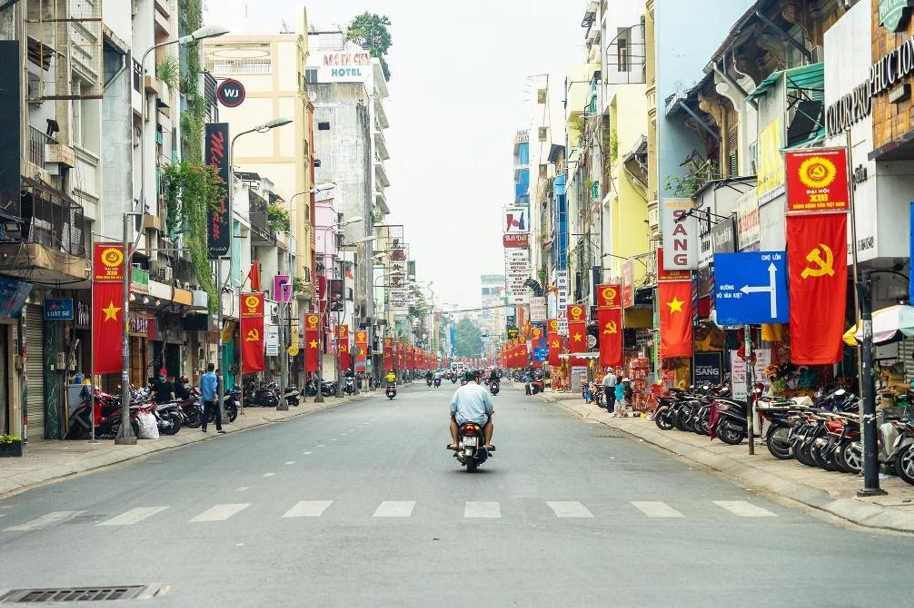
    Foreigners visiting Vietnam can hardly miss the abundance of flags, posters, statues, and slogans that remind them of who is leading Vietnam and of the Communists’ “glorious” struggle against the French, Americans, and the South Vietnam regime throughout the last century.

    However, isn’t it a bit too archaic to still flash the symbol of the hammer and sickle these days, when the means of production and the economy no longer rely on these tools? Farmers and factory workers neither drive nor fuel modern-day politics as well. Likewise, what is the point of having the statues of Ho Chi Minh, Karl Marx, and Lenin in public parks and in the meeting rooms of schools, universities, and governmental departments? Do ordinary people who showcase the red and yellow flag in front of their houses every April 30 cherish the fact that the country was “reunited” in 1975?[1] Do police officers–who check and remind households that fail to do so–love the flag so much and wholeheartedly believe in the cause? In essence, what is the significance of this panorama of symbols?

    Vaclav Havel, the dissident intellectual of communist Czechoslovakia and later president of post-communist Czechoslovakia/the Czech Republic,[2] can point us to the answer.

    The panorama of lies

    Following the end of World War II, Czechoslovakia was ruled by the Communists. The iron fist of Communist rule drove dissidents out of the country and clamped down on those who remained. Other than the Prague Spring of 1968, an unsuccessful effort to steer Czechoslovakia back towards democracy, there was hardly any resistance.

    However, communist Czechoslovakia was not just about who held the government; life itself had to adjust in a way that fit the current political climate. Vaclav Havel (1936-2011), who is arguably one of the most respected dissidents in the history of Czechoslovakia, lived most of his life under Communist rule. He grew up to become a playwright, and at the same time, he established himself as a prominent and well-loved politician. A high point of Havel’s dissident writing, The Power of the Powerless, [3] does not concern itself with formal politics; rather, it deals with the “hearts and minds” of the people.

    A significant character in The Power of the Powerless is the greengrocer who puts the slogan “Workers of the World Unite!” in his front window every day, along with his vegetables. He is neither passionate nor concerned about whether or not the workers of the world unite, but he does this anyway. This irony reminds me of my family who obediently and diligently displays the Vietnamese flag at times in the year when they should, but remains so apathetic that they do not even care if the flag is hanging upside down. There also seems to be other households quite similar to my own which led to the government’s legal guidelines (3420/HD-BVHTTDL) that specifically address this violation.[4]

    The greengrocer’s act is the observable tip of the iceberg of how the hearts and minds of the people work in communist Czechoslovakia; they want to avoid trouble with those who have power. By displaying the slogan, the greengrocer implies:

    I, greengrocer XY, live here and I know what I must do. I behave in the manner expected of me. I can be depended upon and am beyond reproach. I am obedient and therefore I have the right to be left in peace.  (Havel, 1978, p. 6)

    I am once again reminded of my family. I recall that every time my father was late in hanging the flag, my mother would berate him. She would constantly tell him to do it now because she didn’t want the hassle of dealing with the police. When I asked my parents about this, they said that they just wanted to be “left in peace” (yên thân). Likewise, if you ask teachers, students, or employees of governmental departments about the statues of Ho Chi Minh and Karl Marx in their buildings, they would probably tell you something similar.

    But, why do the authorities punish such a trivial thing? Whether or not the greengrocer displays the slogan would certainly have little to no effect on the workers’ movement, nor does it pose any tangible threat to the existence of a government that possesses the hard power of the courts, the military, and the police. The greengrocer does not even replace the slogan with another one that is critical about the regime.

    To address this question, Havel points out that, in fact, people would ignore the greengrocer’s slogan, but they do so precisely because such sayings are everywhere – in other shop windows, on lampposts, bulletins, and buildings. The key here is that while they ignore individual slogans, the people are well aware of the panorama of these slogans as a whole. The existence of this panorama tells people that dishonesty goes hand-in-hand with obedience here; this is normal, everyone does it, and so must you. In the same vein, transgressions must be punished because “anything which leads people to overstep their predetermined roles is regarded by the system as an attack upon itself” (Havel, 1978, p. 8).

    Therefore, if a Vietnamese policeman, school administrator, or government official reproaches someone who questions the phrase: “Live, fight, work, and study like our great Uncle Ho” (Sống, chiến đấu, lao động, và học tập theo gương bác Hồ vĩ đại), it is extremely likely that this policeman/school administrator/government official himself has also questioned, albeit in private, the very same slogan! Yet, they also believe that nobody should disrupt the rules of the game and that everyone should blindly follow what the system demands.

    My next question is, how do people live with themselves when their existence is surrounded by so many lies, ironies, contradictions, and hypocrisies, including those of their own making? Would they feel embarrassed and ashamed of themselves for being so afraid and thus becoming unquestionably obedient? These questions, Havel argues, boil down to man’s dignity and authentic identity. To be able to live in lies, the greengrocer deludes himself into believing that there is nothing wrong with the workers of the world unite; he separates the part of himself that questions the slogan from the other half that accepts the excuse. Living in a world of lies and deceit for so long warps our perspective and this bastardized reality becomes our “new normal;” the greengrocer becomes accustomed to the state of his compromised dignity and comes to accept the deception and inauthenticity of the system as part and parcel of life. In effect, he loses his authentic self.

    On the question of dignity and identity, it is interesting that the slogan “Sacrifice for the country and serve the people” (Vì nước quên thân, vì dân phục vụ) is hung in every police station, in a country where police, alongside tax officials, are seen as the most corrupt group (Towards Transparency and Transparency International, 2017). A few years ago, when I passed by one of Vietnam’s border checkpoints, I was baffled by the contradiction between the arrogance of the border control officer and the fact that he was sitting right under a “serve the people” banner. My subsequent conversations with poor Vietnamese migrants who often cross the border for work revealed that this was how they were always treated; they often bribed these arrogant officers and kept their heads down to avoid trouble.

    As I listened to these migrants and recalled my own experience, I wondered how these officers could look at themselves in the mirror. They see the “serve the people” banner in their office every day but shamelessly extend their hand through the small window of the checkpoint to receive bribes from the people they look at with disdain – the “lowly” people they are supposed to serve. On the other hand, the migrants are left with little choice but to comply and are forced to accept being treated with less than half the dignity they should be afforded by the simple virtue of being alive.

    Furthermore, Havel argues that the panorama of lies is internally solid, for there is a “metaphysical order binding all its components together,” thus “guarantee[ing] the inner coherence of the totalitarian power structure” (Havel, 1978, p. 10). Through all the examples I have provided, isn’t there a sense of such order emanating from Vietnam’s panorama of (pseudo) symbols? The checkpoint officers and those who bribe them, my parents’ disinterested flag-hanging, the equally disinterested policeman who checks the flags, and the people who put the statues of Ho and Marx in their meeting rooms are all parts of a system that everyone who lives or has lived in Vietnam knows all too well; it is a system where “the working class is enslaved in the name of the working class, [where] the complete degradation of the individual is presented as his ultimate liberation, […] [and where] the arbitrary abuse of power is called observing the legal code” (Havel, 1978, p. 10).

    In fact, one of my interviewees [5] told me that before he left Vietnam and started to look at the country from a distance, life there was quite “smooth” for him, because “things hung together…everything I heard in school, in the newspaper, in the street etc. was in harmony with each other…I didn’t feel the urge to question things.” This “harmony” is the glue that holds the panorama of lies together. Secondly, as my interviewee’s response also points out, this panorama is solid because those who lack the individual will and instead excel in the use of empty phrases are the ones who thrive (Havel, 1978, p. 13).

    Havel thus concludes that “individuals confirm the system, fulfill the system, make the system, are the system” (Havel, 1978, p. 9). This conclusion runs contrary to what many intellectuals and laymen alike often think about authoritarianism as entailing an evil ruler and people who are controlled against their will, or a class that oppresses all other classes, and where the line of struggle is between the oppressor and the oppressed. The concept of “the panorama of lies” goes beyond such binary definitions and shows that the line of struggle “runs de facto through each person, for everyone in his own way is both a victim and a supporter of the system” (Havel, 1978, p. 16-17).

    Conclusion

    I work with and observe a wide range of activists who work tirelessly and voice their opinions hoping to one day make Vietnam a liveable country for ALL and not just for those with unearned privileges and unchecked power. They pursue different paths of change; some try to run for seats in the National Assembly, others focus on analysing the actions of the government, and there are those who try to nurture a different kind of Vietnamese. For them, a different kind of Vietnamese means Vietnamese citizens who feel anger when their own dignity, or the dignity of others,’ is negated; they are those who strive for “what should be,” instead of settling for “what is.” They are those who are honest with themselves about right versus wrong, instead of surrendering their own judgement, mindlessly obeying the state and condemning those who do not conform.

    Vaclav Havel and his people saw the end of Communist rule in Czechoslovakia in 1989, but the democratic miracle did not immediately follow. Havel, then in the position of president, argued that democratic politics and the market economy, both carrying the promise of a good life, cannot happen in the face of “post-communist morass” (Havel, 1997). The ghost that kept haunting post-communist Czechoslovakia/the Czech Republic was called out in Havel’s speech before Parliament in 1997:

    Many people believe that democracy or no democracy, the people in power are again people who cannot be trusted and who are more concerned about helping themselves than about the greater good….The prevalent opinion is that it pays off in this country to lie and to steal; that many politicians and civil servants are corruptible; that political parties – though they all declare honest intentions in lofty words – are covertly manipulated by suspicious financial groupings.(Havel, 1997)

    I understand that the different paths of change I mentioned above ultimately feed into each other. However, with the lesson from Czechoslovakia/the Czech Republic and Havel’s thoughts, I cannot help but wonder how best to prioritise these tasks and decide when to pursue which.

    I would also like to believe that Havel’s thoughts give Vietnamese activists hope, especially during the present time when a relentless crackdown makes revolutionary change seem like an utterly unreachable dream. After reading Havel’s work, I see the sparks of our own “Vietnam Spring” starting not in the places representing the power of the system – the National Assembly, the election, state-owned media, or the police – but in the very hearts and minds of ordinary Vietnamese people. The revolutionary Vietnamese of the present day are those who dare to live in truth.

    Bibliography:

    1. On April 30, 1975, North Vietnam forces entered Saigon and officially ended the existence of the Republic of Vietnam as a nation. North Vietnam and South Vietnam were then joined and ruled by the Vietnamese Communist Party (VCP), and Hanoi became the capital of the whole of Vietnam. In the narrative of the VCP, April 30 is called reunification day and a cause to celebrate, whereas people who sided with South Vietnam call it ‘Black April,’ amongst other names that convey pain and sadness for the loss of their country.
    2. Czechoslovakia split into the Czech Republic and Slovakia in 1992-1993. Vaclav Havel’s presidency was from 1989 to 2003, with some intervals in between.
    3. To be fair to this great work of Havel, I should be clear that the panorama of lies is only a small part of it. I focus particularly on this concept in order to unpack the omnipresence of (pseudo-) symbols in Vietnam.
    4. I am not saying that all Vietnamese display the red and yellow flag in the same disinterested way as Havel’s greengrocer. We will not know unless we ask every single Vietnamese. However, we can always make an educated guess. In Vietnam, there are pockets of the population who resent or distrust the regime for many good reasons, from the historic 1975 event and family members lost at sea during the Boat People exodus to forced evictions and rampant corruption. Growing inequality and poverty drive young people from rural areas to cities or overseas, and also expose even more the lies about the socialist utopia which the VCP claims it pursues and which it trumpets with slogans and posters in public places.
    5. This interview is part of my PhD research on activism under authoritarian rule in the 2010-2019 period in Vietnam.

    References

    Havel, V. (1979). The Power of the Powerless. Available at: https://www.nonviolent-conflict.org/resource/the-power-of-the-powerless/

    Havel, V. (1997). Address to the Czech Parliament. Available at: https://www.rferl.org/a/1087560.html

    Towards Transparency & Transparency International (2017). 2017 Global Corruption Barometer: Vietnam. Hong Duc Publishing House.
  • Vietnam: Seven State Secrets About Religions That May Surprise You

    Vietnam: Seven State Secrets About Religions That May Surprise You

    Stories from the past that the government wants to continue keeping them secretive

    In mid-April 1947, a prominent figure from the southwest of Vietnam disappeared after meeting with the Viet Minh. This mysterious disappearance created an eternal feud between the Hoa Hao Buddhist community and the Vietnamese Communist Party (VCP). The person who disappeared was Hoa Hao Buddhist founder Huynh Phu So.

    Over the past 70 years, no official documents have been released about Huynh Phu So’s disappearance. Millions of Hoa Hao Buddhists are still waiting for an official answer about what happened to their founder. “The day the teacher went absent,” or the date of Master Huynh Phu So’s disappearance, is still a formal commemorative holiday in Hoa Hao Buddhism. However, from 1975 until now, the government has banned the public celebration of this daywithout explaining.

    In a different and more recent event, a special task force consisting of high-ranking VCP military members was sent to the Central Highlands in April 2004to deal with the largest demonstration of the Montagnard people since 1975. Some 10,000 to 30,000 Montagnards protested against harsh government policies on land, religion, and ethnic groups in the region.

    How violent were these protests, and how were they put down? We may not know for sure, but there have been reports about many Montagnards who escaped Vietnam and travelled to Cambodia on foot after these protests.

    After the government quelled all of the protests, the Vietnamese state, international media, and human rights organizations released inconsistent information about the actual number of deaths. Furthermore, the Vietnamese government never published the total number of those injured or imprisoned during the protests; they refused to release the details of the trials and court hearings of those arrested. What happened in the Central Highlands in 2004 is still a mystery to the local people and the world.

    https://2xjs7y10oiyz26vqxu2hok6y-wpengine.netdna-ssl.com/wp-content/uploads/2021/01/AP_040722018930.jpg
    Montagnards in the Central Highlands fled from Vietnam to Cambodia to seek refugee status in 2004. Photo: AP.

    The wounds the government could have inflicted against these people will not heal until the truth behind the incidents should be transparent to the public.

    Huynh Phu So’s unexplained disappearance and the crackdown in the Central Highlands in 2004 are just two of these wounds that remain unaddressed in Vietnam, and they will continue to fester for as long as they remain as such.

    In 2020, Vietnam released a list of classified state documents, showing that the government kept confidential and secretive information on various religious groups.

    Nevertheless, while releasing this information might have been good news, it actually brought more issues because it raised more questions than answers. The released list and the information on these state secrets on religious organizations will continue to be kept secretive by the government indefinitely.

    The Law on the Protection of State Secrets in Vietnam

    In 2018, Vietnam’s National Assembly passed the Law on the Protection of State Secrets. According to this legislature, state secrets are classified into three levels: top secret, secret, and confidential. The government will protect the top-secret information for up to 30 years, 20 years for secret information, and confidential information gets the least duration of protection: only up to 10 years.

    Yet, the level of confidentiality of a secret does not matter much because the government can extend the protection of any state secrets indefinitely. Article 20 of the Law on the Protection of State Secrets gives the government the ability to continue extending the lifetime of any state secret.

    It should also be noted that when the government declassifies formerly sensitive information, it does not mean that those content will be disclosed to the public in Vietnam. Only the state gets to decide what gets released into the public sphere. Therefore, the authorities announce that they have state secrets on a certain religious group. Still, they do not have to disclose what this information is, and they will continue to keep them as state secrets indefinitely.

    In Thanh Tra (Inspection) magazine, Nguyen Phuong Vy of the Institute of Strategy and Science of the Inspector also believed the law regarding the scope of state secrets is too broad. She stated that, in effect, ordinary and non-sensitive information could also be classified as sensitive.

    This can be particularly observed in the field of religion. Here are seven of the top religious state secrets in Vietnam that may surprise you.


    1. The VCP puts its members among the religious leaders. Who are these people? It’s a state secret.

    Many people have been wondering whether or not the VCP assigns some of its members to be part of various religious organizations. Decision 1722/QĐ-TTg of the prime minister provided the government’s list of state secrets, released in November 2020.

    This specific list confirms that the VCP does indeed have its members present in the leadership of many religious organizations. However, information about how these Party members are “selected, arranged, and enlisted” is not disclosed; this falls under the confidential tier of classified information  (Article 3, Clause 7, Section c).

    Religious organizations are not state organs, but the party and the state can assign people to control them. This shows that the recognized religious organizations in Vietnam are not independent of the state and are under the government’s influence and coercion.

    1. The state uses “advocacy work” to identify critics against it, but how much does that work cost in tax money? That’s another secret!

    Vietnam uses the special term “advocacy work within the religions” to define how the government should mobilize religious dignitaries to support the state. The goal of this process, according to Dan Van magazine, is to “fight, educate, differentiate, and narrow down the number of people who have opinions or beliefs that oppose, disagree or contravene the policies of the party and the law of the State.”

    According to the information we have, the government has never disclosed the budget for this group to the public. The amount of money spent on these activities is classified as secret information by the State according to Decision 960/QĐ-TTg dated July 7, 2020, issued by the prime minister.

    1. Information of meetings between the state and the religious leaders in the country is confidential.

    Information about meetings between religious organizations, their leaders, and even certain members that have “influence” within a specific religion, with the government is considered the state’s top secret. The minutes of these meetings are also on the VCP’s list of confidential information.

    This regulation is extensive, with no restrictions on what can be discussed in these meetings. Likewise, any gathering with state leaders from the provincial level upwards can be considered a state secret. There are also no specific regulations or definitions on who can be considered an “influential” member of a religious organization.

    These ambiguities may cause problems for certain members of religious groups. They either must keep all of the information they have discussed in meetings with the state confidential, or they will face being accused of disclosing state secrets.

    https://2xjs7y10oiyz26vqxu2hok6y-wpengine.netdna-ssl.com/wp-content/uploads/2020/11/Untitled-design-9-1024x536.png
    Six religious leaders are members of the 14th National Assembly. Photo: National Assembly Newspaper, Dan Van magazine
    1. Veterans’ and Farmers’ Associations are considered “special forces” of the government in working with religions. There are a lot of secrets involving their works.

    It may be unclear to see the Veterans’ and Farmers’ Associations belong to the government’s organizations that work with religious leaders and religions in the country.

    The Veterans’ Association’s list of state secrets, according to Decision No. 872/QĐ-TTg dated June 19, 2020, issued by former Prime Minister Nguyen Xuan Phuc, affirms that one task of that association is to “enlist religious dignitaries in service of national defense and security.” They are also required to detect and report activities which “violate national security, social order, and safety.” Their reports on these topics to the government are classified as confidential.

    The Farmers’ Association also has the added task of “reflecting and evaluating the situation of farmers having changes in ideology and awareness, and to monitor activities which may affect politics, national defense, security and society in the areas considered to be hotspots of ethnic and religious issues.” The reports and surveys regarding this task are also considered state secrets.

    1. The Vietnam Women’s Union places its members among religions within areas that the government has considered to be “religious hotspots”

    The state also gave The Vietnam Women’s Union, like the Farmers’ Association, a mission in areas considered by the government to be religious hotspots.

    According to the list of state secrets of the Vietnam Women’s Union, Decision No. 1222/QĐ-TTg – issued by former Prime Minister Nguyen Xuan Phuc – identified that the Vietnam Women’s Union has provided “reports related to evaluating and commenting on the mobilization of union members in ethnic and religious hotspots” and maintained their confidentiality.

    In addition, this association also deploys its “key members” into areas that the government considered to be ethnic and religious hotspots. The list of these key members is also classified as confidential by the state.

    1. Information that the state has on educational activities organized by religious organizations which “affect national security” are classified as state secret.

    According to the list of state secrets in education and training (Decision No. 809/QĐ-TTg, dated June 10, 2020, issued by former Prime Minister Nguyen Xuan Phuc), information on the educational activities of religious organizations “influencing politics, defense and security” is confidential.

    The state has always considered the educational activities organized by religious organizations to be sensitive information.

    Since 1954 in the north and after 1975 in the south, religious organizations have been banned from participating in activities in the field of general education. The educational activities within these organizations are also controlled and monitored by the State. According to the Law on Belief and Religion, the state requires all religious organizations that if they want to teach law and history, they will have to follow strictly with the guidance of the Ministry of Justice and the Ministry of Education and Training.

    1. How the state handles what it claims to be “complex religious matters” in Vietnam is top secret.

    The “handling of complex religious matters” is classified as top secret in both the VCP’s state secrets list and the state secret list maintained by the Ministry of Home Affairs.

    The Ministry of Home Affairs considers the information it has on the “complex religious issues” to be more secretive and confidential than the information about the government’s personnel list.

    For these “complex religious matters”, because they are listed as utmost top-secret, even if the state does not extend the duration of the protection clause when it expires, yet it will take 30 more years from now for this information to be publicly released.

    If we think back about the story about the crackdown in the Central Highlands in 2004 mentioned earlier in this article, which the state considers a complex religious situation, the public may not know about the story’s facts until at least 2034.

    Currently, Vietnam does not have any law that defines how a religious issue can fall under this “complex matter” category; it all depends on the perspectives of the VCP and the state.


    This article was written in Vietnamese by Thai Thanh and was previously published in Luat Khoa Magazine on January 27, 2021. The English translation was done by Jade NG.

  • Vietnam Briefing: Exoduses In Kabul And Saigon, At The Same Time, For Different Reasons

    Vietnam Briefing: Exoduses In Kabul And Saigon, At The Same Time, For Different Reasons

    The Vietnam Briefing, which is released every Monday morning Vietnam time, looks at Vietnam’s political developments of the past week.


    Exoduses in Kabul and Saigon, at the same time, for different reasons

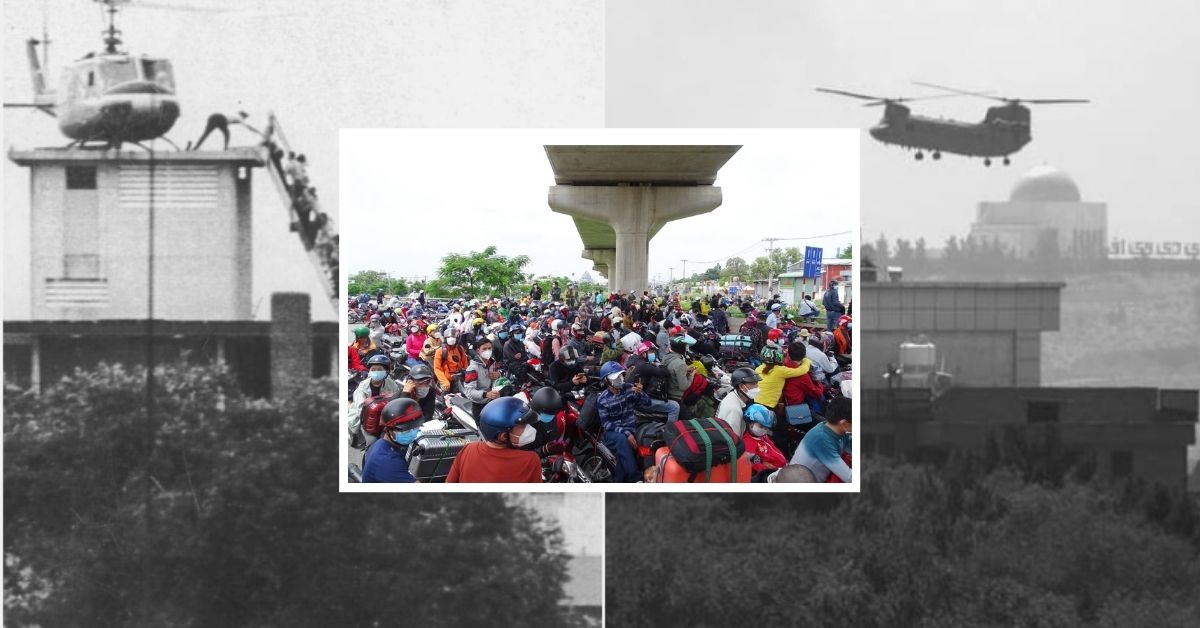
    The world is talking about people fleeing Kabul as the Taliban enters the city, with some comparing this to the similar situation in Saigon in 1975.

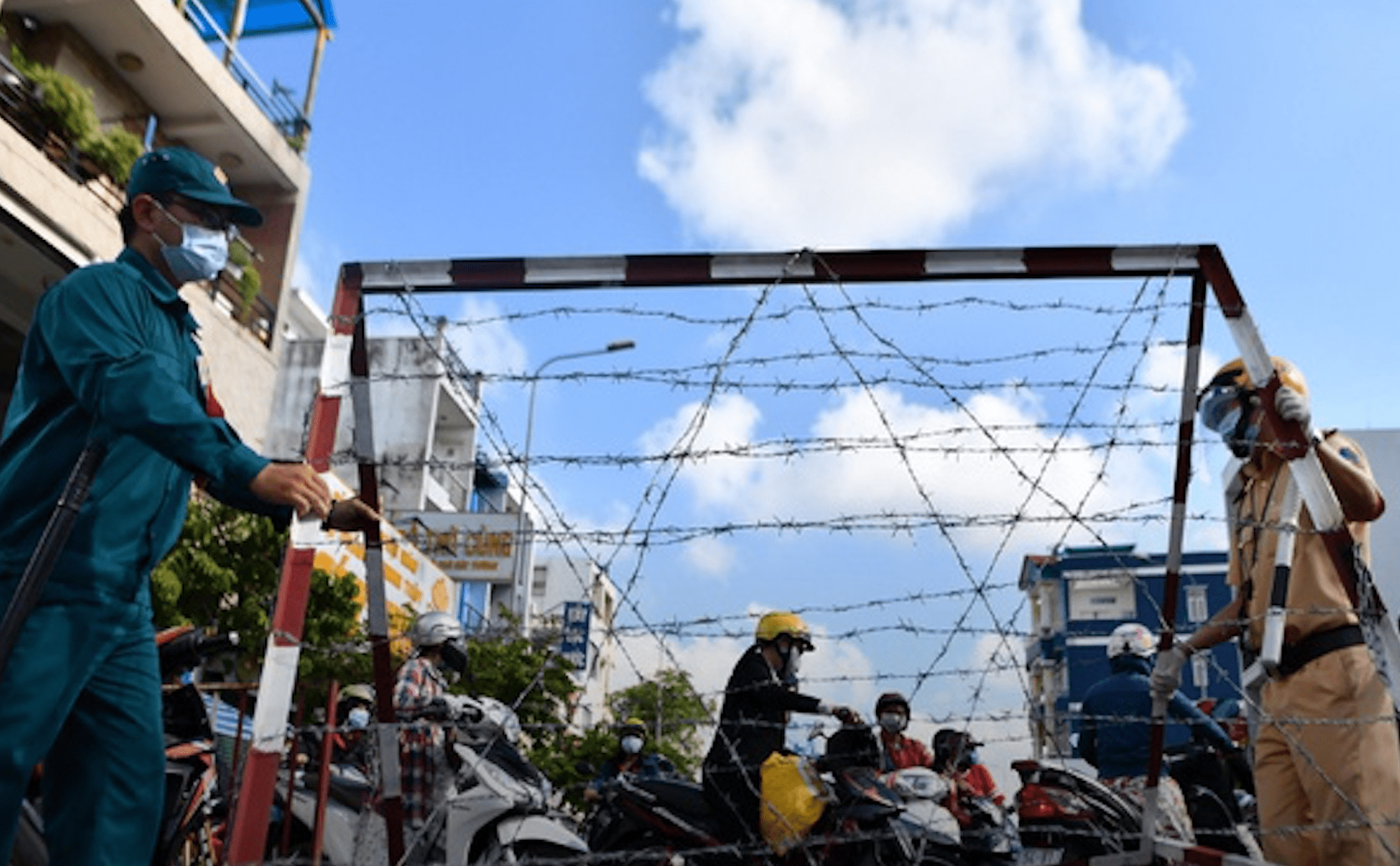
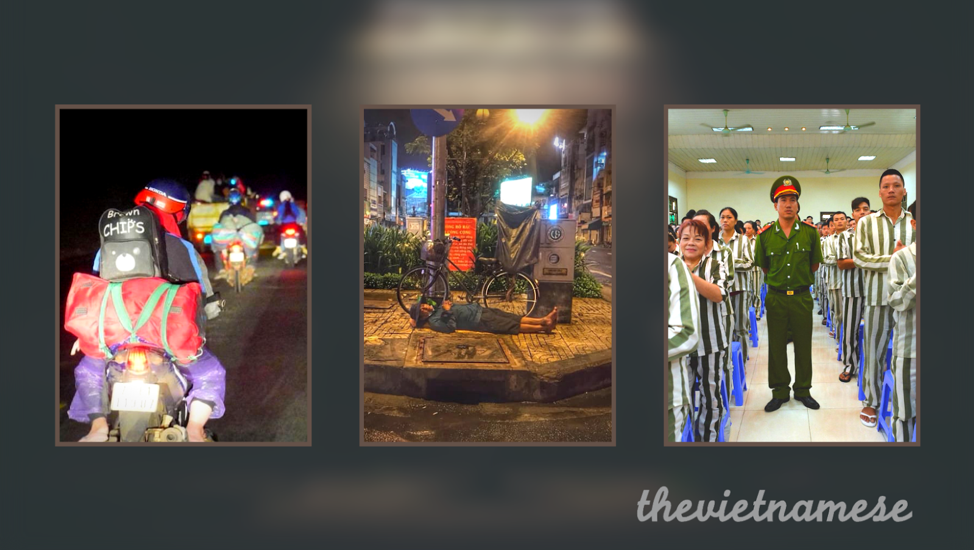
    Coincidentally, at the same time on Sunday, Saigon witnessed an exodus of migrant workers fleeing the city after the local government renewed the lockdown order for another 30 days.

    Quotes from VnExpress:

    • Thousands are setting out for their hometowns on motorbikes with suitcases and other belongings, creating gridlocks at the eastern gateway of Ho Chi Minh City (HCMC) and Thu Duc City.
    • “The area near my house has discovered a few Covid-19 cases, and more people have died from the pandemic, so I am very frightened and do not dare to stay,” said one man named Trung, adding that he has received no support from the local government. “I have no choice. I know that many parts of the country are keeping socially distancing, but if I stay I have no money to spend, and I’m afraid of getting infected.”
    • “Back home, I still have family and relatives, but in HCMC, I have lost my job and really didn’t know how to live,” said another person.

    COVID-19

    • Last week, Vietnam added almost 60,000 new cases and 2,187 deaths, pushing the total number of cases over 265,000 with total deaths almost 5,500.
    • Saturday witnessed the biggest daily tally with 9,710 new cases.
    • Hanoi extended the lockdown order until August 22.
    • The two biggest cities, Hanoi and HCMC, briefly introduced highly controversial COVID-19 measures to control the movement of people. Hanoi required people to present proof of assignments issued by their employers while HCMC forced people to fill in an online form at the city’s checkpoints. Local governments quickly reversed course after creating traffic gridlocks and receiving a backlash from the public.
    • Vaccines made in Vietnam: “Vietnam may be able to produce a COVID-19 vaccine in September if everything goes smoothly, Prime Minister Pham Minh Chinh told scientists, units and businesses participating in vaccine production and research at a meeting on August 12.” (VietnamPlus)
    • One thing to note: The state media has been playing down the number of deaths, instead emphasizing patient recoveries. Luat Khoa magazine cites an unnamed source saying the Communisty Party has instructed the state media to avoid highlighting the death tolls and concentrate on the “positive” side of the situation.

    Critics of the government’s COVID-19 response punished

    From RFA:

    “Authorities in Vietnam have arrested a Facebook user for posting mild criticism of government COVID-19 policies, while a university fired a lecturer after a student shared her comments faulting Hanoi’s pandemic response on the social media platform.”


    Learn more about Vietnam

    Was Vietnam’s Chinese COVID-19 Vaccine Debacle Just a Stunt?

    The Diplomat/Le Dong Hai Nguyen/August 13

    “There is a strong case to be made that the Vietnamese government leveraged ingrained anti-Chinese sentiment to boost vaccine uptake.”

    Vietnam human rights recap: Arrests of government critics continue in the first seven months of 2021

    The 88 Project/August 6

    “It’s been an eventful year so far in Vietnamese politics. Arrests of critics of the regime have taken place against the backdrop of the 13th National Party Congress, National Assembly elections, and rising Coronavirus infections. Twenty-three critics of the regime have been arrested during the first seven months of 2021, while 20 have been sentenced to prison. Article 331 was the most frequent charge levelled against critics, with 11 individuals arrested for “abusing democratic freedoms to infringe upon the interests of the State.” Eight people were charged under Article 117, a broad provision which criminalizes producing or disseminating information ‘opposing’ the State.”

    Kamala Harris has an important job to do in Asia

    The Hill/Williams Danvers/August 15

    “With her planned trip to Asia, specifically to Vietnam and Singapore, Vice President Kamala Harris will take on another foreign policy challenge: helping to implement fundamental pieces of the Indo-Pacific strategy.”

    New research: “Two years into CPTPP”

    CSIS/Kati Suominen/August 9

    “Trade in the CPTPP [Comprehensive and Progressive Agreement for Trans-Pacific Partnership] region after the agreement entered into force has largely paralleled members’ trade flows with the rest of the world. Vietnam has grown its trade in goods as well as inbound investment, possibly a positive signal to other Southeast Asian countries that are considering CPTPP membership, such as the Philippines and Indonesia. Japan and Singapore have led the region’s trade in digitally deliverable services, also a key sector for the Philippines and the United Kingdom, another aspiring member. To be sure, these early patterns should be interpreted with care and should not be read as caused by the CPTPP. Further papers in this series explore the extent to which these and other patterns can be attributed to the CPTPP, as opposed to other factors.”

    New research: “US Secretary of Defense Lloyd Austin’s Southeast Asia Tour: Assurances and Dividends”

    ISEAS/William Choong, Hoang Thi Ha, Le Hong Hiep and Ian Storey/5 August 2021

    “The choice of Singapore, Vietnam and the Philippines – as well as forthcoming high-level US engagements in these three countries – highlight their importance as ‘critical Indo-Pacific partners’ in the Biden administration’s Indo-Pacific strategy.”

    New book by Ted Osius, the former US Ambassador in Vietnam: “Nothing is impossible: America’s Reconciliation with Vietnam”

    “Ted Osius, U.S. Ambassador to Vietnam 2014-17, offers a vivid first-hand account of the various forms of diplomacy that brought about the reconciliation between two former enemies and helped bring new prosperity to Vietnam. Nothing is Impossible – with a foreword by John Kerry — tells an inspiring story of how international diplomacy can create a better world.”

  • Four Land Issues That Expose The Injustices Faced By Religious Organizations In Vietnam

    Four Land Issues That Expose The Injustices Faced By Religious Organizations In Vietnam

    After 1975, churches and sects in southern Vietnam found themselves in a difficult situation; they no longer had the right to decide the fate of their own religious facilities.

    Due to the harsh land policy of “the winning side,” priests were left without a church, Buddhist monks and nuns lost their pagodas, and the faithful were stripped of places to congregate, pray, and worship.

    The rationale for the construction of such locations changed from being based on the necessity of a religion’s expansion to being contingent on the decisions of the government. As such, plots of land formerly owned by religious institutions were left unused, underutilized, and were eventually overgrown with weeds. In fact, some sects had to beg local governments to allocate some space to establish their facilities because they could no longer buy the land themselves.

    It is unclear whether the four serious religion-related land problems below are solved by the new Prime Minister Pham Minh Chinh in his revised Draft of the Land Law.[1]

    1. Religious lands have been requisitioned by the government since 1975

    A year after the Chairman of Thua Thien-Hue ​​Provincial People’s Committee declared that the Thuy Tien Lake Water Park would be “revived,” its construction site still remained abandoned and in a dilapidated state. Its lake was virtually dry, wild weeds littered the ground, and so far, no investor has yet been announced.

    The plot at Thuy Tien Lake lies on Thien An Hill, which used to be managed by the Thien An Monastery. Following the requisition of this plot by the authorities in 1999, the land was assigned to a State-owned company to be transformed into a fee-paying recreational facility within 40 years.[2] However, in less than 10 years, this project proved to be ineffective and was unable to attract tourists as construction work remained unfinished. The original investor was replaced but the project was discontinued and has long been abandoned.

    Approximately 16 kilometers from the Thien An Monastery, right in the heart of Hue City, lies another plot that has forever lost any traces of its history of Catholicism; a monastery, which was more than 100 years old, had been turned into an ordinary building. What used to be a privately-owned high school on land owned by Lasan priests is currently the Hue Conservatory and the Huong River Theater;[3] authorities “borrowed” and took over the school after 1975.

    The school Ecole Pellerin. Photo: Lasan.

    In December 2020, one month after the main priest of the Thi Nghe Parish was delegated by the Archdiocese of Saigon to sue the Ho Chi Minh City People’s Committee in order to retrieve a primary school,[4] the authorities returnedfive religious facilities which they took after 1975.[5] However, this was too small of a number when we compared it to what the Catholic Church originally surrendered to the state since 1975. In an interview with the Vatican-based Fides News Agency in 2009, Cardinal Pham Minh Man recounted that Saigon alone had lost nearly 400 education, healthcare, charity, and humanitarian facilities after 1975.[6]

    For indigenous religions whose voices are practically non-existent, such as Hoa Hao Buddhism [7] and Caodaism,[8], and Baha’i [9], they continued to suffer great injustices in land use, following the Communist takeover of South Vietnam. These organizations have forever lost facilities that they took great pains to establish.

    In 2008, Prime Minister Nguyen Tan Dung issued a directive that permitted the continued use of religious facilities on lands assigned by the State, if the lands were used appropriately and efficiently; local authorities would look at situations on a case-by-case basis and return lands to the sects accordingly. [10] Nonetheless, this directive had little effect when it came to returning lands to religious organizations.

    In 2015, the Ministry of Construction reported that the number of complaints about housing and land-related to religious groups was significantly increasing. Most of the complaints were regarding religion-related plots borrowed or requisitioned by the government.[11]

    The land conflict between religious organizations and the government is an important problem as this relates to not only the interests of churches and sects but also to their millions of believers. Religious facilities are not only places of worship but also venues for education, charity, aid, and leisure.

    While you are reading this article, the faithful at the An Hoa Parish are still praying day and night and keep hoping that their land will not be allocated to others, divided, or put up for sale.[12]

    2. Religious organizations have trouble receiving lands from individuals

    Did you know that the Baha’i religion was not recognized by the Vietnamese government after 1975? This religion was only permitted to resume its religious activities in 2008. However, the religious leaders of Baha’i continued to petition the government to assign them a piece of land to build their headquarters, but that petition has not been responded to. [13]

    You may wonder why the Baha’i clergy did not purchase land from one of their followers instead?

    This is because the Land Law in Vietnam does not allow such transactions.[4]

    Specifically, Article 169, Paragraph 1, Section (g) states that religious organizations are only entitled to receive land use rights via a land assignment by the State in accordance with religion policy, land zoning, and the State’s overall plan.

    As such, no matter how large its budget is, it is impossible for the Baha’i religion to buy land to establish its office, even though this religion was already officially recognized by the State. The re-establishment of offices for religions founded before 1975 is something totally alien to the current land policy.

    In 2020, Catholic followers at the Dong Dinh Parish, in the Nho Quan District, Ninh Binh Province, reacted sharply in response to how local authorities handled their request to expand their church.[15]

    The statue of Mother Mary in the disputed land between the Dong Dinh Parish and the government. Photo: Dong Dinh Parish.

    The Dong Dinh Parish had previously petitioned the State to increase the land size of their church. The district-level officials of the Fatherland Front guided them through the procedure to regain their land-use rights so that they could get land allocated to them for the parish.

    However, after receiving land donations from parishioners, the commune-level authorities declared that they will construct a dam in the area that will separate the church from the parishioners’ land.

    The faithful reacted angrily. They built a steel fence around the land and erected seven statues of saints in protest against the inconsistency of the local authorities.

    In 2017, a team that conducted research on laws that affected religions in Vietnam, which included journalist Pham Doan Trang, assessed the prevention of civil transactions of religion-related lands. Their research had found that religious organizations and their followers were given unequal treatment under the law.[16]

    3. Religious facilities need a license prior to being given a location

    In 2009, the government expelled young monks of the Lang Mai congregation from the Bat Nha Pagoda in Lam Dong Province. Previously, the pagoda concluded that its premises had to be expanded in order to accommodate and support these new monks. However, the State refused to issue the license for the expansion so it was impossible for them to be given more land and recruited more young monks for the Lang Mai congregation.

    The Bat Nha Pagoda in Lam Dong Province was once the place where Lang Mai monks practiced. Photo: chuahoanghiem.com

    Lang Mai is a Buddhist sect founded by Thich Nhat Hanh, an internationally-known Vietnamese monk. Despite being a well-known sect overseas, it is not licensed to practice in Vietnam. These aforementioned monks were the first, and also the last, practitioners of this religion in Vietnam.

    In southern Vietnam, the religious facilities of Hoa Hao Buddhism are frequently harassed by police when they are just faithful congregate gathered at their temples. [17] The police are adamant in claiming that some of the sects in Hoa Hao Buddhism are illegal. Sadly, this is also the case for many other independent Caodaism facilities.

    The Land Law stipulates that land assignment for religious facilities is based not on the demands of these organizations, but instead on the religion policy, land zoning, and the land-use plans approved by the State.[18]

    In “The Collision of Religion And The Vietnamese State,” a report released in May 2021, Aerolyne Reed cites Vo Quoc Hung Thinh’s research for Legal Initiatives for Vietnam regarding Vietnam’s policy on religion. She summarizes Hung Thinh’s main points which allege that Vietnam’s licensing, land assigning, and the construction of religious facilities only fuel personal interests and pave the way for cronyism among the government officials.[19]

    Vo Quoc Hung Thinh also claims that most recently approved projects to build pagodas, such as the pagodas of Lung Cu and Bai Dinh, do not purely belong to religious organizations, but are partnerships between some government-approved religious and commercial groups.

    Land ownership and the building of religious facilities are closely connected to religious activities. The fact that the government has the right to assign land and grant construction permits sends a very clear message about its power to decide the fate of religious organizations.

    The 2013 Land Law stipulates that land disputes, in which one party is a religious facility or an organization, is handled by the provincial-level chairman of the People’s Committee (Article 203, Paragraph 3, Point b). In case of disagreement with the settlement, a religious organization is entitled to lodge a complaint to the Ministry of Natural Resources and Environment or bring the case to court in accordance with administrative lawsuit procedures.

    In reality, local authorities and the central government deal with complaints about religion-related lands by staying quiet and refusing to respond, prolonging the settlement duration, or sowing discord among the plaintiffs with the aim of trying their patience to the extent that the petitioners eventually abandon the lawsuit.

    Front side (above) and backside (below) of the primary school of the Thien An Monastery before 1975. Photo: Thien An Monastery

    In early 2000, because the lodged land complaint of the Thien An Monastery was not addressed thoroughly, local authorities started construction on the monastery’s land. [20] Sadly, this is not the only issue plaguing the Thien An Monastery; the monastery has also been complaining about one of their schools being taken over by the government after 1975.[21]

    Heiner Bielefeldt, the United Nations special rapporteur on freedom of religion and belief, states that the petitions of religious communities, in general, are not well responded to by administrative agencies or courts in Vietnam. [22] In many cases, complainants are sent back to their localities to have their complaints re-considered. More often than not, this leads to the prolongment of settlements and to these cases being ignored or forgotten.

    In his 2014 report, following his official visit to Vietnam, Heiner Bielefeldt notes that Vietnam – as a country – is legally inefficient in addressing religion-related land disputes. [23] Furthermore, religious communities that are officially recognized by the State also express their disappointment over ineffective legal procedures.


    This article was written in Vietnamese by Nguyen Vu and was previously published in Luat Khoa Magazine on June 7, 2021. The English translation was done by Hoai Huong.

    Bibliography:

    1.  N. An (2021, May 1). Thủ tướng yêu cầu sớm xây dựng dự án Luật đất đai sửa đổi. TUOI TRE ONLINE. https://tuoitre.vn/thu-tuong-yeu-cau-som-xay-dung-du-an-luat-dat-dai-sua-doi-20210501081853663.htm

    2.  Anh, T. (2017, July 6). Không thừa nhận việc Đan viện Thiên An đòi hơn 107 ha đất và rừng thông. baothuathienhue. https://baothuathienhue.vn/khong-thua-nhan-viec-dan-vien-thien-an-doi-hon-107-ha-dat-va-rung-thong-a44163.html

    3.  Thái Thanh. (2020, September 3). 10 trường học Công giáo chính quyền mượn, lấy nhưng không chịu trả. Luật Khoa Tạp Chí. https://www.luatkhoa.org/2020/09/10-truong-hoc-cong-giao-chinh-quyn-muon-lay-nhung-khong-chiu-tra/

    4.  Phương, T. (2021, January 27). Tôn giáo tháng 11/2020: Tổng giáo phận Sài Gòn kiện chính quyền TP. Hồ Chí Minh. Luật Khoa Tạp Chí. https://www.luatkhoa.org/2020/12/ton-giao-thang-11-2020-tong-giao-phan-sai-gon-kien-chinh-quyen-tp-ho-chi-minh/#1-t%E1%BB%95ng-gi%C3%A1o-ph%E1%BA%ADn-s%C3%A0i-g%C3%B2n-ki%E1%BB%87n-ubnd-tp-h%E1%BB%93-ch%C3%AD-minh-%C4%91%C3%B2i-l%E1%BA%A1i-tr%C6%B0%E1%BB%9Dng-ph%C6%B0%E1%BB%9Bc-an-th%E1%BB%8B-ngh%C3%A8-

    5.  Thanh, T. (2021, January 16). Tôn giáo tháng 12/2020: Pháp Luân Công gặp rắc rối với chính quyền. Luật Khoa Tạp Chí. https://www.luatkhoa.org/2021/01/ton-giao-thang-12-2020-phap-luan-cong-gap-rac-roi-voi-chinh-quyen/#6-ch%C3%ADnh-quy%E1%BB%81n-tp-h%E1%BB%93-ch%C3%AD-minh-trao-l%E1%BA%A1i-5-c%C6%A1-s%E1%BB%9F-cho-t%E1%BB%95ng-gi%C3%A1o-ph%E1%BA%ADn-s%C3%A0i-g%C3%B2n

    6.  Tổng Giáo phận Sài Gòn. (09–12-09). ĐHY GB Phạm Minh Mẫn trả lời phỏng vấn Fides. TGP Sài Gòn. https://tgpsaigon.net/bai-viet/dhy-gb-pham-minh-man-tra-loi-phong-van-fides-43852

    7.  Phương, T. (2020, March 29). Lịch sử thăng trầm và đầy bi kịch của Phật giáo Hòa Hảo. Luật Khoa Tạp Chí. https://www.luatkhoa.org/2019/08/lich-su-thang-tram-va-day-bi-kich-cua-phat-giao-hoa-hao/

    8.  Phương, T. (2020b, December 6). Tôn giáo tháng 9/2020: Số phận của những Thánh thất Cao Đài độc lập. Luật Khoa Tạp Chí. https://www.luatkhoa.org/2020/10/ton-giao-thang-chin-so-phan-cua-nhung-thanh-that-cao-dai-doc-lap/

    9.  Duy, T. (2020, November 13). Tôn giáo Baha’i: Ký ức nhọc nhằn trên đất Việt. Luật Khoa Tạp Chí. https://www.luatkhoa.org/2020/07/ton-giao-bahai-ky-uc-nhoc-nhan-tren-dat-viet/

    10.  Chỉ thị 1940/CT-TTg của Thủ tướng Chính phủ về nhà, đất liên quan đến tôn giáo, ban hành ngày 31/12/2018. https://thuvienphapluat.vn/van-ban/bat-dong-san/Chi-thi-1940-CT-TTg-nha-dat-lien-quan-ton-giao-83510.aspx

    11.  Vân, H. (2015, January 7). Khiếu nại đòi nhà đất tôn giáo tăng ở một số tỉnh phía nam và Hà Nội. PLO. https://plo.vn/bat-dong-san/khieu-nai-doi-nha-dat-ton-giao-tang-o-mot-so-tinh-phia-nam-va-ha-noi-522362.html

    12.  Facebook Giáo xứ An Hòa. (2021, March 29). Facebook. https://www.facebook.com/giaoxu.anhoa.900/posts/205721937988187

    13.  Thư tháng Baha’i 202. (2014, March 27). Bahai.Org.Vn. http://bahai.org.vn/wp172/wp-content/uploads/2014/04/Thu_thang_202.pdf#1-tranh-ch%E1%BA%A5p-nh%C3%A0-%C4%91%E1%BA%A5t-v%C3%A0-ch%C3%ADnh-s%C3%A1ch-%C4%91%E1%BA%A5t-%C4%91ai-ph%C3%A2n-bi%E1%BB%87t-nh%E1%BA%B1m-ki%E1%BB%83m-so%C3%A1t-c%C3%A1c-t%C3%B4n-gi%C3%A1o-ph%C3%A1t-tri%E1%BB%83n-

    14.  Luật Đất đai 2013 (Luật số: 45/2013/QH13). https://thuvienphapluat.vn/van-ban/Bat-dong-san/Luat-dat-dai-2013-215836.aspx

    15.  Thanh, T. (2020b, November 13). Tôn giáo tháng 6: Tín đồ về từ rừng, tranh chấp đất đai, VN phản đối báo cáo của Mỹ. . .. Luật Khoa Tạp Chí. https://www.luatkhoa.org/2020/07/ton-giao-thang-6-tin-do-ve-tu-rung-tranh-chap-dat-dai-vn-phan-doi-bao-cao-cua-my/

    16.  Mục III.B.69, Trang thứ 36 của Báo cáo – nghiên cứu: Đánh giá Luật tín ngưỡng, tôn giáo 2016 và tình hình thực hiện quyền tự do tín ngưỡng, tôn giáo. (2017, November 1).

    17.  Human Rights Watch. (2020, October 28). Việt Nam: Hãy chấm dứt đàn áp các nhà hoạt động tôn giáo. https://www.hrw.org/vi/news/2018/02/08/314768

    18.  Mục 2, Chương 2; Điều 159.2 của Luật Đất đai 2013. https://thuvienphapluat.vn/van-ban/Bat-dong-san/Luat-dat-dai-2013-215836.aspx

    19.  Vo Quoc, H. T. (2021, May 5). The Collision Of Religion And The Vietnamese State. The Vietnamese. https://www.thevietnamese.org/2021/05/the-collision-of-religion-and-the-vietnamese-state/

    20.  Thanh, T. (2020b, September 28). 45 năm đất Đan viện Thiên An dưới tay chính quyền. Luật Khoa Tạp Chí. https://www.luatkhoa.org/2020/08/45-nam-dat-dan-vien-thien-an-duoi-tay-chinh-quyen/

    21.  Ibid., [20].

    22.  Tổ nghiên cứu tôn giáo (2017, November 1). Báo cáo – nghiên cứu: Đánh giá Luật tín ngưỡng, tôn giáo 2016 và tình hình thực hiện quyền tự do tín ngưỡng, tôn giáo.

    23.  United Nations High Commissioner for Refugees. (2015, January 30). Refworld | Report of the Special Rapporteur on freedom of religion or belief, Addendum: Mission to Viet Nam (21 to 31 July 2014). Refworld. https://www.refworld.org/docid/54f432530.html

  • Religion Bulletin, June 2021: The Vietnamese Buddhist Church Fiercely Guards Its Merit Donations

    Religion Bulletin, June 2021: The Vietnamese Buddhist Church Fiercely Guards Its Merit Donations

    https://2xjs7y10oiyz26vqxu2hok6y-wpengine.netdna-ssl.com/wp-content/uploads/2021/07/image.png
    Photo: Vietnamese Buddhists (left), Financial Times. Photo processing: Luat Khoa.

    [Religion 360*]

    Buddhists, Vietnamese Buddhist Church oppose Ministry of Finance’s draft circular on merit donations

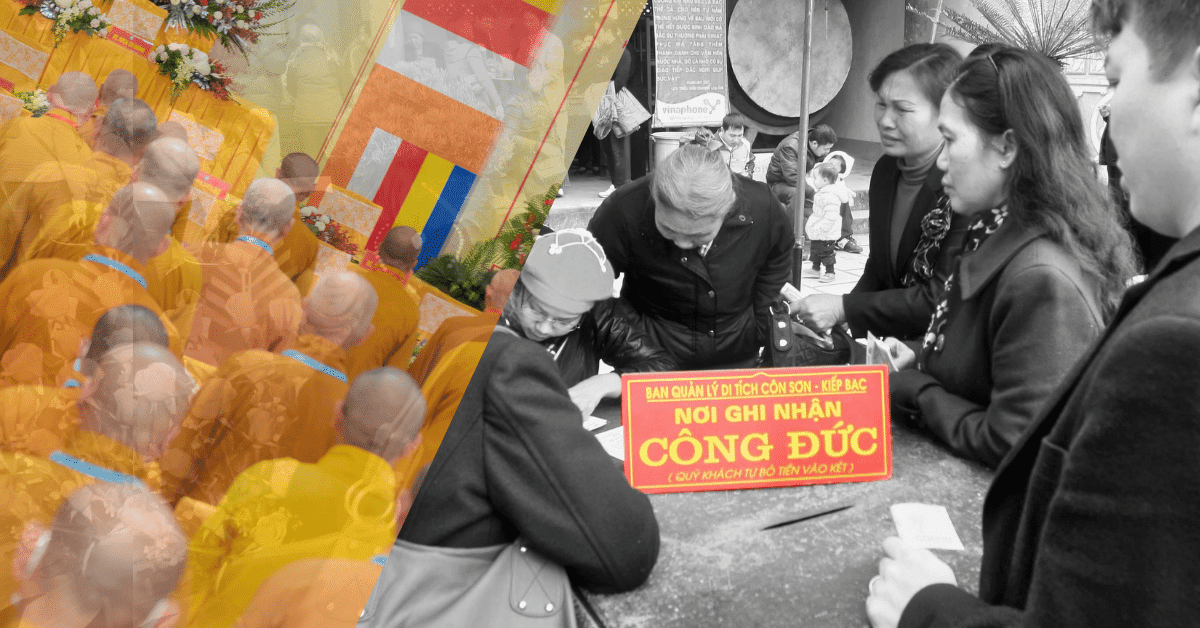
    The Ministry of Finance’s draft circular, published on April 28, 2021, and related to the management of merit donations, has met unexpected and fierce opposition from Buddhists and the Vietnamese Buddhist Church (VBC). [1]

    The draft is intended to guide the management of income and expenditures, funds for organizing festivals, merit donations, and sponsorships for religious relics.

    The two most disputed parts of the draft have to do with merit donations, specifically (1) the ban on private ownership of merit donations and (2) interference in financial management matters (mandating those religious organizations to open accounts, regulate income and expenditure items, and requiring that organizations submit reports to the state regarding financial matters related to merit donations).

    Many Buddhists have given feedback on the draft directly on the Ministry of Finance’s webpage. [2] They assert that donations, funds, and property contribute to places of worship and monasteries is their right. They do not consent to allow any third party to interfere in using and managing such contributions.

    https://2xjs7y10oiyz26vqxu2hok6y-wpengine.netdna-ssl.com/wp-content/uploads/2021/07/image-1.png
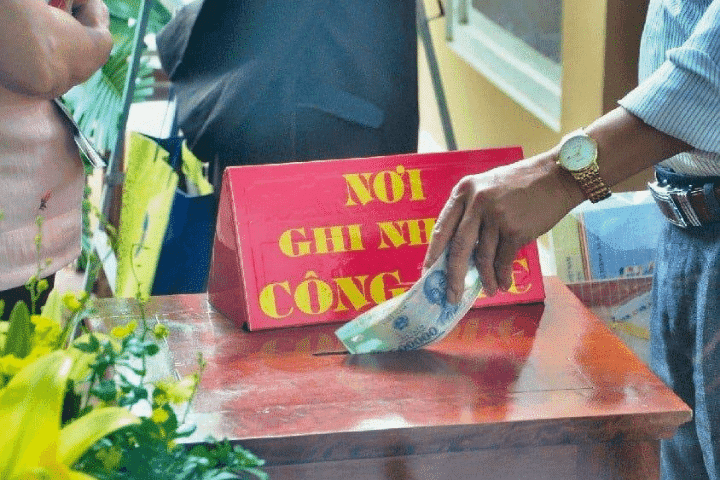
    A temple-goer deposits money into a merit donation bin. Photo: VBC.

    The VBC’s Management Board reported that the Ministry of Finance did not consult them before issuing the draft.

    In a petition on June 17, 2021, the VBC stated that the draft’s contents were unconstitutional, illegal, and did not protect ownership rights. Furthermore, the draft “does not [even] guarantee the equality of all religions before the law” by using the phrase “merit donations,” which is a term common only in Buddhism. [3]

    The VBC asserted that merit donations were the private property of churches and the monasteries belonging to those churches.

    The church recommended that the state eliminate the entirety of its regulations on income, expenditures, and merit donations, or at the very least, clarify the rules on merit donations, while also vowing not to manage such donations, which belong to the VBC’s organizations, religious institutions, and monasteries.

    In a meeting with the Government Committee for Religious Affairs on June 30, the Ministry of Finance stated that its draft was under the provisions of relevant legislation and that it did not intend to interfere in the internal affairs of religious organizations and institutions. [4]

    Online conference held on mechanisms for management and use of land for religious purposes

    On June 3, in a meeting with the Central Economic Committee and the Ministry of Natural Resources and the Environment, the Government Committee for Religious Affairs reported that land issues were becoming more complicated by the day and that new policies were needed. [5]

    According to the Government Committee for Religious Affairs’ report, the 2013 Land Law still contained numerous issues and inadequacies regarding religious organizations and land management. Among them were questions surrounding the land allocation process, the issuance of land usage rights certificates, the usage of land for welfare activities, the construction of spiritual tourism areas, and the resolution of land conflicts.

    The report conceded that current land policies “are not going to resolve religious land issues and that because the tendency of religion is towards development, the land demand for religious purposes is real.”

    https://2xjs7y10oiyz26vqxu2hok6y-wpengine.netdna-ssl.com/wp-content/uploads/2021/07/image-2.png
    A clash related to a land dispute at Thien An Abbey in 2017. Photo: Thien An Abbey.

    According to the Government Committee for Religious Affairs, there are approximately 29,801 religious institutions today, increasing 5,801 since 2008; however, the reserve of land for religious purposes has not increased.

    The 2016 Law on Faith and Religion and the 2013 Land Law are both in their final stages. This is an opportunity to reform land policy for religious organizations.

    Land policies are among the greatest sources of conflict when it comes to religious freedom in Vietnam. Although there have been many changes in land policy, the government still maintains discriminatory practices against religious organizations.

    See more: Four land issues that have caused injustices for religious organizations.

    Anniversary of the founding of Hoa Hao Buddhism: Police continue to set up security checkpoints at temple headquarters

    On June 26, Le Quang Hien, a dignitary of the Pure Hoa Hao Buddhist Church, reported that police continued to set up security checkpoints as they have every year, to prevent people from reaching temple headquarters at Long Xa Commune (Cho Moi Suburban District, An Giang Province) for the anniversary of the religion’s founding. [6]

    https://2xjs7y10oiyz26vqxu2hok6y-wpengine.netdna-ssl.com/wp-content/uploads/2021/07/Untitled-design5-1024x576.jpg
    Pictures were taken of the checkpoints in front of the Pure Hoa Hao Buddhism headquarters. Photo: Le Quang Hien’s Facebook profile.

    There has yet to be any report on the police harassment that Pure Hoa Hao Buddhists have faced.

    Police set up checkpoints at the Pure Hoa Hao Buddhism headquarters regularly during the religion’s major holidays to prevent followers from gathering.

    Security forces regularly obstruct religious activities at churches and independent Hoa Hao Buddhist institutions and followers’ private residences. The government sees these groups as illegal religious organizations and therefore does not permit them to conduct religious gatherings.

    Tuyen Quang provincial police: Mobilizing people not to follow the “heretical” Duong Van Minh religion

    At the beginning of June 2021, Tuyen Quang provincial police reported that they had made a concerted effort to convince 80 Hmong households in Cao Duong Hamlet, Yen Thuan Commune, Ham Yen Suburban District not to follow the “heretical” Duong Van Minh religion. [7]

    Provincial police stated that Vietnam respected freedom of faith and religion but would deal harshly with fanatical activities, those that threaten national security, and those who incite the masses to oppose the socialist government.

    https://2xjs7y10oiyz26vqxu2hok6y-wpengine.netdna-ssl.com/wp-content/uploads/2021/07/image-3.png
    A meeting in which residents are discouraged from following “false religions”. Photo: Tuyen Quang provincial police.

    The Duong Van Minh religion came into existence in the 1980s, mainly aiming to reform the Hmong people’s traditional rituals progressively.

    The religion regularly appears in international reports on religious freedom in Vietnam; followers have been harassed and attacked by police, receiving jail sentences, and their religious grounds have been dismantled.

    According to the U.S. State Department’s 2020 Report on International Religious Freedom, the Duong Van Minh religion leaders reported that the authorities had permitted them to use some “don houses” to store funeral supplies. [8] “Don house” is a term used to describe one of the religion’s several sites of practice that the government was once determined to demolish. More than 19 of these houses were dismantled in 2019.

    However, the article by Tuyen Quang provincial police reveals that the government firmly opposes the Duong Van Minh religion. The article calls the religion a “false” one, a hostile force, and an illegal organization that is determined to prevent residents from participating in this religion.

    This approach is applied to the Duong Van Minh religion and the many new religions that are currently surging across Vietnam.

    BPSOS: Parishioners of Con Dau Parish finally live in peace after 10 years of struggle

    After 10 years of agonizing struggle, the parishioners of Con Dau Parish (Da Nang) have been permitted by the government to live in peace in the area surrounding the church, as they’ve desired. [9]

    The human rights organization BPSOS (Boat People SOS) reported that at the beginning of the year, the authorities set aside 170 lots of land surrounding the church to house those who had fought, allowing them to live in peace as they had desired. Approximately 100 lots of land were distributed to 50 households.

    https://2xjs7y10oiyz26vqxu2hok6y-wpengine.netdna-ssl.com/wp-content/uploads/2021/07/image-4.png
    A strip of houses is being constructed for parishioners around the Con Dau Church, May 21, 2021. Photo: Mach Song Media.

    The Con Dau Parish uprising occurred in 2010 when the Da Nang municipal authorities were determined to clear 4 hamlets in Hoa Xuan Commune, Cam Le District, which included the Con Dau Catholic village, to construct an ecological travel zone. [10]

    The clearance decision was not agreed upon by parishioners, who disputed details of both compensation and relocation, leading to a conflict between hundreds of households and the government.

    Throughout 10 years of petitions, the government organized numerous episodes of suppression and coercion, causing many to flee the border as refugees. Violent clashes with police have led some residents to suffer injuries and jail sentences, while others lived in perpetual states of unrest.

    In 2017, municipal authorities finally agreed to repurpose the area around Con Dau Church into a resettlement area for parish households. [11]

    A group of individuals arrested in relation to a “false religion” and “defaming the government”

    At the beginning of June 2021, the Kinh Mon Township (Hai Duong Province) website reported that the Ministry of Public Security had arrested a group allegedly believed to be practicing a false religion and defaming leaders, the party, and the state. [12]

    The article stated that the group was arrested under Article 331 of the Penal Code – abusing democratic freedoms to infringe upon the interests of the State and the legal rights and interests of organizations and individuals. However, the article did not specify how many were arrested or their identities.

    The article reported that the group had the name “Pháph môn cần khaii vữngh trụ luậth làm trính tâm” (roughly “the Dharma discipline needs to establish the rule of law at its heart firmly”), created and controlled by a Facebook account named “Mẹ Báich Nhiên.” The page included spiritual activities such as group initiation, worship, and prayers.

    In particular, members were alleged to have used many social media accounts (Facebook and YouTube) to spread video clips criticizing leaders, the party, and the state; in these clips, members would write the government’s crimes on pieces of paper and then shred them with scissors or knives, sprinkle salt on photographs, or cast curses.

    The Ministry of Public Security website has yet to announce the arrests formally.

    New religions are thriving in Vietnam in many different forms. These groups normally operate through social media or under the radar to avoid government interference.

    [Did You Know?]

    What are “strange religions”? How many “strange religions” does Vietnam have?

    In June 2021, the Government Committee for Religious Affairs reported that as of April 2021, Vietnam had 85 “strange religions.” [13]

    These “strange religions” are also called “false religions,” the two terms the government reserves for religious groups and organizations that operate “illegally.”

    https://2xjs7y10oiyz26vqxu2hok6y-wpengine.netdna-ssl.com/wp-content/uploads/2021/07/image-5.png
    Materials related to the Supreme Master Ching Hai religious sect, which the government considers a “false religion.” Photo: People’s Public Security Newspaper.

    They could be religious organizations that spread to Vietnam from overseas, such as Supreme Master Ching Hai or the World Mission Society Church of God, or they could be homegrown, like the Vietnam Protestant Church of Christ in the Central Highlands or the Duong Van Minh religion in the northern mountainous regions.

    These “strange religions” are but one part of new religious phenomena appearing in Vietnam, which the authorities see negatively.

    The Vietnamese government has yet to define what a “false” or “strange religion” is. Reasons used to punish these groups are often subjectively applied.

    The government and the press propagandize against “strange religions” in lockstep, based on the following four primary characteristics:

    First, these groups’ religious activities are conducted surreptitiously and are unregistered by the local authorities. The government portrays this secrecy as an evasion of the law to carry out deceptive and harmful acts. In actuality, groups and organizations are seen as “false religions” cannot register their religious activities with local authorities. They must operate secretly to avoid police repression.

    Second, the government sees these groups’ activities as flimsy or intentionally destructive to national traditions, most common among them being the non-worship of ancestors. In addition, their activities are seen as affecting security and order, with their “illegal” gatherings and “anti-state” behavior.

    Third, to deny the legitimacy of these “strange religions,” the government propagandizes that these groups and organizations borrow, combine, and modify the doctrines of orthodox religions and claim them as their own rather than create their own.

    Fourth, the government and the press vigorously spread propaganda on the negative consequences of participating in new religions and have effectively caused the public to develop a negative view. The most common method is using an exceptional case to stress the severe consequences of participating on health, wealth, and spirit.

    In summary, the Vietnamese government does not see religious activities as civil ones. In their eyes, religious organizations walk the line between civil and political groups; they have a responsibility to help the state maintain security and order and mobilize the people to implement policies. As such, all religious activities must be conducted openly and under government supervision (which is why they don’t allow religious activities to be conducted in private residences).

    People participating in new religions is not a recent phenomenon. Hoa Hao Buddhism and Cao Daiism were both completely new religions at the beginning of the 20th Century.

  • Religion Bulletin, May 2021: A Protestant Church Was Accused Of Spreading COVID-19

    Religion Bulletin, May 2021: A Protestant Church Was Accused Of Spreading COVID-19

    Samples are taken for testing at the alleyway in which the Phuc Hung Missionary Church organizes weekly religious activities. Photo: Doc Lap/Thanh Nien Newspaper.

    [Religion 360*]

    COVID-19’s effect on religious activities: Criminal proceedings brought against a Protestant church

    The May 2021 resurgence of COVID-19 in many provinces and cities around Vietnam has affected religious activities to a large degree.

    On May 26, 2021, Ho Chi Minh City (HCMC) discovered positive cases among the Phuc Hung Missionary Church members. [1]

    One day later, Nguyen Duy Tan, head of the municipal Religious Committee, stated that this Protestant church had been permitted to hold religious gatherings at a private residence, with 28 members registered. [2]

    According to Tan, the church conducted four sessions in May, all according to proper municipal social distancing guidelines and with 20 participants each; however, the site was possibly limited in space. The source of the outbreak has yet to be confirmed.

    https://2xjs7y10oiyz26vqxu2hok6y-wpengine.netdna-ssl.com/wp-content/uploads/2021/06/image-15.jpeg
    Phuc Hung Missionary Church in Go Vap District, HCMC. Photo: Doc Lap/Thanh Nien.

    It was not until May 30 that Go Vap district police in HCMC charged the Phuc Hung Missionary Church with “spreading infectious disease.” [3]

    Police stated that church members did not properly comply with COVID guidelines and made incomplete declarations.

    A day before police initiated criminal proceedings, the HCMC Center for Disease Control accused church representatives of misreporting the actual number of church members. [4] Many church members made no declarations until they showed signs of illness.

    The Vietnamese press rapidly reported on the number of infections originating from the Phuc Hung Missionary Church [5], to whom the Ministry of Home Affairs attributed responsibility.

    Immediately after announcing criminal proceedings, the Ministry of Home Affairs proposed in a meeting regarding the COVID situation in HCMC that the city suspend the church’s activities, and pending the investigation results, possibly revoke its permit and eliminate its registration. [6]

    In addition to the situation involving the Phuc Hung Missionary Church, on May 26, 2021, provincial authorities in Bac Giang coerced an F1 member (someone who has been in contact with a Covid-19 positive person) of the World Mission Society Church of God into a quarantine zone. [7] The media published a video of the authorities using a construction crane to apprehend the individual forcibly.

    According to government sources, the woman purposefully avoided making a health declaration and tried to evade quarantine. Authorities stated that the individual was a member of the World Mission Society Church of God and accordingly had differing views on quarantine and health declarations.

    The World Mission Society Church of God is a religious group whose activities are not authorized by the state.

    At the beginning of May, the Ministry of Home Affairs promulgated an official document on the methods religious organizations should use to prevent and control the spread of COVID. [8] As a result, religious organizations have had to cease gatherings even in locations with zero cases unless the authorities deem a gathering necessary.

    On May 28, the Government Committee for Religious Affairs reported that the leaders of 43 religious organizations had vowed to the committee and the Ministry of Home Affairs to comply with disease control and prevention directives. [9] As such, religious organizations have restricted gatherings, declined clergy coming from overseas, practiced social distancing, worn masks, and used disinfectants.

    Vietnamese state media accuses the U.S. State Department’s 2020 Report on International Religious Freedom of misrepresentation, slander

    https://2xjs7y10oiyz26vqxu2hok6y-wpengine.netdna-ssl.com/wp-content/uploads/2021/06/image-1.png
    Articles (left to right) from VOV, People’s Public Security, and the People’s Livelihood criticizing the U.S. State Department’s Report on International Religious Freedom. Photo: screenshots.

    More than two weeks after the U.S. State Department announced its annual Report on International Religious Freedom, the Vietnamese state media began publishing a series of articles in response.

    Voice of Vietnam’s online newspaper criticized the U.S. State Department, stating that it was using inaccurate information provided by a human rights organization based in the United States, BPSOS (Boat People SOS). The newspaper stated that the United States continued to demonstrate a subjective view of the religious situation in Vietnam and that it was slandering the Vietnamese authorities by accusing them of suppressing religion. [10]

    The article stated: “Vietnam rejects the [U.S. State Department’s] one-sided, condemnatory, and subjective approach regarding faith and religion in the country”.

    Sharing the VOV’s views, the People’s Public Security Newspaper published an article titled “Exposing the false reports on freedom of belief and religion in Vietnam”. [11]

    The newspaper stated that the report’s accusations of repression and strict control of freedom of religion were “slanderous and lacking in objectivity; the U.S. State Department and the U.S. Commission on International Religious Freedom (USCIRF) are taking advantage of issues regarding freedom of faith and religion to disrupt national unity”.

    Similarly, the People’s Livelihood Newspaper, belonging to the Ministry of Labor, Invalids, and Social Affairs, also criticized the U.S. State Department’s report as lacking in objectivity and misrepresenting the situation regarding religious freedom in Vietnam. [12]

    The U.S. State Department’s Report on International Religious Freedom was released on May 12, 2021, published annually. [13]

    This year’s report contained several accusations regarding the Vietnamese government’s strict control over freedom of religion, its suppression of independent religious organizations, its punishment of religious activists, and its use of laws and administrative procedures to limit freedom of religion. According to the report, religious activities in the Central Highlands and the northern mountainous areas continue to be tightly controlled. Land disputes between religious organizations and the state were highlighted in detail.

    The Vietnamese state press’ vehement rebuttal of the United States’ Report on International Religious Freedom has become routine. USCIRF’s previous reports were met with a similar reaction.

    [The Government’s Reach]

    Religious training institutions must teach history and law according to the Government Committee for Religious Affairs’ curriculum

    In January 2021, the Government Committee for Religious Affairs began transferring lectures on Vietnamese history and Vietnamese law to religious training institutions in some provinces and cities, including Hanoi, [14] Nam Dinh, [15] Dong Nai, [16] An Giang, [17] and Bac Lieu. [18]

    According to Article 37 of the 2016 Law on Faith and Religion, religious organizations must teach Vietnamese history and Vietnamese law to establish a religious training institution.

    In February 2020, the Government Committee for Religious Affairs promulgated the teaching curriculum for these two subjects (Decision 35/QD-TGCP). It required their implementation in religious training institutions (including secondary schools, colleges, institutes, and major seminaries). [19]

    https://2xjs7y10oiyz26vqxu2hok6y-wpengine.netdna-ssl.com/wp-content/uploads/2021/06/image-2.png
    The Government Committee for Religious Affairs’ two books on history and law. Photo: Vietnamese Buddhist Church.

    Before this, the teaching of the two subjects was implemented by the religious training institutions themselves, with many different reference materials. We have observed large differences between the training objectives of the Government Committee for Religious Affairs and those of several religious training institutions.

    In the Government Committee for Religious Affairs’ curriculum, the training objectives of these two subjects are to induce religious leaders to abide by the state’s laws on religion and have them fulfill their obligations to the country.

    The Government Committee for Religious Affairs stipulates that all skills learned from studying history are “to serve as applied knowledge […] to live and work responsibly, and to carry out the rights and duties of citizens towards their homeland”.

    On the other hand, the training objectives for history at the Buddhism Institute in HCMC are to equip students with historical knowledge, research skills, and historical event analyses. [20]

    The Government Committee for Religious Affairs also stipulates how to teach these two subjects to develop compliant attitudes towards the state’s laws on faith and religion.

    Controlling the training activities of religious institutions is among the Government Committee for Religious Affairs’ ambitions. Requiring institutions to teach history and law according to their curriculum is a step in that direction.

    In January 2021, in an article published in State Organizations Magazine, [21] the vice minister of home affairs and the head of the Government Committee for Religious Affairs, Vu Chien Thang, highlighted one of the functions of the 2021 promulgation: “Review and evaluate the activities of religious training institutions; do not allow ‘unregulated’ training or travel overseas for illicit training”.

    Thang also confirmed in the article that in 2020, the Ministry of Home Affairs had succeeded in influencing religious organizations to choose church leaders who were close to the government.

    Party newspaper praises role of special civil force in controlling religious activities in the highlands

    At the end of April 2021, the Vietnamese Communist Party’s online newspaper published articles introducing the state’s special civil force. [22]

    According to the newspaper, the special civil force effectively provides information and advises the state in many goals, including controlling religions in the highlands. This civil force is deemed to have the “persons of prestige”.

    https://2xjs7y10oiyz26vqxu2hok6y-wpengine.netdna-ssl.com/wp-content/uploads/2021/06/image1-1.jpg
    General Secretary Nguyen Phu Trong meets with village elders, chiefs, dignitaries, and persons of prestige who participated in the program “Village Fulcrums” in 2018. Photo: Committee for Ethnic Minority Affairs.

    According to the Committee for Ethnic Minority Affairs, “persons of prestige” number 30,247 individuals in 52 provinces and cities in 2020. Provinces with numerous mountainous areas have the highest number of “persons of prestige.” [23]

    “Persons of prestige” appear in many of the state’s administrative occupations (the Fatherland Front, police, leaders of the ethnic minority, and religious positions, etc.). [24] Among their tasks is informing the state on noteworthy activities in their communities, including those to do with religion and security and order.

    Also, according to the Vietnamese Communist Party’s E-Newspaper, in past years, “persons of prestige” have made important contributions to eliminating false religions and obstructing illicit religious propaganda. [25]

    The criteria for choosing “persons of prestige” is stipulated in Decision #12/QD-TTg, issued by the prime minister on March 6, 2018. [26]

    According to the document, “persons of prestige” are normally cadres, civil servants, officials, members of the armed forces who have made many contributions and are no longer active, dignitaries, religious functionaries, village elders, heads of lineages, businessmen, professors, researchers, and individuals of economic standing who are respected by the community.

    Furthermore, requirements to become a “person of prestige” include consistently executing the state’s laws and regulations and carrying out activities of a communal nature, with notable comprehension of and influence within one’s community.

    The series of articles from the Vietnamese Communist Party E-Newspaper reveal that this special civil force will focus on development moving forward. They are seen as a force to help the state control civil activities that might affect national security, especially in mountainous areas.

    [Did You Know?]

    Protestantism has many independent churches: a perfectly ordinary fact

    The recent incident involving the Phuc Hung Missionary Church has raised public concerns about independent religious groups.

    Immediately after Vice Minister of Home Affairs, Vu Chien Thang, stated that the Phuc Hung Missionary Church was not a religious organization, newspapers emphasized this detail to attract readers, spreading incomplete information. For example, Thanh Nien Newspaper published the headline: “Breaking: ‘Phuc Hung Missionary Church’ was merely a gathering place, its head was not a pastor.” [27] In the same vein, the Ministry of Health’s news page reposted information from the Family Newspaper with the headline: “SHOCKING: Phuc Hung Missionary Church not a religious organization.” [28]

    The press’ incomplete information regarding the Phuc Hung Missionary Church’s type of organisation caused the public to develop unsympathetic views towards Protestant religious groups.

    According to the Government Committee for Religious Affairs, Protestantism advocates building independent churches with various organizational models, depending on the sect. It could be a centralized model with grassroots churches, like the Protestant Church of Vietnam (Southern branch). [29] Grassroots churches are imbued with the power to manage their own affairs in the spirit of independence, self-sustenance, and self-transmission. In particular, Protestantism does not prevent its followers from joining other sects or splintering off to operate independently.

    The HCMC Committee for Religious Affairs reported that the city had 145 groups that operated like the Phuc Hung Missionary Church. These groups were all legally registered with the local authorities as stipulated by the 2016 Law on Faith and Religion.

    Vietnam maintains a complex, multi-step process for groups to be recognized as religious organizations. Currently, there are only nine Protestant religious organizations recognized by the state, all of which operate using a centralized model with grassroots churches. [30]

    Protestant churches not yet recognized by the state can still operate by registering their places of assembly and religious activities.

    In 2018, there were approximately 70 Protestant organizations yet to be recognized as religious organizations by the state due to their failure to meet the requirements set out by the Law on Faith and Religion. [31] These organizations have about 79,000 followers, 75.9 percent of whom are in Binh Phuoc Province, the Central Highlands, and the northern mountainous regions.

    Furthermore, the government has deemed illegal some Protestant organizations, such as the Vietnam Church of Christ in the Central Highlands, regularly obstructing their activities and suppressing their members.

  • Vietnam Briefing: Deepening COVID-19 Crisis; Bao Sach Charges; South China Sea Tension; Harris’ Visit To Vietnam

    Vietnam Briefing: Deepening COVID-19 Crisis; Bao Sach Charges; South China Sea Tension; Harris’ Visit To Vietnam

    The Vietnam Briefing, which is released every Monday morning Vietnam time, looks at Vietnam’s political developments of the past week.


    COVID-19 cases surpass 200,000

    • Last week, Vietnam added more than 55,000 new cases of COVID-19  and almost 2,000 deaths. The total number of confirmed cases has reached over 205,000 cases and 3,250 deaths.
    • Sunday witnessed a daily tally record with 9,684 new cases.
    • Hanoi has extended its lockdown order until August 22.
    • Ho Chi Minh city is running out of allocated vaccine doses.
    • Vingroup corporation will establish a manufacturing facility to produce vaccines.
    • Vietnam vaccine: “Nanocovax, the only made-in-Vietnam Covid-19 vaccine near completion, has an efficacy rate of 90 percent, its producer said.”

    The Bao Sach criminal case: 5 members were officially accused of “abusing democratic freedom”

    From RFA:

    “Five Vietnamese journalists accused by authorities in southern Vietnam’s Can Tho province of slandering government leaders in their investigative reports will now be charged only with ‘abusing democratic freedoms’ after an investigation failed to produce evidence of more serious State-secrets charges against them.”

    What to expect:

    • Can Tho’s People’s Provincial Procuracy Office will soon prosecute them.
    • Can Tho’s People’s Provincial Court will soon try them and the trial is expected to be short (one day potentially).
    • All the defendants are expected to be convicted with sentences of up to 36 months of imprisonment. Warnings and community services are not off the table.

    Meet the new vice chief of VCP’s Propaganda Committee

    From Nhan Dan:

    “Member of the Party Central Committee (PCC) and Editor-in-chief of Nhan Dan (People) Newspaper Le Quoc Minh has been appointed to serve concurrently as Deputy Head of the PCC’s Commission for Communication and Education and hold the position of Secretary of the Party Committee of the Vietnam Journalists Association (VJA) for the 2015-2020 and 2020-2025 tenures.”


    Vietnam demands China stop Paracel Islands military drills

    From VnExpress:

    • Vietnam has asked China to stop and not repeat military drills on its Hoang Sa (Paracel) Islands, asserting that they violate Vietnam’s sovereignty.
    • “China performing drills on Vietnam’s Paracel Islands violates Vietnam’s sovereignty over the islands, goes against the spirit of the Declaration on the Conduct of Parties in the South China Sea (DOC), complicates the situation, and is not beneficial for current negotiations between China and ASEAN on the Code of Conduct for the South China Sea (COC), as well as the maintenance of peace, stability and cooperation at the East Sea,” Foreign Ministry spokeswoman Le Thi Thu Hang said Thursday.

    US’ Vice President Harris to visit Vietnam on August 24

    From Bloomberg:

    “The global semiconductor shortage and other supply chain troubles will be a focus of Vice President Kamala Harris’s trip to Southeast Asia later this month, where she also aims to shore up U.S. relations with countries at China’s doorstep.”


    Learn more about Vietnam

    Controlling the Information Space: Big Tech and Free Speech in Southeast Asia

    The Diplomat/Andreyka Natalegawa and Kyra Jasper/August 05

    “Countries like Vietnam have mobilized ‘cyber-armies’ to monitor and report online content critical of the central government. These cyber-armies exploit the content moderation mechanisms on platforms like Facebook, reporting content en masse for violating ‘Facebook’s ever-pliable Community Standards, whether or not the rules were broken.’”

    Bad news for Vietnam’s Mekong Delta

    The Interpreter/Milton Osborne/July 29

    “The release of recent research from the Netherlands adds an additional insight into what is happening in Vietnam’s Mekong Delta, the country’s all-important food-producing region that contributes some fifty per cent to its agricultural GDP. In a stark conclusion, the research cites 2050 as the Tipping Point when the delta will no longer be able to cope with saltwater intrusions, a phenomenon that is already causing the loss of productive land.”

    Russia and Vietnam: An alliance of convenience

    The Interpreter/Nikola Mikovic/August 2

    “Russia is one of the biggest suppliers of weapons to Southeast Asia, with Vietnam alone a major customer for Russia’s arms. While it is estimated that throughout the 1980s, Moscow had provided Vietnam with an average of US$1 billion annually in military assistance and another US$1 billion annually in economic assistance, following the collapse of the Soviet Union, the Kremlin lost significant influence in the country. Now Russia is seeking to regain lost ground.”

  • Toward Greener Pastures: A Reflection On Human Trafficking In Vietnam

    Toward Greener Pastures: A Reflection On Human Trafficking In Vietnam

    In October 2019, 39 people were found dead inside a sealed refrigeration trailer in Grays, Essex, in the United Kingdom. Initially thought to be Chinese, these people were, in fact, Vietnamese, mostly from Nghe An and Ha Tinh provinces in the north-central region of Vietnam, who had left their families and their homeland for a minuscule chance at a better life.

    “They were treated worse than cattle,” DCI Daniel Stoten, the lead investigator, told The Guardian.  This tragic event is now commonly known as the Essex Lorry Deaths.

    In response to this tragedy, Nguyen Xuan Phuc, who was the prime minister of Vietnam at that time, ordered an investigation into the incident. He ordered the Ministry of Public Security, the Foreign Ministry, and the two central provinces of Nghe An and Ha Tinh to investigate and find out cases of Vietnamese citizens being brought illegally to foreign countries and strictly handle the violations.

    Yet, after almost two years, despite the sentencing and imprisonment of the people involved with the trafficking crimes and the investigations by Vietnam and other foreign governments, human trafficking in Vietnam continues to thrive.

    Deutsche Welle, a media organization based in Germany, reports that the ongoing surge of COVID-19 cases in the country is pushing more and more Vietnamese citizens to turn towards smuggling and human trafficking to make ends meet. Despite the country’s closed borders, people are still able to move in and out of the country through routes passing through neighboring Myanmar and China.

    Michael Brosowski, the co-founder of the Hanoi-based Blue Dragon Foundation, a charity organization that deals with child rescue and human trafficking, mentions in the article that most of the cases he’s been handling involve women and girls from ethnic minorities. He also adds that there have been reports of girls being forced to work in karaoke bars, which are likely fronts for brothels.

    Human trafficking is a messy, disturbing, and heartbreaking issue. Yet, the fact that it continues to this day and that some people willingly choose to engage in it, or are left with no other choice but to resort to it, only underscores the importance and necessity of open dialogue and addressing it in the public sphere. In the context of Vietnam, it is essential to reflect on why it continues to be so prevalent and on why it has remained cancer growing seemingly unchallenged in Vietnamese society.

    Human Trafficking in Vietnam

    The United Nations defines human trafficking as “the recruitment, transportation, transfer, harboring or receipt of people through force, fraud or deception, with the aim of exploiting them for profit.” They add that “men, women, and children of all ages and from all backgrounds can become victims of this crime” and that the people who operate such practices often use “violence, fraudulent employment agencies, or fake promises of education and job opportunities to trick and coerce their victims.”

    The U.S. Department of State’s global report on human trafficking provides several facts and statistics regarding the troubled state of this issue in Vietnam and lays out several recommendations that the country should take in order to better improve this situation. Likewise, our own Jason Nguyen, in his pieceregarding human trafficking, summarizes many of the key points and features of this aforementioned report.

    To put it simply, The U.S. Department of State classifies Vietnam under its Tier 2 watchlist; this means that the country has not met its minimum standards in terms of eliminating human trafficking but is at least trying to do so. Continued failure to act and a lack of concrete action may lead Vietnam to be reclassified as Tier 3; countries that fall under this bracket will be barred from getting any financial assistance from the United States. Vietnamese citizens will also face heightened immigration restrictions and the assets of Vietnamese officials in the United States will be frozen as well.

    Regarding the actions Vietnam is currently undertaking to address human trafficking, Nguyen writes that the country has ramped up prosecution against human traffickers and has passed legal revisions to terminate ludicrous brokerage fees; these fees, if too steep, cannot be realistically paid. In effect, workers end up indebted to their employers

    With regards to specific legislation, Nguyen notes that Articles 150 and 151 of the Penal Code are specific anti-trafficking provisions that aim to dissuade would-be traffickers; both carry hefty prison sentences and associated fines. Yet, despite being called “sufficiently stringent” in the U.S. Department of State’s report, the implementation of these laws is not ideal. Despite having more charges filed against human traffickers, the number of investigations and convictions has actually decreased. Poor data collection, inadequate monitoring, and problematic evidence collection continue to hinder Vietnam’s fight against human trafficking, despite the government providing personnel and state forces anti-trafficking training.

    The U.S. Department of State report also alleges that some Vietnamese government officials, at the commune and village levels, were complicit in the practice of trafficking itself. They allegedly accepted bribes from traffickers, overlooked trafficking indicators, and even demanded large sums of money from the victims prior to reuniting them with their families.

    As for the victims and perpetrators of human trafficking themselves, Nguyen writes that “over 60 percent of victims come from ethnic minority groups” and that both traffickers and their victims “share poor economic and educational backgrounds.” He also notes that most traffickers are also illiterate and have not finished high school.

    The Borgen Project, a non-profit organization that aims to make fighting poverty part and parcel of the U.S foreign policy, also notes several facts that highlight the plight of Vietnamese human trafficking victims; men, women, and children are all fair game in this industry and their servitude ranges from forced labor in various physically intensive industries, such as manufacturing or agriculture, to prostitution and sex work in brothels.

    Addressing the Issue

    The U.S. Department of State’s global report does an exceptional job in presenting the current state of human trafficking in Vietnam. Likewise, it also provides several suggestions and recommendations that the country should prioritize to improve the situation as soon as possible. Nguyen condenses these as follows:

    1. Bolstering collaboration with NGOs and civil society;
    2. Amending existing loopholes;
    3. Training law enforcement officials in domestic trafficking cases;
    4. Implementing policies;
    5. Increasing national funding for provincial-level authorities to assist victims of trafficking; and
    6. Inviting independent bodies to verify that the government has terminated forced labor in rehabilitation centers.

    These suggestions are all well and good but they mostly seem to deal with the effects and the aftermath of human trafficking itself; even preventative measures such as information campaigns and policy formation skirt the root of the problem. They fail to get to the heart of the issue and sadly this almost guarantees that human trafficking in Vietnam will continue to exist and grow.

    How then should we approach Vietnam’s human trafficking problem?

    As mentioned earlier, the victims and perpetrators of human trafficking in the country do not come from privilege nor wealth. They are not from the upper or middle classes of society, nor have they completed their formal education; some cannot even read. They come from ethnic minorities and face daily challenges that would seem alien to those blessed with the sanctity of comfort. They constantly live in extreme poverty, and due to their actual and perceived lack of choice, are forced to latch onto any opportunity that comes their way just to be able to bring home food for themselves and for their families. Necessity and despair force both traffickers and their victims to do what they think they need to do, even if it means resorting to illegal and dehumanizing means.

    The hopeless deceive the hopeless with promises of greener pastures and a better life while concealing the risks, dangers, and reality.

    Inequality, poverty, and social disparity are at the center of this issue and if Vietnam desires long-lasting permanent change regarding human trafficking, these need to be rightfully addressed and resolved.

    Granted, non-governmental organizations and volunteer groups, such as the Blue Dragon Children’s Foundation, exist and are already doing their part to help alleviate this situation. However, they lack the funds, manpower, and machinery to continuously push forward to bring about definite progress; only the Vietnamese government has an abundance of all three. And yet, the government seems content with keeping the status quo and staying at Tier 2.

    Hence, unless some form of change occurs within the government, or the human trafficking trade suddenly becomes less lucrative for those corrupt and morally bankrupt officials involved in it, more Vietnamese people face the risk of suffocating to death in a cramped enclosed space, thousands of miles away from their homes and loved ones.

    Bibliography:

    1. BBC News. (2021, January 22). Essex lorry deaths: Men jailed for killing 39 migrants in trailer. BBC News. https://www.bbc.com/news/uk-england-essex-55765213.
    2. Gentleman, A. (2020, December 21). Essex lorry deaths: two found guilty over manslaughter of 39 Vietnamese people. The Guardian. https://www.theguardian.com/uk-news/2020/dec/21/essex-lorry-trial-two-found-guilty-over-deaths-of-39-vietnamese-people.
    3. Thuy, H. (2019, October 27). PM orders investigation into overseas trafficking of Vietnamese citizens – VnExpress International. VnExpress International – Latest news, business, travel, and analysis from Vietnam. https://e.vnexpress.net/news/news/pm-orders-investigation-into-overseas-trafficking-of-vietnamese-citizens-4002921.html.
    4. Bohane, H. (2021, June 11). Vietnam: Human trafficking on the rise amid COVID: DW: 11.06.2021. DW Made for Minds. https://www.dw.com/en/vietnam-human-trafficking-on-the-rise-amid-covid/a-57853994
    5. The United Nations: Office on Drugs and Crime. (n.d.). Human-Trafficking. United Nations : Office on Drugs and Crime. https://www.unodc.org/unodc/en/human-trafficking/human-trafficking.html.
    6. Office To Monitor And Combat Trafficking In Persons. (2021, July 1). 2021 Trafficking in Persons Report: Vietnam. United States Department of State. https://www.state.gov/reports/2021-trafficking-in-persons-report/vietnam/
    7. Nguyen, J. (2021, July 17). Q&A: What You Should Know About The Human Trafficking Situation In Vietnam. The Vietnamese. https://www.thevietnamese.org/2021/07/qa-what-you-should-know-about-the-human-trafficking-situation-in-vietnam/.
    8. Minh, H. L. (2020, January 18). 10 Facts About Human Trafficking in Vietnam. The Borgen Project. https://borgenproject.org/10-facts-about-human-trafficking-in-vietnam/.
  • Vietnam: In The Middle Of The COVID-19 Pandemic, They Are The Ones Being Left Behind

    Vietnam: In The Middle Of The COVID-19 Pandemic, They Are The Ones Being Left Behind

    Since the first infections were detected in the country, Vietnam has surpassed[1] 100,000 Covid-19 cases spanning 62 out of its 63 provinces and more than 1,000 deaths. As the pandemic shows no signs of vanishing anytime soon, especially in the southern provinces, this Southeast Asian country faces both a healthcare and economic crisis.

    The Vietnamese Communist Party, as usual, has been deploying propaganda, at maximum capacity, to placate the public. Vigorous slogans, from promises of “leaving no one behind” to “protecting people’s lives remain a top priority” [2], are dominating state media and pro-government online groups on social media.

    However, the reality is far gloomier than the Party’s political discourse.

    Besides revealing the darker side [3] of Vietnam’s epidemiological strategy, the pandemic also deepens the increasingly widening gap between the haves and have-nots and between the people with power and those without.

    The Workers

    According to the Vietnam General Statistics Office report, [4] nearly 13 million workers were negatively affected by the economic downturn caused by the third and fourth wave of Covid-19 outbreaks. This number includes [5] about 557,000 people who lost their jobs, 4.3 million people who had their working hours cut, those who had to take time off from work or had to rotate shifts, and another 8.5 million who had their income reduced.

    The pandemic has had an impartial effect on the Vietnamese labor market, but so far, freelance and manual workers are among those who got hit the hardest.

    In Vietnam, the term “freelance workers” has a very different connotation compared to the West. This workforce primarily consists of senior citizens, the impoverished, and college graduates, who lack physical health and certain skills that the average employer often deems necessary. They are known for doing various unskilled jobs, such as being street vendors, motorbike drivers, lottery ticket sellers, and the like.

    These freelance workers usually rely on their own labor to make ends meet daily while lacking health insurance and many personal savings, so they are at a greater risk of getting infected with the coronavirus or becoming financially strained under lockdown measures and other anti-coronavirus restrictions. Furthermore, stagnant economic activities, coupled with the government’s ineffective financial assistance schemes, seem to add [6] to their struggle.

    A street vendor in Da Nang City. Photo: RFA.

    At the same time, factory workers, the backbone of Vietnam’s export-oriented economy, are also facing another set of challenges in the midst of the pandemic.

    When coronavirus infections started to spread inside many factories during the latest outbreak, most workers were required to be quarantined inside their workplaces while continuing production in a strategy known as “dual goal.” [7] This strategy aimed to control infections while at the same time maintaining industrial production.

    However, risky working environments and the factories’ poor accommodations have sparked anger among many workers, causing them to flee their workplaces. Meanwhile, on social media, many people have also expressed their disagreement with the decisions of local authorities, repeatedly condemning[8] them for compromising workers’ health for cash.

    Besides rigid anti-coronavirus measures, the “ho khau” system, a household registration scheme used in Vietnam, has created another burden for these unskilled workers, especially for migrants from poorer provinces seeking manual jobs in big cities and industrial zones.

    More specifically, this household registration system denies migrant workers the eligibility to receive public services and welfare assistance where they temporarily live and work, such as healthcare and education, unless they register with local police.

    Many migrant workers chose to return to their hometowns by motorbikes. Photo: Người Huế ở Sì Gòn (Facebook group)/ BBC Vietnamese.

    Nevertheless, Vietnam’s bureaucratic public services, alongside rampant corruption in the registration process, leaves many of them living illegally without legitimate status. As a result, when several southern industrial provinces and the economic hub of Ho Chi Minh City remained under lockdown to battle the latest outbreak of Covid-19, a large number of these employees were left with no choice but to return to their hometowns to avoid infection and to overcome the financial difficulties caused by their unemployment.

    Over the past few weeks, a massive exodus of migrant workers has been seen, with workers risking their lives on arduous journeys to go back home. Many choose motorbikes, and some attempted to make it on foot, [9] with several unfortunate souls losing their lives along the way. In response, several provinces have publicized official announcements citing the Covid-19 infection risk to urge migrant workers not to return home [10] or to “go back to where they started.” [11]

    This dire situation has led to an outcry on Vietnamese social media. Many users are questioning the government’s response and criticizing its failure to provide financial assistance to these people, secure safer means of homebound transportation, and provide housing in adequate quarantine facilities.

    A worker walked more than 180 km in 16 days from Dak Lak Province to his sister’s house in Binh Phuoc Province, as he did not have enough money for a bus ride. Photo: Zing News/ provided by the worker.

    Inmates, Prisoners of Conscience, and Addicts

    Multiple prisons and rehabilitation centers, especially in several southern localities, have also become new hotspots of infections during the fourth wave of the Covid-19 outbreak in Vietnam.

    On July 7, local authorities declared [12] that Chi Hoa Prison, a detention center located in Ho Chi Minh City, had recorded more than 80 people infected with Covid-19, including detainees and correctional officers. As the situation worsened, riots began to erupt [13] inside the facility as the rapid spread of coronavirus fueled fear among hundreds of inmates.

    A few weeks later, on July 23, all of the staff and addicts [14] at Bo La Rehabilitation Center, a facility located in the southern province of Binh Duong, tested positive for Covid-19. At the same time, a mental health hospital in Ho Chi Minh City also diverted a part of its functionality to treat Covid-19 patients, including many infected mental health patients, as surging cases overloaded healthcare capacity in the city.

    The infrastructure of detention and rehabilitation centers in Vietnam in general and other public facilities have long been infamously known for their degradation, poor living conditions, and maltreatment of prisoners and patients.

    Riot police vans were seen leaving the Chi Hoa Prison after reportedly being deployed to quell riots. Photo courtesy: Dinh Van/ VnExpress.

    Several family members of prisoners of conscience have also expressed their concerns over the safety of their relatives amid the Covid-19 situation. During interviews with RFA Vietnamese, [16] many expressed concerns that the proximity of sleeping quarters, poor living conditions, and limited information about the prisoners threaten the well-being of the people being kept inside the cells.

    Currently, prisoners, addicts, and mental health patients are not part of the official list [17] of 16 qualified priority groups to receive Covid-19 vaccinations, despite promises of future vaccination opportunities. However, given Vietnam’s ongoing vaccine shortage, these people will likely be the last to receive the vaccine.

    Other Vulnerable Groups

    The latest vaccination scandals [18] include a woman and her husband being prioritized to get vaccinated thanks to her father’s connections and a decision from Ho Chi Minh City authorities to lend Vingroup, a local conglomerate, 5,000 Moderna doses from the COVAX initiative to inoculate its staff, raise questions about equal access to the Covid-19 vaccine for all Vietnamese citizens.

    From a broader perspective, the political landscape in Vietnam is deepening the inequality in vaccine distribution. Government officials with strong connections or powerful corporations with economic clout can “cut in line” [19] to get vaccinated first, taking away inoculation opportunities from others, especially those who are most vulnerable once infected.

    As of July 19, [20] Ho Chi Minh City has officially begun vaccinating older adults and patients with underlying health conditions in the fifth phase of its inoculation campaign. Still, authorities have neither provided further information on the screening process nor medical assistance should side effects occur in these high-risk groups. Meanwhile, vaccination schedules for other vulnerable groups, such as the homeless, war veterans, and the disabled have remained undisclosed.

    Homeless people in Ho Chi Minh City amid the Covid-19 pandemic. Photo: Lao Dong.

    The Communist Party, since the very first days of its establishment, has prided itself on being “a Party of the people, of the working class.” [21] The Party manifests its ideology in the notion that their ultimate goals are “nothing other than the interests of the [working] class, the people and the nation” to build a more “democratic, wealthy and equal Vietnam.”

    Almost a century later, the Covid-19 pandemic has fully uncovered what the Party has been dedicating its whole lifespan to achieving benefits for itself and those living dependent on the corrupt system. Ironically, the poor, migrant workers or prisoners of conscience have never been of great concern to the Communist regime.

    As the dark clouds of Covid-19 continue to loom large over Vietnam, the tragic fates of those voiceless and powerless people mentioned above seem astoundingly more genuine than the Party’s empty promises.

    Bibliography:

    1. Số liệu Covid-19 tại Việt Nam. (2021, August 2). VnExpress. https://vnexpress.net/covid-19/covid-19-viet-nam
    2. Tiep, P. (2021, May 16). Quyết tâm đẩy lùi dịch COVID-19, bảo vệ sức khỏe nhân dân là trên hết. Báo Công An Nhân Dân. https://cand.com.vn/Su-kien-Binh-luan-thoi-su/Quyet-tam-day-lui-dich-COVID-19-bao-ve-suc-khoe-nhan-dan-la-tren-het-i605680/
    3. Jason, N. (2021, July 21). How The Latest Outbreak Reveals The Darker Side Of Vietnam’s Anti-Coronavirus Strategy. The Vietnamese Magazine. https://www.thevietnamese.org/2021/07/how-the-latest-outbreak-reveals-the-darker-side-of-vietnams-anti-coronavirus-strategy/
    4. Bang, L. (2021, July 7). Over 1.1 million people unemployed, nearly 13 million others affected by Covid-19 pandemic. Vietnamnet. https://vietnamnet.vn/en/society/over-1-1-million-people-unemployed-nearly-13-million-others-affected-by-covid-19-pandemic-753558.html
    5. VOA News. (2021, July 16). Vietnam Shops for Vaccines in Hopes of Avoiding More Lockdowns. VOA. https://www.voanews.com/covid-19-pandemic/vietnam-shops-vaccines-hopes-avoiding-more-lockdowns
    6. RFA. (2021, June 7). Lao động tự do chật vật trong đợt dịch COVID-19 thứ tư. Đài Á Châu Tự Do. https://www.rfa.org/vietnamese/in_depth/freelance-workers-struggle-during-the-fourth-covid-19-outbreak-06072021145713.html
    7. Việt Nam có nên vận dụng “mục tiêu kép” trong lúc này? (2021, May 27). Đài Á Châu Tự Do. https://www.rfa.org/vietnamese/in_depth/should-vietnam-maintain-dual-goal-now-05272021111728.html
    8. Ibid., [7]
    9. Nhi, T. (2021, July 26). Người đàn ông đi bộ 16 ngày từ Đắk Lắk về Bình Phước để tránh dịch. Zing News. https://zingnews.vn/nguoi-dan-ong-di-bo-16-ngay-tu-dak-lak-ve-binh-phuoc-de-tranh-dich-post1243231.html
    10. Nguyen, C. (2021, August 1). Xót xa cả gia đình gặp nạn trên đường về quê tránh dịch Covid-19. Người Lao Động. https://nld.com.vn/thoi-su/xot-xa-ca-gia-dinh-gap-nan-tren-duong-ve-que-tranh-dich-covid-19-20210801092125848.htm
    11. Ngoc, N. (2021, July 31). Từ 1/8, dân Quảng Ngãi buộc quay lại nơi xuất phát. Tiền Phong. https://tienphong.vn/tu-1-8-dan-quang-ngai-buoc-quay-lai-noi-xuat-phat-post1360999.tpo
    12. Tinh, D. (2021, July 7). TP.HCM: Ổ dịch tại Trại tạm giam Chí Hòa có 81 ca nhiễm Covid-19. Thanh Niên Online. https://thanhnien.vn/thoi-su/tphcm-o-dich-tai-trai-tam-giam-chi-hoa-co-81-ca-nhiem-covid-19-1410289.html
    13. Trại Chí Hòa: Hàng trăm phạm nhân nổi dậy sau khi 81 người nhiễm COVID-19 trong trại. (2021, July 7). Đài Á Châu Tự Do. https://www.rfa.org/vietnamese/news/vietnamnews/chi_hoa_riot-07072021052110.html
    14. Canh, N. (2021, July 23). Toàn bộ những người ở cơ sở cai nghiện ma tuý Bố Lá dương tính với SARS-CoV-2. Báo Công An Nhân Dân. https://cand.com.vn/y-te/Toan-bo-nhung-nguoi-o-co-so-cai-nghien-ma-tuy-Bo-La-duong-tinh-i621306/
    15. Anh, T. (2021, July 25). TP HCM lập bệnh viện điều trị người tâm thần mắc Covid-19. VnExpress. https://vnexpress.net/tp-hcm-lap-benh-vien-dieu-tri-nguoi-tam-than-mac-covid-19-4330137.html
    16. Son, T. (2021, July 7). COVID-19 xâm nhập trại giam: lo lắng cho an nguy của các tù nhân. Đài Á Châu Tự Do. https://www.rfa.org/vietnamese/in_depth/families-of-prisoners-of-conscience-worry-as-covid-spreads-in-prisons-07072021080636.html
    17. Thanh, A. (2021, July 11). [Infographic] Những nhóm mở rộng được ưu tiên tiêm vắc-xin Covid-19. Người Lao Động. https://nld.com.vn/thoi-su/infographic-nhung-nhom-mo-rong-duoc-uu-tien-tiem-vac-xin-covid-19-20210711011752387.htm
    18. The Vietnamese Magazine. (2021, July 26). Vietnam Briefing: COVID-19 Crisis Deepening While The National Assembly Convened To Elect State Leadership. The Vietnamese Magazine. https://www.thevietnamese.org/2021/07/vietnam-briefing-covid-19-crisis-deepening-while-the-national-assembly-convened-to-elect-state-leadership/
    19. Minh, N. (2021, July 22). Có bao nhiêu “cháu ngoại” đã trót lọt chen hàng để tiêm vaccine trước? Luật Khoa Tạp Chí. https://www.luatkhoa.org/2021/07/co-bao-nhieu-chau-ngoai-da-trot-lot-chen-hang-de-tiem-vaccine-truoc/
    20. L.Đ.O. (2021, July 19). Người già, người có bệnh nền tại TPHCM được tiêm vaccine tại bệnh viện. Người Lao Động. https://laodong.vn/y-te/nguoi-gia-nguoi-co-benh-nen-tai-tphcm-duoc-tiem-vaccine-tai-benh-vien-932236.ldo
    21. L.Đ.O. (2020, January 28). Đảng của dân tộc, Đảng của giai cấp công nhân. Người Lao Động. https://laodong.vn/thoi-su/dang-cua-dan-toc-dang-cua-giai-cap-cong-nhan-778528.ldo
  • Vietnam Briefing: Public Shaming On National Television Amidst Worsening COVID-19 Situation

    Vietnam Briefing: Public Shaming On National Television Amidst Worsening COVID-19 Situation

    The Vietnam Briefing, which is released every Monday morning Vietnam time, looks at Vietnam’s political developments of the past week.


    Vietnam’s national television under fire for using pseudoscience to humiliate people

    • The government-owned national television channel VTV1 has been under fire as it compared breaking social distancing rules with “having animal brains” in a national broadcasting session. It also compared people who ran away from the police and the authorities as “having reptile brains.”
    • This idea of people having “animal” and “reptile” brains is rooted in a theory that has long been refuted, according to Yale University School of Medicine. Even though the theory is considered by many experts to be pseudoscience, it still appeared on Vietnam’s national television.
    • VTV has deleted this video from its website along with other related articles and has since been silent about this broadcasting.

    COVID-19 in Vietnam

    • According to Reuters: “Vietnam’s daily COVID-19 infections hit a record 8,649 cases on Friday, taking its total tally to over 137,000.” Most of the new cases were recorded in the south, particularly in Ho Chi Minh City.
    • Even though the social distancing period for Ho Chi Minh City was supposed to end by the end of last week, Prime Minister Pham Minh Chinh imposed an extension for another two weeks starting August 2. By the end of this period, if no more extension is imposed, Ho Chi Minh City will have been in lockdown for 38 days.
    • Vaccination efforts have escalated in Ho Chi Minh City. It has been reported that Ho Chi Minh City will increase the number of vaccination sites from 600 to 1,000, with each site aiming to vaccinate at least 300 people each day.
    • Meanwhile, there have been heated debates about the type of vaccine being used in Vietnam, as Ho Chi Minh City received one million doses of the Sinopharm vaccine from China.
    • As of Friday, July 30, only around 6.2 million people have been vaccinated with around 620,000 people fully vaccinated nationwide in Vietnam, according to the University of Oxford. The population of Vietnam is around 100 million, so the number of people fully inoculated is less than 1 percent of the population.
    • The National Assembly gave Prime Minister Pham Minh Chinh the authority and the responsibility to decide on “special measures”regarding the COVID-19 situation. This shows the lackluster role of the National Assembly in the pandemic.

    US Vice President Kamala Harris to visit Vietnam in August

    • According to Nikkei Asia: “US Vice President Kamala Harris will visit Singapore and Vietnam in August, the White House said Friday, as Washington seeks to bolster ties with the two key Asia-Pacific partners.” This will be the first time an American vice president officially visits Vietnam while still in office.
    • Last week, US Defense Secretary Lloyd Austin also visited Vietnam and met with Vietnam Defense Minister Phan Van Giang to “deepen cooperation in security and pandemic recovery.”
    • Foreign policy experts see these visits by senior US officials as a sign that the US is broadening its presence in Southeast Asia and the South China Sea amidst China’s rising influence. There is also hope that deepening US-Vietnam relations would be beneficial for human rights advocacy.

    New (but expected) faces elected by the National Assembly

    • In the first meeting of the 15th National Assembly (elected in 2021), the legislative assembly has elected people to the 50 most important leadership positions for the next five-year term, including the prime minister, president, chairman of the National Assembly, chief justice of the Supreme People’s Court, prosecutor general of the Supreme People’s Procuracy, along with various ministers and deputies.
    • The full list of the 50 positions and the newly elected leaders can be found here.
    • As mentioned in previous briefings, even though these names have only been recently confirmed, many of the appointees have been known since as early as April.
    • Amidst the surge of COVID-19 infections, the National Assembly delegation to Ho Chi Minh City is not going to meet with voters as planned.

    Activist and ex-detainee summoned by the authorities despite widespread lockdown

    • According to BBC Vietnamese, on July 28, 2021, activist and ex-political prisoner Pham Thanh Nghien, who is living in Ho Chi Minh City, was summoned by the police in Hanoi for her book, “Slices of Life Behind Bars,” which was published in the US in 2017. She said that it is possible that she was summoned also due to her criticism of the government on her Facebook account.
    • It is unknown why the authorities wanted the activist to travel to Hanoi, despite social distancing measures in both Hanoi and Ho Chi Minh City, which make it much more difficult for anyone to travel around the country.

    Learn more about Vietnam

    COVID-19 Turned Vietnam’s State-Run Union’s Greatest Weakness Into Its Biggest Strength

    Joe Buckley/The Diplomat/July 29, 2021

    “The state-led Vietnam General Confederation of Labor (VGCL) is Vietnam’s only legal trade union federation. It is subordinate to the ruling Communist Party, embedded in the structures of the party-state, and receives a lot of funding from it. Government leaders often make speeches reinforcing how committed they are to strengthening the VGCL and reminding people that the Confederation is an arm of the state. You will find a union office, staffed by full-time officials, at almost every level of Vietnam’s administration, from the impressive and imposing national headquarters on Hanoi’s Quan Su street down to modest and charming ward and district-level offices throughout the country. In individual companies, union reps are often human resource managers or similar.

    Due to this, the VGCL has been heavily, and often rightly, criticized for being unable to represent and struggle for workers properly. The VGCL has never organized a strike, for example, and often serves as a channel to inform workers of government and company policies rather than to challenge them.”

    In Vietnam, Civil Society Is Picking up the Slack Where Authorities Struggle

    Luke Hunt/The Diplomat/July 28, 2021

    “The Communist authorities in Vietnam risk becoming increasingly marginalized after failing to curb the spread of COVID-19. Civil society groups are now taking the initiative in combating the pandemic amid harsh lockdowns in the country’s south.”

    America Can—and Should—Vaccinate the World

    Helene Gayle, Gordon LaForge, and Anne-Marie Slaughter/Foreign Affairs/March 19, 2021

    “The Biden administration is right to want to take the lead in vaccinating the world, for a host of reasons both self-interested and altruistic. But it should not fall into the trap of trying to beat Russia and China at their own game—handing out vaccines to specific countries based on their geostrategic importance and the amount of attention they are receiving from rival powers.

    Rather, Biden should pursue abroad the sort of “all in” unity approach that he has proclaimed at home. His administration should focus less on strategic advantage than on vaccinating the largest number of people worldwide in the shortest amount of time. In so doing, the United States would concentrate on what the world’s peoples have in common—susceptibility to this and many other viruses—regardless of the nature of their governments.”

    Research: “The Ambiguous Legacy of Ngô Đình Diệm in South Vietnam’s Second Republic (1967–1975)”

    Sean Fear/Journal of Vietnamese Studies/March 01, 2016

    “Although recent English-language Vietnam War scholarship has devoted considerable attention to reassessing the Ngô Đình Diệm era, contemporaneous South Vietnamese interpretations of the president’s tenure have been largely overlooked. Contrary to prevailing assumptions that his influence ended abruptly with his 1963 murder, Ngô Đình Diệm was a hotly debated figure long after his death. Moreover, his contested legacy came to symbolize South Vietnam’s enduring political, regional and religious schisms, contributing to and reinforcing his country’s profound social fragmentation. The fluid and ambiguous memory that Vietnamese had of his time in office had a substantial impact on subsequent political developments, establishing patterned dynamics of political conflict that endured throughout the Second Republic and providing conceptual yardsticks against which subsequent politicians and political developments were measured. Ngô Đình Diệm’s fraught symbolic resonance and significant posthumous political impact are therefore crucial dimensions to consider in evaluating his legacy.”