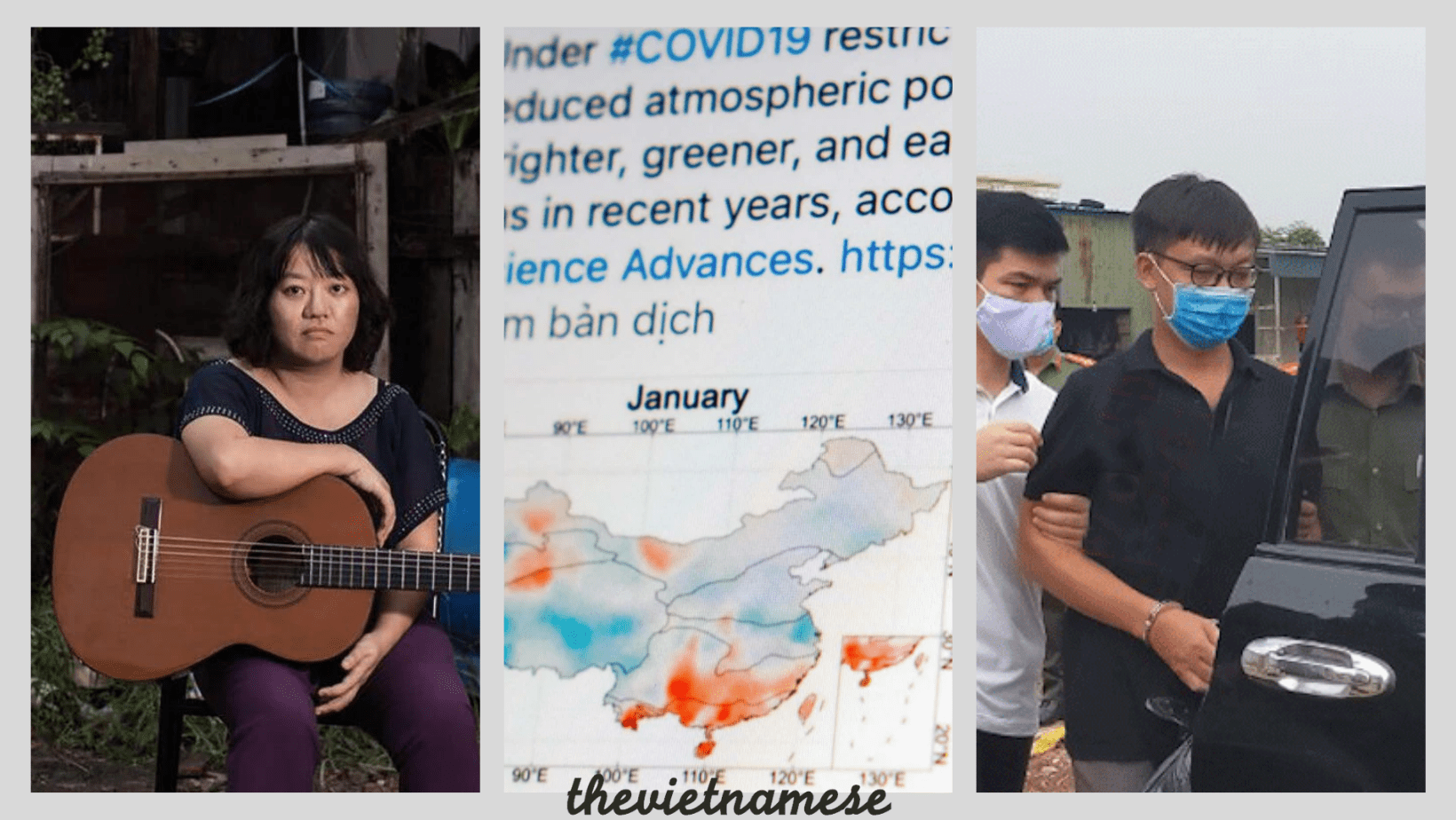
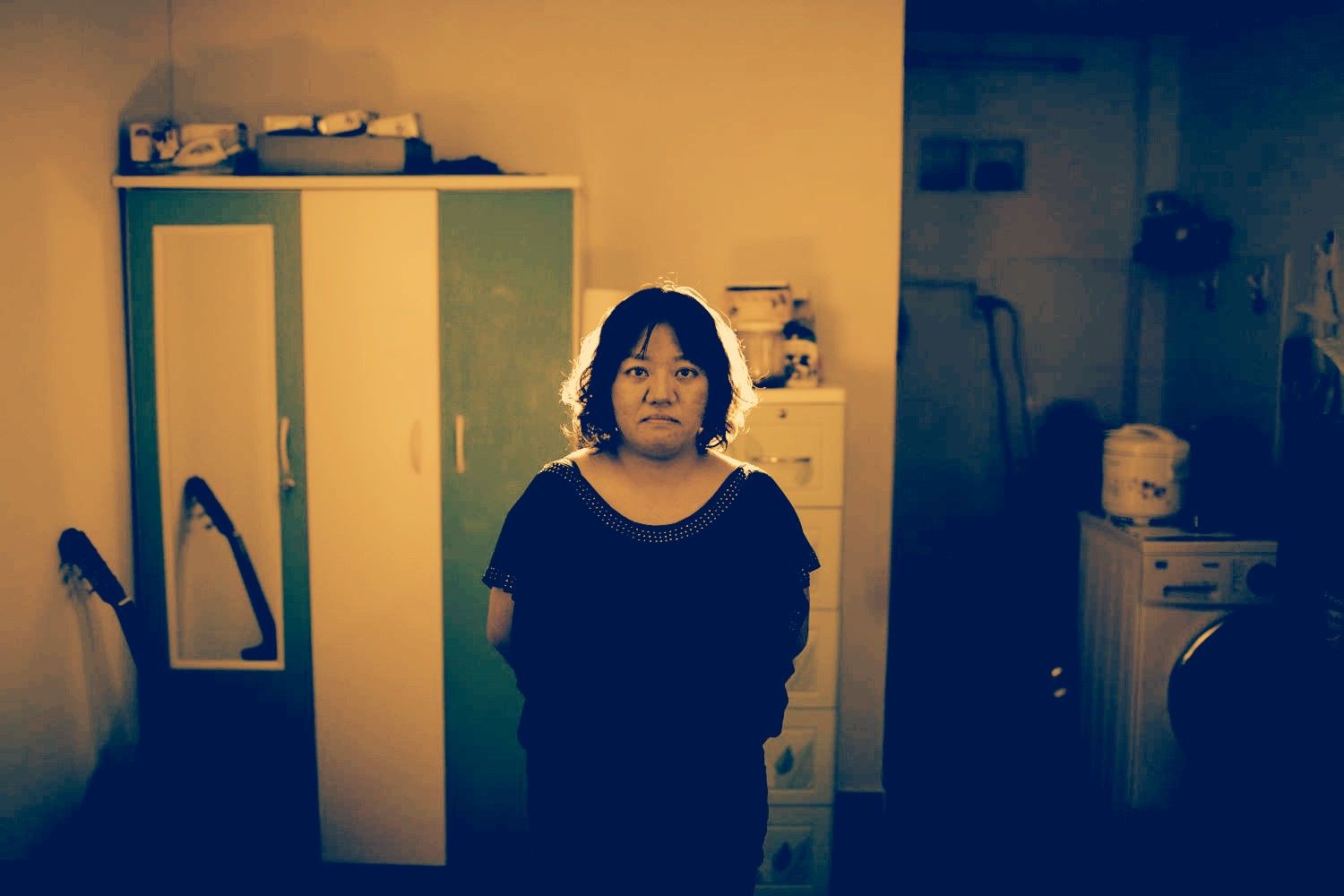
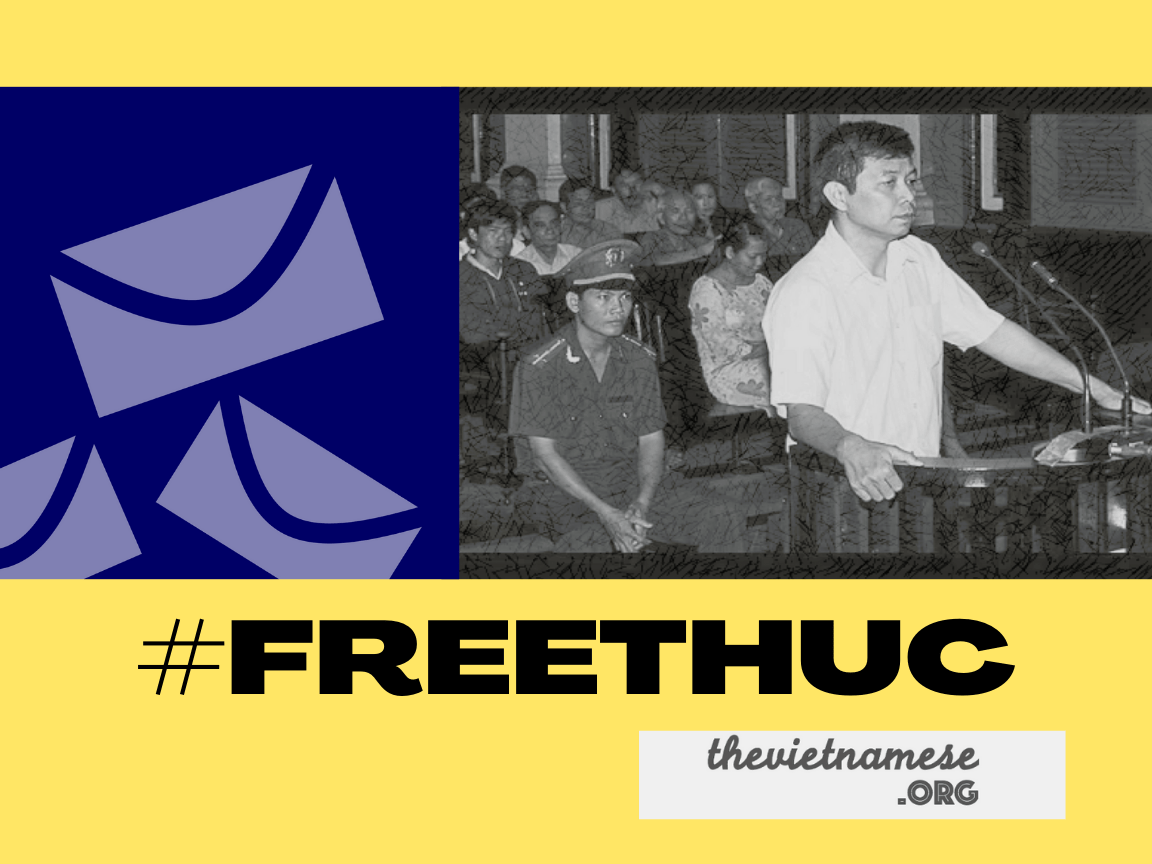
The case of journalist Pham Doan Trang: Investigation process completed, leading to her indictment
On Aug 26, 2021, Hanoi Police announced that they had completed the investigations into Pham Doan Trang on the allegation of “spreading information against the State.” The government is now allowing lawyers to defend her for the first time since she was arrested last October.
Last year, on October 6, Pham Doan Trang was arrested by Vietnamese state security and she was subsequently charged with “conducting propaganda against the Socialist Republic of Vietnam” under Article 88 of the 1999 Penal Code and “making, storing, spreading information, materials, items for the purpose of opposing the State of the Socialist Republic of Vietnam” under Article 117 of the 2015 Penal Code. Since then, Trang has been held incommunicado and denied visits from her family and lawyers.
Trinh Huu Long, a personal representative of Pham Doan Trang, claimedthat her arrest was “completely unconstitutional, [and] in violation of the law.” Pham Doan Trang is a prominent journalist and democracy activist, famously known for her political books written for general readers and articles with sharp criticisms against Vietnam’s Communist government. “The authorities would do better to respect Doan Trang’s work rather than punish her,” Long concluded.
Pham Doan Trang could face up to 20 years in prison if found guilty.
Vietnamese police disguised as health workers arrest a dissident blogger
On Aug 30, Vietnamese police arrested Bui Van Thuan, a dissident Facebook user, for criticizing the government in his online posts, especially his comments on the Dong Tam land dispute incident.
After cutting power to Thuan’s house in Nghi Son Town, Thanh Hoa Province, police officers, disguised as medical workers, asked his wife to let them in to take a health statement. “They said they were in a hurry and urged me to open the door quickly so that they could go to see others, so I invited them to come into the living room,” Thuan’s wife, Trinh Thi Nhung, said.
After getting into the house, a male officer “broke into the bedroom and restrained and handcuffed my husband just as he had woken up and was about to come out,” she said. The police then carried out a search of the house, handcuffing both the blogger and his wife, and confisticating a jar of lime-flavored honey, despite opposition from the family, and a copy of “The Handbook for Families of Prisoners” published by Pham Doan Trang as they left, according to Nhung.
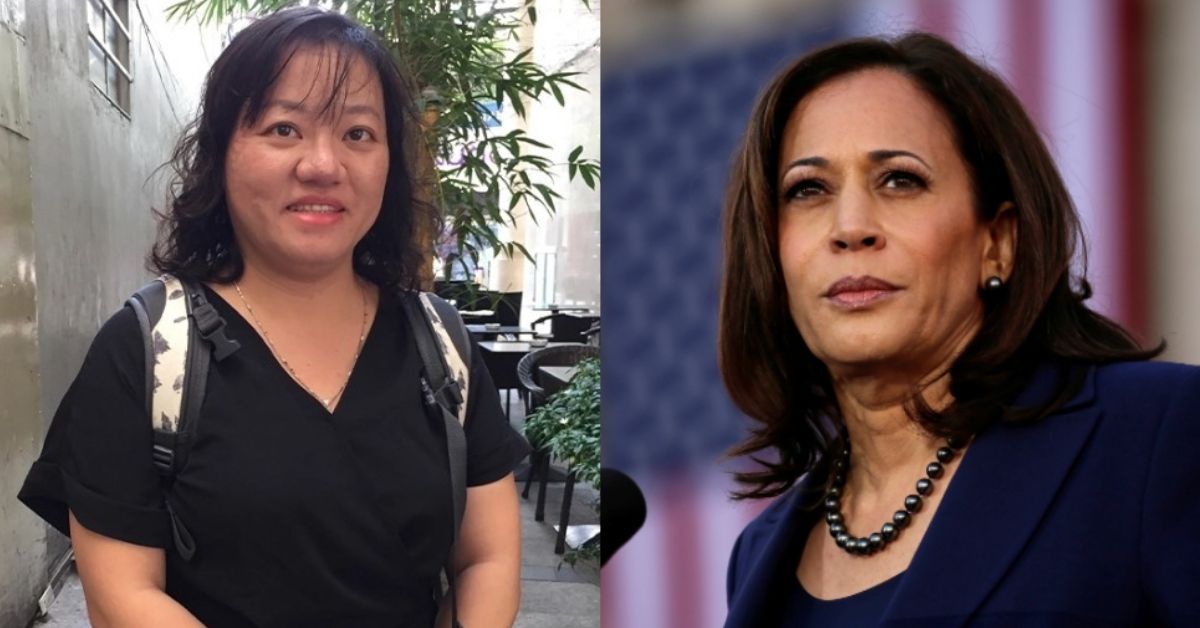
Thuan was later formally prosecuted for “storing publications and materials against the Socialist Republic of Vietnam under Article 117 of Vietnam’s Criminal Code,” according to police documents reviewed by VOA. His arrest came just after the U.S. Vice President Kamala Harris’ visit to Vietnam, where she raised concerns about human rights issues.
Last year, when the dissident blogger was interviewed by the Los Angeles Times, he expressed concerns about Facebook’s compliance with Vietnamese authorities to suppress free speech by suspending dissidents’ accounts and censoring critical voices against the government.
Australia continues to urge Vietnam to release Vietnamese-Australian political prisoner Chau Van Kham
On Aug 30, Australian Minister for Foreign Affairs Marise Payne sent a letter to MP Chris Hayes, advocating for the release of political prisoner Chau Van Kham.
Chau Van Kham was arrested in Jan 2019 in Ho Chi Minh City; he was later sentenced to 12 years in prison for alleged “terrorist activities against the People’s government.” Kham is a member of Viet Tan, a democracy and human rights organization regarded as a “terrorist group” by the Vietnamese government. However, the United Nations considers Viet Tan a “peaceful organization advocating for democratic reform.”
Meanwhile, Chau Van Kham’s family has spent more than two years advocating for his vaccination against COVID-19 once it is made available as the coronavirus situation began to deteriorate in Vietnam, especially with recent outbreaks in many prisons. “My husband is 72 years old, it’s easy for him to get COVID and die there. That’s why I want a vaccine for my husband,” said Trang Chau, his wife.
He was not among those released under an amnesty annually granted on Vietnamese Independence day on September 2.
COVID-19 situation in Vietnam
Quick take: Vietnam has recorded over 520,000 confirmed COVID-19 cases with more than 13,000 deaths. Fully vaccinated people only account for under 3 percent of the country’s population.
Vietnamese Prime Minister Pham Minh Chinh warns of a lengthy battle against COVID-19, reports Reuters. “We cannot resort to quarantine and lockdown measures forever, as it will cause difficulty for the people and the economy,” he said during a meeting with an antivirus committee last Wednesday. The highly transmissive Delta variant has shattered Vietnam’s early success in containing COVID-19 infections.
Ho Chi Minh City, Vietnam’s coronavirus epicenter, is considering a plan to reopen its economic activities from September 15, shifting from the “zero COVID-19” strategy to “living with the virus” policy, reports Reuters. The city has been gripped by a recent sharp rise of coronavirus infections and has remained under stringent lockdown since. So far, half of Vietnam’s confirmed cases, and 80 percent of its fatalities, have been recorded in Ho Chi Minh City.
Vietnam ranked bottom in Nikkei Asia’s Covid Recovery Index, mostly due to the country’s surge in COVID-19 cases, slow vaccination rates and rigid social distancing measures, which caused disruptions in the supply chain. The Nikkei chart ranks more than 120 countries and regions around the world on the assessment of infection management, vaccine rollouts and social mobility. This is the second time Vietnam is listed at the bottom.
Hanoi will send over 1,200 city residents from its largest COVID-19 cluster to a centralized quarantine facility on the city’s outskirts, reports VnExpress. The affected neighborhood, which is located in Thanh Xuan District, has reported more than 300 coronavirus cases since August 23. At the same time, Hanoi authorities are also set to extend lockdown measures until September 21, while maintaining strict COVID-19 restrictions in high risk areas.
Vietnam to receive an additional two million AstraZeneca vaccine doses, reports VnExpress: “Three batches of 2,016,460 AstraZeneca COVID-19 vaccine doses have arrived in Ho Chi Minh City this week. The batches, part of a 30 million dose contract between AstraZeneca and the Vietnam Vaccine JSC (VNVC), arrived on Tuesday and Wednesday.”
Ho Chi Minh City faces a food delivery crisis, reports Nikkei Asia: “The government-led delivery operation became overwhelmed during the first week, prompting the city to issue a written request to local supermarkets and online platforms to participate in delivery services. The move followed an announcement from the city on August 28, allowing as many as 25,000 shippers to join the delivery rollout. However, involving local businesses has done little to improve the situation.”
Ministry of Foreign Affairs spokeswoman makes statement on China’s revised Maritime Traffic Safety Law
On September 1, Ministry of Foreign Affairs spokeswoman Le Thi Thu Hang made a statement on China’s official enforcement of its revised Maritime Traffic Safety Law, reports state-run VietnamPlus: “Vietnam resolutely and persistently safeguards its sovereignty, sovereign rights and jurisdiction over its waters determined in line with the provisions of the 1982 UN Convention on the Law of the Sea (UNCLOS 1982),” said Hang.
On August 27, China’s Maritime Safety Administration announced that foreign vessels entering its “territorial waters,” which refers to its unlawful nine-dash line, must “report ship and cargo information to China’s maritime administrations,” according to the South China Morning Post (SCMP).
The revised Maritime Traffic Safety Law, which took effect on September 1, “comes amid escalating tension between China and rival claimants, as well as Western nations led by the US and its expanded military presence in the region,” writes the SCMP.
One day later, on August 28, Science Advances magazine took down a Facebook post of an attached scientific research showing China’s nine-dash line map after Vietnam’s social media users flooded its comment section with opposition and criticisms. Despite its effectiveness this time, the aggressive strategy utilized by Vietnamese social media users, or its “public opinion shapers,” has also been deployed to attack pro-democracy activists and foreign ambassadors’ social network accounts in Vietnam, particularly when they raise concerns about the country’s poor human rights record.
The Diplomat/ Le Vinh Trien and Kris Hartley/ September 1
“Anti-epidemic measures developed without collaboration fail to reflect the voices of diverse communities. When the political power among these communities is imbalanced, policy inconsistencies arise and a chain reaction emerges. Case counts rise as people resist restrictive behavior protocols, straining health care capacity and imperiling vulnerable groups. Ultimately, mixed messaging at the policy level widens the trust gap between government and citizens.”
“There is no moral equivalence between North Vietnamese forces and the Taliban. During World War II, the Viet Minh actually supported the United States and its allies by serving as the only Vietnamese force resisting Japan’s invasion of Indochina. This preamble for conflict hardly compares to the Taliban militia, which massacred minority Hazara communities and forced Hindus to carry yellow badges to set them apart from Afghan Muslims—like Jews in Nazi Germany.”
“The Afghans solved their problem by valiantly fighting the Soviet Union forces that invaded their country, and the Vietnamese benefited from the eventual dissolution of the USSR. Little to none of the economic reform that made Vietnam’s economy a vibrant one would likely have happened had the Soviet Union still been around.”
If you ever visit An Giang Province, in the Mekong Delta Vietnam, you might be surprised by how a number of families practice Buddhism there. They follow Buddhism, but they do not pray to statues or depictions, but rather, a wooden board painted crimson, placed squarely in the center of the altar.
If you look closely, you’ll see individuals dressed in brown, their hair placed in high buns, worshipping Buddha in the simplest of ways at home – without the knocking of wooden bells or the reading of scriptures, but rather, only with the placement of flowers, incense, and water.
These people are practitioners of Hoa Hao Buddhism, a religion built on a Buddhist foundation but with completely different practices from any other school of thought.
From humble beginnings, the founder of Hoa Hao Buddhism brought to the inhabitants of the Mekong River Delta a simplified Buddhist philosophy, suitable for their impoverished circumstances. Not long after its establishment, the religion would quickly catch fire in the hearts of countless citizens.
Hoa Hao Buddhist clergy don’t cut their hair as in other schools of Buddhism. They also don’t have splendid and majestic temples; rather, they advise their adherents to practice at home and to worship simply, diligently perform good works, simplify weddings and funerals, and live with responsibility towards the nation.
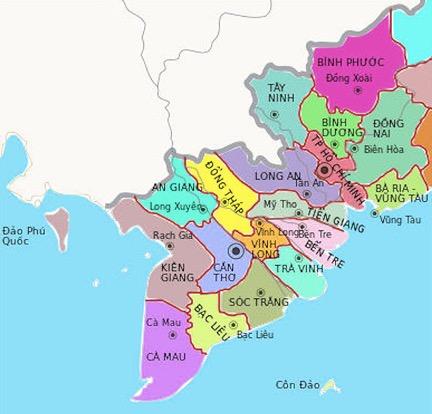
A map of the 13 provinces of the Mekong Delta today. The shape of An Giang Province has four distinct sides, so it is often called the Long Xuyen quadrilateral (Long Xuyen being the provincial capital city). An Giang Province shares a boundary with Cambodia and borders Dong Thap, Kien Giang, and Can Tho provinces. Photo: Gocnhin.net.
Huynh Phu So – the Muhammad of the Mekong Delta
As we know, at the beginning of the 20th Century, the Nguyen Dynasty ceded the entirety of southern Vietnam to French rule. In the Mekong Delta, nearly all residents were farmers, but they had to lease land from landowners at exorbitant prices, leading to arduous existences. [1] The people suffered in poverty under France’s oppressive politics that favored the landlord class.
Numerous anti-French peasant movements broke out around this canal-crisscrossed land, and the French authorities established a system to closely monitor civil activities.
Religions are often born out of thrilling or mysterious events that are able to win over large amounts of people.
In 1940, in the area of Chau Doc, the French began taking notice of an unusual young man who announced the establishment of Hoa Hao Buddhism and who became the head of a religion at only 19 years of age. Followers came from all over and even the most notable figures became disciples. [2]
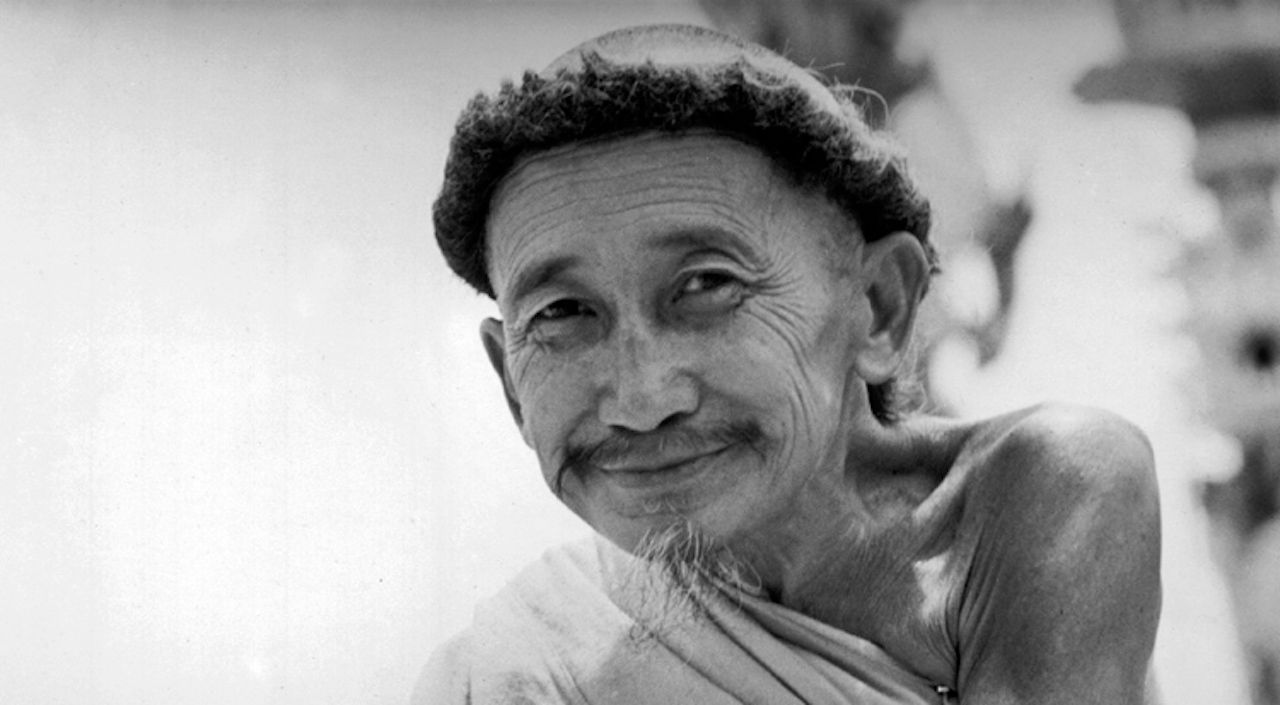
That young man was Huynh Phu So, who has been described as having a slender figure, a luminous face, and an articulate manner of speech.
In a 1942 speech written by Huynh Phu So himself, and preserved by apostles to this day, the young man stated that he himself had spent many lives saving people and that this life was a continuation of the Buddha’s sending him down to “save sentient beings.”
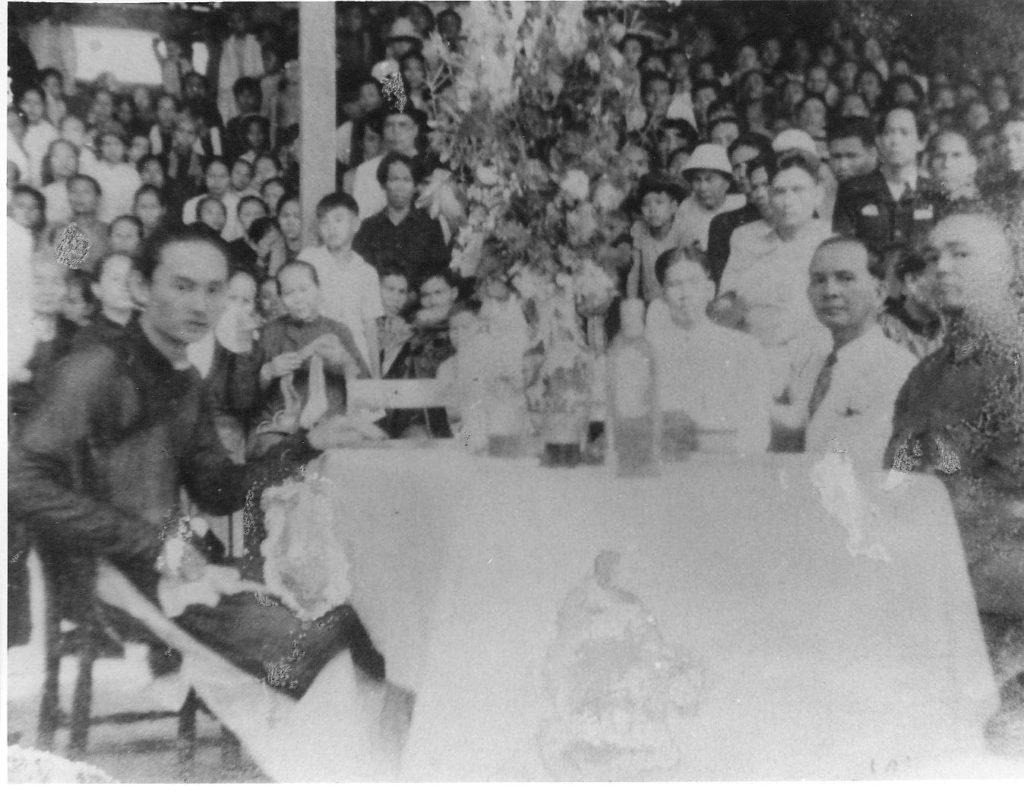
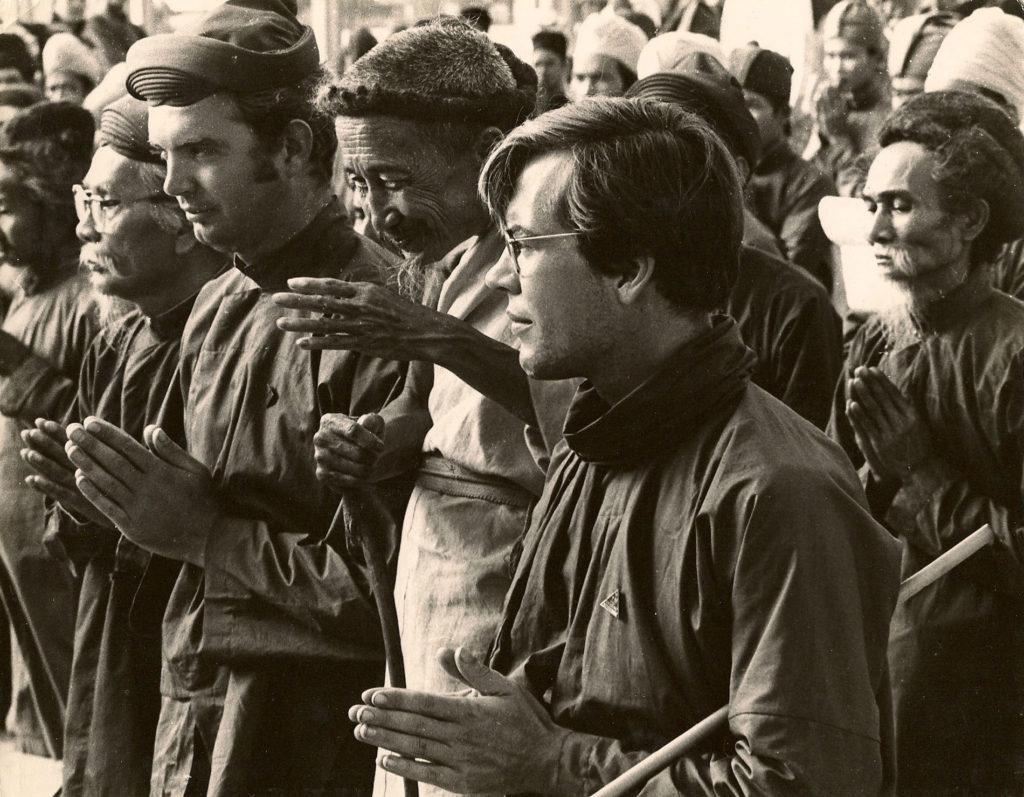
Hoa Hao Buddhists attend the opening of festivities on May 17, 1971, marking the anniversary of the religion’s founding. Photo: Hoa Hao Buddhism Family.
The religion’s Central Management Board records Huynh Phu So as having established the religion after travelling with his family to the region of the Seven Mountains (Thất Sơn), today a part of An Giang Province and seen by many as a sacred area that also gave birth to the Buu Son Ky Huong [Strange Fragrance of the Treasured Mountain] religion.
According to Sấm Giảng (Huynh Phu So’s teaching books), Master Huynh Phu So expressed in a verse comprised of hundreds of rhyming sentences that he was the successor of the Buu Son Ky Huong sect.
Thus, the principle “study Buddha, cultivate man” and the foundational “Four Great Gratitudes” (Gratefulness to one’s parents and ancestors, gratefulness to one’s nation, gratefulness to the three treasures [the Buddha, the Dharma, and the Sangha], and gratefulness to one’s compatriots and mankind) of the Buu Son Ky Huong sect became core values of Hoa Hao Buddhism.
In terms of communication, Huynh Phu So would convey everything simply and easily, and as a result, his religion was easily absorbed by the masses. The article “Principles of Religious Practice”, written by Huynh Phu So in 1945, summarizes in just 10 pages the religion’s philosophy and guides people on how to live a good life from his point of view.
The religion’s philosophy attracted poverty-stricken farmers by offering them the possibility of a good life and showing them how to practice Buddhism, even in conditions of deprivation.
“Meditate without action rather than with offerings of food, Buddha would never want sentient beings to bribe. … Because our crops were flooded this year, we should quickly dispense with superstition. Try to maintain the three cardinal guides, Completed virtue is what is precious.” (Excerpted from “A crazy person’s disregard for the people”)
Moreover, Hoa Hao Buddhism’s philosophy was able to reconcile individual and family lives with responsibility for the nation, based on the foundation of the “Four Gratitudes,” providing people with the rationale for becoming practitioners.
“The monk decided to close the pagoda doors, Drew his golden sword, mounted his horse, and charged into danger. After he settled scores with the enemy nation, The Zen pagoda returned to Buddhist homage!” (The Words of Huynh Phu So)
The concept of the “Four Gratitudes” brought Hoa Hao Buddhism to life, making it both dear to the people and compatible with the conditions of deprivation at the time.
Beyond his ability for eloquence, Huynh Phu So was also celebrated for his rare ability to treat the illnesses of his followers, who saw him as both a prophet and a fighter for national independence.
Fighting for national independence
In 1942, the Japanese intervened to bring Huynh Phu So to Saigon for refuge after a period of strict house arrest by the French that began in 1940. In Saigon, he quietly linked up with followers to advocate for Vietnam’s independence, which was consistent with both his religion’s principles and the zeitgeist at that time.
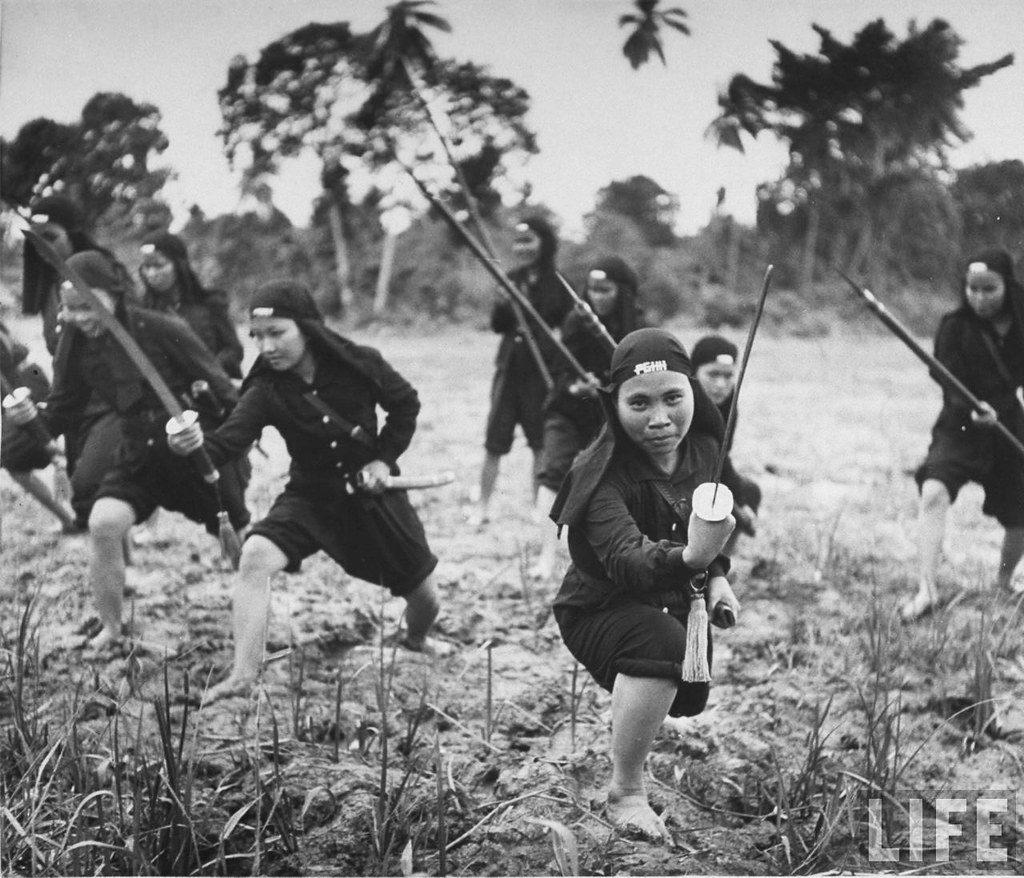
In 1944, Hoa Hao Buddhism established a paramilitary force called Bao An [Peace Protection] Group to maintain the security of Hoa Hao Buddhist villages in the Mekong Delta.
Hoa Hao Buddhist soldiers practice martial arts in July 1948. Photo: LIFE Magazine.
With Huynh Phu So’s profile and his large number of parishioners, Hoa Hao Buddhism had a notable voice in the independence movement in the south. With the aim of creating a political voice in society, Huynh Phu So and a number of intellectuals established in 1946 the Vietnamese Social Democracy Party – abbreviated as S.D. Party.
In the beginning, besides linking up with different religious and political organizations, Hoa Hao Buddhists also connected with the Viet Minh to advocate for Vietnamese independence. However, it was not long before a serious conflict erupted between the two groups.
This conflict would eventually lead to Huynh Phu So’s mysterious disappearance. On April 16, 1947, Huynh Phu So went missing during a meeting between the Viet Minh and Hoa Hao Buddhists in the area of Dong Thap Muoi (Plain of Reeds). To this day, his disappearance remains a mystery.
According to an article written by Nguyen Van Tran, and published in the overseas newspaper Viet Bao Online in 2016, the author cited a letter related to Hoa Hao Buddhism and Huynh Phu So that was stored at National Archive Center #4, under the Ministry of Home Affairs Department of State Documents and Archives. The letter, dated April 17, 1947, confirmed that the Viet Minh’s Long Xuyen Administrative Committee held Huynh Phu So in their custody but the letter did not state clearly what happened to him after that.
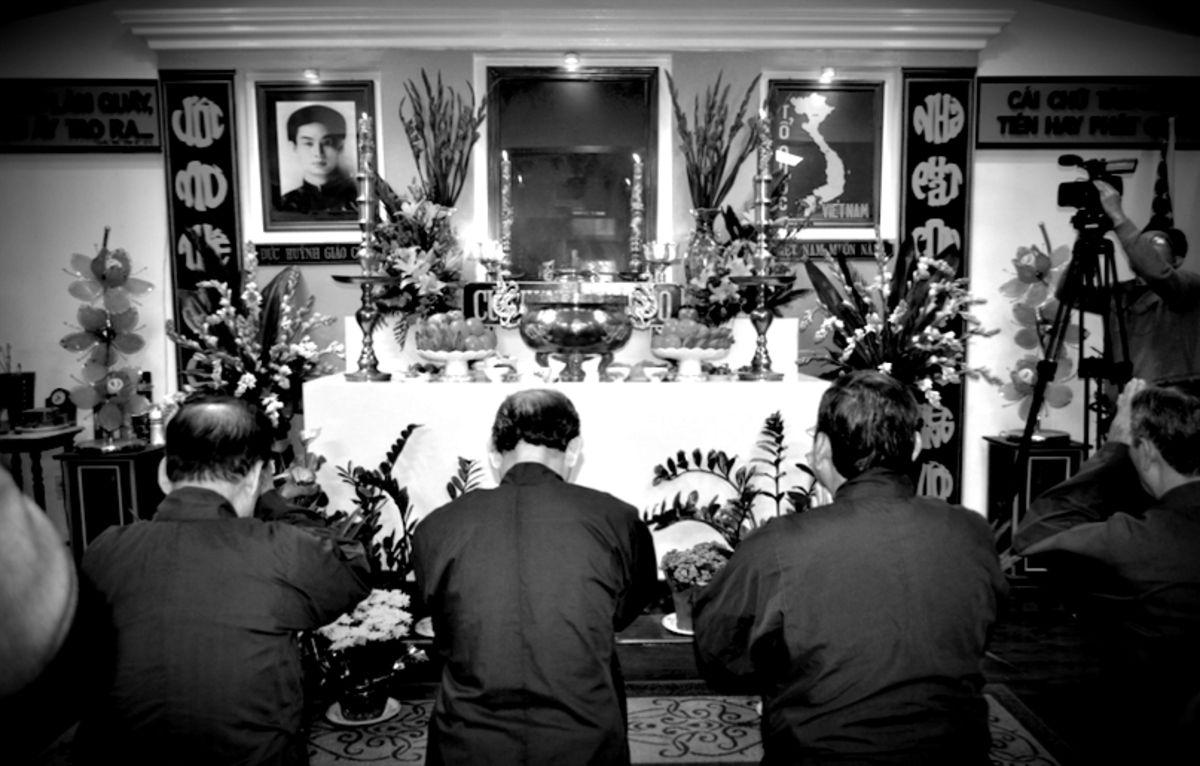
To Hoa Hao Buddhists today, the day Huynh Phu So went missing is referred to as “the day Virtuous Master disappeared,” or “the day of Virtuous Master’s Longevity Calamity.”
According to author Nguyen Long Thanh Nam, who was active in Hoa Hao Buddhism, and who worked for the government of the Second Republic (the Republic of Vietnam), the animosity between Hoa Hao Buddhists and the Viet Minh only worsened after Huynh Phu So’s disappearance. A number of Hoa Hao Buddhists changed sides and worked with the French to oppose the Viet Minh. According to Nam, in the approximate period from 1947 to 1955, Hoa Hao Buddhism became a competent military force with the help of the French. This fact would also lead to the religion facing strong repression from Ngo Dinh Diem’s government, which sought to consolidate military forces.
After Ngo Dinh Diem’s period of discriminatory treatment towards religions, Hoa Hao Buddhism was strengthened and developed under the Second Republic (1967 – 1975). At that time, exiles who had faced repression under Ngo Dinh Diem, such as Nguyen Long Thanh Nam, returned home to restore the religion. It was also during this time that Hoa Hao Buddhism split into two sects: the new sect was led by Luong Trong Tuong, while the original sect was led by Huynh Van Nhiem. In 1972, another sect splintered from the original group, led by Le Quang Liem. These divisions, however, did not hinder the development of the movement.
Hoa Hao Buddhists attend opening festivities on May 17, 1971, marking the religion’s founding day. Photo: Hoa Hao Buddhism Family.
In 1975, as their religious activities proliferated, Hoa Hao Buddhist groups also operated six high schools, a university, and two hospitals.
However, after the upheaval of April 30, 1975, which saw the fall of the government of the Republic of Vietnam in the south, the vibrant religious scene in the south darkened under the shadow of the victors.
Scene of darkness after April 30
From the day Huynh Phu So disappeared, Hoa Hao Buddhists fiercely opposed the Viet Minh; thus, from April 30, 1975, onwards, the religion was completely banned from operating.
Author Nguyen Long Thanh Nam cited an article published in the Liberated Saigon (Sài Gòn Giải phóng) newspaper on August 9, 1975, to describe the government’s policy towards Hoa Hao Buddhism after the events of April 30.
The Liberated Saigon article stated that the leaders of the religion, Luong Trong Tuong and Huynh Van Nhiem, “opposed religion, the nation, and the revolution.” It also described a three-day high-level meeting of some Hoa Hao Buddhist leaders in Thot Not Suburban District, Can Tho Province. At the end of that meeting, this group announced the dissolution of the Management Committee, S.D. Party’s Executive Committee, specialized organizations, as well as social workgroups. This meeting was held to accompanying the request of the government to prevent further assemblies of people in that area.
Author Nam also cited an article translated into Vietnamese from the Los Angeles Times (published in 1978), which stated that leaders and practitioners of Hoa Hao Buddhism who had participated in politics were all sent off to re-education camps.
In December 1998, a UN special rapporteur on freedom of belief and religion, Adbelfattah Amor, released his report following a formal visit to Vietnam in October 1998.
In his report, the rapporteur stated that he was not able to meet any Hoa Hao Buddhists, either formally or privately. Non-state sources had informed him that after April 30, 1975, the government closed more than 3,500 Hoa Hao pagodas, as well as more than 5,000 worshipping centers, where the Hoa Hao Buddhists often held their social and religious activities.
Amor concluded that Buddhist, Cao Dai, Hoa Hao, and Muslim religious organizations could not be established nor operate independently of the government. The existence of registered religious groups at the time served more as the government’s tools of social control than citizens exercising their religious freedom.
In 1999, Hoa Hao Buddhism fundamentally split into two sects. One sect, the Hoa Hao Buddhist Church, was permitted by the government to operate and is headquartered at An Hoa Temple in Phu My Town, Phu Tan Suburban District, An Giang Province.
Many Hoa Hao Buddhists do not participate in this sect, stating that the management committee is controlled by the government and does not operate according to t proper religious principles.
The remaining other sect is not recognized by the government as “official” and is headquartered at the Hoa Hao Buddhist Family Group no more than 3 km from the An Hoa Temple. The activities of the independent Hoa Hao Buddhists are forbidden.
In August 1999, the overseas newspaper Viet Bao Onlinereported a conflict between the two sects in An Giang Province involving the Hoa Hao Buddhist Church being the only sect recognized by the state. The “official” church was able to organize public festivals and events but did not organize a holiday around “the Day of Virtuous Master’s Longevity Calamity,” nor did it read sermons during any holidays.
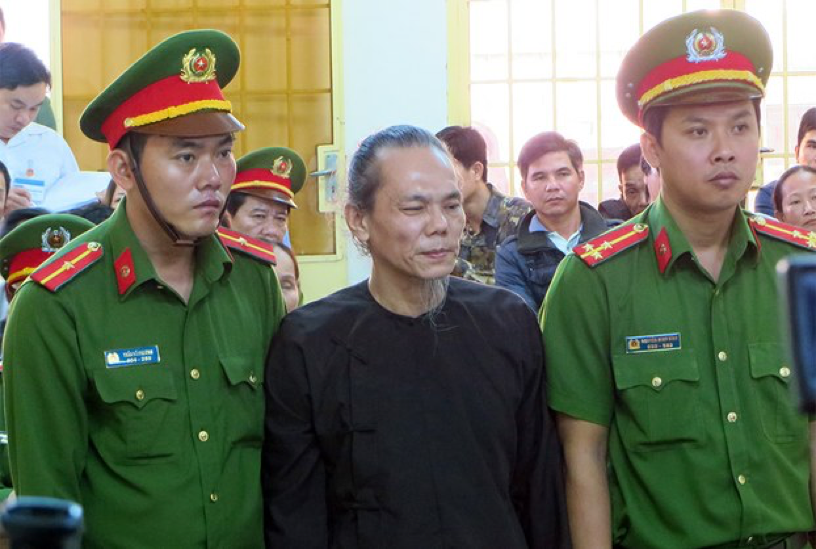
Hoa Hao Buddhist Bui Van Trung during his preliminary trial on February 9, 2018, in the An Giang Province People’s Court. For allegedly disturbing public order, he was sentenced to six years in prison, while five other Hoa Hao Buddhists were sentenced to between two to six years. Photo: RFA.
In 2014, Vietnam continued to invite special rapporteurs from the UN to evaluate the country’s level of religious freedom. The rapporteurs’ report maintained that the oppressive situation independent Hoa Hao Buddhists faced had not changed appreciably. Their freedoms continued to be obstructed, and they were often followed, arrested, beaten, and imprisoned.
Every year, the United States’ Report on International Religious Freedom touches on the Vietnamese government’s harassment of independent Hoa Hao Buddhists and its restriction of their activities. The 2012 report stated that the government allowed only 5 of 10 of Hoa Hao Buddhist religious texts to be published and that it banned the reading of Huynh Phu So’s writings in public. Beyond the charges of repression of independent Hoa Hao Buddhists, the 2018 US report documented that the government continued to ban followers from celebrating any holidays related to the life of Huynh Phu So.
References:
[1] Vietnam during the French colonial era, Nguyen The Anh, Culture – Literature & Art Publishing House, p. 227. [2] On the historical roots of Hoa Hao Buddhism, Pascal Bourdeaux, Dang The Dai Dich.
This article was written in Vietnamese by Tran Phuong and was previously published in Luat Khoa Magazine on August 3, 2019. Will Nguyen did the English translation.
In 1968, the south of Vietnam had just moved past a period of long-running political unrest that had society shaken and stirred. The people were fed up with the promises and realities that the government brought their way. The fears of both the Communist and the Nationalist sides were not so different. To survive, people had to gird themselves and pray that spiritual forces would deliver them from the war’s uncertainties.
Moving beyond the religious sphere, many southern monks openly opposed the increasingly brutal war. International journalists began paying attention to priests and spiritual leaders, who possessed enough credibility and representation to express the general population’s suffering.
Upon arriving in My Tho, Steinbeck’s group climbed onto a motorized boat and headed to the Coconut Monk’s sanctuary in the middle of the My Tho River. The roar of Steinbeck’s boat and the crashing waves were no match for the wind chimes, constructed from the used metals of tank ammunition, that were reverberating from Con Phung (Phoenix Island), the Coconut Monk’s island. At his pagoda, he and his disciples transformed the shells of wartime bombs and bullets into objects of peace. He even raised a cat and a mouse together to prove that the north and the south could live in peace with one another despite their differences.
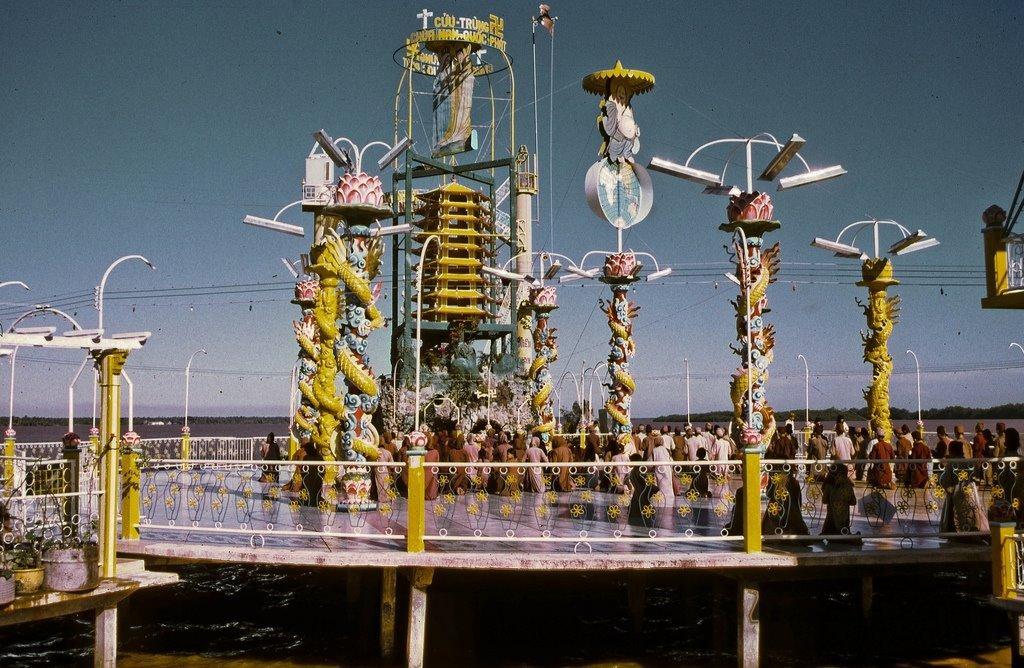
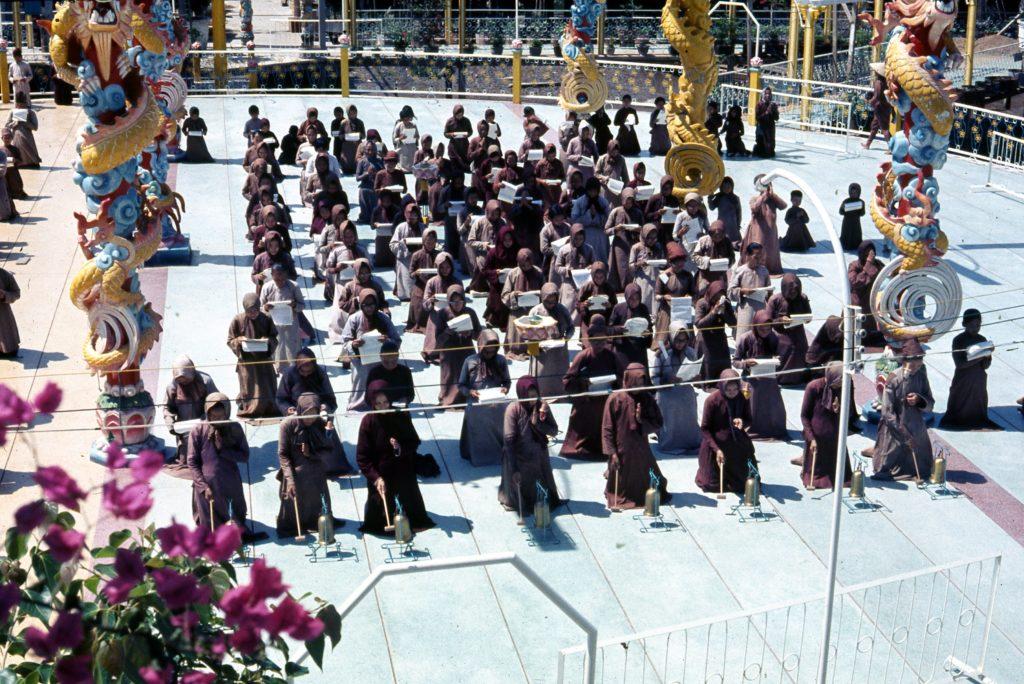
Stepping onto the pagoda, Steinbeck saw before him 200 followers dressed in brown, their heads wrapped in head cloths, prostrated towards the setting sun. On a platform of flowered tiles, where followers conducted their ceremonies, colorful cement dragons wound around nine pillars erected in the courtyard. The nine columns represented the tributaries that form the Mekong River delta, a region of rare abundance.
The lower part of the pagoda appeared to rise from the middle of the river, its floor lined with a cement map of Vietnam about 20 meters in length. Scattered underneath were little model homes, the greenery designed to resemble miniatures of cities from north to south. Saigon and Hanoi were marked by two high cement columns on the map, allowing the two cities to be seen even when high tide submerged the map. Each day, the Coconut Monk would pray for peace in Vietnam by traversing the symbolic map from Saigon to Hanoi.
The Coconut Monk’s followers conducted a ceremony on Nam Quoc Pagoda’s Nine Dragon Pavilion in 1969. Photo: Lance & Cromwell.
The Coconut Monk received Steinbeck in a yellow monk’s robe but dangled a Catholic crucifix on his chest. His head was not wrapped as his followers; instead, his ponytail was plaited and wrapped in a white cloth, which the Coconut Monk stated was in the style of Jesus’ crown of thorns. Occasionally, his plait of hair would be let down to his chest, whereby he would say he represented the image of the Maitreya Buddha.
At their first meeting, Steinbeck and the Coconut Monk experienced a special moment of inspiration. Originally an admirer of Buddhism and Daoism, Steinbeck stated that the day before, he looked at a map of Vietnam and saw that if a circle were drawn around the S-shaped expanse of land, it would resemble a Tai Chi symbol from the doctrine of yin and yang. In this Tai Chi symbol, Cambodia’s Tonle Sap Lake was the white dot in the black portion, represented by the land, while China’s Hainan Island was the black dot in the white portion, represented by the sea. The Coconut Monk then had his follower bring over a map he had drawn the day before that matched what Steinbeck had just stated, confirming a strange coincidence. Followers became increasingly surprised at the spiritual connection between the two. Steinbeck also felt something he couldn’t quite put his finger on when he stepped foot onto the enigmatic pagoda.
Steinbeck would take a motorbike from Saigon down to Con Phung every weekend and stay overnight from that fateful meeting onwards. He felt calmer there than any other place, which seemed completely isolated from the terrible war crisscrossing the south. Steinbeck wrote in his memoir that his days spent at the pagoda were the happiest time of his life.
Front row from left: John Steinbeck, the Coconut Monk, and the director of Sad Song of Yellow Skin, Michael Rubbo, in 1970. Photo: Sad Song of Yellow Skin.
A letter to President Johnson
One morning, the Coconut Monk’s followers woke Steinbeck up while the sky was still dark. When he cleared the sleep from his mind, he saw that his motorbike was propped up neatly in a motorized boat. The Coconut Monk wanted Steinbeck to return to Saigon immediately to have lunch with his (Steinbeck’s) friends, reporters, at a restaurant in Cho Lon. Steinbeck quickly hit the road but could not dispel his worries, as he knew that the government never wanted this troublesome monk to step foot in Saigon.
That afternoon, the Coconut Monk stopped by the restaurant to see Steinbeck having lunch with his friends. Through a luxury Buick automobile window, the Coconut Monk told Steinbeck that he wanted Steinbeck to tell the reporters about his new movement. The monk stated that tomorrow, he would arrive at Independence Palace and march to the American Embassy (now at No. 4 Le Duan Rd. in Ho Chi Minh City) to deliver a letter explaining his plan for peace to then U.S. President Lyndon B. Johnson.
Having frequently witnessed how Saigon police dealt with protestors, Steinbeck knew this was a very dangerous plan. To protect his teacher, he chose to notify the embassy of the Coconut Monk’s plans, a decision that would prove extremely naïve.
The next afternoon, with a coconut in one hand, the Coconut Monk stepped out of his car at a corner near Independence Palace. He was half-surrounded by people jeering or prostrating themselves and half-surrounded by plainclothes police. At that moment, police vehicles poured onto the street, blocking the monk’s path into Independence Palace. The Coconut Monk switched routes, going straight to the American Embassy despite police warnings.
As the crowds followed the Coconut Monk to the embassy, a contingent of Marines awaited him there. On the roof of the enormous blockhouse were approximately 40 Marines with their guns trained on the group of people below. In the air, a helicopter hovered overhead as the short, emaciated monk slowly and deliberately sat down on the sidewalk with his coconut.
After more than 20 minutes, the embassy became aware of the military overreaction. It sent out an employee who accepted the monk’s letter but rejected his coconut because the American president was unable to accept gifts from foreign dignitaries. The monk returned to his island satisfied, escorted by the unwilling police. As a warning for the Coconut Monk never to step foot in Saigon again, the police arrested 30 of his closest followers after he left the city.
The letter the embassy received was an unprecedented petition. The Coconut Monk asked President Johnson to borrow 20 transport planes to deliver him, his followers, and materials to the 17th parallel—where Vietnam was divided into two enemy states. He and his followers would form a prayer group right in the middle of the Ben Hai River. He would sit at the center of this group and pray for seven days with no food or drink. On each side of the river would be 300 monks praying together with him.
No one knows if the letter ever reached President Johnson, but everyone knows that the Coconut Monk never gave up his dream of bringing peace to Vietnam.
From a warm-hearted uncle to the Coconut Monk
In Con Phung (Ben Tre) today, which was once the Coconut Monk’s territory, there remains a marble slab with a brief inscription describing the monk, which states:
“From 1928 – 1935, he studied abroad in France at the College of Physical Chemistry in Lyon – Caen – Rouen. After three years, he succeeded in his study. But for what? From 1935 – 1945, he returned home and climbed the mysterious That Son [Seven Mountains] to look for a path to peace, meditating on the principles of yin and yang and ‘no war, no violence.’ From 1947 – 1972, he worked for peace and was imprisoned once or twice. He lived without losing heart, wisdom, or courage. (His) Morality united Vietnam to live together with meditative hearts. Thich Hoa Binh (Love Peace), of divine rights and virtue”.
Articles about the Coconut Monk today confirm that his name was Nguyen Thanh Nam and that he was the only child of a wealthy family in Ben Tre.
After he returned from studying overseas, Nguyen Thanh Nam married his wife. He opened up a factory producing soap out of coconut before leaving for the monkhood near the Seven Mountains, An Giang Province, in 1945.
Three years later, when his body had taken on the form of an emaciated old man who pursued asceticism to the fullest, Nguyen Thanh Nam, aged 37, descended from the mountains and continued to meditate under a tree overlooking the Tien River for another two years. At that time, several people began noticing him, especially the fact that he only drank coconut water and only ate a bit of fruit for daily sustenance.
Then in 1952, he built an Eight Trigrams platform in the middle of an irrigation canal using a 14-meter coconut tree. For the entirety of the next two years, people from all over came to see this strange man who meditated rain-or-shine. He never uttered a word and only wrote down what he wanted to communicate to others.
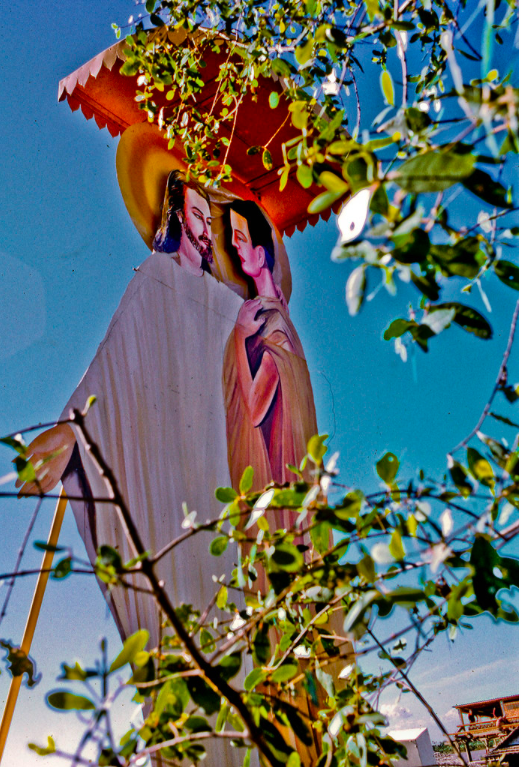
In 1963, the Coconut Monk and others purchased a large barge where he built the massive Nam Quoc Pagoda at Con Phung, in the middle of the My Tho River. At the pagoda, he allowed the construction of many structures, including a model of the Seven Mountains, an image of the Buddha laying his hand on the body of Jesus, an image of the Virgin Mary embracing Guan Yin, and a nine-story tower. This was the sanctuary of the Coconut Religion, also known as the Religion of Congeniality.
His unusual methods of religious practice included taking a vow of silence, only drinking coconut water and eating fruit, abstaining from sugar and salt to keep the body pristine after death, persuading others to take up vegetarianism, performing good works, and praying for peace. People found the fact that he found religion near the sacred Seven Mountains irresistible. In 1974, in Dinh Tuong Province (today a part of Tien Giang Province), there were up to 3,516 followers of the Coconut Religion, while Protestantism only had 3,512.
An erected image of the Buddha laying his hand on the body of Jesus at Nam Quoc Pagoda. Photo: Lance Nix.
Conducting politics or prayer?
Both the first and the second republics of (South) Vietnam did not kindly those calling for peace, whether they were a respectable monk or an ordinary farmer, a well-known journalist or a good-natured student.
It was precisely because of the government’s sensitivity that the Coconut Monk was forbidden from travelling to Cambodia to pray for peace in 1961. However, the authorities were unable to stop him from conducting the same activities in Saigon.
In December 1964, when Secretary of Defense Robert McNamara came to Saigon, the Coconut Monk and his disciples looked for him while holding two cages, one holding a cat and another holding a rat. The Coconut Monk released the cat and the rat into one cage, but the cat did not consume the rat. The press wrote many stories about the event. Later on, Thich Nhat Hanh would retell the story in a children’s picture book with the ending: “If the cat and the rat can live in peace with one another, can humans do the same?”.
Many people, including the government at the time, believed that the Coconut Monk used the cover of religion to conduct politics. The evidence included the two times he ran as a presidential candidate in the 1967 and 1971 elections, where he raised a large number of campaign funds, supposedly from his followers. He also frequently organized press conferences and sought out and sent letters to political figures to call for peace in Vietnam.
His activities were non-violent, but the Saigon government still found ways to crack down on him. Either he would be arrested, the Nam Quoc Pagoda would be raided, or his followers would also be arrested. Despite this, the Saigon government still allowed the Coconut Monk to freely practice his religion, as long as he stayed put at Con Phung and refrained from causing disruption and occupying the authorities. As Thich Nhat Hanh wrote at the beginning of 2010 regarding religious freedom in Vietnam: “During the colonial period, during the time of Diem and Thieu, religious practitioners did experience many difficulties, but they were never as tightly and unreasonably controlled as they are today [after 1975]”.
Followers of the Coconut Religion in 1969 at the Nam Quoc Pagoda. Photo: Lance Nix.
Dying under the Communist sky
After 1975, all of the south fell under the control of communist totalitarianism. Religions were deemed superstitions, church properties and possessions were confiscated, and monks and religious dignitaries were imprisoned in re-education camps without trial. Vietnam became one of the most religiously oppressive countries on earth at the time. The Coconut Religion, then very new religion, obviously did not stand a chance against government eradication.
According to Phap Luat [Law] Newspaper, after April 30, 1975, the Coconut Monk was no longer allowed to practice his religion. After a period of time, he tried to escape over the border and was caught by the authorities. It wasn’t until 1985 that the government released the diminutive monk, who weighed less than 40 kg and reached less than 1.4 meters tall and allowed him to return home.
Due to government censorship, it is challenging to find complete information on the Coconut Monk’s activities after being released from prison.
After returning home to Chau Thanh Suburban District in Ben Tre Province, the Coconut Monk resumed religious activities and was visited by many followers. After a time, he established a local radio station and opened every broadcast with: “This is Phu An Hoa Radio, the voice of the Religion of Congeniality….”
The government asserted that the Coconut Monk’s radio station was superstitious and slandered the state, and so it confiscated his broadcasting equipment and questioning him and his followers.
Forbidden from practicing his religion, he and his followers moved to Phu Quoc Island in Kien Giang Province, but they were quickly and forcibly sent back to their homes. In May 1990, when his followers secretly transported him to Ho Chi Minh City to take refuge before returning to a follower’s home in Tien Giang Province, the police found him. A scuffle broke out between the two sides at a residential home, leading to the Coconut Monk’s death.
After that incident, the People’s Court of Ben Tre Province convicted the Coconut Monk’s followers of obstruction of officials, handing them heavy sentences. However, the details of that trial were never publicized by the press and kept secretive by the Vietnamese government.
In 1986, Steinbeck overheard overseas Vietnamese say that the Vietnamese government wanted to transform the Nam Quoc Pagoda into a tourist attraction in a Paris restaurant.
Later, Steinbeck would write in his memoir of the Coconut Monk: “When I saw him for the last time, we didn’t say goodbye. He touched his eye, indicating a rare tear. Then grinning, he pointed to the sky where he lived. Memories are obsolete, and I can’t forget.”
In February 1991, less than a year after the Coconut Monk’s unjust death, Steinbeck passed away during a surgical procedure on his spine. In Vietnam, the Coconut Monk was buried according to his will: his body was standing up.
The Nam Quoc Pagoda later became a tourist destination, and the Vietnamese press continues to write stories smearing the Coconut Religion to this day.
This article was written in Vietnamese by Tran Phuong and was previously published in Luat Khoa Magazine on February 9, 2020. Will Nguyen did the English translation.
U.S. Vice President Kamala Harris’ visit to Vietnam: Main takeaways
U.S. Vice President Kamala Harris and Vietnam’s top officials met on Wednesday, August 25, carrying out talks on several key areas, including the enhancement of maritime security, boosting economic cooperation, combating climate change and providing healthcare support, reports Reuters.
Earlier, on Tuesday, Harris’ flight from Singapore to Hanoi was delayed by more than three hours after the U.S. Embassy in Hanoi was made aware of an “anomalous health incident,” which referred to the mysterious Havana Syndrome.
Vietnamese Prime Minister Pham Minh Chinh held an unannounced meeting with Chinese Ambassador Xiong Bo, just before Harris’ arrival, affirming that “Vietnam does not align itself with one country against another.” Beijing also offered Vietnam an additional 2 million doses of Sinopharm vaccine during the meeting.
Vice President Harris made sharp criticism at China’s “bullying” in the South China Sea while urging Vietnam to join the United States against Beijing’s advances, reports Associated Press. “We need to find ways to pressure and raise the pressure, frankly, on Beijing to abide by the United Nations Convention on the Law of the Sea, and to challenge its bullying and excessive maritime claims,” Harris said at the opening of a meeting with Vietnamese President Nguyen Xuan Phuc.
The U.S. Embassy in Vietnam has signed an agreement with Hanoi authorities, in the presence of Vice President Harris, for a land lease to build a new $1.2 billion embassy campus in the city, reports VnExpress. The new embassy, which will be located in the Cau Giay District, is a project announced by Vietnam and the United States in 2019.
Vice President Harris announced that the United States would donateone million Pfizer-BioNTech vaccine doses to Vietnam, bringing the total number of vaccines donated by the United States to the country to six million doses. Meanwhile, a new regional office of the U.S. Centers for Disease Control and Prevention (CDC) will open in Hanoi, with a mission of “protecting Americans and people of the region” and “building key relationships to tackle shared health priorities,” according to the CDC press release.
“We’re not going to shy away from difficult conversations,” said Vice President Harris during her meeting with Vietnamese leaders regarding human rights abuses and political activism in Vietnam, according to Associated Press. However, the results of those discussions remain unclear. Overall, Vietnam is notoriously known for its crackdown on freedom of speech and the arrests of political dissidents.
Strengthening the U.S.-Vietnam Comprehensive Partnership, from the White House press release: “The Vice President’s travel to Vietnam signifies the United States’ deep commitment not only to the region but also to the U.S. – Vietnam relationship. In bilateral meetings with Vietnamese leaders, Vice President Harris reaffirmed the U.S. commitment to a strong, prosperous, and independent Vietnam, as well a free, open, healthy, and resilient Indo-Pacific region.”
The Covid-19 situation in Vietnam
In total, Vietnam has recorded over 430,000 confirmed Covid-19 cases with more than 10,000 deaths as of Sunday, August 29, 2021.
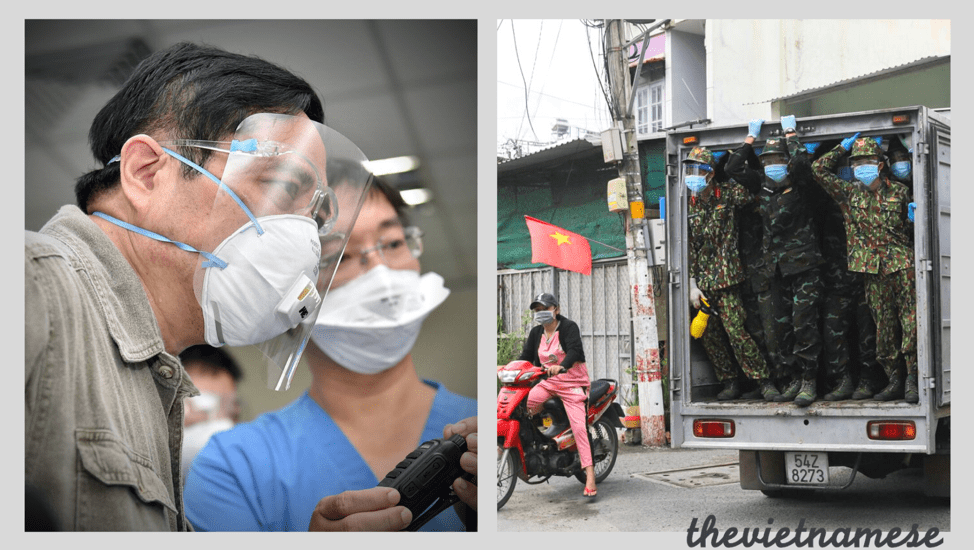
Vietnam to deploy troops to contain the surge of Covid-19 infections in Binh Duong Province, a major manufacturing hub, reports Reuters. The southern province, which is located nearby Ho Chi Minh City, is expected to record an additional 50,000 coronavirus cases over the next two weeks.
Vietnam’s Deputy Prime Minister Vu Duc Dam was replaced by Prime Minister Pham Minh Chinh as head of the National Steering Committee for Covid-19 prevention and control. The replacement decision came amid the worst coronavirus outbreak in the Southeast Asian nation.
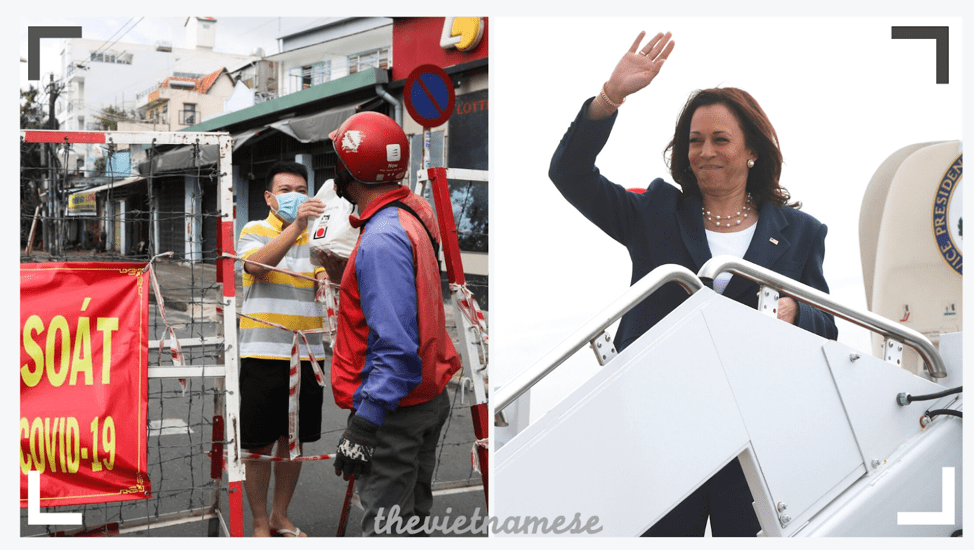
Ho Chi Minh City to resume delivery service operations in the city reports VnExpress. According to local authorities, delivery drivers, popularly known as “shippers” in Vietnam, will be allowed to operate in Covid-19 high-risk districts to relieve shopping demands among locals. Delivery drivers, along with temporary contractors and migrant workers, are among the most vulnerable groups during the Covid-19 pandemic in Vietnam.
Vietnam’s homegrown Covid-19 vaccine NanoCovax to be granted emergency use after being approved by The National Committee for Ethics in Biomedical Research, reports VietnamPlus: “The National Committee for Ethics in Biomedical Research under the Ministry of Health (MoH) has agreed that the mid-term results from Nano Covax’s phase 3 clinical trials will be submitted to the Advisory Council for the Registration of Circulation of Drugs and Medicinal Ingredients for considering the issuance of a registration certificate for the conditional circulation of the vaccine.”
Covid-19 vaccine donations to Vietnam: Australia donated to Vietnam a total of 403,000 AstraZeneca doses, as part of an “ongoing commitment to help Vietnam in its fight against the pandemic,” wrote the Australian Embassy in Vietnam. Meanwhile, on August 25, Italy also announced its donation of over 800,000 AstraZeneca doses to Vietnam via the COVAX Initiative, while over 500,000 vaccine doses, also made by AstraZeneca, arrived in Hanoi on August 23 as a donation from the Polish government.
The Vatican sends financial aid to help Vietnam deal with the Covid-19 pandemic, reports Reuters: “About $70,000 was sent to Bangladesh for continuing recovery assistance from Cyclone Yaas, which left tens of thousands of people homeless last May, and about 100,000 euros to Vietnam, where food supplies have been hit by the COVID-19 pandemic.”
“Vietnam falls into a different category of Chinese wedge strategy, in which China seeks to reinforce Vietnamese neutrality, instead of de-aligning it, since Vietnam is not a formal U.S. ally. Hanoi considers itself a neutral country under its “four noes” policy, of “no military alliance, no affiliation with one country to counteract the other, no foreign military base in the Vietnamese territory to act against other countries, and no force or threatening to use force in international relations.” Such a policy is rooted in Hanoi’s search for a balance between ideological values and national security interests, which stipulates that Vietnam only allies with states that share both. Vietnam is officially neutral between the United States and China, since it only shares security interests with the former and ideological values with the latter (as well as strong economic ties to both.)”
South China Morning Post/ Dien Nguyen An Luong/ August 24
“When both countries sought to burnish their vaccine diplomacy campaigns in Vietnamese cyberspace, the US beat China by a wide margin in terms of positive public reactions, reflecting the fact the Vietnamese public prizes US vaccines over Chinese ones. Such sentiments were reflected in an analysis of Facebook posts and their average engagements on vaccine diplomacy that were among the most engaged content between January and July.”
“One of the few socialist republics left in the world, Vietnam is an authoritarian state run by a nominally communist party, ruling over a population that is among the most pro-capitalist and pro-American on Earth. The precipitous fall of Afghanistan reveals that the United States cannot simply impose liberal democracy on other countries, even if they share such affinities. The desire for rights and reform must come from the people themselves. And in Vietnam, it is.”
While in Vietnam, Vice President Kamala Harris has significant leverage to make a change: free one of the most prominent journalists and democracy activists in the country.
For the Vietnamese Communist Party, political prisoners are bargaining chips in international negotiations. They sell their own citizens to gain a trade deal or a more favorable security treaty. That’s because they know human rights are the soft spot of major powers, such as the United States and the European Union.
Thus, they release political prisoners in exchange for economic and political gains. The problem is the prisoners are released conditionally: they are expelled from the country. Most of them settle in the United States.
But journalist Pham Doan Trang, one of Vietnam’s most respected journalists, is a different case. Unlike other political prisoners, she has not been indicted or convicted yet; she is a detainee under investigation and still has a chance to be released in Vietnam.
Once the police have determined that an accused person did commit a crime, there is absolutely no way that person can avoid conviction and sentencing. The only option left is to negotiate a settlement in another country, as had happened with some other political prisoners.
Of course, the investigators have now gathered more than enough evidence to make a case against Trang and put her away for up to 20 years. Chances are, the Communist Party has not decided yet on how to move forward with her case to maximize its own interests. All options are still on the table.
Doan Trang has insisted that she doesn’t want to leave the country until it becomes a democracy. As a close friend and colleague of hers for over a decade, I know how painful it is for her to be forced out of her only home, her beloved Vietnam.
As one of the most prominent and talented journalists and democracy activists in Vietnam since the end of the Vietnam War in 1975, she has always aimed at breaking down the censorship curtain that puts the country at the bottom of Reporters Without Borders’ Press Freedom Index. Her writings and activism include various samizdat political books, two independent magazines (Luat Khoa and The Vietnamese), many protest movements, and international advocacy campaigns.
As a result, she was awarded the Homo Homini Prize from People in Need (Czech Republic) in 2017 and the Press Freedom Award by Reporters Without Borders (France) in 2019. But more importantly, Doan Trang’s way of working and living inspires other Vietnamese to stand up for their rights and a better, kinder country.
No authoritarian regime would tolerate her. After years of cat-and-mouse games with the authorities, and many physical assaults, the police have detained Doan Trang since October 7, 2020, charging her with spreading propaganda against the state. The criminal provision has been widely condemned by human rights groups as a way the government silences critics – a clear violation of free speech protected by the Constitution and legally binding international treaties.
Doan Trang was on her way to meet then-president Barack Obama in May 2016 in Hanoi before the police kidnapped her and detained her for the rest of the day. Vice President Harris may not be able to meet Trang in the detention center, but she can surely do a lot to free her in Vietnam.
The trade relations, especially the semiconductor supply chain and strategic partnership are believed to be the reasons Vice President Harris is paying a visit to Vietnam.
In such circumstances, I believe that the United States, and Vice President Harris, in particular, have an excellent chance to push for Doan Trang’s release right in Vietnam while the case is still undecided. And there is a precedent for that.
In June 2007, Vietnam released attorney and democracy advocate Le Quoc Quan after three months of temporary detention and two days before Chairman Nguyen Minh Triet visited the United States. Attorney Le Quoc Quan had not been indicted yet, and a major reason he was freed was a mountain of pressure from the United States government and civil society, such as the National Endowment for Democracy, where Quan did a fellowship before his return to Vietnam.
It is now urgent to push for Doan Trang’s release, before it’s too late.
COVID-19: Vietnam marked new daily infections and deaths record
Saturday, August 21, 2021, Vietnam confirmed a total of 13,417 Covid-19 cases, the highest tally since the country detected its first coronavirus infections. On Sunday, the country recorded 737 coronavirus-related deaths, the highest fatality number on any given single day.
Quick take: In total, Vietnam’s Covid-19 confirmed cases surpassed 340,000 with over 8,000 deaths. Ho Chi Minh City (HCMC) and other southern provinces remain the country’s largest coronavirus hotspots. As of now, only around 1.7 percent of the country’s population have been fully vaccinated.
Panic buying has been seen in HCMC as a result of the local authorities’ decision to impose a stringent lockdown, prohibiting residents from leaving their homes, according to Reuters. Meanwhile, chairman of the city’s People’s Committee, Nguyen Thanh Phong, was removed from his position by the Communist Party, possibly on account of his poor handling of Covid-19.
Starting this Monday, HCMC will deploy military troops to enforce the strict stay-at-home order for two weeks amid spiralling Covid-19 infections and deaths in the city, Reuters reports. “We are asking people to stay where they are, not to go outside. Each home, company, factory should be an antivirus fort,” said Pham Duc Hai, deputy head of the city’s coronavirus authority.
HCMC official: The city records an average of 240 coronavirus-related deaths every 24 hours. Meanwhile, there are “hundreds of acutely-ill patients and thousands of people wishing to flee the city,” he added.
Dr. Kidong Park, World Health Organization Representative in Vietnam: “[Vietnam’s] current healthcare system is under enormous pressure” due to the surge in Covid-19 cases. “There is still a lot of work to be done while the next few weeks are crucial […] to contain the recent outbreaks,” Dr. Park affirmed.
Vietnam calls for international support to deal with the pandemic: “We hope that other countries and international organizations would continue to share information, technology, finance, health services, and vaccines so that Vietnam can soon control and fight off this dangerous disease,” said Ms. Le Thi Thu Hang, Vietnam’s Foreign Ministry spokeswoman.
The Vietnamese government proposed a plan to distribute around 130,000 tons of rice to over 8.6 million Vietnamese people, who face food shortages because of Covid-19 pandemic effects. The food aid will be distributed to 24 provinces and municipalities in the country.
Covid-19 vaccine’s arrival in Vietnam, from VietnamPlus: “Vietnam received an additional 1,209,400 doses of AstraZeneca COVID-19 vaccine on August 19, according to the Vietnam Vaccine JSC (VNVC). This is the ninth batch delivered to Vietnam under the VNVC’s order of 30 million doses with AstraZeneca, which will be handed over to the Ministry of Health at a not-for-profit price.”
U.S. Vice President Kamala Harris is set to visit Vietnam this Tuesday, human rights issues to be raised
Families of several Vietnamese prisoners of conscience co-wrote an open letter to Vice President Kamala Harris, asking her to pressure Hanoi for the release of their family members.
The letter, signed by four prisoners’ wives, informs Harris that many prisoners of conscience are jailed for publicly disagreeing with the government, “which does not happen in a democratic country like the United States.”
They request the release of their family members “so the old mother may still see her son, the young wife can again cry on her husband’s shoulder, so the two-digit-prison-terms will not take away the life of one man and the livelihood of his whole family. All because they dare to speak the truth, a very normal action in any democratic nation,” the letter said.
The letter was signed by the wives of Truong Minh Duc, serving 12 years in prison for “attempting to overthrow the government;” Nguyen Nang Tinh, serving 11 years for his Facebook posts critical of the government; Luu Van Vinh, serving 15 years for spreading information about a 2016 toxic chemical spill at the Formosa steel plant; and Tran Duc Thach, an author serving 12 years for his writings that expose the corruption, injustice and human rights abuses of the Vietnamese government.
According to the California-based Vietnam Human Rights Network, Vietnam currently detains around 300 political prisoners.
The 88 Project, a human rights advocacy project, along with other 12 human rights organizations, also released an open letter to Vice President Harris prior to her visit.
Released on Wednesday, August 18, 2021, the letter urges the vice president to “emphasize the importance of human rights with Vietnamese leaders” and also calls for specific action to be taken regarding the situation of Tran Huynh Duy Thuc, a prominent Vietnamese democracy activist whose health is slowly deteriorating due to his prolonged hunger strike.
In 2010, Thuc was sentenced to 16 years in prison for writing and publishing online articles calling for a multi-party democratic system in Vietnam.
Thuc’s imprisonment, detention, and subsequent treatment at the hands of Vietnamese authorities are blatant infringements of his right to a fair trial under the International Covenant on Civil and Political Rights, and the Vietnamese Constitution. He has also been subject to various forms of physical and mental duress which violate the international prohibition against torture.
The full text of the open letter can be accessed here.
Legal Initiatives for Vietnam (LIV), a non-profit and non-partisan organization, calls on Vice President Kamala Harris to work for the release of LIV’s co-founder Pham Doan Trang and to urge Vietnamese authorities to respect freedom of the press.
On October 6, 2020, at 11:30 pm, Pham Doan Trang was arrested by Vietnamese state forces and was subsequently charged with “conducting propaganda against the Socialist Republic of Vietnam” and “making, storing, spreading information, materials, items for the purpose of opposing the State of the Socialist Republic of Vietnam.”
LIV appeals to Vice President Kamala Harris to urge the Vietnamese government to unconditionally release illegally imprisoned journalists, including Pham Doan Trang, and push for a freer and more inclusive Vietnamese media environment, where “no journalist needs to fear oppression by their government.”
LIV’s open letter to Vice President Harris can be accessed here.
Vice President Kamala Harris seeks to “strengthen relationships with partners in the region,” reports CNN:
Officials say Harris will look to strengthen relationships with partners in Southeast Asia during her visit to Vietnam and Singapore. She will also engage with members of the private sector and civil society leaders.
The vice president will also seek to share the Biden administration’s vision for a free and open Indo-Pacific when she meets with Vietnamese government officials, her office said, and she will raise security issues, including in the South China Sea.
A member of the ‘Provisional Government of Vietnam’ sentenced to a three-year prison term under Article 109 of the penal code
A court in central Vietnam’s Nghe An Province last Monday sentenced a member of a U.S.-based political opposition group to three years in prison for alleged activities aimed at overthrowing the country’s one-party Communist government.
Tran Huu Duc, born in 1964 and a resident of Nghe An Province, was accused by prosecutors of using Facebook to connect with other members of the so-called Provisional Government of Vietnam, headquartered in Orange County, California, from June 2020 to January 2021.
The Provisional Government of Vietnam was founded in 1991 by former soldiers and refugees loyal to the South Vietnamese government that existed before the country’s takeover by North Vietnam in 1975.
In its Freedom in the World 2021 report, Washington D.C.-based Freedom House gave Vietnam an overall score of 19 out of a possible 100, a one-point decrease from last year’s rating. Vietnam scored three out of 40 in political rights, and 16 out of 60 in civil liberties.
“The relationship between Washington and Hanoi is one of the most delicate and most subtle in the world. Historical memories, ideological differences, and domestic concerns often make things unspeakable in this growing relationship. But the largest factor of all that renders the U.S.-Vietnam relationship so delicate and so subtle is China. It is also the critical factor that makes and unmakes the strategic aspect of U.S.-Vietnam ties.”
“History is happening again, and again as tragedy and farce. The wars in Vietnam and Afghanistan happened as a result of American hubris, and in both cases, Americans mostly focused on the political costs of war for them. But in each case, the Vietnamese (and Laotians, Cambodians and Hmong), and now the Afghans, have paid the much greater toll in human suffering. In April 1975, the United States recognized its moral responsibility and evacuated about 130,000 Vietnamese people, and then accepted hundreds of thousands more from Vietnam, Laos and Cambodia in subsequent decades. This is what must happen now, and anything short of such a vision of responsibility and hospitality will compound the American failure in Afghanistan.”
“In South Vietnam, as in Afghanistan, this U.S. inability to impose its will on local political realities ultimately led to the failure of nation-building and defeat in war. The specific ways in which Afghanistan has collapsed highlight the primacy of the local.”
Legal Initiatives for Vietnam (LIV), a non-profit, non-partisan organization that works to build a truly democratic society in Vietnam through independent journalism, research, and education, released an open letter on August 21, 2021, addressed to the office of the United States Vice President, Kamala Harris.
On October 6, 2020, at 11:30 pm, Pham Doan Trang was arrested by Vietnamese state forces. She was subsequently charged with violating Article 88 of the 1999 Penal Code by “conducting propaganda against the Socialist Republic of Vietnam” and Article 117 of the 2015 Penal Code for “making, storing, spreading information, materials, items for the purpose of opposing the State of the Socialist Republic of Vietnam.”
Following her abduction, she has “been held incommunicado, denied visitation from her family and her lawyers, and she faces up to 20 years of imprisonment.”
Through their open letter, LIV hopes that Vice President Kamala Harris can help push the current state of Vietnamese media towards a freer and more inclusive environment where no journalist needs to fear oppression by their government.
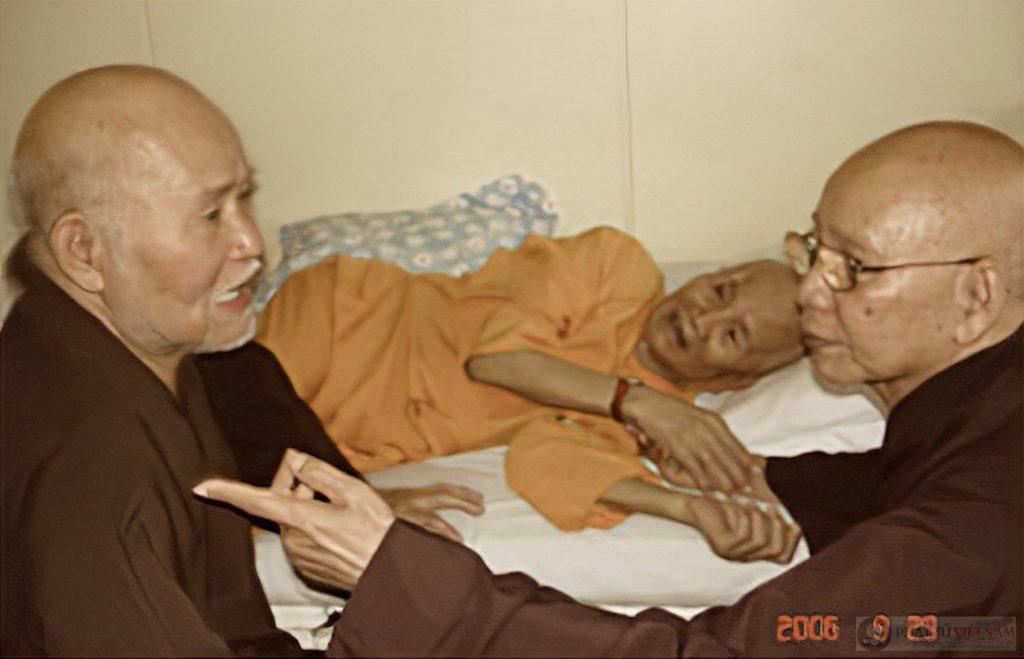
Thich Quang Do’s birth name is Dang Phuc Tue. He was born in Thanh Chau Commune, Tien Hai Suburban District, Thai Binh Province, on November 27, 1928, into a family with three other siblings.
He left his home in 1942 at 14 years of age to become a monk at Thanh Lam Village Pagoda in Ha Dong Province, which is today a part of Hanoi.
He passed away on the night of February 22, 2020, at Tu Hieu Pagoda in Ho Chi Minh City.
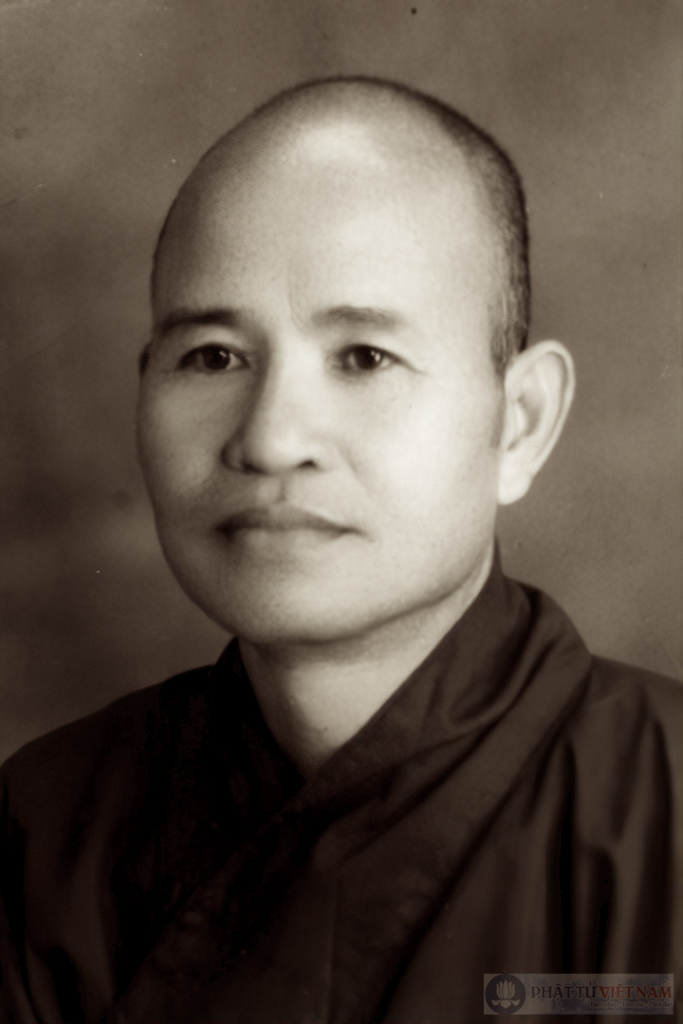
An undated portrait of Thich Quang Do. Photo: Phattuvietnam.net
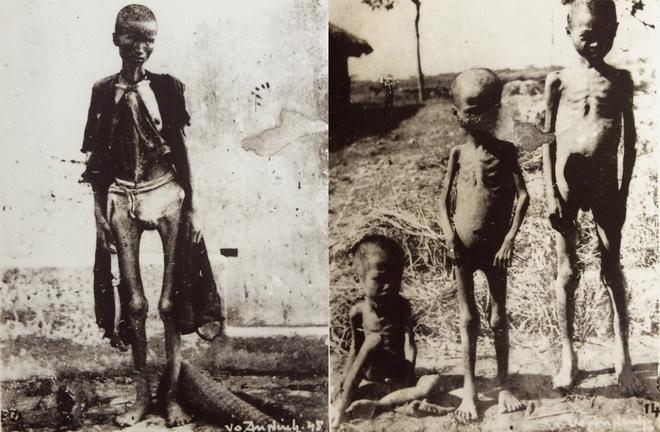
In the beginning months of 1945, famine swept across the northern part of Vietnam, killing two million people. At the time, 18-year-old Thich Quang Do was in training in Ha Dong Province, as a disciple of the Venerable Thich Duc Hai.
“In the year of the rooster (1945), the people were very hungry, especially in the two provinces of Thai Binh and Nam Dinh. Those who had starved to death littered the streets. […] At the time, my master at Thanh Lam Village Pagoda […] heard from people heartbreaking stories, so he travelled out to Ha Dong Township and established a relief group to help the hungry. That was March 1945. My master opened up a food camp to help sustain the hungry. He relied on Ho Dac Diem, who was the Ha Dong Province chief, to intervene with the Japanese and request some rice to rescue the starving. The group was able to carry many people through the famine.” [2]
A young woman (left) and three siblings of another family in Thai Binh during the 1945 famine. The northern famine was caused by the Japanese and the French and led to approximately two million deaths. Photo: Vo An Ninh.
Right after that disaster, the August Revolution broke out, and seeing that the people were still incensed at the famine caused by foreign countries, the Viet Minh hunted down Vietnamese traitors and those who worked for the Japanese or the French, executing them. The executions were seen – by some – as a way for the Viet Minh to flaunt their prestige. Thich Quang Do’s master was allegedly a Vietnamese traitor.
He recalled in an open letter sent to the general secretary of the Vietnamese Communist Party, Do Muoi, in 1994:
”At 10 AM, on the morning of August 18, 1945 […] as I looked at my master, his two hands bound behind his back by zinc wire, on his neck hung two signs scrawled with the words ‘Vietnamese traitor, national sellout’ […] On both sides, a group of people holding sticks, spears, and scythes, stood guard. A group calling themselves the magistrates of the People’s Tribunal stood on a platform […] forcing my master to kneel down in the courtyard and listen to the court convicted him. They immediately sentenced him to death, carrying him out to the field of grass in front of the courtyard, blood continuing to flow from his mouth [as he had been punched]. Upon reaching the field of grass, they wrestled him down onto his side, shooting him through the ears three times with a pistol. Another stream of bright red blood sprayed straight up, and my master died instantly.” [3]
Spurred by the exceedingly painful image of his master being executed, Thich Quang Do wrote: “I swore to fight fanaticism and mercilessness, and to devote my entire life to pursuing justice through Buddhism’s teachings on non-violence, tolerance, and mercy”. [4]
In 1947, Thich Quang Do was ordained as a monk while studying at the Quan Su Buddhist Institute in Hanoi. During this time, he wrote for the magazine Phuong Tien[Means], where Venerable Thich To Lien was editor-in-chief. In 1951, Venerable To Lien dispatched Do to study abroad in Sri Lanka [5]. In that same year, Buddhist temples throughout the country were unified under the leadership of the Vietnamese Buddhist Federation, headquartered at Tu Dam Pagoda in Hue. [6]
After Sri Lanka, Thich Quang Do travelled to India in 1953 to continue his studies. The year after, Vietnam was divided in two, and the Vietnamese Buddhist Federation splintered. Buddhist sects and associations continued to operate independently, and a number of northern Buddhist temples moved south.
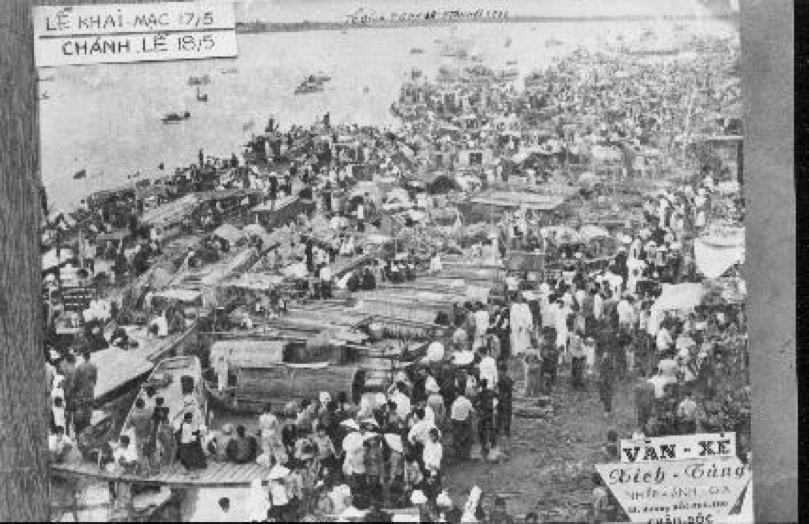
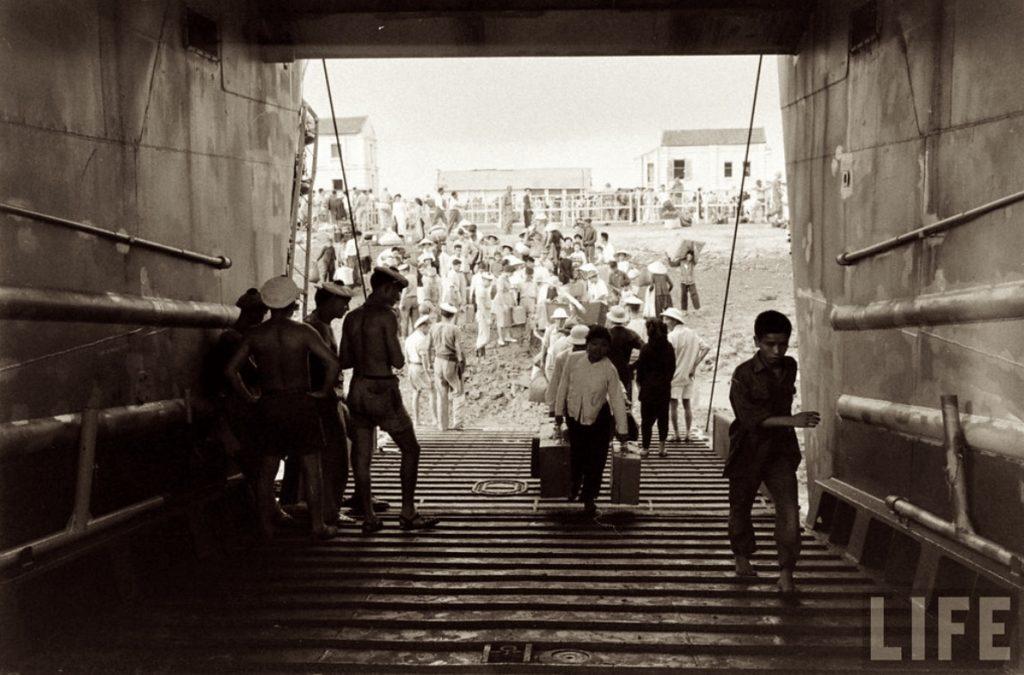
While Vietnam awaited a free general election, the Geneva Accords split the country at the 17th parallel into two separate militarized zones; residents on each side were free to move to the other side. Approximately 800,000 northerners moved to the south, according to data from the South Vietnamese government. This photo depicts northerners preparing to move to the south. Photo: LIFE.
In 1958, Thich Quang Do, 30 and fluent in English and Chinese, returned to Saigon to teach and translate scriptures. [7] During this time, the Vietnamese Buddhist Federation moved its headquarters to An Quang Pagoda in Saigon, and Buddhist sects and associations continued to operate independently. [8]
At the end of 1961, Buddhists and monks were increasingly subjected to excessive religious persecution by the Saigon government. There were reports that many areas banned Buddhists from practising and forced them to give up their religion. By April 1963, as Vesak Day (Buddha Day) approached, monks in Hue were no longer able to tolerate the repression, declaring that they were at odds with the government and commencing a period of impassioned struggle for Buddhism. [9]
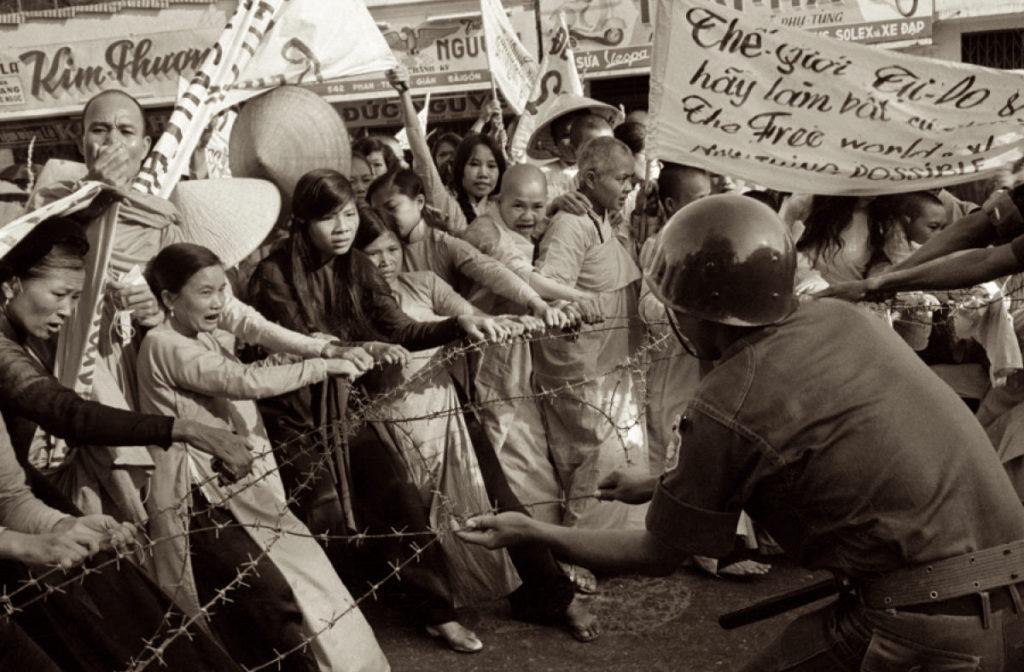
Nuns, monks, and Buddhists scuffle with police in Saigon, protesting against government repression. Buddhist leaders demanded that the government respect the Buddhist flag, cease the repression of Buddhists, treat them equally, grant them the freedom to proselytize and practice, and make reparations for those killed. Photo: HORST FAAS/AP.
To weather the religious crisis, the Inter-sectarian Committee to Protect Buddhism was established in May 1963. It comprised 11 sects and associations and was headquartered at Xa Loi Pagoda in Saigon. The committee included 19 individuals, of whom Venerable Thich Tinh Khiet was the highest leader and Thich Quang Do was an assistant to the diplomatic corps. [10]
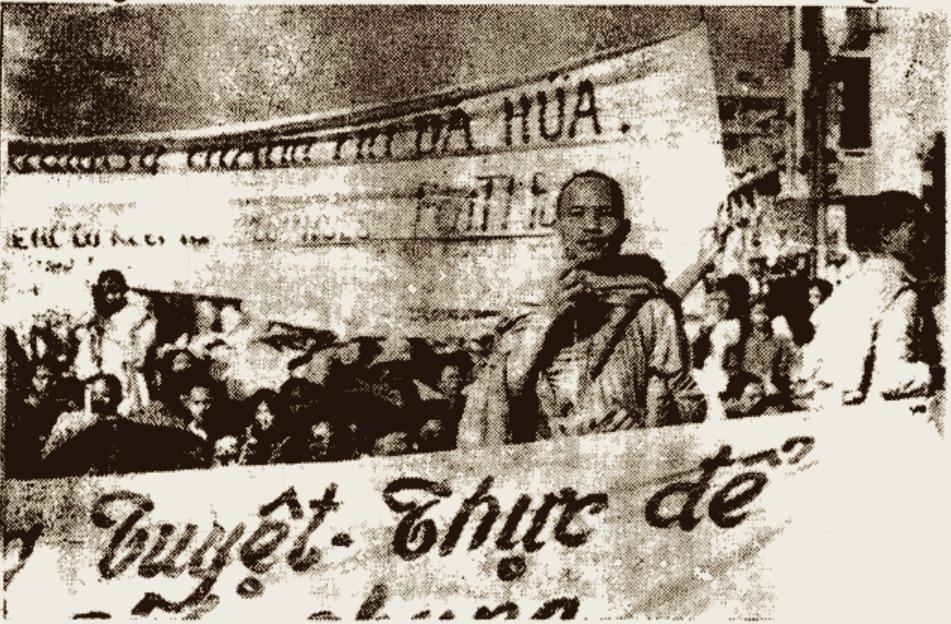
The committee organized large-scale protests and hunger strikes. Thich Quang Do hit the streets with thousands of monks, nuns, and Buddhists to fight for the religion. The government cracked down. Many monks self-immolated to demand a resolution to Buddhism’s five aspirations. Dozens of people lost their lives in clashes with police. The tumult lasted for many months, stirring world opinion.
Thich Quang Do, 35, elaborating on the Buddhist struggle in front of monks, nuns, Buddhists, students, and police. Photo: Buddhist Struggles (Quoc Oai)
On August 20, 1963, the government arrested Thich Quang Do in its “floodwater campaign,” in which pagodas were raided simultaneously to capture Buddhist leaders. He was tortured in prison. While behind bars, he secretly received English articles, translating them into Vietnamese and then sending them out, where they were reprinted in Buddhist newspapers to encourage the fighting spirit of monks, nuns, and Buddhists. [11]
The conflict between Buddhists and the government led the United Nations to send a fact-finding mission to Vietnam on October 24, 1963. A week later, President Ngo Dinh Diem was assassinated, and Buddhism was able to gain the upper hand. Thich Quang Do was released but remained seriously ill due to the torture he suffered while in prison. [12]
Immediately after the 1963 Buddhist crisis and with the flames of solidarity burning bright in the hearts of monks and nuns, a number of well-respected monks reiterated calls to unify Buddhism.
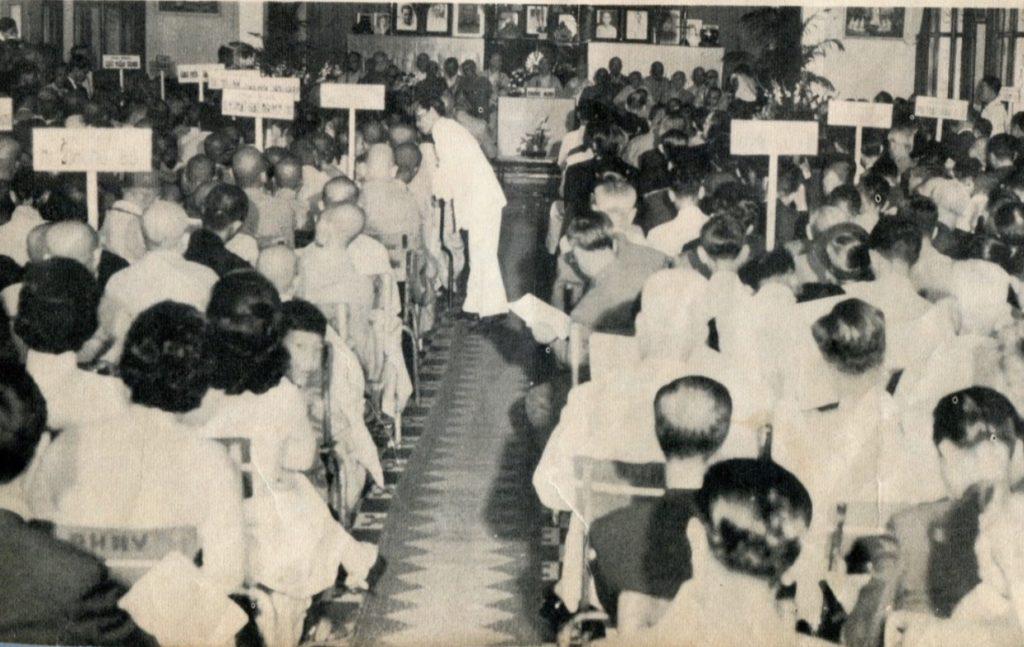
A scene from the opening of the Buddhist Unity Congress at Xa Loi Pagoda on December 31, 1963; outside the pagoda, thousands of Buddhists gathered to support Buddhist solidarity. Photo: Buddhism’s Historic Struggle.
At the beginning of 1964, the Buddhist Unity Congress concluded. Eleven sects and associations were merged into a single Unified Buddhist Church of Vietnam (UBCVN), headquartered at the National Pagoda of Vietnam (which was just starting construction). The UBCVN ratified a charter edited by Thich Tri Quang [13] and sat under the supervision of the Supreme Patriarch Institute and the Hoa Dao Institute.
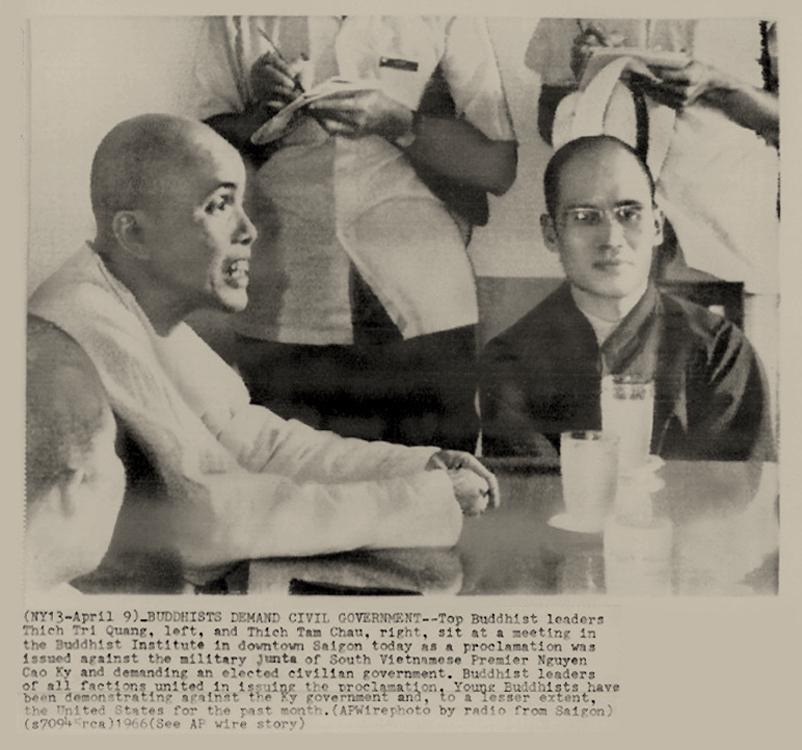
In 1966, a little over two years after unification, the church began to fracture under pressure. A conflict arose between two groups. On one side was the An Quang bloc, led by Thich Tri Quang, which advocated a fierce struggle to interfere in politics, with its overwhelming force and superior organizational ability. On the other side were the moderated at the National Pagoda of Vietnam, led by Thich Tam Chau, who only fought for religious freedom.
Thich Tri Quang (left) and Thich Tam Chau(right) sit in a Saigon monastery on April 9, 1966, to announce to the press their demand for the establishment of a Constitutional Committee for the general election of a civilian government. Photo: AP.
In October 1966, the An Quang bloc established its own and separate Hoa Dao Institute with three sects and associations. [14]
By 1967, the National Pagoda of Vietnam bloc convened a congress with eight sects and associations to amend its charter, asserting that the 1964 charter sought to eliminate the autonomy of sects and associations. From here, the conflict deepened when the government recognized the National Pagoda of Vietnam bloc’s amendments.
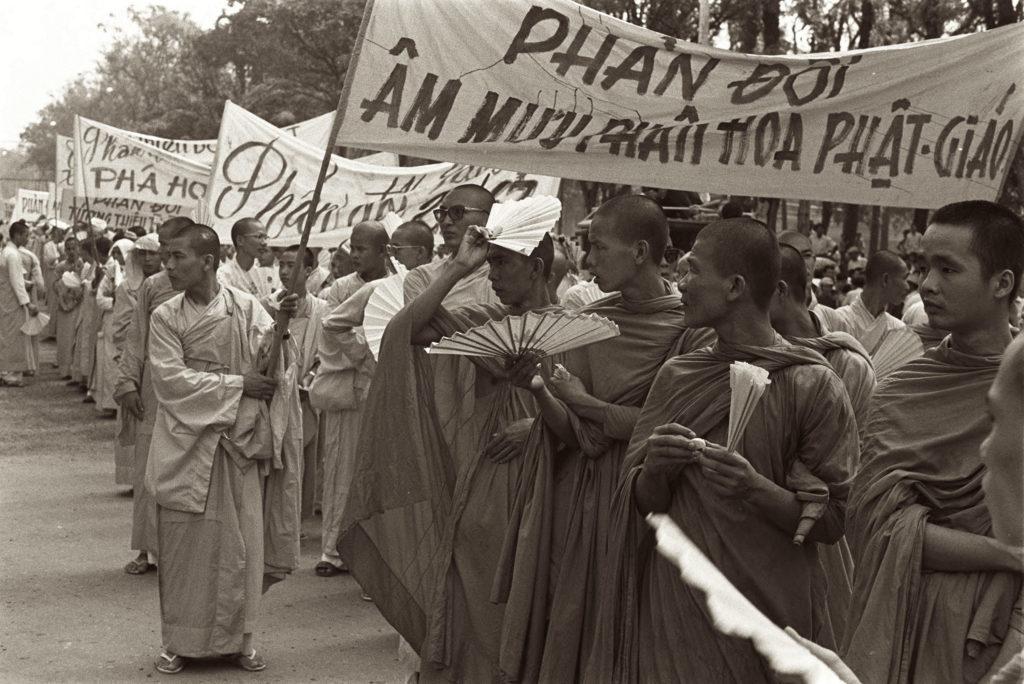
Also in 1967, the An Quang bloc organized a series of large-scale protests, carrying the Buddhist altars down to the streets to oppose both the government and the National Pagoda bloc. The government accused the An Quang bloc of “sowing chaos” and accordingly cracked down against them. The government later broadly apologized to all Vietnamese Buddhists and monks that it had to maintain social order and there were no other methods except for cracking down against the monks of the An Quang bloc.
Not only did the An Quang bloc organize protests, but it also organized other noteworthy activities, such as carrying the Buddhist altars into the streets, hunger strikes, and a number of acts that are still considered controversial to this day for their perceived un-Buddhist spirit. Photo: LIFE.
According to the Sangha of the United Southern Buddhist Church, Thich Quang Do served both as the spokesperson for and inspector of the UBCVN’s Hoa Dao Institute in 1972; two years later, he was appointed general secretary.
The conflict between the An Quang and National Pagoda of Vietnam blocs, with their different approaches, continued until April 30, 1975.
From when he returned to Saigon until 1975, Thich Quang Do taught at Van Hanh University, the Saigon University of Literature, Hoa Hao University (An Giang), even the Pontifical Academy of Pius X (Da Lat), and other Buddhist academies. [15] He also edited numerous scriptures and books on Buddhism.
After taking control of the south, the victors immediately cracked down on all religions, sending dignitaries to re-education camps, destroying Buddhist statues, and confiscating the property of sects and associations.
General Tran Van Tra, head of the Saigon-Gia Dinh Military Management Committee, organizes an international press conference on May 8, 1975. Photo: Herve GLOAGUEN/Gamma-Rapho via Getty Images.
Thich Quang Do witnessed what the victors did to Buddhism. He recounts in an interview with Radio Free Asia in 2015:
“On April 30, 1975, the Communists forcibly conquered South Vietnam. All the Vietnamese people were enslaved to an inhumane, cruel, hateful policy that was unmerciful towards religion. Our Unified Buddhist Church of Vietnam was also stripped of its more than 2000 years of legal status, Buddhist leaders were fiercely repressed, and 12 monks and nuns of Duoc Su Pagoda self-immolated.” [16]
“During the investigation in Can Tho Province into the 12 self-immolations against repressive communist policies [one individual was only 14 years of age], the Communist authorities accused Venerable Thich Hau Hien of being an informant for the Americans and South Vietnamese, committing lewdness against other nuns in their attempt to invalidate 12 immolations. That plot, however, failed because I didn’t sign the final forms legitimizing their scheme.
[…] Things hit a fever pitch on March 3, 1977, when the Communists came to appropriate the Quang Thi Trang convent […], tearing down the “UBCVN” sign and tossing it to the ground. At exactly 11 AM that day, as general secretary of the Hoa Dao Institute, I signed circular urging monks and nuns to prepare to sacrifice to protect the religion and the honor of the Church.”
On April 6, 1977, Venerable Master Huyen Quang and I, along with a number of others, were imprisoned in Phan Dang Luu Prison in Ba Chieu, Gia Dinh. Later, I would find out that former Venerable Master Thich Thien Minh was also captured and had died of unknown causes at the Saigon police headquarters.” [17]
According to Amnesty International, Venerable Thich Thien Minh had died in a temporary detention camp in October 1978. [18] To this day, the Vietnamese state has yet to make an announcement about his death in Detention Camp #4 on Phan Dang Luu Rd., Ho Chi Minh City.
A portrait of the Venerable Thich Thien Minh. He was born in 1921 in Quang Tri and entered the monkhood as a child. After the Buddhist Unity Congress in 1964, he was selected as general director of the Unified Buddhist Church’s youth affairs. Minh stood shoulder-to-shoulder with Venerable Thich Tri Quang during the Buddhist political struggles in the south. Photo: Hoavouu.com.
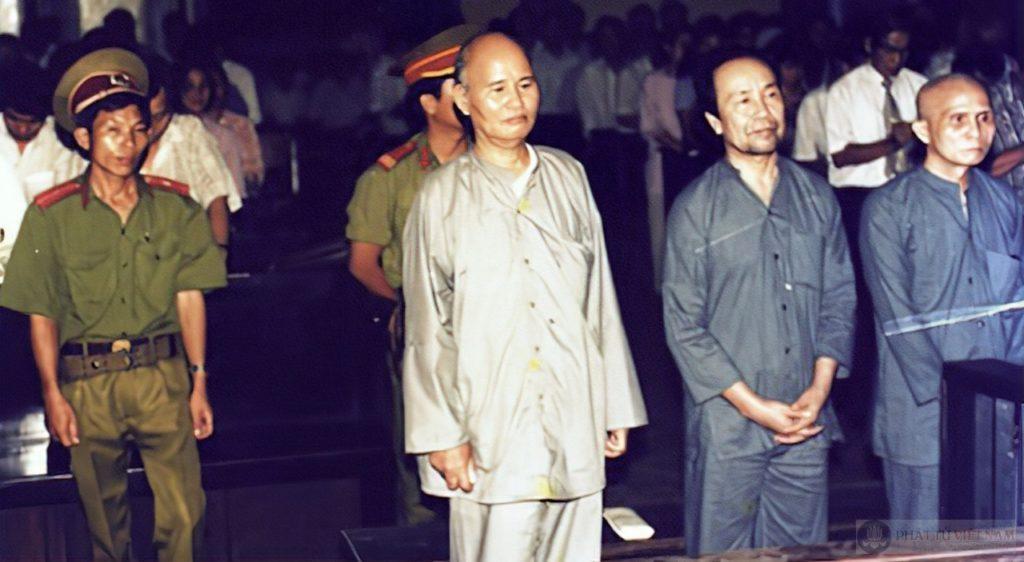
Seven members of the An Quang bloc and Thich Quang Do were eventually tried in December 1978. [19]
The seven were accused of numerous crimes: taking advantage of religion to disrupt national security, disrupting national unity, and acting to oppose the revolution. Under international pressure, Venerable Thich Quang Do and Venerable Thich Thanh The were acquitted. [20] In that same year, Thich Quang Do and Venerable Thich Huyen Quang were nominated for the Nobel Peace Prize. [21]
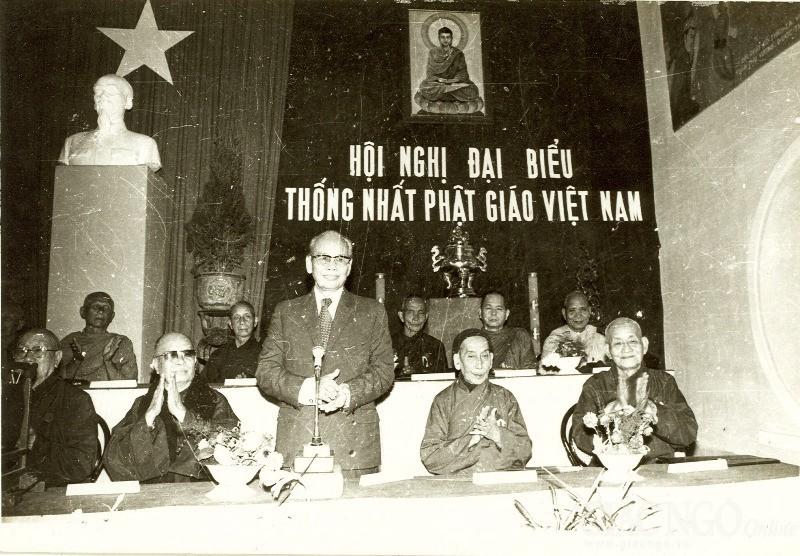
From 1980 – 1981, Do, Venerable Thich Huyen Quang, Thich Duc Nhuan, and a number of others disagreed with the remaining An Quang bloc members, who advocated cooperating with the state to establish the Buddhist Church of Vietnam, which would allow the Communist Party to tightly control church activities.
In just one day, the government united all monks, nuns, and Buddhists across the country during the Conference of Representatives to Unify Vietnamese Buddhism, which took place on November 7, 1981, at Quan Su Pagoda. Photo: Buddhist Church of Vietnam.
With the establishment of the Buddhist Church of Vietnam, the UBCVN, with its history since 1951, became illegal and remains so to this day. Venerable Thich Quang Do recalls:
“From the day former Venerable Master Tri Thu was elected head of the state church [that is, today’s Buddhist Church of Vietnam], the UBCVN no longer had a director leading the Hoa Dao Institute. Without a director, the vice-director stepped up until another congress could be convened to elect officials […]. Because of that, Venerable Master Huyen Quang was the first vice-director to become institute director, and we continued to conduct business with the church [UBCVN] as usual”.
“At four in the afternoon on February 24, 1982, I received a letter from the municipal police headquarters, with the word ‘express’ written on it. When I opened it, I saw that I had been ‘invited’ down to their office.
At exactly 8 AM [the next day], I arrived at police headquarters and was led to a waiting room, where two uniformed officers stood guard with pistols. After approximately an hour, I guess when they figured that was enough psychological torture, I was taken in to see Quang Minh. He said: ‘You’re being involved in religion also means you’re involved in politics (!), we’re going to have to handle you accordingly.’ After about five minutes, Quang stood up and read out the decision, […] expelling me from the city.” [22]
In the ten years after, Thich Quang Do lived alone under the watchful eyes of Thai Binh police: “The Communists […] exiled me to Vu Doai Commune, Vu Thu Suburban District, Thai Binh Province from February 25, 1982, for the crime of ‘being involved in religion and thus being involved in politics.” [23]
Thich Quang Do and Thich Huyen Quang in an undated photo, possibly during the time Thich Huyen Quang was exiled in Binh Dinh. Venerable Thich Huyen Quang was born in 1919 and left home to become a monk in Binh Dinh when he was 13 years old. According to the UBCVN, he was detained in the pagoda until his passing in 2008. Photo source: unknown.
In the late 1980s, Vietnam entered the era of Doi Moi when the country’s economy changed into the market economy of capitalism. At that time, some monks saw that as the opportunity to fight for religious freedom.
At the end of 1991, Venerable Thich Don Hau, nearing death, left in his will a call to restore the UBCVN and reactivate the 1964 church charter, amended in 1973. [24] He reminded the dignitaries, among them Venerable Thich Huyen Quang and Thich Quang Do, that they respectively held the positions of director and general secretary of the Hoa Dao Institute.
Religious repression continued to intensify in 1992 and 1993, and the self-immolation of monks in the Mekong River Delta demanding religious freedom led to enormous protests in Hue, which the authorities cracked down upon and suppressed information about. [25]
On May 21, 1992, a man self-immolated at Thien Mu Pagoda, leading to the temporary detention of Thich Tri Tuu, a Buddhist nun. Immediately after that, thousands of monks and nuns took to the streets in protests that shook the city, and a government car was set on fire. Photo: Nicolas Cornet.
After living in exile in Thai Binh for 10 years, in 1992, Thich Quang Do decided to return to the south a month after notifying the authorities of his plans:
“On February 10, 1982, the Communists also inexplicably exiled my mother to Vu Doai Commune with me, where she died a tragic death […] in January of 1985 from cold and deprivation. Left all on my own, I decided that I could no longer allow myself to be hemmed in so senselessly, interminably, and unscrupulously. On March 22, 1992 (after 10 years and 27 days of exile), I returned to Saigon after letting Hanoi police know, arriving on March 25, 1992. [26]
I returned to the south in 1992 and continued to work on the [Phat Quang] dictionary series; in 1994, I sent to Do Muoi [a former senior leader] a series of assessments regarding the Vietnamese Communist Party’s mistakes towards the nation and Vietnamese Buddhism. After that, I went out into the community to provide aid.” [27]
In November 1994, the Mekong River Delta suffered an unexpected flood, killing approximately 400 people. Representing the UBCVN, Venerable Thich Quang Do, along with a number of monks and retired scholars, went out to render aid to their compatriots, only to be arrested afterwards.
“On January 4, 1995, they arrested me and imprisoned me at the temporary detention center on Nguyen Van Cu St. in the middle of Saigon. Venerable Khong Tanh and I each received five years in prison and five years probation”. [28]
Thich Quang Do, together with Thich Khong Tanh, Thich Nhat Ban, Thich Tri Luc, and two retired scholars Dong Ngoc and Nhat Thuong, at their August 1995 trial in Ho Chi Minh City. Photo: Vietnamese Buddhists.
“My time in jail wasn’t too bad; it was fairly leisurely […]. You eat and you go about your work, just like anywhere else […]. Before I was imprisoned, I had requested […] that they give me the Phat Quang dictionary set that I was working on.
I completed [the dictionary series] while in prison; when I received special amnesty and was released on September 2, 1998, they refused to return the nearly 100 volumes that I had already translated […]. They required I fill out a request form.
Unreasonable! This having-to-request business. If it’s going to be that way, then I’m not going to request anything. They can just keep it and use it however they like; I’ll just redo everything again at home. So I did, and it took me two years. I redid everything, without having to make a request of anyone. Please be reasonable. Let’s think about this. For example, if you’re hungry, then you go and ask people for food. When people give it to you, you thank them. But in this situation, the government simply kept my work, I didn’t give it to them”. [29]
At the beginning of 1999, Thich Quang Do went out to Quang Ngai to visit Venerable Thich Huyen Quang, who had just been exiled three days before. Also in the same year, Do became the director of the UBCVN’s Hoa Dao Institute.
After his trip to Quang Ngai, he was interrogated by police. In February 2001, he was formally put under house arrest for violating the terms of his probation. [30]
After that trip, Thich Quang Do stated to the press that: “I will continue to speak loudly, strongly, and firmly for freedom, democracy, human rights, and freedom of religion, so that those in and outside the country hear the church’s calls and its support for human rights and democracy.” [31]
In 2001, Thich Quang Do issued a call for democracy in Vietnam to his domestic and overseas compatriots, as well as to the Vietnamese government:
“But today, as other countries around the world develop, growing more prosperous, free, and democratic by the day, our country is becoming increasingly paralyzed and impoverished, our people oppressed and trampled on. […]
This catastrophe persists, nurtured by three factors: the government thinks too highly of itself and refuses to accept the opinions of others, resulting in a single-party dictatorship; the government has broken away from the people and refuses the most basic calls for human rights and citizens’ rights, resulting in an abominable authoritarian regime; the government is too dependent on foreign countries, from ideology to the structure of the state apparatus, causing social and civilizational upheaval [,..] moral decay and national stagnation.” [32]
In October 2003, after the state lifted its probation order, Quang Do risked his life to bring Thich Huyen Quang from Binh Dinh to HCMC for medical treatment. While on the road, the two were stopped by police and held on National Highway 1A, accused of keeping some state secrets with them [33], resulting in approximately 200 monks and nuns, and more than 1,000 Buddhists from nearby pagodas protesting to protect the two. [34]
Venerable Thich Quang Do visits Venerable Thich Huyen Quang (laying down) in 2006. Venerable Thich Huyen Quang passed away on July 5, 2008, at Nguyen Thieu Monastery in Binh Dinh Province. Photo: Vietnamese Buddhists.
In 2006, Thich Quang Do received two awards for his human rights work, Norway’s Thorolf Rafto Memorial Prize and the World Movement for Democracy’s Democracy Courage Tribute. However, the Vietnamese government prevented Do from travelling overseas to accept the awards.
In 2007, the UBCVN began mutually supporting disenfranchised citizens through the Disenfranchised Relief Fund, helping those who had long petitioned the government on land issues.
And in order to eradicate what it does not approve of, the government began a well-worn campaign of using the press to cast aspersions on Do and the UBCVN.
Newspapers from Nhan Dan [The People] to Tuoi Tre [Youth] called Do “a religious exploiter” accusing him of “political opportunism,” “inciting the people,” being “on a mission of vengeance,” and behaving like “an old dog who can’t learn new tricks.”
In the same year, during which he was banned from talking to the press, Thich Quang Do responded to Al-Jazeera through video: [35]
“We are prisoners in our own homeland, where the government decides who has the right to speak and who has to keep their mouths shut. Even at this very moment, I’m being held at the Thanh Minh Monastery in Saigon. Secret police tail me day and night, preventing me from moving freely.
I’ve been continuously repressed by the Communist regime since 1975. But I myself am not afraid of anything because I am fighting for what is right.
Today, we lack an opposition party and freedom of the press, independent religions are being cracked down upon, and anyone demanding political reform, democracy, or human rights could be subject to immediate arrest.
We must have political pluralism, the right to free elections, and the right to decide our political system […]. In sum, we must have the right to determine our future and our fate.”
From 2001, Venerable Thich Quang Do was held under house arrest at Thanh Minh Monastery, where he was closely monitored by police and isolated from church activities and the outside world. Politicians from the world over regularly tried to find ways to visit him. Photo: Clochers & Lieux de culte.
In 2012, while he was meeting with the Australian ambassador in Vietnam, Thich Quang Do had expressed his views regarding the East Sea [South China Sea] problem:
“Vietnam has already lost a portion, an island in Hoang Sa [the Paracels], eight islands in Truong Sa [the Spratleys]. China just established the Tam Sa [Sansha] district center, setting up administrative and military bodies to control that region. […] For now, I only wish for Vietnam to democratize and then ally itself with the world’s democratic nations. […] As it stands right now, I don’t have any hope for Vietnam.” [36]
In 2011, Thich Quang Do became the fifth patriarch of the UBCVN but met with many difficulties in developing the UBCVN due to his house arrest at Thanh Minh Monastery:
“They [the government] have yet to cease discrimination and repression of the UBCVN. Thus, the church has struggled to conduct activities over the past 30 years. We can’t preach, we can’t open schools to teach. […] If they had an opportunity to completely do away with the church, they absolutely would.
For several decades, [I have been restricted to] a single room upstairs that I inhabit. […] Every two months, I go to the hospital, and that’s it. No one is allowed to come and go, and I can’t move freely either. When I go to the hospital, they [the police] follow.”
A photo of Venerable Thich Quang Do in his room at Thanh Minh Monastery on September 3, 2018. Photo: International Buddhist Information Office.
“As of now, I eat only one meal a day, which is brought up to me in the morning. There’s a chair outside my door that I leave my plates on after I finish eating. The kitchen will come up to take them away, and then they lock the metal gate. The stairs up to my room have a metal gate, just like a prison cell. It’s been like this for more than 20 years since I returned from the north.
I owe my residence here to Venerable Thich Thanh Minh’s pagoda […]. Since I left to join the monkhood some sixty years ago, I have lived thanks to the generosity of others. […] As of now, I only recite Buddhist scriptures to myself. I’m not allowed to pray for or preach to others; I can only recite to myself. They have stipulated this very clearly.” [37]
In mid-September 2018, exactly three months after American Ambassador Daniel Kritenbrink came to visit him, Thich Quang Do was evicted from Thien Minh Monastery, staying at a number of pagodas before heading home to Thai Binh at 90 years of age:
“I returned to my hometown as an ostensible retreat, but if there were any small pagodas, I would recite Buddhist scriptures there. No matter what happens to the church, even if I die, I could never give it up.”
American ambassador Daniel Kritenbrink (left) and a colleague visit Venerable Thich Quang Do on June 14, 2018. Photo: International Buddhist Information Office.
Not long after, Venerable Thich Quang Do, the fifth patriarch of the UBCVN, returned to HCMC at age 90 to continue his obstacle-plagued work of the church.
Two years later, at 9:30 PM on February 22, 2020, Venerable Thich Quang Do, the fifth patriarch of the UBCVN, took his last breath at Tu Hieu Pagoda; his painful endeavor for the Vietnamese homeland finally came to an end.
On February 25, 2020, three days after his funeral, monks, nuns, and Buddhists escort Venerable Thich Quang Do to his cremation site; his ashes were scattered at sea 49 days later. Photo: Giac Ngo [Enlightenment].
This article was written in Vietnamese by Tran Phuong and was previously published in Luat Khoa Magazine on March 1, 2020. The English translation was done by Will Nguyen.
*** In our previous version of this article, we have cited the 1979 report of Amnesty International on the death of Venerable Thich Thien Minh. However, upon our recent re-checking of the cited link, it is unfortunate that the link is no longer accessible. Therefore, we have changed the link to the copy of Amnesty International’s January 1979 newsletter. We apologize for this inconvenience.***
[7] Brief biography of Elder Venerable Thich Quang Do (1928 – 2020), cited material. [8] Vietnamese Buddhism Monthly Review #27 and #28, published by the Vietnamese Buddhist Federation. [9] Vietnamese Buddhism’s Historic Struggle, Nam Thanh, published by the UBCVN Hoa Dao Institute in 1964. [10] Vietnamese Buddhism’s Historic Struggle cited material. [11] Thich Quang Do is appointed the new leader of the Unified Buddhist Church of Vietnam, cited material. [12] Brief biography of Elder Venerable Thich Quang Do (1928 – 2020), cited material. [13] White paper on the divide between An Quang and the National Pagoda of Vietnam, written by Thich Tam Chau in 1993. [14] White paper on the divide between An Quang and the National Pagoda of Vietnam cited material. [15] Brief biography of Elder Venerable Thich Quang Do (1928 – 2020), cited material. [16] Interview of Elder Venerable Thich Quang Do regarding the UBCVN over the past 40 years. [17] Assessments regarding the Vietnamese Communist Party’s mistakes towards the Nation and Vietnamese Buddhism, Thich Quang Do, written in 1992. [18] Amnesty International Newsletter January 1979. (1979, January 1). Amnesty International. https://www.amnesty.org/en/wp-content/uploads/2021/06/nws210011979en.pdf. [19] Thich Quang Do is appointed the new leader of the Unified Buddhist Church of Vietnam, cited material. [20] Amnesty International Report 1979, p.117, cited material. [21] Thich Quang Do is appointed the new leader of the Unified Buddhist Church of Vietnam, cited material. [22] Assessments regarding the Vietnamese Communist Party’s mistakes towards the Nation and Vietnamese Buddhism, Thich Quang Do, written in 1992. [23] Letter written to Do Muoi, Thich Quang Do, written in 1994. [24] Venerable Thich Don Hau’s will. [25] In Vietnam, Monks Lead Protest to Repression. [26] Letter written to Do Muoi, Thich Quang Do, written in 1994.
It is probably one of the worst times for Vietnam right now. The latest wave of Covid-19 infections has pushed Vietnam into both a healthcare and a media crisis. Once envied for its low death toll and effective methods to contain the virus, the Communist nation is now struggling to keep itself afloat as the rapid transmission of the new Delta variant overwhelms the healthcare capacity of its many provinces and municipalities.
Last year, when the first cases of Covid-19 began to emerge in the country, the Vietnamese government actively utilized its state media apparatus to promote anti-coronavirus measures, deliver nationalistic and heroic messages [1] to target local audiences, as well as project its initial success in containing the disease by quoting praises from international media and experts.
However, the latest outbreak, which created an unprecedented crisis, has driven state media to adopt new propaganda tactics. Similar to the Chinese authorities’ media strategy, [2] when coronavirus first broke out in Wuhan, the Vietnamese government proactively covered up the truth, silenced independent voices, and pushed optimistic narratives to sway public attention away from the reality on the ground.
Amid the worsening Covid-19 predicament, many social media users in Vietnam chose social networks to share their personal experiences and to seek financial and medical help from the community. This circumstance has thus created a stark contrast between the government’s efforts to portray a positive picture of the pandemic and the appalling stories shared by ordinary citizens.
The Vietnamese Magazine has analyzed the contents from both state media and public postings on social networking sites in Vietnam to create a more comprehensive picture of the current situation through three main criteria: the reports of state-owned media regarding the death toll, the government’s assistance for affected individuals, and the vaccination program.
The Death Toll Cover-up
As of this writing, Vietnam has recorded [3] over 265,000 Covid-19 infections, with around 100,000 recoveries and more than 5,000 deaths. The country’s recent daily infections tally is about 6,000 to 9,000 cases.
Since the beginning of August, when the coronavirus situation began to worsen, numerous real-life stories and videos have started circulating on Vietnamese social media. These postings, which are done primarily by ordinary citizens, exposed the grim condition of Vietnam’s healthcare facilities, the struggle of impoverished people in quarantined areas, and the harrowing scenes of long lines of ambulances carrying the coffins of Covid-19 victims to cemeteries.
Despite their accurate portrayal of the current situation during the time they were released, that footage was mainly absent on the country’s official news channels. On the other hand, state media has ramped up its censorship on these disturbing details and has also diverted public attention towards the mishandling of the pandemic by other foreign countries.
A long trail of ambulances was seen parked on the road leading to Binh Hung Hoa Cemetery, Ho Chi Minh City. Photo: Le Phan/ Tuoi Tre Online.
In the past few weeks, when daily Covid-19 mortality rates began to spike, almost all major newspapers and broadcasting channels in the country avoided mentioning or reporting [4] on the details of the death toll. Instead, their reports focused on the number of recoveries and emphasized the severity of the situations in other neighboring Southeast Asian countries.
For instance, Thanh Nien Online, a state-owned newspaper, last reported [5] on coronavirus-related deaths in Vietnam on July 29, despite its previous regular updates of the number. This news outlet nevertheless diverted its reports on death tolls from Vietnam to Indonesia [6] and Thailand [7].
Other online news outlets, such as Vietnamnet [8] and Tuoi Tre Online,[9] last reported on the number of Covid-19 deaths in Vietnam on July 30 and August 3, respectively. At the same time, VTV, the Communist Party’s most significant broadcasting mouthpiece, asked [10] its audience to spread “positive information” instead of dwelling on “negative and less optimistic” news to overcome the pandemic.
This manipulative approach to the media further raises public concerns about the authenticity of the government’s official statistics, and at the same time, casts lingering suspicion among Vietnamese citizens on whether or not the actual scenario is far worse than the state media’s reportage.
Welfare for the Poor: Promises and Reality
Besides grappling with the surge of new Covid-19 infections, Vietnam is also facing an economic and welfare crisis as the livelihoods of millions of its citizens are being jeopardized for the sake of rigid anti-coronavirus measures.
During the lockdown periods, a significant number of civil society groups on social media, as well as SOSmap.net, a project established by citizens, have begun operations in Vietnam. These social and technical incentives act as open platforms to connect bringers of goodwill to those in need. People can post their requests or promises to help on these platforms for a variety of purposes – from donating food and providing financial aid, to giving medical advice, and the like.
These online platforms, despite differing in scope and geographic location, all have one thing in common: they are flooded with waves of hopeless calls for help from ordinary citizens, [11] of all of whom are negatively affected by harsh lockdown measures. In the majority of cases, the victims are contractors and manual workers who face financial difficulties or food shortages due to unemployment; many of them receive little or no support from the government.
A mass exodus of workers has also been seen fleeing [12] Ho Chi Minh City and other southern industrial provinces as the number of coronavirus cases surged in the region, while many factory workers and prisoners of conscience are at risk of getting infected due to poor working and living conditions.
An exodus of people, mostly contracting workers, have fled Ho Chi Minh City to overcome financial difficulties due to strict lockdown measures. Photo: Thanh Quan/ Thanh Nien Online.
But on state media, their hopeless voices are barely mentioned. They are often drowned-out to pave the way for a medley of political discourses,[13] victory speeches, [14] and firm guarantees of “letting no one starve” [15] from the government. According to our analysis, mainstream newspapers and broadcasting channels in Vietnam generally choose to report only on the positive sides of the migrant workers’ crisis, praise [16] the local authorities for their “timely” assistance for affected families, and simultaneously avoid mentioning the country leaders’ mistakes which helped lead to the current situation.
Needless to say, the propaganda narratives mentioned above have two primary aims: placating the public and circumventing the Vietnamese authorities’ own failure in providing basic necessities to its people. Since freedom of the press is a concept that does not exist in Vietnam, the media is nothing but the Party’s effective tool to bend public opinion to its will.
An article from a state-owned newspaper claimed that all contracting workers in Ho Chi Minh City had been financially supported (left), while a local neighborhood argued that they had received nothing from the government (right). Photo: screenshot/ Facebook post.
The Vaccination Triad
Meanwhile, as Vietnam struggles to contain the spread of Covid-19, its citizens are encouraged to get vaccinated to reach herd immunity [17] “in the shortest amount of time.” According to official statistics, [18] as of July 31, around 1.5 million vaccine doses have been given in Ho Chi Minh City, the country’s largest Covid-19 hotspot, while health authorities ensure that “around 99 percent of the population above 18 years of age [in the city] will be vaccinated.”
The same rhetoric of hope and assurance, as expected, are also dominating the country’s state media.
Although the vaccination plan sounds promising, state-owned media fail to consider three key shortcomings that could hinder the country’s progress towards achieving its immunity goal. These challenges include Vietnam’s ongoing shortage of Covid-19 vaccines, low rates of immunization [19] and the people’s hesitancy to get Chinese-made jabs.
Earlier, a decision from Ho Chi Minh City authorities to use the Chinese-made Sinopharm in its inoculation program due to the vaccine scarcity problem has drawn public opposition and criticism. People’s concerns over the efficacy of these vaccinations, the significant lack of transparency of government officials about their vaccination status and which types of vaccines were given to the officials, and deep-rooted anti-China sentiments among many Vietnamese are believed to be the reasons for such reactions.
On social media platforms such as Facebook, public opinion expressingobjections to Chinese vaccines have sparked thousands of interactions. At the same time, many of the commenters claimed that they would reject the made-in-China vaccinations if given a chance.
The hostility also takes place under actual circumstances. A week ago, long lines of local people were seen angrily leaving a vaccination venue in District 1, Ho Chi Minh City. They were informed by the vaccination venue that they would be given Sinopharm shots since that center had run out of AstraZeneca vaccines.
Local people seen leaving a vaccination venue in District 1, Ho Chi Minh City, after being informed that they would receive Chinese-made Sinopharm vaccines. Photo: screenshot/ VOV.
On state-owned news channels, none of these stories has been adequately reported. Instead, the common headlines regarding the current vaccination campaign in Vietnam mostly boast [20] the country’s rapid rate of inoculations, reassure [21] the public of an abundant vaccine supply, or urge [22] the people to get Sinopharm while endorsing its high effectiveness against Covid-19.
The ongoing vaccination fiasco is yet another example of the Communist Party attempting to control the flow of public discourse, debate, and opinion.
The stories they peddle in mainstream media and the experiences of ordinary citizens rarely overlap; they portray two different truths: the alternative reality of the Party and the reality on the ground.
Once again, the vulnerable people’s frantic calls for help are suppressed and overpowered by the Party’s extravagant mouthpieces.
Bibliography:
Lena, L. (2020, June 24). Nationalism, heroism and media in Vietnam’s war on COVID-19. East Asia Forum. https://www.eastasiaforum.org/2020/06/24/nationalism-heroism-and-media-in-vietnams-war-on-covid-19/
Muyi Xiao, Drew Jordan, Meg Felling And Christoph Koettl. (2020, March 18). How China Is Reshaping the Coronavirus Narrative. The New York Times. https://www.nytimes.com/video/world/asia/100000007024807/china-coronavirus-propaganda.html
The Vietnamese Magazine. (2021, August 16). Vietnam Briefing: Exoduses In Kabul And Saigon, At The Same Time, For Different Reasons. The Vietnamese Magazine. https://www.thevietnamese.org/2021/08/vietnam-briefing-exoduses-in-kabul-and-saigon-at-the-same-time-for-different-reasons/
Minh, H. (2021, August 14). Điều VTV không nói: hơn 5.000 người đã chết vì COVID-19 ở Việt Nam. Luật Khoa Tạp Chí. https://www.luatkhoa.org/2021/08/dieu-vtv-khong-noi-hon-5000-nguoi-da-chet-vi-covid-19-o-viet-nam/
Chau, L. (2021, July 29). Thêm 4.323 bệnh nhân khỏi bệnh; 233 ca tử vong do Covid-19 trong 8 ngày qua. Thanh Niên Online. https://thanhnien.vn/thoi-su/them-4323-benh-nhan-khoi-benh-233-ca-tu-vong-do-covid-19-trong-8-ngay-qua-1422364.html
Vi, L. (2021, August 4). Số ca tử vong do Covid-19 vượt mốc 100.000, Indonesia đánh giá đã qua đỉnh dịch. Thanh Niên Online. https://thanhnien.vn/video/the-gioi/so-ca-tu-vong-do-covid-19-vuot-moc-100000-indonesia-danh-gia-da-qua-dinh-dich-164860v.html
A, Đ. (2021, August 5). Nhân viên nhà xác Thái Lan ngất xỉu vì số ca tử vong tăng cao. Thanh Niên Online. https://thanhnien.vn/the-gioi/nhan-vien-nha-xac-thai-lan-ngat-xiu-vi-so-ca-tu-vong-tang-cao-1425575.html
Lien, N. (2021, July 30). Việt Nam công bố thêm 159 bệnh nhân Covid-19 tử vong. Vietnamnet. https://vietnamnet.vn/vn/suc-khoe/viet-nam-cong-bo-them-159-benh-nhan-covid-19-tu-vong-761050.html
Anh, L. (2021, August 3). Sáng 3–8: Thêm 3.578 ca mắc COVID-19, hôm qua là ngày tiêm vắc xin nhiều nhất tới nay. Tuổi Trẻ Online. https://tuoitre.vn/sang-3-8-them-3-578-ca-mac-covid-19-hom-qua-la-ngay-tiem-vac-xin-nhieu-nhat-toi-nay-20210802201648193.htm
Chuyển động 24h tối – 10/8/2021. (2021, August 10). VTV. https://vtv.vn/video/chuyen-dong-24h-toi-10-8-2021-514933.htm
Tinh, N. (2021, August 6). Dân kêu cứu khắp nơi, chính quyền thì đang làm gì? Luật Khoa Tạp Chí. https://www.luatkhoa.org/2021/08/dan-keu-cuu-khap-noi-chinh-quyen-thi-dang-lam-gi/
Jason, N. (2021, August 4). Vietnam: In The Middle Of The COVID-19 Pandemic, They Are The Ones Being Left Behind. The Vietnamese Magazine. https://www.thevietnamese.org/2021/08/vietnam-in-the-middle-of-the-covid-19-pandemic-they-are-the-ones-being-left-behind/
B.S. (2021, July 30). Cần chống dịch quyết liệt hơn với những giải pháp đặc biệt. Báo Công An Nhân Dân. https://cand.com.vn/Su-kien-Binh-luan-thoi-su/Can-chong-dich-nghiem-ngat-hon-quyet-liet-hon-voi-nhung-giai-phap-dac-biet-vi-an-toan-hanh-phuc-am-no-cua-nhan-dan-i622263/
Truong, X. (2021, August 14). Thủ tướng: “Nhất định chúng ta sẽ sớm chiến thắng đại dịch COVID-19.” VTC News. https://vtc.vn/thu-tuong-nhat-dinh-chung-ta-se-som-chien-thang-dai-dich-covid-19-ar630743.html
Hoa, Đ. D. (2021, August 2). Không để cho dân đói trong đại dịch. Vietnamnet. https://vietnamnet.vn/vn/tuanvietnam/tieudiem/khong-de-cho-dan-doi-trong-dai-dich-covid-19-761973.html
Minh, B. (2021, July 20). Gói hỗ trợ 26 nghìn tỷ đồng: “Sự động viên kịp thời.” Dân Trí. https://dantri.com.vn/an-sinh/goi-ho-tro-26-nghin-ty-dong-su-dong-vien-kip-thoi-20210719210750222.htm
Tiêm hết vaccine cho người dân TPHCM để đạt miễn dịch cộng đồng sớm nhất. (2021, July 31). Ministry of Health. https://moh.gov.vn/hoat-dong-cua-lanh-dao-bo/-/asset_publisher/TW6LTp1ZtwaN/content/tiem-het-vaccine-cho-nguoi-dan-tphcm-e-at-mien-dich-cong-ong-som-nhat
Ibid., [17]
Reuters. (2021, August 13). Vietnam concerned over vaccine supply as COVID-19 cases near record. Reuters. https://www.reuters.com/world/asia-pacific/vietnam-concerned-over-vaccine-supply-covid-19-cases-near-record-2021-08-12/
Nguyen, T. (2021, August 11). Tốc độ tiêm vaccine COVID-19 đang tăng nhanh những ngày gần đây. Báo Tin Tức. https://baotintuc.vn/y-te/toc-do-tiem-vaccine-covid19-dang-tang-nhanh-nhung-ngay-gan-day-20210811181034442.htm
L.Đ.O. (2021b, August 10). Bộ trưởng Bộ Y tế: Việt Nam sẽ đón số lượng lớn vaccine phòng COVID-19. Lao Động Online. https://laodong.vn/y-te/bo-truong-bo-y-te-viet-nam-se-don-so-luong-lon-vaccine-phong-covid-19-940407.ldo
Nam, K. (2021, August 12). Đừng để thốt lên “Giá như. . .” khi đã quá muộn. Trang Tin Điện Tử Đảng Bộ Thành Phố Hồ Chí Minh. https://www.hcmcpv.org.vn/tin-tuc/dung-de-thot-len-gia-nhu%E2%80%A6-khi-da-qua-muon-1491882335
The 88 Project commenced and was joined by 12 other human rights organizations to sign and publish an open letter, addressed to current U.S. Vice President Kamala Harris, ahead of her planned mission to Singapore and Vietnam.
The intentions of her visit, as previously reported by Nikkei Asia, are to strengthen U.S presence in the Southeast Asian region, and to discuss the issues of climate change, regional security, and the Covid-19 pandemic.
Released on Wednesday, August 18, 2021, the letter urges the Vice President to “empathize the importance of human rights with Vietnamese leaders” and also calls for specific action to be taken regarding the situation of Tran Huynh Duy Thuc, a prominent Vietnamese democracy activist whose health is slowly deteriorating due to his prolonged hunger strike.
In 2010, Thuc was sentenced to 16 years in prison for writing and publishing online articles calling for a multi-party democratic system in Vietnam. The letter also claims that Thuc’s imprisonment, detention, and subsequent treatment at the hands of Vietnamese authorities are blatant infringements of his right to a fair trial under the International Covenant on Civil and Political Rights, and the Vietnamese Constitution itself. He has also been subject to various forms of physical and mental duress which violate the international prohibition against torture.
The 12 signatories of the open letter implore U.S. Vice President Kamala Harris to express her concern regarding this blatant denial of Thuc’s human rights, in her discussions with Vietnamese leaders, and to call for his immediate and unconditional release.