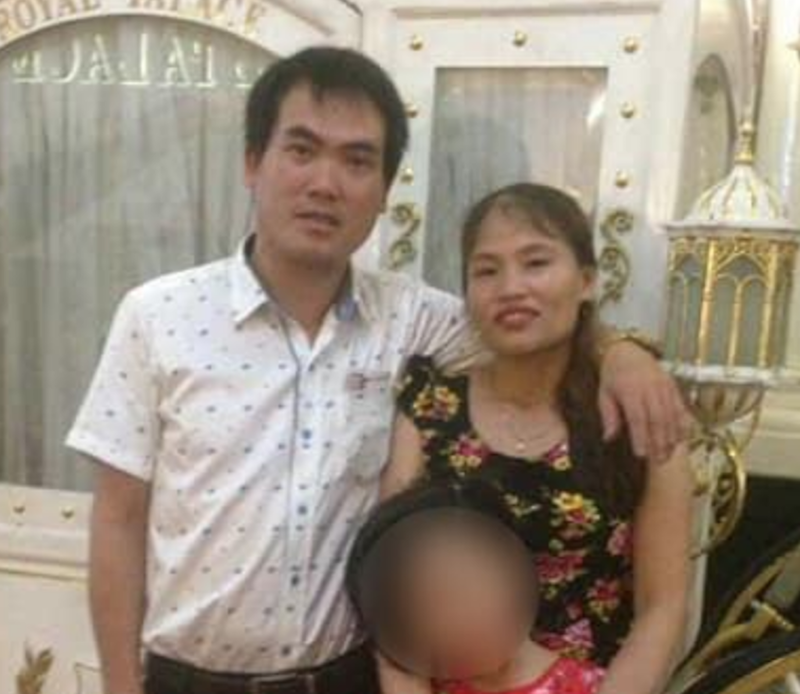
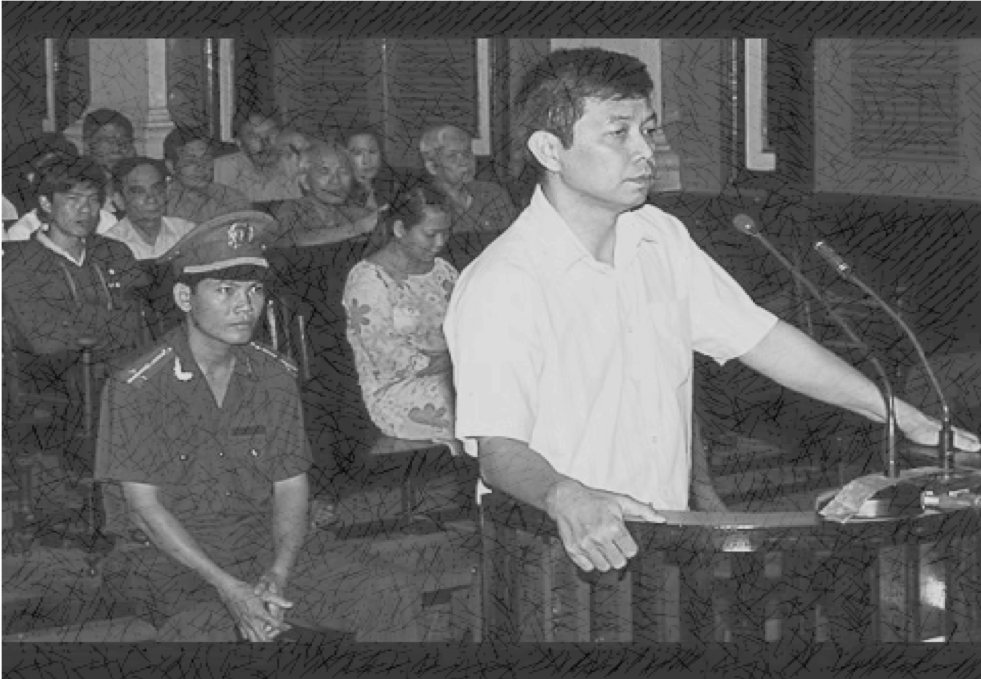
An inmate who was diagnosed with a brain hemorrhage in January 2019 told his family that he did not get proper treatment and was sent back to prison after about a month in the hospital.
34-year-old Ha Van Truong is currently serving a nine-year-sentence for manslaughter in the case resulting from a land dispute between farmer Dang Van Hien and Long Son Commercial and Investment Company (Long Son), a private company in Dak Nong Province in October 2016.
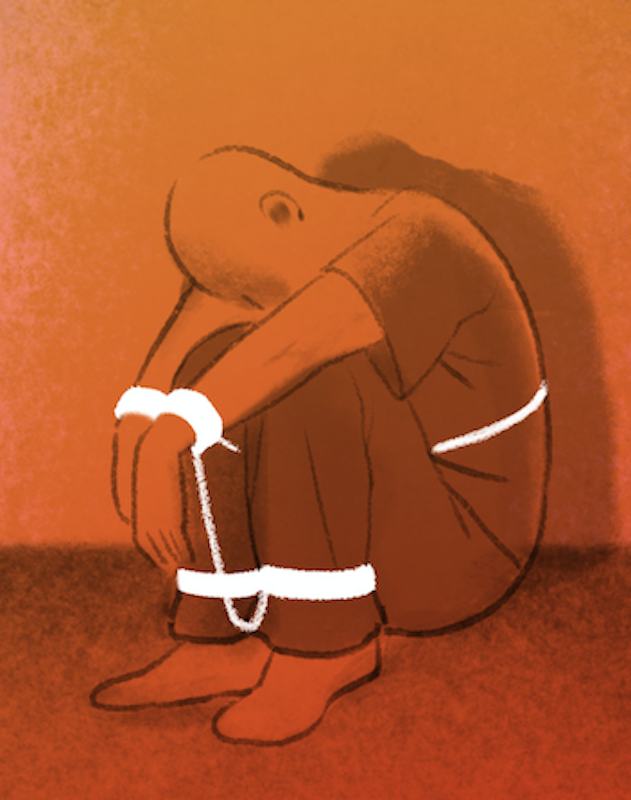
On March 31, 2019, Truong was, again, admitted to the hospital with the same diagnosis. But his family informed us last night that his conditions have gotten worse. They also stated that during both of his stay in the hospital, he was subjected to shackling – a practice which international human rights law defines as torture.
Last year, the trial of Dang Van Hien and Ha Van Truong received extensive news coverage due to an unusually heightened public sympathy for the defendants, who were perceived as victims of land-grabbing. In Vietnam, land-grabbing has become an increasingly urgent social and political issue that the whole nation often paid close attention to.
After Dang Van Hien was sentenced to death for homicide, more than 3,000 people signed an online petition, asking the president of Vietnam to commute his sentence. Earlier this year, in February 2019, Hien’s case was proceeding towards a trial for cassation – a review of both the law and facts that could give him a second chance at life.
Truong was initially sentenced to 12-year-imprisonment, but an appellate court in Ho Chi Minh City reduced the term to 9 years which again showed the impact of public support on the case.
However, Truong has been a victim of police brutality and torture, and he also did not receive adequate medical care. His family told us that Truong suspected his brain hemorrhage was a result of the injuries he received from police beating during his pre-trial detention. Since then, he has been suffering from a chronic headache, but the prison’s medical clinic only gave him pain reliever medication. He did not receive a proper diagnosis until he fainted and was admitted to the hospital in January 2019.
During his first admission, the authorities waited for two days before informing his family without any specific reasons. Truong was left alone in the hospital with no one to care for him. He was unable to eat solid food, but the police fed him with only rice and pork. The families of other patients had to give him some milk to drink until his family found out about his whereabouts and visited him.
Truong’s current prognosis is not looking too positive. His family said that his body has been frail so he would need assistance to move around and that he often passed out.
In such dire conditions, Truong is still subjected to shackle 24/7 even when he is lying on the hospital bed. Initially, the police chained both Truong’s hands and feet, but now, they only applied such treatment to his feet. The use of shackle on inmates is a violation of the UN’s Nelson Mandela Rules on the treatment of prisoners.
Truong’s situation is not the exception but rather a depiction of the overall picture of prison conditions in Vietnam.
Families of prisoners of conscience and political dissidents, over the years, repeatedly made allegations about the substandard conditions of Vietnamese prison centers and the mistreatment of prisoners, especially those who needed medical care.
In 2014, prisoner of conscience Dinh Dang Dinh, a teacher, passed away shortly after his release from prison. Dinh maintained his innocence until the day he died. He was collecting signatures of residents in his hometown to protest the government’s plan to mine bauxite in the Highlands of Central Vietnam. Dinh was arrested in 2011 and sentenced to 6-year-imprisonment in 2013 for propagandizing against the state. When his health deteriorated, he received a pardon and an immediate release, but it was too late.
His family alleged that the lack of proper medical care and the continued refusal to hospitalize Dinh during his incarceration contributed to his untimely passing.
In March 2019, the UN Human Rights Committee expressed its concerns about the country’s prison conditions, finding that there were: “consistent reports of poor conditions of detention, including overcrowding, use of prolonged solitary confinement, shackling, abuses by other prisoners at the instigation of prison officials, and non-separation of healthy prisoners from those with contagious diseases, intentional exposure of prisoners to HIV infection, denial of medical care; and punitive transfer of prisoners”.
Ha Van Truong remains in critical conditions today, but he has been transferred to Cho Ray Hospital in Ho Chi Minh City – one of the top medical facilities in the country. His family continues to hope and pray for a speedy recovery. But at the same time, they also ask: why didn’t he receive adequate medical treatment during his first hospital admission two months ago?
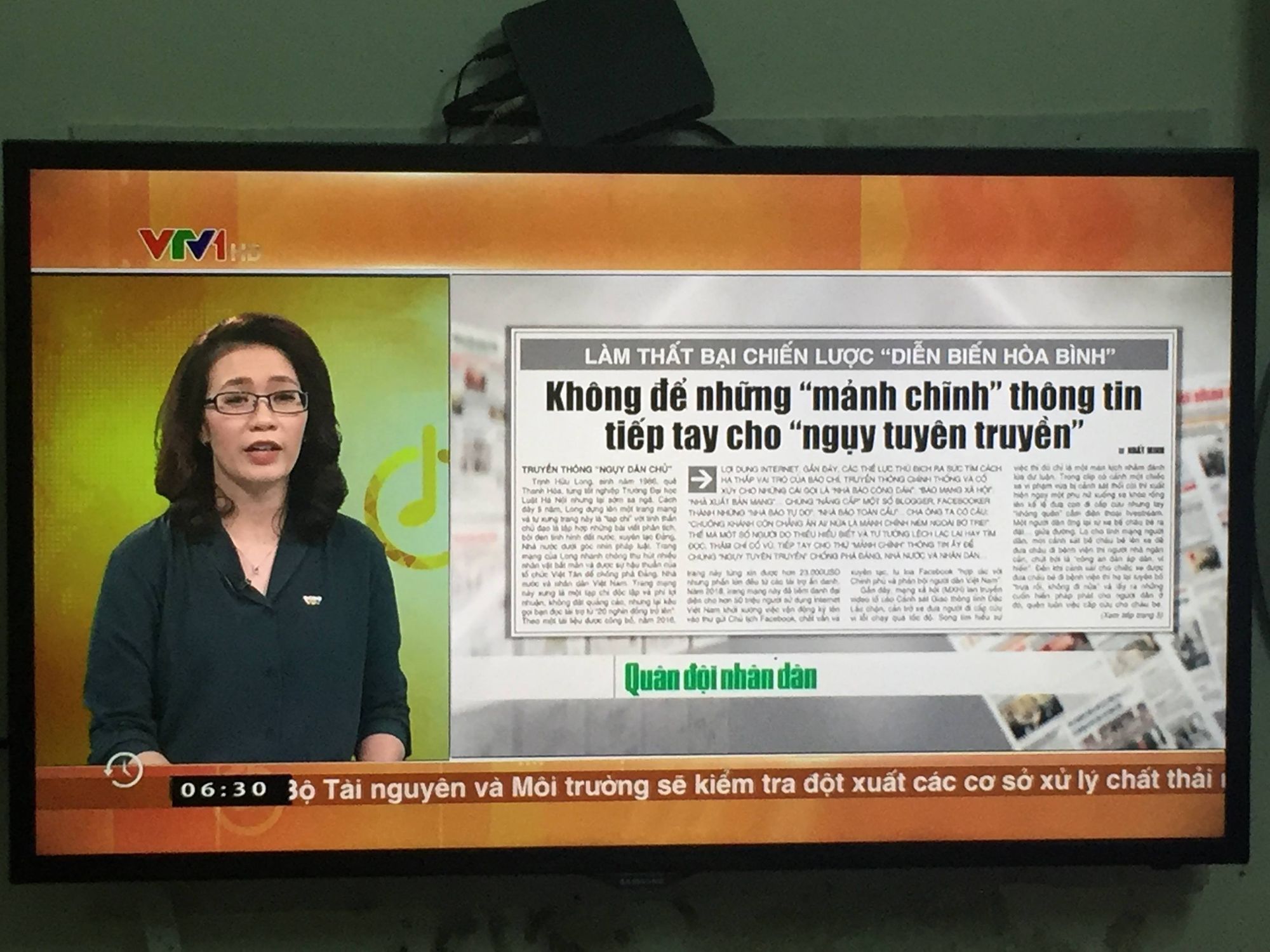
On March 25, 2019, in what could have been a classic libel case, the online newspaper of the Vietnamese Armed Forces defamed some independent newspapers, media, and civil society organizations, including our Vietnamese site – Luat Khoa magazine in an article written by author Nhat Minh.
Vietnam’s national television VTV 1 also broadcasted the same article during its morning news on the same day.
The article accused Luat Khoa magazine and its editor-in-chief, Trinh Huu Long, to have received support from Viet Tan, an overseas Vietnamese political party that has been classified as a “terrorist organization” by the regime.
Among other things, it also alleged that independent newspapers, media, and civil society organizations such as Luat Khoa, Cong Hoa TV, Vietnam Path Movement, and so forth, were promoting “fake democracy,” and that the real intention of these organizations was to misrepresent information about the Vietnamese Communist Party and the government by portraying them in a negative light.
According to the author, some forms of citizen journalism and blogging by individuals who exposed wrongdoings and injustice in society could be criminal conducts.
Examples of bloggers recently imprisoned for exercising their freedom of expression, such as Phan Kim Khanh and Nguyen Van Hoa, were named in the article to support the writer’s position.
The article, in many ways, reinforced the Vietnamese government’s view of independent media in the country. It was this very same view which probably had put Vietnam at number 176 out of 180 on the Reporters Without Border’s World Press Freedom Index in 2018.
It may be a challenge for Vietnam to name one independent media from the list of over 800 news outlets it often uses to prove press freedom exists in the country.
Nevertheless, the article suggested criminal prosecution against the activists and journalists operating these organizations. It also called for stronger and more effective collaboration from the tech companies – such as Facebook and Google – in compliance with the new cybersecurity law.
The article reconfirmed what the Vietnamese government has continued claiming in the past one and a half years, that Facebook has already established a separate channel to resolve requests from Vietnam regarding any information deemed to have violated the country’s social media (rules).
It also paraphrased an unnamed official from the Cybersecurity Bureau of the Ministry of Public Security (Vietnam’s National Police Department) and declared that “Google and Facebook both found Vietnam’s cybersecurity law is ‘suitable’ and will research on amending their policies to be in line with Vietnam’s law.”
The article included a quote from Ann Lavin – Google’s Director of Public Policy and Government Affairs in Asia-Pacific – stating that “Google would respect and follow the domestic laws of host countries, including Vietnam.”
However, the author failed to make it clear to the readers that Ms. Lavin’s quote was taken from a conversation she had with the then Minister of Information and Communication, Truong Minh Tuan, in January 2018 – almost one year before the new cybersecurity took effect. The fact that she is no longer working at Google was also left out.
The article did provide statistics on the removals of contents allegedly done by Google and Facebook upon the government’s request.
It stated that by “the end of June 2018, Google had removed 6,700/7,800 clips from YouTube – a Google’s product – including 300 clips carried subverting contents, inciting subversion against the VCP and the government and 6 YouTube channels got blocked completely.”
It further claimed that “Facebook also removed 1,000 links (out of 5,000 requests) which were deemed to have violated Vietnam’s laws, 107 fake accounts, 137 accounts that defamed, misrepresented, and propagandized against the VCP and the government.”
However, these companies’ reports did show a worrying trend of increasing content restrictions in Vietnam and the seeming willingness of tech giants to comply with the government’s requests.
Among the four requests for contents removal from Vietnam listed by Google during the reporting period dated between January-June 2018, we found a particularly troubling one.
Accordingly, the Authority of Broadcasting and Electronic Information, Ministry of Information and Communications in Vietnam had asked Google to remove “over 3,000 YouTube videos that mainly criticized the Communist Party and government officials.” Google admitted that they “restricted the majority of the videos from view in Vietnam, based on Decree 72.”
Decree 72 is a controversial legal document, seeking to curtail the people’s ability to share information on the internet in Vietnam since 2013, half a decade before the cybersecurity law came into existence.
As for Facebook, their reports indicated that the company had complied with a total of 265 content restrictions requests from the Vietnamese government during the first six months of 2018 compares to 22 requests from July-December 2017.
Facebook also released some Vietnamese users’ data to the government upon requests under legal process and emergency requests.
From January-June 2017, Facebook received four requests involving five accounts where they released some information to 25% of the requests. From July-December 2017, Facebook released information in response to 38% of the eight requests, affecting 12 user accounts.
In the first six months of 2018, however, the Vietnamese government made a total of 12 requests which involved 26 accounts, but Facebook only released data in response to 17% of the requests.
The above statistics showed a concerning trend because, before 2017, Facebook’s transparency report indicated that it had never released users’ data to the government under any circumstances.
Reports from Vietnamese activists on the grounds in the past 12 months, however, also indicated a much larger number of accounts removal and content restrictions on Facebook.
“How do you explain or assess that Vietnam is ranked 175 out of 180 countries in the Reporters Sans Frontiers’ 2018 World Press Freedom Index?”
The question from Mr. Fathalla, a member of the UN Human Rights Committee, succinctly summed up Vietnam’s human rights situation, especially when it came to those rights involving the people’s freedom of expression.
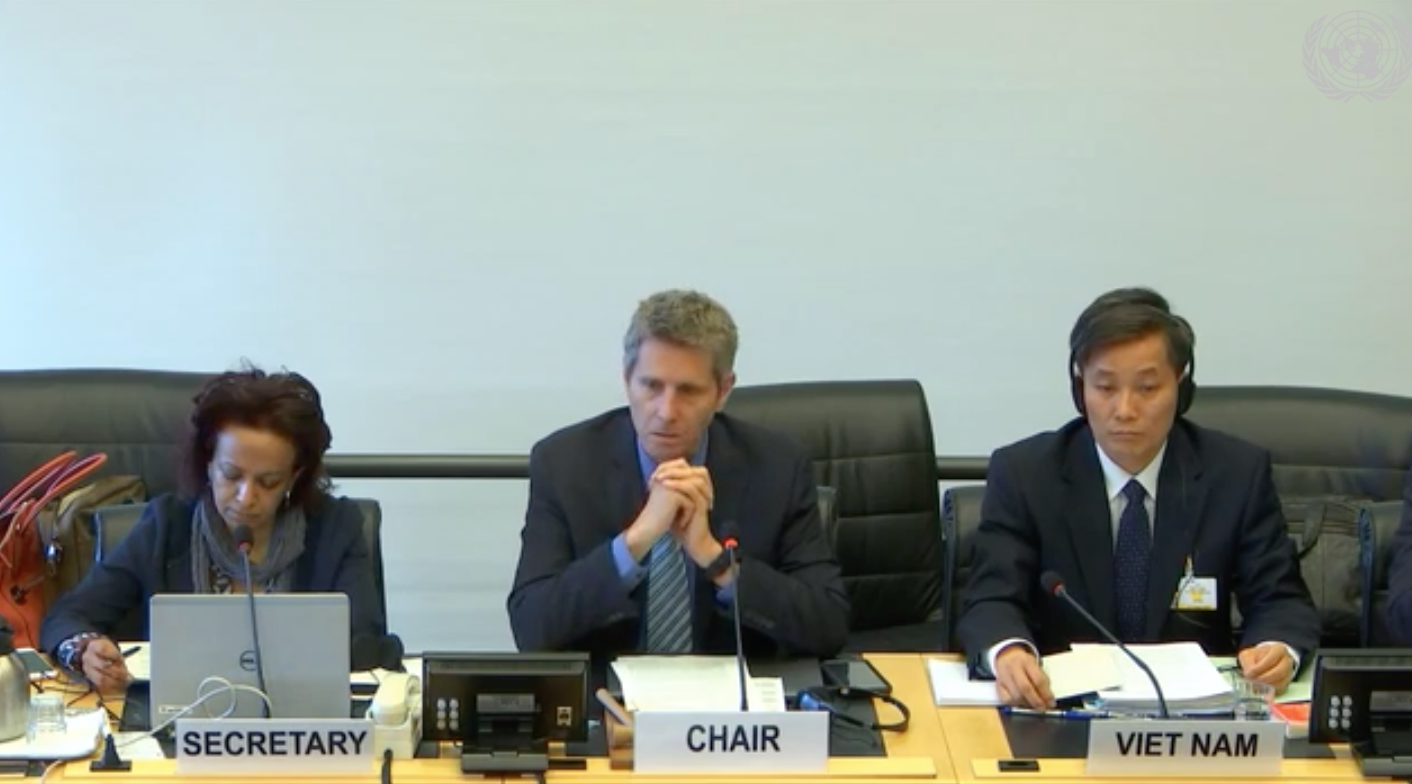
Between March 11 and 12, 2019 and during their 125th session, the Human Rights Committee completed their review of Vietnam’s compliance and implementation of the International Covenant on Civil and Political Rights (ICCPR) in Geneva, Switzerland.
Vietnam was 13 years overdue in submitting its third report for the review, which was due in August 2004. As a result, there was a 15-year-gap between the last review and this recent one.
Nevertheless, the questions from the Committee during the two-day-proceeding painted an accurate, but very worrying picture of the human rights situation in the country right now.
The Committee questioned specific contents of the new 2018 Cybersecurity Law and the 2016 Press Law regarding their possible violations of Article 19 of the ICCPR on freedom of expression.
There was scrutiny over the independence of the judiciary in Vietnam where all judges seemed to be members of the Vietnamese Communist Party.
Lawyers were disbarred for being human rights defenders themselves, or just by merely took on politically sensitive cases, such as those involved police brutality and torture committed by the state’s officials.
The most recently amended Penal Code has taken a step further in limiting and curtailing the practice of law when it requires lawyers to make mandatory reports on their clients in a few specific instances – for example when it involves a “national security” crime – or risk being prosecuted themselves.
At the same time, the penal code sections relating to “national security” are used almost exclusively against human rights defenders and political dissidents in Vietnam. As such, the mandatory report requirement seems to especially deny this group of people their right to a fair trial with competent legal assistance.
There were also concerns from the Committee over the fact that police brutality had become more prevalent in recent years due to impunity.
Prison conditions in general, and especially the treatment of human rights defenders in prison, were also brought up repeatedly during the proceeding, where the Committee rejected Vietnam’s attempt to brush off the issue by offering evidence of some handful visits to prisons by foreign embassies in recent years.
The Committee’s members instead referred to the UN’s Committee Against Torture’s recommendations after the review of Vietnam under the Convention in November 2018, where numerous alarming issues regarding the poor conditions in Vietnam’s prisons were addressed, such as the use of shackle and solitary confinement.
Vietnam was named as one of the world’s top executioners in 2016 by an Amnesty International’s report on the death penalty, after the Ministry of Public Security released some rare statistics in February 2017, stating that 429 prisoners were executed between August 8, 2013, and June 30, 2016, at an average rate of 147 executions per year.
At the review, facts involved the wrongful convictions involving two death-row inmates, Ho Duy Hai and Le Van Manh, were also addressed in details by members of the Committee.
The rights of indigenous people in Vietnam also took center after reports on their religious persecution and forced statelessness were submitted to the Committee in advance by NGOs working on these issues. Among them were Boat People SOS, Viet Nam Coalition Against Torture (VN-CAT), Council of Indigenous Peoples in Today’s Viet Nam (CIP-TVN), The Advocates for Human Rights and Tai Studies Center, Khmers Kampuchea-Krom Federation, and Hmong United for Justice.
The UN received close to thirty shadow reports from civil society organizations before the review, which included both independent groups and NGOs that have an affiliation with the Vietnamese government.
The Human Rights Committee is expected to issue their concluding observations in the coming months.
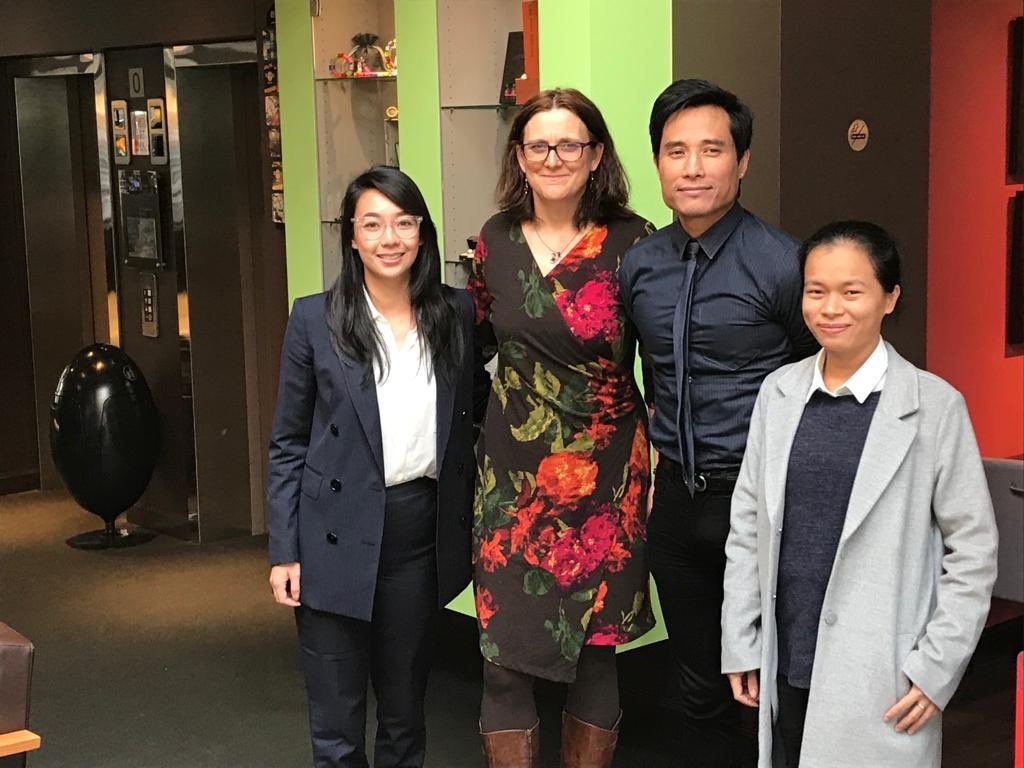
“The human rights situation in Vietnam is worrying,” according to Commissioner for Trade of the European Union, Cecilia Malmström, after her meeting with independent Vietnamese civil society organizations on March 14, 2019.
When announcing the adoption of the EU-Vietnam trade and investment agreements (EV-FTA) in October 2018, Commissioner Malmström had hoped that such agreements would “help spread European high standards and create possibilities for in-depth discussions on human rights and the protection of citizens.”
However, during recent months, the human rights situation in Vietnam did not improve.
Instead, it became more concerning.
Commissioner Malmström is not the only EU official who has expressed concerns over the worrying trend of suppression on human rights in Vietnam in recent months.
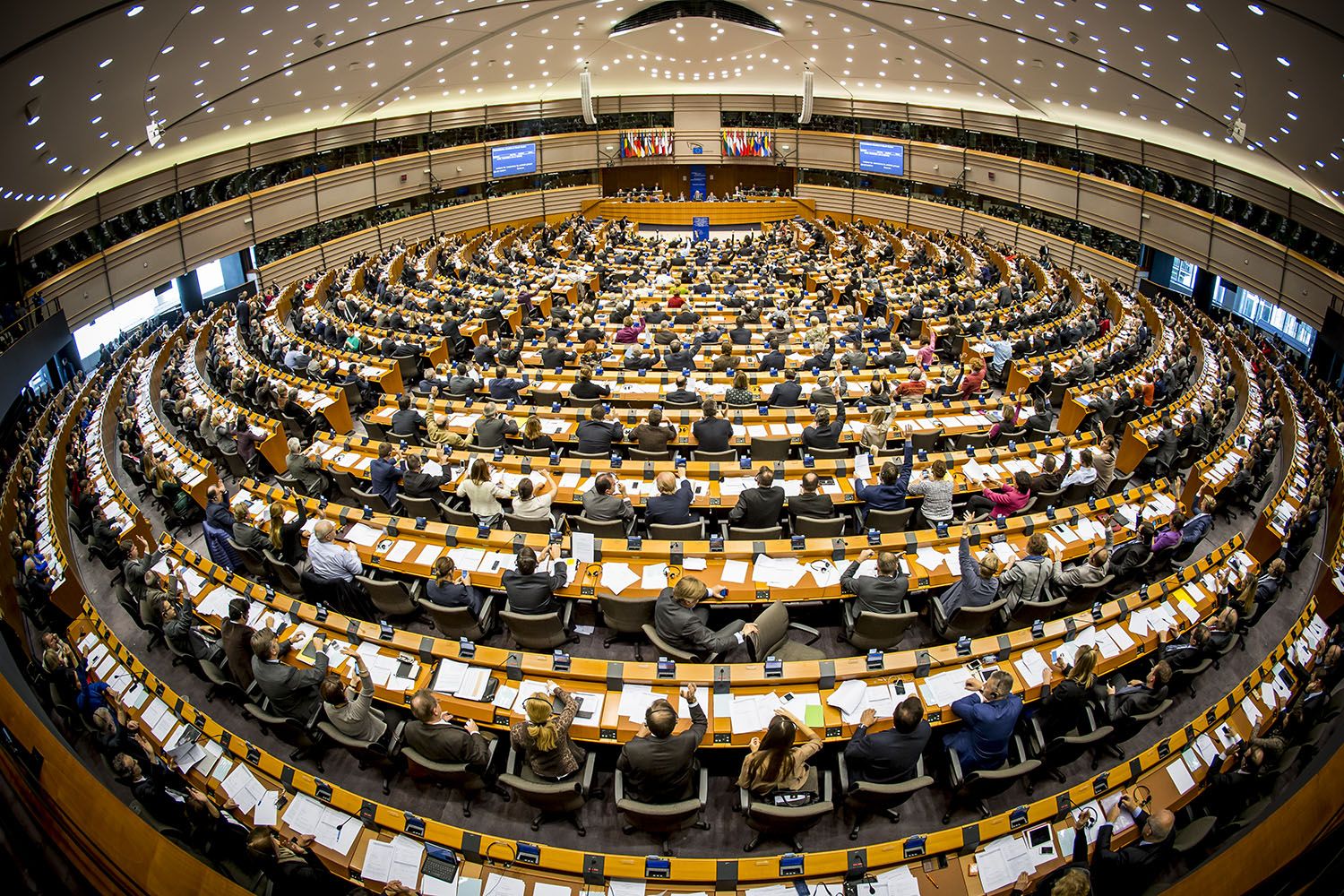
32 MEPs from across the political spectrum of the EU Parliament signed a letter back in September 2018, calling on the EU to demand specific human rights improvements from Vietnam before the ratification of the EV-FTA.
EU Spokesperson on Foreign Affairs and Foreign Policy, Maya Kocijancic, also confirmed in an interview with Radio Free Asia earlier this month, that during the 8th EU-Vietnam Human Rights Dialogue held in Brussels on March 4, 2019, the EU had addressed specific cases of prisoners of conscience with the Vietnamese delegation.
Ms. Kocijancic also stated during the same interview that the annual dialogue “raised a wide range of issues related to freedom of expression, cybersecurity, the death penalty, environmental and labor rights, cooperation within the United Nations framework.”
As of today, The 88 Project’s database documented 21 Vietnamese activists are held in pre-trial detention. There are 218 other activists currently serving a prison sentence; among them, 30 are female activists and 51 indigenous political prisoners.
According to VOICE (Vietnamese Overseas Initiative for Conscience Empowerment), one of the organizations attended the meeting with Commissioner Malmström, the unconditional and in-country release of Vietnamese prisoners of conscience must be the first human rights benchmark before the ratification of the EV-FTA.
The Prime Minister of Vietnam, Nguyen Xuan Phuc, announced today at a preparatory meeting for the DPRK-US summit in Hanoi that the country needs to “prove to the whole world that it is peaceful, friendly and orderly … as (the core of) its culture, a way of life of Vietnamese people.”
The price to pay for such an image could very well be the freedom of those who dare to exercise their constitutional rights like Le Thi Khanh’s husband, Tran Thanh Phuong.
For almost six months, Le Thi Khanh, a garment maker in Ho Chi Minh City, has not been able to see her husband who was taken away by the local authorities since September 1, 2018.
Her husband is Tran Thanh Phuong, a Facebooker who has been in police detention for attempting to participate in a protest during the celebration of Vietnam’s National Day.
As a pre-emptive strike, the police “invited” Phuong to come to the local station to talk to them, but they then detained him without a formal arrest warrant, according to his wife.
At first, Khanh could still bring her husband food and meet him once a day at the local police station of their ward.
But on September 7, 2018, when she went to see her husband, the police told her they had transferred him to a different location yet refused to tell her where.
Khanh then went to the District’s Police Department to look up her husband’s whereabouts.
There, the police asked her to provide them with her marriage certificate before allowing visitation. Once she did, they promised her that she would get to see him on October 10, 2018.
Came October 10, 2018, Khanh packed some food to bring to her husband with high hopes that she could see him, but again she was disappointed.
The District’s police told her they had transferred him to No. 4, Phan Dang Luu Street which is the detention center under the Ho Chi Minh City Police Department, The Security Investigative Unit.
She immediately went to No. 4 Detention Center and was able to confirm that her husband was, indeed, held there.
Since then, she was only able to send him food every two months, but the authorities have yet to allow visitation.
She also has no idea what crimes her husband has been charged with because no one would tell her anything.
But Khanh was aware that Phuong was using his Facebook to look up information relating to Vietnam’s Constitution, as well as the exercise of their constitutional rights.
“My husband often read different groups’ postings on Facebook about disseminating our Constitution. He said we should read to gain our own knowledge so that when the police arrest us, we could know what rights we have and demand them,” Khanh told us.
Not being to know how her husband has been doing was an ordeal which Khanh went through in the past six months while trying to make end’s meet to raise the couple’s two daughters, entirely on her own now.
Tran Thanh Phuong has effectively been held incommunicado by various police forces in Ho Chi Minh City since September 7, 2018.
Khanh also told us that on October 15, 2010, the police even tried to summon her 13-year-old daughter to come in for questioning on the 19th regarding their investigation of the case.
She, of course, refused to comply with the outrageous request.
Phuong was alleged to be a member of a dissident group calls “Constitution” (Hiến pháp).
The group’s members have been arrested and detained arbitrarily by the Vietnamese authorities from September 2018 to date.
While the members acknowledged that they participated in the June 10, 2018’s mass protest against the then draft bills of the cybersecurity and the Special Economic Zones law, all information surrounding their activities – including those coming from the authorities – could not openly show their criminal liability.
One of them has been arrested, tried, convicted and sentenced to five-year-imprisonment.
In that case, the defendant – Huynh Truong Ca – was alleged by the government to have live-streamed 40 clips on Facebook criticizing the government, the Communist Party, and calling on people to exercise their constitutional right: participate in demonstrations.
Such conduct, however, not only could not constitute the legal merits of a crime but also was a person’s political opinion which international human rights law protects.
Notwithstanding international law standards, the government of Vietnam often violates even its constitution while suppressing people during protests and arresting them.
The 2013 Constitution guarantees all Vietnamese people the right to assemble and to demonstrate peacefully.
The absence of a valid constitutional protection mechanism, however, has allowed the government’s unlawful activities continued.
Crowd control’s measures in Vietnam were recently broadcasted internationally when the Hanoi’s security police detained and questioned the Kim Jong-un and Donald Trump impersonators duo ahead of the DRPK-US summit.
The police’s intention to avoid any remote possibility of people gathering during the event was apparent when they demanded the two’s itinerary while in Hanoi and had since surveilled their movements.
Spontaneous gatherings in public are frown upon by the VCP because its leaders could not and would not risk the chance – however slim – of having a protest breaks out, especially during a highly observed event like the Kim-Trump peace summit.
Since September 2018 to date, The Vietnamese has documented over a dozen incidents of arbitrary arrest and detention. More than half of them involved the members of the Constitution group where Tran Thanh Phuong is a member.
February 1, 2019, a group of nine EU Parliament’s members from different political parties, jointly sent a letter to Vietnam’s President Nguyen Phu Trong, asking for the unconditional release of environment and labor rights defender, Hoang Duc Binh.
The letter reminded Vietnam that “the promotion and protection of fundamental rights must remain a common benchmark” for the continuing negotiation of the Free Trade Agreement between the European Union and Vietnam.
According to the MEPs’ letter:
The EVFTA commits the European Union and Vietnam to respect and effectively implement such principles and fundamental rights as provided in the ICCPR.
The European Council has delayed the EV-FTA’s ratification process due to “technical reasons” according to two other MEPs, Jude Kirton-Darling and Ramon Tremosa. They released a video clip on January 22, 2019, demanding that Vietnam improves its human rights records for the EV-FTA to proceed.
Almost one year ago, on February 6, 2018, a court in Central Vietnam convicted Hoang Duc Binh on two separate charges, “resisting officers acting under their duty,” and “abusing freedoms and democratic rights to infringe upon the State’s interest or the rights and interests of other entities and individuals.” (Articles 257, 258 of the 1999 Penal Code, amended as 330, 331 under the 2015 Penal Code).
Binh was sentenced to the maximum term of 7 years for each of the offenses, which meant that the court found his conduct to be “seriously harmful” to the public according to the sentencing guidelines.
Binh maintained his innocence, stating that all he did was accompanying a group of fishermen and a Catholic priest to travel from Nghe An to Ha Tinh to file their civil suits against Formosa Ha Tinh Steel Corporation.
Formosa Ha Tinh was the main culprit that had paid 500M USD to settle the damages they caused in the environmental disaster which affected four coastal provinces in Central Vietnam back in 2016.
In recent months, Hoang Duc Binh’s family has raised concerns about his deteriorating health conditions after each visitation.
The letter was signed by Barbara Lochbihler (Greens/EFA), Wajid Khan (S&D), Petras Austrevicius (ALDE), Anne-Marie Mineur (GuE), Ana Gomes (S&D), Karoline Graswander-Hainz (S&D), Reinhard Bütikofer(Greens/EFA), David Martin (S&D), and Marietje Schaake (ALDE).
The MEPs asked that Hoang Duc Binh “to be immediately and unconditionally released” and that he will be “allowed to remain inside his home country, Vietnam, and not forced into exile as a precondition for his release.”
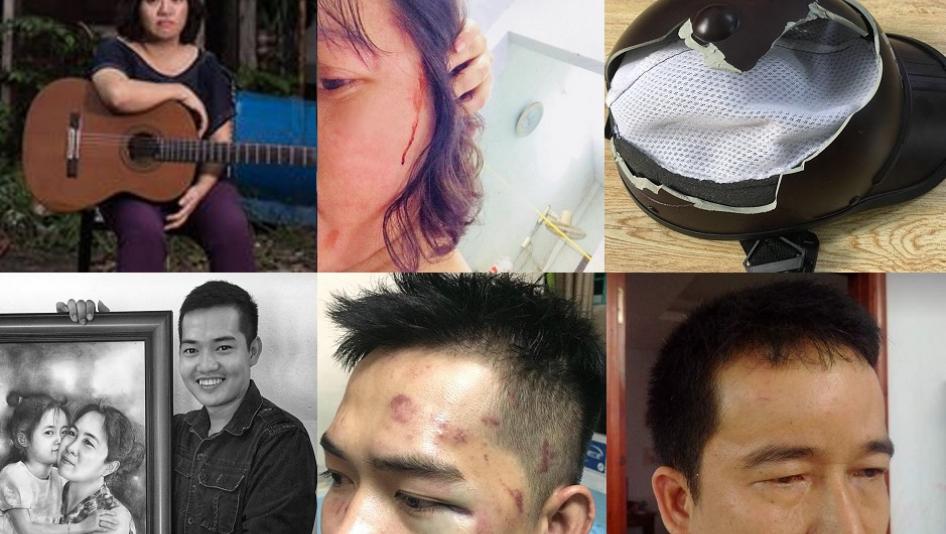
Today, January 28, 2019, a driver in Hanoi who was supportive of the movement to fight against illegal BOT (Build-Operate-Transfer) toll booths in Vietnam, Ha Van Nam, was kidnapped by allegedly plainclothes police.
Nam alleged that he was brutally assaulted, resulting in two broken ribs and other injuries. The perpetrators later threw him at the front gate of Dan Phuong hospital in Hanoi.
Ha Van Nam and his injuries. Photo courtesy: Truong Chau Huu Danh’s Facebook.
In recent days, friends and supporters of the protest against “dirty” BOTs in Vietnam have asserted that there are corrupt individuals from the police force who act in concert with thugs and BOT An Suong’s owner to suppress those who challenge the BOT’s legal merits to collect toll money.
On January 24, 2019, a man named Ngo Cong Tuan from Hanoi was visiting friends in Ho Chi Minh City happened to pass by BOT An Suong and got picked up by the local police of Tan Tao Ward.
He alleged that he was physically beaten by the police right after he was arrested and the beating continued during the car ride to the station. He was then detained with no criminal charge for two days, from 24-26 January.
Ngo Van Tuan being taken to the hospital. Photo courtesy: Truong Chau Huu Danh’s Facebook.
Tuan further alleged the police officers continued to beat him during the detention, ordered him to take off his clothes, and also starved him during the two-day-detention.
He was released on January 26, 2019, with no investigative report. Almost immediately after his release, Tuan went back to the same police station to report the assault and file a statement, but the police officers tried to close their door on him.
All of this was captured on a live-stream video posted on Facebook. In the end, Tuan was able to make the report, but he also had to be admitted to a hospital for a check-up.
Tuan was not part of the BOT protest; he was only a passerby.
In an unrelated event happened in a different province, on January 28, 2018, while working on location, reporter Ngoc Thanh was involved in a physical altercation with police officers from Ward 4, Vinh Long Province. Thanh received injuries and had to be admitted to the hospital on the same day.
Reporter Ngoc Thanh in hospital. Photo courtesy: Truong Chau Huu Danh’s Facebook.
In November 2018, Vietnam underwent its first review under the UN-Convention Against Torture which the country had ratified in 2015.
In December 2018, the Committee Against Torture issued its concluding observations on the initial report of Viet Nam with specific recommendations to the government.
Portions of these recommendations specifically raised concerns over allegations of police brutality and death in police custody/detention (Paragraphs 20-23).
The Committee specifically requested that the State of Vietnam elucidates and informs the Committee about the outcome of the deaths in police custody of the following individuals by December 7, 2019:
Do Dang Du, a 17-year-old minor, who reportedly died in custody on 5 February 2015 as a result of severe injuries to the head and body while in police custody in Chuong My district, Hanoi;Nguyen Huu Tan, a Buddhist who was detained and whom the police alleged had committed suicide while in custody. No independent investigation of the death was carried out, and the detainee’s family was subjected to reprisals from the local police after complaining to the authorities;Ma Seo Sung, a Hmong Christian who was arrested and detained by the police and allegedly committed suicide by hanging and whose family also received threats of reprisals;Ksor Xiem of the Montagnard Evangelical Church, who died of injuries sustained in police custody, andY Ku Knul a Montagnard Christian who died while under arrest and whose body showed signs of electric shocks.
Among the above, the case of Do Dang Du shocked the nation when it happened in October 2015, partly because it involved a minor who was detained illegally by the police in Hanoi – the Capital city of Vietnam.
However, after his family’s attorneys also got physically assaulted by thugs and one police officer in plain clothes, it seemed that information had stopped coming forward.
Mrs. Nguyen Thi Mai, the mother of Do Dang Du, the most shocking case in the last three years involving deaths in police detention in Vietnam. Photo Courtesy: Chau Doan.
Neither Du’s family or the public in Vietnam was satisfied with the explanation given by the authorities that he was beaten to death by a cellmate over “dirty dishes.”
The UN-Committee Against Torture seemed to agree with them when it asked the State to report back to the committee with further details later in 2019.
However, in reality, the police forces in some 63 provinces all over Vietnam probably did not get informed about the UN-CAT’s findings and recommendations because allegations of police brutality continued to grow in the first month of the new year.
On 22 January 2019, Vietnam underwent for the third time a comprehensive peer review of its human rights record at the Human Rights Council (a process known as Universal Periodic Review or UPR), amidst what many rights groups and observers have called the worst wave of crackdown on dissent, activism and civil society in years.
121 governments took to the floor and made close to 300 recommendations on a wide range of human rights issues. Under the rules of the UPR, Vietnam can choose to “accept” or merely “note” the recommendations it receives and must do so in writing by the time the 41st session of the Human Rights Council begins in late June 2019.
Governments have the primary responsibility to implement those recommendations that they have accepted and report progress therein in the next cycle of review.
Many of the issues raised during the third review are the subject of recommendations that Vietnam had accepted to implement or noted in the two previous UPR cycles. Critics say that Vietnam not only failed to implement them but have taken actions to the contrary.
Prior to the latest review, numerous independent civil society organizations, both inside Vietnam and internationally, submitted parallel reports to the United Nations on the non-implementation of previously accepted recommendations and the overall deteriorating human rights situation in Vietnam.
Below are some highlights of recommendations clustered by several major recurring thematic issues (the number preceding each recommendation refers to the paragraph number in the draft outcome report of Vietnam’s third UPR, followed by the name of the recommending country in parentheses):
Civil Society and Human Rights DefendersRestrictive Laws and RegulationsDeath PenaltyDiscrimination, Inequalities and Vulnerable GroupsFundamental FreedomsJudicial System, Fair Trials and Due Process
Phan Kim Khanh, one of the youngest political dissidents in Vietnam. Khanh is currently serving a 6-year-prison term.
Civil Society and Human Rights Defenders
6.55 Take steps to protect human rights defenders, particularly by repealing or revising the provisions of the Penal Code that make reference to the concept of national security (France)
6.145 Immediately release prisoners who have been arbitrarily or unlawfully detained and allow them to exercise their human rights and fundamental freedoms in Vietnam, including Ho Duc Hoa, Tran Huynh Duy Thuc, Tran Thi Nga, Nguyen Bac Truyen, and the members of the Brotherhood for Democracy (United States of America)
6.175 Release human rights defenders sentenced to prison for exercising the right to freedom of expression (Iceland)
6.177 Take the necessary measures to ensure the freedom of expression of human rights defenders and journalists, in particular by investigating and punishing perpetrators of threats and reprisals against them (Argentina)
6.180 Protect human rights defenders and prosecute all persons guilty of violence or intimidation against them (Luxembourg)
6.186 Review regulations impeding the operation of Civil Society Organisations, to enable a more open space and ensure that national security provisions are not used to prevent peaceful debate and dissent (Ireland)
6.191 Release all human rights defenders as well as political and religious activists detained for the peaceful expression of their political opinions or religious belief (Poland)
6.198 Adopt measures in line with international standards to guarantee freedom of association, opinion and expression, including online, and to ensure that journalists, human rights defenders and NGOs can freely operate (Italy)
6.202 Guarantee Fully freedom of speech, the rights of peaceful assembly and association as well as the safety of journalists, and review cases of persons convicted for having freely expressed their opinion, including human rights defenders (Switzerland)
6.203 Improve protection of the rights to peaceful assembly and expression by reviewing existing legislation, and publishing and implementing clear, transparent guidelines on security personnel conduct in managing peaceful demonstrations (United Kingdom of Great Britain and Northern Ireland)
6.205 Ensure consistent implementation of the Law on Belief and Religion particularly at the local level, including with respect to registration of Protestant groups and other groups in Northwest Highlands provinces, and remove undue restrictions on access to religious materials and clergy for those imprisoned and cease any harassment of independent groups on account of their religion (United States of America)
6.211 Publicly recognize human rights defenders and provide an environment in which they can carry out their human rights work safely (Belgium)
6.214 Nurture a culture of free expression online and offline, release all imprisoned human rights defenders, including bloggers and political dissenters, and put an end to their harassment (Czechia)
6.215 Create an enabling environment for independent civil society and ensure that the prepared Law on Association facilitates the registration, work and funding of NGOs free from undue State interference and restrictions (Czechia)
6.216 Lay ground for political plurality and democracy and guarantee its citizens the full enjoyment of the rights to vote and to be elected and to take part in the conduct of public affairs (Czechia)
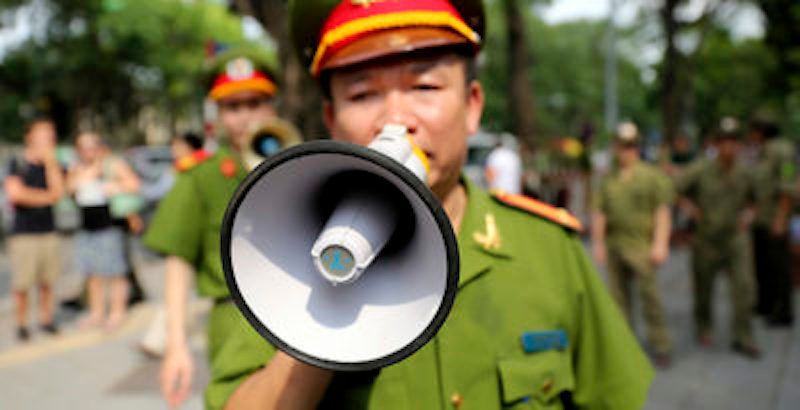
A policeman, flanked by local militia members, tries to stop a foreign journalist from taking pictures outside the Ho Chi Minh City people’s court, where a human rights case was taking place in August 2011. Photograph: Ian Timberlake/AFP/Getty Images
Restrictive Laws and Regulations
6.73 Adapt the Code of Penal Procedure to international standards and amend Articles 109 and 117 on “activities against the State” in the Penal Code, in line with human rights standards (Switzerland)
6.167 Repeal or amend provisions in the Penal Code and Cyber Security Law so that provisions relating to national security are clearly defined or removed, to ensure that they cannot be applied in an arbitrary manner to endanger any forms of freedom of expression, including internet freedom (Finland)
6.171 Review all convictions based on laws restricting freedom of expression and opinion, in particular articles 79 and 88 of the Penal Code, according to the revised penalty ranges (Germany)
6.174 Consider revising national legislation, including the Law on Belief and Religion and the media Laws, in order to harmonize it with international standards regarding the right of freedom of expression and of religion (Brazil)
6.183 Amend, within one year, the 2015 Penal Code, Decree 174/2013, Decree 72/2013, Decree 27/2018, the 2018 Law on cybersecurity and articles 4, 9, 14 and 15 of the 2016 Press Law, to guarantee offline and online freedom of press and expression, and the right to privacy, in line with articles 17 and 19 of the International Covenant on Civil and Political Rights (Netherlands)
6.185 Related Cybersecurity Decrees should include clear provisions for interpretation of the Law on Cybersecurity according to international standards on freedom of expression (Ireland)
6.187 Ensure that the legal framework protects freedom of expression both offline and online and accordingly amend the Penal Law and Law on Cybersecurity to ensure consistency with international human rights law, including the International Covenant on Civil and Political Rights (New Zealand); Ensure that freedom of expression is protected online and offline by amending national security provisions in the Penal Code, and the Cybersecurity law and its implementing decree, so as to comply with article 19 of International Covenant on Civil and Political Rights and other commitments (Sweden); Guarantee the rights to freedom of expression and freedom of assembly and amend the penal code and the Cyber Security Law to make sure that the limitations on the right of freedom of expression are in line with the International Covenant on Civil and Political Rights (Austria); Review the Criminal Code and the law on cybersecurity to harmonize it with international standards related to the freedom of expression, association and assembly (Canada)
6.188 Revise the provisions of Articles 117 and 331 of the 2015 Penal Code and other relevant laws that restrict the ability to exercise fundamental freedoms and allow free operation of national and international media (Norway)
6.193 Ensure full implementation of its international human rights obligations regarding freedom of religion and belief by reviewing the Law on Belief and Religion to bring it into line with article 18 of the International Covenant on Civil and Political Rights (Poland)
6.194 Abolish prior censorship in all fields of cultural creation and other forms of expression, both online and offline, including by bringing the restriction to freedom of expression under the 2016 Press Law in line with international standards and fostering a pluralistic and independent media environment (Portugal)
6.197 Review and amend national legislations in order to enable the effective exercise of the rights of freedom of expression and peaceful assembly in line with the standards enshrined in the International Covenant on Civil and Political Rights (Seychelles)
6.212 Review the law on religion and belief to enable religious groups to practice freely (Canada);Review the 2016 Law on Belief and Religion and bring it in conformity with international human rights standards and freedom of religion or belief standards (Croatia)
Nguyen Thi Loan, mother of Ho Duy Hai. Photo credit: Nguyen Lan Thang.
Death Penalty
6.5 Accede to the Second Optional Protocol to the International Covenant on Civil and Political Rights aimed at abolishing the death penalty (El Salvador); Ratify the Second Optional Protocol to the International Covenant on Civil and Political Rights aiming at the Abolition of the Death Penalty (Montenegro); Ratify, without reservations, the Second Optional Protocol to the International Covenant on Civil and Political Rights, aiming at the abolition of the death penalty (Slovenia); Ratify the Second Optional Protocol to the International Covenant on Civil and Political Rights aiming at the abolition of the death penalty (Croatia)
6.140 Initiate a moratorium on the imposing of capital punishment and especially for non-violent crimes (Finland); Consider implementing a full moratorium on the death penalty (Georgia); Impose a moratorium on executions and abolish the death penalty (Iceland); Establish a de facto moratorium on the death penalty with a view to its abolition (Portugal); Establish a moratorium on the application of the death penalty as a step towards its definitive abolition and modify the Penal Code to reduce the number of crimes for which the capital punishment can be imposed (Spain); Impose a moratorium on executions with the goal of abolishing the death penalty (Albania); Establish a moratorium on the death penalty as a step towards complete abolition of this practice (Australia); Immediately adopt a moratorium on the death penalty with a view to ultimately abolishing it (Austria); Take the necessary measures to establish a moratorium on executions of death row prisoners as well as to repeal the death penalty from their national legislation (Argentina)
6.141 Abolish the death penalty and, without delay, reduce the number of offences punishable by the death penalty (France); Abolish definitely the death penalty and ratify the Second Optional Protocol to the International Covenant on Civil and Political Rights aiming at the Abolition of the Death Penalty (Luxembourg); Continue reform towards abolition of the death penalty, including by continuing to reduce the list of crimes punishable by the death penalty under the Penal Code 2015, in particular non-violent crimes, and by providing greater transparency about the numbers, methods and associated crimes relating to its use (New Zealand); Abolish the death penalty for all crimes, and consider ratifying the Second Optional Protocol to the International Covenant on Civil and Political Rights, aimed at abolishing the death penalty (Uruguay)
6.142 Further reduce the list of offences punishable by death, eliminate the death penalty for “activities against the people’s government”, “espionage”, “embezzlement”, and “taking bribes” as well as for serious drug offences (Germany); Continue to reduce the number of crimes subject to the death penalty and consider introducing a de facto moratorium on its application (Mexico); Continue to reduce the scope of crimes subject to the death penalty only for “most serious crimes” and consider introducing a moratorium (Norway); Continue the process of reduction of offences subject to death penalty, until the abolition of the capital punishment and to publish statistics on the use of death penalty in Vietnam (Romania); Further reduce the offences punishable by death penalty and provide official figures regarding death sentences and executions; consider to introduce a moratorium of death penalty (Italy)
6.143 Reduce further the list of crimes punishable by the death penalty, in particular economic crimes and drug-related offences, and envisage a complete moratorium on the application of the death penalty (Switzerland)
6.144 Assist the process of national discussion on death penalty with a view of its eventual abolishment (Ukraine)
6.146 Restrict the use of the death penalty to crimes that meet the threshold of “most serious crimes” under international law (Belgium)
6.290 Cease applying the death penalty for non-violent crimes, including drug offences (Australia)
6.291 Introduce a national moratorium on the death penalty, aiming at complete abolition. Until then, reduce the number of crimes subject to the death penalty, ensuring that it does not apply to offences other than the “most serious” crimes, in accordance with International Covenant on Civil and Political Rights (Sweden)
A group of Jarai people in Vietnam’s Highlands. Photo courtesy: Thinh Nguyen.
Discrimination, Inequalities and Vulnerable Groups
6.90 Continue efforts in eliminating inequalities in access to public services (China)
6.92 Increase efforts in addressing discrimination, in line with its international obligations, and towards improving its legal framework against gender-based violence (Greece)
6.93 Enact legislation to ensure access to gender affirmation treatment and legal gender recognition (Iceland)
6.96 Continue to conduct studies with a view to amend existing or introduce new legal instruments to eliminate all forms of discrimination against people living with HIV (Malaysia)
6.97 Take further steps to ensure the protection of all vulnerable groups in society including LGBTI persons (Malta)
6.98 Legalize same-sex marriage before the next UPR (Netherlands)
6.99 Explicitly provide “sexual orientation” and “gender identity” as a forbidden ground of discrimination in the revised Labour Code and other relevant laws (Norway)
6.107 Take further measures to reduce inequalities and enhance access to services especially to vulnerable persons, including women, children and disabled (Bhutan)
6.108 Review the Labour Code and the law on gender equality to include a detailed definition of sexual harassment (Canada)
6.109 Develop legislation against discrimination on the grounds of sexual orientation and gender identity (Chile)
6.153 Set up a robust legislative framework prohibiting and sanctioning all discriminatory practices, enabling victims access justice (Madagascar)
6.170 Take measures to combat religious motivated violence and harassment and ethnic discrimination and inequality (Brazil)
6.217 Revise the Penal Code and the Criminal Procedure Code and criminalise all forms of violence against women, raise public awareness on gender equality and combating discrimination against women and girls, enhance efforts and measures to prevent and combat human trafficking, especially that of women and children (Hungary)
6.229 Adopt marriage equality legislation, extending full marriage rights to same-sex couples (Iceland)
6.230 Review the Law on Marriage and Family with a view to setting the same minimum age for marriage for women and men (Zambia)
6.231 Review the law on marriage and the family to guarantee the equality to same sex couples (Canada)
6.259 Step up the efforts for the participation of woman in political and public life and their representation in the decision-making bodies (Ethiopia)
6.260 Prohibit all forms of violence against women and strengthen women’s access to justice (Iceland)
6.261 Continue to strengthen measures to prevent abuse and violence against women (Japan)
6.262 Adopt a national plan of action to prevent all forms of violence against women and assign sufficient resources for its implementation (Spain)
6.263 Further invest in women’s economic empowerment and promote decent work for women in partnership with relevant international organizations (Thailand)
6.268 Implement the policy on promoting gender equality and bridging the gender gap, which focusing on enhancing the role and participation of women in the political, economic and social spheres (Cambodia)
6.284 Develop, in line with the Convention on the Rights of Persons with Disabilities, community-based and people-centred mental health services that do not lead to institutionalization and over medicalization and that respect the free and informed consent of persons with mental health conditions and psychosocial disabilities while combatting stigma and violence against them (Portugal)
6.288 Pursue efforts to adopt national legislation to ensure further respect of the rights of migrants, to prepare the ground for the International Convention on the Protection of the Rights of all Migrant Workers and Members of Their Families (Egypt)
6.289 Continue its efforts on prevention and reduction of statelessness through among others reacquisition of Vietnamese nationality and prevent children statelessness (Kenya)
Protest in Ho Chi Minh City on June 10, 2018. Photo courtesy: Facebook, unknown author.
Fundamental Freedoms
6.42 Enhance efforts to comply with the recommendations accepted during the second Universal Periodic Review cycle on guaranteeing the right to freedom of expression (Chile)
6.168 Take steps to guarantee freedom of opinion and freedom of expression, including on the internet, in the context of the adoption of the law on cybersecurity (France)
6.179 Protect civil and political rights, especially freedom of expression, peaceful assembly and association (Luxembourg)
6.184 Restrictions on freedom of expression, and particularly online freedom, be lifted in line with Vietnam’s obligations under international law (Ireland)
6.189 Strengthen efforts to ensure the freedom of expression, including in the digital environment (Peru)
6.195 Ensure freedom of expression, including online, and promote actions to ensure freedom and independence of the media (Japan)
6.196 Continue the measures aimed at lifting all restrictions on the right to freedom of opinion and expression and to allow bloggers, journalists and other internet users to promote and protect human rights (Romania)
6.199 Enhance efforts to guarantee freedom of religion or belief, also by further reducing administrative obstacles to peaceful religious activities and by combating violence and discrimination on religious grounds (Italy)
6.200 Adopt legislative changes to guarantee the protection and free exercise of freedom of expression, association and peaceful assembly (Spain)
6.206 Take the necessary measures to eliminate administrative barriers in order to guarantee exercise of freedom of worship (Angola)
6.207 Enact laws to provide for freedom of assembly and peaceful demonstration in line with the International Covenant on Civil and Political Rights (Australia)
6.209 Take further steps to ensure an independent and pluralistic media landscape, including by reducing political influence on media outlets (Austria)
6.210 Safeguard freedom of religion and believe for all in Vietnam (Kenya)
6.213 Increase and ensure Vietnamese citizens’ access to information, including by increasing radio and television coverage in all parts of the country (Cyprus)
6.236 Allow for the establishment of independent trade unions and to recognize their right to organise (Canada)
Four death-row inmates from left to right, Ho Duy Hai, Le Van Manh, Nguyen Van Chuong, Dang Van Hien. Photo courtesy: Luat Khoa.
Judicial System, Fair Trials and Due Process
6.147 Ensure that evidence obtained through torture is inadmissible in trial in keeping with Viet Nam’s obligations under the Convention against Torture (New Zealand)
6.148 Take steps to prohibit harassment and torture during the investigation process and detention and punish the perpetrators (Togo)
6.150 Abolish immediately at all levels the exercise of outdoor trials to ensure the right to the presumption of innocence, effective legal representation and fair trials (Denmark)
6.152 Revise the judicial system to provide a safer environment to victims in case of all crimes (Hungary)
6.156 Pursue judicial and institutional reforms to bring them into line with international human rights standards (Senegal)
6.158 Ensure that fair trial guarantees and due process rights, as provided in international law and standards, are respected and upheld in all cases (Slovakia)
6.164 Amend the Criminal Procedural Code so that persons are represented by a lawyer immediately following their arrest and to guarantee their right to a fair trial (Canada)
About the Author
Shiwei Ye is an Asia-based independent human rights analyst, strategy advisor, trainer, and civil society consultant.
Nine years ago, on January 20, 2010, the People’s Court of Ho Chi Minh City convicted Tran Huynh Duy Thuc, Le Cong Dinh, Le Thang Long and Nguyen Tien Trung under Article 79 of the 1999 Penal Code for “subversion against the people’s government.”
Tran Huynh Duy Thuc was sentenced to 16 years in prison and five years probation which technically meant five more years under house arrest.
Thuc was arrested in May 2009, and for almost a decade, the unique case of a successful entrepreneur turned dissident continued to be the highest profile among the hundreds of political prisoners and dissidents in the country.
Article 79 has faced harsh criticisms from the international community.
During Vietnam’s 2nd UPR cycle in 2014, the Vietnamese government accepted the recommendations to amend this and other arbitrary penal codes under the “national security” section, to ensure they would not be used to infringe the people’s human rights.
However, in reality, the amended Penal Code of 2015 did not change the situation in any way. The crime “subversion against the state” remains as Article 109 under the new code.
Thuc’s indictment described his criminal conducts included the act of forming and persuading people to join the Chan research group, to write and publish online articles defaming the government, creating division among the Vietnamese Communist Party.
The prosecution further alleged that he had attempted to reach out and establish a relationship with leaders of the VCP, with the intent of re-shaping their political opinion to change the regime, and that he had planned to manufacture a document named “The Vietnam Path” to subvert against the State.
The Vietnamese government’s point of view on “subversion against the State” is often not shared by the international community, especially democratic nations in the West.
The heart of the problem lies in Section 1, Article 4 of Vietnam 2013 Constitution which states:
The Communist Party of Vietnam – the Vanguard of the Vietnamese working class, simultaneously the vanguard of labourers and of the Vietnamese nation, the faithful representative of the interests of the working class, labourers and the whole nation, acting upon the Marxist-Leninist doctrine and Ho Chi Minh’s thought, is the leading force of the State and society.
Because of this political monopoly, the VCP and the State of Vietnam became interchangeable in the mind of Hanoi’s regime.
The leaders of the VCP would not hesitate in sentencing people who hold a different political philosophy than theirs to prison for decades because questioning the ultimate leadership of the Party equates “overthrowing the government.”
This viewpoint effectively puts the VCP at odds with the universal values of human rights, in particular, the right to freedom of expression where holding a different political opinion, calling for pluralism and a multi-party system cannot be deemed criminal.
In Tran Huynh Duy Thuc’s case, the defendants were also found guilty because the government further alleged that they were members of the Democratic Party and had started to write a new constitution.
As one may correctly guess, organizing a political party in Vietnam – as in Thuc’s case – could also be construed as an act to “subvert the government.”
Vietnam, at press time, has only one political party.
Thuc has received the offer to be released into exile on numerous occasions, but he turned them down, stating that he would finish his full prison term instead of having to leave his home country indefinitely.
The offer to be released into exile to political prisoners in Vietnam is not a release.
It is more like a suspension of the sentence for either medical or humanitarian reasons. The released prisoners would not be able to come back to Vietnam, effectively being banned from their own country.
When the Penal Code was amended, Thuc’s attorney has argued that the government should release him according to Section 3 of Article 109. Because at most, the evidence provided by the prosecution could only show that the defendants were in “preparation” to commit a crime under Section 3, with the maximum sentence of five years.
His petition for a review of the case under the new Penal Code has gone unanswered.
On December 13, 2018, Julie Ward, a Member of the European Parliament representing the North West of England, sent a letter to the President of Vietnam – Nguyen Phu Trong – (who is also the leader of the VCP), calling for an unconditional, in-country release of Tran Huynh Duy Thuc. The letter addressed the concerns over allegations from his family that he had suffered abuse in prison.
A group of the EU Parliament’s MEPs, including Ms. Ward, has stated in more than one occasion that the release of prisoners of conscience like Tran Huynh Duy Thuc would be a critical condition for them to support the EU-Vietnam FTA.
On this 9th anniversary of his conviction, U.S. House Representative Zoe Lofgren also called for Tran Huynh Duy Thuc’s release and denounced the mistreatment of political prisoners by Vietnamese authorities.
During the last week of December 2018, Vietnam’s state-owned newspapers flooded the country’s social media with articles on rules and tips for writing and blogging in a new era of internet usage, all in preparation for the 2018 Cybersecurity Law taking effect on New Year’s Day.
In the days leading to the country’s cyber D-day, on December 30, 2018, with the headlines“How to Write to Express your Political Opinion on the Internet without Violating the Law?” Tuoi Tre online newspaper essentially summarized the ultimate paradox for people living under one of the most repressive countries around the world.
While the article elicits opinions from a wide range of interviewees, from intellects and heads of certain IT firms to regular social media users, they all repeat the same government’s mantra: practice self-censorship and avoid criticism of the Party and the state, so that you can have the right to express yourself.
Like the headlines itself, the “opinion” of the group of people interviewed in this article seems to be blissfully ignorant of the international standards for freedom of expression, in particular, Article 19 of the International Covenant on Civil and Political Rights, where a government not only cannot criminalize people for stating their political opinions but is also not allowed to censor them.
It is not surprising that the article of Tuoi Tre did not consider critical opinions of the government to be worthy of political opinions and instead endorsed the same old government’s propaganda which had been recycled throughout the past seven decades, that one could have an opinion about anything in Vietnam, except those that criticize the Party and the government. After all, all newspapers in the country are considered to be the arms and legs of that propaganda machine.
Another leading newspaper in Vietnam, Thanh Nien, also published an article on December 29, 2018, warning people to steer clear of “The 14 Ways to Violate the New Cybersecurity Law” with the first paragraph declaring the use of social media “to gather and call on other people to incite disorder” among the prohibited acts. The language of this paragraph is nothing new; it is the same as Decree 38 which has been used for regulating public gatherings in Vietnam, an ordinance that legal experts in the country have repeatedly questioned its constitutionality since its issuance in 2005.
Praising the accomplishments of the Party and the state, as well as reciting their propaganda, are not only welcome but also considered to be parts of the Vietnamese journalists’ obligations according to the “Code of Conduct” published by the Vietnamese Journalists Association (VJA).
The VJA, however, is an organization formed by the government according to its Media and Press Law of 2016 (link in Vietnamese), and these obligations are statutory. The Vietnamese authorities may think that by legislating journalists’ conducts, it would give them the appearance of a society that respects the rule of law. However, in reality, perhaps the only thing such laws could further demonstrate would probably be the systematic abuse of press freedom in the country.
Nevertheless, the Vietnamese government is now ready to roll out the “code of model behaviors” for people who use social media in the new year, and the VJA has taken an extra step this past week with the announcement of its “Eight Rules for Journalists to Behave on Social Media” on December 25, 2018.
Among others, most notably is the requirement that journalists are not to “post any news, articles, pictures, or audio recordings on social media or repost speech and opinions in opposition to the way, policy, and guideline of the Party or the State.”
Not stopping at that, the new rules for journalists according to the VJA also require that while online, they are not going to “comment, give an opinion or share any information which contains the purpose of inciting or engaging others to react negatively, as well as those issues that are political, economic, cultural, societal, relating to defense security, and external affairs,…with complexity and sensitivity which need consensus as well as positive and constructive observation and behaviors for society”.
Effectively, the new arbitrarily worded regulations for journalists, when being applied together with the new cybersecurity bill, could mean that the sharing of any information considered to be critical of a proposed law, such as the still pending draft bill on the Special Economic Zones which ignited the nationwide protests in June 2018 for example, may be deemed illegal and criminal by the government starting in 2019.
At the same time, state-owned media in Vietnam also welcomed the news of the CP-TPP (Comprehensive and Progressive Agreement for Trans-Pacific Partnership) taking effect at the end of December 2018. In the new year, Vietnam continues to push for the EU-Vietnam Free Trade Agreement to be ratified by the EU Parliament in March 2019. Both of these trade agreements demand serious improvement on the human rights situation in Vietnam, directly and indirectly.
– Vietnam arrested 103 people (up from 43 in 2017) – 120 activists were tried – At least 22 of those who tried were females – 35 had known religious affiliations – 11 were sentenced to between 10 and 14 years – Two received the sentence of between 15 and 19 years – One person, Le Dinh Luong, was sentenced to 20 years
In total, 210 people are serving jail sentences for their peaceful activism in Vietnam with 19 more await trial.
Whether the Vietnamese government will yield to international pressure and improve its human rights records, or follows through and starts enforcing the new suppressive law on bloggers and journalists in 2019, the message from the activists’ community is unanimous: they will continue to write and express their opinions regardless. Before the Cybersecurity Law of 2018, Vietnam already has enough penal codes to send their political dissidents to prison for a long time.