Category: Human Rights

  • World Report On The Situation Of Human Rights Defenders: UN Expert Urges Vietnam To Stop Criminalize Activists

    World Report On The Situation Of Human Rights Defenders: UN Expert Urges Vietnam To Stop Criminalize Activists

    This week, the office of UN Special Rapporteur on the Situation of Human Rights Defenders, Michel Forst, released the first global survey on the situation of human rights defenders in 12 years, since the landmark Global Survey conducted in 2006 by the then UN Special Representative Hina Jilani.

    Regarding the situation in Vietnam, the report states:

    “Human rights defenders are physically attacked, criminalized, given long sentences, held in detention without trial, and tortured and subject to degrading treatment while imprisoned. The government retains strict control over the media, restricts the registration and activities of civil society organizations, and suppresses peaceful assemblies.”

    The report noted that while Vietnam guarantees all citizens their human rights, in practice, several law decrees are regularly applied to restrict the rights of human rights defenders.

    “Citizens do not enjoy the right to a fair trial and to due process. Arbitrary detention is frequently used. The government tries to silence human rights defenders and bloggers, including through physical attacks, torture, criminalization, solitary confinement and degrading treatment in detention. The government exercises strict control on the media and the work of journalists. It takes harsh action against peaceful protests.

    There are more than 100 political prisoners in Viet Nam, some serving lengthy prison sentences for the legitimate exercise of their rights. The right to fair trial and due process is not respected. Human rights defenders who face particularly high risks are those who criticize the government, including journalists, bloggers, labor rights defenders, and land and environmental rights defenders.”

    While Vietnam is party to most core international human rights treaties, the report pointed out that the country “has neither accepted any treaty-based individual complaints procedures nor treaty-based inquiry procedures.” Moreover, it also noted that Vietnam has yet to accede to the Optional Protocol of the Convention against Torture (CAT-OP), the Second Optional Protocol to the International Covenant on Civil and Political Rights aiming to the abolition of the death penalty (CCPR-OP2-DP).

    In 2018 alone, the report stated that the “2016 Law on Belief and Religion that came into effect in 2018 imposes strict registration requirements and enables state interference into the activities and internal affairs of religious groups. It provides the authorities with discretion to penalize unsanctioned religious activity. It includes a clause prohibiting religious practices that damage ‘the national great unity, harm state defense, national security, public order and social morale’ (Article 5).”

    The Penal Code which was amended in 2015 and came into effect in 2018, is found by the Special Rapporteur to be regularly applied against human rights defenders, in particular, “activities aiming to overthrow the people’s administration (Article 109, previously Article 79 in the 1999 Penal Code); undermining 333 national unity policy (Article 116, previously 87); conducting propaganda against the State (Article 117, previously 88); disrupting security (Article 118, previously 89); causing public disorder (Article 318, previously 245) and abusing democratic freedoms to infringe upon the interests of the State (Article 331, previously 258).”

    The report also was alarmed by the provision of the newly amended Penal Code that would make defense lawyers liable for “not reporting some types of serious crimes committed by their client.”

    On the issue of government’s regulating people’s use of the internet, Decree No. 72/2013/ND-CP of July 15, 2013, on the management, provision and use of internet services and online information, as well as Decree No. 174/2013/ND-CP of November 13, 2013 on penalties for administrative violations against regulations on post and telecommunications, information technology and radio frequency, were mentioned in the report to demonstrate how freedom of expression and freedom to access the internet are further curtailed in Vietnam.

    The report raised serious concerns over the new Cybersecurity Law passed in June 2018, requiring “global technology firms such as Facebook and Google to store ‘important’ personal data in Viet Nam, open local offices, remove offensive content upon the request of the government. It also allows the government to conduct an audit of their information systems.”

    The Special Rapporteur took note that “there are no laws, policies, or practices that protect the rights of human rights defenders,” and described various cases of human rights defenders being harassed, physically assaulted, arbitrarily arrested and detained, unfairly tried and imprisoned. From the April 2018 trial of the Brotherhood of Democracy to the harsh and unfair sentences given in the cases of Tran Kim And, Le Thanh Tung, Luu Van Vinh, Nguyen Van Hoa, Nguyen Viet Dung, and Le Dinh Luong, they were all mentioned with specific details in the report.

    The prison conditions of Mother Mushroom and Tran Thi Nga, as well as the attack on human rights defenders and blogger Pham Doan Trang in August 2018, were used as examples for the treatment of women HRDs in Vietnam.

    In regards to government’s suppression on demonstrations and disperses public assemblies, the report wrote: “When people gathered in 2016 to demonstrate against the Formosa company after the waste spill, the authorities used tear gas and excessive force to disperse the crowd. In June 2018, when thousands of people gathered in different places to protest a proposal to allow foreign firms to have 99-year leases in new special economic zones. The police detained protesters and subject some to beatings before releasing them.”

    The report also noted that during the past 12 years, the office of the Special Rapporteur had sent numerous communications to the government of Vietnam with regards to the dire conditions of human rights defenders in the country, but most of them did not receive a reply.

    The Special Rapporteur urges the government to “cease the criminalization of human rights defenders and to release all who have been detained and imprisoned for the legitimate exercise of their right to freedom of opinion, expression, assembly, and association.

    He also “urges the government to ensure that the detention of prisoners adheres to the Standard Minimum Rules for the Treatment of Prisoners (the Nelson Mandela Rules) and that everyone enjoys the right to a fair trial and due process. He calls for the government to review, amend and/or repeal laws that restrict the rights of human rights defenders and to introduce legislation, policies and administrative practices that protect human rights defenders. He recommends that the government become party to the other core human rights treaties and to establish a national human rights institution that is fully compliant with the Paris Principles.”

    The complete World Report can be accessed here.

  • How Closed Is Civic Space in Vietnam?

    How Closed Is Civic Space in Vietnam?

    UPDATE ON DECEMBER 20, 2018: The correct decree number has been included after more information was released by the organizers of the conference mentioned in this article.

    Today, December 19, 2018, the police in Hanoi disrupted an event and forced the organizers to discontinue the Third Annual Conference on the Roles of Government, Civil Society, and other Related Stakeholders in Providing and Monitoring Public Services (Third Annual Conference) which was supposed to last until tomorrow. The conference was organized by several NGOs and CSO working groups in the country, and its disruption again shows alarming signs that civic space in Vietnam is not only closed but getting more restrictive.

    As a sunny state in Southeast Asia that often gets praised on many travel and food networks channels, the scores which different international indexes give Vietnam on individual freedoms, such as the classification as a “closed” society by CIVICUS, don’t seem to match up.

    However, Vietnam is a country with many paradoxes and the political atmosphere more often than not has proven to be extremely repressive for civil society.

    From a few sources on social media, the Hanoi authorities cited an archaic decree as their reasons to stop the above conference. It was not the often used Decree 38/2005/NĐ-CP (Decree 38) (link in Vietnamese), which requires public gatherings of more than five people to seek approval from the Provincial People’s Committee.

    This time, the local authorities used a decree that was originated to regulate people’s gatherings during wartime dated back in 1957: Decree 257-TTg (link in Vietnamese). Decree 257 sought to provide the implementation guidelines for Presidential Order 101-SL/L.003 (link in Vietnamese) executed by Ho Chi Minh on May 20, 1957, on the right to freedom of association.

    Ironically, while the language of both Decree 257 and Presidential Order 101-SL/L.003 stated the requirement to give 24 hours notice (including verbal notice) of gatherings which would be similar to the Third Annual Conference; neither one mandated such gatherings must be discontinued if notice was not given. More than six decades later, the authorities in Hanoi insist that the Third Annual Conference had to end.

    In recent years, despite what the Constitution of 2013 says about the right to peaceful assembly, the Vietnamese authorities, however, often applied Decree 38 to regulate “public gatherings. This decree would allow law enforcement to disperse crowds and mandates the police and army to cooperate with local authorities “to ensure the public order in case of need.”

    Here is the first paradox, which is about the nature of Decree 38 and Decree 257, as these are laws that were not passed by the country’s legislative body – the National Assembly. They were orders issued by the administrative branch of the government. One would think that they should be deemed unconstitutional when contradicted directly with what the current Constitution said about the right to peaceful assembly in Vietnam when it was last amended in 2013. But that is not the case.

    In reality, the Constitution is often ignored completely, and Decree 38 has been the sword that the police force frequently used to cut right through people’s civil rights again and again. And now, even a decree dated back to June 14, 1957, like No. 257, could trump the current Constitution.

    The second paradox is that only one week ago, on December 12, 2018, Ambassador Duong Chi Dung, the Head of Vietnam’s Permanent Mission in Geneva, cited in his speech at the UPR pre-session (an event organized by UPR-Info), that Vietnam, since the last Universal Periodic Review (UPR) cycle in 2014 had implemented 96% of all recommendations it had accepted from the member states to improve human rights conditions in the country.

    13 out of the 182 recommendations Vietnam supported back in June 2014 requested the government to guarantee the people’s freedom of peaceful assembly and association. In practice, from 2014 to date, not only that Decree 38 is still being widely and arbitrarily applied in the country, but the authorities now started to enforce another decree which should have been considered obsolete under the country’s current legal framework, seeking to curtail the freedom of association further.

    Back to the conference that got stopped mid-way in Hanoi today, even disregarding the constitutionality of Decree 38 and 257, another paradox was the fact that it was not taken place in “public.” The location of the event was at The Hanoi Club, a private hotel.

    The definition of “public places,” like the constitutionality of Decree 38 or Decree 257 itself, was never explained or defined in a court of law. While it could arguably be correct to say that the Standing Committee of the National Assembly is entrusted with the power to “interpret the Constitution,” they have never attempted to exercise such power. The judiciary in Vietnam has not been showing interest in taking up the task either.

    In the meanwhile, the Ministry of Public Security – the national police force – has taken full advantage of maneuvering Decree 38 – and now, Decree 257 – at their will, without any judicial oversight. What happened today at the Third Annual Conference in Hanoi raised more doubts about the space reserved for civil society organizations to operate freely and independently in Vietnam.

  • Black Sundays Report: Vietnamese People’s Response To Police Brutality During June 2018 Protests

    Black Sundays Report: Vietnamese People’s Response To Police Brutality During June 2018 Protests

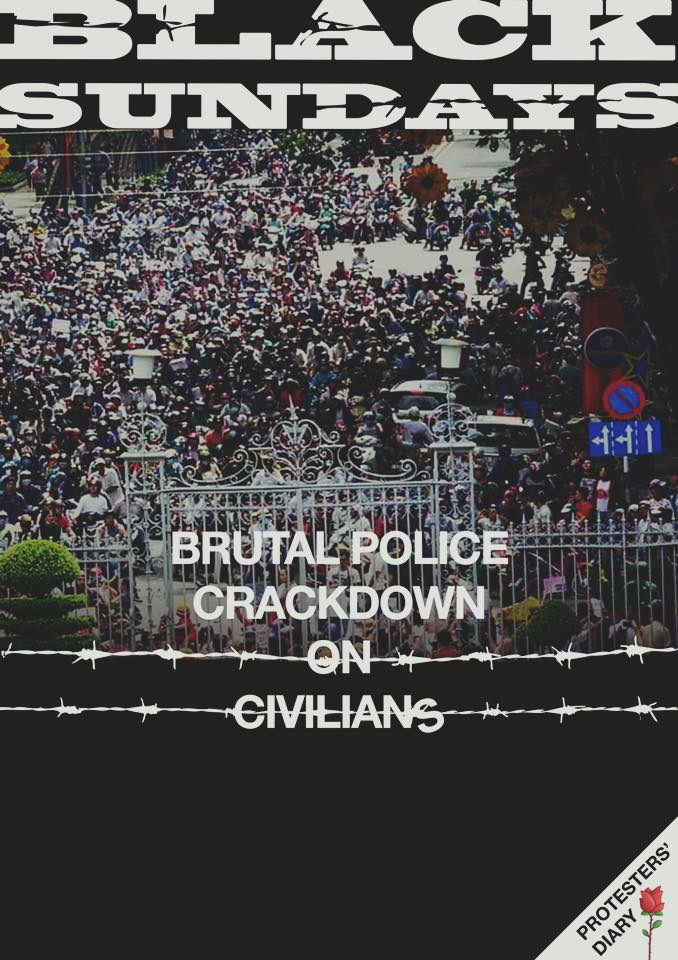
    Civilians, victims of police brutality and arbitrary detention, academics, activists, researchers, and a lot more people from all walks of life inside and outside of Vietnam got together and produced a report on the two “Black Sundays” of June 10 and June 17, 2018.

    It is the Vietnamese people’s unified and firm response to the vicious repression by the government during the latest rounds of protest in the country.

    According to the Facebook page of Nhật Ký Biểu Tình (Protestors’ Diary), copies of the report have been delivered to the UN OHCHR, other international NGOs working on human rights as well as various foreign embassies.

    The full report can be downloaded here.

  • Saigon Is Under De-facto Martial Law

    Saigon Is Under De-facto Martial Law

    June 17, 2018| Hundreds of people were stopped, detained, searched, and later taken to a temporary holding center set up in the heart of Saigon (aka Ho Chi Minh City) for apparently no reasons.

    The government, this time, did not even announce that there were any “illegal” public gatherings as in the previous weekend where thousands of people protested against the cybersecurity and Special Economic Zones draft laws.

    What they have done instead, was to preemptively take a strike at all of the citizens who were happened to be in those hot spots of last week’s protest. Some did go out to the streets with the intent to participate in a demonstration, but they could not even start.

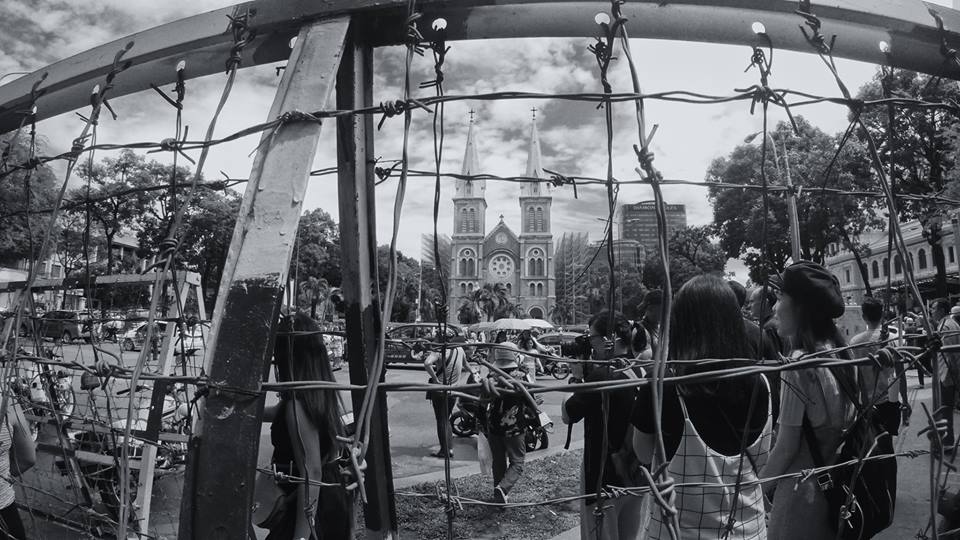
    From the early morning, all types of police, secret police, and security forces have filled up various areas in Saigon. Many coffee shops near the Notre Dame Cathedral Basilica were asked to close by the authorities.

    One witness reported that police were arresting people at a McDonald’s nearby. The only group that acted provocatively was the police and other security forces, this person wrote on Facebook.

    The security forces watched every single bystander, people who happened to pass through the area. Anyone who looked “suspicious” to them would get stopped, asked for identification, searched, and demanded to show their phones where any pictures that were taken would get deleted.

    All were done without any probable cause and of course, without a warrant.

    It seemed as if the law no longer existed there. The city was under siege by its police force, and the people lived under martial law.

    Worse, there would likely be no recourse in a court of law for the victims, even if some of them could gather enough courage to file a complaint against the authorities.

    One person who was arrested while working near Nguyễn Văn Bình Books Street and detained until that evening said on Facebook, that she felt the experience eerily reminded her with words from Anne Frank’s Diary.

    She also recalled that others were taken into separate rooms and some got beaten up by the police. The beatings must be very violent because everyone at that detention center could hear the screams. When they tried to run towards the room to help, the police stopped them with threats of physical violence, recalled by another witness.

    The victim – who later got identified as Trinh Toan – was taken to the hospital for head injuries and reported to be in a coma since.

    Those who got released were cited for “disrupting public disorder,” ironically.

    Another witness live-streamed to tell her story after her release. She described how she and other Catholics got picked up by the police on their way to church. They were taken to that very same detention center in Tao Dan Park and later were both beaten and abused verbally.

    A Vietnamese overseas detailed how the security forces physically subdued him and assaulted him while he was strolling near his house close to Hoang Van Thu Park. The police only released him after he screamed out some profanity in English and revealed his foreign nationality.

    Some other people were already taken into police custody with no warrant a few days before last Sunday.

    One of them was Nguyen Tin. He described the police physically assaulted him, smacking his face repeatedly when he refused to speak and answer questions while in custody. The right to remain silent does exist in Vietnam, but in this case, it failed to protect the citizen.

    Almost all of the pro-democracy activists in Vietnam had plainclothes officers surveilled their homes this past week to prevent them from leaving the house and joined the protest.

    On social media, many more people were reported missing in the past 48 hours, and efforts by civil society groups are ongoing to document and identify those who were arrested, detained and/or suffered abuse.

    Phil Robertson from Human Rights Watch tweeted today:

    “Brutality of #Vietnam authorities attacking activists opposed to new internet surveillance law is really off the charts! Time for #Hanoi to be called out by U.N. Human Rights Council, U.N. General Assembly for their rights crimes!”

    From the June 10, 2018 protest, the authorities might have arrested about 300 people in Saigon alone. One of them was an American citizen, Will Anh Nguyen, whose story made headlines internationally. Vietnam police filed charges against Nguyen for “disturbing public order” on June 15, 2018, and continued to hold him in detention.

    This past weekend, Saigon was the city that got suppressed the hardest. It is estimated that over 100 people arrested and detained and the number of injuries caused by police brutality is still being counted.

  • The Right to Protest In Vietnam Is Not Only Legal, It’s Constitutional

    The Right to Protest In Vietnam Is Not Only Legal, It’s Constitutional

    On June 14, 2018, AFP reported, the spokesperson of Vietnam’s Ministry of Foreign Affairs, Le Thi Thu Hang, told reporters that Vietnam was holding an American citizen of Vietnamese descent, Will Anh Nguyen, under the suspicion of “disrupting public order.”

    Online video clips showed Nguyen being dragged away by several men with his head covered in blood, and that he was thrown into the back of a police car. Later that day, news surfaced on Vietnam’s social media that he was arrested for being part of the demonstration.

    One probably would stop and wonder: Is protesting illegal in this country?

    Simply put, the right to protest is not only legal in Vietnam, but it is also the people’s constitutional right.

    Article 25 of Vietnam’s 2013 Constitution prescribes:

    The citizen shall enjoy the right to freedom of opinion and speech, freedom of the
    press, of access to information, to assemble, form associations and hold
    demonstrations. The practice of these rights shall be provided by the law.

    Not only that, Article 166 of the 2015 Penal Code makes it a crime to infringe upon the human rights of others with the maximum sentence of up to five years in prison.

    Nguyen very likely did not violate any law when participating in a march in Ho Chi Minh City while on vacation; the problem was: he had exercised his universal human rights in the wrong country.

    His arrest is now making international headlines where most of the major media outlets have covered the story, and it also brings many people’s attention to the right to protest in Vietnam.

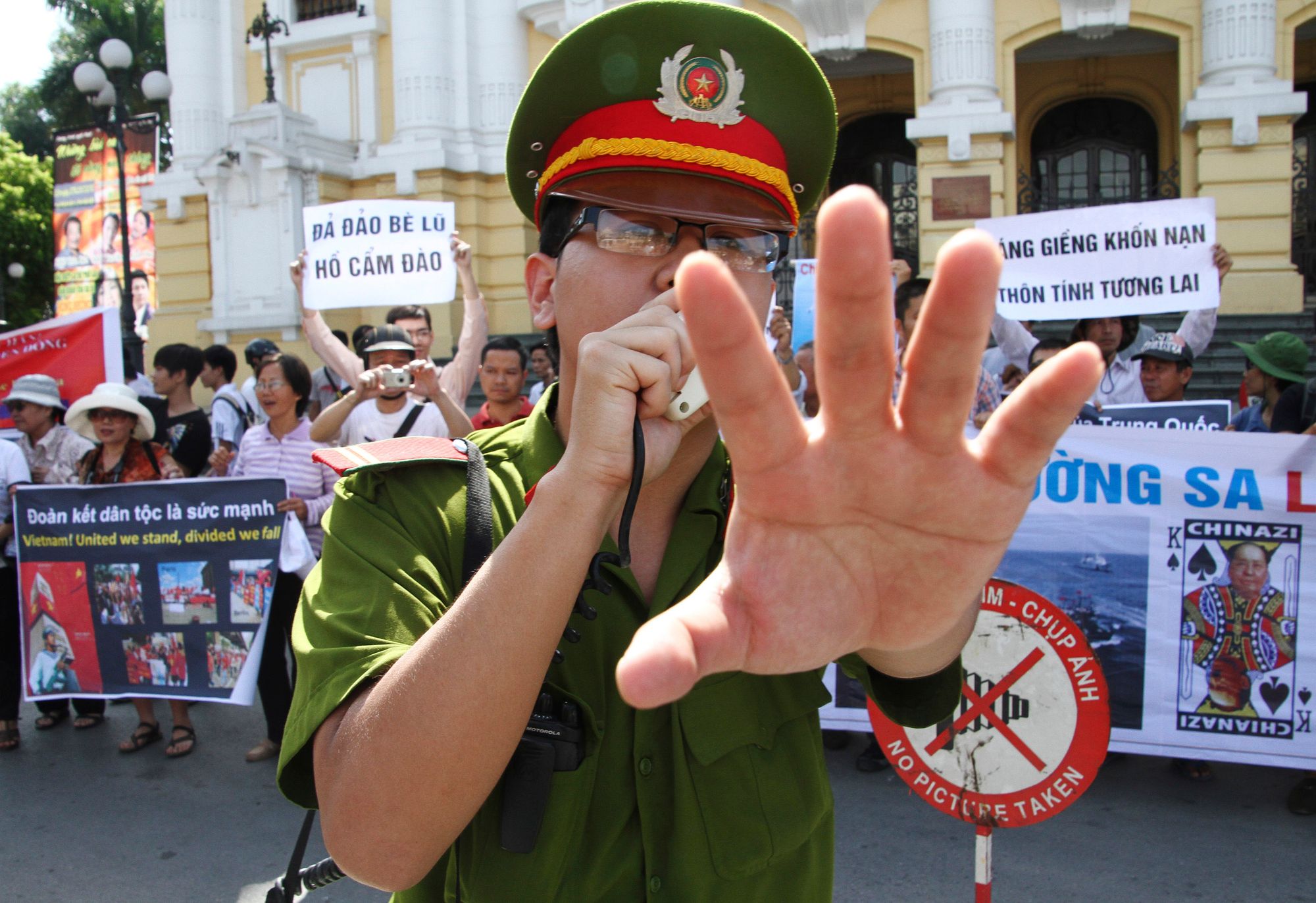
    As in all of the protests that happened before, this time, again there were allegations that the police used excessive force to suppress the peaceful demonstrators.

    Yes, in one province – Binh Thuan – riots broke out between the protestors and the police, but everywhere else, they were mostly peaceful, including the one that Will participated.

    The UN Human Rights Office for South-East Asia stated on June 14, 2018: “We are particularly concerned about allegations that some protesters were beaten by law enforcement authorities.”

    Any seasoned pro-democracy activists and human rights defenders will tell you what has happened to Will Anh Nguyen this past weekend is the same routine violation of human rights in Vietnam when people dare to exercise the right to demonstrate.

    First, Vietnam still has no law providing for the practice of any of the rights stated in Article 25 of the Constitution.

    While the legislative body of the nation kept delaying passing such a law, the government in March 2005 issued Decree 38/2005/NĐ-CP to regulate “public gatherings”.

    Accordingly, a public gathering of more than five people must be approved by the Provincial People’s Committee, unless it was organized by the government or social and/or political organizations belong to the government.

    This Decree has been quite effectively used by the government to wrongfully break up protests and to arrest people in the past. Nevertheless, its language has been denounced by both legal experts in Vietnam and the international community because of human rights violations.

    It is worth noting that the Decree does not mention the word “demonstration” anywhere, so it can be argued that legally, it cannot be used to regulate protests.

    Thus, in 2011, during the height of another wave of protests across the country, a group of activists and lawyers petitioned the National Assembly’s Standing Committee for a review of Decree 38.

    Vietnam does not have a constitutional court. Instead, the National Assembly has the power to interpret the Constitution, but to date, they have not responded to the petition filed back in 2011.

    In fact, the National Assembly of Vietnam has never exercised this power to interpret the law.

    In a nutshell, the law on the practice of demonstration seems to have been strategically delayed while an allegedly unconstitutional government’s decree will act as the only official tool to round up peaceful protesters and arresting them.

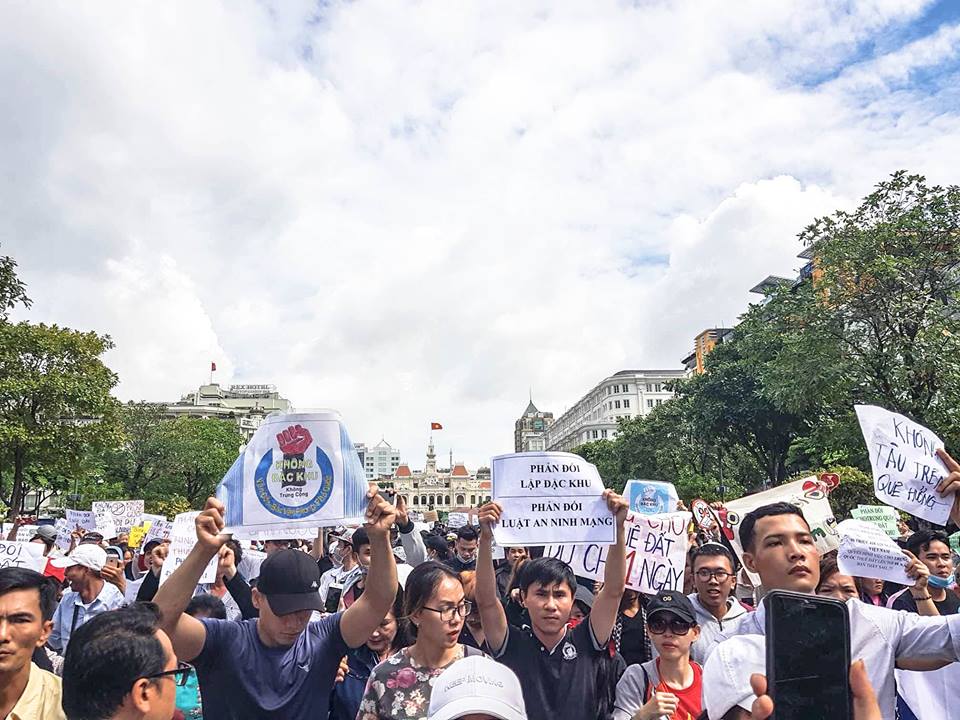
    The nation-wide protests broke out in Vietnam last Sunday, June 10, 2018, against the proposed Special Economic Zones (SEZ) and the cybersecurity draft laws, were estimated to have had thousands of people marching.

    Some sources believed around 300 people were later arrested in Ho Chi Minh City alone, and one of them was Will Anh Nguyen.

    Since his detention on Sunday afternoon, his family has been actively working with the U.S embassy to get him released.

  • Two Years Later, Formosa Toxic Pollution Still Sends People to Prison in Vietnam

    Two Years Later, Formosa Toxic Pollution Still Sends People to Prison in Vietnam

    April 24, 2018| After an approximate three-hour hearing, the Appellate Court of Nghe An Province, Vietnam, affirmed the 14-year sentence for blogger and human rights defender, Hoàng Đức Bình, in relation to the 2017 protests of Catholic fishermen in the areas affected by the Formosa environmental disaster.

    Hoàng Đức Bình, a member of the Viet Labor Movement, was sentenced earlier this year by a trial court in February.

    The story on the marine pollution caused by Taiwan’s Formosa Hà Tĩnh Steel Corporation broke out two years ago in Vietnam, prompting a nationwide protest in April and May 2016 where people demanded the company closed its steel mill business and ceased all of its operations.

    Formosa admitted in May 2016 that they were responsible for the toxic spill from their factory into the local sea in violations of Vietnam’s laws, and agreed to pay 500 million USD for damages in a confidential settlement with the Vietnamese government.

    The toxic pollution caused by Formosa is estimated to have affected the livelihood of people along more than 200 km of local seawaters in four coastal provinces of Central Vietnam.

    To date, the public in Vietnam still has very little information regarding the settlement agreement while many affected families have yet to receive their shares in the settlement.

    Thus, local people continued their protests against Formosa, and Hoàng Đức Bình was among them.

    One of the activities Bình participated in, was to travel with fishermen from Quỳnh Lưu District, Nghệ An Province to the local courts in Hà Tĩnh Province – where Formosa is located – to file their civil suits against the company in February 2017, and the authorities of Nghệ An Province arrested him after that.

    Attorney Nguyễn Khả Thành, one of Bình’s lawyers, announced the court’s decision on his Facebook today.

    According to his lawyer, Hoàng Đức Bình was convicted on two separate charges under Vietnam’s 1999 Penal Code. Article 257 is for “resisting officers acting under their duty,” and Article 258 is for “abusing freedoms and democratic rights to infringe upon the State’s interest or the rights and interests of other entities and individuals.”

    Bình was given the maximum sentence – 7 years – for each of the offenses, which implied that the court found his conduct to be “seriously harmful” to the public according to the sentencing guidelines of Articles 257 and 258.

    Hoàng Đức Bình maintained that all he did was to accompany the fishermen and a Catholic priest in traveling from Nghệ An to Hà Tĩnh to file their civil suits.

    Nghệ An Province was not among the list of the four provinces to receive compensation from Formosa’s 500M USD settlement, and hence, the need for fishermen there to file lawsuits to recover for their alleged damages arose.

    On September 25, 2015, just a few months before the story of Formosa marine life disaster broke the news, world leaders have agreed on what now is known as the 17 Sustainable Developmentment Goals. Among them, the seriousness of climate change due to humans’ activities is highlighted, and that countries have agreed, future economic development must go hand in hand with environmental protection and respect for human rights.

    After the trial court convicted Bình for a total of 14 years in February this year, UN experts and Special Rapporteurs issued a joint statement, condemning his arrest and sentence and demanded his release.

    “Imprisoning bloggers and activists for their legitimate work raising public awareness on environmental and public health concerns is unacceptable,” said Baskut Tuncak, Special Rapporteur for Human Rights and Hazardous Substances and Wastes.

    “We call on the authorities to release Hoang Duc Binh and Nguyen Nam Phong who were detained following their efforts to raise awareness and ensure accountability in relation to the spill of the Formosa Steel plant. Authorities must ensure that Viet Nam’s rapid economic expansion does not come at the expense of human rights, in particular those of local communities and workers.”

    Another lawyer of Hoàng Đức Bình, Hà Huy Sơn, also wrote on his Facebook today: Bình told him that before his trial in February 2018, he was beaten up by death-row inmates who were put in the same cell as his.

    Attorney Sơn also added in the same status, that the only witnesses participated in the trial were the traffic police officers involved in the alleged incident, and none of the video clips capturing the event were allowed to be introduced. He then concluded, the court has violated Vietnam’s criminal procedures and that the verdict is therefore unjust.

  • Will #MeToo finally have its break in Vietnam?

    Will #MeToo finally have its break in Vietnam?

    In the late evening of April 18, 2018, many journalists in Vietnam began to share on social media a story that could come with the power to shatter the nation’s culture of playing down sexual harassment in the workplace and silencing victim.

    A female intern at Tuổi Trẻ newspaper was rumored to have attempted to commit suicide and was hospitalized, after alleging that she was raped by her superior. Tuổi Trẻ is considered one of the largest – if not the largest – state-owned newspaper in Vietnam, owned by the Ho Chi Minh City Chapter of the Communist Youth Union.

    By the next day, information about the alleged attacker surfaced, again, via social media.

    Tuổi Trẻ – while along with some 800 other state-owned media did not publish an official story – yet did announce that they have suspended journalist Đặng Anh Tuấn – whose pen name is Anh Thoa – the Head of Tuổi Trẻ television news because of the allegations.

    But at the same time, the editorial board denied in the same announcement that the intern was admitted to the hospital due to an attempted suicide.

    On April 20, 2018, the faculty at the university where the victim is enrolled, delivered a deadly blow to Tuổi Trẻ’s editorial board.

    In possibly one of the very first moves ever done by a university in the country for cases involving sexual harassment of their students, the Head of the Department of Journalism and Communications of The Vietnam National University Ho Chi Minh City sent an official letter to the editorial board at Tuổi Trẻ, demanding them to perform a formal investigation and provide the public with an explanation.

    What surprised people was the fact that the faculty of the university stood by their student’s allegations by clarifying and denouncing Tuổi Trẻ’s description of her conditions in their press announcement.

    The letter read, in parts:

    “We would like to bring your attention to this specific issue so that it could be dealt with directly, that Student ‘Doe’ has endured a prolonged period of psychological trauma which produced catastrophic effects on both her physical and mental health, which in turn deteriorated her health and led her to face the negative decision concerning her life.”

    The current story of the female journalist intern from Vietnam resembles very closely the ordeal of Japanese journalist Shiori Ito last year, who went public with the allegation that veteran journalist, Noriyuki Yamaguchi, raped her in April 2015.

    But while Ms. Ito currently has to fight not only her ongoing legal battle but also a culture that preferred silence and shaming victims in a country like Japan – where #Metoo could not quite take off – the situation may be different in Vietnam this time.

    It is encouraging to see that Vietnamese men and women – especially women – from all walks of life came out in support of the victim. The hashtags #MeToo and #letherdoherjob have been surfacing on Vietnam’s social media since Wednesday’s night, and they keep spreading.

    First, other female journalists shared equally horrific stories about how they and their female colleagues too, were harassed and assaulted at works.

    The amount of compassion – from journalists who used to work at Tuổi Trẻ – for the victim is also comforting to know. The reactions from many of the popular and veteran journalists on social media in the country are also positive.

    The message from the majority was actually quite simple and clear: speak up if you have been a victim or know a victim; and call on Tuổi Trẻ to perform a thorough investigation and be transparent and accountable to the victim and the public.

    But make no mistake that the culture of victim blaming and silencing does not exist in the country.

    On the contrary, as in any other patriarchal society, Vietnam carries its own baggage, full of prejudice against female victims in most of the sexual harassment and sexual violence cases.

    In Vietnam, while sexual harassment in the workplace was recognized in the Labour Code for the first time almost three years ago in May 2015, many victims still do not speak up or come forward with their stories.

    One reason could be that there are still no clear and well-defined legal definitions for conducts that would constitute sexual harassment.

    According to CARE, an international organization working on gender-based violence in Hanoi, Vietnam, 78.2% of victims of sexual harassment in the workplace are women.

    Without a clear legal framework to protect them, female workers in Vietnam dare not to speak up because they are afraid of losing their job.

    In 2014, ActionAid International Vietnam reported that their survey of over 2,000 women in Hanoi and Ho Chi Minh City revealed, that 87% of those answered have been a victim of sexual harassment in public where 67% of the bystanders who witnessed such conducts did nothing to help the victims. 31% of female students also reported that they were sexually harassed in public.

    Many of the stories published on social media in Vietnam in the past two days seem to show a pattern. The perpetrators often targetted young interns who are still in school or female employees who are freshly minted from college.

    Inexperienced, young, and in need of a job, the victims – who are also facing a culture that got influenced heavily by Confucianism with very strict standards when it comes to gender roles – would incline to choose to quit their jobs and internalize their emotional wounds rather than speaking up against the perpetrator.

    Yet, now, there is hope with the latest case involving the Tuổi Trẻ’s intern.

    In the past two days, Facebook statuses have shown an influx of stories of similar experiences and offers of support.

    People published allegations of sexual harassment and misconduct against the Director of the largest legal online research company in the country, Thư viện Pháp luật (The law library) online. This story again was a rumor among the legal professionals but never brought to broader public attention.

    Female activists in the country already start calling on people to use the hashtag #MeToo. And while it is true that we still have to continue looking out for development, it is not too early to say that #MeToo has made an important breakthrough in Vietnam where many have begun to say, Vietnam needs #MeeToo now.

  • From Nguyễn Văn Đài’s April 5, 2018 Trial – What Constitutes “Overthrowing the People’s Government” in Vietnam?

    From Nguyễn Văn Đài’s April 5, 2018 Trial – What Constitutes “Overthrowing the People’s Government” in Vietnam?

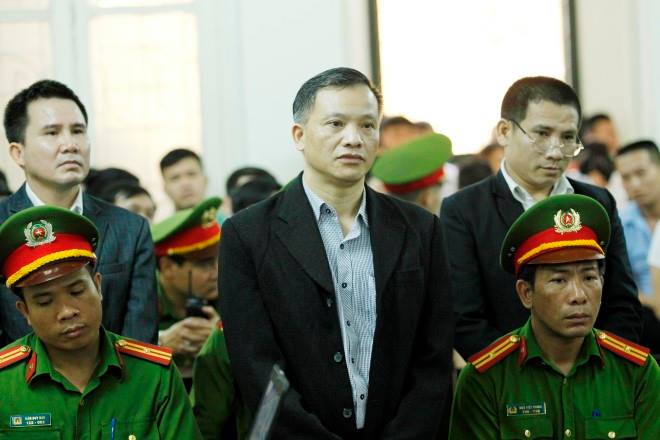
    April 5, 2018 | Nguyễn Văn Đài – probably one of the most prominent dissidents in Vietnam for almost two decades – received one of the harshest sentences for political dissent in recent years.

    A court in Hanoi, Vietnam sentenced Nguyễn Văn Đài to 15 years imprisonment and 5 years probation under house arrest. His colleagues tried and convicted in the same case, also received equally harsh sentences. Nguyễn Trung Tôn, 12 years imprisonment and 3 years probation; Trương Minh Đức, 12 years imprisonment and 3 years probation; Nguyễn Bắc Truyển, 11 years imprisonment and 3 years probation; Lê Thu Hà, 9 years imprisonment and 2 years probation; Phạm Văn Trội, 7 years imprisonment and 1 year probation.

    The 48-year old former attorney was among the first group of Vietnamese lawyers who took up political cases in the early 2000’s and defended dissidents, as well as those who were persecuted for exercising religious freedom.

    Đài was the type of lawyer who would defend those accused of the very same crime he is facing today: “conducting activities to overthrow the people’s government.”

    This crime is infamously known among international human rights groups and foreign embassies as the Article 79 of Vietnam’s Penal Code 1999.

    While carrying capital punishment as the maximum sentence, Article 79 however, utterly lacks a clear, well-defined description of conducts which would constitute a person’s criminal liability, and as such, making it impossible for people to cry out mea culpa.

    The law only states that “a person conducting activities to form or participate in any organization to overthrow the people’s government shall be punished as follows,” and then immediately dwells into specifying the sentencing guidelines from twelve years, twenty years, life imprisonment, up to the death sentence for the main perpetrator, and five to fifteen years for those who act as accomplices.

    Because of this ambiguity per se in its language, Article 79 had faced strong criticism from the international community over the years, especially during the last Vietnam’s Universal Periodic Review (UPR) in January 2014.

    Critics continue pointing out, that along with Articles 88 and 258 of the Penal Code, the government has used these criminal provisions almost exclusively against political dissidents and pro-democracy activists, taking advantage of the vague language of these codes to criminalize peaceful protests and suppress political dissent.

    Facing such international pressure during the 2014 UPR, Vietnam agreed to amend Article 79, and they did, in 2015.

    However, except for some minor, cosmetic changes such as the number of the code section from 79 to 109, and adding a category for those who are “preparing to commit the crime” with the punishment ranging from one to five years imprisonment, the remaining of the “new” Article 109 is taken verbatim from Article 79.

    In short, we still have to look to actual cases to define which conducts would constitute the crime of “overthrowing the people’s government” in Vietnam, and in Đài’s case today, such conducts would be:

    “Opening an office, having a website to operate, developing a ‘shortening manifesto’, having a structured organization, having internal and external affairs strategy, operating to increase membership, capacity, …; abusing the right to promote ‘democracy, human rights,’ ‘civil society’ to conceal the objectives of the Brotherhood for Democracy … waiting for the appropriate timing to openly operate in opposition of the government through changing the political structure in Vietnam, developing ‘pluralism with multiple parties’ and a government with ‘separation of powers’ to overthrow the people’s government while using a private sector economy as its basis.”

    The above paragraph was an excerpt taken from the Conclusion section at page 10 of the 16-page long indictment issued on December 31, 2017 against Nguyễn Văn Đài and his five colleagues, Lê Thu Hà (who was arrested together with Đài on December 16, 2015), Nguyễn Bắc Truyển, Nguyễn Trung Tôn, Trương Minh Đức, and Phạm Văn Trội.

    The new Penal Code of Vietnam was not taken effective until January 1, 2018. Thus, Đài and his colleagues were charged with Article 79 of the old code.

    Nguyễn Văn Đài has never shied away from his political ambitions and his outspoken criticism of the current regime, especially regarding the political monopoly the Vietnamese Communist Party (VCP) has over the country.

    In 2006, Đài openly called for the establishment of other political parties and forming political opposition to challenge the VPC’s ruling. According to a research on Vietnam’s democratization advocates conducted by the Australian scholar, Benedict J. Tria Kerkvliet, Nguyễn Văn Đài would fall under the category of those who chose to confront the regime head-on.

    He holds a firm personal belief that every Vietnamese people do have the intellectual capacity and enough knowledge to participate in a pluralistic form of governance with multiple parties.

    He previously wrote that Vietnam had had other political parties in the past, during the 1930’s and the early independent days from 1945-1946. Notably, in the South of Vietnam – before the fall of Saigon – political parties were very active. Moreover, Đài always believes that the current Constitution supports the formation of other political parties besides the VPC.

    His direct challenge to the ruling party’s power resulted in a conviction for “propaganda against the state” under Article 88 in 2007, where he served four years in prison and was released in 2011.

    Coincidentally, 2011, the year in which Đài was released, also marked the beginning of an unprecedented rise of the young pro-democracy and pro-human rights movement in Vietnam.

    Starting in the summer of 2011, Vietnamese people – especially youths – swarmed the streets of major cities such as Hanoi and Saigon, protesting against China’s aggression due to the incident involving the cutting of Vietnam’s Binh Minh vessel’s cable cab in the South China Sea.

    People organized protests through Facebook’s pages, and statuses, calling for massive turnouts all over the country like never seen before, at least not anything like that had happened since after the Vietnam War was over in 1975.

    At first, the government allowed the protests, but when faced with thousands of youths on the streets, they quickly decided to change course and started cracking down on peaceful protesters. Yet this very conduct of the government had opened doors to another era of civil disobedience in Vietnam: the birth of the independent civil society organizations (CSO) movement inside the country. Many of the protesters on those streets in Vietnam six years ago are now the prominent faces of the pro-democracy movement.

    The undeterred Nguyễn Văn Đài quickly caught on to this phenomenon and organized his own CSO – the Brotherhood for Democracy (which got named in the indictment) – continuing pushing for political changes through challenging the one-party rule. A person with charisma, Đài again rose to the occasion, becoming the familiar face during those meetings with foreign officials and diplomats from many embassies in Hanoi.

    And that was documented in his December 2017 indictment as well, where it detailed how he was able to connect with foreign institutions and individuals to secure funding for his CSO – activities that are normal for any non-governmental organization around the world. The indictment even named diplomats from the U.S. and Germany as people who acted as his references.

    It also worths noting that almost two years ago, Vietnam’s National Assembly attempted to pass a law on association with restrictions on receiving “foreign funds.” However, such efforts failed when faced with stern opposition from NGOs and CSOs from Vietnam, both registered and non-registered.

    Thus, except for the indictment in Đài’s case making it out to be a crime, Vietnam’s laws have yet to prohibit NGOs to receive foreign financial aids.

    But the reality remains, that as of right now, Vietnam still only has one political party – the Communist Party – and Nguyễn Văn Đài and his colleagues’ latest trial and conviction demonstrate that any efforts aiming at forming a political opposition would constitute conduct punishable by very long and harsh sentences.

    In December 2008, many people gasped as China sentenced Nobel Peace Prize Laureate, Liu Xiaobo, to 11 years for “suspicion of subversion against the state.”

    Now almost ten years later, in April 2018, using an eerily similar charge against Nguyễn Văn Đài and his colleagues, Vietnam has demonstrated that it too, does not yield to international pressure and would even go the extra miles in sending political dissents to prisons for even longer terms than its communist big brother.

  • Censorship in Vietnam: JFK Miller Interviews Thomas Bass

    Censorship in Vietnam: JFK Miller Interviews Thomas Bass

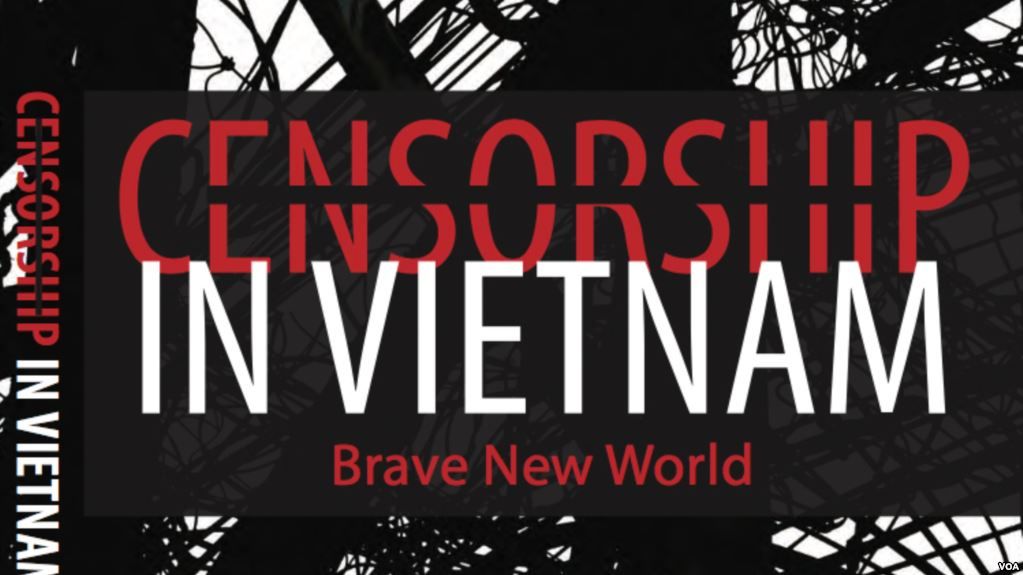
    • With permission from author Thomas Bass, The Vietnamese is pleased to reprint the interview Mr. Bass has given to JFK Miller, a Melbourne-based journalist, in February 2018 on his latest book, Censorship in Vietnam: Brave New World

    Thomas A. Bass’s 2009 book The Spy Who Loved Us dissects the double life of Pham Xuan An, a correspondent for Time during the Vietnam War and a contemporary of Peter Arnett, Richard Pyle, and Morley Safer. As American radio blasted Bing Crosby’s ‘White Christmas’ to signal the evacuation of embassy personnel in those final tumultuous hours of April 30, 1975, An was Time’s last man standing, the magazine’s sole remaining reporter in Saigon as the North Vietnamese tanks rolled in. In truth, he was part of the welcome brigade. An was a spy who used his journalistic contacts to feed vital intelligence to Hanoi. Time’s Zalin Grant, who worked alongside An, called him “the first known case of a Communist agent to appear on the masthead of a major American publication.”

    But An’s tale is a story within a story. Bass’s latest book, Censorship in Vietnam: Brave New World (University of Massachusetts Press, 2017), recalls his experience with Vietnam’s state censorship apparatus when he tried to get a translation of The Spy Who Loved Us published in Vietnam. He succeeded, but at a cost — five years of negotiations and no less than 400 cuts to his manuscript.

    Was it worth it? Bass himself answers that question below. For me, the reader, the answer is a resounding yes. The censorship experience Bass recounts in his book paints a vivid picture of present-day Vietnam, and it’s not a flattering one. Economically, the country is one of Asia’s “new” tigers which last year posted the world’s second-fastest growth rate. Politically, however, it’s a paranoid and insecure beast which lacks the ability to confront its own past and look squarely at its own present (Bass does not mince words: Vietnam is “a culture in ruins,” he writes). I traveled to the country several times in the ’90s, but am ashamed to say my conception of Vietnam was cryogenically frozen somewhere between The Quiet American and Apocalypse Now. Well, it was, until I read this book.

    My connection with Thomas Bass comes via our different but eerily similar experiences with state censorship – his with Vietnam, mine with China. As I worked my way through his book it struck me how alike the censorship systems in both countries are. And then on page 83, I learned why: Hanoi takes its cues straight from Beijing. The dissident novelist Pham Thi Hoai explains, “We always look to the Chinese and copy them… it is mandatory for every high Vietnamese official to get training in China once a year, just as it was in the time of the Cold War. It is no accident that every campaign and law adopted in China is introduced into Vietnam six months later.”

    It’s perhaps no surprise then that Vietnam’s military conflicts with China, including the incredibly brutal 1979 conflict in which tens of thousands died on both sides in less than a month, are glossed over in school textbooks.

    But this is simply one of the censorship’s many casualties. Writers and journalists are routinely given draconian prison terms for speaking truth to power. Criticism of the Chinese is censored, as is praise for the French and Americans (“they are not allowed to have taught the Vietnamese anything,” writes Bass). Disparagement of communism and communist party officials is banned, together with the discussion of “government policy, military strategy… minority rights, human rights, democracy, calls for political pluralism, allusions to revolutionary events in other communist countries, distinctions between north and south Vietnamese, and stories about Vietnamese refugees.”

    Whether it’s novels or journalism, there’s an overarching optimism that must pervade writing in Vietnam that is forced upon its writers by state censors. Either be censored, self-censor, or be damned. A 1988 novel by the above-mentioned Pham Thi Hoai, The Crystal Messenger (which I’ve not read, but now want to because of Bass’s book), was banned for the reason that its view of Vietnam was “excessively pessimistic.” No surprise that she now lives in self-imposed exile in Berlin, a place where, unlike her homeland, she is lauded for her work.

    My one criticism of Bass’ book is the choice of the most prosaic of titles – Censorship in Vietnam – with a nod to Huxley in the subtitle. But this is small beer. On the whole, this is a tremendously eye-opening book, and thoroughly readable. Our discussion follows.

    ***

    Why was it important to you to have a translation of your book published in Vietnam, especially know that it would be censored?

    Communicating across borders interest me. There is much to be learned and much to be unlearned, and even the misunderstandings are revelatory. Look what happened when I tried to mail you a copy of Censorship in Vietnam from the U.S. The book was returned to me several weeks later by “homeland security.” Who would have guessed that the “JFK” in your name – honoring of the 35th president of the United States – was suspicious? But apparently, according to the paranoids who patrol our borders, initials without complete first names imply criminal intent. So it took another 20 bucks and the entire “John Fitzgerald Kennedy” to get you a copy of my book.

    Another answer to your question has to do with surviving as an author. My books have been translated into various foreign editions, and I enjoy traveling to literary events in far-flung places. So why not add Hanoi? Nha Nam, the Vietnamese publisher of my book, was supposed to be the country’s best. I would be joining the likes of Vladimir Nabokov, Milan Kundera, and Orhan Pamuk. Not bad company.

    But I think you’re asking a more serious question, which is the subject of Censorship in Vietnam. If I knew how much grief I would be getting for translating The Spy Who Loved Us into Vietnamese, why did I invite it? The answer is pretty straightforward. I wanted to conduct an experiment. Exactly how much grief was coming my way, and who would be cranking the handle?

    Did you brace yourself for a rough ride, or did you go into it thinking that you might perhaps get away with more than you thought you could?

    I knew that chunks of my book on Pham Xuan An would be removed. It was full of subversive material – by which I mean material that the Vietnamese consider subversive – conversations with exiled writers, accusations of corruption in the Communist Party of Vietnam, jokes about how ugly the language has become in postwar Vietnam.

    My Vietnamese publisher and my literary agent in New York and subagents in Tokyo and Bangkok all assured me that I had nothing to worry about, that none of the books they had published in Vietnam had been censored. They were either ignorant or lying, but it’s also true that no one pays much attention to foreign rights. A book goes into Polish or Portuguese, and very few authors have the time or skills required to check the translation. I had been tipped 3 off to the fact that even novels and poetry are censored in Vietnam. So a nonfiction book about a Vietnamese spy who claimed to have loved the United States and the values of investigative reporting and Western journalism was certainly going to be censored.

    For the few hundred bucks my literary agent was making on the deal, he kindly allowed me to rewrite the standard publishing contract for the sale of translation rights, and then we patiently negotiated these changes as the contract was bounced back and forth between New York and Hanoi. I inserted clauses about prior review and final approval of the translation, and I larded the contract with trip switches, so that every time the censors moved on me I had to be notified. The manuscript became a kind of early warning system, ding, ding, dinging on my desk, at every stroke of a censor’s pen. And in Vietnam, as you yourself found in China, there is not just one censor, but various tag teams and competing groups of censors, which operate in a hierarchy of censors that stretches all the way up to the head of the Communist Party. Each level in this hierarchy is afraid of getting whacked by the one above it. So the natural urge is to adopt what the French call langue de bois – the wooden speech of martinets and political hacks. This is how a culture dies … but at least the censors will never be out of a job.

    Given my jerry-rigged publishing contract, I owe a great debt of thanks to the editors at Nha Nam who honoured this contract. I was a pain in their necks, if not dangerous to the survival of their company, but still they notified me every step along the way. At the end of five years, my book was radioactive. My original editor had quit the company and quit publishing altogether. The project had been at death’s door a half dozen times, and many of us were surprised when printed copies of the book finally appeared – briefly – on bookshelves in Hanoi and Saigon.

    Did you ever consider simply pulling the plug and abandoning the translation altogether?

    Remember, this was an experiment, with every twist and turn in the process producing “data.” At the most basic level, I was studying the Vietnamese language. How has it changed since the end of the Vietnam War in 1975? Pham Xuan An complained about these changes when I was interviewing him for “The Spy Who Loved Us,” which began as an article for The New Yorker and later became a book with the same title. He said the Vietnamese language was being corrupted by Marxist-Leninist gobbledygook borrowed from Russia and Maoist terms imported from China. To learn how to speak this new language, An was sent to a “re-education” camp for ten months. “I was a bad student,” he said. “They never understood my jokes, but at least I didn’t do anything serious enough for them to shoot me.” (An’s “re-education camp” was actually a military academy outside Hanoi for training high-level officials, but I believe him when he says the experience was bone-chillingly boring.)

    Censoring books in Vietnam begins before the first word is translated. In this case, the person chosen to translate my book was a north Vietnamese journalist fluent in gobbledygook. He produced quotes that sounded nothing like the south Vietnamese spy about whom I was writing. The publisher was surprised that I cared about these things or knew enough to want the language changed. A nonfiction book for them was the equivalent of an encyclopedia entry. Give us the information, and give it to us in today’s language – in this case, the language spoken in North Vietnam, which is where most of the book-buying public lives. There was also a good dose of prejudice at work. The South Vietnamese lost the war, which means that not only their political system but also their culture and language are in the process of being effaced.

    After the censored Vietnamese-language copy was published in print, you released an uncensored version on the Internet. Can you explain why this was important to you?

    Censorship is so crushing in Vietnam that many authors are skipping printed publications and releasing their work directly to the web. In my case, I wanted to see what the printed book looked like. I wanted to evaluate the damage done to the text by Vietnam’s censors, count up the number of cuts and alterations, and study the people and ideas that got erased.

    After assembling my literary seismograph – in other words, after The Spy Who Loved Us was translated and released in Vietnam (although not under that title, which the censors considered far too dangerous)-I felt obliged to provide my Vietnamese readers with a copy of the original book. This too is standard practice in Vietnam. Even when a book is printed, people go to the web to find what everyone assumes will be a more accurate version online.

    At the same time, I wanted to conduct a second experiment. Vietnam’s censors work across borders. You can’t publish books online with impunity. Electronic publications will be attacked by trolls, worms, viruses, denunciation campaigns, denial of service attacks, bribery, extortion – whatever works to get them taken down. I don’t want to exaggerate the risks I took, which were nothing compared to my Vietnamese colleagues, but the Vietnamese version of my book – the complete version published online in Berlin on computers hardened against attacks from Vietnam’s censors – invited retaliation. It was attacked in a variety of ways. The translator was forced to drop out. He also pulled his translation, which we could no longer use. People threatened to sue me. The internet lit up with chatter maligning me and the project. The Berlin web site went down a few times, but it held fast against the censors and trolls, due to the good work of exiled author Pham Thi Hoai, whose site for many years has been the rallying point for opposition to Vietnam’s communist police state.

    When you engaged the dissident Pham Hong Son to translate your book for the Berlin release, did it weigh on your mind that you might be condemning him to another hefty prison term? (Son had already spent five years in prison and another seven under house arrest for translating essays on democracy).

    As I mentioned, the first translator for the unexpurgated version of The Spy Who Loved Us, was forced to quit. Enough threats were brought to bear that he felt he had no choice. Pham Hong Son is a different kind of person altogether. After spending five years in prison, much of it in solitary confinement, for translating an essay on democracy and recommending this form of government to his fellow countrymen, he went on doing exactly the same thing after he was released to house arrest. Trained as a medical doctor, a true intellectual and patriot, he is a brave man, someone whom I admire and am lucky to count as a friend. He did the work for free because he thought it was important, and ever since then, I have been looking for some way to repay him.

    In your book’s foreword you ask the question central to all of this. Could China and Vietnam’s governance model become the new normal? It pains me to acknowledge this, but democracy, with all its trappings – not least of which, freedom of speech and freedom of the press – is in bad odor at the moment, while the Vietnam/PRC model, which puts economic development above free speech, is in the ascendancy. Add to this, declining American power and an Oval Office occupant who has turned American democracy (indeed all democracy, I would argue) into a global laughing stock, and Reagan’s “Shining City on a Hill” now looks like a faltering candle. Is it any real surprise that countries like Vietnam and China seem to have more faith in their political systems than we currently do in ours? And do you not think that democratic reformers in Vietnam are, at least for now, fighting an impossible battle?

    This is the key question of the moment. As the western democracies falter and lose faith in themselves, as they debase their elections, trade freedom for security, and forget their founding principles, people think that police states with good shopping look attractive.

    This is an illusion. In fact, it is a dangerous illusion. Censorship can kill you. The absence of free speech can kill you. Not knowing the truth can kill you. These are fundamental values, not to be sold at any price, but they are also tools for survival. This argument was made by Nobel-prize-winning economist Amartya Sen, when he was asked by the Indian government to advise them on which model they should choose for development: the open societies of the West or China’s surveillance state, which is attractive at the moment because of its economic growth. Sen warned his compatriots not to go for the shiny lure. He reminded them about China’s Great Leap Forward, which was actually a great leap backward, killing at least 30 million people in a devastating famine. What caused this social collapse? Censorship – a skein of lies spun to please Chairman Mao, ignorance about what was happening in the countryside, courtiers, and buffoons who reported good news in place of facts. Exactly what’s happening in the United States today.

    China has been called “a consumerist totalitarian state.” The description is just as apt for Vietnam, I think. In this type of polity, economic growth trumps personal freedom. The idea is that you cannot have both, that personal freedom must give way to economic development, that the two cannot possibly work in tandem. First World economic parity must be attained before you can even start to think about personal freedoms.

    Vietnam, like China, is indeed a consumerist totalitarian state, and it too believes that good shopping can replace good governance. It thinks that substituting material goods for freedom is a bargain its citizens will buy. The people I write about in Censorship in Vietnam disagree. For them, freedom is a muscle that atrophies if you don’t use it. They think that all this talk about putting development first and democracy last is a bunch of ideological hooey. This argument is good for nothing more than buttressing the police state and building the walls behind which the ruling elites do their serious stealing. Who ever said that economic development and personal freedom are mutually exclusive? The history of our two countries, the United States and Australia, proves that the opposite is true. In fact, as the United States becomes less democratic and slides toward authoritarian rule, its economic development and leading role in science and technology will be weakened.

    In the book, you write that state censorship is producing an intellectual wasteland in Vietnam, and yet I can’t help but think that we’re also suffering from this in the West, despite our having all the freedoms available to us and all the advantages of the digital age. We live in an era where knowledge has never been more widely available, and yet we seem to have succeeded in becoming remarkably ignorant (the rise of populism is not just restricted to the U.S). In a way, it makes us more culpable for our ignorance than those who live under authoritarian regimes. In their system, censorship is preventing them from getting to the truth, but we in the West have no such excuse.

    I agree with you that these are perilous times. We are dancing on the edge of the volcano. We are distracted, forgetful, ignorant about our history, and incurious about our future. Plato wrote about this in his allegory of the cave, and here we are, twenty-five hundred years later, still chained to our seats, staring at shadows on the walls. “Democracy dies in darkness” is the motto adopted by The Washington Post after last year’s election in the United States. This sounds vaguely apocalyptic, but the paper’s editor is not looking for salvation in a Batmobile. He is reminding us about the importance of getting the news and learning how to sift truth from falsehood. You know the old joke, “What’s the difference between an optimist and a pessimist? A pessimist is better informed.” This is the golden age of journalism. I can wake up in the morning and before my first sip of coffee peruse headlines from Tokyo to Timbuktu. Sure, the amount of fake news and the stupidity of my optimistic neighbors is unnerving. But in this case, it’s up to me to loosen my chains and turn around if I want to see outside the cave.

    You write that censorship exists in all societies, whether it is the state censorship of authoritarian regimes like Vietnam or the “soft censorship” of Western liberal democracies where dissenting views are side-lined. I want to take issue with this, if I may. To me, this a false equivalency. Here, people can express their opinions, while in authoritarian states they are prevented from doing so. Someone may risk marginalisation for expressing a non-mainstream view (whether it’s unpopular, unpatriotic, unorthodox, racist, or simply ignorant), but that person still has the right to say it.

    I wasn’t arguing that “soft censorship” is the same as the hard variety, which is enforced by prison sentences or, in the most extreme cases, by death. I think that censorship exists along a continuum. It begins with ideological conformity, fear of retribution, a limited number of media outlets owned by large corporations, PR campaigns, book bannings, surveillance, disinformation, and propaganda. It moves from there to state-run security apparatuses, government control of the media, gulags, torture, and other means by which the state exercises its power. I oppose all forms of censorship, whether they be ideological or market-based. Some deserve more strenuous opposition than others, but all merit the light of discovery and condemnation.

    What reaction (or denunciation) from Hanoi do you expect for publishing Censorship in Vietnam?

    When the uncensored Vietnamese translation of The Spy Who Loved Us was published in Berlin – with side-by-side comparisons showing the 400 passages that had been cut or altered and with extensive commentary on how censorship works in Vietnam – the publication provoked a firestorm of criticism on the Vietnamese web. Hundreds of messages (not all of them written by trolls) accused me of “betraying” my subjects. I had quoted people without their permission or refused to remove their names when they asked me to do so. (Censoring books after publication is standard operating procedure in Vietnam. If something becomes too controversial or people get scared about being quoted, then a book disappears from the shelves. Even newspaper interviews are never conducted “on the record,” because the record can always be revised or erased.) The firestorm of criticism became the party line on Thomas Bass. He’s a backstabbing, bumpy-nosed betrayer of Vietnamese values who deserves to be censored and, in fact, he reveals the value of censorship, if it keeps people like him out of Vietnamese bookstores. At moments like this, I remember the advice of Henri Beyle, better known to us by his pen name Stendhal, who consoled himself by saying that he wrote for “the Happy Few.”

    Now that your book has been published do you have any reservations about returning to Vietnam? Say you were invited to speak about your book at a literary festival in Hanoi. Would you be concerned about any repercussions?

    I would be pleased to return to Vietnam. In spite of their benighted government, the people and the country are quite marvelous. Many brave dissidents are currently at work in Vietnam, and I would like to support them. I don’t know whether I’m brave or foolhardy or simply have the bones of a working journalist, but on my next trip to Vietnam, I plan to stuff my suitcase with copies of Censorship in Vietnam and try to carry them over the border. The electronic edition has yet to appear, and I have a lot of friends who would appreciate receiving a copy – even if they have to wrap it in brown paper or hide it under their beds. This will be another small attempt at lighting a match in the darkness.
  • Vietnam: Increasing Cyber Attacks on Activists Portray A Shrinking Internet Freedom

    Vietnam: Increasing Cyber Attacks on Activists Portray A Shrinking Internet Freedom

    During the last week of November and in early December 2017, many of the independent media websites in Vietnam reported that access to their sites had been blocked. This includes The Vietnamese. Readers confirmed they could not access the attacked sites unless they installed VPN to get over the firewalls.

    Another independent news project also runs by The Vietnamese’s editorial board, Luat Khoa online legal magazine, was also blocked in Vietnam starting around December 4, 2017. Luat Khoa has been in operation for the past three years with over 90k likes on Facebook and an average of 500,000 pageviews per month. This is the first time Luat Khoa gets blocked in the country.

    In a more severe case, on December 5, 2017, Dan Luan – another well-known independent site – shared on Facebook that their website was under DDoS attack for about a week in late November. A DDos attack is defined as “an attempt to make an online service unavailable by overwhelming it with traffic from multiple sources”.

    Earlier last month, there were also failed attempts trying to inject Dan Luan’s website with malicious scripts via Cross-Site Scripting (XSS). Dan Luan frequently suffered cyber attacks, which they believed were the works of government-controlled hackers.

    Also in November 2017, a handful of popular Facebookers lost access to their accounts because they were reported by anonymous users to Facebook for violations of community standards. Among them was blogger Nguoi Buon Gio, who now lives in exile in Germany.

    It seems quite likely that the Vietnamese government would rely on cyber attacks as an important tactic for oppression in recent years when the numbers of Internet and social media users increased dramatically in the country.

    In July 2017, We Are Social, a social media marketing and advertising reported Vietnam had surpassed Thailand to become the 7th country with the most Facebook users worldwide.

    The government has not exactly been shy in expressing the desire to tighten their grip on controlling the virtual world. As previously reported, Vietnam claimed to have worked with Facebook and Google to remove thousands of videos and accounts that allegedly contained anti-state materials.

    Earlier this year, in May 2017, Gen. Nguyen Danh Cong of the Ministry of Public Security stated during an intra-departmental meeting, that the MPS had successfully blocked thousands of websites which they deemed to be anti-state and reactionary contents.

    Four years before that, on May 5, 2010, Gen. Vu Hai Trieu, the then Deputy Director of the MPS, announced: “Our technical departments have destroyed 300 Internet web pages and blogs posting unsuitable contents.”

    Coincidentally, it was in early November 2017 that the Washington D.C.-based cybersecurity firm, Volexity, issued a report, confirming it has been – since May 2017 – monitoring an active operation of mass surveillance and cyber attacks operating out of Vietnam.

    This operation includes the maintenance of an active group of hackers whose mission is to target Vietnamese activists and dissidents, as well as foreign citizens, corporations, and governments with interests in Vietnam.

    It was not the first time that the international cybersecurity community had warned about hackers who seemed to have had a close tie with the Vietnamese government. In the past three years, besides Volexity, at least two other organizations, Electronic Frontier Foundation and FireEye, had issued similar reports.

    Vietnam’s government is believed to have been maintaining a cyber espionage group calls OceanLotus since at least 2014. OceanLotus (or SeaLotus) is also known as APT-C-00 or APT32 according to these organizations.

    There was also other information leading people to believe that OceanLotus was related to the hacker group Sinh Tu Lenh.

    Sinh Tu Lenh became famous among Vietnamese cyber community about a decade ago when it was named as the party responsible for the numerous cyber attacks, aiming at dissidents, activists, and independent news sites, including Dan Luan, Talawas, Xcafevn, Anh Ba Sam, and Mother Mushroom.

    Also recently, on November 14, 2017, Freedom House issued its Freedom on the Net report and named 30 countries where the government paid commentators and political bots to spread government propaganda. Vietnam was one of them.

    According to Michael J. Abramowitz, president of Freedom House: “The effects of these rapidly spreading techniques on democracy and civic activism are potentially devastating.”

    The report also quoted Sanjia Kelly, director of the Freedom on the Net project: “Governments are now using social media to suppress dissent and advance an anti-democratic agenda.”

    “Not only is this manipulation difficult to detect, it is more difficult to combat than other types of censorship, such as website blocking because it’s dispersed and because of the sheer number of people and bots deployed to do it.”

    But activists in Vietnam are not new to this form of government’s suppression. Back in 2014, our editorial board’s member, Pham Doan Trang, had met with Google and Facebook representatives in the U.S. where she forwarned them about the daily attacks these “paid opinion shapers” had fired at activists and bloggers in Vietnam and how such conducts affected democracy movement.

    During the summer of 2014 alone, over 40 accounts of activists were reported, and in turn, got shut down by Facebook.

    Calling themselves the government’s “cyber army forces”, these online bots repeatedly reported activists and bloggers’ Facebook accounts, effectively causing their shut-downs.

    Taking advantages of Facebook’s loosely defined rules and standards of conducts for the users’ community, the troop of “opinion shapers” would abuse the Facebook’s “Report Abuse Button” with thousands of reports a day on a specifically targeted activist’s account.

    Yet, to date, it seems that the activists and the democracy movement have proven their potential sustainability in Vietnam, because people are still actively promoting their causes and Facebook continues to be the main platform for advancing social changes, despite all odds.

    Back in March 2015, facing the city government’s immediate decision to cut down some 6,700 trees in Hanoi, activists created a Facebook group and organized people for peaceful protests. They were able to mobilize residents of Hanoi and successfully stopped the city government from going forward with the plan.

    In 2016, Facebook again proved its effectiveness, as it was one of the best platforms for informing the public about the Formosa environmental disaster in Central Vietnam. During the height of the weeks-long protests against Formosa Ha Tinh Steel Plant – the company responsible for causing the pollution – access to Facebook was blocked on a few weekends. But its popularity among the general public had caused the government to undo such decision almost immediately.

    This year, in the recent months, drivers who were passing through a BOT toll in Cai Lay Ward, Tien Giang Province have been protesting the improper location of said toll. Their acts of civil disobedience – through various forms of slowing down the process of paying toll fees and causing the toll to close down – were followed closely by the public on Facebook and other social media platforms.

    To protect themselves and fight back, Vietnamese activists have received technical assistance from organizations, such as Access Now, when they got reported by the government’s bots on Facebook or got struck by some other forms of cyber attacks.

    In the meanwhile, the Draft Law on Cybersecurity – which mirrored that of China – is now waiting for the National Assembly’s approval.

    And as such, the battle in the cyber world continues.