This article was published in Vietnamese by Luat Khoa Magazine on March 8, 2019. The translation was done by Will Nguyen.More than two years after the Vietnamese article was published, all three women in this article have been arrested and charged with national security laws in Vietnam. We do not want their stories to go in silence, so we translate them to tell the world about who these women are: the women of possibilities.
March 8, is International Women’s Day, and Vietnam celebrates this holiday wholeheartedly.
However, no mainstream newspapers will write about the three women in this article. No organizations will honor them. No solemn ceremony will have them as guests. And among those who “care” about them the most are usually…the Vietnamese police.
They say things few people say.
They do things few people do.
They’ve accepted risks that few people dare accept.
In actuality, they’re part of a world that few care about or dwell on; for these individuals, few are willing to stand by their side.
The women we speak of in this special piece represent the hidden aspirations, the beautiful reflections, the burning dreams of an entire nation. They’re singing for us a song of freedom, nurturing a better future for each and every one of us.
In February of 2016, a wave of independent candidates competed for seats in the National Assembly, setting off a movement that was the largest of its kind in post-1975 Vietnam. Approximately 30 candidates had signed up, only for the “consultation” process to remove them from the roster. Nguyen Thuy Hanh was among them.
Different from Party-nominated candidates, independent candidates announced their action plans. And different from nearly all independent candidates, Nguyen Thuy Hanh was the rare voice that included women’s rights in her platform. She called for stricter laws on violence against women and human trafficking, encouraged job creation, and pushed for education policies and legal support for women.
Born in 1963, Nguyen Thuy Hanh is a Hanoi woman whose soul is full of art and romance. She has participated in civil society struggles since the 2011 anti-China protests, when protesting was especially taboo not just in the minds of state officials but the vast majority of ordinary citizens.
Over nearly eight years, having participated in tens of protests and having been beaten and arrested many times, she has witnessed Vietnamese society slowly change, from opposing the right to protest to respecting and then supporting it. When boisterous, nationwide protests broke out on June 10th, 2018 and tens of thousands of people took to the streets to oppose the Special Economic Zones and Cybersecurity Laws, Nguyen Thuy Hanh was perhaps one of the most elated, for her contributions had normalized what had previously been one of the most “sensitive” acts in society.
However, Nguyen Thuy Hanh’s name is more often connected to the “50k Fund”, which she created to financially support prisoners of conscience and their families. The fund started at the beginning of 2018, originating from a brief, online fundraiser to help a number of activists on trial. Hanh had received several fold the amount requested and thus, the idea for a future fund to help activists at-risk unexpectedly came into being.
The 50k Fund aimed to help with difficult situations lesser known to the public, and its name was purposefully chosen to encourage people to donate small amounts, rather than >50,000 VND (~2.20 USD), popularly believed to be the minimum for charity. Such small amounts also assuaged donor fears of police harassment.
To this day, Nguyen Thuy Hanh’s 50k Fund has received thousands of donations, totaling many billions of VND (~hundreds of thousands of USD), all of which are documented in detail on her public Facebook account.
The 50k Fund’s meaningfulness goes beyond providing prisoners of conscience everyday material support. It also awakens the emotions of ordinary citizens, encouraging them to care more about politics and helping them overcome the intangible fear constraining their hearts and minds. The 50k Fund normalizes and makes concrete that which is considered “political” or “sensitive”, bringing to citizens the full splendor and meaning of civil society struggle.
A lover of beauty and romance, Nguyen Thuy Hanh draws a long, brilliant stroke for the Vietnamese democracy movement.
Can Thi Theu
Peasant leader Can Thi Theu. Photo: RFA. Graphic: Luat Khoa Magazine.
People normally think of peasant leaders as something from their history classes, as figures only found in textbooks. But Can Thi Theu is a real-life, flesh-and-blood peasant leader, a heart beating strongly within the body politic.
The life of this courageous woman is connected to the phrase “Duong Noi’s disenfranchised citizens”. Duong Noi is a ward in Ha Dong District. Prior to 2008, it was part of Ha Tay Province, but today, it has been incorporated into Hanoi. Can Thi Theu’s name is probably not mentioned very often in domestic or international press, and she doesn’t have her own English-language Wikipedia page. From 2007, she became one of thousands of disenfranchised citizens who lost their land when the government forcefully reclaimed agricultural and cemetery land in Duong Noi for new urban construction projects.
The “disenfranchisement” of farmers like Can Thi Theu lies in their complete exclusion from the process, from project planning all the way to land acquisition.
They were not consulted about compensation or relocation assistance, and the government did not provide them any kind of vocational training after taking away their livelihoods. Furthermore, the gravesites of their ancestors were leveled without notification of their displacement.
As a woman born in the year of the Tiger (1962), Can Thi Theu rose among the thousands of disenfranchised citizens to become leader, with her strategic mind, her ability to see in the short- and the long-term, and her skill in thwarting police tactics.
Her leadership skills also manifest in her ability to endure and sacrifice for others, forever taking the hit while protecting those in her care. She is patient and looks past the small, unimportant details to achieve the peasant movement’s longer-term goals. It must be remembered that these farmers lost their land 12 years ago; it’s not easy to keep Duong Noi a hot topic to this day.
The price that Can Thi Theu had to pay was not small. She was twice imprisoned (2014 – 2015 and 2016 – 2018) for a total of two years and 11 months, for obstruction of officials and disturbing public order.
From prison in the Central Highlands, she wrote a letter home to her fellow citizens before the 2017 Lunar New Year: “Fight to the end, to demand the return of our land, our right to live, and our rights as human beings, which the communist regime has stolen from my family and those who share our plight.”
You read that properly. Northern farmer Can Thi Theu is not afraid of calling out the “elephant in the room”, the direct perpetrators of the injustice that she and farmers like her have had to endure.
Can Thi Theu became the face of one of the greatest forms of injustice that Vietnamese citizens contend with, when she fell victim to the Vietnamese Communist Party’s larcenous land policy, which it has consistently carried out for decades.
She is also a living representative for those fighting to abolish “universal ownership” of land, seeking to establish legitimate, private land ownership rights for every individual. Every act in Vietnamese history has been intimately tied to land, and Can Thi Theu has placed herself center-stage for the next.
Pham Doan Trang
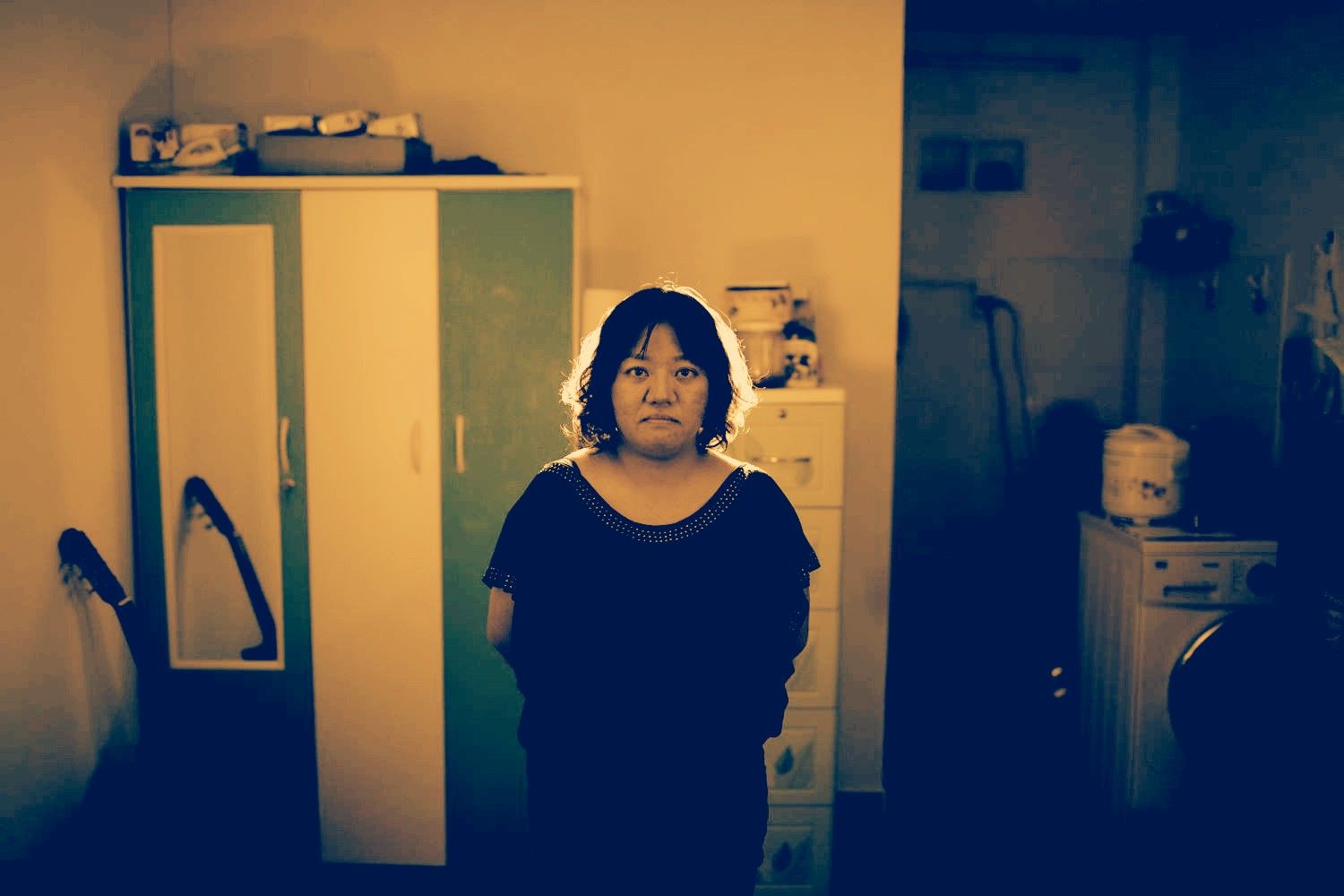
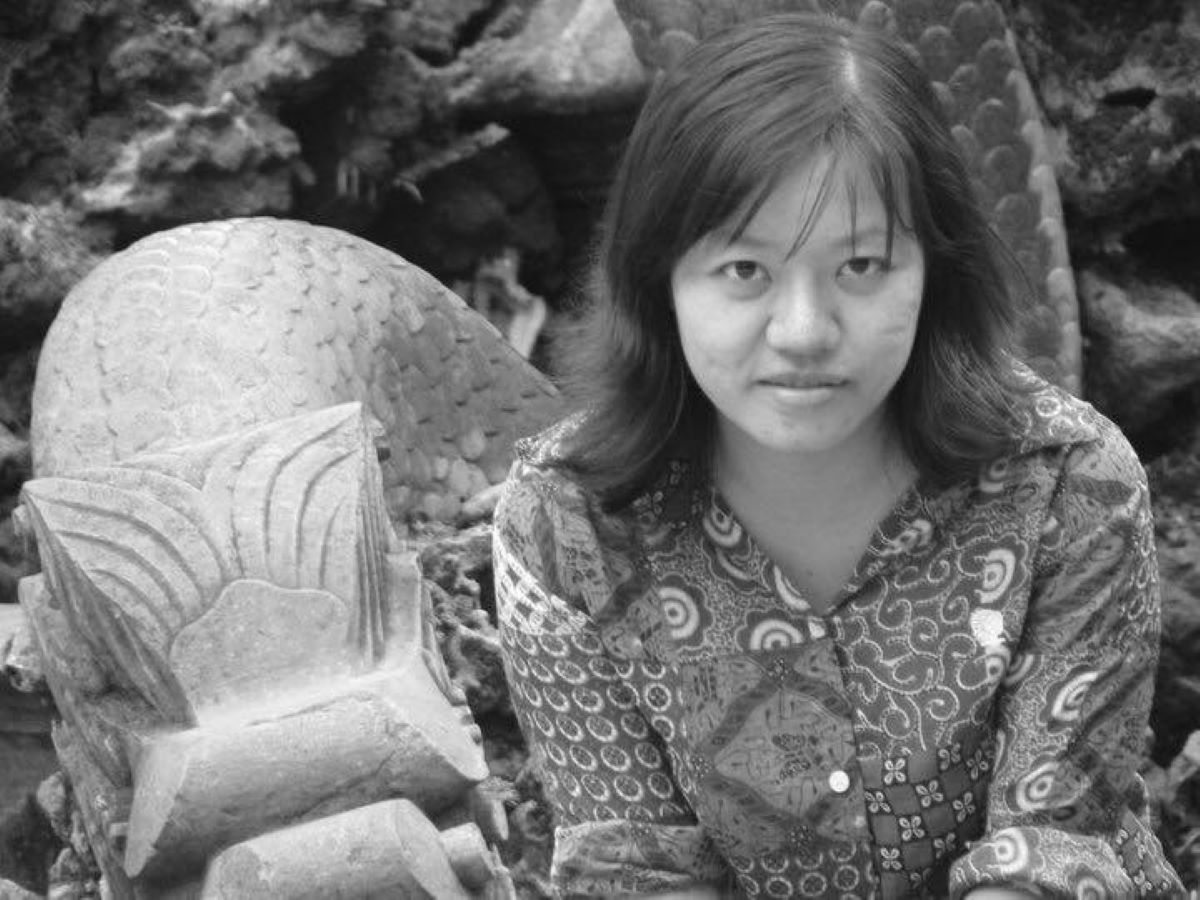
Activist Pham Doan Trang. Photo: Tri Dung. Graphic: Luat Khoa Magazine.
If someone believed that it was impossible to be a bona-fide journalist in Vietnam’s mainstream media environment, then Pham Doan Trang proves the opposite. She has 12 years of experience as a sterling journalist at VnExpress, VietNamNet, and Ho Chi Minh City Law, with reams of critical stories and excellent documentations.
If someone believed that journalists and intellectuals in Vietnam faced insurmountable political restrictions, then Pham Doan Trang proves the opposite.
She constantly embarks on endless explorations to (un)cover the most sensitive, most dangerous, most censored topics.
She also does not limit herself within the rigid confines of mainstream newspapers; instead, she uses all the tools at her disposal to write and publish. Independent newspapers, overseas newspapers, blogs, social media, samizdat—Doan Trang has adeptly utilized them all to convey information to her readers.
For Doan Trang, the concept of “hitting the ceiling” is completely foreign; she is forever someone who lifts those ceilings so that others may have more breathing room.
If someone believed that they were unable to surmount material, physical, and even spiritual difficulties, then Pham Doan Trang proves the opposite.
A small and frail woman with numerous scars and injuries, she has had to endure countless assaults by police, drifting through more than 35 different locations across the country over the past 20 months to escape police pursuit and continue her work.
She lives frugally, no different from those provincial students in the 90s, who left to study in the city, but people would see her write consistently and prolifically.
Politics for the Common People, Non-violent Resistance, and Studying Public Policy Through the Case of SEZs are just some of the many titles she’s penned over the years.
Born in 1978, Doan Trang belongs to the post-war generation and grew up when the country and the world were changing at dizzying speeds. Unsatisfied with the disorderly state of the country, people like Doan Trang saw it as their role to address these disorders. For her, there is always work to do, and she does so, without rest.
Doan Trang swears by a lifetime oath: to never leave Vietnam, not even for a day, while it remains without democracy.
Doan Trang personifies fierceness and does not compromise with evil or cowardice. But she is also full of romance and forever searches for beauty in the strums of a guitar.
She inspires people to stand up, to take steps and discover the beauty of politics. With knowledge and vigor, she represents for many the aspiration for a democratic Vietnam, the light of hope in the dark depths of despair, and the ability for oneself to embody that hope.
Doan Trang talks the talk and walks the walk, inspiring many with what could be; her life, simply put, is a powerful testament to what could be.
The three women in this piece embody the possibilities. They have defied political and gender stereotypes that weigh down their every step. The meaning of March 8th has never lain in flowers or gifts; it lies in the women who fight for what is right and just.
This March 8, we reserve flowers for women like Nguyen Thuy Hanh, Can Thi Theu, and Pham Doan Trang.
The aftermath of the war left Vietnam in shambles. As the conflict that raged and surged within its borders came to an end, the country was left bleeding, battered, and broken. With millions dead, an almost non-existent economy, and a bleak uncertain future under the questionable leadership of the Communist Party, Vietnam was beginning to look more and more like a lost cause, destined to be another failed state under the selfish rule of tyrannical forces.
However, no one would have expected Vietnam to be where it stands today.
Since Vietnam opened its economy to international trade in 1986, the country has undergone a massive and abrupt shift. It morphed from being one of the poorest nations in the world to being one of the fastest growing economies in Southeast Asia. Case in point, between the years 2002 to 2018, Vietnam’s GDP increased 2.7 times which, according to the World Bank, lifted 45 million people out of poverty.
Vietnam’s economy has also shown surprising resilience in the face of the ongoing global pandemic. While other countries in the Southeast Asian sphere have been greatly suffering due to COVID-19, Vietnam has been keeping itself afloat; some might even argue that it is thriving.
Aside from keeping infection rates under control, Vietnam’s GDP actually grew a surprising 2.6 percent in the third quarter of last year, passing even Singapore and Malaysia. Because of its commendable handling of the pandemic and its perceived economic stability, Vietnam is shaping up to be an alternate hub for manufacturing as international businesses begin to pull out of China.
Yet, economic growth and financial stability is only one way to measure the worth of a nation. While Vietnam seems to be doing admirably well in this regard, it is floundering in several other aspects. To be more specific, in its observation of human rights, and in the protection of several of its most marginalized citizens.
The Human Rights Measurement Initiative’s (HRMI) 2020 Country Report on Vietnam presents several findings that both highlight Vietnam’s economic success and its key failings as a country.
In terms of Quality of Life, Vietnam has performed reasonably well in the categories of Health, Housing, and Work but its ranking regarding food accessibility still falls below the benchmark.
This report states that “Vietnam is performing better than many countries in East Asia for the rights to housing (89.5%), work (91.3%), and health (94.6%). This suggests that the Vietnamese government is using its resources fairly effectively so that people have access to housing and work. These scores have also increased steadily since 2007, suggesting that the quality of life in Vietnam is increasing.”
However, in regards to food, the Human Rights Measurement Initiative also believes that Vietnam could manage its resources better to ensure that more of its citizens do not go hungry.
It is also important to take note of some caveats in the given information. The report makes an effort to highlight the fact that Housing does not actually refer to having a place to live in.
Rather, it refers to sanitation access and access to potable drinking water. As such, several respondents have stated that some people are at risk of having these rights violated. Some of these people include street children, homeless youth, and surprisingly, human rights advocates.
The category for Work also needs slight clarification. The 91.3 percent figure refers to people who are NOT absolutely poor. This means that anyone who lives on more than a meager amount of US$3.20 a day is counted towards this number.
Granted, even with Vietnam’s less than stellar performance regarding food accessibility and concerns regarding housing and work, what the Vietnamese government has done so far is, to a small degree, admirable and we have to give credit where credit is due, political beliefs notwithstanding. If we go solely by the data presented regarding Quality of Life, and also taking into consideration the state Vietnam was in after the war, what it has accomplished is somewhat commendable.
But the report does not end there. And as more information is presented, the more sinister reality behind the facade begins to reveal itself.
Regarding the upholding of civil and political rights, it is clear that Vietnam is performing miserably. In all aspects presented in the report under the categories of Safety from the State and Empowerment, Vietnam’s scores range from Bad to Very Bad and these scores have only been getting worse with the passage of time.
The data heavily implies that the Vietnamese government doesn’t seem to care about protecting, or even at the very least acknowledging, the universal human rights of its citizens.
The report also notes several groups of people whose rights are at most danger of being violated. One fact that immediately stands out is that these groups are common in all the lists provided within the report itself. Some of these people-at-risk include: members of labour unions, people engaged in or suspected of political violence, journalists, people with particular religious beliefs and practices, immigrants, and human rights advocates.
In general, if a person has particular political affiliations or beliefs that don’t align with what the Vietnamese government espouses, or if they believe in a religion that isn’t part of the mainstream zeitgeist, their rights to work, freedom from arbitrary arrest, freedom from disappearance, freedom from torture, assembly and association, and freedom of opinion and expression are actively hindered, ignored, or violated by the government.
In effect, the HRMI report presents a two-faced Vietnam.
On the one hand, you have Vietnam as a rising cub economy. This is the face of Vietnam that is often read or heard about in mainstream news outlets.
This is the Vietnam that Western economists praise to high heavens for being able to steer itself away from total collapse towards some semblance of stability and even growth. This is the Vietnam that the communist government wants its citizens to be proud of.
On the other hand, you have Vietnam as a heartless oppressor of its own people. This is the Vietnam that is willing to go to drastic lengths to silence or restrict any form of discontent, dissent, and differing points of view.
This is the Vietnam that shows no concern for those it tramples under its heels as it marches forward towards a selfish vision of progress and growth that benefits only those who hold the reins.
This is the Vietnam that is willing to pay for the price of progress with the rights, liberties, and lives of its own citizens.
This is the face that very few get to see.
But it doesn’t have to be this way. There are many avenues to progress and growth, and the road is never set in stone. History has shown us time and time again that nations formed on a foundation of dialogue, compromise, and free speech tend to outlast the rest and stand firm against the test of time.
Governments can work with their citizens, even with those who hold beliefs or thoughts that go against the grain to bring about benefits that everyone can enjoy. This kind of progress is possible, and it is attainable.
However, the question isn’t “Can Vietnam go on this path?” The response to this should be apparent; if Vietnam can pull itself from the brink of collapse to be where it is today, of course it can.
In reality, the question stands as such,“Is the Vietnamese government willing to do so?”
Vietnam makes no progress with freedom of religion, which remains tightly controlled.
Vietnam is among countries with the greatest diversity of religions, but it is also among those that suppress freedom of religion most heavily.
In 2020, ethnic Thuong in the Central Highlands, Hoa Hao Buddhists, independent Cao Dai practitioners, and followers of new religions in the northwest all had to pay the price for exercising their freedom of religion.
1. No place for new religions
Muong Nhe District police in Dien Bien Province urge residents not to follow new religions. Photo: Dienbientv.vn.
Vietnam possesses a great diversity of religions, but the government is quite strict with new ones.
Recently, a woman introduced me to Phap Mon Dieu Am. She advised me to eat vegetarian and call a phone number to receive “messages that will be imprinted on your heart”.
Phap Mon Dieu Am is a new religion, and the Vietnamese government prohibits spreading it.
Authorities worry that new religions will destabilize security and spur anti-government activities. All new religions are referred to generally as “heresies.”
In the northwest region, especially Dien Bien Province, two new religions have sprouted, known as the Gie Sua and the Ba Co Do religions.
The province has initiated criminal proceedings against three people for “acting to overthrow the people’s administration” and “harboring criminals” in relation to the Gie Sua religion.
Dien Bien police also acknowledged that it has pressured residents to sign forms giving up their new religions.
“We went from house to house, explaining things to the residents and asking them to sign pledges giving up the Gie Sua religion, to not believe in the propaganda about establishing “the Mong Kingdom,” Major Vu Van Hanh told the Dien Bien Phu Paper in February 2020.
“As of today, the Na Co Sa border defense post has gotten 55 households/325 individuals to sign pledges giving up their heresies”, he said.
Despite the government’s threats, other new religions continue to silently operate across the country.
The Government Committee For Religious Affairs stated in 2015 that there were approximately 60 instances of new religions in Vietnam.
And yet, throughout Vietnam, people could sometimes unexpectedly hear information about these strange, new religions like Phap Mon Dieu Am, Thanh Hai Vo Thuong Su, Gie Sua, Ba Co Do, Hoang Thien Long, Phap Mon Di Lac, Buu Toa Tam Giao, or Hoi Thanh Duc Chua Troi Me…
2. Ethnic Thuong livingunder strict religious policies
Two of the three ethnic Ba-Na individuals arrested on March 19, 2020 for practicing the Ha Mon religion. Photo: Tran Hieu.
Since 1975, the Thuong ethnic group has been beleaguered as they have never been in their history.
After the government forced them to give up their traditional faiths, many converted to Catholicism and Protestantism. However, the Thuong have not been able to escape government harassment and are not allowed to freely organize their religious activities.
Peaceful civil activities such as gatherings and protests are all seen as linked to heresies.
Dega Protestantism, Ha Mon, and the Protestant Church of Christ are all seen as heresies that mislead the masses.
In March 2020, three Ba Na followers of the Ha Mon religion that had absconded into the jungle for seven years were arrested on suspicion of spreading anti-state propaganda. In June, rather than being charged, the three underwent criticism sessions before the people.
In July, another ethnic Thuong underwent a public criticism session for illegally crossing the border to Cambodia many times, propagating “heresy”, and distorting state policies.
Thuong refugees in Thailand have stated that members of their ethnic group from the Central Highlands escape across the Vietnamese border every month. Currently, there are a little over 500 Thuong refugees in Thailand.
3. Interfering in the internal affairs of religious organizations
The arms of the state reach deep into the internal affairs of religions.
In June 2020, the Government Committee For Religious Affairs ordered the Tien Thien Cao Dai Temple to “create regulations for active dignitaries and functionaries, as well as regulations to resolve letters of petition and grievance, and the selection of dignitaries to be applied to its followers”. These regulations should be the internal matters that the religious organizations voluntarily manage, but the government is directing them to comply with specific instructions.
In Phu Yen Province, local authorities and the Tay Ninh Holy See Cao Dai Great Temple, Vietnam’s largest Cao Dai organization, tried to take over the independent Phu Lam Cao Dai temple in June 2020.
In a conference marking 25 years of state management of the Cao Dai religion, “the church of churches,” i.e. the Government Committee For Religious Affairs, stated that it will increase its research to study more closely the Cao Dai religion and to manage this religion, preventing it from further splintering and having internal conflicts between the religion’s own organizations.
In June 2020, the Diocese of Vinh decided to retire Dang Huu Nam, a clergyman well-known for his civil society activities. After the decision, the People’s Daily and many anonymous pro-government web pages stated that the removal was well-deserved because of Nam’s anti-government activities.
4. Arresting Falun Gong practitioners
The two women arrested by Ha Tinh Province police at the beginning of April 2020 for illegally spreading Falun Gong. Photo: Kiem Sat Newspaper.
As of October 2020, at least 66 Falun Gong practitioners have been arrested and punished administratively for storing or distributing flyers regarding the religion. You may yourself see in public spaces a number of people practicing Falun Gong, numbers which are growing by the day in Vietnam.
However, distributing flyers or practicing Falun Gong with others at home are considered violations of the law. In Quang Tri, a high school principle was harshly disciplined for inviting a large number of people to his home to practice Falun Gong.
In July 2020, police arrested 28 people for attending a lecture on Falun Gong at a residence in Ha Tinh Province.
Local authorities state that spreading Falun Gong violates the law because the religion has yet to be recognized by the state.
But Falun Gong practitioners disagree with this.
“Our connections are very loose,” a Falun Gong practitioner stated in an interview with Luat Khoa. “We don’t organize into associations or anything like Catholicism or Buddhism.”
LIV, the organization that manages Luat Khoa magazine, has archived information regarding Falun Gong practitioners that have been arrested. This list is a part of a database on freedom of religion in Vietnam, which can be found at: https://www.liv.ngo/data/
Readers can also check out a number of other Luat Khoa articles to find out more about the Falun Gong: Is practicing Falun Gong legal?…, and our Religion Bulletins from May, June, and September.
5. Controlling publishing
Arrested Falun Gong practitioners have been administratively punished based on a decree regarding publishing. Specifically, they were punished for distributing flyers without government approval.
Publication policies are particularly strict when it comes to religion or politics.
In 2012, the government stipulated that the borrowing or gifting of publications between citizens requires government permission.
The Government Committee For Religious Affairs manages the Religion Publishing House and is the department in charge of censorship for religious publications.
Control of publishing certainly exercises a heavy influence on the development of religions, and it is impossible to avoid the idea that the government censors with a heavy hand to purposefully limit this development.
6. Punishing individuals
Venerable Thich Quang Do. Photo: AFP.
In February 2020, Vietnam’s longest imprisoned monk Venerable Thich Quang Do passed away.
Before 1975, Venerable Quang Do actively mobilized for the Unified Buddhist Church of Vietnam. After 1975, he continued to lead this delegation, despite fierce government suppression that continued until his death.
Many other religious dignitaries remain subject to the government’s control and punishment.
In January 2020, the head of Song Ngoc Parish Father Nguyen Dinh Thuc stated that he was banned from holding mass beginning in August 2019. Father Thuc is widely known by the public for his civil society activities among central Vietnamese fishermen after the Formosa environmental disaster. Between 2017 and 2019, the government banned him from traveling overseas twice.
In February 2020, a Khmer monk named Seun Ty had his passport confiscated for two weeks, with the government threatening that he had violated Vietnam’s Cybersecurity Law. In May 2020, authorities refused to issue a passport to Nguyen Van Toan, a clergyman that often publicly criticized the government.
After issuing complaints about discriminatory treatment, including instances of torture, families of a number of imprisoned religious activists stated that they had lost touch with their loved ones behind bars.
The government disapproves of religious activists linking with diplomatic missions of their own accord.
The authorities ordered four religious activists in the Central Highlands, Pastors Nguyen Ngoc Khanh, Y Kuan E Ban, Y Quy Bdap, and Y Khen Bdap to come in for questioning after they met with an American delegation regarding religious freedom.
7. Obstructing freedom of association
In 2020, the Unified Buddhist Church of Vietnam and the Pure Hoa Hao Buddhist Church continued to operate without legal recognition. As in previous years, members of the group were prevented by police from conducting ceremonies at their headquarters in March and July.
A number of members of the Unified Buddhist Church of Vietnam stated that the government interfered in the February 2020 funeral of Venerable Thich Quang Do, stripping them of the right to manage the event. The attempted seizure of the Phu Lam Cao Dai Temple also demonstrates that the government does not accept the idea of practitioners there operating independently.
8. Seizing property and possessions
St. Joseph School, which is part of the Da Minh Tam Hiep Parish, is currently a medical facility within the Dong Nai General Hospital. Photo: The Dominican Sisters of St. Catherine Siena Tam Hiep.
The government has moved from seizing religious properties after 1975 to now “re-appropriating” them.
In 2020, Thi Nghe Parish in Ho Chi Minh City and the Dominican Sisters of St. Catherine Siena Tam Hiep in Dong Nai Province stated that the usage rights for two schools that the government previously borrowed were quietly transferred to state entities.
Policies from 2003 related to land and properties of religious organizations helped local authorities gain usage rights over religious properties that they were “borrowing.”
Currently, religious organizations do not have the legal grounds to demand their properties back if the government refuses to return them.
Religious organizations that possess large pieces of land can also become targets of harassment.
In Thua Thien – Hue Province, Thien An Abbey and provincial authorities are in conflict over the abbey’s land and property. The abbey’s 107 hectares of land has been continually chipped away by the government since 1975, without notification nor compensation.
In June 2020, Thien An Abbey’s forests were attacked by individuals who cut down trees and sawed deeply into the roots of many conifers.
On August 13, 2020, an area household mobilized a group of men to hammer down stakes and put up barbed wire on a part of Thien An Abbey’s land.
Another problem is that religious organizations are not allowed to sell or purchase land and must wait on the government to provide it.
In Ninh Binh Province, members of the Dong Dinh Parish were extremely upset when local authorities refused to give their land to their church. After the parishioners had donated the land to the government to pass to the church in accordance with the law, commune cadres announced that they would not turn the land over to the church but instead, would build a flood-prevention dyke between the current church land and the land parishioners had given to the government.
9. Religious organizations hit with reprisals
Letters police sent to members of Phu Lam Temple inviting them in for questioning. Photo: Cao Dai Orthodox Preservation.
In August 2020, a crowd that included residents and commune cadres protested for two days on land disputed by Thien An Abbey, local households, and the government. The crowd hung up banners and used loudspeakers to decry the monks “taking their land.”
In Phu Yen Province, after supporting the unsuccessful takeover of Phu Lam Temple, provincial authorities invited five members of the temple in for questioning. Authorities threatened these members, telling them that they had to accept the government’s takeover order.
In 2020, Central Highland provincial authorities accused the Protestant Church of Christ of using religious activities to incite people to oppose the government. Many members of this church were taken in for interrogation.
10. Controlling the press
The Vietnamese government maintains a monopoly over all official media. With regard to religious issues, Vietnam’s journalists present information according to government instruction. In February 2020, Tuoi Tre Newspaper had to remove an article about Venerable Thich Quang Do’s career.
In June 2020, many publications simultaneously posted articles rejecting accusations in a 2019 international report regarding religion issued by the United States. In August 2020, the monks of Thien An Abbey issued a rebuttal to a report by Thua Thien – Hue Radio and Television, stating that it was untruthful and smeared the monks.
In recent years, all official newspapers in Vietnam have criticized the Falun Gong movement and its ‘impropriety.” These publications have only conveyed government views rather than the views of its adherents.
Two Catholic webpages, Good News To The Poor and VietCatholic, remain blocked in Vietnam, as are many press organizations that speak up for religious freedom, such as VOA, RFA, BBC, RFI, and Luat Khoa Magazine.
There are no private television or radio stations that operate freely in Vietnam.
On December 8, 2020, international organization CIVICUS – a global alliance of civil society organisations and activists dedicated to strengthening citizen action and civil society throughout the world – revealed its 2020 Monitor report which tracks Civic Space worldwide.
“Civic space is the bedrock of any open and democratic society. When civic space is open, citizens and civil society organisations are able to organise, participate and communicate without hindrance. In doing so, they are able to claim their rights and influence the political and social structures around them. This can only happen when a state holds by its duty to protect its citizens and respects and facilitates their fundamental rights to associate, assemble peacefully and freely express views and opinions. These are the three key rights that civil society depends upon. The CIVICUS Monitor analyses the extent to which the three civil society rights are being respected and upheld, and the degree to which states are protecting civil society.”
More than 20 organizations collaborate on the CIVICUS Monitor to provide an evidence base for action to improve civic space on all continents. Civic space in 196 countries is categorized as either closed, repressed, obstructed, narrowed or open, based on a methodology which combines several sources of data on the freedom of association, peaceful assembly and expression.
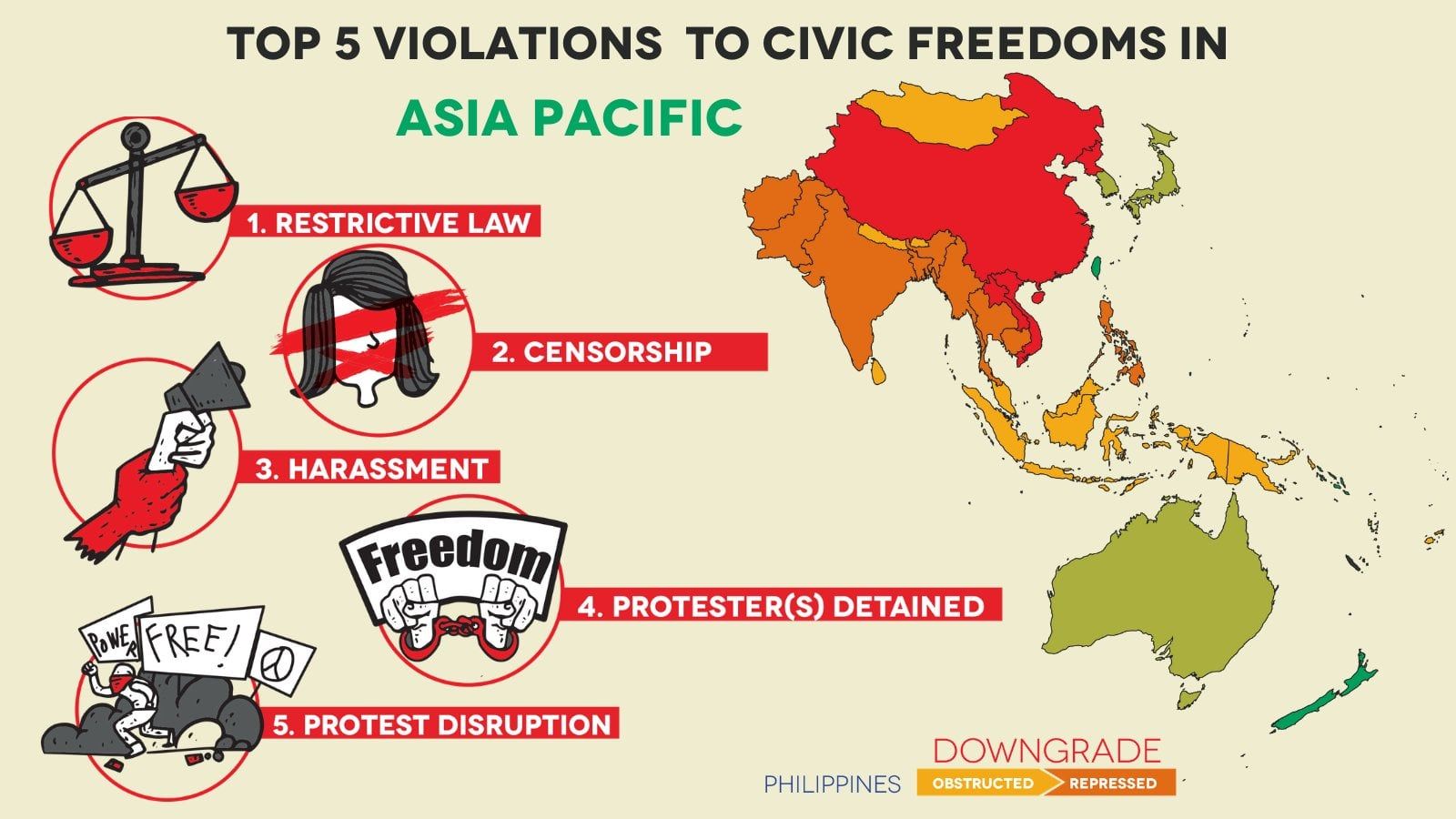
CIVICUS Monitor shows that out of 25 countries in Asia, Vietnam and three other countries, China, Laos, and North Korea, are rated “closed.”
The new CIVICUS Monitor report also indicates that 90 percent of countries in Asia repress civic freedoms. It also raised concerns about attacks on the media and vilification of human rights defenders.
“Our research shows that civic freedoms, including the freedom of expression, assembly and association, continue to be violated across the region. The percentage of people living in Asian countries with closed, repressed or obstructed civic space is nearly 90 percent,” said Josef Benedict, Asia-Pacific Civic Space researcher for CIVICUS.
The report also stated that “in Vietnam, where civic space is rated ‘closed’ … the authorities continue to harass those who criticize the one-party regime. Scores of individuals were arrested or jailed after summary trials under an array of restrictive laws for ‘abusing democratic freedoms’ and ‘anti-state propaganda’, including activists, bloggers and Facebook users. Most recently, the Vietnamese authorities arrested human rights defender Pham Doan Trang – one of the nation’s most prominent independent journalists.”
Journalist Pham Doan Trang. Photo Courtesy: Pham Doan Trang Facebook.
Furthermore, the report also notes that “the persecution against independent publishers, The Liberal Publishing House, has continued in 2020 after a brief pause due to the pandemic.” It further reports that “members of the Independent Journalists Association of Vietnam – the last independent journalist organization in the country – have also been arrested and prosecuted. Human rights groups raised serious unfair trial concerns and allegations of torture in the Dong Tam trial, which has led to convictions. Many activists were kept under surveillance, or detained for months without access to legal counsel and subjected to abusive interrogations.”
Dong Tam Trial. Photo Courtesy: Tuoi Tre newspaper.
The ASIA-PACIFIC ratings overview can be found here.
Two months after journalist Pham Doan Trang’s arrest, Reporters Without Borders (RSF) recently launched a campaign calling for her unconditional release. The campaign includes a petition and a video of Doan Trang’s five Vietnamese overseas colleagues voicing their support for her.
Pham Doan Trang was arrested at her home in Saigon on the night of October 6, 2020. She is the co-founder of Legal Initiatives for Vietnam and worked as an editor for both Luat Khoa magazine and The Vietnamese magazine before her arrest.
She is charged with “conducting propaganda against the Socialist Republic of Vietnam” under Article 88 of the 1999 Penal Code, and “making, storing, spreading information, materials, items to oppose the State of the Socialist Republic of Vietnam” under Article 117 of the 2015 Penal Code (revised in 2017). She is facing up to a 20-year sentence if convicted.
In 2019, RSF awarded Pham Doan Trang the Press Freedom Prize for Impact. Daniel Bastard, the head of RSF’s Asia-Pacific desk, in his statement calling for her release, wrote:
“Because of her bravery and her generosity, Pham Doan Trang has become a symbol of the fight to provide her fellow Vietnamese citizens with reliable, independent journalism. By signing this petition for her release, you demonstrate a commitment to press freedom in a country where all the media are strictly controlled by the communist party’s propaganda bureau. You also express your solidarity with Vietnamese civil society, which is now very active despite state censorship.”
According to RSF, Vietnam has languished for years near the bottom of RSF’s World Press Freedom Index and is ranked 175th out of 180 countries in the 2020 Index.
Pham Thi Doan Trang, a leading democracy activist and a prominent Vietnamese journalist, was arrested on October 6, 2020 in Ho Chi Minh City by Vietnamese police.
Here is a legal briefing updated on the morning of October 9, Vietnam time.
What allegations has the Vietnamese government made against Pham Thi Doan Trang?
Doan Trang is charged with “conducting propaganda against the Socialist Republic of Vietnam” under Article 88 of the 1999 Penal Code, and “making, storing, spreading information, materials, items for the purpose of opposing the State of the Socialist Republic of Vietnam” under Article 117 of the 2015 Penal Code (revised in 2017).
This is a bit complicated. Why are they charging her with two crimes under two separate penal codes? Here is the context:
The 1999 Penal Code (revised in 2009) was replaced by the 2015 Penal Code. The 2015 Penal Code went into effect on January 1, 2018 after being revised in 2017.
The two crimes that Doan Trang is charged with are almost the same. Here is the text:
Article 88. Conducting propaganda against the Socialist Republic of Vietnam
1. Those who commit one of the following acts against the Socialist Republic of Vietnam shall be sentenced to between three and 12 years of imprisonment:
a) Propagating against, distorting and/or defaming the people’s administration; b) Propagating psychological warfare and spreading fabricated news in order to foment confusion among the people; c) Making, storing and/or circulating documents and/or cultural products with content against the Socialist Republic of Vietnam.
2. In the case of committing less serious crimes, the offenders shall be sentenced to between 10 and 20 years of imprisonment.
Article 117. Making, storing, spreading information, materials, items for the purpose of opposing the State of the Socialist Republic of Vietnam
1. Any person who for the purpose of opposing the State of the Socialist Republic of Vietnam commits any of the following acts shall face a penalty of five to 12 years’ imprisonment:
a) Making, storing, spreading information, materials, items that contains distorted information about the people’s government; b) Making, storing, spreading information, materials, items that contain fabricated information that causes dismay among the people; c) Making, storing, spreading information, materials, items to cause psychological warfare.
2. An extremely serious case of this offence shall carry a penalty of 10 to 20 years’ imprisonment.
3. Any person who makes preparation for the commitment of this criminal offence shall face a penalty of 1 to 5 years’ imprisonment.
What does this mean?
Here is the date you need to remember: January 1, 2018. That’s the day the new and current penal code took effect.
The only reason Doan Trang is charged with the same crime under both the old and current penal codes is that the government has been “investigating” her activities both before and from January 1, 2018.
Some people suspect that Doan Trang is linked to the Dong Tam case as she authored and distributed two Vietnamese-English reports on Dong Tam (in February and September 2020). Some others think her case is mainly about her role at the Liberal Publishing House, a samizdat publisher founded in February 2019. But the two charges suggest that the police take the case further than that.
What did Doan Trang do before 2018?
Her famous book titled “Politics for the Common People” was published in 2017, and there was a report on the environmental disaster in central Vietnam in 2016. She has been involved in international advocacy work since 2013 and she also played a role in the environmental protest movement in Ha Noi in 2015, as well as other activities
Who is in charge of the investigation?
The Investigation Bureau of the Ha Noi Police.
Although the arrest was jointly conducted by Ha Noi Police, the Ho Chi Minh City Police, and the Ministry of Public Security (MPS), the lead agency is the local government of Ha Noi.
According to the MPS website, the Investigation Bureau of the Ha Noi Police was the organization that opened the case and filed charges against Doan Trang. The People’s Procuracy of Ha Noi later approved these motions. It is unclear when the motions were filed and approved.
Where is Doan Trang now?
The latest information from the mainstream media is that Doan Trang has been transferred to Ha Noi. Ha Noi Police confirmed the information with the Tuoi Tre newspaper.
Where exactly is Doan Trang being detained? Her family told us that they were informed by Ha Noi Police in the evening of October 8 that she is being detained at Detention Center No. 1 (also known as the new Hoa Lo Prison) in Tu Liem district of Ha Noi.
How long is the pre-trial detention expected to be?
According to Article 173 of the Criminal Procedure Code, as the crime Doan Trang is charged with falls under either the very serious or extremely serious categories of both penal codes, the time limit for detention is four months, and can be extended once for three months.
However, if Doan Trang’s case is categorized as an extremely serious type, the procuracy can extend the detention twice, for four months each time.
The process may be prolonged due to requests for further investigation from the Procuracy or the provincial-level court of Ha Noi. In this case, it could become very complicated as with the case of blogger Nguyen Huu Vinh, who was detained for 22 months before going to trial.
When will Doan Trang be allowed to meet with attorneys and receive family visits?
It’s unclear whether or not Doan Trang will be allowed access to legal representation and to receive family visitation.
According to Article 74 of the Criminal Procedure Code, “the head of the Procuracy is authorized, when confidentiality of investigations into national security breach is vital, to sanction defense counsels’ engagement in legal proceedings after investigations end.”
Articles 88 and 117 fall under the national security chapter of the Penal Code, and therefore access to lawyers is not guaranteed. Even if a lawyer is granted permission to assist Doan Trang, his or her access to the accused, in practice, is not always guaranteed.
Family visitation, according to Article 22 of the Law on Temporary Detention and Custody, depends on the decision of the head of the detention facility. If the investigative agency requests the detention facility not allow the detainee to meet with relatives, the facility head may accept the request, and Doan Trang will not be able to see her family before trial. It’s highly unlikely the facility head would reject such a request by the police.
Here is what the law says:
Article 22. Meetings with relatives, defense counsels and consular access of persons held in custody or temporary detention
[…] 4. The head of a detention facility may not allow a visitor to meet a person held in custody or temporary detention in the following cases, for which he/she shall clearly state the reason:
a. The visitor, who is a relative of the person held in custody or temporary detention, fails to produce his/her personal identity papers or papers proving his/her relationship with such person, or the case-settling agency has requested in writing the detention facility not to let such person meet with his/her relatives for the reason that such a meeting may seriously affect the settlement of the case; the visitor, who is a defense counsel, fails to produce his/her personal identity paper or paper on the defense for the person held in custody or temporary detention; […]
If visitation is granted, Doan Trang’s family can visit her once a month, with each visit lasting no longer than one hour.
What’s next?
We don’t know when the investigation will be completed or when Doan Trang will be presented before the court. However, here is what we can expect:
The People’s Procuracy of Ha Noi will issue an indictment prosecuting Doan Trang.
The trial will be conducted by the People’s Court of Ha Noi, a provincial-level court.
After the trial, if Doan Trang appeals, the case will go up to the People’s High Court in Ha Noi, a tribunal higher than provincial level and lower than the supreme level. Usually, political cases stop after the appellate.
There is no chance that the case will be brought to the People’s Supreme Court, the highest tribunal of the land, as it requires motions filed by either the prosecutor general or the chief justice, both controlled by the very ruling Communist Party that wants to silence critics to protect their monopoly.
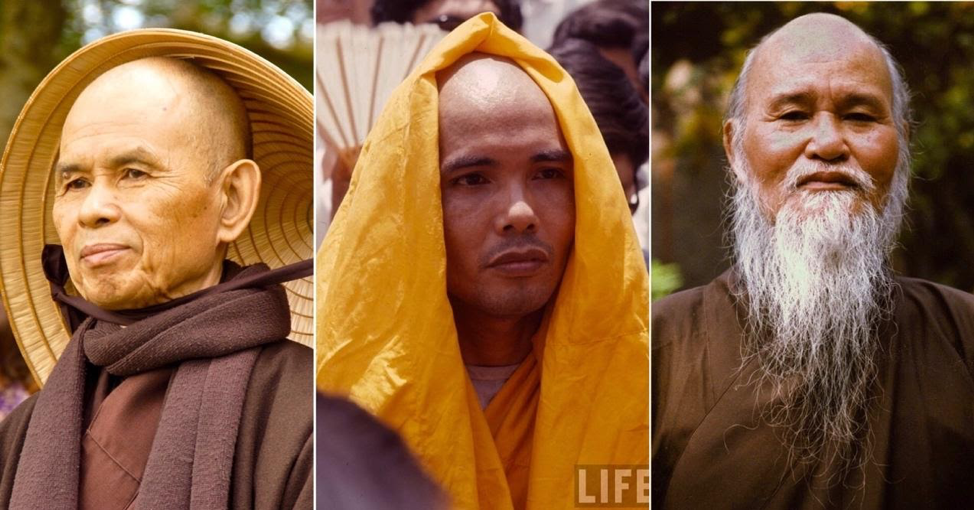
Long ago, there lived three monks: Thich Nhat Hanh, Thich Tri Quang, and Thich Quang Do. All three were well-versed in the Buddhist Dharma. Nhat Hanh spoke eloquently and wrote well. Tri Quang had talent for leadership and was trusted by the masses. Quang Dao was well-studied and excelled in foreign languages.
Long ago, there lived three monks.
When Ngo Dinh Diem’s regime cracked down on Buddhism, these three combined forces to fight back. Nhat Hanh campaigned overseas, calling for peace and religious freedom in Vietnam. Tri Quang led tens of thousands of monks and Buddhist adherents as they protested in Saigon. And Quang Do, the youngest of the trio, stood side-by-side with these Buddhists as they marched on the streets.
Long ago, there lived three monks.
When the communists arrived, the paths of these three diverged. Nhat Hanh became world-famous with his Plum Village Monastery. Tri Quang was imprisoned and refrained from speaking about politics again. Quang Do continued the struggle for religious freedom and human rights, ultimately serving the longest period of house arrest of any monk in Vietnam.
1997
One day in October of 1997, in a theater in Berkeley, California, approximately 3,500 people, who paid US$20 a ticket to meet their most beloved monk, sat in silence.
A ringing bell echoed across the theater, and a monk’s voice loudly called out: “All rise!”. Zen Master Nhat Hanh, draped in a deep brown robe, lead 35 monks and nuns as they slowly spread out across the stage.
Many in the audience clasped their hands before their chests and directed their eyes towards the stage. Sitting on a high podium next to a large, bronze bell and an arrangement of giant sunflowers, Zen Master Nhat Hanh began expounding on mindfulness. “Learn how to stop running,” he advised his audience. “Many of us have been running all our lives.”
“Society is very individualistic, selfish, with people thinking about himself or herself alone. Each for himself, each for herself alone. But in fact even if you have the desire, the intention, to help others, it would still be difficult for you to do so, because when you are not in peace with yourself, it’s very difficult to relate to people in a peaceful way in order to help them,” he stated to reporter Don Lattin of the San Francisco Chronicle.
By that point, Zen Master Nhat Hanh had become internationally renowned for this talks on mindfulness and world peace. After 1975, he stopped speaking to the international media about human rights in Vietnam, even though Buddhism there was suffering through hardship.
At the same time, in a prison cell thousands of miles away from America, Venerable Quang Do was compiling a Buddhist dictionary. He was sentenced to five years in prison in 1995 for helping flood victims in the Mekong Delta. Ten years before that, he witnessed his mother pass away in hunger and poverty after the government exiled both to Thai Binh.
In 1997, Venerable Tri Quang grew accustomed to his comfortable life. He no longer spoke about politics or peaceful resistance.
After 1975, he was confined to a wheelchair to heal his feet, which had atrophied after government torture, according to a monk who was imprisoned with him at the time. From the 1980s onwards, the international media stopped mentioning him and the tragedies of Buddhism in the south.
Childhood in chaos
Born during the tumult of French and Japanese fighting over control of the country, the three monks were all witness to the historical crises of that era.
One day in Diem Dien Village, Quang Binh Province, the mother of Tri Quang met two monks who left a deep impression on her, he relayed in his autobiography. Upon returning home, she told her husband that the family should have someone join the monastery, as the two monks had. Thus, on the eve of the lunar new year in 1938, Tri Quang shaved his head and entered the monastery at Pho Minh Pagoda; he was only 15 years old. The next year, he was transferred to Hue to study for another six years. When he was put in charge of the Quang Binh Province Buddhist Committee for National Salvation (seen as a part of the Viet Minh Front), he saw many of his classmates sacrifice their lives in the resistance war against the French.
Zen Master Thich Nhat Hanh, in Hue, when he was 16 years old. Source: Plum Village.
In Hue, Nhat Hanh grew up the son of a man who worked for Emperor Bao Dai’s government. Nhat Hanh stated the seed of the Great Buddha blossomed within him from when he was very young. Responding to reporter Don Lattin about his childhood, he stated that while he was studying at the village school, he and his friends would go door-to-door begging for bowls of rice to give to those dying of hunger. He relayed that the kids had to decide early on who would get to eat and who wouldn’t because there simply wasn’t enough rice to go around. In 1942, Zen Master Nhat Hanh left his family and entered the monastery at Tu Hieu Temple in Hue. He was only 16.
In the same year, a 15-year old teenager in Thai Binh traveled to Ha Dong province (today’s Hanoi) to enter the monastery at Thanh Lam Temple. He took on the Buddhist name Quang Do. He recalled, only three years after he left his family, he witnessed his master tied up and brought out to the village courtyard like a criminal, after the Viet Minh suspected him of being a traitor. His master was then denounced and executed by three bullet rounds. It was then the young 18-year old swore to himself that he would use Buddhism’s mercy, forgiveness, and non-violence to fight against fanatics and the unforgiving.
A united sense of purpose
After the tragedy at Thanh Lam Temple, Thich Quang Do went to study in Hanoi. During this time, Tri Quang and Nhat Hanh likely met one another in Hue.
At the time, the Bao Quoc Buddhist Institute had just been established in Hue in 1947. A year later, Tri Quang became a teacher there, and Nhat Hanh a student.
In 1950, Tri Quang went to Saigon for the first time, concurrent with Nhat Hanh. In Saigon, Tri Quang, along with some other monks, unified three Buddhist institutes into one, locating it at An Quang Temple. Nhat Hanh began teaching here.
Both Nhat Hanh and Tri Quang had a common desire to unify Buddhism and develop it into a national religion [1]. Both pursued this desire through journalism.
After the Geneva Accords were signed in 1954 and the country was temporarily divided in two, Tri Quang became the editor-in-chief of the Vien Am paper. A year later, Nhat Hanh was made editor-in-chief of Vietnamese Buddhism, but after two years, he was forced to suspend the paper after pushing for Buddhist unification too vociferously.
During this time period, both individuals suffered enormous mental anguish. Nhat Hanh was completely “defanged” in his struggle and afterward temporarily withdrew from the limelight, retreating to a solitary location with allies in Lam Dong. Tri Quang, haunted by images of his mother being publicly denounced in 1956, wandered to Nha Trang before returning to Hue in 1960. Buddhism’s suppression (by Ngo Dinh Diem’s government) would add an extra layer of pressure on top of his mother’s tragedy.
In 1958, Quang Do returned to Saigon after studying abroad in Sri Lanka and India. Under Ngo Dinh Diem’s religiously discriminatory regime, and the conflict brewing between the Nationalists and the Communists hanging over their heads, young Nhat Hanh and Quang Do were not able to accomplish much in the way of big tasks. But it seems all three were able to sense impending disaster for Buddhism in the south.
In his book Intention’s Road Home, Zen Master Thich Nhat Hanh explained that in 1961, when he and his friends’ place of residence was raided, he had to retreat to Saigon for safety. During this difficult time period, he traveled to the United States, where he conducted research on Buddhism at Princeton University and then taught at Columbia University.
Pictures of Zen Master Thich Nhat Hanh, Venerable Thich Tri Quang, and Venerable Thich Quang Do, taken in 1960. Source: PVCEB, AP, and Vietnamese Buddhists.
Days of struggle
On the night of May 8, 1963, as Venerable Tri Quang, head of central Vietnam’s Buddhist Association, stepped into Hue’s radio station together with the provincial leader to resolve ongoing protests as gunfire rang out among the Buddhist crowds surrounding the station. That night, Hue Radio did not broadcast as promised the program celebrating Vesak, recorded earlier that morning. Compounding popular anger was the fact that the government had prevented the flying of Buddhist flags. The crowds did not disperse until two in the morning. That night, many were seriously injured, resulting in eight deaths.
In the gloom of the next morning, as Venerable Tri Quang was resting, roiling crowds of young people began filling the streets, holding Buddhist flags. That same day, Buddhists in Saigon decided to establish the Inter-party Committee to Protest Buddhism (abbreviated as the “Inter-party”), confirming a drawn-out struggle. Venerable Tri Quang sat on the Advisory Board, while Venerable Quang Do worked as assistant to the public relations committee of the Inter-party.
The objective of the Inter-party was to get the government to respond to five demands: withdraw the decree banning the flying of Buddhist flags, put Buddhism on equal footing with Catholicism, end the suppression of Buddhist followers, grant Buddhist monks and nuns the freedom to proselytize, and compensate for the deaths caused (during the crisis) and punish those responsible.
In the two days following the incident at the Hue radio station, Buddhists protested spontaneously, but thereafter, they gained a sense of order and organization with Venerable Tri Quang’s direction, the monk recounted in an autobiographical short story. He also found ways for Buddhists to come to Tu Dam Temple to pray each week for those who had passed away. In Saigon, monks organized spiritual processions from one temple to the next, as well as protests and hunger strikes.
The government only ramped up its repression; many temples in Hue were blockaded, and monks and nuns were publicly attacked. It wasn’t until Venerable Thich Quang Duc, 73, immolated himself on June 11th, 1963 that the situation improved in any meaningful way. Tri Quang traveled from Hue to Saigon to enter into discussions with the government.
In the weeks and months that followed Venerable Quang Duc’s self-immolation, the Inter-party signed a joint communiqué with the government responding to Buddhism’s five demands. However, the government never implemented the communiqué, greatly angering monks, nuns, and the general population.
According to Thich Nhat Hanh, at the time he was in America campaigning for religious freedom and a cessation of war in his own homeland. He appeared on television, met journalists, translated materials detailing the human rights violations in Vietnam, and pushed international organizations, including the United Nations, to intervene in the increasingly volatile situation in South Vietnam.
As Thich Tri Quang relayed in his autobiography, on the morning of July 17, 1963, Venerable Quang Do was unable to deliver translated international press updates to Xa Loi Pagoda. That day, countless Buddhists poured into Giac Minh Temple, where the monks were on a hunger strike. These crowds quickly morphed into an enormous protest. As the Buddhist adherents tried to approach Giac Minh Temple, they were blocked by police. Venerable Quang Do was among them, directing the protests to struggle not only against the police barricade but for Buddhism itself. In his book History of the Vietnamese Buddhist Struggle, Monk Tue Giac writes that after 10 am that morning, the protests had devolved into a fighting match with police. Venerable Quang Do suffered a head injury, blood pouring down his face. Any Buddhist who had not been arrested by police returned to Giac Minh Temple, resisting as barbed wire fencing kept more than 600 monks, nuns, and adherents barricaded for 54 hours.
Thich Quang Do (circled) directs a protest on the streets of Saigon, July 17h 1963. Source: HORST FAAS/AFP.
By August 20, 1963, Ngo Dinh Diem’s government was determined to restore order. A day after martial law was imposed, monks were arrested and adherents attacked. Venerable Quang Do was apprehended. Venerable Tri Quang went to the American Embassy to apply for amnesty.
From that point until President Ngo Dinh Diem’s assassination on November 2, 1963, the struggle raged between Buddhists, the Army, and international pressure.
In December 1963, after the struggle had succeeded, Venerable Tri Quang along with other monks established the Unified Buddhist Church, Venerable Quang Do went overseas for medical treatment, and Venerable Nhat Hanh returned to Saigon.
While Venerable Tri Quang mobilized Buddhist adherents, monks, and nuns to continue the political struggle, Nhat Hanh was able to fulfill his wish of establishing several campuses, including the La Boi Publishing House, Van Hanh University, the Youth School for Social Services, and the Tiep Hien Congregation (a congregation centered on the full integration of Buddhism into daily life).
Thich Tri Quang walks among South Vietnamese soldiers in Danang, January 1965. Source: Christian Simonpietri/Sygma/CORBIS.
In May 1966, Thich Nhat Hanh headed to the US to campaign for an end to the war in Vietnam. After three months, the South Vietnamese government refused to let him return home. At the time, Thich Nhat Hanh began becoming world-renowned as the face for peace in Vietnam. The next year, Reverend Martin Luther King nominated him for the Nobel Peace Prize.
Thich Nhat Hanh on his way to the United States to campaign for the end of war in Vietnam. His trip was originally planned to span three months, but after he left, the South Vietnamese government refused to let him return home again. Source: PVCEB.
A road diverged three ways
At the beginning of 2005, as the people proudly and warmly greeted his arrival, Zen Master Nhat Hanh was finally able to return home after more than 40 years away, accompanied by a Sangha of approximately 200 adherents. He conducted talks with audiences that included party members in Ho Chi Minh City, Hue, and Hanoi.
Meanwhile, Venerable Quang Do lived in solitary confinement, locked in a room at Thanh Minh Zen Monastery in Ho Chi Minh City. Across the street were police whose only job was to keep an eye on him day and night.
During his trip, Zen Master Nhat was able to visit Venerable Tri Quang but not Venerable Quang Do.
In the eyes of the Vietnamese media, Zen Master Nhat Hanh was someone to be immensely proud of, he was “flesh and blood” who had returned to his homeland to further contribute to the people’s well being. Venerable Quang Do, on the other hand, was a boil that the government tried every means to remove. But back then, both monks were cut from the same cloth, up until the day Saigon fell.
After 1975, as Zen Master Nhat Hanh set up his Plum Village Monastery in France, Venerable Tri Quang was imprisoned for a year and a half in a hole the size of a coffin, which he was only allowed to leave for 15 minutes each day to wash up. From then on, people no longer saw him calling for protests or making demands for Buddhism; the international media was never able to make direct contact with him again for as long as he lived.
After the war, Venerable Quang Do along with a number of other monks fought for those who had self-immolated in the name of religious freedom and in protest of the new regime’s intention to eliminate the Unified Buddhist Church of Vietnam. In a country with no international media, no independent courts, and no freedom of association, these efforts would be in vain, the number of immolated corpses perhaps outnumbering that of the old regime. He was never able to reach a compromise with the government, up until the day he died.
Long ago, there lived three monks: Nhat Hanh, Tri Quang, and Quang Do. When the communists arrived, the lives of these three diverged completely.
Correction (April 12, 2020): in a version of this article, we had written that Zen Master Thich Nhat Hanh had entered the monastery at Tu Dam Temple. We wish to correct this to Tu Hieu Temple, in Hue.
Footnote: [1] See numbers 2 to 28 in Buddhism Magazine, and Intention’s Road Home (Zen Master Thich Nhat Hanh).
References:
Autobiographical Short Stories (Original: Tiểu truyện tự ghi), Venerable Thich Tri Quang.
Autobiography of Tri Quang (Original: Trí Quang Tự Truyện), Venerable Thich Tri Quang.
Intention’s Road Home (Original: Nẻo về của ý), Zen Master Thich Nhat Hanh, translated by Chan Dat
On the morning of April 19, 2008, indigenous villagers of Ia Piar – more than 80 km away from the Gia Lai provincial capital in Pleiku – were heading to their commune people’s committee with well prepared posters and banners calling for religious freedom and the protection of land ownership. They had their own “battle plan” ready, but so did the authorities.
Soon after the protest began, the villagers, who are Protestants, ran into a group of strangers carrying wooden sticks in their hands. For no reason, the protesters were severely threatened and beaten by these people. To save their lives, the villagers ran off in different directions, except for Nay Them, who was arrested despite not having joined the protest.
Nay Them recalls how the meeting room of the district police, where he was first interrogated, soon turned into a “slaughterhouse”. The police tied him to a chair with electric wires. He was tied so tightly he could barely move, not even a centimeter.
As if in a Hollywood movie, policemen kept walking around Nay while his whole body was shaking violently after being kicked, slapped, and beaten with batons that directly struck his head. Being shaken up after falling down from the chair, he was beaten over and over again. The people who hit him no longer considered him as one of their compatriots.
There was no attempt to talk to him nicely or to reason with him. Or maybe it was simply because this tactic is not used for ethnic Jrai people such as Nay. He had no rights at all, not even the right to talk, or to even open his mouth.
The police insisted that Nay knew exactly where the protestors were hiding. They kept beating him over and again with their hands and a baton. “ Soldiers, plainclothes policemen, mobile policemen and even traffic policemen were enjoying beating me up”, said Nay. “One of them walked around me and finally hit my face with a baton”. Blood splattered from his swollen nose and eyes until Nay fainted.
The next day, Nay woke up at a detention center with wounds all over his body. “I was in so much pain my eyes were swollen”, he recalls. “I could sit but could not open my eyes. I could not eat for five days”.
Ia Piar Commune is almost 80 km away from Pleiku, the provincial capital, and about 17 km away from the district police department.
Meanwhile, Nay’s brother-in-law, Siu Wiu, the person in charge of the protest, was hiding far away deep in the forest. Siu was a small, muscular Jrai, a typical example of the dark-skinned Montagnards in the Central Highlands. His eyes were as sharp as a cat’s.
Every policeman in this district knew Siu Wiu. He had been sent to a re-education camp in 2004 under the charge of leading a demonstration. At the camp, Siu met 180 other Jrai people who were exploited while being held prisoner. They worked as sugar cane porters or builders from early morning until evening . “Everyone was beaten by hoe handles no matter who they were – young or senior citizens,” Nay said.
“We were arrested not for burglary, but for fighting for land protection and religious freedom”, he said. “Do you know if treating us like this is right or wrong?” Siu recalled asking one officer at the camp.
Two years later, he was set free, the re-education camp having failed to change Siu’s thinking about the government.The camp gave him 160,000 dong, which was just enough to buy a bus ticket home, leaving him without any money to buy anything to eat on his way back to his village.
Meanwhile, Siu’s family members – all Protestants – continued to be targeted because they had taken part in the protests. Some had been detained, arrested or imprisoned.
Siu Wiu was under house arrest while his father, Nay Bro, was imprisoned. “I was not allowed to do anything, and our land was also taken by the government,” Siu said. He added that the government had take three-quarters of his land, leaving just a little than 250 square meter left for farming.
Facing such difficulties, he called for a protest in front of the people’s committee of the Ia Piar commune. Other villagers joined Siu in the protest.
“In order to convince the villagers to join this protest, I talked about the truth. They also lost their land so they followed me”, said Siu. “Their beliefs were threatened by the government. Their family members had been sent to prison for religious reasons. The government said that we were free to exchange information, free to communicate. But in fact, we would be arrested whenever we raised our voices.”
Protests such as this were not uncommon in the Central Highlands of Vietnam. From 2001 to 2008, demonstrations have taken place frequently in the area and thousands of people have fled to Cambodia to escape the government’s revenge.
One month hiding in the forest was too much for Siu Wiu. He decided to go home to look for more food, but he was detained immediately. “I was arrested at around 4 pm and severely tortured,” he said. “They tied my legs to the chair with a hammock string and started to beat me until my mouth was swollen, my eyes could not open properly, and my ears were full of blood”.
Siu was sentenced to 10 years in prison at the end of December 2008.
Nay Them, who was released right after they caught Siu, never forgot what the policeman told him: “I understand that you don’t know about the protest, but as I was afraid that you would hide some information, I had to beat you first”.
The experiences of Nay Them, Nay Bro and Siu Wiu show how the Central Highlands of Vietnam is like a large prison for ethnic people who fight for their religious freedom and land rights. The more remote their villages are, the more controlling the local governments are. No law exists in these far-flung regions.
No lawyers dared to defend them. In addition to being a warning to villagers of the high cost of joining protests, the mobile trials were also a government ruse to make it appear that those charged had been given a fair trial. The trials were a sham. And even when left prison after serving their time, they’d still never be free people.
Nay Bro had been sentenced to seven years in prison for sabotaging the great unity policy after being accused of organizing protests in 2005. At the detention center, he was imprisoned with 62 other Jrai, Ede and Bana people for their work on behalf of land rights and religious freedom.
After being released from prison, the local police kept an eye on him as he remained a suspect in the plotting of protests.
“On August 25, 2015, the police came to arrest me again,” said Nay Bro. “They came to my house while I was looking for bamboo shoots in the forest. When I headed back home, my wife informed me that there were 5-6 policemen visiting my house. They asked her to keep me in my house as they wanted to see me the next day. I would rather die in the forest than be put under communist surveillance”.
Nay Bro took his personal belongings and informed his daughter that he and his wife would be away for a few days to take care of some friends in the hospital. Nay and his wife hid in the forest for more than 11 days.
Stateless in Thailand
As a highlander, Nay Bro didn’t believe what lowlanders often said: “If you didn’t do anything wrong, the police would set you free.” From his own experience, he knew that “once I was imprisoned for the first time, I would have no chance to go home after the second time I was imprisoned”.
In September 2015, Nay Them helped his parents-in-law travel to Saigon, where they then followed a stranger travelling by bus to Thailand. Crossing the border was the only way to avoid being arrested by the government and sent back to a reform camp or prison. Thailand was the favorite place for Montagnard refugees seeking to escape Vietnam.
Siu Wiu (right) and his father, Nay Bro, standing in front of their house above a river in Thailand. Nay Bro has been waiting for resettlement for almost 4 years in Bangkok, not knowing what will happen next. Photo: Luat Khoa tap chi.
The word Montagnard was first used by the French when they ruled Vietnam to refer to the more than 20 different ethnic groups indigenous to the Central Highlands. These indigenous peoples lived in the Central Highlands before the Kinh, or Vietnamese, people arrived. The E-de, Jrai and Bana people have a larger population than other ethnic groups, such as the K’ho, Sedang, Stieng, and Ma.
Today, the word Montagnard has disappeared from official state usage,. They are now generally known as “ethnic minority people”.
Them was arrested in November 2016 after the police discovered that he was involved in helping his parents-in-law escape across the border to Thailand. He was in a dilemma between asking his in-laws to return to Vietnam and being prosecuted on the charge of “forcing others to flee or stay abroad illegally”, which carried a punishment of at least two years in prison.
Once again, crossing the border was the only way that Nay Them could think of to get out of his predicament. He took his wife, two children and his wife’s younger brother to Thailand with him after having been temporarily released. The arrest warrant was issued immediately after they left.
In the middle of July 2019, I met Nay Them and his wife’s other eight family members at a refugee camp in a suburb of Bangkok. They lived not far from the WestGate Shopping Mall, in the Bang Dai District, Nonthaburi Province. Siu Wiu came to Bangkok in 2018 after finishing his 10-year prison term.
Temporary identification cards issued for asylum seekers Nay Them and his family. Photo: Luat Khoa tap chi.
That day, Nay Them looked exhausted and frustrated. With a big paper board hanging in front of his chest, he and his two year old daughter, who was born in Thailand, wandered around different NGO offices, such as the United Nations High Commissioner for Refugees (UNHCR), begging for help for his wife, who had been detained for over a year.
Sen Nhiang, a Jrai person who took me to the camp from the MRT station, said “Although living in poor conditions here, I can follow my Protestantism freely. In the worst case, even if I’m arrested, I would not be beaten as the Vietnamese police did to me”.
Together with his wife and three other children, Sen lived in a 20 square meter room. There were no chairs or tables. A thin mattress lay in a corner, and the only other objects were an electric fan, clothes, books, a gas cooker, and an empty fridge; a Christian crucifix was placed solemnly in another corner of the room. His three children spoke Jrai and Thai much better than Vietnamese. His wife was sitting in front of their house weaving a towel for overseas Vietnamese who donated rice for her community. For almost a year, Sen had no job, as was the case with other refugees living here. His 14-year old daughter had just broken her arm and he was looking for support to continue her treatment.
Talking about the status of the Montagnards in Thailand, Grace Bui, a retired US attorney, said that this area is now home to over 500 Montagnards, with approximately 120 children. “Thailand did not sign the United Nations Convention in 1951 on the status of refugees, so Montagnards, despite being recognized as refugees by the UNHCR, are still illegal residents,” she said. “They are not allowed to work, and police can arrest and punish them very harshly.” ”
Grace has been voluntarily working in the camp over the last four years. She works with overseas Vietnamese to obtain rice donations. Grace asks the INGOs, UNHCR for support for the most needy cases, especially when someone is arrested.
Y Rin Kpa, an Ede ethnic man from the Central Highlands, who had been in prison for 10 years for taking part in protests, messaged me via Facebook from a refugee camp in Cambodia. He told me that he was in a camp in Phnom Penh with 27 other Montagnards, including seven children under 14.
He reported that Cambodian police were strictly surveilling these people. They lived with very limited subsidies and supplies funded by the UNHCR every month. However, their biggest fear wasn’t living under such a demanding situation, but of being deported back to Vietnam, where they could face imprisonment and other abuses. A family of three was forced to go back to Vietnam in June 2019.
Evan Jones, a coordinator for Asia Pacific Refugee Rights Network, a non-governmental organization that advocates for refugees in the Asia Pacific region, explained why these people don’t want to return to Vietnam.
“Vietnam is well-known for punishing returnees with prison sentences, harassment, physical abuse and intimidation,” she said. “It has been particularly difficult to keep in contact with Montagnards who have been forcibly returned in the past. This may suggest that they have faced reprisals from the Vietnamese authorities after their return.”
The Criminal Law issued in 2015 includes four articles for prosecuting people for illegal border crossings. The shortest prison sentence is one year (Article 349) if charged with organizing or brokering illegal emigration. The law stipulates up to 20 years in prison for particularly serious cases as stated in Article 121, which covers illegal emigration for the purpose of opposing the people’s administration.
Phil Robertson, deputy director of the Asian Division for Human Rights Watch, has been observing the human rights situation in the Central Highlands for nearly 20 years. He is not optimistic about the situation of Montagnard refugees.
“Vietnam continues to press hard to persuade the Thai government to force Montagnards to go back. In Bangkok and nearby provinces, Montagnards live in difficult situations, doing low paying work in the informal sector, and facing problems with access to health and education services for themselves and their children. Most importantly, they don’t know what the future will hold for them, and whether they will ever be safe,” he said. “In Cambodia, Vietnam’s influence is even greater [than in Thailand], so seeking protection is even harder. UNHCR officials and diplomats based in Bangkok and Phnom Penh, who represent governments that resettle refugees, should redouble their efforts to protect the Montagnards, and strongly resist Vietnam’s efforts to force the Montagnards to go back.”
Despite pressure from the Vietnamese government, the number of Montagnards crossing the border into Thailand is still increasing. “The total number of Montagnards [crossing the border] has increased,” said Sen Nhiang.. “Last month, there were 20 more people coming from Dak Lak. We don’t have enough rice to give them”.
Sen Nhiang and his wife, sitting in their small studio apartment in Bangkok, recall what made them escape Vietnam to become stateless in Thailand. Photo: Luat Khoa tap chi.
Vietnamese embassies in both Thailand and Cambodia refused to speak with Luat Khoa about the situation of the Montagnards. In Thailand, the embassy didn’t respond to our emails, faxes or phone calls. In Cambodia, a staff member named Ngoc informed us that he had no information about the status of the Montagnards in Phnom Penh, while the Politburo officer said Ngoc was the only one who could answer our questions.
The Montagnard refugees don’t speak English or Thai and very little Vietnamese. As a result, it takes them much longer to go through UNHCR procedures to obtain refugee status; after that, they have to wait for approval from a third country to be re-settled. The chance of resettling is uncertain, and nobody is sure what the future will be like.
Jennifer Harrison, UNHCR spokeswoman in Bangkok, said she could not reveal the total number of Montagnards who are applying for refugee status at UNHCR. She said UNHCR is doing its best to help refugees.
She said: “UNHCR consistently advocates that refugees and asylum seekers – having been confirmed or claimed to be in need of international protection – cannot be returned to their countries of origin according to the principle of non-refoulement, which prevents states from expelling or returning persons to a territory where their life or freedom would be threatened.”
Losing all in Vietnam
For hundreds of years the Montagnards have depended upon the forests to earn their living and to survive. It’s said that the Montagnards preserved the forests of the Central Highlands to serve the never-ending needs of the Kinh people – the majority of Vietnam’s population. The beds the Kinh people lie on and the chairs they sit on likely come from forests in the Central Highlands.
The Montagnards sacrificed their own fertilized lands to welcome immigrants from the north when the country was divided into two regions in 1954. And they did this again when the lowlanders moved to the new economic zones on the order of the government in a move to deal with population growth and unemployment in cities after 1975.
The Montagnards I met in Thailand said that they had been under surveillance by the Vietnamese government back in the villages in the Central Highlands. First they were not allowed to follow their Protestant beliefs and then they lost their lands.
The Central Highlands has become the most religiously sensitive areas in Vietnam following a long period of persecution since 1975. Photo: East West Center.
The Central Highlands is no longer a mysterious land when native customs and customary laws continue to be abolished by the government.
“When I was a child, I heard from teachers and the commune people’s committee that praying for rain, buffalo stabbing and other traditional practices were considered backward customs and superstition”, said Nay Them. “They asked the village elders to abandon these ancient customs”.
People eliminated costly rituals and men stopped smoking and drinking once they started to follow Protestantism. And so it was strange in the early 2000s when the government asked the people to restore their traditional customs. Between 2000 and 2004, the government wanted to limit the number of Protestants and so sought to restore these old customs, which were anathema to their religious beliefs.
“They said that these were the original customs of the Central Highlands, and that following Roman Catholicism and Protestantism were following French and American customs,” said Nay Them. He had witnessed the police take away Bibles away from people and beat them, but he did not understand why they did it.
Under strict controls by the local authorities, Nay asked his community to focus on praying at the beginning of the month, but it was also very difficult. At the beginning of the month, the villagers secretly prayed together at the leader’s house. Every Sunday, the police would come and check all the houses. If they found people praying, they would force them to go to the police station. Police said that this religion was not allowed, especially when the people gathered and prayed at the same place.
“I went to the public church but what I got was contemptuousness,” said Nay Them. “They also discriminated against me for advocating against the government”.
Pastor Than Van Truong, who helped some Montagnard families cross the border to Thailand, said that in the 2000s the number of house Protestant groups in the Central Highlands increased sharply. These groups paid much interest to human rights as the local government had been discriminating against them regarding administrative procedures and land disputes. The people depended on their religious affiliations to share their concerns about such issues.
There are many Protestants like Nay in the Central Highlands who also need to pray at home.The number of Protestants in the Central Highlands increased by 432% from 1975 to 1999, to a total of 228,618 followers.
The Protestants in the Central Highlands have long been regarded as a threat to the Communist regime. In 1999, former Prime Minister Phan Van Khai, along with Nguyen Tan Dung, one of the deputy ministers responsible for the Central Highlands, established the 184 Steering Committee (the Committee for the Guidance of Correct Thought) to suppress Protestants in the Central Highlands and the northwest.
“When we pursued and drove away FULRO (the United Front for the Liberation of Oppressed Races) and the rebellious groups, evangelical churches in some places had to be closed….”, according to a committee statement describing its successful effort to control Protestantism in the Central Highlands. “After a few years of taking measures against Protestantism, such as suspending religious activities of Protestantism, dismissing the governing board of deacons, re-educating the clergy in detention camps, closing churches, dealing forcefully with unauthorized religious activities and agitating for the masses to defect from their own religions in fact, Protestant activities have been narrowed and prevented from operating in a normal way”
FULRO was an armed movement fighting for independence for indigenous people in Vietnam. They fought against both the regime of the Republic of Vietnam and the Viet Cong. After hiding themselves in the forests in Cambodia, FULRO was disbanded and its members were resettled in the United States at the end of 1992.
Neil L. Jamieson, Le Trong Cuc, and A. Terry Rambo – three researchers – predicted in a special report published in 1998 that there might be some crisis in the area, and this prediction became true between 2001 and 2008.
“Many upland people began to see themselves as poor and backward. They felt inferior to lowlanders, to foreigners, and even to some other minority groups”, the researchers wrote in their report. “Lacking money, food, access to natural resources and public services [education, health care, information], they were on the edge of losing their most precious resources of all: self-confidence and self-respect. It was not just that they lacked money and access to daily necessities. After all, the uplands have always been economically worse off than the lowlands. The problem is that the people gradually became self-conscious about their economic status.”
In early 2001, thousands of Montagnards paraded from their villages to the government center in the region for a protest. The government then issued a curfew order, cut off the telephone lines, mobilized tanks and mobilized army forces to eliminate the massive protest.
In order to alleviate the situation, author Nguyen Ngoc suggested former Prime Minister Nguyen Tan Dung, who was in charge of the Central Highlands, to revise land ownership policies, but he refused to do this. Dung sent the protesters work as forced laborers in re-education camps and prisons.
Since the 2001protests, the government has claimed that FULRO and its Degar Protestantism, a religious organization that unites the Montagnard Protestants to stand up for their rights, was behind uprisings and activities that were opposed to the government in the Central Highlands. Until now, many Montagnards continue to be persecuted as the government thinks they have links to these organizations.
In the refugee camp in Bangkok , I had tried to find out the connection between the refugees and Degar Protestantism but the people I spoke to claimed to have no idea about it. Pastor Than Van Truong said that he had asked the Montagnard pastors to get more information about Degar Protestantism but again no one knew anything about it.
Kpă Hung, a 44-year old Bana man, who was arrested for the third time in 2004, when he was sentenced to 12 years in prison, lost his faith in the government. “On the protest day, I sought a transparent dialog between the government and the people,” he said. “But they neither admitted their faults nor changed their minds”.
Meanwhile, Prime Minister Dung has continued to push harsh policies in the Central Highlands during his two succeeding terms as prime minister.
A former UN staff member in Vietnam told Luat Khoa that the state considered the Central Highlands “very sensitive” in terms of religious and ethnic issues.The United Nations in Vietnam could only intervene in the Central Highlands indirectly through Universal Periodic Reviews (UPR) and visits by the UN special rapporteur.
Land issues did not improve after a series of misguided policies in the Central Highlands, such as hydropower projects, which allocated most of the land to agroforestry farms and land in forest areas to Vietnamese and other migrated minority groups from the north. The Montagnards didn’t received any benefits. The Land Law issued in 2003 and 2013 did not solve the land problem for indigenous highlanders.
An anonymous expert with a decade of experience working on forest lands said that the land issue in the Central Highlands was extremely complicated. He said that land disputes in some areas of the regions accounted for more than 90% of complaints. Land disputes had been taking place among the Montagnards, the government, businesses, the Kinh and other ethnic migrants.
The expert said that the Montagnards continue to face many disadvantages. “For example, they didn’t have sufficient legal evidence to fight for their land”, he said. “And furthermore, the government did not provide adequate compensation for the indigenous people who lost their land to the government. Their land was not protected by customary laws and the people didn’t even have the right to agree on prices.”
The expert said that those indigenous people who didn’t want to fight, moved closer to natural forests, but they once again had to confront the government.
He added that the vicious cycle of land loss, land shortages, land disputes and encroachment was a result of multiple factors. “For instance, forest land for ethnic people to cultivate was worth approximately 15 million dong/ha/year. But if they switched to trading crops, the profit would rise to 80-120 million dong/ha/year,” he said.
The Montagnard families whom I met in Bangkok told me that they had little to no space available for use. They didn’t have enough capital to grow high-value crops so they tried to live day by day.
Children under threat
In an old house above the small canal, I found a group of Jrai women painting scenes of their unforgettable escapes from Vietnam. While there, I met Jen, a 20-year-old Jrai girl who had fled to Bangkok the year before. She spoke a little English and the Jrai language, and she was working hard as a translator for an American artist who was coming to the camp every weekend to provide painting therapy to her mom and others in the camp.
Jen’s mother was painting a scene about how she lost her two-year daughter after they passed through the immigration check-point at the border. While she hid herself under the bus she let her daughter go with the guide through the check-point. They reunited two days later in Laos and continued their escape to Thailand.
The paint of Jen’s mother described her escape to Thailand. Photo: Luat Khoa tap chi.
When her mother fled to Thailand, Jen was still a child in the Central Highlands. “My two younger sisters and I had to take care of ourselves. We were very scared right after our parents had left home….” she said. “We cried so much, but we accepted the reality after two or three months, and we tried to be stronger for the next three years”.
Jen stuttered when describing the time her mother tried to escape from the police after being forced to provide her husband’s contact in Bangkok. “My mother didn’t say that she was about to go to Thailand,” said Jen. “She told me to stay at home and take care of my two younger sisters; then she walked away with my youngest sibling.”
“When I turned 18-years-old they came to my house and asked if my father had called me or if I had contacted my parents,” she said. “I dared not to speak any words. I was afraid that they would arrest me.”
Jen said there were many similar cases in her village. “the police arrested the family members and beat them at the police station”, she said. “When they came to see us, we gathered at the corner and I tried in fear to protect my sisters with my arms.”
“Once again, the police ordered me to come to their office. They threatened that if I did not call my parents and urge them to return home, I would be put into prison,” she said. “They asked me to give them my parents’ contact information. I answered that I didn’t have any. I was so scared that I only spoke a few words and then burst into tears. They yelled at me. They beat me up. They slapped my face and head. Each night, they sent some people to investigate our house.”
Jen later decided to give 10 million dong (about US$430) to the man next door to send her three sisters to Thailand. The money was from her grandmother and her job.
“At 3:00 am that day, the man took the three of us to Saigon [Ho Chi Minh City”, she said. “At the Mien Dong Bus Station, he told us to wait until someone picked us up. Finally, a man came and forced us to walk quickly. We jumped into a small car with many people, I had no idea what would happen next. We walked through the river and the jungle. After three days, we arrived in Thailand”.
To escape the threat of Vietnamese police, children like Jen’s sisters had to go with strangers and travel in dangerous cars with the hope that they would later be able to reunite with their parents. The children faced the danger of being kidnapped, sold to brothels, or forced to work as slaves.
For the past two decades, only international organizations abroad have been monitoring the situation in the Central Highlands, but they are struggling to get accurate information due to government restrictions in the area.
Many NGOs remain silent when asked about the situation in the Central Highlands for fear of government retaliation. World Vision Vietnam, a Christian organization that has helped children in Vietnam for 30 years, declined to comment on the situation of children in persecuted Protestant families in the Central Highlands.
Phil Robertsonbelieves that the Vietnamese government is trying to cover up its human rights violations in the Central Highlands.
“The problem is Vietnam sees its abusive treatment of the Montagnards as an internal matter and does everything it can to keep the international community out of this,” said Robertson. “But in reality, what Vietnam is doing to the Montagnards clearly violates international human rights, and so the international community is quite right to be concerned about this.”
Robertson added that Hanoi severely restricts access to the highlands to keep diplomats and human rights monitors like HRW, UN officials, and international media out of the picture, so it is sometimes difficult to get up-to-date information about what is happening there.
“By making it difficult to get information from the area,” he said, “Vietnam hopes to make the world forget its blatant discrimination and rights abuses against the Montagnards.”
“Over the past 20 years, the Montagnard people have gone through hard times, especially during crackdowns by the authorities after protests, but these communities are strong and they continue to persevere in the face of government repression,” he said.
A Ga said that his case caught the attention of U.S. government because he was arrested by Thai police in January 2018. He said he believes the Vietnamese government was involved in his arrest. After three months in detention, he and his family were taken to the Philippines and then flown to the United States. Now he has begun a new life in North Carolina – the place where many Montagnards families have resettled in the past.
Meanwhile, in the refugee camps in Thailand and Cambodia, Montagnard refugees continue to live desperate lives, not knowing what the future holds for them.
While you are reading this article, somewhere on the desolate borders between Vietnam, Cambodia and Laos, there are likely some frightened Montagnard families making the harrowing trip across the border, running away from the Vietnamese government in the hope of finding a new and better life.
As a Vietnamese overseas student working on her Ph.D. at Indiana University’s School of Law, Huong Nguyen was focused on her academic career but couldn’t stop thinking about the activist community she was involved with in Vietnam.
This explains why she frequently reached out to students and gave presentations around campus, one of which was the student chapter of Amnesty International.
It was there that she met Kaylee Uland, a blonde, blue-eyed undergraduate whose life growing up in Indiana was far removed from Vietnam and the communist government’s litany of human rights violations that she heard from Huong that day.
“This was one of my first exposures to learning about political prisoners, and it gnawed at me learning that some people were in prison solely because of expressing their political or religious beliefs or a blog post,” Kaylee responded in an email.
Fired up by Huong’s talk, Kaylee began to dedicate herself to advocacy efforts alongside Huong, conducting public outreach efforts on campus and letter-writing campaigns. Around the same time, Huong connected with Ella Gancarz, a filmmaker who wanted to create a documentary about human rights in Vietnam. At the junction of these partnerships, The 88 Project was conceived in 2012.
The group takes its name from Article 88, one of the provisions of the 1999 Criminal Code traditionally used to prosecute activists. The 88 Project’s logo is a pair of handcuffs, which also represents the number ‘88’. According to their website, “the slightly open handcuff in our logo symbolizes the fact that not even prison bars can hold back the ideas of hope, human rights, and democracy.”
From left to right: Ella Gancarz, Huong Nguyen and Kaylee Uland, the founders of The 88 Project. Source: the88project.org.
Over the years, the members have volunteered and worked part-time, on top of their full-time jobs, to put together a weekly newsletter reporting and analyzing the news.
“I believe that regardless of how busy we are if we care enough about something, we can make time for it,” Huong responded in an email. “I am grateful that our team members care enough about our mission to dedicate the time for the project despite their busy career and personal life.”
“We wanted to allow users to interact with the data in multiple ways, depending on their needs and learning style,” Kaylee said.
Although Kaylee doesn’t speak Vietnamese, she is proud to be part of a team that provides an up-to-date English-based source of news on human rights issues, political prisoners, and activists at risk in Vietnam.
“One of our largest challenges has always been gathering, verifying, and processing data from inside Vietnam,” she said. With Huong’s network and Vietnamese language skills, the 88 Project has maintained a strong backbone of research integrity through carefully vetting the information that goes into their news, database, and map. The group also takes security precautions to protect their sources, in-country contributors, and data.
Online activity is heavily monitored and independent media does not exist in Vietnam. According to the 2019 World Press Freedom Index released by Reporters Without Borders, Vietnam sits at #176 out of 180 countries in terms of freedom of the press, one notch higher than China but one below Sudan.
Despite the challenges facing human rights defenders in Vietnam, the 88 Project finds success in big and small ways, such as when its work is used to advocate for the release of prisoners or when the nonprofit organization is cited in news and journal articles.
“There can be a lot of bad news before you get to hear any good news,” Kaylee said in an audio recording with Memria and the Norwegian Human Rights Fund. “But as a privileged person, as a white, educated, female American, the least I can do is to try to use my voice in some way to bring the very powerful and strong, but unfortunately, silenced voices of human rights defenders working on the front lines to a larger audience.”
Linh Nguyen is a contributor to The Vietnamese. Linh can be reached at linhnguyen1251992@gmail.com and Twitter @LinhVietnam4.
An uncommonly successful online campaign is happening in Vietnam with thousands of signatures and with momentum is still going strong. The campaign – “If not NOW then WHEN?” – initiated by seven civil society groups and organizations on Change.org, is the Vietnamese people’s latest and loudest response to a series of highly publicized cases of sexual abuse and violence against women and children uncovered recently in the country.
In addition to signing this petition, hundreds of Facebookers also changed their avatars to include a frame with the slogan “If not NOW then WHEN?” and the hashtag #nhanpham200k (dignity200k) to promote this campaign.
The “200k” hashtag refers to the 200,000 VND amount that the Hanoi police has fined the perpetrator in a recent sexual assault case in March 2019. Although the perpetrator was captured on an elevator’s security cameras while assaulting a woman by kissing her on the mouth, the authorities decided to treat the case as an administrative violation and did not file charges against him. Such a decision has angered the entire nation that has watched the story where his criminal actions unfold on social media, leading some activists and organizations to decide to take action.
The “If not NOW then WHEN?” campaign was launched within a few days after the administrative fine of 200,000 VND was made public. And because the organizers want to stress that a person’s dignity is worth more than the 200,000 VND fine, they have included the hashtag #nhanpham200.
Citing loopholes in the law which allow for unjust decisions such as the 200,000 VND case, the campaign calls on citizens to demand Chairwoman Nguyen Thi Kim Ngan and other members of Vietnam’s National Assembly to take action and change the laws. Their goal is to appeal to the legislative branch to make changes in the Penal Code so that it would be more effective in both punishing the perpetrators in sexual harassment and sexual violence cases and preventing future sexual crimes.
According to Facebooker Ngoc Diep, one of the first activists who has initiated this campaign, the campaigners will collect signatures until early May 2019. Then, they will send them directly to the National Assembly before the beginning of their next congressional meeting – which is expected to commence on May 20, 2019.
By April 9, 2019, more than 13,000 people have signed the petition even though Change.org recently has been blocked in a few areas in Vietnam. It means that those who have signed the petition from Vietnam must take an extra step, which is to get over the firewall before they can add their names to the petition.
It also means that the demands contained within the petition are of great concern for a lot of Vietnamese people.
Why is there such a tremendous response from the public to this petition that led to so many people taking the time and making an effort to make a point about this issue?
Ngoc Diep explained that the campaign has identified with the people’s realization that there are loopholes in the law, which renders the system ineffective in bringing justice to the victims of sexual harassment and sexual abuse in the country.
Recently, several cases of sexual attacks on women and children have caused outrage in society, and yet the legal system was unable to bring the perpetrator to justice. The case in the elevator with the 200,000 VND fine was just one of many such cases.
In another case, a teacher was accused of inappropriately touching his fifth-grade students, but the authorities claimed that his conduct did not fall under the current definition of sexual abuse. The teacher went unpunished.
A suspect in a brutal beating and raping of a 9-year-old girl was allowed bail because the authorities found his conduct did not fall under the “extremely severe” category that would demand pre-trial detention.
Just a few days after the petition “If not NOW then WHEN?” had started, another video clip appeared on social media showing a toddler being grabbed and kissed by an older male stranger in an elevator in Ho Chi Minh City.
The campaign and its supporters have felt an even stronger sense of urgency now, that such change is not only needed but is also inevitable. They want to raise public awareness about sexual harassment and sexual abuse and demand that “the legitimate rights and interests of the people” be protected.
As such, they are hoping that more signatures will be added to the petition in the upcoming days. It is hoped that the increasing public pressure that comes with the petition will then force lawmakers to face this current social crisis of sexual harassment and sexual abuse and institute changes.
Among the demands, the campaign emphasizes the critical role of civil society organizations in raising community awareness, as well as preventing sexual crimes.
The campaigners are especially concerned with the lack of specific and coherent definitions for a variety of conduct that would constitute sexual harassment in the current Penal Code. They also pointed out that the law should also provide for better protection mechanisms for victims of sexual abuse and violent sexual crimes.
The Penal Code is not the only one that needs changes, according to these activists. The Civil Code also needs to be reformed with the guidelines for victims to receive restitution being improved.