


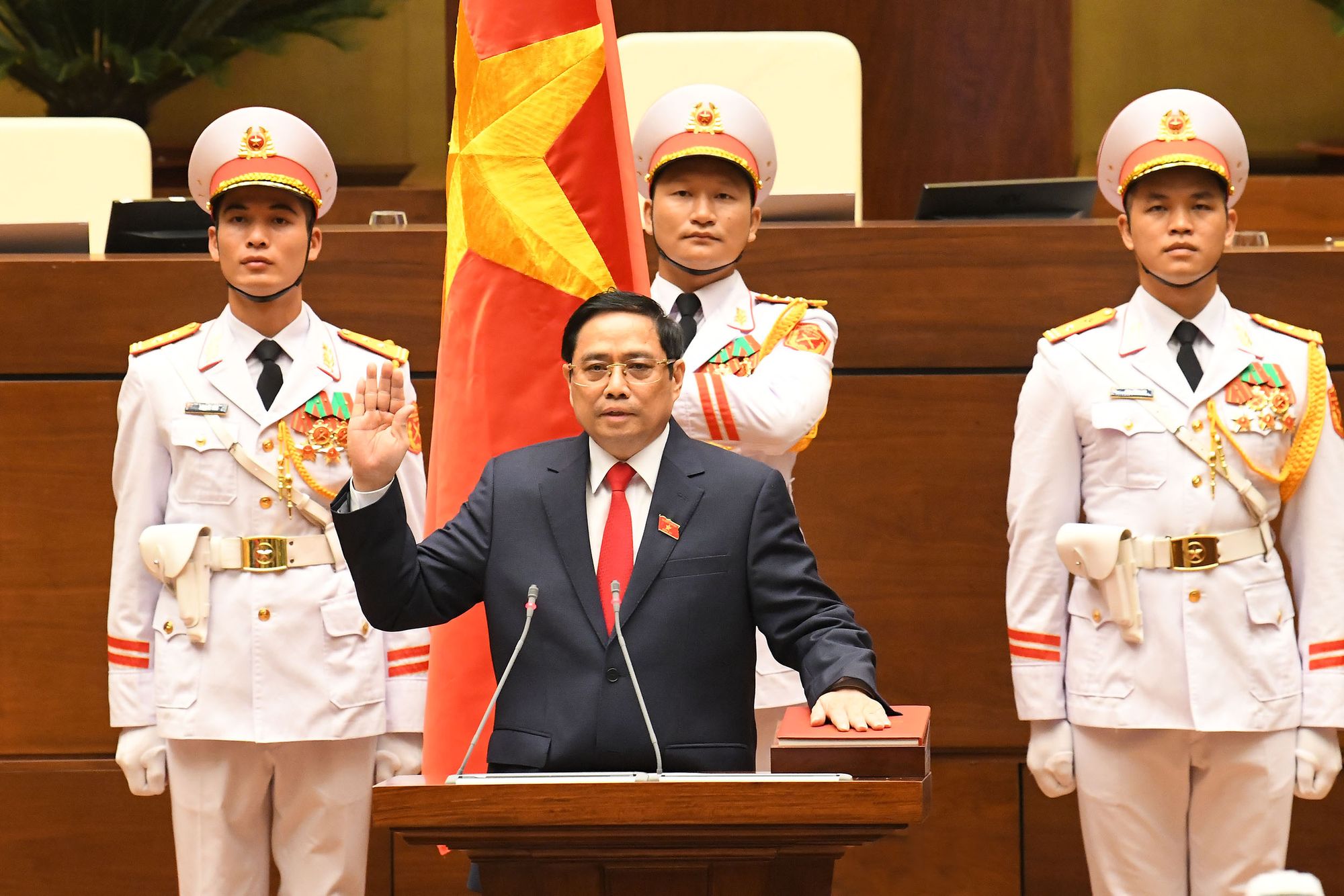
Among the “four pillars,” the position of prime minister possesses both power and prestige.
In the spring of 2021, Vietnam has a new leader: Pham Minh Chinh, a former police intelligence officer and former head of the Vietnamese Communist Party’s Central Organization Commission. On July 26, 2021, Pham Minh Chinh, once again, takes his oath to be the prime minister of Vietnam for the next 5 years.
One amongst “four pillars of the imperial court”
In the article “A few things you should know about Vietnam’s National Assembly chairmanship,” we wrote about the formation of the institutional division of power known as the “four pillars,” which includes the general secretary, the state president, the prime minister, and the chairman of the National Assembly.
If the state president and the chairman of the National Assembly, two among four of the most powerful positions in the Vietnamese Communist Party hierarchy, serve as primarily ceremonial positions, then the prime minister has both pomp and power, possessing broad authority in the governing system.
The prime ministership was once a position without any notable power. Before Prime Minister Vo Van Kiet’s term (1991-1997), previous prime ministers left a very little mark, except for Ho Chi Minh – who served as both state president and prime minister from 1946-1955.
Prime ministers after him, such as Pham Van Dong (1955-1987), Pham Hung (1987-1988), and Do Muoi (1988-1991), all served during periods where the government functioned according to the direction and management of the Party, rather than with tools of the executive branch. The same could be said during periods where Ho Chi Minh and Le Duan had overwhelming individual influence over the Party, causing other institutions and positions, including the prime ministership, to be subservient.
In the 1980 Constitution, the government was called the Council of Ministers, with the prime minister position changed to the chairman of the Council of Ministers. This was an institution of collective leadership, with the powers of the chairman being minimal. With the 1992 Constitution, Vietnam reverted to the government mechanism in which the prime minister was head, concentrating greater power in his hands rather than practicing collective decision-making as in the past. Vo Van Kiet was the first prime minister to enjoy the new system under the 1992 Constitution.
With the depth and broadness of economic reform, the government’s role in managing national affairs grew by the day to more quickly, effectively, and dynamically respond to domestic and international developments. This increase in authority also served to more adequately address the increasing importance of foreign affairs in the age of globalization. The position of prime minister, thus, became extremely powerful. Nguyen Tan Dung (2006-2016) is seen as the most powerful prime minister ever and once competed fiercely for the position of general secretary.
Who elects the prime minister?
Vietnam’s central government is modeled on the parliamentary system, with the central role (theoretically) held by the National Assembly. Constituents elect members of the National Assembly, and the National Assembly elects the government’s leadership figures, including the prime minister. (Obviously, everyone knows who actually “elects” the members of the National Assembly and the prime minister). The prime minister must be a member of the National Assembly.
Normally, electing the prime minister occurs during the first session of the new National Assembly term, after the general election, which occurs after the Party congress. In 2016, the procedure took an unusual turn: the National Assembly elected the new prime minister in the last meeting of its term in April, preceding the general election by more than a month. After the general election, the new National Assembly then repeated the election of the prime minister one more time. Nguyen Xuan Phuc was sworn into office twice in 2016. Pham Minh Chinh also had the same experience in 2021.
How powerful is the prime minister?
The prime minister’s powers are stipulated in Article 98 of the Constitution and Article 28 of the Law on Government Organization (ratified in 2015 and amended in 2019).
As head of state administration, this position has broad authority, from enforcing laws and organizing personnel to proposing and distributing the budget.
As a unitary state, the central government has overarching authority, with the prime minister’s power extending from the center all the way to the provinces and cities.
Outside his separate authority, the prime minister also has general authority over the collective decisions and resolutions of the cabinet.
For more details, please see the two documents described above. Here, we would like to list a few of the prime minister’s decision-making powers to demonstrate just how influential this position is in the economic sphere:
· Regarding land: has the power to establish a council to assess land usage programs and plans at the national level; approves changes in land usage purposes on rice cultivation fields 10 hectares and above, protected and special-use forest land 20 hectares and above; decides the policy framework for compensation, support, and resettlement in special cases; decides price tables for province-level land in many cases; decides on several cases in which the usage rights for land the state allocates or leases are not auctioned.
· Regarding investment: has the power to approve investment plans on the scale of airports, ports, oil and gas rigs, large urban areas, industrial zones, and export processing zones; approves investment plans overseas in banking, insurance, stocks, and telecommunications…from 400 billion dong and above, along with other projects involving capital of 800 billion dong and above.
Is prime minister the highest attainable position?
No. In the party power hierarchy, the general secretary remains at the top and is the most powerful position overall.
There has never been a prime minister who has risen to become general secretary, except for Do Muoi, who was the chairman of the Council of Ministers. Nearly all served only one or two terms before retiring, except Nguyen Xuan Phuc, who served as prime minister and then stepped down to become state president, a much less powerful position.
This article describes the power of the prime minister, but in actuality, we have only spoken of it in legal terms and in relation to the order of power in the party. The position’s power is also dependent on the individual’s level of influence within the party.
To put it another way, a leader’s power is the sum of his or her institutional power and individual sway. If the system bestows power but the individual leader doesn’t have the ability to wield it properly, then he does not have much power at all. Conversely, the system can bestow limited power, but an individual can exercise influence beyond his institutional limits.
This article was written in Vietnamese by Trinh Huu Long and was previously published in Luat Khoa Magazine on April 6, 2021. The English translation was done by Will Nguyen.