Tag: picks

  • Vietnam Briefing: Meet The New State Leadership

    Vietnam Briefing: Meet The New State Leadership

    We release the Vietnam Briefing every Monday morning.


    The rumors were right. Meet the new state leadership

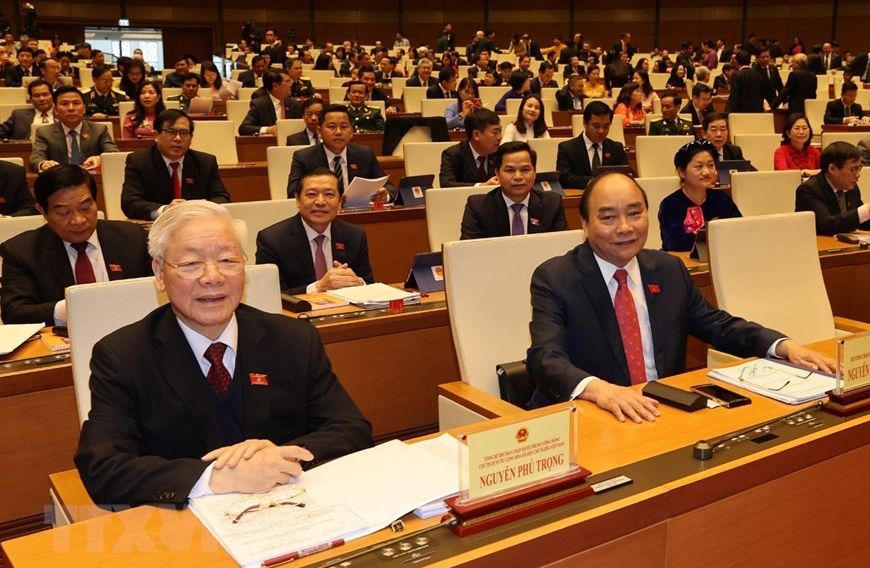
    We reported correctly in our first briefing on February 8 that there were rumors that current Prime Minister Nguyen Xuan Phuc, Pham Minh Chinh, the head of the Party Central Committee’s Organization Commission and Vuong Dinh Hue, the secretary of the Hanoi Party Committee, would be named president, prime minister, and chairperson of the National Assembly, respectively.

    What is happening in the last session of the National Assembly is proving the rumors are right.

    Vuong Dinh Hue took over the chairperson position of the National Assembly on March 31 after his predecessor, Nguyen Thi Kim Ngan, was released from duty the previous day by the legislative chamber’s resolution. The Communist Party quickly appointed the then-minister of finance, Dinh Tien Dung, to replace Hue as the party chief of Hanoi on April 3.

    The National Assembly also relieved Nguyen Xuan Phuc from the prime minister post and Nguyen Phu Trong from the president post on April 3, paving the way for elections of Nguyen Xuan Phuc to be president and Pham Minh Chinh to be prime minister this week. Phuc was already nominated to the post on April 2.

    When this entire process ends tentatively by the end of April 5, the political tradition of having a “gang of four” sharing four top seats of the party and the state will be restored.


    Another journalist is arrested

    Nguyen Hoai Nam, a former investigative journalist working for the mainstream media, was arrested on April 2 in Ho Chi Minh City. He is currently under pre-trial detention and is charged with “abusing democratic freedoms to infringe upon the interests of the State, lawful rights and interests of organizations and/or citizens.”

    Who is Nam? VnExpress says he was a former reporter at Thanh Nien (Youth), Phap Luat TPHCM (HCMC Law), Vietnam Television and Phap Luat Viet Nam (Vietnam Law). The news agency added that Nam had posted on his Facebook account several articles challenging police investigations into violations at Vietnam Inland Waterways Administration, which it said had  resulted in the arrest of its former deputy head Tran Duc Hai in 2019.

    According to VnExpress: “The reporter implicated 15 people who had allegedly committed violations regarding the case, 12 more than determined by police. He went on to accuse the investigators of ‘letting the criminals off the hook.’”

    The nature of the charge:

    • The charge is based on Article 331 of the 2015 Penal Code, previously known as Article 258 of the 1999 Penal Code.
    • The criminal provision is widely condemned by both domestic and international human rights groups as vague and as used by the government to silence critics.
    • Activists ran a campaign called the “258 Campaign” to advocate for the abolition of the provision.

    Four citizens convicted of spreading anti-state propaganda

    Publicly saying bad things about the Communist Party might well result in being imprisoned for years in Vietnam. That’s what happened to four citizens in Khanh Hoa Province on March 30.

    Nguyen Thi Cam Thuy, 45, was sentenced to  nine years in prison, Ngo Thi Ha Phuong, 25, to seven years and Le Viet Hoa, 59, to five years, VnExpress reported.

    Another person, Vu Tien Chi, was sentenced to 10 years in prison in Lam Dong Province.

    Just like Article 331 and Article 258, this criminal provision has received a high degree of criticism from human rights groups inside and outside of Vietnam.


    Read more about Vietnam:

    The US Department of State’s human rights report on Vietnam

    “The Socialist Republic of Vietnam is an authoritarian state ruled by a single party, the Communist Party of Vietnam, and led by General Secretary and President Nguyen Phu Trong, Prime Minister Nguyen Xuan Phuc, and Chairwoman of the National Assembly Nguyen Thi Kim Ngan. The most recent National Assembly elections, held in 2016, were neither free nor fair; there was limited competition among Communist Party-vetted candidates.”

    Drinking coffee in the US? Worry about forests in Vietnam, study says

    Mongabay | April 2, 2021

    “The U.S.’s thirst for coffee drives forest loss in central Vietnam, while Germany’s craving for cocoa is doing the same in West Africa, a landmark study that tracks the drivers of deforestation across borders found.”

    Vietnam Should be More Proactive in Global Governance

    The Diplomat | March 30, 2021

    “After its COVID-19 successes, Vietnam is well positioned to play a more energetic role on the global stage.”

    The Vietnamese Recovery Is Made in America

    Wall Street Journal | March 30, 2021

    “Vietnam’s economy is growing again, on the back of a strong rise in exports. The Southeast Asian nation looks to be one of the most clear-cut international beneficiaries of the U.S. stimulus package.”

    How The Vietnamese State Uses Cyber Troops to Shape Online Discourse

    ISEAS | March 3, 2021

    • The operations of Vietnam’s public opinion shapers and cyber-troops reveal that the online discourse is manipulated to enforce the Communist Party’s line.
    • Vietnamese authorities constantly grapple with the vexing question: How to strike a delicate balance between placating critical public sentiment online while ensuring that it does not spill over into protests against the regime.
    • When it comes to methods, targets and motives, there appears to be significant crossover between public opinion shapers and the government’s cyber troops.
    • The Vietnamese state cyber-troops have been encouraged to use real accounts to massreport content. This helps explain why it is the only Southeast Asian state to publicly acknowledge having a military cyber unit.
    • The lack of political and technological wherewithal presents an uphill battle for these cyber-troops in influencing Vietnam’s online information environment.
  • The Price Of Progress

    The Price Of Progress

    The aftermath of the war left Vietnam in shambles. As the conflict that raged and surged within its borders came to an end, the country was left bleeding, battered, and broken. With millions dead, an almost non-existent economy, and a bleak uncertain future under the questionable leadership of the Communist Party, Vietnam was beginning to look more and more like a lost cause, destined to be another failed state under the selfish rule of tyrannical forces.

    However, no one would have expected Vietnam to be where it stands today.

    Since Vietnam opened its economy to international trade in 1986, the country has undergone a massive and abrupt shift. It morphed from being one of the poorest nations in the world to being one of the fastest growing economies in Southeast Asia. Case in point, between the years 2002 to 2018, Vietnam’s GDP increased 2.7 times which, according to the World Bank, lifted 45 million people out of poverty.

    Vietnam’s economy has also shown surprising resilience in the face of the ongoing global pandemic. While other countries in the Southeast Asian sphere have been greatly suffering due to COVID-19, Vietnam has been keeping itself afloat; some might even argue that it is thriving.

    Aside from keeping infection rates under control, Vietnam’s GDP actually grew a surprising 2.6 percent in the third quarter of last year, passing even Singapore and Malaysia. Because of its commendable handling of the pandemic and its perceived economic stability, Vietnam is shaping up to be an alternate hub for manufacturing as international businesses begin to pull out of China.

    Yet, economic growth and financial stability is only one way to measure the worth of a nation. While Vietnam seems to be doing admirably well in this regard, it is floundering in several other aspects. To be more specific, in its observation of human rights, and in the protection of several of its most marginalized citizens.

    The Human Rights Measurement Initiative’s (HRMI) 2020 Country Report on Vietnam presents several findings that both highlight Vietnam’s economic success and its key failings as a country.

    In terms of Quality of Life, Vietnam has performed reasonably well in the categories of Health, Housing, and Work but its ranking regarding food accessibility still falls below the benchmark.

    This report states that “Vietnam is performing better than many countries in East Asia for the rights to housing (89.5%), work (91.3%), and health (94.6%). This suggests that the Vietnamese government is using its resources fairly effectively so that people have access to housing and work. These scores have also increased steadily since 2007, suggesting that the quality of life in Vietnam is increasing.”

    However, in regards to food, the Human Rights Measurement Initiative also believes that Vietnam could manage its resources better to ensure that more of its citizens do not go hungry.

    It is also important to take note of some caveats in the given information. The report makes an effort to highlight the fact that Housing does not actually refer to having a place to live in.

    Rather, it refers to sanitation access and access to potable drinking water. As such, several respondents have stated that some people are at risk of having these rights violated. Some of these people include street children, homeless youth, and surprisingly, human rights advocates.

    The category for Work also needs slight clarification. The 91.3 percent figure refers to people who are NOT absolutely poor. This means that anyone who lives on more than a meager amount of  US$3.20 a day is counted towards this number.

    Granted, even with Vietnam’s less than stellar performance regarding food accessibility and concerns regarding housing and work, what the Vietnamese government has done so far is, to a small degree, admirable and we have to give credit where credit is due, political beliefs notwithstanding. If we go solely by the data presented regarding Quality of Life, and also taking into consideration the state Vietnam was in after the war, what it has accomplished is somewhat commendable.

    But the report does not end there. And as more information is presented, the more sinister reality behind the facade begins to reveal itself.

    Regarding the upholding of civil and political rights, it is clear that Vietnam is performing miserably. In all aspects presented in the report under the categories of  Safety from the State and Empowerment, Vietnam’s scores range from Bad to Very Bad and these scores have only been getting worse with the passage of time.

    The data heavily implies that the Vietnamese government doesn’t seem to care about protecting, or even at the very least acknowledging, the universal human rights of its citizens.

    The report also notes several groups of people whose rights are at most danger of being violated. One fact that immediately stands out is that these groups are common in all the lists provided within the report itself. Some of these people-at-risk include: members of labour unions, people engaged in or suspected of political violence, journalists, people with particular religious beliefs and practices, immigrants, and human rights advocates.

    In general, if a person has particular political affiliations or beliefs that don’t align with what the Vietnamese government espouses, or if they believe in a religion that isn’t part of the mainstream zeitgeist, their rights to work, freedom from arbitrary arrest, freedom from disappearance, freedom from torture, assembly and association, and freedom of opinion and expression are actively hindered, ignored, or violated by the government.

    In effect,  the HRMI report presents a two-faced Vietnam.

    On the one hand, you have Vietnam as a rising cub economy. This is the face of Vietnam that is often read or heard about in mainstream news outlets.

    This is the Vietnam that Western economists praise to high heavens for being able to steer itself away from total collapse towards some semblance of stability and even growth. This is the Vietnam that the communist  government wants its citizens to be proud of.

    On the other hand, you have Vietnam as a heartless oppressor of its own people. This is the Vietnam that is willing to go to drastic lengths to silence or restrict any form of discontent, dissent, and differing points of view.

    This is the Vietnam that shows no concern for those it tramples under its heels as it marches forward towards a selfish vision of progress and growth that benefits only those who hold the reins.

    This is the Vietnam that is willing to pay for the price of progress with the rights, liberties, and lives of its own citizens.

    This is the face that very few get to see.

    But it doesn’t have to be this way. There are many avenues to progress and growth, and the road is never set in stone. History has shown us time and time again that nations formed on a foundation of dialogue, compromise, and free speech tend to outlast the rest and stand firm against the test of time.

    Governments can work with their citizens, even with those who hold beliefs or thoughts that go against the grain to bring about benefits that everyone can enjoy. This kind of progress is possible, and it is attainable.

    However, the question isn’t “Can Vietnam go on this path?” The response to this should be apparent; if Vietnam can pull itself from the brink of collapse to be where it is today, of course it can.

    In reality, the question stands as such,“Is the Vietnamese government willing to do so?”

    And this query is a lot harder to answer.

  • Vietnam Briefing: Another Congressional Candidate Arrested While Congress Elects New Leaders

    Vietnam Briefing: Another Congressional Candidate Arrested While Congress Elects New Leaders

    The Vietnam Briefing is released every Monday.


    Another congressional candidate arrested

    Independent journalist Le Trong Hung, a candidate for the National People’s Congress, was arrested on March 27 by Hanoi local police, VOA cited his family.

    He had filed his candidacy earlier this year and his application was approved by election officials.

    Hung is known for running his social media-based TV channel called Chan Hung TV, that broadcasted information about victims of injustice, including  farmers who had lost their land and people who had been wrongfully convicted.

    Besides Hung, another person arrested after declaring his candidacy is Tran Quoc Khanh, as we reported two weeks ago. The general election will be held on May 23, 2021.


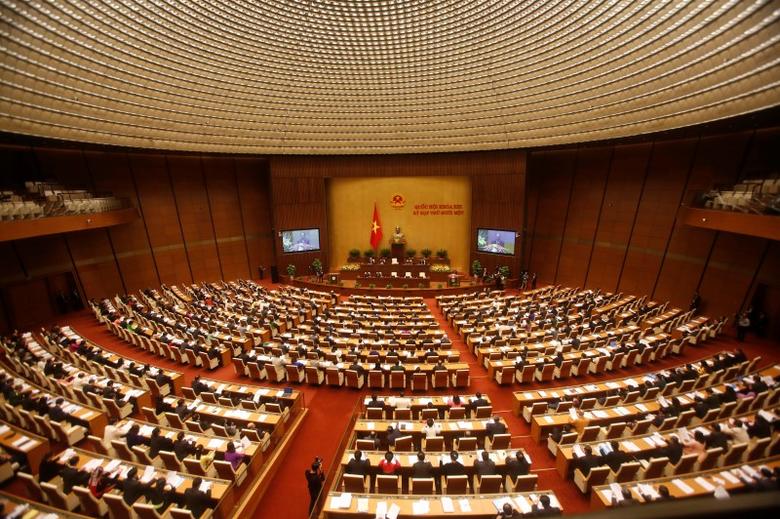
    The National Assembly is convening to decide top state positions

    If things go as planned, Vietnam will have a new president, a new prime minister and a new chairperson of the National Assembly potentially by April 7.

    Some other top seats of the National Assembly and the cabinet will also be considered.

    It’s now officially announced that current Prime Minister Nguyen Xuan Phuc will be nominated to be president of the state.


    Tension in the South China Sea

    Not only has China sent warplanes into Taiwan’s air space over the past week, but also hundreds of Chinese vessels have also massed in disputed areas in the South China Sea.

    From Reuters:

    “Vietnam’s Foreign Ministry spokeswoman Le Thi Thu Hang on Thursday said the Chinese vessels at the reef, which Hanoi calls Da Ba Dau, had infringed on its sovereignty.

    ‘Vietnam requests that China stop this violation and respect Vietnam’s sovereignty,’ Hang told a regular briefing.

    A Vietnamese coastguard vessel could be seen moored near the disputed area on Thursday, according to ship tracking data published by the Marine Traffic website.

    Hang said Vietnam’s coastguard was ‘exercising its duties as regulated by laws’, including international law.”


    Rapping Vietnam Ambassador Daniel Kritenbrink tapped as Joe Biden’s top Asia envoy

    He made headlines last month in Vietnam by rapping in both English and Vietnamese. Now he’s nominated for one of the top seats in the US State Department.

    From The South China Morning Post:

    “The US ambassador who made a splash in Vietnam by making a rap video may soon get a promotion – to be the top diplomat for Asia under President Joe Biden. Daniel Kritenbrink, a career diplomat who speaks Chinese and Japanese, was nominated by Biden to be the assistant secretary of state for East Asia and the Pacific, a White House statement said.”


    Learn more about Vietnam:

    Vietnam proves immune to China’s vaccine diplomacy campaign

    March 27, 2021 | Nikkei Asia

    “It would be a stretch to accredit that one comment as an accurate measure of public sentiment in Vietnam toward the Chinese-made vaccine. But in Southeast Asia, Vietnam has remained a prominent outlier to China’s fanfare vaccine diplomacy campaign.”

    Biden can address Vietnam’s currency valuation without Section 301

    March 27, 2021 | East Asia Forum

    “While there were intense talks during the Trump administration — including a call between Trump and Vietnamese Prime Minister Nguyen Xuan Phuc — there are no reports suggesting any ongoing talks with the Biden administration.”

    China, Vietnam Lead Three-Speed Asian Recovery, World Bank Says

    March 26, 2021 | Bloomberg

    “A three-speed recovery is taking hold across East Asia and the Pacific, with China and Vietnam already beating their pre-pandemic levels of economic growth while other countries could take years more to heal, according to World Bank projections.”

    Vietnam’s New Government Election: The Sooner the Better?

    March 23, 2021 | Fulcrum

    “There is little reason for the Community Party of Vietnam to repeat its “fast track” procedure to get a new government in place. The Party’s reputation is best served by its playing by the rules.”

    Why Biden Sends Warships to the South China Sea, Just as Trump Did

    March 22, 2021 | VOA News

    “U.S. President Joe Biden is keeping pace with his predecessor in the frequency of American warships sent to Asia, analysts believe, a way to get a foothold in contested seas and routinize warnings aimed at the region’s strongest maritime force, Beijing.”

  • Oppression Through Greed: What The Myanmar Military And Vietnam Stand To Gain

    Oppression Through Greed: What The Myanmar Military And Vietnam Stand To Gain

    More than a month has passed since the start of the Myanmar coup and since then various notable events have taken place. At the start of the takeover, several prominent figures of the ruling National League for Democracy (NLD) were arrested and detained. Among those taken into custody were Aung San Suu Kyi and President Win Myint of the NLD .

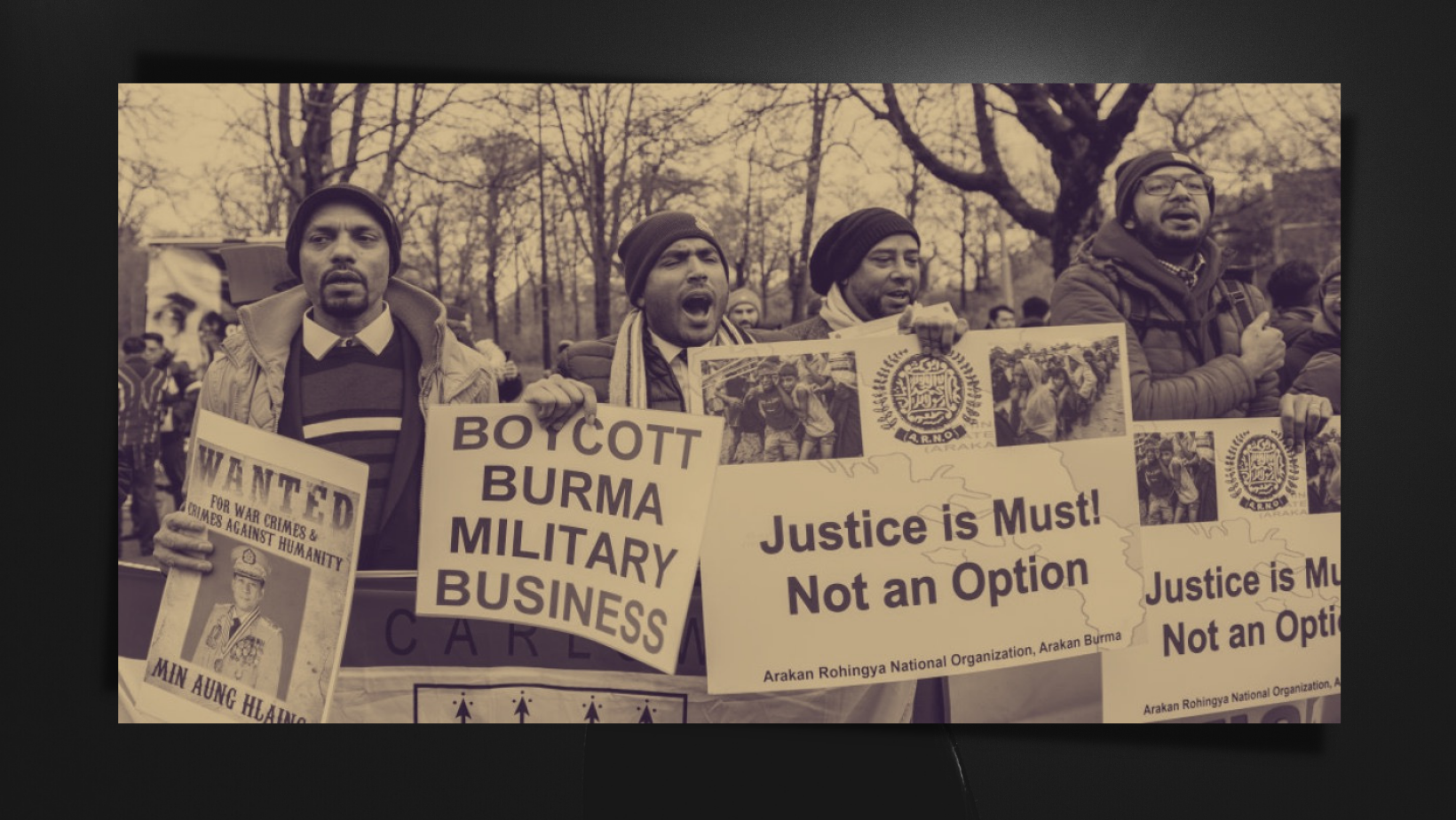
    The following weeks were then marked by massive demonstrations and acts of civil disobedience by the citizens of Myanmar. Crowds of people from all walks of life continue to gather to protest around the country in a display of anger and frustration against the fledgling dictatorship of Min Aung Hlaing.

    The Myanmar military has responded with escalating acts of violence and control typical of any authoritarian state. Initially, they tried to shut down forms of communication and when these proved to be less than effective, they resorted to using physical force against their own citizens. To date, at least 149 people have been killed and countless more have been arrested.

    While the Myanmar military continues to claim that its takeover was inevitable due to its alleged and unsupported claims of election fraud, the truth is much less conspiratorial. It is the result of the callousness and unending greed of those who would willingly choose to set their nation ablaze rather than let power slip from their fingertips.

    Information has been released and verified that exposes the connections the Myanmar military has with several local and international corporations and businesses; these business interests continue to be the main driving force behind the Myanmar military’s oppressive and repressive actions.

    Yet, how much money do they actually stand to gain?

    In December 2020, Justice for Myanmar, a movement which aims to expose systemic oppression and human rights violations in the country, released a comprehensive report that details the involvement of the Myanmar military with Mytel and Viettel. The report then explains how these three entities work in tandem to further line their pockets while committing grave violations of human rights. Viettel is publicly known to be a state-owned enterprise with direct ties to both the Communist Party of Vietnam and the Ministry of Defense.

    Then, on March 4, 2021, Justice for Myanmar released additional information regarding this issue. While its previous report explores the structure and the effects of the symbiotic relationship of the military, Mytel, and Viettel, this more recent exposé focuses more on the financial aspect of the situation.

    Justice for Myanmar claims that Military generals involved in this operation may be entitled to more than US$700 million after five to nine years since the start of Mytel’s business venture and a further US$450 million in the five years after that.

    This is due to the military owning more than 28 percent of shares in Mytel through Star High, a subsidiary of the Myanmar Economic Corporation, which is a Myanmar military conglomerate.

    However, when the other domestic investor – Myanmar National Telecom Holdings (MNTH) – was unable to keep its financial obligations and was forced to sell a number of its total shares in Mytel to Star High, causing the military owns more shares of Mytel.

    In effect, the military actually owns as much as 39 percent of Mytel in shares while 49 percent belongs to Viettel. The remainder goes to the other smaller investors that came from MNTH.

    Viettel also stands to achieve significant financial gain through this arrangement.

    Viettel was essential in the establishment of Mytel itself. In Mytel’s first three years of operation, Justice for Myanmar reported that Viettel “agreed to provide the lion’s share of the US$1.38 billion needed by Mytel in its first three years by investing US$169 million in its shares and lending it up to US$903 million.”

    Aside from this, Viettel also dedicated staff and personnel to train and establish Mytel’s workforce. Interest is also paid to Viettel from the loan taken by Mytel on top of the 2 percent annual management fee from yearly profits.

    Mytel also has allegedly made deals with some Vietnamese banks as well. This report stated that Mytel had entered into a US$40 million five year loan with Vietnam’s TP Bank.

    It is clear that this arrangement stands to be very financially lucrative for those involved, and while the ethics of both military and sizable foreign ownership in commercial businesses is, to an extent, debatable, the danger with Mytel lies in the nature of the company itself.

    Mytel is not just any company; it is a telecommunications company. And it is often the case that governments and militaries have malicious vested interests in controlling telecommunications.

    There is already evidence available that the Myanmar military is using Mytel to infringe on the rights of the already oppressed Rohingya minority. Being a telecommunications company also gives the Myanmar military direct access to information it can use to strengthen and extend its hold on the country.

    Justice For Myanmar spokesperson Yadanar Maung states that, “Every phone call on the Mytel network and every kilobyte of data finances the people’s oppression. The brutal and corrupt Myanmar military junta is motivated by personal profit and it is greed that drives their brazen and bloody attacks on the people.” His words and sentiments seem to be echoed by a few of Mytel’s former business partners.

    In response to its militarization, some of Mytel’s domestic and international business partners and investors have grown concerned.

    Singaporean payments firm Coda has removed Mytel from it’s payment channels and International Power Generation, (IPG), a local investor, has taken initial steps to distance itself from the company. While the actions of Coda and IPG are commendable and other investors in Mytel should follow suit, it still remains doubtful if this will have any significant and immediate effect.

    After all, the fact remains that the three-way relationship between Mytel, Viettel, and the Myanmar military is only one of more than 100 business channels that the Myanmar military uses to fatten its coffers. Should one avenue be shut down, others continue to remain open for them to exploit and use. With the amount or resources available at their disposal, it should only be a minor inconvenience for them to open up alternative methods for monetary gain. But, this is hardly a surprise. In fact, it is expected.

    The struggle for true freedom and democracy has never been an easy fight. It has always been a Sissyphean battle, an uphill and treacherous climb against overwhelming odds. And once you reach the top, there is also no guarantee that you can stay there.

    Oftentimes, a nation finds itself on the zenith of the hill only to stumble and fall partway or even descend all the way to the very bottom. Yet, as believers in a better tomorrow for ourselves and for all, we pick ourselves up and try again. We stand and climb as many times as it takes, for a future we might not even get to see.

    And here lies the beauty of the struggle.

    While the Myanmar military and other authoritarians like it fight to amass wealth and hoard as many pieces of magic paper they can get, others fight for something much greater than themselves: an idea, a dream, a possibility.

    What activists, protestors, and demonstrators in Myanmar, and in the rest of the world stand to gain cannot be measured in billions, or even trillions of dollars. Rather, its value can only be glimpsed in the people’s eyes as they continue to stand firm, shoulder-to-shoulder, against tyranny and against terror.

    Now is the time to stand with the people of Myanmar; for the good of one is for the good of all.

  • Vietnam Briefing: A Prominent Writer Dies, Sparking Discussions Of His Works And Censorship

    Vietnam Briefing: A Prominent Writer Dies, Sparking Discussions Of His Works And Censorship

    The Vietnam Briefing is released every Monday.

    Last week, we had a new chief of external relations of the Communist Party, a detained activist being transferred to an unknown facility, and a prominent writer passed away.


    Police transferred a detained land rights activist to another facility without informing his family of the details of the sudden move

    Detained land rights activist Trinh Ba Phuong’s family says they were informed by officials of Hanoi No 1. Detention Center on March 19 during a prison visit that Phuong had been transferred to another detention facility. The officials have given them no further information about the move.

    Who is  Phuong? He is a prominent land rights activist who is part of a group of farmers in Duong Noi, a rural area of Hanoi, who have been evicted from their land by the government since 2008. They claim the land acquisition was illegal and the compensation was extremely low. Phuong’s mother, Can Thi Theu, and father, Trinh Ba Khiem, have been imprisoned several times since then. Theu, and Trinh Ba Tu – Phuong’s brother, were arrested and detained again in June 2020 in the same case with Phuong. They are all charged under Article 117 of the Penal Code, which is “making, storing or disseminating information, documents, materials and items against the Socialist Republic of Vietnam.”

    One thing to note: In Vietnam, the government agency in charge of detention facilities and the investigative agencies are both under the authority of the Ministry of Public Security.


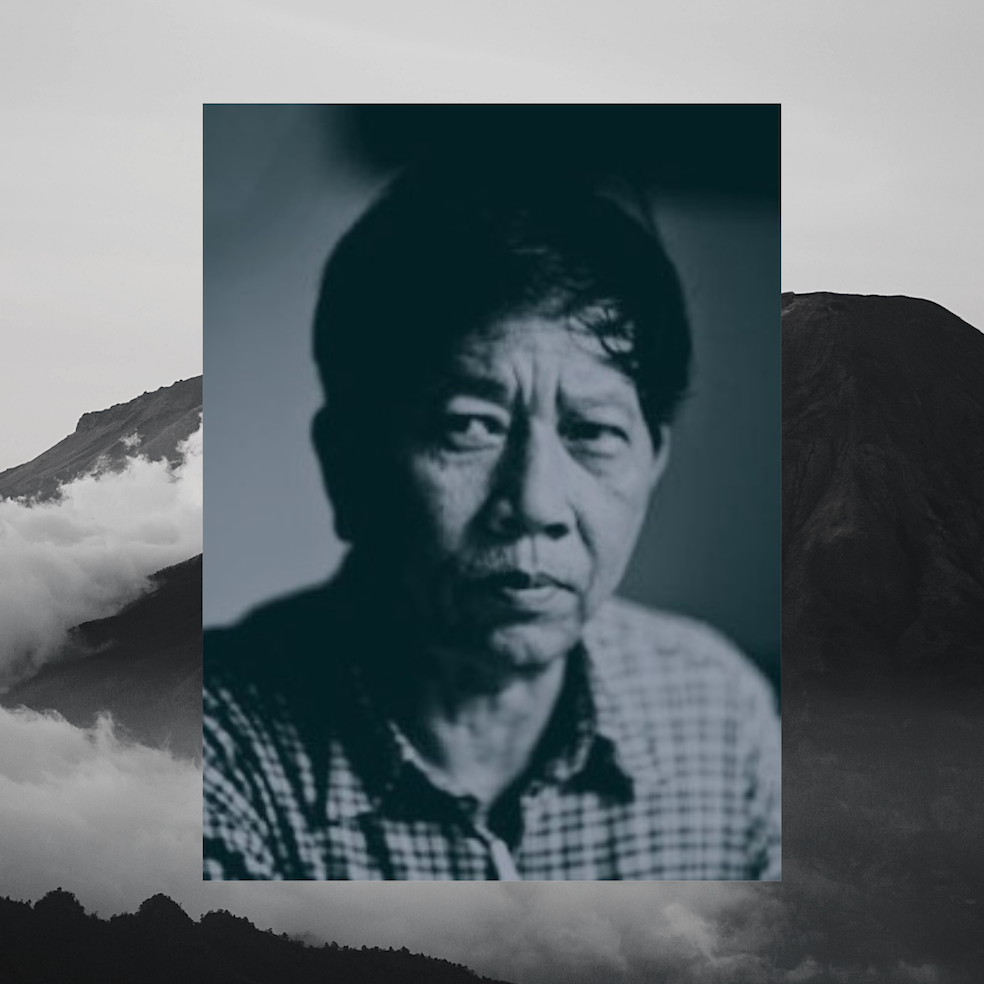
    Prominent writer Nguyen Huy Thiep passes away at 72

    If you talk about Vietnam’s literature and censorship, Nguyen Huy Thiep is the name you need to pay attention to. He is one of the most prominent Vietnamese writers since the Vietnam War. His death sparked discussions on social media on his work and how he suffered from heavy censorship.

    Scholar Thomas Bass wrote:

    “Thiep began his meteoric career in 1987, and already by 1988 he had published his collected works and celebrated what everyone was calling ‘the year of Nguyen Huy Thiep’. In 1989, the film of ‘The General Retires’ was released, and by 1990 Thiep was being installed as a member of the Writers’ Association. But this is also the year that copies of his works began disappearing from book stores. Nhan Dan, the party newspaper, published two essays attacking Thiep, claiming that he had ‘betrayed the Vietnamese Revolution by toppling sacred heroes in Vietnamese history’ and that he was ‘deceived by the chimera of pre-1975 Saigon’. The denunciation campaign continued until 1991, when the police raided Thiep’s house, carried off his books and manuscripts, and provoked a turning point in his life. This also marks a turning point in Vietnamese literature, when the country’s brief, five-year experiment with Renovation ended in the dark age that persists today.”


    VCP has a new chief of external relations

    Following the Party Congress in January-February, the Politburo continued to  appoint new personnel to top Party positions. On March 19, Le Hoai Trung was appointed head of the Commission for External Relations.

    Who is he? Trung served as deputy minister of foreign affairs since 2010, and Vietnam’s ambassador to the United Nations in New York (2011-2014). He was elected to  the Party’s Central Committee in 2016 and 2021.


    Learn more about Vietnam:

    Should Vietnam become a member of the UN Human Rights Council?

    ASEAN Today | 19 March 2021

    “The UNHRC should push Vietnam to implement existing action plans to improve human rights conditions in the country, rather than offering it a place in the forum. If Vietnam becomes a member of the UNHRC, it will not only discredit the UN body’s standing but will also legitimize Vietnam’s policies of oppression.”

    Vietnam Must Be Pleased With the Biden Administration… For the Most Part

    The Diplomat | 16 March 2021

    “…the Biden administration appears to emphasize not only shared national interests, but values as well, such as democracy, freedom, and human rights. For Hanoi, there is likely a certain amount of trepidation regarding the potential consequences of engaging with a more vocal Washington on these issues, which are extremely sensitive for Vietnamese Communist Party (VCP) leaders. Additionally, Hanoi likely has concerns about whether the Biden administration will take action against Vietnam for Trump-era allegations that it is a currency-manipulator as well as potential U.S. sanctions against Vietnam for purchasing Russian military equipment under the Countering America’s Adversaries Through Sanctions Act.”

  • Vietnam Briefing: Dong Tam And The General Election

    Vietnam Briefing: Dong Tam And The General Election

    It’s a new week and Vietnam Briefing’s mission is to keep our readers up to date on developments in Vietnam. As we missed the briefing last week, here is the key news of the past two weeks.


    Vietnam has started to roll out COVID-19 vaccines

    The Vietnamese government started administering the first COVID-19 vaccinations doses on March 8. Frontline workers, including doctors, nurses and technicians at designated hospitals combatting COVID-19 are among the first to receive the vaccines produced by Oxford University and AstraZeneca.


    High court affirms verdict on Dong Tam case

    The appellate trial of the Dong Tam case (March 8-9) went just as everyone expected: no overturning of any sentences and no amendment to the lower court’s verdict. The sentences of the six defendants remain the same, including two death penalties.

    A fair trial? It’s hardly a thing in Vietnam. Take the word of Phil Robertson of Human Rights Watch:

    “There are still many unanswered questions about what happened during the Dong Tam raid that authorities have never been willing to clarify.”

    “We are also deeply troubled by the information brought out in the defense lawyers’ report, stating that police used torture on some defendants to force them to confess, raising fundamental concerns about the fairness of the entire trial.”

    A historic case, yes. The Dong Tam case is undoubtedly one of the most important and consequential events in Vietnam’s post-1975 history. Those who wish to study the country’s history of land struggles and party-controlled judiciary should take a very close look into the case as it is among the most well-documented events and it provides an intensive account of the issues.

    Learn more about the case:


    The National Assembly is in the final days of its current term. Yet, it may elect new state leaders just before the election.

    In an unexpected, but not unprecedented, move, the Communist Party’s Central Committee is sending three candidates to the National Assembly’s last session of the term for confirmation of three top state positions: president, prime minister, and chair of the National Assembly.

    The Party and state media provided no information about who the candidates are, but you don’t need them to name names in order to know who these people are. Vietnamese people often read between the lines and listen to internet influencers – some they believe have inside information – to know what’s going on.

    So who are they? Current Prime Minister Nguyen Xuan Phuc for president, Pham Minh Chinh for prime minister, and Vuong Dinh Hue for National Assembly chair. VCP General Secretary Nguyen Phu Trong is not seeking reelection for the presidency, although he is now running for a National Assembly seat.

    What’s special about that? It’s not about who for what, it’s about timing. If elected in April during the last session of the current National Assembly, which is almost certain, the candidates will only serve a few months until the end of the current term. After the general election on May 23, the new National Assembly will convene in July and repeat the same process of electing the same people to the same positions. That’s what happened in April 2016, right before the last general election, which was held more than a month later. And we don’t think there are many people who can explain why the VCP has to rush to do such a repetitive process. The logic behind this remains a mystery to the public.


    Man arrested after declaring intention to run for office

    This is not something that happened the last time we had an election in 2016 (yes, I know how hard it is to call it an election, but let’s use the word for now). A 61-year-old man named Tran Quoc Khanh was arrested on March 9 and accused of “making, storing, spreading information, materials, items for the purpose of opposing the State of Socialist Republic of Vietnam” under Article 117 of the Penal Code.

    He is known for his frequent Facebook activities including live-streaming on human rights and corruption in Vietnam. The arrest was conducted by Ninh Binh Provincial Police shortly after Mr. Tran declared his intention of running for a National Assembly seat.

    Something to note: Unlike the exciting election season in 2016 when dozens of activists and independent candidates campaigned for office, despite all failing, there are almost no independent candidates running for office this time.


    Here is what the incoming National Assembly may look like

    Remember what we mentioned about this two weeks ago? Here is an infographic from the state news agency’s article titled “Expected structure of deputies of the 15th National Assembly.” Yes, the election is more than two months away, but the government has already “expected” the results.


    Freedom House drops Vietnam’s freedom score

    This time every year, the US-based human rights group Freedom House announces its widely-cited work: Freedom in the World Index. And unlike the recent years, Vietnam’s score dropped 1 point in the 2021 index, down to 19/100 and remains in the “Not Free” group of countries.

    What was Vietnam’s response to this? Ministry of Foreign Affairs spokesperson Le Thi Thu Hang said on March 11 that Vietnam has consistently protected and promoted human rights. That’s the government’s usual way of dealing with such queries from reporters who work for the international media. We have no knowledge of any reporter from the Vietnamese media asking about such issues, and we doubt anybody ever does.


    Vietnam joins China, Russia and India to block UN Security Council’s condemnation of Myanmar’s coup

    The United Nations, especially its Security Council, has been reluctant to make any strong statements on the military coup in Myanmar. On March 9, they failed to agree on such a statement, and Vietnam, as a non-permanent member of the council, jointly blocked the effort with China, Russia, and India.

    Context:

    • Vietnam is the fourth biggest foreign investor in Myanmar as of January 2021, with 19 projects and approximately US$1.5 billion invested there.
    • Vietnam’s military has close ties to Myanmar’s military businesses, such as Mytel.

    Vietnam commemorates the 33rd anniversary of the Gac Ma incident

    March 14 has been a sensitive date in Vietnam over the past 12 years since the public started to learn about the bloody incident of Gac Ma.

    The Gac Ma incident happened on March 14, 1988, when Chinese warships fired on a group of mainly unarmed Vietnamese troops in Gac Ma Reef (Johnson South), killing 64 of them. Gac Ma (Johnson South Reef), Colin and Len Dao (Lansdowne) Reefs are part of the Truong Sa (Spratly) Islands where the two countries both claim sovereignty. It’s rumored that Vietnam’s then-Minister of National Defense ordered that there be no resistance to the Chinese.

    Why sensitive? Not many things in Vietnam are as sensitive as the country’s relations with China. The Vietnamese government censored information about the Gac Ma incident for over 20 years until the early 2010s. Even now, many state media outlets do not mention China in their stories about Gac Ma Reef, although the government has increasingly tolerated open discussions about the topic.

    What to watch? Citizens, mostly dissidents and activists, spread information about the Gac Ma incident on social media, criticizing the government’s handling of China, and they also go to cemeteries and temples to commemorate the soldiers who lost their lives on that day. They often face government harassment due to these activities.

    Go deeper: Here is some useful material to understand more about the issue, including a video clip of the 1988 incident.


    French warship visits Vietnam

    Shortly after completing a patrol in the South China Sea in February, the French Navy sent a warship to Vietnam on March 9, where it spent four days in Cam Ranh Port (southern Vietnam) for helicopter repairs.

    The South China Sea is certainly a place global superpowers can’t afford to ignore due to its strategic position in terms of security and trade, especially when China has aggressively claimed sovereignty over most parts of the sea with its nine-dash line.

    Cam Ranh Port is a familiar name to those who study security in the region. It is a strategic deep water bay in the south of Vietnam and it played a crucial role in the Vietnam War. This is where the Soviet Union, and later Russia, stationed troops from 1979 to 2002.


    Events to watch:

    Mainland Southeast Asia: power, protest and participation

    March 23, 2021 3 pm, Auckland, Wellington

    Three expert scholars will contextualise developments in Thailand, Myanmar and Vietnam, followed by a discussant response and Q&A

    Speakers: Thitinan Pongsudhirak (Thailand), Wai Wai Nu (Myanmar), Nguyen Khac Giang (Vietnam). Discussant: Natasha Hamilton-Hart. Chair: Emeritus Professor Roberto Rabel

    Hosted by the Centre for Strategic Studies: NZ


    Learn more about Vietnam:

    Vietnam: Successfully Navigating the Pandemic | IMF, 10 March 2021:

    Despite COVID-19, Vietnam’s economy has remained resilient, expanding by 2.9 percent in 2020—one of the highest growth rates in the world—and with growth projected to be 6.5 percent in 2021, thanks to strong economic fundamentals, decisive containment measures and well-targeted government support, according to the IMF’s latest annual assessment of the country’s economy.

    How Economic Reforms of the 1980s Changed the Face of Vietnam | National Interest, 12 March 2021:

    “Back when the Heritage Foundation published its first index [of Economic Freedom] in 1995, Vietnam scored 41.7 points. By 2005, this had risen to 48.1 points and in 2010 it climbed further to 49.8 points. What is remarkable is the huge increase in economic freedom since 2015, when Vietnam was awarded a score of 51.7. Since then, Vietnam has added another 10 points to reach 61.7 points today—an increase of 20 points since 1995!”

    Vietnam, ASEAN, and the US-China Rivalry in the Indo-Pacific | The Diplomat, 13 March 2021:

    “China may not feel comfortable if Vietnam pursues stronger security ties with the U.S. and its allies, but it is China’s aggressive behaviors in the South China Sea that have pushed Vietnam into this course of action. China should adjust its approach or risk pushing Vietnam and other regional countries further toward the United States.”

    “Politically, certain reforms may also be explored, but mainly to streamline and increase the efficiency of the political system, not to democratize it. Vietnamese leaders believe that political stability is a precondition for economic development, and they will not tolerate any developments that may destabilize the political system.”

  • The Enemy Of My Enemy: Tensions Between The US, China, And Vietnam

    The Enemy Of My Enemy: Tensions Between The US, China, And Vietnam

    The Vietnam War is a stain upon the fabric of recent human history. This bloody and violent conflict, fought on the premise of conflicting ideals and against the intangible boogeyman of Marx and Engels, resulted in the deaths of more than 3 million Vietnamese, the majority of which were civilian casualties. It has likewise led to the diaspora of more than 2 million other Vietnamese people and to the initial political and economic isolation of Vietnam from the rest of the world.

    Nearly five decades after the end of the fighting, the scars of the conflict still remain fresh in the eyes of those who lived through the war. For those fortunate enough to have been born after the war, these scars are but whispers at the back of their minds – almost silent and unobtrusive.

    However, these scars are always lingering somewhere in the corner of their minds. One would assume that both parties to the fighting, Vietnam and the United States, would have deep-seated animosity towards each other due to their entanglement in this conflict. However, this doesn’t seem to be the case. Diplomatic and economic ties between the US and Vietnam were reestablished in 1995, just two decades after the end of the Vietnam War.

    A report by the US Congressional Research Service, published on February 16, 2021, details several key components regarding current US-Vietnam relations. To date, the United States is Vietnam’s 2nd largest trading partner, only trailing behind China. Growing Chinese hegemony in the region has also led to stronger bonds between the US and Vietnam in matters of security and sovereignty.

    While it appears that the connection between these two nations is forged out of practicality and necessity more than anything else, with the United States needing allies in the Southeast Asian frontier and with Vietnam needing the commerce and trade to strengthen its economy, the two countries have been able to create and maintain several mutually beneficial arrangements with each other, despite their shared and bloody history of fighting and conflict.

    Yet, there still remain several issues which continue to hinder these relations from developing at a much quicker pace. One is the uneasy three-way tension among the United States, Vietnam, and China.

    China, as mentioned earlier, continues to remain Vietnam’s number one partner in trade. Likewise, both countries share similar political systems, which the US Congressional report stated provides “a party-to-party channel for communication” and also contributes to “often similar official world-views.” Being two of only a handful of nations led by Communist parties, there is a strange sense of kinship and familiarity that exists between the two sides. However, recent events have put a drastic strain on Sino-Vietnamese relations as well.

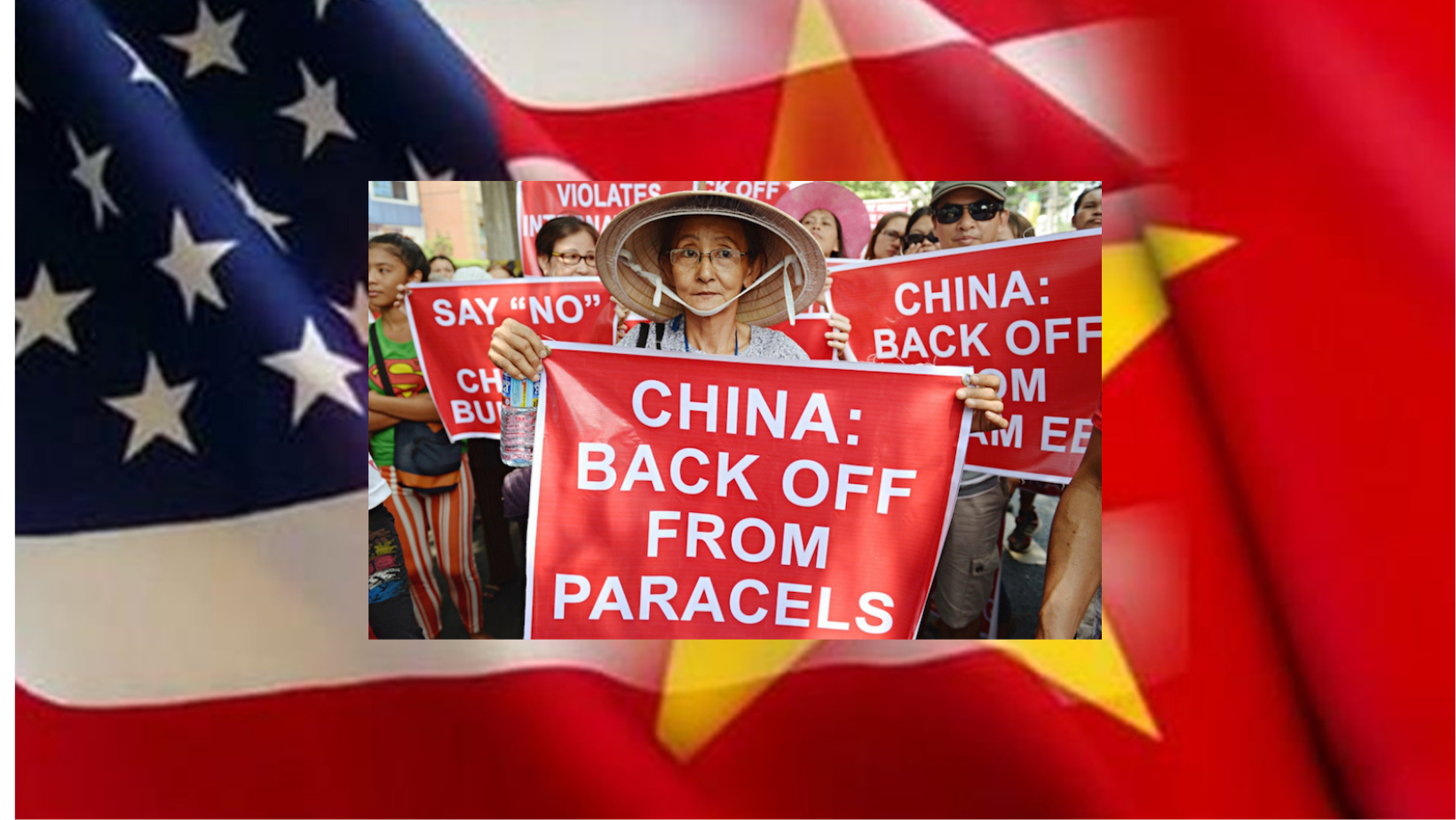
    For more than a decade, China has been claiming most of the South China Sea as part of its sovereign jurisdiction using its controversial and fraudulent Nine-Dash Line myth to support its expansion. It has also been illegally encroaching into the territories of Vietnam and the other Southeast Asian nations for its own personal gain.

    Mainland China has harassed and sunk many maritime vessels from several Southeast Asian countries, illegally harvested fish and other natural resources from these contested waters, and has been building several artificial islands to solidify its hold in this corner of the world. The Mainland’s aggressive, bullish, egoistic, and selfish actions have not only negatively impacted the people and governments of Southeast Asia, but have also caused drastic and irreparable damage to the environment.

    In response, Vietnam has made several international protests regarding China’s actions and has also increased its visibility in the region by expanding its offshore energy exploration program and by implementing its own land reclamation projects. It has also fostered better relations with other maritime powers such as Japan, India, and, of course, the United States, in an attempt to intimidate China and force it to rethink some of its expansionist policies and actions.

    Because of the increased security collaboration between the US and Vietnam, the Obama administration removed all restrictions on selling Vietnam lethal weapons in 2016. Donald Trump’s presidency continued this show of goodwill by providing Vietnam with 24 new coast guard patrol vessels, aerial drones, coastal radar, and two decommissioned US Coast Guard Hamilton-class cutters.

    Yet, Vietnam rarely joins the United States in undertaking large scale diplomatic actions without taking into consideration how China will react. Vietnam’s protests against the Mainland regarding the South China Sea also seem to have minimal effect in the region; in fact, China’s presence has even increased in recent years.

    Despite the tangible support of the United States and the backing of most of the international community, Vietnam’s condemnations and actions have merely been a form of lip service: all bark and no bite. The Vietnamese government’s crackdown on those critical of its policies against China isn’t doing it any favors either.

    In effect, Vietnam finds itself in a bind and is caught between the whims and desires of two irreconcilable world powers.

    On the one hand, you have the United States: a significant trading partner with links to the rest of the free world, but also the cause of much destruction and death in Vietnam’s recent history. On the other, you have China: Vietnam’s largest trading partner and a source of much revenue for the government, but whose expansionist policies are currently threatening and challenging its sovereignty.

    At the moment, Vietnam seems content to play both world powers off against each other in an attempt to squeeze as many benefits as it can from the United States and China. However, the longer the Vietnamese government tries to appease both sides, the more it stands to lose in the long run; the longer Vietnam wears the mantle of neutrality and passivity, the more citizens that will lose faith and trust in the Party. And a government without the backing and support of its citizens, is a complete and utter failure.

    So, should Vietnam pick a side? Should it finally choose between Uncle Sam and Chairman Mao? Is Vietnam even currently in a position to make such a polarizing decision?

    Granted, the economic backlash of this choice has the potential to be quite severe; cutting ties with either your first or second largest trading partner is more than enough to destabilize Vietnam’s growing economy. There is little to no guarantee that China will stop expanding into contested waters if Vietnam decides to fully comply with all of China’s demands. There is also no telling what the United States will do either. With so many variables to consider and so many unknowns, perhaps the most prudent and wisest decision would be to maintain the status quo.

    The answers to these questions  may best be left to economists and experts and we will only know in retrospect if Vietnam ends up making the right decision.

    Ultimately, what will be scrutinized and criticized by believers in democratic ideals is whether or not the Vietnamese government has acted in accordance with the whims and desires of its citizens. Yet, the Human Rights Group reported that given Vietnam’s track record of silencing dissent, its foray into the mass surveillance of its citizens, and other abuses, this remains extremely doubtful.

    Whatever the Vietnamese government decides to do regarding the enemy of its past and the enemy of its present will no doubt benefit the Party first, with the country and its people being merely afterthoughts in the Party’s  grand scheme. And perhaps this is the greatest tragedy of it all.

  • Vietnam Briefing: 2021 Is Going To Be A Busy Year Of Elections

    Vietnam Briefing: 2021 Is Going To Be A Busy Year Of Elections

    We release the Vietnam Briefing every Monday, Vietnam time, with an emphasis on politics and foreign affairs. The briefing today is mainly about the different kinds of elections Vietnam is going to have this year.


    COVID-19:

    • COVID-19 vaccinations will be rolled out this month.
    • Hai Duong Province will end lockdown from March 3.
    • Hanoi’s closure order for street vendors, cafes and historical sites has remained unchanged, but just as we briefed last week, many places are still open.

    We are starting to know what the next National Assembly will look like

    It’s true. We don’t need to wait until the general election ends on May 23 or for the results to be released in June. The National Assembly’s Standing Committee revealed in early February and last week the “tentative proportion” or “tentative allocation,” of seats for Parliament’s next term (2021 – 2026).

    This means we can now see which government and Communist Party bodies will tentatively hold how many seats in the National Assembly.

    The tentative number of seats is officially stated in the Standing Committee’s Resolution 1185/NQ-UBTVQH14, which is dated February 5, 2021 and which was debated again last week during the committee’s session that ended on February 23.

    More details:

    • Approximately 95 members of the National Assembly are members of the Communist Party of Vietnam’s (CPV) Central Committee, including 12-14 members of the Politburo and the Central Secretariat.
    • Outside-of-the-party members: 25-50 (5-10 percent).
    • Members from the central government: 207 (41.4 percent).
    • Members from the military: 12 (excluding the minister of national defense).
    • Members from the police: 2 (excluding the minister of public security).
    • Other seats are also planned to be allocated to other government and party bodies.

    Context:

    • The general election will be held on May 23 for both the National Assembly and local legislative bodies at all three levels (province, district, and commune). The results are expected to be released in June. The first National Assembly session will be held in July, mainly to elect top officials of all three branches of the central government.
    • General elections are held every five years, shortly after the Communist Party congresses.
    • Free and fair elections? That’s what the government says, but it’s not the view of Freedom House, a human rights organization, in its 2020 report: “Elections to the National Assembly are tightly controlled by the CPV, which took 473 of the body’s 500 seats in the 2016 balloting. Candidates who were technically independent but vetted by the CPV took 21 seats. More than 100 independent candidates, including many young civil society activists, were barred from running in the elections.”

    Curious about how this election works? Pay close attention to two things: the role of the Fatherland Front – the Communist Party’s external arm – as a vetting agency and how the government deals with independent candidates.


    Vietnam to run for a seat at the United Nations’ Human Rights Council

    That’s what the Deputy Prime Minister announced last week before a United Nations’ session in Geneva, Switzerland.

    Vietnam apparently doesn’t have a good record on human rights. But just like other authoritarian states such as China, Cuba, and Saudi Arabia, it has a chance to win one out of 47 seats on the United Nations’ Human Rights Council’s 2023-2025 term.

    Context:

    • Vietnam was elected to the very council once in 2013, serving a two-year term from 2014 to 2016.
    • Government persecution targeting dissidents and human rights defenders has been increasingly harsh over the past five years, according to the data collected by The 88 Project.
    • Vietnam has consistently been categorized as a “Not free” country by the international rights group Freedom House.
    • Vietnam is currently a non-permanent member of the UN Security Council, and it will serve until the end of this year.

    Vietnamese ambassador runs for re-election to International Law Commission

    It seems Vietnam is actively seeking more influence on the international stage. Here is another election at the United Nations that Vietnam is campaigning for, according to VietnamPlus:

    “Vietnam’s permanent missions to the United Nations (UN) in New York and Geneva have recently sent diplomatic notes to the UN and member countries informing them of the candidacy of Ambassador Nguyen Hong Thao to the International Law Commission (ILC) for the 2023-2027 term, marking the official start of the Vietnamese candidate’s campaign for re-election to the UN’s important law organ.

    In 2016, Ambassador Thao became the first Vietnamese to be elected as an ILC member. During the 2017-2022 term, he actively promoted ILC’s research results, delivered speeches and joined discussions at the ILC.”


    The Dong Tam appellate trial will be held on March 8

    Remember the high-profile Dong Tam trial in September? The appellate trial opens on March 8 and will last until March 10.

    Six defendants have appealed their sentences to the People’s High Court in Hanoi.

    What should we expect?

    • The trial will very likely result in the affirmation of the lower court’s verdict with little or no adjustments to the defendants’ convictions and sentences.
    • Similar to the trial in September, the appellate trial is expected to be closed to the public, with no independent and international media, and no independent observers allowed to attend; even family members of the defendants may be refused permission to observe the trial.

    Learn more about the Dong Tam case:


    Amnesty International’s new investigation into hacking group Ocean Lotus

    Two weeks ago, we mentioned the hacking group Ocean Lotus in our briefing, indicating that the Vietnamese government is likely behind the effort to target dissidents and foreign entities.

    Last week, another report on the matter was released by Amnesty International. Here is what it says:

    “Our investigation was not able to attribute Ocean Lotus’ activities to any company or government entity. However, the extensive list of people and organizations targeted by Ocean Lotus over years shows that it has a clear focus on targeting human rights and media groups from Vietnam and neighbouring countries. This raises questions about whether Ocean Lotus is linked to Vietnamese state actors. The consistent evidence linking Ocean Lotus to Viet Nam should trigger the Vietnamese authorities to undertake an impartial, thorough and independent investigation into the group’s unlawful activities and human rights abuses.”

    Context:

    • The Vietnamese government has kept silent on the issue.
    • The Vietnamese government also has accused Amnesty International of “distorting Vietnam’s reality” and of “intervening in Vietnam’s internal affairs.”

    Read more about Vietnam:

    Where to now for Vietnam after Trong? (East Asia Forum – Feb 27): “Events over the past year have brought major long-term trends in Vietnam’s domestic and foreign policy to the surface. The country will be less aligned with China. In the next decade, it will likely have its first non-conservative leader since the Cold War’s end but its leaders continue to value the Leninist state model.”

    Vietnam’s unresolved leadership question (East Asia Forum, Feb 25): “Pham Minh Chinh emerged as a new star. […] Chinh is also a potential candidate to succeed General Secretary Trong when Trong vacates his position. In that case, Chinh will have reached a position his predecessors — Nguyen Tan Dung and Nguyen Xuan Phuc — wanted but did not get. The question is whether Trong wants and has enough time to groom Chinh to handle the roles of general secretary and state president.”

    Supply chain bottlenecks in Vietnam (Bangkok Post, Mar 1): “Vietnam’s economy has fared better than that of almost any other country except China during the Covid-19 crisis. It grew by 2.9% last year while most other countries fell into recession. One consequence of the crisis was that manufacturers realised the importance of diversifying supply chains, and many accelerated the China Plus One policies that they had initiated because of the US-China trade war. This led to a surge of investment in Vietnam from global manufacturers last year.”

    Capital meant for Myanmar may seek havens in Vietnam and Cambodia (Nikkei Asia, Feb 27): “The military coup in Myanmar has forced investors who had earmarked capital for the country to look for nearby alternatives. Delta Capital, Anthem Asia and other funds that have solely focused on Myanmar are adopting a wait-and-see approach, and those with a wider geographic footprint are funneling money to destinations like Cambodia and Vietnam. Vietnam is especially frothy.”

    Mitsubishi pulls out of Vinh Tan 3 coal project in Vietnam (Reuters, Feb 26): “Mitsubishi Corp has decided to pull out of the Vinh Tan 3 power plant in Vietnam, two sources familiar with the company’s thinking on the matter told Reuters, as it shifts away from carbon intensive businesses in the face of climate change. Mitsubishi’s move to exit the estimated $2 billion project shows how willing Japanese companies and financiers are to drop their once-strong support for coal amid pressure from shareholders and activists.”

  • Vietnam Officially Announces National Decline In The Number Of Buddhist Followers, Shocking Its Buddhist Sangha

    Vietnam Officially Announces National Decline In The Number Of Buddhist Followers, Shocking Its Buddhist Sangha

    According to Vietnam’s official statistics, in 2019, the religion with the largest number of followers in the country is Catholics with 5.9 million people. The number of followers of Buddhism is 4.6 million, ranking second. However, the numbers reported by this census contradict statistics from other state agencies, leading religious leaders and followers in Vietnam to question its accuracy.

    The Giac Ngo Newspaper – a Buddhist media – reported that this news “shocked” some monks, and that some  believers “burst into tears” when they heard the news. Many people naturally assumed that Vietnam would have more Buddhists than any other religious group.

    However, over the years, followers, monks and as well as senior sangha officials in Vietnam, have gone from one disappointment to another because the number of Buddhists has fallen dramatically in state statistics.

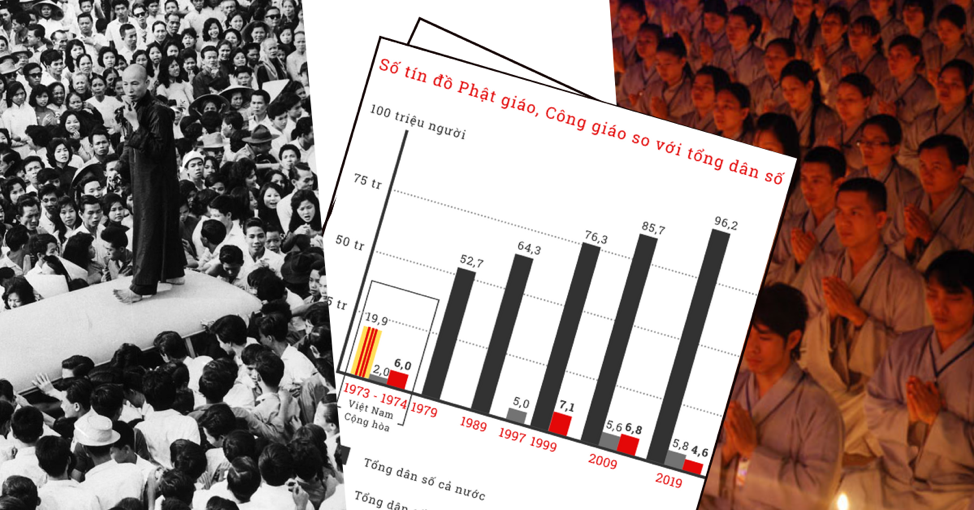
    The number of Buddhists in the 2009 Population and Housing Census was 6.8 million, a decrease of about 300,000 compared to 1999. Even so, Buddhism remained the religion with the largest number of followers in Vietnam.

    The situation only changed with the 2019 census results.

    In that year, the government announced that the number of Buddhists decreased by 30 percent compared to 2009. From 2019, Buddhism has lost its top position in the number of followers in Vietnam according to the State census.

    Over the past 50 years, Vietnam’s general population increased, but the number of Buddhist followers decreased

    Buddhism – a religion of about 2,000 years of development in Vietnam – now has only 4.6 million followers, accounting for about 4.78 percent of the total population.

    Meanwhile, the number of people who claimed to be Buddhist in the Republic of Vietnam (which only consisted of the south of Vietnam and a portion of the center) in 1963 was 9 to 11 million, accounting for 70 percent to 80 percent of the south’s total population as stated in the estimates that the US Central Intelligence Agency (CIA) compiled that year.

    The current figure of 4.6 million Buddhists is also less than the number of followers identified by the CIA as active Buddhists in the Republic of Vietnam in 1974, which was about 5-6 million.

    After 1975, the vibrant religious culture in the south suffered a period of “government watch” for more than 15 years. During that time period, major religions were restricted in their practices and the smaller religions were completely banned.

    According to State Magazine, a research journal of the Ministry of Home Affairs, in the first two censuses of 1979 and 1989, Vietnam did not record the number of religious followers.

    By the early 1990s, Vietnam began to officially recognize the religions that were previously popular in the South but which were banned after 1975, such as Hoa Hao and Cao Dai Buddhism. In 1999, the government started to keep statistics on the number of religious followers in the country.

    Nevertheless, as more statistics were completed, it was observed that the number of Buddhist followers were reported as having fallen. Throughout the three censuses (in 1999, 2009, and 2019), the number of Buddhists decreased by 35 percent while the national population increased by about 26 percent

    Graphics from Luat Khoa Magazine based on the data sources below.

    The Vietnam Buddhist Sangha refutes the state figures, but also does not publicize its own membership numbers

    Looking back, in 2012, the Buddhist Sangha of Vietnam opined about the number of Buddhists in Vietnam after the 2009 census results were published.

    Although Most Venerable Thich Bao Nghiem, vice chairman of the board of directors and head of the Board of the Dharma Preaching of the Central Vietnam Buddhist Sangha, acknowledged the 2009 census is quite “large, serious, and objective,” he also said at the time: “The statistical results …. about Buddhism are not accurate for many different reasons.” He explained that in Vietnam, apart from those who claim to follow other religions, the rest are really “followers of Buddhism, who love Buddhism and are influenced by Buddhism”. If one accepts Thich Bao Nghiem’s reasoning, then the number of followers of Buddhism in Vietnam could have been about 78 million in 2009 – which is the number we get when we subtract all people who declared themselves to have a different religion than Buddhism from the national population at that time.

    However, in 2019, the Vietnam Buddhist Sangha was again surprised when the State census stated that the number of Buddhist followers declined further and that Buddhism was no longer the religion with the most followers in Vietnam.

    Despite this continuing disappointment, over the years, the Vietnam Buddhist Sangha – with nearly 40 years of operation and the only state-recognized Buddhist organization in the country – still has not published the number of its own followers. The only official figure for Buddhists in Vietnam comes from state statistics.

    Meanwhile, other religions have tallied and announced the numbers of their own followers. For example, in 2018, the Vietnam Catholic Bishops’ Council announced that the whole country had about 7 million Catholics (Vietnam’s state statistics put the number at just about 5.86 million). Overseas branches of Hoa Hao Buddhism also stated that there were about 3 million Hoa Hao Buddhists in 2010 (state statistics in 2009 said just 1.3 million).

    Figures for the number of Buddhist followers from other state agencies are also inconsistent

    Unable or unwilling to declare the number of its own Buddhist believers, the Buddhist Sangha currently uses statistics from the Government Committee for Religious Affairs.

    Accordingly, the Sangha often uses the estimate given by Tran Thi Minh Nga that she used when she wrote an article in 2014 on the website of the Government Committee for Religious Affairs. Nga said that up to June 2010, Buddhism had had about 10 million followers in Vietnam.

    Meanwhile, the number of Buddhists in 2009 announced by the General Statistics Office was only 6.8 million.

    Nga did not cite the data source that she mentioned in her article at that time. In 2014, she was the deputy director of the Buddhist Department of the Government Committee for Religious Affairs. Currently, she is serving as the deputy head of the Government Committee for Religious Affairs.

    In a report on religious freedom in Vietnam in 2019, the US Department of State also used data from the Government Committee for Religious Affairs, which in January 2018 stated that about 14.9 percent of the total population was Buddhist. If applying this ratio to the total population in 2019, the number of Buddhists would have been about 14.3 million.

    According to Associate Professor Hoang Thu Huong of the University of Social Sciences and Humanities, the National University of Hanoi, Buddhist monks believe that Buddhists must include both 1) those believers who take refuge in the Three Jewels or Triple Gem (also known as the “Three Refuges”), and also 2) those who identify themselves as being influenced under Buddhism. Dr. Huong also said that because the criteria for inclined towards Buddhism could not be included in statistics survey questions, and that could be why the number of Buddhist followers differs among different state agencies.

    However, during the period of the Republic of Vietnam, the CIA recorded both of these statistics, including active believers (possibly including the Three Refuges) and self-proclaimed and sympathetic Buddhists.


    (*) Data sources for the chart listed above.


    This article was written in Vietnamese by Thai Thanh and previously published in Luat Khoa Magazine on February 18, 2021. The translation was done by Luu Ly.

  • Vietnam Briefing: Military General Appointed To Lead Party’s Propaganda

    Vietnam Briefing: Military General Appointed To Lead Party’s Propaganda

    It was a week of Tet (Lunar New Year), containing COVID-19, a new draft decree on personal data protection, and an unexpected appointment of a military general to the top seat of the Communist Party’s propaganda commission.


    COVID-19

    • Vietnam is expected to secure 60 million doses of vaccines, Minister of Health Nguyen Thanh Long said on February 19. One day earlier, the health agency announced that 204,000 doses of the vaccine will be available in Vietnam by February 28.
    • The cafes, street restaurants, and historical sites closure order in Hanoi has remained unchanged, but in fact, many cafes and restaurants are still open.

    It’s been a long time since a military general led the Communist Party’s propaganda machine

    One needs to look back to the 1980s to see military generals running the Communisty Party’s propaganda departments. Le Quang Dao, Dang Quoc Bao, and Tran Do were the ones holding this position back then. General Tran Do later became known as the high-ranking member of the Party who called for a multiparty political system in Vietnam in the 1990s; he was expelled from the Party in 1999.

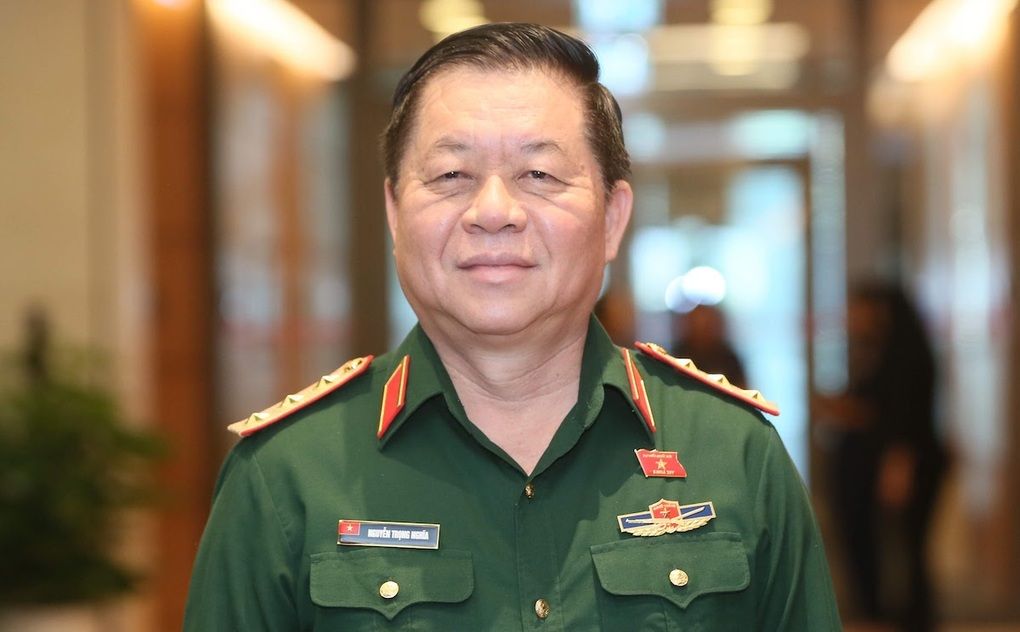
    Not until last week, however, had another general been appointed to the position. Sen. Lt. Gen. Nguyen Trong Nghia was named the chairperson of the Party Central Committee’s Commission for Popularisation and Education (also known as the Commission for Propaganda) on February 18. He previously served as vice chairman of the General Department of Politics of the Vietnam People’s Army.

    One unusual thing to note: He’s not yet a member of the Politburo, making him the first non-Politburo-member to chair the commission since the 1990s.

    Propaganda experience: RFA reported: “Nguyen, 59, had previously overseen the creation in 2017 of a 10,000-member army cyber unit, Task Force 47, which monitored political comment online, countering statements opposing Vietnam’s ruling party.”

    Context: The military has already occupied two out of 18 seats in the Politburo, which is also an unusually high number because over the past 20 years only the Minister of National Defence has held the position. If Gen. Nghia is going to be appointed as a member of the Politburo in the coming years, that would make a record three generals in that Party body.


    Here comes another attempt to detail the Cybersecurity Law

    It’s been almost three years since Vietnam’s National Assembly passed the highly controversial Cybersecurity Law. No guidance on the law’s implementation has been given as the central government usually does in the case of decrees, circulars, and decisions.

    A draft decree was made available to the public for comments at the end of 2018, but it quickly disappeared after a huge backlash from domestic and international actors.

    Earlier this month, the Ministry of Public Security’s website announced another draft decree to address personal data protection.

    You can find the full text of this document in Vietnamese here (Google Drive link). The draft decree is available for public consultation from February 9 to April 9.

    We have taken a look at the text and here are nine takeaways.

    Spoiler: The draft decree has a lot to do with the government dealing with foreign services, such as Facebook and Google. It is not necessarily good news for these companies.


    Vietnam – Myanmar relations amidst political instability in Myanmar

    Three things you need to know about Vietnam’s position on the political tensions in Myanmar after the military overthrew the elected government led by the National League for Democracy.

    • First, the government called on the international community to further support the transition to democracy in Myanmar, matching the wishes and interests of the people of Myanmar, as reported by VietnamPlus. This statement was made on February 15 by Ambassador Le Thi Tuyet Mai, Permanent Representative of Vietnam to the United Nations, the World Trade Organisation (WTO) and other international organisations in Geneva, during a session of the United Nations Human Rights Council.
    • Second, four days later, Ambassador Le Thi Tuyet Mai made another statement at a session of the WTO, saying Vietnam wanted to strengthen its trade ties with Myanmar. According to VietnamPlus: “Vietnam hails Myanmar’s achievements in structural reforms and impressive economic growth in the past year, and wants to continue bolstering the economic-trade and investment ties with the nation in the time to come, a Vietnamese diplomat said.”
    • Third, Vietnam’s military has significant investments in Myanmar in cooperation with the country’s military. A rights group named Justice for Myanmar released an investigative report in December 2020 accusing Viettel – a Vietnamese military telecommunications corporation – of assisting the Myanmar military in war crimes and crimes against humanity through Myanmar’s Mytel company.

    China’s police chief visits Vietnam

    Mr. Zhao Kezhi, the Minister of Public Security of China, visited Vietnam and was received by top government officials: CPV General Secretary and State President Nguyen Phu Trong, Prime Minister Nguyen Xuan Phuc, Minister of Public Security To Lam, and Minister of National Defense Ngo Xuan Lich.

    China’s Xinhuanet reported:

    “Zhao, during the meeting, expressed hopes that the two sides could enhance the synergy between the China-proposed Belt and Road Initiative and Vietnam’s ‘Two Corridors and One Economic Circle’ plan, expand and grow the economic, trade and investment cooperation, so as to better benefit the people of the two countries.”


    84 percent of Vietnamese choose the United States over China

    This is according to a survey released by ISEAS Yusof-Ishak Institute in Singapore on February 10, making Vietnam the second country in ASEAN that favors the United States the most.

    Survey question: If ASEAN were forced to align itself with one of the two strategic rivals, which should it choose?


    New report by the US Congressional Research Service on relations with Vietnam

    The US Congressional Research Service released a report on the US-Vietnam relations on February 16, 2021. This report is meant to inform US lawmakers on matters relating to Vietnam.

    Quotes:

    “China’s actions in the South China Sea have led the United States and Vietnam to intensify security collaboration. In 2016, the Obama Administration removed remaining US restrictions on sales of lethal weapons and related services to Vietnam. Applications to export all defense items, lethal and non-lethal, are subject to a case-by-case review by the State Department’s Directorate of Defense Trade Controls. The Obama and Trump Administrations prioritized bilateral maritime assistance, including providing 24 new coast guard patrol vessels, aerial drones, coastal radar, and two decommissioned U.S.”

    “Although the Trump Administration continued the annual bilateral human rights dialogue and criticized Vietnam’s human rights record in various annual reports and selected statements, it did not appear to assign a high priority to human rights in its overall approach to Vietnam.”


    We are happy to introduce our weekly Vietnam Briefing that will be published every Monday (Vietnam time). We will produce the briefings by carefully selecting worthy news stories from verifiable and trusted sources, including Vietnam’s independent and mainstream media, civil society groups, as well as our own sources. In line with the publication’s code of conduct, we will practice no self-censorship and we pledge to be truthful, honest, and fair.

    If you have any questions, please feel free to contact us: editor@thevietnamese.org.