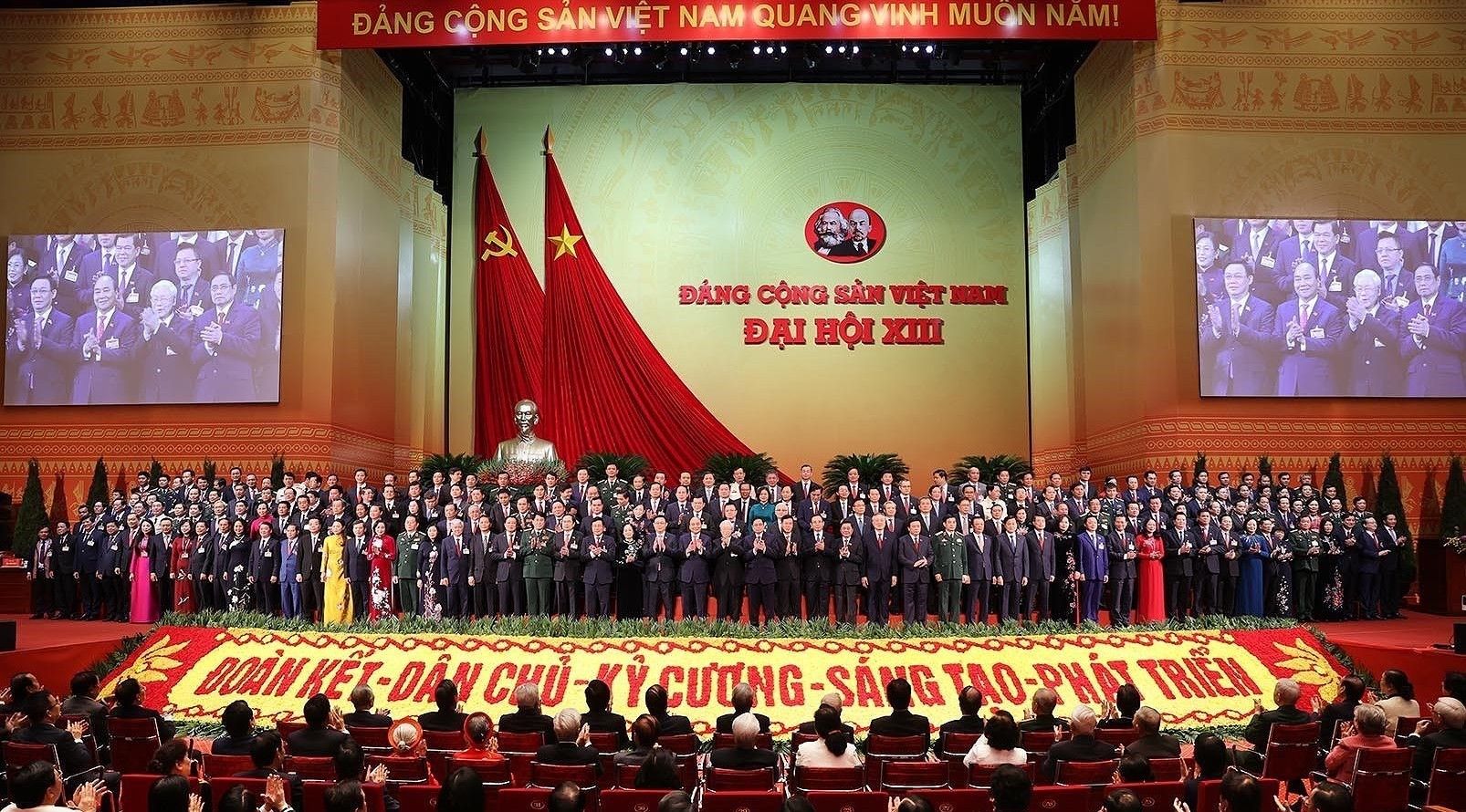
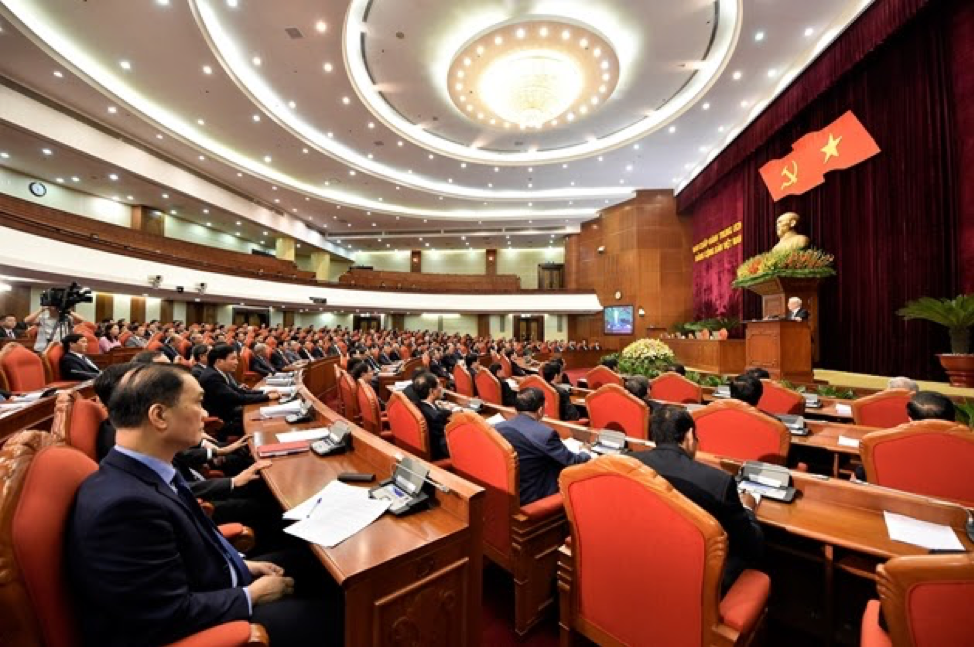
First, it means that the chief justice of the Supreme People’s Court, Nguyen Hoa Binh, has been officially promoted. He was elected to the Politburo for the first time on January 31, 2021, at the first meeting of the VCP 13th Central Committee.
Nguyen Hoa Binh is the second chief justice in the history of Vietnam’s Supreme People’s Court to be elected to the Politburo. The Politburo is the agency that chooses the most powerful politicians in the Party.
The other chief justice on the Politburo was also named Hoa Binh, but had the surname Truong; he was elected to the Politburo in January 2016 at the 12th Party Congress. However, Truong Hoa Binh was moved into an executive position as the deputy prime minister almost immediately thereafter, when Vietnam’s National Assembly met in a special session during April of that same year. During that time, it was Nguyen Hoa Binh who replaced Truong Hoa Binh as the chief justice of the Supreme People’s Court and he held this position since.
If Nguyen Hoa Binh can continue to be the chief justice for the next five years, it will be the very first time that the Supreme People’s Court has had someone with real power in the Politburo.
A chief justice in the past was not a very meaningful position in the Party. Up to now, there have been only a few chief justices that were included as members of the Central Committee.
In addition to the two “Hoa Binhs” mentioned above, there were only two others, Pham Hung and Nguyen Van Hien. The other three chief justices – Pham Van Bach, Tran Cong Tuong, and Trinh Hong Duong – were not even selected as members of the Central Committee. The absence of the chief justices in the Central Committee glaringly emboldened the Party in how it dealt with the judicial branch in Vietnam’s political system. That is, the Party did not see the judiciary as a body with significant power.
One would think that judges and justices should not be members of the only political party in the country so that they can be neutral and independent. One would hope that the judicial branch would remain neutral so that we can have fair trials in the country. However, in reality, this is not the case in Vietnam.
Vietnam does not have an independent judicial branch and the above standard cannot be applied in this country. One’s position within the Party determines the actual political power of a party member, and not any state position one may also hold. The Politburo is the agency that Vo Van Kiet – at one time – had considered to be “superior” to the Central Committee, and gaining a position on the Politburo was the ultimate political goal for the most ambitious and successful Party members in Vietnam.
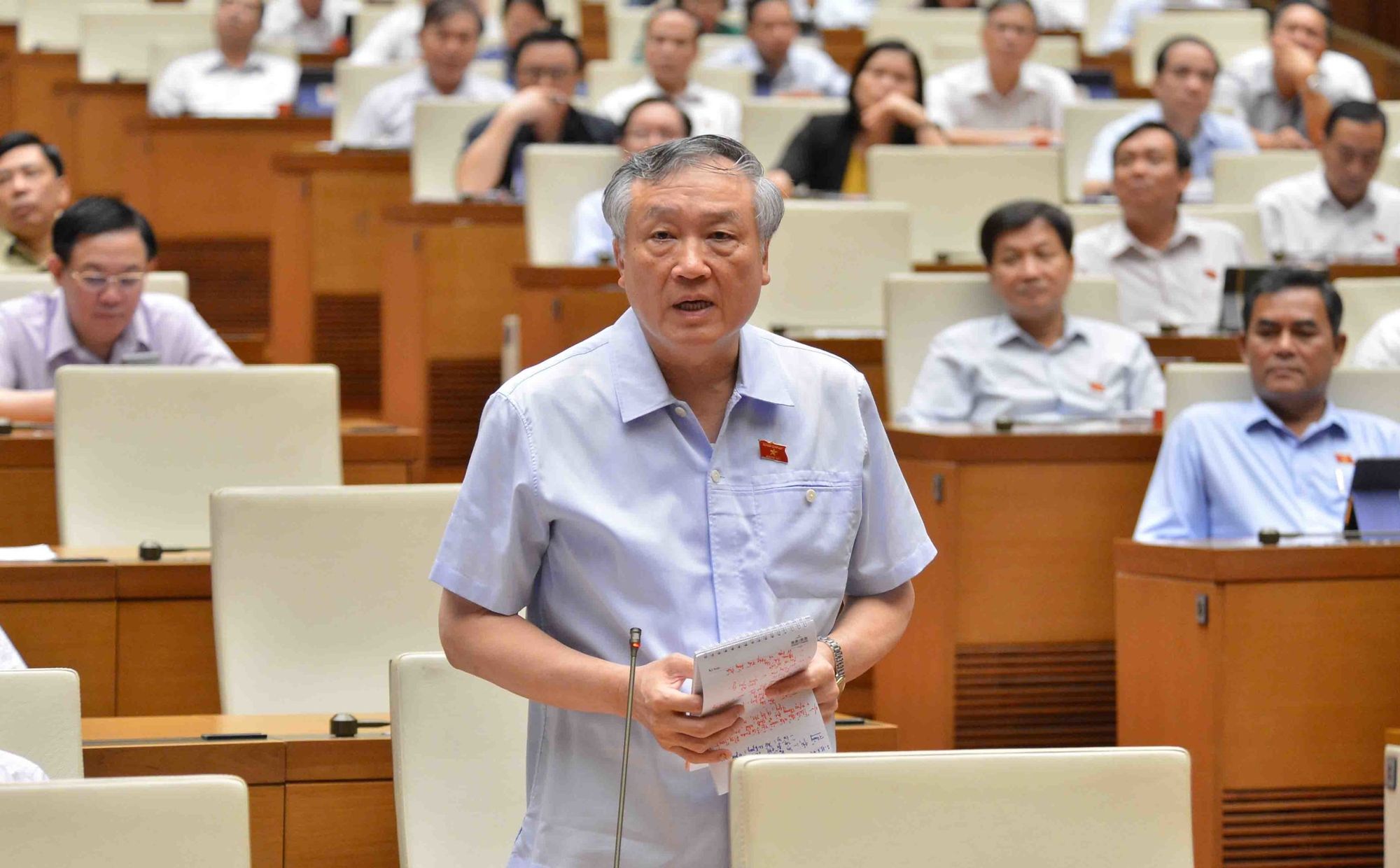
Chief Justice Binh (standing) in the cassation hearing of the Ho Duy Hai case on May 6, 2020. Photo courtesy: VNA.
Being in the Politburo is a reward that the Communist Party gave Nguyen Hoa Binh. We do not know enough to say what he did to receive such an honor. But what he has done in the past five years may possibly offer us some clues.
His appointment is most likely a reward for his role in directing the courts to hear a series of prominent cases related to the “anti-graft” campaign that General Secretary Nguyen Phu Trong started. For the first time in Vietnam’s contemporary history, many high-ranking party members were tried and convicted with extremely heavy sentences: Dinh La Thang, Nguyen Bac Son, Truong Minh Tuan, Trinh Xuan Thanh, and others.
Other prominent cases may also include the cassation trial of the death row inmate Ho Duy Hai and the Dong Tam trial in 2020.
Also, there were many political cases in the past five years which the Party deemed to be closely related to the security of the regime. These include cases related to the Independent Journalists Association of Vietnam (2020), the Brotherhood of Democracy (2016), Nguyen Ngoc Nhu Quynh (blogger Mother Mushroom, 2017), etc. From 2016 to date, the number of dissidents who have been tried has increased much higher than in the past, to the point that the opposition has almost been wiped out in Vietnam.
If the VCP rewarded Chief Justice Nguyen Hoa Binh for the way he handled the cases mentioned above, then we can see that it only encouraged the judicial branch to be more of a supportive team player within the authoritarian regime the Party has created, and that trials cannot be considered independent or the place to resolve injustices in society.
This means that people, such as wrongful death-row inmate Ho Duy Hai, a peasant who was tried and convicted for fighting for his land as was Le Dinh Chuc of Dong Tam Village, or those political dissidents like Pham Chi Dung and Tran Huynh Duy Thuc, who have almost no chance to plead for justice.
Nguyen Hoa Binh was directly involved in the cassation trial of Ho Duy Hai in May 2020, and he was the person who continuously insisted that Ho Duy Hai was guilty, despite all the evidence that Hai’s attorney presented in court. Nguyen Hoa Binh was the center of widespread public criticism during the cassation trial, but he was still promoted by the VCP.
The rise of Chief Justice Binh only proves that the Party is willing to disregard public opinion in order to keep its political power. Now, with his promotion, activists who are involved with the democracy movement in Vietnam may suffer more consequences. With this new position that makes him more powerful than before, Binh may begin to punish those who once made him lose face by criticizing him in public.
It is true that the fact that Chief Justice Nguyen Hoa Binh was elevated to the Politburo may slightly enhance the status of the judicial branch in Vietnam’s political system. However, that doesn’t mean that the courts in Vietnam will be fairer and more independent. If Nguyen Hoa Binh’s promotion means anything, it is that the courts will act more like the powerful tools of the VCP so that the Party can continue to strengthen its one-party political power in the country.
This article was written in Vietnamese by Trinh Huu Long and previously published in Luat Khoa Magazine on February 2, 2021. The translation was done by Jade NG.
This article was written in Vietnamese by Trinh Huu Long and previously published in Luat Khoa Magazine on February 18, 2021. The translation was done by the author.
It’s been almost three years since Vietnam’s National Assembly passed the highly controversial Cybersecurity Law. No guidance on the law’s implementation has been given as the central government usually does in the case of decrees, circulars, and decisions.
A draft decree was made available to the public for comments back at the end of 2018, but it quickly disappeared after receiving huge backlash from domestic and international actors.
Earlier this month, the Ministry of Public Security’s website announced another draft decree which was to address personal data protection.
You can find the full text of this document in Vietnamese here (Google Drive link). The draft decree is available for public consultation from February 9 to April 9.
We have taken a look at the text and below are nine takeaways.
1. Two types of personal data
The draft decree categorizes personal data as two types: basic and sensitive.
Basic personal data includes information about personal identification, such as name, date of birth, place of birth, address, nationality, ethnicity, marital status, and ID number. One thing, however, is unclear: “data containing online activities and history.”
Sensitive personal data includes political and religious opinions; health, genes, sex, biometrics; finances; sexual life; residence; social networking; and others.
2. Individual right to personal data
Individuals have a wide range of rights regarding their personal data as follows:
To consent or refuse data processing by others of one’s own personal data;
To be informed of personal data being processed by others;
To demand an end of data processing; to file complaints about violations;
To demand compensation in cases of data abuse;
Sensitive personal data should not be released. Plus, no release of basic personal data is allowed should it negatively affect its owner. The draft decree doesn’t specify the term “to release personal data” and whom the data is released to besides the public, but based on the wording of Article 6, the draft seems to be only addressing releases to the public.
3. Circumstances in which personal data is being processed without consent
According to Article 10, all personal data, regardless of being basic or sensitive, is subject to being processed (collection, storing, and use) without consent in the following circumstances:
Matters relating to national security, public security, and public order;
Emergencies where the freedoms, or the health and life of the owner’s personal data or of the community’s are being involved;
Investigations and convictions of legal violations;
Conducting research and gathering statistics (after de-identifying the data);
Other circumstances according to the law and international treaties.
The last circumstance, “other circumstances according to the law,” is a loophole that is widely used in the legal system of Vietnam to give the government’s executive branch, especially ministries, an almost unlimited ability to interpret laws and regulations using circulars and executive decisions.
4. Personal data being processed without informing its owner
According to the draft decree, the owners of personal data are normally informed should their data be processed by government agencies or other legal actors.
However, there are three exceptions to the rule, and the most concerning is the second one (Item b, Section 3, Article 11): “In case the processing of personal data is constituted by the law, international agreements, and international treaties.”
This is another loophole in an important matter relating to the transparency of personal data processing.
5. The establishment of the Committee on Personal Data Protection
A new government agency called the Committee on Personal Data Protection is going to be established. It will be set up under the central administration.
The Ministry of Public Security (MPS) can appoint no more than six members to the Committee upon the cabinet’s approval.
The Committee is closely tied to the MPS Department of Cybersecurity and Hi-Tech Crimes Prevention as it is headquartered at the department and chaired by the department’s head officer.
6. Permit required for processing sensitive personal data
Article 20 requires that parties who want to process sensitive personal data must register with the Committee on Personal Data Protection.
However, the Article excludes activities by government agencies relating to law enforcement, judicial procedures, heath, social security, and scientific research. That means these agencies don’t need to register. Also, the Article leaves another loophole for other authorities to exploit by attaching a clause saying “other activities according to the law.”
What remains after excluding the above-mentioned government agencies? Enterprises and non-governmental organizations, both domestic and international ones. Services such as social media, banking, and healthcare must register with the Committee.
7. Permit required for conducting cross-border transfer of personal data
This is directly related to foreign services operating in Vietnam or domestic services operating in other countries, especially technology companies.
Article 21 states that four conditions must be met before a party can make a cross-border transfer of personal data:
Data owner’s consent;
Storing the original copy of the data in Vietnam;
Providing documents that prove the data receiving countries have personal data protection regulations at the same or higher level than that of this decree;
Obtaining a written approval from the Committee.
The second and third conditions can be waived should the data processing party provide statements regarding their commitment on protecting the data.
The data processing party must archive records of data transferring within three years, and stop transmitting data should data leaks or abuses occur, or should they no longer have sufficient capacity to protect the data, or the data owner is incapable/ having difficulties protecting his/her rights and interests.
The Committee on Personal Data Protection will routinely inspect data transmitting parties once a year.
The requirement of storing data’s original copy in Vietnam will likely make it a bit more difficult for foreign social networks, email services, and e-commerce activities to operate in Vietnam. According to Google expert Duong Ngoc Thai, Facebook is unlikely to store users’ personal data in Vietnam but rather just cache data to make access to its services faster.
8. Administrative fines can be up to 5 percent of the total revenue of a company in the Vietnam market
Those who violate the regulations on personal data protection are subject to fines of 50 million dong or 5 percent of their total revenue in the Vietnam market.
Simultaneously, violators can also be banned from processing personal data for 1 to 3 months and may have their data processing licenses revoked.
If not allowed to collect, store and use users’ personal data, online services will probably not be able to function the way they do currently.
The decree doesn’t specify how the government can prohibit online services from processing personal data, but the Cybersecurity Law provides the government with the authority to order the telecommunications companies to block services and sources of information that are deemed to be harmful to society.
9. Effectivity
The draft decree is expected to take effect on December 1, 2021, as stated in the document.
This article was written in Vietnamese by Trinh Huu Long and previously published in Luat Khoa Magazine on February 3, 2021. The translation was done by Ha Thanh.
* * *
Only 9.5 percent of the members of the Central Committee of theVietnamese Communist Party (VCP) are women, or just 19 out of 200 members. Of these, 18 women are official members and one is an alternate member.
What do these numbers tell us?
Let’s take a look at some other numbers first.
In the Politburo (the Party’s most powerful body), only one member out of 18 is a woman, Truong Thi Mai. Mai is currently the head of the Central Mass Mobilization Department of the Central Committee, a not-so-important organ of the Party. Also, it is expected that Mai probably will not hold any important position in the next five years.
Among the new five members of the Secretariat – the body assisting the Politburo – one is a woman. Her name is Bui Thi Minh Hoai. Yes, while it is true that the Politburo could send more members to this body in the future, even if it does, it can only add one more woman, which would be its only female member, Truong Thi Mai.
Compared to the 12th Party Congress, the number of female members in the Party’s Central Committee has fallen by one person, and the number of female Politburo members has decreased by two.
None of the female Central Committee members of the 13th session may possibly hold key positions in the Party or the State. In the previous session, five years ago, Nguyen Thi Kim Ngan became the chairwoman of Vietnam’s 12th National Assembly. Now, the “gang of four” or the “four pillars,” will just be made up of males.
However, if we look at the (arguably) equivalent of the VCP’s Central Committee, which is the National Assembly, we see a different picture.
The percentage of women in the National Assembly over the past 10 years has often been around 25 percent. Now, it is close to 27 percent, which is a lot higher if we compare it to the number of females in the Central Committee. Furthermore, this gender ratio is expected to remain unchanged in the National Assembly election in May 2021.
In 2018, Vietnam was among the top three countries in Southeast Asia with the highest proportion of women in its Congress, along with Laos (28 percent) and the Philippines (28 percent).
In the world, the percentage of female delegates in Vietnam’s Congress is even higher than the United States (23 percent), the Czech Republic (23 percent), South Korea (19 percent), Hungary (12 percent), Japan (10 percent), and even exceeds the global average of 25 percent.
Isn’t that great news? Unfortunately, the answer is No.
It is because the National Assembly is of little significance in Vietnam. Every Vietnamese citizen acknowledges the fact that our Congress has no real authority. It is nothing more than the place that rubber stamps the Politburo’s and the Party Central Committee’s decisions.
In Vietnamese, people usually call the National Assembly the agency of “puppets” where its delegates just nod and approve Party decisions.
Real political power only rests in the VCP and its committees.
The Politburo is a gathering of about 20 of the most powerful Party members. However, the Central Committee is also becoming increasingly powerful, and we could say it has become the main power center within the Party. Obtaining a position within the Central Committee is one of the key goals of any serious and ambitious Vietnamese Communist politician. Failure to enter the “Central” (the word commonly used to refer to the Central Committee) is often regarded as the end of a Party member’s political life because he or she would be one of the voices that carries no authority.
The fact that women only make up less than 10 percent of the Central Committee, therefore, can be considered as a reflection of their actual position in Vietnam’s politics.
Of course, the proportion of female politicians in the localities may be higher. However, for an authoritarian regime with only one political party like Vietnam, where the central government dominates almost every aspect of society, being a part of the Central Committee gives its members actual political authority.
Why is the proportion of women in politics in Vietnam so low?
National Assembly Chairwoman Nguyen Thi Kim Ngan presents flowers to the Standing Committee of the Central Presidium of the Vietnam Women’s Union. Photo courtesy: Ministry of Home Affairs.
Gender stereotypes are considered to be a major barrier to climbing the political ladder in Vietnam. Research by Oxfam shows that all genders in Vietnam prefer male leaders. To them, men are viewed as more suited for leadership roles, and also have the masculine qualities that are also believed to be the necessary qualities of a good leader.
In spite of all the good rhetoric about fairness and gender equality promoted by the VCP propaganda machine, and despite its putting on a seemingly pretty face on the proportion of women in politics, Vietnam, in fact, is still almost exclusively dominated by men.
On February 1 2021, the Myanmar military arrested and detained several prominent figures from the National League for Democracy (NLD), the ruling party of Myanmar prior to the recent coup. Among those arrested were Aung San Suu Kyi and President Win Myint.
This was followed by a swift declaration of a state of emergency and the entrenchment of military cronies in the Myanmar government. Min Aung Hlaing, the figurehead of this new budding dictatorship, stated that it was inevitable that the military would seize control; he alleged that last year’s election, which the military resoundingly lost, was fraudulent and that this coup was their way to ensure a smooth and stable transition towards “a genuine and disciplined demoractic system.” The actions of the Myanmar military have been met by both local and international backlash, criticism, and scrutiny despite their attempt to justify the coup.
Unprecedented numbers of Myanmar citizens have gathered to express their disapproval and anger towards the military through constant and relentless demonstrations and protests; some have even been arrested for their participation in these events. Even though the new regime has been attempting to quell these gatherings through the disruption of internet services, limiting telecommunications access, and through the enforcement of curfews, the Myanmar people have hardly faltered – they continue to remain steadfast and resolute in the face of escalating violence by Min Aung Hlaing’s fledgling dictatorship.
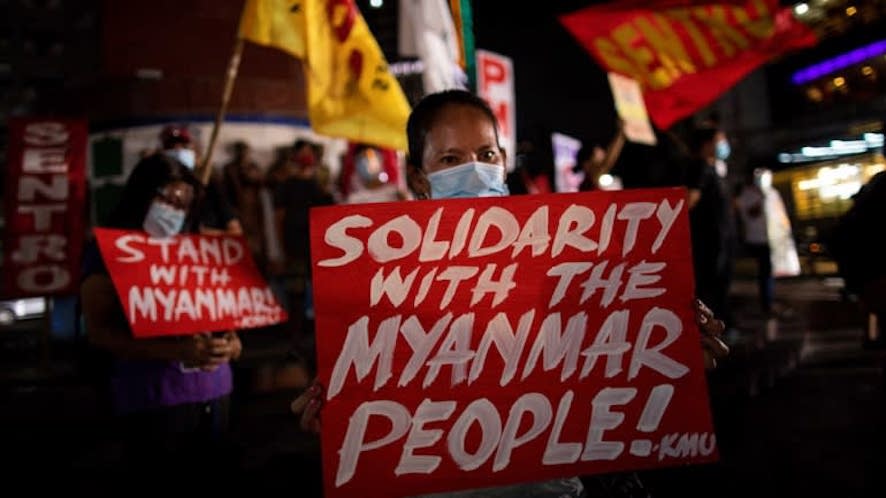
On the international stage, the residents of other nations have organized demonstrations of their own in solidarity with their brothers and sisters in Myanmar. Likewise, private citizens, NGOs, and various media outlets have been spreading awareness of the situation and have placed the actions of this dictatorship under the scrutiny of the rest of the free world. Some foreign countries, such as the United States, now under the Biden administration, have imposed economic sanctions to pressure the Myanmar military into compliance.
The United Nations Human Rights Council, despite the dissenting voices of China, Bolivia, Venezuela, Russia, and the Philippines, has also made several demands of the current ruling power of Myanmar, such as a call for the immediate lifting of the declaration of the state of emergency and the release of all arbitrarily detained individuals.
Justice for Myanmar, a group of undercover activists that aims to improve the lives of all people in their homeland, has recently published a list of people, businesses, and organizations under the control and sway of the military junta. These entities provided the Myanmar military with assets and sources of revenue that aided it in its systemic takeover of the country that further lined the pockets of those in control.
Justice for Myanmar calls on “the international community to impose immediate comprehensive and targeted sanctions against the Myanmar military in response to their Feb 1 coup and their continuing violations of international law, including their campaign of genocide against the Rohingya and war crimes and crimes against humanity in ethnic regions.”
This published report lists 133 businesses fully or partially controlled by the Myanmar military, the names of 174 directors of those businesses, 112 other businesses which the military gets additional income from, and 32 state-owned enterprises that were formerly under the control of civilian institutions. While a majority of the businesses stated are based in Myanmar, there are a number which operate in other neighboring countries such as Vietnam, South Korea, and Japan.
Yadanar Maung, the spokesperson for Justice For Myanmar, states that the “brutal and illegitimate Feb 1 coup, is enabled by their business interests. The Myanmar military leadership uses business to enrich themselves at the expense of the Myanmar people and finance their brutal campaigns of repression….” He then adds that several international businesses such as Kirin Holdings and Viettel empowered the Myanmar military and that their continued operation in the country will only serve to further embolden the junta to commit further atrocities against its people.
With money being an essential factor in the military takeover, one of the most effective ways to aid the struggle of the citizens of Myanmar is through severing relations with those institutions and companies that actively do business with the junta.
In Vietnam, as private citizens in our own country, something as simple as refusing to patronize businesses like Viettel is a start. Those with direct connections to organizations that work with the businesses on the list may take it a step further and call for these groups to distance themselves from the junta. With enough people, we could even petition our government to look into whether or not they actively do business with any of the corporations in the report in a bid to expose and terminate these agreements.
Yet, something as simple and cliche-sounding as discussing this issue with family and friends serves this purpose as well.
After all, the situation in Myanmar is not a story in a vacuum, but rather it is one of many tales regarding the struggle of freedom against the ever rising threat of authoritarianism in the world. It is merely one chapter in the anthology of human history, of the conflict between those who persevere for the betterment of all against those who would enrich only themselves at the expense of everyone else.
As such, the events in Myanmar cannot be willfully ignored, and we have to stand as a unified front against tyranny, selfishness, and deceit. And thankfully, a few exceptions notwithstanding, the rest of the world seems to be on the same page.
All in all, the Justice for Myanmar report, the words of its spokesperson, and all the corollary information derived from the available facts underscore the reality that this coup was not the result of grave injustice, nor the misplaced nationalistic sentiments of the Myanmar military; it is the result of the callousness and unending greed of those who would willingly choose to set their nation ablaze rather than let power slip from their fingertips through legitimate democratic mechanisms.
It is the last resort of a delusional group of people destined to fade into the annals of history as nothing more than a footnote in a textbook. Times are changing and the people of Myanmar have spoken. True democracy will come to them in time as it has come to several other nations in the past. And while the fight rages in the streets of Naypyidaw all the way to the alleys of Kawthaung, the united people of the free world stand in solidarity, in kinship, and in brotherhood with the Myanmar citizens in their struggle for lasting democracy and freedom.
In Vietnam, we are hoping that our human rights and democracy activists will also take the opportunity to stand in solidarity with the people of Myanmar.
The COVID-19 situation continued to worsen throughout the Lunar New Year and serious measures have been put in place.
Hanoi has decided to temporarily close coffee shops, street restaurants, and historical sites from midnight, February 16.
Students in Hanoi will have to study online until February 28, following similar decisions by Hai Duong, Binh Thuan, Thanh Hoa, Binh Dong, and Binh Phuoc provinces.
Ho Chi Minh City’s students will continue to study online until February 28.
The chairperson of the Hanoi People’s Committee proposed that Prime Minister Nguyen Xuan Phuc close universities located in the capital until the end of February. These universities are under the authority of the central government, and not the local government.
Hai Duong, a northern province near Hanoi, will be locked down from February 16 for 15 days and citizens have been ordered to stay home. Only essential movements and businesses are allowed. Schools are closed until at least February 28.
Vietnam – one of Asia’s top-performing economies during the pandemic
“Vietnam was one of Asia’s top-performing economies in 2020 and among the few countries that managed to record growth last year as authorities globally scrambled in their battle against the coronavirus pandemic. It saw 2.9 percent growth in 2020, narrowly edged out by the Taiwan economy’s 2.98 percent growth.”
A state-owned media journalist arrested for defaming provincial officials
It’s not unusual hearing news stories about journalists being arrested in Vietnam. Mr. Pham Bui Bao Thy (Phạm Bùi Bảo Thy) – the head of the representative office of Giáo dục và Thời đại (Education and Era) newspaper in central Vietnam – was arrested and charged by Quang Tri provincial police with “abusing democratic and freedom rights to infringe on the State’s interests and rights and the interests of organizations and individuals” under Article 331 of the Penal Code, according to Tuoi Tre and the Vietnam News Agency.
The provincial police have accused him of using anonymous Facebook accounts to spread baseless information and to defame some top government officials in the province.
The police have put him under a two-month detention order.
Another person named Le Anh Dung (Lê Anh Dũng) was also arrested in the same case. Voice of Vietnam (VOV) reported that Mr. Dung, 56, lived in Ho Chi Minh city and he is accused of administering the accounts.
Article 331, previously Article 258 of the Penal Code, is widely condemned by rights groups such as Amnesty International and Human Rights Watch. Several human rights defenders and dissidents have been arrested and convicted of the crime, including well-known journalists such as Nguyen Huu Vinh, also known as Anh Ba Sam (2014), and Truong Chau Huu Danh (2020).
Is a government-backed hacking group targeting dissidents?
The lotus is seen as a symbol of Vietnam. Look at the national flagship airline’s logo and you will see it. And now, technology experts believe that a hacking group named OceanLotus, potentially linked to the Vietnamese government, is targeting dissidents and human rights organizations.
The Committee to Protect Journalists, an international rights group, released an interview with Steven Adair, president and co-founder of Volexity, a US-based cybersecurity company that has studied OceanLotus, on February 1. Below is a part of the interview:
“Question: Is it possible to say whether state actors are behind OceanLotus?
Answer: We definitely believe it’s out of Vietnam, but whether it’s a government agency, a contractor working for them, or something else, we don’t claim that we know that. We look at the immense level of effort and resources to maintain all the infrastructure and identify the victims. It’s not something anyone’s going to do in their spare time.”
Human Rights Watch: Vietnam among countries using COVID-19 to justify free speech violations
A report released on February 11 by Human Rights Watch lists Vietnam among countries taking advantage of the COVID-19 pandemic to advance the governments’ agenda of suppressing human rights, especially the right of free speech.
Quote:
“Authorities in at least seven countries have blocked individual news reports or ordered online media or social media users to remove or edit Covid-19 related content. Vietnamese authorities summoned 650 Facebook users between January and March to question them about publishing false information relating to the pandemic, forced all of them to remove their posts, and fined over 160 of them. Vietnamese law does not only target incorrect information, but information that is deemed to defame or insult others’ reputation or honor.”
France’s nuclear attack submarine patrols in the South China Sea
On February 17, a lot of Vietnamese people inside and outside of Vietnam, as well as the state-owned media, will be speaking about the border war with China that started exactly 42 years ago. Anti-China sentiment has been strong in Vietnam, and many people wanted to see world superpowers harshly confront China on issues such as trade, human rights, security, and so on. Territorial disputes in the South China Sea are among them. Vietnamese people are desperate to see the United States and other countries on their side. Last week, France seemed to make a strong statement on the issue.
“The French nuclear attack submarine SNA Emeraude recently conducted a patrol in the South China Sea, Defence Minister Florence Parly announced this week, sparking questions over the timing and tensions in Asia’s hotly contested waters.”
Xi Jinping urges Vietnam to “stand against the instigation of external forces” on the South China Sea issue
It was Lunar New Year in Vietnam and China last week. The two countries’ top leaders, Nguyen Phu Trong of Vietnam and Xi Jinping of China, had a phone conversation on February 8 to exchange wishes and to discuss various issues, according to Xinhuanet, China’s state-owned media agency. Here are a few things to note from this conversation.
Quote:
“China, Xi added, is willing to work with Vietnam to accelerate the synergy of the Belt and Road Initiative with the ‘Two Corridors, One Economic Belt,’ promote the construction of cross-border economic cooperation zones between the two countries, and explore exchanges and cooperation in such fields as healthcare, digital economy and humanities.
The two sides should strengthen coordination and cooperation on international and regional issues, firmly uphold the international system with the United Nations at its core, oppose protectionism and unilateralism, and support a fast entry into force of the Regional Comprehensive Economic Partnership agreement, Xi noted.
China and Vietnam, he said, should properly manage the maritime differences and stand against the instigation of external forces to promote the development of regional peace and stability.”
“I believe my life is firmly tied to the nation’s.”
For at least the past 12 years, Pham Doan Trang has been one of the most prominent names in Vietnamese politics, and her arrest on October 6, 2020, has her staring down 20 years in prison.
So, who is Pham Doan Trang?
Pham Doan Trang
Birth name: Pham Thi Doan Trang Birthdate: May 27, 1978 Birthplace: Hanoi Profession: Democracy activist, journalist Location: Currently being held in Temporary Detention Camp #1, Alley 702, Phuc Dien Ward, Nam Tu Liem District, Hanoi. Quotations without citations are taken from writings on Doan Trang’s blog: phamdoantrang.com.
Growing up with the music of the Beatles
Hanoi youth in the 1970s. Photo: ngoisao.net.
Pham Doan Trang is the youngest child in a family of teachers. Her grandparents taught history and math at Hang Ken School, and her mother and father were also teachers. During the subsidy period, Doan Trang grew up in a poor residential area in southern Hanoi. Shewrote about her childhood in her blog:
Like many other children, I was scared of ghosts. This fear only grew when we had to sleep amidst blackouts so dark we couldn’t see our own fingers. Looking out the window, the alleyways were pitch black. There was a burned-out house whose gray walls were charred black. The owner of the house had died in a fire long ago, and no one lived there anymore. There was another house in which the husband and wife died in an accident, and the children lived with the grandparents; no one dared go there either.
In 2nd grade, a neighbor’s cassette player strongly stirred little Doan Trang’s curiosity as it played Beatles’ songs one after the other. Her soul was set aflutter with these hits. From that point on, she began studying English so she could sing Beatles songs.
“In 7th grade, I began struggling with my neighbor’s cassette player to listen to and transcribe the songs where I tried my best to record the lyrics,” she said. “I started borrowing my friends’ personal songbooks where they had the lyrics written out to transcribe the Beatles songs, complete with incorrect English spellings and spotty grammar…. I grew up with the music of the Beatles”.
In college
Doan Trang during her freshman year at Hanoi Foreign Trade University in 1996. Photo: Pham Doan Trang’s Facebook profile.
From 1996-2000, Doan Trang studied at Hanoi Foreign Trade University, majoring in international economics. It was during this time that she and her classmates first connected to the internet. In her blog, she described her college years in Vietnam:
Back then, the internet was only barely establishing itself in Vietnam, and students were quite shy and cautious when surfing online…. We didn’t have books, but we could already see the events in reality were not really accurately described in those books anyway. Moreover, who would let the students just willy-nilly visit the companies and large organizations to find out the truth…. Because of that, students of my time especially focused on studying the one resource that was most useful: online economic articles, either written or translated by journalists. Countless generations of economics students got their education through these articles.
Baby steps towards journalism
Doan Trang interviewing Ms. Hoang Thi Minh Ho (1914-2017), wife of businessman Trinh Van Bo, in 2010. Photo: Pham Doan Trang’s Facebook profile.
In the winter of 2000, after graduating from university, Doan Trang began a stint at the e-newspaper VnExpress, which had just been established. She wrote about that time in her blog:
I remember fondly the winter of 2000, those days and months when I was just starting out in journalism. Sometimes when I think back, I picture myself as a child, dazed and naïve, scared of everything and everyone. I was scared of many things, but most of all, I was scared of miswriting.
After a period of time as newsroom secretary at VnExpress, Doan Trang switched over to television at the digital TV channel VTC (Vietnam Television Corporation).
During her journalism career, Doan Trang has stated that with the exception of sports, she wrote about all sorts of topics—including those which couldn’t be published in the media.
“Trang the Ridiculous”
Doan Trang’s blog. Photo: screenshot.
In August 2006, Doan Trang established her blog phamdoantrang.org, which helped her connect with friends in and outside the country, as well as providing her with a platform with which to write about things that could not be published in the media. The blog remains to this day.
When writing her blog, she used the name “Trang the Ridiculous”.
“I started my blog … originally and purely as a means to practice writing in English,” she wrote. “As such, you can see right away that Trang the Ridiculous’ blog became a gathering place for the ridiculous and the recalcitrant.”
After a number of years, Doan Trang’s blog moved beyond its original purpose.
Sympathizing with the weak
One of the many things that haunted Doan Trang was the fate of the weak around her.
When I was young and living with my parents in a poor neighborhood in southern Hanoi, I remember the women who shouted to themselves, hoarse out of fear and hopelessness, “my child, oh my child….” I remember the tired faces of those struggling to survive, working countless jobs with no names: pedaling cyclos and bicycles, repairing shoes, carving chopsticks, etc. I remember asking myself why so many people around me died young; I once asked my friend, why is human life here worth so little, and he responded: “Whose life? You think your life is worth something?”
“If I had the power to change anything in Vietnam,” she wrote, “I would say that the country lacks an environment where human beings are respected.”
Speaking up is tied to the nation
Journalist Pham Doan Trang when she was working for state newspapers. Photo: Tuoi Tre Online.
Doan Trang once wrote on her blog that life would be so much easier if we closed our eyes to the suffering around us.
She has said that the first reason most people don’t say what they think is innate fear, fear of being blamed, fear of responsibility, fear of isolation. The second reason is, perhaps, that people are not perceptive enough to see the problem or their self-interest in the problem. Even worse, they may only see the penalty in speaking up, believing that speaking up won’t change anything anyway; maybe they feel that the problem is not even relevant to them.
I’ve worked in a number of organizations, and I recognize that people will speak up, and only speak up, when they see themselves as part of the organization. People only strongly attach themselves to the nation when they feel they have shared visions for the future; only then will they feel inspired to turn these visions into reality.
Quitting VTC Television
In March 2007, Doan Trang announced that she would step down from VTC and move to the e-newspaper VietNamNet.
I was like many of us: obsessed with working in television, to the point of madness. I brought (just a portion of) the flame I had from when I was 12 or13 and 19 or 20 to my time working as a visual journalist at VietNamNet TV. I was fortunate that I didn’t pour my whole self into it, otherwise I would have lost even more than I did those 10 years. One day, the pragmatic voice inside of me cried out: “Trang, is it worth it?”.
Mobilizing for LGBT rights
The cover of Bóng – a biography of LGBT figure Nguyen Van Dung, written by authors Hoang Nguyen and Doan Trang. Photo: Global Span (“Nhịp Cầu Thế Giới”).
In 2007, a man named Nguyen Van Dung recounted his life and the LGBT world he inhabited in a trailblazing book called Glass – Biography of a Gay Man, authored by Doan Trang and Hoang Nguyen.
The biography shook society, revealing for the first time the world of LGBT in Vietnam.
Nguyen Van Dung became a popular figure and one of Doan Trang’s friends, and the book, which was used to mobilize for LGBT rights, became a bestseller.
Working as a state journalist
Doan Trang worked for the e-newspaper VietNamNet when Nguyen Anh Tuan was still editor-in-chief. Photo: thongtincongnghe.com.
In 2008-2009, Doan Trang became the first Vietnamese journalist to write an in-depth analysis on Sino-Vietnamese relations. The articles resonated strongly among Vietnamees when they appeared in Vietnam Weekly, a specialty page of VietNamNet.
Prior to that, at the end of 2007, bloggers in Hanoi and Ho Chi Minh City organized ground-breaking protests to oppose China’s establishment of Tam Sa (Sansha) City, an island in the disputed area of the sea, which Vietnam also claims sovereignty over.
In 2007, Doan Trang wrote extensively about her experiences as a journalist in Vietnam.
I like being around those who are different from me, especially those who are quirky or even eccentric. I crave novelty. So, I rarely regret spending too much time or energy on work. I don’t think you can excel at something if you don’t love it. And if you love it and you do it well, in turn, it will change you in positive ways. Obviously, [overworking] can still ruin your life, but unhappiness can spring even from one’s happiness.
However, never will I be an effective journalist if I feel unhappiness weighing down on my heart.
If you’re a Vietnamese journalist, you’ll have many more reasons to feel sad. Whether this sadness is worthwhile depends on you. But if you sincerely want peace, perhaps you shouldn’t become a journalist.
Detained for nine days
Journalist Doan Trang in 2009. Photo: Pham Doan Trang’s Facebook profile.
In 2009, an unexpected event caused Doan Trang’s life to veer in a different direction.
On August 27, 2009, blogger Wind Trader, whose real name is Bui Thanh Hieu, was arrested. The next day, Doan Trang was also arrested, and then blogger Mother Mushroom, whose real name is Nguyen Ngoc Nhu Quynh, was arrested a few days after that.
Police stated that all three individuals had infringed upon national security by printing t-shirts opposing the establishment of bauxite mines in the Central Highlands.
All three individuals were released one after the other after nine days in detention. At the time, Doan Trang was a reporter for Vietnam Weekly (VietnamNet). She wrote about her detention in her blog:
Among the three bloggers, I was perhaps the most ‘unjustly’ arrested; I didn’t participate in the t-shirt printing at all, had never laid eyes on the shirts, or even been consulted about them. Now, when I occasionally think back to that event, it’s of one sad thought: I didn’t even get to wear my shirt, not even once….
Fired by VietnamNet
Doan Trang during an award ceremony held by the publication Ho Chi Minh City Law. Photo: Pham Doan Trang’s Facebook profile.
After her arrest and detention in 2009, Doan Trang was fired by VietnamNet; no reason was given.
During the dark, depressing winter days of 2009, [Professor Dang Phong] remained one of three individuals who helped me keep the flame alive. I couldn’t give in to their rottenness. I couldn’t.
During the dark, depressing winter days of 2009, [Professor Dang Phong] remained one of three individuals who helped me keep the flame alive. I couldn’t give in to their rottenness. I couldn’t.
After that upheaval, Doan Trang went to work for the Ho Chi Minh City Law newspaper.
I was lucky to cross paths with Ho Chi Minh City Law newspaper during those difficult days, when the lingering effects of my time in detention remained serious, when I lived under constant suspicion and when I myself couldn’t trust anyone.
“A history of Vietnamese blogs”
Doan Trang in a protest against Chinese antagonism on June 5t, 2011. Photo: Lan Thang.
In June 2012, Doan Trang released “A History of Vietnamese Blogs” on her personal blog to mark the 7th anniversary of Yahoo! 360°’s arrival in Vietnam. Yahoo! 360° opened up a world of information for Vietnamese citizens. It became the online literary movement and provided social and political commentaries.
In addition to working for Ho Chi Minh City Law newspaper, Doan Trang also wrote articles for other publications, including Tia Sang (Ray of Light), Nhip Cau The Gioi (Global Span – a Vietnamese newspaper in Hungary), and a number of other publications.
During this period, Doan Trang continued to write in-depth analyses on Sino-Vietnamese relations. She was the first journalist in Vietnam to write about the Vietnam-China dispute over the South China Sea, which was a very politically sensitive issue in the country that the government just started to lift up its censorship in the past five years.
On the morning of August 5, 2012, Doan Trang was arrested when she participated in an anti-China protest in Hanoi. This arrest led Doan Trang to become more involved with human rights activities and began her works as a Human Rights Defender in Vietnam.
Pham Doan Trang became a Human Rights Defender
In 2012, Doan Trang became one of the first Vietnamese journalists to report on human rights violations occurring inside the country to the outside world.
That same year, Scrap Paper (Giay Vun) Publishing House published Doan Trang’s book And the Fourth Power, as well as a number of other works of which she was co-author, including The F Generation. In the same year, Knowledge Publishing House published Vietnam and the East SeaDispute, which Doan Trang co-authored.
In March 2013, as the Vietnamese government was seeking citizen feedback on its new draft of the Constitution, Doan Trang began writing a series of articles called What I Tell Myself and Others, which sought to disseminate basic knowledge about politics and human rights where she wrote:
Isn’t this an amazing opportunity for us to learn about our Constitution, the law, constitutionality, human rights and citizens’ rights…? This writer asks for even more: this is an occasion to push all of us Vietnamese citizens, especially young people, to try caring about politics a bit more. How about it?
Moving away from state journalism
Doan Trang during a 2012 press conference held by state-owned Oil and Gas Group regarding East Sea issues. Photo: Pham Doan Trang’s Facebook profile.
In 2013, Doan Trang announced that she was leaving Ho Chi Minh City Law. By this point, she had worked for more than 10 different state media outlets. She then made the decision to go overseas and participate in international advocacy.
The next year, Doan Trang traveled to the United States at the invitation of Villa Aurora, a prestigious artists’ residence, and the University of Southern California.
Human rights advocacy for Vietnam
Doan Trang and a number of other activists in front of the UN Headquarters in New York, January 24, 2014. Photo: Doan Trang’s blog.
From the end of 2013, Doan Trang embarked on many trips to the United States, Europe, and Thailand to advocate for human rights in Vietnam. In particular, Doan Trang was part of a delegation of civil society advocates during a number of international events, including the Universal Periodic Review session on human rights at the UN in February 2014 and the Canadian Senate hearings on human rights in Vietnam in April 2014.
Co-founding Luat Khoa Magazine
Three of the four co-founders of Luat Khoa Magazine. Photo: liv.ngo.
On November 5, 2014, readers first laid eyes on Luat Khoa Magazine, a publication dedicated to law, politics, and human rights and founded by Doan Trang and a number of others.
In her blog, she introduced Luat Khoa:
I understand the fear of not knowing anything about the law, of not knowing even where to begin to escape that immense jungle. I understand how overwhelming these things can be, and I know (in part) what it’s like to be involved in matters related to “courts” with a voice too weak to have any say, not knowing what to do or who to believe, never mind using the law to defend oneself….
Broadly speaking, discovering the law and studying jurisprudence are the first steps on the road to building a state governed by rule of law.
Police retaliation upon returning home
Doan Trang in a meeting with US senators visiting Vietnam in May 2015. Photo: Pham Doan Trang’s Facebook profile.
On January 26, 2015, Doan Trang returned to Vietnam. She was detained at the airport for 15 hours and was closely monitored after returning home. Afterwards, she was arbitrarily arrested by police when she served as a translator for the families of death row inmates Ho Duy Hai and Nguyen Van Chuong in an advocacy meeting with the New Zealand Embassy in Hanoi.
Two weeks after she returned to Vietnam, police disseminated explicit pictures of Doan Trang taken from her computer, which they had confiscated six years earlier.
In March 2015, police poured glue into the locks of Doan Trang’s home, preventing her from attending a meeting at the German Embassy in Hanoi.
Assaulted by police during protests against felling trees in Hanoi
Doan Trang, carrying a backpack, was dragged by police during protests on April 26h, 2015. Photo: Phan Tat Thanh.
On the morning of April 26, 2015, the group For a Green Hanoi organized a march to prevent the Hanoi authorities from cutting down trees in the city. During the protest, police strong-armed Doan Trang and many other protestors onto buses. Doan Trang recalled the incident:
After the march was disrupted on Sunday, when everyone was gathered in front of the Long Bien district police station, Mr. La Viet Dung checked in on me: “You were dragged over a manhole this morning, weren’t you?” he asked.
I remember I was lost in the middle of the crowd, images rushing past in a blur, but I recall seeing a stretch of green sky and a sea of undulating faces, young and old, of both the citizens and police.
Demanding the release of individuals at the police station
Doan Trang together with activists Dinh Thao and Luu Van Minh on the night of September 23, 2015. Photo: Le Anh Hung.
Doan Trang participated in many attempts to free those arbitrarily held at police stations.
On the night of September 23, 2015, six young individuals of the channel Conscience TV were arbitrarily detained. That same day, Doan Trang and other activists arrived at the Hai Ba Trung District police station in Hanoi to demand their release. She and others organized a small protest in front of the station, where they were assaulted by the police.In December 2015, Doan Trang uploaded “Timeline of the capital’s tree-felling ‘campaign’” in both English and Vietnamese on her blog.
Arrested on the way to meet President Barack Obama
In May 2016, Doan Trang took a car from Saigon – where she had just undergone knee surgery – to Hanoi to meet American president Barack Obama. However, she was apprehended by police several hours south of Hanoi and held for 26 hours in Ninh Binh Province.
After being arbitrarily detained in Ninh Binh, she returned to Saigon and continued to be harassed by police at a friend’s residence where she was staying.
From this point onwards, up until her most recent arrest, Doan Trang was repeatedly harassed by police in all sorts of ways. Anytime a diplomatic delegation came to Hanoi, she would be put under house arrest for many weeks prior to its arrival.
Resumption of book and report writing on the environment, politics, and human rights
Doan Trang along with Ms. Le Thi Minh Ha, wife of blogger Nguyen Huu Vinh, during the release of Anh Ba Sam on March 23, 2016 in Hanoi. Photo: JB Nguyen Huu Vinh.
In 2016, Doan Trang participated in writing and editing the bilingual (English-Vietnamese) book Anh Ba Sam, about blogger Anh Ba Sam, whose real name is Nguyen Huu Vinh. The book was released on Amazon a week before Mr. Vinh’s preliminary trial in March 2016.
Beginning in February 2016, as the Vietnamese government was organizing elections for representatives of the National Assembly’s 14th term and of the People’s Councils at all levels, Doan Trang wrote a good deal about the processes on her blog.
The book Overview of Vietnam’s Marine Environmental Disaster. Photo: Liberal Publishing House.
In October 2016, the group Green Trees published the book Overview of Vietnam’s Marine Environmental Disasteron Amazon, with Doan Trang and other activists as co-authors. The book laid out the timeline of events during and after Hung Nghiep Formosa Ha Tinh’s polluting of beaches in mid-2016. Also in the same year, the book From Facebook Down to the Streets was published on Amazon.
Supporting other activists
Doan Trang standing with crutches to the right of Green Trees group members in a photo taken in 2016. Photo: Anh Ba Sam.
Few outsiders know that Doan Trang is more than just an activist; she also guides young people on how to become activists themselves. For these young people, she is a rare kind of teacher, imparting on them knowledge and skills that they can’t learn anywhere else.
The days writing Politics for the Common People
Doan Trang in 2017. Photo: Thinh Nguyen.
In 2017, Doan Trang wrote Politics for the Common People while she was under house arrest in Hanoi. In July 2017, she left Hanoi for Saigon in order to evade police harassment.
On September 22, 2017, Politics for the Common People was published by Scrap Paper Publishing House and Green Trees. The book aimed to spread basic political knowledge to everyday people, especially the young involved in social and human rights activism.
Cover of Politics for the Common People. Photo: Liberal Publishing House.
I wrote [Politics for the Common People] while under tight police supervision in Hanoi; I couldn’t do anything or go anywhere. I felt like I couldn’t breathe—literally…. Meanwhile, in some other location, their boss, sitting in an air-conditioned room, directed them to closely follow the ‘suspect’, research the suspect’s habits, her daily routine, her path to and from home, and how items are arranged in her house….
If I didn’t have my guitar by my side, I probably would’ve gone insane…. But, to me, all of that isn’t important; what’s important is that people read the book. The more people that read it, the better.
In 2017 and 2018, Doan Trang stated that at least 300 copies of Politics for the Common People were confiscated by Danang police as they were being transported from Poland to Vietnam.
Link to purchase the book: Amazon (print), Smashwords (digital).
Receiving the Homo Homini Award
Doan Trang in a documentary film shown at the Homo Homini Award ceremony in Prague, Czech Republic. Photo: People In Need.
In February 2018, People In Need, an internationally-renowned non-profit organization based in the Czech Republic, bestowed upon Doan Trang the Homo Homini Award, given annually to honor valiant political and human rights activists and journalists across the world. Doan Trang was unable to leave Vietnam to receive the award.
Days of horror
Photo: People In Need.
In February 2018, Doan Trang was kidnapped by police and interrogated about Politics for the Common People;upon returning home to Hanoi to celebrate the Lunar New Year with her family, she was put under house arrest.
At the beginning of March, police continued to hold her captive as she tried to find ways to escape Hanoi. Ultimately, Doan Trang was able to escape to Saigon, but her health was quite frail.
One day at the end of May, Doan Trang returned to Hanoi. As soon as she stepped off the bus in Hanoi, police were waiting for her. She was forced to resume house arrest because the authorities were afraid she would “instigate” the masses to protest two bills: the SEZ Law and the Cybersecurity Law.
With the help of friends and readers, Doan Trang escaped the Hanoi police one more time, traveling to Saigon. During this escape, she seriously injured her hands climbing over high walls, which she did in spite of her aching knees.
The next book
From left: Nguyen Anh Tuan, Pham Doan Trang, and Trinh Huu Long. Photo: Luat Khoa Magazine.
In June 2018, when protests against the two proposed laws broke out, Doan Trang joined hands with jurist Trinh Huu Long and activist Nguyen Anh Tuan to write Studying Public Policy through the Case of SEZs. In mid-December 2018, the book was published by Luat Khoa Magazine.
Admitted to the hospital after a brutal police assault
Doan Trang was admitted to the hospital after police broke up singer Nguyen Tin’s concert. Photo: Pham Doan Trang.
On August 15, 2018, Doan Trang was assaulted by plainclothes police while attending an evening concert by singer Nguyen Tin. The concert was broken up by police, who interrogated and beat both organizers and attendees.
Doan Trang recounted how six plainclothes police officers beat her with a motorcycle helmet and some custom-made weapons. Police confiscated her computer and I.D. documents during the event.
The next day, she was admitted to the hospital suffering a concussion. At the hospital, police kept an eye on her as though she were a criminal; no friends or readers were allowed to speak with her. She was bedridden for the next three weeks.
Only later did Doan Trang learn that the concert was disrupted by police because they suspected Doan Trang was going to use the event to distribute Politics for the Common People and other “anti-state” materials.
Homeless
Doan Trang’s living situation became increasingly precarious as she no longer had her identification papers and police scoured for her everywhere. Vietnam’s tenant registration system effectively worked to make life difficult for an independent journalist like her. She believes that police even forced her neighbors in Hanoi to sign pledges to immediately report her if they saw her.
In January 2019, Loc Hung Garden – where Doan Trang was living – was torn down by the authorities. From then on, half her time and energy was spent trying to find a place to live while on the run from police and while her hands and feet were seriously injured. Doan Trang was unable to walk more than a few hundred meters and could not ride a motorcycle.
Injured and exhausted, Doan Trang felt her journalism career was coming to a close in the face of relentless government pursuit.
Unable to live a normal life
Doan Trang and saxophonist Dang Vu Luong in Ky Anh District, Ha Tinh Province, March 2017. Photo: Pham Doan Trang’s Facebook profile.
For more than three years beginning in July 2017, Doan Trang lived in at least 60 different locations across Vietnam. She traveled for over three years on a pair of injured legs, weighed down by a pervasive fear, while being constantly beaten, assaulted, and beleaguered by police. She described her life in her blog:
Working as an independent journalist and author under a totalitarian regime means that you can be arrested and interrogated, even assaulted, at any time without any way to protect yourself and unable to freely move around the country….
One could also be placed under house arrest or become essentially homeless. You can’t go out and enjoy yourself or even walk down the street because someone could be following you, or even worse, a complete stranger could suddenly attack you from behind.
Your family is closely monitored, and police might make trouble for your friends and supporters .… You have to live with the perpetual feeling that you are an enemy of the state, deserving of punishment ….
You certainly won’t die, because they have no intention of killing you. But you can no longer live normally like other people or like you had before. Misery, depression, and mental breakdowns will all pile on to wreak havoc and slowly kill you.
Receiving the Press Freedom Award from Reporters Without Borders
Doan Trang received the Reporters Without Borders Press Freedom Award, September 12, 2019. Photo: Trinh Huu Long / Luat Khoa Magazine.
On September 12, 2019, Reporters Without Borders awarded Doan Trang the 2019 Press Freedom Award Prize for Impact.
Responding to BBC Vietnamese, Doan Trang spoke of her wishes after receiving the prize:
I hope that in the near future, more people in Vietnam will continue to strongly speak up, to express their views and political opinions on social and political matters.
I especially hope for the appearance of more writers, more independent journalists, more professional bloggers, and even more state journalists, who will participate in democratizing society through the media.”
Unable to live and unable to write
Doan Trang with musician Tuan Khanh and activist Pham Thanh Nghien. Photo: Tuan Khanh’s Facebook profile.
In her most trying days, Doan Trang was neither able to live nor to write.
In February 2019, she founded and became an editor for Liberal Publishing House.
In July 2020, Doan Trang and a number of translators announced that they would publish the book Fighting Impunity, translated from a work by Safeguard Defenders providing instructions on how to use Magnitsky Laws to sanction human rights violators. In addition, Liberal Publishing House also produced other works on human rights, politics, and democracy.
After Liberal Publishing House released a number of books and reports, police sought to disrupt its activities by any means possible. Many book distributors and recipients were followed, threatened, and assaulted by the authorities.
Report on the Dong Tam Village Incident
The cover of Fighting over Senh Field: A Report on the Dong Tam Village Attack. Photo: Liberal Publishing House.
In February 2020, a month after riot police shot at Dong Tam villagers in the middle of the night, Liberal Publishing House published a bilingual (English-Vietnamese) work called Fighting over Senh Field: A Report on the Dong Tam Village Attack.
Fighting over Senh Field had five authors, including: Doan Trang, activist Will Nguyen, and activists Can Thi Theu and her two sons Trinh Ba Phuong and Trinh Ba Tu. Ms. Theu and her two sons were arrested before the preliminary trial for murder and obstruction of officials in Dong Tam.
IPA honors Liberal Publishing House
Doan Trang in a documentary shown during her acceptance of the Prix Voltaire 2020 award. Photo: screenshot.
At the beginning of June 2020, the International Publishers Association (IPA), the world’s largest association of publishers, awarded Liberal Publishing House the Prix Voltaire 2020 Award. The award is given to publishing organizations around the world that best embody IPA’s spirit of independent publishing.
At the beginning of July 2020, Doan Trang announced her withdrawal from Liberal Publishing House, citing her “ailing health” and “security threats to members of LPH”.
A few weeks later, Liberal Publishing House became embroiled in a scandal after Doan Trang publicly accused a high-level manager in the organization of corruption. The spat dragged on, with the other side claiming that Doan Trang’s accusations were false. The matter remains to be settled, but the person whom Doan Trang accused also withdrew from Liberal Publishing House.
Arrested after the third report on Dong Tam
Ho Chi Minh City police lead Doan Trang from her home late on the night of October 6, 2020. Photo: Pham Doan Trang’s Facebook profile.
At 11:30 pm on the night of October 6, 2020, Ho Chi Minh City Police arrested Doan Trang, and extradited her to Hanoi the following day.
Police charged her with “propaganda against the state” as stipulated in Article 88 of the 1999 Penal Code and “making, storing, or distributing information, materials, and items to oppose the State” as stipulated in Article 117 of the 2015 Penal Code.
Police arrested Doan Trang on the very day Vietnam and the United States held their annual human rights dialogue, detaining her shortly after the event ended.
Doan Trang in a documentary about Liberal Publishing House, shown at the Frankfurt Book Fair. Photo: Screenshot/IPA.
Shortly before her arrest, Doan Trang and Will Nguyen had announced the release of the 3rd edition of the Dong Tam Report, in both English and Vietnamese.
Doan Trang introduced the report on Facebook: “On September 25, we released the 3rd and most complete edition of the Dong Tam Report to readers. It is bilingual and twice as thick as the February edition. Strangely, I was also able to break my own personal record: I lost 7 kg of body weight.”
Doan Trang’s arrest occurred before she was able to participate in a live discussion at the world’s most prestigious event for publishers – Frankfurt Bookfair – from October 14-18, 2020. In September 2020, IPA announced on its website that Doan Trang would be attending the event.
International response to her arrest
The Vietnamese government’s arrest and indictment of journalist Pham Doan Trang sparked a sweeping international backlash.
After her arrest, the Czech Republic’s foreign minister Tomáš Petříček recalled on his Twitter and Facebook accounts that Doan Trang had been bestowed the Homo Homini Award for her bravery and contributions to protecting human rights.
US Assistant Secretary of State for Democracy, Human Rights, and Labor, Robert A. Destro, wrote on Twitter that the United States condemned the arrest of activist Pham Doan Trang and called for her immediate release.
Doan Trang probably didn’t want to be detained, but she knew she would be arrested and sentenced one day. She had long prepared for it.
Right after Doan Trang’s arrest, her friends made public a letter that she had left behind. “Ideally, I’d like to be free (and allowed to stay in Vietnam instead of being expelled), with the goals achieved,” she wrote.
She touched upon three objectives that she hoped readers would leverage her imprisonment to achieve.
The first goal was to tie her imprisonment to advocacy for new laws to reform how Vietnam conducts elections and constitutes its National Assembly.
The second one was to encourage people to read her books.
And the third goal was for democracy activists to use her imprisonment to negotiate with the Vietnamese government, with a focus on new legislation for elections and National Assembly formation.
***
In 2011, Doan Trang was still affected by the repercussions of her 2009 arrest. Back then, Trang could have chosen a different path, one that led to a quieter life – but she didn’t.
In a 2011 post, she imagined asking her late grandfather:
“Oh grandfather, when you were alive, did you ever think that your grandchild would grow up to be a ‘disaffected’, ‘disruptive’, ‘danger to national security’, grandfather?” And then I would ask him: “Should people love their country, should they tie themselves to their nation, grandfather?”
Today, Doan Trang undoubtedly has an answer.
***
This article was written by Tran Phuong and previously published on Luat Khoa Magazine on October 25, 2020. The translation was done by Will Nguyen.
We are happy to introduce our weekly Vietnam Briefing that will be published every Monday (Vietnam time). We will produce the briefings by carefully selecting worthy news stories from verifiable and trusted sources, including Vietnam’s independent and mainstream media, civil society groups, as well as our own sources. In line with the publication’s code of conduct, we will practice no self-censorship and we pledge to be truthful, honest, and fair.
The situation has been worsening over the past week. After new cases were recently reported in Hai Duong, Hai Phong, Hanoi, Bac Ninh, Quang Ninh, Dien Bien, Ha Giang, and now Binh Duong, Ho Chi Minh City and Gia Lai also have identified patients with COVID-19. In addition, one staff member of Tan Son Nhat International Airport was found to have COVID-19, according to the Ministry of Health. The airport remains in operation though. This data was updated at 10:00 pm on Sunday.
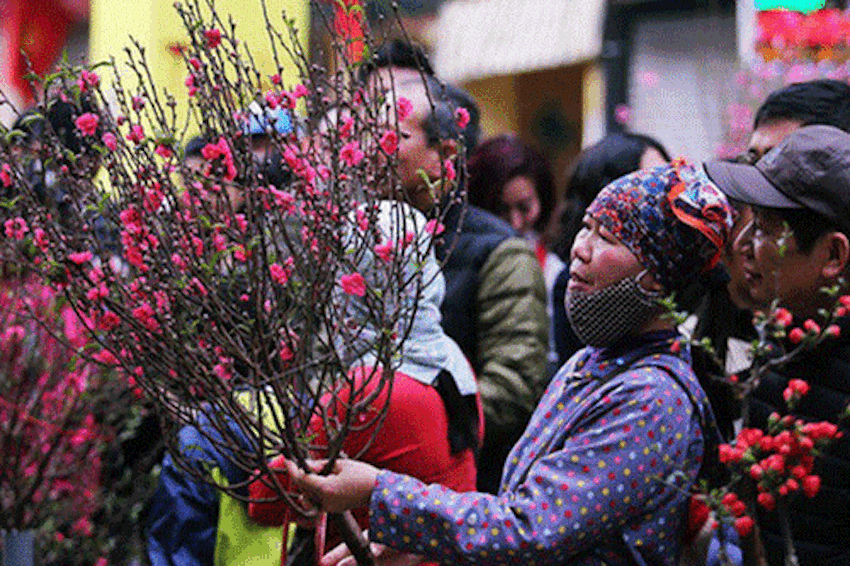
Tet, the Vietnamese Lunar New Year, is fast approaching (February 10-16) and many people are trying to find ways to return home for family gatherings. Unfortunately, the coronavirus is also finding ways to continue to infect people.
Fireworks for the Lunar New Year’s Eve have been canceled in various parts of the country, including Ho Chi Minh City. In Hanoi and Hai Phong, each city will have just one show instead of 30 and 12, respectively.
Meet the new leadership of the Vietnamese Communist Party
The Communist Party’s 13th Congress ended last Monday morning, February 1, 2021, one day earlier than planned due to COVID-19 concerns.
The main part of the Congress’s agenda was to elect a new leadership for the party. Two hundred members of the Central Committee were elected by the Congress on Saturday, January 30, and the Committee convened the next day to elect members of the Politburo, the general secretary, and members of the Central Disciplinary Commission.
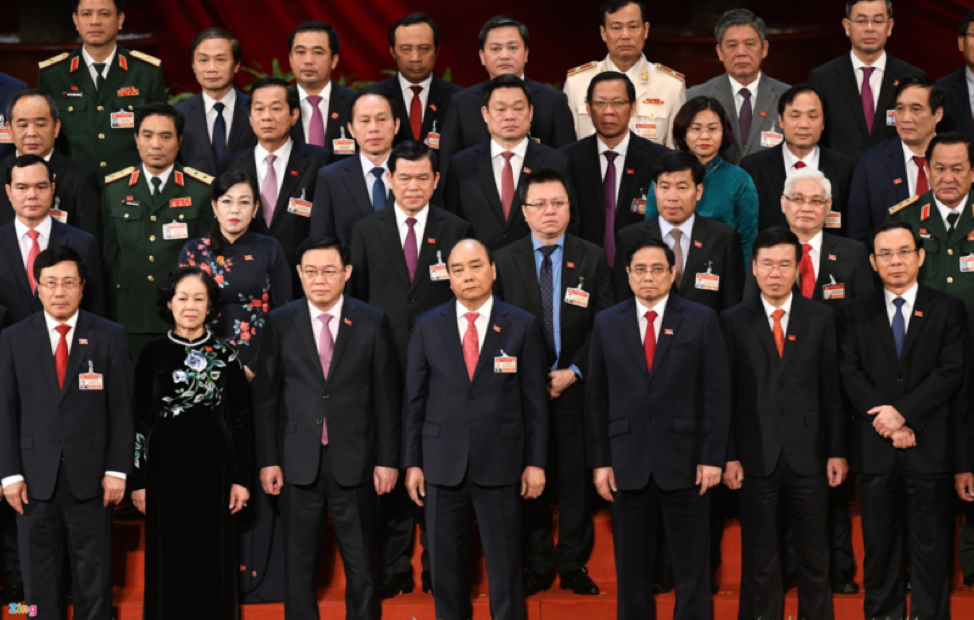
The results were announced the same day. Current general secretary Nguyen Phu Trong won re-election. The next three seats in line are current prime minister Nguyen Xuan Phuc, the head of the Party Central Committee’s Organization Commission, Pham Minh Chinh, and the secretary of the Hanoi Party Committee, Vuong Dinh Hue. Together, they are often called “The Gang of Four,” or the “Four Pillars,” holding the top seats of the Party and State.
The public in Vietnam is often informed of the results well in advance by some Internet influencers who seem to have insider information. Now, the rumor is that Nguyen Xuan Phuc will be the president, Pham Minh Chinh will be the prime minister, and Vuong Dinh Hue will be the chairperson of the National Assembly.
Of course, we have to wait until June or July, 2021, after Vietnam’s general election on May 23, 2021, to know if the rumors are correct. However, in the past, these rumores have often proved to be true.
Hard numbers: Only 19 out of 200 members of the Central Committee – the elite club of the party – are women; and only one woman was elected to the Politburo, reducing the number from three in the previous term.
After the Party Congress
As we mentioned in an earlier article, the Communist Party’s Politburo would routinely convene right after the Party Congress to assign positions to its members. Now we have started to know at least two of those positions.
February 6, 2021: In Hanoi, Vo Van Thuong was appointed the standing secretary of the Party Secretariat – a small but powerful Party body that is responsible for overseeing the daily activities of the Party, directly assisting the Politburo.
Who is he? Thuong, 51, was born in the southern province of Vinh Long. He is a young and rising star in the VCP, and he will take the fifth position in the Party leadership. He previously served as the head of the Central Propaganda Commission, and was formerly the standing deputy secretary of the Ho Chi Minh City Party Committee, the secretary of Quang Ngai Province Party Committee, the secretary of the Central Committee of the Communist Youth Union, as well as having served in other positions.
Context: No member from the South faction (in the South of Vietnam) won any of the top seats in the so-called Gang of Four (Party’s general secretary, president, prime minister, and chairperson of the National Assembly).
February 6, 2021: In Hanoi, Tran Tuan Anh, who currently heads the Ministry of Industry and Trade, was appointed commissioner of the Party’s Central Economic Commission.
Who is he? Anh has been the head of the Ministry of Industry and Trade since 2016. He was previously the deputy minister of that same ministry and also was the deputy commissioner of the Central Economic Commission. Anh was also the vice president of the Can Tho City People’s Committee and he also served as Vietnam’s consul general in San Francisco, in the United States.
What is special about him? Now 57, Anh is notably a son of Vietnam’s former president Tran Duc Luong (1997 – 2006).
Now, Vietnam’s general election
The Communist Party’s election is now over, and the next general election will take place on May 23, 2021 to elect members of the National Assembly and local government representatives.
The current chairperson of the National Assembly, Nguyen Thi Kim Ngan, wasted no time and immediately sprang into actions. She publicly announced that the national legislative body aimed to have 25 – 50 outside-of-the-party members; 207 members from the central government, 293 members from local governments; 50 members under 40 years old; at least 18 percent of members from ethnic minorities, and at least 35 percent women, according to Thanh Nien newspaper.
Who formally decides the numbers? The Standing Committee of the National Assembly. It will meet on February 22, 2021 to discuss the matter further.
Backlash: Nguyen Thi Kim Ngan’s statement immediately drew backlash from social media users who criticized her and the ruling Communist Party – the only legally operating political party in Vietnam – for trying to fake a general election.
China’s construction of military bases near the border with Vietnam
One of the most popular political news stories of last week was reports that China had been constructing two military bases close to the border with Vietnam. The following is a quote from Tuoi Tre News:
“Vietnam is verifying reports of a Chinese surface-to-air missile base being constructed near the China-Vietnam border,” Le Thi Thu Hang, spokesperson of the Vietnamese Ministry of Foreign Affairs, said at a press conference in Hanoi on Thursday. The missile base is reportedly located in Ningming County in southwestern Guangxi, China, about 20 kilometers away from China’s border with Vietnam. The unverified information also stated that the missile base is situated about 40 kilometers away from another construction site, believed to be a military heliport.”
More details with satellite images have been published by Dai Su Ky Bien Dong, a nonprofit research group dedicated to the South China Sea issue.
Tran Huynh Duy Thuc ends his hunger strike
Political prisoner Tran Huynh Duy Thuc ended his hunger strike on February 3, 2021. His family announced the news via a Facebook page named after him.
He started his hunger strike more than two months ago, demanding the government consider his petition to reduce his sentence of 16 years imprisonment and release him in accordance with a new provision of the 2015 Penal Code. From his family, he only consumed milk during his strike. Tran Huynh Duy Thuc was convicted in 2009 for “conducting activities against the state” under Article 79 of the then-Penal Code.
He told his family members via a phone call that he had achieved his main goal of the hunger strike which was to “keep a light burning during our country’s revolution.”
Neither the family nor the government provided any information about whether or not his appeal petition is under consideration.
Still no news about imprisoned democracy activist Pham Doan Trang
Neither her attorney or family members have had any contact with jailed democracy activist Pham Doan Trang since she was arrested by Vietnam’s police on October 6, 2020. She has been held incommunicado in Hanoi since her arrest.
Family members of Pham Doan Trang’s have visited the No. 1 Detention Center in Hanoi weekly to give her personal supplies, but they have not been allowed to meet her and no communication has been allowed.
Vietnam’s Criminal Procedures Code allows investigative agencies to hold those suspected of national security crimes incommunicado until the investigation is completed.
Pham Doan Trang is a co-founder of The Vietnamese and Luat Khoa magazines. You can learn more about her here and about the Party’s crackdown on the opposition movement under General Secretary Nguyen Phu Trong here.
This article was written in Vietnamese by Bui Cong Truc and previously published in Luat Khoa Magazine on January 20, 2021. The translation was done by Luu Ly.
* * *
How is the VCP “more democratic” than the CCP?
Most of the active communist parties today are more or less based on the Soviet Communist Party model.
The system originated with the majority power of the Party National Congress. This congress elects a minority group called the Communist Party Central Executive Committee (the Central Committee, for short).
Theoretically, the Central Committee is the governing body that decides most of the important issues in terms of policies and personnel in the Communist Party organization. However, the organs elected by this body have certain privileges, and can completely surpass the power of the Central Committee itself, depending on the time period.
These agencies include the Political Bureau (aka the Politburo), the Secretariats, or a typical body of the Soviet Union Communist Party, the Organizational Bureau.
So are the power structures of both Communist parties similar? How has the individual history of each party, the Chinese Communist Party of China (CCP) and the Vietnamese Communist Party (VCP), affected each country’s economic and social development? This article will provide readers with more information about the fundamental differences between these two Communist brothers.
Two leaders of the two Communist parties, Xi Jinping and Nguyen Phu Trong. Photo taken during Nguyen Phu Trong’s visit to China in 2017. Photo: Xinhua News Agency.
Conflicts between the Central Committee and the Politburo
Many people accept, as common sense, that the Politburo is the central power for both the VCP and the CCP. However, the party rules of these two brothers have many differences.
The first notable point is that the Central Committee of the CCP has only been required to meet once a year since Deng Xiaoping reformed and re-institutionalized the political apparatus. Many Chinese observers assert that this was an intentional effort to limit the frequency of the CCP Central Committee’s meetings so that the authority of the body would be reduced as much as possible.
The pressure to democratize within this Party is not insignificant and not recent, but for many reasons, these proposals have been unsuccessful. Arguably, the CCP’s Central Committee only plays a behind-the-scenes role, compared to the main playerr, the Politburo.
Regulations in Vietnam are different. According to Article 16 of the VCP Charter, the Central Committee of the Party must meet at least twice a year.
The fact that the Central Committee of the VCP meets more than once a year does not seem to say much about the different power structures of the two parties. However, in reality, the most important issues require a decision of this body. If we compare the total number of meetings and resolutions of the Party’s central organs in the two countries, especially since Deng Xiaoping’s faction took power, the VCP’s Central Committee has twice as many meetings as its Chinese counterpart.
For example, only in 2016 did the VCP Central Committee convene the conference four times, with important contents including redefining the working regulations of the Central Committee, the Politburo, and the Secretariats; the working regulations of the Central Inspection Committee; regulations on the implementation of the Party Charter; and the regulations on the inspection, supervision and discipline of the Party. These were all important meetings to help Nguyen Phu Trong’s political coalition gain the upper hand. Once he was the leader of the control group within the VCP, his famous “anti-corruption” campaign followed and it has been the most controversial issue in Vietnam in recent years.
Another feature that is also noticed by many international commentators when comparing the two parties is the number of times that resolutions of a party’s central body are referred to in official legal documents.
According to statistics cited by three experts, Regina Abrami (Harvard), Edmund Malesky (Chicago), and Yu Zheng (Connecticut), the percentage of legal normative documents promulgated by competent state agencies that cited Central Committee resolutions by the VCP Central Committee was quite high, averaging 23 percent. Meanwhile, this rate in China was only 5.5 percent.
This statistic shows the direct influence of the VCP’s Central Committee on the policy making process. The difference of more than 17 percentage points is also an indication that the VCP’s Central Committee plays a greater role than its Chinese counterpart, at least on a legislative basis.
This table compares the powers of the CCP and VCP Central Committees through two criteria: the number of meetings and the proportion of legal documents that quote the agency’s resolutions (Abrami, Malesky, & Zheng, 2008).
The differences in the real power of the Central Committee of the CCP and the VCP are not limited to the numbers. In some specific political events, the power of the VCP’s Central Committee is also more clearly shown.
For example, in 1997, when General Secretary Do Muoi decided to retire before the end of his term, his replacement Le Kha Phieu, was selected after an unusual meeting of the entire Central Committee.
This approach is in stark contrast to the cases of Hu Yaobang and Zhao Ziyang in China. Finding replacements for these two to take the seat of general secretary was a private matter decided in Politburo secret meetings. In these meetings, there were also many retired “revolutionary elders” who did not have a role in deciding the next generation of leaders, according to the Party Charter.
Not only that, in 2001, the Central Committee of the VCP even vetoed the Politburo’s request to allow Le Kha Phieu to continue holding the position of general secretary. Instead, the Central Committee elected Nong Duc Manh, who was the president of Vietnamese National Assembly at that time, to fill the most powerful seat.
In 2006, former Prime Minister Vo Van Kiet also wrote an open letter to the Politburo requesting it to respect collective intelligence and the democratic decision of the Party’s Central Committee, and not make the Politburo the “superior” body.
On the Chinese side, there has never been any case where the Central Committee directly and flatly opposed a proposal by the Politburo.
So far, many people have questioned whether the VCP’s Central Committee still has real power over the Politburo, as well as if it has followed in the footsteps of it’s elder brother in the north.
There is still reason to believe that the traditional competition between the 176 members representing various factions and schools within the Central Committee of the Communist Party still exists.
The historical path of the two political parties
So what is the reason for the difference between the VCP and the CCP? Many scholars often point to the history of the two political parties.
For China, although Mao Zedong was seen as the CCP’s supreme leader for a long time, the power rivalry between factions within the party remained fierce, until Deng Xiaoping restored order according to his wishes.
First, the policies of political and economic reform after the dire consequences left behind by Mao were enacted from the top down, and specifically from the Politburo. In a time when the Party’s political bodies were mostly ragged and lost across China, the top-down orientation seemed to make things easier to manage. This increased the legitimacy of a few powerful individuals in the Politburo.
Not only that, but the Tiananmen Incident in 1989 created more controversy between the groups of “hard players” and “soft players” towards the protesters. The controversy further fueled the desire of Deng Xiaoping and the elites to concentrate more power, and to limit the mass discussions, of the Central Committee – which they saw as an impediment to the process of fast decision making and effective policy enforcement.
Mao Zedong and Deng Xiaoping in 1959. Photo: Kyodo News/ Associated Press.
With Deng Xiaoping officially succeeding in selecting the general secretary without the consent of the Party’s Central Committee (a serious violation of the Party’s Charter), the few minorities in China gradually took control of political power.
Since 1989, the three positions of the troika in the power structure of the socialist state of China have been the general secretary of the Communist Party, president of the State, and chairman of the Chinese Central Military Commission, all traditionally held by one person, which have been Jiang Zemin, Hu Jintao, and now Xi Jinping respectively.
Prior to the 7th Party Congress in 1991, it can be said that the troika model in Vietnam was not much different from the Soviet Union. The general secretary had a central position in the Party with an important influence on its political policy and direction, while the chairperson of the Council of Ministers was the head of the executive branch with the obligation to enforce and guarantee the Party’s orientation. And finally, there was the president of the State, but that position often just has a symbolic meaning.
However, the three titles of general secretary, prime minister, and president are the real “three-pillars” of power in the contemporary Vietnamese political apparatus.
What happened?
Some researchers point out that after the period of bad experiments with macroeconomic and microeconomic policies, chaos emerged in Vietnam’s society. Some senior leaders within the Party, such as Nguyen Van Linh and Vo Van Kiet, wished to promote more key reforms to revitalize Vietnam. One of the first things they did was to diversify and turn the Central Committee into a more authoritative institution, which they hoped in the future would be the point of consensus for the new reforms they proposed.
Their first success was the increase in the number of members of this body. Starting in 1986, during the 6th National Congress, leaders in the Party’s provincial committees began to be elected to the Central Committee, thereby displaying a large force supporting economic and political reforms.
By the 7th Congress, Vo Van Kiet successfully persuaded the Party to allow local representatives to get nominated and elected as official members of the Central Committee. With that change, the voting power of local leaders was strengthened, making them a majority group within the Party.
Vo Van Kiet, who was the advocate of empowering the Party’s Central Committee. Photo courtesy: VNA.
Obviously, the reformists’ wishes could only be fulfilled quite smoothly after the remaining four symbols of the Communist Party’s anti-colonial era, including Le Duan, Le Duc Tho, Pham Hung, and Truong Chinh, had passed away. After their deaths, the Party was left with a power vacuum, which created opportunities for the resurgence of the reform faction.
According to many studies, before the 7th Congress of the VCP, two factions arose and became rival forces in the Party.
The first group was made up of former central leaders, or the Marx theorists, who had found a common voice under the leadership of general secretary Do Muoi.
The second group, as previously mentioned, was the technocratic leaders, who tended to modernize and came from the grassroots level, such as Vo Van Kiet and his ally in the south, Phan Van Khai.
By 1990, another group wanted to participate in defining the power model, and it was led by Le Duc Anh. Le Duc Anh was the commander-in-chief of the Vietnamese armed forces on the Cambodian battlefield, and he had just returned home. He wanted to strengthen the military’s role in governance, and he favored economic reform, but he also wanted to control its pace.
During the 7th Congress, after these three groups compromised with one another, the VCP’s new tradition of power was formed. All three factions would have power and this was codified in the 1992 Constitution – which could be the most important outcome of the compromise. Do Muoi continued to hold the post of general secretary, Vo Van Kiet became prime minister and General Le Duc Anh succeeded to the presidency.
* * *
In 1996, Le Kha Phieu was expecting to hold both the presidency and the position of general secretary, with a goal of unifying state power in a way that would be similar to China’s model. Nevertheless, this effort was unsuccessful. In 2018, when Nguyen Phu Trong concurrently held both of the aforementioned titles after President Tran Dai Quang died, people began to worry that a Chinese power structure model was being formed in Vietnam. That concern is not without foundation.
Besides, there is not enough information to significantly compare whether the Vietnamese “three-pillars” model or the Chinese “monopoly” model is better. Some scholars argued that decision-making through a majority of a large body – such as the Party’s Central Committee – would reduce extremization and give highly compromising decisions. However, some other experts would argue that these compromising decisions only showed the lack of a definite direction from the Party’s central authority. It could deem that the Party only served a few politicians’ self-interests, considering the one-party and authoritarian political environment in Vietnam.
When we examine whether the VCP or CCP can be deemed more “democratic,” it must be pointed out that neither system includes “the people” in their decision-making process. The members in both of these parties are still more concerned with their own power within their respective parties.
A report submitted by Justice for Myanmar, a movement which aims to expose systemic oppression and human rights violations in the country, on December 20, 2020, released details regarding the involvement of Viettel and other international businesses in the Myanmar telecommunications sector. This piece of investigative journalism states that “the commercial partnerships established between these businesses and Mytel (Myanmar’s newest mobile network operator) show that they are complicit in the abuses committed by the Myanmar military.”
An even more concerning factor would be the connivance of the Vietnamese government itself. Viettel is a state-owned enterprise operated by Vietnam’s Ministry of Defense and it is also the fourth largest stakeholder in Mytel. Hence, the Vietnamese government appears to have a direct hand in the affairs of another sovereign nation. In the same vein, Mytel itself has its own fair share of controversies and scandals hounding it since its inception.
While a large number of businesses are named in the report, Mytel and Viettel are given more attention and both play an integral role in the scandal surrounding the Myanmar telecommunications sector. The remainder of this article will shed light on both these companies and will examine the reasons for their involvement in this issue.
Mytel is Myanmar’s fourth mobile network operator. It launched in June 2018 and from the report, it was envisioned to be “a successful collaboration between the private sector and [the] Union government” of Myanmar. In the two years it has been in operation, Mytel has amassed more than 10 million subscribers and their quarterly profits are estimated to be at around US$25 million. On the surface, Mytel appears to be your typical for-profit communications business. However, the aforementioned report exposes the truths, lies, and intricacies within this corporation.
Justice for Myanmar also stated that 28 percent of Mytel’s shares are publicly owned, the shares under the control of Star High Co. Ltd., a privately registered company that is a subsidiary of the Myanmar Economic Corporation (MEC), a military-controlled conglomerate.
A lack of transparency regarding the company’s finances also plagues Mytel with public shareholders not being informed of how the company’s profits are being used. The report also highlights that the communication infrastructure built by Mytel is being utilized by the Myanmar military to aid in their oppression of the Rohingya ethnic minority. With the advent of 5G coming into the region, these human rights violations and abuses will only intensify.
Unlike Mytel, Viettel is publicly known to be a state-owned enterprise with direct ties to both the Communist Party of Vietnam and the Ministry of Defense. Since its establishment in 1989 as a construction company, the enterprise has gradually evolved and is now the leading force in the Vietnamese telecommunications sector. The company’s reach has also extended to other fields as well, such as the real estate and investment sectors. It’s involvement in Myanmar began in 2010 and its sway and influence in that country has only grown since then. According to the report, aside from being a major shareholder in Mytel, Viettel has also been actively aiding the modernization of Myanmar’s military through providing equipment and training. In effect, Vietnam Ministry of Defense, a foreign government entity, is aiding and complicit in the multitude of war crimes and human rights violations of the Myanmar military.
It is apparent that both these companies, Viettel and Mytel, are heavily influenced, or even controlled, by their country’s respective governments and military. Yet, what benefits could these twin pillars of the state stand to gain from their involvement in the telecommunications sector? Why are these two towers of nationhood so fascinated with controlling communications?
The meddling of the government and the military in telecommunications is not something new. This is most apparent when we look at the various authoritarian states of the past. Mass surveillance, wiretapping, and undercover spy rings are the tricks of the trade and these were heavily used to observe and control citizens living under the heels of these regimes.
For instance, a 2015 report by Amnesty International asserted that the Stasi surveillance network had around 174,000 informants, which made up about 2.5 percent of the working population of East Germany during the Cold War. The amount of information this network was able to amass about both citizens and foreign tourists is both staggering and horrifying; this information was then used to influence public opinion, identify dissidents, and control the general population. Since the fall of the Berlin Wall in 1989, around 2.75 million people have asked to see their files in the Stasi database. While this is just one prime example of how totalitarian states use the personal information of their citizens, this has been fairly consistent throughout history. No matter which era, the play has been the same: authoritarian regimes collect information from just about everyone and use this knowledge to quash any dissenting thoughts people might hold and to quell any actions the government might find subversive.
This is exactly what we see in how the Myanmar military treats the Rohingya people. Several Mytel towers are built inside military bases found within ethnic areas. In doing so, Mytel subverts the need for negotiations and the consent of the local communities in order to expand its communications network inside those locations. The townships of Ann, Kengtung, and Lashio have suffered the brunt of the abuses by the Myanmar military with thousands of citizens displaced from their homes, a lack of food and water, extrajudicial killings, forced disappearances, torture, and constant surveillance all made possible due to the infrastructure established by Mytel, with the invisible hand of the Vietnamese government pulling the strings from behind the scenes.
While surveillance has historically been known to be the main reason governments and militaries desire to control telecommunications, in the case of Viettel and Mytel, a lucrative avenue for corruption presents itself.
The Justice For Myanmar report also mentions that the profits the Myanmar military makes through Mytel are hidden through proxy shareholders and military shell companies. While 23 percent of the profit goes to 11 Myanmar investors, another 28 percent goes to the state-owned enterprise, Star High Co. Ltd. Although Star High is registered as a private company, it is listed as a public company on both the Mytel website and official government documents. Shares in this company also belong to individual members. Moving through Star High, the money flows and changes hands several times and at the end of it all, no one can really tell where the money goes. The remaining 49 percent of the profit, the lion’s share, goes to Viettel Global JSC, and at the end, reaches Vietnam’s Ministry of Defense.
In the case of Mytel and Viettel, corruption and control appear to be the main forces that fuel how the Vietnamese and Myanmar governments and militaries act. A symbiotic relationship has been formed between all players involved that benefits those in-charge, but at the cost of human rights, and more importantly, human lives.
The lives of their citizens and those underrepresented are treated not even as commodities, but as obstacles that need to be discarded, ignored, or eliminated. Yet, the dramatic irony of it all is that the same advancements in telecommunications used by governments and military to push their agendas also provide others with the means to identify and lay bare the truth for all the world to see. At the end of the day, all truths will be exposed, all lies will be debunked, and all will be laid bare at the feet of justice.
The Central Committee of the Vietnamese Communist Party (VCP) is a very powerful governing body of the VCP and it seems to be gaining more influence within the Party day by day.
What is the Central Committee?
In a previous article, we explained that the Party Congress is the highest governing body of the VCP according to its own charter. However, these congresses only happen every five years, and at some times in the past, they could actually be held at longer intervals. Then during the five years between the two congresses, which body will lead the VCP’s activities?
That body would be the Central Committee. In other words, the Central Committee is the second most important body of the VCP.
Who are the members of the Central Committee?
The Central Committee gathers together all of the most powerful members of the VCP. There are about 180 official members (who have the right to cast votes) and approximately 20 alternative members (who do not have the right to vote). This is an approximation because these numbers fluctuate when some members are disciplined (as in the cases of Dinh La Thang, Nguyen Bac Son, and Truong Minh Tuan), or when some pass away (Tran Dai Quang). There are also some members who resign during their terms for various reasons.
Almost all of the secretaries of the provincial committees, some of the deputy secretaries of the major cities (such as Hanoi and Ho Chi Minh City), and the secretaries of significant departments (such as the central departments and state enterprises) get selected to the Party Congress to be members of the Central Committee (both of the official and alternative members).
We also see the prime minister, deputy prime ministers, ministers, and some deputy ministers of the major ministries (such as the Ministry of Public Security or the Ministry of Defense) and directors join the Central Committee.
Vietnam Television (VTV), the Voice of Vietnam (VOV), the Vietnam Academy of Social Sciences, and the Vietnam Academy of Science and Technology all belong to the central government and have equal standing as the ministries. Therefore, the heads of these organizations can also become members of the Central Committee.
The National Assembly chairperson, vice-chairperson, and the commissioners of all committees are all included on the Central Committee. There may even be deputy commissioners of some committees participating in the Central Committee.
The prosecutor general and deputy prosecutor general of the People’s Supreme Procuracy along with the chief justice and deputy justice of the People’s Supreme Court also participate as members of the Central Committee. The leaders of the Vietnamese Fatherland Front, the Vietnam Farmer’s Union, and the Ho Chi Minh Communist Youth Union, etc. are also members of the Central Committee.
Of course, the members of the Politburo (including the VCP general secretary), and the Secretariat, the heads and deputies of the VCP departments, are all members of the Central Committee.
Who elects the members of the Central Committee?
New members of the Central Committee are elected during the Party Congress. Almost all of the new members will be nominated before the congress by the former Central Committee. It is very rare to see any members of the Central Committee get elected if they are not nominated in advance by the Central Committee. Being nominated at the Party Congress or by their self-nomination would not help them get elected.
In the time period between the two Party Congresses, the Central Committee may also elect more official members from its own alternative members group.
What are the roles of the Central Committee?
Because it is acting as the VCP’s main stage, the Central Committee can do the following:
Elect the members of the Politburo, the general secretary, the members and the Standing Secretary of the Secretariat, and the members and the commissioner of the Central Commission for Disciplinary Inspection. These are the most important and powerful departments of the VCP.
Organize to implement the political platforms of the VCP, the VCP’s charter, the resolutions of the Party congresses, and decisions regarding both foreign and internal affairs. It also focuses on the VCP’s mass mobilization and constructing the VCP’s organizational development, as well as summoning the Party Congress.
How often does the Central Committee hold its plenary sessions?
According to the VCP’s charter, the Central Committee will meet every six months, but it can meet more often if it is necessary. The meetings are officially called plenary sessions. If these sessions are held twice a year, then during the five years between the VCP congresses there will have been 10 meetings. However, in recent history, the Central Committee has held between 12-15 sessions, and there were years when they met four times a year, as in 2011, 2015, and 2016.
It is not a coincidence that the plenary sessions always met before the National Assembly had its sessions. Before the National Assembly conducts its session, there must be a Central Committee plenary session. In that plenary session, the Central Committee, together with Politburo meetings, will not only decide the National Assembly’s agenda, but also the decisions that the National Assembly will make during its session. Of course, the sessions of the National Assembly will not always be conducted as planned by the Central Committee’s original decision. In 2018, the National Assembly was pressured by the public to halt the law on the creation of the three Special Economic Zones. That halt has continued to date and that decision was not something the Central Committee could have expected.
The first plenary session of a new term of the Central Committee begins during the Party Congress to elect the members of the Politburo, the general secretary, and a few other positions. The Party Congress will end on the next day after the Central Committee finishes its first plenary session and the new leaders of the VCP will be introduced during that final day.
Are the plenary sessions of the Central Committee open to the public?
No.
Even at the National Assembly, which is the nation’s elected legislative body, the Vietnamese people are prevented from attending and observing its sessions. Thus, the plenary sessions of the Central Committee – one of the top governing bodies of the VCP – are not open to the public.
The plenary sessions are conducted in the conference hall of the Office of the Party Central Committee located at No. 1, Hung Vuong Street, Hanoi, at Ba Dinh Square, the site of many historical events, and where Ho Chi Minh read the Proclamation of Independence of the Democratic Republic of Vietnam on September 2, 1945.
Only representatives of a few of the special mouthpieces of the government – such as Vietnam Television, the Voice of Vietnam, the Vietnam News Agency, Nhan Dan (The People) newspaper, the VCP online newspaper, and the government’s online newspaper, are allowed to attend. However, these organizations only report on the commencement and the conclusion of these sessions. Everything else is kept secret.
After the plenary session concludes, the Office of the Central Committee will announce the results of the meeting at a news conference.
Does the Central Committee have actual power?
Yes.
Before Party Congress V (in 1982), the Central Committee had an insignificant role when compared to the Politburo. For example, the third Central Committee was active from 1960 to 1976 for a total of 16 years. Nevertheless, it only conducted 19 plenary sessions. All of the major decisions during those years came from the Politburo and the Party’s Central Military Commission.
However, starting with its fifth term, and especially the sixth term, the Central Committee conducted more plenary sessions, having at least two sessions per year. During these sessions, the Committee decided and implemented more important policies with regards to the operation of the VCP.
One reasonable explanation for this was the decentralization of the VCP’s power over the years.
Before, people like Ho Chi Minh, Le Duan, Le Duc Tho, Truong Chinh, all had extensive influence within the VCP. Perhaps, that was mainly because Vietnam was in a state of war. At that time, the Politburo and the Central Military Commission, and even just a few top leaders, would have enough authority and power to execute their decisions on their own.
However, beginning in the early 1980’s, the group of the heroic individuals who specifically contributed to the VCP development got older and died and so the group lost its influence in the Party.
More than that, when Vietnam began to live in a peaceful period, each local province came to have its own individual and unique problems. Therefore, the authority in the VCP had to be shared among the members of the Politburo and also with the local governments, and with other governmental enterprises as well. The decentralization of power in the VCP and also in the government meant that more authority was disbursed to local governments.
At the same time, there were issues that the Politburo could not decide, and it passed those on to the Central Committee. During the XI term, we had the example of two Politburo members, Prime Minister Nguyen Tan Dung and General Secretary Nguyen Phu Trong, who conflicted with each other a lot during their terms. Their conflict couldn’t be resolved within the Politburo, so they brought it to the Central Committee’s floor. At the 2012 Central Committee’s 6th plenary session, there was a plan to review the prime minister’s responsibilities during his term. The prime minister ended up not being disciplined and was able to retain his position.
Even though the Central Committee possesses such significant power and has been gaining more control over the years, its agenda can still be dictated by the Politburo. In 2006, Prime Minister Vo Van Kiet penned his letter to the Politburo, asking it to respect the decisions that came from the Central Committee and to quit acting as the higher-level, supervising department of the Committee.
Based on the VCP’s charter, the agenda and the nomination and election of all the positions in the Central Committee’s plenary sessions should be organized by the Politburo. However, it is still unclear which department has more power between these two most potent governing bodies of the VCP.
We can only hope that with more research and analysis that we can better understand the organizational power of the VCP.