The latest events from the third day of the Dong Tam trial (September 9, 2020):
Procuracy recommends two death sentences
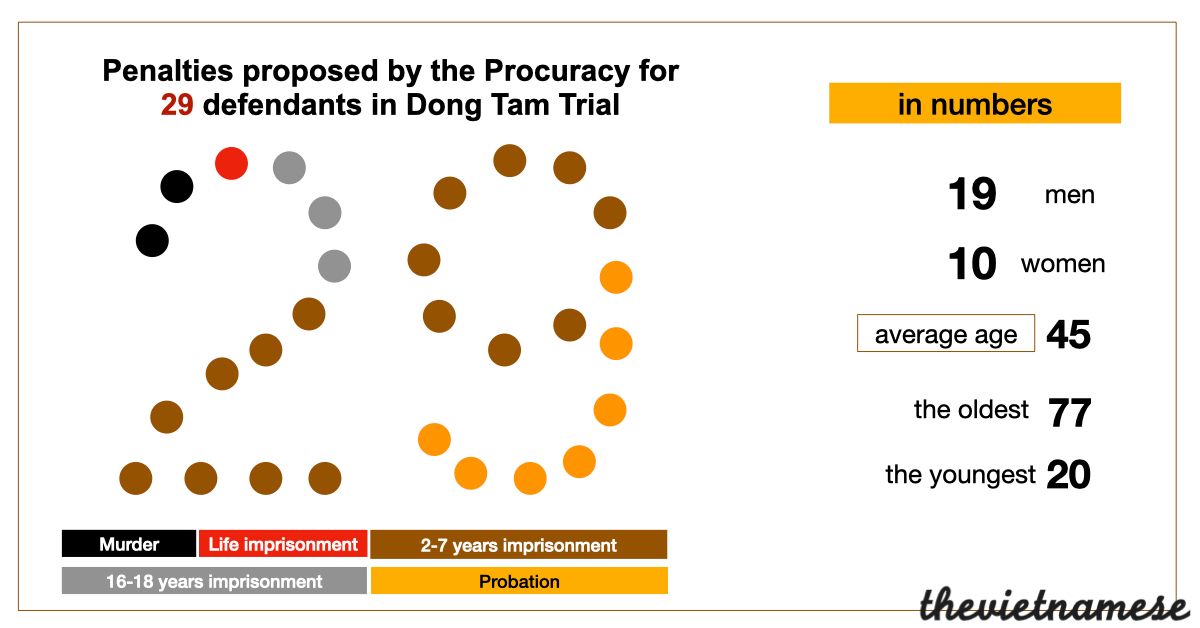
According to state-run Zing e-newspaper, the Hanoi People’s Procuracy recommended to the court that Le Dinh Cong and Le Dinh Chuc receive the death penalty. The recommended sentences for the remaining 27 defendants ranged from 15 months of probation to life in prison. Le Dinh Cong and Le Dinh Chuc were both prosecuted for murder.
Also prosecuted for murder was Le Dinh Doanh (who was recommended a life sentence), Bui Viet Hieu and Nguyen Quoc Tien (recommended sentences of 16-18 years in prison), and Nguyen Van Tuyen (a recommended sentence of 14-16 years in prison).
Nineteen other defendants had their original charge of murder downgraded by investigators to obstruction of officials. In total, 23 defendants were charged with the latter crime and were recommended sentences ranging from 15 months probation to 7 years in prison.
A speedy cross-examination of defendants
Prior public information estimated that the trial would last 10 days, but after only two days, the procuracy has already arrived at recommended sentencing for the defendants. This is due to the speediness of the trial, with each defendant questioned for only a few minutes and lawyers racing to keep up, unable to record all responses in full.
In a BBC interview, lawyer Ngo Anh Tuan spoke of Tuesday’s trial highlights, when every single defendant pleaded guilty.
According to Tuan, this development could be due to the fact that the defendants were facing heavy sentences and felt that even if they had retracted their previous statements, it would not stop the inevitable; as such, they chose to plead guilty in hope of a lesser sentence.
Lawyers interrupted
During the third day of the trial, lawyer Le Van Luan recounted how the prosecution repeatedly interrupted him as he debated the legality and legal value of the submitted electronic materials (unsourced videos broadcast in court, video confessions of the defendants recorded during the period of investigation that were never mentioned in case files).
Noteworthy is that during this time, the presiding judge “left the room”, and the judge sitting next to him took his place, warning the lawyers to “defend what is before you, no more expounding on the law, no more utilizing the law”; if they continued, he warned, they would be found “in contempt of court” and “asked to leave the trial”.
“No need” – episode two
During the first day of trial, court security prevented lawyers from speaking with their clients. When lawyers objected, the presiding judge declared that there was “no need” for lawyers and defendants to speak with one another in court – in complete violation of the law.
After lawyers forcefully responded by sending a complaint to the presiding judge of the Hanoi People’s Court during their midday recess, the next morning, on the second day of trial, the court agreed not to block contact and to abide by legal statutes.
But as lawyer Dang Dinh Manh told the BBC, by the afternoon of the second day, the court reversed direction, asking lawyers to register before speaking with their clients and mandating that they stand two meters away from their clients. By the third day of the trial, “they no longer allowed us to see (our clients) at all,” he said.
Manh believed that this reversal may be due to the fact that as the trial progressed, lawyers questioning defendants allegedly resulted in “a lot of information being disclosed unexpectedly”.
In addition to single-handedly deciding that lawyers had “no need” to speak with their clients, the trial’s presiding judge also decided on the second day that there was “no need” to respond to lawyer requests for the court to provide the “video evidence” it was planning to show, so that all parties would have access to and understand the materials.
Accordingly, the prosecution stated that it would not provide the sources or any information regarding the evidence because there is “no need”.
Two of the trial’s defense lawyers: Nguyen Van Mieng and Dang Dinh Manh. Photo courtesy: Facebook Manh Dang.
Were the defendants tortured during the investigation?
Lawyer Dang Dinh Minh relayed that at the end of the second day of the trial, he turned to the row of defendants and asked the 29: “Those who WERE tortured during your investigation, do nothing; those who WERE NOT tortured during your investigation, please raise your hand”. Ten raised their hands, 19 did not.
What do the residents of Dong Tam think of the defendants and their families?
Responding in an interview with Luat Khoa Magazine, Mrs. Nguyen Thi Duyen – wife of defendant Le Dinh Uy and granddaughter-in-law of Le Dinh Kinh – affirmed:
In our village, we Dong Tam residents strongly mourn the death of elder Le Dinh Kinh, as well as the enormous losses our family has suffered and the many relatives who were arrested on the night of January 9. It brings us great anguish.
But many cannot express this for fear of immediate retaliation by police and village security. Intimidation, there is intimidation. That’s the truth because many have been called to the police station and the village committee and told that they were not allowed to come to my house. They wanted to burn incense for elder Le Dinh Kinh but were prevented by security forces, who construed burning incense with some kind of involvement in the matter. So residents were very afraid and didn’t dare come, though they mourned Kinh dearly.
They were able to express themselves more quietly by going to his gravesite and burning incense there, rather than coming to our house. If they came, they would be recorded and followed on camera, and possibly be immediately denounced; security would definitely summon them right away.
We can’t even burn incense freely for someone who’s already passed away; as such, I certainly do not hold the security forces of Dong Tam in high regard.
But I affirm to everyone that Dong Tam’s residents care for and support those in custody. Villagers have conveyed themselves through text messages and they encourage us whenever they get a chance. They do not isolate my family or any other relative who’s been arrested, and I feel very happy living with the residents of Dong Tam.
***
This article was written in Vietnamese by Y Chan and published on Luat Khoa Magazine. The translation is done by Will Nguyen.
Second day of trial of the Dong Tam Incident – Summary
Below is a summary of the main events that happened on the second day of the trial.
Court allowed direct contact between attorneys and defendants – for now
According to attorney Le Van Luan, the court granted attorneys direct contact with their clients this morning.
As reported, during the first day of the trial, security at the courtroom prevented the attorneys from interacting with the defendants. When the attorneys demanded the trial panel respect the rights of the defendants and the attorneys, the chairman rejected their request and publicly announced that “it is not necessary” for the attorneys and the defendants to have contact during the trial.
Controversy over “video evidence” presented at the trial
Attorney Dang Dinh Manh pointed out two puzzling issues about the presentation of the “video evidence” on the first day of the trial.
In the questioning section, the court showed a video that was produced in documentary style, telling the story from the state’s viewpoint and depicting how the villagers had wrongfully protested and claimed the disputed land, and how that led to the confrontation which resulted in the death of three police officers. The video ended with miserable scenes of the families of the three police “victims”, showing suffering widows and children.
According to attorney Manh, this was an unprecedented offering of evidence. Everything presented at court during a trial must be evidence related to the case and it has to be real, original, intact and unedited, and not include doctored videos.
In a separate post on social media, independent journalist Pham Doan Trang quoted a source who said that the attorneys objected to the presentation of the doctored “evidence” and demanded hard evidence instead. But the court rejected the objection and instead instructed the attorneys to “just watch the video”.
The second issue was the “confession videos” shown during the questioning of each defendant. These videos were not mentioned in the case files. The attorneys, therefore, had no idea of their existence and had no chance to review them beforehand. Attorney Manh considered this “a trick played on the attorneys,” causing them surprise and anger when they tried to defend their clients during the trial.
The attorneys later co-signed a request submitted to the trial panel and the People’s Procuracy Office in Hanoi, demanding a complete list of this alleged video evidence.
Video clips of defendants admitted to guilt were shown at trial by the prosecution. Photo courtesy: ANTV
State media: The defendants showed remorse and asked for leniency
Reports on the trial from state media like Dan Tri, Tuoi Tre, etc. all followed the same direction: the defendants pleaded guilty.
Dan Tri reported that “In the court, all defendants admitted their crimes as stated in the indictments, showed their remorse, asked for leniency and at the same time sent their apologies to the families of the three sacrificed police officers.”
Meanwhile, Tuoi Tre reported that defendant Bui Viet Hieu voluntarily “raised his hand asking to speak.” Hieu “apologized to the trial panel” for his statement made the day before and admitted his lack of understanding of land policies.. Hieu then “appealed for leniency since no one should punish a man who already admits his guilt”. In a statement issued on the first day of the trial, Hieu had defended the position of the Dong Tam people regarding the land dispute.
Tuoi Tre also reported that defendant Mai Thi Phan took part in the years-long protest because “Le Dinh Kinh (the head of Dong Tam Village who was killed in the incident) had promised to give a piece of the disputed land to her and the people involved.” The paper depicted the defendant as “shamefully stuttering” while admitting “We know what we did was wrong, we see our guilt now.”
One defendant counter-questioned the trial panel
State media buried other events in the trial, specifically a defendant who questioned the trial panel.
Information published by attorney Dang Dinh Manh told a story about defendant Bui Thi Noi. When the court questioned her, she responded with a request to the trial panel, demanding it answer a series of her questions.
She asked, “Why do you have law but don’t respect the law? Why didn’t the government arrest Noi’s father (Mr. Le Dinh Kinh adopted her as his child) according to the law? Instead, the government tricked him to go to an open field and broke his leg ….” (Bui Thi Noi was referring to the incident that happened in April 2017. It was when the authorities tricked Le Dinh Kinh out of the village and assaulted him, breaking his leg.)
When the chairman of the trial panel repeated his question for the third time, “What did you buy the gasoline for?” defendant Noi answered “To burn the corrupt officials!”
The chairman later ordered the police to escort her out of the courtroom.
Civil society organizations: Request to treat Mr. Bui Viet Hieu as a special witness
A group of civil society organizations initiated an urgent petition addressed to state leaders and collected signatures for the campaign.
Part of the petition requested:
“Treating Mr. Bui Viet Hieu as a special witness with the most special protection measures; it is best to transfer him to another incarceration facility that is not under police control.”
They explained their reason:
Mr. Bui Viet Hieu had directly witnessed a police officer shoot and kill Mr. Le Dinh Kinh in a face-to-face confrontation. This account matches forensic evidence showing two bullets hitting Mr. Kinh from the chest through to his back (completely contradicting the investigation conclusion which stated the shots were fired from the back). Mr. Hieu himself was the second senior member of the Dong Thuan Group (a group formed by Le Dinh Kinh to protest to the authorities on the land dispute).
Mr. Hieu was also shot at the same place and same time, according to his statement: “After they shot and killed Mr. Kinh, they turned their flashlight on my position and fired two shots, aiming at my heart. But the police missed the target and the bullets hit my ribs instead, exploding and causing three wounds in my duodenum and two wounds in my colon. The police left me lying there for hours, from very early in the morning until 11:00 am on January 9, 2020 (the day the incident happened). Only when it was obvious that I was still alive, did the authorities decide to take me to the hospital.”
Defendants’ family: If there are death penalties in the sentence, we will not sit and watch our loved ones die unjustly
Luat Khoa Magazine interviewed Ms. Nguyen Thi Duyen – the wife of defendant Le Dinh Uy and the granddaughter-in-law of Mr. Le Dinh Kinh. Here are some extracts from the interview:
I am very scared that my loved ones will have to endure extremely harsh punishment, despite the fact that it was not us villagers who initiated the attack. It was the authorities who launched the attack on us.
Our relatives and I have heard a lot of rumours that there will be death penalties in this trial. Many people predicted that three members of our family, my father Le Dinh Cong, my uncle Le Dinh Chuc and my brother Le Dinh Doanh, will face the death penalty.
If the people holding power in their hands decide to tear apart our family in this way, they clearly have no conscience. An old man like Mr. Kinh had already died in such a cruel manner in this January 9 incident. I hope the people who are on the trial panel will mull over things before making any decisions because the truth about Dong Tam villagers is far more complicated than many people have depicted.
If there are death penalties, we will never stop fighting to save our loved ones. We will not sit and watch the people we love die in such an unjust manner.
Hoanh Village, a few days before the historic Dong Tam trial, is a place where the green rice fields are flowing beside country roads under the hot autumn sun. Vietnam’s national flag and banners commemorating the 75th anniversary of its National Day crowd the village gate.
I equipped myself quite well before I arrived in Hoanh Village, in both my mind and my technological tools.
“That place has many security police. Be careful!” – I was warned in a text message.
I have wanted to go to Hoanh Village during these days to be a journalist and practice the most basic ethical responsibility of our profession. I wanted to report the complete story about a historical event that will happen soon. I wanted to learn about the defendants’ families and what they yearned for, besides justice.
The village welcomed me with the typical peaceful beauty that many northern rural villages offer: a traditional market, big old banyan trees, rice fields, and winding roads. It was as calm as if it had never gone through the recent chaos it had experienced. There were no skeptical eyes staring at a stranger when I accidentally met villagers, or when they wholeheartedly showed me the directions to Mr. Kinh’s house.
They whispered to me, “So pitiful that house now, with only women and children left.”
There were no security police there; at least that was how I saw it. Yet, there were a few surveillance cameras placed on the awnings of opposite houses, which surprised me a little.
I met Mrs. Du Thi Thanh, the wife of Mr. Le Dinh Kinh, and Mrs. Le Thi Thoa, the fourth daughter of the couple, and their group of little grandchildren. In the house, which was pockmarked by police bullets, they told me stories about their father and husband. My questions were overwhelmed by their memories. The wife and daughter, and at times, both of them, unwittingly reliving stories about their husband and father as a man from their past. They told me the stories in tears, and there were moments of silence, and even some smiles. Before the attack, there were the peaceful times they had spent in the village.
The wall is used to hang Mr. Le Dinh Kinh’s portrait and his medals, as well as the evidence of bullet fire. Photo courtesy: May/Luat Khoa Magazine.
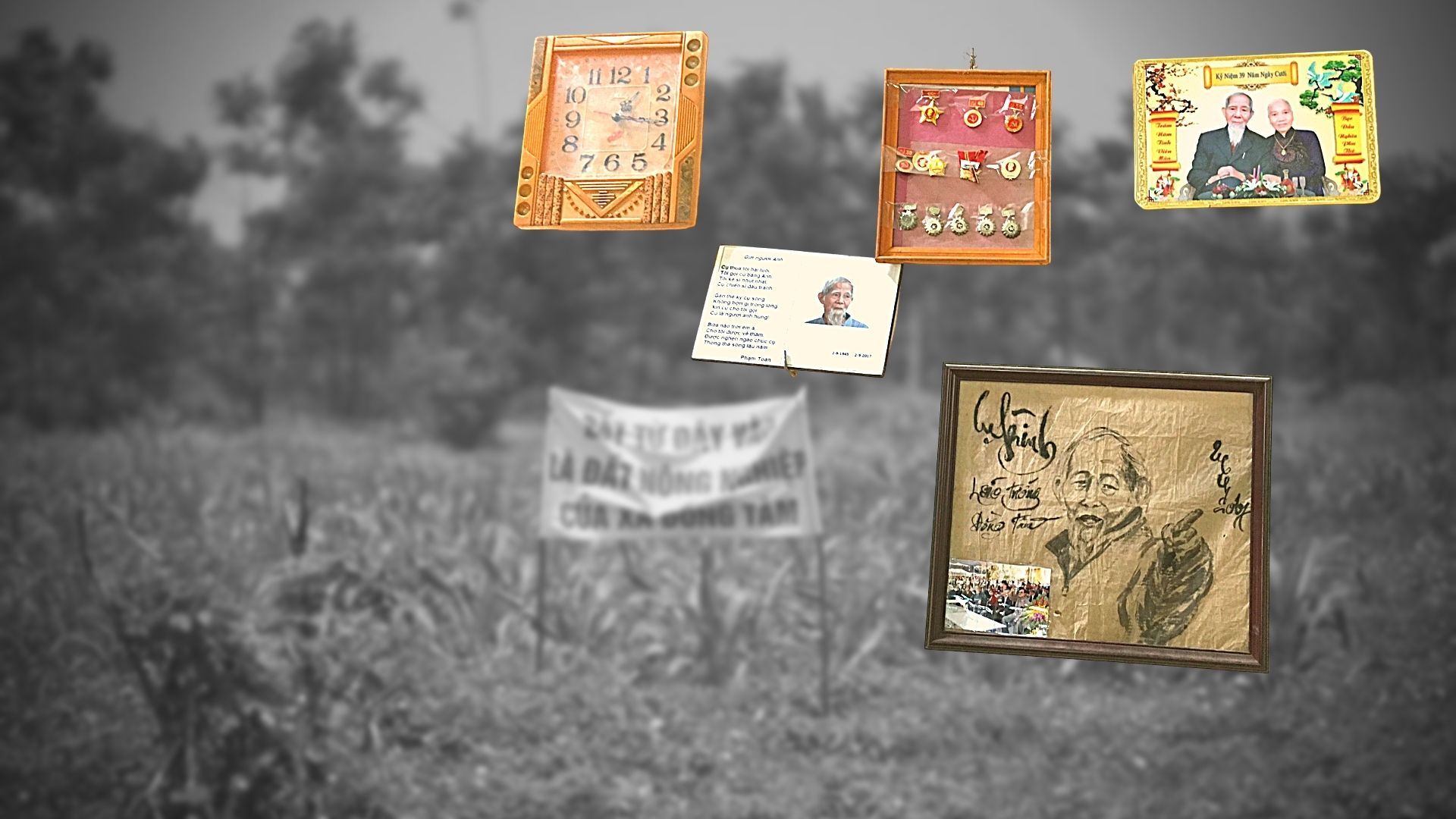
Mr. Le Dinh Kinh’s portrait and the medals that the government and the Vietnamese Communist Party awarded to him were hung on the wall opposite the main door. The same wall was marked by bullet holes, evidence of the attack one dawn last winter.
“These things, when he was alive, he treasured them so much,” Mrs. Thanh said, looking up at the medals. “He was given an award when he reached his 55th year as a Communist Party member.”
“What are your memories of him?” I asked the two women.
Du Thi Thanh:
Our house always needed a lot of upkeep, but he always forced me to take him to attend the Communist Party meetings in our ward. Before, he could go by himself, but starting in 2017, after his leg was broken during an assault by the police, he had to use a wheelchair. The first wheelchair was a gift from Mr. Chung (Nguyen Duc Chung – the former chairman of the Hanoi People’s Committee). Later, the Disabilities Association gave him another wheelchair. I remember when he tested out the second wheelchair, which he praised: ‘This one is smoother, my wife,’ he told me. ‘The first wheelchair came from Chung, I heard it was expensive, but the wheels were wobbly.’
I used the wheelchair to take him to his meetings, waited for him, and we would go back home together. People kept talking, one after another, which made me anxious because I could not know when the meeting would be adjourned.
More than that, the people did not obey any rules because when one person spoke, another would go outside to chat with others. It was just like the chatting done in the market. But it was only my husband and a few others who were thorough. I remember that he proposed to do roll calls to make sure the Communist Party’s meetings in our ward would have sound principles.
When we got home I was annoyed, and I told him if the Communist Party’s meetings were just like that, we should not go because we just sat there and did not benefit from anything. I told him that we were old and we should stay home to rest. However, he was angry with me. He said: ‘Why would you say that? I do not care if there were improper people there. I came because I want to be proper and exemplary.’
If you offer comments about his Communist Party carelessly, then you are bound to be berated.. From then on, if he asked me to take him to such meetings, I would go with him, and I stopped asking him to stay home.
Le Thi Thoa:
There are now only regrets…. Our father-daughter relationship had so many fights …. (She cried.)
I was never close to my father when he was alive. Among his children, I was the child that had so many opposite perspectives from him. I could not sit down and have a proper talk with him without us having a clash of opinions because we would fight right away after exchanging a few sentences. My father whole-heartedly trusted the Communist Party, and he believed in the Communist Party’s Secretary General Nguyen Phu Trong without condition. I warned him and told him: ‘Father, many officials nowadays have become corrupt.’ But my father scolded me and said we can’t tar the whole brush because the corrupt officials were only a small group and that they were the lower officials that covered their faults and smeared the Party.
I had wanted him to let go of the land dispute everytime I witnessed my father face grave danger. I cried and told him that I was scared. I stated that the Party had too many factions, and they could turn against each other to eliminate the opposition. My father responded to me that he was doing the right thing so he should not be afraid. He said the land of Senh field, where we had disputes with the government, belonged to the people of this ward. He also assured me that if he already made a mistake, the Party would have kicked him out a long time ago.
When he was in the hospital in 2017, some people gave him money when they visited him. He then gave the money to a policewoman and asked her to keep it for him. He always said: ‘(Nguyen Duc) Chung already said so (that the government would never prosecute Dong Tam villagers). Or, he would say ‘the people from the city had promised me already (to not prosecute),’ and that ‘things have to be reported to Mr. (Nguyen Phu) Trong because the Party would then be transparent.’ I was so mad, I stopped talking to him, ignoring the old man’s ideology.
From the time when he was still a local official right up until to his retirement, I saw him as a person who spent so much time volunteering for the community. I felt uneasy. He only cared about the ward and the village’s everyday issues, leaving my mother to take care of our household alone. As years passed , the Mieu Mon land dispute documents passed through the hands of many leaders , but he stored them all in his head. He memorized all of them, line by line, without fail, without a need to look at the papers.”
Mrs. Du Thi Thanh shows the bullet hole in the glass door. Photo courtesy: May/Luat Khoa Magazine.
Du Thi Thanh:
When he was an official, he only focused on his position and worked for the ward and the village. Even when his wife and kids suffered, he took no notice . When he retired, he began to farm the field. I guess he farmed to compensate his family because there had been so many years that he neglected us. The village people passed by our field and would tease him: ‘Oh, Mr. Kinh, Mr. Kinh. You were an official, why are you only now putting your head to the field?’
Le Thi Thoa:
Other people who were government officials had so much land. My father worked at the top positions in this ward, but my family didn’t even have a rice field when he retired. I remember that my parents would come to some undocumented land that nobody cared to claim . From dawn to dust, they would go there to work on that land, clearing, ploughing, digging, furrowing and cultivating the land till it was ready to be used for planting food crops. . They worked so hard and spent so much time on that field only to have their sweat and blood rewarded by a call from the government to donate all the cultivated land to the ward when harvesting time came. Is that reasonable? But then I have never heard my father blame the Party or curse the government. He only scolded me. (She smiled.)
I was irritated and slightly annoyed at the absurdity when I read online that people cast doubt on the source of money my father received from overseas, indicating it was from the reactionary forces. Truth be told, my father would forever continue believing in the Communist Party until his last dying breath.
If he truly believes that something is right and is not against his conscience, my father would fight to protect it till the very end. He used that mentality to protect the Senh field and the Communist Party.
Du Thi Thanh:
Until his last days, even after witnessing so many city officials do an about-face, he still believed in his Party. I worried for his safety, but he chided me: ‘You do not need to worry about me. I am a Communist Party member. A Party member must stand up and take care of the people. If we ignore the truth and don’t speak up, we are guilty in front of the people.’
I remember when he was young, he would pedal with only one leg, but he was incredibly fast. He would bike across the fields to go to the town center for a meeting. He was disabled in one leg, but he was talented so it helped him to become the head of the ward police force. He could only stand up on one leg, but he took care of all of the ward’s work thoroughly. The people in this ward respected and loved him.
Le Thi Thoa:
I recall that he told us he had played soccer when he was young and sprained his leg. Unfortunately, he did not receive proper treatment, which led to a permanent disability later on in life. My father was always so busy with work. When he was riding his Thong Nhat branded bicycle or when he got a ride on a motorbike to go to the district office, he always had to stretch out his disabled leg. Even having his meals or a cup of tea, he could not fold that leg. When he walked, it seemed as if he was dragging it along.
Du Thi Thanh:
But they shot and blasted his disabled leg.
Le Thi Thoa:
Dad died such an inconsolable death.. What is there left when all of the men in this house have been arrested. We can only pray to Heaven. We looked up at the sky and cried our hearts out about the injustice. When we fixed part of our home after the assault and repaired the damage caused by the police attack , our mother wept until she passed out because she was so heart-broken that our family now was left with only women and young children. My father’s belief caused all of that. If I knew in the end that our family would be this broken, I would have made more of an effort to stop my dad from disputing the land with the government. You should throw away everything, dad!” (Le Thi Thoa sobbed)
Mrs. Du Thi Thanh shows the bullet holes in the wall. Photo courtesy: May/Luat Khoa Magazine.Another bullet hole in the home of Mr. Le Dinh Kinh. Photo courtesy: May/Luat Khoa Magazine.
“We will walk (to court) from our village”
Du Thi Thanh:
My sons, my grandsons, are all in prison. It has been more than eight months, and our family did not receive any news about them. My son Chuc, did the wound on his head heal? Ten days after he was arrested, his wife gave birth to a son. His wife sent him a picture of the newborn baby, but the prison officials did not allow him to receive it. I believe that Doanh got shot in the arm, how is he now? Uy, and then Cong. My sons and my grandsons are all working people. They each have their own family . Their wives now have to raise their children alone and unsupported. If I knew this in advance, I’d rather kept my mouth shut . I would have forced all of them to be silent. How could any piece of land be more precious than having a peaceful family life?”
Le Thi Thoa:
The rental car company did not accept our reservation (or that of any of the villagers) to rent cars to go to the trial. The company told us that the police had forewarned them. An official in our ward advised us to stay home because we would not be allowed to enter the Hanoi courthouse. But regardless, we will go there. We will walk from our village to Hanoi and attend the trial. My mother wants to see her sons and grandsons. The young children in our house want to see their fathers; the wives want to see their husbands. No one should be able to prevent us from doing that.
Du Thi Thanh:
What do I expect at the trial? I just want to meet my sons and grandsons. I want them to issue a death certificate for my husband. He passed away more than eight months ago, but we have yet to receive the death certificate. The officials from our ward forced me to state the reason for his death as ‘died at home.’ No. That was not right. Mr. Le Dinh Kinh was shot to death at home. A bullet entered near his heart. Two bullets were fired into his head. His left knee was shattered. That was how my children’s father died. The bloodstain is still in our room, how could they lie like that?
The bloodstain is right here. It is very stubborn though, I could not wash it off.
“Just stay still here, I will go downstairs and get you a wet cloth to help you breathe better.” That was my last sentence to my husband. The fumes were so heavy. I was going back to his side when someone took my arms and dragged me away. When I came back home, the room was covered in blood. Our home was shattered. Can you see this door jamb protruding out? A bullet is stuck in it.
***
Mrs. Thanh relived the story as she walked me around her house.
I could see the remnants of bullets fired through their glass door. Their closets were also shot up, and the wall had a massive crack. There were areas of newly patched cement, but others were left untouched. Evidence of bullets was everywhere, substantial bullet holes, smaller holes, on the first floor and the second floor. They were also in the kitchen and the living room. There were also black stains on the floor, which Mrs. Thanh suspected it came from the tear gas.
She was walking with her hunched shoulder, her hair all white. Just like her daughter, she doesn’t believe in anyone because “only Heaven could help my sons and grandsons” during the trial starting next Monday. The two women did not say words like “justice”, “righteousness”, or “fairness” when they referred to the trial as I had imagined they might. They did not expect too much, just the simple wish to be able to see their loved ones and to somehow brush each other’s hands at the trial hearing.
I just wanted to write down their stories, documenting ordinary farmers who unfortunately have family members caught in the justice of law and now tried as defendants. Although I guaranteed that I would not write about the land dispute issues or give speculation on which side is right or wrong, not a single newspaper in Vietnam accepted to publish this article.
On September 7, 2020 when the Dong Tam trial begins, where would we see the faces of the mother, wives, and children of the 29 defendants from Hoanh Village and the Mit Village, both located in Dong Tam Ward? Broadcast on television? Captured on cameras or on the cover of newspapers? Would the state-owned media specifically describe these women as who they are and not as people from the reactionary force?
I hope that my imagination about their fate during the Dong Tam trial will not turn real. I also hope that there will be a place, a time to safely and freely tell their stories. Their voices have been silenced for so long.
***
The original article was written in Vietnamese by May and published in Luat Khoa Magazine. The English translation was done by Karie Nguyen.
First day of trial of the Dong Tam Incident – What we have learned
The 10-day trial of the Dong Tam Incident promises to be a long and tedious process, not only for the people involved but also the concerned audience. If you don’t have time to follow live updates, below is a summary of the main events throughout the day.
Luat Khoa and The Vietnamese magazines will produce summary reports at the end of each day until the end of the trial.
There are 29 defendants to be tried in the course of 10 days
Of the 29 defendants, 25 are accused of “Murder” under Article 123, section 1, clauses (a), (d), (n), and (o) of the 2015 Penal Code.
Another four individuals are being tried for “Obstructing officers in the performance of their duty” under Article 330, section 2, clause (a) of the 2015 Penal Code.
There are 15 attorneys representing the defendants, hired by the defendants and their families. The other 18 attorneys were appointed by the court.
The trial is expected to last 10 days.
Tightened security, family members not allowed to enter the courtroom
Top level security measures were applied in the so-called public trial. Police imposed blockades and restricted access around Pham Van Bach Street where the People’s Court of Hanoi is located. The police put up barricades preventing defendants’ family members and citizens from approaching the court area.
One family member told Luat Khoa that more than 20 policemen had surrounded her house since yesterday. This morning, she had to lie to the surveillance police to get through their siege and head to the courthouse.
A few family members of the defendants were outside the courthouse in the morning of September 7, 2020. Photo courtesy: Luat Khoa Magazine.
Attorneys barred from direct contact with defendants at the trial
During the lunch break of the trial, a collective of attorneys lodged an urgent protest to the chief justice of the People’s Court of Hanoi, demanding the trial panel respect the defendants’ right to defense and the attorneys’ right to represent the defendants, including the right of the attorneys to have direct contact with the defendants.
In the morning session of the trial, when the trial panel paused to conduct private discussions, the security force at the courtroom prevented the attorneys from interacting with the defendants.
As the trial panel resumed, attorney Dang Dinh Manh demanded the attorneys’ right to have direct contact with the defendants whom they were representing in court.
However, the chairman of the trial (Judge Truong Viet Toan) publicly announced “since the attorneys had time to work on the case files, had time to meet with the defendants in prison, now it is no longer necessary for the defendants and their attorneys to have any further contact at the court during the trial.”
Despite one attorney pointing out this pronouncement fundamentally violated section 4 article 256 of the Criminal Procedure Code, the chairman of the trial ignored the protest.
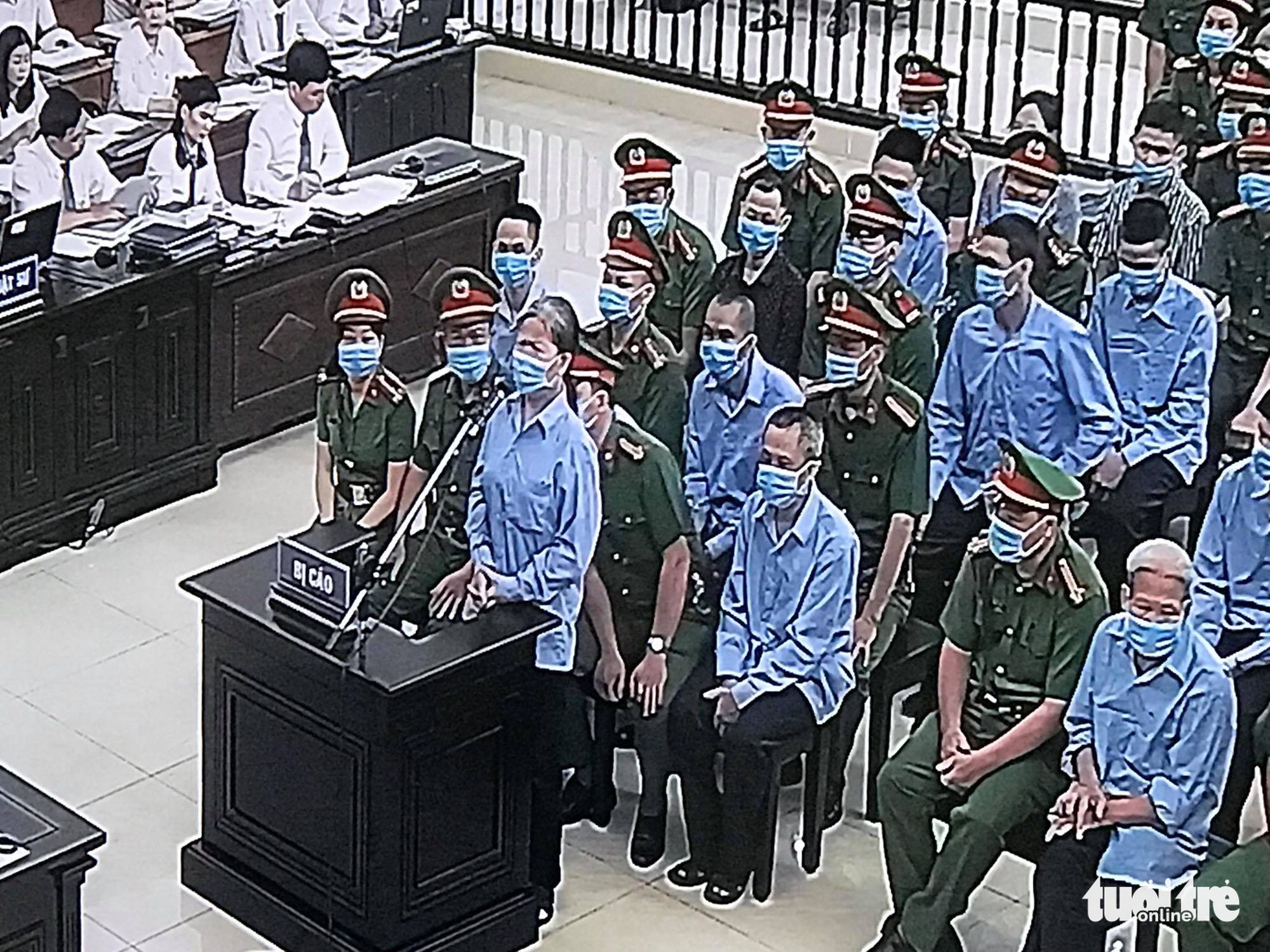
The trial panel in Dong Tam trial. Photo courtesy: Doan Tan/Vietnam News Agency.
Petition from attorneys before the trial
On September 3, 2020, a group of 13 attorneys representing the defendants co-signed a petition to the chairman, the chief justice of the People’s Court of Hanoi, and the chief procurator of the People’s Procuracy of Hanoi.
The petition called for attention to many incorrect and false details in the indictment by the People’s Procuracy of Hanoi, including distorted information and statements that are contradictory to the many versions of the event published by the Ministry of Public Security after the incident.
The petition also raised various and constant obstacles met by the attorneys during the whole process, from investigating, prosecuting and final preparation stages for the trial. The attorneys were not allowed to hold private meetings with their clients and were barred from accessing the case files until the very last minute.
At the courtroom, the chairman of the trial when responding to the petition only granted permission for the attorneys to watch videos in the case files during the trial, rejecting their request to obtain copies of the photographs and videos mentioned in the prosecutor’s files regarding the case.
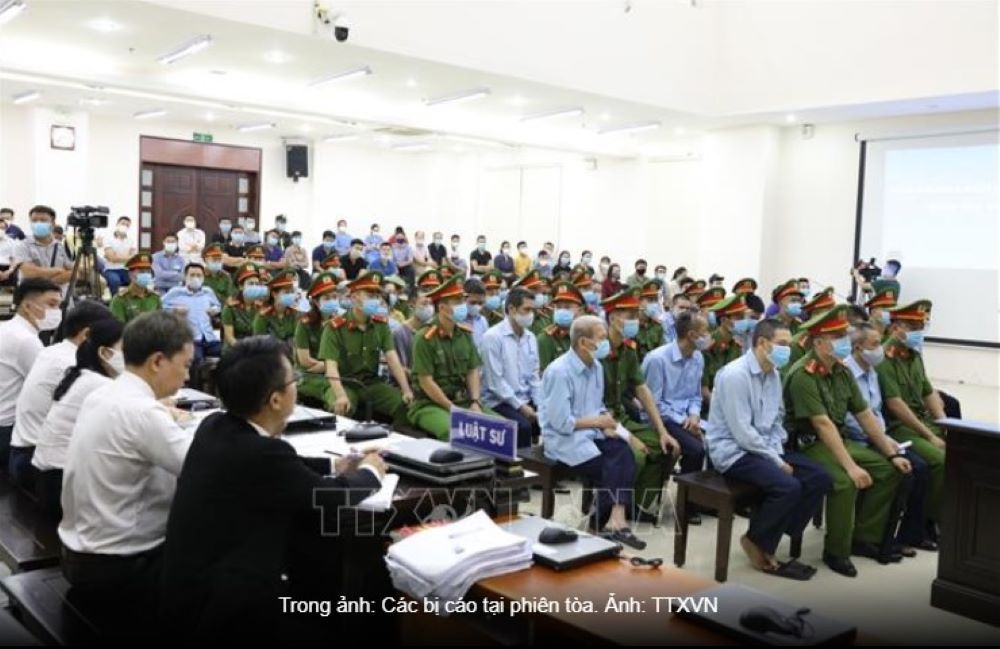
The defense lawyers for Dong Tam trial. Photo courtesy: Vietnam News Agency.
NGOs voice concerns and call for a fair trial
On September 6, Phil Robertson, deputy Asia director of Human Rights Watch, issued a statement on the case:
“There are major concerns about due process and the right to a fair trial for the 29 villagers facing charges for incidents in Dong Tam. Use of torture and forced confessions are common in police custody in Vietnam. The courts are far from independent and predetermined outcomes dictated by the ruling communist party are trademarks of Vietnam’s so-called justice system. Defendants’ access to their lawyers is extremely limited and occurs only after the police have completed their interrogations and finished their investigation.
There are still many unanswered questions about what happened during the Dong Tam raid that may never be answered in Hanoi’s rush to convict these defendants. Quite clearly, the authorities want to hit them with very harsh penalties to warn off others who might dare to challenge state authority in the future. Given the widespread interest in this case, Vietnam should allow independent international observers including diplomats, journalists and NGOs to observe the trial, and end harassment and surveillance of the family members of the accused.”
Meanwhile, on September 4, 2020, 11 civil society organizations penned an open letter addressed to Elisabeth Tichy-Fisslberger, president of the UN Human Rights Council, calling on the UN to demand that Vietnam conduct a “fair and open trial” in this case.
Arresting one observer of the trial
According to information published by Ms Do Thu on her social media, her father, Trinh Ba Khiem, was arrested this morning while attempting to attend the trial, only to be released later in the evening of the same day.
Mr. Khiem’s sons, Trinh Ba Phuong and Trinh Ba Khiem, and his wife, Can Thi Theu, who had been posting information about the Dong Tam Incident on social media and showing support for the Dong Tam villagers, were all arrested on June 24 2020 in a separate case.
On September 7, 2020, at 9:00 A.M. Hanoi Time, a trial will be held against 29 people who are farmers of Dong Tam village. The defendants were being alleged with “homicide” and “oppose officials who were on duty.” The maximum punishment for homicide in Vietnam could be the death penalty.
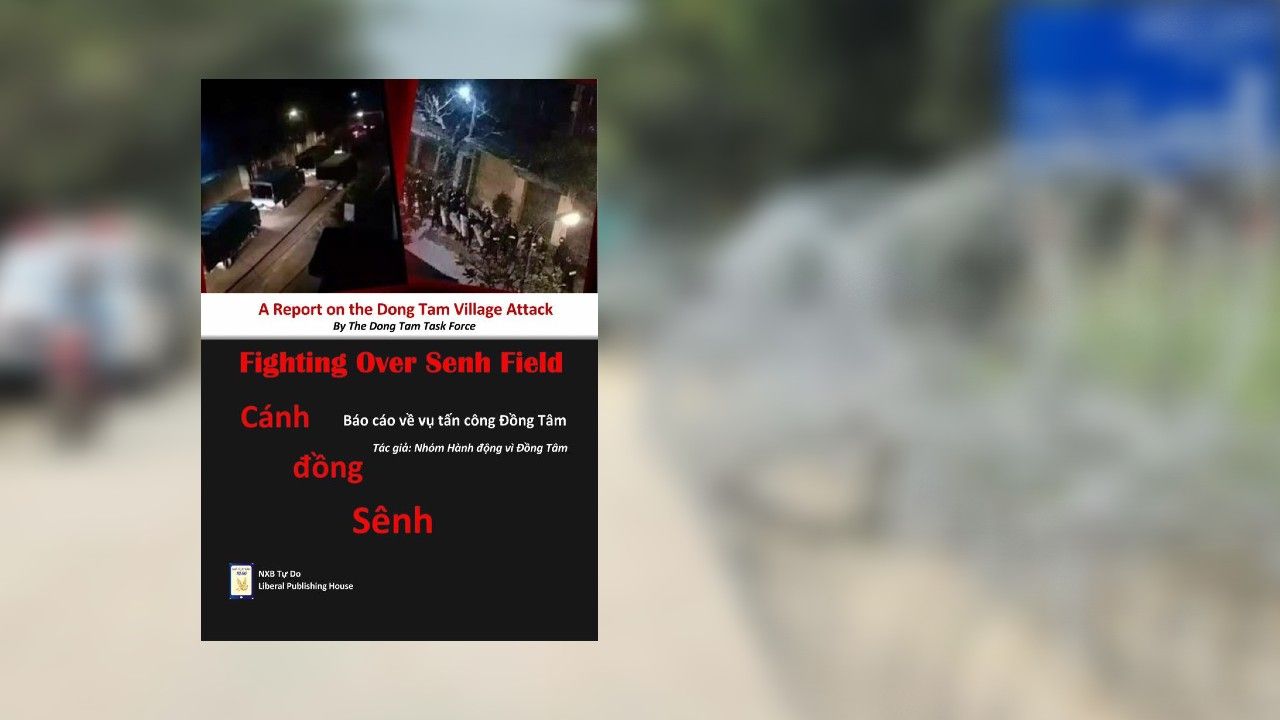
The protracted dispute over the land between Dong Tam villagers and the government simmered over the last few decades, and a group of activists compiled a report and published it here.
There were four people killed when the police bursted into the village, including Le Dinh Kinh, the 85-year-old village’s leader.
The trial will expectedly last for ten days. We will continue to update it in our [News] section throughout.
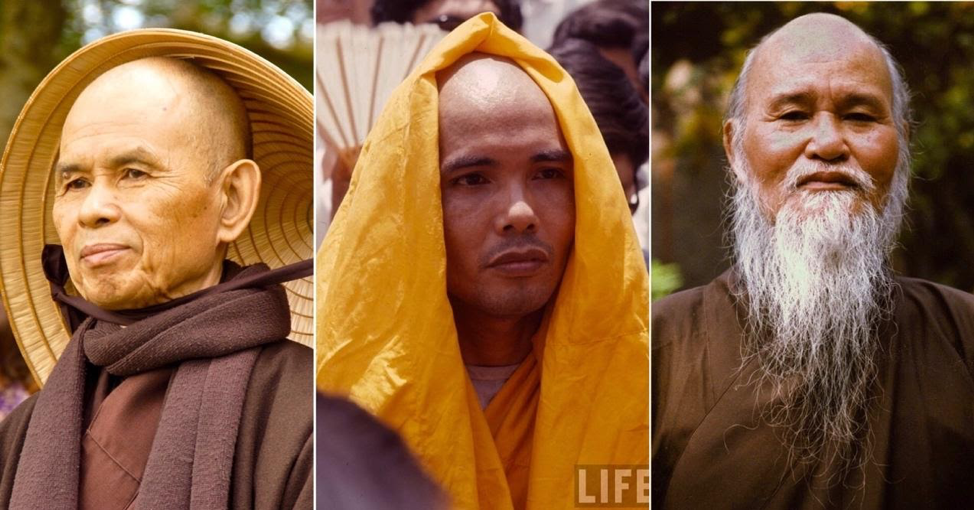
Long ago, there lived three monks: Thich Nhat Hanh, Thich Tri Quang, and Thich Quang Do. All three were well-versed in the Buddhist Dharma. Nhat Hanh spoke eloquently and wrote well. Tri Quang had talent for leadership and was trusted by the masses. Quang Dao was well-studied and excelled in foreign languages.
Long ago, there lived three monks.
When Ngo Dinh Diem’s regime cracked down on Buddhism, these three combined forces to fight back. Nhat Hanh campaigned overseas, calling for peace and religious freedom in Vietnam. Tri Quang led tens of thousands of monks and Buddhist adherents as they protested in Saigon. And Quang Do, the youngest of the trio, stood side-by-side with these Buddhists as they marched on the streets.
Long ago, there lived three monks.
When the communists arrived, the paths of these three diverged. Nhat Hanh became world-famous with his Plum Village Monastery. Tri Quang was imprisoned and refrained from speaking about politics again. Quang Do continued the struggle for religious freedom and human rights, ultimately serving the longest period of house arrest of any monk in Vietnam.
1997
One day in October of 1997, in a theater in Berkeley, California, approximately 3,500 people, who paid US$20 a ticket to meet their most beloved monk, sat in silence.
A ringing bell echoed across the theater, and a monk’s voice loudly called out: “All rise!”. Zen Master Nhat Hanh, draped in a deep brown robe, lead 35 monks and nuns as they slowly spread out across the stage.
Many in the audience clasped their hands before their chests and directed their eyes towards the stage. Sitting on a high podium next to a large, bronze bell and an arrangement of giant sunflowers, Zen Master Nhat Hanh began expounding on mindfulness. “Learn how to stop running,” he advised his audience. “Many of us have been running all our lives.”
“Society is very individualistic, selfish, with people thinking about himself or herself alone. Each for himself, each for herself alone. But in fact even if you have the desire, the intention, to help others, it would still be difficult for you to do so, because when you are not in peace with yourself, it’s very difficult to relate to people in a peaceful way in order to help them,” he stated to reporter Don Lattin of the San Francisco Chronicle.
By that point, Zen Master Nhat Hanh had become internationally renowned for this talks on mindfulness and world peace. After 1975, he stopped speaking to the international media about human rights in Vietnam, even though Buddhism there was suffering through hardship.
At the same time, in a prison cell thousands of miles away from America, Venerable Quang Do was compiling a Buddhist dictionary. He was sentenced to five years in prison in 1995 for helping flood victims in the Mekong Delta. Ten years before that, he witnessed his mother pass away in hunger and poverty after the government exiled both to Thai Binh.
In 1997, Venerable Tri Quang grew accustomed to his comfortable life. He no longer spoke about politics or peaceful resistance.
After 1975, he was confined to a wheelchair to heal his feet, which had atrophied after government torture, according to a monk who was imprisoned with him at the time. From the 1980s onwards, the international media stopped mentioning him and the tragedies of Buddhism in the south.
Childhood in chaos
Born during the tumult of French and Japanese fighting over control of the country, the three monks were all witness to the historical crises of that era.
One day in Diem Dien Village, Quang Binh Province, the mother of Tri Quang met two monks who left a deep impression on her, he relayed in his autobiography. Upon returning home, she told her husband that the family should have someone join the monastery, as the two monks had. Thus, on the eve of the lunar new year in 1938, Tri Quang shaved his head and entered the monastery at Pho Minh Pagoda; he was only 15 years old. The next year, he was transferred to Hue to study for another six years. When he was put in charge of the Quang Binh Province Buddhist Committee for National Salvation (seen as a part of the Viet Minh Front), he saw many of his classmates sacrifice their lives in the resistance war against the French.
Zen Master Thich Nhat Hanh, in Hue, when he was 16 years old. Source: Plum Village.
In Hue, Nhat Hanh grew up the son of a man who worked for Emperor Bao Dai’s government. Nhat Hanh stated the seed of the Great Buddha blossomed within him from when he was very young. Responding to reporter Don Lattin about his childhood, he stated that while he was studying at the village school, he and his friends would go door-to-door begging for bowls of rice to give to those dying of hunger. He relayed that the kids had to decide early on who would get to eat and who wouldn’t because there simply wasn’t enough rice to go around. In 1942, Zen Master Nhat Hanh left his family and entered the monastery at Tu Hieu Temple in Hue. He was only 16.
In the same year, a 15-year old teenager in Thai Binh traveled to Ha Dong province (today’s Hanoi) to enter the monastery at Thanh Lam Temple. He took on the Buddhist name Quang Do. He recalled, only three years after he left his family, he witnessed his master tied up and brought out to the village courtyard like a criminal, after the Viet Minh suspected him of being a traitor. His master was then denounced and executed by three bullet rounds. It was then the young 18-year old swore to himself that he would use Buddhism’s mercy, forgiveness, and non-violence to fight against fanatics and the unforgiving.
A united sense of purpose
After the tragedy at Thanh Lam Temple, Thich Quang Do went to study in Hanoi. During this time, Tri Quang and Nhat Hanh likely met one another in Hue.
At the time, the Bao Quoc Buddhist Institute had just been established in Hue in 1947. A year later, Tri Quang became a teacher there, and Nhat Hanh a student.
In 1950, Tri Quang went to Saigon for the first time, concurrent with Nhat Hanh. In Saigon, Tri Quang, along with some other monks, unified three Buddhist institutes into one, locating it at An Quang Temple. Nhat Hanh began teaching here.
Both Nhat Hanh and Tri Quang had a common desire to unify Buddhism and develop it into a national religion [1]. Both pursued this desire through journalism.
After the Geneva Accords were signed in 1954 and the country was temporarily divided in two, Tri Quang became the editor-in-chief of the Vien Am paper. A year later, Nhat Hanh was made editor-in-chief of Vietnamese Buddhism, but after two years, he was forced to suspend the paper after pushing for Buddhist unification too vociferously.
During this time period, both individuals suffered enormous mental anguish. Nhat Hanh was completely “defanged” in his struggle and afterward temporarily withdrew from the limelight, retreating to a solitary location with allies in Lam Dong. Tri Quang, haunted by images of his mother being publicly denounced in 1956, wandered to Nha Trang before returning to Hue in 1960. Buddhism’s suppression (by Ngo Dinh Diem’s government) would add an extra layer of pressure on top of his mother’s tragedy.
In 1958, Quang Do returned to Saigon after studying abroad in Sri Lanka and India. Under Ngo Dinh Diem’s religiously discriminatory regime, and the conflict brewing between the Nationalists and the Communists hanging over their heads, young Nhat Hanh and Quang Do were not able to accomplish much in the way of big tasks. But it seems all three were able to sense impending disaster for Buddhism in the south.
In his book Intention’s Road Home, Zen Master Thich Nhat Hanh explained that in 1961, when he and his friends’ place of residence was raided, he had to retreat to Saigon for safety. During this difficult time period, he traveled to the United States, where he conducted research on Buddhism at Princeton University and then taught at Columbia University.
Pictures of Zen Master Thich Nhat Hanh, Venerable Thich Tri Quang, and Venerable Thich Quang Do, taken in 1960. Source: PVCEB, AP, and Vietnamese Buddhists.
Days of struggle
On the night of May 8, 1963, as Venerable Tri Quang, head of central Vietnam’s Buddhist Association, stepped into Hue’s radio station together with the provincial leader to resolve ongoing protests as gunfire rang out among the Buddhist crowds surrounding the station. That night, Hue Radio did not broadcast as promised the program celebrating Vesak, recorded earlier that morning. Compounding popular anger was the fact that the government had prevented the flying of Buddhist flags. The crowds did not disperse until two in the morning. That night, many were seriously injured, resulting in eight deaths.
In the gloom of the next morning, as Venerable Tri Quang was resting, roiling crowds of young people began filling the streets, holding Buddhist flags. That same day, Buddhists in Saigon decided to establish the Inter-party Committee to Protest Buddhism (abbreviated as the “Inter-party”), confirming a drawn-out struggle. Venerable Tri Quang sat on the Advisory Board, while Venerable Quang Do worked as assistant to the public relations committee of the Inter-party.
The objective of the Inter-party was to get the government to respond to five demands: withdraw the decree banning the flying of Buddhist flags, put Buddhism on equal footing with Catholicism, end the suppression of Buddhist followers, grant Buddhist monks and nuns the freedom to proselytize, and compensate for the deaths caused (during the crisis) and punish those responsible.
In the two days following the incident at the Hue radio station, Buddhists protested spontaneously, but thereafter, they gained a sense of order and organization with Venerable Tri Quang’s direction, the monk recounted in an autobiographical short story. He also found ways for Buddhists to come to Tu Dam Temple to pray each week for those who had passed away. In Saigon, monks organized spiritual processions from one temple to the next, as well as protests and hunger strikes.
The government only ramped up its repression; many temples in Hue were blockaded, and monks and nuns were publicly attacked. It wasn’t until Venerable Thich Quang Duc, 73, immolated himself on June 11th, 1963 that the situation improved in any meaningful way. Tri Quang traveled from Hue to Saigon to enter into discussions with the government.
In the weeks and months that followed Venerable Quang Duc’s self-immolation, the Inter-party signed a joint communiqué with the government responding to Buddhism’s five demands. However, the government never implemented the communiqué, greatly angering monks, nuns, and the general population.
According to Thich Nhat Hanh, at the time he was in America campaigning for religious freedom and a cessation of war in his own homeland. He appeared on television, met journalists, translated materials detailing the human rights violations in Vietnam, and pushed international organizations, including the United Nations, to intervene in the increasingly volatile situation in South Vietnam.
As Thich Tri Quang relayed in his autobiography, on the morning of July 17, 1963, Venerable Quang Do was unable to deliver translated international press updates to Xa Loi Pagoda. That day, countless Buddhists poured into Giac Minh Temple, where the monks were on a hunger strike. These crowds quickly morphed into an enormous protest. As the Buddhist adherents tried to approach Giac Minh Temple, they were blocked by police. Venerable Quang Do was among them, directing the protests to struggle not only against the police barricade but for Buddhism itself. In his book History of the Vietnamese Buddhist Struggle, Monk Tue Giac writes that after 10 am that morning, the protests had devolved into a fighting match with police. Venerable Quang Do suffered a head injury, blood pouring down his face. Any Buddhist who had not been arrested by police returned to Giac Minh Temple, resisting as barbed wire fencing kept more than 600 monks, nuns, and adherents barricaded for 54 hours.
Thich Quang Do (circled) directs a protest on the streets of Saigon, July 17h 1963. Source: HORST FAAS/AFP.
By August 20, 1963, Ngo Dinh Diem’s government was determined to restore order. A day after martial law was imposed, monks were arrested and adherents attacked. Venerable Quang Do was apprehended. Venerable Tri Quang went to the American Embassy to apply for amnesty.
From that point until President Ngo Dinh Diem’s assassination on November 2, 1963, the struggle raged between Buddhists, the Army, and international pressure.
In December 1963, after the struggle had succeeded, Venerable Tri Quang along with other monks established the Unified Buddhist Church, Venerable Quang Do went overseas for medical treatment, and Venerable Nhat Hanh returned to Saigon.
While Venerable Tri Quang mobilized Buddhist adherents, monks, and nuns to continue the political struggle, Nhat Hanh was able to fulfill his wish of establishing several campuses, including the La Boi Publishing House, Van Hanh University, the Youth School for Social Services, and the Tiep Hien Congregation (a congregation centered on the full integration of Buddhism into daily life).
Thich Tri Quang walks among South Vietnamese soldiers in Danang, January 1965. Source: Christian Simonpietri/Sygma/CORBIS.
In May 1966, Thich Nhat Hanh headed to the US to campaign for an end to the war in Vietnam. After three months, the South Vietnamese government refused to let him return home. At the time, Thich Nhat Hanh began becoming world-renowned as the face for peace in Vietnam. The next year, Reverend Martin Luther King nominated him for the Nobel Peace Prize.
Thich Nhat Hanh on his way to the United States to campaign for the end of war in Vietnam. His trip was originally planned to span three months, but after he left, the South Vietnamese government refused to let him return home again. Source: PVCEB.
A road diverged three ways
At the beginning of 2005, as the people proudly and warmly greeted his arrival, Zen Master Nhat Hanh was finally able to return home after more than 40 years away, accompanied by a Sangha of approximately 200 adherents. He conducted talks with audiences that included party members in Ho Chi Minh City, Hue, and Hanoi.
Meanwhile, Venerable Quang Do lived in solitary confinement, locked in a room at Thanh Minh Zen Monastery in Ho Chi Minh City. Across the street were police whose only job was to keep an eye on him day and night.
During his trip, Zen Master Nhat was able to visit Venerable Tri Quang but not Venerable Quang Do.
In the eyes of the Vietnamese media, Zen Master Nhat Hanh was someone to be immensely proud of, he was “flesh and blood” who had returned to his homeland to further contribute to the people’s well being. Venerable Quang Do, on the other hand, was a boil that the government tried every means to remove. But back then, both monks were cut from the same cloth, up until the day Saigon fell.
After 1975, as Zen Master Nhat Hanh set up his Plum Village Monastery in France, Venerable Tri Quang was imprisoned for a year and a half in a hole the size of a coffin, which he was only allowed to leave for 15 minutes each day to wash up. From then on, people no longer saw him calling for protests or making demands for Buddhism; the international media was never able to make direct contact with him again for as long as he lived.
After the war, Venerable Quang Do along with a number of other monks fought for those who had self-immolated in the name of religious freedom and in protest of the new regime’s intention to eliminate the Unified Buddhist Church of Vietnam. In a country with no international media, no independent courts, and no freedom of association, these efforts would be in vain, the number of immolated corpses perhaps outnumbering that of the old regime. He was never able to reach a compromise with the government, up until the day he died.
Long ago, there lived three monks: Nhat Hanh, Tri Quang, and Quang Do. When the communists arrived, the lives of these three diverged completely.
Correction (April 12, 2020): in a version of this article, we had written that Zen Master Thich Nhat Hanh had entered the monastery at Tu Dam Temple. We wish to correct this to Tu Hieu Temple, in Hue.
Footnote: [1] See numbers 2 to 28 in Buddhism Magazine, and Intention’s Road Home (Zen Master Thich Nhat Hanh).
References:
Autobiographical Short Stories (Original: Tiểu truyện tự ghi), Venerable Thich Tri Quang.
Autobiography of Tri Quang (Original: Trí Quang Tự Truyện), Venerable Thich Tri Quang.
Intention’s Road Home (Original: Nẻo về của ý), Zen Master Thich Nhat Hanh, translated by Chan Dat
After nearly 100 days of zero new confirmed cases in the local community, within the last 10 days, there has been a jump in the number of patients contracting the virus in various cities in Vietnam.
According to official figures, in the six months from January 23 to July 25, there were only 140 local cases, the rest were imported patients, and zero fatalities. Since July 25, in a period of less than two weeks, more than 300 new local cases have been confirmed with 10 deaths so far.
Da Nang, the third largest city of the country, has become the new epicenter of the pandemic.
While this new surge seems to have caught the entire nation by surprise, in reality it is a scenario that was long written on the wall, with the pandemic having never really ceased to rock countries after it first appeared on the world stage in January 2020 (the first reported case outside of China). And though it has created a new scare among citizens, it is a positive and necessary alarm.
Empty street in Hoi An city in August 2020. Photo Courtesy: The Vietnamese
To the moon and back
More than three months without domestic positive cases had put the whole nation in a complacent mode. Even the health care staff at hospitals had lowered their guard. Most of the initial cases from July 25 were linked to patients and their caretaker relatives in Da Nang hospitals.
Since then, the virus has quickly spread throughout the community and to other cities.
Fortunately, it does not take long for the whole system to restart and quickly return to crisis mode. Da Nang was almost immediately put under partial lockdown, with thorough contact tracing being carried out for every new case. People who had been in close contact with new positive cases were put under quarantine. Medical teams and personnel from Hanoi and Ho Chi Minh were sent to the epicenter to help relieve the pressure and the wearing of face masks in public in big cities became mandatory again.
There is reason to be optimistic about the ability of the country to contain the new wave despite it having caught everyone off guard.
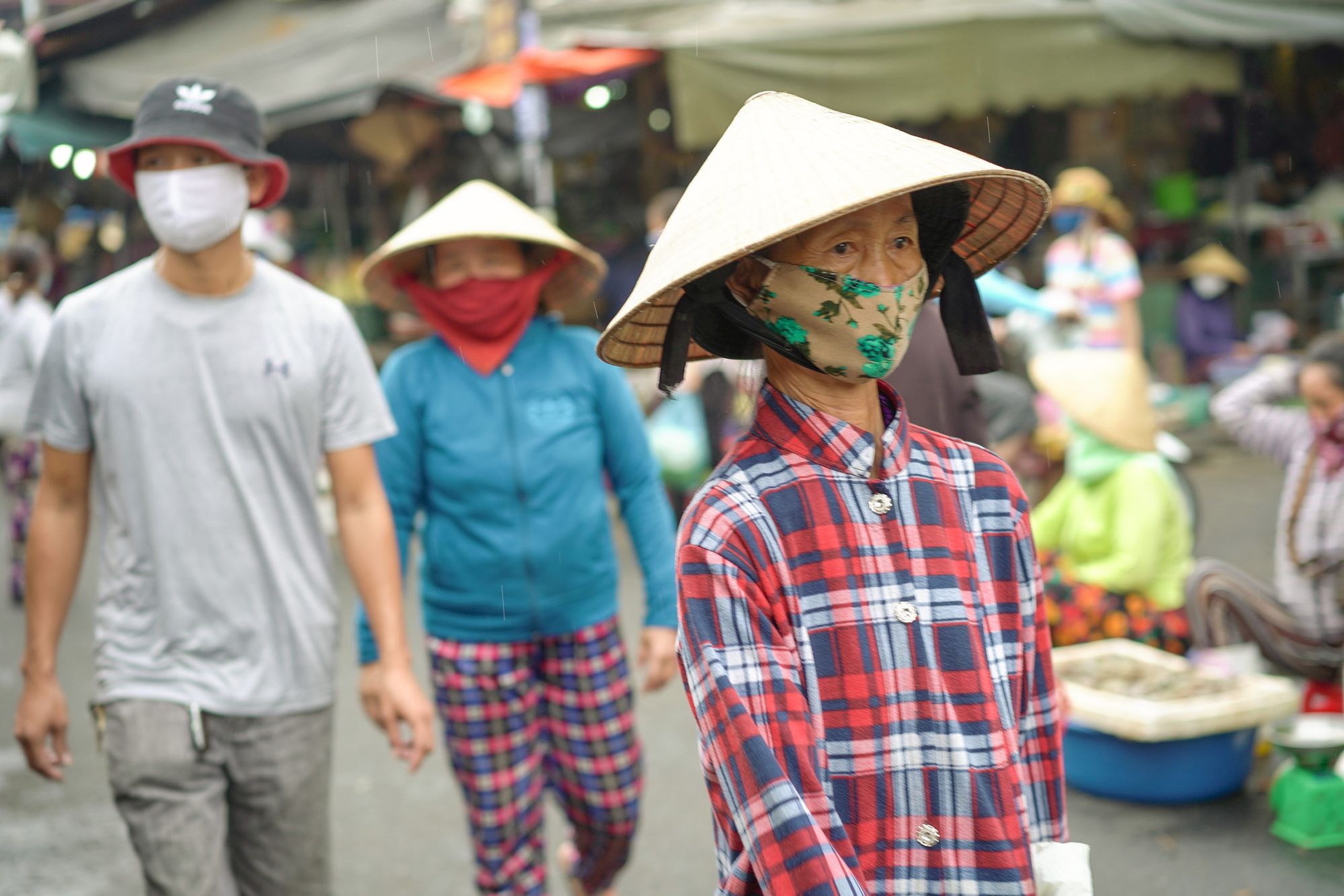
Local wet market in Hoi An City. Photo courtesy: The Vietnamese
Through the looking glass of Taiwan
With the initial success in containing Covid-19, there has been an ongoing debate among citizens on whether Vietnam’s authoritarian system is better equipped than other democratic societies to cope with a pandemic. However, focusing on governing systems might miss some critical points.
Comparing Vietnam with Taiwan, an exemplary success in the fight against this pandemic, may provide some useful insights.
At first glance, the two countries could not be more different. One is a communist state, the other one of the most vibrant democratic systems in the world. At closer look, Vietnam and Taiwan share some vital similarities in the fight against Covid-19.
They both are next to China, the origin of the pandemic. Both governments, and especially their people, have the same distrust of the Chinese Communist Party, hence the high alert mode from the very beginning, long before other countries took this infectious disease seriously. They also share painful experiences from the SARS pandemic in 2003, which also originated from China. With those scars still fresh in mind, going through this crisis is like bathing in the same river twice. They knew how and where to swim.
The culture and society also played an important role here.
Both countries are still dominated by Confucious-like ideals about the need for a harmonious society where collectivism trumps individualism. In the case of major crises like a pandemic, this kind of mindset helps glue the community together faster, quickly putting everyone into the same “for the common good” mode.
This particular pandemic, Covid-19, in which the elderly are the most vulnerable, also highlights one important aspect: how societies treat and value their aged populations.
In Vietnam, like Taiwan, most families have at least one senior member living under the same roof. Therefore, most people, even the younger generations, despite being in low-risk groups, still voluntarily took extra precautions to protect their family members.
Opportunities lie in the midst of every crisis, as the old saying goes. And there are many opportunities for a change-demanding society like Vietnam.
While the resurgence has shattered the illusion of exceptionalism, deflating many hardcore aficionados of the authoritarian system, it has also inflated the constant alert mindset, which is a life-and-death difference in the fight against most infectious diseases.
The health crisis also puts the whole governing system in the spotlight, pushing the need for greater transparency and accountability.
With the virus always seeming to have a head start, the authorities have had no other option than to constantly play catch-up. Around-the-clock updates and publicized data and numbers are now the new normal. Government officials are forced to focus on containing the spread of the pandemic. Even when the pandemic is over, it is hard to imagine returning to “the old normal”.
The virus has also created space for a newborn civil society. With the government’s resources stretched thin and vastly inadequate, citizens and volunteer groups have organized themselves for a wide range of mutual-support activities, from donating basic necessities to setting up coordinating teams to offer transportation for supplies and people in need. Again, when the pandemic is over, citizens who have trained themselves in this new normal will not be easily caged again. Instead, they will demand a greater place on the stage in building a common and better society for themselves.
A deadly pandemic is obviously not an ideal scenario to push for a positive change in any society. But as in any crisis, a good response brings along good reforms.
There are reasons to be optimistic about the emergence of some form of positive change after the country has gone through this extraordinary period.
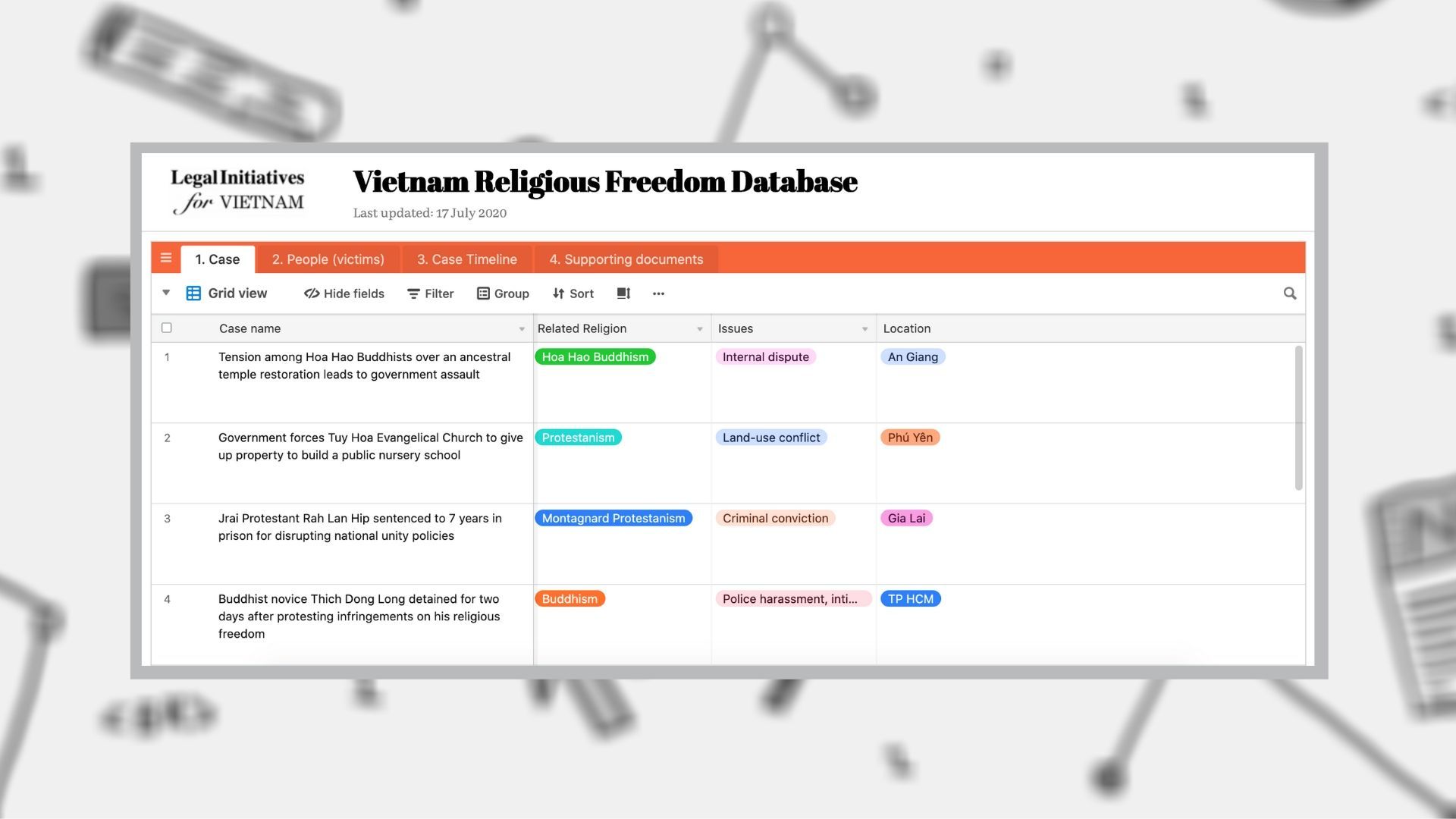
On July 17, 2020, Legal Initiatives for Vietnam (LIV) launched its Database on Religious Freedom in Vietnam.
LIV is a non-profit organization based in California (United States) and is the organization that oversees both Luat Khoa Magazine and The Vietnamese. You can find more information about LIV and the reason the organization is based in the United States (and not Vietnam) here.
With this regularly-updated data, LIV hopes to begin documenting cases related to religious freedom, both past and present.
It could be an issue related to the land dispute between the Tuy Hoa Protestant Church and Phu Yen provincial authorities. It could be the trial of an ethnic minority member from the Central Highlands who practiced Dega Protestantism or trials for those who promoted Falun Gong.
It could also be the conflict between Hoa Hao Buddhists in An Giang Province regarding the restoration of the An Hoa Tu Temple or the scuffles between unaffiliated Hoa Hao Buddhists and local police.
Currently, when you access this data, you will see 19 cases (among them, more than 20 events involving Falun Gong practitioners have been combined into one case), with more than 91 victims or persons directly involved. Other cases are still being updated.
To expand the number of readers, this data content will be presented in English. After consulting the Q&A information below, you can access data regarding freedom of religion here: www.liv.ngo/data
Why did LIV put together this database?
The multi-faceted religions of Vietnam are a national point of pride, and the strength of religion and faith has contributed to the ability of Vietnamese to persevere through difficult periods in history.
After April 30, 1975, however, many people became victims of the Vietnamese state’s harsh religious policies.
Although the strict control of religion has gradually decreased over time, the state still maintains a tight spiritual grip on religion. Activities that lay outside government control or that allegedly do not support the government’s efforts to build “national unity” are all seen as illegal.
As an organization that primarily conducts journalism, LIV has encountered many difficulties in evaluating the situation regarding freedom of religion and faith in Vietnam. Unlike cases involving freedom of speech or other political cases, those involving religion are generally not known or else fall into obscurity. For cases that are known, information is spotty and lacking. We believe that other press and human rights organizations also encounter similar problems.
Because of this, our initial data is created by compiling information regarding cases related to religious freedom in a systematic way. We hope this data can be a useful source of information for journalists, activists, as well as readers who care about the right to freedom of religion.
How was the data compiled?
The compiled data is based on information coming from sources such as local and foreign journalists, as well as from human rights organizations.
Furthermore, where such arrangements can be made, LIV will directly gather information from the people involved.
Database information only includes cases reported by journalists and those people directly involved. We will not provide our own viewpoints regarding these cases.
We hope readers will contribute information about cases that they are familiar with. For directions on how to contact us, please see the section “How Can I Provide Information?”
How do I read information from the data table?
Readers can view the data using the Air Table tool. This is an interactive spreadsheet tool that makes it easy to find information without having to switch tables.
When you open the link www.liv.ngo/data, you will see four tables: 1. Case, 2. People (victims), 3. Case Timeline, and 4. Supporting Documents.
Photo Courtesy: Luat Khoa magazine
For information about each case, you only need to read Table 1. All information in the other, remaining tables are connected to this first one.
In Table 1, you’ll see the name of each case in the first column, with the relevant information added across rows.
In the next four columns, you can filter cases according to more detailed information: Related religion, Issues, Location, and Status, by pressing the “Filter” button and entering the information you want filtered.
For example: if you want to find cases that occurred in An Giang Province, press “Filter”, choose “Location”, and pick the province of “An Giang”.
In the three columns near the end of Table 1, including People, Case Timeline, and Supporting Documents, you can see that the information here is colored. With these three columns, you can click on the phrases in each cell to view more detailed information.
For example, if you want to read more information about individuals related to the case of Rlan Hip, an ethnic Jrai sentenced to seven years in prison for disrupting national unity, you can press on his name in People (victims) in Table 1. Information about the victim, Rlan Hip, will appear as follows:
Photo Courtesy: Luat Khoa magazine
The People section includes the personal information of relevant individuals, such as birthdate, ethnicity, identifying photographs, gender, and activity timelines.
Case Timeline provides chronological summaries of cases based on information from sources that we have quoted in the penultimate column of Table 1.
Supporting documents can be videos, photographs, or any materials related to each case.
Similarly, you can also filter data by Table 2. People (victims) to look at information according to gender, ethnicity, religion, and criminal prosecution.
How can I provide information?
We hope you can contribute to this religious freedom database as much as possible. Tell us about cases involving religious freedom that you know about or are directly involved in.
Readers can send us information through this link: bit.ly/vuviectongiao. We’ll reach out to you as soon as possible to gather more information. You can also provide us information anonymously. Information provided will only be used for this religious freedom database and will not be given to any third party.
As we compile and present data, it will be difficult to avoid errors, and we hope readers can take a little time to contribute their thoughts. Email us at tongiao@luatkhoa.org or religion@liv.ngo.
In mid-April, Reuters broke the news that Facebook agreed to censor so-called “anti-state” posts after the Vietnamese government put pressure on the social networking site and took local servers offline, slowing down traffic. Since the news broke, the activist and politically-engaged community in Vietnam has been determined to jump over another hurdle in its struggle for freedom of expression.
Thao Dinh, an activist in Hanoi who formerly worked as director of communications for VOICE, a Vietnamese human rights NGO, said she has used Facebook much less since learning about the content restrictions and has switched to other platforms.
“Diversity is important,” Dinh said. “The worst scenario is one platform becoming a monopoly. So I would recommend people use as many services as they want depending on their needs, such as Twitter, YouTube, Facebook, Blogs, LinkedIn, Reddit, Quora, Telegram, except the platforms spying on us for the government.”
Additionally, Vietnamese activists are urging their fellow countrymen, if they choose to use Facebook, to be wary about sharing sensitive and personal information on the platform. Hoang Dung advised his network on Facebook to adjust their settings and clear their “Off-Facebook Activity” which is a summary of activity that businesses and organizations share about your interactions, such as visiting their apps or websites.
Vi Yen Nguyen, the training manager at VOICE, shared on her profile three other alternatives to Facebook: Signal, Telegram, and Wire.
Vi Yen wrote, “Facebook was faced with pressure by the Vietnamese government and gave up. It is no longer a reliable platform. Although admittedly, in this censorship case, Facebook is only a victim.”
(Vi Yen Nguyen’s quote was in Vietnamese: “Facebook đã chào thua trước áp lực của chính quyền Việt Nam. Nó không còn là một nơi đáng tin cậy. Dù phải thừa nhận rằng, trong vụ kiểm duyệt này, Facebook cũng chỉ là một nạn nhân.”)
Human Rights Watch said that Facebook should have resisted.
“Facebook has set a terrible precedent by caving to the government of Vietnam’s extortion,” said John Sifton, Asia advocacy director at Human Rights Watch. “Now other countries know how to get what they want from the company, to make them complicit in violating the right to free speech. The government of Vietnam shouldn’t have throttled the platform’s traffic in the first place, but Facebook shouldn’t have agreed to its demands.”
In a statement, a Facebook spokesperson said that the Vietnamese government “has instructed us to restrict access to content which it has deemed to be illegal in Vietnam. We believe freedom of expression is a fundamental human right, and work hard to protect and defend this important civil liberty around the world. However, we have taken this action to ensure our services remain available and usable for millions of people in Vietnam, who rely on them every day.”
The UN’s Guiding Principles on Business and Human Rights require businesses such as Facebook to “respect human rights,” including avoiding infringements and addressing adverse impacts in which they are involved. As a member of the Global Network Initiative, Facebook has pledged that it will protect the human rights of users when they are confronted with government demands inconsistent with international human rights standards.
“It’s hard to see how Facebook can live up to its human rights obligations when it’s helping Vietnam censor free speech,” Sifton said.
The pressure on Facebook coincides with a new decree by the Vietnamese government implementing monetary fines for people and internet companies for posting or publishing a sweeping range of items with “forbidden contents”, materials that promote “reactionary ideas”, “have not been allowed for circulation, have been prohibited for circulation or have been confiscated.”
The United States and other countries should have better utilized their diplomatic leverage to support Facebook in their stance against pressure from the government of Vietnam, Human Rights Watch said. Other businesses and business groups should have stood more publicly with the company to prevent the government’s strong-arm tactics.
The reluctance of Vietnamese activists to continue using Facebook has created new market opportunities for other social networks. Dinh recently got her Twitter profile officially verified.
“Since #Facebook is lowering its standards to protect human rights in #Vietnam, Twitter and other platforms are having a great opportunity for growing in [the] Vietnam market,” she tweeted.
On May 8, 2020, around 15:30 Hanoi’s time, the 17 members-committee of the Supreme People’s Court of Vietnam reaffirmed Ho Duy Hai’s lower courts’ decisions and again sentenced him to death. They have also denied the petition for a cassation trial from the Supreme People’s Procuracy of Vietnam.
Hai’s death sentence has been affirmed
In its statement denying the petition from the Judicial Committee of the Supreme People’s Procuracy of Vietnam, the committee even though agreed there were prosecutorial mistakes. Still, its members believed those mistakes did not change the character of the case. Accordingly, the Judicial Committee of the highest court believed that the lower courts have duly convicted Hai and sentenced him to death. Therefore, they affirmed the lower courts’ decisions, effectively sentenced Hai to death again.
Ho Duy Hai’s family and his lawyer after the decision was announced. Photo courtesy: Nguyen Xuan Dien
The Judicial Committee of the Supreme People’s Court believed these prosecutorial mistakes did not change the character of the case. Yet, if we look at them from an international law perspective, they might have violated the defendant’s right to a fair trial. The errors admitted by the government were among the followings:
No murder weapons. The alleged “weapons” were purchased at a market by the police.
Hai’s DNA, fingerprints were not found at the crime scene.
Hai also was convicted of ‘robbery’ in the same case, but the police could not find any of the items alleged to be robbed by him.
No eyewitness identified Hai at the crime scene.
Technically, there was no physical evidence. The only evidence in the case was Hai’s confession. Under Vietnam’s laws, the confession could not be the sole evidence used to convict defendants.
Would Hai’s life be saved under Vietnam’s laws?
The cassation trial is the highest court’s proceeding in a case in Vietnam. But Hai still has three options (link is in Vietnamese) under Vietnam’s laws to save his life.
The National Assembly could intervene and request the Judicial Committee of the Supreme People’s Court to conduct a meeting to review the cassation trial’s decision.
The Head of the Supreme People’s Procuracy of Vietnam petitioned, or the Chief Justice of the Supreme People’s Court requested the Judicial Committee to review their decision in the cassation trial.
The President of Vietnam pardons the death sentence.
The cassation trial of Ho Duy Hai during the past three days has created a lot of public discussion in Vietnam. People have discussed the case because many of them saw the injustice of Ho Duy Hai’s judgment during the last twelve years.
Representative Le Thanh Van at the National Assembly. Photo courtesy: Bao Moi
One of the National Assembly’s members, Mr. Le Thanh Van, a representative Ca Mau province, has also expressed his opinion on his Facebook account. Mr. Le said that he would do all that he could to push for Vietnam’s Congress to intervene with this case. He stated that the decision of the cassation trial is unconvincing and not persuasive enough.
Numerous attorneys and journalists also expressed on social media that the decision of the cassation trial’s decision was not fair. They believed that Ho Duy Hai should have been released. One of them was Huy Duc, the author of the book The Winning Side (Ben Thang Cuoc).