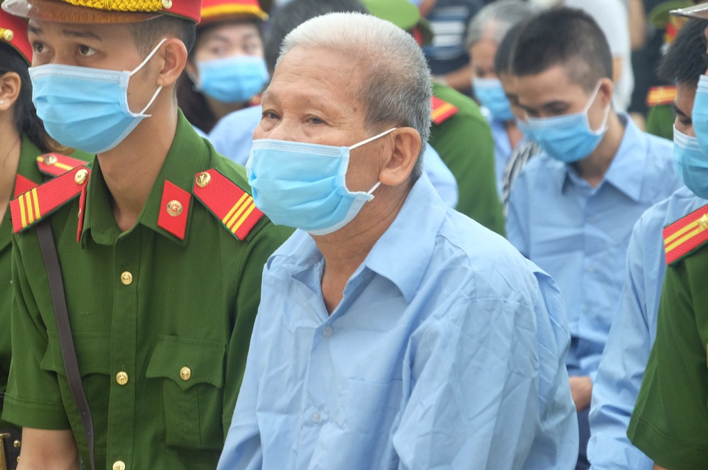
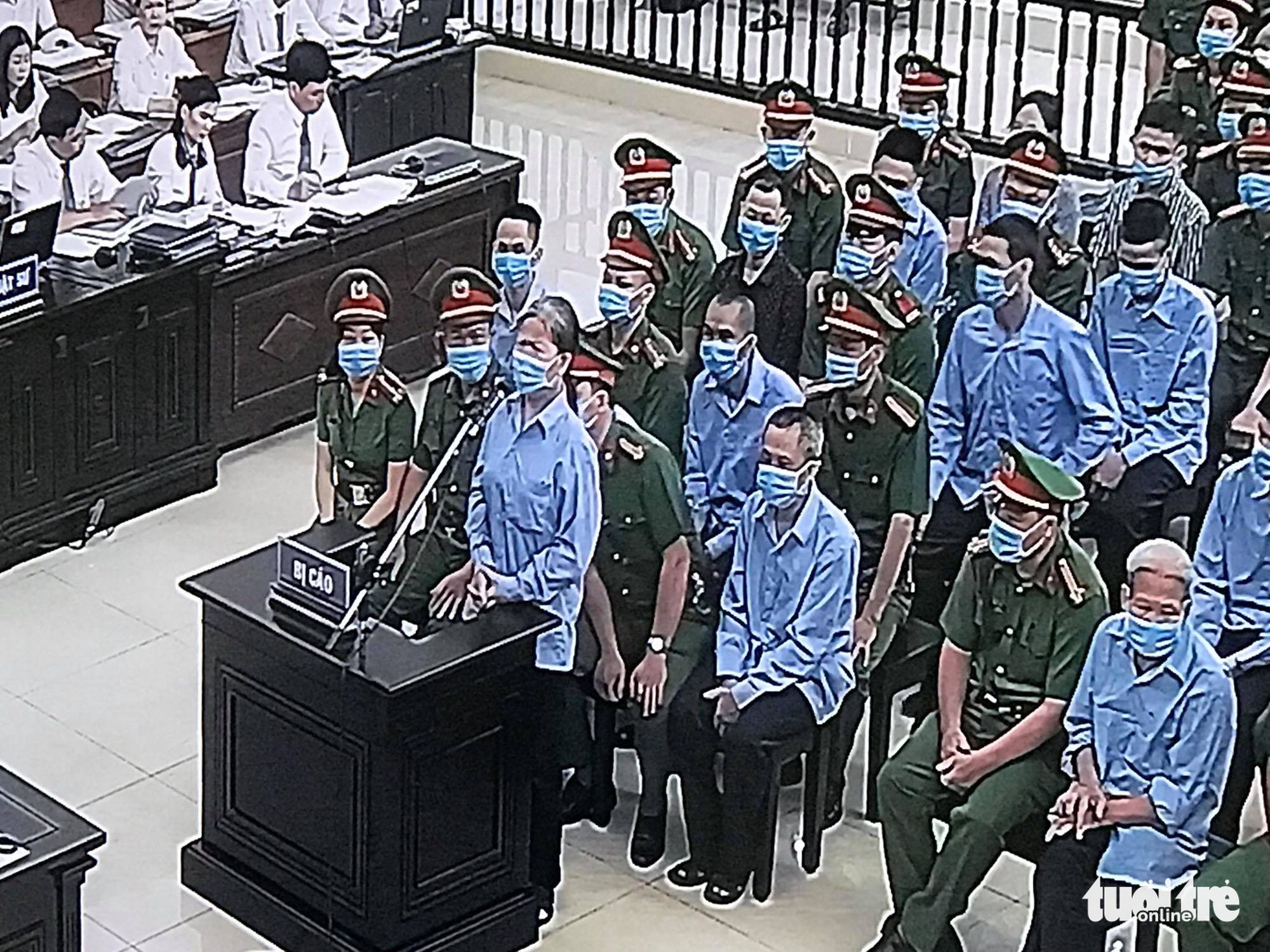
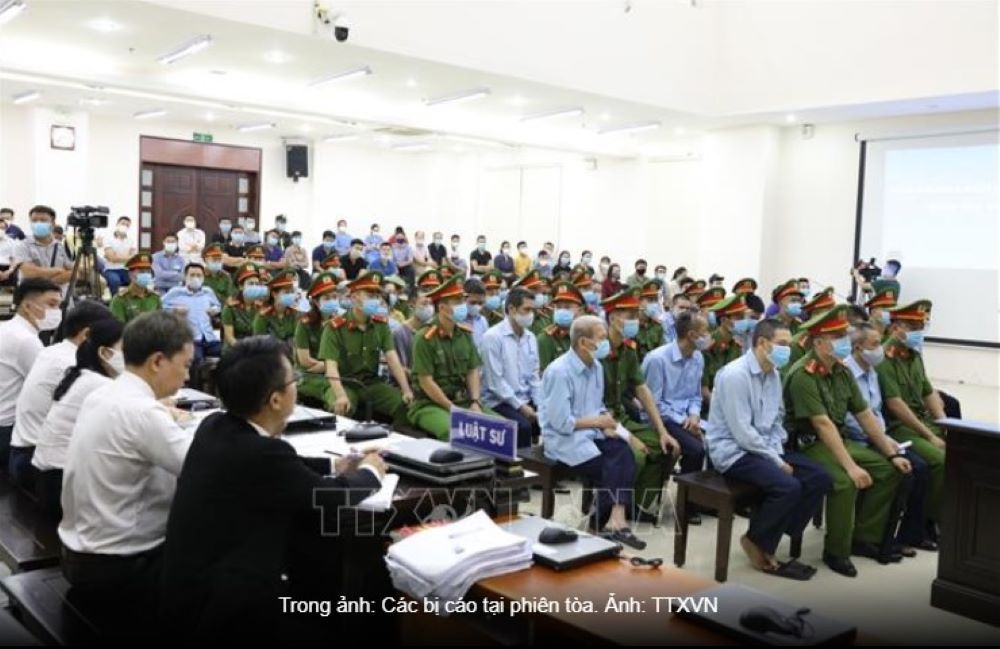
On the afternoon of September 10, after four days of a predicted 10-day trial, the Hanoi People’s Court took a recess and is expected to announce sentencing at 3 pm Monday, September 14, 2020.
Here are the latest events from the fourth day of the Dong Tam trial (September 10, 2020):
Defense session shortened
In an interview with the BBC, defense lawyers stated that during today’s trial, the tribunal shortened the defense portion of the 29 defendants.
Lawyer Nguyen Van Mieng said, “It appeared the tribunal wanted to limit today’s trial to the morning, pressuring us on time and seemingly not wanting procurators to counter argue with (defense) lawyers.”
“Normally, the procuracy must debate in full all matters the lawyers have petitioned, such as the request to send the case back for re-investigation in order to confirm that shortcomings have been addressed, that forensics have been conducted at the scene of the crime, that Hanoi police’s plans for maintaining the security of the Mieu Mon Airport construction project should have been provided to determine if they included a plan to attack Le Dinh Kinh’s residence. The tribunal simply responded that these matters were ‘already clear’.”
Lawyers petitioned the return of files, asked investigators to clarify content
Le Van Hoa, the defense lawyer for Le Dinh Cong, Le Dinh Chuc, Le Dinh Uy, and Tran Thi La, posted his entire defense argument on Facebook.
In it, he requested the tribunal review and return case files to prosecutors for supplementary investigation to clarify the imperative matters below:
1. The legal status of the 59-hectare parcel of land at Senh Field, Dong Tam Commune, My Duc Suburban District, Hanoi.
According to Attorney Hoa, the ambiguity regarding whether the disputed parcel is agricultural land that belongs to the Dong Tam Commune, the local authorities or national defense land belonging to the Air Defense – Air Force Arm (of the Ministry of Defense), is the direct and root cause of events that led to the Dong Tam incident in April 2017 and January 9, 2020.
2. The legal status of the deployment into Dong Tam of thousands of Hanoi riot police in conjunction with another police force fell under the Ministry of Public Security on the night of January 8 and early morning of January 9, 2020. Which office decided this deployment? And was this decision right or wrong?
3. A forensic investigation to clarify the deaths of three police officers; documentation in case files put together by investigators is not yet convincing.
4. The mysterious circumstances surrounding Le Dinh Kinh’s death must be clarified.
5. A request that the tribunal carry out criminal proceedings for the murder case according to the petition filed by Mrs. Du Thi Thanh (wife of Le Dinh Kinh).
The lawyers participating in today’s trial. Photo courtesy: Lawyer Le Van Hoa’s Facebook account.
Lawyer of three police officers killed opposes a forensic reassessment of the crime scene
According to state-run Laborer Newspaper, lawyer Nguyen Hong Bach, who is defending the rights of the three police officers “sacrificed (in the line of duty)”, opposes a forensic reassessment of the case’s crime scene because it will “re-emphasize the pain and loss for the victims’ families”.
After defense lawyers pointed out a number of issues (with the forensic case), Bach stated that he “felt deeply hurt”.
Bach explained his view: “Could we really recreate such a gruesome murder scene? Who would dare to climb down that sky-well, for others to pour gasoline on?”
He argued that not every part of the crime or the crime scene needs to be recreated for the forensic investigation to be conducted. In this situation, a forensic investigation should not be conducted, said, arguing that doing so would only bring pain to the officers’ families.
Plans to protect Dong Tam are top-secret documents?
On top of opposing a forensic investigation, lawyer Nguyen Hong Bach – who represented the three deceased officers – also rejected the demands to publicize Plan 419A of the Hanoi City Police regarding the maintenance of order and security surrounding Dong Tam Commune.
Lawyer Ngo Anh Tuan had earlier requested the publicizing and clarification of this plan and entering it into the record in order to evaluate the legality and objectives of those on duty the night the incident took place.
According to Attorney Tuan, “The people and lawyers can be skeptical and do not believe that this Plan 419A exists in reality or it can be illegal since it is not publicized. It can be determined that the consequences that happened on such a day (January 9, 2020) were the responsibilities of the leaders of the Hanoi Police Department towards their officers.”
In response, Attorney Bach stated that these plans were “top-secret documents”, and that defense lawyers “had no right to demand (their publicizing)”.
Is participating in a “Consensus Group” formed by the Dong Tam farmers a crime?
On his Facebook profile page, lawyer Nguyen Van Mieng posted an excerpt from his defense argument emphasizing that the presiding judge frequently asked each defendant “the same question” about their participation in the “Consensus Group,” a group formed by the farmers, and headed by Mr. Le Dinh Kinh to deal with land dispute with the government.
According to attorney Mieng, the indictment did not criminalize the establishment of the group. But during its questioning, the tribunal was especially concerned with whether the defendants had participated in the Consensus Group, in order to evaluate their other alleged crimes.
This is a violation of human rights, and the fundamental rights and obligations of citizens, as stipulated in Article 25 of the (Vietnamese) Constitution.
According to Article 25, “Citizens have the right to freedom of speech, press, information, assembly, association, and protest. The exercise of these rights shall be regulated by law.”
“Accordingly, to participate or not in the Consensus Group is a citizen’s right, and no one can use a constitutionally-guaranteed right as the basis of criminalization,” Mieng stated.
The lawyers participating in today’s trial. Photo courtesy: Lawyer Le Van Hoa’s Facebook account.
Defense lawyers manhandled and tailed after leaving court
Lawyer Nguyen Ha Luan relayed that a shoving match broke out after police officers attempted to confiscate a USB drive and refused to let lawyer Ngo Anh Tuan copy data; another plainclothes police officer shoved lawyers Dang Dinh Manh and Nguyen Van Mieng.
Recounting the incident, lawyer Dang Dinh Manh stated that in the afternoon, after they had left the trial, the three (lawyers Tuan, Manh, and Mieng) were brutally dragged to the gate by the underarms and then straight-arm shoved down the steps, after arguing with police officers to return the USB drive so the lawyers could copy the data over to their laptops.
Afterwards, while traveling on the road, the lawyers discovered that there were four individuals on two motorcycles closely following them. When the lawyers stopped their vehicle, these individuals also stopped onto the sidewalk; when the lawyers continued moving, so did they.
Did the Propaganda Committee issue instructions to journalists on how to cover the Dong Tam case?
On social media, a number of notable figures, such as journalist Nguyen Manh Kim (of The New Viet magazine), disseminated detailed information regarding a document from the Vietnamese Communist Party’s Central Propaganda Committee. The document contained detailed instructions on how state journalists should cover “sensitive issues” related to the trial.
In the section regarding the Dong Tam case, the document directed journalists to:
– Affirm that the suspects had “refused dialogue, reconciliation”.
– Recount the idea that suspects had “attacked [officials] first” (this phrase was emphasized).
– Criticize the “depravity of suspect Le Dinh Kinh.”
– Affirm that the need for the officials to suppress people (at the crime scene) was “pressing” and done “according to regulations.”
– Reflect that the public opinion is in “consensus” with the government regarding the matter, the “support” of citizens regarding the court’s sentencing, and the tribunal’s “fair sense of justice.”
– Report information “in moderation”; do not report “details” or “negative news” regarding “admissions of guilt” or the “repentance” of defendants.
Note that these instructions appeared before the trial began.
Sources of this information publicly stated that they could not post pictures of the document because each instruction form sent to publications has a specific “marking” to help Vietnam’s security forces trace leaks.
We have yet been able to verify this information.
Court to announce sentencing on Monday, September 14
After this afternoon’s session, the trial will temporarily recess for the tribunal to deliberate. It is expected that the tribunal will announce sentencing at 3 pm, Monday, September 14.
***
This article was written in Vietnamese by Y Chan and previously published on Luat Khoa Magazine. The translation is done by Will Nguyen.
The latest events from the third day of the Dong Tam trial (September 9, 2020):
Procuracy recommends two death sentences
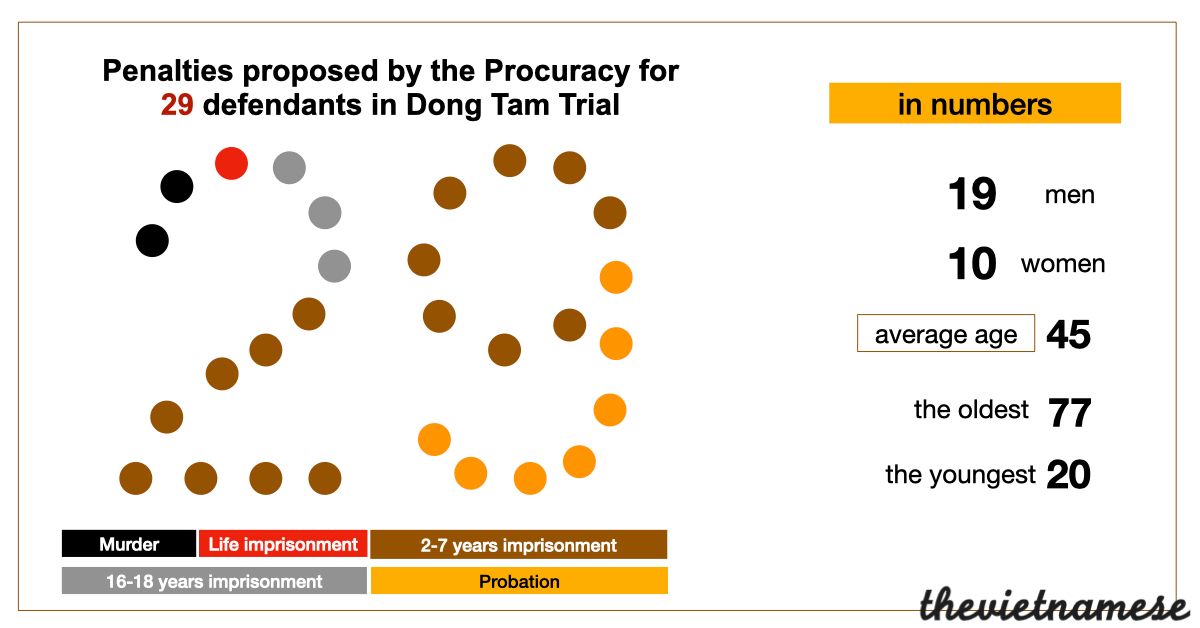
According to state-run Zing e-newspaper, the Hanoi People’s Procuracy recommended to the court that Le Dinh Cong and Le Dinh Chuc receive the death penalty. The recommended sentences for the remaining 27 defendants ranged from 15 months of probation to life in prison. Le Dinh Cong and Le Dinh Chuc were both prosecuted for murder.
Also prosecuted for murder was Le Dinh Doanh (who was recommended a life sentence), Bui Viet Hieu and Nguyen Quoc Tien (recommended sentences of 16-18 years in prison), and Nguyen Van Tuyen (a recommended sentence of 14-16 years in prison).
Nineteen other defendants had their original charge of murder downgraded by investigators to obstruction of officials. In total, 23 defendants were charged with the latter crime and were recommended sentences ranging from 15 months probation to 7 years in prison.
A speedy cross-examination of defendants
Prior public information estimated that the trial would last 10 days, but after only two days, the procuracy has already arrived at recommended sentencing for the defendants. This is due to the speediness of the trial, with each defendant questioned for only a few minutes and lawyers racing to keep up, unable to record all responses in full.
In a BBC interview, lawyer Ngo Anh Tuan spoke of Tuesday’s trial highlights, when every single defendant pleaded guilty.
According to Tuan, this development could be due to the fact that the defendants were facing heavy sentences and felt that even if they had retracted their previous statements, it would not stop the inevitable; as such, they chose to plead guilty in hope of a lesser sentence.
Lawyers interrupted
During the third day of the trial, lawyer Le Van Luan recounted how the prosecution repeatedly interrupted him as he debated the legality and legal value of the submitted electronic materials (unsourced videos broadcast in court, video confessions of the defendants recorded during the period of investigation that were never mentioned in case files).
Noteworthy is that during this time, the presiding judge “left the room”, and the judge sitting next to him took his place, warning the lawyers to “defend what is before you, no more expounding on the law, no more utilizing the law”; if they continued, he warned, they would be found “in contempt of court” and “asked to leave the trial”.
“No need” – episode two
During the first day of trial, court security prevented lawyers from speaking with their clients. When lawyers objected, the presiding judge declared that there was “no need” for lawyers and defendants to speak with one another in court – in complete violation of the law.
After lawyers forcefully responded by sending a complaint to the presiding judge of the Hanoi People’s Court during their midday recess, the next morning, on the second day of trial, the court agreed not to block contact and to abide by legal statutes.
But as lawyer Dang Dinh Manh told the BBC, by the afternoon of the second day, the court reversed direction, asking lawyers to register before speaking with their clients and mandating that they stand two meters away from their clients. By the third day of the trial, “they no longer allowed us to see (our clients) at all,” he said.
Manh believed that this reversal may be due to the fact that as the trial progressed, lawyers questioning defendants allegedly resulted in “a lot of information being disclosed unexpectedly”.
In addition to single-handedly deciding that lawyers had “no need” to speak with their clients, the trial’s presiding judge also decided on the second day that there was “no need” to respond to lawyer requests for the court to provide the “video evidence” it was planning to show, so that all parties would have access to and understand the materials.
Accordingly, the prosecution stated that it would not provide the sources or any information regarding the evidence because there is “no need”.
Two of the trial’s defense lawyers: Nguyen Van Mieng and Dang Dinh Manh. Photo courtesy: Facebook Manh Dang.
Were the defendants tortured during the investigation?
Lawyer Dang Dinh Minh relayed that at the end of the second day of the trial, he turned to the row of defendants and asked the 29: “Those who WERE tortured during your investigation, do nothing; those who WERE NOT tortured during your investigation, please raise your hand”. Ten raised their hands, 19 did not.
What do the residents of Dong Tam think of the defendants and their families?
Responding in an interview with Luat Khoa Magazine, Mrs. Nguyen Thi Duyen – wife of defendant Le Dinh Uy and granddaughter-in-law of Le Dinh Kinh – affirmed:
In our village, we Dong Tam residents strongly mourn the death of elder Le Dinh Kinh, as well as the enormous losses our family has suffered and the many relatives who were arrested on the night of January 9. It brings us great anguish.
But many cannot express this for fear of immediate retaliation by police and village security. Intimidation, there is intimidation. That’s the truth because many have been called to the police station and the village committee and told that they were not allowed to come to my house. They wanted to burn incense for elder Le Dinh Kinh but were prevented by security forces, who construed burning incense with some kind of involvement in the matter. So residents were very afraid and didn’t dare come, though they mourned Kinh dearly.
They were able to express themselves more quietly by going to his gravesite and burning incense there, rather than coming to our house. If they came, they would be recorded and followed on camera, and possibly be immediately denounced; security would definitely summon them right away.
We can’t even burn incense freely for someone who’s already passed away; as such, I certainly do not hold the security forces of Dong Tam in high regard.
But I affirm to everyone that Dong Tam’s residents care for and support those in custody. Villagers have conveyed themselves through text messages and they encourage us whenever they get a chance. They do not isolate my family or any other relative who’s been arrested, and I feel very happy living with the residents of Dong Tam.
***
This article was written in Vietnamese by Y Chan and published on Luat Khoa Magazine. The translation is done by Will Nguyen.
Second day of trial of the Dong Tam Incident – Summary
Below is a summary of the main events that happened on the second day of the trial.
Court allowed direct contact between attorneys and defendants – for now
According to attorney Le Van Luan, the court granted attorneys direct contact with their clients this morning.
As reported, during the first day of the trial, security at the courtroom prevented the attorneys from interacting with the defendants. When the attorneys demanded the trial panel respect the rights of the defendants and the attorneys, the chairman rejected their request and publicly announced that “it is not necessary” for the attorneys and the defendants to have contact during the trial.
Controversy over “video evidence” presented at the trial
Attorney Dang Dinh Manh pointed out two puzzling issues about the presentation of the “video evidence” on the first day of the trial.
In the questioning section, the court showed a video that was produced in documentary style, telling the story from the state’s viewpoint and depicting how the villagers had wrongfully protested and claimed the disputed land, and how that led to the confrontation which resulted in the death of three police officers. The video ended with miserable scenes of the families of the three police “victims”, showing suffering widows and children.
According to attorney Manh, this was an unprecedented offering of evidence. Everything presented at court during a trial must be evidence related to the case and it has to be real, original, intact and unedited, and not include doctored videos.
In a separate post on social media, independent journalist Pham Doan Trang quoted a source who said that the attorneys objected to the presentation of the doctored “evidence” and demanded hard evidence instead. But the court rejected the objection and instead instructed the attorneys to “just watch the video”.
The second issue was the “confession videos” shown during the questioning of each defendant. These videos were not mentioned in the case files. The attorneys, therefore, had no idea of their existence and had no chance to review them beforehand. Attorney Manh considered this “a trick played on the attorneys,” causing them surprise and anger when they tried to defend their clients during the trial.
The attorneys later co-signed a request submitted to the trial panel and the People’s Procuracy Office in Hanoi, demanding a complete list of this alleged video evidence.
Video clips of defendants admitted to guilt were shown at trial by the prosecution. Photo courtesy: ANTV
State media: The defendants showed remorse and asked for leniency
Reports on the trial from state media like Dan Tri, Tuoi Tre, etc. all followed the same direction: the defendants pleaded guilty.
Dan Tri reported that “In the court, all defendants admitted their crimes as stated in the indictments, showed their remorse, asked for leniency and at the same time sent their apologies to the families of the three sacrificed police officers.”
Meanwhile, Tuoi Tre reported that defendant Bui Viet Hieu voluntarily “raised his hand asking to speak.” Hieu “apologized to the trial panel” for his statement made the day before and admitted his lack of understanding of land policies.. Hieu then “appealed for leniency since no one should punish a man who already admits his guilt”. In a statement issued on the first day of the trial, Hieu had defended the position of the Dong Tam people regarding the land dispute.
Tuoi Tre also reported that defendant Mai Thi Phan took part in the years-long protest because “Le Dinh Kinh (the head of Dong Tam Village who was killed in the incident) had promised to give a piece of the disputed land to her and the people involved.” The paper depicted the defendant as “shamefully stuttering” while admitting “We know what we did was wrong, we see our guilt now.”
One defendant counter-questioned the trial panel
State media buried other events in the trial, specifically a defendant who questioned the trial panel.
Information published by attorney Dang Dinh Manh told a story about defendant Bui Thi Noi. When the court questioned her, she responded with a request to the trial panel, demanding it answer a series of her questions.
She asked, “Why do you have law but don’t respect the law? Why didn’t the government arrest Noi’s father (Mr. Le Dinh Kinh adopted her as his child) according to the law? Instead, the government tricked him to go to an open field and broke his leg ….” (Bui Thi Noi was referring to the incident that happened in April 2017. It was when the authorities tricked Le Dinh Kinh out of the village and assaulted him, breaking his leg.)
When the chairman of the trial panel repeated his question for the third time, “What did you buy the gasoline for?” defendant Noi answered “To burn the corrupt officials!”
The chairman later ordered the police to escort her out of the courtroom.
Civil society organizations: Request to treat Mr. Bui Viet Hieu as a special witness
A group of civil society organizations initiated an urgent petition addressed to state leaders and collected signatures for the campaign.
Part of the petition requested:
“Treating Mr. Bui Viet Hieu as a special witness with the most special protection measures; it is best to transfer him to another incarceration facility that is not under police control.”
They explained their reason:
Mr. Bui Viet Hieu had directly witnessed a police officer shoot and kill Mr. Le Dinh Kinh in a face-to-face confrontation. This account matches forensic evidence showing two bullets hitting Mr. Kinh from the chest through to his back (completely contradicting the investigation conclusion which stated the shots were fired from the back). Mr. Hieu himself was the second senior member of the Dong Thuan Group (a group formed by Le Dinh Kinh to protest to the authorities on the land dispute).
Mr. Hieu was also shot at the same place and same time, according to his statement: “After they shot and killed Mr. Kinh, they turned their flashlight on my position and fired two shots, aiming at my heart. But the police missed the target and the bullets hit my ribs instead, exploding and causing three wounds in my duodenum and two wounds in my colon. The police left me lying there for hours, from very early in the morning until 11:00 am on January 9, 2020 (the day the incident happened). Only when it was obvious that I was still alive, did the authorities decide to take me to the hospital.”
Defendants’ family: If there are death penalties in the sentence, we will not sit and watch our loved ones die unjustly
Luat Khoa Magazine interviewed Ms. Nguyen Thi Duyen – the wife of defendant Le Dinh Uy and the granddaughter-in-law of Mr. Le Dinh Kinh. Here are some extracts from the interview:
I am very scared that my loved ones will have to endure extremely harsh punishment, despite the fact that it was not us villagers who initiated the attack. It was the authorities who launched the attack on us.
Our relatives and I have heard a lot of rumours that there will be death penalties in this trial. Many people predicted that three members of our family, my father Le Dinh Cong, my uncle Le Dinh Chuc and my brother Le Dinh Doanh, will face the death penalty.
If the people holding power in their hands decide to tear apart our family in this way, they clearly have no conscience. An old man like Mr. Kinh had already died in such a cruel manner in this January 9 incident. I hope the people who are on the trial panel will mull over things before making any decisions because the truth about Dong Tam villagers is far more complicated than many people have depicted.
If there are death penalties, we will never stop fighting to save our loved ones. We will not sit and watch the people we love die in such an unjust manner.
Hoanh Village, a few days before the historic Dong Tam trial, is a place where the green rice fields are flowing beside country roads under the hot autumn sun. Vietnam’s national flag and banners commemorating the 75th anniversary of its National Day crowd the village gate.
I equipped myself quite well before I arrived in Hoanh Village, in both my mind and my technological tools.
“That place has many security police. Be careful!” – I was warned in a text message.
I have wanted to go to Hoanh Village during these days to be a journalist and practice the most basic ethical responsibility of our profession. I wanted to report the complete story about a historical event that will happen soon. I wanted to learn about the defendants’ families and what they yearned for, besides justice.
The village welcomed me with the typical peaceful beauty that many northern rural villages offer: a traditional market, big old banyan trees, rice fields, and winding roads. It was as calm as if it had never gone through the recent chaos it had experienced. There were no skeptical eyes staring at a stranger when I accidentally met villagers, or when they wholeheartedly showed me the directions to Mr. Kinh’s house.
They whispered to me, “So pitiful that house now, with only women and children left.”
There were no security police there; at least that was how I saw it. Yet, there were a few surveillance cameras placed on the awnings of opposite houses, which surprised me a little.
I met Mrs. Du Thi Thanh, the wife of Mr. Le Dinh Kinh, and Mrs. Le Thi Thoa, the fourth daughter of the couple, and their group of little grandchildren. In the house, which was pockmarked by police bullets, they told me stories about their father and husband. My questions were overwhelmed by their memories. The wife and daughter, and at times, both of them, unwittingly reliving stories about their husband and father as a man from their past. They told me the stories in tears, and there were moments of silence, and even some smiles. Before the attack, there were the peaceful times they had spent in the village.
The wall is used to hang Mr. Le Dinh Kinh’s portrait and his medals, as well as the evidence of bullet fire. Photo courtesy: May/Luat Khoa Magazine.
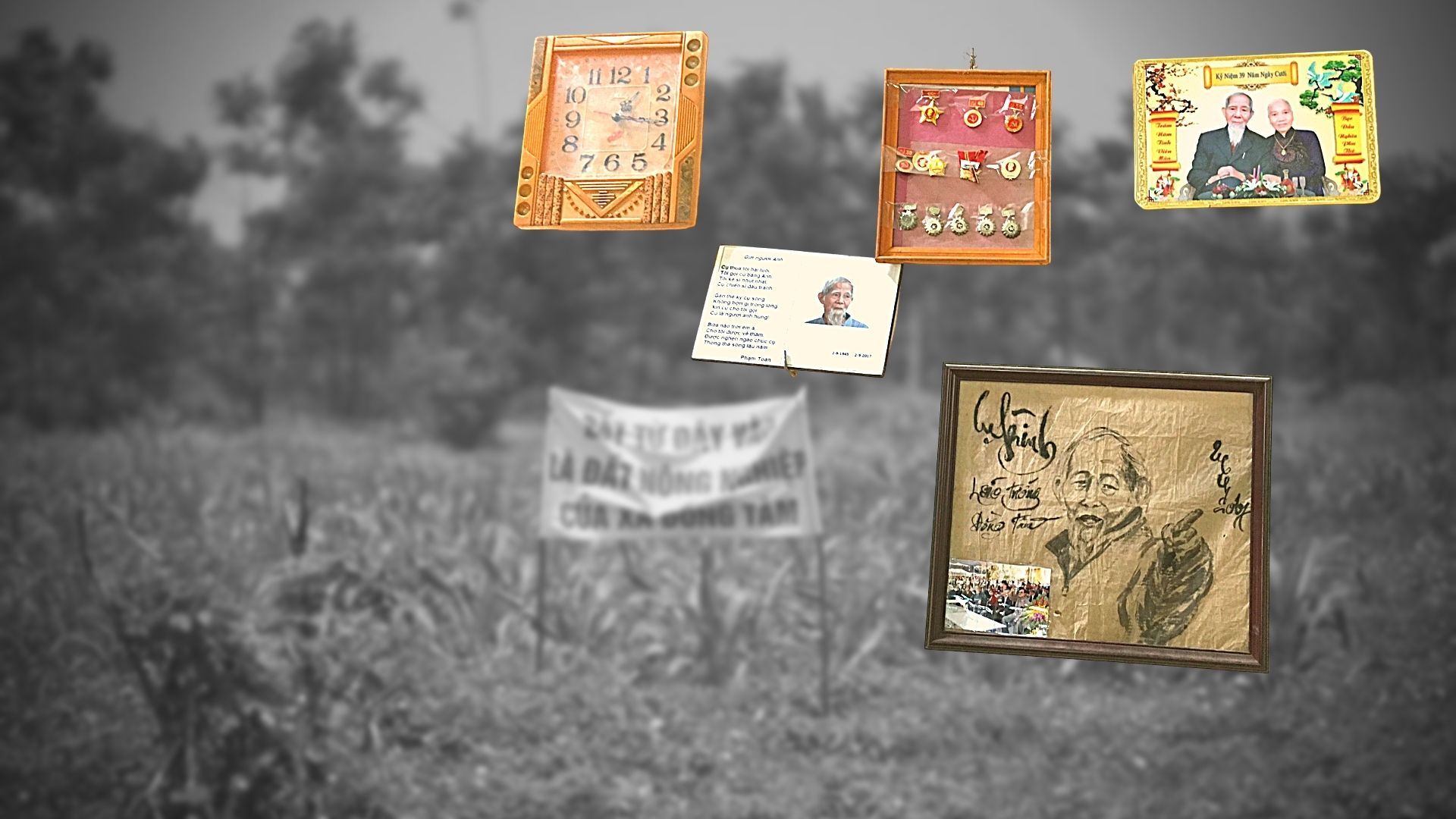
Mr. Le Dinh Kinh’s portrait and the medals that the government and the Vietnamese Communist Party awarded to him were hung on the wall opposite the main door. The same wall was marked by bullet holes, evidence of the attack one dawn last winter.
“These things, when he was alive, he treasured them so much,” Mrs. Thanh said, looking up at the medals. “He was given an award when he reached his 55th year as a Communist Party member.”
“What are your memories of him?” I asked the two women.
Du Thi Thanh:
Our house always needed a lot of upkeep, but he always forced me to take him to attend the Communist Party meetings in our ward. Before, he could go by himself, but starting in 2017, after his leg was broken during an assault by the police, he had to use a wheelchair. The first wheelchair was a gift from Mr. Chung (Nguyen Duc Chung – the former chairman of the Hanoi People’s Committee). Later, the Disabilities Association gave him another wheelchair. I remember when he tested out the second wheelchair, which he praised: ‘This one is smoother, my wife,’ he told me. ‘The first wheelchair came from Chung, I heard it was expensive, but the wheels were wobbly.’
I used the wheelchair to take him to his meetings, waited for him, and we would go back home together. People kept talking, one after another, which made me anxious because I could not know when the meeting would be adjourned.
More than that, the people did not obey any rules because when one person spoke, another would go outside to chat with others. It was just like the chatting done in the market. But it was only my husband and a few others who were thorough. I remember that he proposed to do roll calls to make sure the Communist Party’s meetings in our ward would have sound principles.
When we got home I was annoyed, and I told him if the Communist Party’s meetings were just like that, we should not go because we just sat there and did not benefit from anything. I told him that we were old and we should stay home to rest. However, he was angry with me. He said: ‘Why would you say that? I do not care if there were improper people there. I came because I want to be proper and exemplary.’
If you offer comments about his Communist Party carelessly, then you are bound to be berated.. From then on, if he asked me to take him to such meetings, I would go with him, and I stopped asking him to stay home.
Le Thi Thoa:
There are now only regrets…. Our father-daughter relationship had so many fights …. (She cried.)
I was never close to my father when he was alive. Among his children, I was the child that had so many opposite perspectives from him. I could not sit down and have a proper talk with him without us having a clash of opinions because we would fight right away after exchanging a few sentences. My father whole-heartedly trusted the Communist Party, and he believed in the Communist Party’s Secretary General Nguyen Phu Trong without condition. I warned him and told him: ‘Father, many officials nowadays have become corrupt.’ But my father scolded me and said we can’t tar the whole brush because the corrupt officials were only a small group and that they were the lower officials that covered their faults and smeared the Party.
I had wanted him to let go of the land dispute everytime I witnessed my father face grave danger. I cried and told him that I was scared. I stated that the Party had too many factions, and they could turn against each other to eliminate the opposition. My father responded to me that he was doing the right thing so he should not be afraid. He said the land of Senh field, where we had disputes with the government, belonged to the people of this ward. He also assured me that if he already made a mistake, the Party would have kicked him out a long time ago.
When he was in the hospital in 2017, some people gave him money when they visited him. He then gave the money to a policewoman and asked her to keep it for him. He always said: ‘(Nguyen Duc) Chung already said so (that the government would never prosecute Dong Tam villagers). Or, he would say ‘the people from the city had promised me already (to not prosecute),’ and that ‘things have to be reported to Mr. (Nguyen Phu) Trong because the Party would then be transparent.’ I was so mad, I stopped talking to him, ignoring the old man’s ideology.
From the time when he was still a local official right up until to his retirement, I saw him as a person who spent so much time volunteering for the community. I felt uneasy. He only cared about the ward and the village’s everyday issues, leaving my mother to take care of our household alone. As years passed , the Mieu Mon land dispute documents passed through the hands of many leaders , but he stored them all in his head. He memorized all of them, line by line, without fail, without a need to look at the papers.”
Mrs. Du Thi Thanh shows the bullet hole in the glass door. Photo courtesy: May/Luat Khoa Magazine.
Du Thi Thanh:
When he was an official, he only focused on his position and worked for the ward and the village. Even when his wife and kids suffered, he took no notice . When he retired, he began to farm the field. I guess he farmed to compensate his family because there had been so many years that he neglected us. The village people passed by our field and would tease him: ‘Oh, Mr. Kinh, Mr. Kinh. You were an official, why are you only now putting your head to the field?’
Le Thi Thoa:
Other people who were government officials had so much land. My father worked at the top positions in this ward, but my family didn’t even have a rice field when he retired. I remember that my parents would come to some undocumented land that nobody cared to claim . From dawn to dust, they would go there to work on that land, clearing, ploughing, digging, furrowing and cultivating the land till it was ready to be used for planting food crops. . They worked so hard and spent so much time on that field only to have their sweat and blood rewarded by a call from the government to donate all the cultivated land to the ward when harvesting time came. Is that reasonable? But then I have never heard my father blame the Party or curse the government. He only scolded me. (She smiled.)
I was irritated and slightly annoyed at the absurdity when I read online that people cast doubt on the source of money my father received from overseas, indicating it was from the reactionary forces. Truth be told, my father would forever continue believing in the Communist Party until his last dying breath.
If he truly believes that something is right and is not against his conscience, my father would fight to protect it till the very end. He used that mentality to protect the Senh field and the Communist Party.
Du Thi Thanh:
Until his last days, even after witnessing so many city officials do an about-face, he still believed in his Party. I worried for his safety, but he chided me: ‘You do not need to worry about me. I am a Communist Party member. A Party member must stand up and take care of the people. If we ignore the truth and don’t speak up, we are guilty in front of the people.’
I remember when he was young, he would pedal with only one leg, but he was incredibly fast. He would bike across the fields to go to the town center for a meeting. He was disabled in one leg, but he was talented so it helped him to become the head of the ward police force. He could only stand up on one leg, but he took care of all of the ward’s work thoroughly. The people in this ward respected and loved him.
Le Thi Thoa:
I recall that he told us he had played soccer when he was young and sprained his leg. Unfortunately, he did not receive proper treatment, which led to a permanent disability later on in life. My father was always so busy with work. When he was riding his Thong Nhat branded bicycle or when he got a ride on a motorbike to go to the district office, he always had to stretch out his disabled leg. Even having his meals or a cup of tea, he could not fold that leg. When he walked, it seemed as if he was dragging it along.
Du Thi Thanh:
But they shot and blasted his disabled leg.
Le Thi Thoa:
Dad died such an inconsolable death.. What is there left when all of the men in this house have been arrested. We can only pray to Heaven. We looked up at the sky and cried our hearts out about the injustice. When we fixed part of our home after the assault and repaired the damage caused by the police attack , our mother wept until she passed out because she was so heart-broken that our family now was left with only women and young children. My father’s belief caused all of that. If I knew in the end that our family would be this broken, I would have made more of an effort to stop my dad from disputing the land with the government. You should throw away everything, dad!” (Le Thi Thoa sobbed)
Mrs. Du Thi Thanh shows the bullet holes in the wall. Photo courtesy: May/Luat Khoa Magazine.Another bullet hole in the home of Mr. Le Dinh Kinh. Photo courtesy: May/Luat Khoa Magazine.
“We will walk (to court) from our village”
Du Thi Thanh:
My sons, my grandsons, are all in prison. It has been more than eight months, and our family did not receive any news about them. My son Chuc, did the wound on his head heal? Ten days after he was arrested, his wife gave birth to a son. His wife sent him a picture of the newborn baby, but the prison officials did not allow him to receive it. I believe that Doanh got shot in the arm, how is he now? Uy, and then Cong. My sons and my grandsons are all working people. They each have their own family . Their wives now have to raise their children alone and unsupported. If I knew this in advance, I’d rather kept my mouth shut . I would have forced all of them to be silent. How could any piece of land be more precious than having a peaceful family life?”
Le Thi Thoa:
The rental car company did not accept our reservation (or that of any of the villagers) to rent cars to go to the trial. The company told us that the police had forewarned them. An official in our ward advised us to stay home because we would not be allowed to enter the Hanoi courthouse. But regardless, we will go there. We will walk from our village to Hanoi and attend the trial. My mother wants to see her sons and grandsons. The young children in our house want to see their fathers; the wives want to see their husbands. No one should be able to prevent us from doing that.
Du Thi Thanh:
What do I expect at the trial? I just want to meet my sons and grandsons. I want them to issue a death certificate for my husband. He passed away more than eight months ago, but we have yet to receive the death certificate. The officials from our ward forced me to state the reason for his death as ‘died at home.’ No. That was not right. Mr. Le Dinh Kinh was shot to death at home. A bullet entered near his heart. Two bullets were fired into his head. His left knee was shattered. That was how my children’s father died. The bloodstain is still in our room, how could they lie like that?
The bloodstain is right here. It is very stubborn though, I could not wash it off.
“Just stay still here, I will go downstairs and get you a wet cloth to help you breathe better.” That was my last sentence to my husband. The fumes were so heavy. I was going back to his side when someone took my arms and dragged me away. When I came back home, the room was covered in blood. Our home was shattered. Can you see this door jamb protruding out? A bullet is stuck in it.
***
Mrs. Thanh relived the story as she walked me around her house.
I could see the remnants of bullets fired through their glass door. Their closets were also shot up, and the wall had a massive crack. There were areas of newly patched cement, but others were left untouched. Evidence of bullets was everywhere, substantial bullet holes, smaller holes, on the first floor and the second floor. They were also in the kitchen and the living room. There were also black stains on the floor, which Mrs. Thanh suspected it came from the tear gas.
She was walking with her hunched shoulder, her hair all white. Just like her daughter, she doesn’t believe in anyone because “only Heaven could help my sons and grandsons” during the trial starting next Monday. The two women did not say words like “justice”, “righteousness”, or “fairness” when they referred to the trial as I had imagined they might. They did not expect too much, just the simple wish to be able to see their loved ones and to somehow brush each other’s hands at the trial hearing.
I just wanted to write down their stories, documenting ordinary farmers who unfortunately have family members caught in the justice of law and now tried as defendants. Although I guaranteed that I would not write about the land dispute issues or give speculation on which side is right or wrong, not a single newspaper in Vietnam accepted to publish this article.
On September 7, 2020 when the Dong Tam trial begins, where would we see the faces of the mother, wives, and children of the 29 defendants from Hoanh Village and the Mit Village, both located in Dong Tam Ward? Broadcast on television? Captured on cameras or on the cover of newspapers? Would the state-owned media specifically describe these women as who they are and not as people from the reactionary force?
I hope that my imagination about their fate during the Dong Tam trial will not turn real. I also hope that there will be a place, a time to safely and freely tell their stories. Their voices have been silenced for so long.
***
The original article was written in Vietnamese by May and published in Luat Khoa Magazine. The English translation was done by Karie Nguyen.
First day of trial of the Dong Tam Incident – What we have learned
The 10-day trial of the Dong Tam Incident promises to be a long and tedious process, not only for the people involved but also the concerned audience. If you don’t have time to follow live updates, below is a summary of the main events throughout the day.
Luat Khoa and The Vietnamese magazines will produce summary reports at the end of each day until the end of the trial.
There are 29 defendants to be tried in the course of 10 days
Of the 29 defendants, 25 are accused of “Murder” under Article 123, section 1, clauses (a), (d), (n), and (o) of the 2015 Penal Code.
Another four individuals are being tried for “Obstructing officers in the performance of their duty” under Article 330, section 2, clause (a) of the 2015 Penal Code.
There are 15 attorneys representing the defendants, hired by the defendants and their families. The other 18 attorneys were appointed by the court.
The trial is expected to last 10 days.
Tightened security, family members not allowed to enter the courtroom
Top level security measures were applied in the so-called public trial. Police imposed blockades and restricted access around Pham Van Bach Street where the People’s Court of Hanoi is located. The police put up barricades preventing defendants’ family members and citizens from approaching the court area.
One family member told Luat Khoa that more than 20 policemen had surrounded her house since yesterday. This morning, she had to lie to the surveillance police to get through their siege and head to the courthouse.
A few family members of the defendants were outside the courthouse in the morning of September 7, 2020. Photo courtesy: Luat Khoa Magazine.
Attorneys barred from direct contact with defendants at the trial
During the lunch break of the trial, a collective of attorneys lodged an urgent protest to the chief justice of the People’s Court of Hanoi, demanding the trial panel respect the defendants’ right to defense and the attorneys’ right to represent the defendants, including the right of the attorneys to have direct contact with the defendants.
In the morning session of the trial, when the trial panel paused to conduct private discussions, the security force at the courtroom prevented the attorneys from interacting with the defendants.
As the trial panel resumed, attorney Dang Dinh Manh demanded the attorneys’ right to have direct contact with the defendants whom they were representing in court.
However, the chairman of the trial (Judge Truong Viet Toan) publicly announced “since the attorneys had time to work on the case files, had time to meet with the defendants in prison, now it is no longer necessary for the defendants and their attorneys to have any further contact at the court during the trial.”
Despite one attorney pointing out this pronouncement fundamentally violated section 4 article 256 of the Criminal Procedure Code, the chairman of the trial ignored the protest.
The trial panel in Dong Tam trial. Photo courtesy: Doan Tan/Vietnam News Agency.
Petition from attorneys before the trial
On September 3, 2020, a group of 13 attorneys representing the defendants co-signed a petition to the chairman, the chief justice of the People’s Court of Hanoi, and the chief procurator of the People’s Procuracy of Hanoi.
The petition called for attention to many incorrect and false details in the indictment by the People’s Procuracy of Hanoi, including distorted information and statements that are contradictory to the many versions of the event published by the Ministry of Public Security after the incident.
The petition also raised various and constant obstacles met by the attorneys during the whole process, from investigating, prosecuting and final preparation stages for the trial. The attorneys were not allowed to hold private meetings with their clients and were barred from accessing the case files until the very last minute.
At the courtroom, the chairman of the trial when responding to the petition only granted permission for the attorneys to watch videos in the case files during the trial, rejecting their request to obtain copies of the photographs and videos mentioned in the prosecutor’s files regarding the case.
The defense lawyers for Dong Tam trial. Photo courtesy: Vietnam News Agency.
NGOs voice concerns and call for a fair trial
On September 6, Phil Robertson, deputy Asia director of Human Rights Watch, issued a statement on the case:
“There are major concerns about due process and the right to a fair trial for the 29 villagers facing charges for incidents in Dong Tam. Use of torture and forced confessions are common in police custody in Vietnam. The courts are far from independent and predetermined outcomes dictated by the ruling communist party are trademarks of Vietnam’s so-called justice system. Defendants’ access to their lawyers is extremely limited and occurs only after the police have completed their interrogations and finished their investigation.
There are still many unanswered questions about what happened during the Dong Tam raid that may never be answered in Hanoi’s rush to convict these defendants. Quite clearly, the authorities want to hit them with very harsh penalties to warn off others who might dare to challenge state authority in the future. Given the widespread interest in this case, Vietnam should allow independent international observers including diplomats, journalists and NGOs to observe the trial, and end harassment and surveillance of the family members of the accused.”
Meanwhile, on September 4, 2020, 11 civil society organizations penned an open letter addressed to Elisabeth Tichy-Fisslberger, president of the UN Human Rights Council, calling on the UN to demand that Vietnam conduct a “fair and open trial” in this case.
Arresting one observer of the trial
According to information published by Ms Do Thu on her social media, her father, Trinh Ba Khiem, was arrested this morning while attempting to attend the trial, only to be released later in the evening of the same day.
Mr. Khiem’s sons, Trinh Ba Phuong and Trinh Ba Khiem, and his wife, Can Thi Theu, who had been posting information about the Dong Tam Incident on social media and showing support for the Dong Tam villagers, were all arrested on June 24 2020 in a separate case.
On September 7, 2020, at 9:00 A.M. Hanoi Time, a trial will be held against 29 people who are farmers of Dong Tam village. The defendants were being alleged with “homicide” and “oppose officials who were on duty.” The maximum punishment for homicide in Vietnam could be the death penalty.
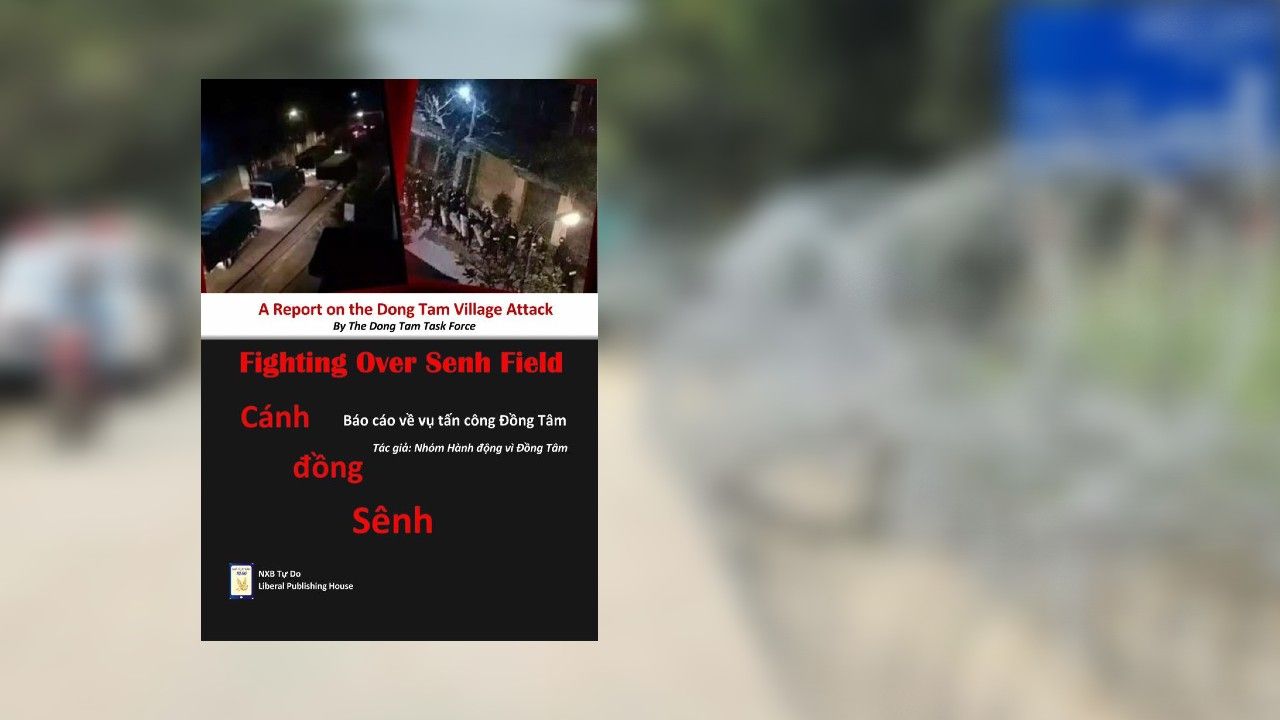
The protracted dispute over the land between Dong Tam villagers and the government simmered over the last few decades, and a group of activists compiled a report and published it here.
There were four people killed when the police bursted into the village, including Le Dinh Kinh, the 85-year-old village’s leader.
The trial will expectedly last for ten days. We will continue to update it in our [News] section throughout.
The Report on Religious Freedom in Vietnam is published each month. If you would like to contribute information to the report, please send it to tongiao@luatkhoa.org or editor@thevietnamese.org.
In the [The Government Hand] and [On This Day] we explore why religions are not able to grow in the face of strict government discriminatory policies regarding land rights. In the section [Religion 360°] read about how the government continues to harass Falun Gong proselytizers, about four religious rights activists in the Central Highlands who were interrogated and other monthly news. The [Did You Know?] section may surprise you with the news that there are four religions that have suffered as much as a 90 percent loss of followers.
The Government’s Hand
Land Rights Disputes and Discriminatory Governmental Policies to control the growth and development of religious organizations
For more than 45 years after the fall of Saigon, religious organizations continued to demand that the government return their lands and real properties which the authorities had “confiscated or borrowed”. A few of these real properties were turned into restaurants or hotels, while some others had been turned into hospitals and government buildings during the last four decades.
The long wait to for the return of land and real properties that the government “borrowed”
On July 18, 2020, Thien An Monastery submitted a petition to the People’s Commission of Thua Thien – Hue Province and the Tien Phong Forestry Company to demand the return of St. Mary’s School, which the government had “borrowed” (in reality, it was a forced extortion) in 1976. Tien Phong Forestry Company is owned by the People’s Commission of Thua Thien – Hue Province.
From the allegations in the above-referenced petition, the government transferred the right to use St. Mary’s School and its related real property and land in close proximity to Tien Phong Forestry Company. Thien An Monastery alleged that the Tien Phong Forestry Company had sold or given these real properties to people and businesses to build personal villas and restaurants.
Petition dated July 18, 2020. Photo courtesy: Thien An Monastery
After 1975, the new regime interfered with the land rights of religious organizations in the south of Vietnam. The government extorted the lands of “unrecognized” religious organizations such as Hoa Hao Buddhism, Cao Dai, and the Baha’i Faith. For the “recognized” and larger religions, such as Catholicism and Buddhism, the government “borrowed” real properties and land from them.
Until the 2000’s, land disputes between the Catholic Church and the Vietnamese government continued to be tense as the regime began to permanently transform the land and real properties it had taken from religious organizations into development projects for both private enterprises and government businesses.
At the end of 2008, the government issued Decision 1940/CT-TTg to direct local authorities to review the lands and real properties which used to belong to religious organizations that the government confiscated or borrowed since 1975. In that decision, the government advised the local authorities to reassess how the lands and real properties that belonged to the religious organizations had been used so that they could decide if they would continue their use, return them to the organizations, or give the organizations other real properties to replace the ones that had been taken.
The details of how Decision 1940/CT-TTg was carried out in reality were not widely publicized. But we have found a report from the Government Committee for Religious Affairs in 2011 that summarized the results of over 2 years in compliance with Decision 1940/CT-TTg. The government stated that 7,102 religious structures in 33 provinces received the right to use land.
However, in 2015, Vietnam’s Ministry of Construction disclosed that the petitions and litigations regarding land rights involving buildings and real properties of religious organizations continued to increase and had become more complicated. These buildings and real properties all belonged to the category in which the Vietnamese government had borrowed or confiscated them.
Following the national election in 2016, it is almost certain that the government stopped discussing this decision in Vietnam.
At present, the land dispute between religious organizations and the government is mostly focused on the large and organized religions that have sufficient power to stand up to the government, such as the Catholic Church and the Protestant.
The other religions, such as the Buddhist Sangha of Vietnam, Hoa Hao Buddhism, Baha’i, Cao Dai, etc., seem to have accepted the government’s arrangement, or else do not actively make public the land rights problem between them and the government.
Religious organizations face danger when their lands and real properties are located in high-price areas that are part of the government’s planning scheme
During the history of religious development in Vietnam, many of the real properties belonging to religious organizations were located in the highest priced lands around the country. Furthermore, with the fast economic development in Vietnam, many provincial governments have developed planning schemes for their cities which include lands belonging to religious organizations.
In 2015, the Redemptorist Church of Nha Trang strongly protested the decision of the government to lease an abbey located in one of the highest priced lands in the city. The government confiscated this abbey from the Redemptorists Church of Nha Trang in 1978. The church petitioned many times for the return of the abbey in 1996, 2006, and 2008, but these demands yielded no results. At present,, the government has leased this abbey to a private enterprise until 2062 for the construction of a commercial building and a hotel.
In the picture above, the abbey belonging to the Redemptorist Church of Nha Trang was confiscated by the government in 1978 (Smaller inset photo courtesy of the 459 Signal Battalion) and later became the Hai Yen Hotel. In 2015, the government continued to lease this land to build a commercial building and 40-story hotel. (Larger photo courtesy of Beau Rivage Nha Trang).
On the location beside the Saigon River next to District One – the financial center and the local government’s headquarters of Ho Chi Minh City – the government has been trying to gradually reduce the land and real properties once belonging to the Thu Thiem Congregation of the Holy Cross Lovers.
According to a RFA report, after 1975, the new regime “borrowed” a few schools operated by the Thu Thiem Congregation to build new public schools. In 2016, the government ordered the closure and abandonment of a cemetery belonging to the congregation. In 2018, the Ho Chi Minh City government ordered the relocation of the Thu Thiem Church to build new roads along the riverside. However, because of public outrage over that decision, one year later, the government agreed to not relocate the church, but that other real properties belonging to the church would be closed to accommodate the road building project.
The Carmelite Church in Hanoi also faced the same dispute with the government as the Thu Thiem Congregation, but was a lot less fortunate. From 2012 to 2016, the government started to demolish churches and monasteries that belonged to the Carmelite Church located at 72 Nguyen Thai Hoc Street, Hanoi, to build a new section of Saint Paul’s (Xanh Pôn) Hospital. The government has since completely demolished the churches and the monasteries of the Carmelite Church.
According to the Archdiocese of Hanoi, it had never authorized the transfer or donating of these lands and real properties to the government. In addition, the government is currently using four other locations belonging to the Archdiocese to run a hospital. The Archdiocese of Hanoi stated that the church and monastery of the Carmelite Church should not be demolished.
Land policies especially designed for religious organizations
Religious organizations in Vietnam suffered tremendous losses when their lands and real properties were confiscated by the regime after 1975. More than that, the land policies during the last decades greatly hampered the ability of religions to grow and develop.
The government has established and maintained land policies designed to discriminate against religious groups.
In Vietnam, while the land theoretically belongs to all of the people, in reality, entrepreneurs and individual citizens can buy and sell land as the law allows people to “transfer and receive land usage rights.” However, religious organizations are not allowed to practice this right because they have to follow rules and regulations that only apply to religious groups.
Vietnam’s current Land Law 2013 specifies that religious organizations may only have land when the provincial government allows them to do so. Religious organizations recognized by the government have to petition provincial governments when they want to expand their real properties and land. The provincial government will decide whether to approve a petition or not. If people want to donate land to a religious organization, then the government will need to approve the request by a religious group to receive such land. The government then will receive the title of the lands and transfer it to the religious organization.
This policy has in fact limited the expansion of religious groups in Vietnam. Even when religious organizations gather enough money, they cannot freely buy land to expand their operations without government approval.
In 2014, the Baha’i Faith petitioned the government and requested that their lands and real properties that were confiscated after 1975 be returned to them. The Vietnamese government recognized the Baha’i Faith as a religion in 2008, but up until 2014, it still could not operate because it did not have any locations to build structures for their religion. As a result, six years after the religion was officially recognized by the government, the Baha’i Faith still has not received any of its former land or real properties to practice their faith. Compared to before 1975 when the group owned hundreds of locations to practice their religion, nowadays, the Baha’i Faith only has two locations. One is in Ho Chi Minh City and the other is in Danang.
Another issue with the government’s land policy is that these religious organizations have often gotten into trouble with the government.
One example is a case that happened in June 2020 in Ninh Binh Province. After receiving land from 12 individual households who wanted to donate them to the Dong Dinh Parish, the provincial government did not give the land to the parish. Instead, it announced that it will use the land between the parish and the 12 lots that these individuals wanted to donate to build a river-bank dike.
Dong Dinh Parish stated that the white curve in the photograph marks the donated land on which the government announced it would build a dike. Photo courtesy: Dong Dinh Parish.
The government often announced that it had provided sufficient assistance to religious organizations to obtain lands because it did not charge any administrative fee for land rights transfers. However, in reality, this land policy has prevented the development of religions in Vietnam. Religious organizations cannot develop and expand if they cannot freely engage in transferring land usage rights like any other individual or entity in Vietnam.
This land policy also created significant difficulty for religions that are not recognized by the government. It is illegal to practice religion on personal property in Vietnam. Therefore, religions like Hoa Hao Buddhism, CaoDaism, and the Unified Buddhist Sangha of Vietnam face the risk of being in conflict with the government.
Religion 360°
Police in Ha Tinh broke into the private practicing place of 28 Falun Gong proselytizers
According to Ha Tinh Newspaper, at 3 pm on July 18, 2020, the police of Cam Vinh Ward, Cam Xuyen District, Ha Tinh Province, reported that they had disbursed a gathering of 28 people who were practicing Falun Gong exercises at someone’s residence in that area.
A video of the incident recorded by the police showed 28 middle-aged people sitting together in front of a television, watching and practicing Falun Gong exercises.
Lieutenant Dang The Long, the head of the Cam Vinh Ward police, stated that the gathering of people to practice Falun Gong, which is not a religion recognized by the government, was unlawful and could disturb the peace in the area.
At present, Falun Gong practitioners often gather in public parks and on beaches to practice. So far, there have not been any reports that police were intervening in the practice of Falun Gong. However, the government does not allow people to gather in large groups in a private residence to practice Falun Gong.
From March to May 2020, the police of Ha Tinh Province fined at least five individuals for disseminating materials about Falun Gong.
Twenty-eight Falun Gong proselytizers in a home where the Ha Tinh Police conducted an investigation. (Top photo courtesy: Ha Tinh News). A group of Falun Gong practitioners practice at a beachside in Danang. (Bottom photo courtesy: Youtube/Nguyen Trong The).
An Announcer of Ha Tinh Radio and Broadcasting was temporarily suspended from his job for disseminating Falun Gong materials
On July 24, 2020, Nguoi Viet Daily News, citing information from social media, reported a disciplinary decision by Ha Tinh Radio and Broadcasting to discipline an announcer because he had disseminated Falun Gong materials.
According to the news report, the announcer disseminated information about Falun Gong on his social media account. This conduct was found to be a violation of his company’s “policies and internal regulations.” The order also stated that formal disciplinary action will be decided after the matter has been thoroughly investigated.
In June 2020, a principal of a high school in Quang Tri Province was disciplined after he gathered a group of people to practice Falun Gong at his house.
Four religious rights activists were investigated by the police after meeting with a group from America about the freedom of religion in Vietnam
Independent journalist Vo Ngoc Luc reported that on July 17, 2020, Pastor Nguyen Ngoc Khanh was interrogated by the police of Buon Me Thuot City, Dak Lak Province. The police stated that the interrogation was related to a “meeting with foreign individuals and organizations.” Prior to his interrogation, Pastor Nguyen Ngoc Khanh had met with a group from the United States to discuss freedom of religion.
Similarly, Mr. Y Kuan E Ban (often referred to as Ama Sim) was also interrogated by the police of Cuor Dang Ward, Cu M’gar District, Dak Lak Province. The local authorities came to his house during the night of July 15, 2020 and asked him to cooperate with them. The local government investigated him at his home and stated Y Kuan E Ban “had practiced Protestantism unlawfully” with 40 other people and asked him to go to the People’s Committee Office of the ward the next day. The next day, Y Kuan was interrogated by the local authorities about his meeting with the American group about freedom of religion.
On the left, the invitation to Pastor Nguyen Ngoc Khanh; on the right, the investigative report of Y Kuan E Ban. Photo courtesy: Vo Ngoc Luc
Another case was reported by Human Rights and Justice for Indigenous People of Vietnam. Specifically, the Cu Kuin District police invited Mr. Y Quy Bdap and Pastor Y Khen Bdap to their station on July 23, 2020 to discuss “how to work together to ensure public safety in that location.”
The invitations were sent by the police of Cu Kuin District to Pastor Y Khen Bdap and Y Quy Bdap on July 22, 2020. Photo courtesy: Human Rights and Justice for Indigenous People of Vietnam.
However, during the interrogation on the morning of July 23, 2020, both men were only asked about their meeting with the American group to discuss freedom of religion. The police accused them of participating in human rights work and alleged that they had made false statements about Vietnam. Both men reported that they were threatened and verbally abused by the police during the interrogation.
After the interrogation, the police requested that the two men continue to be interrogated in the afternoon, but they both refused citing health reasons. In the evening, after they failed to return to the police station, the police sent seven security police to their houses and forced them to go to the station. The family of Y Qui Bdap protested and prevented the police from forcing him to go.
Human rights activists and religious rights activists are often interrogated by the police after they meet with groups from foreign countries. The government uses this tactic to investigate the content of meetings and to also prevent activists from criticizing Vietnam when speaking with foreign officials.
Police in Gia Lai Province publicly criticize a Montagnard in a community meeting because he was found to be involved with De Ga Protestantism
According to the Gia Lai Police Department Newspaper, on July 4, 2020, the police of Ia Grai District, Gia Lai Province brought a Montagnard, Puih Hong, 40, to a public criticism session at Cham Village, Grand Ward.
Puih Hong at the public criticism session on July 4, 2020. Photo courtesy: Gia Lai Police
A public criticism session is a method that the police frequently use to intimidate people in the Central Highlands. The subject of the criticism session has to stand in front of his neighbors and admit to crimes he has been alleged to have committed.
At this public criticism session, Puih was accused of distributing information about De Ga Protestantism and it was alleged that he had “defamed the religion laws and the great unity of the government.” Puih was also accused of illegally escaping to Cambodia between June 2017 to May 2020 after which the Cambodian government deported him back to Vietnam.
The police of Dak Lak Province allege that the Montagnard Evangelical Church Of Christ is anti-government
On July 24, 2020, a report accused the Montagnard Evangelical Church of Christ of being anti-government and of mobilizing people to secede from Vietnam to form an autonomous region in the Central Highlands. This report was broadcasted on the Security Police Television under the Ministry of Public Security.
In this report, the Senior Lieutenant Colonel Truong Hong Quy, who is the head of the Domestic Security Police Bureau of the Dak Lak Province Police Department, stated that a few individuals had used religion to mobilize and propagandize the people to secede and become opposed to the Vietnamese government. In this specific case, the Montagnard Evangelical Church of Christ was cited.
Quy also said that the Montagnard Evangelical Church of Christ received financial resources from overseas to mobilize people to be anti-government.
Colonel Nguyen The Luc, the deputy director of the Dak Lak Province Police Department, also stated that the group had used religion to engage in anti-government conduct and that it now used the Montagnard Evangelical Church of Christ. According to the police, before that, practicing De Ga Protestantism was used to mobilize people.
This report also alleged that members of the Montagnard Evangelical Church of Christ were former members of FULRO, that they had participated in anti-government protests and were being imprisoned at re-education camps. The arrested included Y Jol Bkrong, Ksor Sun, Y Kou Bya, Y Nia Ayun, Y Nuen Ayun, and Y Nguyet Bkrong.
Throughout this report, one can see that the Dak Lak Province Police Department has a firm belief about the character of the Montagnard Evangelical Church of Christ and that the department will try its best to dissolve the religious group.
The Administrative Council of Hoa Hao Buddhism prevented from entering a religious location to conduct rituals
The Administrative Council of Hoa Hao Buddhism announced that it was prevented from entering its temporary religious site in Long Giang Ward, Cho Moi District, An Giang Province from July 6-8, 2020.
On the evening of July 8, 2020, the Administrative Council was allowed to enter the site to perform rituals to commemorate the day Founder – Master Huynh Phu So – established Hoa Hao as a religion.
In previous years, during big celebrations to commemorate certain events and anniversaries of Hoa Hao Buddhism, its followers faced harassment and were prevented by the government from practicing their beliefs. The security police often set up posts to control followers going to their religious sites.
On This Day
The demolition and forced evacuation of real properties and lands of religious organizations in Thu Thiem
According to Tuoi Tre News, as of July 2016, 22 religious sites were willing to relocate from their current locations to new places. These 22 religious sites were originally located in the area that had been assigned for the construction of the new urban compound at Thu Thiem, District Two, Ho Chi Minh City.
The article strongly emphasized that these religious organizations agreed to transfer their lands to the government and to be moved to other locations. However, it also targeted the Lien Tri Temple and spread news that the temple was not willing to relocate like others. However, Lien Tri Temple belongs to the Unified Buddhist Sangha of Vietnam, which was organized and founded before 1975, and it is not recognized as a religion by the current government.
Thich Khong Tanh, the abbot of the Lien Tri Temple at the time, stated that other religious organizations were willing to relocate because they received compensation and were given lands with higher prices. At the same time, the Lien Tri Temple did not receive similar equal treatment.
The government announced that it would demolish the temple in July 2016. On September 8, 2016, when it could not reach an agreement regarding the compensation with Lien Tri Temple, the government sent its forces to occupy and demolish the structure.
The monks who used to live at Lien Tri Temple disbursed themselves and were allowed to live in other temples; the government has yet to compensate them.
Thich Khong Tanh, abbot of Lien Tri Temple, sits on the grounds of the collapsed temple after the government forced its demolition. Photo courtesy: Quang Duc
Did You Know?
The followers of four religions decreased by more than 90 percent
The national census of 2019 showed that a lot of religions suffered significant decreases in the numbers of their followers, including four religions which saw a decline of more than 90 percent.
Three of the religions, which include Ta Lon Dutiful and Loyal Buddhism, Vietnam Pure Land Buddhist Association, and Southern Buddhism Minh Su Faith, suffered more than a 90 percent decrease in the number of their followers in the past decade. The Baha’i Faith also suffered a loss of 90 percent of its followers since 1975.
In a report published in 2017 by the Government Committee for Religious Affairs, it was reported that Ta Lon Dutiful and Loyal Buddhism had 6,500 followers. But only after two years, the Census of 2019 showed that the number of followers had fallen to just 401. Ta Lon Dutiful and Loyal Buddhism was founded in 1915 in Kien Giang Province with beliefs in Buddhism and Confucianism.
Among the Buddhist sects in Vietnam, the Vietnam Pure Land Buddhist Association was viewed as the sect that had the most followers. The Government Committee for Religious Affairs reported that it had about 1.5 million followers and 350,000 members in 2010. Nevertheless, in 2019, the number of followers of this sect had decreased to 2,306 followers.
The Census of 2019 also reported that the Southern Buddhism Minh Su Faith only had 260 followers. In 2010, the Government Committee for Religious Affairs reported that the group had 11,224 followers.
The Baha’i Faith has waited 33 years for the government to recognize it as an official religion which happened in 2008. In 2010, it had about 7,200 followers. At present, the current number of followers of the Baha’i Faith is about 2,153, a 90 percent decline compared to the 200,000 followers it had before 1975.
Furthermore, seven other religions suffered a loss of 50-80 percent in the number of their followers. Those religions include Caodaism, Tu An Hieu Nghia, Giao hoi Co Doc Phuc Lam, and Hoa Hao Buddhism. A few other religions also suffered a loss in followers during the last decade, including Buu Son Ky Huong, and Hoi thanh Minh Ly Dao – Tam Tong Mieu.
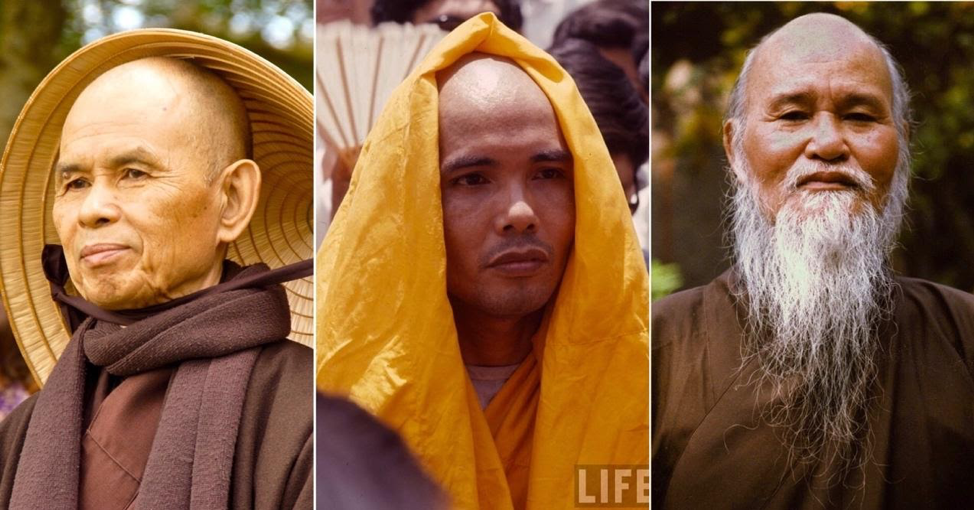
Long ago, there lived three monks: Thich Nhat Hanh, Thich Tri Quang, and Thich Quang Do. All three were well-versed in the Buddhist Dharma. Nhat Hanh spoke eloquently and wrote well. Tri Quang had talent for leadership and was trusted by the masses. Quang Dao was well-studied and excelled in foreign languages.
Long ago, there lived three monks.
When Ngo Dinh Diem’s regime cracked down on Buddhism, these three combined forces to fight back. Nhat Hanh campaigned overseas, calling for peace and religious freedom in Vietnam. Tri Quang led tens of thousands of monks and Buddhist adherents as they protested in Saigon. And Quang Do, the youngest of the trio, stood side-by-side with these Buddhists as they marched on the streets.
Long ago, there lived three monks.
When the communists arrived, the paths of these three diverged. Nhat Hanh became world-famous with his Plum Village Monastery. Tri Quang was imprisoned and refrained from speaking about politics again. Quang Do continued the struggle for religious freedom and human rights, ultimately serving the longest period of house arrest of any monk in Vietnam.
1997
One day in October of 1997, in a theater in Berkeley, California, approximately 3,500 people, who paid US$20 a ticket to meet their most beloved monk, sat in silence.
A ringing bell echoed across the theater, and a monk’s voice loudly called out: “All rise!”. Zen Master Nhat Hanh, draped in a deep brown robe, lead 35 monks and nuns as they slowly spread out across the stage.
Many in the audience clasped their hands before their chests and directed their eyes towards the stage. Sitting on a high podium next to a large, bronze bell and an arrangement of giant sunflowers, Zen Master Nhat Hanh began expounding on mindfulness. “Learn how to stop running,” he advised his audience. “Many of us have been running all our lives.”
“Society is very individualistic, selfish, with people thinking about himself or herself alone. Each for himself, each for herself alone. But in fact even if you have the desire, the intention, to help others, it would still be difficult for you to do so, because when you are not in peace with yourself, it’s very difficult to relate to people in a peaceful way in order to help them,” he stated to reporter Don Lattin of the San Francisco Chronicle.
By that point, Zen Master Nhat Hanh had become internationally renowned for this talks on mindfulness and world peace. After 1975, he stopped speaking to the international media about human rights in Vietnam, even though Buddhism there was suffering through hardship.
At the same time, in a prison cell thousands of miles away from America, Venerable Quang Do was compiling a Buddhist dictionary. He was sentenced to five years in prison in 1995 for helping flood victims in the Mekong Delta. Ten years before that, he witnessed his mother pass away in hunger and poverty after the government exiled both to Thai Binh.
In 1997, Venerable Tri Quang grew accustomed to his comfortable life. He no longer spoke about politics or peaceful resistance.
After 1975, he was confined to a wheelchair to heal his feet, which had atrophied after government torture, according to a monk who was imprisoned with him at the time. From the 1980s onwards, the international media stopped mentioning him and the tragedies of Buddhism in the south.
Childhood in chaos
Born during the tumult of French and Japanese fighting over control of the country, the three monks were all witness to the historical crises of that era.
One day in Diem Dien Village, Quang Binh Province, the mother of Tri Quang met two monks who left a deep impression on her, he relayed in his autobiography. Upon returning home, she told her husband that the family should have someone join the monastery, as the two monks had. Thus, on the eve of the lunar new year in 1938, Tri Quang shaved his head and entered the monastery at Pho Minh Pagoda; he was only 15 years old. The next year, he was transferred to Hue to study for another six years. When he was put in charge of the Quang Binh Province Buddhist Committee for National Salvation (seen as a part of the Viet Minh Front), he saw many of his classmates sacrifice their lives in the resistance war against the French.
Zen Master Thich Nhat Hanh, in Hue, when he was 16 years old. Source: Plum Village.
In Hue, Nhat Hanh grew up the son of a man who worked for Emperor Bao Dai’s government. Nhat Hanh stated the seed of the Great Buddha blossomed within him from when he was very young. Responding to reporter Don Lattin about his childhood, he stated that while he was studying at the village school, he and his friends would go door-to-door begging for bowls of rice to give to those dying of hunger. He relayed that the kids had to decide early on who would get to eat and who wouldn’t because there simply wasn’t enough rice to go around. In 1942, Zen Master Nhat Hanh left his family and entered the monastery at Tu Hieu Temple in Hue. He was only 16.
In the same year, a 15-year old teenager in Thai Binh traveled to Ha Dong province (today’s Hanoi) to enter the monastery at Thanh Lam Temple. He took on the Buddhist name Quang Do. He recalled, only three years after he left his family, he witnessed his master tied up and brought out to the village courtyard like a criminal, after the Viet Minh suspected him of being a traitor. His master was then denounced and executed by three bullet rounds. It was then the young 18-year old swore to himself that he would use Buddhism’s mercy, forgiveness, and non-violence to fight against fanatics and the unforgiving.
A united sense of purpose
After the tragedy at Thanh Lam Temple, Thich Quang Do went to study in Hanoi. During this time, Tri Quang and Nhat Hanh likely met one another in Hue.
At the time, the Bao Quoc Buddhist Institute had just been established in Hue in 1947. A year later, Tri Quang became a teacher there, and Nhat Hanh a student.
In 1950, Tri Quang went to Saigon for the first time, concurrent with Nhat Hanh. In Saigon, Tri Quang, along with some other monks, unified three Buddhist institutes into one, locating it at An Quang Temple. Nhat Hanh began teaching here.
Both Nhat Hanh and Tri Quang had a common desire to unify Buddhism and develop it into a national religion [1]. Both pursued this desire through journalism.
After the Geneva Accords were signed in 1954 and the country was temporarily divided in two, Tri Quang became the editor-in-chief of the Vien Am paper. A year later, Nhat Hanh was made editor-in-chief of Vietnamese Buddhism, but after two years, he was forced to suspend the paper after pushing for Buddhist unification too vociferously.
During this time period, both individuals suffered enormous mental anguish. Nhat Hanh was completely “defanged” in his struggle and afterward temporarily withdrew from the limelight, retreating to a solitary location with allies in Lam Dong. Tri Quang, haunted by images of his mother being publicly denounced in 1956, wandered to Nha Trang before returning to Hue in 1960. Buddhism’s suppression (by Ngo Dinh Diem’s government) would add an extra layer of pressure on top of his mother’s tragedy.
In 1958, Quang Do returned to Saigon after studying abroad in Sri Lanka and India. Under Ngo Dinh Diem’s religiously discriminatory regime, and the conflict brewing between the Nationalists and the Communists hanging over their heads, young Nhat Hanh and Quang Do were not able to accomplish much in the way of big tasks. But it seems all three were able to sense impending disaster for Buddhism in the south.
In his book Intention’s Road Home, Zen Master Thich Nhat Hanh explained that in 1961, when he and his friends’ place of residence was raided, he had to retreat to Saigon for safety. During this difficult time period, he traveled to the United States, where he conducted research on Buddhism at Princeton University and then taught at Columbia University.
Pictures of Zen Master Thich Nhat Hanh, Venerable Thich Tri Quang, and Venerable Thich Quang Do, taken in 1960. Source: PVCEB, AP, and Vietnamese Buddhists.
Days of struggle
On the night of May 8, 1963, as Venerable Tri Quang, head of central Vietnam’s Buddhist Association, stepped into Hue’s radio station together with the provincial leader to resolve ongoing protests as gunfire rang out among the Buddhist crowds surrounding the station. That night, Hue Radio did not broadcast as promised the program celebrating Vesak, recorded earlier that morning. Compounding popular anger was the fact that the government had prevented the flying of Buddhist flags. The crowds did not disperse until two in the morning. That night, many were seriously injured, resulting in eight deaths.
In the gloom of the next morning, as Venerable Tri Quang was resting, roiling crowds of young people began filling the streets, holding Buddhist flags. That same day, Buddhists in Saigon decided to establish the Inter-party Committee to Protest Buddhism (abbreviated as the “Inter-party”), confirming a drawn-out struggle. Venerable Tri Quang sat on the Advisory Board, while Venerable Quang Do worked as assistant to the public relations committee of the Inter-party.
The objective of the Inter-party was to get the government to respond to five demands: withdraw the decree banning the flying of Buddhist flags, put Buddhism on equal footing with Catholicism, end the suppression of Buddhist followers, grant Buddhist monks and nuns the freedom to proselytize, and compensate for the deaths caused (during the crisis) and punish those responsible.
In the two days following the incident at the Hue radio station, Buddhists protested spontaneously, but thereafter, they gained a sense of order and organization with Venerable Tri Quang’s direction, the monk recounted in an autobiographical short story. He also found ways for Buddhists to come to Tu Dam Temple to pray each week for those who had passed away. In Saigon, monks organized spiritual processions from one temple to the next, as well as protests and hunger strikes.
The government only ramped up its repression; many temples in Hue were blockaded, and monks and nuns were publicly attacked. It wasn’t until Venerable Thich Quang Duc, 73, immolated himself on June 11th, 1963 that the situation improved in any meaningful way. Tri Quang traveled from Hue to Saigon to enter into discussions with the government.
In the weeks and months that followed Venerable Quang Duc’s self-immolation, the Inter-party signed a joint communiqué with the government responding to Buddhism’s five demands. However, the government never implemented the communiqué, greatly angering monks, nuns, and the general population.
According to Thich Nhat Hanh, at the time he was in America campaigning for religious freedom and a cessation of war in his own homeland. He appeared on television, met journalists, translated materials detailing the human rights violations in Vietnam, and pushed international organizations, including the United Nations, to intervene in the increasingly volatile situation in South Vietnam.
As Thich Tri Quang relayed in his autobiography, on the morning of July 17, 1963, Venerable Quang Do was unable to deliver translated international press updates to Xa Loi Pagoda. That day, countless Buddhists poured into Giac Minh Temple, where the monks were on a hunger strike. These crowds quickly morphed into an enormous protest. As the Buddhist adherents tried to approach Giac Minh Temple, they were blocked by police. Venerable Quang Do was among them, directing the protests to struggle not only against the police barricade but for Buddhism itself. In his book History of the Vietnamese Buddhist Struggle, Monk Tue Giac writes that after 10 am that morning, the protests had devolved into a fighting match with police. Venerable Quang Do suffered a head injury, blood pouring down his face. Any Buddhist who had not been arrested by police returned to Giac Minh Temple, resisting as barbed wire fencing kept more than 600 monks, nuns, and adherents barricaded for 54 hours.
Thich Quang Do (circled) directs a protest on the streets of Saigon, July 17h 1963. Source: HORST FAAS/AFP.
By August 20, 1963, Ngo Dinh Diem’s government was determined to restore order. A day after martial law was imposed, monks were arrested and adherents attacked. Venerable Quang Do was apprehended. Venerable Tri Quang went to the American Embassy to apply for amnesty.
From that point until President Ngo Dinh Diem’s assassination on November 2, 1963, the struggle raged between Buddhists, the Army, and international pressure.
In December 1963, after the struggle had succeeded, Venerable Tri Quang along with other monks established the Unified Buddhist Church, Venerable Quang Do went overseas for medical treatment, and Venerable Nhat Hanh returned to Saigon.
While Venerable Tri Quang mobilized Buddhist adherents, monks, and nuns to continue the political struggle, Nhat Hanh was able to fulfill his wish of establishing several campuses, including the La Boi Publishing House, Van Hanh University, the Youth School for Social Services, and the Tiep Hien Congregation (a congregation centered on the full integration of Buddhism into daily life).
Thich Tri Quang walks among South Vietnamese soldiers in Danang, January 1965. Source: Christian Simonpietri/Sygma/CORBIS.
In May 1966, Thich Nhat Hanh headed to the US to campaign for an end to the war in Vietnam. After three months, the South Vietnamese government refused to let him return home. At the time, Thich Nhat Hanh began becoming world-renowned as the face for peace in Vietnam. The next year, Reverend Martin Luther King nominated him for the Nobel Peace Prize.
Thich Nhat Hanh on his way to the United States to campaign for the end of war in Vietnam. His trip was originally planned to span three months, but after he left, the South Vietnamese government refused to let him return home again. Source: PVCEB.
A road diverged three ways
At the beginning of 2005, as the people proudly and warmly greeted his arrival, Zen Master Nhat Hanh was finally able to return home after more than 40 years away, accompanied by a Sangha of approximately 200 adherents. He conducted talks with audiences that included party members in Ho Chi Minh City, Hue, and Hanoi.
Meanwhile, Venerable Quang Do lived in solitary confinement, locked in a room at Thanh Minh Zen Monastery in Ho Chi Minh City. Across the street were police whose only job was to keep an eye on him day and night.
During his trip, Zen Master Nhat was able to visit Venerable Tri Quang but not Venerable Quang Do.
In the eyes of the Vietnamese media, Zen Master Nhat Hanh was someone to be immensely proud of, he was “flesh and blood” who had returned to his homeland to further contribute to the people’s well being. Venerable Quang Do, on the other hand, was a boil that the government tried every means to remove. But back then, both monks were cut from the same cloth, up until the day Saigon fell.
After 1975, as Zen Master Nhat Hanh set up his Plum Village Monastery in France, Venerable Tri Quang was imprisoned for a year and a half in a hole the size of a coffin, which he was only allowed to leave for 15 minutes each day to wash up. From then on, people no longer saw him calling for protests or making demands for Buddhism; the international media was never able to make direct contact with him again for as long as he lived.
After the war, Venerable Quang Do along with a number of other monks fought for those who had self-immolated in the name of religious freedom and in protest of the new regime’s intention to eliminate the Unified Buddhist Church of Vietnam. In a country with no international media, no independent courts, and no freedom of association, these efforts would be in vain, the number of immolated corpses perhaps outnumbering that of the old regime. He was never able to reach a compromise with the government, up until the day he died.
Long ago, there lived three monks: Nhat Hanh, Tri Quang, and Quang Do. When the communists arrived, the lives of these three diverged completely.
Correction (April 12, 2020): in a version of this article, we had written that Zen Master Thich Nhat Hanh had entered the monastery at Tu Dam Temple. We wish to correct this to Tu Hieu Temple, in Hue.
Footnote: [1] See numbers 2 to 28 in Buddhism Magazine, and Intention’s Road Home (Zen Master Thich Nhat Hanh).
References:
Autobiographical Short Stories (Original: Tiểu truyện tự ghi), Venerable Thich Tri Quang.
Autobiography of Tri Quang (Original: Trí Quang Tự Truyện), Venerable Thich Tri Quang.
Intention’s Road Home (Original: Nẻo về của ý), Zen Master Thich Nhat Hanh, translated by Chan Dat
Followers return home from the jungle, land disputes, Vietnam objects to US report.
Many religion-related events transpired in June 2020, including a dispute between an independent Cao Dai temple and registered Cao Dai followers, and a land dispute between a Catholic parish and a Buddhist abbey and local authorities, all covered along with other news in [Religion 360°]. Find out how independent Cao Dai temples have been bullied in past years in [Did you know?].
We welcome your suggestions and collaboration on reports. Email us at tongiao@luatkhoa.org or editor@thevietnamese.org.
[Religion 360°]
Three ethnic Bana arrested, but not prosecuted, for following the Ha Mon religion, after nine years of hiding in the jungle.
Three ethnic Bana: Ju, 56, Lup, 50; and Kunh, 32, were arrested on March 19, 2020, after nine years of hiding in the jungle. Authorities allowed them to return home and did not press any charges against them.
From left: Kunh (second), Ju (third), and Lup (fifth). Photo: TTXVN.
All three were allowed to return home to “draw from experience and educate themselves before the people” in their home villages on June 3, 2020. This method is commonly used to deter residents in areas that the authorities deem susceptible to religion.
State journalists published a flurry of articles describing the Vietnamese state’s lenient policy towards those who repent after joining religious groups not approved by the government.
According to the above reports, the three were not involved in any anti-state activities or foreign organizations, but had hid in the jungle for nine consecutive years because they feared punishment from the authorities for following the Ha Mon religion.
Independent religious practitioners in the Central Highlands often abscond to the jungle to avoid being hunted down by police. Many then proceed to contact relatives while in hiding to bring them over to Thailand or Cambodia as refugees. Services transporting people across borders are commonplace among independent religious practitioners in the Central Highlands.
Vietnamese journalists mobilized to oppose 2019 international report on religion authored by the United States
On June 11, 2020, many newspapers in Vietnam published articles related to a 2019 international report on religion authored by the United States.
The articles could be divided into two categories. The first simply conveyed the Foreign Ministry’s opposition. The second asserted the American report was inaccurate and distorted the religious situation in Vietnam.
Nation and Development, an extension of the National Committee – Forum of Compatriots for Vietnam’s Ethnic Groups, said the report was slander and contained false information regarding the religious situation in Vietnam. The paper stated that these kinds of reports serve to help “hostile forces” overthrow the state.
The Times, a publication of the People’s Daily, stated that the United States “lacked logic” by putting out this report instead of focusing on the COVID-19 pandemic raging across the country and the “equally negative turmoil regarding African-American George Floyd”.
The article in The Times also asserted that the American report was unable to differentiate between “those who genuinely practiced their faith or religion and those who used faith or religion to propagate superstitions and anti-government sentiments”.
An independent Cao Dai temple in Phu Yen Province falls victim to bullying
According to RFA, on the morning of June 18, 2020, independent followers of Hieu Xuong Temple in Tuy Hoa City, Phu Yen Province, attempted to protect the institution from their state-registered counterparts, who planned to seize the building.
A dispute at Hieu Xuong Temple on June 18, 2020. Photo: Công Danhboy’s Facebook account.
The independent Cao Dai followers told RFA that approximately 60 registered followers came with police to their temple, which was built in 1964.
RFA quoted Hieu Xuong Temple overseer Nguyen Ha as stating that the registered followers brought an administrative order to confiscate the temple.
Hieu Xuong Temple followers closed the gates to prevent the confiscation until 11 am that day, when the registered group dispersed.
Overseer Cao Van Minh, who is currently managing the temple, told RFA that he simply wanted the institution to be able to practice independently.
Hieu Xuong Temple is among a number of temples that remained independent after 1975, refusing to join the state-sanctioned Cao Dai bloc. These independent temples regularly face harassment from the authorities and the state-sanctioned Cao Dai bloc. Currently, there are no statistics on the number of independent Cao Dai temples operating.
High school principal stripped of all party positions after practicing Falun Gong with others at his home
At the end of June 2020, Vietnamese journalists reported on Tran Huu Duc, a 41-year-old principal of a school in Quang Tri Province, due to his affiliation with the Falun Gong.
Tran Huu Duc. Photo: Cua Tung High School.
According to Traffic Newspaper, Quang Tri provincial police reported him to the Vinh Linh suburban district committee after discovering that he was propagating and practicing Falun Gong with others at his home.
Afterward, the suburban district standing committee requested that he cease congregating people in his home and stop distributing Falun Gong materials.
On May 15, 2020, Duc tore up the forms he had completed with the Vinh Linh suburban district committee. Shortly after, Duc also returned to them the form for party members who showed signs of infringement. After Duc’s defiant acts, the suburban district committee decided to strip him of all party positions in the 2020-2025 term, and also suggested that the Office of Education and Training discipline him.
In March 2020, the Government Committee For Religious Affairs announced that all localities should be on strict guard for those who might try to take advantage of the COVID-19 pandemic to conduct illegal religious proselytizing. As of May 2020, local police had arrested at least 23 people for spreading Falun Gong.
State newspapers warn against the activities of two unregistered sects
At the start of June 2020, Voice of Vietnam’s news page reported there were currently many Protestant sects illegally operating in Vietnam.
The article focused on two sects with South Korean origins, the Shincheonji Church of Jesus and the World Mission Society Church of God. It reported that these two religious organizations were operating surreptitiously, disrupting social order in Vietnam, and destroying familial and societal traditions.
The article also warned residents not to participate in the activities of these two sects.
Nguyễn Hồng Phong, vice director of the Internal Security Bureau (Ministry of Public Security) stated that Vietnam currently had approximately 70 unregistered Protestant organizations, with around 200,000 followers.
Land dispute between Dong Dinh Parish and Ninh Binh provincial authorities
At the end of May and beginning of June 2020, the members of Dong Dinh Parish, in Nho Quan suburban district, Ninh Binh Province, stated that they had been deceived by local and provincial authorities, who had taken their land but not returned it as agreed.
According to information from Dong Dinh Parish, at the beginning of 2019, the parish had a back-and-forth with local authorities about the need to expand parish land.
In April 2019, 12 households with land bordering the parish agreed to donate 4.5 hectares of agricultural land and merge it with the church.
The large piece of land outlined in red is the 4,569 square meter piece of land that the 12 households donated to the Dong Dinh Parish in order to expand the church land outlined in orange. Photo: Dong Dinh Parish.
On May 22, Dong Dinh Parish submitted an application to expand its parish to include the land that the 12 households had donated to the Ninh Binh Province People’s Committee, the Nho Quan Suburban District People’s Committee, and the Huu Thuong Commune People’s Committee.
In September, representatives of the Nho Quan Religious Front guided the 12 houses in filling out the application to return the land to the government so that provincial authorities could then confer the land back to Dong Dinh Parish.
On May 28, 2020, Huu Thuong commune authorities allowed workers onto the land that the 12 households donated to conduct measurements and announce the construction of a dyke between current parish land and the donated land to prevent flooding.
The red line indicates the position of the dyke commune authorities planned to build to prevent flooding. Photo: Dong Dinh Parish.
On May 29, parishioners decided to cordon off the donated land with wire mesh, placing seven holy statues in different places to prevent trespassing.
Afterwards, the government, Dong Dinh Parish, and parishioners had a dialogue but were unable to reach an agreement.
Unknown persons trespass upon Thien An Monastery’s forests
On June 12, 2020, Thien An Monastery announced that individuals had trespassed upon the monastery’s pine forests to cut down trees.
Bamboo groves on monastery land were surreptitiously chopped down. Photo: Thien An Monastery.
The abbots were able to prevent the would-be choppers but do not know who organized the action. Many older-aged trees within a one-square-hectare space were cut into but not felled, so that they would die slowly of natural causes.
A pine tree which the abbey estimated to be more than 60 years old was deeply sawed into, ensuring its death. Photo: Thien An Monastery.
Thien An Monastery was officially constructed in 1943 on land which today includes approximately 107 hectares of land, homes, and pine forests owned by the monastery. It is located in Thuy Bang Commune, Huong Thuy Suburban District, Thua Thien–Hue Province.
In the past 20 years, Thien An Monastery and Thua Thien–Hue provincial authorities have butted heads over how to use the monastery’s land. Events such as forest burnings, trespassings, and authorities harassing abbots have occurred repeatedly in past years.
Independent Cao Dai temples continue to be bullied over the years
For many decades, independent Cao Dai temples have operated under duress, unsure of when their temple would be repossessed by “state-sanctioned Cao Dai”.
The Cao Dai religion has been recognized by the state since 1997. At that time, a new sect called Sect 1997, or “state-sanctioned Cao Dai,” was established to control the religion, a move which independent Cao Dai followers inside and outside the country have criticized.
The incident at Hieu Xuong Temple above is but one of many conflicts that have occurred over the years as Sect 1997 and local cadres try to expropriate independent Cao Dai temples.
At the beginning of 2020, as an independent Cao Dai temple in Ben Tre Province was carrying out its normal rituals, local cadres and authorities came to “conduct work”. The independent adherents saw this as harassment and refused to cooperate.
In 2017, the independent adherents of Hoai Nhon Temple in Binh Dinh Province were harassed by the authorities as they were preparing to carry out a ritual. That same year, Dong Thap provincial authorities harassed independent followers in Tam Nong Suburban District and repossessed their temple to give to Sect 1997. The followers in Tam Nong were then convinced by the authorities to conform to Sect 1997.
In 2015, an independent Cao Dai family in Tay Ninh Province told RFA they were assaulted by a member of Sect 1997 when they organized a gathering at their home with other independent adherents. The family alerted the authorities, who did not intervene.
In 2012, according to RFA, independent Cao Dai followers of Phu My Temple in Binh Dinh Province were assaulted by “state-sanctioned” adherents, injuring six people. According to the independent followers, police were present but did not intervene.
Photo of the scuffle that broke out between followers of the Phu My Temple and “state-organized” followers in Binh Dinh Province on September 16, 2012. Photo: DVOV/BPSOS.
According to BPSOS, these disputes are part of plans by Sect 1997 to increase control over independent Cao Dai followers and push them to conform to the sect.
Currently, there are no accurate and updated statistics regarding the number of independent Cao Dai temples nor any news regarding the current dispute with Sect 1997. We hope to gather more information regarding the independent Cao Dai temples in the near future. Please send any information you have to tongiao@luatkhoa.org or editor@the vietnamese.org.
After nearly 100 days of zero new confirmed cases in the local community, within the last 10 days, there has been a jump in the number of patients contracting the virus in various cities in Vietnam.
According to official figures, in the six months from January 23 to July 25, there were only 140 local cases, the rest were imported patients, and zero fatalities. Since July 25, in a period of less than two weeks, more than 300 new local cases have been confirmed with 10 deaths so far.
Da Nang, the third largest city of the country, has become the new epicenter of the pandemic.
While this new surge seems to have caught the entire nation by surprise, in reality it is a scenario that was long written on the wall, with the pandemic having never really ceased to rock countries after it first appeared on the world stage in January 2020 (the first reported case outside of China). And though it has created a new scare among citizens, it is a positive and necessary alarm.
Empty street in Hoi An city in August 2020. Photo Courtesy: The Vietnamese
To the moon and back
More than three months without domestic positive cases had put the whole nation in a complacent mode. Even the health care staff at hospitals had lowered their guard. Most of the initial cases from July 25 were linked to patients and their caretaker relatives in Da Nang hospitals.
Since then, the virus has quickly spread throughout the community and to other cities.
Fortunately, it does not take long for the whole system to restart and quickly return to crisis mode. Da Nang was almost immediately put under partial lockdown, with thorough contact tracing being carried out for every new case. People who had been in close contact with new positive cases were put under quarantine. Medical teams and personnel from Hanoi and Ho Chi Minh were sent to the epicenter to help relieve the pressure and the wearing of face masks in public in big cities became mandatory again.
There is reason to be optimistic about the ability of the country to contain the new wave despite it having caught everyone off guard.
Local wet market in Hoi An City. Photo courtesy: The Vietnamese
Through the looking glass of Taiwan
With the initial success in containing Covid-19, there has been an ongoing debate among citizens on whether Vietnam’s authoritarian system is better equipped than other democratic societies to cope with a pandemic. However, focusing on governing systems might miss some critical points.
Comparing Vietnam with Taiwan, an exemplary success in the fight against this pandemic, may provide some useful insights.
At first glance, the two countries could not be more different. One is a communist state, the other one of the most vibrant democratic systems in the world. At closer look, Vietnam and Taiwan share some vital similarities in the fight against Covid-19.
They both are next to China, the origin of the pandemic. Both governments, and especially their people, have the same distrust of the Chinese Communist Party, hence the high alert mode from the very beginning, long before other countries took this infectious disease seriously. They also share painful experiences from the SARS pandemic in 2003, which also originated from China. With those scars still fresh in mind, going through this crisis is like bathing in the same river twice. They knew how and where to swim.
The culture and society also played an important role here.
Both countries are still dominated by Confucious-like ideals about the need for a harmonious society where collectivism trumps individualism. In the case of major crises like a pandemic, this kind of mindset helps glue the community together faster, quickly putting everyone into the same “for the common good” mode.
This particular pandemic, Covid-19, in which the elderly are the most vulnerable, also highlights one important aspect: how societies treat and value their aged populations.
In Vietnam, like Taiwan, most families have at least one senior member living under the same roof. Therefore, most people, even the younger generations, despite being in low-risk groups, still voluntarily took extra precautions to protect their family members.
Opportunities lie in the midst of every crisis, as the old saying goes. And there are many opportunities for a change-demanding society like Vietnam.
While the resurgence has shattered the illusion of exceptionalism, deflating many hardcore aficionados of the authoritarian system, it has also inflated the constant alert mindset, which is a life-and-death difference in the fight against most infectious diseases.
The health crisis also puts the whole governing system in the spotlight, pushing the need for greater transparency and accountability.
With the virus always seeming to have a head start, the authorities have had no other option than to constantly play catch-up. Around-the-clock updates and publicized data and numbers are now the new normal. Government officials are forced to focus on containing the spread of the pandemic. Even when the pandemic is over, it is hard to imagine returning to “the old normal”.
The virus has also created space for a newborn civil society. With the government’s resources stretched thin and vastly inadequate, citizens and volunteer groups have organized themselves for a wide range of mutual-support activities, from donating basic necessities to setting up coordinating teams to offer transportation for supplies and people in need. Again, when the pandemic is over, citizens who have trained themselves in this new normal will not be easily caged again. Instead, they will demand a greater place on the stage in building a common and better society for themselves.
A deadly pandemic is obviously not an ideal scenario to push for a positive change in any society. But as in any crisis, a good response brings along good reforms.
There are reasons to be optimistic about the emergence of some form of positive change after the country has gone through this extraordinary period.