Author: demo_admin

  • Religion Bulletin – August 2020

    Discover the four common tactics the Vietnamese authorities use to suppress religious organizations in [The Government’s Reach]. In [Religion 360°], we continue coverage of the parishes resisting the government acquisition of schools borrowed after 1975, along with other news. Learn a bit about the Khmer Krom movement in [On This Day], where we discuss the arrest of a former Khmer temple head in Tra Vinh.

    If you have any suggestions or would like to join us in writing reports, please email us at: tongiao@luatkhoa.org or editor@thevietnamese.org

    [The Government’s Reach]

    Four tactics the Vietnamese authorities use to suppress religious organizations

    For years, the government has used multiple tactics to suppress religious organizations it does not agree with.  The authorities refer to their actions as “professional”, but in common parlance, these actions are more “cloak and dagger”. The following are the four most common tactics used by the government to suppress religious organizations.

    1. Organizing crowds to protest

    The land dispute at Thien An Abbey continued to escalate in August 2020. On August 10 and 11, a group of about 40 individuals organized a protest to speak out against Thien An Abbey for sitting on their and the government’s land. Protestors used large signs and loudspeakers to threaten and insult monks while standing on the disputed land. According to the  abbey, the crowd’s organizers were cadres of the Thuy Bang Commune People’s Committee, along with a number of police, as well as cadres from social organizations such as the Women’s Association.

    Crowds protest at Thien An Abbey on the afternoon of August 11, 2020. Source: Good News to the Poor.

    In May 2017, an enormous mobilized force of between 1,000 to 3,000 people organized a week-long protest to speak out against Father Dang Huu Nam, the head of Phu Yen Parish in Vinh Diocese. This force criticized the clergyman’s words against the government and his actions when he assisted parishioners in suing the Ha Tinh Formosa Co. a year after the company caused a marine environmental disaster in 2016.

    A protest opposing Father Dang Huu Nam in May 2017. Source: People’s Police

    In Vietnam, protests like these cannot be organized without the backing of the government. They’re put together to smear and lower the prestige of religious organizations that the government does not approve of.

    1. Using state media 

    The protests against the monks of Thien An Abbey were reported in detail by the Thua Thien – Hue Province state media. After the protests, Thua Thien – Hue newspapers published two articles on August 18, 2020 and August 26, 2020 accusing the monks of surreptitiously taking land and falsely slandering the authorities with accusations of oppression. Hue Radio-Television broadcast a report on the protests as well. State journalists have previously blamed the monks of Thien An Abbey for being “aggressive and uncooperative with the authorities”.

    The protests opposing Father Dang Huu Nam were also reported in-depth by scores of other state journalists. More significantly, Vietnam Television (VTV) conducted a live national broadcast on the evening of March 24, 2017, regarding priests in Phu Yen Parish. The VTV report accused the Phu Yen priests of disrupting order and security by inciting parishioners to submit litigation against the Ha Tinh Formosa Co..

    The Vietnamese state closely monitors media organizations, and journalists are not allowed to report on news that could adversely affect government interests. No independent television and radio stations are permitted to operate.

    Religious organizations today normally have to establish their own media channels or use social media to speak up for themselves. There are currently two Catholic websites actively operating: “Good News to the Poor” and “VietCatholic,” but both are blocked in Vietnam.  Independent media, such as VOA, RFA, BBC, and RFI, are also blocked in Vietnam.

    1. Using hired thugs

    According to the monks of Thien An Abbey, this land dispute has lasted more than 20 years and has always involved unidentified, aggressive individuals who assault the monks. Over many years, Thien An Abbey has faced numerous aggressive acts, including glass shards strewn across the football field, pine trees being cut down, statues of Christ being stolen and smashed, stalking, and threats—none of which are investigated by local authorities.

    An attack on monks in July 2017, which the authorities did not investigate. Source: Good News to the Poor.

    The Vietnamese authorities are well-versed in using hired agents to create physical scuffles in order for police to then respond with violence.

    On February 14, 2017, according to VOA, police infiltrated a group of people who were mobilizing to sue the Formosa Co. These infiltrators threw rocks in the direction of riot police and instigated violence, giving police a pretext to suppress the movement, injuring about 50 parishioners. Police also instigate and/or stage scenes of violence in order for state media to record negative images.

    Hired agents who were not part of the contingent hurled rocks in the direction of riot police in order to instigate violence.  Source: VTV.

    In October 2019, six independent Hoa Hao Buddhists were stopped by a mob blocking the road and were severely beaten as they were on their way to An Hoa Temple to stop the re-tiling of that temple’s original roof. The matter was not investigated by the police.

    The government use of hired thugs to instigate violence and threaten activists and religious groups is commonplace in Vietnam—and a serious problem.

    1. Harassment using administrative regulations unrelated to religion

    In 2018, Thuy Bang Commune police asked Thien An Abbey to provide a list of individuals who lived at the abbey in order for police to carry out direct inspections and corroborations.

    In June 2017, Thua Thien – Hue provincial police set up a traffic blockade to prevent parishioners and monks from entering Thien An Abbey. Simultaneously, a large scuffle broke out at the abbey itself, injuring many monks who were unable to get to a hospital because of the traffic blockade.

    This administrative harassment may seem insignificant but sometimes it is part of a larger trap to ensnare religious organizations and activists.

    In February 2018, six Hoa Hao Buddhists were sentenced to between two years of probation and six years in prison for interfering with traffic police who had prevented residents from attending the death anniversary of a fellow follower. The six were convicted of obstructing officials and disturbing public order when they protested and argued with traffic police who were purposefully checking the papers and confiscating the vehicles of those attending the anniversary.

    Local authorities regularly misuse administrative regulations as tools to punish and entrap religious organizations and to hinder activities. Authorities in a number of locations in the Central Highlands refuse to issue paperwork to independent worshippers, such as identity cards, passports, marriage licenses, and land use deeds, as punishment.

    [Religion 360°]

    Thi Nghe Parish asks for help as the authorities unilaterally change the usage rights of a parish school

    In August 2020, Thi Nghe Parish in Ho Chi Minh City asked citizens for support in demanding the return of their school, which the authorities had initially borrowed and later permanently altered the usage rights to.

    Phuoc An – Thi Nghe Private School before 1975. Source: Ogden Williams Collection.

    Vietnam does not recognize the right to land ownership. Land belongs to the state and citizens are granted usage rights.

    Before 1975, Thi Nghe Parish contributed money to build Phuoc An Private School for approximately 4,000 students. After 1975, when private schools were abolished, the parish lent the state two three-story structures and another single-story building to function as a school (named Phu Dong Elementary School).

    In 2019, when the parish was conducting a survey to build an underground parking structure for parishioners, it discovered that the authorities had granted usage rights to Phu Dong Elementary School in 2013; for six years, the parish was unaware that the school structures no longer belonged to them.

    After more than a year of petitioning, in July 2020, Binh Thanh District authorities responded, stating: “Phu Dong Elementary School, including border walls, are state property to be managed by Phu Dong School.”

    Land policy from the 2000s granted local authorities the ability to delineate to themselves the (continued) usage of religious grounds already being used by the state. If the state continues to use these religious grounds for public purposes, then religious organizations cannot ask for the return of their properties.

    Da Minh Tam Hiep congregation demands the return of a school building it lent to the authorities

    At some point in the last 44 years, the Da Minh Tam Hiep congregation’s Giuse School became a Dong Nai Province medical center.

    Nuns in the congregation stated that before 1975, 1,000 students came to study at the school every year, at both the elementary and middle school levels. In 1976, the congregation lent the school to the authorities for five years to train cadres.

    After five years, not only did the authorities refuse to return the school to the congregation, they further borrowed two rowed structures and a 6.482 square meter plot of land. These grounds were handed over to Bien Hoa General Hospital, which was then granted usage rights in 2004.

    St. Giuse School, currently of Da Minh Tam Hiep congregation. Photo source: Da Minh Tam Hiep congregation.

    Recently, the Da Minh Tam Hiep congregation is in need of activity grounds for newly-joined nuns and as senior facilities for older nuns, hence it has asked for the return of the school building it lent to the government. But similar to the situation in Thi Nghe Parish, such returns are difficult to achieve if the authorities do not voluntarily choose to do so.

    Dak Nong Province announces that it must “deal with” many new religions in the region

    In August 2020, the Dak Nong Newspaper, belonging to the Dak Nong Province Communist Party, reported that many new religions were operating illegally in the region.

    These new religions are referred to as “strange” or “heretical” religions. According to the Dak Nong Newspaper, approximately 10 of these “strange, heretical religions” have penetrated the province. Among them, the Gie Sua religion has the most followers, with 232; Falun Gong has 96; Hoang Thien Long 71; the World Mission Society Church of God 53; and the Tien Thien religion 24.

    The Dak Nong Newspaper reported that the government will resolutely eliminate these “strange, heretical religions” from the province, and will ask residents to denounce anyone following or spreading these unsanctioned religions.

    State journalists report that the Gie Sua religion was founded by an ethnic Hmong in the United States, who changed Protestant rites, such as worshipping on Sunday instead of Saturday, not recognizing the lord Jesus’ name, and not celebrating Christmas or Easter.

    According to Nghe An Newspaper, the Hoang Thien Long religion involves the spiritual worship of martyrs and “Uncle Ho” to treat diseases.

    The Khanh Hoa Newspaper states that the World Mission Society Church of God was a religion based on the tenets of Protestantism and was introduced from South Korea into Vietnam in the 2000s.

    The Tien Thien religion has yet to be reported on by state media. Information available online indicates that this religion is based on the teachings of Daoism.

    Individual punished for spreading Falun Gong beliefs

    State media reported that at least one person has been punished for spreading Falun Gong practices in August 2020.

    According to the People’s Police Newspaper,  Hai Duong provincial police arrested Ms. Le Thi Thoa, 61, as she was “illicitly spreading Falun Gong” in an alleyway in the city of Hai Duong. She was fined 300,000 dong (US$13).

    Ms. Le Thi Thoa was arrested by investigators and punished administratively. Source: People’s Police.

    Though the government has not made any formal pronouncements about Falun Gong, local authorities uniformly see it as heretical and forbid people from promoting the  movement.

    A number of religious prisoners unable to receive foodstuffs, medicine, and supplies due to COVID-19

    Hua Phi, Cao Dai leader and member of the Inter-religious Council of Vietnam, told RFA that the authorities were not allowing religious prisoners to receive foodstuffs, medicine, and supplies due to COVID-19.

    Near the end of July 2020, COVID-19 resurged in a number of cities in Vietnam, and detention centers and prisons temporarily discontinued outside visits. These detention centers became disease hotspots, such as in Da Nang, where outside visits and deliveries for prisoners were temporarily halted.

    However, in other cities and provinces, a number of families of non-political and non-religious prisoners were still able to send in medicine and supplies.

    Current regulations allow these detention centers autonomy in determining visitation and outside delivery policies. There’s a high possibility that these centers are using COVID-19 as a pretense to punish religious prisoners.

    Authorities finally recognize Lai Chau Parish as a religious organization after more than 13 years of applying

    On August 21, 2020, the Lai Chau Province People’s Committee permitted the Hung Hoa Diocese to establish the Lai Chau Parish as a legal religious organization.

    According to Father Phero Pham Thanh Binh the Epsicopal See of Hung Hoa Diocese had been requesting that the authorities recognize Lai Chau Parish as a legal religious entity since 2007, a request that has only just now been accepted.

    The 2016 Law on Faith and Religion stipulates that an organization granted a certificate of registration must operate for at least five years and meet a number of other requirements before it is officially recognized as a religious organization. In actuality, however, the authorities often drag their feet in granting legal status to any religious organization.

    Hung Hoa Diocese manages parts of the north of Vietnam, including the entirety of Phu Tho, Yen Bai, Lao Cai, Lai Chau, Dien Bien, and Son La provinces, a portion of Hoa Hinh, Ha Giang, and Tuyen Quang provinces, as well as the city of Hanoi.

    According to the head of the Hanoi Episcopal See, Giuse Vu Van Thien, Hung Hoa Diocese has faced many difficulties, because the religious policies are different from province to province: “Some policies are relaxed, but some others are difficult. Some of the policies have limited government interference, but some are overbearing. And there are others that even have cadres announcing white zones which means there are no religions in that locality at all”.

    [On This Day]

    The imprisonment of a Khmer temple’s former head and the Khmer Krom Movement

    At the end of July 2010, Tra Vinh provincial police imprisoned Thach Sophon, the former head of a Khmer temple, after investigating him for a case that occurred in April 2010.

    Thach Sophon was arrested July 29, 2010, two days after he left the priesthood. The government stated that his arrest stemmed from an incident in April of that same year, in which the temple he headed held a suspected burglar in captivity for a night before bringing him to police. More than a month after his arrest, he was  still not  allowed to see his family or any lawyers.

    According to RFA, the human rights group Khmers Kampuchea-Krom Federation (KKF), which advocates for the rights of Khmer living in Vietnam’s Mekong Delta region, raised objections to Thach Sophon’s detention. The federation stated that he was arrested because the government suspected he was linked to the Khmer Krom movement. In 2006, the federation said, a disciple of his was accused of anti-state propaganda but was able to escape to Thailand before being detained. Another disciple confirmed that Thach Sophon had been monitored by the authorities since 2005.

    In September 2010, Thach Sophon was sentenced to nine months of probation for illegally detaining another person.

    These events pushed many human rights groups to suspect that the authorities intentionally arrested Thach Sophon to interrogate him about the Khmer Krom movement. When this proved unsuccessful, they framed him with a case that occurred three months earlier.

    The Khmer Krom Movement

    The Khmer Krom movement picked up strength during the 2000s and still operates, though it no longer draws as much attention. It is a movement that peacefully advocates for the rights of local Khmer living in Vietnam, including Khmer monks. Many Khmer Krom organizations participate in the movement, but the predominant one is the The Khmers Kampuchea-Krom Federation (KKF), whose website is currently blocked in Vietnam.

    The Khmer Krom movement advocates for human rights in Vietnam for the Khmer ethnicity, including their freedom of religion, freedom of association, freedom of expression, freedom of information and the press, land rights. It also includes medical right, the environment, and local culture.

    However, the Vietnamese authorities still see the movement as a seditious one that unites Cambodian citizens and Khmer living in the Mekong Delta against the government. In August 2010, Vietnam requested that Cambodia resolutely shut down this movement. In 2014, many large protests broke out demanding human rights for Khmer living in Vietnam.

    The temporary confiscation of a Khmer monk’s passport after an alleged violation of the Cybersecurity Law in February 2020

    In February 2020, Long Phu district police in the province of Soc Trang interrogated a 36-year-old Khmer monk of Cambodian citizenship named Seun Ty, confiscating his passport for two weeks.

    “They interrogated me and pressured me to confess to violating Vietnam’s Cybersecurity Law after I shared a Radio Free Asia (RFA) interview with Mr. Tran Manrinh, a representative of KKF,” Seun Ty told Voice of America. ‘They used this action to accuse me of violating the Cybersecurity Law.”

    Long Phu district police had threatened to bar him from entering Vietnam or fine him 30 million dong (US$1,298). After human rights organizations forcefully spoke up, his passport was returned after two weeks.
  • Vietnam: What Does The Government Committee For Religious Affairs Do With More Than 64 Billion Dong Every Year?

    Vietnam: What Does The Government Committee For Religious Affairs Do With More Than 64 Billion Dong Every Year?

    This article was first published on 06/21/2020 in Vietnamese by Luat Khoa Magazine with Thái Thanh as the author. The English translation was first published by the US-Vietnam Research Center at the University of Oregon.

    ***

    In simplest terms, the Government Committee for Religious Affairs is the “church” of all churches in Vietnam.

    As you read this article, the Government Committee for Religious Affairs is burning through its 64.9 billion dong (US$2.8 million). Though details of its budget are not made public, we know only 60.7 billion dong are used for committee activities.

    At the local level, Luat Khoa has read through all 2020 budget estimates for Vietnamese provinces and cities, but only 14 provinces have enumerated the amounts distributed to their provincial and municipal religious committees.

    In 2020, the religious committees of these 14 provinces and municipalities were provided 33.965 billion dong. If this number is extrapolated to include all 63 cities and provinces, the approximate total would reach more than 152.840 billion, equivalent to about 60 percent of the 2020 budget for Vietnam Television (VTV).

    Phu Tho Province has earmarked 600 million dong of a budgeted 1.885 billion dong (~78,000 USD) to celebrate festivities and welcome religious dignitaries.

    In Thanh Hoa, the provincial religious committee is allotted 5.14 billion dong, five times the amount given to the province’s SOS Children’s Village; what this money is used for, however, is not publicly disclosed.

    (Source: estimated 2020 provincial budgets; Unit: million dong”)

    The numbers above do not include the budgets provided for hundreds of religious affairs offices at the urban district, district, and provincial city levels.

    But what do the Government Committee for Religious Affairs and local religious offices do anyway, and are they worthy of taxpayer money?

    Back then, back then…

    According to the Government Committee on Religious Affairs, the forerunner to the committee was established in 1955 as the “Central Committee on Religion”, directly responsible to the prime minister’s office.

    At the time, the task of this committee was to: “Network with religions, and in particular, implement their abilities to mobilize”.

    But given the partition of the country at the time, in what ways did this committee “network” with and “mobilize” religions?

    Zen master Thich Nhat Hanh has written in The History of Vietnamese Buddhism that in the north, no Buddhist periodicals were allowed to be published, no Buddhist institutes were allowed to accept disciples, no prayer books were printed, orphanages were shuttered, monks under the age of 30 had to give up their robes and don army fatigues or peasant garb to produce (for the state), churches no longer had anything with which to practice and their land had to be “donated” to the state in order to build socialism. [1]

    Monks who disagreed with the government were quickly isolated until their deaths, as happened with the Venerable Thich To Lien, Venerable Thich Vinh Tuong, and Venerable Thich Tri Hai.

    In 1975, this northern tradition of controlling and subjugating religion was applied to the south. Scores of self-immolations by monks and nuns occurred to protest the discriminatory religious policies of the new government. Arrested monks were sent to re-education camps, tortured, and some even died in prison, such as the Venerable Thich Thien Minh. Others were confined to wheelchairs after their time behind bars, such as Venerable Thich Tri Quang.

    Up until the late 1980s, the government saw religion and popular faiths as impediments on the path to socialism. Hoa Hao Buddhism and the Cao Dai religion were seen as “heresies”, tools of foreign countries.

    It was not until the 90s that the Communist Party of Vietnam began to accept that religious morality was compatible with “Doi Moi” policies.

    The Government Committee on Religious Affairs at the time had the dual task of controlling and utilizing the power of religion; ancestor worship was no longer seen as superstition. Boat people were called to return home to pay respects and send foreign currency to relatives.

    By the late 1990s, the Cao Dai religion and Hoa Hao Buddhism were both begrudgingly accepted by the state after millions of followers had suffered more than 20 years of government discrimination.

    And now, and now…

    Three recent activities carried out by the Government Committee on Religious Affairs give us a good overview of what the body does currently, outside of its tasks of issuing regulations and controlling the publication of religious works.

    The first has to do with Dinh Quang Tien, the head of Cao Dai Affairs, meeting with the Tien Thien Cao Dai Church to prepare for the All-sect Congress of Nhon Sanh Representatives.

    According to the Government Committee on Religious Affairs, during this meeting, Mr. Tien directed the church’s internal affairs, “building regulations regarding public dignitaries and functionaries and regulations resolving petitions and complaints; and publicly electing dignitaries with sufficient qualifications for the Church’s Senate, Standing Committee, and Chambers.”

    The second concerns deputy head Tran Thi Minh Nga chairing a seminar on “Deviance within Religious Activities in Vietnam Today”, with the participation of the Fatherland Front, the Ministry of Public Security, and the Ministry of Culture, Sports, and Travel.

    Not only does it control religions within the country, but the Government Committee on Religious Affairs also extends its arm overseas.

    On June 18, 2020, leaders of the Government Committee on Religious Affairs and the State Committee on Overseas Vietnamese held a meeting regarding the religious activities of the five million Vietnamese living overseas.

    During this meeting, the Committee confirmed that the latter organizes annual trips overseas to “meet with communities, understand their sentiments and aspirations, exchange views with local authorities, and suggest ways to help Vietnamese communities with religious and spiritual activities”.

    On the Committee  website, its regularly-posted activities include organizing conferences and visiting local and overseas locations to conduct business with religions and the relevant city and provincial authorities. However, this committee does not publicize its budget as other bodies do.

    In its 2020 budget estimate, this committee is the only body in the Ministry of the Interior to provide 1 billion dong for environmental protection activities. A portion of this money appears to be earmarked for the “National Conference on the Role of Religion in Protecting the Environment and Responding to Climate Change”.

    Today, the Government Committee on Religious Affairs has become the “Church” of all churches in Vietnam, at once interfering in the internal affairs of religions while also trying to determine the “religious standards” for society.

    Different from democratic countries, where religious organizations operate independently, religious organizations in Vietnam that want official recognition must operate as though they were a government body. On that front, the Government Committee on Religious Affairs functions as an intermediary for the state to control religious activities.

    Laudable “achievements” that have yet to be lauded

    The Government Committee on Religious Affairs also has its share of achievements which have not been shared on its website.

    Currently, in Thailand, there are more than 1,000 Montagnards who are religious refugees. They fled their villages in the Central Highlands with their  families and went to Thailand after being harassed and oppressed, and some were even jailed for many years for wanting to practice their religions freely or demanding the return of land to locals. Some went separately with their families, while others traveled together in large groups; some even had the misfortune of falling victim to human trafficking networks.

    In Dien Bien, the authorities forced residents to sign a pledge renouncing the “Gie Sua” religion. A lieutenant colonel from a provincial border guard post stated that he went from house to house, rationalizing the reasons, and then asked residents to sign a pledge renouncing the religion.

    The Unified Buddhist Church of Vietnam,established in 1964, was no longer recognized by the government in 1975. Leading members of the church were closely monitored; Venerable Thich Quang Do was under surveillance until his death, and Buddhist temples regularly faced harassment from the authorities.

    In An Giang Province, independent Hoa Hao Buddhists organize every year to mark the day the religion’s founder disappeared from his home. Many scuffles have broken out between independent Hoa Hao Buddhists and police, with many followers handed lengthy jail sentences  for “obstruction of officials”.

    Independent Cao Dai followers are struggling with “state-run Cao Dai” to protect the former’s remaining temples. On June 18, 2020, in the city of Tuy Hoa, Phu Yen Province, “State-run Cao Dai” tried to confiscate the Hieu Xuong Temple, which belonged to independent followers.

    From 2009 to 2019, the number of followers of the Cao Dai religion and Hoa Hao Buddhism has decreased dramatically.

    The Cao Dai religion has lost approximately 76 percent of its followers. Of approximately 2.4 million followers in 2009, only 556,234 remain, according to the 2019 Census.

    Hoa Hao Buddhism has lost nearly a third of its followers compared to numbers from 2009. Follower count has decreased from 1,433,252 in 2009 to 983,079. During his return to Vietnam in 2007, Zen master Thich Nhat Hanh suggested that the state dissolve both the Government Committee on Religious Affairs and the police division overseeing religion because they did more harm for religion than good.

    He stated that this police division and the Government Committee on Religious Affairs were erroneous emulations from China and lamented that the Vietnamese government still held onto them.

    Reference:
    [1] Việt Nam Phật giáo Sử Luận (Translated: The History of Vietnamese Buddhism), Nguyễn Lang (pen name of Thich Nhat Hanh), p. 744.

    ***

    The original Vietnamese version of this article is on Luat Khoa Tap chi. Translated by Will Nguyen.

  • This Land Is Our Land: 100 Years Of Blood Spilled Over Land Rights In Vietnam

    This Land Is Our Land: 100 Years Of Blood Spilled Over Land Rights In Vietnam

    A 100 years have passed in Vietnam, but the people continue to shed their blood over the ownership of their land.

    We all wish to live in peace and harmony. But try to imagine, just for once, if we were put into the shoes of the people whose lands are taken away by others, what would we do?

    Whether being ruled by the French during colonization or under the dictatorship of the Vietnam Communist Party, the people who lost their land all faced the same despairing fate. One step forward and they could become criminals facing jail sentences or even the death penalty. One step backward and they could lose everything.

    Throughout this 100 years, Vietnamese people have gone from Noc Nan Field to Senh Field, from Ninh Thanh Loi Village to Lac Nhue Village, from the Tay Nguyen Uprising to the Thai Binh Uprising, from Dak Nong Province to Hai Phong Province, and still there is no end in sight for the land ownership disputes.

    We will take a look at 10 notorious cases of land disputes in Vietnam over the past 100 years.

    A rural area in Rach Gia Province in the 1920’s. Photo courtesy: Manh Hai/Flickr

    1. Ninh Thanh Loi, Rach Gia Province

    Time of dispute: January to May, 1927

    Area of dispute: around 300 acres

    Victim: Boss Chot

    Offender: A local chief (cai tổng) named Tr.

    Fatalities: 24

    Location: Ninh Thanh Loi Village, Phuoc Long District, Rach Gia Province (now located in Bac Lieu Province)

    Time after time, local officers seized 90 percent of the agricultural land of this Khmer village. They learned all about the law on land confiscation and also the tricks to get around them.

    At that time, a local chief named “Tr.” ordered the village chief to prepare land confiscation papers. They planned to confiscate a 300-acre plot of land that belonged to a Khmer local boss who was of Chinese origin named Chot. Boss Chot was not an easy target. He sued the village chief and won the case. To protect his land against the local officials, Boss Chot initiated a plan.

    In May 1927, a French field supervisor broke up a traditional ritual set up by Chot to boost his men’s spirit. Chot then captured four farmers on the land of the supervisor and took them home. Next, he set up lines of white thread surrounding his land and prohibited any trespassing.

    On May 7, 1927, the chief of Phuoc Long District set up an ambush on Chot’s group but neither side suffered any damage. That night, Chot’s men came to the house of local chief Tr. to take revenge but did not find him. They killed his father instead.

    The next fight broke out following an order from the chief of Rach Gia Province, which resulted in six deaths on Chot’s side and three deaths on the side of the authorities. During the final encounter, the vice chief of Can Tho Province sent men to back up Rach Gia. And this time, Chot’s men were completely outnumbered. He, His daughter, and 12 other people were killed right at the scene.

    After the incident, the chief of Phuoc Long District and officers of Ninh Thanh Loi Village reported to their superiors that it was an uprising against the state, instead of a land dispute. The French governor disagreed with the claim. He believed Chot’s initial purpose was to fight against the local corrupt officials who robbed his land, and that with just 40 men Chot could not create an uprising against the state. Instead, it must have been a normal land dispute. The French governor recommended that the governor-general of Indochina review the land law for the Khmer people, and pledged to solve land dispute cases in Ninh Thanh Loi Village in a fair manner.

    Farmers who were barefooted in Gia Rai District, Bac Lieu Province in the 1920’s. Photo courtesy: Manh Hai/Flickr

    2. Noc Nan Field, Bac Lieu Province

    Time of dispute: 1919-1928

    Area of dispute: 72.95 acres

    Victims: The families of Bien Toai and Muoi Chuc

    Offenders: Mother-in-law of a brother of the chief of Gia Rai District

    Fatalities: 5

    Location: Ninh Thanh Loi Village, Phuoc Long District, Rach Gia Province (now in Bac Lieu province)

    A year after the Ninh Thanh Loi Incident, southern Vietnam was again rocked by the Noc Nan case. Confiscated lands represented the blood and bones of the farmers. When pushed against the wall by injustice, they were ready to sacrifice their own lives to keep the land. The Bien Toai and Muoi Chuc families did exactly just that for their lands.

    After the fight that led to the death of four family members of the Bien Toai and Muoi Chuc families, and a French policeman, the case was brought to Can Tho Criminal Court. Two French attorneys voluntarily took the case and defended the two families. Most newspapers in Saigon sent their staff to follow the case live in the courtroom.

    Before the deadly face-off, the Bien Toai and Muoi Chuc families had tried all legal means to protest to the authorities but to no avail. They had been working on their agricultural land that was inherited from their grandfather which had a legal leasing paper. Then a Chinese named Ma Ngan secretly plotted with local officers to rob their land.

    In 1917, Ma Ngan bought a piece of land next to Bien Toai’s property. He paid extra to the landowner to put into the contract that the purchased area included the Bien Toai family’s land. In 1926, Ma Ngan obtained official legal ownership of the land through bribery. The Bien Toai and Muoi Chuc families now suddenly became farmers working for other people but on the land which they always thought was theirs. Meanwhile, Ma Ngan was aware of his dirty tricks so he did not plan to make a big scene out of it. Instead, he silently sold the land to Ho Thi Tr., the mother-in-law of a brother of the chief of Gia Rai District.

    Mrs. Tr. then asked the court for an order to collect all taxes on the land by confiscating all the rice produced by the Bien Toai and Muoi Chuc families. On February 16, 1928, two French policemen accompanied by four soldiers and the village officials carried out the court order on the two families.

    At first, Ms. Ut Trong represented the families to monitor the rice calculation process. When the calculation was completed, she asked for an invoice for the rice taken but the group refused and a fight broke out. Members of the Bien Toai and Muoi Chuc families showed up to fight the authoritie’s men. This resulted in the deaths of one French policeman, three younger brothers of the Bien Toai family named Muoi Chuc, Nhan, and Nhin, together with Nghia, the wife of Muoi Chuc.

    In court, even the prosecutors defended the farm families. The French prosecutor stated that the Bien Toai and Muoi Chuc families were put in incredibly unjust circumstances. Their land was seized by a conman and their rights were ignored by local officers. It was so cruel because the farmers were ordered not only to hand over all of the rice they produced as a tax, but also had to pay extra money for using their own land.

    The two attorneys argued that these genial farmers were victims of a legal system built by the French that was full of loopholes which was abused by men in power.

    The court later announced that Bien Toai, his youngest brother, and his son were to be released. Ms. Ut Trong received a six-month sentence, which was the time she had already been held in prison, and so she was also released immediately. Bien Toai’s brother-in-law received a two-year sentence due to his prior record of stealing.

    The court ruling was widely celebrated and reported by newspapers all over southern Vietnam.

    Cambodian general Les Kosem who had Cham ethnicity, a leader of FULRO, who were with other Thuong people. Photo courtesy: Documentation Center of Cambodia.

    3. The FULRO Uprising, Central Highlands

    Time of dispute: 1955-1970

    Victims: Indigenous people in Cao Nguyen (Central Highlands) and other areas in southern Vietnam

    Offenders: The government of The Republic of Vietnam and migrants

    Fatalities: Unknown

    Beginning in 1954, the government of President Ngo Dinh Diem carried out an “absolute equality” policy to assimilate all the communities in the Cao Nguyen area. This policy allowed the confiscation of land of the ethnic Thuong people and transfer to Kinh people, the Vietnamese ethnic majority, and banned all traditional customs and rituals in Cao Nguyen. That was a rollback of the previous authority’s policy where the French had granted Cao Nguyen a special autonomy policy. Before, under French rule, the government restricted the migration of ethnic Kinh people to this area, respected the land rights of the locals and prioritized the use of traditional customs to resolve disputes.

    After years of peaceful protest without progress, some local people formed a military group called FULRO (United Liberation Front for the Oppressed Races) in 1963. The group represented not only various ethnic peoples in the Central Highlands, but also the Cham and Khmer. They also received support from the Cambodian government.

    Below are some noteworthy incidents.

    On September 20, 1964, FULRO men opened fire on a military camp in Buon Me Thuot, captured six American soldiers as prisoners and occupied the radio station. The next day, the force captured an American colonel. In September 1965, FULRO attacked a Vietnamese military camp. In December 1965, Pleiku and Phu Bon were attacked by the force, which led to the authorities carrying out death sentences against four FULRO soldiers.

    The years-long conflict put ethnic Kinh people under constant panic. FULRO demanded that the Saigon government carry out many policies, including evicting all the ethnic Kinh out of Cao Nguyen and returning the land to the Thuong ethnicity. It took the Saigon government a great amount of time and effort to settle this racial conflict. They had to implement land policies which gave priorities to the Thuong people.

    Mr. Trinh Khai. Photo courtesy: Mai Pham/Facebook.

    4. Lac Nhue, Ha Nam Province

    Time of dispute: 1990 – 1993

    Area of dispute: 75 acres

    Victims: Lac Nhue Village

    Offenders: Kim Bang district government

    Fatalities: 5

    Location: Lac Nhue Village, Dong Hoa Parish, Kim Bang District, Ha Nam Province

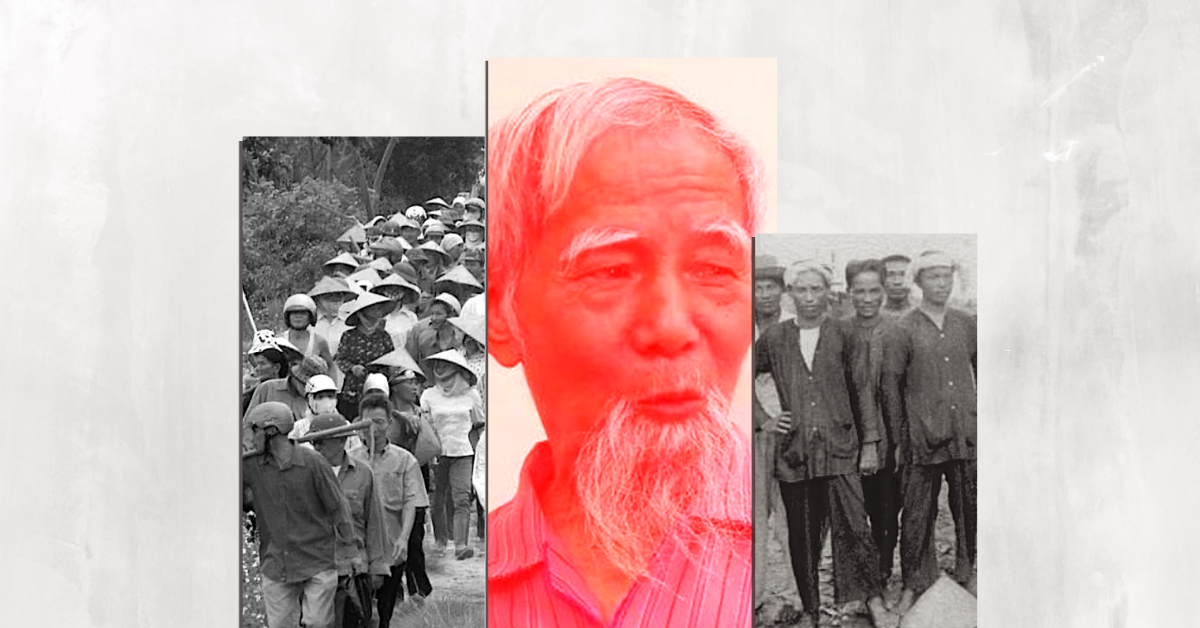
    After so many futile attempts to make appeals for land disputes and against local official corruption, the Lac Nhue village people decided to take matters into their own hands under the leadership of a person whom they all trusted named Trinh Khai. Details about this dispute were scarcely reported since the government wanted to suppress all related information involving the case.

    After many years of teaching at the Marine University, Trinh Khai, an engineer who studied in Soviet Russia, retired to his hometown in the early 1990s. At the time, the local officials in Kim Bang District implemented a new agricultural land leasing system. They cut off 75 acres of land in Lac Nhue Village and granted it to another village. Mr. Khai, who had good knowledge of the laws and also experience with the dirty tricks used by local officials, helped the village farmers to make appeals at the parish level, the district and even all the way up to the central government.

    After many incidents in which strangers snuck into the village and threatened Mr. Khai and other people’s safety, the villagers decided to build a fortress to protect them from the outside world.

    The peak of the conflict came when two young men from outside of the village were beaten to death by villagers in the middle of the night. The villagers believed the authorities sent the men to assassinate Mr. Khai. State media meanwhile reported that these two men were just normal citizens who came to buy fingerlings.

    After this incident, it was reported that Mr. Khai was arrested when he showed up at the parish office to cooperate with the authorities. There was also information stating that the authorities had ordered the police to hunt down and arrest him. In the end, the leader who protected the land rights of the farmers was given a death sentence. According to veteran journalist Pham Thanh, two villagers also died while being held in prison and six others were given jail sentences.

    In a nutshell, this incident was no different than the case in Ninh Thanh Loi, except that the current government did not act fairly like the lieutenant governor of Cochinchina in the past. This time, the government did not judge this case in an unbiased manner. Instead, the authorities consistently claimed the Lac Nhue incident was a case of land dispute where people distorted state policies and constituted conspiracies against the state. The government even published novels and made a movie about the incident (titled “The story of Nho Village) to defame Lac Nhue villagers and Mr. Trinh Khai, letting them go down in history in eternal shame.

    The building of the People’s Committee of An Ninh Ward, Quynh Phu District, Thai Binh Province which was destroyed by protestors destroyed in the night of June 26, 1997, value was estimated at 800 millions dong. Photo courtesy: Bauxite Vietnam.

    5. The Thai Binh Incident, Thai Binh Province

    Time of dispute: 1987 – 1997

    Victims: Citizens of Thai Binh Province

    Offenders: Officials of Thai Binh Province

    Fatalities: Unknown

    Location: The entire area of Thai Binh Province

    In the 1990s, petitions from citizens of Thai Binh Province regarding land issues and local officials’ widespread corruption piled up yet remained unresolved.

    In May 1997, furious after years of being bullied by local officials, a group of army veterans led about 3,000 farmers to stage a sit-in protest in front of the Communist Party’s headquarters in Thai Binh Province. This event led to a series of uprisings demanding justice throughout the province.

    Two retired officials told journalist Huu Tho about the root cause of the uprisings: “Do you believe that we are the bad guys or the reactionary force?” he asked. “How could we put up with these officials when they bully us even worse than the feudal landlords?!”

    Tens of thousands joined the protests and riots, captured at least 64 officials and policemen as hostages, and vandalised many government buildings and private houses of local officials. The unrest lasted until November 1997. Many people were sentenced to prison for taking part in these protests.

    Uprising in the Central Highlands in 2004. Photo courtesy: YouTube.

    6. Ethnic Thuong Uprising, Central Highlands

    Time of dispute: 2001 – 2004

    Victims: Indigenous people in the four provinces of the Central Highlands

    Offenders: Authorities, migrants

    Fatalities: At least 33

    Location: Central Highlands

    The Communists learned nothing from the mistakes of the earlier administration of Ngo Dinh Diem. They also understood nothing about the Central Highlands. The government thought this area was still covered with vast uncultivated lands. They then created new economic zones, built vast agricultural farms, and allowed unrestricted migration from other parts of the country. The result was that the land area of the indigenous people was disproportionately scaled back and the native people in the Central Highlands found themselves in unprecedented harsh living conditions.

    Researchers Neil L. Jamieson, Le Trong Cuc and A. Terry Rambo in their 1998 report, The Development Crisis in Vietnam’s Mountains, East-West Center predicted a crisis in the making in the Central Highlands:

    “A lot of people in the highland areas start to realize they are poor and left behind. They feel inferior to the people from the lowlands, […]. Lack of money, lack of food, lack of access to natural resources, public services (education, healthcare, information), they are in danger of losing their most valuable assets: their confidence and dignity. […] The problem is more and more people are aware that they are poor.”

    As if pouring gas on a fire, the Communists also destroyed the most sacred thing in the lives of the ethnic Thuong people: religion. The government completely banned religious freedom in the Central Highlands. Traditional rituals were terminated, Protestantism was almost disallowed, and Catholics were stringently restricted.

    A crisis suddenly arose in 2001 and especially in 2004 with the uprising of the ethnic Thuong people. It led to the biggest protests up until then and many violent encounters with the police. The Thuong demanded that the government return their lands and guarantee their freedom of religion. The protests forced thousands of ethnic Thuong either to become refugees in Cambodia or to be sent to education camps and prisons in Vietnam. According to Human Rights Watch, the conflict resulted in eight deaths in the protests and 25 deaths in prisons. However, these figures are impossible to verify since the government prohibited international observers from entering the Central Highlands at the time.

    Doan Van Vuon’s land and house were demolished by the government. Photo courtesy: Thanh Nien newspaper.

    7. Doan Van Vuon, Hai Phong Province

    Time of dispute: 2009 – 2012

    Area of dispute: 19.3 hectares

    Victims: The Doan Van Vuon family

    Offenders: People’s Committee of Tien Lang District

    Location: Vinh Quang Village, Tien Lang District, Hai Phong City

    The situation of the Doan Van Vuon family was exactly what the Bien Toai and Muoi Chuc families had faced about 80 years before, but with a different outcome. Although the local officials’ decisions were completely wrong and there were no fatalities in the conflict, the members of the Doan Van Vuon family still faced jail sentences.

    Doan Van Vuon, a military veteran, received a five-year sentence while three family members were given sentences ranging from two to five years in prison and suspended sentences.

    On the government side, there was only one local official sentenced to 30 years in prison, with the rest given suspended sentences.

    The incident started in 2009, when Tien Lang District reclaimed land that had been given to the Doan Van Vuon family.

    In 1993, the local authority handed Vuon’s family 21 hectares and it determined that this decision was legal.

    However, in 1997, the local authority handed him another 19.3 hectares and this was later concluded as an illegal decision.

    The local authority’s decisions, from the second handing of 19.3 hectares of land to the forced reclaiming of land of the Vuon family, did not have any legal basis. Then Prime Minister Nguyen Tan Dung pointed out that the overlapping and confusing regulations regarding land management and officials’ inability to implement the laws were the root causes of the conflict.

    Van Giang farmers during the fight for their land. Photo courtesy: Reuters.

    8. Van Giang, Hung Yen Province

    Time of dispute: 2012 – now

    Area of dispute: 73 hectares

    Victims: A number of families in Cuu Cao Village

    Offenders: Government of Van Giang District

    Fatalities: 2

    Location: Cuu Cao Village, Van Giang District, Hung Yen Province

    The citizens of Van Giang took a step forward to protect their land and they became criminals. In these types of conflicts, when the government sided with corporations (in this case it was Ecopark) to shrink compensation for reclaimed land, the people had no other choice but to stand up and fight.

    In April 2012, the authorities sent between 2,000 and 4,000 military police to sweep away a group of citizens who vowed to protect their land. There were 20 citizens arrested after this incident.

    In August 2013, a number of families captured and tied up village officials for trespassing on their uncompensated lands. The incident resulted in one man receiving a 21-month sentence and one other receiving a two-year sentence.

    In October 2014, two security guards of a backfilling company were beaten to death and one excavator truck was burnt. This led to six people receiving three-to-four year sentences, despite their statements that they neither beat anyone nor vandalized any assets.

    From left to right, Dang Van Hien, Ha Van Truong, and Ninh Viet Binh at their trial. Photo courtesy: Zing. Graphic image: Luat Khoa Magazine.

    9. Dang Van Hien, Dak Nong Province

    Time of dispute: 2008 – now

    Victims: Dang Van Hien and other families

    Offenders: Long Son Co.

    Fatalities: 3

    Location: Small zone no. 1535, Quang Truc Village, Tuy Duc District, Dak Nong Province

    This area witnessed many fiere conflicts. There were many fights between migrants and agricultural companies who were offered the land by local authorities. Fist fights, house burnings, field vandalizing, and gun shootings were all familiar to the local people. They chose to rely on themselves to protect the land rather than counting on the authorities.

    Dang Van Hien did not want any trouble, but he had no choice. Since 2008, local authorities had offered Long Son Co. an area that included land belonging to Hien and other families. Many violent encounters broke out over the years between the company and the families, yet all levels of government, from province to state, looked away.

    One early morning in October 2016,about 30 people came to Hien’s house in a heavy rain to bulldoze his farm. Hien opened fire that day. Ninh Viet Binh, a neighbor, came to back him up. Ha Van Truong, Hien’s cousin, later was also accused of murder, despite the fact that he only handed Hien the bullet magazines.

    The incident resulted in the deaths of three workers of the Long Son Co. In court, Hien was given a death sentence, Binh received a 20-year sentence later reduced to 18-years jail time, while Truong was given a 12-year sentence, later reduced to a 9-year prison sentence.

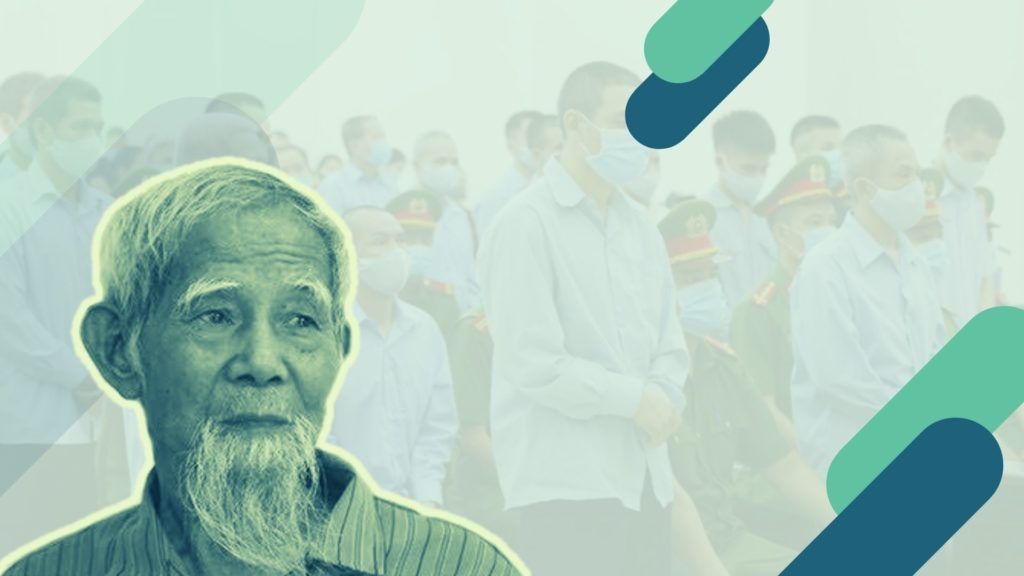
    Mr. Le Dinh Kinh. Photo courtesy: Dong Tam TV.

    10. Dong Tam, Hanoi

    Time of dispute: 2014 – now

    Area of dispute: 28.7 hectares

    Victims: A number of families in Dong Tam

    Offenders: The authorities of My Duc District and Viettel Corporation

    Fatalities: 4

    Location: Dong Tam Village, My Duc District, Hanoi

    From Dang Van Hien to Doan Van Vuon, from Van Giang District to Dong Tam Village, the message of the Vietnam government could not be clearer: despite their lives being threatened, despite their lands being taken away, the people still have no right to fight back. Any act of defiance that creates damage to the authority’s side will be severely punished, whether the government is right or wrong.

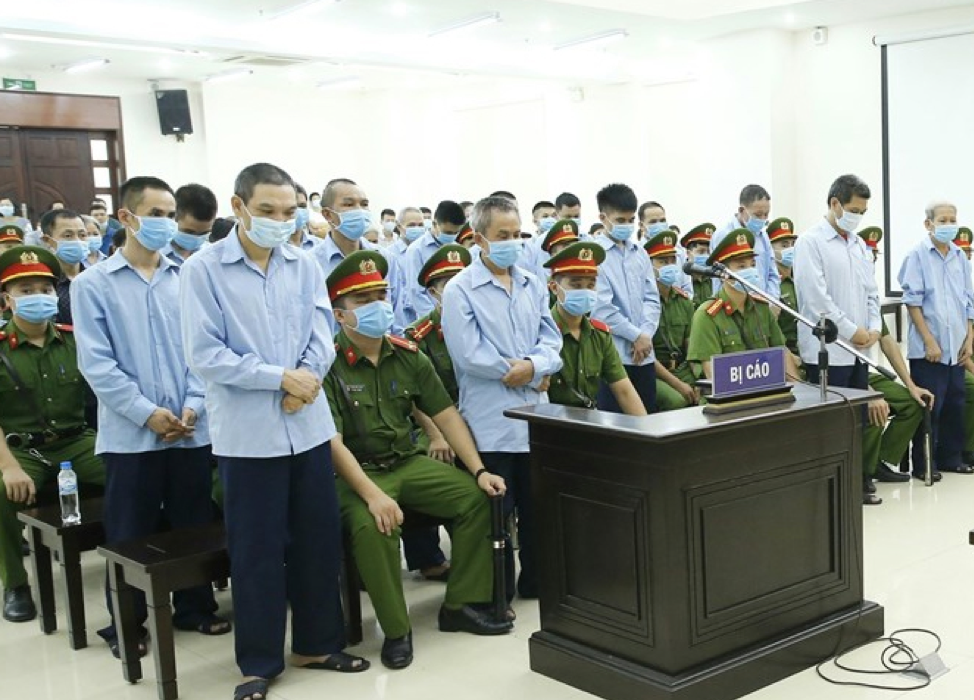
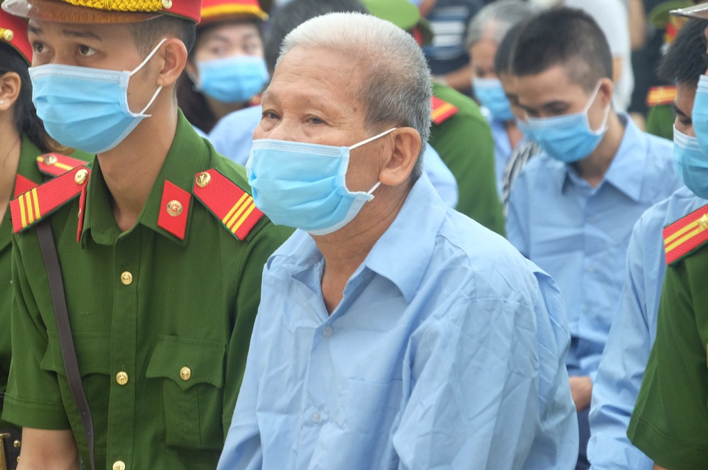
    Twenty-nine defendants in the Dong Tam case, including a 77-year old man, were forced to fight back against thousands of police ambushing their village in the middle of the night. Since 2007, there have been many violent incidents in Dong Tam yet the government has been unable to resolve the issue in a fair manner.

    The government of Vietnam used to denounce the brutality of French colonial rule. However, nearly 100 years ago under French rule, the trial of the Noc Nan field case was open and the press freely took part, reported and conducted independent investigations. Meanwhile, 100 years later, the trial for the Dong Tam Incident was closed and family members of the defendants were not allowed to even get near the court. Independent press was barred from entering the courtroom, and the attorneys were prohibited from making contacts with the defendants at trial.

    ***

    If there is no fundamental change in the land law in Vietnam to allow the private ownership of land, blood may still be shed over land issues for another 100 years.

    This article was written in Vietnamese by An Nam and previously published on Luat Khoa Magazine. The translation is done by Y Chan.

  • Recap: Sentencing in the Dong Tam Trial

    Recap: Sentencing in the Dong Tam Trial

    As reported earlier, after four days of a predicted 10-day trial, the Hanoi People’s Tribunal took a recess beginning on the afternoon of September 10 to deliberate. At 3 pm on September 14, 2020, an initial verdict was announced.

    These are the details of the sentencing and the developments surrounding them:

    The range of initial sentences

    The Tribunal sentenced Le Dinh Cong and Le Dinh Chuc to death for the crime of murder.

    Also prosecuted for murder was Le Dinh Doanh, who was sentenced to life in prison. Three other defendants who were charged with murder received prison sentences ranging from 12 to 16 years.

    The 23 remaining defendants were prosecuted for obstruction of officials. Among them, nine received prison sentences ranging from three to six years, and the remaining 14 were sentenced to between 15 to 36 months of probation.

    Compared to the recommendations by the Hanoi People’s Procuracy, the Tribunal’s sentencing only differed in granting 7 defendants probation instead of prison time.

    Noteworthy is that while nearly all of the defendants received sentences equal to or lesser than the Procuracy’s recommendations, Bui Thi Noi received a heavier sentence than what was recommended.

    The Procuracy recommended 4 to 5 years of prison for Bui Thi Noi. The Tribunal sentenced her to 6.

    Bui Thi Noi, adopted daughter of Mr. Le Dinh Kinh, who died in the early morning attack on January 9, directly challenged the Tribunal during questioning on the second day of the trial, asking: “We have laws, but why are they not carried out? Why was my father (Le Dinh Kinh) lured out to a field and his leg broken, instead of being arrested properly…?”

    When the presiding judge asked Noi three times why she bought gasoline, Noi responded “I bought gasoline to burn the corrupt!”

    The court’s determinations

    As reported by Thanh Nien, the Tribunal determined “This was a serious criminal case that [was] particularly dangerous, denigrating the law and human life.” Judges assessed that “the defendants’ behaviors were extremely barbaric, cruel, and inhumane.”

    According to information from Zing, the Tribunal also required the ring-leading defendants to compensate each victim’s family 116 million dong (US$5000) and provide child support to the deceased police officers’ children until they all reach the age of 18.

    Responses from lawyers and relatives of the defendants

    Speaking with RFA, Mrs. Nguyen Thi Duyen, Le Dinh Kinh’s granddaughter-in-law, stated: “To be honest, I’m not very surprised and had already mentally prepared myself. I knew for certain they would keep the sentencing as is.”

    “The next steps must be taken gradually; there’s simply no way to change [the government’s] hearts or minds,” she continued. “It will most certainly force [those] Dong Tam residents to suffer through long prison sentences.”

    Lawyer Nguyen Van Mieng, on the other hand, asserted: “There is not enough evidence to conclude that those three [police officers] died because of Chuc, Cong, and the others. Handing out two death sentences and a life imprisonment is completely unreasonable!”

    Mieng shared the view that all four deaths must be re-investigated.

    Appeals and future developments

    Le Dinh Cong and Le Dinh Chuc, who were both sentenced to death, stated that they would appeal.

    We have provided an analysis here regarding the next possible developments in this case.

    If at any point, a defendant, victim, or his or her representative appeals, the case will be forced into retrial. The entire case will be presented and re-tried in a higher court, which in this instance is the People’s Supreme Court in Hanoi.

    According to the law, the deadline for retrial ranges approximately from December 2020 to January 2021.

    In the meantime, the Procuracy, defendants, and lawyers have the right to provide additional evidence.

    Lawyers and relatives still have the right to see the defendants. Other individuals and organizations (journalists, social organizations, international organizations) are also able to submit requests to see the defendants.

    ***

    This article was written in Vietnamese by Y Chan and previously published on Luat Khoa Magazine. The translation is done by Will Nguyen.

  • The Dong Tam Case: What Happens Next?

    The Dong Tam Case: What Happens Next?

    On September 14, 2020, the Hanoi People’s Court delivered the judgments in the trial of the Dong Tam case.

    What will happen next?

    First of all, we need to understand this is a first-instance trial and the judgments have not yet come into force. The enforcement of criminal judgments therefore is not yet initiated.

    Appeal

    Within 15 days of the first-instance trial’s verdict, which is from September 14-29, 2020, there are two possible scenarios.

    (Note: According to the instruction from the Supreme People’s Court, the time limit for appeal is calculated from the day after the verdict is delivered, which is September 15, 2020.)

    1. If the rulings are not appealed, they will automatically come into force on the 16th day after the verdict was delivered, which will be on September 30, 2020. The sentence enforcement procedure will also be initiated on that day.

    2. If the rulings are appealed:

    • Appeal by the defendants: If any of the defendants, victims or their representatives appeal against the rulings, the case will move into the appellate trial phase. The whole trial will be restarted. In this case, the time limit for making an appeal is September 29, 2020.

    If an appeal is filed beyond the 15-day limit, the appellate court can still consider it permissible “on condition that the appellant has been obstructed by force majeure or objective obstacles from lodging an appeal within the time limit as defined by this Law.” (Article 335, 2015 Criminal Procedure Code)

    • Appeal by the Procuracy: If the Hanoi People’s Procuracy appeals against all or parts of the judgments, the case will also move into the appellate trial phase.
    • Appeal by the Supreme People’s Procuracy in Hanoi: according to law, they have a 30-day limit to appeal the rulings after the verdict was delivered.

    What is an appellate trial?

    According to Article 330, 2015 Criminal Procedure Code, “Appellate trial means that the immediate superior Court re-tries a case or re-considers the decisions passed by the first instance trial, whose judgments and rulings pronounced for the case are appealed before coming into force.”

    In other words, all or parts of the rulings will be re-considered by the immediate superior court.

    What is the superior court in this case?

    The People’s High Court in Hanoi

    When will the appellate trial take place?

    At the moment, there is no detailed instruction document on how to calculate the time frame to open the appellate trial, but based on the 2015 Criminal Procedure Code, we can estimate a number of markers for what happens next:

    • Within 75 days upon the admission of a case, the People’s High Court in Hanoi has to issue a decision to hear the appellate case. Therefore, we can estimate in case of appeal, that the last day to issue the decision will be December 13, 2020 (Sunday). Since it is a non-working day, the time limit can be extended to December 14, 2020 (Monday).
    • Within 15 days upon issuing the decision to hear the appellate case, the court has to start the appellate trial. Therefore, we can estimate in case of appeal the last day to start the appellate trial will be December 29, 2020 (Monday).
    • Within 10 days upon issuing the decision to hear the appellate case, the court has to send this decision to the Procuracy–which is on an equal level of hierarchy–and to the defense counsels, crime victims, litigants and protectors of legitimate rights and benefits of crime victims, litigants, appellants, persons incurring interests and duties from the appeal. The last day of this time frame will be December 23, 2020 (Monday).
    • The court can delay the appellate trial for no more than 30 days, which means the last day in this case could be on January 28, 2021 (Wednesday).

    In practice, however, the court can violate the time limit regulations. The appellate trial therefore can be delayed to a much later time than the above estimated number of days.

    While awaiting the appellate trial, what can happen?

    • The People’s High Court can make decisions on changing or terminating preventive measures such as detention. Although practically, there is no possibility some defendants will be released on bail awaiting the appellate trial, yet it is still an available legal option.
    • If the appellants withdraw the appeals, the court will suspend the appellant trial. In practice, this is also unlikely.
    • The Procuracy, the defendants and their lawyers can submit additional evidence.
    • The lawyers and family members are entitled to meet the defendants. Other individuals, organizations (the media, social organizations, international organization, etc.) can file proposals to meet with the defendants.

    In order to better understand this case, we need to study thoroughly the Law on temporary detention and custody.

    What are the possible outcomes of the appellate trial?

    According to Article 355, 2015 Criminal Procedure Code, the possible outcomes of an appellate trial could be:

    • Reject appeals and sustain the first-instance court’s judgments;
    • Alter the first-instance trial’s judgments;
    • Annul the first-instance court’s judgment and send the case back for re-investigation or retrial;
    • Annul the first-instance trial’s judgments and dismiss the case;
    • Terminate the appellate trial if the appellants withdraw their appeals.

    In case of altering the first-instance trial’s judgments, if the appeals are filed by the defendants, the appellate court cannot deliver a harsher sentence than what has already been given to the defendants.

    In case of altering the first-instance trial’s judgments, if the appeals are filed by the procuracy or the crime victims, the appellate court can deliver rulings that are disadvantageous to the defendants.

    What may happen after the appellate trial?

    The rulings from the appellate trial will come into force immediately.

    If the appellate court sustains the first-instance trial’s judgments, or alters the judgments but sustains the sentences, the enforcement procedure will be initiated. The defendants become convicts (serve jail sentences, face death penalties). In this case, one must study thoroughly the Law on execution of criminal judgments.

    The convicts with death sentences still have a chance to file pardon petition for commutation of death sentence with the state president (within 7 days after the appellate rulings were delivered), petition for a cassation trial, or file for a retrial of the case.

    If the appellate court chooses to delivers other outcomes, then there are corresponding legal options for each scenario.

    ***

    This article was written in Vietnamese by Tran Ha Linh and previously published on Luat Khoa Magazine. The translation is done by Y Chan.

  • Dong Tam Trial – Day 4

    Dong Tam Trial – Day 4

    On the afternoon of September 10, after four days of a predicted 10-day trial, the Hanoi People’s Court took a recess and is expected to announce sentencing at 3 pm Monday, September 14, 2020.

    Here are the latest events from the fourth day of the Dong Tam trial (September 10, 2020):

    Defense session shortened

    In an interview with the BBC, defense lawyers stated that during today’s trial, the tribunal shortened the defense portion of the 29 defendants.

    Lawyer Nguyen Van Mieng said, “It appeared the tribunal wanted to limit today’s trial to the morning, pressuring us on time and seemingly not wanting procurators to counter argue with (defense) lawyers.”

    “Normally, the procuracy must debate in full all matters the lawyers have petitioned, such as the request to send the case back for re-investigation in order to confirm that shortcomings have been addressed, that forensics have been conducted at the scene of the crime, that Hanoi police’s plans for maintaining the security of the Mieu Mon Airport construction project should have been provided to determine if they included a plan to attack Le Dinh Kinh’s residence. The tribunal simply responded that these matters were ‘already clear’.”

    Lawyers petitioned the return of files, asked investigators to clarify content

    Le Van Hoa, the defense lawyer for Le Dinh Cong, Le Dinh Chuc, Le Dinh Uy, and Tran Thi La, posted his entire defense argument on Facebook.

    In it, he requested the tribunal review and return case files to prosecutors for supplementary investigation to clarify the imperative matters below:

    1.    The legal status of the 59-hectare parcel of land at Senh Field, Dong Tam Commune, My Duc Suburban District, Hanoi.

    According to Attorney Hoa, the ambiguity regarding whether the disputed parcel is agricultural land that belongs to the Dong Tam Commune, the local authorities or national defense land belonging to the Air Defense – Air Force Arm (of the Ministry of Defense), is the direct and root cause of events that led to the Dong Tam incident in April 2017 and January 9, 2020.

    2.    The legal status of the deployment into Dong Tam of thousands of Hanoi riot police in conjunction with another police force fell under the Ministry of Public Security on the night of January 8 and early morning of January 9, 2020. Which office decided this deployment? And was this decision right or wrong?

    3.     A forensic investigation to clarify the deaths of three police officers; documentation in case files put together by investigators is not yet convincing.

    4.     The mysterious circumstances surrounding Le Dinh Kinh’s death must be clarified.

    5.     A request that the tribunal carry out criminal proceedings for the murder case according to the petition filed by Mrs. Du Thi Thanh (wife of Le Dinh Kinh).

    The lawyers participating in today’s trial. Photo courtesy: Lawyer Le Van Hoa’s Facebook account.

    Lawyer of three police officers killed opposes a forensic reassessment of the crime scene

    According to state-run Laborer Newspaper, lawyer Nguyen Hong Bach, who is defending the rights of the three police officers “sacrificed (in the line of duty)”, opposes a forensic reassessment of the case’s crime scene because it will “re-emphasize the pain and loss for the victims’ families”.

    After defense lawyers pointed out a number of issues (with the forensic case), Bach stated that he “felt deeply hurt”.

    Bach explained his view: “Could we really recreate such a gruesome murder scene? Who would dare to climb down that sky-well, for others to pour gasoline on?”

    He argued that not every part of the crime or the crime scene needs to be recreated for the forensic investigation to be conducted. In this situation, a forensic investigation should not be conducted, said, arguing that doing so would only bring pain to the officers’ families.

    Plans to protect Dong Tam are top-secret documents?

    On top of opposing a forensic investigation, lawyer Nguyen Hong Bach – who represented the three deceased officers – also rejected the demands to publicize Plan 419A of the Hanoi City Police regarding the maintenance of order and security surrounding Dong Tam Commune.

    Lawyer Ngo Anh Tuan had earlier requested the publicizing and clarification of this plan and entering it into the record in order to evaluate the legality and objectives of those on duty the night the incident took place.

    According to Attorney Tuan, “The people and lawyers can be skeptical and do not believe that this Plan 419A exists in reality or it can be illegal since it is not publicized. It can be determined that the consequences that happened on such a day (January 9, 2020) were the responsibilities of the leaders of the Hanoi Police Department towards their officers.”

    In response, Attorney Bach stated that these plans were “top-secret documents”, and that defense lawyers “had no right to demand (their publicizing)”.

    Is participating in a “Consensus Group” formed by the Dong Tam farmers a crime?

    On his Facebook profile page, lawyer Nguyen Van Mieng posted an excerpt from his defense argument emphasizing that the presiding judge frequently asked each defendant “the same question” about their participation in the “Consensus Group,” a group formed by the farmers, and headed by Mr. Le Dinh Kinh to deal with land dispute with the government.

    According to attorney Mieng, the indictment did not criminalize the establishment of the group. But during its questioning, the tribunal was especially concerned with whether the defendants had participated in the Consensus Group, in order to evaluate their other alleged crimes.

    This is a violation of human rights, and the fundamental rights and obligations of citizens, as stipulated in Article 25 of the (Vietnamese) Constitution.

    According to Article 25, “Citizens have the right to freedom of speech, press, information, assembly, association, and protest. The exercise of these rights shall be regulated by law.”

    “Accordingly, to participate or not in the Consensus Group is a citizen’s right, and no one can use a constitutionally-guaranteed right as the basis of criminalization,” Mieng stated.

    The lawyers participating in today’s trial. Photo courtesy: Lawyer Le Van Hoa’s Facebook account.

    Defense lawyers manhandled and tailed after leaving court

    Lawyer Nguyen Ha Luan relayed that a shoving match broke out after police officers attempted to confiscate a USB drive and refused to let lawyer Ngo Anh Tuan copy data; another plainclothes police officer shoved lawyers Dang Dinh Manh and Nguyen Van Mieng.

    Recounting the incident, lawyer Dang Dinh Manh stated that in the afternoon, after they had left the trial, the three (lawyers Tuan, Manh, and Mieng) were brutally dragged to the gate by the underarms and then straight-arm shoved down the steps, after arguing with police officers to return the USB drive so the lawyers could copy the data over to their laptops.

    Afterwards, while traveling on the road, the lawyers discovered that there were four individuals on two motorcycles closely following them. When the lawyers stopped their vehicle, these individuals also stopped onto the sidewalk; when the lawyers continued moving, so did they.

    Did the Propaganda Committee issue instructions to journalists on how to cover the Dong Tam case?

    On social media, a number of notable figures, such as journalist Nguyen Manh Kim (of The New Viet magazine), disseminated detailed information regarding a document from the Vietnamese Communist Party’s Central Propaganda Committee. The document contained detailed instructions on how state journalists should cover “sensitive issues” related to the trial.

    In the section regarding the Dong Tam case, the document directed journalists to:

    – Affirm that the suspects had “refused dialogue, reconciliation”.

    – Recount the idea that suspects had “attacked [officials] first” (this phrase was emphasized).

    – Criticize the “depravity of suspect Le Dinh Kinh.”

    – Affirm that the need for the officials to suppress people (at the crime scene) was “pressing” and done “according to regulations.”

    – Reflect that the public opinion is in “consensus” with the government regarding the matter, the “support” of citizens regarding the court’s sentencing, and the tribunal’s “fair sense of justice.”

    – Report information “in moderation”; do not report “details” or “negative news” regarding “admissions of guilt” or the “repentance” of defendants.

    Note that these instructions appeared before the trial began.

    Sources of this information publicly stated that they could not post pictures of the document because each instruction form sent to publications has a specific “marking” to help Vietnam’s security forces trace leaks.

    We have yet been able to verify this information.

    Court to announce sentencing on Monday, September 14

    After this afternoon’s session, the trial will temporarily recess for the tribunal to deliberate. It is expected that the tribunal will announce sentencing at 3 pm, Monday, September 14.

    ***

    This article was written in Vietnamese by Y Chan and previously published on Luat Khoa Magazine. The translation is done by Will Nguyen.

  • Dong Tam Trial – Day 3

    Dong Tam Trial – Day 3

    The latest events from the third day of the Dong Tam trial (September 9, 2020):

    Procuracy recommends two death sentences

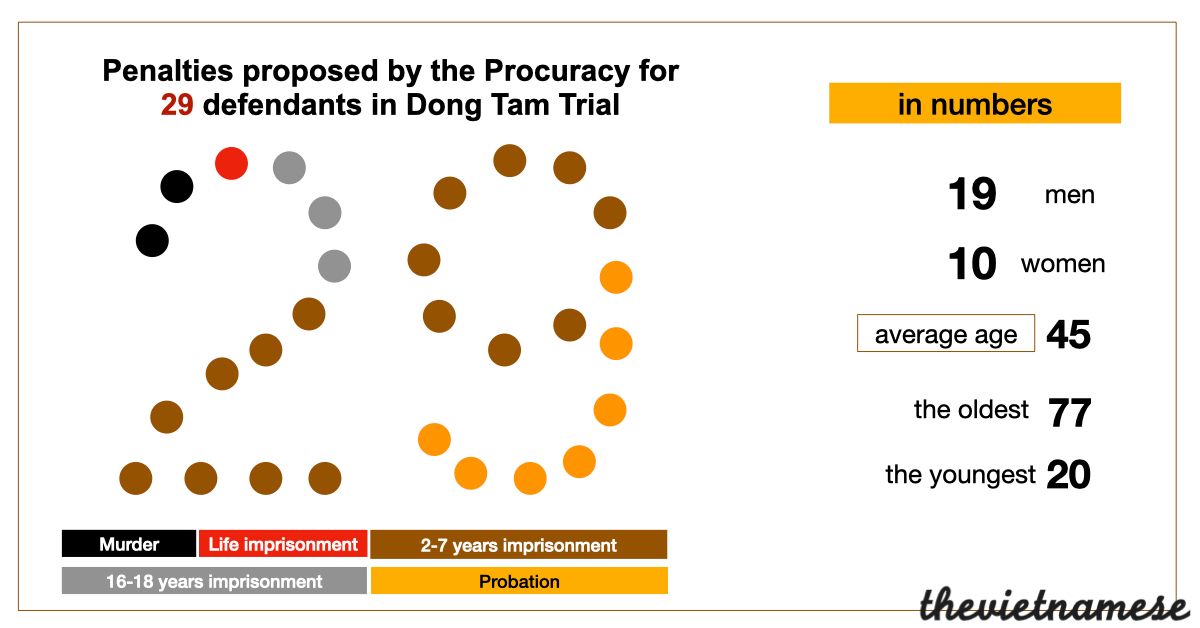
    According to state-run Zing e-newspaper, the Hanoi People’s Procuracy recommended to the court that Le Dinh Cong and Le Dinh Chuc receive the death penalty. The recommended sentences for the remaining 27 defendants ranged from 15 months of probation to life in prison. Le Dinh Cong and Le Dinh Chuc were both prosecuted for murder.

    Also prosecuted for murder was Le Dinh Doanh (who was recommended a life sentence), Bui Viet Hieu and Nguyen Quoc Tien (recommended sentences of 16-18 years in prison), and Nguyen Van Tuyen (a recommended sentence of 14-16 years in prison).

    Nineteen other defendants had their original charge of murder downgraded by investigators to obstruction of officials. In total, 23 defendants were charged with the latter crime and were recommended sentences ranging from 15 months probation to 7 years in prison.

    A speedy cross-examination of defendants

    Prior public information estimated that the trial would last 10 days, but after only two days, the procuracy has already arrived at recommended sentencing for the defendants.  This is due to the speediness of the trial, with each defendant questioned for only a few minutes and lawyers racing to keep up, unable to record all responses in full.

    In a BBC interview, lawyer Ngo Anh Tuan spoke of Tuesday’s trial highlights, when every single defendant pleaded guilty.

    According to Tuan, this development could be due to the fact that the defendants were facing heavy sentences and felt that even if they had retracted their previous statements, it would not stop the inevitable; as such, they chose to plead guilty in hope of a lesser sentence.

    Lawyers interrupted

    During the third day of the trial, lawyer Le Van Luan recounted how the prosecution repeatedly interrupted him as he debated the legality and legal value of the submitted electronic materials (unsourced videos broadcast in court, video confessions of the defendants recorded during the period of investigation that were never mentioned in case files).

    Noteworthy is that during this time, the presiding judge “left the room”, and the judge sitting next to him took his place, warning the lawyers to “defend what is before you, no more expounding on the law, no more utilizing the law”; if they continued, he warned,  they would be found  “in contempt of court” and “asked to leave the trial”.

    “No need” – episode two

    During the first day of trial, court security prevented lawyers from speaking with their clients. When lawyers objected, the presiding judge declared that there was “no need” for lawyers and defendants to speak with one another in court – in complete violation of the law.

    After lawyers forcefully responded by sending a complaint to the presiding judge of the Hanoi People’s Court during their midday recess, the next morning, on the second day of trial, the court agreed not to block contact and to abide by legal statutes.

    But as lawyer Dang Dinh Manh told the BBC, by the afternoon of the second day, the court reversed direction, asking lawyers to register before speaking with their clients and mandating that they stand two meters away from their clients. By the third day of the trial, “they no longer allowed us to see (our clients) at all,” he said.

    Manh believed that this reversal may be due to the fact that as the trial progressed, lawyers questioning defendants allegedly resulted in  “a lot of information being disclosed unexpectedly”.

    In addition to single-handedly deciding that lawyers had “no need” to speak with their clients, the trial’s presiding judge also decided on the second day that there was “no need” to respond to lawyer requests for the court to provide the “video evidence” it was planning to show, so that all parties would have access to and understand the materials.

    Accordingly, the prosecution stated that it would not provide the sources or any information regarding the evidence because there is “no need”.

    Two of the trial’s defense lawyers: Nguyen Van Mieng and Dang Dinh Manh. Photo courtesy: Facebook Manh Dang.

    Were the defendants tortured during the investigation?

    Lawyer Dang Dinh Minh relayed that at the end of the second day of the trial, he turned to the row of defendants and asked the 29: “Those who WERE tortured during your investigation, do nothing; those who WERE NOT tortured during your investigation, please raise your hand”. Ten raised their hands, 19 did not.

    What do the residents of Dong Tam think of the defendants and their families?

    Responding in an interview with Luat Khoa Magazine, Mrs. Nguyen Thi Duyen – wife of defendant Le Dinh Uy and granddaughter-in-law of Le Dinh Kinh – affirmed:

    In our village, we Dong Tam residents strongly mourn the death of elder Le Dinh Kinh, as well as the enormous losses our family has suffered and the many relatives who were arrested on the night of January 9. It brings us great anguish.

    But many cannot express this for fear of immediate retaliation by police and village security. Intimidation, there is intimidation. That’s the truth because many have been called to the police station and the village committee and told that they were not allowed to come to my house. They wanted to burn incense for elder Le Dinh Kinh but were prevented by security forces, who construed burning incense with some kind of involvement in the matter. So residents were very afraid and didn’t dare come, though they mourned Kinh dearly.

    They were able to express themselves more quietly by going to his gravesite and burning incense there, rather than coming to our house. If they came, they would be recorded and followed on camera, and possibly be immediately denounced; security would definitely summon them right away.

    We can’t even burn incense freely for someone who’s already passed away; as such, I certainly do not hold the security forces of Dong Tam in high regard.

    But I affirm to everyone that Dong Tam’s residents care for and support those in custody. Villagers have conveyed themselves through text messages and they encourage us whenever they get a chance. They do not isolate my family or any other relative who’s been arrested, and I feel very happy living with the residents of Dong Tam.

    ***

    This article was written in Vietnamese by Y Chan and published on Luat Khoa Magazine. The translation is done by Will Nguyen.

  • Dong Tam Trial – Day 2

    Dong Tam Trial – Day 2

    Second day of trial of the Dong Tam Incident – Summary

    Below is a summary of the main events that happened on the second day of the trial.

    Court allowed direct contact between attorneys and defendants – for now

    According to attorney Le Van Luan, the court granted attorneys direct contact with their clients this morning.

    As reported, during the first day of the trial, security at the courtroom prevented the attorneys from interacting with the defendants. When the attorneys demanded the trial panel respect the rights of the defendants and the attorneys, the chairman rejected their request and publicly announced that “it is not necessary” for the attorneys and the defendants to have contact during the trial.

    Controversy over “video evidence” presented at the trial

    Attorney Dang Dinh Manh pointed out two puzzling issues about the presentation of the “video evidence” on the first day of the trial.

    In the questioning section, the court showed a video that was produced in documentary style, telling the story from the state’s viewpoint and depicting how the villagers had wrongfully protested and claimed the disputed land, and how that led to the confrontation which resulted in the death of three police officers. The video ended with miserable scenes of the families of the three police “victims”, showing suffering widows and children.

    According to attorney Manh, this was an unprecedented offering of evidence. Everything presented at court during a trial must be evidence related to the case and it has to be real, original, intact and unedited, and not include doctored videos.

    In a separate post on social media, independent journalist Pham Doan Trang  quoted a source who said that the attorneys objected to the presentation of the doctored “evidence” and demanded hard evidence instead. But the court rejected the objection and instead instructed the attorneys to “just watch the video”.

    The second issue was the “confession videos” shown during the questioning of each defendant. These videos were not mentioned in the case files. The attorneys, therefore, had no idea of their existence and had no chance to review them beforehand. Attorney Manh considered this “a trick played on the attorneys,” causing them surprise and anger when they tried to defend their clients during the trial.

    The attorneys later co-signed a request submitted to the trial panel and the People’s Procuracy Office in Hanoi, demanding a complete list of this alleged video evidence.

    Video clips of defendants admitted to guilt were shown at trial by the prosecution. Photo courtesy: ANTV

    State media: The defendants showed remorse and asked for leniency

    Reports on the trial from state media like Dan Tri, Tuoi Tre, etc. all followed the same direction: the defendants pleaded guilty.

    Dan Tri reported that “In the court, all defendants admitted their crimes as stated in the indictments, showed their remorse, asked for leniency and at the same time sent their apologies to the families of the three sacrificed police officers.”

    Meanwhile, Tuoi Tre reported that defendant Bui Viet Hieu voluntarily “raised his hand asking to speak.” Hieu “apologized to the trial panel” for his statement made the day before and admitted his lack of understanding of land policies.. Hieu then “appealed for leniency since no one should punish a man who already admits his guilt”. In a statement issued on the first day of the trial, Hieu had defended the position of the Dong Tam people regarding the land dispute.

    Tuoi Tre also reported that defendant Mai Thi Phan took part in the years-long protest because “Le Dinh Kinh (the head of Dong Tam Village who was killed in the incident) had promised to give a piece of the disputed land to her and the people involved.” The paper depicted the defendant as “shamefully stuttering” while admitting “We know what we did was wrong, we see our guilt now.”

    One defendant counter-questioned the trial panel

    State media buried other events in the trial, specifically a defendant who questioned the trial panel.

    Information published by attorney Dang Dinh Manh told a story about defendant Bui Thi Noi. When the court questioned her, she responded with a request to the trial panel, demanding it answer a series of her questions.

    She asked, “Why do you have law but don’t respect the law? Why didn’t the government arrest Noi’s father (Mr. Le Dinh Kinh adopted her as his child) according to the law? Instead, the government tricked him to go to an open field and broke his leg ….” (Bui Thi Noi was referring to the incident that happened in April 2017. It was when the authorities tricked Le Dinh Kinh out of the village and assaulted him, breaking his leg.)

    When the chairman of the trial panel repeated his question for the third time, “What did you buy the gasoline for?” defendant Noi answered “To burn the corrupt officials!”

    The chairman later ordered the police to escort her out of the courtroom.

    Civil society organizations: Request to treat Mr. Bui Viet Hieu as a special witness

    A group of civil society organizations initiated an urgent petition addressed to state leaders and collected signatures for the campaign.

    Part of the petition requested:

    “Treating Mr. Bui Viet Hieu as a special witness with the most special protection measures; it is best to transfer him to another incarceration facility that is not under police control.”

    They explained their reason:

    Mr. Bui Viet Hieu had directly witnessed a police officer shoot and kill Mr. Le Dinh Kinh in a face-to-face confrontation. This account matches forensic evidence showing two bullets hitting Mr. Kinh from the chest through to his back (completely contradicting the investigation conclusion which stated the shots were fired from the back). Mr. Hieu himself was the second senior member of the Dong Thuan Group (a group formed by Le Dinh Kinh to protest to the authorities on the land dispute).

    Mr. Hieu was also shot at the same place and same time, according to his statement: “After they shot and killed Mr. Kinh, they turned their flashlight on my position and fired two shots, aiming at my heart. But the police missed the target and the bullets hit my ribs instead, exploding and causing three wounds in my duodenum and two wounds in my colon. The police left me lying there for hours, from very early in the morning until 11:00 am on January 9, 2020 (the day the incident happened). Only when it was obvious that I was still alive, did the authorities decide to take me to the hospital.”

    Defendants’ family: If there are death penalties in the sentence, we will not sit and watch our loved ones die unjustly

    Luat Khoa Magazine interviewed Ms. Nguyen Thi Duyen – the wife of defendant Le Dinh Uy and the granddaughter-in-law of Mr. Le Dinh Kinh. Here are some extracts from the interview:

    I am very scared that my loved ones will have to endure extremely harsh punishment, despite the fact that it was not us villagers who initiated the attack. It was the authorities who launched the attack on us.

    Our relatives and I have heard a lot of rumours that there will be death penalties in this trial. Many people predicted that three members of our family, my father Le Dinh Cong, my uncle Le Dinh Chuc and my brother Le Dinh Doanh, will face the death penalty.

    If the people holding power in their hands decide to tear apart  our family in this way, they clearly have no conscience. An old man like Mr. Kinh had already died in such a cruel manner in this January 9 incident. I hope the people who are on the trial panel will mull over things before making any decisions because the truth about Dong Tam villagers is far more complicated than many people have depicted.

    If there are death penalties, we will never stop fighting to save our loved ones. We will not sit and watch the people we love die in such an unjust manner.

  • Dong Tam Trial – Day 1

    Dong Tam Trial – Day 1

    First day of trial of the Dong Tam Incident – What we have learned

    The 10-day trial of the Dong Tam Incident promises to be a long and tedious process, not only for the people involved but also the concerned audience. If you don’t have time to follow live updates, below is a summary of the main events throughout the day.

    Luat Khoa and The Vietnamese magazines will produce summary reports at the end of each day until the end of the trial.

    There are 29 defendants to be tried in the course of 10 days

    Of the 29 defendants, 25 are accused of “Murder” under Article 123, section 1, clauses (a), (d), (n), and (o) of the 2015 Penal Code.

    Another four individuals are being tried for “Obstructing officers in the performance of their duty” under Article 330, section 2, clause (a) of the 2015 Penal Code.

    There are 15 attorneys representing the defendants, hired by the defendants and their families. The other 18 attorneys were appointed by the court.

    The trial is expected to last 10 days.

    Tightened security, family members not allowed to enter the courtroom

    Top level security measures were applied in the so-called public trial. Police imposed blockades and restricted access around Pham Van Bach Street where the People’s Court of Hanoi is located. The police put up barricades preventing defendants’ family members and citizens from approaching the court area.

    One family member told Luat Khoa that more than 20 policemen had surrounded her house since yesterday. This morning, she had to lie to the surveillance police to get through their siege and head to the courthouse.

    A few family members of the defendants were outside the courthouse in the morning of September 7, 2020. Photo courtesy: Luat Khoa Magazine.

    Attorneys barred from direct contact with defendants at the trial

    During the lunch break of the trial, a collective of attorneys lodged an urgent protest to the chief justice of the People’s Court of Hanoi, demanding the trial panel respect the defendants’ right to defense and the attorneys’ right to represent the defendants, including the right of the attorneys to have direct contact with the defendants.

    In the morning session of the trial, when the trial panel paused to conduct private discussions, the security force at the courtroom prevented the attorneys from interacting with the defendants.

    As the trial panel resumed, attorney Dang Dinh Manh demanded the attorneys’ right to have direct contact with the defendants whom they were representing in court.

    However, the chairman of the trial (Judge Truong Viet Toan) publicly announced “since the attorneys had time to work on the case files, had time to meet with the defendants in prison, now it is no longer necessary for the defendants and their attorneys to have any further contact at the court during the trial.”

    Despite one attorney pointing out this pronouncement fundamentally violated section 4 article 256 of the Criminal Procedure Code, the chairman of the trial ignored the protest.

    The trial panel in Dong Tam trial. Photo courtesy: Doan Tan/Vietnam News Agency.

    Petition from attorneys before the trial

    On September 3, 2020, a group of 13 attorneys representing the defendants co-signed a petition to the chairman, the chief justice of the People’s Court of Hanoi, and the chief procurator of the People’s Procuracy of Hanoi.

    The petition called for attention to many incorrect and false details in the indictment by the People’s Procuracy of Hanoi, including distorted information and statements that are contradictory to the many versions of the event published by the Ministry of Public Security after the incident.

    The petition also raised various and constant obstacles met by the attorneys during the whole process, from investigating, prosecuting and final preparation stages for the trial. The attorneys were not allowed to hold private meetings with their clients and were barred from accessing the case files until the very last minute.

    At the courtroom, the chairman of the trial when responding to the petition only granted permission for the attorneys to watch videos in the case files during the trial, rejecting their request to obtain copies of the photographs and videos mentioned in the prosecutor’s files regarding the case.

    The defense lawyers for Dong Tam trial. Photo courtesy: Vietnam News Agency.

    NGOs voice concerns and call for a fair trial

    On September 6, Phil Robertson, deputy Asia director of Human Rights Watch, issued a statement on the case:

    “There are major concerns about due process and the right to a fair trial for the 29 villagers facing charges for incidents in Dong Tam. Use of torture and forced confessions are common in police custody in Vietnam. The courts are far from independent and predetermined outcomes dictated by the ruling communist party are trademarks of Vietnam’s so-called justice system. Defendants’ access to their lawyers is extremely limited and occurs only after the police have completed their interrogations and finished their investigation.

    There are still many unanswered questions about what happened during the Dong Tam raid that may never be answered in Hanoi’s rush to convict these defendants. Quite clearly, the authorities want to hit them with very harsh penalties to warn off others who might dare to challenge state authority in the future. Given the widespread interest in this case, Vietnam should allow independent international observers including diplomats, journalists and NGOs to observe the trial, and end harassment and surveillance of the family members of the accused.”

    Meanwhile, on September 4, 2020, 11 civil society organizations penned an open letter addressed to Elisabeth Tichy-Fisslberger, president of the UN Human Rights Council, calling on the UN to demand that Vietnam conduct a “fair and open trial” in this case.

    Arresting one observer of the trial

    According to information published by Ms Do Thu on her social media, her father, Trinh Ba Khiem, was arrested this morning while attempting to attend the trial, only to be released later in the evening of the same day.

    Mr. Khiem’s sons, Trinh Ba Phuong and Trinh Ba Khiem, and his wife, Can Thi Theu, who had been posting information about the Dong Tam Incident on social media and showing support for the Dong Tam villagers, were all arrested on June 24 2020 in a separate case.

  • “Dong Tam Report” – Trying to Find Transparency

    “Dong Tam Report” – Trying to Find Transparency

    On September 7, 2020, at 9:00 A.M. Hanoi Time, a trial will be held against 29 people who are farmers of Dong Tam village. The defendants were being alleged with “homicide” and “oppose officials who were on duty.” The maximum punishment for homicide in Vietnam could be the death penalty.

    The protracted dispute over the land between Dong Tam villagers and the government simmered over the last few decades, and a group of activists compiled a report and published it here.

    There were four people killed when the police bursted into the village, including Le Dinh Kinh, the 85-year-old village’s leader.

    The trial will expectedly last for ten days. We will continue to update it in our [News] section throughout.