Author: demo_admin

  • Vietnam’s Cybersecurity Draft Law: Made in China?

    Vietnam’s Cybersecurity Draft Law: Made in China?

    During the first part of last year’s November, the National Assembly of China passed the Law on Cybersecurity and established its effective date to be June 1, 2017.

    Then come June 2017, five days after said law went into effect in China, the Vietnam’s Ministry of Public Security (MPS) sent their own proposal regarding a draft of the Cybersecurity Law to the Vietnamese government. It has been claimed that this draft law was the result of a legislative process which began to take place since July 2016, when the National Assembly scheduled Cybersecurity Law as one of its agenda’s items then. The MPS then also established their own drafting team and an editing group to work on the drafts of Vietnam’s Cybersecurity Law in late March this year.

    After going through various collections of public comments and four draft versions of the law, the final draft (Draft Law) now is in the hands of the National Assemblymen and women. It would be among the items to be discussed when they meet at the end of 2017, and if all things go according to plan, Vietnam’s Cybersecurity Law will get approved and signed into laws by the middle of next year.

    Yet, whether purposefully or unintentionally, Vietnam’s Draft Law has shocked many people because it is almost identical to that of China’s.

    In their proposal submitted to the government, the MPS stressed that they have researched, and thus taken into considerations Cybersecurity laws from China, Japan, the Czech Republic, South Korea, and the U.S when drafting the Draft Law.

    I have to make it clear that I do not have any evidence to conclude the Vietnamese government has indeed copied China’s Cybersecurity Law. Moreover, if both countries are functioning under an identical political system, then the use of identical legislative tools would be very understandable. This is even more likely when the MPS openly admitted that they have considered Chinese laws as stated. Besides, copying or learning from other countries’ legislative experiences do not necessarily mean negative consequences.

    However, let’s just go straight to comparing Vietnam’s 4th draft of the Cybersecurity Law currently sitting on the desks of the National Assembly’s members and the English translation of the Chinese laws, to see how much they are alike to one another, and whether such similarities will bring negative consequences to Vietnamese people.

    1. Two documents, one technical term

    There is one technical term in the Vietnamese Draft Law that one should pay close attention to, which is the “critical information system regarding national security” in Article 9.

    In the China’s version, there is a similar technical term: “critical information infrastructure” in Article 31.

    Both laws centered on these two technical terms, and their definitions are also very much alike. Both are used to define any information, that if being under attack, they would bring harms to national security, social order and public safety.

    That information – as mentioned in both Vietnam’s and China’s Cybersecurity Law – would then include energy, finance, transportation, media, and publications, as well as electronic governance.

    However, the Draft Law of Vietnam also includes military-security, national secrets, banking, natural resources and environment, chemicals, medicine, and other national security structures.

    The Draft Law also does not distinguish between private companies and government agencies when applying the concept of “critical information system regarding national security”. Based on the context of said law’s wordings, the targeted entities are implied to be both of them. The government and the enforcing authorities could also interpret this law as broad as possible.

    Baker & McKenzie, in their analysis of the Chinese Cybersecurity Law, has warned all companies whose may have established relationships with those entities which fall under the regulatory perimeters of said law, that this law could very well be applicable to them.

    The agencies and enterprises who are within the application of this law shall abide the technical measures and regulations as set by the government, and submit themselves to be under the direct control and observation of the MPS. They will have to obtain all necessary business permits to operate and maintain their equipment while at the same time, must cooperate with the authorities in monitoring users’ information.

    These regulations between Vietnam and China are identical.

    2. Directly target information considered to be dangerous to the regime

    It is not surprising to learn that both Vietnam and China are extremely concerned about cybersecurity.

    As detailed in the proposal from the MPS, the Draft Law of Vietnam focuses on underlining the importance of “preventing, fighting against, and neutralizing all activities using cyberspace to intrude national security; subverting against the Socialist Republic of Vietnam; propagandizing to destroy the ideology, the internal affairs, and the common national unification; inciting mass protests; and obstructing cybersecurity, from the reactionary forces and those who are enemies of the State”.

    Further, Article 22 of the Draft Law clearly states that the Vietnamese government would apply all necessary technical methods to treat such information.

    Article 12 of the Chinese Cybersecurity Law has a similar provision when it prohibits Internet users from using “the network to engage in activities endangering national security, national honor, and interests, inciting subversion of national sovereignty, the overturn of the socialist system, inciting separatism, undermining national unity, advocating terrorism or extremism, inciting ethnic hatred and ethnic discrimination, disseminating violent, obscene or sexual information, creating or disseminating false information to disrupt the economic or social order, as well as infringing on the reputation, privacy, intellectual property or other lawful rights and interests of others, and other such acts”.

    3. Requiring all Internet users to provide true identity

    Article 47 of the Vietnamese Draft Law specifically demands all Internet service providers to require “users to provide true and correct personal information. If any user refuses to comply, the service providers shall have the responsibility to deny that user service”.

    At the same time, Internet service providers must establish their own verification system to ensure the accuracy and veracity of the information provided by the service users according to Article 33.

    Article 24 of the Chinese Cybersecurity Law has the same language as those contained in the Vietnamese Draft Law’s Article 47.

    Once businesses and the State can obtain users’ detailed personal information, there will be no guaranty that they would not use it for improper purposes, and would not harm such users.

    4. The server is required to be localized within Vietnam’s territory and the providers will have to transmit their data overseas

    This requirement has proven to be the most controversial in the past few days among the public in Vietnam.

    Article 34 of the Draft Law requires “foreign corporations and providers, in order to provide telecommunications and Internet services in Vietnam, must … obtain business permits to operate, maintain a local representative agency, and the server which manages Vietnamese users’ data shall be stored within the national territory of the Socialist Republic of Vietnam”.

    Article 48 further provides, all personal information and important data concerning national security shall be stored within the national territory of Vietnam. In the event that someone wants to transfer such information overseas, then a security assessment shall be performed according to the related governmental agencies’ requirements.

    These rules and regulations have caused many Vietnamese concerns, that Google, Facebook, other social media platforms, email providers, and cloud computing service providers will soon pack up and leave Vietnam’s market.

    Surprisingly, Article 37 of the Chinese version also provides for similar regulations as the two above-mentioned Draft Law’s articles.

    As recent as this past June, tech giant Apple had to cooperate with a Chinese corporation to invest in a database center to comply with this specific provision. Microsoft, IBM, and Amazon had complied as well.

    5. Forcing users and providers to act as informants

    If the Draft Law gets passed into law, Internet users, telecom and Internet providers must cooperate thoroughly with the government.

    Article 45 requires those who engage in activities using cyberspace must strictly comply with the government’s guidelines and shall allow the government to enforce their cybersecurity’s measures and safeguards.

    Moreover, all service providers must work with the government to provide actual identities of those Internet users, while at the same time, shall have the responsibility to fend off all information which is deemed to be detrimental to the State, according to Articles 46 and 47.

    Again, we find the same regulating language in China’s Cybersecurity Law. This time is located at Article 28, which demands that “network operators shall provide technical support and assistance to public security organs’ and state security organs; lawful activities preserving national security and investigating crimes”.

    6. Forcing tech companies to follow government’s technical standards

    Article 46 mandates all businesses involved in the production and putting in commerce digital products, as well as providing Internet services, shall be in accordance with the provisions of laws and with the “mandatory quality assurance of State standards”, before releasing their products to the market.

    The State also shall pass laws which set the standards for the hardware and software to be used with the above-mentioned technical measures, as well as make sure that the applicable entities shall comply.

    This provision also serves as the legal basis for the State to enact the necessary decrees and orders, regulating the specificity of the technical measures mentioned and how to enforce such measures.

    Compare to China, the Chinese government had required all new computers to be pre-installed with the automatic content-control software – Green Dam – and also forced businesses, including Google, to have this software installed on all their computers.

    The fact that the Vietnamese government had become increasingly more and more interfering with the technical measures regarding the high-tech market highlights the fact that it has opened the doors for corruption and abuse of power from the MPS, the Ministry of Defense (MOD), Ministry of Science and Technology, and other related governmental agencies.

    7. Forcing all entities that have relations with “critical information” to be evaluated by the State when buying hardware and software.

    Articles 11, 16, and 48 of the Draft Law gives the MPS, the MOD, and other State’s agencies, the authority to review equipment, networks products, and services which may be related to the national critical data system before they could be put into use or upgrade.

    This is similar to Article 35 of China’s Cybersecurity Law.

    Accordingly, this regulation means that any governmental agency or private business – who maintains an information system which related to energy, national finance, banking, transportation, chemicals, medicine, natural resources and environment, media, news and publishing, shall go through the MPS and/or the MOD when purchasing the necessary hardware, software, Internet service provider for their operation.

    It probably makes sense to see this regulation being applied to government’s agencies, but the fact that it is stepping into fields such as banking, medicine, news, and publishing, raises questions about the State’s ambition in controlling information in society at large.

    These regulations would grant the police and military the all-access key to both government’s agencies’ and private businesses’ hardware and software. This would be an opportunity for them to exert pressure on other agencies, businesses, as well as putting the whole society at risk for corruption and abuse of power.

    —

    The above were only seven strikingly obvious similarities between the Vietnam’s Draft Law and China’s Cybersecurity Law. With an in-depth reading of both documents, one probably finds, even though smaller, much more alike features.

    This article is translated into English by Tran Vi from the article “Dự luật An ninh mạng: Hàng Việt Nam ‘Made in China’?“ that was published on Luat Khoa magazine on November 4th, 2017.

  • Why President Trump Will Be Much Happier as the Leader of Vietnam

    Why President Trump Will Be Much Happier as the Leader of Vietnam

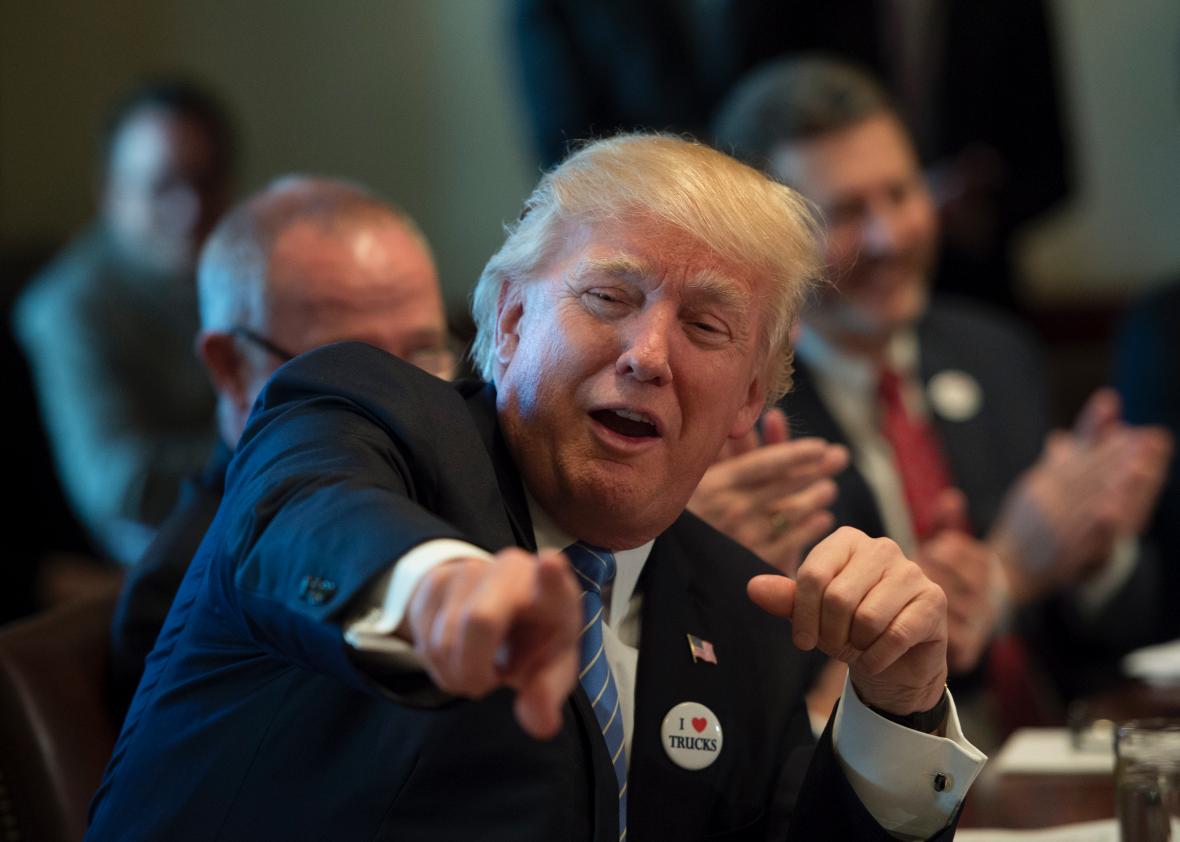
    President Donald Trump is coming to Vietnam on an official visit for the APEC meetings from November 10-11. He could have been in this country much sooner had he not avoided the draft during the Vietnam War.

    I am not sure President Trump knows where Vietnam exactly is on the map (which is quite usual for a lot of foreigners), but he will certainly fall in love with the country when he comes here this time, especially after hearing what I am about to disclose.

    Let me take this opportunity to send him a few words of regards and explain to him why I think so.

    But before I forget, let’s start with the same premise: one must be a member of the Communist Party of Vietnam to become the country’s leader.

    1. Forget about the Democrats: They are already extinct.

    The last time Vietnamese people saw a glimpse of a “democrat” was back in … 1988, when the fake Democratic party (yeah, we had such things back then – they were basically puppets formed by the communists themselves) disbanded under the order of the Communist Party. Basically, President Trump, you and your chosen party will enjoy absolute power here.

    The Vietnam’s Constitution clearly states that the Communist Party is the force which leads both the government and society. In fact, it is the only one ruling the country.

    So, no worries about the opposition. You’re far, far away from Hillary Clinton, Bernie Sanders, and Nancy Pelosi. You will win every election, and win big. When I say “big”, that means more than 90% of the popular votes where every single eligible adult in the country will vote, not just the “landslide victory” last year in the U.S.

    2. You have the entire Congress in your party’s hand, not just a simple majority.

    There is no need to battle with anyone in Congress. “Repeal and Replace” could be done very easily, right then and there. As well as the tax bill. And the annual budget bill. Basically, everything and anything.

    Congressional hearings are extremely rare for top leaders like you. Your cabinet members may be questioned by Congress, but in general, no one would throw stones in their faces like how the Democrats treat you, your staff, and the Republicans. Congress is also more laid back, as they only meet twice a year, each time for one month.

    How could Vietnam achieve such harmony between the Executive branch and the Legislative branch?

    Just imagine your Republican fellows occupy 95% of the seats in Congress and the remaining 5% are all your friends and good friends. This is because our unique election laws were designed to prevent non-communist candidates from running right from the first place. Nobody else but communist members and their close allies can go pass the three rounds of pre-election vetting, which of course are held by the communist-organized body called the Fatherland Front (such patriotic name, you will love it!).

    3. You don’t have to deal with the media because independent news does not exist.

    I know the media in the States is extremely annoying, and they just never leave you alone. Here in Vietnam, you are untouchable. What does that mean? It means you can do whatever and say whatever, not a single journalist dares to criticize you.

    Heaven on Earth! Why is that?

    Because you and your party control the entire media. So, there is no CNN, no Washington Post, no New York Times, leave alone Stephen Colbert and Trevor Noah. Only Fox News, Breitbart and the likes are allowed. Not only that, those that are allowed must also report news as they were ordered by you and your party. Imagine, even Steven Colbert must listen to and follow every word of yours! That’s true respect, isn’t it?

    Some crazy leftists at organizations like Freedom House and Reporters Without Borders may put your country at the bottom of the Press Freedom Index, but who cares, right?

    4. Just in case anyone criticizes you, you can always lock them up, for years.

    We have already put thousands of dissidents in jail already. In the past, we even made them…disappeared.

    Really, if you find anyone who writes some short statement about you on Facebook or Twitter that annoys you, then your police can come and arrest such person right away, then put him/her in jail for, says two years or more without trials. The courts – which totally under your direct control – could also sentence a lawyer to seven years of imprisonment if he dares to sue you. Or, they could put another lawyer who always criticizes you (imagine the ACLU and their lawyers, I know how much you hate them) in prison for five years because…he has criticized you.

    You often feel frustrated that it takes forever to lock up that woman, right? In Vietnam, we recently locked up a woman whom the government does not like very much in June – a female pro-democracy blogger called Mother Mushroom – for ten full years after a day of trial, sweet and simple. (By the way, your wife, Melania, gave Mother Mushroom the Women of Courage award earlier this year, though. So, I thought you would want to check with her on this, just to be safe.)

    5. There is no court that would stop you from issuing or enforcing executive orders.

    This is an interesting part. Of course, you must be very upset with those federal courts issuing restraining orders on your travel bans one after another. In fact, you also know that you must deal with Ruth Bader Ginsburg, Sonia Sotomayor, and others at some points. Furthermore, you cannot be certain whether Neil Gorsuch may turn his back on you one day and side with those leftists all the way on issues like abortion and affirmative action cases.

    But, here in Vietnam, every single judge will be your party’s members (I mean the “sworn allegiance to” kind of members, not just registered voters), and they will always obey your party’s rules from the top down. That means whatever is your call, they will follow. No questions asked!

    The so-called “judicial review” also does not exist in our country. A lot of executive orders and legal documents are clearly unconstitutional, but no one gives a damn. Let me give you an example.

    Four years ago, our Prime Minister Nguyen Tan Dung signed two decrees, 72 and 174, regulating that criticizing the government on the Internet was prohibited and could be fined up to $4,700 USD (about twice the average annual income for a Vietnamese). Those two decrees were not only unconstitutional, but also directly contradicting international human rights law, and were widely condemned by the international community, including your country back then. But so far, no one had been able to challenge them in any court in Vietnam because simply put, our judicial system was set up in such a way that such efforts would be futile from the beginning: no courts will accept those filings. Problems solved.

    6. The term “special prosecutor” is non-existent and will never come into existence.

    Investigating our country’s top leaders is absolutely impossible. In fact, none of them has been in such situation since the Communist Party took power in 1945.

    You would love this fact: Vietnamese prosecutors cannot investigate any communist member without the party’s permission. Thus, it is outright prohibited! Nobody is going to thumb their nose into your and your family’s business.

    There is no Robert Mueller here, believe me. Never.

    7. Tax returns? They are there, but rules don’t apply to you.

    In Vietnam, everyone knows our leaders are rich. Maybe some of them are even as rich as you are. But no one knows exactly how rich they are, and no one dares to ask them to show their tax returns.

    We have a huge (I mean really, bigly huge) problem with transparency. Another left-wing (perhaps fake?) organization called Transparency International ranks Vietnam at 113/176 on their Corruption Perceptions Index in 2016 with only 33/100 scores. But that’s a good thing for you, right?

    If you are the top leader in Vietnam, you don’t have to bother with the media complaining about your frequent flights to Mar-a-Largo or how much money you have made off your presidency because no one will have the guts to ask. And those who do, you can just put them in jail. What a life!

    8. Last, but not least: Endless golfing.  

    This, nevertheless, is as important as anything I have mentioned above. You love golf, and we, the Vietnamese, do too. We basically have golf courses popping up at every single corner across our country. And, you can play golf as much as you want, just remember to not disappear for too long during your term. The public doesn’t even know you go play golf, let alone complain about it – because there is no “fake news” here to report on that, only your news, remember?

    Is this the vision of the great country that you have been talking about, or perhaps, maybe dreaming of?

    Then, President Trump, welcome to Vietnam!

  • New Report: Four Ways the Vietnamese Government Controls Religious Practitioners

    New Report: Four Ways the Vietnamese Government Controls Religious Practitioners

    A new report suggests that there are four methods the Vietnamese government uses to control the practice of religion in the country: 1) using legal documents and other administrative regulations; 2) using the propaganda apparatus; 3) dividing to rule; 4) using physical violence (beating, intimidation, imprisonment).

    The report, “Assessment of the 2016 Law on Belief and Religion in relation to the Exercise of the Right to Freedom of Religion and Belief in Vietnam”, was researched and written by journalist Pham Doan Trang and other members of the Religions Research Group – an independent civil society group in Vietnam.

    Not only pointing out the government’s tactics, the report also analyzes the Vietnam’s Law on Belief and Religion 2016 and compares it to the international human rights standards.

    The report in English is available to download here (PDF) with the authors’ consent.

    The Vietnamese version of the report can be found here.

  • Vietnam Government Claims to Work with Google and Facebook to Remove Thousands of Anti-government Content

    Vietnam Government Claims to Work with Google and Facebook to Remove Thousands of Anti-government Content

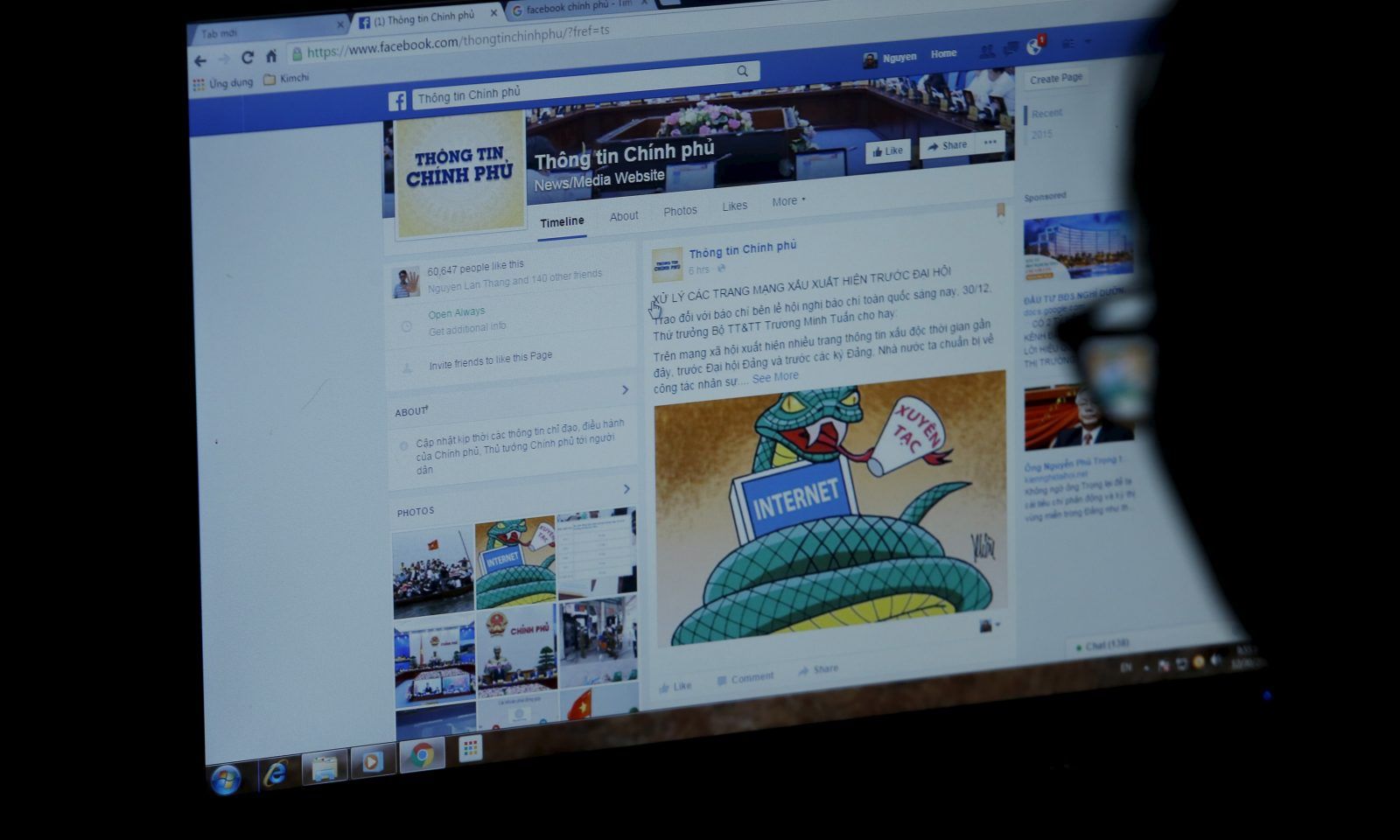
    Vietnam’s head of the Internet management authority, Nguyen Thanh Lam, has repeatedly claimed that the government has been working with Facebook and Google to remove thousands of videos and accounts from these tech giants’ platforms, according to the country’s mainstream media.

    During a press conference on July 7, 2017, the former prominent journalist made the announcement that Youtube, a Google’s product, had removed 3,000 video clips that contained “toxic content” and Facebook had also removed 600 accounts that were fake or contained information that distorted individuals and organizations.

    Among those 600 accounts are 132 accounts that frequently distorted or smeared the Communist Party, the government, groups, and individuals, VietNamNet reported.

    In an interview with VietNamNet, Nguyen Thanh Lam also expressed his appreciation to Google and Facebook for their cooperation with the Vietnam’s government.

    “They understand why we made such requests”, said Mr. Nguyen.

    Facebook sent Monika Bickert, Head of Global Policy Management, to Vietnam on April 26 to meet with the Minister of Information and Communication Truong Minh Tuan. According to the Vietnam News Agency, Ms. Bickert told the minister that Facebook was willing to cooperate with the Vietnamese government to block toxic content that violates the local laws.

    During the meeting, the Facebook’s representative also made a commitment that they would create a separate channel to process Vietnam’s requests.

    A month later, Eric Schmidt, the Chairman of Google’s parent company Alphabet Inc., met Prime Minister Nguyen Xuan Phuc in Hanoi. He reportedly said that “Google will cooperate with the government” to prevent and remove bad information on Youtube.

    Mr. Nguyen Thanh Lam noted that it had been easier to convince Youtube than Facebook: “There was toxic information that Youtube already removed or blocked but Facebook does not”.

    We found no information about Vietnam’s requests in 2017 on Google Transparency Report and Facebook’s Government Requests Report, potentially because they have only released reports until 2016.

    The Google’s report shows Vietnam has made five content removal requests to Google since 2010. It is not confirmed that Google has actually cooperated with the Vietnamese government to remove the mentioned contents.

    However, the tech giant’s website highlights two content removal requests made by the Vietnamese government. One is a blog that “allegedly contained information about the military and criticized the government”, and one is “to remove search results on a particular word that generated results that contained allegedly unflattering depictions of past Vietnamese leaders.” Google declined both requests.

    It has been 20 years since Larry Page and Sergey Brin created Google. It is the same period of which Vietnam has been connected to the Internet. The country currently has approximately 50 million Internet users which amount to more than half of the population, and 45 million Facebook users. Both platforms are the most popular search engine and social network in Vietnam respectively.

    Yet, the two tech giants are now considered as real threats to the government as they help people access uncensored information about the communist regime and generate political discussions.

    In October 2013, Dinh Nhat Uy – the brother of a jailed activist – was sentenced to one year and three months of probation only for using Facebook to criticize the government.

    A prominent human rights activist, blogger Nguyen Ngoc Nhu Quynh (Mother Mushroom), was also sentenced to 10 years of imprisonment in June 2017 partly for posting articles that “contain untruthful and baseless information” about the Communist Party and its sole-leadership over the political system of Vietnam.

    The government usually uses three internationally-condemned criminal provisions, Article 79, 88 and 258, to put dissidents and activists in jail.

    Not only criminalizing online expression, Hanoi also puts administrative sanctions on those who voice their dissents on the Internet. Websites’ owners, social networks, and Internet users may be fined up to US$4,700 for “criticizing the government, the Party or national heroes” or “spreading propaganda and reactionary ideology against the state”

    Many Facebook users and bloggers have been fined under these regulations, according to a Freedom House’s report.

    It is significant to note that the Vietnamese government has made claims about receiving cooperation from Google and Facebook since early 2017, in the middle of a new crackdown on the democracy movement that has led to at least 16 activists and dissidents being arrested or convicted.

    In 2014, Vietnam was named as an enemy of the Internet by Reporters Without Borders, a France-based human rights organization.