Author: demo_admin

  • Religion Bulletin, May 2021: A Protestant Church Was Accused Of Spreading COVID-19

    Religion Bulletin, May 2021: A Protestant Church Was Accused Of Spreading COVID-19

    Samples are taken for testing at the alleyway in which the Phuc Hung Missionary Church organizes weekly religious activities. Photo: Doc Lap/Thanh Nien Newspaper.

    [Religion 360*]

    COVID-19’s effect on religious activities: Criminal proceedings brought against a Protestant church

    The May 2021 resurgence of COVID-19 in many provinces and cities around Vietnam has affected religious activities to a large degree.

    On May 26, 2021, Ho Chi Minh City (HCMC) discovered positive cases among the Phuc Hung Missionary Church members. [1]

    One day later, Nguyen Duy Tan, head of the municipal Religious Committee, stated that this Protestant church had been permitted to hold religious gatherings at a private residence, with 28 members registered. [2]

    According to Tan, the church conducted four sessions in May, all according to proper municipal social distancing guidelines and with 20 participants each; however, the site was possibly limited in space. The source of the outbreak has yet to be confirmed.

    https://2xjs7y10oiyz26vqxu2hok6y-wpengine.netdna-ssl.com/wp-content/uploads/2021/06/image-15.jpeg
    Phuc Hung Missionary Church in Go Vap District, HCMC. Photo: Doc Lap/Thanh Nien.

    It was not until May 30 that Go Vap district police in HCMC charged the Phuc Hung Missionary Church with “spreading infectious disease.” [3]

    Police stated that church members did not properly comply with COVID guidelines and made incomplete declarations.

    A day before police initiated criminal proceedings, the HCMC Center for Disease Control accused church representatives of misreporting the actual number of church members. [4] Many church members made no declarations until they showed signs of illness.

    The Vietnamese press rapidly reported on the number of infections originating from the Phuc Hung Missionary Church [5], to whom the Ministry of Home Affairs attributed responsibility.

    Immediately after announcing criminal proceedings, the Ministry of Home Affairs proposed in a meeting regarding the COVID situation in HCMC that the city suspend the church’s activities, and pending the investigation results, possibly revoke its permit and eliminate its registration. [6]

    In addition to the situation involving the Phuc Hung Missionary Church, on May 26, 2021, provincial authorities in Bac Giang coerced an F1 member (someone who has been in contact with a Covid-19 positive person) of the World Mission Society Church of God into a quarantine zone. [7] The media published a video of the authorities using a construction crane to apprehend the individual forcibly.

    According to government sources, the woman purposefully avoided making a health declaration and tried to evade quarantine. Authorities stated that the individual was a member of the World Mission Society Church of God and accordingly had differing views on quarantine and health declarations.

    The World Mission Society Church of God is a religious group whose activities are not authorized by the state.

    At the beginning of May, the Ministry of Home Affairs promulgated an official document on the methods religious organizations should use to prevent and control the spread of COVID. [8] As a result, religious organizations have had to cease gatherings even in locations with zero cases unless the authorities deem a gathering necessary.

    On May 28, the Government Committee for Religious Affairs reported that the leaders of 43 religious organizations had vowed to the committee and the Ministry of Home Affairs to comply with disease control and prevention directives. [9] As such, religious organizations have restricted gatherings, declined clergy coming from overseas, practiced social distancing, worn masks, and used disinfectants.

    Vietnamese state media accuses the U.S. State Department’s 2020 Report on International Religious Freedom of misrepresentation, slander

    https://2xjs7y10oiyz26vqxu2hok6y-wpengine.netdna-ssl.com/wp-content/uploads/2021/06/image-1.png
    Articles (left to right) from VOV, People’s Public Security, and the People’s Livelihood criticizing the U.S. State Department’s Report on International Religious Freedom. Photo: screenshots.

    More than two weeks after the U.S. State Department announced its annual Report on International Religious Freedom, the Vietnamese state media began publishing a series of articles in response.

    Voice of Vietnam’s online newspaper criticized the U.S. State Department, stating that it was using inaccurate information provided by a human rights organization based in the United States, BPSOS (Boat People SOS). The newspaper stated that the United States continued to demonstrate a subjective view of the religious situation in Vietnam and that it was slandering the Vietnamese authorities by accusing them of suppressing religion. [10]

    The article stated: “Vietnam rejects the [U.S. State Department’s] one-sided, condemnatory, and subjective approach regarding faith and religion in the country”.

    Sharing the VOV’s views, the People’s Public Security Newspaper published an article titled “Exposing the false reports on freedom of belief and religion in Vietnam”. [11]

    The newspaper stated that the report’s accusations of repression and strict control of freedom of religion were “slanderous and lacking in objectivity; the U.S. State Department and the U.S. Commission on International Religious Freedom (USCIRF) are taking advantage of issues regarding freedom of faith and religion to disrupt national unity”.

    Similarly, the People’s Livelihood Newspaper, belonging to the Ministry of Labor, Invalids, and Social Affairs, also criticized the U.S. State Department’s report as lacking in objectivity and misrepresenting the situation regarding religious freedom in Vietnam. [12]

    The U.S. State Department’s Report on International Religious Freedom was released on May 12, 2021, published annually. [13]

    This year’s report contained several accusations regarding the Vietnamese government’s strict control over freedom of religion, its suppression of independent religious organizations, its punishment of religious activists, and its use of laws and administrative procedures to limit freedom of religion. According to the report, religious activities in the Central Highlands and the northern mountainous areas continue to be tightly controlled. Land disputes between religious organizations and the state were highlighted in detail.

    The Vietnamese state press’ vehement rebuttal of the United States’ Report on International Religious Freedom has become routine. USCIRF’s previous reports were met with a similar reaction.

    [The Government’s Reach]

    Religious training institutions must teach history and law according to the Government Committee for Religious Affairs’ curriculum

    In January 2021, the Government Committee for Religious Affairs began transferring lectures on Vietnamese history and Vietnamese law to religious training institutions in some provinces and cities, including Hanoi, [14] Nam Dinh, [15] Dong Nai, [16] An Giang, [17] and Bac Lieu. [18]

    According to Article 37 of the 2016 Law on Faith and Religion, religious organizations must teach Vietnamese history and Vietnamese law to establish a religious training institution.

    In February 2020, the Government Committee for Religious Affairs promulgated the teaching curriculum for these two subjects (Decision 35/QD-TGCP). It required their implementation in religious training institutions (including secondary schools, colleges, institutes, and major seminaries). [19]

    https://2xjs7y10oiyz26vqxu2hok6y-wpengine.netdna-ssl.com/wp-content/uploads/2021/06/image-2.png
    The Government Committee for Religious Affairs’ two books on history and law. Photo: Vietnamese Buddhist Church.

    Before this, the teaching of the two subjects was implemented by the religious training institutions themselves, with many different reference materials. We have observed large differences between the training objectives of the Government Committee for Religious Affairs and those of several religious training institutions.

    In the Government Committee for Religious Affairs’ curriculum, the training objectives of these two subjects are to induce religious leaders to abide by the state’s laws on religion and have them fulfill their obligations to the country.

    The Government Committee for Religious Affairs stipulates that all skills learned from studying history are “to serve as applied knowledge […] to live and work responsibly, and to carry out the rights and duties of citizens towards their homeland”.

    On the other hand, the training objectives for history at the Buddhism Institute in HCMC are to equip students with historical knowledge, research skills, and historical event analyses. [20]

    The Government Committee for Religious Affairs also stipulates how to teach these two subjects to develop compliant attitudes towards the state’s laws on faith and religion.

    Controlling the training activities of religious institutions is among the Government Committee for Religious Affairs’ ambitions. Requiring institutions to teach history and law according to their curriculum is a step in that direction.

    In January 2021, in an article published in State Organizations Magazine, [21] the vice minister of home affairs and the head of the Government Committee for Religious Affairs, Vu Chien Thang, highlighted one of the functions of the 2021 promulgation: “Review and evaluate the activities of religious training institutions; do not allow ‘unregulated’ training or travel overseas for illicit training”.

    Thang also confirmed in the article that in 2020, the Ministry of Home Affairs had succeeded in influencing religious organizations to choose church leaders who were close to the government.

    Party newspaper praises role of special civil force in controlling religious activities in the highlands

    At the end of April 2021, the Vietnamese Communist Party’s online newspaper published articles introducing the state’s special civil force. [22]

    According to the newspaper, the special civil force effectively provides information and advises the state in many goals, including controlling religions in the highlands. This civil force is deemed to have the “persons of prestige”.

    https://2xjs7y10oiyz26vqxu2hok6y-wpengine.netdna-ssl.com/wp-content/uploads/2021/06/image1-1.jpg
    General Secretary Nguyen Phu Trong meets with village elders, chiefs, dignitaries, and persons of prestige who participated in the program “Village Fulcrums” in 2018. Photo: Committee for Ethnic Minority Affairs.

    According to the Committee for Ethnic Minority Affairs, “persons of prestige” number 30,247 individuals in 52 provinces and cities in 2020. Provinces with numerous mountainous areas have the highest number of “persons of prestige.” [23]

    “Persons of prestige” appear in many of the state’s administrative occupations (the Fatherland Front, police, leaders of the ethnic minority, and religious positions, etc.). [24] Among their tasks is informing the state on noteworthy activities in their communities, including those to do with religion and security and order.

    Also, according to the Vietnamese Communist Party’s E-Newspaper, in past years, “persons of prestige” have made important contributions to eliminating false religions and obstructing illicit religious propaganda. [25]

    The criteria for choosing “persons of prestige” is stipulated in Decision #12/QD-TTg, issued by the prime minister on March 6, 2018. [26]

    According to the document, “persons of prestige” are normally cadres, civil servants, officials, members of the armed forces who have made many contributions and are no longer active, dignitaries, religious functionaries, village elders, heads of lineages, businessmen, professors, researchers, and individuals of economic standing who are respected by the community.

    Furthermore, requirements to become a “person of prestige” include consistently executing the state’s laws and regulations and carrying out activities of a communal nature, with notable comprehension of and influence within one’s community.

    The series of articles from the Vietnamese Communist Party E-Newspaper reveal that this special civil force will focus on development moving forward. They are seen as a force to help the state control civil activities that might affect national security, especially in mountainous areas.

    [Did You Know?]

    Protestantism has many independent churches: a perfectly ordinary fact

    The recent incident involving the Phuc Hung Missionary Church has raised public concerns about independent religious groups.

    Immediately after Vice Minister of Home Affairs, Vu Chien Thang, stated that the Phuc Hung Missionary Church was not a religious organization, newspapers emphasized this detail to attract readers, spreading incomplete information. For example, Thanh Nien Newspaper published the headline: “Breaking: ‘Phuc Hung Missionary Church’ was merely a gathering place, its head was not a pastor.” [27] In the same vein, the Ministry of Health’s news page reposted information from the Family Newspaper with the headline: “SHOCKING: Phuc Hung Missionary Church not a religious organization.” [28]

    The press’ incomplete information regarding the Phuc Hung Missionary Church’s type of organisation caused the public to develop unsympathetic views towards Protestant religious groups.

    According to the Government Committee for Religious Affairs, Protestantism advocates building independent churches with various organizational models, depending on the sect. It could be a centralized model with grassroots churches, like the Protestant Church of Vietnam (Southern branch). [29] Grassroots churches are imbued with the power to manage their own affairs in the spirit of independence, self-sustenance, and self-transmission. In particular, Protestantism does not prevent its followers from joining other sects or splintering off to operate independently.

    The HCMC Committee for Religious Affairs reported that the city had 145 groups that operated like the Phuc Hung Missionary Church. These groups were all legally registered with the local authorities as stipulated by the 2016 Law on Faith and Religion.

    Vietnam maintains a complex, multi-step process for groups to be recognized as religious organizations. Currently, there are only nine Protestant religious organizations recognized by the state, all of which operate using a centralized model with grassroots churches. [30]

    Protestant churches not yet recognized by the state can still operate by registering their places of assembly and religious activities.

    In 2018, there were approximately 70 Protestant organizations yet to be recognized as religious organizations by the state due to their failure to meet the requirements set out by the Law on Faith and Religion. [31] These organizations have about 79,000 followers, 75.9 percent of whom are in Binh Phuoc Province, the Central Highlands, and the northern mountainous regions.

    Furthermore, the government has deemed illegal some Protestant organizations, such as the Vietnam Church of Christ in the Central Highlands, regularly obstructing their activities and suppressing their members.
  • Vietnam: How Powerful Is The Prime Minister?

    Vietnam: How Powerful Is The Prime Minister?

    Among the “four pillars,” the position of prime minister possesses both power and prestige.


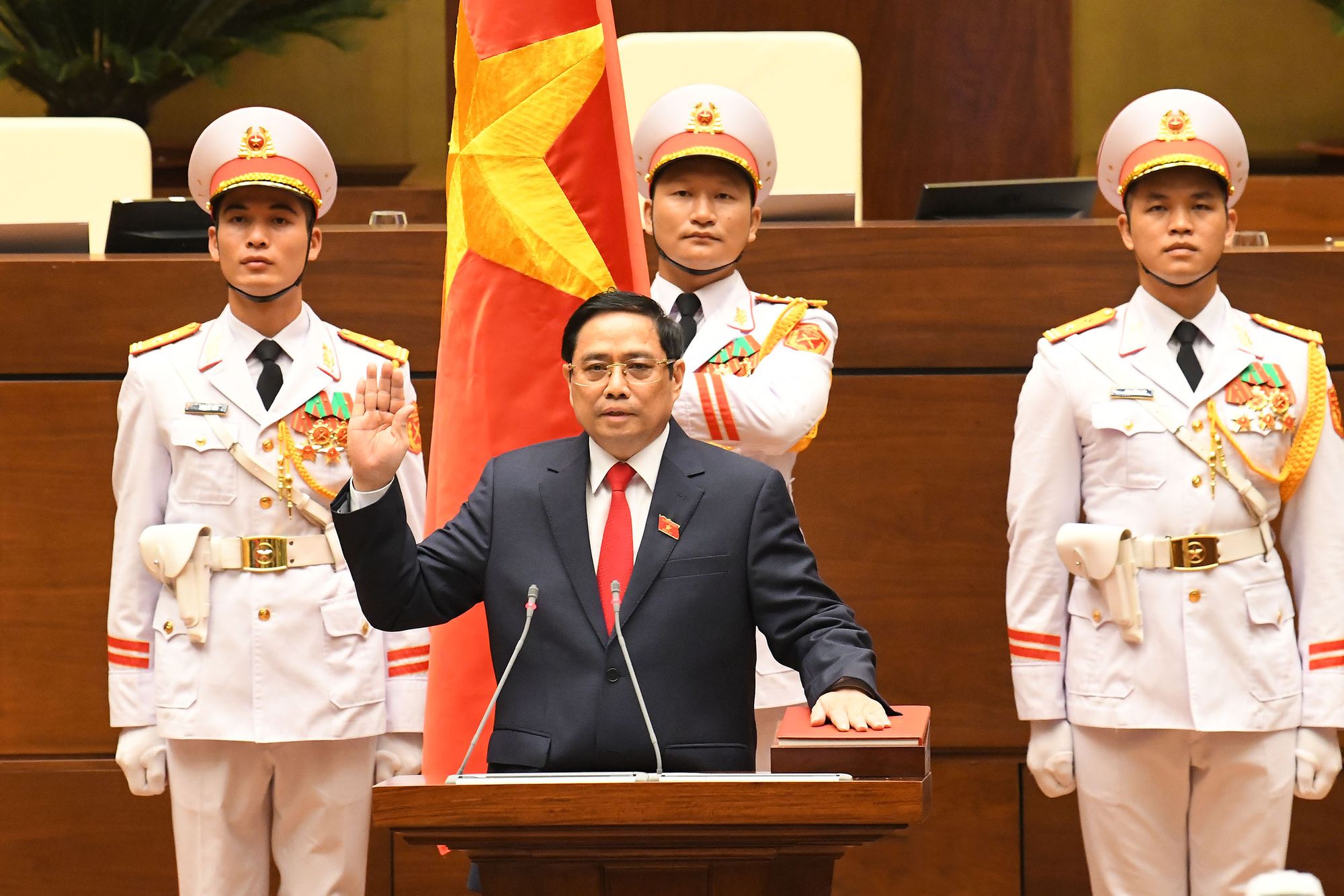
    In the spring of 2021, Vietnam has a new leader: Pham Minh Chinh, a former police intelligence officer and former head of the Vietnamese Communist Party’s Central Organization Commission. On July 26, 2021, Pham Minh Chinh, once again, takes his oath to be the prime minister of Vietnam for the next 5 years.

    One amongst “four pillars of the imperial court”

    In the article “A few things you should know about Vietnam’s National Assembly chairmanship,” we wrote about the formation of the institutional division of power known as the “four pillars,” which includes the general secretary, the state president, the prime minister, and the chairman of the National Assembly.

    If the state president and the chairman of the National Assembly, two among four of the most powerful positions in the Vietnamese Communist Party hierarchy, serve as primarily ceremonial positions, then the prime minister has both pomp and power, possessing broad authority in the governing system.

    The prime ministership was once a position without any notable power. Before Prime Minister Vo Van Kiet’s term (1991-1997), previous prime ministers left a very little mark, except for Ho Chi Minh – who served as both state president and prime minister from 1946-1955.

    Prime ministers after him, such as Pham Van Dong (1955-1987), Pham Hung (1987-1988), and Do Muoi (1988-1991), all served during periods where the government functioned according to the direction and management of the Party, rather than with tools of the executive branch. The same could be said during periods where Ho Chi Minh and Le Duan had overwhelming individual influence over the Party, causing other institutions and positions, including the prime ministership, to be subservient.

    In the 1980 Constitution, the government was called the Council of Ministers, with the prime minister position changed to the chairman of the Council of Ministers. This was an institution of collective leadership, with the powers of the chairman being minimal. With the 1992 Constitution, Vietnam reverted to the government mechanism in which the prime minister was head, concentrating greater power in his hands rather than practicing collective decision-making as in the past. Vo Van Kiet was the first prime minister to enjoy the new system under the 1992 Constitution.

    With the depth and broadness of economic reform, the government’s role in managing national affairs grew by the day to more quickly, effectively, and dynamically respond to domestic and international developments. This increase in authority also served to more adequately address the increasing importance of foreign affairs in the age of globalization. The position of prime minister, thus, became extremely powerful. Nguyen Tan Dung (2006-2016) is seen as the most powerful prime minister ever and once competed fiercely for the position of general secretary.

    Who elects the prime minister?

    Vietnam’s central government is modeled on the parliamentary system, with the central role (theoretically) held by the National Assembly. Constituents elect members of the National Assembly, and the National Assembly elects the government’s leadership figures, including the prime minister. (Obviously, everyone knows who actually “elects” the members of the National Assembly and the prime minister). The prime minister must be a member of the National Assembly.

    Normally, electing the prime minister occurs during the first session of the new National Assembly term, after the general election, which occurs after the Party congress. In 2016, the procedure took an unusual turn: the National Assembly elected the new prime minister in the last meeting of its term in April, preceding the general election by more than a month. After the general election, the new National Assembly then repeated the election of the prime minister one more time. Nguyen Xuan Phuc was sworn into office twice in 2016. Pham Minh Chinh also had the same experience in 2021.

    How powerful is the prime minister?

    The prime minister’s powers are stipulated in Article 98 of the Constitution and Article 28 of the Law on Government Organization (ratified in 2015 and amended in 2019).

    As head of state administration, this position has broad authority, from enforcing laws and organizing personnel to proposing and distributing the budget.

    As a unitary state, the central government has overarching authority, with the prime minister’s power extending from the center all the way to the provinces and cities.

    Outside his separate authority, the prime minister also has general authority over the collective decisions and resolutions of the cabinet.

    For more details, please see the two documents described above. Here, we would like to list a few of the prime minister’s decision-making powers to demonstrate just how influential this position is in the economic sphere:

    ·      Regarding land: has the power to establish a council to assess land usage programs and plans at the national level; approves changes in land usage purposes on rice cultivation fields 10 hectares and above, protected and special-use forest land 20 hectares and above; decides the policy framework for compensation, support, and resettlement in special cases; decides price tables for province-level land in many cases; decides on several cases in which the usage rights for land the state allocates or leases are not auctioned.

    ·      Regarding investment: has the power to approve investment plans on the scale of airports, ports, oil and gas rigs, large urban areas, industrial zones, and export processing zones; approves investment plans overseas in banking, insurance, stocks, and telecommunications…from 400 billion dong and above, along with other projects involving capital of 800 billion dong and above.

    Is prime minister the highest attainable position?

    No. In the party power hierarchy, the general secretary remains at the top and is the most powerful position overall.

    There has never been a prime minister who has risen to become general secretary, except for Do Muoi, who was the chairman of the Council of Ministers. Nearly all served only one or two terms before retiring, except Nguyen Xuan Phuc, who served as prime minister and then stepped down to become state president, a much less powerful position.

    This article describes the power of the prime minister, but in actuality, we have only spoken of it in legal terms and in relation to the order of power in the party. The position’s power is also dependent on the individual’s level of influence within the party.

    To put it another way, a leader’s power is the sum of his or her institutional power and individual sway. If the system bestows power but the individual leader doesn’t have the ability to wield it properly, then he does not have much power at all. Conversely, the system can bestow limited power, but an individual can exercise influence beyond his institutional limits.


    This article was written in Vietnamese by Trinh Huu Long and was previously published in Luat Khoa Magazine on April 6, 2021. The English translation was done by Will Nguyen.

  • Vietnam’s State President: The Captain But Not Really A Captain

    Vietnam’s State President: The Captain But Not Really A Captain

    In Vietnam, the position of state president is like that of a ship captain who completely got separated from the helm.


    During his single term as the prime minister, Nguyen Xuan Phuc became popular in the news for his words and promises to transform many provinces and cities in Vietnam into “captains,” from “economic captain” to “developmental captain.” Now, he himself has become the captain of Vietnam, as he accepted the position of state president – the legal head of state.

    But like many other captains of years past, his position as the “captain” of Vietnam is not what it appears. Yes, he will work from No. 2 Hung Vuong Street in Hanoi’s old French palace that dates more than 100 years, where French governors-general and President Ho Chi Minh once sat, but he won’t have much real power.

    “The four pillars” and the parliamentary system

    The state president is normally drawn from the Politburo of the Vietnamese Communist Party-normally, but not always. The exception is Ton Duc Thang, who succeeded Ho Chi Minh and served from 1969 to 1981. Ton Duc Thang was only a Party Central Committee member.

    In history, the most powerful state president of Vietnam was undoubtedly Ho Chi Minh, who held the position for more than 23 years, from 1946 until he died in 1969. During his years of greatest power, Ho Chi Minh also held the highest leadership position in the Communist Party and the position of prime minister until 1955. Between 1955 and 1960, Ho resigned as prime minister but held onto two other positions within the Party: party chairman and general secretary.

    From 1960 onwards, Ho remained the party chairman and state president, but with the rise of Le Duan and his ascension to power, Ho Chi Minh was no longer the center of Vietnam’s political life. From then onwards, the role of state president slowly became largely ceremonial.

    Ton Duc Thang, who was not elected into the Politburo, of course, held the position of state president, but he did not have much influence. His successor, Vo Chi Cong, on the other hand, was a member of the Politburo. But at the time, people didn’t call the position “State President,” but rather, “State Council President,” the council being an institution of collective leadership similar to the collective leadership structure of the Council of Ministers; this structure was originally borrowed from the Soviet Union and Eastern Europe and was incorporated wholesale into Vietnam’s 1980 Constitution.

    It was perhaps the next president, Le Duc Anh (1992-1997), who carved out a noteworthy role for the position of state president when he turned the role into an individual leadership position rather than a collective one. With his powerful influence derived from his time as defense minister, Le Duc Anh, along with General Secretary Do Muoi and Prime Minister Vo Van Kiet, formed what journalist Huy Duc calls the “tripartite division of power.” At the time, the “four pillars” had yet to take shape clearly; it was not until the leadership transition in 1997 that this was established.

    In actuality, the designation “four pillars” refers to the order of power within the Party. At the same time, the position of the state president in a parliamentary system such as Vietnam’s is a formality that only carries ceremonial value rather than any real power.

    What does it mean to be ceremonial?

    The parliamentary system is special in that the person who leads the state (head of state) is not the head of the cabinet. For example, in nearly all European countries, the head of the cabinet is the prime minister, who is simultaneously the majority leader in parliament; the head of state is either the president or the king/queen. We can see that Germany, Belgium, Denmark, and the United Kingdom all have prime ministers as their central political leaders rather than presidents or kings/queens.

    Vietnam is similar. The state president is the head of state, which according to its Constitution is “the person who leads the state, who represents the Socialist Republic of Vietnam domestically and in foreign affairs.” However, the person who leads the state administration is the prime minister, who possesses far-reaching power, as we have analyzed in the article “Vietnam: How powerful is the prime minister?”

    The Constitution grants the state president a number of limited powers that do not appear lacking, but in practice, are quite lacking. These powers include promulgating the Constitution, laws, and decrees, abilities that very much resemble veto power over decrees; numerous powers that relate to proposals to the National Assembly to elect or remove individuals from the highest positions in government; and above all, power as commander-in-chief of the armed forces.

    “Commander-in-chief”sounds enormously powerful. But the command of Vietnam’s armed forces has never laid with the state president; it actually lies with the Politburo and the Central Military Commission (CMC). In recent times, the secretary of the Central Military Committee has always been the Party general secretary, while the deputy minister of the CMC has been the minister of defense. The state president is simply a standing member of the CMC. Nguyen Phu Trong has been the only individual to hold both Party general secretary and state president positions while concurrently serving as the secretary of the CMC.

    Thus, the state president does not actually hold any guns. He doesn’t hold the purse strings either, because control of the treasury is held by the prime minister. The authority of the state president, then, lies in approving military promotions, bestowing awards and honors, and deciding on issues related to citizenship, reprieves, and diplomatic protocols, etc.

    With limited powers, Vietnamese presidents after Ho Chi Minh have never fully exercised their powers on thorny issues, such as dismissing a number of high-ranking positions in the government and the military or vetoing an ordinance from the National Assembly’s Standing Committee.

    Though it has transitioned from a collective leadership role (in the State Council) to an individualized one, the position of state president still represents the collective in announcing decisions and lacks the broad, active powers of the prime minister.

    The real power of the state president perhaps lies in the fact that he has his feet in both the Politburo and the CMC. If it weren’t for this straddling, the state president would be merely a puppet. Thus, when examining the actual power of a Vietnamese political leader, it is not enough to look to the law; one must also look at his or her power within the Party and the individual influence he or she has.

    Nguyen Xuan Phuc has bestowed the title of “captain” on many provinces and cities as his way to encourage them to develop and prosper, though perhaps these provincial and municipal leaders have yet to understand how they were called “captains.” Nguyen Xuan Phuc now has also assumed the position of head of the ship, but he is also no captain.


    This article was written in Vietnamese by Trinh Huu Long and was previously published in Luat Khoa Magazine on April 7, 2021. The English translation was done by Will Nguyen.

  • A Few Things You Should Know About Vietnam’s National Assembly Chairpersonship

    A Few Things You Should Know About Vietnam’s National Assembly Chairpersonship

    Though it is one of the “four pillars” of the Vietnamese government, the National Assembly chairpersonship remains the weakest position.


    Vietnam’s National Assembly has been preparing to change its window dressing in late March 2021. No need to wait until the general election wraps up in May 2021; the National Assembly chairmanship had a new occupant in the final days of March. To reaffirm that the election in May did not change Vietnam’s political situation, July 20, 2021 would mark Vuong Dinh Hue’s continuation to serve the same leadership position as the National Assembly chairman for the next 5 years when it re-elected him.

    One amongst the “four pillars of the imperial court”

    Beginning in the mid-1980s, Vietnamese politics slowly moved beyond the individual leadership model and the overpowering influence of Ho Chi Minh and his successor Le Duan. This, in combination with the economic reform process, led to the gradual development of a new institutional division of power. Over time, supreme power was divided among four positions: the general secretary, state president, prime minister, and chairperson of the National Assembly.

    Today, as war has receded into the distance and demands to join the international community grow, the political system functions have begun trending towards laws of the state rather than the directives of the Vietnamese Communist Party. As such, the National Assembly increasingly plays a larger and more dynamic role in the political system.

    However, it wasn’t until 1992, when Nong Duc Manh was elected as National Assembly chairman, that a member of the Politburo occupied the position. Before that, Truong Chinh – a Politburo member – served as chairman of the National Assembly Standing Committee from 1960 to 1981. Still, as stated above, the National Assembly did not play a large role during that time, though it’s hard to say that its role today is large either.

    The National Assembly chairmen after Truong Chinh all worked their way up to become members of the Party Central Committee (such as Le Quang Dạo) or outside the Party Central Committee altogether (e.g., Nguyen Huu Tho).

    All National Assembly chairmen from Nong Duc Manh onwards were members of the Politburo. Though its numbers are among the “four pillars,” the National Assembly chairmanship remains the weakest position and must abide by party decisions.

    Launchpad to power

    Of the five National Assembly chairmen since 1992, two have become general secretary of the VCP’s Central Committee – the highest position in the entire political system: Nong Duc Manh (2001 – 2011) and Nguyen Phu Trong (2011- present).

    In stark contrast, the prime minister’s office has been unable to propel its occupant any further. One after the other, Vo Van Kiet, Phan Van Khai, and Nguyen Tan Dung became prime ministers and then retired, failing to make it to the general secretary. The exception is Nguyen Xuan Phuc, who, rather than retiring after serving as prime minister, is set to become state president; that is, he is taking one step down the ladder of party power.

    Is the National Assembly chairman the “boss” of the National Assembly representatives?

    No.

    In principle, the National Assembly chairman is simply a member of the National Assembly, with all members being equal and everyone retaining one vote. No representative can force another representative to do his or her bidding. The National Assembly chairperson cannot issue any order to a representative, except for limited powers during work assignments with vice National Assembly chairpersons.

    Then what does the National Assembly chairman do?

    He or she mainly coordinates the activities of the National Assembly and the National Assembly’s Standing Committee, presiding over meetings and sessions and ratifying adopted constitutions, laws, resolutions, and ordinances.

    For more details, please see Vietnam’s Constitution and the Law on National Assembly Organization.

    The National Assembly chairman also usually acts as head of the National Electoral Council. This arrangement contains a conflict of interest when a representative (and often also a candidate) organizes elections. In democratic countries, the council must, in principle, be independent of the National Assembly.

    A position almost always reserved for men

    Of the 11 National Assembly chairpersons in Vietnam’s modern history, the only woman to serve in this position was Nguyen Thi Kim Ngan, who held the position from 2016 to 2021. But truth be told, Ngan is the only woman to have ever served as one of the “four pillars.”

    Her predicted successor, Vuong Dinh Hue, will carry on the near-exclusive tradition of men being at the helm of the National Assembly.

    Hue has served as minister of finance (2011-2012), head of the Central Economic Committee (2012-2016), deputy prime minister (2016-2020), and secretary of the Hanoi party committee (2020-current). He has been a member of the Politburo since 2016.


    This article was written in Vietnamese by Trinh Huu Long and was previously published in Luat Khoa Magazine on March 30, 2021. The English translation was done by Will Nguyen.

  • Vietnam Briefing: COVID-19 Is Surging Again While The Government Is Trying To Tighten Internet Control

    Vietnam Briefing: COVID-19 Is Surging Again While The Government Is Trying To Tighten Internet Control

    The Vietnam Briefing, which is released every Monday morning Vietnam time, looks at Vietnam’s political developments of the past week.


    While the situations in the US and Europe are rapidly reaching a state of normalcy, COVID-19 cases are, once again, surging in Vietnam

    It is unclear if the biggest story last week was the new surge of COVID-19 or the national football team’s journey in the World Cup qualifying round. Football seems to be a religion in Vietnam where one of the most circulated newspapers praised the team’s victories as a vaccine for the nation. But here we go, stories about COVID-19:

    • According to John Hopkins University’s data, the number of cases has reached an all-time high with 470 new cases on June 19, increasing the total number of cases to 13,117 and 64 deaths.
    • Ho Chi Minh city has been under lockdown since the beginning of May 2021.
    • Vietnam has received 500,000 Sinopharm vaccine doses donated by China. Naturally, this raises concerns among the public about the safety of the shots.
    • A few days earlier, nearly one million AstraZeneca vaccines were shipped to Vietnam as a donation from the Japanese government. The Vietnamese public warmly welcomed this.

    Read more about this topic:


    A national code of conduct for social media

    The pandemic has been a time of tightening internet controls in Vietnam, especially regarding social media. The Minister of Information and Communications issued a national code of conduct for social media on June 17 to push for what they call a “healthy” internet environment. This is what it says:

    • Users should behave appropriately under the good moral, cultural, and traditional values of the Vietnamese nation.
    • Users should provide their real identity and should only share news from trusted and mainstream sources of information.
    • Users are encouraged to share positive information about Vietnam.
    • Social networks should make their platforms safe and healthy by cooperating with the government to address law violations.
    • State employees should behave according to the code of conduct.

    However, this document is not legally binding as explained by The Vietnamese.


    World Refugees Day and the memory of Vietnamese boat people

    It was World Refugees Day on June 20, and it is significant to remember that a large part of Vietnamese people in the world are refugees or former refugees.

    After Vietnam’s own civil war, which is more known as the Vietnam War, the country’s name quickly became associated with a humanitarian crisis: the plight of the Vietnamese boat people. From the late 1970s to the mid-1990s, over a million people in Southern Vietnam and some from the North crossed the South China Sea, the Gulf of Thailand, and land borders to seek freedom in the Philippines, Malaysia, Indonesia, Thailand, and Hong Kong.

    Most of them later resettled in the United States, Canada, Australia, and some European countries; they eventually formed Vietnamese communities in their new homes. They now number in the millions and are vocal in criticising the communist regime in Vietnam. However, some of them, especially those who landed in Hong Kong, got sent back to Vietnam.

    It is worth mentioning that some Vietnamese people attempted to cross the sea recently, and their target destinations were Australia and Taiwan.


    Learn more about Vietnam

    Ho Chi Minh City looks to get its own back

    David Brown/ Asia Sentinel/ June 19

    “The city, has 10 percent of Vietnam’s population but generates 22 percent of Vietnam’s GDP. It is not just the nation’s financial and entrepreneurial dynamo, it’s also the still-not-entirely-reconciled former capital of anti-Communist “South Vietnam.” Since liberation, the sprawling city has sent most of its tax revenues to the central government for redistribution to poorer parts of Vietnam. Over the years, the city authorities seem to have considered it reasonable that they, not officials in Hanoi, should have the deciding voice in how to spend the fraction of locally generated revenues that it is allowed to keep.”

    Human trafficking in Vietnam on the rise amid Covid

    DW/Hugh Bohane/ VnExpress/ June 14

    “A surge in Covid-19 cases in Vietnam has prompted a spike in human trafficking and smuggling as people become more financially desperate, rights organizations have warned.  Despite Vietnam’s closed borders amid the pandemic, traffickers and smugglers have found new ways to transport people not only within the country but also across borders, they added.”

  • Vietnam: The New Code Of Conduct On Social Media Is Not Legally Binding

    Vietnam: The New Code Of Conduct On Social Media Is Not Legally Binding

    On June 17, 2021, Reuters reported that Vietnam announced a national code of conduct for social media. This new code would be the national guidelines on social media behavior in Vietnam, where users are encouraged to post positive content about the country. There are certain prohibitions for social media users and companies, requiring that social media providers in Vietnam follow Vietnamese law when “requested by authorities to remove content from their platforms.”

    This national code of conduct is Decision 847/QĐ-BTTTT (Decision 847), and it was issued by the Ministry of Information and Communications (MIC).

    There are specific prohibitions throughout this decision, and it also lists the individuals and entities that are subject to the regulations. Yet, at the same time, the extent to which it is a legally binding document and how the government will enforce it is still ambiguous.

    Nevertheless, we can safely conclude that right now, under Vietnamese law, Decision 847 is NOT a legally binding document.

    Why is it not legally binding?

    This so-called national code of conduct on social media was issued as a decision from the minister of the MIC. These kinds of decisions in Vietnam are not legally binding documents under the Law on Promulgation of Legislative Documents 2015,

    Under its Article 3.1, the Law on Promulgation of Legislative Documents 2015 requires that legally binding documents should be “general rules of conduct, commonly binding, and applied repeatedly to agencies, organizations and individuals nationwide or within a certain administrative division, promulgated by the regulatory agencies and competent persons in this Law, the implementation of which is ensured by the State.”

    A minister of any ministry is deemed incompetent to promulgate legal documents if he or she issues only a decision, such as this Decision 847. Only a circular or a joint circular issued by a minister will be deemed legally binding documents. Therefore, Decision 847 cannot be treated as a legally binding document under Vietnamese law.

    Decision 847 cannot regulate social media users and providers.

    Technically, only binding legal documents can regulate its subjects, but Decision 847 is quite ambiguous.

    Article 2 of Decision 847 clearly defines the subjects that are being regulated, including official departments, state employees and officials who use social media. It also states that organizations and individuals who use social media and social media providers are all subjected to its regulations.

    Yet, under Article 8, which sets the implementation of Decision 847, it states, “the social users and companies are encouraged to fully execute the content of this decision and propagandize it to other organizations and individuals who are also on social media.”

    If Decision 847 only encourages its subjects to follow and propagandize it, it completely defeats the purpose of regulating users and companies on social media in Vietnam. Moreover, the vagueness and ambiguity of this decision reaffirm that it should not be a legally binding government document.

    Does the MIC want to regulate all the people, companies, and other governmental agencies in Vietnam with Decision 847?

    Typically, a decision from a minister would only affect his or her ministry. However, in developing this national code of conduct on social media, is it the intent of the minister of MIC to instruct and direct how citizens and other government departments should act on social media according to his standards of positivity and morality? Is it his or the government’s duty to coach citizens on behaving in our everyday life?

    Who will regulate the ethical and cultural values for the entire Vietnam? This country already lacks an independent court system, and this decision does not have any judicial oversight. So who will get to decide what ethics and culture are if Decision 847 is enforced? Is it the government’s decision to dictate good ethics, and what is a positive culture for Vietnam on social media? What will be the meaning of our freedom of expression if we actually behave and live like this?

  • Religion Bulletin, April 2021: The United States Proposes Putting Vietnam On The List Of Countries Of “Particular Concern.”

    The Vietnamese government is found to have systematically violated freedom of religion.

    https://2xjs7y10oiyz26vqxu2hok6y-wpengine.netdna-ssl.com/wp-content/uploads/2021/05/image9.jpg
    Illustration: Luat Khoa

    [Religion 360*]

    United States Commission on International Religious Freedom: Proposal to put Vietnam on the list of countries of particular concern

    In its latest report on religious freedom, the United States Commission on International Religious Freedom (USCIRF) proposed reinstating Vietnam onto the list of countries of particular concern (CPC).

    Governments that engage in or tolerate severe violations of religious freedom are placed on the list of CPC. For countries on this list, the U.S. Congress will introduce non-economic policies before taking economic measures to stop violations.

    USCIRF assessed that Vietnam’s religious freedom conditions in 2020 were as bleak as those in 2019. This is because the Vietnamese government enforces its Law on Faith and Religion, which contravenes international human rights standards and systematically violates religious freedom.

    The organization listed numerous suppression and obstruction of religious freedom in Vietnam in 2020 involving independent religious groups and those recognised by the government.

    Ethnic minority groups in mountainous areas that follow new religions and sects, Buddhist dignitaries, independent Cao Dai adherents, Protestants, Catholic clergy members, and prisoners of conscience are victims of the Vietnamese government’s strict religious policies.

    https://2xjs7y10oiyz26vqxu2hok6y-wpengine.netdna-ssl.com/wp-content/uploads/2021/05/image-11.jpeg
    The USCIRF’s 2021 report on religious freedom. Photo: USCIRF.

    Specific instances of religious suppression in 2020 that USCIRF cited:

    • Suppressing religious activities conducted by ethnic minorities Hmong and Montagnard in the Central Highlands.
    • Limiting the religious activities of independent Hoa Hao Buddhists.
    • Interfering in the funeral of Venerable Thich Quang Do, the fourth patriarch of the Unified Buddhist Church.
    • Obstructing the Unified Buddhist Church’s relief efforts in Thua Thien – Hue Province.
    • Harassing independent Cao Dai followers, attempting to take over their temples, and forcing them to unite with state-recognized churches.
    • Harassing and attacking clergy members of Thien An Abbey over a land dispute.
    • Subjecting prisoner of conscience Nguyen Bac Truyen to poor prison conditions and limiting his access to medical care; refusing to provide the prisoner of conscience Le Dinh Luong a Bible.
    • Using Article 34 of the Law on Faith and Religion to interfere in the election affairs of a state-recognized religion.

    Deputy Minister of Home Affairs: “False religions” must be stopped

    At the beginning of April 2021, Vu Chien Thang, deputy minister of the Ministry of Home Affairs and head of the Government Committee for Religious Affairs, affirmed the need to stop “false religions” from illegally operating and affecting social life.

    https://2xjs7y10oiyz26vqxu2hok6y-wpengine.netdna-ssl.com/wp-content/uploads/2021/05/image-3.png
    Deputy Minister of the Ministry of Home Affairs and head of the Government Committee for Religious Affairs, Vu Chien Thang, talks about stopping “false religions”. Photo: Xuan Thu / TTXVN.

    The Ministry of Home Affairs deputy minister stated that factions, sects, and illegal religious phenomena had appeared in many locations.

    Afterwards, the head of the Government Committee for Religious Affairs presented two solutions to deal with new religions.

    First, local religious committees have to coordinate with other organizations, such as the police, to stop illegal religious activities in a timely manner.

    Second, state-recognized religions have a responsibility to direct citizens towards their organizations.

    That there is no place for new religions in Vietnam has been the government’s consistent message for many years.

    In April 2021, Tuyen Quang Newspaper also reported that Tuyen Quang Province was currently seeing many new religious activities of a superstitious nature. These religious activities were being used to oppose the government.

    The activities of new religions are never presented from multiple viewpoints. Instead, the press covers these religious phenomena from the government’s vantage, which predominantly opposes religious activities not recognized by the state.

    New religions are multiplying in Vietnam by the day, but the government’s hardline view pushes many followers to practice surreptitiously and without legal registration.

    Vietnam has regulations regarding the registration of religious activities, but the majority of them are dependent on the subjective views of the government and their acceptance of the religion.

    The government asserts three reasons for the abandonment of new religions. First, new religions contain superstitious activities. Second, new religions have different tenets and conceptions from state-recognized religions, ruining customs and distorting culture. And third, new religions (such as Falun Gong) have a political agenda.

    Greater Unity Newspaper: Investigate party members and state cadres that participated in the Humanity Club

    In April 2021, the state press continued to investigate the activities of the Humanity Club (HC), a spiritual organization operating as a private enterprise.

    We summarized notable events related to this organization in a recent bulletin. The Government Committee accused the HC of Religious Affairs and other state organizations of propagating superstitions and defrauding members.

    This time, the Greater Unity Newspaper (which belongs to the Vietnamese Fatherland Front and aligned with the Vietnamese Communist Party) confirmed that some Party members and low-level and high-level state cadres were members of this club.

    “Information obtained by Greater Unity reveals that the list of HC participants includes the former vice chairman of Hanoi city and even leaders who currently hold important government positions,” the Greater Unity Newspaper claimed.

    Furthermore, the paper stated that some lecturers and cadres (without naming specific individuals) from a roster of universities, academies, and schools have participated in the club.

    The paper also asked that Party and State organizations “quickly deal with offenders” who had participated in and had propagated a superstitious organization.

    https://2xjs7y10oiyz26vqxu2hok6y-wpengine.netdna-ssl.com/wp-content/uploads/2021/05/image-12.jpeg
    A meeting of the Humanity Club. Photo: Greater Unity Newspaper.

    Followers of the Ba-ni religion protest their merge with Islam

    At the end of April 2021, the Ba-ni religious community strongly protested on social media the requirement that they list their religion to be Islam or “other” when applying for new ID cards.

    The Ba-ni religion is not recognized by the state as Buddhism and Catholicism are. Those who follow the religion are lumped together by the State with those who follow Islam.

    Ba-ni religious followers are ethnic Cham, a long-standing indigenous group in Vietnam. Cham Ba-ni practitioners state that their practices and rituals are different from those of Muslims. Thus, they do not accept the merging of their religion with Islam.

    https://2xjs7y10oiyz26vqxu2hok6y-wpengine.netdna-ssl.com/wp-content/uploads/2021/05/image-13.jpeg
    Two Cham Ba-ni clergymen prepare betel leaves to place at the foot of a gravestone in a gravesite cleansing ritual. Photo: Ninh Thuan Newspaper.

    Government vague in requiring faith certifications when citizens declare their religion on new ID cards

    Vietnam’s new identity cards do not indicate the religions of their owners. However, the government is requiring that people declare their religion on their ID applications.

    At the beginning of 2021, the government began issuing citizens new ID cards fitted with chips. Police in several provinces and cities have mandated that citizens present their faith certifications when they declare their religions.

    This mandate has alarmed many religious followers, who practice their religion without faith certifications.

    On April 24, 2021, Ho Chi Minh City authorities announced that citizens could declare their religions when applying for new ID cards without faith certifications.

    At present, other provinces have yet to make similar announcements.

    https://2xjs7y10oiyz26vqxu2hok6y-wpengine.netdna-ssl.com/wp-content/uploads/2021/05/image-4.png
    Citizens apply for new ID cards in Hai Ba Trung District in Hanoi on March 9, 2021. Photo: VnExpress.

    Nguyen Phuc Nguyen, head of the Buddhist Department under the Government Committee for Religious Affairs, stated to  Giac Ngo Newspaper at the end of March 2021: “There is nothing troublesome about requiring Buddhist faith certifications.”

    On April 14, 2021, the Government Committee for Religious Affairs confirmed that different locations had different requirements for religious declarations and new ID cards.

    Nghe An: Government blocks two groups from the World Mission Society Church of God from operating

    On April 12, 2021, Nghe An provincial authorities reported to the Government Committee for Religious Affairs that religious activities were still being exploited to oppose the government in the province.

    The information above was brought up during a summary conference in Nghe An, marking three years since implementing the Law on Faith and Religion and its attendant 2017 decree.

    Provincial authorities stated that the state’s management of religion was not tight enough, allowing some individuals to exploit religious activities to oppose the government.

    The statement did not identify any religion in particular, but the situation on the ground reveals that the authorities were alluding to the dignitaries and followers of Catholicism.

    In 2020, Father Dang Huu Nam was transferred out of My Khanh Parish, and his pastoral duties were stopped. Father Nam is known for leading parishioners to sue the Hung Nghiep Formosa Ha Tinh Steel Company after the central coast environmental disaster. Authorities had long demanded his transfer and the cessation of his pastoral duties.

    On April 7, 2021, VOV Newspaper reported that Anh Son suburban district police in Nghe An Province had obstructed proselytizing activities at a private residence in Phuc Son Commune. The activities involved six adults and six children from the World Mission Society Church of God, a religion the government fiercely suppresses. Police dispersed the meeting and confiscated exhibits, computers, and proselytizing materials.

    https://2xjs7y10oiyz26vqxu2hok6y-wpengine.netdna-ssl.com/wp-content/uploads/2021/05/image-14.jpeg
    The children and adults of the World Mission Society Church of God blocked by police from proselytizing in Phuc Son Commune, Anh Son Suburban District, Nghe An Province. Photo: VOV Newspaper.

    On April 19, 2021, the authorities blocked another group from the World Mission Society Church of God from conducting religious activities in an apartment in the city of Vinh. The People’s Public Security Newspaper reported that the police had brought approximately 11 adults and five children to the Hung Dung Ward police station for investigation. Religious documents and objects were confiscated, and local authorities were instructed by police to “supervise and educate” those involved.

    https://2xjs7y10oiyz26vqxu2hok6y-wpengine.netdna-ssl.com/wp-content/uploads/2021/05/image-15.jpeg
    Followers of the World Mission Society Church of God were blocked from conducting religious activities on April 19, 2021, in the city of Vinh. Photo: People’s Public Security Newspaper.

    This year’s commemoration of “Virtuous Master’s Disappearance Day” again interrupted by the authorities

    In 2020, the Pure Hoa Hao Buddhist Church reported that An Giang provincial authorities once again prevented followers from congregating to mark “Virtuous Master’s Disappearance Day”.

    Beginning on April 4, 2021, authorities set up two checkpoints on the road leading to the headquarters of the Central Directors Committee of the Pure Hoa Hao Buddhist Church in Long Giang Commune, Cho Moi Suburban District, An Giang Province.

    https://2xjs7y10oiyz26vqxu2hok6y-wpengine.netdna-ssl.com/wp-content/uploads/2021/04/image-1.png
    On April 5, 2021, police set up a checkpoint on the road leading to the Pure Hoa Hao Buddhist Church’s commemoration site, one day before the event. Photo: Le Quang Hien.

    After being blocked from their headquarters, many of the church’s dignitaries moved the prayer site to another location.

    Furthermore, on April 5, 2021, the Pure Hoa Hao Buddhist Church’s Communications Department reported that security forces had tailed the church’s directors.

    Other Hoa Hao Buddhists celebrated at home by setting up altars and hanging flags and banners. There have yet to be any reports of police harassment and obstruction at private residences during this year’s commemoration.

    The Hoa Hao Buddhist Church, the only Hoa Hao Buddhist organization recognized by the government, has never organized for this holiday, which is among three major holidays for Hoa Hao Buddhists.

    [Did You Know?]

    The difference between the Ba-ni Cham and the Islamic Cham

    According to researcher Inrasara, Islam began to influence the Champa kingdom in the 16th Century. During that time, Islam arrived by way of wealthy Arab merchants who had left China to spread the religion southward.

    As it made its way into the kingdom, Islam entered into large and persistent conflict with indigenous Cham inhabitants who followed Hinduism. By the time of King Po Rome’s reign (1627 – 1651), Islam had indigenized to become the Ba-ni religion.

    https://2xjs7y10oiyz26vqxu2hok6y-wpengine.netdna-ssl.com/wp-content/uploads/2021/05/image-6.png
    The attire of Ba-ni Cham women (left) and Islamic Cham women. Photo (from left): Inra Jaya, Lam Vien Nui Cam.

    Today, Cham people who follow Islam in the areas of An Giang, Tay Ninh, and Ho Chi Minh City; Cham people who follow Ba-la-mon (a Hindu religion) and the Ba-ni religion mainly reside in the two provinces of Ninh Thuan and Binh Thuan.

    The 2019 census only recorded the number of followers of Islam and Ba-la-mon, providing no figures for the Ba-ni Cham.

    According to statistics from April 1, 1999, Vietnam had a total of 152,132 ethnic Cham. [1] Among them, Ninh Thuan had 61,000 people; Binh Thuan 29,312; An Giang 30,000; Binh Dinh and Phu Yen 20,000; Ho Chi Minh City 5,000; Dong Nai 3,000; Tay Ninh 3,000; and Binh Phuoc and Binh Duong 1,000. According to the Nation and Development Newspaper, the mouthpiece of the Committee for Ethnic Minority Affairs, there were approximately 31,000 Ba-ni Cham in 2018.

    Ba-ni Cham has different religious activities from Islamic Cham. They believe in Allah, but they also worship the gods of rain, the seas, and the mountains, as well as their ancestors. They have lost the tradition of going on the pilgrimage to Mecca. Vegetarianism and daily prayer are carried out in September and only by laypeople. The influence of matriarchy has caused Ba-ni Cham to focus more on the karơh ceremony for women than the katat ceremony for men (both are initiation ceremonies the Ba-ni religion reserves for boys and girls when they reach puberty).[2]


    References:

    [1] Inrasara, Journeys and Home, page 16, Writers Association Publishing House.

    [2] Inrasara, Cham Wisdom, page 106, Knowledge Publishing House.

  • Religion Bulletin, March 2021: More Ethnic Montagnards Under Scrutiny For Religious Activities In Phu Yen

    [Religion Flashpoints]

    Map and data source: Phu Yen Province People’s Committee

    Phu Yen police: “Where are the papers certifying this group site?”

    In March 2021, the Youtube page DAK LAK NEWS published a clip showing the authorities and commune police arriving to stop the religious activities of Montagnards in Khit Village, Ia Lam Commune, Song Hinh District, Phu Yen Province.

    More than 10 ethnic Montagnards, including seniors, women, and children, sat and listened to the allegations as police prepared to file a report against them.

    Source: DAK LAK NEWS.

    Based on a government representative’s recitation of the document, the incident occurred at an unspecified date. Police vehemently objected to a phone user recording the meeting.

    Police repeatedly and loudly asked: “Where are the papers certifying this group site?”.

    This is likely a case of the police and the authorities attempting to prevent religious activities at “unauthorized” congregation sites, in accordance with the 2016 Law on Religion and Faith.

    According to this law, when registering group religious activities, registrants must declare to local authorities the religious activities and festivals to be organized. The local authorities can then either approve or deny the permit for group religious activities.

    In January 2021, Phu Yen provincial authorities organized a public interrogation of five ethnic Montagnard people for following the Protestant Church of Christ (UMCC) in Ia Lam Commune, Song Hinh District.

    That was not the only interrogation session ethnic Montagnard Protestants have faced in Phu Yen.

    Another group of Protestants under scrutiny in Phu Yen Province

    At the beginning of April 2021, Public Security News reported that Phu Yen provincial police and Song Hinh district police put detained four ethnic Montagnard for public interrogation following UMCC. The public interrogation took place in Song Hinh village or, Song Hinh district.

    https://2xjs7y10oiyz26vqxu2hok6y-wpengine.netdna-ssl.com/wp-content/uploads/2021/04/image-20.jpeg
    From left: Ma Lang, Ma Sing, Ma Duyen, and Ma Phep during their public interrogation in Song Hinh Village, Song Hinh District. Photo: People’s Public Security Newspaper.

    According to the article, Ma Lang, Ma Sing, Ma Duyen, and Ma Phep were accused of following UMCC, connecting with individuals overseas to carry out unauthorized religious activities, and providing information on social issues in order to lower Vietnam’s reputation before the international community.

    During the public interrogation session, Ma Lang stated that he would leave UMCC.

    The article also accused the human rights organization BPSOS of “spreading propaganda, developing armed forces, and enticing” numerous ethnic Montagnards into following UMCC. Currently, there is no information on any other form of punishment meted out to the four ethnic Montagnards.

    Phu Yen will likely be a religious flashpoint in 2021. The recent suppressive activities demonstrate that the government is putting pressure on ethnic Montagnard Protestants, especially followers of the Protestant Church of Christ.

    [Religion 360*]

    A Hanoi club accused of spreading superstitions

    On March 23, 2021, Greater Unity Newspaper (Báo Đại Đoàn Kết), an organization of the Vietnamese Fatherland Front, launched a series of articles on a club that the newspaper asserted was spreading superstitions and deceiving its members.

    The reported club, named the Humanity Club (HC), has operated in Hanoi since July 2019. The club is legally registered as a limited liability company.

    Greater Unity Newspaper accused the Humanity Club of spreading superstitions regarding spirits, collecting and modifying the teachings of other religions to propagate to members, and forcing members to raise money for charity.

    Greater Unity Newspaper also cited former members who now opposed to the club.

    https://2xjs7y10oiyz26vqxu2hok6y-wpengine.netdna-ssl.com/wp-content/uploads/2021/04/image-16.jpeg
    A meeting of the Humanity Club. Photo: Humanity Club.

    After Greater Unity Newspaper’s series on the Humanity Club, state organizations began intervening. Below is the official timeline of events:

    • March 23, 2021: Greater Unity Newspaper launches reports on the Humanity Club.
    • March 27, 2021: Secretary of the Hanoi Party Committee demands the Hanoi People’s Committee begin an investigation to clarify and verify the information. 
    • March 29, 2021:
      • The Government Committee For Religious Affairs confirms that the Humanity Club’s activities spread superstitions. 
      • The Office of Publishing, Printing, and Distribution suspends publication of the book “God Bestows upon Mankind an Intellectual Foundation” (book of Dharma) used by the Humanity Club.
    • March 30, 2021: The Government Committee For Religious Affairs confirms that the book of Dharma has elements of superstition, causes fear and confusion among readers, and negatively impacts citizen morale.
    • March 31, 2021: the Ministry of Public Security announces an investigation of the Humanity Club.
    • April 1, 2021: The Humanity Club announces a temporary suspension of operations and moves out of its headquarters.
    • April 2, 2021: The Hanoi Committee For Religious Affairs announces that it will conduct an interdisciplinary inspection of the Humanity Club.

    According to Vietnamnet – a state-owned newspaper – a club member stated that the club had, of its own volition, returned all money it had received from the individual on April 7, 2021, including dues and other donations.

    The club’s website and Facebook page announced a temporary suspension of operations in order to find a new venue. It has yet to publish any response to the accusations of Greater Unity Newspaper and other government bodies.

    Bac Kan: Two groups from the World Mission Society Church of God prevented from practicing religion

    According to Youth Newspaper, on March 27, 2021, Bac Kan city police blocked two groups of the World Mission Society Church of God from carrying out religious activities and confiscated a number of religious materials.

    The first group consisted of six people and operated at a private residence in the Tong Neng Cluster, Huyen Tung Ward, Bac Kan City. The second group included five people and operated from a hostel in Duc Xuan Ward, Bac Kan City.

    https://2xjs7y10oiyz26vqxu2hok6y-wpengine.netdna-ssl.com/wp-content/uploads/2021/04/image-17.jpeg
    The first group of the World Mission Society Church of God prevented by Bac Kan city police from operating. Photo: Quoc Huy / Youth Newspaper.

    Bac Kan city police stated that this church was not recognized by the government. It accused the church of organizing group religious activities, “complicating social order and muddling the religious lives of citizens.”

    According to VietCatholic News, the World Mission Society Church of God was established in South Korea and arrived in Vietnam in 2001.

    In 2018, the state press and the Vietnamese government began paying attention to the organization, putting pressure on the church’s operating groups. The Vietnamese government sees the World Mission Society Church of God as a cult.

    An Hoa Parish: Pray for the land seized by the state

    On March 29, 2021, An Hoa Parish (in the city of Da Nang) organized a prayer session for a piece of parish land that the government was partitioning and selling.

    According to Thai Ha Media, the piece of land is owned by An Hoa Parish. Before 1975, it was the parish’s Gioan XXIII School.

    An Hoa Parish was established in 1960, and the majority of parishioners are northerners who moved south in 1954.

    After 1975, the Gioan XXIII School, along with other parish structures, including a printing press and a livestock farm, were requisitioned by the government. For years, the school was left abandoned, and the land on which it sits is now being partitioned and sold.

    https://2xjs7y10oiyz26vqxu2hok6y-wpengine.netdna-ssl.com/wp-content/uploads/2021/04/image-18-1024x576.jpeg
    This piece of land was previously the site of An Hoa Parish’s Gioan XXIII School. Photo: An Hoa Parish.

    An Hoa Parish stated that it had sent 12 complaints to Da Nang authorities from May 23, 2019, to January 16, 2021, but never received any kind of response. On January 16, 2021, An Hoa Parish reported that it rejected the Da Nang Office of Natural Resources and the Environment’s proposal regarding the parish’s complaints. The parish did not elaborate on the content of the proposal.

    Pure Hoa Hao Buddhist Church: Determined to celebrate “Virtuous Master Huynh’s Disappearance Day”

    The Pure Hoa Hao Buddhist Church announced that it would, by all means, celebrate “Virtuous Master Huynh’s Disappearance Day” this year, even if it meant facing government suppression.

    “Virtuous Master Huynh’s Disappearance Day,” also called “Virtuous Master’s Disappearance Day,” is a holiday to commemorate the work of Huynh Phu So, the founder of Hoa Hao Buddhism, and his disappearance after a meeting with the Viet Minh on February 25, 1947. To this day, no one knows what actually happened to him.

    After April 30, 1975, Hoa Hao Buddhism was banned. It was not until 1999 that the government allowed the religion to operate again, through a newly-formed church tightly controlled by the state. This new church has never celebrated “Virtuous Master’s Disappearance Day”.

    Hoa Hao Buddhists still do not know when the state will allow them to openly celebrate this important holiday.

    In years past, the Pure Hoa Hao Buddhist Church still celebrated the holiday, though under tight supervision. Activities had to be limited as much as possible.

    Practitioners were allowed to hang up signs and set up altars, but only in their private residences. Other Buddhist holidays, however, are allowed by the government to be celebrated publicly on the streets and with large gatherings.

    Ministry of Home Affairs: the government is paying special attention to the religious activities of indigenous peoples

    The year 2021 will remain a difficult one for indigenous peoples, as the government remains highly concerned about their religious activities.

    https://2xjs7y10oiyz26vqxu2hok6y-wpengine.netdna-ssl.com/wp-content/uploads/2021/04/image-19.jpeg
    A meeting of the Ministry of Home Affairs regarding the religious activities of ethnic minorities. Photo: Government Committee For Religious Affairs.

    The Ministry of Home Affairs reported that currently, there are approximately 2.8 million indigenous people who are religious. Among them, the majority follow Buddhism (mainly Khmer) and Protestantism.

    In a conference on the religious activities of indigenous peoples, the Ministry confirmed that the government was paying particular attention to the topic.

    The Ministry of Home Affairs stated that there remained activities that took advantage of religion to incite protests and destabilize security and order, and also noted the emergence and operation of many new religious phenomena in a number of ethnic minority areas.

    In the conference, Vu Chien Thang, deputy head of the Ministry of Home Affairs and head of the Government Committee For Religious Affairs, stated that moving forward, the Government Committee For Religious Affairs would maintain closer cooperation with the National Assembly’s Committee For Ethnic Minority Affairs regarding the religious activities of indigenous groups.

    Without participating in state-controlled religious organizations, the indigenous community has almost no other way to engage in religious activities. The government continues to see those outside their control as threats to national security.

  • Vietnam Briefing: The First Openly Gay Candidate Running For Election

    Vietnam Briefing: The First Openly Gay Candidate Running For Election

    The Vietnam Briefing, which is released every Monday morning Vietnam time, is a look at Vietnam’s political developments of the past week.


    That’s it. The election is here.

    This is the last briefing before the general election on Sunday, May 23. Candidates spent the last week busying themselves with voter meetings and media campaigns.

    Changes in the final list of candidates: After the extensive vetting process and the finalizing of the list of candidates, the National Election Council made a few changes last week with three candidates removed from the list. The Council announced that those who had been removed had all filed to withdraw from the candidacy themselves, which had had been accepted by the Council.

    • Among them is the prominent case of Nguyen Quang Tuan, the director of Hanoi Heart Hospital, officially due to “physical conditions and other reasons.” He is reportedly involved in a corruption probe relating to the hospital during his time as director of the hospital.

    A candidate to pay attention to: Luong The Huy is one of nine self-nominated candidates who survived the vetting process and made it to the final list in the National Assembly election. He is also running for a seat on the Hanoi City’s People’s Council. Huy, 33, a leading civil society activist and gender expert, has already made history by being the first openly gay candidate to run for election in Vietnam.


    Nguyen Phu Trong talks about socialism

    On Sunday, Vietnam’s state media simultaneously published an 8,000-word essay about the country’s path to socialism written by the top political leader: Nguyen Phu Trong, the secretary-general of the Communist Party.

    Main message: As usual, Trong has only three points to make: denouncing capitalism and democracy in the world, delegitimizing the opposition, and justifying Communist rule in Vietnam as a regime truly “of the people, by the people, and for the people.” He also promoted the “socialist-oriented market economy” and “socialist democracy” to emphasize how significant it is that the VCP continues to take the role of leading the country.

    What’s missing? Although published one week before the election, the essay provided no account of multiparty, free and fair elections, while insisting that “democracy is the nature of the socialist regime.”

    Nothing new. The Party’s top leader usually has to play the role of the leading voice in philosophy and theoretical issues. The secretary general often gives speeches and publishes essays and books discussing the issues, proving he is philosophically knowledgeable enough to lead the Party and the country to the ultimate goal of socialism. Trong is even more than a party leader. He’s spent almost his entire career as the Party theorist and previously served as  the chair of the Party’s Central Council for Theoretical Studies, the top think tank that influences its platform.


    Learn more about Vietnam

    Vietnam’s tug of war with China over Laos

    The Diplomat/ Nguyen Khac Giang/ May 12, 2021

    “Hanoi’s geopolitical survival is also linked to Laos. Vietnam has land borders with only China, Cambodia, and Laos. Given the complex history and perpetual distrust of Beijing’s intentions, forming a unified ‘Indochina’ political bloc to safeguard against possible northern encroachment has always been a priority in Hanoi’s strategic thinking. The last time they failed in the late 1970s, North Vietnam had to fight wars on both sides of the country and was on the brink of total collapse. In addition, since China’s support for Cambodian Prime Minister Hun Sen’s government has drawn Cambodia securely into its orbit, Vietnam cannot afford to lose Laos.”