Tag: News

  • Vietnamese Police Continue Questioning People Over Facebook Activities

    Vietnamese Police Continue Questioning People Over Facebook Activities

    The police force in Ben Tre Province, Vietnam seemed to have been quite busy in the last few months, going after people’s postings on Facebook.

    In January 2019, their Domestic Security Bureau took a university student in and questioned him over his Facebook’s usage, including whether he had joined a group calls “Liking BBC Vietnamese” (Thích BBC Tiếng Việt) – which the police classified as “politically hostile.”

    On February 13, 2019, Vietnamnet newspaper reported that Ben Tre provincial police conducted an investigation and interrogated a 35-year-old man, Phan Chi Toan, about his Facebook’s activities under the username “Phan Rio.”

    Police alleged that the Facebook account calls Phan Rio was conducting “subversion against the people’s government.”

    How did he do it according to the authorities?

    He did so by joining numerous groups, allegedly “politically hostile” towards the Vietnamese Communist Party (VCP) and the State, posting, sharing, and commenting on contents that incited demonstrations, as well as propagating to defame the policies, guidelines, and directions of the VCP and the government.

    The police had not formally charged Toan with a crime but did declare that they would proceed with the case according to the regular procedures.

    The same Vietnamnet’s article further mentioned that the People’s Committee of Mo Cay Bac District, also in Ben Tre Province, had fined a 55-year-old man – Dang Tri Thuc – under Government’s Decree 174/2013/ND-CP, Article 64, Section 4, for using his Facebook account to incite public demonstration in December 2018.

    Accordingly, Thuc, a driver, was accused of using the live-stream feature on Facebook to make video clips, calling on others to protest on a few major road intersections on December 22 and 28. He allegedly admitted guilt, confessed and promised he would not repeat the offense, so the authorities fined him with 15M VND or approximately 650 USD.

    Decree 174/2013/ND-CP, Article 64: Violations against regulations on websites/ news websites

    Section 4. A fine ranging from VND 30,000,000 to VND 50,000,000 shall be imposed for any of the following violations:

    a) Propagating information against the Socialist Republic of Vietnam; sabotaging the bloc of great national unity at a degree of severity which is still not liable to criminal prosecutions;

    b) Propagating information with the aims of inciting war of aggression, causing hatred between ethnic groups or people of countries, inciting violence or propagating reactionary thought at a degree of severity which is still not liable to criminal prosecutions;

    c) Distorting history, denying the revolutionary achievements or offending the nation, people or national heroes at a degree of severity which is still not liable to criminal prosecutions.

    While the right to demonstrate is constitutionally protected in Vietnam, the government had routinely violated this right by applying their Decree 38/2005/NĐ-CP – to regulate “public gatherings – during protests to arrest the participants.

    Since the nationwide mass protests broke out in June 2018 against the draft bills on the cybersecurity law and the development of three special economic zones, the security police have continued to track down those who had participated and made arrests in different cities and provinces.

    The family of a woman names Doan Thi Hong from Binh Thuan Province has recently made a public plea on social media, alleging that Hong was taken into police custody by a group of plainclothes police on September 2, 2018. She was a participant in the same June 2018 protest mentioned above.

    Although she has a young child under 36-month-old at the time of the arrest, which under Vietnam’s laws is a factor to consider against pre-trial detention, her sister claimed that Hong had been arbitrarily kept incommunicado since September of last year.

    According to her sister, Hong was not a dissident and only exercised her right to protest that one time.

    It seems that the police’s recent investigations targetting Facebook’s activities and usage in Vietnam also focus primarily on the average users and not necessarily the more well-known bloggers and dissidents.
  • Vietnamese Police Questioned University Student Over Facebook Postings

    Vietnamese Police Questioned University Student Over Facebook Postings

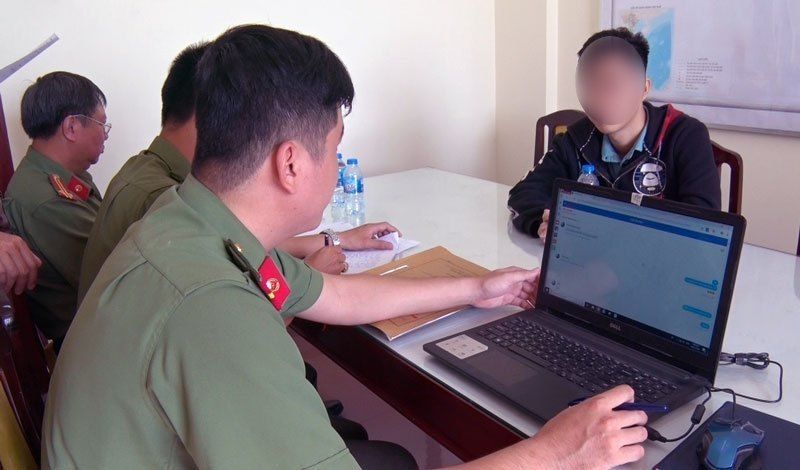
    On February 1, 2019, the Domestic Security Bureau of Ben Tre Province interviewed Tran Ngoc Phuc, a 21-year-old student of Ton Duc Thang University in Ho Chi Minh City at their station.

    Dong Khoi online newspaper, a publication of the VCP’s Provincial Committee in Ben Tre, published the story on the same day.

    According to the article, the police accused Phuc, a resident of Tan Phu Commune, Chau Thanh District, Ben Tre Province, of using his personal account to propagandizing against the Vietnamese Communist Party and the State.

    Namely, Phuc was using Facebook under the name “Ngoc Phuc” to join several “politically hostile” groups. Among them, was “The South of Vietnam” (Miền Nam Việt Nam), Fanclub of Saigon Capital (Đô thành Sài Gòn Fanclub), and  “Liking BBC Vietnamese” (Thích BBC Vietnamese).

    Phuc also allegedly admitted to the police that he was indeed the Facebooker Ngoc Phuc and that he had posted, shared, and commented on specific contents.

    The police had deemed these contents as materials which “propagandized, sabotaged the thoughts, distorted the direction, objectives, and policy of the VCP, the laws of the State and distorted (the image of) the leader Ho Chi Minh.”

    Formal charges against Phuc had not been filed, but the police indicated that they would continue to build the case and follow the regular legal procedures in this case.

    During the first month since the new Cybersecurity Law took effect in Vietnam on January 1, 2019, there were several reports that the police had questioned and detained some Facebookers.

    Rights groups, online campaigners, bloggers, activists, and dissidents continuously criticize the new law for further curtailing freedom of speech and shrinking the online civic space in Vietnam.

  • Former Political Prisoner, Truong Duy Nhat, Disappeared In Thailand After Seeking Refugee Status With UN

    Former Political Prisoner, Truong Duy Nhat, Disappeared In Thailand After Seeking Refugee Status With UN

    Last Friday, January 25, 2019, former political prisoner, Truong Duy Nhat, was last seen at the office of the UN HCR – The Refugee Agency in Bangkok, Thailand.Nhat was there to register himself as an asylum seeker after leaving Vietnam earlier in the month.According to his family and friends, no one had heard from him since last Saturday, and they could not contact him.Nhat has left Vietnam for Thailand for about 21 days, said his family.The family was able to confirm that Nhat was not held by Thailand’s IDC (Immigration Detention Center). They also obtained further information today that Thai authorities, up to this point, did not arrest Nhat either.Nhat’s phone number in Thailand is not turned off, but no one answered the calls. His wife and daughter are worried about his safety and well-being as they are still unable to get in touch with him.Truong Duy Nhat was sentenced to two-year-imprisonment in 2014 under Article 258 of the 1999 Penal Code. Nhat was arrested in May 2013 and held in detention until his trial.The government alleged some of his blog entries on the Blog “Another Point of View” (Một Góc Nhìn Khác) was “abusing democratic freedoms to infringe the interest of the state”.His blog was indeed critical of the government and the leaders of the Vietnamese Communist Party.One of the entries published in April 2013 was calling for the resignation of Prime Minister Nguyen Tan Dung and the VCP’s General Secretary Nguyen Phu Trong for their perceived political and economic mismanagement.After his release in 2015, Nhat continued with his blogging and resided in Da Nang, Vietnam.Nhat’s wife is still in Vietnam, but his daughter is studying in Vancouver, Canada. They are asking members of the public to come forward with any useful information regarding his whereabouts.

  • Vietnam: Court Sentenced Doctor For Involuntary Manslaughter, Ignited Public Outrage

    Vietnam: Court Sentenced Doctor For Involuntary Manslaughter, Ignited Public Outrage

    On January 30, 2019, The People’s Court of Hoa Binh Province found Dr. Hoang Cong Luong guilty of involuntary manslaughter and sentenced him to 42-month-imprisonment.

    The verdict caused an outcry across different sectors in Vietnam’s society, especially among other doctors who did not agree with the court’s reasoning.

    They believed that Dr. Luong did not breach his duty of care as a medical doctor.

    Dr. Luong was a former nephrologist at Hoa Binh General Hospital who was charged with involuntary manslaughter for failing to check the RO (reverse osmosis) water before initiating a hemodialysis treatment in May 2017, causing 18 patients to suffer anaphylactic-like symptoms – eight of whom later died as a result.

    A total of seven people were put on trial this year for “involuntary manslaughter” under Article 98 and “negligence of responsibility, causing serious consequences” under Article 285 of the 1999 Penal Code.

    The case was initially tried in May 2018 where Dr. Luong was charged with Article 285. The court dismissed the case and returned the file to the prosecution for re-investigation in June 2018.

    The prosecution came back and formally filed charges against Dr. Luong for involuntary manslaughter in December 2018. The second trial commenced in January 2019.

    According to the trial court’s verdict of yesterday, Dr. Luong was guilty because he failed to wait for the documentation confirming the water’s safety before initiating the dialysis. Instead, Dr. Luong relied on the verbal confirmation of the staff in charge.

    The court’s reasoning also put Dr. Luong in the position of a gatekeeper, which many doctors disagreed and argued that would have required nephrologists to be more than medical service providers.

    According to these Vietnamese doctors, the failure to wait for the appropriate documentation was only an administrative mistake, not enough to constitute his criminal culpability.

    They also argued that other doctors would have used the same method as Dr. Luong because having the documentation – in reality – does not make any difference compares to the verbal confirmation of the staff before starting the dialysis. Delaying the dialysis to wait for the documentation could also cost the patients their lives.

    According to the community of doctors standing with Dr. Luong, when faced with such circumstances, whether he had waited for the documentation or went ahead with a verbal confirmation, nothing could have changed the fact that the water was contaminated and Luong could never detect such contamination.

    The evidence at trial also established that the water in question was contaminated due to improper cleaning performed by the maintenance staff.

    One of the witnesses, Nguyen Huu Dung, the Head of the Dialysis Department of Bach Mai Hospital in Hanoi, testified that the responsibility to maintain the water safety was one of the maintenance department, not the treating physician.

    Regardless of the testimony from the experts and the doctors’ community standards, the court still decided Dr. Luong had committed involuntary manslaughter.

    Throughout the process, not only the public and the doctors’ community stood by Dr. Luong, but all of the victims’ families have also pleaded with the court to exonerate him. Their action constituted one of the conditions under Vietnam’s laws which could exempt Dr. Luong from criminal liability under Article 29, Penal Code of 2015.

    While the new penal code only took effect on January 1, 2018, which was after the alleged medical malpractice had happened, Vietnamese laws allowed the retroactive application of any section that could have benefited the accused.

    For his defense, Dr. Luong should have been able to use any section involving the extenuating circumstances, and other exemptions from criminal liability under the recently amended 2015 Penal Code, to defend his action. That did not happen.

    The public outrage, in this case, started since its commencement where the director of the hospital, Truong Quy Duong, was first exempt from prosecution and was able to leave the country to go abroad to Canada back in 2018.

    Due to public pressure and Dr. Luong’s lawyers’ argument, he was later charged with negligence and had to return to stand in the second trial.

    Other doctors had pointed out that the absence of a national standard for dialysis procedures should make the Ministry of Health liable in this case as well.

    The case also revealed more unanswered questions regarding the maintenance of the RO water system being used in dialysis at Hoa Binh General Hospital.

    As the director of that hospital, should the responsibility of overseeing the maintenance and operation of all departments belongs to Truong Quy Duong, and that he should have been ultimately held liable for the death of the patients?

    The case of Dr. Hoang Cong Luong has become one of the most controversial criminal cases in recent years, underlining issues that challenge Vietnam’s legal system today and in years to come.

    People questioned the neutrality and fairness of the court and the role of the prosecution in this case. Was the prosecution’s decision to file charges against Dr. Luong for involuntary manslaughter done according to laws?

    Not only there is a lacking of the standard of care for doctors in medical malpractice cases in the country, but also, there are other criminal procedures’ issues that urgently need reform, such as evidence admissibility and the standard for expert witnesses’ testimony.

  • State-Owned Media Features Police Brutality With Neutral Headline, Sparks Debate

    State-Owned Media Features Police Brutality With Neutral Headline, Sparks Debate

    Yesterday evening, January 29, 2019, Facebookers in Vietnam were circulating a video clip showing a gentleman lying on the ground while another, older man in police uniform was stomping on him, hitting him on the face, head and chest area.

    By the afternoon of January 30, 30219, the story got featured on Tuoi Tre online – one of the largest newspapers in Vietnam. It was one of the rarer times where one could find stories of police’s misconducts featured quickly on state-owned news right after making waves on social media.

    While Tuoi Tre was able to confirm the story and interviewed a supervisor of the police officers involved in the incident, many netizens became very critical of its headline which states: “Temporary Suspension of Deputy Ward Police Officer Using Feet to ‘Take Action’ on Witness.”

    The criticisms targeted the headline for de-escalating an incident of police brutality into something a lot less severe by using vague and ambiguous language like “take action.”

    The term “take action” was actually used by the Head of Tuy Hoa Police Department, Nguyen Van Dung, in his interview with Tuoi Tre regarding the incident.

    Some freelance journalists believed that Tuoi Tre practiced too much self-censorship and that in this situation, they could have used the word “stomp” and would not face any disciplinary action from the Central Committee of Propaganda. Later in the day, another online newspaper, Phap Luat of Ho Chi Minh City also published the same story and used the word “stomp” in the headline.

    Tuoi Tre was slammed with an order to pay a total fine of VND220 million (close to USD10,000) in July 2018 along with a 90 days suspension.

    Back then, the government issued such order after finding that Tuoi Tre had reported news that was “untrue” and causing “severe impacts” when it published an inaccurate story about the late President Tran Dai Quang’s comment on the Law on Demonstration and failed to remove a “nationally divisive” comment left by a reader on another article.

    However, with this story, some readers did come to the defense of Tuoi Tre, stating that it was a clever way of playing with words to get the people’s attention. Also, it should be okay for Tuoi Tre to quote a word used by a person they have interviewed.

    To these people, what more important was the fact that Tuoi Tre dared to swiftly report the incident at length, letting the victim provided a detailed description of the events.

    The victim in the incident was Le Huu Quoc, a resident of Phu Thanh Ward, Tuy Hoa City, Phu Yen Province. Quoc was a witness in an altercation between two other men.

    According to Quoc, he and another person were trying to break up the fight of two others, and the local police have asked all of them to come to the station.

    At the police station of the local ward, Quoc was physically assaulted – as seen in the video clip – by the deputy chief Huynh Minh Le.

    Quoc told Tuoi Tre that when he was at the police station, officer Le started yelling at him, strangled his neck, pushed him to the ground and used his feet to stomp on Quoc. Another officer came and stopped Le.

    After Quoc came home from the station, the police officers – who were fully armed – also arrived at his house later that night, asking him to go back and provide more statement. Quoc refused because he was scared from the treatment he received earlier.

    Quoc said: “I was only a witness, but they had to call a fully armed police force to come and get me like a criminal, causing damage to my reputation. Further, I already came to the station earlier and got beaten up by the deputy chief so I would not go again.”

    Confirming with Tuoi Tre, the Head of Tuy Hoa City Police Department, Nguyen Van Dung, acknowledged the incident and informed the public that the involved officer had been put on leave.

    Vietnam faced increasing public complaints regarding police brutality in recent years. After its first review under UN’s Convention Against Torture in 2018, the government is due to elucidate about five individual cases of death while in police custody by December 7, 2019.

    The debate about Tuoi Tre’s decision to publish the story and its use of certain language for its headline could be continued in the days to come regarding the practice of state’s censorship and self-censorship.

    In the meanwhile, the fact that the story of Le Huu Quoc quickly made the headlines shows the inconvenient truth about police brutality in Vietnam: it continues to happen around the country at an alarming rate, causing detrimental effects on the people and society as a whole.

  • Nguyen Phu Trong Released Carp In Celebration Of Tet While Refused To Pardon Tran Huynh Duy Thuc

    Nguyen Phu Trong Released Carp In Celebration Of Tet While Refused To Pardon Tran Huynh Duy Thuc

    One of the most widely circulated pictures on Vietnam’s social media in the last 24 hours was probably the picture of President Nguyen Phu Trong releasing a carp into Hoan Kiem Lake on January 26, 2019.

    President Trong was with a group of overseas Vietnamese who were part of a government’s sponsored program to come back to Vietnam to celebrate Tet – which will be on February 5, 2019.

    In Vietnam, like some of its neighboring countries, the Tet’s celebration starts almost a month before with many rituals that have been around for generations.

    Releasing carps into ponds and lakes has been a part of the annual celebration of Tet in some regions of Vietnam, probably more in the Northern provinces than in the South.

    It is being done during the ritual of sending the Kitchen God up to heaven so that he could make the report to the Jade Emperor on the 23rd of the 12th month under the Lunar calendar.

    The carp is believed to be the vehicle that could take the gods up to the sky because of the folklore widely circulated in East Asian cultures: “carp leaping over the dragon’s gate”.

    Moreover, the act of releasing – phóng sinh (放生) – captured carps, birds, and other animals, is believed to be done out of mercy and benevolence in Vietnamese culture.

    Unfortunately, as time goes by, this practice has given rise to other social problems, such as the illegal captures of birds and animals, as well as environmental issues when people release not only the carps but also the plastic bags they use to carry the fish to the releasing waters.

    However, some netizens were criticizing Trong for engaging in the practice of “releasing” this year for an entirely different reason.

    About a week ago, Tran Huynh Duy Thuc’s family and lawyer announced the government still refused to either grant a review of his case or pardon him after 12 petitions and one complaint against the Office of the President.

    Thuc is currently serving his tenth-year of the 16-year-sentence for “subverting against the people’s government” for calling for political pluralism and democracy in the country.

    The criticizing netizens raised the issue that if the government is still detaining over 200 political prisoners, charging them with vaguely defined crimes when they were only exercising their rights to express their political opinions peacefully, then what is the benevolent meaning behind the releasing of the carps by the president?

    Notwithstanding the political dissidents, there are also four wrongful convictions involving the death penalty which President Trong has continued to stay silent about their status. Three of these inmates have spent more than a decade on death-row while the evidence used to convict them have been proven to be improperly admitted.

    Some people believe that it would have been a lot more meaningful for the President of Vietnam to consider releasing citizens who were wrongfully convicted during this time of the year.

  • #SaveTamDao: A Cry for Help from Vietnam’s Primary Rainforest

    #SaveTamDao: A Cry for Help from Vietnam’s Primary Rainforest

    One of Vietnam’s most famous preserved national parks – Tam Dao – is crying for help.

    Tam Dao is among the country’s oldest primary rainforests, locates in the Red River Delta – arguably, the heart of Vietnam.

    But the heart of Vietnam is bleeding from deforestation committed by business interest groups.

    It faces imminent danger from a development project calls Tam Dao II, jointly sponsored by Vinh Phuc Province and Sun Group – a private enterprise.

    Sun Group is among of the largest real estate development corporations in Vietnam, but it also faces the most accusations from environmentalists and environmental protection groups as one of the worst violators in major deforestations happening across the nation.

    A group of Vietnamese discovered back in October 2018 that the National Park was closed and visitors were not allowed to enter.

    Facebook’s community in Vietnam immediately suspected that a private company must have obtained the right to develop their real estate project in the area.

    After all, in recent years, Vietnamese people have repeatedly uncovered one deforestation disaster after another in primary rainforests throughout this tropical country.

    Every time, the citizens found out that the deforestation resulted from improper conducts of both the provincial government and the private company that won the bid for the development project.

    Every time, the last line of defense in protecting the rainforests of Vietnam has been the online campaigns organized by ordinary citizens.

    This time, it is the same.

    A group of environmentalists created a new Facebook group with a new hashtag #SaveTamDao.

    What are the people trying to save? What is Tam Dao?

    Tam Dao National Park is a 36,000 hectares primary rainforest, preserving the original ecosystem of the Red River Delta that has been around for some 160,000 million years.

    Standing tall at about 1,200 meters above sea level with the highest peak reaching up to 1,500 meters and about 80 km from Hanoi, Tam Dao is known not only for its natural beauty but also the sanctuary and profound spiritual impact it imprints on visitors.

    Since 1996, the government has designated Tam Dao as a national park with the highest level of protection.

    In 2006, an attempt to develop a resort in Tam Dao with Vietnam Partner, LLC (registered in the U.S.) as the investor was proposed. However, it quickly came to an indefinite halt after facing opposition and harsh criticisms from scientists and others who work on rainforest preservation.

    Ten years later, it seemed as if the old development project was revived quietly by a new investor.

    According to the Facebook group – Save Tam Dao – in 2016, the commencement of the resort development project was witnessed by Vietnam’s top officials, including Prime Minister, Nguyen Xuan Phuc, and representatives from Sun Group.

    300 hectares of forest land belongs to the national park will be converted to land that could be used in development projects this time.

    Most worrisome, as in other development projects on forest lands across the country, the government did not disclose the Environmental Impact Assessment (EIA) to the public.

    The community and the people to date have not had the opportunity to participate in the EIA process.

    They could not even take a look at the development’s map.

    During an attempt to hike up Tam Dao recently, a group of citizens has obtained testimony from the residents living in a village at the bottom of the trail, that there must be a plan in place to build a “huge hotel.”

    This group also took pictures along the way, showing logs from the rainforest’s hundred-year-old trees lying around after got chopped off.

    According to Lonely Planet, “there are at least 64 mammal species (including langurs) and 239 bird species in the park” and added, “illegal hunting remains a big problem”.

    From Vietnamnet online newspaper in 2016:

    “Tam Dao National Park is covered by a rich flora, consisting of 490 species from 34 genera and 130 families.

    Tam Dao National Park is also home to 281 species of fauna from 281 genera, 84 families and 26 orders belonging to 4 main classes: animals, birds, reptiles and amphibious ones.

    Among the variety of life forms in the park are several rare species, including cheek black monkey, Tam Dao snake-head fish, silver pheasant wood grouse, etc.”

    According to Save Tam Dao group, the development project, as planned, will cause detrimental and irreversible impacts on the rainforest’s rich ecosystem which in turn, will affect the livelihood of the nearby residential areas and the people who rely on it for their sources of clean water and air.

    Pictures from Save Tam Dao Facebook group showing illegal logging and deforestation in Tam Dao National Park:

  • Protest Against BOT: How Vietnamese Drivers Fight Back

    Protest Against BOT: How Vietnamese Drivers Fight Back

    BOT, this three-letter-word probably does not have any special meaning for anyone but the Vietnamese people. It is a daily nightmare for many commuters in the country of close to 95 million in population.

    BOT stands for Build-Operate-Transfer, which is a form of contracts between a private company and the government that has become very popular in transport projects across Vietnam. By April 2018, it was estimated that 67 BOT(s) were in operation throughout the country.

    To put it simply, in a typical BOT development plan, the government would contract with a private company to build a transport project – for example, a section of a highway or a new highway bridge – and later allowed the company to operate a toll booth for a number of years to collect money from commuters to recover their investment.

    However, in Vietnam, once these BOT(s) began to open toll booths to collect fees, some of them faced enormous opposition from the people, namely the drivers who were subjected to paying such fees.

    In August 2017, a massive protest initiated by drivers when BOT Cai Lay in Tien Giang Province began to collect fees had lasted for days, causing this toll booth to stop collecting fees indefinitely.

    The drivers’ reason for protesting the fees was because the toll booth was wrongly situated, collecting money from people who did not use the road that was constructed under the BOT project.

    On August 6, 2017, the drivers started to use small bills to pay for the toll fees – which range from 35.000 VND – 180.000 VND – creating long delays on the highway in many days. After about two weeks, the BOT’s owner had no choice but to close down the toll (“xả trạm” in Vietnamese) and let traffic goes through without collecting the required fees until the government could come up with a resolution.

    BOT Cai Lay, however, remains completely shut down from December 2017 until today, while both the local and central governments have yet to finalize a plausible, alternative plan to resolve the problems. Their latest proposal – announced on January 15, 2019 – was to reduce the fees and extend the collecting period, but such a plan still failed to address the concern about the wrong location.

    In early December 2018, allegations regarding another wrongly situated BOT stormed both social media and the news in Vietnam because this toll booth is stationed on the most important highway in the country – National Highway 1 – at the outskirt of Ho Chi Minh City in Binh Tan District.

    The drivers alleged that the toll booth continued operating after its contractual time with the government had ended for more than 31 months, collecting fees that it was not entitled to. When being confronted, the owner of the BOT – IDICO company – claimed that the toll remained because it had built other transport projects nearby and could continue to collect fees.

    However, the drivers did not accept this explanation, stating that if IDICO had constructed other projects, the toll should be stationed in those areas.

    BOT An Suong locates at a critical junction for traffic entering and leaving Ho Chi Minh City, and the toll collects fees both ways for at least 15.000 VND each. For those who have to travel through this area daily, the amount they pay could be quite substantial in any given month.

    On December 6, 2018, about one hundred drivers showed up to protest the fees collection at An Suong, and they faced hundreds of men, as well as police officers and civil security forces. A group of men wearing masks opened the door of a protesting driver’s car, dragged out Le Thai Hung who was sitting on the passenger’s seat and physically assaulted him.

    Hung was then taken to the nearby police station by the same group where he alleged that he got beaten up during his 12-hour detention. The police did not charge him; they later released him and said he fell and suffered injuries.

    On January 14, 2019, the story of BOT An Suong got heated again on social media where four drivers (one of them is journalist Truong Chau Huu Danh) who protested the fees collection at this toll booth were detained illegally in an alley nearby for over 30 hours.

    The victims live-streamed their plight where they were confined in a car, surrounded by hundreds of masked men and police throughout the night.

    Their three cars were picked up by a towing truck which they claimed was acting under the order of the owner of the BOT. They were towed from the BOT to an alley about 50 meters nearby where the four persons were held against their will. Barricades were put up at the only entrance/exit of a dead-end alley, effectively stopped them from leaving. They also claimed that their cars were damaged due to the removal. A fifth person was attacked and taken away earlier in the evening of January 14, and his car later was towed to an unknown place.

    In the live-stream clips, viewers could see police officers were present at the scene but failed to act and protect the victims from both the removal and the false imprisonment. Also present at the scene was a large group of men in “blue masks” who acted most aggressive, yet it was impossible to know their true identity.

    The four continued staying together in one car, a Ford Ranger, where no one was allowed to get close to them. Food delivery, their lawyer (who came by the next morning), and even an ambulance, all were denied entry.

    Around 9:00 P.M., one of the drivers, Huynh Long, stepped off the car to find a restroom and disappeared. He later was found unharmed, but his wallet and cellphones were taken.

    Long said he was held against his will by a group of men on motorbikes, who then rode around town with him and threatened him to stop his protest against BOT An Suong. They later left him stranded on the streets after taking his belongings, but Long got help and was able to come back to the alley the following morning to be with his friends.

    By January 15, 2019, the police attempted a few times to write up their investigative report about the incident, and the four victims finally were allowed to leave the scene in the late evening. They stated that they would initiate legal action against those who were involved in the false imprisonment.

    On January 16, 2019, the protest by the drivers and others continued at An Suong, asking the BOT to stop collect fees. One driver said in a live-stream on Facebook that he has prepared for the worst, and that if the BOT’s owner would again try to detain drivers, he could last up to ten days.

    At about 2:00 P.M. local time, according to the same protesting driver, the toll booth gave up and let cars pass through without having to pay.

    There is a Facebook group of drivers who participated in these BOT protests in recent years calls Friends on the Long Road (Bạn Hữu Đường Xa).

    One of the reasons these protests were successful and received public support was the fact that a lot of Vietnamese people got frustrated when they have paid a lot of taxes for improving and maintaining road conditions, and yet the country’s infrastructure and transportation remained the worst in the world.

    Further, whether it was the Formosa environmental disaster, the land eviction in Loc Hung garden, or these BOT projects, the people did not get to participate in the decision-making process nor were they even consulted. Often, the public never knew about these projects until they became disastrous for the people’s daily life.

  • Loc Hung Garden Incident: Government’s Forced Eviction Is Without Legal Merits

    Loc Hung Garden Incident: Government’s Forced Eviction Is Without Legal Merits

    January 8, 2019| The forced eviction in the area known as Loc Hung vegetable garden in Ho Chi Minh City continued at daybreak today.

    At about 5:50 A.M., Facebookers in Vietnam reported that hundreds of police and plainclothes security police had resumed their demolishment at Loc Hung. By 6:00 A.M., the authorities have arrested Cao Ha Truc, one of the leaders representing the Loc Hung residents in their land dispute with the government during the last 20 years, along with his wife.

    Truc is among the group of people that have lived at Loc Hung all their life, beginning with his grandparents and parents who were migrating from the North of Vietnam after the Geneva Accord took effect and divided the country in half. The Catholics Church had given his family the land they lived on since 1954, and according to him, they have used it to farm vegetables all these years.

    In an interview conducted by an independent news media, Tin Mung Cho Ngươi Ngheo, on January 4, 2019, Truc openly challenged the government on their legal grounds to enforce the eviction of the Loc Hung residents’ homes, asserting that there was no land recovery decision from the authorities.

    A land recovery decision (quyết định thu hồi đất) is the first legal requirement to start the process of enforced eviction under Vietnam’s laws. (Article 71, Law on Land 2013).

    Attorney Trinh Vinh Phuc (who was one of the defense lawyers for Will Nguyen – a Vietnamese American convicted for inciting public disorder when joining the June 2018 protest), was among a few lawyers who openly supported the residents of Loc Hung.

    On his Facebook page, attorney Phuc agreed with Truc and the other residents that the enforcing authorities have yet to produce a land recovery decision to start the eviction process.

    Moreover, the law further requires that fair compensation must be provided for the affected residents and that the government must assist with relocation.

    Loc Hung residents repeatedly claim that the government did not comply with any of those requirements under the law.

    While the image of bulldozers tearing down homes in forced eviction has become a familiar scene in Vietnam’s land dispute cases, the legality of such conduct by the enforcing authorities is questioned. The Law on Land 2013 required that the enforcement team must move both the people and their property outside the enforced area, perform proper inventory, and notify the owners with information on how to reclaim them. The enforcement should also be carried out during regular business hours.

    However, according to human rights activist, Nguyen Ho Nhat Thanh, close to one thousand police officers have been mobilized throughout today to demolish Loc Hung garden. More news on social media indicated that the police were preparing for the demolishment throughout the night, turning on public speakers at maximum volume and asking the residents to leave the area.

    Other bloggers reported that there were at least five bulldozers at the scene, tearing down people’s houses. Cao Ha Truc and his wife were both arrested today because they have been recognized as the residents’ leaders.

    Like the days before, the local authorities also blocked off streets leading to Loc Hung and stopped people from entering the area. The security police of Ho Chi Minh City even surveilled the Church of Redemptorists and prevented the priests from leaving so that they could not go to Loc Hung to show support for the Catholic community there.

    Starting from last night, witnesses described Loc Hung’s residents were living in a war-like zone. People were panicking and beginning to move out their property throughout the night in fear that the forced eviction would soon resume.

    In the middle of the chaos, yet many residents still managed to gather for a candlelight vigil in front of Lady Mary statute and sang their prayers.

    The estimated value of the lost property which the residents will incur is going to be in the billions of VND.

    One of the most vulnerable groups living in Loc Hung is the community of some elderly veterans from the South of Vietnam’s army who do not have an immediate family. Most of these men received injuries during the war and because they were soldiers of the “old regime,” they were not given any opportunities or even proper healthcare under the current regime. Now facing homelessness, their already uncertain future appears to be even bleaker.

    The house of former political prisoners couple, Pham Thanh Nghien and Huynh Anh Tu, is also among those going to be soon torn down at Loc Hung garden. Both of them are well-known dissidents who remain critical of the government after their releases from prison. The couple has a one-year-old daughter with asthma conditions living with them.

    Southeast Asia and the Pacific office of Amnesty International has issued a call for action today, asking the public to contact the local enforcement authorities in Vietnam to demand them to cease their eviction activities in Loc Hung immediately.

  • Land-Grabbing In Vietnam Gets Serious In Urban Areas

    Land-Grabbing In Vietnam Gets Serious In Urban Areas

    January 4, 2018| In the early hours of the day, various police forces and their accompanying civil security (dân phòng) surrounded an area in Ward 6, District Tan Binh, Ho Chi Minh City known as Loc Hung vegetable garden with bulldozers, firetrucks, and paramedics to forcefully evicted about one hundred households from the land that they have been disputing with the local government for close to two decades.

    The residents have spent years on negotiations with the local government, starting from the time the price for their land skyrocketed and the area became desired for development in the early 2000s.

    The two sides could not agree on the price. It is estimated that with such a prime location, the value should be more than 100M VND per meter square, but the government rezoned the area and only offered the people around the range of a few hundreds of thousands VND per meter square. The millions of VND in the difference between the two prices eventually killed the talks, and the authorities declared they would use forced eviction in the last few days of 2018.

    Now, only less than a week into the new year, the police and security forces were barricading and blocking traffic and people from coming into the area so that they could begin demolishing the residents’ homes starting from around 9:00 A.M.

    Throughout the day, our editor, Pham Doan Trang, reported from the scene and stated on her Facebook page that the security police also stationed in front of many dissidents’ homes in Saigon and even arrested Nguyen Tri Dung, the son of blogger Dieu Cay (Nguyen Van Hai) at his home in District 3. Nguyen Tri Dung was later released in the evening of January 4, 2019.

    By 9:20 A.M. the authorities cut off electricity, 3G, and Wifi at Loc Hung. The police began to tear down people’s houses in the area with all means available, from shovel and hammer to bulldozer, while calling on the people to voluntary leave the area.

    88 households would become homeless without compensation for their land once the demolishment is finished.

    By 11:00 A.M., a large area surrounding the garden was completely sealed off by the police. Witnesses described on Facebook that they were asked to provide identification and not allowed to enter.

    Face-bookers continued to report the demolishment and the dispute between the local police and the residents with updates and even live-stream videos.

    Aerial view of Loc Hung. Sources: Facebook Nguyen Dat An.

    According to the residents, Loc Hung is a piece of land estimated to be in between four and six hectares, belongs to the Catholics Church of Vietnam since 1954 with proper documentation, including deeds and other recordings from the former South of Vietnam’s regime. Also, starting from 1954, there were Catholics who migrated from the North of Vietnam to the South after the Geneva Accord took effect that settled in the area. This community has been living in Loc Hung continuously for generations.

    In 1993, the residents were trying to register for their right to possess and use the land with the local government (in Vietnam, individual citizens do not own their land as all lands belong to “the people” and under the state’s management, but they can register for the right to possess and usage). The residents alleged that the government intentionally ignored their petitions to record land right’s usage.

    Unable to register their land, the people could not construct and develop the area, and instead, relied on vegetable farming to make a living. Their peaceful existence became the thorn in the eyes of the local authorities as the price for the land continued to increase.

    Nevertheless, to this day, Loc Hung garden has never been part of any development project, and it is also the most cogent argument the residents and their supporters have against the local government, that there is no imminent reason for the forced eviction and the destruction of hundreds of houses.

    By 6:00 P.M. it was reported that at least four people were arrested and some houses have been torn down. The residents strongly opposed the eviction and protested. One person even lay down in front of a bulldozer to protest.

    A man lay down in protest. Source: Amen TV

    As of press time, there were a total of at least ten people arrested and ten houses destroyed.

    The forced eviction came during the time Vietnamese people starting to get ready for the Lunar New Year which will be on February 5, 2019. Seeing hundreds of people become homeless from a land dispute in the middle of the largest urban city in the country has angered many users on Facebook. Information continued to be shared throughout the day, despite the new cybersecurity law went into effect on January 1.

    Land disputes and land-grabbing have always been among the most severe issues which test the government’s ability to govern since Vietnam embarked on the economic reform in the late 1980s.

    The government of Ho Chi Minh City is already in the middle of a heated controversy regarding land-grabbing and development started from the 1990s in the Thu Thiem peninsula. Forced eviction and ill-planning relocation plans of people living in the development area have dragged the government’s ambitious dream for Thu Thiem through the mud for over 20 years.

    Adding Loc Hung – and close to one hundred people living there – to the mix, raises even more concerns about Vietnam’s failure to handle development projects according to the U.N.’s Sustainable Development Goals.

    The Vietnamese communist government has been trying to demonstrate their ability to promote the 16 SDG’s goals with their development projects, especially during their negotiation with the EU for the EU-VN Free Trade Agreement. However, the reality of land-grabbing and forced eviction happening in the country throughout the past few decades cast severe doubts on the government’s claim.

    As of tonight, at least ten households in Loc Hung are homeless and without any compensation from the government.