Tag: Human Rights

  • Not Just Football, Some Vietnamese Do Care About Human Rights, Political Pluralism, and Democracy

    Not Just Football, Some Vietnamese Do Care About Human Rights, Political Pluralism, and Democracy

    Throughout 2018 and up until yesterday, January 24, 2019, the world continued to witness Vietnamese people’s love of football exploded, and the South Korean coach, Park Hang-seo, solidified his status as the country’s new, de-facto national hero.

    Images of people stormed the streets or “đi bão” – literally means “ride the storm” in Vietnamese – across major cities after each team’s win seemed to reaffirm that belief.

    While it may be fair to conclude that the majority of Vietnamese cares more about a football match than the other political issues in the country, we probably should pay attention to a different side of Vietnamese society that a foreigner may not see quite readily in recent days.

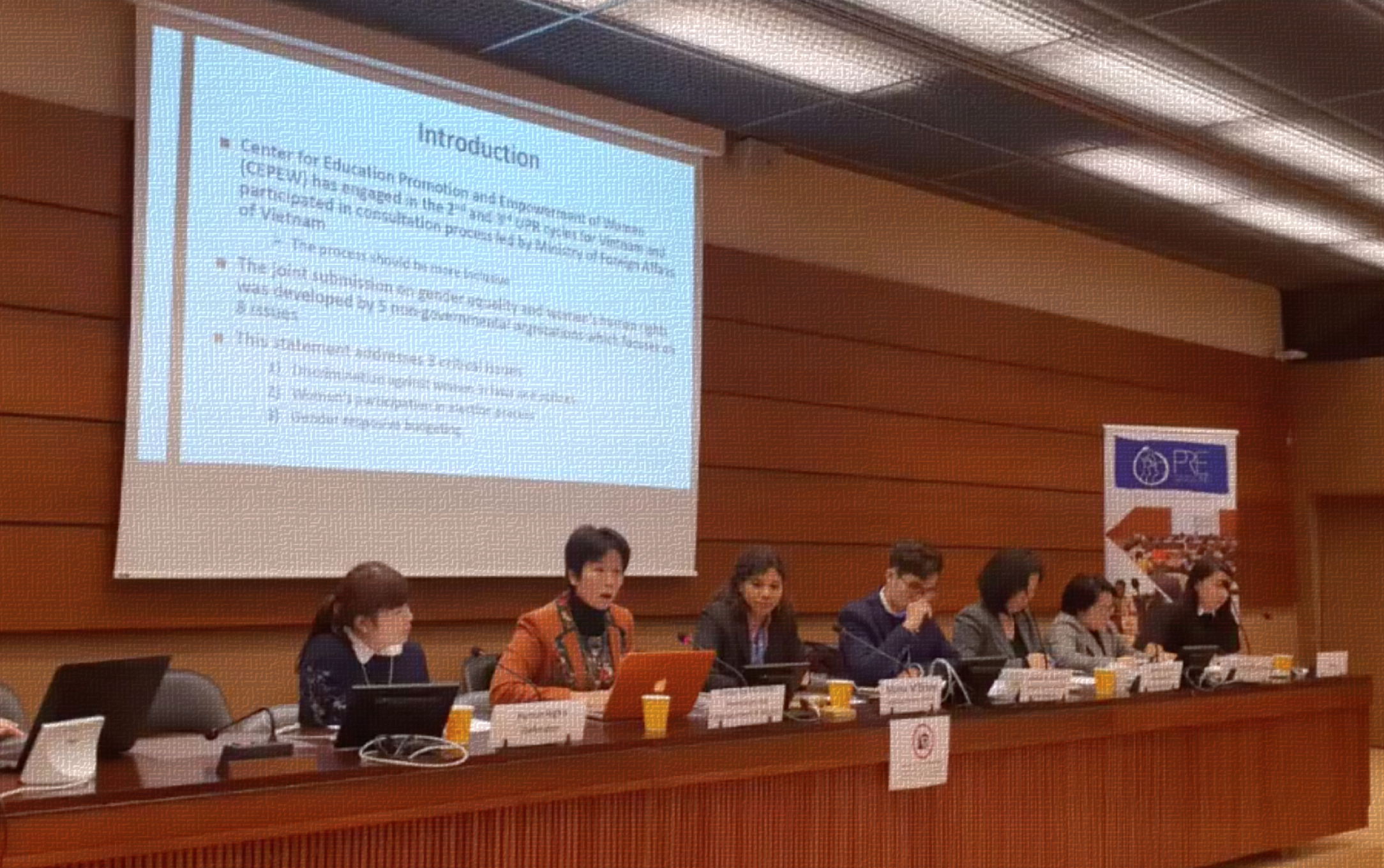
    Two nights before the last football match against Japan during the Asia Cup, from 8:30 P.M. to midnight of January 22, 2018, there was another international event concerning Vietnam: its third Universal Periodic Review (UPR) cycle.

    This particular UN mechanism – which only came into play on the world stage during the past decade – is where a state would undergo peer-review put on by other countries regarding its human rights’ records every 4.5 years.

    It is doubtful that the word UPR is popular, even in the West.

    But the January 22, 2019 event had attracted over 90,000 Vietnamese to tune in and watched to date, with over 4,000 comments and over 1,000 reactions on a live-stream posting by the Facebook page UPR Vietnam.

    UPR Vietnam is a collective effort of independent CSO workers in the country who want to bring more awareness of the human rights conditions in Vietnam to its people.

    Of course, comparing the number of people who went online to watch a UN’s human rights event to a football match does not mean much. But it is only fair if we put it within the context of Vietnam’s political background so that we could see why this group of viewers does show a different side of the country.

    Vietnam is probably a mini version of China with more free internet. That is one of the simplest ways – yet quite correct – to envision the country and its political structure.

    For almost 80 years in the North and more than 43 years in the entire country, the Vietnamese Communist Party ruled the state under a dictatorship.

    In Vietnam, there is no other political party. The VCP is the only political force.

    Young children would be indoctrinated at an early age when they joined the Communist Youth League.

    When they grow up, becoming a member of the VCP could also mean being part of a privileged class because the Party is the leading force that runs the country.

    VCP members take the majority in all branches of the government. The decision of the VCP’s Politburo would trump all others.

    Ho Chi Minh was taught to be loved and admired, even worshipped as the one hero who liberated his people from French colonization. History books spent 90% of the time teaching only historical events happened after 1945 and about how the VCP came to absolute power.

    The intent is clear and simple, to ensure that no one should have even the slightest doubt about the perpetuity of the VCP’s leading role in Vietnam.

    Not a single sign of dissent has been tolerated by the regime, especially in recent years.

    During the past two years, the political will of the VCP seemed to have hardened with 97 arrests of political dissidents compares to 43 in 2017, and 18 in 2016.

    The most significant difference between Vietnam and China is probably the fact that the government has failed to build a “Great Firewall” which let the internet and social media became the much needed civic space where people could come together and discuss current affairs and politics.

    That online space is now under threat with the new cybersecurity law that was passed in June 2018 and took effect on January 1, 2019.

    Along with the new law, a more rigid approach by the VCP in dealing with its own members also emerged.

    At the end of 2018, a well-respected intellectual and a long-time VCP member – Professor Chu Hao – was disciplined by the Party in a series of events which some people have dubbed “the VCP’s waging war against intellects.”

    It seemed, however, the Party and its leader, Secretary General Nguyen Phu Trong, were only acting in line with their manifesto.

    The hope that the Party would reform itself and be tolerable to the ideas of forming democratic institutions and the rule of law which some people might have carried on throughout the past four decades, seemed to have ended bitterly with the former Deputy Minister Chu Hao’s withdrawing himself from the Party.

    Getting over the status quo is never easy for any given society, not to mention one that has been under decades of authoritarianism.

    The fact that there is still a minority group of people (most of them are under 40-year-old) who – despite being born and grew up in such a political context – still cares about human rights does matter.

    It matters because only five years ago, during the last UPR cycle, not a lot of people in Vietnam know much about human rights and could care less about the UPR process.

    It matters, even more, when the one recommendation from the Czech Republic to Vietnam during this UPR cycle, asking the government to allow political pluralism and democracy in the country, also became one of the most read news of January 2019 on Luat Khoa online magazine just 24 hours after being published.

    Recognizing that there is a small, young sector of the population who is still willing to speak up when faced with harassment and even imprisonment as the government hardened its oppression methods, is, therefore, essential.

    It is the other image of Vietnamese that the world needs to take notice because we are more than just a fun, tropical travel destination with good foods and hard-core football fans.

    Although a new draconian cybersecurity law went into effect earlier this year, there are still people who refuse to censor themselves or curb their online activism in any way.

    Instead, they have continued fighting for what they believe is right.

    They are the drivers protesting against BOT An Suong, the lawyers and activists exposing the government’s wrongdoing in Loc Hung vegetable garden’s forced eviction, the environmentalists trying to save the rainforest in #SaveTamDao campaign, and many more.

  • Tran Huynh Duy Thuc: A Decade Behind Bars

    Tran Huynh Duy Thuc: A Decade Behind Bars

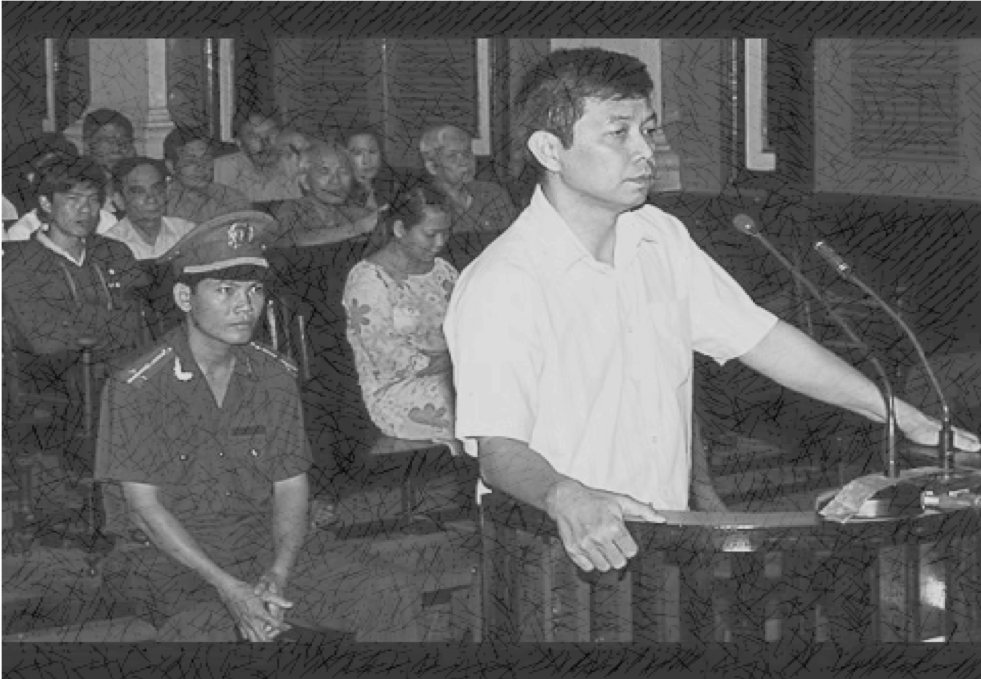
    Nine years ago, on January 20, 2010, the People’s Court of Ho Chi Minh City convicted Tran Huynh Duy Thuc, Le Cong Dinh, Le Thang Long and Nguyen Tien Trung under Article 79 of the 1999 Penal Code for “subversion against the people’s government.”

    Tran Huynh Duy Thuc was sentenced to 16 years in prison and five years probation which technically meant five more years under house arrest.

    Thuc was arrested in May 2009, and for almost a decade, the unique case of a successful entrepreneur turned dissident continued to be the highest profile among the hundreds of political prisoners and dissidents in the country.

    Article 79 has faced harsh criticisms from the international community.

    During Vietnam’s 2nd UPR cycle in 2014, the Vietnamese government accepted the recommendations to amend this and other arbitrary penal codes under the “national security” section, to ensure they would not be used to infringe the people’s human rights.

    However, in reality, the amended Penal Code of 2015 did not change the situation in any way. The crime “subversion against the state” remains as Article 109 under the new code.

    Thuc’s indictment described his criminal conducts included the act of forming and persuading people to join the Chan research group, to write and publish online articles defaming the government, creating division among the Vietnamese Communist Party.

    The prosecution further alleged that he had attempted to reach out and establish a relationship with leaders of the VCP, with the intent of re-shaping their political opinion to change the regime, and that he had planned to manufacture a document named “The Vietnam Path” to subvert against the State.

    The Vietnamese government’s point of view on “subversion against the State” is often not shared by the international community, especially democratic nations in the West.

    The heart of the problem lies in Section 1, Article 4 of Vietnam 2013 Constitution which states:

    The Communist Party of Vietnam – the Vanguard of the Vietnamese working class, simultaneously the vanguard of labourers and of the Vietnamese nation, the faithful representative of the interests of the working class, labourers and the whole nation, acting upon the Marxist-Leninist doctrine and Ho Chi Minh’s thought, is the leading force of the State and society.

    Because of this political monopoly, the VCP and the State of Vietnam became interchangeable in the mind of Hanoi’s regime.

    The leaders of the VCP would not hesitate in sentencing people who hold a different political philosophy than theirs to prison for decades because questioning the ultimate leadership of the Party equates “overthrowing the government.”

    This viewpoint effectively puts the VCP at odds with the universal values of human rights, in particular, the right to freedom of expression where holding a different political opinion, calling for pluralism and a multi-party system cannot be deemed criminal.

    In Tran Huynh Duy Thuc’s case, the defendants were also found guilty because the government further alleged that they were members of the Democratic Party and had started to write a new constitution.

    As one may correctly guess, organizing a political party in Vietnam – as in Thuc’s case – could also be construed as an act to “subvert the government.”

    Vietnam, at press time, has only one political party.

    Thuc has received the offer to be released into exile on numerous occasions, but he turned them down, stating that he would finish his full prison term instead of having to leave his home country indefinitely.

    The offer to be released into exile to political prisoners in Vietnam is not a release.

    It is more like a suspension of the sentence for either medical or humanitarian reasons. The released prisoners would not be able to come back to Vietnam, effectively being banned from their own country.

    When the Penal Code was amended, Thuc’s attorney has argued that the government should release him according to Section 3 of Article 109. Because at most, the evidence provided by the prosecution could only show that the defendants were in “preparation” to commit a crime under Section 3, with the maximum sentence of five years.

    His petition for a review of the case under the new Penal Code has gone unanswered.

    On December 13, 2018, Julie Ward, a Member of the European Parliament representing the North West of England, sent a letter to the President of Vietnam – Nguyen Phu Trong – (who is also the leader of the VCP), calling for an unconditional, in-country release of Tran Huynh Duy Thuc. The letter addressed the concerns over allegations from his family that he had suffered abuse in prison.

    A group of the EU Parliament’s MEPs, including Ms. Ward, has stated in more than one occasion that the release of prisoners of conscience like Tran Huynh Duy Thuc would be a critical condition for them to support the EU-Vietnam FTA.

    On this 9th anniversary of his conviction, U.S. House Representative Zoe Lofgren also called for Tran Huynh Duy Thuc’s release and denounced the mistreatment of political prisoners by Vietnamese authorities.

  • Vietnam Rings In 2019 with More Restrictions on Citizens’ Freedoms

    Vietnam Rings In 2019 with More Restrictions on Citizens’ Freedoms

    During the last week of December 2018, Vietnam’s state-owned newspapers flooded the country’s social media with articles on rules and tips for writing and blogging in a new era of internet usage, all in preparation for the 2018 Cybersecurity Law taking effect on New Year’s Day.

    In the days leading to the country’s cyber D-day, on December 30, 2018, with the headlines “How to Write to Express your Political Opinion on the Internet without Violating the Law?” Tuoi Tre online newspaper essentially summarized the ultimate paradox for people living under one of the most repressive countries around the world.

    While the article elicits opinions from a wide range of interviewees, from intellects and heads of certain IT firms to regular social media users, they all repeat the same government’s mantra: practice self-censorship and avoid criticism of the Party and the state, so that you can have the right to express yourself.

    Like the headlines itself, the “opinion” of the group of people interviewed in this article seems to be blissfully ignorant of the international standards for freedom of expression, in particular, Article 19 of the International Covenant on Civil and Political Rights, where a government not only cannot criminalize people for stating their political opinions but is also not allowed to censor them.

    It is not surprising that the article of Tuoi Tre did not consider critical opinions of the government to be worthy of political opinions and instead endorsed the same old government’s propaganda which had been recycled throughout the past seven decades, that one could have an opinion about anything in Vietnam, except those that criticize the Party and the government. After all, all newspapers in the country are considered to be the arms and legs of that propaganda machine.

    Another leading newspaper in Vietnam, Thanh Nien, also published an article on December 29, 2018, warning people to steer clear of “The 14 Ways to Violate the New Cybersecurity Law” with the first paragraph declaring the use of social media “to gather and call on other people to incite disorder” among the prohibited acts. The language of this paragraph is nothing new; it is the same as Decree 38 which has been used for regulating public gatherings in Vietnam, an ordinance that legal experts in the country have repeatedly questioned its constitutionality since its issuance in 2005.

    Praising the accomplishments of the Party and the state, as well as reciting their propaganda, are not only welcome but also considered to be parts of the Vietnamese journalists’ obligations according to the “Code of Conduct” published by the Vietnamese Journalists Association (VJA).

    The VJA, however, is an organization formed by the government according to its Media and Press Law of 2016 (link in Vietnamese), and these obligations are statutory. The Vietnamese authorities may think that by legislating journalists’ conducts, it would give them the appearance of a society that respects the rule of law. However, in reality, perhaps the only thing such laws could further demonstrate would probably be the systematic abuse of press freedom in the country.

    Nevertheless, the Vietnamese government is now ready to roll out the “code of model behaviors” for people who use social media in the new year, and the VJA has taken an extra step this past week with the announcement of its “Eight Rules for Journalists to Behave on Social Media” on December 25, 2018.

    Among others, most notably is the requirement that journalists are not to “post any news, articles, pictures, or audio recordings on social media or repost speech and opinions in opposition to the way, policy, and guideline of the Party or the State.”

    Not stopping at that, the new rules for journalists according to the VJA also require that while online, they are not going to “comment, give an opinion or share any information which contains the purpose of inciting or engaging others to react negatively, as well as those issues that are political, economic, cultural, societal, relating to defense security, and external affairs,…with complexity and sensitivity which need consensus as well as positive and constructive observation and behaviors for society”.

    Effectively, the new arbitrarily worded regulations for journalists, when being applied together with the new cybersecurity bill, could mean that the sharing of any information considered to be critical of a proposed law, such as the still pending draft bill on the Special Economic Zones which ignited the nationwide protests in June 2018 for example, may be deemed illegal and criminal by the government starting in 2019.

    At the same time, state-owned media in Vietnam also welcomed the news of the CP-TPP (Comprehensive and Progressive Agreement for Trans-Pacific Partnership) taking effect at the end of December 2018. In the new year, Vietnam continues to push for the EU-Vietnam Free Trade Agreement to be ratified by the EU Parliament in March 2019. Both of these trade agreements demand serious improvement on the human rights situation in Vietnam, directly and indirectly.

    However, in 2018, The 88 Project reported:

    – Vietnam arrested 103 people (up from 43 in 2017)
    – 120 activists were tried
    – At least 22 of those who tried were females
    – 35 had known religious affiliations
    – 11 were sentenced to between 10 and 14 years
    – Two received the sentence of between 15 and 19 years
    – One person, Le Dinh Luong, was sentenced to 20 years

    In total, 210 people are serving jail sentences for their peaceful activism in Vietnam with 19 more await trial.

    Whether the Vietnamese government will yield to international pressure and improve its human rights records, or follows through and starts enforcing the new suppressive law on bloggers and journalists in 2019, the message from the activists’ community is unanimous: they will continue to write and express their opinions regardless. Before the Cybersecurity Law of 2018, Vietnam already has enough penal codes to send their political dissidents to prison for a long time.

  • World Report On The Situation Of Human Rights Defenders: UN Expert Urges Vietnam To Stop Criminalize Activists

    World Report On The Situation Of Human Rights Defenders: UN Expert Urges Vietnam To Stop Criminalize Activists

    This week, the office of UN Special Rapporteur on the Situation of Human Rights Defenders, Michel Forst, released the first global survey on the situation of human rights defenders in 12 years, since the landmark Global Survey conducted in 2006 by the then UN Special Representative Hina Jilani.

    Regarding the situation in Vietnam, the report states:

    “Human rights defenders are physically attacked, criminalized, given long sentences, held in detention without trial, and tortured and subject to degrading treatment while imprisoned. The government retains strict control over the media, restricts the registration and activities of civil society organizations, and suppresses peaceful assemblies.”

    The report noted that while Vietnam guarantees all citizens their human rights, in practice, several law decrees are regularly applied to restrict the rights of human rights defenders.

    “Citizens do not enjoy the right to a fair trial and to due process. Arbitrary detention is frequently used. The government tries to silence human rights defenders and bloggers, including through physical attacks, torture, criminalization, solitary confinement and degrading treatment in detention. The government exercises strict control on the media and the work of journalists. It takes harsh action against peaceful protests.

    There are more than 100 political prisoners in Viet Nam, some serving lengthy prison sentences for the legitimate exercise of their rights. The right to fair trial and due process is not respected. Human rights defenders who face particularly high risks are those who criticize the government, including journalists, bloggers, labor rights defenders, and land and environmental rights defenders.”

    While Vietnam is party to most core international human rights treaties, the report pointed out that the country “has neither accepted any treaty-based individual complaints procedures nor treaty-based inquiry procedures.” Moreover, it also noted that Vietnam has yet to accede to the Optional Protocol of the Convention against Torture (CAT-OP), the Second Optional Protocol to the International Covenant on Civil and Political Rights aiming to the abolition of the death penalty (CCPR-OP2-DP).

    In 2018 alone, the report stated that the “2016 Law on Belief and Religion that came into effect in 2018 imposes strict registration requirements and enables state interference into the activities and internal affairs of religious groups. It provides the authorities with discretion to penalize unsanctioned religious activity. It includes a clause prohibiting religious practices that damage ‘the national great unity, harm state defense, national security, public order and social morale’ (Article 5).”

    The Penal Code which was amended in 2015 and came into effect in 2018, is found by the Special Rapporteur to be regularly applied against human rights defenders, in particular, “activities aiming to overthrow the people’s administration (Article 109, previously Article 79 in the 1999 Penal Code); undermining 333 national unity policy (Article 116, previously 87); conducting propaganda against the State (Article 117, previously 88); disrupting security (Article 118, previously 89); causing public disorder (Article 318, previously 245) and abusing democratic freedoms to infringe upon the interests of the State (Article 331, previously 258).”

    The report also was alarmed by the provision of the newly amended Penal Code that would make defense lawyers liable for “not reporting some types of serious crimes committed by their client.”

    On the issue of government’s regulating people’s use of the internet, Decree No. 72/2013/ND-CP of July 15, 2013, on the management, provision and use of internet services and online information, as well as Decree No. 174/2013/ND-CP of November 13, 2013 on penalties for administrative violations against regulations on post and telecommunications, information technology and radio frequency, were mentioned in the report to demonstrate how freedom of expression and freedom to access the internet are further curtailed in Vietnam.

    The report raised serious concerns over the new Cybersecurity Law passed in June 2018, requiring “global technology firms such as Facebook and Google to store ‘important’ personal data in Viet Nam, open local offices, remove offensive content upon the request of the government. It also allows the government to conduct an audit of their information systems.”

    The Special Rapporteur took note that “there are no laws, policies, or practices that protect the rights of human rights defenders,” and described various cases of human rights defenders being harassed, physically assaulted, arbitrarily arrested and detained, unfairly tried and imprisoned. From the April 2018 trial of the Brotherhood of Democracy to the harsh and unfair sentences given in the cases of Tran Kim And, Le Thanh Tung, Luu Van Vinh, Nguyen Van Hoa, Nguyen Viet Dung, and Le Dinh Luong, they were all mentioned with specific details in the report.

    The prison conditions of Mother Mushroom and Tran Thi Nga, as well as the attack on human rights defenders and blogger Pham Doan Trang in August 2018, were used as examples for the treatment of women HRDs in Vietnam.

    In regards to government’s suppression on demonstrations and disperses public assemblies, the report wrote: “When people gathered in 2016 to demonstrate against the Formosa company after the waste spill, the authorities used tear gas and excessive force to disperse the crowd. In June 2018, when thousands of people gathered in different places to protest a proposal to allow foreign firms to have 99-year leases in new special economic zones. The police detained protesters and subject some to beatings before releasing them.”

    The report also noted that during the past 12 years, the office of the Special Rapporteur had sent numerous communications to the government of Vietnam with regards to the dire conditions of human rights defenders in the country, but most of them did not receive a reply.

    The Special Rapporteur urges the government to “cease the criminalization of human rights defenders and to release all who have been detained and imprisoned for the legitimate exercise of their right to freedom of opinion, expression, assembly, and association.

    He also “urges the government to ensure that the detention of prisoners adheres to the Standard Minimum Rules for the Treatment of Prisoners (the Nelson Mandela Rules) and that everyone enjoys the right to a fair trial and due process. He calls for the government to review, amend and/or repeal laws that restrict the rights of human rights defenders and to introduce legislation, policies and administrative practices that protect human rights defenders. He recommends that the government become party to the other core human rights treaties and to establish a national human rights institution that is fully compliant with the Paris Principles.”

    The complete World Report can be accessed here.

  • How Closed Is Civic Space in Vietnam?

    How Closed Is Civic Space in Vietnam?

    UPDATE ON DECEMBER 20, 2018: The correct decree number has been included after more information was released by the organizers of the conference mentioned in this article.

    Today, December 19, 2018, the police in Hanoi disrupted an event and forced the organizers to discontinue the Third Annual Conference on the Roles of Government, Civil Society, and other Related Stakeholders in Providing and Monitoring Public Services (Third Annual Conference) which was supposed to last until tomorrow. The conference was organized by several NGOs and CSO working groups in the country, and its disruption again shows alarming signs that civic space in Vietnam is not only closed but getting more restrictive.

    As a sunny state in Southeast Asia that often gets praised on many travel and food networks channels, the scores which different international indexes give Vietnam on individual freedoms, such as the classification as a “closed” society by CIVICUS, don’t seem to match up.

    However, Vietnam is a country with many paradoxes and the political atmosphere more often than not has proven to be extremely repressive for civil society.

    From a few sources on social media, the Hanoi authorities cited an archaic decree as their reasons to stop the above conference. It was not the often used Decree 38/2005/NĐ-CP (Decree 38) (link in Vietnamese), which requires public gatherings of more than five people to seek approval from the Provincial People’s Committee.

    This time, the local authorities used a decree that was originated to regulate people’s gatherings during wartime dated back in 1957: Decree 257-TTg (link in Vietnamese). Decree 257 sought to provide the implementation guidelines for Presidential Order 101-SL/L.003 (link in Vietnamese) executed by Ho Chi Minh on May 20, 1957, on the right to freedom of association.

    Ironically, while the language of both Decree 257 and Presidential Order 101-SL/L.003 stated the requirement to give 24 hours notice (including verbal notice) of gatherings which would be similar to the Third Annual Conference; neither one mandated such gatherings must be discontinued if notice was not given. More than six decades later, the authorities in Hanoi insist that the Third Annual Conference had to end.

    In recent years, despite what the Constitution of 2013 says about the right to peaceful assembly, the Vietnamese authorities, however, often applied Decree 38 to regulate “public gatherings. This decree would allow law enforcement to disperse crowds and mandates the police and army to cooperate with local authorities “to ensure the public order in case of need.”

    Here is the first paradox, which is about the nature of Decree 38 and Decree 257, as these are laws that were not passed by the country’s legislative body – the National Assembly. They were orders issued by the administrative branch of the government. One would think that they should be deemed unconstitutional when contradicted directly with what the current Constitution said about the right to peaceful assembly in Vietnam when it was last amended in 2013. But that is not the case.

    In reality, the Constitution is often ignored completely, and Decree 38 has been the sword that the police force frequently used to cut right through people’s civil rights again and again. And now, even a decree dated back to June 14, 1957, like No. 257, could trump the current Constitution.

    The second paradox is that only one week ago, on December 12, 2018, Ambassador Duong Chi Dung, the Head of Vietnam’s Permanent Mission in Geneva, cited in his speech at the UPR pre-session (an event organized by UPR-Info), that Vietnam, since the last Universal Periodic Review (UPR) cycle in 2014 had implemented 96% of all recommendations it had accepted from the member states to improve human rights conditions in the country.

    13 out of the 182 recommendations Vietnam supported back in June 2014 requested the government to guarantee the people’s freedom of peaceful assembly and association. In practice, from 2014 to date, not only that Decree 38 is still being widely and arbitrarily applied in the country, but the authorities now started to enforce another decree which should have been considered obsolete under the country’s current legal framework, seeking to curtail the freedom of association further.

    Back to the conference that got stopped mid-way in Hanoi today, even disregarding the constitutionality of Decree 38 and 257, another paradox was the fact that it was not taken place in “public.” The location of the event was at The Hanoi Club, a private hotel.

    The definition of “public places,” like the constitutionality of Decree 38 or Decree 257 itself, was never explained or defined in a court of law. While it could arguably be correct to say that the Standing Committee of the National Assembly is entrusted with the power to “interpret the Constitution,” they have never attempted to exercise such power. The judiciary in Vietnam has not been showing interest in taking up the task either.

    In the meanwhile, the Ministry of Public Security – the national police force – has taken full advantage of maneuvering Decree 38 – and now, Decree 257 – at their will, without any judicial oversight. What happened today at the Third Annual Conference in Hanoi raised more doubts about the space reserved for civil society organizations to operate freely and independently in Vietnam.

  • Vietnamese Government Celebrates National Day By Violating Its Own Constitution

    Vietnamese Government Celebrates National Day By Violating Its Own Constitution

    Today| marks the 73rd year since Ho Chi Minh stood at Ba Dinh Square on September 2, 1945, and proclaimed that all people shall enjoy their natural rights in the pursuit of happiness. Thus, it is quite hard to imagine that the current regime – who is supposedly following Ho Chi Minh’s teachings – has decided to mark such an auspicious occasion with a stern, yet illegal, warning to all citizens: do not go out and protest.

    But that is precisely how the Vietnamese authorities have decided to honor the birth of their nation this year, by loudly ordering the people not to participate in any form of public demonstration on Vietnam’s Independence Day.

    Throughout August, high-ranking officials in the Vietnamese Communist Party have taken turns assaulting the human right to assembly, a right enshrined in Vietnam’s 2013 Constitution.

    First, it was To Lam, head of the Ministry of Public Security (in charge of the national police force). Lam assured the Standing Committee of the National Assembly on August 13, 2018, that the police would take all possible measures to prevent people from participating in protests after he was admonished by Committee members for the mass protests that took place in June.

    A few weeks later, Hanoi city leader and high-ranking police official Nguyen Duc Chung also vowed that he would not allow “any crowds to publicly gather” under his watch during Independence Day weekend.

    Several state-owned media outlets during the past week “coincidentally” published articles condemning both the June 10th protestors and the call on social media accounts for a nationwide protest on September 2nd. The government seems to blame overseas groups, some of which have been declared “terrorist organizations” in recent years by Vietnamese authorities.

    News has also surfaced both on social media and on official news agencies that the police have arrested a small number of individuals disseminating information “against the state”, including one who was caught trying to enter Vietnam through Cambodia with several weapons.

    Minister To Lam has publicly congratulated the police forces of Binh Dinh and Phu Yen provinces for arresting the armed individual whom the government believes to be a member of Viet Tan, one of the aforementioned overseas groups. Viet Tan denied this accusation on the same day the individual was arrested.

    While no protest broke out today, the political sphere remains tense, and Vietnam is not in much of a celebrating mood compared to previous years.

    The Special Economic Zones draft bill is still dangling over citizens’ heads. The people are continuously wary of their country becoming ever more dependent on China.

    The government is not exactly helping, with the national bank announcing last Thursday that the Chinese renminbi could soon be used in trading activities along the country’s northern border, starting in October.

    There were also reports of the internet being down – again – due to cable issues during the last week of August (the fourth time in 2018 thus far). In Vietnam, internet outages often “coincide” with periods of social and political turmoil, as was observed when Vietnamese protested the Taiwanese steel mill, Formosa Ha Tinh, back in May 2016.

    Earlier this month, activists were also brutally assaulted by police officers for simply gathering at a small concert in a Ho Chi Minh City cafe. Many of these activists were also placed under surveillance this holiday weekend.

    Are the reactions from the Vietnamese government in August just overblown paranoia or do they have reason to fear the people?

    It is difficult to say.

    However, we do know from the writings of several state-owned newspapers that the government is extremely wary of anything remotely resembling the “color revolutions” or the Arab Spring in Vietnam. They prefer to take pre-emptive measures, using all means to prevent demonstrations, even if doing so would mean breaking their own laws and constitution.

    Moreover, the Vietnamese government does not distinguish between peaceful dissidents and those who call for a violent overthrow of the government, and the case of one of their most famous political prisoners, Tran Huynh Duy Thuc, is the best example.

    Thuc was sentenced to 16 years imprisonment back in 2009 for “subversion against the state,” and the evidence used to uphold the conviction included his writings pleading with the government to take rapid and immediate action to preserve economic growth and avoid over-dependence on China.

    Before his arrest, Tran Huynh Duy Thuc was one of Vietnam’s most successful entrepreneurs, with the government unable to find any evidence of wrongdoing within his multi-million dollar business after raids. Western countries have offered Thuc political asylum on multiple occasions, but he refuses to leave his country to live in exile.

    His latest defiant act—a hunger strike—protesting what he calls “an unjust judicial system,” again put the Vietnamese government in a predicament: they could not justify his imprisonment to the increasingly informed public. September 2, 2018 marks the 20th day of Thuc’s hunger strike.

    Up until last month, Thuc had received the longest sentence for a political prisoner: 16 years imprisonment, followed by 5 years of house arrest.

    In August, the record was surpassed by Le Dinh Luong, who was sentenced to 20 years imprisonment, again for “subversion against the state.” Luong was known by his peers as an activist who campaigned against the environmental destruction caused by corporations and development projects.

    The VCP has managed – especially in recent years – to ensure that its human rights records rival that of its big Communist brother, China, with more suppression and harsher sentences against activists.

    But will more suppression lead to a stable and peaceful society as the VCP hopes for, or will blurring “peaceful dissent” with “subversion against the state” further chip away at the government’s legitimacy? The answer remains unclear.

    What we do know, however, is that history has never been on the side of regimes that refuse to engage in dialogue with dissenters, that refuses to heed the people’s discontent. One need only look at Vietnam’s own history to see this fact in action.

  • “Minds” over Facebook: Vietnamese Netizens’ Great Cyber Exodus?

    “Minds” over Facebook: Vietnamese Netizens’ Great Cyber Exodus?

    In the past two days, the “F-Generation” of Vietnam started what seems to be an online exodus when many well-known Facebookers announced that they are moving on to Minds.com – an alternate platform for social media.

    The “F” in F-Generation stands for “Facebook” as the online social media giant has a dominant presence in the country where some statistics raised the number of users to be between 50 to 60 million.

    For about two months, people had been protesting both online and offline against the latest Cybersecurity law which was passed by an overwhelming 86.86% of the National Assembly.

    The law raised concerns over Internet users’ privacy, people’s freedom of expression, and their right to access the Internet.

    Brad Adams, Asia director at Human Rights Watch, declared: “This bill, which squarely targets free expression and access to information, will provide yet one more weapon for the government against dissenting voices. It is no coincidence that it was drafted by the country’s Ministry of Public Security, notorious for human rights violations.”

    In less than two days, some of the prominent Facebookers have received thousands of subscribers over at their freshly minted Minds accounts.

    In the same time, reports of pages and personal accounts have been taken down by Facebook also surfaced.

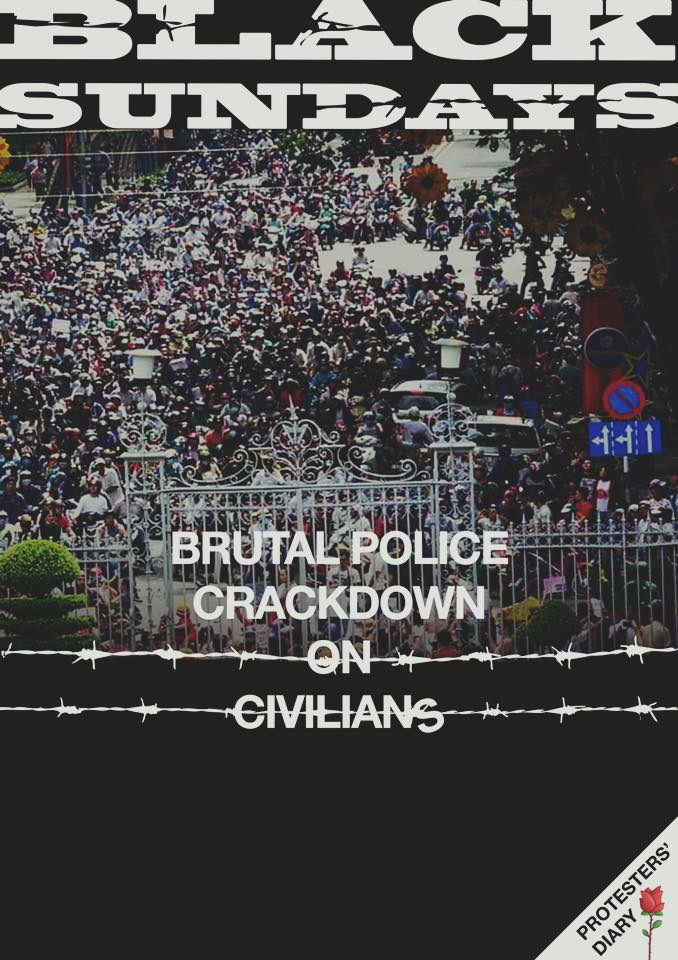
    Trương Thị Hà, a victim of police brutality during the last “Black Sundays” protest, announced on Minds this morning that her account has been deactivated by Facebook.

    After she posted a letter to her university professor, asking him to explain why he stood there while the police brutalized her during her detention after the protest, that very post was deleted for “violating Facebook community standards” at about 8:30 a.m. Then, her entire account seemed to have disappeared by 10:40 a.m.

    According to author Claire Bernish who wrote about Minds back in June 2015, Facebook could finally meet its match. Minds gives users the familiarity with many features they have already accustomed to on Facebook while commits to protecting their privacy.

    “Minds takes the government’s eyes out of the equation by encrypting private messages and using open-source code that any programmer can check,” Bernish explained.

    “We are a free and open-source platform to launch your digital brand, social network, and mobile app. We are also a social network ourselves. It is a global social network of social networks,” the Minds team declared.

    The hacker collective Anonymous also backed Minds, citing the fact that the founders of the new online social media shared the same vision of those who use the Internet for activism.

    According to the Wired UK: “Two of those on the Minds team – Bill Ottman and Lori Fena – have strong backgrounds dealing with privacy and freedom of expression issues and are both known for their internet-related activism. It is likely these are the type of people that the company is hoping to attract – those with a cause, who want to build something and share it openly with others who may also have a cause.”

    President Trần Đại Quang signed the Cybersecurity bill into law on June 25, 2018, although some 27,000.00 signatures of citizens who had expressed their objection to the proposal of the law, were delivered to his office during the prior weekend.

    It seems as if the activists and human rights defenders from Vietnam might have found a friend in Minds because the reason they chose Facebook in the first place, was to use the platform as a tool to advance a cause: promoting human rights and democracy in the country.

    While not all of them agreed to the solution of leaving Facebook and saw that as a sign of defeat, the silence from Facebook during the last two months as the Cybersecurity law stormed the nation could force many activists to reconsider whether to continue to use it as their primary platform. Most are still using both platforms, but all seemed to agree that if Facebook agreed to comply with the new Cybersecurity, then it could mean they will have to leave for good.

    Vietnamese netizens are no strangers to such online “resettlement.” Back in 2009, when Yahoo 360 blog closed down its operation, Facebook quickly became the next best choice in the country.

    Almost ten years later, while Facebook could still enjoy its reign in the country as the most used online social media platform, the power of Vietnamese users should not be underestimated by anyone.

    Afterall, Vietnamese are a group of people whose contemporary history entwined with mass migration and exodus. They have a lot of experience with starting over, yet again, and they will not be afraid to do so.

  • Black Sundays Report: Vietnamese People’s Response To Police Brutality During June 2018 Protests

    Black Sundays Report: Vietnamese People’s Response To Police Brutality During June 2018 Protests

    Civilians, victims of police brutality and arbitrary detention, academics, activists, researchers, and a lot more people from all walks of life inside and outside of Vietnam got together and produced a report on the two “Black Sundays” of June 10 and June 17, 2018.

    It is the Vietnamese people’s unified and firm response to the vicious repression by the government during the latest rounds of protest in the country.

    According to the Facebook page of Nhật Ký Biểu Tình (Protestors’ Diary), copies of the report have been delivered to the UN OHCHR, other international NGOs working on human rights as well as various foreign embassies.

    The full report can be downloaded here.

  • Saigon Is Under De-facto Martial Law

    Saigon Is Under De-facto Martial Law

    June 17, 2018| Hundreds of people were stopped, detained, searched, and later taken to a temporary holding center set up in the heart of Saigon (aka Ho Chi Minh City) for apparently no reasons.

    The government, this time, did not even announce that there were any “illegal” public gatherings as in the previous weekend where thousands of people protested against the cybersecurity and Special Economic Zones draft laws.

    What they have done instead, was to preemptively take a strike at all of the citizens who were happened to be in those hot spots of last week’s protest. Some did go out to the streets with the intent to participate in a demonstration, but they could not even start.

    From the early morning, all types of police, secret police, and security forces have filled up various areas in Saigon. Many coffee shops near the Notre Dame Cathedral Basilica were asked to close by the authorities.

    One witness reported that police were arresting people at a McDonald’s nearby. The only group that acted provocatively was the police and other security forces, this person wrote on Facebook.

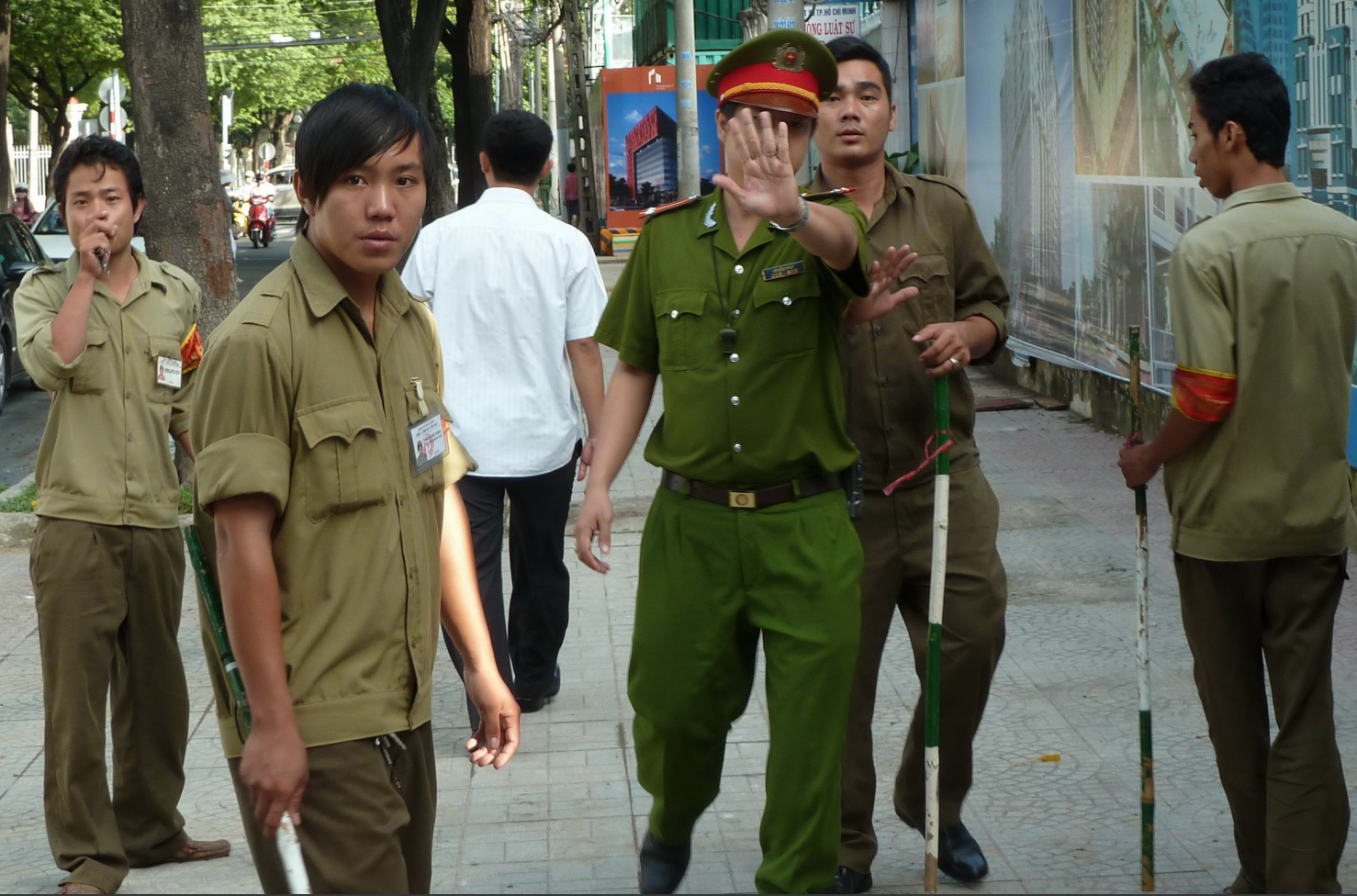
    The security forces watched every single bystander, people who happened to pass through the area. Anyone who looked “suspicious” to them would get stopped, asked for identification, searched, and demanded to show their phones where any pictures that were taken would get deleted.

    All were done without any probable cause and of course, without a warrant.

    It seemed as if the law no longer existed there. The city was under siege by its police force, and the people lived under martial law.

    Worse, there would likely be no recourse in a court of law for the victims, even if some of them could gather enough courage to file a complaint against the authorities.

    One person who was arrested while working near Nguyễn Văn Bình Books Street and detained until that evening said on Facebook, that she felt the experience eerily reminded her with words from Anne Frank’s Diary.

    She also recalled that others were taken into separate rooms and some got beaten up by the police. The beatings must be very violent because everyone at that detention center could hear the screams. When they tried to run towards the room to help, the police stopped them with threats of physical violence, recalled by another witness.

    The victim – who later got identified as Trinh Toan – was taken to the hospital for head injuries and reported to be in a coma since.

    Those who got released were cited for “disrupting public disorder,” ironically.

    Another witness live-streamed to tell her story after her release. She described how she and other Catholics got picked up by the police on their way to church. They were taken to that very same detention center in Tao Dan Park and later were both beaten and abused verbally.

    A Vietnamese overseas detailed how the security forces physically subdued him and assaulted him while he was strolling near his house close to Hoang Van Thu Park. The police only released him after he screamed out some profanity in English and revealed his foreign nationality.

    Some other people were already taken into police custody with no warrant a few days before last Sunday.

    One of them was Nguyen Tin. He described the police physically assaulted him, smacking his face repeatedly when he refused to speak and answer questions while in custody. The right to remain silent does exist in Vietnam, but in this case, it failed to protect the citizen.

    Almost all of the pro-democracy activists in Vietnam had plainclothes officers surveilled their homes this past week to prevent them from leaving the house and joined the protest.

    On social media, many more people were reported missing in the past 48 hours, and efforts by civil society groups are ongoing to document and identify those who were arrested, detained and/or suffered abuse.

    Phil Robertson from Human Rights Watch tweeted today:

    “Brutality of #Vietnam authorities attacking activists opposed to new internet surveillance law is really off the charts! Time for #Hanoi to be called out by U.N. Human Rights Council, U.N. General Assembly for their rights crimes!”

    From the June 10, 2018 protest, the authorities might have arrested about 300 people in Saigon alone. One of them was an American citizen, Will Anh Nguyen, whose story made headlines internationally. Vietnam police filed charges against Nguyen for “disturbing public order” on June 15, 2018, and continued to hold him in detention.

    This past weekend, Saigon was the city that got suppressed the hardest. It is estimated that over 100 people arrested and detained and the number of injuries caused by police brutality is still being counted.

  • The Right to Protest In Vietnam Is Not Only Legal, It’s Constitutional

    The Right to Protest In Vietnam Is Not Only Legal, It’s Constitutional

    On June 14, 2018, AFP reported, the spokesperson of Vietnam’s Ministry of Foreign Affairs, Le Thi Thu Hang, told reporters that Vietnam was holding an American citizen of Vietnamese descent, Will Anh Nguyen, under the suspicion of “disrupting public order.”

    Online video clips showed Nguyen being dragged away by several men with his head covered in blood, and that he was thrown into the back of a police car. Later that day, news surfaced on Vietnam’s social media that he was arrested for being part of the demonstration.

    One probably would stop and wonder: Is protesting illegal in this country?

    Simply put, the right to protest is not only legal in Vietnam, but it is also the people’s constitutional right.

    Article 25 of Vietnam’s 2013 Constitution prescribes:

    The citizen shall enjoy the right to freedom of opinion and speech, freedom of the
    press, of access to information, to assemble, form associations and hold
    demonstrations. The practice of these rights shall be provided by the law.

    Not only that, Article 166 of the 2015 Penal Code makes it a crime to infringe upon the human rights of others with the maximum sentence of up to five years in prison.

    Nguyen very likely did not violate any law when participating in a march in Ho Chi Minh City while on vacation; the problem was: he had exercised his universal human rights in the wrong country.

    His arrest is now making international headlines where most of the major media outlets have covered the story, and it also brings many people’s attention to the right to protest in Vietnam.

    As in all of the protests that happened before, this time, again there were allegations that the police used excessive force to suppress the peaceful demonstrators.

    Yes, in one province – Binh Thuan – riots broke out between the protestors and the police, but everywhere else, they were mostly peaceful, including the one that Will participated.

    The UN Human Rights Office for South-East Asia stated on June 14, 2018: “We are particularly concerned about allegations that some protesters were beaten by law enforcement authorities.”

    Any seasoned pro-democracy activists and human rights defenders will tell you what has happened to Will Anh Nguyen this past weekend is the same routine violation of human rights in Vietnam when people dare to exercise the right to demonstrate.

    First, Vietnam still has no law providing for the practice of any of the rights stated in Article 25 of the Constitution.

    While the legislative body of the nation kept delaying passing such a law, the government in March 2005 issued Decree 38/2005/NĐ-CP to regulate “public gatherings”.

    Accordingly, a public gathering of more than five people must be approved by the Provincial People’s Committee, unless it was organized by the government or social and/or political organizations belong to the government.

    This Decree has been quite effectively used by the government to wrongfully break up protests and to arrest people in the past. Nevertheless, its language has been denounced by both legal experts in Vietnam and the international community because of human rights violations.

    It is worth noting that the Decree does not mention the word “demonstration” anywhere, so it can be argued that legally, it cannot be used to regulate protests.

    Thus, in 2011, during the height of another wave of protests across the country, a group of activists and lawyers petitioned the National Assembly’s Standing Committee for a review of Decree 38.

    Vietnam does not have a constitutional court. Instead, the National Assembly has the power to interpret the Constitution, but to date, they have not responded to the petition filed back in 2011.

    In fact, the National Assembly of Vietnam has never exercised this power to interpret the law.

    In a nutshell, the law on the practice of demonstration seems to have been strategically delayed while an allegedly unconstitutional government’s decree will act as the only official tool to round up peaceful protesters and arresting them.

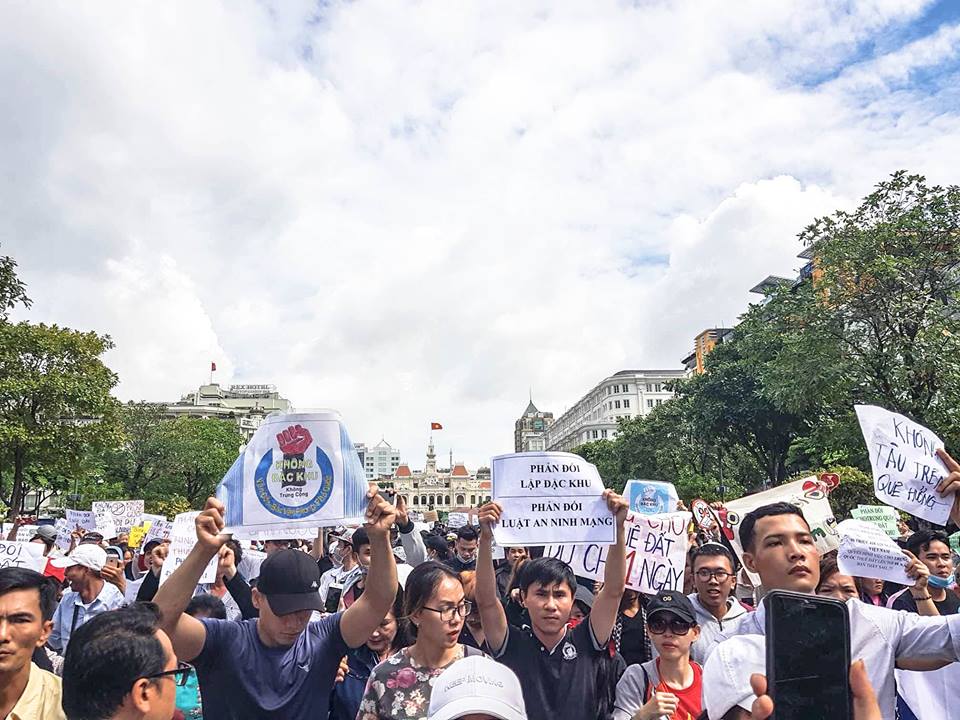
    The nation-wide protests broke out in Vietnam last Sunday, June 10, 2018, against the proposed Special Economic Zones (SEZ) and the cybersecurity draft laws, were estimated to have had thousands of people marching.

    Some sources believed around 300 people were later arrested in Ho Chi Minh City alone, and one of them was Will Anh Nguyen.

    Since his detention on Sunday afternoon, his family has been actively working with the U.S embassy to get him released.