Blog

  • Will #MeToo finally have its break in Vietnam?

    Will #MeToo finally have its break in Vietnam?

    In the late evening of April 18, 2018, many journalists in Vietnam began to share on social media a story that could come with the power to shatter the nation’s culture of playing down sexual harassment in the workplace and silencing victim.

    A female intern at Tuổi Trẻ newspaper was rumored to have attempted to commit suicide and was hospitalized, after alleging that she was raped by her superior. Tuổi Trẻ is considered one of the largest – if not the largest – state-owned newspaper in Vietnam, owned by the Ho Chi Minh City Chapter of the Communist Youth Union.

    By the next day, information about the alleged attacker surfaced, again, via social media.

    Tuổi Trẻ – while along with some 800 other state-owned media did not publish an official story – yet did announce that they have suspended journalist Đặng Anh Tuấn – whose pen name is Anh Thoa – the Head of Tuổi Trẻ television news because of the allegations.

    But at the same time, the editorial board denied in the same announcement that the intern was admitted to the hospital due to an attempted suicide.

    On April 20, 2018, the faculty at the university where the victim is enrolled, delivered a deadly blow to Tuổi Trẻ’s editorial board.

    In possibly one of the very first moves ever done by a university in the country for cases involving sexual harassment of their students, the Head of the Department of Journalism and Communications of The Vietnam National University Ho Chi Minh City sent an official letter to the editorial board at Tuổi Trẻ, demanding them to perform a formal investigation and provide the public with an explanation.

    What surprised people was the fact that the faculty of the university stood by their student’s allegations by clarifying and denouncing Tuổi Trẻ’s description of her conditions in their press announcement.

    The letter read, in parts:

    “We would like to bring your attention to this specific issue so that it could be dealt with directly, that Student ‘Doe’ has endured a prolonged period of psychological trauma which produced catastrophic effects on both her physical and mental health, which in turn deteriorated her health and led her to face the negative decision concerning her life.”

    The current story of the female journalist intern from Vietnam resembles very closely the ordeal of Japanese journalist Shiori Ito last year, who went public with the allegation that veteran journalist, Noriyuki Yamaguchi, raped her in April 2015.

    But while Ms. Ito currently has to fight not only her ongoing legal battle but also a culture that preferred silence and shaming victims in a country like Japan – where #Metoo could not quite take off – the situation may be different in Vietnam this time.

    It is encouraging to see that Vietnamese men and women – especially women – from all walks of life came out in support of the victim. The hashtags #MeToo and #letherdoherjob have been surfacing on Vietnam’s social media since Wednesday’s night, and they keep spreading.

    First, other female journalists shared equally horrific stories about how they and their female colleagues too, were harassed and assaulted at works.

    The amount of compassion – from journalists who used to work at Tuổi Trẻ – for the victim is also comforting to know. The reactions from many of the popular and veteran journalists on social media in the country are also positive.

    The message from the majority was actually quite simple and clear: speak up if you have been a victim or know a victim; and call on Tuổi Trẻ to perform a thorough investigation and be transparent and accountable to the victim and the public.

    But make no mistake that the culture of victim blaming and silencing does not exist in the country.

    On the contrary, as in any other patriarchal society, Vietnam carries its own baggage, full of prejudice against female victims in most of the sexual harassment and sexual violence cases.

    In Vietnam, while sexual harassment in the workplace was recognized in the Labour Code for the first time almost three years ago in May 2015, many victims still do not speak up or come forward with their stories.

    One reason could be that there are still no clear and well-defined legal definitions for conducts that would constitute sexual harassment.

    According to CARE, an international organization working on gender-based violence in Hanoi, Vietnam, 78.2% of victims of sexual harassment in the workplace are women.

    Without a clear legal framework to protect them, female workers in Vietnam dare not to speak up because they are afraid of losing their job.

    In 2014, ActionAid International Vietnam reported that their survey of over 2,000 women in Hanoi and Ho Chi Minh City revealed, that 87% of those answered have been a victim of sexual harassment in public where 67% of the bystanders who witnessed such conducts did nothing to help the victims. 31% of female students also reported that they were sexually harassed in public.

    Many of the stories published on social media in Vietnam in the past two days seem to show a pattern. The perpetrators often targetted young interns who are still in school or female employees who are freshly minted from college.

    Inexperienced, young, and in need of a job, the victims – who are also facing a culture that got influenced heavily by Confucianism with very strict standards when it comes to gender roles – would incline to choose to quit their jobs and internalize their emotional wounds rather than speaking up against the perpetrator.

    Yet, now, there is hope with the latest case involving the Tuổi Trẻ’s intern.

    In the past two days, Facebook statuses have shown an influx of stories of similar experiences and offers of support.

    People published allegations of sexual harassment and misconduct against the Director of the largest legal online research company in the country, Thư viện Pháp luật (The law library) online. This story again was a rumor among the legal professionals but never brought to broader public attention.

    Female activists in the country already start calling on people to use the hashtag #MeToo. And while it is true that we still have to continue looking out for development, it is not too early to say that #MeToo has made an important breakthrough in Vietnam where many have begun to say, Vietnam needs #MeeToo now.

  • From Nguyễn Văn Đài’s April 5, 2018 Trial – What Constitutes “Overthrowing the People’s Government” in Vietnam?

    From Nguyễn Văn Đài’s April 5, 2018 Trial – What Constitutes “Overthrowing the People’s Government” in Vietnam?

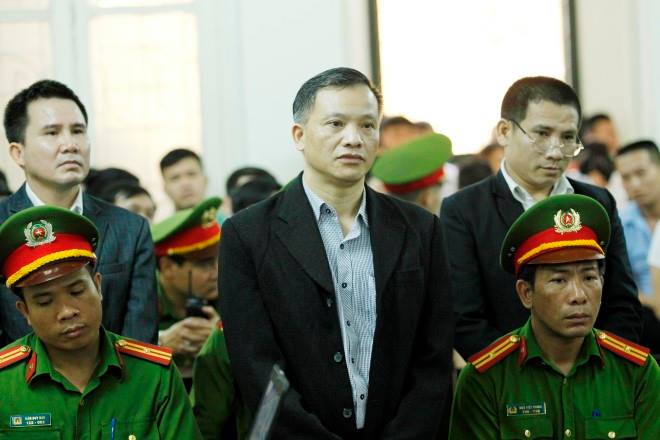
    April 5, 2018 | Nguyễn Văn Đài – probably one of the most prominent dissidents in Vietnam for almost two decades – received one of the harshest sentences for political dissent in recent years.

    A court in Hanoi, Vietnam sentenced Nguyễn Văn Đài to 15 years imprisonment and 5 years probation under house arrest. His colleagues tried and convicted in the same case, also received equally harsh sentences. Nguyễn Trung Tôn, 12 years imprisonment and 3 years probation; Trương Minh Đức, 12 years imprisonment and 3 years probation; Nguyễn Bắc Truyển, 11 years imprisonment and 3 years probation; Lê Thu Hà, 9 years imprisonment and 2 years probation; Phạm Văn Trội, 7 years imprisonment and 1 year probation.

    The 48-year old former attorney was among the first group of Vietnamese lawyers who took up political cases in the early 2000’s and defended dissidents, as well as those who were persecuted for exercising religious freedom.

    Đài was the type of lawyer who would defend those accused of the very same crime he is facing today: “conducting activities to overthrow the people’s government.”

    This crime is infamously known among international human rights groups and foreign embassies as the Article 79 of Vietnam’s Penal Code 1999.

    While carrying capital punishment as the maximum sentence, Article 79 however, utterly lacks a clear, well-defined description of conducts which would constitute a person’s criminal liability, and as such, making it impossible for people to cry out mea culpa.

    The law only states that “a person conducting activities to form or participate in any organization to overthrow the people’s government shall be punished as follows,” and then immediately dwells into specifying the sentencing guidelines from twelve years, twenty years, life imprisonment, up to the death sentence for the main perpetrator, and five to fifteen years for those who act as accomplices.

    Because of this ambiguity per se in its language, Article 79 had faced strong criticism from the international community over the years, especially during the last Vietnam’s Universal Periodic Review (UPR) in January 2014.

    Critics continue pointing out, that along with Articles 88 and 258 of the Penal Code, the government has used these criminal provisions almost exclusively against political dissidents and pro-democracy activists, taking advantage of the vague language of these codes to criminalize peaceful protests and suppress political dissent.

    Facing such international pressure during the 2014 UPR, Vietnam agreed to amend Article 79, and they did, in 2015.

    However, except for some minor, cosmetic changes such as the number of the code section from 79 to 109, and adding a category for those who are “preparing to commit the crime” with the punishment ranging from one to five years imprisonment, the remaining of the “new” Article 109 is taken verbatim from Article 79.

    In short, we still have to look to actual cases to define which conducts would constitute the crime of “overthrowing the people’s government” in Vietnam, and in Đài’s case today, such conducts would be:

    “Opening an office, having a website to operate, developing a ‘shortening manifesto’, having a structured organization, having internal and external affairs strategy, operating to increase membership, capacity, …; abusing the right to promote ‘democracy, human rights,’ ‘civil society’ to conceal the objectives of the Brotherhood for Democracy … waiting for the appropriate timing to openly operate in opposition of the government through changing the political structure in Vietnam, developing ‘pluralism with multiple parties’ and a government with ‘separation of powers’ to overthrow the people’s government while using a private sector economy as its basis.”

    The above paragraph was an excerpt taken from the Conclusion section at page 10 of the 16-page long indictment issued on December 31, 2017 against Nguyễn Văn Đài and his five colleagues, Lê Thu Hà (who was arrested together with Đài on December 16, 2015), Nguyễn Bắc Truyển, Nguyễn Trung Tôn, Trương Minh Đức, and Phạm Văn Trội.

    The new Penal Code of Vietnam was not taken effective until January 1, 2018. Thus, Đài and his colleagues were charged with Article 79 of the old code.

    Nguyễn Văn Đài has never shied away from his political ambitions and his outspoken criticism of the current regime, especially regarding the political monopoly the Vietnamese Communist Party (VCP) has over the country.

    In 2006, Đài openly called for the establishment of other political parties and forming political opposition to challenge the VPC’s ruling. According to a research on Vietnam’s democratization advocates conducted by the Australian scholar, Benedict J. Tria Kerkvliet, Nguyễn Văn Đài would fall under the category of those who chose to confront the regime head-on.

    He holds a firm personal belief that every Vietnamese people do have the intellectual capacity and enough knowledge to participate in a pluralistic form of governance with multiple parties.

    He previously wrote that Vietnam had had other political parties in the past, during the 1930’s and the early independent days from 1945-1946. Notably, in the South of Vietnam – before the fall of Saigon – political parties were very active. Moreover, Đài always believes that the current Constitution supports the formation of other political parties besides the VPC.

    His direct challenge to the ruling party’s power resulted in a conviction for “propaganda against the state” under Article 88 in 2007, where he served four years in prison and was released in 2011.

    Coincidentally, 2011, the year in which Đài was released, also marked the beginning of an unprecedented rise of the young pro-democracy and pro-human rights movement in Vietnam.

    Starting in the summer of 2011, Vietnamese people – especially youths – swarmed the streets of major cities such as Hanoi and Saigon, protesting against China’s aggression due to the incident involving the cutting of Vietnam’s Binh Minh vessel’s cable cab in the South China Sea.

    People organized protests through Facebook’s pages, and statuses, calling for massive turnouts all over the country like never seen before, at least not anything like that had happened since after the Vietnam War was over in 1975.

    At first, the government allowed the protests, but when faced with thousands of youths on the streets, they quickly decided to change course and started cracking down on peaceful protesters. Yet this very conduct of the government had opened doors to another era of civil disobedience in Vietnam: the birth of the independent civil society organizations (CSO) movement inside the country. Many of the protesters on those streets in Vietnam six years ago are now the prominent faces of the pro-democracy movement.

    The undeterred Nguyễn Văn Đài quickly caught on to this phenomenon and organized his own CSO – the Brotherhood for Democracy (which got named in the indictment) – continuing pushing for political changes through challenging the one-party rule. A person with charisma, Đài again rose to the occasion, becoming the familiar face during those meetings with foreign officials and diplomats from many embassies in Hanoi.

    And that was documented in his December 2017 indictment as well, where it detailed how he was able to connect with foreign institutions and individuals to secure funding for his CSO – activities that are normal for any non-governmental organization around the world. The indictment even named diplomats from the U.S. and Germany as people who acted as his references.

    It also worths noting that almost two years ago, Vietnam’s National Assembly attempted to pass a law on association with restrictions on receiving “foreign funds.” However, such efforts failed when faced with stern opposition from NGOs and CSOs from Vietnam, both registered and non-registered.

    Thus, except for the indictment in Đài’s case making it out to be a crime, Vietnam’s laws have yet to prohibit NGOs to receive foreign financial aids.

    But the reality remains, that as of right now, Vietnam still only has one political party – the Communist Party – and Nguyễn Văn Đài and his colleagues’ latest trial and conviction demonstrate that any efforts aiming at forming a political opposition would constitute conduct punishable by very long and harsh sentences.

    In December 2008, many people gasped as China sentenced Nobel Peace Prize Laureate, Liu Xiaobo, to 11 years for “suspicion of subversion against the state.”

    Now almost ten years later, in April 2018, using an eerily similar charge against Nguyễn Văn Đài and his colleagues, Vietnam has demonstrated that it too, does not yield to international pressure and would even go the extra miles in sending political dissents to prisons for even longer terms than its communist big brother.

  • Tran Thi Nga – The Story of A Grassroots Human Rights Defender in Vietnam

    Tran Thi Nga – The Story of A Grassroots Human Rights Defender in Vietnam

    She came from a poor family in rural areas of North of Vietnam, married young at nineteen years old and soon had children of her own.Growing up, she did not have good opportunities for schooling.As a young girl, her mother passed away when she was ten, and her father could not afford to continue sending her to school. After seventh grade, she began working and helped taking care of her younger siblings.Her first marriage ended quickly. Her husband was abusive, he beat her, and did so very often.She left him and became a single mother with two young children to bring up while not having a job.Like many other people around her, she never heard of things like human rights.Like them, she was too busy finding means to feed herself and her family.But less than two decades later, she became a person who not only knows about human rights but also makes it her life mission to defend them.Her name is Tran Thi Nga, who also goes by her blogger’s name Tran Thuy Nga.The road to becoming a human rights defender for Nga was influenced by her own life experiences.After divorcing her first husband and returning to her hometown with her two children, she began a new chapter in life with 5kg of rice borrowed from a cousin.She used half of the borrowed rice to cook porridge for her starving kids and turned the rest into rice flour to make steam rice rolls, selling them to the neighbors and make a profit of fewer than 1 USD a day. With that, she was able to support her children and herself for a while.Nga soon realized she could not raise her children by just selling steamed rice rolls, so she borrowed some money and applied to go to Taiwan as a migrant worker.Unfortunately, Nga got injured almost immediately after she arrived and started work. Alone in a strange country and unable to receive compensation for the injuries, she again became desperate about the future.However, with the help of a Vietnamese priest, Nga was able to negotiate a settlement with her previous employer for her work-related injuries.Her life took a totally different turn from that point as she later told her friends, because the best thing she had received from that experience was not money, but learning how to fight for one’s own rights and stand up against injustice.Returning home around 2008, Nga slowly went on a path that shaped her into a human rights defender.She joined the protests against China’s aggression in the summer of 2011, which was a turning point for the independent civil society movement in Vietnam.She stood with land-grabs victims in Hanoi and assisted the family of death-row inmate Ho Duy Hai in their fight for Hai’s release.Wearing a traditional Vietnamese dress and a bright smile on her face, Nga also was one of the faces that stood out during the march against the government’s decision to cut down more than 6,700 trees in Hanoi in the spring of 2015.Her neighbors now remember her fondly as someone who would always stand up for them against the police’s wrongdoings.But she pays a heavy price for standing up for others and against the government’s wrongs.Nga was arrested on January 21, 2017, just a few days before Tet – the Vietnamese celebration of the Lunar New Year. And two days before Christmas 2017, in a one-day appeal trial, the government affirmed her conviction and the 9 years imprisonment sentencing.Long before the 2017 arrest and trial, her children and she had been a victim of police abuse many times. Their house was vandalized and her leg was broken when plainclothes police attacked her with metal rods a few years back.Nevertheless, the year 2017 was especially challenging for those who work as human rights activists in Vietnam.The government seemed to have increased its oppression with over 20 individual cases of activists being arrested and charged with anti-state crimes which carry long and harsh sentencing.Mother Mushroom aka Nguyen Ngoc Nhu Quynh and Tran Thi Nga were among those who targeted by the recent government’s crackdown.Both were bloggers who spoke about social injustice like Formosa environmental disaster and police brutality on social media like Facebook and Youtube.Both are mothers with young children.And yet they both received some of the harshest sentences handed out to dissidents in recent years. They were tried in 2017 and got sentenced to 10 years and 9 years imprisonment, respectively, for propaganda against the state under Article 88 of Vietnam’s Penal Code.Recently, the government had ordered to have them relocate to prison centers that are hundreds of miles away from their hometowns, which also meant it might be impossible for their young children to visit them.In February 2018 and right before the Vietnamese New Year – Tet, a group of Vietnamese activists pleaded with both Nga and Quỳnh in a public petition that they should consider seeking political asylum for the sake of their children. Both have been unwavering.Tran Thuy Nga may not be the type of activists who are being seen as the leading voices behind some of the more well-known campaigns, such as “We Are One” or “We Want to Know” on social media in Vietnam.Yet, in her own way, her life and works could really help people understand how one ordinary person in Vietnam begins her journey towards self-empowerment, to stand up and defend universal human rights.

  • Phạm Đoan Trang – The Humming Guitar Before Rainstorm Falls

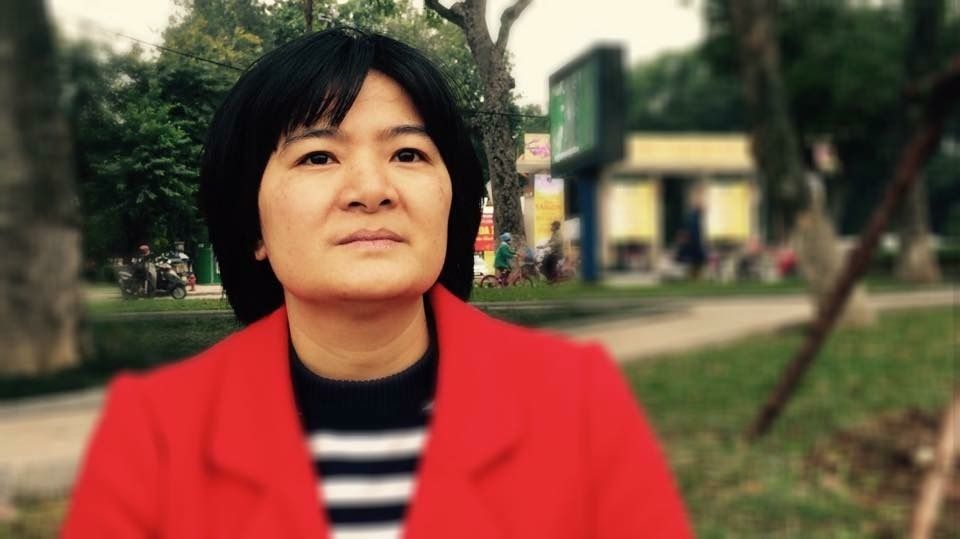
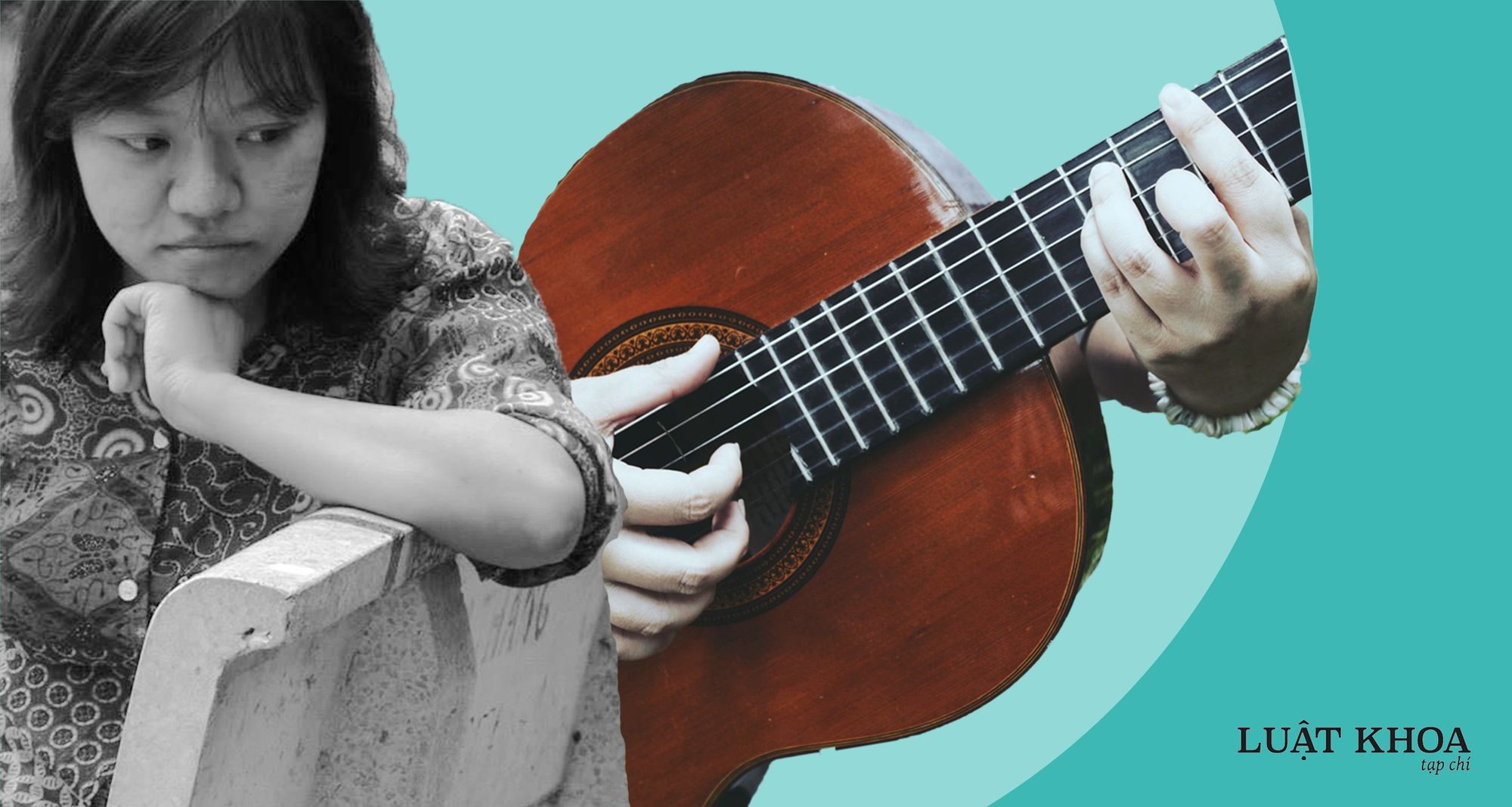
    Phạm Đoan Trang – The Humming Guitar Before Rainstorm Falls

    “I’m so very tired. How long can they keep continue doing this? They’ve cut electricity yesterday. Today it’s the Internet.”

    That was the last message I received from Đoan Trang in the afternoon on the 9th day of the Vietnamese New Year celebration, Tết. Less than an hour later, I messaged her. There was no reply until midnight.

    Trang’s family later told me that two strangers came to their residential home in the afternoon and took Trang with them. Their reasons? Her book – Politics for the Masses – which Trang wrote and published late last year.

    Discovering the forbidden zones

    Đoan Trang was once considered one of the best journalists in the country, representing the mainstream, ‘orthodox’ majority of the Vietnamese press.

    Even though she started her career at VnExpress – one of Vietnam’s first online newspapers – back in 2001, it was at Vietnamnet, another prominent e-newspaper, that Đoan Trang first made her break into the news business. After that came the much renowned and critically acclaimed feature writings and commentaries, which she produced while working for the Pháp luật Thành phố Hồ Chí Minh (The Law in Ho Chi Minh city newspaper).

    From 2007 to 2008, Trang wrote a series of articles exploring the Spratlys and Paracels Islands conflict on Vietnamnet. The series brought to her both professional glory and hardships in perhaps, equal measure.

    It was the first time since Vietnam and China normalized their relationship in the 1990s, that the South China Sea (or East Sea from Vietnam’s point of view) conflict was analyzed on a mainstream newspaper, and in a quite direct and candid manner, with an abundance of research. Despite the normalization, the East Sea conflict was then still a forbidden subject in Vietnam: an area very much known to many, but rarely touched upon by the Vietnamese mainstream journalists.

    Đoan Trang’s writing career is indeed a journey to discover these unknown lands. Before she became a household name with her political writings on Vietnamnet, Trang co-authored with Hoang Nguyen the book “Bóng” (Shadow), the first published autobiography of a homosexual person in Vietnam. However, the story with the East Sea was different. To land one’s foot in such an area is to place oneself a step further into a jail cell.

    As it turned out, Đoan Trang soon found both of her feet ended up inside a government’s prison cell. She was arrested and detained for nine whole days at a police station from the end of August to early September in 2009. On the same occasion, two other bloggers with dissident views were also arrested: Bùi Thanh Hiếu ( blogger Người Buôn Gió), and Nguyễn Ngọc Như Quỳnh (blogger Mother Mushroom).

    “To this day, I still don’t know what they arrested me for,” Trang said.

    After her nine-day detention, Trang lost her job at Vietnamnet. It only took nine days for her to go from a well-respected journalist into a “subject” who threatened Vietnam’s “national security”. With such a label, she also faced an infinite prospect of unemployment. However, she soon found a job at The Law in Ho Chi Minh city newspaper’s branch office in Hanoi. Nam Đồng, the veteran editor-in-chief of the paper, specifically invited Trang to work for them and assured her that she would be able to work normally as a journalist.

    If the Vietnamese police thought that nine days in a cell were enough to smack Trang around, they were dead wrong. The incident pushed Trang to march even further down on her chosen path. She got involved in democracy activism and continued to write stories other mainstream journalists still hadn’t found the courage to tell.

    On her personal blog at www.phamdoantrang.com, Trang began to discuss some of the most politically sensitive matters in the country: the one-party system, the police state, the public demonstrations and the resulting oppression, the arrests of political activists, etc.

    Trang turned up at the demonstrations against China’s aggression in the East Sea in 2011 and 2012. She joined the demonstrators protesting the government’s plan to cut down a large number of trees in Hanoi in March 2015. Her face and voice soon were sought after by different human rights delegations from Europe and the United States.

    Trang has thus stepped into the darkest of forests and the deadliest swamps in Vietnam. The areas in which the Vietnamese communist security apparatus have always guarded carefully.

    Of course, the sword of the State never shows mercy for such a “rogue” as that is how they see her.

    The Cat and Mouse game

    At 2.39 A.M. on a day back in 2016, Đoan Trang was awakened by the doorbell.

    She was staying temporarily at a friend’s home while still on her way to escape the pursuit of the Vietnamese police. The place was an apartment room inside a building with 24-hour security service. No strangers are supposed to be allowed into the main access, let alone coming straight to the door and ring the bell.

    “The bells were definitely tolling for me”, Trang recollected.

    “I heard clearly chit-chatting sounds from a group of people outside my door. There was no other way to explain their appearances at such ungodly hour, except that they have uncovered my tracks”.

    Hearing no noise from inside, the group of strangers left. Đoan Trang was left unscathed on that occasion.

    Going “dạt vòm” (Vietnamese slang which literally means “sleeping rough” and is used by activists to describe situations where they have to deflect secret police’s surveillance by leaving home) has become something that Trang is well-accustomed to.

    Before any demonstrations or meetings with foreign officials, this tiny lady must get herself to a hidden place at least a day prior. This is to evade being cordoned off by the government’s security force because the Vietnamese police always try to prevent Trang from turning up at such events.

    Once in a while, Trang came to stay at a friend’s place; other times, she either had to book a room at a hotel or stay at a construction site – where those living on the margins of society usually assemble.

    But escaping the police is never easy.

    Once back in 2015, not long after she came back to Vietnam after a one-year fellowship at the University of Southern California, U.S., Đoan Trang was abducted right at the Hồ Gươm (Sword Lake) in central Hanoi in broad daylight. She was on her way to the L’Espace Center to interpret in a meeting between a representative of the New Zealand embassy and the families of two wrongful death-row inmates, Ho Duy Hai and Nguyen Van Chuong.

    A police car stopped right next to the pavement and Trang was forced into it. She was taken to the nearest police station. They only released her after successfully breaking off the meeting.

    “Every time things like that happened, friends and relatives rushed to look for me. It is such an annoyance. And the thing about being abducted that frequently is that: if you are not mentally tough, you start getting paranoid, you start to see security people everywhere”, Trang revealed.

    But it was apparently still not enough cloak-and-dagger for some people.

    On 24 May 2016, the then US President, Barack Obama, planned to meet several representatives of the Vietnamese civil society communities in Hanoi. Đoan Trang was invited. At the time, she was still recuperating from a recent operation on both of her knees in Saigon (Ho Chi Minh City).

    Knowing full well that the security folks would follow her and prevent her from attending the meeting, a secret road trip to Hanoi was arranged with help from two drivers who are Trang’s friends.

    The road trip was smooth. They reached Ninh Binh in the late evening of the 23rd of May, one day before the meeting. They had a private and well-secluded hostel reserved for them, giving them the hope for a safe night without police surveillance.

    But the secret police were sleeker than what was thought of them. Early morning the next day, Trang saw several people in the hostel’s foyer, carefully dissecting her with their eyes. Then a female security officer with her own entourage marched into Trang’s room, bringing with them strange equipment and winners’ sniggers.

    “I felt like a hunted animal,” Trang recalled.

    Trang and her friends could not make it to Hanoi for the meeting with Obama. Instead, they were kept inside the hostel for the entire day.

    “In literature, there is this novel, The Seventh Cross, which is about the loneliness of the German people who were fleeing the Nazis. Now I understand how they felt. Occasionally, I walked across a huge city full of cars and people, but there was no place for me to stay. There is no hostel or hotel that would be safe enough.”

    “They do not consider us humans. To them, each and every one of us is simply a project in the name from which they could mooch off the national budget. So don’t expect to have a dialogue with the security people. We can only have a dialogue with those who respect us.”

    It may sound negative for many, but such an insight comes from a person who has been forced to have a “dialogue” with the Vietnamese security officers hundreds of time.

    The hidden audience

    “You used to sing this song, which goes ‘Let me go home’ or something? It was damn sad.”

    I received that message from Đoan Trang in an afternoon when she was on the run from another police’s pursuit.

    “I wanna go home”, she wrote in English to me, borrowing from the song Home by Michael Bublé.

    Trang likes to take care of her home. She said that she “misses the flower vase, the table, the painting, and especially longs for her guitar”.

    Not many people know about Trang’s passion for the guitar. It has been more than one occasion, in which Trang confided in me how she doesn’t really have any true passion for politics or the struggle for democracy like people usually assume. The only thing she cannot live without is her guitar.

    “I love the guitar very much. I miss it ceaselessly whenever I am away. I just want to hug it when I come home, and to kiss it and caress it with my fingers,” she said.

    If you are ever so lucky, you can sit down and hear Trang’s renditions of Mozart’s The Magic Flute, or the ballads If by Bread, I Kiss Your Memories by the Bees Gees, or Love Me with All of Your Heart (Ray Charles version).

    Trang has been teaching herself to compose music, and therefore the “dạt vòm” days are full of sufferings for her. She cannot play the guitar normally like others. Thus, she usually plays the guitar as if she won’t be able to play it tomorrow.

    People have countless reasons to fear the idea of having to go to prison. For Trang, she fears that she will not be able to play the guitar anymore. Prisons in Vietnam seldom let prisoners play guitars. It is usually with close supervision if they are allowed to play at all. The guitar strings can be used for many things, including committing suicide.

    One thing Trang has never been able to tell for sure is whether her home was bugged. Many people say with certainty, that such a “notorious dissident” like Trang, has to be bugged somehow. In the former Soviet and East European states, many people only found out that their homes were bugged after the communist regimes collapsed.

    Trang always has this feeling that even though she plays her guitar alone, there is somebody else listening.

    “I never thought I would play my guitar in such a circumstance. On the ‘other end’ of the line, if somebody is listening, what are they thinking? Maybe they think I am such a crazy woman”. Trang said, half-jokingly.

    Writing for the Mass

    On the past 9th February, the newspaper Tin Tức (The News) of the Vietnamese Press Association announced something unusual: The Danang City’s customs officers confiscated several parcels of politically-sensitive books.

    Amongst the four parcels of books “with politically-sensitive contents” which were confiscated, two parcels consist of several copies of Politics for the Mass, a book that Trang wrote.

    Politics for the Mass, written in Vietnamese and talks mostly about Vietnam and for the Vietnamese people. One would think such a book should have been able to publish in Vietnam, and not having to be ordered from abroad like that. More than 20 years ago, I dug around in my parents’ old stack of books and found the textbook Elementary Politics, published by the Vietnamese communist government. It was a short, yellowed book. I read it in one go. The clear and simple language of the book allowed my 12-year-old self to thoroughly understand and get mesmerized by Marxism-Leninism.

    But the right to publish this kind of book only belongs to the government.

    Many years later, I read another political book. This one perhaps is most famous for this oft-quoted sentence: “All animals are equal, but some animals are more equal than others”.

    Animal Farm by George Orwell somehow managed to escape the Vietnamese government’s censors and got published for a short period of time before they ordered the confiscation of all copies and listed it as a banned book in Vietnam.

    Politics for the Mass by Đoan Trang does not have such luck. She has no other way to get it published in the first place, except by relying on a “foreign force”: the tech-giant Amazon.

    Trang is the type of journalist who is especially concerned with those who have yet to know a lot of things. While many people sigh in dejection whenever “popular literacy” or “people’s intellectual level” is touched upon, Trang always reaches out to the people who are still strangers to the most basic concepts in politics and law.

    “I still remember very clearly how in 2009 when I was first arrested, I was totally naive. I did not know anything about law, or about how to behave with the police. When we went to demonstrate against China in 2011, the whole group was still none the wiser. We got bullied by the police a lot”, Trang recalled.

    “It was only in 2013 when I started to explore politics, law, democracy, human rights, etc. So when I write, I imagine that I am writing for this girl, Đoan Trang pre-2013”.

    The idea of a book for the common folks emerged when Trang read the preface to the Vietnamese translation of The Undercover Economist by Tim Harford. It was written by Nguyen Duc Thanh, a prominent Vietnamese economist, who said that Vietnam needs intellectual heralds who can help bringing complex, academic knowledge to the general public.

    After nearly 20 years working in the news business, Trang has the insight that “the Vietnamese newspapers and media fail to do such a thing. Don’t blame it on the people’s low intellectual level, or that they don’t like to read. It is us who are still not willing to help the people read, explore, discover”.

    “I don’t write a book so that it will become a legacy or get included in some canon somewhere. I don’t mind if the book grabs the public attention only for a few years if that can help the people become less ignorant about politics and inspire others to write better books on politics. We must write more so that the people become less fearful.”

    So said so done, Trang wrote Politics for the Mass, Non-violent resistance, and she is now writing several other books.

    When Politics for the Mass was published, some readers complained that Trang was too hurried in her writing and made a number of errors which could have been easily avoided.

    “Hurried”.

    Đoan Trang has always been in a hurry. Always urging. Always kicking other people into immediate actions.

    She cannot wait. Because she never knows when they will arrive: the uniforms and the handcuffs.

    “We cannot give up”

    Not many people know this, but Đoan Trang did have an opportunity to seek political asylum when she finished her nine-month course at the University of Southern California back in 2014. At least three organizations, government departments had offered Trang their assistance in applying for asylum because they were concerned about her safety when she decided to return to Vietnam.

    But Trang has never had any intention to stay abroad.

    “Many people look at your life and only see a weirdo who does strange stuff and invites misfortunes upon herself. Do you feel miserable?”, I once asked Trang.

    40-year-old, no husband, no kids, living on the run, for her greatest asset is her uncertain future. Yet not many people understand that Trang is rather happy, and not at all miserable like they imagine.

    “Many people prioritize stability, they want family, children, peaceful life. There is nothing wrong or right to argue about it because that is their own life. But for myself, if I haven’t got involved in activism, I would never have been able to experience the adoration that people have for me”, Trang said.

    Indeed. Occasionally Trang told me about such experiences, showing gratitude and pride in equal measure. Like this one time when a hotel owner told Trang to leave immediately because a police officer just came by to ask for her. That owner even showed her which way to run. When she had her knees operation, many people came to assist her, many of whom she had never met.

    “Sometimes they came to visit me in the hospital. They pushed some money into my hands, then cried and ran away. And there were old friends – who had not been in touch for some time – suddenly reappeared to help me with this and that”, Trang recalled.

    “Some people actually recognize me on the streets. I am especially elated to find young people who recognize me and talked about my writings. There was this one time in a restaurant in Saigon, the owner kept smiling at me, then he came near and asked if I am Đoan Trang. Once I said yes, he served me the meal himself, slashed the bill for me, and gave me some gifts at the end.”

    Trang said, “it is a wonderful treasure. What can you possibly trade to receive such sentiments? We cannot give up because there are still people like those in life.”

    Of all the songs she has sung, Đoan Trang loves “Fernando” by ABBA the most, the band that her 1970’s generation grew up with.

    The song’s lyrics are about two old Mexican Revolution veterans reminiscing their younger years fighting for freedom.

    The song ends with an inspiring chorus:

    …If I had to do the same again I would, my friend, Fernando…

    Maybe right at this moment, on the “other end” of the line, inside the Vietnamese Ministry of Public Security’s office, an unnamed police officer is listening to the gentle sound of a humming guitar softly weaving the melodies of “Fernando”, as if it cares not when the storm comes.

    …If I had to do the same again I would, my friend, Fernando…

    ________________

    In March 2018, Đoan Trang was honored by People In Need from the Czech Republic with the Homo Homini award for her tireless works on promoting and advancing human rights in Vietnam.

    This article was originally written in Vietnamese and published by Luật Khoa tạp chí on February 25, 2018, entitles, Đàn reo trước bão.
  • Censorship in Vietnam: JFK Miller Interviews Thomas Bass

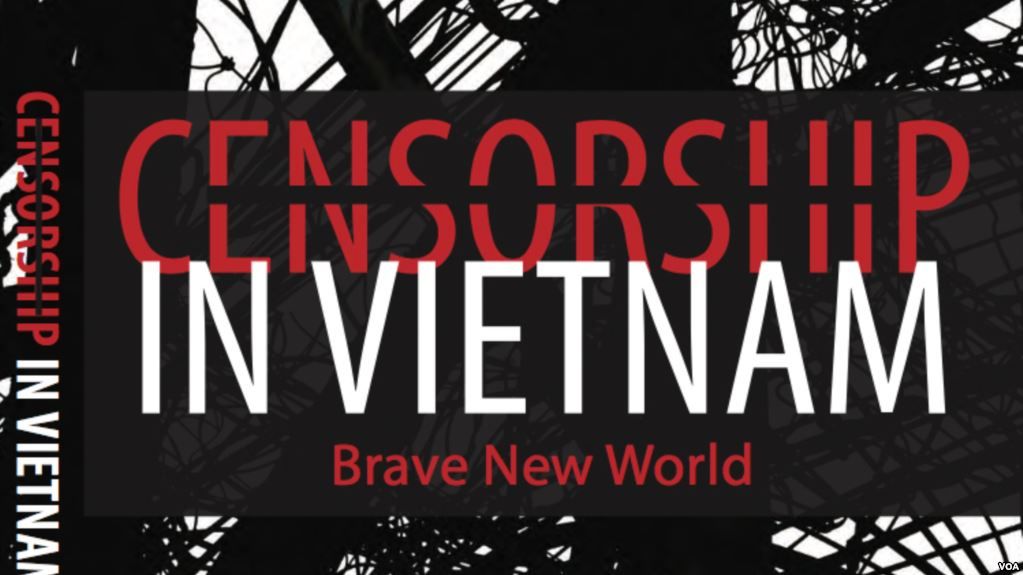
    Censorship in Vietnam: JFK Miller Interviews Thomas Bass

    • With permission from author Thomas Bass, The Vietnamese is pleased to reprint the interview Mr. Bass has given to JFK Miller, a Melbourne-based journalist, in February 2018 on his latest book, Censorship in Vietnam: Brave New World

    Thomas A. Bass’s 2009 book The Spy Who Loved Us dissects the double life of Pham Xuan An, a correspondent for Time during the Vietnam War and a contemporary of Peter Arnett, Richard Pyle, and Morley Safer. As American radio blasted Bing Crosby’s ‘White Christmas’ to signal the evacuation of embassy personnel in those final tumultuous hours of April 30, 1975, An was Time’s last man standing, the magazine’s sole remaining reporter in Saigon as the North Vietnamese tanks rolled in. In truth, he was part of the welcome brigade. An was a spy who used his journalistic contacts to feed vital intelligence to Hanoi. Time’s Zalin Grant, who worked alongside An, called him “the first known case of a Communist agent to appear on the masthead of a major American publication.”

    But An’s tale is a story within a story. Bass’s latest book, Censorship in Vietnam: Brave New World (University of Massachusetts Press, 2017), recalls his experience with Vietnam’s state censorship apparatus when he tried to get a translation of The Spy Who Loved Us published in Vietnam. He succeeded, but at a cost — five years of negotiations and no less than 400 cuts to his manuscript.

    Was it worth it? Bass himself answers that question below. For me, the reader, the answer is a resounding yes. The censorship experience Bass recounts in his book paints a vivid picture of present-day Vietnam, and it’s not a flattering one. Economically, the country is one of Asia’s “new” tigers which last year posted the world’s second-fastest growth rate. Politically, however, it’s a paranoid and insecure beast which lacks the ability to confront its own past and look squarely at its own present (Bass does not mince words: Vietnam is “a culture in ruins,” he writes). I traveled to the country several times in the ’90s, but am ashamed to say my conception of Vietnam was cryogenically frozen somewhere between The Quiet American and Apocalypse Now. Well, it was, until I read this book.

    My connection with Thomas Bass comes via our different but eerily similar experiences with state censorship – his with Vietnam, mine with China. As I worked my way through his book it struck me how alike the censorship systems in both countries are. And then on page 83, I learned why: Hanoi takes its cues straight from Beijing. The dissident novelist Pham Thi Hoai explains, “We always look to the Chinese and copy them… it is mandatory for every high Vietnamese official to get training in China once a year, just as it was in the time of the Cold War. It is no accident that every campaign and law adopted in China is introduced into Vietnam six months later.”

    It’s perhaps no surprise then that Vietnam’s military conflicts with China, including the incredibly brutal 1979 conflict in which tens of thousands died on both sides in less than a month, are glossed over in school textbooks.

    But this is simply one of the censorship’s many casualties. Writers and journalists are routinely given draconian prison terms for speaking truth to power. Criticism of the Chinese is censored, as is praise for the French and Americans (“they are not allowed to have taught the Vietnamese anything,” writes Bass). Disparagement of communism and communist party officials is banned, together with the discussion of “government policy, military strategy… minority rights, human rights, democracy, calls for political pluralism, allusions to revolutionary events in other communist countries, distinctions between north and south Vietnamese, and stories about Vietnamese refugees.”

    Whether it’s novels or journalism, there’s an overarching optimism that must pervade writing in Vietnam that is forced upon its writers by state censors. Either be censored, self-censor, or be damned. A 1988 novel by the above-mentioned Pham Thi Hoai, The Crystal Messenger (which I’ve not read, but now want to because of Bass’s book), was banned for the reason that its view of Vietnam was “excessively pessimistic.” No surprise that she now lives in self-imposed exile in Berlin, a place where, unlike her homeland, she is lauded for her work.

    My one criticism of Bass’ book is the choice of the most prosaic of titles – Censorship in Vietnam – with a nod to Huxley in the subtitle. But this is small beer. On the whole, this is a tremendously eye-opening book, and thoroughly readable. Our discussion follows.

    ***

    Why was it important to you to have a translation of your book published in Vietnam, especially know that it would be censored?

    Communicating across borders interest me. There is much to be learned and much to be unlearned, and even the misunderstandings are revelatory. Look what happened when I tried to mail you a copy of Censorship in Vietnam from the U.S. The book was returned to me several weeks later by “homeland security.” Who would have guessed that the “JFK” in your name – honoring of the 35th president of the United States – was suspicious? But apparently, according to the paranoids who patrol our borders, initials without complete first names imply criminal intent. So it took another 20 bucks and the entire “John Fitzgerald Kennedy” to get you a copy of my book.

    Another answer to your question has to do with surviving as an author. My books have been translated into various foreign editions, and I enjoy traveling to literary events in far-flung places. So why not add Hanoi? Nha Nam, the Vietnamese publisher of my book, was supposed to be the country’s best. I would be joining the likes of Vladimir Nabokov, Milan Kundera, and Orhan Pamuk. Not bad company.

    But I think you’re asking a more serious question, which is the subject of Censorship in Vietnam. If I knew how much grief I would be getting for translating The Spy Who Loved Us into Vietnamese, why did I invite it? The answer is pretty straightforward. I wanted to conduct an experiment. Exactly how much grief was coming my way, and who would be cranking the handle?

    Did you brace yourself for a rough ride, or did you go into it thinking that you might perhaps get away with more than you thought you could?

    I knew that chunks of my book on Pham Xuan An would be removed. It was full of subversive material – by which I mean material that the Vietnamese consider subversive – conversations with exiled writers, accusations of corruption in the Communist Party of Vietnam, jokes about how ugly the language has become in postwar Vietnam.

    My Vietnamese publisher and my literary agent in New York and subagents in Tokyo and Bangkok all assured me that I had nothing to worry about, that none of the books they had published in Vietnam had been censored. They were either ignorant or lying, but it’s also true that no one pays much attention to foreign rights. A book goes into Polish or Portuguese, and very few authors have the time or skills required to check the translation. I had been tipped 3 off to the fact that even novels and poetry are censored in Vietnam. So a nonfiction book about a Vietnamese spy who claimed to have loved the United States and the values of investigative reporting and Western journalism was certainly going to be censored.

    For the few hundred bucks my literary agent was making on the deal, he kindly allowed me to rewrite the standard publishing contract for the sale of translation rights, and then we patiently negotiated these changes as the contract was bounced back and forth between New York and Hanoi. I inserted clauses about prior review and final approval of the translation, and I larded the contract with trip switches, so that every time the censors moved on me I had to be notified. The manuscript became a kind of early warning system, ding, ding, dinging on my desk, at every stroke of a censor’s pen. And in Vietnam, as you yourself found in China, there is not just one censor, but various tag teams and competing groups of censors, which operate in a hierarchy of censors that stretches all the way up to the head of the Communist Party. Each level in this hierarchy is afraid of getting whacked by the one above it. So the natural urge is to adopt what the French call langue de bois – the wooden speech of martinets and political hacks. This is how a culture dies … but at least the censors will never be out of a job.

    Given my jerry-rigged publishing contract, I owe a great debt of thanks to the editors at Nha Nam who honoured this contract. I was a pain in their necks, if not dangerous to the survival of their company, but still they notified me every step along the way. At the end of five years, my book was radioactive. My original editor had quit the company and quit publishing altogether. The project had been at death’s door a half dozen times, and many of us were surprised when printed copies of the book finally appeared – briefly – on bookshelves in Hanoi and Saigon.

    Did you ever consider simply pulling the plug and abandoning the translation altogether?

    Remember, this was an experiment, with every twist and turn in the process producing “data.” At the most basic level, I was studying the Vietnamese language. How has it changed since the end of the Vietnam War in 1975? Pham Xuan An complained about these changes when I was interviewing him for “The Spy Who Loved Us,” which began as an article for The New Yorker and later became a book with the same title. He said the Vietnamese language was being corrupted by Marxist-Leninist gobbledygook borrowed from Russia and Maoist terms imported from China. To learn how to speak this new language, An was sent to a “re-education” camp for ten months. “I was a bad student,” he said. “They never understood my jokes, but at least I didn’t do anything serious enough for them to shoot me.” (An’s “re-education camp” was actually a military academy outside Hanoi for training high-level officials, but I believe him when he says the experience was bone-chillingly boring.)

    Censoring books in Vietnam begins before the first word is translated. In this case, the person chosen to translate my book was a north Vietnamese journalist fluent in gobbledygook. He produced quotes that sounded nothing like the south Vietnamese spy about whom I was writing. The publisher was surprised that I cared about these things or knew enough to want the language changed. A nonfiction book for them was the equivalent of an encyclopedia entry. Give us the information, and give it to us in today’s language – in this case, the language spoken in North Vietnam, which is where most of the book-buying public lives. There was also a good dose of prejudice at work. The South Vietnamese lost the war, which means that not only their political system but also their culture and language are in the process of being effaced.

    After the censored Vietnamese-language copy was published in print, you released an uncensored version on the Internet. Can you explain why this was important to you?

    Censorship is so crushing in Vietnam that many authors are skipping printed publications and releasing their work directly to the web. In my case, I wanted to see what the printed book looked like. I wanted to evaluate the damage done to the text by Vietnam’s censors, count up the number of cuts and alterations, and study the people and ideas that got erased.

    After assembling my literary seismograph – in other words, after The Spy Who Loved Us was translated and released in Vietnam (although not under that title, which the censors considered far too dangerous)-I felt obliged to provide my Vietnamese readers with a copy of the original book. This too is standard practice in Vietnam. Even when a book is printed, people go to the web to find what everyone assumes will be a more accurate version online.

    At the same time, I wanted to conduct a second experiment. Vietnam’s censors work across borders. You can’t publish books online with impunity. Electronic publications will be attacked by trolls, worms, viruses, denunciation campaigns, denial of service attacks, bribery, extortion – whatever works to get them taken down. I don’t want to exaggerate the risks I took, which were nothing compared to my Vietnamese colleagues, but the Vietnamese version of my book – the complete version published online in Berlin on computers hardened against attacks from Vietnam’s censors – invited retaliation. It was attacked in a variety of ways. The translator was forced to drop out. He also pulled his translation, which we could no longer use. People threatened to sue me. The internet lit up with chatter maligning me and the project. The Berlin web site went down a few times, but it held fast against the censors and trolls, due to the good work of exiled author Pham Thi Hoai, whose site for many years has been the rallying point for opposition to Vietnam’s communist police state.

    When you engaged the dissident Pham Hong Son to translate your book for the Berlin release, did it weigh on your mind that you might be condemning him to another hefty prison term? (Son had already spent five years in prison and another seven under house arrest for translating essays on democracy).

    As I mentioned, the first translator for the unexpurgated version of The Spy Who Loved Us, was forced to quit. Enough threats were brought to bear that he felt he had no choice. Pham Hong Son is a different kind of person altogether. After spending five years in prison, much of it in solitary confinement, for translating an essay on democracy and recommending this form of government to his fellow countrymen, he went on doing exactly the same thing after he was released to house arrest. Trained as a medical doctor, a true intellectual and patriot, he is a brave man, someone whom I admire and am lucky to count as a friend. He did the work for free because he thought it was important, and ever since then, I have been looking for some way to repay him.

    In your book’s foreword you ask the question central to all of this. Could China and Vietnam’s governance model become the new normal? It pains me to acknowledge this, but democracy, with all its trappings – not least of which, freedom of speech and freedom of the press – is in bad odor at the moment, while the Vietnam/PRC model, which puts economic development above free speech, is in the ascendancy. Add to this, declining American power and an Oval Office occupant who has turned American democracy (indeed all democracy, I would argue) into a global laughing stock, and Reagan’s “Shining City on a Hill” now looks like a faltering candle. Is it any real surprise that countries like Vietnam and China seem to have more faith in their political systems than we currently do in ours? And do you not think that democratic reformers in Vietnam are, at least for now, fighting an impossible battle?

    This is the key question of the moment. As the western democracies falter and lose faith in themselves, as they debase their elections, trade freedom for security, and forget their founding principles, people think that police states with good shopping look attractive.

    This is an illusion. In fact, it is a dangerous illusion. Censorship can kill you. The absence of free speech can kill you. Not knowing the truth can kill you. These are fundamental values, not to be sold at any price, but they are also tools for survival. This argument was made by Nobel-prize-winning economist Amartya Sen, when he was asked by the Indian government to advise them on which model they should choose for development: the open societies of the West or China’s surveillance state, which is attractive at the moment because of its economic growth. Sen warned his compatriots not to go for the shiny lure. He reminded them about China’s Great Leap Forward, which was actually a great leap backward, killing at least 30 million people in a devastating famine. What caused this social collapse? Censorship – a skein of lies spun to please Chairman Mao, ignorance about what was happening in the countryside, courtiers, and buffoons who reported good news in place of facts. Exactly what’s happening in the United States today.

    China has been called “a consumerist totalitarian state.” The description is just as apt for Vietnam, I think. In this type of polity, economic growth trumps personal freedom. The idea is that you cannot have both, that personal freedom must give way to economic development, that the two cannot possibly work in tandem. First World economic parity must be attained before you can even start to think about personal freedoms.

    Vietnam, like China, is indeed a consumerist totalitarian state, and it too believes that good shopping can replace good governance. It thinks that substituting material goods for freedom is a bargain its citizens will buy. The people I write about in Censorship in Vietnam disagree. For them, freedom is a muscle that atrophies if you don’t use it. They think that all this talk about putting development first and democracy last is a bunch of ideological hooey. This argument is good for nothing more than buttressing the police state and building the walls behind which the ruling elites do their serious stealing. Who ever said that economic development and personal freedom are mutually exclusive? The history of our two countries, the United States and Australia, proves that the opposite is true. In fact, as the United States becomes less democratic and slides toward authoritarian rule, its economic development and leading role in science and technology will be weakened.

    In the book, you write that state censorship is producing an intellectual wasteland in Vietnam, and yet I can’t help but think that we’re also suffering from this in the West, despite our having all the freedoms available to us and all the advantages of the digital age. We live in an era where knowledge has never been more widely available, and yet we seem to have succeeded in becoming remarkably ignorant (the rise of populism is not just restricted to the U.S). In a way, it makes us more culpable for our ignorance than those who live under authoritarian regimes. In their system, censorship is preventing them from getting to the truth, but we in the West have no such excuse.

    I agree with you that these are perilous times. We are dancing on the edge of the volcano. We are distracted, forgetful, ignorant about our history, and incurious about our future. Plato wrote about this in his allegory of the cave, and here we are, twenty-five hundred years later, still chained to our seats, staring at shadows on the walls. “Democracy dies in darkness” is the motto adopted by The Washington Post after last year’s election in the United States. This sounds vaguely apocalyptic, but the paper’s editor is not looking for salvation in a Batmobile. He is reminding us about the importance of getting the news and learning how to sift truth from falsehood. You know the old joke, “What’s the difference between an optimist and a pessimist? A pessimist is better informed.” This is the golden age of journalism. I can wake up in the morning and before my first sip of coffee peruse headlines from Tokyo to Timbuktu. Sure, the amount of fake news and the stupidity of my optimistic neighbors is unnerving. But in this case, it’s up to me to loosen my chains and turn around if I want to see outside the cave.

    You write that censorship exists in all societies, whether it is the state censorship of authoritarian regimes like Vietnam or the “soft censorship” of Western liberal democracies where dissenting views are side-lined. I want to take issue with this, if I may. To me, this a false equivalency. Here, people can express their opinions, while in authoritarian states they are prevented from doing so. Someone may risk marginalisation for expressing a non-mainstream view (whether it’s unpopular, unpatriotic, unorthodox, racist, or simply ignorant), but that person still has the right to say it.

    I wasn’t arguing that “soft censorship” is the same as the hard variety, which is enforced by prison sentences or, in the most extreme cases, by death. I think that censorship exists along a continuum. It begins with ideological conformity, fear of retribution, a limited number of media outlets owned by large corporations, PR campaigns, book bannings, surveillance, disinformation, and propaganda. It moves from there to state-run security apparatuses, government control of the media, gulags, torture, and other means by which the state exercises its power. I oppose all forms of censorship, whether they be ideological or market-based. Some deserve more strenuous opposition than others, but all merit the light of discovery and condemnation.

    What reaction (or denunciation) from Hanoi do you expect for publishing Censorship in Vietnam?

    When the uncensored Vietnamese translation of The Spy Who Loved Us was published in Berlin – with side-by-side comparisons showing the 400 passages that had been cut or altered and with extensive commentary on how censorship works in Vietnam – the publication provoked a firestorm of criticism on the Vietnamese web. Hundreds of messages (not all of them written by trolls) accused me of “betraying” my subjects. I had quoted people without their permission or refused to remove their names when they asked me to do so. (Censoring books after publication is standard operating procedure in Vietnam. If something becomes too controversial or people get scared about being quoted, then a book disappears from the shelves. Even newspaper interviews are never conducted “on the record,” because the record can always be revised or erased.) The firestorm of criticism became the party line on Thomas Bass. He’s a backstabbing, bumpy-nosed betrayer of Vietnamese values who deserves to be censored and, in fact, he reveals the value of censorship, if it keeps people like him out of Vietnamese bookstores. At moments like this, I remember the advice of Henri Beyle, better known to us by his pen name Stendhal, who consoled himself by saying that he wrote for “the Happy Few.”

    Now that your book has been published do you have any reservations about returning to Vietnam? Say you were invited to speak about your book at a literary festival in Hanoi. Would you be concerned about any repercussions?

    I would be pleased to return to Vietnam. In spite of their benighted government, the people and the country are quite marvelous. Many brave dissidents are currently at work in Vietnam, and I would like to support them. I don’t know whether I’m brave or foolhardy or simply have the bones of a working journalist, but on my next trip to Vietnam, I plan to stuff my suitcase with copies of Censorship in Vietnam and try to carry them over the border. The electronic edition has yet to appear, and I have a lot of friends who would appreciate receiving a copy – even if they have to wrap it in brown paper or hide it under their beds. This will be another small attempt at lighting a match in the darkness.

  • Wrongfully Convicted Ho Duy Hai Languishes on Death Row

    Wrongfully Convicted Ho Duy Hai Languishes on Death Row

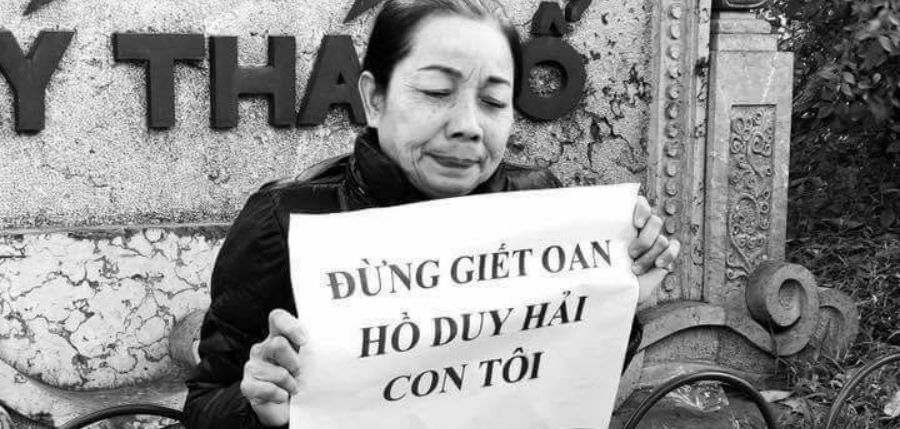
    During these last days of 2017, be it rain or shine, people in Ha Noi, Vietnam, could often spot a frail, weary middle-aged woman holding up a sign “Do Not Kill My Innocent Son, Ho Duy Hai” near the government’s headquarters.

    She is death-row inmate Ho Duy Hai’s mother, Nguyen Thi Loan.

    Since Hai’s conviction in 2008, Ms. Loan has begun her own crusade to petition for his release. In the past few years, she especially traveled more often to Ha Noi where the central government is located to raise awareness of Hai’s case because time might be running out for him.

    Ho Duy Hai’s execution was halted once in December 2014 due to public outcry, but recently, local authorities had expressed their impatience for having to continue keeping him on death row.

    On December 7, 2017, at a meeting of the People’s Committee of Long An Province, Dinh Van Sang – Prosecutorial General of the People’s Procuracy of Long An Province had suggested that the execution of Ho Duy Hai should be carried out as soon as possible because “the imprisonment of this kind (of prisoners) would be too burdensome (for the government).”

    Ho Duy Hai and his sister in a family picture. Photo credits: Kienthuc.net.

    It often goes without exception in the majority of jurisdiction, that one shall not be convicted based solely on his or her confessions.

    The criminal law principle of corpus delicti requires a higher burden of evidence from the prosecution and provides that a defendant’s confession – on its own – is not enough for a conviction.

    Having credible physical evidence from the prosecution then becomes the determining factor in convincing a jury or a judge, that the government has satisfied the burden of proof and that they have proved the defendant was, in fact, guilty of the crime charged.

    Vietnam follows this general rule in prosecuting criminal cases.

    Yet, such a rule only exists in law books and legal codes.

    In practice, people not only got convicted solely on their confessions but very often, they confessed because they were beaten and tortured by the investigating officers.

    Ho Duy Hai was one of them.

    In March 2008, Hai – a then 23-year-old recent graduate from Long An Province located in the Mekong Delta south of Sai Gon – was arrested, charged and convicted of double homicide and sentenced to death.

    The only evidence used to convict him was practically his confession, which he later recanted and revealed that he was forced to confess by the police during his detention.

    The prosecution not only did not offer any credible physical evidence, they even committed basic prosecutorial mistakes.

    The time of death was never established for the two victims, making it impossible for the defendant to come up with an alibi.

    The murder weapons were “lost” by the forensic team and other items were later “purchased” a local market by witnesses who vouched for their similarities if compared to the real ones.

    None of the fingerprints found at the crime scene matched Ho Duy Hai’s.

    A special team of legal experts set up by the Vietnamese National Assembly and led by the current Commissioner of the National Assembly’s Judiciary Committee – Le Thi Nga – visited Hai in the end of December 2014 after his family successfully used social media campaign to halt his execution (which was set to be carried out earlier that month).

    The report signed by Ms. Le Thi Nga in February 2015, found that Hai’s case was riddled with irregularities and prosecutorial mistakes and that the prosecution did not present sufficient evidence to support a conviction. It also called for a trial of cassation for Hai.

    2018 will be three years since the government’s legal experts concluded that Hai’s case deserved a review and ten years since Hai’s life as a free man ceased to exist, yet it seems as if the legal obstacles have stacked even higher against him.

    Hai remains in prison, his youthful years waste away with each day spent on death row.

    With the assistance of a local artist, Thinh Nguyen, Ms. Loan and other parents of wrongfully convicted death-row inmates appeared in several video clips to raise public awareness on the reality of forced confessions and prosecutorial irregularities in Vietnam’s criminal cases.

    And even though the videos are well-received, it seems as if these efforts are to no avail, at least for the time being.

    His mother has also written thousands of petitions pleading the government to not kill her innocent son, and she would talk to anyone – be it the personnel from foreign embassies or just about any passerby on the streets – whoever would spare a few minutes listening to her telling the story of Hai’s wrongful conviction.

    Her hope is that one day, not only the people will stop and listen to her, but so will government officials and that they will take up Hai’s case and declare him a free man.

  • Vietnam: Increasing Cyber Attacks on Activists Portray A Shrinking Internet Freedom

    Vietnam: Increasing Cyber Attacks on Activists Portray A Shrinking Internet Freedom

    During the last week of November and in early December 2017, many of the independent media websites in Vietnam reported that access to their sites had been blocked. This includes The Vietnamese. Readers confirmed they could not access the attacked sites unless they installed VPN to get over the firewalls.

    Another independent news project also runs by The Vietnamese’s editorial board, Luat Khoa online legal magazine, was also blocked in Vietnam starting around December 4, 2017. Luat Khoa has been in operation for the past three years with over 90k likes on Facebook and an average of 500,000 pageviews per month. This is the first time Luat Khoa gets blocked in the country.

    In a more severe case, on December 5, 2017, Dan Luan – another well-known independent site – shared on Facebook that their website was under DDoS attack for about a week in late November. A DDos attack is defined as “an attempt to make an online service unavailable by overwhelming it with traffic from multiple sources”.

    Earlier last month, there were also failed attempts trying to inject Dan Luan’s website with malicious scripts via Cross-Site Scripting (XSS). Dan Luan frequently suffered cyber attacks, which they believed were the works of government-controlled hackers.

    Also in November 2017, a handful of popular Facebookers lost access to their accounts because they were reported by anonymous users to Facebook for violations of community standards. Among them was blogger Nguoi Buon Gio, who now lives in exile in Germany.

    It seems quite likely that the Vietnamese government would rely on cyber attacks as an important tactic for oppression in recent years when the numbers of Internet and social media users increased dramatically in the country.

    In July 2017, We Are Social, a social media marketing and advertising reported Vietnam had surpassed Thailand to become the 7th country with the most Facebook users worldwide.

    The government has not exactly been shy in expressing the desire to tighten their grip on controlling the virtual world. As previously reported, Vietnam claimed to have worked with Facebook and Google to remove thousands of videos and accounts that allegedly contained anti-state materials.

    Earlier this year, in May 2017, Gen. Nguyen Danh Cong of the Ministry of Public Security stated during an intra-departmental meeting, that the MPS had successfully blocked thousands of websites which they deemed to be anti-state and reactionary contents.

    Four years before that, on May 5, 2010, Gen. Vu Hai Trieu, the then Deputy Director of the MPS, announced: “Our technical departments have destroyed 300 Internet web pages and blogs posting unsuitable contents.”

    Coincidentally, it was in early November 2017 that the Washington D.C.-based cybersecurity firm, Volexity, issued a report, confirming it has been – since May 2017 – monitoring an active operation of mass surveillance and cyber attacks operating out of Vietnam.

    This operation includes the maintenance of an active group of hackers whose mission is to target Vietnamese activists and dissidents, as well as foreign citizens, corporations, and governments with interests in Vietnam.

    It was not the first time that the international cybersecurity community had warned about hackers who seemed to have had a close tie with the Vietnamese government. In the past three years, besides Volexity, at least two other organizations, Electronic Frontier Foundation and FireEye, had issued similar reports.

    Vietnam’s government is believed to have been maintaining a cyber espionage group calls OceanLotus since at least 2014. OceanLotus (or SeaLotus) is also known as APT-C-00 or APT32 according to these organizations.

    There was also other information leading people to believe that OceanLotus was related to the hacker group Sinh Tu Lenh.

    Sinh Tu Lenh became famous among Vietnamese cyber community about a decade ago when it was named as the party responsible for the numerous cyber attacks, aiming at dissidents, activists, and independent news sites, including Dan Luan, Talawas, Xcafevn, Anh Ba Sam, and Mother Mushroom.

    Also recently, on November 14, 2017, Freedom House issued its Freedom on the Net report and named 30 countries where the government paid commentators and political bots to spread government propaganda. Vietnam was one of them.

    According to Michael J. Abramowitz, president of Freedom House: “The effects of these rapidly spreading techniques on democracy and civic activism are potentially devastating.”

    The report also quoted Sanjia Kelly, director of the Freedom on the Net project: “Governments are now using social media to suppress dissent and advance an anti-democratic agenda.”

    “Not only is this manipulation difficult to detect, it is more difficult to combat than other types of censorship, such as website blocking because it’s dispersed and because of the sheer number of people and bots deployed to do it.”

    But activists in Vietnam are not new to this form of government’s suppression. Back in 2014, our editorial board’s member, Pham Doan Trang, had met with Google and Facebook representatives in the U.S. where she forwarned them about the daily attacks these “paid opinion shapers” had fired at activists and bloggers in Vietnam and how such conducts affected democracy movement.

    During the summer of 2014 alone, over 40 accounts of activists were reported, and in turn, got shut down by Facebook.

    Calling themselves the government’s “cyber army forces”, these online bots repeatedly reported activists and bloggers’ Facebook accounts, effectively causing their shut-downs.

    Taking advantages of Facebook’s loosely defined rules and standards of conducts for the users’ community, the troop of “opinion shapers” would abuse the Facebook’s “Report Abuse Button” with thousands of reports a day on a specifically targeted activist’s account.

    Yet, to date, it seems that the activists and the democracy movement have proven their potential sustainability in Vietnam, because people are still actively promoting their causes and Facebook continues to be the main platform for advancing social changes, despite all odds.

    Back in March 2015, facing the city government’s immediate decision to cut down some 6,700 trees in Hanoi, activists created a Facebook group and organized people for peaceful protests. They were able to mobilize residents of Hanoi and successfully stopped the city government from going forward with the plan.

    In 2016, Facebook again proved its effectiveness, as it was one of the best platforms for informing the public about the Formosa environmental disaster in Central Vietnam. During the height of the weeks-long protests against Formosa Ha Tinh Steel Plant – the company responsible for causing the pollution – access to Facebook was blocked on a few weekends. But its popularity among the general public had caused the government to undo such decision almost immediately.

    This year, in the recent months, drivers who were passing through a BOT toll in Cai Lay Ward, Tien Giang Province have been protesting the improper location of said toll. Their acts of civil disobedience – through various forms of slowing down the process of paying toll fees and causing the toll to close down – were followed closely by the public on Facebook and other social media platforms.

    To protect themselves and fight back, Vietnamese activists have received technical assistance from organizations, such as Access Now, when they got reported by the government’s bots on Facebook or got struck by some other forms of cyber attacks.

    In the meanwhile, the Draft Law on Cybersecurity – which mirrored that of China – is now waiting for the National Assembly’s approval.

    And as such, the battle in the cyber world continues.

  • Vietnam: Deputy PM’s Flip-Flopped Position Signaled Government Will Take Tough Measures on Cybersecurity Law?

    Vietnam: Deputy PM’s Flip-Flopped Position Signaled Government Will Take Tough Measures on Cybersecurity Law?

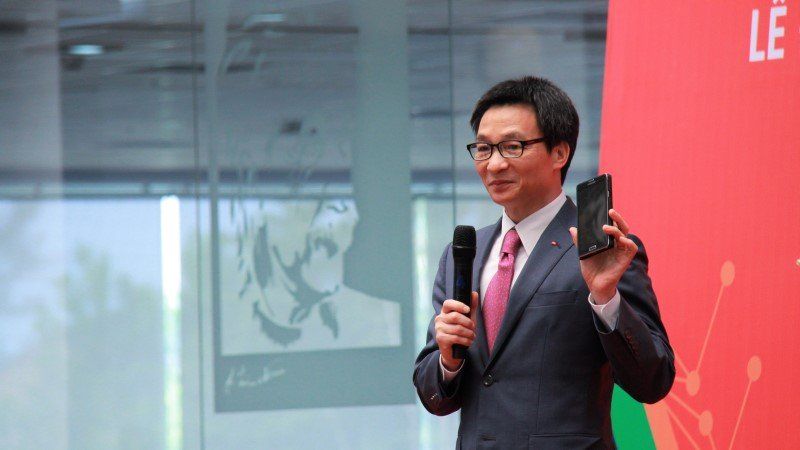
    Once regarded as the poster’s child for – what was hoped by some – the progressive faction within the Communist Party, Deputy Prime Minister Vu Duc Dam, had recently shown his allegiance to the Party’s hardlines, at least on the issue of cybersecurity.

    As the Vietnam’s National Assembly is currently reviewing the latest Draft Law on Cybersecurity, on November 17, 2017, the 54-year old Deputy PM Dam delivered a passionate speech defending why Vietnamese government must control social networks and limit the numbers of Internet users.

    Dam even praised China’s efforts on controlling social media through the use of an Intranet and heavy censorship on search contents.

    But just last year, in March 2016, it was also the same man, Deputy PM Dam, who spoke at a World Bank conference and praised technology, pledging his commitment to support an uncensored Internet in Vietnam.

    “I want to say that now is not the time to discuss the benefits of digital technology, but to affirm: Though digital technology itself has negative sides, this is not by its own faults but rather by those who use it. Thus, we cannot restrain it because of the negative impact, but must find all means to allow it to grow.”

    Would Mr. Dam’s recent change of heart on the issue of Cybersecurity demonstrate the impossibility for Party’s cadres to break free from its political ideology, namely those who are in the Politburo?

    Mr. Dam had long been trusted with the tasks of managing the field of Information and Communications in Vietnam. He has also been viewed as an official who’s more open and friendly with the IT community, given his background working at the National Central Bureau of Post Office and had served as the Deputy Minister of the Ministry of Post Office and Telecommunications.

    It was as recent as February this year, during a talk with FPT University’s students, Dam recalled how he had met with top technology personnel in the country and advised them that the World’s Fourth Industrial Revolution shall be defined by the term “connection”.

    And by connection, Dam meant, “the eight billion equipment which connects at every level, every angle, and does not limit itself to one university, one province, one country but is a global connection. This revolution would have an intimate relationship with technology.”

    So what had changed?

    What would make a man went from one who believed in the ability for people to have a global “connection” as the core element of the Fourth Industrial Revolution to a defender of government’s Internet censorship, and a supporter of an “Intranet” construction – identical to that of China?

    Because now, during his last presentation in front of the National Assembly, Dam also proposed using “technical measures to block, filter or slow down [information] when necessary.”

    The people wonder, who is then, the real Vu Duc Dam and what does he really believe in?

    If there were any hopes for a progressive faction within the Communist Party, Deputy PM Dam probably would be among the top runners to lead such group.

    He was a foreign-educated politician, graduated from university in Brussels, whose popularity rose among the younger population in Vietnam with his English abilities, his support for educational reforms, environmental protection, and his friendliness towards IT community and technology development.

    Yet, Dam’s latest speech on the National Assembly’s floor two Fridays ago showed where his true allegiance lies: The Party’s doctrine which values censorship and putting absolute restraints on free speech.

    Vietnam was a member of the Human Rights Council last year when a resolution was passed without a vote, to include an addition to Article 19 of the Universal Declaration of Human Rights, recognizing the right to Internet access is a human right.

    But that obviously did not stop the government to adamantly insist on tougher Cybersecurity Law, one that mirrored China’s laws. Mr. Dam apparently seems to have forgotten it as well during his latest speech, when he insisted that Vietnam would not break any international law standards with its tougher stand on social media and Internet management.

    The government has recently claimed boastful records in working with Google and Facebook to successfully remove thousands of content that were deemed to be “anti-State” materials during just this year alone.

    Since the Internet was first publicly introduced in Vietnam 20 years ago, now, social media networks have grown to become the main platforms for people to raise their concerns over a number of issues. Many of which would be deemed politically sensitive or even outright dissenting opinions.

    No one seems to deny that both the independent civil society movement and the emerging independent media in the country are the results of ordinary people having access to the Internet.

    As such, the need for an authoritarian government – like Vietnam – to censor and control the Internet and social media networks is real and urgent.

    Deputy PM Dam’s recent defense of the government’s use of technical measures to censor and control the Internet and social media – to some people – adds worries that Vietnam would – by all means – pass the proposed Cybersecurity Draft Law.

    To defend the government’s legitimacy and absolute power, the control over the media had never slipped off the Party’s grips. Deputy PM Dam’s stand on the issue of Cybersecurity could give glimpses of the Party’s unanimity on maintaining that control by expanding and strengthening Internet censorship in the country, regardless of how many factions within the Politburo we may think there are.

  • Vietnam: Activists Refuse to Engage in Government’s Cat-and-Mouse Game

    Vietnam: Activists Refuse to Engage in Government’s Cat-and-Mouse Game

    Around noon on November 16, 2017, journalist Pham Doan Trang, a member of our editorial board, found herself stuffed in a car driven by plained-clothes police, some of whom she might have recognized from the dozen of times they have come and kidnapped her in broad daylight before.

    Just less than half an hour earlier, she was an invited guest of the EU delegation at the swanky Lotte Building in Hanoi, Vietnam, together with Dr. Nguyen Quang A and two other activists, Nguyen Chi Tuyen and Bui Thi Minh Hang.

    All of them, except for Nguyen Chi Tuyen who managed to avoid police detection, was kidnapped by the authorities almost immediately after they left the EU meeting. It was the latest episode in a ludicrous game of cat and mouse that the Vietnamese government had orchestrated for years.

    While telling his Facebook friends about his experiences on November 16, 2017, where he was detained illegally and interrogated for five hours, the prominent pro-democracy intellect, Dr. A, also recalled that the police had done this to him 14 times just between last year and now. They also guarded and surveilled his home heavily, as well as almost followed him around all the time.

    Doan Trang alone has been taken against her own will to various police stations for interrogation a few times just this year, sometimes for the entire day. This last one on November 16 was for 12 hours, which ended when police drove her home around midnight.

    But she was not even certain that night if they were going to actually release her until the car stopped at her house.

    Because “the police like ‘the surprise factor’”, she said. “They would love to terrify you and make it impossible for you to expect what was going to happen next. They rule by fear and instilling fear in you is their favorite job. You just have to learn how to become fearless.”

    Fearless, determined, and completely devoted to the democracy movement in Vietnam would be the words to describe the woman many people view as one of the leading activists in Vietnam, journalist Pham Doan Trang.

    Last year, during Barrack Obama’s May 2017 visit to the country, Doan Trang and Dr. A were also kidnapped by the authorities to prevent them from attending a meeting which was specially arranged by the Obama administration, so that the U.S. president could meet Vietnam’s independent civil society’s representatives.

    For Doan Trang, in trying to make it to the meeting with Obama, she had to travel thousands of kilometers by car while still recuperating from a knees surgery. Her fellow activists had to accompany her, and one of them even also assumed the role of her personal nurse because Doan Trang was too weak to take care of herself. All the while, the group had to lay low and went under the radar so that they could avoid police detection.

    Her knees injuries also came from the police who had crushed them while breaking up a peaceful march in 2015. Doan Trang and hundreds of other residents of Hanoi were protesting against the city government’s decision to cut down some 6,700 trees.

    Back to the morning of May 24, 2016, despite their efforts to divert police attention, secret agents eventually caught up with Doan Trang’s group and found them at a motel about 100 km away from Hanoi, just a couple of hours before the meeting with Obama was supposed to start.

    They were all illegally detained and interrogated, and Doan Trang was held in her motel room until those who were guarding her received confirmation that the Obama meeting was long over. Only then they would let her and her friends go.

    Dr. A also received similar treatment. The police came to his neighborhood early that day in May 2016, around 6:00 A.M., and snatched him away. They confiscated his electronic devices, stuffed him in their car, and drove him around Hanoi and other local proximities like Hung Yen. After receiving confirmation that Obama had boarded his plane from Hanoi to Ho Chi Minh City, they took Dr. A back to his home and released him around 1:00 P.M. the same day.

    Neatly placed name cards left on the meeting table without the faces to match, and their empty chairs during the entire discussion vividly displayed the life of dissidents in Vietnam: The authorities do not hesitate to use whatever available means to subdue their bodies and silence their voices.

    And on that day, it particularly seemed as if no single world leader could change such fact, not even the U.S. president.

    Things did not change for the better this year either.

    Before and during President Trump’s visit to Vietnam earlier this month, dissidents and activists like Dr. A and Doan Trang had reported that they were surveilled and followed by both police and plain-clothes officers. Some said they were even prevented from leaving their houses on certain days when world leaders – like Donald Trump and Xi Jinping – were in town.

    So when it came to those events surrounding the kidnapping on November 16, the Vietnamese activists’ community was not exactly taken by surprise. However, because living under such oppression has become a way of life, it also prompted a quick response from them. Civil society organizations were not silenced, instead, they immediately condemned the authorities’ conducts.

    Without any probable cause, no arrest warrant, the forceful taking of individual citizens into police custody violates even Vietnam’s own criminal procedures, leave alone international legal norms and practices.

    Worse, this has been a routine violation.

    Back in December 2015, dissident attorney Nguyen Van Dai and his assistant Le Thu Ha were taken into police custody and had been held without trials ever since.

    In July 2016, dissidents Nguyen Bac Truyen, Truong Minh Duc, and Pham Van Troi were also taken into custody and later charged with Article 79 of the Penal Code for subversion against the State, together with previously arrested Dai and Ha.

    Doan Trang said no one in Vietnam could really tell for sure each time an activist got snatched by the police, that whether it would be just for a few hours of questioning, or the government would press charges and put someone away for a couple of years.

    Her take is to treat today as if it would be the last day she could still be a free person and try to make the most of it.

    In a country like Vietnam, she said, there would always be so much to do and so much more needed to get done. And getting things done she did.

    Doan Trang came to the EU meeting with an updated report on the Formosa environmental disaster, a new report on Vietnam’s Laws on Religion, and an update on the overall human rights situation in the country. She collaborated with others on these projects in 2017, and at the same time, published a book on introduction to politics. All were done while she still had not fully recovered from last year’s knees surgery and constantly been harassed by the authorities.

    So perhaps, now is also the time that the Vietnamese authorities must stop playing this insipid game of catch and release.

    It was like child-play, Doan Trang described her encounter with the police officers on November 16 on her Facebook status following her release.

    The EU delegation initiated this meeting with members of civil society organizations and held it right before their annual Human Rights Dialogue with Vietnam (which will supposedly happen later in December this year). The delegation wished to consult the civil society actors on issues regarding the country’s environment, labor rights, and the overall human rights situation, pending their ongoing EVFTA (EU-Vietnam Free Trade Agreement) negotiations with Vietnam.

    Ironically, all the while the EU delegation were wishing they could learn more about how Vietnam has been implementing human rights, the activists’ illegal arrest and detention happened right under their nose.

    The police grabbed these activists as they were leaving the building where the meeting took place. It seems as if the Vietnamese authorities could not wait to put their hands on the nation’s most valuable prizes in trade negotiations with foreign governments.

    But to Doan Trang and many of her fellow activists, being viewed as some prized pawns that Vietnam could use to exchange for economic interests, like trade agreements, undermines their cause.

    And they refuse to be treated as such.

    Rather, Doan Trang wishes the international community views her numerous arrests and others’ arrests and imprisonment during the past three years since she came back to Vietnam (after finishing her fellowship at the University of Southern California), as glaring evidence that the country is still ruled by a one-party dictatorship.

    Only by seeing the Vietnamese regime for what it is and not giving it the presumed legitimacy of a democratic government, one that respects human rights and the rule of law, then foreign governments – like the EU – could truly press Vietnam on matters like respecting the people’s will and peaceful democratization process.

    No one likes to see this cat-and-mouse game with the police to continue, except for the authorities themselves.

    This is how Doan Trang hopes the world would react to the Vietnamese activists’ arrests and imprisonment: Do not request Vietnamese authorities to release one or two activists on an individual basis for humanitarian reasons.

    Instead, the international community should call them out on their totalitarian characteristics, their disastrous human rights records, and inform them that their methods of oppressing dissidents and the democracy movement render them an illegitimate regime.

  • Press Release: On the Detention of Our Editorial Board Member Pham Doan Trang

    Press Release: On the Detention of Our Editorial Board Member Pham Doan Trang

    In the afternoon of November 16, 2017, the Vietnamese police kidnapped a member of The Vietnamese’s editorial board, Pham Doan Trang, almost immediately after she had left the meeting with the EU delegation in Hanoi held earlier that day.

    The police had illegally seized her personal property, including her cell phone and laptop, and kept them since. Pham Doan Trang was held incommunicado during the entire detention, and legal representation was not allowed.

    By midnight, the police escorted Pham Doan Trang back to her home in Hanoi and continued to surveil her, effectively putting her under house arrest.

    The meeting with the EU delegation was held right before the commencement of their annual Human Rights Dialogue with Vietnam, which is going to be in early December 2017. During the meeting on November 16, Doan Trang provided the EU delegation with an updates report on Vietnam’s current human rights situation, the report on the Formosa environmental disaster, as well as the latest report on the right to religion in Vietnam.

    We strongly condemn the kidnapping, unlawful taking of property and putting Pham Doan Trang under house arrest. These conducts are in direct violation of both Vietnam’s and international laws, and as such, they have put a member of our editorial board in grave danger where both her physical and mental health have been negatively affected, especially when Doan Trang is still undergoing treatment for her previous knees injuries.

    We, therefore, demand that the relevant authorities of Vietnam to immediately intervene and cease the ongoing illegal house arrest, investigate the unlawful individual conducts listed above, and prosecute those who have committed such crimes, in accordance to the current legal standards in Vietnam.