Author: Quynh-Vi Tran

  • Pham Doan Trang’s Trial Postponed While UN Working Group On Arbitrary Detention Called For Her Immediate Release

    Pham Doan Trang’s Trial Postponed While UN Working Group On Arbitrary Detention Called For Her Immediate Release

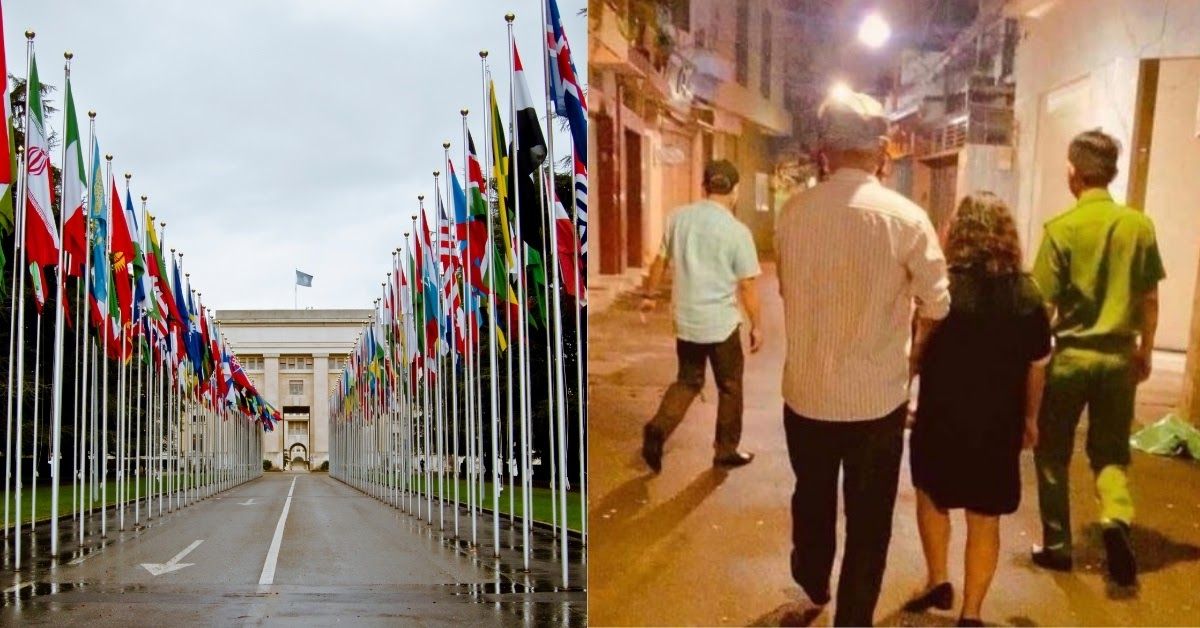
    Vietnam arrested Pham Doan Trang on October 7, 2020, and charged her under Article 88 of its 1999 Penal Code for allegedly “making, storing, distributing or disseminating information, documents, and items against the Socialist Republic of Vietnam.” Her trial was originally scheduled to take place on November 4, 2021, but the court postponed her trial due to the prosecutors having come into contact with COVID-19.

    However, on October 25, 2021, the United Nations Working Group on Arbitrary Detention (WGAD), a team of five independent experts tasked with investigating “cases of deprivation of liberty imposed arbitrarily or inconsistently with the international standards set forth in the Universal Declaration of Human Rights,” released their opinions regarding the arrest, detention, and treatment by the Vietnamese state of internationally recognized independent journalist and human rights defender Pham Doan Trang.

    In this document, WGAD scrutinizes the formal statements given by the side of Doan Trang and that of the Vietnamese government in order to verify the authenticity of the claims regarding her situation in custody and to provide recommendations for the Vietnamese government.

    WGAD also stated that even though the Vietnamese government vehemently rejects the accusations alleged by the side of Doan Trang and that “[the Vietnamese government] cannot provide detailed information regarding this case to the press and other irrelevant parties,” WGAD will still continue with its investigation as part of its mandate “to serve the needs of victims of arbitrary arrest and detention worldwide.”

    WGAD concluded that “the deprivation of liberty of Pham Doan Trang, being in contravention of articles 2, 6, 7, 8, 9, 11, 19, 20 and 21 of the Universal Declaration of Human Rights and articles 2, 9, 14, 15, 16, 19, 21, 22, 25 and 26 of the International Covenant on Civil and Political Rights, is arbitrary and falls within categories I, II, III, and V.”

    Regarding Doan Trang’s arrest by state forces, WGAD believes that the Vietnamese authorities failed to present a warrant for her arrest and that Doan Trang was not informed of the charges lodged against her. She was also never brought before an independent judicial authority in order to challenge her detention.

    Likewise, WGAD upholds that Doan Trang was put under Incommunicado Detention which “is an environment conducive to torture and cruel inhumane treatment, as it may be used to coerce the individual to confess to the commission of the alleged crimes and admit guilt.” Furthermore, WGAD states that the initial charge under Article 117 of the Vietnamese Criminal Code is “so vague that it is impossible to invoke a legal basis for her detention.” Hence, WGAD concludes that the Vietnamese government failed to establish a legal basis for Doan Trang’s arrest and detention.

    WGAD also believed that she was detained for “peacefully exercising her rights to freedom of opinion, expression, and association.”. As such, it has referred this case to the Special Rapporteur on the promotion and protection of the right to freedom of opinion and expression and to the Special Rapporteur on the rights to freedom of peaceful assembly and of association.

    WGAD also stated that because Doan Trang was not allowed to speak to her defense lawyers until recently, and was denied legal counsel, her right to a fair and just trial has been violated.

    Likewise, WGAD found that Doan Trang was “deprived of her liberty on discriminatory grounds” due to her being a vocal human rights defender and because of her political stance and opinions.

    In light of all the information presented, WGAD requests that the Vietnamese government take all the necessary steps needed in order to remedy Doan Trang’s situation in order to “bring it into conformity with the relevant international norms.”

    WGAD believes that the best remedy would be to urgently and immediately release Doan Trang and compensate her in accordance with international law. WGAD also urges the Vietnamese government to ensure a “full and independent investigation” of Doan Trang’s arbitrary detention and to “take appropriate measures against those responsible for the violation of her rights.”


    The UN WGAD’s full statement can be found here

  • Pham Doan Trang’s Indictment Is Public Today; What Do We Know About Her Case?

    Pham Doan Trang’s Indictment Is Public Today; What Do We Know About Her Case?

    The indictment against journalist and democracy activist Pham Doan Trang was made public on October 18, Vietnam time. We are summarizing the main issues from the 15-page indictment, which you can read here in Vietnamese.

    The main points of the indictment are:

    • The indictment stated that the investigation was done between September 22, 2016 and October 7, 2020. October 7, 2020 was also the day that the authorities arrested Doan Trang.
    • The Department of Cyber Security and High Tech Crimes under the Ministry of Public Security (MPS), the national police in Vietnam, petitioned the investigation department to pursue legal proceedings against Doan Trang on May 4, 2020 and October 7, 2020 and included its documents and materials against her.
    • The Department of Information and Communications of Hanoi City also submitted two petitions with documents and materials to the MPS on December 26, 2017 and January 7, 2019, requesting legal proceedings against Doan Trang.
    • The Investigation Unit of Hanoi City’s Police formally opened the investigation on September 10, 2020.
    • The decision to initiate criminal proceedings against Doan Trang was issued on September 28, 2020.
    • Doan Trang was arrested under a warrant on October 7, 2020 in Ho Chi Minh City.
    • She refused to provide her laptop’s password to the police and accordingly, the police could not access its data.
    • She also refused to acknowledge the Facebook account of the name “Pham Doan Trang” belonged to her, and the investigative unit could not charge her for the information posted via that account on social media.
    • Doan Trang acknowledged that she was one of the authors of the “Report Assessment of the 2016 Law on Belief and Religion in relation to the exercise to Freedom of Religion and Belief in Vietnam” in both English and Vietnamese. This report was published on the website of Luat Khoa Magazine.
    • On February 19, 2021, the Authority of Information Security (under the Ministry of Information and Communications) submitted a document to the investigative unit which stated that it could not determine who owned and managed the domain name luatkhoa.org to pursue further legal proceedings against it.
    • The indictment stated that Doan Trang repeatedly committed unlawful conduct which can be used to increase her punishment.
    • The indictment also did not find any facts to reduce the punishment against her.
    • The investigation of her case was concluded on August 26, 2021.
    • The indictment stated that Doan Trang continued her unlawful conduct from 2017 to 2019 so both the 1999 Penal Code and the 2015 Penal Code (which took effect on January 1, 2018) could be used to prosecute her.
    • However, the indictment also stated that Doan Trang did not confess to any of these crimes and that the 1999 Penal Code would be more beneficial to the defendant since Article 88 of that penal code starts the sentence at 3 years imprisonment versus 5 years imprisonment under Article 117 of the 2015 Penal Code. Therefore, the government dropped charges under Article 117 and only prosecuted Doan Trang under Article 88.

    The Evidence against Pham Doan Trang under the indictment:

    • English document named “Brief report on the marine life disaster in Vietnam”;
    • English document named “General Assessments of the human rights situation in Vietnam”;
    • English and Vietnamese versions of the “Report Assessment of the 2016 Law on Belief and Religion in relation to the exercise of the right to Freedom of Religion and Belief in Vietnam”;
    • Two interviews with Pham Doan Trang by BBC News  Vietnamese and Radio Free Asia – Vietnamese (RFA) in 2018.

    Formal indictment:

    The Hanoi People’s Procuracy Office prosecuted Doan Trang under Article 88, Section 1, subsections a, b, and c for “propagandizing against the Socialist Republic of Vietnam ” of the 1999 Penal Code. The sentencing for this crime will be 3 to 12 years imprisonment.

    The indictment is dated August 30, 2021. However, it was only made public on October 18, 2021, in Vietnam, just more than two weeks before Pham Doan Trang’s trial. For almost two months, Doan Trang’s family and her attorneys, as well as the public, have been kept in the dark about the case Vietnam has against her.

  • Pham Doan Trang Is A Journalist, Her Profession Is Not A Crime

    Pham Doan Trang Is A Journalist, Her Profession Is Not A Crime

    As I am writing this beginning line, my mind is flooded with memories of Pham Doan Trang. I also realize that it has been almost seven years since I said goodbye to her before she left the United States to return to Vietnam. We had become friends and spent seven months together in the United States, and I have not seen her since December 2014. I also have not been able to contact her or speak with her on the phone since October 6, 2020. Vietnamese police arrested her near midnight that day in Saigon. My last text message to her was “Trang, answer me,” which I sent the night she was detained.

    Doan Trang can be classified as many things, depending on the person you speak with. She is a journalist, an activist, a teacher, a political person who opposes the Vietnamese Communist Party, a prominent figure of the democracy movement in Vietnam, and more. Yet, for me, Doan Trang is a friend, a very close friend, and that’s it. My only hope is to help set my friend free because she has not done anything wrong. She deserves to be free so that she can continue to write.

    And yet, sadly, her writing is precisely the reason that has put her in prison in Vietnam.

    In Vietnam, writing or producing verbal speech (YouTube, TikTok, etc.) can be a severe crime when you refuse to obey the government’s censorship system or self-censor on your own. If you look at the details of any political case in Vietnam, I guarantee that you will only find the alleged wrongdoings to be the uncensored writings and speeches produced by these defendants. It does not matter how the Vietnam government classifies their crimes as “abusing democratic rights” or “propagandizing against the state,” their crimes are always their writing and speech.

    For Doan Trang, I can also think of another aspect in which she has irritated the Vietnamese authorities even more. She was not just a journalist; she was also trying to encourage more people to write and be more aware of politics in Vietnam. I was one of the people she inspired to take writing as a profession and focus more on Vietnam’s human rights and political affairs.

    In my writing career, I have two people to be grateful for: my two co-founders of Legal Initiatives for Vietnam (LIV), Trinh Huu Long and Pham Doan Trang. If I had not met them in life, I don’t think I would have been confident enough to write in either Vietnamese or English, especially as a journalist.

    I left Vietnam and came to the United States when I was 12-years-old. I was not too young to think of myself as a native speaker in English, but I was not too old to be confident in my ability to write in Vietnamese either. However, after meeting Trinh Huu Long and Pham Doan Trang in 2014, they changed my life as I believed in their cause and decided to co-found LIV. Starting from that point, I began to promote human rights, democracy, and the rule of law in Vietnam through journalism. Trinh Huu Long may be the first teacher in journalism for me, but Doan Trang is the inspiration for my decision to change my career from law to journalism.

    Many people have asked me why I decided to quit my legal profession and started working for a non-profit organization that focuses on Vietnam. Maybe this career change was not advantageous for them and could be stepping down in life. But Doan Trang’s last words before she left the United States stuck with me throughout these years: “Every country needs a generation of young people who will sacrifice their lives to build a better society for others. If our generation refuses to take up this job for Vietnam, then who else will? Do we wait for the next generation to sacrifice for our country and choose an easier life now?”

    Doan Trang chose to take up this task to promote human rights in Vietnam, and she left America to go back to Vietnam, knowing that she would be imprisoned in the future. Then, for me, the decision of giving up my life as a litigation lawyer to write about human rights and political issues in Vietnam seemed to be a much easier job when I compared myself with Doan Trang.

    She’s inspired me, and we both have the same goal: to put Vietnam on the map for international audiences and encourage more Vietnamese people to care about human rights and democracy. To write about these issues should not be a crime in any nation because we only want to educate the public. What did we do so wrong that my friend Pham Doan Trang has spent one year incommunicado in Vietnam?

    The Vietnamese government cannot explain away Pham Doan Trang’s case or any political cases that have sent hundreds of dissidents to decades in jail. However, I hope the international community and foreign governments can speak up louder and be more explicit against this injustice.

    Journalism is not a crime; writing about politics and human rights is not a crime. Vietnam continues to suppress the free press and the freedom of speech much harder now, which is not an action the international community should condone. Please speak up for those imprisoned by the Vietnam government, such as Pham Doan Trang, because we are on the right side of history.

  • CIVICUS 2020 Monitor Report Continues To Rank Vietnam As “Closed” Civic Space

    CIVICUS 2020 Monitor Report Continues To Rank Vietnam As “Closed” Civic Space

    On December 8, 2020, international organization CIVICUS – a global alliance of civil society organisations and activists dedicated to strengthening citizen action and civil society throughout the world – revealed its 2020 Monitor report which tracks Civic Space worldwide.

    CIVICUS defines:

    “Civic space is the bedrock of any open and democratic society. When civic space is open, citizens and civil society organisations are able to organise, participate and communicate without hindrance. In doing so, they are able to claim their rights and influence the political and social structures around them. This can only happen when a state holds by its duty to protect its citizens and respects and facilitates their fundamental rights to associate, assemble peacefully and freely express views and opinions. These are the three key rights that civil society depends upon. The CIVICUS Monitor analyses the extent to which the three civil society rights are being respected and upheld, and the degree to which states are protecting civil society.”

    More than 20 organizations collaborate on the CIVICUS Monitor to provide an evidence base for action to improve civic space on all continents. Civic space in 196 countries is categorized as either closed, repressed, obstructed, narrowed or open, based on a methodology which combines several sources of data on the freedom of association, peaceful assembly and expression.

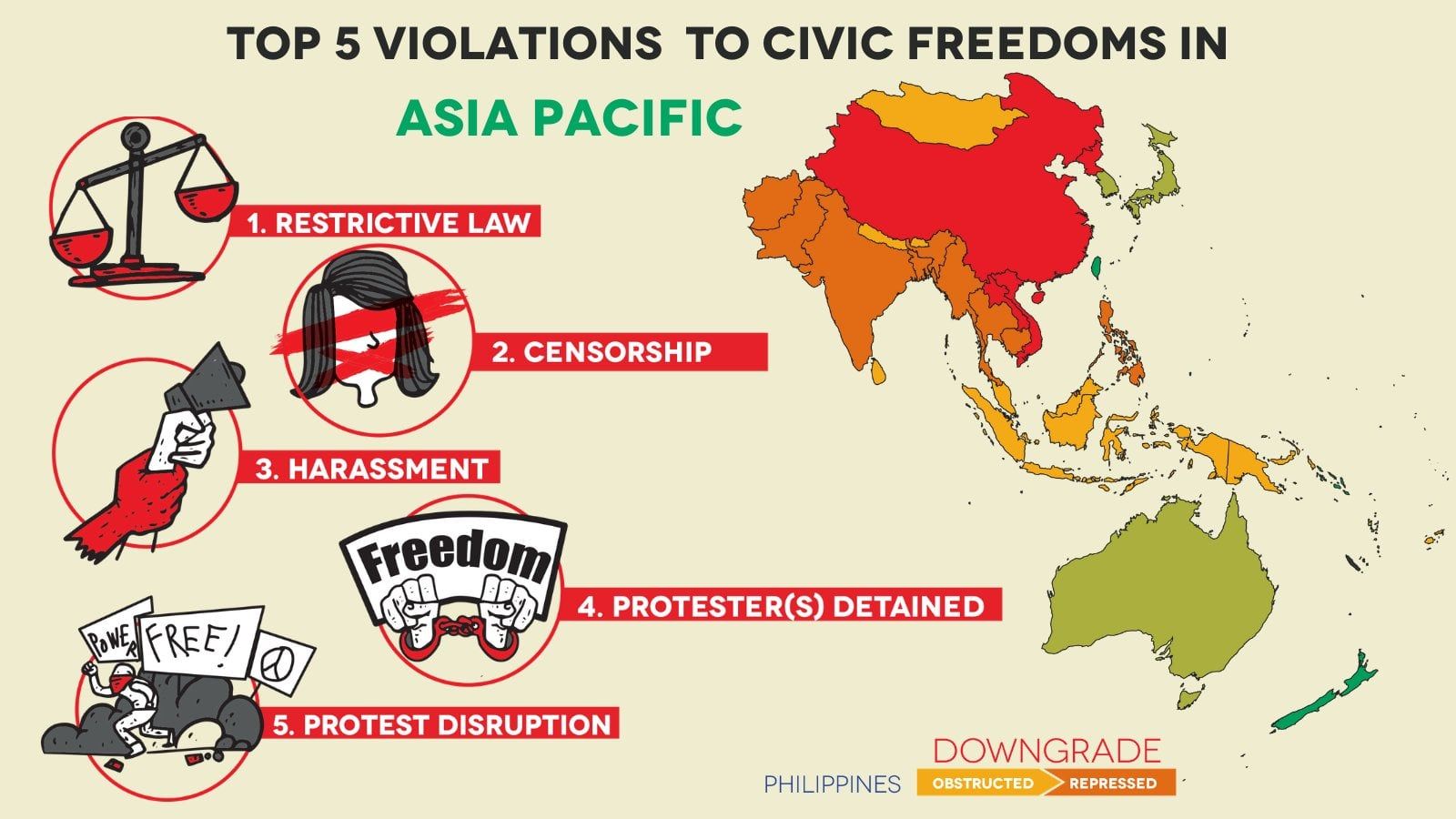
    CIVICUS Monitor shows that out of 25 countries in Asia, Vietnam and three other countries, China, Laos, and North Korea, are rated “closed.”

    The new CIVICUS Monitor report also indicates that 90 percent of countries in Asia repress civic freedoms. It also raised concerns about attacks on the media and vilification of human rights defenders.

    “Our research shows that civic freedoms, including the freedom of expression, assembly and association, continue to be violated across the region. The percentage of people living in Asian countries with closed, repressed or obstructed civic space is nearly 90 percent,” said Josef Benedict, Asia-Pacific Civic Space researcher for CIVICUS.

    The report also stated that “in Vietnam, where civic space is rated ‘closed’ … the authorities continue to harass those who criticize the one-party regime. Scores of individuals were arrested or jailed after summary trials under an array of restrictive laws for ‘abusing democratic freedoms’ and ‘anti-state propaganda’, including activists, bloggers and Facebook users. Most recently, the Vietnamese authorities arrested human rights defender Pham Doan Trang – one of the nation’s most prominent independent journalists.”

    Photo Courtesy: Pham Doan Trang Facebook.
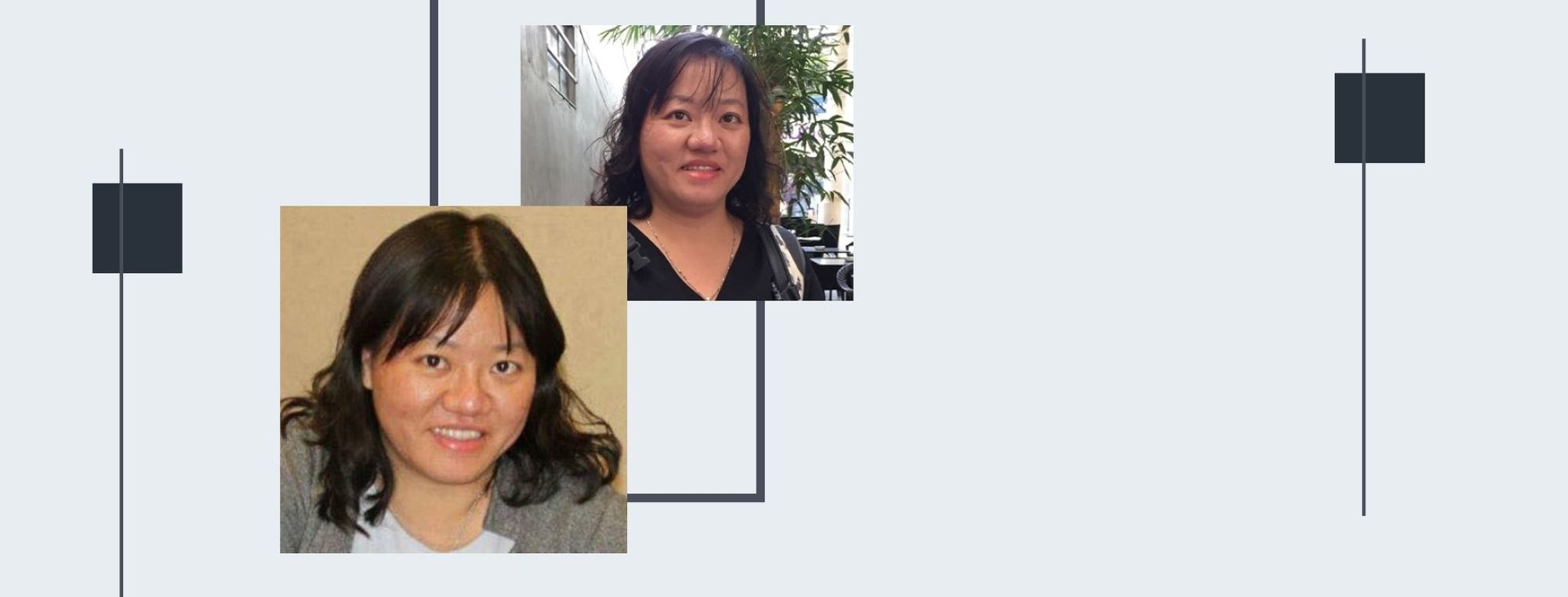
    Journalist Pham Doan Trang. Photo Courtesy: Pham Doan Trang Facebook.

    Furthermore, the report also notes that “the persecution against independent publishers, The Liberal Publishing House, has continued in 2020 after a brief pause due to the pandemic.” It further reports that “members of the Independent Journalists Association of Vietnam – the last independent journalist organization in the country – have also been arrested and prosecuted. Human rights groups raised serious unfair trial concerns and allegations of torture in the Dong Tam trial, which has led to convictions. Many activists were kept under surveillance, or detained for months without access to legal counsel and subjected to abusive interrogations.”

    Dong Tam Trial. Photo Courtesy: Tuoi Tre newspaper.

    The ASIA-PACIFIC ratings overview can be found here.

  • Vietnam: Putting Up with Facebook

    Vietnam: Putting Up with Facebook

    This article was originally published in SEAPA.org on June 3, 2019. As Facebook recently announced that it would agree to significantly increase censorship of “anti-state” posts for Vietnamese users, according to Reuters, we would think this article is providing a glimpse of how life is for an independent news media in Vietnam while we have to deal with both Facebook and the government for our right to publish stories. Please note that the stories and incidents provided in here happened in 2018 and 2019.

    ***

    “No, no. I think Facebook is worse than your communist government.”

    That was a retort from a friend of mine, a foreign researcher on international laws on human rights, after hearing me comparing Facebook’s handling of its content restriction policies to the authoritarian ruling style of the Vietnamese regime.

    “At least,” my friend continued, “Vietnam will charge an activist with a specific Penal Code, 117, 109, 331, or whatever, for writing stories that it disapproves of. From what you are saying, you don’t even know why Facebook deleted your articles. That is even more arbitrary.”

    He made his comments as a joke. But he actually may have a point — a good one at that.

    We had been talking on the phone, and I was venting that Facebook had decided to unilaterally delete four articles from the fan page of Luat Khoamagazine, an online publication that I manage with Trinh Huu Long, another Vietnamese activist. The reason? According to Facebook, the stories have violated its “community standards.”

    No explanation was offered, our appeal was swiftly denied, and the decision was final. All four articles were gone a day after we posted them on Facebook.

    How did we manage to offend the “community” on Facebook that it had to delete our stories that quick?

    I wish that Facebook would care enough to explain to us why writing about the US-China trade war, Donald Trump’s life before he became president of the United States, and the border dispute between Vietnam and Cambodia, would be considered offensive.

    The fourth and last “offending” piece, however, was a long, detailed analysis of different “isms” and why people choose certain ideologies to follow. Its removal, in particular, has caused me to believe that the requests to delete our stories must have come from the Vietnamese government. After all, discussing these issues — especially dancing around the idea that people can choose different ideologies for themselves — could only be “offending” to a regime controlled by the Communist Party in Hanoi. The one that penned a constitutional clause to designate its own political party to be the only leadership force in Vietnam’s government and society.

    To add insult to injury, during the same time, Facebook allowed a comment from an Internet troll to remain on the review session of our page. The troll called us “animals that betrayed (the country and) not worth anyone’s attention.” Our report on this troll has remained unanswered to date; the hateful comment is still there, mocking us every day.

    I have had to use a lot of my own speculations in piecing together what was going behind the scenes between Facebook and our government in this past year because Facebook has been keeping secret everything about its operation in Vietnam.

    To start with, we do not have a country’s representative from Facebook to deal directly with civil society and independent media. Also, besides not telling the users which community standard a removed post has violated, the names of third-party firms that conduct fact-checking for Facebook in Vietnam are not disclosed. These entities, which hold such high authority to review and decide which content can be allowed and what should be deleted, function totally in the dark.

    That is why dealing with Facebook this past year, at times, has felt worse than writing and publishing in defiance of an authoritarian state like Vietnam: Because we have no idea who is on the side of Facebook.

    With the new cybersecurity law passed in 2018 — which took effect earlier this year, in January — I would expect that in 2019, the compliance rate from Facebook to remove contents in Vietnam will increase more drastically. Now the Vietnamese government can just say that requests that may well compromise privacy as well as freedom of expression are all supported by its “legal process” under the new law. Under the new legislation, the law enforcement’s power to make requests to service providers such as Facebook has become potentially boundless. As soon as they open an investigation, the police could start making requests for data, private and otherwise, without any warrant and without any judicial oversight.

    People outside of Vietnam may wonder, why do you still use Facebook?

    It is a legitimate question. My reply is, if it is solely for personal leisure, I will not use it.

    But we must put Facebook and its social-media platform in the context of a country like Vietnam. In Vietnam, we do not have a real-time civic space. People cannot organize or assemble peacefully on the streets without risking arrest and imprisonment. Independent media like our Luat Khoa magazine is slandered as a product of “reactionary forces” by state publications, such as the People’s Armed Forces online news site. Our website has been blocked by the government. If we attempt to open and operate from a brick-and-mortar office, it probably will get shut down by the police within 10 minutes.

    The Vietnamese government could not even tolerate the political satire stirred up by Kim Jong-un impersonator Howard X, swiftly deporting him days ahead of the summit between the North Korean leader and U.S. President Donald Trump in Hanoi in February 2019. It certainly would never allow the flourishing of an independent press.

    And so both the activists and the public in Vietnam have turned to online activism and utilized cyberspace as our civic space. Since the first mass protests broke out in the summer of 2011 (and lasted for three months), protests have been organized on Facebook. Incidents of corruption, social problems such as child abuse, sexual harassment — these stories and more have been reported first on social media. Usually, they then become viral and then get coverage in regular news.

    The online civic-space movement needs to continue and not lose its momentum. Until the day that we find another, more suitable solution, Vietnamese activists will have to engage with the people and with one another on this platform that now has over 50 million users. Yet while we continue to use Facebook, we also push for it to be transparent about its policies and business practices. We are not asking Facebook to help us with our work. We ask that it be frank and up front with us.

    “Secretive,” “non-transparent,” and “unaccountable” — these are words we often use to describe our government functions. We certainly do not want to start using them for Facebook.

  • Vietnam’s Travel Bans Infringe on Activists’ Rights And Violate Own Constitution

    Vietnam’s Travel Bans Infringe on Activists’ Rights And Violate Own Constitution

    On November 20, 2019, Father Nguyen Dinh Thuc, a Vietnamese Catholic priest, posted on his Facebook page that he was not allowed to leave Vietnam to go to Japan to meet with the Pope during the papal visit to Asia. The immigration police gave Father Thuc a document explaining the reason why the government did not allow him to travel abroad. It stated that the priest was banned from leaving Vietnam because the authorities believed they were preventing possible crimes against “national security and public order” according to Article 21, Section 6 of Decree 136/2007/ND-CP. This decree was issued (link in Vietnamese) by Vietnam’s executive branch on August 17, 2007.

    This was not the first time Father Thuc was prevented from traveling overseas. About two years ago, he was also blocked from traveling to Taiwan to attend meetings with Taiwanese civil society organizations regarding an environmental disaster involving a Taiwan enterprise, the Formosa Plastics Corporation. In one of Vietnam’s four central coastal provinces, Father Thuc had helped some of the victims of the Formosa incident voice their concerns over a legal fight and the aftermath of the disastrous environmental situation.

    The case of Father Thuc again demonstrates how the Vietnamese government bans human rights activists from traveling in order to stop them from participating in international advocacy efforts. The Vietnamese authorities have confiscated the passports of more than 100 Vietnamese activists, banning them from traveling by citing the same legal section: Decree 136/2007/ND-CP. Activists are deemed by police as a threat to Vietnam’s national security and public order when they go abroad.

    This incident also explains why we seldom see activists from Vietnam taking part in international advocacy for human rights in Vietnam. And even when activists do travel, they may not want to expose themselves publicly during advocacy events for Vietnam’s human rights because they could lose their passports upon returning home. Dinh Thao, an environmental and human rights activist, had her passport confiscated after being detained for several hours by police after returning to Vietnam this month. In the last three years, she traveled the world publicly advocating for human rights in Vietnam, and the confiscation of her passport was the price she had to pay for her actions.

    The story of Dinh Thao is the same dilemma that almost all Vietnamese activists have had to deal with in the past five or six years. If they travel abroad and publicly advocate for human rights in Vietnam, they face the possibility of being blocked from traveling again after they return to Vietnam.  When Vietnam underwent its second Universal Periodic Review (UPR) in 2014, activists accused the government of reprisals when it prevented activists from leaving the country to advocate for Vietnam’s human rights. Among them, Paulo Nguyen Ho Nhat Thanh, Pham Chi Dung, and Nguyen Bac Truyen were not allowed to depart the country to go to Geneva, Switzerland in January and February 2014 when their passports were confiscated. Pham Le Vuong Cac was also detained and had his passport confiscated in August 2014 when he returned to Vietnam after attending the UPR in Geneva. During the last UPR in 2019, Nguyen Thi Kim Khanh, wife of political prisoner Truong Minh Duc, participated in advocacy activities to raise her husband’s case in Europe and was detained for five hours upon her arrival in Vietnam. The police also took her passport without any judicial oversight, stating it was for national security.

    Without their passports, these activists are prevented from traveling abroad and if they leave the country without it, they risk being considered illegal immigrants or worse, being accused of taking part in human trafficking schemes.

    The ban on activists traveling overseas is illegal, and it also directly violates Vietnam’s 2013 Constitution. Article 23 of the Constitution guarantees that “citizens shall enjoy the freedom of movement and of residence within the country; and can freely travel abroad and return home from abroad.” By issuing governmental decrees like Decree 136/2007/ND-CP in 2007, the Vietnamese government has violated the rights of its citizens.

    These decrees were not introduced, debated, and passed by the legislative branch but were executive orders whose constitutionality should ideally be decided by a judicial review. Sadly, Vietnam’s court system is not independent, and there is no constitutional court in the country. The government is able to issue unconstitutional decrees to suppress people’s rights without having any form of checks and balances.

    The right of movement has met the same fate as the right for peaceful assembly: both of these rights have been violated by governmental decrees with the people having no means at all to fight back. In Vietnam, the National Assembly’s Standing Committee has the right to exercise the power to interpret the law, including constitutional law. This is the committee that can decide whether a law or a decree is constitutional. Unfortunately, the Standing Committee has never exercised that power.

    The government also does not notify activists when it puts their names on a “no travel ban” list, and some of them only find out upon arrival at the airport, as was the case of Father Thuc. Some people, such as Dinh Thao, had their passports confiscated by the police immediately after they returned to Vietnam from overseas.

    And yet, when the authorities infringe upon these activists’ right of movement, the police do not even follow the prescriptions as stated in Decree 136/2007/ND-CP. Article 22, Section 1(d) of this decree states that if a person is prevented from traveling because he or she is suspected to be a threat to national security or public order, such a decision to ban travel must be issued by the minister of the Ministry of Public Security – the head of the national police. In reality, none of the documents banning activists from traveling are signed by the minister. In the latest case of Father Thuc, the decision was signed by an immigration police officer, Lieutenant Colonel Phan Huan.

    Human rights activists in Vietnam face blatant violations of their rights by the government daily as reprisals for their work, but the government cannot stop the democracy movement from expanding. The activist community continues to grow and they willingly face harassment and imprisonment. In recent years, Vietnam has arrested more people for political dissent and handed down harsher sentences. Posting on Facebook with information that the government dislikes may land a person in jail for a decade, as we saw earlier this month. But at the same time, more people are willing to write and expose corruption and official wrongdoing in Vietnam. This is a time for political change and Vietnamese citizens want to be a part of this change. They are increasingly daring to face the consequences.

    In all of the human rights dialogue that the West participates in with Vietnam, putting an end to the travel ban should be top priority. If that happens, then the world will be able to hear Vietnamese activists express their struggles on the international stage. The advocacy to improve the human rights situation in Vietnam should start with eliminating the travel ban now.

  • How Can The EU Parliament Convince Us That Vietnam Will Improve Its Human Rights Record When Dissidents Continue To Get Jailed For Exercising Their Rights?

    How Can The EU Parliament Convince Us That Vietnam Will Improve Its Human Rights Record When Dissidents Continue To Get Jailed For Exercising Their Rights?

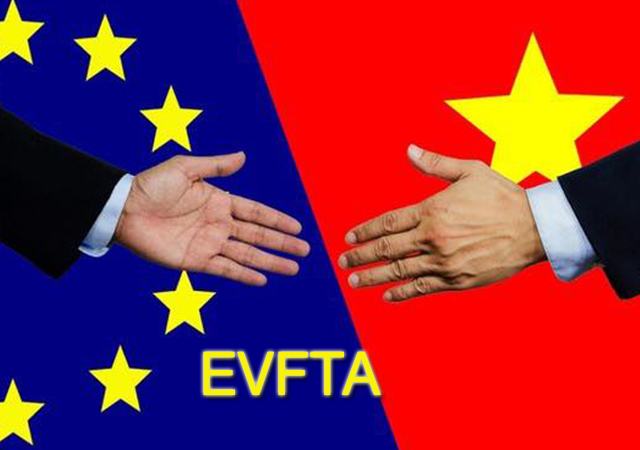
    The European Union – Vietnam Free Trade Agreement (EV-FTA) is expected to be a comprehensive win-win deal for both sides, ambitiously seeking to improve trade and boost mutual economic growth. As with all free trade agreements to which the EU is a party to, a human rights clause is built into this FTA with Vietnam. Many EU officials and parliament members that I have met in the past two years through my advocacy for Vietnam’s human rights situation earnestly believe that Vietnam will improve its record once the FTA takes effect.

    In the past, these friends have asked me to have some faith in the current regime, assuring me that our Vietnamese human rights activists and defenders will have better days in the future. It is a very typical “give them more time” argument that they expect me to accept. Yet the record shows that Vietnam’s aggression against human rights activists increases every year while government-controlled courts continue to hand out harsh sentences. I often wonder how EU officials still want to convince me to have such faith?

    In March 2019, I met with an EU official who was participating in the negotiations of the EV-FTA. She expressed great sympathy for human rights defenders in Vietnam and even realized the situation for human rights there was worrying. And yet, towards the end of our conversation, she asked me what I thought about one of Vietnam’s ministers, whose name I will not disclose. She seemed to be fond of the guy and praised him for belonging to a “progressive group in the Vietnamese Communist Party (VCP)” that she said hopefully would one day push for an improvement in human rights in the country.

    As a democracy activist, I personally think that regardless of whether a person is progressive or not, none of the VCP members right now would dare to inch away from the Party’s political monopoly inside the country. And I frankly stated that the Ministry of Public Security – the national police – would never allow any official to raise his or her voice over the human rights situation in Vietnam. Asking for political pluralism, an improvement in the human rights situation, and democracy would place anyone in danger of being sent to prison for more than a decade, as the latest political trials have shown this year.

    I met with the official right after attending the United Nations Human Rights Committee’s 125th session in Geneva, Switzerland where the Committee completed its third periodic report on Vietnam’s implementation of the International Covenant on Civil and Political Rights (ICCPR). Vietnam submitted its report after a 13-year delay in December 2017–the original deadline was set for August 2004. The Committee sadly acknowledged that in Vietnam’s review “less information was provided on the actual implementation of ICCPR and application of domestic laws in practice, where concrete data was crucially lacking.”

    Vietnam ascended to the ICCPR in 1982, but with regard to complying with the international covenant on human rights, it didn’t actually provide any opportunities for people to learn and exercise their rights. More than that, the government did not allow the Vietnamese people to use the ICCPR in courts to defend themselves when such rights were being violated.

    The point is that more than three decades after Vietnam joined the ICCPR, the human rights situation in Vietnam remains hopeless and people’s rights are being violated on a daily basis. How can we believe that the EV-FTA will improve such a situation when the ICCPR has so far failed so miserably?

    I began to write this article after receiving the news that a close friend, an activist from Vietnam, had been detained upon arrival at the Noi Bai International Airport, where she was put into detention by 10 security police. Dinh Thao is an environmental and human rights activist who left Vietnam to study and work abroad as an advocate for human rights more than three years ago. She was a medical doctor before becoming an activist and I am sure some of the EU parliament members must remember her because she advocated for Vietnam’s human rights situation in Brussels a few years ago and may have met some of them.

    Thao is non-violent and even created a project to educate people about peaceful demonstrations. Yet she was detained by the police immediately after her arrival in Vietnam. What crime did she commit to deserve such treatment? Or is it just simply the fact that the government violated her rights in retaliation for her advocacy internationally for more human rights in Vietnam?

    On the same day that Dinh Thao was detained, November 15, 2019, another Vietnamese was sentenced to 11 years imprisonment and five years of house arrest. Nguyen Nang Tinh, a  music teacher who also advocated for human rights and democracy for Vietnam, was accused by the state of “propagandizing against the government” via his Facebook posts. Tinh denied that the alleged Facebook account belongs to him, but if you read the posts in that account you’ll see that there was nothing that called for a violent overthrow of the regime. If you search for him online, you will see videos of him teaching young children patriotic songs, songs that demand human rights for the people. How could his activities be called “propaganda against the state”?

    As I have worked to protect the human rights of activists in Vietnam for many years, I have often recounted their stories to many Western politicians and officials. The activists I have met are people who had the opportunity to learn about the concept of human rights and who then started to defend such rights for others and also sometimes for themselves. They are the people who believe in the spirit and the universal values of human rights and they also believe that international laws, such as the ICCPR, will protect them. They probably had hoped that the ICCPR would be implemented in Vietnam at their trials. But that hope was never realized because we have never seen arguments articulating any of the articles of the ICCPR, such as Article 19, which protects the freedom of expression, presented in Vietnamese courts.

    And as a result, human rights activists and defenders have often typically been sentenced in rushed one-day trials without an independent judiciary. Sometimes the decisions handed down include lengthy jail sentences, as in the case of Nguyen Nang Tinh, which happened this month.

    In response to the EU officials who asked me to “have faith” in the regime, I point to a database built by the independent civil society organization The 88 Project, which catalogues the arrest and detention of political prisoners in Vietnam. A representative of that organization informed me a few days ago that in 2018, the Vietnamese government had arrested 145 people. These arrests showed the authorities’ blatant violation of the human rights of citizens. That number was greater than the number of arrests Vietnam made in 2017, 2016, and 2015 combined. In 2018, the number of arrests went up because the government detained and sentenced many people after large demonstrations happened in June 2018, in protest against the new cybersecurity law and the development of special economic zones with Chinese investment.

    It is not only human rights activists who are being treated unfairly and who are suffering mistreatment in Vietnam. There are also other groups, such as the workers, for whom the EV-FTA probably has some aspirations to improve their work environment and living standards. Many EU Parliament members have urged the Vietnamese government to quickly ratify the remaining three International Labor Organization (ILO) conventions prior to EU voting on the trade deal. Vietnam has promised to ratify the three ILO conventions over a time period of five years beginning in 2018. However, ratification of international laws is one thing, while the reality of how the Vietnamese authorities have failed to improve workers’ lives is another story.

    In Taipei, Taiwan, legal migrant workers from Vietnam went on a protest this month to demand the abolition of broker fees that each of them had to pay to be able to work in Taiwan. These broker fees are considered to be part of the most exploitative system of all of the countries in Southeast Asia from which these workers come from. What does the Vietnamese government know about this system and why does it allow such a broker fee system to continue to exploit their people? Would the EV-FTA be able to eradicate that system to improve the lives of these workers? How can I have the faith to believe that the Vietnamese government will ever take care of these people?

    Recently, Prime Minister Hun Sen of Cambodia released 70 opposition activists in order to improve his country’s human rights image after the EU threatened the withdrawal of special trade preferences. Cambodia’s political system has many aspects that are far better than in Vietnam. That country at least has an opposition political party – the Cambodian National Rescue Party (CNRP). On the contrary, the Vietnamese Communist Party has a political monopoly and we don’t have a single other political party.

    Running for office as an independent candidate will not lead to any success as the 2016 elections have demonstrated. Being a member of a political party that was formed overseas was the reason that Vietnam sentenced a 70-year-old Vietnamese-Australian man, Chau Van Kham, to 12 years in prison earlier this month.

    And yet, the EV-FTA provides for a lot more benefits for Vietnam than compared the trade preferences that Cambodia would get from the EU. How can Cambodia demonstrate a greater willingness to improve its human rights record while Vietnam just keeps getting worse? How can I have faith that Vietnam will eventually improve?

    During these days, police brutality in Hong Kong has increased dramatically as we see from the recent news coming out from universities there. And as we support and pray for young people there, I hope none of the international politicians and officials will say “give China more time” so that they can resolve their human rights problems.

    In my personal capacity, despite all my efforts, I have yet to make Vietnam’s human rights situation become more well-known in the world. However, I can not look at all of my human rights activists friends in Vietnam and tell them to be patient and to give the government more time.

    We need to raise our voices and demand right now that the Vietnamese government make an effort to improve its human rights record. Should Vietnam make some improvements prior to the EU Parliament vote on the FTA trade deal? Yes, absolutely. Vietnam has to show its good faith by releasing the more than 200 political prisoners who are currently serving time and by allowing the emergence of political pluralism with fair and free elections.

  • Land Dispute in Hanoi Prompted Police Officers To Protest, Is That Illegal?

    Land Dispute in Hanoi Prompted Police Officers To Protest, Is That Illegal?

    On the morning of  November 12, 2019, a protest over a land dispute broke out in the Vietnamese capital of Hanoi. However, unlike in other recent protests, the protesters were not beaten up and arrested by the local authorities. This is probably because the people protesting were police officers of Dong Anh District and so their protest was not deemed illegal by the Hanoi government. This scenario was rare and not the typical case for most of those who protest in Vietnam because in most cases protesters have been assaulted and arrested by local authorities.

    During the last few years, whenever I have had an opportunity to speak with foreigners, I have defended the right of the Vietnamese people to engage in peaceful assembly, which is protected by Vietnam’s Constitution. The problem is that the  government of Vietnam has always classified the right to demonstrate and gather for peaceful assembly as a “disruption of public order,” and so the authorities have arrested hundreds and thousands of its citizens over the years because they joined protests.

    As it turns out, many foreigners have the false belief that demonstrating is illegal in Vietnam and that people are not allowed to protest. The largest protest in Vietnam after our civil war ended in 1975  happened last year, in June 2018. And at that same time, The Vietnamese also clarified that the right to protest was not only legal, but it was a people’s constitutional right. Yet government officials continued to condemn the people’s right to demonstrate and have vowed that they will not allow any crowd to gather publicly. One of the most strident officials supporting the  banning of all protests is To Lam, the minister of public security – the head of the national police force of Vietnam.

    On November 12, 2019, social media and non-governmental media of Vietnam began to report that these police officers had gathered to protest a land dispute involving houses being constructed in Dong Anh district in Hanoi. The cause of the demonstration was very similar to the case of many farmers who had lost their land because of rapid plans for real estate developmental projects in recent years. Those protesting police officers had paid substantial amounts of money to purchase their homes some 17 years ago, but they had not yet received them. The police officers suspected corruption and went to protest against it. In Vietnam’s state-owned media, these protesters were classified as retired police officers who are not currently on active duty. It is likely that the government wants to soften up the fact that it was a case of actual, currently on duty went on protest for their land right to call these protesters as “retired.” However, the land dispute was confirmed to be true as was the fact that these officers did not receive their houses which they had already paid for.

    Whether these officers are retired or not, this is one of the very few incidents in which people who belong to a police unit have found themselves in the same position as other victims who have lost their land. In this case, it was the land rights of former police officers that had been violated and they could not find a proper way to resolve the problem. Protesting against alleged corruption was the only option for them to raise their voices and to address this issue.

    Police forces in Vietnam have always played a close role in carrying out the government’s actions and will. They have been cast as active members of the Vietnamese Communist Party (VCP)  who were assigned to fight opposition movements and the people who do not agree with the way the VCP leads. During the November 12, 2019 incident, the protest by these police officers was not abruptly stopped by the authorities. None of the retired officers got arrested and none were classified as “reactionary forces” in Vietnam’s state-owned media, as has been the  case with others who have protested.

    This is an indication of the big difference in how the government treats its own police officers versus how it treats Vietnamese citizens during protests. Nevertheless, the protest by police in Dong Anh district earlier this month has underpinned that land disputes are becoming a wild beast in Vietnam. This social problem will not exclude government workers and police who will soon join the masses of people in the country who have suffered the injustice of seeing their land taken from them.

    Earlier this year inJanuary, in the Loc Hung Garden Incident, local authorities wrongfully evicted and destroyed over 100 households in Tan Binh district in Ho Chi Minh City. The residents of Loc Hung have filed their petitions and they are continuing their legal struggle with the authorities right up until now. In a major city such as Ho Chi Minh City, the Loc Hung residents have only faced losing their homes and their land but in other remote areas, the victims have faced physical harm and some  have even lost their lives. That is the story of death-row inmate Dang Van Hien.

    Dang Van Hien and his neighbors from Village 1535, Quang Truc ward, Tuy Duc district, who come from different areas of the country, have become adjusted to living in poverty since the time they were born. They gradually saved up enough money and bought a small piece of land, but all they could afford was property in areas off the  beaten track or remotely placed in the jungle. They have been living as the modern “les miserables” in a remote area in Dak Nong province in the Central Highland of Vietnam.

    These farmers were there to farm and live peacefully until a private company – Long Son Investment & Commercial – came and disputed their land ownership. Tragedy struck when the government granted Long Son 1,079 hectares of forest land without first doing a proper land  survey, which resulted in the company’s claims overlapping the parcels of land owned by these poor farmers. Over the last 10 years, these farmers have tried everything they could to petition the government to correct the improper land assessment. At the same time, Long Son used force to destroy their crops and tried to kick them off their lands and out of their homes.

    On October 23, 2016, a deadly altercation happened involving Hien, his friends and the workers of Long Son. Hien fired a self-made gun killing three workers and injuring some others when workers invaded his farm with bulldozers and weapons. He was sentenced to death in 2018 and the highest court upheld his sentence this year. His life may be spared if President Nguyen Phu Trong grants him a reprieve. However, there is no indication that this will happen.

    The Vietnam Land Law has faced a lot of controversies and criticisms in public because its ambiguity has resulted in the many land disputes that people have been facing. Yet, because the state wants to securely own all of the land in the country, individuals and private entities cannot own land and can only receive land use rights from the state. As a socialist country, the Communist Party does not allow private property ownership, and yet the law defines nicely that land ownership in Vietnam “belongs to the entire people” “with the State acting as the owner’s representative and uniformly managing land.” The State also gives itself the power to “hand over land use rights to land users in accordance with this Law.” (Article 4, Land Law 2013). This clause that the state shall “hand over land use rights” has created land disputes in Vietnam over the past decades and continues to do so because of corruption.

    With the recent story of police officers protesting for their land rights this month in Hanoi, we can see that disputes involving land will continue to be a problematic social issue growing inside the country and that no one will be spared, including government workers and police officers. And if the president of Vietnam does not save the life of Dang Van Hien, Hien will be the first person to be executed due to a land dispute and his case may put more pressure on land administration in Vietnam.

    To protect their land rights everyone has to fight, from a poor farmer living in the Central Highlands to the police officers in Vietnam’s capital. The consequences each of them may face for protesting for their rights may be very different. But they all have no other choice but to oppose those who violate their rights. The people have waited patiently and petitioned for 10 or 20 years to protect their rights, but they still have not gotten any response from the judicial system. Corruption and secret deals between some local authorities and real estate developers coupled with an ambiguous law on land administration have worked together to prevent victims of land disputes from having their day in court and receiving justice.

  • Is Vietnam Now A Country Without A Solid Leader?

    Is Vietnam Now A Country Without A Solid Leader?

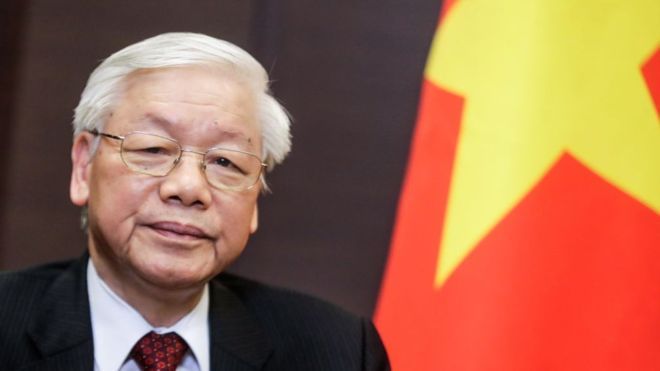
    For more than half a year, the health of Vietnam’s President Nguyen Phu Trong has remained a top secret while rumors and speculation about him continued to spread across social media. Trong was not able to visit the United States in October 2019 as planned, and that fact stirred up new discussion about his health. Surprisingly, the health of the man who currently holds the top positions as the president of Vietnam and general secretary of the Vietnamese Communist Party (VCP) remains a state secret in Vietnam.

    How is that possible?

    According to the new Law on the Protection of State Secrets (link inVietnamese), passed in November 2018, all information that “protects the health of the top leaders of the (Communist) Party and of the state” is a state secret.

    This law now appears to be coming under increasing public scrutiny as a result of growing  speculation regarding the current health condition of the most politically powerful man in Vietnam.

    Rumors about Nguyen Phu Trong’s health have consumed the entire nation since mid-April 2019, and effectively bumped his name to the top of Vietnam’s Google trends on the weekend of April 13, 2019, pushing it to the No. 2 slot that Sunday evening.

    It apparently all began with a Facebook post by freelance journalist Le Nguyen Huong Tra, which quickly went viral after she announced around 4pm on Sunday, April 14, that the 75-year-old Trong suddenly became ill while visiting Kien Giang province in the south. Helicopters were called to take him from the province back to Ho Chi Minh City for an emergency admission to Cho Ray Hospital.

    Later that evening, more rumors from social media pieced together the puzzle and alleged that Trong had suffered a brain hemorrhage, probably the result of a stroke, which affected the left side of his body. Some pictures, allegedly taken late Sunday afternoon at that hospital, also showed police officers surrounding the premises, leading more people to believe Trong was indeed admitted there for emergency treatment.

    As the country’s other top leaders remained completely silent, pro-government trolls on Facebook immediately went to work.

    Kien Giang province, however, has long been perceived by many Vietnamese as a “kingdom” that belongs to the family of Nguyen Tan Dung – Vietnam’s former prime minister,  a man who was also Trong’s old foe and his rival for the top Communist Party post in 2016. The place is Dung’s hometown, and where his power has taken firm root. In fact, Dung’s eldest son, Nguyen Thanh Nghi, currently holds the top leadership position in the Communist Party’s provincial committee there.

    The animosity between the two former rivals, Trong and Dung, is not believed to have ever ceased to exist. If anything, it has intensified with Trong’s anti-graft campaign in recent years, in  which most of the convicted corrupt officials were identified as Dung supporters in the past. As such, the rumor that Trong felt seriously ill in Kien Giang became even more of a tantalizing tale that the public failed to resist.

    Trong, as the leader of both the state and the Communist Party, has been enjoying an unprecedented power that has not been seen since Le Duan’s death in 1986. The possible downside of this setup, perhaps, would be that the country’s future hinges on his wellness. And in the worst case scenario, the Party will have to promptly fill two top positions at the same time to maintain stability until its next Party Congress. It would, then, seem to be a reasonable demand from the public to ask the government for an official account of Trong’s current condition.

    But with the current Law on Protection of State Secrets, however, the details of the health of a Vietnamese leader may never be disclosed, even when the public does have a legitimate reason to demand the facts, as in the case of President Trong.

    At the time this law was under debate in the National Assembly, one legislator, Bui Dang Dung, had questioned whether it was reasonable to classify leaders’ health as a state secret. Nevertheless, he was in the minority and the law was passed with a more than 91 percent approval.

    But why can’t the public in Vietnam be informed about the health of their top leaders and about their fitness for office?

    The answer probably would lie in the manner with which the Communist Party controls and decides elections, as well as its appointment of the top leadership in Vietnam. Despite having a law on elections, in reality, voting in Vietnam is essentially meaningless. Vietnamese people often joke that we don’t have free elections, but rather a selection. And it is a selection that takes place among the Communist Party’s factions, after all the infighting has settled.

    The Party Congress is the backdrop for spectators to watch which candidates will come out as winners, or may we say, rulers of the country. This was the reason for the world to pay attention to Vietnam’s last Party Congress in 2016, where Trong triumphed over Nguyen Tan Dung. The Party members formed alliances and voted accordingly to protect their interests during that meeting.

    As citizens the Vietnamese people are presented with ballots to elect their representatives from among the Party-approved candidates during the general election that follows the Party Congress. The people rubberstamp Party choices for National Assembly members, which consist of those who will, in turn, rubberstamp the Party’s choices for our nation’s top leaders and policy decisions.

    Every few years, however, rumors and unofficial accounts regarding the health of leaders mysteriously show up on social media in Vietnam. Sometimes, the rumors turned out to be true, as in the cases of Nguyen Ba Thanh (Head of the Internal Affairs of the party) or Tran Dai Quang (President). And at other times, the rumors turned out to be false, as with the story of the Minister of National Defense, General Phung Quang Thanh, back in 2015. Most of the time, the public would follow such news with keen interest, believing that they were getting a glimpse into the power struggle within the Communist Party. As the rumors have it, neither Nguyen Ba Thanh’s or Tran Dai Quang’s illnesses resulted from natural causes; instead they were likely poisoned by their political rivals.

    Regardless of whether such rumors contain any substance, negative information regarding a leader’s health can trigger factions within the Party to shuffle and change their alliances, causing the power paradigm to shift and create instability. For the Communist Party, it only makes sense that all information should be kept hidden and dealt with internally to avoid just that. The Party would, by all means, keep information away from the people’s scrutiny to avoid anything that could remotely affect its absolute political power in the country.

    After all, it does not matter how many factions there are in the Party and what they may fight about. Until now, Party members have always agreed, unanimously, that they must continue their political monopoly. With that, the culture of non-transparency and secrecy persists and continues, from the internal actions of the Communist Party to the governing functions of a state with no apparent distinction.

    The leadership of the Communist Party will be on full display in 2021 when their members meet for their Party Congress which will elect the next general secretary and the next group of leaders. During 2019, besides  Trong, the other two most powerful leaders of Vietnam,Nguyen Xuan Phuc and Nguyen Thi Kim Ngan, have both faced major controversies that could diminish their power in their next Party Congress. But the health of Trong remains the top story among the public.

    In October 2019, a video clip of less than 60 seconds showed Trong greeting Laotian leader Bounnhang Vorachith. In the video, viewers can see Trong’s frailty, probably due to an earlier stroke which left one side of his body extremely weak. His walking also showed problems and the question was once again raised among Vietnamese citizens: Is he well enough to lead his Party and the whole country?

    His failure to govern the country was exposed in the tragedy of the 39 Vietnamese citizens who froze to death in Essex, the United Kingdom, earlier this month. After the British and Vietnamese authorities confirmed the nationality of the victims, Prime Minister Nguyen Xuan Phuc extended his condolences to their families. At the same time, President Trong remained silent, even though someone in his position – according to the Constitution – should offer state condolences to the victims and their families.

    In Vietnam’s current regime, whether Trong is well enough to lead may not be a question that people may easily ask and have an answer for. Many people have assumed that it could very well be that within the Communist Party the infighting has already begun to choose the country’s next top leader. In the meantime, citizens can only pay attention to social media and non-governmental media outlets for news about the health of their leader and whether he is still be able to rule.

    For a bit over one year from now until 2021, VCP factions will continue to fight to select their leaders while close to 100 million Vietnamese citizens can only accept the party’s selection. How can this country have a solid leadership when the people do not have the right to elect their top leaders or to be informed about his or her ability to lead?