(Updated on October 6, 2017)
The Vietnam marine life disaster, also known as the Formosa disaster or the fish death disaster, was a water pollution crisis breaking out in Vietnam at least from April 6, 2016. Its most obvious demonstration was the massive fish deaths in the seas of four provinces in central Vietnam: Ha Tinh, Quang Binh, Quang Tri, and Thua Thien-Hue.
The main perpetrator was identified as Hung Nghiep Formosa Ha Tinh, Ltd. (FHS), who discharged toxic industrial waste into the sea through their underwater drainage pipes. Formosa itself accepted responsibility for the disaster on June 30, 2016.
Government statistics estimated that at least 115 tons of free-swimming fish, 140 tons of farmed fish, and 67 tons of clams were killed as a result of water pollution. However, real figures must be times higher than these, with tons of shrimp, cuttle, squid, and other kinds of aquatic animals killed as well.
The disaster also cost human lives. At least a diver (Le Van Ngay) was killed after diving in the polluted sea water, a woman (Linh) died of poisonous fish, and a couple (Mr. Le Van Lam and Mrs. Nguyen Thi Huong) got cancers after working for FHS as keepers of their chemical stocks. At least 21 other divers, dozens of fishers and seafood-consumers reported they had got health problems due to their direct or indirect link with the disaster.
The tragic toll caused by the disaster may never be precisely estimated or get public as a result of bad governance and unaccountability.
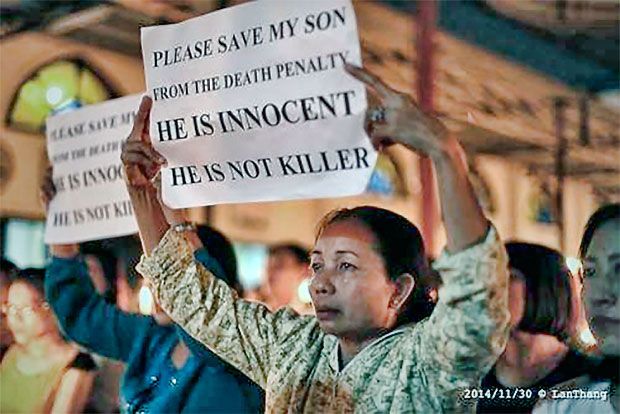
Worse, and most importantly, the marine life disaster involved a humane and political crisis when the Vietnamese government fails to ensure relevant compensation for the victims; they even go further by brutally suppressing voices of dissent. Widespread human rights violations have made 2016 and 2017 dark years for democracy and freedom in Vietnam, characterized by arbitrary detentions, police violence targeted at civilians, and increasing imprisonment of peaceful activists.
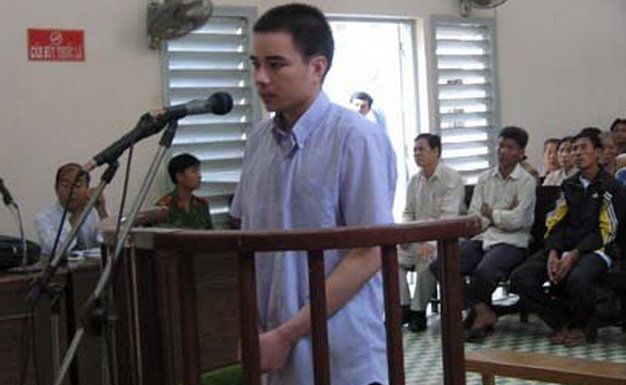
Since October 2016, dozens of activists have been arrested and faced charges related to their activities to protest at Formosa and demand environmental rights. To name some: Nguyen Ngoc Nhu Quynh, Nguyen Van Hoa, Hoang Duc Binh, Nguyen Van Oai, Nguyen Viet Dung.
Others have been hunted nationwide, inter alia Bach Hong Quyen, Thai Van Dung, Tran Minh Nhat.
Many have been victims of government-sponsored violence, inter alia Truong Minh Tam, Hoang My Uyen, Vu Huy Hoang, Le My Hanh, Trinh Dinh Hoa, Tran Hoang Phuc, Huynh Thanh Phat.
2016
April 2016
April 4
Fisherman Nguyen Xuan Thanh (36 years old, a resident of Ba Dong hamlet, Ky Phuong commune, Ky Anh district, Ha Tinh) dived into the sea and unexpectedly discovered a giant waste discharge pipe. This pipe has a diameter of about 1m. It was discharging a yellow liquid.
The pipe was identified as a submerged pipe belonging to the Formosa corporation, 1.5km in length, buried under the seabed. Formosa confirmed that they have an underground sewage system connecting directly from the Formosa project site in the Vung Ang economic zone to the sea.
|
“Already discovered it three years ago” Mr. Nguyen Trung Huynh (born in 1968, a resident of Ky Anh commune) has worked as a sea diver for tens of years. He said three years ago, around 2013, he discovered a pipe buried under the seabed. “At the time I was working for Belgium. The people here said the pipe must be from Belgium, but when I checked, I told them it wasn’t, this pipe belonged to Formosa. I notified the environmental police.
The police, the marine police, and the environmental police hired me to dive and reached that area. I did so, took some video footage and photographs and submitted everything to them. They said, “We will investigate this issue.” Then we didn’t hear from them for years, the local people continued to fish as usual. In April 2016, we discovered that they discharged waste liquid.”
(Mr. Nguyễn Trung Huỳnh discussed with Green Trees, on 19 August 2016)
|
April 6
Residents in the two hamlets, Hai Phong 1 and 2 (Ky Loi commune, Ky Anh district, Ha Tinh) lost over two tons of groupers and red snappers when they were almost ready for harvest. [1]
According to Nguyen Thai Bao (resident of Tay Ha hamlet, Ky Ha commune, Ky Anh district, Ha Tinh), until the noon of April 6, more than 4,000 red snappers and sea basses – which were over a month old and raised in cages – still ate and moved around as usual. However, around 2 p.m. on April 7, when the tide rose and pushed sea water in, the fish swam slowly and then died en mass. [2]
Not only farmed fish, but wild (free-swimming) fish also died. “Around 9 a.m. on April 6, Mr. Chu Van Dai – a diver working in the area undersea where Formosa Steel Plant discharged waste in Vung Ang (Ha Tinh) – discovered much dead fish surrounding the pipe’s opening. Mr. Dai felt a bitter sensation in his mouth, exhaustion, and toxin in the water. The whole team of 15 divers felt that seawater tasted different and toxic. Their bodies felt ill so they asked to be off work. A few days later, the local people saw much dead fish drifted to the seaside of different types, some lived in deep water.” [3]
April 6-8
During these three days, in the three communes Ky Loi, Ky Ha and Ky Ninh (of Ky Anh district), all of the fish belonging to 14 households raising fish in cage, with 18 cages containing different types of fish (red snapper, cobia, grouper, sea bass, etc.) died in mass. Among these were 37,200 breeders, 2,120 kg commercial fish. The damage was over 1 billion Vietnamese dong, approximately USD $45,000.
Wild fish also died in mass in Vung Ang sea (around Son Duong island, Vung Ang port, and Vinh river’s estuary). [4]
April 10
Dead fish drifted into the coast along Quang Dong commune, Quang Trach district, Quang Binh. Dead fish continued to spread southward, to seaside along Nhan Trach, Nhat Le, Bao Ninh, Ngu Thuy, etc. [5]
April 11
The Northern Environmental Monitoring and Aquatic Diseases Center (Aquaculture Research Institute 1 – MARD) published an announcement about the results of their unscheduled monitoring after the abnormal fish deaths took place in Ky Anh, Ha Tinh.
The announcement concluded that virus causing disease was not the cause of this phenomenon, rather fish died in mass due to “toxic agents in the water” in Vung Ang coast. According to this Center, toxin agents originated from untreated wastewater discharged directly into the sea and rivers, polluting seawater and intoxicated fish. [6]
April 15
Tens of fish cages belonging to 60 households living in An Cu Dong, Lang Co town, Phu Loc district, Thua Thien-Hue died en mass in a few days, with the largest number of fish dying on April 15. Damage was estimated to be up to hundreds of millions of dong.
According to Mr. Mai Van Xi – Deputy Head of the Division of Agriculture and Rural Development in Phu Loc district, not only farmed fish but also wild fish living in the Lang Co lagoon died.
April 19
After eating fish collected on the seaside, Tran Thanh Thuy (8 years old, Quang Phu commune, Quang Trach district, Quang Binh) vomited and had diarrhea. Her family took her to the commune medical center and she was treated with intravenous drip and monitored. VietNamNet reported this incident and advised people not to buy and sell or eat dead fish while waiting for the authorities to identify the toxic agents. [7]
April 20
A report from the Department of Agriculture and Rural Development in Thue Thien-Hue stated that the amount of PO4 (phosphate) at a benthic layer is 1mg per liter, while the maximum allowable norm is 0.5 mg per liter only. This increased pH concentration. A sudden and drastic increase of PO4 and pH in the water may have shocked the fish and kill them. [8]
April 21
The Deputy Director of the Aquaculture Department under MARD, Pham Khanh Ly, told the press that the government task force is vertical management agencies, however, the Vung Ang industrial zone (including the Vung Ang Thermal Power Plant and Formosa industrial zone) has foreign elements, so they need to form an interdisciplinary task force, with the Prime Minister’s direction, before they can carry out an inspection. [9]
April 22
On the night of 21st and early morning of 22nd April, more than 20 residents of Bo Trach district, Quang Binh province were rushed to emergency service after they ate poisonous seafood in a restaurant in Phuc Trach Commune. Most of the 200 guests who ate the same meal had symptoms of stomachache, nausea, and diarrhea. [10]
Minister of Industry and Trade Tran Tuan Anh signed a document about sending a task force to the Hung Nghiep Formosa Ha Tinh Co., Ltd. (FHS). [11]
An inspection team of the MONRE led by the Head of the Department of Environment, Nguyen Van Tai, carried out an inspection at the Petro Vietnam Power Corporation in Ha Tinh (Ky Anh Town, Ha Tinh) and the FHS (Vung Ang economic zone, Ha Tinh). [12]
The General Secretary of the VCP, Nguyen Phu Trong, also led a mission to visit and check on the Formosa project’s progress, specifically the Iron and Steel Complex Project and the Son Duong Formosa Ha Tinh (FHS) deep-sea port. In addition, he also visited some production sites in Ha Tinh. He did not once mention the ongoing fish death. [13]
April 23
Responding to an interview question from the Giao Thong (Transportation) newspaper about whether people should continue to eat sea fish and swim in waters where dead fish no longer appeared, Mr. Dang Ngoc Son, Vice-Chair of the Ha Tinh Provincial People’s Committee, said: “For now, many aquatic products raised in cages in Vung Ang (Ha Tinh) are growing normally. Seafood such as squid, shrimp, crab and fish that are alive can be consumed. Furthermore, people can swim in these waters without feeling worried.” [14]
April 24
Le Van Ngay (born 1970, from Khanh Hoa), a diver working for Nibelc Company (the building contractor for Formosa’s breakwater in Son Duong port), died mysteriously a hospital. A few hours before, he suffered from chest pains and breathing difficulties during work and was taken to hospital for emergency treatment. [15]
April 25
Mr. Chou Chun Fan, Deputy Head of Formosa’s External Relations Department, Head of the Formosa Office in Ha Noi, said this in a conversation over-the-phone with Tuoi Tre (Youth) newspaper: “It is impossible to build a steel plant here without leaving any impact on fish and shrimp. Of course, we try to build a plant that meets the State’s requirements. Yet it is normal to lose some things as you gain some things. Just like how when we use this area to build our plant, the soil here is no longer good for growing rice. Between these two things, we must choose one, whether I want to catch fish and shrimp or I want to build a modern steel industry? When this area was cleared the local authorities already made a plan to support fishermen to switch jobs, why do they need to keep fishing in this area?
Do you want to keep fishing or do you want to keep the plant? Go ahead and make your decision. If you want both, even the Prime Minister can’t satisfy you…” [16] Mr. Chou Chun Fan’s comment angered the Vietnamese public on the Internet.
April 26
Quang Binh province called for an urgent meeting. The Chair of the Provincial People’s Committee, Mr. Nguyen Huu Hoai, ordered a ban on swimming in the sea during this time to prevent any mishaps.
The Thua Thien-Hue Department of Natural Resources and Environment announced that they received the analysis result from the water sample taken from Lang Co lagoon and Lang Co seaport (Lang Co town, Phu Loc), the seaside along Quang Cong commune (Quang Dien), Dien Huong, Dien Hai (Phong Dien). According to the analysis, the total nitrogen content (nitrogen, chemical symbol N) calculated on ammonium content (NH4), heavy metal chromium content (chromium, chemical symbol Cr) exceeds the limit allowed by the National Technical Regulation on seawater quality and National Technical Regulation on surface water quality.
This result also pointed out that the cause of both wild fish and farmed fish’s death was not a disease but rather a very powerful agent – a toxic in the water originating from somewhere north of Thua Thien-Hue province. [17]
On the same day, the Ha Tinh newspaper published an article titled “The sea is now clearer, the environment is no longer polluted”. [18] This article encouraged fishermen to continue their work, and “overcome obstacles and losses”. This article was criticized by even mainstream press (such as the Petro Times). [19]
In the afternoon, Mr. Chou Chun Fan and the management team in Ha Tinh organized a press conference and bowed to apologize for their statement of “choose fish or choose steel.”
A petition signed by Vietnamese people appeared on the website “We the People” managed by the White House. This petition requested the American government to assist Vietnam in evaluating the environmental impacts that Formosa Steel Plant was making. This petition was created in English by a person named T.N.
April 27
The Quang Binh Department of Culture – Information & Tourism reported that about 30% tourists coming to Quang Binh canceled their tours and hotel bookings at hotels along the beach in Dong Hoi city during the holiday 30/4-1/5. All restaurants along the beach suffered from slow business due to the fish death.
The first press conference about the fish death crisis was scheduled to begin at 4 p.m. in Ha Noi to announce the cause. However, the press conference was called off, while hundreds of reporters were still waiting outside.
Finally, around 8 p.m., the press conference began and was chaired by the Deputy Minister of Natural Resources and Environment, Mr. Vo Tuan Nhan. The MONRE considered two possible causes of the mass fish death: “One cause could be toxic chemicals discharged from human activities on land and in the sea. The second cause could be an abnormal natural phenomenon, in combination with human impact, which leads to the algal bloom, or red tide as it is commonly known around the world.”
Mr. Vo Tuan Nhan also said: “Up to now, through inspection and collection of evidence, we have not been able to infer the relationship between Formosa’s plants and the mass fish death.” [20]
A female reporter raised a question about heavy metals found in seawater, according to the report prepared by the Thua Thien-Hue Department of Natural Resources and Environment, and the coming tourist season. Deputy Minister Vo Tuan Nhan interrupted her: “Don’t ask that question. That question damages our country.”
The press conference only lasted for 10 minutes and did not provide sufficient information for hundreds of reporters. It disappointed many people.
April 28
Minister of Natural Resources and Environment Tran Hong Ha and local authorities and scientists had a working session at the FHS. After that, he told the press that he would bear the responsibilities[21]. He also said that, according to Vietnamese law (Article 101 of the Environmental Protection Law, effective since 2015), discharging waste liquid through an underground pipe is not allowed; and he would order Formosa to bring the underground pipe to the ground for monitoring. [22]
The MARD reported the result of water sample testing in a governmental meeting, rejecting the theory of red tide. “We can eliminate the cause of the abnormal natural phenomenon in combination with human impact to create algal bloom, which is commonly known as red tide around the world.” [23]
The human rights activist Truong Minh Tam, a member of the Vietnam Path Movement, was arrested by the Ha Tinh and Quang Binh police for “shooting video and taking photographs in Ky Loi commune, Ky Ha commune and Dong Yen parish” in Ky Anh commune.
Hundreds of fishermen in Canh Duong commune, Quang Trach district, Quang Binh province protested fiercely during hot noon on the 28th, 29th and 30th of April, demanding the government to expel Formosa from Vietnam and return clean sea to the people. The protest blocked traffic on National Highway 1 – the connection between the North and the South.
April 30
The Director of Da Nang Department of Natural Resources and Environment, Mr. Nguyen Dieu, and many other staffs of the Department in this city swam in the sea at Pham Van Dong beach (Son Tra district), in order to confirm that seawater in Da Nang was not polluted. Up to that point, dead fish still appeared and drifted to Da Nang seaside. [24]
Facebooker Chu Manh Son was arrested in Quang Trach District, Quang Binh Province by the Ha Tinh police while he was filming the demonstration on National Highway 1A using a mobile phone.
May 2016
May 1
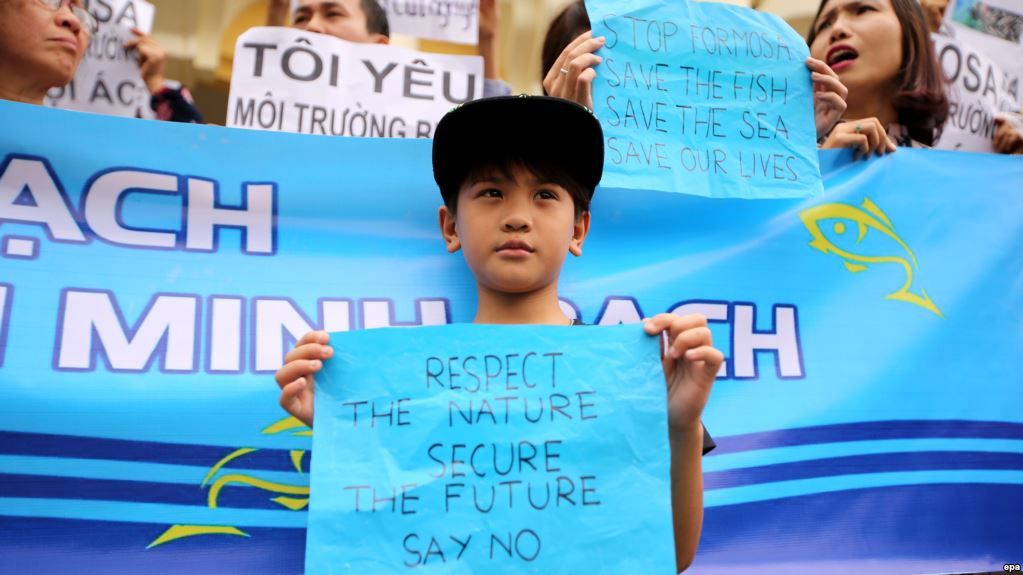
Thousands went on demonstrations in major cities such as Hanoi, Saigon, Da Nang, Nha Trang, and Vung Tau. In Hai Phong, demonstrations were held with banners hung on buses.
Minister of Information and Communications Truong Minh Tuan and a group of journalists went out to eat “Vung Ang seafood” to show that the sea had been free from pollution already, that patriotism meant to eat fish and take sea swimming…
May 2
The 19.00 TV newscast by Vietnam Television (VTV) relayed reportage from the ANTV (a TV channel owned by the police) announcing that the police of Ha Tinh and Quang Binh “took into custody two guys who incited people”, i.e. activists Truong Minh Tam and Chu Manh Son.
May 4
People of Nhan Trach Commune (Bo Trach District, Quang Binh Province) found a reddish brown line of about 1.5 km long, 10 m wide, running along the coastline of 5 villages, very close to the shore. Prof. and Ph.D. Nguyen Ngoc Lam of Nha Trang Oceanography Institute assumed that it might be signs of algal bloom or red tide. In the morning of the following day, May 5, the colored line disappeared. [25]
May 5
20:00, two Chinese-born Vietnamese citizens, Lau Nhat Phong (A Lau) and Mac Vi Luc held a sit-in on Nguyen Hue walking street of Ho Chi Minh City to raise their voice on the dead sea disaster in central Viet Nam. Just in about 10 minutes, both were captured and detained in the police station of Ben Nghe ward until dawn the next day.
May 8
Public protests continued to break up in Ha Noi, Saigon. They were brutally suppressed. In Saigon, the local government deployed strange forces, whose functions were unknown, to snatch slogans, beat and arrest protesters. Hoang My Uyen, a young woman who was carrying her child in the march, was blown up and kicked on her face. Her photo, with scratches on the face, hugging her child in a panic, provoked public indignation on the Internet. Dozens of people were arrested and held at local “social protection centers”. They were beaten, electrocuted, and locked for 2-3 days.
In Hanoi, dozens of people were also arrested and held at various police stations. However, they were released within the day.
May 13
A newspaper named “Nong thon Ngay nay” (Countryside Today) got a fine of VND 140 million for publishing two articles on the “The gioi Tiep thi” (Marketing World) magazine. The articles were titled “The people are always those left behind” and “The lament of fish.”
Paulus Nguyen Thai Hop, Bishop of Vinh Diocese, sent an open letter titled “Public letter on the catastrophic pollution of the marine environment in central Vietnam.” The Vietnam Television described the letter as “a biased depiction of the occurrence, exaggerated, causing anxiety, and using provocative language to abet the parishioners.”
The Office of the United Nations Commission on Human Rights (OHCHR) in Bangkok proclaimed their worries about the increasing violence against the demonstrators for Vietnam’s environment.
May 14
HCMC Police gave information to the press that, “Upon investigation and collection of information, it is affirmed that the terrorist organization named Viet Tan held a crowded muster, disturbing public order in the city on May 1st and 8th.” The police also blackened Huynh Thanh Phat, a young blogger, said Phat “had two previous convictions, hometown in An Giang but wandering mainly in HCMC like a vagabond. He participated actively gathered and disturbed in a spontaneous manner.” [26]
May 15
In Quynh Luu district, Nghe An province, thousands of parishioners surrounded the district’s committee office, asking to carry out investigation and clarify the cause of mass fish deaths.
In Saigon, the police suppressed, breaking up every gathering at April 30 Park. Huynh Ngoc Chenh, an ex-journalist, held a sit-in by himself. He was taken a photo by a blogger and photojournalist named Bui Dzu. The photograph soon became famous, captioned “The Lonely Man”, clearly reminiscent of “The Tank Man” in the 1989 Tiananmen Square protest.
At the end of the day, still, a small protest broke out like a streak of lightning at An Dong market, participated by Nguyen Nu Phuong Dung (a.k.a. Miu Manh Me), Lau Nhat Phong (A Lau) and some other young people.
In Hanoi, after walking along Hoan Kiem lake for about 3 or 4 minutes, a group of about 20 youths wearing fish-shape masks was arrested by the police and civil defense force. They were soon pushed up on a bus and taken into custody for hours.
May 23
Traffic Police Squad 14 (the Hanoi Police) uncovered and seized a truck carrying about four metric tons of rotten fish en route Hanoi. [27]
May 29
In VTV’s talk-show “60 Open Minutes”, whose theme was “Sharing on social media, what is it for?”, MC Ta Bich Loan questioned Phan Anh, another MC, on his sharing of a clip by VTC News about an experiment on dead fish that the VTC team carried out in Vung Ang. Loan asked Phan Anh what his motive was in sharing the clip. Hong Thanh Quang, a police-background journalist, and Pham Manh Ha, a behavioral psychologist, also questioned him aggressively. The program aroused a storm of public opinion among the facebookers. The great majority of people supported Phan Anh and were indignant with Loan and Quang. After the talk-show, Phan Anh became even more famous for his words, “Don’t be silent.”
The VTC’s video clip was about an experiment in which “the fish died within only 2 minutes’ swimming in Vung Ang’ sea water”. It was broadcast on the VTC’s Evening News of April 26 and got bitterly criticized by state-owned newspapers and du luan vien (public opinion shapers), who alleged it to be “dishonest” and “misleading”.
June 2016
June 1
Blogger Nguyen Chi Tuyen (a.k.a. Anh Chi) started a campaign, “To knock pans for transparency”: Everybody knocked their pans in the kitchen at a certain time to ask the government to clarify information about the cause of dead fish, and, at the same time, wrote slogans on the wall of the kitchen. The activities would be live streamed on Facebook, or filmed and replayed later.
June 2
Mai Tien Dung, Minister and Chairman of the Government Office, announced at the government’s monthly press conference that “the reason for mass fish deaths had been found but not yet made public, for it is pending counter argument”, that is they were waiting for independent consultancy, both local and international, to ensure objectivity. [28]
June 5
Green Trees held a protest march in Hanoi in celebration of the World Environmental Day, sending out the message of “Our future in our hands.” The protesters urged for transparency of mass fish deaths and questioned the role of the National Assembly in the crisis. The march lasted only 10 minutes before it was broken up by the police and civil defense force. The protesters were taken on buses to police stations again.
June 9
Angelina Trang Huynh, a member of the Viet Tan (Viet Nam Reform Party, an exile Vietnamese political party in the US), wrote on her Facebook page: The US Ambassador to Vietnam, Ted Osius, had spoken at the briefing on June 9th at the Center for Strategic and International Studies (CSIS), Washington D.C., that he used to put forth an official expression to Hanoi’s leaders, saying that the United States could help find out the cause of fish deaths and deal with the environmental disaster, but Hanoi refused. To his knowledge, until then, some Vietnamese and US scientists still had some cooperation, but the Vietnamese government had denied any official assistance.
June 10
Quang Tri’s Department of Health issued the official document No. 549 to the local People’s Committee regarding the inspection, testing, and processing of the frozen seafood which could not be sold due to extremely toxic chemicals found in the fish following the mass fish death incident. [29]
June 11
Inter-branch forces of Quang Tri sealed and confiscated 25 metric tons of scads contaminated with phenol, an extremely toxic chemical, at Dung Thuoc enterprise (An Duc 3 village, Cua Tung townlet, Vinh Linh District, Quang Tri province). [30]
Vo Van Hung, Director of Quang Tri’s Department of Agriculture and Rural Development, assumed that the issuance of a certificate of offshore fishing and certificate of safe seafood were rather proper. “Issuance of such certificates is to affirm that the fish is clean, yet it does not guarantee safety.” [31]
June 12
Hundreds of parishioners in Quynh Luu district, Nghe An province marched on National Highway 37, starting from Phu Yen Church, to ask the government to “protect the environment, the Vietnamese race, and the country.” They also raised objection against blackening Reverend Father Paulus Nguyen Thai Hop by the Vietnam Television.
June 20
At 9:00 p.m. Hanoi time, PTS Our Island, a Taiwanese broadcast, released a TV report on the fish death disaster in central Vietnam.
The report was also posted on PTS’ YouTube video channel and translated into Vietnamese by Vietnamese activists, evoking strong emotions from the audience. That was the first time a media agency made a TV report about the desperate situation of the fishermen and protesters for environmental protection in Vietnam. Ironically the media agency was a foreign company, and even more, it was from Formosa’s homeland, Taiwan.
June 30
Tran Hong Ha, Minister of Natural Resources and Environment, told the VnExpress news site that he had experienced 84 stressful days. He said: “Formosa Ha Tinh could not deny (its responsibility) as we made a list of 53 violations they committed, ranging from the defects in design and construction to poor operation.” “Phenol and cyanide are the main and direct cause of mass fish deaths. We have full data and unbiased evidence to affirm that phenol and cyanide were from the coking plant of Formosa Ha Tinh.” [32]
At 17:00, the government held a press conference to proclaim the cause of fish deaths: It was Hung Nghiep Formosa Ha Tinh Steel Co., Ltd. (FHS) that was the perpetrator. Chen Yuan Cheng, chairman of the company, apologized and pledged to pay VND 11,500 billion (approx. USD $500 million) as compensation.
Minister and Chairman of the Government Office Mai Tien Dung stated, “Formosa admitted its wrongdoings before the Vietnamese people and made five commitments on compensation and assistance. One should not hit a man when he is down,” “A prosecution against it is something that needs considering. The Vietnamese are naturally tolerant and generous.”
In the evening and at night, dozens of famous facebookers, including lawyers, journalists, human rights activists, etc., raised their frustrated voice to protest vehemently the government who used its discretionary power to negotiate with Formosa and accept an utterly irrelevant compensation. From urging investigation and advocating transparency, independent CSOs now changed their goals to petitioning for criminal proceedings against Formosa or its expulsion from Vietnam, “Formosa get out.”
July 2016
July 4
MONRE leader Tran Hong Ha once stated that Formosa would be forced to bring the underwater waste pipe to the ground for monitoring but now toned down his voice, “The problem is not the underwater pipeline but waste water. Is the waste processed in accordance with environmental standards before it is discharged into the environment through the pipeline? Is the control over it to ensure that the waste is safe made explicit, and if there is a breakdown, what is the possible alternative for it? In case the processed waste reaches the standards, it may be discharged through the current underwater pipeline.” [33]
July 7
Around 3,000 people of Con Se parish, Ba Don town, Quang Binh province, which is 50 km from the Formosa, went on a march, asking the government to shut down the steel company.
July 11
The Inspectorate of Ha Tinh’s Department of Natural Resources and Environment, together with environmental police, entered the farm of Le Quang Hoa (director of Ky Anh Urban Environment Company) in Ky Trinh Ward, Ky Anh town, to examine its operation. Over 100 tonnes of waste from Formosa was found illegally buried underground.
Mr. Hoa explained to Tuoi Tre newspaper that the 100 tonnes were domestic waste of the plant, “It is normal mud, not hazardous waste. It is from some waste treatment stations inside Formosa.” [34]
Although Ky Anh Urban Environment Company was not the unit to deal with industrial waste, it had before signed a processing contract with Formosa.
July 12
Liberty Times Net, a Taiwanese website, reported that on July 11, Fu Yuan Hong, Deputy Chairman of Formosa Chemicals and Fibre Corporation, provided data to reverse and deny the investigative conclusion by the Vietnamese government. Hong’s act was commonly understood as “retracting the statement.” [35]
July 13
Upstream dams near Formosa’s waste landfill site in Ky Anh district suddenly discharged a great amount of water, which was thought to be at Formosa’s request. Local people suspected that such discharge was to destroy the evidence of buried waste. [36]
July 15
The Radio Free Asia (RFA) published results of the first independent test on fish in central Viet Nam. Nguyen Anh Tuan, a pharmacist in Hanoi, who did the test in late June in Quang Ngan commune, Quang Dien District, Thua Thien Hue Province, reported that every index for the scad was below safety standard, or that the scad contained cyanide, phenol, asen, cadmium, and lead. The cuttlefish was contaminated with phenol, a poison not allowed in food.
This independent test, he said, meant that the state should immediately provide a list of the toxic chemicals that caused massive fish deaths and use it as a base to thoroughly and precisely assess the quality of marine products, thereby find ways to help fishermen with their livelihood, to ensure food safety and protect consumers.
July 23
Nguyen Thi Kim Ngan, Chairwoman of the Vietnam National Assembly, presided the first press conference one day after taking office. She said the National Assembly would supervise and monitor closely the case of Formosa, and she would personally meet Vo Kim Cu (former secretary of the party cell and chairman of Ha Tinh province, currently a deputy of the 14th National Assembly) for a warning. However, with regard to the protection of national sovereignty, she said, “A number of organizations and individuals raised their voice to call upon the people to do something, but what have they done for the country? Nothing yet.”
July 24
Vo Kim Cu confirmed with the Tuoi Tre that the issuance of the 70-year investment license to Formosa is in accordance with the laws.
“On the assessment of the project, there were opinions of 12 concerned ministries, including the offices of interior section, national defense, and security… Then it was reported to the government and it was agreed that Ha Tinh would grant the license. The legal basis for the 70-year land lease for Formosa includes the Investment Law, Land Law, Decision No. 72 and Decree No. 108 by the government, as well as other legal documents regulating foreign direct investment. The 70-year investment license is (also) based on Article 36 of the Investment Law, which deals with investment projects of large size, slow capital recovery, meeting the criteria to encourage investment in sectors such as steel, seaports, electricity, and with employment of 5,000 workers and above. The project of Formosa met all the four criteria, so the license issuance is in accordance with the laws.” [37]
July 25
Green Trees sent a petition to dismiss Vo Kim Cu from his deputy title for his violations of law when signing a document beyond his authority, slackening control, giving Formosa full powers to cause a lot of faults which lead to the environmental disaster. The petition was submitted to Nguyen Thi Kim Ngan, Chairwoman of the National Assembly, and the Standing Committee of the National Assembly as well, but there was no feedback.
August 2016
August 1
Su Chih Fen, a Taiwanese congresswoman, member of the Democratic Progressive Party, had her passport confiscated and was detained at Noi Bai International Airport for nine hours while she was leading a delegation to Vietnam to inspect FHS. Vietnamese state-owned newspapers published a piece of news that there was a Taiwanese congresswoman going to Ha Tinh to inspect FHS, without mentioning the fact that she was blocked at the airport by the MPS and prevented from doing entry procedures. Thanks to the help of Nguyen Anh Tuan, a civil society activist, together with numerous local people, Su managed, at last, to get to Ha Tinh (with stringent limits), accompanied by two victims of the Formosa disaster the next day, August 2.
August 7
Thousands of parishioners in Dong Yen parish, Ky Anh district, Ha Tinh province went on a march to call for environmental protection, “Clean environment, clean conscience, and clean morality.” The march got to the main gate of FHS. The police, especially mobile ones, were deployed in great number to defend the corporation.
August 15
Over 4,000 parishioners of Quy Hoa parish, also in Ky Anh District, Ha Tinh Province took a march from the church to the district people’s committee, asking for the local government’s transparency of compensation to fishermen.
August 21
The parishioners of Quy Hoa continued to march.
August 22
In Dong Ha City (Quang Tri Province), in the morning, the MONRE and Vietnam Academy of Science and Technology held a conference to review the assessment results of the current state of the marine environment of the four provinces (Ha Tinh, Quang Binh, Quang Tri and Thua Thien – Hue). Tran Hong Ha, Minister of MONRE, asserted, “Nearly all the waters in central Vietnam are safe.” He said it is now safe to swim and raise aquaculture, and that there are only some areas 15 km from the coastline, such as Son Duong, east of Nhat Le sea, Son Tra… that need more monitoring on the safety level.
At noon, Mr. Ha together with more than ten leaders of the central provinces went swimming at Cua Viet beach and ate seafood at a restaurant in the area.
August 25
Nguyen Thanh Phong, Head of Department of Food Safety and Hygiene (Ministry of Health), said to the VnExpress that “Even if the environment were restored and the seawater gained standard requirements for swimming, it would not be sure that the seafood will be safe to eat,” “The result of observation on phenol and cyanide is for reference, with the MONRE to assess the pollution of marine environment, not the basic data on which food safety level is rated.” [38]
September 2016
September 1
Approximately 2,000 people in Ky Ha (Ky Anh, Ha Tinh) held a peaceful rally to urge the government to expel Formosa and end its operation in Vietnam. The local authorities sent in police forces accompanied by propaganda bandwagons, but these forces were unable to disperse the rally.
At midday, local authorities agreed to meet some representatives of the protesters. The meeting, held at the Ky Anh People’s Committee office, was fruitless: the local government said they had no jurisdiction in the case; it’s the central government’s business. Moreover, they denied recognizing the disaster as an environmental disaster, insisting that it was “an environmental incident” only. Obviously, this was a euphemism to make the disaster more acceptable to the public.
September 13
Bishop Nguyen Thai Hop of the Vinh diocese signed the establishment of the Committee for Supporting Victims of the Marine Disaster.
September 22
1,088 families in Ky Loi (Ky Anh, Ha Tinh) collectively requested to be given a compensatory payment of over 2,000 billion VND (approximately USD $80 million).
September 26-27
Thousands of people based in the two districts of Quynh Luu and Ky Anh in Ha Tinh province filed civil petitions against Hung Nghiep Formosa Ha Tinh Steel Co., Ltd. The Ky Anh People’s Court itself received 506 petitions demanding a compensation of 56 billion VND (nearly US$ 2.5 million).
September 29
PM Nguyen Xuan Phuc issued Decision 1880/QD-TTg on the awarding of compensation for those affected by the massive fish deaths in Ha Tinh, Quang Binh, Quang Tri, and Thua Thien-Hue. Under this Decision, the compensation for the affected shall be calculated from April to September 2016 with funding sourced from the $500 million compensation paid by Formosa.
The Decision listed seven categories of victims: 1. seafood harvesting; 2. aquatic breeding; 3. salt production; 4. coastal seafood business activities; 5. fishing logistics; 6. coastal tourism services; and 7. seafood stockpiling and purchase.
The provincial People’s Committees of the four affected provinces shall instruct owners of vessels or owners of aquatic and salt production facilities to calculate the amount of compensation required for victims. The People’s Committees are required to review the compensation for affected victims and send their findings to MARD before October 5. MARD shall verify the compensation for each locality and report it to the Ministry of Finance before submitting it to the PM for approval before October 10, 2016.
October 2016
October 2
About 13,000 people attended the biggest ever demonstration against Formosa in Ky Anh district. The protesters surrounded the steel company, holding signs demanding Formosa to get out of Vietnam. Police and army troops were deployed to protect the Taiwanese investor, who closed all its doors to the angry crowd.
At 9.30, troops were put to flight. Live video footages taken at the scene showed police and soldiers fleeing in panic. The protesters scaled walls, waving flags and banners, and chanting, “Formosa has collapsed,” “Authorities, close Formosa down for the future of our nation.” The demonstration remained peaceful, however. At midday, the crowd dispersed in an orderly and peaceful manner.
Though the crowd flocked to thousands of people in the biggest ever demonstration, state-controlled media did not mention it at all. The Thanh Nien’s website published a brief piece of news covering the event, but it was quickly removed after a few minutes. The Voice of Vietnam (VOV) and the local Ha Tinh newspaper, at the same time, reported that there was a gathering of Catholics to cause public disorder and disrupt Formosa’s operation.
October 3
Priest Nguyen Dinh Thuc, leading Song Ngoc parish of the Vinh diocese, went to a local court to submit a formal request for compensation on behalf of 619 households in the three towns of Quynh Ngoc, Quynh Tho and Son Hai (Quynh Luu district, Nghe An province), which are located about 180 km from FHS. Hundreds of people in his parish joined him on the way.
Of these 619 households, nearly 400 are Catholics, the remainders are non-Catholics. The amount they demanded was VND 445,968, 380,000. Their request had been sent to the National Assembly, the government office, the Nghe An People’s Committee, and the lower-rank Quynh Luu People’s Committee.
The NA remained silent.
October 5
The Ky Anh People’s Court rejected the 506 petitions by the people from Quynh Luu and Ky Anh. Nguyen Van Thang, Chief Judge of the Ha Tinh People’s Court, said in a briefing that the petitioners had failed to prove their factual damages.
“The rejection of the petitions is pursuant to the Civil Procedural Code. Clause 5, Article 189 of the Code stipulates that a petition must be backed by proofs of the damages caused by the violation of the petitioner’s legitimate rights. Furthermore, Point C, Clause 1, Article 192 cites issues that have been resolved with a valid decision by the relevant authorities. In this case, the compensation process has been already resolved with Decision 1880/QD-TTg by the Government.”
October 7
The People’s Committee of Nghe An province urged the Bishop of Vinh Diocese to expel Priest Dang Huu Nam, who manages Phu Yen parochial and is authorized by local petitioners to represent them in the proceedings against Formosa. The local government accused Father Nam of “abetting legal actions” against Formosa and “taking advantage of religious gatherings to incite disorder”.
October 18
Green Trees, a Hanoi-based environmental organization, released its first report on the Formosa disaster, “An Overview of the Marine Life Disaster in Vietnam”. The report, clandestinely published in Vietnam, marked the hard effort of an unregistered civil society group to investigate the disaster and push for good governance and accountability. It has three versions in Vietnamese, English, and Taiwanese.
October 19
Green Trees visited the National Assembly in Hanoi to hand them 05 copies of their report on Formosa, but the group’s goodwill was treated only with vigilance and antipathy.
November 2016
December 2016
December 6
Priest Nguyen Dinh Thuc, who manages Song Ngoc parochial, testified before the Legislative Council and Ministry of Foreign Affairs of Taiwan about the Formosa-related disaster. On behalf of the Vinh diocese’s committee for supporting Formosa victims, he demanded the Taiwanese president and legislature to make an intervention.
2017
January 2017
January 11
Nguyen Van Hoa (b. 1995), a freelance reporter in central Vietnam, was arrested secretly by the Ha Tinh security officers. His family was not notified of his arrest until one week later.
Hoa had been very active before when he went around reporting news on the life of people in the Formosa-affected areas. He was believed to work as a correspondent for the Radio Free Asia and several Vietnamese media agencies overseas.
January 14
Thousands of fishers in Dong Yen (Ha Tinh province) demonstrated in the rain by blocking National Highway 1A with fishing nets.
January 19
A 100-meter streak of red sea water emerged near the dike protection revetment of the Vung Ang seaport, near FHS, local media reported.
February 2017
Receiving no relevant feedback from the authorities, petitioners decided to sue FHS for damages and bring it to the court of Ky Anh, the place where FHS is located. They declared beforehand that they would go to the court together on February 14.
February 7
Fishers in Quang Tri expressed their concern after their gill nets were found full of strange mud, which made it difficult for them to fish.
February 12
Hundreds of Ha Tinh people blocked National Highway 1A after massive dead fish were found in the Quyen river that runs near FHS.
February 14
“Bloody Valentine’s Day” in Nghe An province. See the attached report for more detailed information.
February 17
Another streak of red sea water was found near the Son Duong seaport in Ky Anh, Ha Tinh.
In the days after, similar streaks of red bubbling sea water were reportedly seen in the seas of Quang Binh, Da Nang, and Thua Thien-Hue.
February 26
Le Quang Nam, Head of the Da Nang Department of Natural Resources and Environment, said the red water emerged in Da Nang as a result of krill shrimps laying eggs.
February 27
Fishers in Quang Trach demonstrated, blocking National Highway 1A with fishing nets.
Phan Van Thong, Head of the Thua Thien-Hue Department of Natural Resources and Environment, said the streaks of red water detected in Ha Tinh and Thua Thien-Hue were actually caused by algal bloom.
The findings by state offices did not satisfy the public, who kept asking about the cause of the red water flows and whether krill shrimps or algal bloom had caused the same phenomena in the previous years.
Public concern remained high also because the red water flows reminded the public of the disaster caused by Formosa in 2016 when “red tides” were sometimes seen in the affected seas.
March 2017
March 1
MONRE published its findings which confirmed that most of the chemical substance contained in the water samples met the normal standards.
March 11
Green Trees published its independent findings, according to which the water in Ha Tinh seas contained phenol, a poisonous chemical compound, at 56 times higher than standard.
April 2017
April 2
Bach Hong Quyen (b. 1988) and Hoang Duc Binh (b. 1983), two active activists who assisted the Formosa victims in Nghe An and Ha Tinh to claim compensations, went to a café near Trung Nghia church (Loc Ha district of Ha Tinh province) at 9pm, where they met a group of local police. The two sides clashed and Giap, one of the police, drew his gun and shot into the air. Quyen and Binh ran to the church asking for help.
Subsequently, hundreds of police were deployed to the church, and Catholics in the area quickly came to support Priest Nguyen Cong Binh and the two activists.
A violent clash broke out between the police and the Catholics, with some people of both sides injured. After the police retreated, the Catholics, in preparation for a planned rally the next day, decided to make additional placards that read, “objections to the police shooting civilians.”
April 3
Thousands of people, mostly Catholics, walked to the local People’s Committee of the Loc Ha district to demand relevant compensations for the Formosa victims and to protest at police violence. At 9 am, they managed to occupy the office of the Committee while local officials and their staffs fled.
In response, Hanoi and Ha Tinh sent in thousands of task force police to surround the area and stamp out the demonstration. A Ha Tinh police officer, Nguyen Bao Trung, in plainclothes, mixed himself in the crowd and threw stones at some local officials in an attempt to trump up a charge against the demonstrators. But the plot was uncovered by the demonstrators, who held Trung down until the end of the day. No more violence was reported, but government-sponsored media described the incidence as utter public chaos and resistance of law enforcement officials. (Initially, they denied that Trung was a police officer but finally admitted that he was a police performing official duties).
April 5
Environmental activist Le My Hanh was attacked by a group of government supporters when she was taking a walk around West Lake in Hanoi. Her companion, teacher Trinh Dinh Hoa, was also beaten up and had his glasses broken, causing his nose to bleed.
Le My Hanh was in Ha Tinh days before and she was filming a lot on some protest rallies by the Catholics in Dong Yen parochial. Her video clips, posted live to Facebook, reached a large audience.
April 6
Nguyen Van Hoa was charged with “abusing democratic freedoms to infringe upon the State’s interests” under Article 258 of the Vietnamese Penal Code, the Ha Tinh Newspaper reported. Though Hoa had been in jail since January, only three months later was he officially charged. This means Hoa may have been arbitrarily detained.
April 8
The Ha Tinh Newspaper’s website published a piece of news reporting that Nguyen Van Hoa, the 22-year-old activist arrested in January, had “admitted guilt”. Attached to the news was a video footage in which Hoa was filmed reading a confession, admitting that he had “conducted propaganda, abetted demonstrations, incited public disorder, and defamed the Party and the State.” He was also made to call on people not to criticize the state and the party’s policies.
April 9
The biking tour held by the Green Trees on the first anniversary of the massive fish deaths was suppressed by Hanoi police and security forces. Around 20 members of the group were arrested by the police who simply labeled them as “anti-state agitators”. Political repression continued in the following days when the police kept exerting pressure on employers and families of the activists to isolate them from the community.
April 13
Two young Saigon-based activists, Huynh Thanh Phat (b. 1999) and Tran Hoang Phuc (b. 1995) were kidnapped and assaulted by a group of thugs, possibly plainclothes police after they visited Con Se parochia in Quang Binh province during their trip from Hanoi back to Saigon. Two months later, Tran Hoang Phuc was arrested by the Hanoi security officers on June 29. On July 3, his family was notified by these officers that he was charged with “conducting propaganda against the state” under Article 88 of the Penal Code.
May 2017
May 2
Environmental rights defender Le My Hanh was once again violently attacked at a friend’s residence in HCMC by a group of five individuals believed to be government loyalists. Two of her friends were also assaulted. One of the attackers filmed and posted the video of the attack on his Facebook page with a threatening message.
Though Hanh and her supporters tried many ways to bring the matter to court, their efforts failed and proved the fact that all violent attacks against peaceful activists are never investigated in obvious criminal cover-up by the police to protect the regime supporters.
May 12
The Ha Tinh police issued a wanted warrant for Bach Hong Quyen, charging him with inciting public disorder and chaos in Ha Tinh on April 3, under Article 245 of the Vietnamese Penal Code. The warrant was signed by Tran Hai Trung, Deputy Chief of the Ha Tinh Investigating Police. Quyen fled from Vietnam with the help of many of his supporters nationwide.
May 15
The Nghe An police stopped Priest Nguyen Dinh Thuc’s car on his way from Song Ngoc parochia, and abducted Hoang Duc Binh, who was accompanying Father Thuc in the car. Hundreds of local Catholics quickly got to the area to protest at the arbitrary detention and call for Binh’s immediate release. An arrest warrant was only issued against him hours later when the police tried to disperse the gathering.
Earlier Binh, a member of the Viet Labour Movement, had been very active and vocal in protecting the rights of local people in the disaster-affected area. He now faces three charges: “inciting public disorder”, “resisting persons in the performance of their official duties”, and “abusing democratic freedoms to infringe upon the state’s interest.”
June 2017
June 1
The Tra Vinh People’s Committee said in an official statement that they would revoke the award granted last year to the painting “Dead Sea” by artist Nguyen Nhan. They also said they would confiscate the painting and impose a sanction against the artist. “Dead Sea” depicted a woman fisher sitting on the sand beach, surrounded by plenty of dead fish.
June 29
Blogger Nguyen Ngoc Nhu Quynh (a.k.a. Me Nam, or Mother Mushroom) was sentenced by the Khanh Hoa People’s Court to ten years of imprisonment for “conducting propaganda against the state”. The evidence of guilt against her included a hand-made placard calling for government transparency and demanding the prosecution of Formosa.
September 27
Activist Nguyen Viet Dung (a.k.a. Dung Phi Ho, b. 1986) was abducted by a group of police when he was taking lunch outside of Song Ngoc church (Nghe An province). The police later told his family that he was arrested for “conducting propaganda against the state” under Article 88 of the Penal Code.
At the same time, activist Tran Minh Nhat faced being hunted nationwide. A wanted warrant was issued against him back in July, but he was not yet known about it until late September. Both Dung and Nhat had been very active in supporting the Formosa victims in their legal fight for relevant compensation, and they had spent much of the time working in the affected area in central Vietnam.
References:
[1] Ngo Tuan, “People in distress due to mass fish deaths for unclear reason”, Ha Tinh newspaper, April 8, 2016:
[2] Ibid.
[3] Lam Chi Cong – Quang Dai, “Fish death catastrophe along the Central coast: A journey of 85 days to search for the cause and perpetrator”, Lao Dong (The Laborer), June 30, 2016.
[4] http://baohatinh.vn/nong-nghiep/ca-chet-hang-loat-o-bien-vung-ang-do-o-nhiem-nguon-nuoc/112165.htm
[5] S. Lam – M. Huyen, “Collecting dead fish along the coast, preventing pollution”, Cong an Nhan dan (The People’s Police) newspaper.
[6] Tuan Nghia, “Fish died en mass in Vung Ang sea due to water pollution”, Ha Tinh newspaper, April 13, 2016.
[7] Duy Tuan – Hai Sam – Quang Thanh, “Vung Ang dead fish whiten the Central Coast, suspected cause is intoxication from Vung Ang”, VietNamNet, April 20, 2016. This article is no longer available on the Internet.
[8] Dac Duc, “Sea fish died in 4 Central provinces”, VnExpress, April 20, 2016.
[9] Kien Trung – Bao Han, “About fish deaths: ‘We can’t inspect Vung Ang industrial zone’’”, VietNamNet, April 21, 2016.
[10] Hoang Phuc, “Almost 200 people poisoned after eating seafood ‘suspected’ of being intoxicated”, Nguoi Lao Dong, April 22, 2016.
[11] “Investigation on environmental law implementation at Formosa”, Tuoi Tre, April 23, 2016:
[12] Ibid.
[13] Xuan Sinh, “General Secretary Nguyen Phu Trong visited and worked in Ha Tinh”, Dan Tri (People’s Knowledge), April 22, 2016.
[14] Van Thanh – Tran Loc, “Ha Tinh Vice-Chair: Rest assured, you can eat fish and swim in Vung Ang”, Giao Thong (Transportation) newspaper, April 23, 2016.
[15] Thuy Phan, “Diver in Formosa project site dies mysteriously”, Giaoduc.net, April 25, 2016:
[16] “Formosa representative: ‘Want to catch fish and shrimp or want a plant, make a choice!”, Tuoi Tre, April 25, 2016.
[17] Nhat Linh, “Fish died in Thua Thien Hue due to heavy metals in seawater”, Tuoi Tre, April 26, 2016.
[18] The Internet version has been revised to “Sea is now clearer, fishermen strive to restore production”, Ha Tinh newspaper, April 26, 2016.
[19] “What a Surprise: Sea is clean! Pollution is gone”, PetroTimes, April 27, 2016.
[20] “No evidence of Formosa’s involvement”, BBC Vietnamese, April 27, 2016:
[21] Van Dinh, “Minister of Natural Resources and Environment Tran Hong Ha: I admit my shortcoming”, Tuoi Tre, April 28, 2016.
[22] Xuan Long, “Minister Tran Hong Ha forces Formosa to bring up discharge pipe”, Tuoi Tre, April 30, 2016.
[23]“Red tide rejected as a cause”, BBC Vietnamese, April 28, 2016.
[24] Nguyen Dong, “A number of key staffs in Da Nang swim in the sea to disprove rumor”, VnExpress, April 30, 2016.
[25] Hoang Tao – Hoang Phuong, “Reddish brown line appears close to Quang Binh shore”, VnExpress, May 4, 2016.
[26] Vien Su, “Viet Tan incites public disorder, taking advantage of the fish death incident”, Tuoi Tre, May 14, 2016.
[27] Huy Nam, “Truck filled with 4 tons of dead fish caught running to Hanoi”, VnMedia, May 24, 2016:
[28] K. Hung – Le Thanh, “We have found the cause of the fish deaths, but not publicized yet to wait for counter argument”, Tuoi Tre, June 2, 2016: http://tuoitre.vn/tin/chinh-tri-xa-hoi/moi-truong/20160602/ba-bo-truong-tham-gia-hop-bao-quanh-vu-ca-chet/1111879.html
[29] Nguyen Vuong, “What does the local government say about the 25 tons of fish containing phenol?”, VTCNews, June 12, 2016.
[30] Ibid.
[31] Ibid.
[32] Pham Hieu – Vo Van Thanh, “‘I’ve experienced 84 stressful days’, said Minister Tran Hong Ha”, VnExpress, June 30, 2016.
[33] Tuan Anh – Manh Quan, “Following the Formosa disaster, many major issues need addressing”, Dan Tri, July 4, 2016.
[34] Van Dinh, “100 tons of Formosa’s wastes found buried in a farm director’s garden”, Tuoi Tre, July 12, 2016.
[35] Available in Taiwanese.
[36] “Water discharge near the processing site under Formosa’s request”, Doi song & Phap luat (Life & Law), July 14, 2016.
[37] Vien Su, “Formosa would have created huge revenues had the incident not occurred, said Mr. Vo Kim Cu”, Tuoi Tre, July 24, 2016.
[38] Nam Phuong, “That the sea is clean enough for swimming does not guarantee the fish are safe to eat, said the Ministry of Health”, VnExpress, August 25, 2016.