Tag: Vietnamese Communist Party

  • The Intertwining Of Science, Politics, And Ideology In Vietnam’s COVID-19 Crisis

    The Intertwining Of Science, Politics, And Ideology In Vietnam’s COVID-19 Crisis

    Amidst the COVID-19 crisis, a moment for science

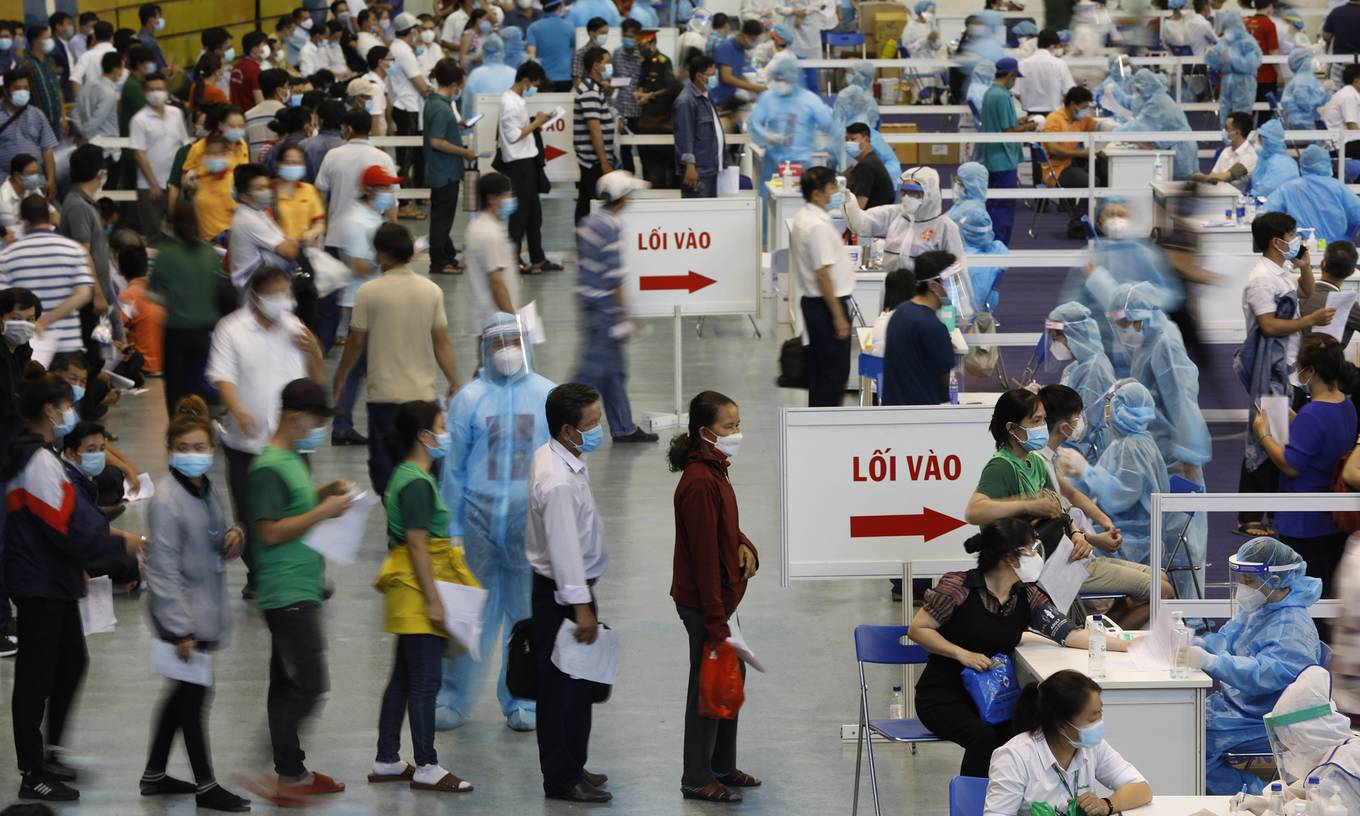
    The escalation of COVID-19 in Vietnam, especially in Saigon (officially known as Ho Chi Minh City), is sending millions of people into crisis. They have struggled on multiple fronts, from healthcare and making sense of varying isolation requirements to obtaining food and necessities amidst strict yet incoherent travel bans and supply shortages.

    The double target of trying to contain COVID-19 while simultaneously continuing economic activities that the government persistently defended and adhered to since the start of the pandemic has been abandoned. This is indicative of how serious the situation has become. Over the past few weeks, Saigonese have experienced life in a way they could never have imagined.

    In this grim picture, Tuoi Tre Online reported on July 10, 2021, that Ho Chi Minh City’s Party Committee Secretary Nguyen Van Nen is now looking to scientists for advice.[1] The secretary’s words were quoted widely in the news:

    I feel that we need to consult the scientists…. At any time, I want specialists and scientists to see flaws in our strategy to fight the pandemic and contact me; I will consider their advice and respond timely.

    A Facebook influencer reacted to this news with a sense of irony and bitterness:[2]

    So what expertise have you relied on to fight the pandemic? Anything but science? Have you been kidding your citizens all along? For one and a half years now, have you been playing with the life and death of millions of people? So, after all, is it true that the tools you have taken to fight a pandemic are simply government decrees and [the manpower of] the Communist Youth League? I feel so ashamed of being led by national leaders who are both blind and arrogant.

    It is rather apparent that in a pandemic, one had better look to the scientists. So, why is a government official only bringing them to the table now? The next question is, how critical can scientists be, with a government that does not like criticism? At the highest level, one must wonder where science and scientists are in the decision-making concerning public matters in non-democratic Vietnam? A look into the Vietnamese Communist Party’s (VCP) ideology that it has followed and its practices could explain this conundrum.

    In ideology: the suppression of civil society and communicative rationality

    In the United Kingdom, at the start of the pandemic, the Scientific Advisory Group for Emergencies was activated. Since then, it has been working closely with the government as an external body to advise on making appropriate decisions regarding COVID-19 in the country. The importance and weight of scientific advice cannot be underestimated; UK scientists successfully convinced Prime Minister Boris Johnson and his cabinet to abandon their herd immunity strategy and adopt a nationwide lockdown in March 2020.

    Without this lockdown, the United Kingdom could have seen 80 percent of its people infected and 500,000 deaths.[3] On the other side of the Atlantic Ocean, the physician-scientist and immunologist Anthony Fauci, in his role as the chief medical advisor to the US president, has been a pillar in handling COVID-19 in the United States.

    Liberal democracy entails the practice of taking advice from scientists and not restraining those who deliver honest yet uncomfortable truths to people in positions of power. The two hallmarks of liberal democracy that shape this practice are civil society and communicative rationality.[4]

    Civil society in a liberal democracy comprises actors and institutions that are supposed to be independent of the state and who act to balance state power. Therefore, universities and the myriad of civil associations in democratic countries are autonomous and can freely critique the conduct of the government or oppose laws and policies they view as problematic without fear of punishment.

    On the other hand, communicative rationality, an ideal of liberal democracy, means that people arrive at a collective agreement about something via genuine, intelligible conversations. Thus parliamentary debate and rebuttal in classroom discussions are part and parcel of a healthy democratic life and politics.

    Nowhere in the ideological textbook of the VCP can one find any sign of friendliness towards the idea of an autonomous, independent civil society, nor communicative rationality in the way the state relates to other estates in society. The Vietnamese government condemns independent civil society as a strategy of ‘hostile forces’ to undermine political stability.[5] Following the Marxist-Leninist ideology, the Communist leaders control civil society and use civil society organizations, such as the press, schools, and mass associations, to garner consent from the people for its rule.[6] Likewise, the Party believes in ‘self-criticism,’ rather than opposition or open, genuine debate in the National Assembly or in other venues where the state and citizens can talk to each other.[7]

    In practice: the strategic mobilization of scientists while confining them within governable spaces

    Since 1975, the Vietnamese State could be described as developmental. In the pursuit of economic growth and technological and social development, the state needs the expertise of scientists and intellectuals. This is evidenced by the existence of a wide range of research and scientific centers and institutions funded by the State that operate within the scope prescribed for them by the government. However, the system ensures that scientists and intellectuals employed in these research centres do not threaten the state.[8]

    Despite these state-employed scientists and intellectuals, the Vietnamese government rarely describes its style of governance as “evidence/science-based.” This suggests that the VCP still aspires to be a good disciple of Marxism-Leninism when it comes to organizing the political system and governance. “The Party knows best” is apparently its motto. In other words, the Party sees itself as the supreme source of authority and expertise. This also makes Vietnam’s developmentalism different from, for example, Japan’s.  Japan’s developmentalism is based on rationality, whereas Vietnam’s is based on ideology.[9]

    Speaking of rationality, communicative rationality still has no place in Vietnam’s politics nor in the civil sphere. The National Assembly has shown little sign of becoming a place for open, genuine debate about public matters. Critical thinking is still lacking in the way students are educated. The free press is still a wild dream for Vietnam.

    I interviewed the head of Luat Khoa Tap Chi not long ago. He described the prominent culture in Vietnam as a “culture of obedience and singular thinking” rather than critical thinking and genuine, intelligible debate. Last but not least, we shall not forget that in 2007, when the Institute of Development Studies was established by renowned intellectuals and scientists of the country to speak truth to power, it went into so much trouble with the government and was eventually disbanded.[10]

    Prospects of the VCP democratizing itself?

    Not so much. In Saigon, what the Party Committee Secretary Nguyen Van Nen said about consulting scientists is most likely just a moment of him forgetting the Party’s line he should be toeing. Indeed, just a week after his statement, a Facebook influencer reposted on his Facebook page a VNExpress interview with Vu Thanh Tu Anh of Fulbright University Vietnam, which reportedly was removed from VNExpress’s website immediately after it was posted.[11] In this interview, Tu Anh discusses some failures in the government’s strategy to contain COVID-19.[12]

    In conclusion, for scientists to speak truth to power, or at least to save Vietnam from this deadly pandemic, they require a change in both ideology and politics, which the VCP seems to be neither willing nor ready to take.

    Bibliography:

    1. Bí thư Thành ủy TP.HCM gặp gỡ các chuyên gia, nhà khoa học cùng bàn cách chống dịch COVID-19, 10 July 2021. Tuổi Trẻ Online. Available at: https://tuoitre.vn/bi-thu-thanh-uy-tp-hcm-gap-go-cac-chuyen-gia-nha-khoa-hoc-cung-ban-cach-chong-dich-covid-19-20210710120636333.htm
    2. Thai Hao’s Facebook page, 10 July 2021. The full post is available at: https://www.facebook.com/permalink.php?story_fbid=1029231357886052&id=100023975920044
    3. Grey, Stephen & MacAskill, Andrew, 7 April 2020. Special Report: Johnson listened to his scientists about coronavirus – but they were slow to sound the alarm. Reuters. Available at: https://www.reuters.com/article/us-health-coronavirus-britain-path-speci-idUSKBN21P1VF
    4. The background of my understanding of liberal democracy in this paragraph comes from Alexis de Tocqueville (on civil society) and Jurgen Habermas (on communicative rationality).
    5. See, for example, an article in Cong an Nhan dan, available at: http://cand.com.vn/Chong-dien-bien-hoa-binh/Canh-giac-thu-doan-loi-dung-xa-hoi-dan-su-de-chong-pha-che-do-581991/; another one in Nhan dan, available at: https://nhandan.vn/tin-tuc-su-kien/xa-hoi-dan-su-mot-thu-doan-cua-dien-bien-hoa-binh-392081/
    6. The reality of ‘state-led civil society’ in Vietnam, most prominent before the late 1980s, is discussed widely in the academic literature. For example, I suggest Landau, I. (2008). Law and civil society in Cambodia and Vietnam: A Gramscian perspective. Journal of Contemporary Asia, 38(2), 244–258; and Salemink, O. (2006). Translating, interpreting, and practicing civil society in Vietnam: A tale of calculated misunderstanding. In D. Lewis & D. Mosse (Eds.), Development Brokers and Translators: The Ethnography of Aid and Agencies (pp. 101–126). Kumarian Press.
    7. See, for example, a discussion session organized by a mass organization, in Tortosa, A. (2012). Grassroots democracy in rural Vietnam: A Gramscian analysis. Socialism and Democracy, 26(1), 103–126. https://doi.org/10.1080/08854300.2011.645661
    8. See Morris-Jung, J. (2017). Reflections on governable spaces of activism and expertise in Vietnam. Critical Asian Studies, 49(3), 441–443. https://doi.org/10.1080/14672715.2017.1339448
    9. For more on developmentalism and plan-rationality versus plan-ideology, see Johnson, C. (1993). The Japanese miracle. In MITI and the Japanese miracle: The growth of industrial policy, 1925-1975 (pp. 1–34). Stanford University Press; and Woo-Cumings, M. (Ed.). (1999). Introduction: Chalmers Johnson and the politics of nationalism and development. In The developmental state (pp. 1–31). Cornell University Press.
    10. Morris-Jung, J. (2015). The Vietnamese bauxite controversy: Towards a more oppositional politics. Journal of Vietnamese Studies, 10(1), 63–109.
    11. Thanh Nguyen’s Facebook post, 17 July 2021. Available at: https://www.facebook.com/paulothanhnguyen/posts/4395856270458582
    12. On 20 July 2021, another scientist, Vu Hong Nguyen, also shared on his Facebook page that his contribution to a TV program in Vietnam about COVID-19 vaccines was abruptly removed. He explains that his skeptical view of the Chinese vaccine Sinopharm, which he planned to talk about in the TV program, was not welcome. He titles this post on his Facebook page as ‘Do not let politics interfere with science’. Nguyen’s Facebook post is available at: https://www.facebook.com/vu.nguyen.758/posts/4726456800701987
  • Why Did The Vietnamese Communist Party Suppress Anti-China Nationalism?

    Why Did The Vietnamese Communist Party Suppress Anti-China Nationalism?

    Since the beginning of its history, the Vietnamese Communist Party (VCP) has been portraying itself as a group of nationalists who liberated the country from foreign intervention. History textbooks, propaganda, and official VCP narratives were all dedicated to showing that the VCP is the true heir of Vietnam and that the path to socialism is the destined path of the country.

    However, this nationalistic sentiment contrasts with the Party’s cherished Marxist-Leninist Communist ideology, which states that nationalism is a bourgeoise illusion[1] that distracts people from their struggle with the bourgeoisie and that only international class struggle matters.[2] Such an ideological paradox is even more puzzling as we examine the regime’s responses to the rise of contemporary anti-China nationalism in Vietnam.

    Anti-China nationalist sentiments have been rampant in Vietnam since the late 2000s, as expressed through various protests, demonstrations, and online debates. These sentiments are popular among the anti-communist Vietnamese diaspora and among the people residing in the country who were enraged by China’s territorial claims in the South China Sea. Since 1947, the Chinese Communist Party (CCP) has established an eleven-dash line map (now the nine-dash line map), claiming various islands in the South China Sea, including the Paracel and Spratly islands – or in Vietnamese, the Hoang Sa and Truong Sa islands.[3]

    For years, the CCP has not relinquished claims to what Vietnamese nationalists insist are Vietnam’s rightful territories. Ten years ago, in 2011, anti-China nationalism manifested itself in the form of demonstrations, when hundreds of Vietnamese people protested in front of the Chinese Embassy in Hanoi, demanding China stay out of the Paracel and Spratly islands.[4] However, these demonstrations were met with repression from the Vietnamese regime.[5]

    On the one hand, the VCP faces widespread nationalist criticism from its citizens for depending on China. Such criticism presented a considerable threat for the regime’s long-established narrative as nationalists fighting foreign influence and as the only legitimate ruler of the country.

    On the other hand, the VCP faces the CCP, whom they have relied on for ideological and policy guidance and economic and military aid during wartime. Distancing itself from the CCP would also betray Marxism-Leninism’s internationalist agenda.

    In a research essay, political scientist Tuong Vu, professor at the University of Oregon, examines contemporary anti-China nationalism in Vietnam as well as the Vietnamese regime’s responses. In a research essay titled “The Party v. the People: Anti-China Nationalism in Contemporary Vietnam,” Professor Vu argues that the suppression of anti-China nationalism is in line with the VCP’s international communist ideology, despite the Party’s nationalist image.[6] This article focuses on explaining the VCP’s repressive actions by analyzing their understanding of communism and nationalism.

    Tuong Vu is a professor and head of the Political Science department at the University of Oregon. His research focuses on state formation, nationalism, ideology, and revolutions in East Asia.

    The Construction of Communist Nationalism

    In order to understand why the VCP suppressed anti-China nationalism, we must first grasp the VCP’s understanding of nationalism itself. The VCP sees nationalism as communism, with an emphasis on communist internationalism that promotes solidarity among socialist states. This suggests that opposition to other socialist states – in this case, China – is not seen as nationalism.

    Since its foundation during the French colonial period, the VCP has always pursued two goals simultaneously: achieving national independence, which concerned the French and other foreign intervention, and carrying out a socialist revolution in the country.

    To achieve the former goal,  the VCP has always portrayed itself as a nationalist faction. Even foreign scholars seem to push the popular narrative that VCP leaders like Ho Chi Minh were nationalists first and communists second and that communism was a mere tool for them to achieve national liberation.[7]

    However, Tuong Vu disagrees with this narrative. He thinks that the VCP has always been devoted to communism, even when it pushes a nationalist propaganda. But how did the VCP reconcile being both nationalist and communist, since being the latter means condemning nationalism?

    Tuong Vu offers a simple explanation. Communism has always been portrayed as the best path to achieve liberation as well as decolonization for Vietnam. It was not just regarded as a tool for nationalism, but instead both the means to achieve independence, as well as the end goal for building the nation. Therefore, anyone who does not support communism is deemed unpatriotic.

    In other words, the VCP ties nationalism or patriotism with being loyal to its own causes. This was demonstrated by the former Prime Minister Pham Van Dong, who declared that “to be patriotic is to build socialism.”[8]

    Communist leaders such as Ho Chi Minh and Le Duan have also consistently tried to incorporate nationalism into communism by demonstrating that communist internationalism, solidarity with workers and communists worldwide, is a part of Vietnamese nationalism. [9]

    As Le Hong Phong and Ha Huy Tap, leaders of the Indochinese Communist Party, the predecessor of the VCP, explained in 1936: “We believe in internationalism, not nationalism, but…we should raise the spirit for national liberation while tying it to the interests of the working masses….”

    So nationalism for the VCP is communism. The VCP’s nationalism is particularly tied to its belief in internationalism, which says that “socialist brothers” around the world should find solidarity together instead of fighting each other like capitalist countries.

    Additionally, the VCP also distinguished communist-nationalist movements from the other nationalist movements that it deemed to be bourgeoisie, and as a result it prioritized the former.

    For instance, the VCP endorsed China in the Sino-Indian border war in 1962, even though the Communist Party of India criticized China and supported the Indian government. The VCP saw the Communist Party of India as having “sunken deeply in the bourgeois nationalist mud by colluding with the Indian bourgeoisie to slander a brother communist party,” based on archival materials collected by Tuong Vu.

    This is important because it marks the VCP’s tactic when confronted with a reality that does not fit into their view of communist internationalism.

    The VCP’s actions of justifying reality by creating more theoretical arguments to support its action do not stop there, as its idea of nationalism based on communist internationalism was further challenged by the fact of infighting among communist states the Sino-Soviet split (1956-1966), in which China was at odds with the Soviet Union, and the Sino-Vietnamese border war in 1979, in which China assaulted Vietnam’s border after Vietnam attacked the China-backed Khmer Rouge regime.

    Justifying Reality

    Accommodating reality, the VCP shifted its own narrative on nationalism by focusing more on domestic communist propaganda. Nevertheless, this new narrative still links Vietnamese nationalism with communism and internationalism. This shows that even when Vietnam was threatened by China, the VCP was still following communist internationalism instead of endorsing a more nationalist approach.

    This is evident in the way the VCP has never acknowledged the Sino-Vietnamese border war as a war between socialist brothers. Just as when it justified endorsing China over India in 1962, the VCP argues that the border war was not about communist infighting. The conflict, argues the VCP, was “a fierce struggle between national independence and socialism on the one hand and aggression, expansionism, and chauvinism on the other, between Marxism-Leninism on the one hand and Maoism on the other.” This denial of reality demonstrates a deeply rooted ideological loyalty to Marxism-Leninism.

    In order to demonstrate how the VCP justified the Sino-Soviet split, Tuong Vu looked into the VCP’s construction of historical narratives through the most basic and widespread document: the First-Grade Reader (Tập Đọc Lớp Một), a textbook used to teach first-grade children to read. He compared the two editions of the textbook, the one published in 1956, which was before the Sino-Soviet split, with the one published in 1972, after the split.

    Data by Tuong Vu. Graphic by The Vietnamese Magazine. 

    Firstly, there was significantly more content on communist heroes and less content on other socialist countries in the latter edition. This was due to the prolonged war, which produced more “heroes”, and because the VCP seemed to focus more on glorifying internal communist mobilization after the Sino-Soviet split. Additionally, these communist heroes were portrayed as both nationalist and communist – their struggle was seen as both contributing to the country and the international construction of communism worldwide.

    Secondly, the content on non-communist heroes and patriotism not linked to the VCP was consistently low in both editions, and particularly low compared to the amount of content on communist heroes.

    This reaffirms that the VCP constructed nationalism not based on ethnic lines but rather on political ideology, which suggests that the Party is more likely to align with a foreign communist force than to align with Vietnamese nationalists who reject communism.

    Protests and Deconstruction of Communist Nationalism

    The VCP’s loyalty to communist internationalism as a part of its nationalism was fiercely challenged by the wave of anti-China nationalism in 21st Century Vietnam due to China’s territorial claims in the South China Sea.

    Anti-China opposition in Vietnam is expressed through two main channels: protests and debates on alternative understandings of nationalism. Both of these channels pose significant threats to the VCP’s legitimacy.

    Ten years ago, in 2011, massive anti-China protests broke out on the streets of Hanoi and Ho Chi Minh City, especially in the areas where the Chinese embassy and consulate were located, to protest China’s harassment of Vietnamese fishermen in the Spratly and Paracel islands.[10]

    The protests did not happen just once, but rather multiple times throughout the summer of 2011 for almost three consecutive months. While these protests were significant, they were not the first. In 2008, many democracy activists and bloggers were also arrested or detained for protesting China’s claims in the South China Sea.[11]

    Alongside the protests, many Vietnamese intellectuals started to question the legitimacy of the VCP as Vietnam’s only ruling party and its construction of communist nationalism. Many retired, high-ranking government officials joined in these debates.

    For example, Tong Van Cong, former editor of the state-controlled newspaper Lao Dong, argued that the true wish of the late Ho Chi Minh was to establish democracy for Vietnam rather than achieving socialism at any cost, thus questioning the Party’s nationalism based on ideology, as well as its refusal to institutionalize democracy.[12]

    The late Le Hieu Dang, former vice-president of the Vietnam Fatherland Front in Ho Chi Minh City, a strong umbrella association of communist organizations, also expressed his dissatisfaction with the VCP’s ideological relationship with China.[13]

    While he joined the communist movement during wartime due to his love for his country, Dang argued that the VCP had failed to pay back the debt it owed the Vietnamese people after they fought for and supported the Party. This debt was piled on to the Party’s failed policies based on China’s policy advice, resulting in misery for many Vietnamese people. In contrast, he argued that the VCP owes China nothing. This argument contradicted the Party’s narrative that the country owed China for its generous support for Vietnam in wartime.

    Joshua Kurlantzick, senior fellow on Southeast Asia for the Council on Foreign Relations, believes that the protests did not merely demonstrate anti-China sentiments, but also showed the protesters’ frustration with the government’s repressive actions towards dissents over the years, and the government’s failure to deliver democracy.[14]

    This further explains why the VCP oppressed anti-China protests and saw the protesters as a threat. These protests were seen as opposing a foreign regime and opposing the VCP, the only “legitimate” ruling body in Vietnam.

    Further Problems for the VCP

    Currently, the VCP’s policies towards China are once again being challenged, this time by the COVID-19 pandemic, especially when it comes to vaccines. After resisting China’s vaccine diplomacy for a while, the government has recently approved the Chinese Sinopharm vaccine, and it was met with opposition and hesitation from a lot of Vietnamese people.[15] The VCP’s late approval was either because of its distrust of China’s vaccine diplomacy, or because the public opinion in Vietnam has been strongly anti-China.

    In a survey conducted by the ISEAS-Yusof Ishak Institute in 2021, individuals from Vietnam are the most disapproving of China’s leadership in the pandemic among 10 ASEAN countries, significantly more disapproving than others.[16] In contrast, Vietnam is the most approving of US leadership in the pandemic among these countries, much more so than the average ASEAN country.

    Vietnam is the most disapproving of China among the 10 nations. Data by the ISEAS-Yusof Ishak Institute. Graphic by The Vietnamese Magazine.
    Vietnam is the most approving of the US among the 10 nations. Data by the ISEAS-Yusof Ishak Institute. Graphic by The Vietnamese Magazine. 

    When it comes to the South China Sea, Vietnam also shows the most concern with China’s actions – its encroachment and military activities – rather than the US military presence or an escalation of the situation between the US and China.

    Once again, this is a rather ironic situation, as the ideological doctrine of the VCP has been consistently promoting solidarity with other socialist countries while condemning capitalist and imperialist states such as the United States.

    Data by the ISEAS-Yusof Ishak Institute. Graphic by Son Nguyen/The Vietnamese. 

    This shows that the VCP’s communist internationalism is not working. Arguably, it is even backfiring because Vietnamese public opinion is shifting towards supporting the United States – a capitalist and imperialist superpower according to Vietnam’s propaganda – instead of supporting China – a socialist brother.

    Conclusion

    On the surface, increasing anti-China sentiments among the Vietnamese people seem to be in the VCP’s favor, as it hopes to reclaim the Paracel and Spratly islands.

    However, this anti-China nationalism also presents a great threat to the VCP establishment that is loyal to communist ideology which promotes solidarity among socialist states. It also presents a deeper ideological threat to the VCP, as Vietnamese nationalists begin to question the VCP’s version of nationalism that correlates being a patriot to being a communist.

    The anti-China protests and data on popular opinions suggest that despite the VCP’s efforts, the Vietnamese people are feeling more and more detached from the socialist solidarity with China that the VCP has consistently promoted.

    If the VCP continues to refuse to change its ideological approach to China, and if it continues to repress anti-China nationalism, it runs a grave risk of getting its own Marxist-Leninist legitimacy further questioned and challenged.

    Bibliography

    [1] Crawford, T. (1923, August 15). Bourgeois Nationalism. Marxists Internet Archive. https://www.marxists.org/archive/roy/1923/08/15a.htm

    [2] McLellan, D. T. (1998, July 20). Marxism – Class Struggle. Encyclopedia Britannica. https://www.britannica.com/topic/Marxism/Class-struggle

    [3] Xu, B. (2020, July 15). China’s Maritime Disputes. Council on Foreign Relations. https://www.cfr.org/timeline/chinas-maritime-disputes

    [4] Ide, B. B., & Orendain, B. S. (2011, June 4). Hundreds of Vietnamese Stage Anti-China Protest. Voice of America. https://www.voanews.com/east-asia/hundreds-vietnamese-stage-anti-china-protest

    [5] Vietnam breaks up anti-China protests. (2012, December 9). The Guardian. https://www.theguardian.com/world/2012/dec/09/vietnam-breaks-up-anti-china-protests

    [6] Vu, T. (2014). The Party v. the People: Anti-China Nationalism in Contemporary Vietnam. Journal of Vietnamese Studies, 9(4), 33–66. https://doi.org/10.1525/vs.2014.9.4.33

    [7] Buttinger, J. (1977). The Journal of Developing Areas, 11(3), 423-425. Retrieved June 11, 2021, from http://www.jstor.org/stable/4190492

    [8] Le, H. N. (2016, February 29). Phạm Văn Đồng – Nhà Chính trị, Nhà Văn hóa lớn của Đảng và Dân tộc. Báo Nhân Dân. https://nhandan.vn/tin-tuc-su-kien/pham-van-dong-nha-chinh-tri-nha-van-hoa-lon-cua-dang-va-dan-toc-256438

    [9] Nguyen, C. T. (2018, July 31). Tư tưởng Hồ Chí Minh Về Tinh Thần Yêu Nước. Tạp Chí Quốc Phòng Toàn Dân. http://m.tapchiqptd.vn/vi/theo-guong-bac/tu-tuong-ho-chi-minh-ve-tinh-than-yeu-nuoc-12158.html

    [10] Vandenbrink, R., & Nguyen, A. (2011, June 5). Anti-China Protests in Vietnam. Radio Free Asia. https://www.rfa.org/english/news/vietnam/protests-06052011165059.html

    [11] Human Rights Watch. (2020, October 28). Vietnam: New Round of Arrests Target Democracy Activists. https://www.hrw.org/news/2008/09/12/vietnam-new-round-arrests-target-democracy-activists

    [12] Tong, V. C. (n.d.). Nhân Ngày sinh lần thứ 120 Chủ tịch Hồ Chí Minh: Vì Sao Hồ Chí Minh Đặt Dân Chủ Trước Giàu Mạnh? Bauxite Vietnam. Retrieved June 11, 2021, from https://boxitvn.blogspot.com/2010/05/nhan-ngay-sinh-lan-thu-120-chu-tich-ho_19.html

    [13] Le, H. D. (n.d.). Suy Nghĩ Trong Những Ngày Nằm Bịnh. . .. Bauxite Vietnam. Retrieved June 11, 2021, from https://boxitvn.blogspot.com/2013/08/suy-nghi-trong-nhung-ngay-nam-binh.html

    [14] Kurlantzick, J. (2014, May 16). Vietnam Protests: More Than Just Anti-China Sentiment. Council on Foreign Relations. https://www.cfr.org/blog/vietnam-protests-more-just-anti-china-sentiment

    [15] Nguyen, S. (2021, June 7). Vietnam Briefing: Busy With The Pandemic, But The Government Still Cracks Down On Free Speech. The Vietnamese Magazine. /2021/06/vietnam-briefing-busy-with-the-pandemic-but-the-government-still-cracks-down-on-free-speech/

    [16] Seah, S., Hoang, T. H., Martinus, M., & Pham, T. P. T. (2021, February). The State of Southeast Asia: 2021 Survey Report. ISEAS-Yusof Ishak Institute. https://www.iseas.edu.sg/articles-commentaries/state-of-southeast-asia-survey/the-state-of-southeast-asia-2021-survey-report/

  • Is Vietnam Being Ruled By A Diarchy?

    Is Vietnam Being Ruled By A Diarchy?

    This article was written in Vietnamese by Y Chan and previously published in the Luat Khoa Magazine on February 2, 2021.


    The 13th Party Congress ended in Vietnam in February 2021, and the list of the country’s top leaders has finally been leaked after many attempts to keep this information “top secret.”

    Yet, despite the confidentiality and mystique surrounding this event, the identities of Vietnam’s new leaders did not catch anyone by surprise because they were also of no particular interest to the ordinary Vietnamese citizen.

    The names of Vietnam’s top four leaders are Nguyen Phu Trong, Nguyen Xuan Phuc, Pham Minh Chinh, and Vuong Dinh Hue.

    The rumors also stated that Nguyen Phu Trong would continue to be the general secretary of the Vietnamese Communist Party (VCP). Nguyen Xuan Phuc would be the president of Vietnam. Pham Minh Chinh would be the prime minister, and Vuong Dinh Hue would be the chairperson of the National Assembly. In April 2021, more than a month before the general election of Vietnam, the VCP also announced these top leaders with the same positions that the rumors had spread.

    Knowing the country’s top leaders before they could even vote, it is not a surprise that Vietnamese citizens have been more interested in the US presidential elections than their own.

    Why is this bizarre phenomenon the case in Vietnam?

    The answer lies in the state governance model of a diarchy that restricts Vietnamese citizen representation in government and eliminates all hope of participating in governance.

    In Machinery of the Government, which is in Part VI of the book Politics for the Common People by Pham Doan Trang, the meaning of this phenomenon is fully explained.

    The 1st Rule: The Party Controls the State; the State is in the Party’s Hands

    Part VI begins by explaining the roles, functions, and nature of the three fundamental branches of government in detail.

    Doan Trang introduces the models and activities of the legislative, executive, and judiciary arms of countries worldwide. At the end of each section, the author references the situation in Vietnam.

    Readers can see that while the tripartite branches of government in democratic institutions are designed according to the principle of independence limited by checks and balances, the Vietnamese model is the exact opposite.

    In the legislative branch, we have the National Assembly. In principle, this body is supposed to be the people’s representation, with its members directly chosen by Vietnamese citizens. The National Assembly is supposedly responsible for making laws in accordance with the desires of the people.

    To fulfill this function, the National Assembly needs to truly reflect what the people want, with each delegate acting on behalf of the Vietnamese public.

    In reality, Doan Trang wrote, “at least 95% of the members of the National Assembly belong to the Communist Party.” The few remaining delegates, she continued, “may not be party members at the time of the election, but they may be admitted to the Communist Party in the future, and they are sympathizers of the VCP.”

    With this structure, she concluded that the National Assembly of Vietnam has “deficient actual representation and does not stand for the people at all.” More than that, in effect, the National Assembly’s “ability to supervise and control the executive branch is almost non-existent.”

    In terms of legislation, “since the beginning, the law-making program was based on … the undertakings of the VCP, not on the needs of the people.” In other words, according to Doan Trang,  “making laws is only meant to actualize the resolutions of the VCP.”

    In the executive branch, aside from the head of state and the head of government, the real “big boss” is the man who holds the title of general secretary of the VCP. The general secretary is the “biggest boss” in Vietnam because he controls the VCP.

    Pham Doan Trang described Le Duan, the person who is considered the most powerful general secretary of the VCP. She wrote, “he was not the head of state, nor the head of government. He was just a one-party leader, yet for generations, this general secretary had the power to command the entire political system, in effect, making both the president and the prime minister of Vietnam fade into obscurity from 1976 to his death, 1986.”

    The general secretary is not elected publicly, and his identity is even kept secret until the last minute, even though everyone already suspects who will hold the position.

    The judiciary branch “has the function of interpreting the law and on that basis, has the responsibility of adjudicating and resolving legal disputes,” Doan Trang wrote in her book. To perform this function well, agencies in the judiciary must be neutral and independent. But this is not the case in Vietnam.

    “In Vietnam, the judge must also be a member of the Communist Party,” writes Doan Trang. Yet, you will not find this in any legal document; it is an unwritten law.”

    In summary, as Pham Doan Trang has observed, “Vietnam’s political system seems parliamentary in that it has a president who is not the head of government, and the members of the previous government are selected from Congress and appointed by them as well, with Congress being the most powerful body. However, the Vietnamese political system has a distinct characteristic that sets it apart from other parliamentary regimes: it is a one-party system, and the VCP is central to all three branches of government.”

    The 2nd Rule: The Military Controls the Government; the Government in the hands of the Military

    “Military” is the term used to refer to the armed forces and police of Vietnam.

    Doan Trang dedicates chapter VIII of part VI in her book to a discussion of these two forces.

    Accordingly, “the military and the police play a crucial role because they deal with national sovereignty. […] Briefly, it can say that the police safeguard domestic sovereignty, and the military protects national sovereignty. Without them, these two important components of a country are impossible to retain. Hence, both the military and the police are essential for every independent nation.”

    Doan Trang says that the most critical feature of these forces is “their monopoly and use of weapons and force.”

    “In any country, the military and police are assumed to be the only two forces in society that have the right to use weapons and force when necessary,” she writes. “Society assumes that they have the legitimacy to use weapons and violence.”

    “Because of this, there is always a tendency for both the military and police to abuse their power.”

    The military can build a regime, defend it, or even overthrow it. At the same time, it can also use its power to become the government itself. In a similar vein, Doan Trang also wrote that the police “could dominate the government, intervene in and control the course of policies, monitor every aspect of civilian life, and create a police state or a police government.”

    Democratic countries often take a liberal approach to control this potential problem.

    Accordingly, Doan Trang concluded that “the constitution and laws of a country must ensure that the military is completely neutral, non-political, or out of politics, and that the military system is under the leadership of the civilian government.”

    The military, in this case, she emphasized, “must be loyal to the nation and not to any party or government.” In liberal democracies, this is the way of ensuring that their citizens remain free without the risk of militarization or abuse by state forces.

    The criterion for selecting the US secretary of defense is an illustrative example of this approach. Accordingly, the head of the military must be a civilian and not a person serving in any armed forces.

    If the person nominated for this position has served in the military, he or she must leave the military beforehand and have been a civilian for at least seven years. In American history, there have been three exceptions to this rule.

    The most recent example is that of current US Secretary of Defense Lloyd Austin of President Joe Biden’s administration. Retired General Austin was only out of the service for four years when he was appointed. General James Mattis, who served in this same position in former President Donald Trump’s administration, also had been retired for just four years when he was appointed.

    In these specific cases, US lawmakers unanimously agreed that these appointments should not be seen as a precedent to change this already established rule.

    In contrast, Vietnam and other communist states such as China and North Korea address this issue differently.

    Doan Trang wrote in her book that these countries aim to bring about “the radical politicization of the military, towards allowing the ruling party’s ideology to penetrate the army fully.”

    From “instead of loyalty to the nation, the people, and the constitution,” the military is asked to “be loyal to the ruling party and its ideology.”

    This approach is accomplished by (1) “granting special privileges to the military and the police, especially the officer ruling class,” (2) “fiercely propagating the ruling party’s ideology within the armed forces,” and (3) “punishing, eliminating, and destroying dissident elements within state forces, while rewarding soldiers who are loyal to the Party.”

    This penetration makes the armed forces a powerful tool of the Party in ruling the country. Every aspect of the nation, from security and defense to economic development, culture, and education, every single one has the fingerprints of the military or the police all over them.

    As a result, people can no longer distinguish between the military, the police, and the civilian government.

    ***

    The US Supreme Court once stated that the military is a “special society” separate from civilian life, with its own rules, disciplines, and traditions.

    The laws and regulations of the military are often incompatible with civil society, but the existence of the military allows for the continuation of everyday life.

    However, most people in democratic states are aware that the armed forces should never overwhelm civil society. In communist states where the army governs the people, the nation will inevitably drift towards authoritarianism.

    Those in power rely on the armed forces to rule and control the people.

    If in the past, Vietnam had the Trung sisters, who helped regain freedom for the people and became queens who ruled together, then today we have a regime of diarchy that restricts the people’s right to proper representation in the government and inhibits them from questioning the power of the ruling party.

    The party controls the state, and the state is in the party’s hands. The army controls the government, and the government is also in the hands of the military.

    This is why the secret of the party’s leadership is unsurprising to any citizen of Vietnam because the VCP and its general secretary still rule the country today.

  • Vietnam’s Institutional Corruption: Why Nguyen Phu Trong’s “Blazing Furnace” Will Be Meaningless In The Long Term

    Vietnam’s Institutional Corruption: Why Nguyen Phu Trong’s “Blazing Furnace” Will Be Meaningless In The Long Term

    This article was written in Vietnamese by Vo Van Quan and previously published in the Luat Khoa Magazine on October 6, 2020.


    The term burning furnace (đốt lò in Vietnamese) is a frequently used term in Vietnam to describe the anti-graft campaign that Nguyen Phu Trong pledged would eliminate corruption in the country.

    After nearly ten years of the Vietnamese Communist Party (VCP) being under the leadership of General Secretary Nguyen Phu Trong, many people seem to be proud that the Vietnamese government has done well in its political task of purging the moral degradation that affects the people’s trust in the Party and the State.

    For instance, in the first six months of 2020, Nguyen Phu Trong ordered several investigations of senior party officials: a member of the Politburo, a former member of the Politburo, four current and former members of the Party Central Committee, and 186 other members of the Party who were under the Central Committee’s management. These investigations seem to affect a broad number of Party members.

    Big-name politicians such as Hoang Trung Hai, Dinh La Thang, Le Thanh Hai, Nguyen Duc Chung, Truong Minh Tuan, Nguyen Bac Son, and Tat Thanh Cang, all seem to have either been brought to justice, have been reprimanded for their actions, or have lost any chance for a long-term political position in the future. Since the beginning of the VCP’s Doi Moi policy in 1986, it can be seen as one of the unprecedented successes for the Party.

    However, after the new Party Congress concluded in early 2021, it immediately became apparent that all of these achievements would have been for nothing if another faction becomes the majority in the Party’s leadership.

    If the ruling faction’s victories against corruption under Trong’s leadership have been so triumphant, why are they at risk of falling apart after just one new congress?

    Philosophical or social science discussions related to corruption in Vietnam are sparse. On the  rare occasion that they do take place, they are mainly carried out by members of the VCP themselves to serve their interest.

    This article will introduce another perspective on anti-corruption science and explain why the “blazing furnace” of Nguyen Phu Trong does not have any significant value over the long term.

    The concept itself and the philosophical problems associated with corruption are innumerable. Great philosophers from ancient times, such as Plato and Aristotle, to the more modern era, such as Machiavelli and Montesquieu, all discussed this topic in great detail.

    Hence, to prove the lack of current anti-corruption policies in Vietnam, this article will only focus on these two concepts: individual corruption and institutional/systemic corruption.

    Individual corruption, in the simplest sense, pertains to the selfish actions of a specific person while they work in public service. Such behavior may involve accepting bribes, abusing power, or giving special consideration to family or friends in government deals, contracts, or bidding.

    Personal corruption is at the lowest level in terms of organization and state functions. This concept is often used when corruption is the exception and not the norm of the system.

    Because of this, individual corruption can be present in any country regardless of its development and level of democracy. Individual corruption is inevitable, but it is also the easiest to deal with. Several laws, ethical appeals, and judicial campaigns are aimed at limiting or eliminating it.

    We can immediately recognize that this is the VCP’s current approach to fighting corruption in Vietnam. However, the success rate of stopping individual corruption greatly depends on stopping this form of government misconduct at this level.

    At this point, we need to discuss institutional corruption.

    Professor Dennis F. Thompson of Harvard University, one of the first academics who introduced the concept of institutional corruption, suggests that corruption becomes an integral part of a system in three ways:

    1. Corruption benefits the system’s survival while at the same time undermining it.

    2. Corruption is of an impersonal passive nature.

    3. Corruption becomes a phenomenon that can be generalized to the whole society.

    However, Professor Thompson was speaking about the political situation in the United States, and it would be difficult to apply his theoretical archetype to Vietnam. That said, his ideas can be used as the foundation for analysis.

    Regarding his first point, it can be said that corruption in Vietnam has reached a level of coexistence with the political system because of the close relationship of objective and subjective factors, such as a cumbersome state apparatus, meager wages and benefits, and the overwhelming power of state authority.

    The need to align government interests with those of a large population in Vietnam is not something new.

    Recently, many people in Vietnam were surprised when the Ministry of Public Security announced that the Civil Defense force and the other grassroots security forces had a combined number of 1.5 million people, equivalent to nearly 1.5 percent of the Vietnamese population. And these 1.5 million people are on the government payroll.

    But the story does not stop there. In 2017, official government statistics recorded up to 11 million workers receiving direct salaries from the state budget.

    The number of officials at the commune level is stated to be 1.3 million.

    Units belonging to the public non-business sector, such as education, health, culture, and sports, have more than 73,600 units and employ 2.5 million people. This is a 14.7 percent increase compared to 2012. The number of political organizations, unions, and associations is at 35,100 units, and they employ more than 237,000 people.

    A cumbersome state apparatus keeps the budget in a condition of exhaustion, even though wages and benefits are generally meager. In effect, when people decide to work for the state, they expect something else when they join, and that is power. They can then use this power to generate other sources of income.

    A pattern starts to form. People spend money to gain access to the state apparatus. Then, they use this newly acquired power to participate in various corrupt practices, that become an integral part of maintaining and operating the government machinery of Vietnam.

    Running for office has also become so popular that the head of the Party Inspection Committee of Hanoi had to admit, “Comrades, now people say less than 100 million dong cannot buy a position.”

    Therefore, even though abuse of power, corruption, bribery, budgetary overspending, and the like have become problems and seriously affect the reputation of state agencies, they have become essential in maintaining the existence of the status quo.

    Thus, in Vietnam, corruption has gradually become universally accepted into the system. This means that the decision to commit an act of corruption no longer depends on the rationality or morality of an individual. It has become an instinct of those who participate in the system.

    This phenomenon has also been argued to have become integral to the Vietnamese political apparatus through many studies by both Vietnamese and international scholars.

    For example, in a short study conducted by the Anti-corruption Resources Center, between 2005-2010, 95 percent of the public saw the police force as degenerate and corrupt. The same study also noted that 59 percent of businesses consider the bribes that they have to pay as “additional operating expenses”.

    A more recent study by Nguyen Thai Hoa confirms that corruption and informal fees are some of the biggest drivers of developing the informal economy in Vietnam.

    There is also no mechanism for citizens and civil society organizations to denounce, criticize, and intervene in an organized manner. The process of dealing with corruption depends heavily on the political will of the local Communist Party’s internal forces. Corruption has become a mindset, a culture, or a thought that permeates the entire Vietnamese society, whether in the public or private sectors.

    The above features are consistent with the warnings of Roberto Laver, a guest researcher at the Center for Ethics in Harvard Law School. He said that once corruption becomes ingrained and widespread, the system itself will nurture, or even encourage, corrupt behavior.

    Those who do not participate in acts of corruption or abuse of power quickly discover that they cannot survive in such a system and are often left to fend for themselves. They realize that they must sacrifice their values and ideals and compromise if they want any chance of promotion in their chosen career.

    Looking back at the “blazing furnace” project of General Secretary Nguyen Phu Trong, from central government to local government, from administrative agencies to non-business agencies, from state-owned companies to party committees, we can finally say with certainty that corruption is no longer just a peculiar phenomenon that revolves around an individual’s morality or behavior. It is a type of cancer, festering and growing at the core of Vietnamese society.

    ***

    Due to the above-mentioned nature of institutional corruption, we have grounds to believe that Nguyen Phu Trong’s blazing furnace will end very quickly.

    He can remove one Politburo member or even five Politburo members.

    He can arrest 100 or 200 members of the Party Central Committee.

    He can even purge all Party members of a city if conditions permit.

    But these are merely superficial solutions that fail to address the sickness at the heart of the issue.

    The anxiety of the supporters of the blazing furnace movement in the future is not without basis. In the end, the furnace only burns individual corruption.

    Yet, the corruption that thrives in the veins of the Vietnamese government itself requires more vigorous efforts to excise. And this is something the Communist Party may never dare to do because it will call for an end to the monopoly of the VCP’s political power in Vietnam and replace the authoritarian regime with pluralism.

  • Vietnam Briefing: VCP Has Finalized The List Of Candidates In The Very Election They Are Running For

    Vietnam Briefing: VCP Has Finalized The List Of Candidates In The Very Election They Are Running For

    We release the Vietnam Briefing every Monday morning, Vietnam time.


    The Vietnamese Communist Party is finalizing the list of eligible candidates for the  upcoming general election

    The way elections in Vietnam work is to pre-determine the results, and the way to achieve that is to determine the list of candidates.

    Vietnamese citizens can’t just register themselves as candidates and expect their names will go straight to the candidate listings on the ballots. If they want to be candidates, they have to go through a vetting process called hiệp thương, which is conducted by the Vietnam Fatherland Front, the extended political arm of the Vietnamese Communist Party (VCP). After the third and final round of hiệp thương, the list of candidates will be released and voters can vote for only these candidates.

    The Fatherland Front’s local committees of Hanoi and Ho Chi Minh city did exactly that just last week. Similar events were held in other provinces as well.

    Context:

    • At least two independent candidates have been arrested before the third round of hiệp thương.
    • Dozens of candidates in Hanoi withdrew before the final list was adopted.
    • Almost no dissidents or activists are running for election this year. This is a major change compared to the last election in 2016, when at least 30 of them ran (and failed to make it to the final list).

    A prominent activist, Nguyen Thuy Hanh, was arrested

    Quote from VietnamPlus:

    “Hanoi’s police have taken a woman into custody as they investigate allegations of ‘making, storing, distributing, or disseminating information, documents, and items against the State of the Socialist Republic of Vietnam’ under Article 117 of the 2015 Penal Code.

    The Investigation Security Agency under the municipal Department of Public Security said on April 8 they had arrested Nguyen Thuy Hanh, born in 1963 and living in Thuong Dinh ward, Thanh Xuan district.”

    Context:

    • Nguyen Thuy Hanh has been a prominent advocate for democracy and human rights in Vietnam since 2011. She also participated in several anti-China movements.
    • Hanh ran for election in 2016 as an independent candidate but failed to make it through the VCP’s vetting process.
    • She founded and managed a well-known charity called the 50k Fund (Quy 50k) to assist family members of political prisoners financially for several years before shutting it down in late 2020.

    Read her profile in The 88 Project’s database and an op-ed about her.


    Vietnam unveils tools for taxing and tracking big tech

    Quote from Nikkei Asia:

    “Vietnam is proposing a pair of regulations that would compel global tech players such as Alibaba and Google to hand over more taxes and data, in a move to increase government oversight in one of the world’s fastest-growing digital markets.”


    US stops short of branding Vietnam a currency manipulator

    Quote from Reuters:

    “The U.S. Treasury Department on Friday said Vietnam, Switzerland and Taiwan tripped its thresholds for possible currency manipulation under a 2015 U.S. trade law, but refrained from formally branding them as manipulators.”


    US names new ambassador to Vietnam

    Quote from VnExpress:

    “U.S. President Joe Biden on Thursday nominated Marc Evans Knapper as the new ambassador to Vietnam.

    The Senior Foreign Service member, who will succeed Daniel J. Kritenbrink, is currently serving as the deputy assistant secretary for Japan and Korea in the State Department.

    He has previously served in the U.S. embassies in Seoul, South Korea, Baghdad, Iraq, and Tokyo, Japan, and the State Department’s Office of India Affairs and Office of Japanese Affairs.”


    What’s special about April for Vietnamese?

    April is a special month not only in Vietnam but also in Vietnamese overseas communities. It marks the end of the Vietnam War on April 30, 1975. The event widely divides Vietnamese people around the world with the winning side, which is the ruling Communist Party, celebrates and the losing side mourns. The losing side is millions of people in the South and Vietnamese former refugees as well as their families now settled in countries such as the United States, Canada, and Australia. Discussing the loss of the losing side and the nature of the fall of Saigon is still largely taboo in Vietnam.

    However, this day is not only about the war, it is also the end of the first and the only Vietnamese democracy in history thus far, the Republic of Vietnam.

    Curious about it? Here are the books you might be interested in:


    Learn more about Vietnam

    Why the #MilkTeaAlliance movement has little appeal to Vietnamese youth

    Dien Nguyen An Luong/South China Morning Post | April 16, 2021

    “Against that backdrop, outsiders may wonder why Vietnam’s internet-savvy youth have remained an outlier in the #MilkTeaAlliance. How have Vietnam’s leaders afforded to stave off such a movement? Will anti-government sentiment materialise any time soon in the country? A closer look at how social media and geopolitics have become increasingly interwoven provides some clues.  While some observers have talked up its role, there has been a growing body of evidence that social media alone could not have fanned the likes of Arab Spring-style uprisings.”

    Vietnam’s Great Debate Over Democracy

    Trien Vinh Le/The Diplomat | April 15, 2021

    “Inspired by the development stories of East Asian countries that have experienced the benefits of embracing democratic principles, there are official and informal opinions that Vietnam needs a second Doi Moi centered around political reform. If new political institutions and practices are allowed to emerge and lead to new ways of governing and fresh policy ideas, the economy can pivot to more open and more innovative activities based on science and technology. It is appropriate to ask how the current government system can usher in a new era of economic transformation when so many at the top benefit from the old model based on exploitation of labor and natural resources.”

    Vietnam restores regional balance to top leadership

    Le Hong Hiep/Nikkei Asia | April 14, 2021

    “In an attempt to address southern politicians’ grievances, the party appears to be taking steps to gradually restore the regional balance.  Soon after the 13th congress, the party installed Vo Van Thuong, a politician from the southern province of Vinh Long, as the standing member of its secretariat, the No. 5 position in the party’s hierarchy. Last week, the National Assembly also elected three southerners into senior state and government positions, including Vo Thi Anh Xuan from An Giang Province as vice president, Tran Thanh Man from Can Tho city as deputy chair of the National Assembly, and Le Minh Khai from Bac Lieu Province as one of the deputy prime ministers.”

    How a Vietnam-Malaysia Fishing MOU Could Ease the Wider South China Sea Dispute

    Ralph Jennings/VOA News | April 16, 2021

    “Malaysia and Vietnam intend to sign a memorandum of understanding that experts say could eventually help ease a decades-old, six-party dispute over sovereignty in the resource-rich South China Sea.  Maritime law enforcement agencies from the two Southeast Asian countries aim to sign the memo this year and resolve at least 15 years of trouble over the movement of Vietnamese fishing vessels, the official Bernama news agency in Malaysia reported in early April. Bernama quoted the Malaysian Maritime Enforcement Agency director-general saying he’s confident the deal, now in its final stages, will solve the issue of Vietnamese fishing boats that enter Malaysian-claimed waters.”

  • Election in Vietnam: The Whims Of The Few Or The Will Of The Masses?

    Election in Vietnam: The Whims Of The Few Or The Will Of The Masses?

    This article was written in Vietnamese by Vo Van Quan and was previously published in the Luat Khoa Magazine on February 4, 2020.


    Regulation 214

    On February 2, 2002, Vietnam’s Politburo officially announced Regulation 214 on the Standard Framework for titles of cadres belonging to the Central Executive Committee, the Politburo, and the Secretariat.

    Accordingly, the Politburo amended and supplemented specific provisions on the required qualities and capabilities of important internal party positions.

    To put it simply, Regulation 214 is comparable to job descriptions and position requirements that we often see in job listings. As for members of the Party Central Committee, Regulation 214 requires them “to be a representative of political courage, ethical qualities and working ability; have the capacity to organize the successful implementation of the Party’s policies and duties.”

    If one is a member of the Politburo and the Secretariat, the candidate must be “an official member of the Central Committee for a full term or more; has experienced and completed essential tasks in key leadership positions at the provincial level.”

    However, it is worth mentioning that Regulation 214 does not set out specific criteria for certain titles such as the president, prime minister, or chairperson of the National Assembly, all of which are state positions. Theoretically, these are not party positions and are therefore outside the influence of the VCP’s internal politics.

    Regulation 214, however, dictates that the person in the position of State president is required to have “high prestige,” a “solidarity center”, and  “comprehensive, outstanding” talent; while the prime minister must “stand out comprehensively … in strategic planning for socio-economic development, national defense and security, [possess] sensitive thinking, [be] dynamic, decisive”.

    Obviously, it can be understood that the VCP was setting the criteria for its members to consider in order to have a basis for nominating, recommending, voting, and selecting “ideal” candidates for the National Assembly and the People’s Council in 2021.

    However, with the electoral mechanism in Vietnam, it is completely understandable that the Party’s Regulation 214 will be used to determine leading positions in the State. However, these regulations still have to be approved by a group of 17 members of the Politburo.

    So, are the above rules able to replace the popular vote? Are the Vietnamese people so incapable of choice that they must give authority to the elites (such as the VCP) to choose their leaders?

    Một cuộc họp của Bộ Chính trị - Đảng Cộng sản Việt Nam, tháng 5/2019. Ảnh: TTXVN.
    A meeting of the Politburo – Communist Party of Vietnam, May 2019. Photo: VNA.

    The political elite

    An argument exists to justify the Communist Party’s electoral mechanism. This argument is that the Vietnamese people are not well educated, are easily provoked, and are unsuitable for democratic elections. So, it is better for an elite minority to choose the country’s  leaders; this elite minority is now believed to be the VCP.

    Such an argument is found not only in Vietnam but in other parts of the world as well.

    For instance,  theories such as technocracy (a model of governance that believes that only experts in certain fields can be elected to corresponding positions in government related to their field of expertise) and epistocracy (a system that assumes only “qualified” citizens with enough information and political authority can vote or run for government) are not really new.

    The famous 19th century philosopher John Stuart Mill used to support an electoral system based on voters’ caste and professional work. Experts who have complex knowledge and skills get six votes, farmers and merchants get three or four, skilled workers two, and unskilled workers one ballot.

    More recently, Jason Brennan in his article The Case Against Democracy also promotes a political environment where only qualified and knowledgeable citizens should be allowed to vote or stand for office.

    He writes that most of the political questions in contemporary life have become too complex for common voters to understand; they are too fond of simple answers to complex questions. Worse, he argues that the common people are not only ignorant, but that they also believe that they know more than what they actually do; they even claim that they are right. He believes that this makes their political decisions ignorant and stupid.

    Brennan does not propose a voting model based on qualifications and educational levels like Mill, but rather recommends a test of voters’ political capacity before allowing them to vote.

    The rules of the VCP electoral mechanism seem to be loosely based on or inspired by these  two aforementioned technocratic and epistocratic theories:

    • Party members are considered “qualified” citizens who make the initial decisions regarding the formation of government through voting among themselves to elect members of the Party Central Committee. Then, the members of the Party Central Committee who are considered “high quality” citizens choose the “elite” members who will sit in the Politburo and the Secretariat seats, and also thoroughly become the state leaders, regardless of the outcome of local popular elections.
    • Meanwhile, the Politburo, which claims its membership to be the technocratic masters, sets the required standards for the new leaders, and then nominates and fills in the state positions for Vietnam.

    The VCP considers this a brilliant method to select the top leaders for the country. But is it?

    The defects of democratic elections

    Democratic elections are clearly not liked by everyone, and some even find them to be very disappointing. The election of former US President Donald Trump is a very fitting example.

    Ông Donald Trump và phu nhân đi bầu vào tháng 11/2016. Ảnh: Getty Images.
    Donald Trump and Melania Trump were at voting booths in November 2016. Photo: Getty Images.

    During the primaries in the 2016 US presidential election, as many as 50 Republican Party members openly voiced their disapproval of Donald Trump.

    Specifically, General Michael Hayden (a four-star general, and former director of the CIA and NSA) said that Trump did not have the right temperament to lead. More specifically, he said that Trump lacked the personality, patience, disposition, knowledge, curiosity, or even the willingness to learn. These qualities, according to Hayden, are needed by candidates to be deserving of the title of president of the United States.

    Using similar language, David French, a writer of The Dispatch, never concealed that he belonged to the “Anti-Trump” movement. He strongly affirmed that personality is essential in being a world leader. A person’s temperament, knowledge, and integrity will shape his or her behavior. And even though the democratic process and expert advisors can help shape and steer a president lacking in these qualities, mistakes can still happen, especially for someone as stubborn as Trump.

    In the end, with his victory in the 2016 election, Trump showed that he was well supported by a large number of American voters, regardless of how many critics said that he was not worthy enough or deserving of the US presidency. In fact, during the middle of his impeachment fiasco, Trump’s ratings were not only stable, they also increased.

    I will not go too deep in regards to Trump, because his assessment is still very controversial, even among the Vietnamese. However, this entire situation gives us this sliver of truth: people sometimes may vote for unworthy candidates.

    ajorities in many countries are dissatisfied with their democracy

    The above-listed statistics is rather a detailed study conducted by Pew Research on voter views of candidates for elected positions in the United States, which found that voters did not take into consideration the quality and competency of political candidates.

    Only 47 percent said that the quality of the candidates was good, and even less than 5 percent rated the quality and competence of the candidates as very good. The remaining 52 percent had a negative view. As for the presidency, 58 percent said they were not satisfied with the choices they had.

    Furthermore, according to Pew, people in democratic countries tend to be dissatisfied with the way their countries operate. The list includes centuries-old democracies such as the United States and Great Britain. In line with this, the people’s opinions of their elected officials are also not high.

    For instance, in Greece, up to 90 percent of the population believes that their elected officials do not care about the will, views, and aspirations of ordinary citizens.

    Also, more than 58 percent of the US population share this opinion about their own politicians. Even though the indicators of transparency and corruption in the United States have always been evaluated positively by independent organizations, up to 69 percent of respondents agree with the opinion that national politicians are both corrupt and decadent.

    In some African countries, democratic elections have turned into a game of those who can spend the most money to rile the mob.

    So then, why have most nations in the world still chosen to maintain a universal electoral system? Why has most of the world not surrendered political power to the elites who are allegedly more knowledgeable, educated, and are supposed to have leadership qualities that can help them steer and rule a country?

    There is much to discuss about leaders who are chosen by the people, and those chosen by the elite.

    The first misconception of those who oppose popular elections is that they think the majority will end up choosing the wrong candidates. In the same vein, they also believe that this choice should be left to the “elite.” They think that this small group of people can accurately decide without being influenced by interest groups, personal preferences, or other hidden agendas. These claims are utterly baseless.

    Even Mill himself realized that countries needed to build a system that fully reflected current attitudes in society, and the idea of an administration full of economists frightened him.

    For instance, why should a lawyer get three times the votes of a skilled worker when law is such a broad and diverse field? Politics and welfare issues are just small specializations in law and not all lawyers are knowledgeable enough to talk about them, let alone determine the best course of action in a field they may not be trained in.

    Regarding Jason Brennan’s voter-competency test model, David Runciman, a professor of politics at Cambridge University, identifies that this model just pushes his questions to the starting point and fails to answer any more.

    Who will be considered qualified to prepare this test model? College professors? They also have their own political interests and opinions. Economists? They may be talkative on a variety of market rules, but their predictions about the future of the market are often incorrect.

    And Brennan, himself a university lecturer, has probably also seen countless students cramming knowledge into their heads just to pass exams.

    Proponents of the “epistocracy” model also have to deal with the fact that the educated, and also the elites, are in fact influenced by the crowd and are biased just like everyone else in the world.

    As social scientists Larry Bartels and Christopher Achen pointed out: History shows that intellectual groups, elite or not, can be as deviated from political morality and political thinking as anyone else.

    There are shortcomings and problems in today’s modern electoral and representative democracy, but this does not mean that it is neither efficient nor just. As in marriage, anyone can choose the wrong partner, similar to how we can elect the wrong person. But with democracy, various checks and balances exist that can help ensure that the system can function as intended. As with marriage, we can get divorced and then marry again.

    And when the people’s decision-making power is taken away, words such as “ability,” “quality,” “elite,” “technocrat,” or “epistocratic” are just flimsy excuses for control.

  • Ho Chi Minh – From Political Monument To God Of Prayers – Part 2

    Ho Chi Minh – From Political Monument To God Of Prayers – Part 2

    This article was written in Vietnamese by Vo Van Quan and was previously published in the Luat Khoa Magazine on February 1, 2021.


    The religion Way of Uncle Ho aims to start a spiritual revolution in order to save the nation from foreign enemies, both past and present. This revolution also aspires to harmonize the balance between the worlds found in this religion’s metaphysical framework. These worlds include the Heavenly realm, the Buddha’s realm, the Earthly realm, and the Yin realm.

    “A spiritual heavenly revolution.

    Replace the old, change to the new. This religion will bring the people and our country up and we will no longer be slaves of others.

    From now on there will be a new order. By the law of God, by the demand of our ancestors.”

    According to the teachings of this religion, the Heavenly realm rules over the other three realms. However, the blasphemous behavior, attitude, and way of worship in the Earthly realm destabilizes the harmony of the other worlds.

    This religion espouses that, because of Ho Chi Minh’s achievements, the purity of his soul, and his moral conduct on earth, his soul was “elected” to become the leader of the Heavenly Palace upon passing away. Henceforth, he leads the spiritual revolution which claims to promote the right path to reach heaven in the material world.

    https://2xjs7y10oiyz26vqxu2hok6y-wpengine.netdna-ssl.com/wp-content/uploads/2021/02/image-1024x812.jpeg
    Photo: Hochiminh.vn.

    In Chapter 4 of “New Religions and State’s Response to Religious Diversification in Contemporary Vietnam,” the author Hoang Van Chung summarizes the eight issues that this revolution wants to address:

    1. A mistaken understanding of the origins of the Vietnamese people and the their neglect of ancestor worship;

    2. The overuse of joss paper and objects;

    3. The incorrect performance of traditional rituals to the Mother Goddess;

    4. A mistake in dating the death anniversary of Ho Chi Minh;

    5. The invalidity of rituals of spiritual possession;

    6. The pervasive worship of foreign spirits and gods, such as the Indian Buddha, Jesus Christ, and Chinese spiritual figures (Guan Yin or Bodhisattva);

    7. Disrespect for heroic martyrs; and

    8. Making mistakes in medical diagnosis and the treatment of illnesses caused by spiritual entities.

    The religious texts of the Peace Society state:

    “In the twenty-first century

    The first Vietnamese Buddha was born.”

    Monism has since become the motto of Ho Chi Minh’s religion. This religion states that the Vietnamese people can only worship the Vietnamese Buddha: “Uncle Ho.” Worship of any other foreign power also goes against their tenets and beliefs.

    “Do not worship foreign gods

    We worship our own Buddha in our country.”

    Most importantly, Vietnam is seen as the leader of the entire revolutionary process that determines the future of mankind; this demonstrates a somewhat extreme form of nationalism.

    “Vietnam is the eldest son of the Emperor.

    Born first in the Earthly world.”

    If people disobey the Jade Buddha’s commands, natural disasters, epidemics, wars, and social disorder will befall human society. This punishment is therefore not limited to  just one nation or to one group of people, but extends to the entire world.

    What is the Way of Uncle Ho’s religious practice?

    The Ho Chi Minh religion has its own form of exorcism and this practice, in general, is very popular in the north. However, Madam Xoan believed that those who perform this act, if they come from the Mother Goddess religion or other popular sects, would often lose their cognitive abilities. On the contrary, Madam Xoan claimed she was a disciple of the Jade Buddha, so she could hear and preach the voice of the Jade Buddha without losing her reason.

    As for worship, adherents of this religion are guided to worship Ho Chi Minh at home.

    These worshipers have an altar that includes a statue or photo of Ho Chi Minh, the Communist Party’s version of the Vietnamese flag, and a bowl of incense. This altar should also be higher than all other altars in the house. Each day believers are required to offer fresh flowers, cakes, or fruits. Prayer is optional, but burning joss paper and other objects is prohibited. Their holidays also follow the official Vietnamese national holiday calendar which somewhat shows the religion takes a political stance.

    One of the Ho Chi Minh Shrines in Ben Tre. Photo: The Vietnamese.

    With respect to mass religious gatherings, the Peace Society spends most of its time performing activities such as the annual ancestral worship ceremony, which obviously includes Ho Chi Minh and the martyrs. They also provide magic spells and incantations.

    It is also quite interesting to note that the Way of Uncle Ho has a very high anti-Chinese sentiment.

    According to the leaders of the Peace Society, evil spirits are the wandering souls of the Chinese invaders who died years ago. They still haunt Vietnam, harm the people’s health, and negatively influence the future of the nation.

    “Don’t listen to evil spirits. In the past, they were the enemy who deceived us and harmed us.

    They admired evil and always wanted to invade our country.”

    When the Hai Duong 981 drilling rig entered Vietnamese territorial waters in 2014, Madam Xoan and 400 other followers gathered, prayed, and condemned the behavior of the enemy in the north, the Chinese.

    “I pray to Uncle Ho, he will pour out the safe water

    […] So that he could protect our sovereignty over seas and islands

    from being  invaded, in heaven and on earth.”


    Madam Xoan has repeatedly tried to register this religion with the Vietnamese government, but the answer from officials is usually to wait for a decision from their superiors. She is also believed to have close connections with more than 30 figures in the central government, including scientists working in state agencies, ministry officials, and intellectuals interested in studying and learning about this religion.

    According to research estimates, there are believed to be more than 10,000 official followers of the Way of Uncle Ho, and major ceremonies take place with more or less a thousand believers in attendance. This is a significant figure if you consider the fact that other domestic religions are slowly dying.

    In addition, although not officially recognized, the followers of Ho Chi Minh’s religions, such as the Jade Buddha, receive approval from the government, along with the ability to exercise their freedom of religion easier than others.

    However, these were the study’s conclusions up to the time of publication (2017).

    In more recent times, the Way of Uncle Ho as the Jade Buddha has also fallen under the close scrutiny of local authorities. For example, the People’s Public Security newspaper published an article that claimed the Way of Uncle Ho had used Ho Chi Minh’s image with “misguided claims,” such as alleging that it “received Uncle Ho’s blessings” and its leaders offered some medicinal leaves to cure all diseases of the people. The authorities of some provinces, such as Vinh Phuc, also warned that this religion was an act of “illegal” religious activities.

    The Vietnamese government is now in a dilemma. Should it maintain the treatment of Uncle Ho as a well-loved political figure and expect all Vietnamese citizens to continue worshiping his life? Or will the authorities rein in the Way of Uncle Ho and other cults and illegal religions involving Ho Chi Minh, and deal with these religious activities as it has often dealt with other different religions in the country? Only time will tell us how the authoritarian government of Vietnam will act on this issue.

  • Chief Justice Nguyen Hoa Binh Elected To The VCP’s Politburo. What Does This Mean?

    Chief Justice Nguyen Hoa Binh Elected To The VCP’s Politburo. What Does This Mean?

    First, it means that the chief justice of the Supreme People’s Court, Nguyen Hoa Binh, has been officially promoted. He was elected to the Politburo for the first time on January 31, 2021, at the first meeting of the VCP 13th Central Committee.

    Nguyen Hoa Binh is the second chief justice in the history of Vietnam’s Supreme People’s Court to be elected to the Politburo. The Politburo is the agency that chooses the most powerful politicians in the Party.

    The other chief justice on the Politburo was also named Hoa Binh, but had the surname Truong; he was elected to the Politburo in January 2016 at the 12th Party Congress. However, Truong Hoa Binh was moved into an executive position as the deputy prime minister almost immediately thereafter, when Vietnam’s National Assembly met in a special session during April of that same year. During that time, it was Nguyen Hoa Binh who replaced Truong Hoa Binh as the chief justice of the Supreme People’s Court and he held this position since.

    If Nguyen Hoa Binh can continue to be the chief justice for the next five years, it will be the very first time that the Supreme People’s Court has had someone with real power in the Politburo.

    A chief justice in the past was not a very meaningful position in the Party. Up to now, there have been only a few chief justices that were included as members of the Central Committee.

    In addition to the two “Hoa Binhs” mentioned above, there were only two others, Pham Hung and Nguyen Van Hien. The other three chief justices – Pham Van Bach, Tran Cong Tuong, and Trinh Hong Duong – were not even selected as members of the Central Committee. The absence of the chief justices in the Central Committee glaringly emboldened the Party in how it dealt with  the judicial branch in Vietnam’s political system. That is, the Party did not see the judiciary as a body with significant power.

    One would think that judges and justices should not be members of the only political party in the country so that they can be neutral and independent. One would hope that the judicial branch would remain neutral so that we can have fair trials in the country. However, in reality, this is not the case in Vietnam.

    Vietnam does not have an independent judicial branch and the above standard cannot be applied in this country. One’s position within the Party determines the actual political power of a party member, and not any state position one may also hold. The Politburo is the agency that Vo Van Kiet – at one time – had considered to be “superior” to the Central Committee, and gaining a position on the Politburo was the ultimate political goal for the most ambitious and successful Party members in Vietnam.

    Phiên tòa giám đốc thẩm vụ án Hồ Duy Hải ngày 6/5/2020. Ảnh: TTXVN.
    Chief Justice Binh (standing) in the cassation hearing of the Ho Duy Hai case on May 6, 2020. Photo courtesy: VNA.

    Being in the Politburo is a reward that the Communist Party gave Nguyen Hoa Binh. We do not know enough to say what he did to receive such an honor. But what he has done in the past five years may possibly offer us some clues.

    His appointment is most likely a reward for his role in directing the courts to hear a series of prominent cases related to the “anti-graft” campaign that General Secretary Nguyen Phu Trong started. For the first time in Vietnam’s contemporary history, many high-ranking party members were tried and convicted with extremely heavy sentences: Dinh La Thang, Nguyen Bac Son, Truong Minh Tuan, Trinh Xuan Thanh, and others.

    Other prominent cases may also include the cassation trial of the death row inmate Ho Duy Hai and the Dong Tam trial in 2020.

    Also, there were many political cases in the past five years which the Party deemed to be closely related to the security of the regime. These include cases related to the Independent Journalists Association of Vietnam (2020), the Brotherhood of Democracy (2016), Nguyen Ngoc Nhu Quynh (blogger Mother Mushroom, 2017), etc. From 2016 to date, the number of dissidents who have been tried has increased much higher than in the past, to the point that the opposition has almost been wiped out in Vietnam.

    If the VCP rewarded Chief Justice Nguyen Hoa Binh for the way he handled the cases mentioned above, then we can see that it only encouraged the judicial branch to be more of a supportive team player within the authoritarian regime the Party has created, and that trials cannot be considered independent or the place to resolve injustices in society.

    This means that people, such as wrongful death-row inmate Ho Duy Hai, a peasant who was tried and convicted for fighting for his land as was Le Dinh Chuc of Dong Tam Village, or those political dissidents like Pham Chi Dung and Tran Huynh Duy Thuc, who have almost no chance to plead for justice.

    Nguyen Hoa Binh was directly involved in the cassation trial of Ho Duy Hai in May 2020, and he was the person who continuously insisted that Ho Duy Hai was guilty, despite all the evidence that Hai’s attorney presented in court. Nguyen Hoa Binh was the center of widespread public criticism during the cassation trial, but he was still promoted by the VCP.

    The rise of Chief Justice Binh only proves that the Party is willing to disregard public opinion in order to keep its political power. Now, with his promotion, activists who are involved with the democracy movement in Vietnam may suffer more consequences. With this new position that makes him more powerful than before, Binh may begin to punish those who once made him lose face by criticizing him in public.

    It is true that the fact that Chief Justice Nguyen Hoa Binh was elevated to the Politburo may slightly enhance the status of the judicial branch in Vietnam’s political system. However, that doesn’t mean that the courts in Vietnam will be fairer and more independent. If Nguyen Hoa Binh’s promotion means anything, it is that the courts will act more like the powerful tools of the VCP so that the Party can continue to strengthen its one-party political power in the country.


    This article was written in Vietnamese by Trinh Huu Long and previously published in Luat Khoa Magazine on February 2, 2021. The translation was done by Jade NG.

  • Vietnam’s 13th Party Congress: Women Have No Place In Politics

    Vietnam’s 13th Party Congress: Women Have No Place In Politics

    This article was written in Vietnamese by Trinh Huu Long and previously published in Luat Khoa Magazine on February 3, 2021. The translation was done by Ha Thanh.

    * * *

    Only 9.5 percent of the members of the Central Committee of theVietnamese Communist Party (VCP) are women, or just 19 out of 200 members. Of these, 18 women are official members and one is an alternate member.

    What do these numbers tell us?

    Let’s take a look at some other numbers first.

    In the Politburo (the Party’s most powerful body), only one member out of 18 is a woman, Truong Thi Mai. Mai is currently the head of the Central Mass Mobilization Department of the Central Committee, a not-so-important organ of the Party. Also, it is expected that Mai probably will not hold any important position in the next five years.

    Among the new five members of the Secretariat – the body assisting the Politburo – one is a woman. Her name is Bui Thi Minh Hoai. Yes, while it is true that the Politburo could send more members to this body in the future, even if it does, it can only add one more woman, which would be its only female member, Truong Thi Mai.

    Compared to the 12th Party Congress, the number of female members in the Party’s Central Committee has fallen by one person, and the number of female Politburo members has decreased by two.

    None of the female Central Committee members of the 13th session may possibly hold key positions in the Party or the State. In the previous session, five years ago, Nguyen Thi Kim Ngan became the chairwoman of Vietnam’s 12th National Assembly. Now, the “gang of four” or the “four pillars,” will just be made up of males.

    However, if we look at the (arguably) equivalent of the VCP’s Central Committee, which is the National Assembly, we see a different picture.

    The percentage of women in the National Assembly over the past 10 years has often been around 25 percent. Now, it is close to 27 percent, which is a lot higher if we compare it to the number of females in the Central Committee. Furthermore, this gender ratio is expected to remain unchanged in the National Assembly election in May 2021.

    In 2018, Vietnam was among the top three countries in Southeast Asia with the highest proportion of women in its Congress, along with Laos (28 percent) and the Philippines (28 percent).

    In the world, the percentage of female delegates in Vietnam’s Congress is even higher than the United States (23 percent), the Czech Republic (23 percent), South Korea (19 percent), Hungary (12 percent), Japan (10 percent), and even exceeds the global average of 25 percent.

    Isn’t that great news? Unfortunately, the answer is No.

    It is because the National Assembly is of little significance in Vietnam. Every Vietnamese citizen acknowledges the fact that our Congress has no real authority. It is nothing more than the place that rubber stamps the Politburo’s and the Party Central Committee’s decisions.

    In Vietnamese, people usually call the National Assembly the agency of “puppets” where its delegates just nod and approve Party decisions.

    Real political power only rests in the VCP and its committees.

    The Politburo is a gathering of about 20 of the most powerful Party members. However, the Central Committee is also becoming increasingly powerful, and we could say it has become the main power center within the Party. Obtaining a position within the Central Committee is one of the key goals of any serious and ambitious Vietnamese Communist politician. Failure to enter the “Central” (the word commonly used to refer to the Central Committee) is often regarded as the end of a Party member’s political life because he or she would be one of the voices that carries no authority.

    The fact that women only make up less than 10 percent of the Central Committee, therefore, can be considered as a reflection of their actual position in Vietnam’s politics.

    Of course, the proportion of female politicians in the localities may be higher. However, for an authoritarian regime with only one political party like Vietnam, where the central government dominates almost every aspect of society, being a part of the Central Committee gives its members actual political authority.

    Why is the proportion of women in politics in Vietnam so low?

    https://2xjs7y10oiyz26vqxu2hok6y-wpengine.netdna-ssl.com/wp-content/uploads/2021/02/image-4.png
    National Assembly Chairwoman Nguyen Thi Kim Ngan presents flowers to the Standing Committee of the Central Presidium of the Vietnam Women’s Union. Photo courtesy: Ministry of Home Affairs.

    Gender stereotypes are considered to be a major barrier to climbing the political ladder in Vietnam. Research by Oxfam shows that all genders in Vietnam prefer male leaders. To them, men are viewed as more suited for leadership roles, and also have the masculine qualities that are also believed  to be the necessary qualities of a good leader.

    In spite of all the good rhetoric about fairness and gender equality promoted by the VCP propaganda machine, and despite its putting on a seemingly pretty face on the proportion of women in politics, Vietnam, in fact, is still almost exclusively dominated by men.

  • Is The VCP “More Democratic” Than The CCP?

    Is The VCP “More Democratic” Than The CCP?

    This article was written in Vietnamese by Bui Cong Truc and previously published in Luat Khoa Magazine on January 20, 2021. The translation was done by Luu Ly.

    * * *

    How is the VCP “more democratic” than the CCP?

    Most of the active communist parties today are more or less based on the Soviet Communist Party model.

    The system originated with the majority power of the Party National Congress. This congress elects a minority group called the Communist Party Central Executive Committee (the Central Committee, for short).

    Theoretically, the Central Committee is the governing body that decides most of the important issues in terms of policies and personnel in the Communist Party organization. However, the organs elected by this body have certain privileges, and can completely surpass the power of the Central Committee itself, depending on the time period.

    These agencies include the Political Bureau (aka the Politburo), the Secretariats, or a typical body of the Soviet Union Communist Party, the Organizational Bureau.

    So are the power structures of both Communist parties similar? How has the individual history of each party, the Chinese Communist Party of China (CCP) and the Vietnamese Communist Party (VCP), affected each country’s economic and social development? This article will  provide readers with more information about the fundamental differences between these two Communist brothers.

    Two leaders of the two Communist parties, Xi Jinping and Nguyen Phu Trong. Photo taken during Nguyen Phu Trong’s visit to China in 2017. Photo: Xinhua News Agency.

    Conflicts between the Central Committee and the Politburo

    Many people accept, as common sense, that the Politburo is the central power for both the VCP and the CCP. However, the party rules of these two brothers have many differences.

    The first notable point is that the Central Committee of the CCP has only been  required to meet once a year since Deng Xiaoping reformed and re-institutionalized the political apparatus. Many Chinese observers assert that this was an intentional effort to limit the frequency of the CCP Central Committee’s meetings so that the authority of the body would be reduced as much as possible.

    The pressure to democratize within this Party is not insignificant and not recent, but for many reasons, these proposals have been unsuccessful. Arguably, the CCP’s Central Committee only plays a behind-the-scenes role, compared to the main playerr, the Politburo.

    Regulations in Vietnam are different. According to Article 16 of the VCP Charter, the Central Committee of the Party must meet at least twice a year.

    The fact that the Central Committee of the VCP meets more than once a year does not seem to say much about the different power structures of the two parties. However, in reality, the most important issues require a decision of this body. If we compare the total number of meetings and resolutions of the Party’s central organs in the two countries, especially since Deng Xiaoping’s faction took power, the VCP’s Central Committee has twice as many meetings as its Chinese counterpart.

    For example, only in 2016 did the VCP Central Committee convene the conference four times, with important contents including redefining the working regulations of the Central Committee, the Politburo, and the Secretariats; the working regulations of the Central Inspection Committee; regulations on the implementation of the Party Charter; and the regulations on the inspection, supervision and discipline of the Party. These were all important meetings to help Nguyen Phu Trong’s political coalition gain the upper hand. Once he was the leader of the control group within the VCP, his famous “anti-corruption” campaign followed and it has been the most controversial issue in Vietnam in  recent years.

    Another feature that is also noticed by many international commentators when comparing the two parties is the number of times that resolutions of a party’s central body are referred to in official legal documents.

    According to statistics cited by three experts, Regina Abrami (Harvard), Edmund Malesky (Chicago), and Yu Zheng (Connecticut), the percentage of legal normative documents promulgated by competent state agencies that cited Central Committee resolutions by the VCP Central Committee was quite high, averaging 23 percent. Meanwhile, this rate in China was only 5.5 percent.

    This statistic shows the direct influence of the VCP’s Central Committee on the policy making process. The difference of more than 17 percentage points is also an indication that the VCP’s Central Committee plays a greater role than its Chinese counterpart, at least on a legislative basis.

    https://2xjs7y10oiyz26vqxu2hok6y-wpengine.netdna-ssl.com/wp-content/uploads/2021/01/image1-3-1024x605.jpg
    This table compares the powers of the CCP and VCP Central Committees through two criteria: the number of meetings and the proportion of legal documents that quote the agency’s resolutions (Abrami, Malesky, & Zheng, 2008).

    The differences in the real power of the Central Committee of the CCP and the VCP are not limited to the numbers. In some specific political events, the power of the VCP’s Central Committee is also more clearly shown.

    For example, in 1997, when General Secretary Do Muoi decided to retire before the end of his term, his replacement Le Kha Phieu, was selected after an unusual meeting of the entire Central Committee.

    This approach is in stark contrast to the cases of Hu Yaobang and Zhao Ziyang in China. Finding replacements for these two to take the seat of general secretary was a private matter decided in Politburo secret meetings. In these meetings, there were also many retired “revolutionary elders” who did not have a role in deciding the next generation of leaders, according to the Party Charter.

    Not only that, in 2001, the Central Committee of the VCP even vetoed the Politburo’s request to allow Le Kha Phieu to continue holding the position of general secretary. Instead, the Central Committee elected Nong Duc Manh, who was the president of Vietnamese National Assembly at that time, to fill the most powerful seat.

    In 2006, former Prime Minister Vo Van Kiet also wrote an open letter to the Politburo requesting it to respect collective intelligence and the democratic decision of the Party’s Central Committee, and not make the Politburo the “superior” body.

    On the Chinese side, there has never been any case where the Central Committee directly and flatly opposed a proposal by the Politburo.

    So far, many people have questioned whether the VCP’s Central Committee still has real power over the Politburo, as well as if it has followed in the footsteps of it’s elder brother in the north.

    There is still reason to believe that the traditional competition between the 176 members representing various factions and schools within the Central Committee of the Communist Party still exists.

    The historical path of the two political parties

    So what is the reason for the difference between the VCP and the CCP? Many scholars often point to the history of the two political parties.

    For China, although Mao Zedong was seen as the CCP’s supreme leader for a long time, the power rivalry between factions within the party remained fierce, until Deng Xiaoping restored order according to his wishes.

    First, the policies of political and economic reform after the dire consequences left behind by Mao were enacted from the top down, and specifically from the Politburo. In a time when the Party’s political bodies were mostly ragged and lost across China, the top-down orientation seemed to make things easier to manage. This increased the legitimacy of a few powerful individuals in the Politburo.

    Not only that, but the Tiananmen Incident in 1989 created more controversy between the groups of “hard players” and “soft players” towards the protesters. The controversy further fueled the desire of Deng Xiaoping and the elites to concentrate more power, and to limit the mass discussions, of the Central Committee – which they saw as an impediment to the process of fast decision making and effective policy enforcement.

    https://2xjs7y10oiyz26vqxu2hok6y-wpengine.netdna-ssl.com/wp-content/uploads/2021/01/China-Deng-Xiao-ping-005-1-1024x819.jpg
    Mao Zedong and Deng Xiaoping in 1959. Photo: Kyodo News/ Associated Press.

    With Deng Xiaoping officially succeeding in selecting the general secretary without the consent of the Party’s Central Committee (a serious violation of the Party’s Charter), the few minorities in China gradually took control of political power.

    Since 1989, the three positions of the troika in the power structure of the socialist state of China have been the general secretary of the Communist Party, president of the State, and chairman of the Chinese Central Military Commission, all traditionally held by one person, which have been Jiang Zemin, Hu Jintao, and now Xi Jinping respectively.

    Prior to the 7th Party Congress in 1991, it can be said that the troika model in Vietnam was not much different from the Soviet Union. The general secretary had a central position in the Party with an important influence on its political policy and direction, while the chairperson of the Council of Ministers was the head of the executive branch with the obligation to enforce and guarantee the Party’s orientation. And finally, there was the president of the State, but that position often just has a symbolic meaning.

    However, the three titles of general secretary, prime minister, and president are the real “three-pillars” of power in the contemporary Vietnamese political apparatus.

    What happened?

    Some researchers point out that after the period of bad experiments with macroeconomic and microeconomic policies, chaos emerged in Vietnam’s society. Some senior leaders within the Party, such as Nguyen Van Linh and Vo Van Kiet, wished to promote more key reforms to revitalize Vietnam. One of the first things they did was to diversify and turn the Central Committee into a more authoritative institution, which they hoped in the future would be the point of consensus for the new reforms they proposed.

    Their first success was the  increase in the number of members of this body. Starting in 1986, during the 6th National Congress, leaders in the Party’s provincial committees began to be elected to the Central Committee, thereby displaying a large force supporting economic and political reforms.

    By the 7th Congress, Vo Van Kiet successfully persuaded the Party to allow local representatives to get nominated and elected as official members of the Central Committee. With that change, the voting power of local leaders was strengthened, making them  a majority group within the Party.

    https://2xjs7y10oiyz26vqxu2hok6y-wpengine.netdna-ssl.com/wp-content/uploads/2021/01/kiet_1.jpg
    Vo Van Kiet, who was the advocate of empowering the Party’s Central Committee. Photo courtesy: VNA.

    Obviously, the reformists’ wishes could only be fulfilled quite smoothly after the remaining four symbols of the Communist Party’s anti-colonial era, including Le Duan, Le Duc Tho, Pham Hung, and Truong Chinh, had passed away. After their deaths, the Party was left with a power vacuum, which created opportunities for the resurgence of the reform faction.

    According to many studies, before the 7th Congress of the VCP, two factions arose and became rival forces in the Party.

    The first group was made up of  former central leaders, or the Marx theorists, who had found a common voice under the leadership of general secretary Do Muoi.

    The second group, as previously mentioned, was the technocratic leaders, who tended to modernize and came from the grassroots level, such as Vo Van Kiet and his ally in the south, Phan Van Khai.

    By 1990, another group wanted to participate in defining the power model, and it was led by Le Duc Anh. Le Duc Anh was the commander-in-chief of the Vietnamese armed forces on the Cambodian battlefield, and he had just returned home. He wanted to strengthen the military’s role in governance, and he favored economic reform, but he also wanted to control its pace.

    During the 7th Congress, after these three groups compromised with one another, the VCP’s new tradition of power was formed. All three factions would have power and this was codified in the 1992 Constitution – which could be the most important outcome of the compromise. Do Muoi continued to hold the post of general secretary, Vo Van Kiet became prime minister and General Le Duc Anh succeeded to  the presidency.

    * * *

    In 1996, Le Kha Phieu was expecting to hold both the presidency and the position of general secretary, with a goal of unifying state power in a way that would be similar to China’s model. Nevertheless, this effort was unsuccessful. In 2018, when Nguyen Phu Trong concurrently held both of the aforementioned titles after President Tran Dai Quang died, people began to worry that a Chinese power structure model was being formed in Vietnam. That concern is not without foundation.

    Besides, there is not enough information to significantly compare whether the Vietnamese “three-pillars” model or the Chinese “monopoly” model is better. Some scholars argued that decision-making through a majority of a large body – such as the Party’s Central Committee – would reduce extremization and give highly compromising decisions. However, some other experts would argue that these compromising decisions only showed the lack of a definite direction from the Party’s central authority. It could deem that the Party only served a few politicians’ self-interests, considering the one-party and authoritarian political environment in Vietnam.

    When we examine whether the VCP or CCP can be deemed more “democratic,” it must be pointed out that neither system includes “the people” in their decision-making process. The members in both of these parties are still more concerned with their own power within their respective parties.