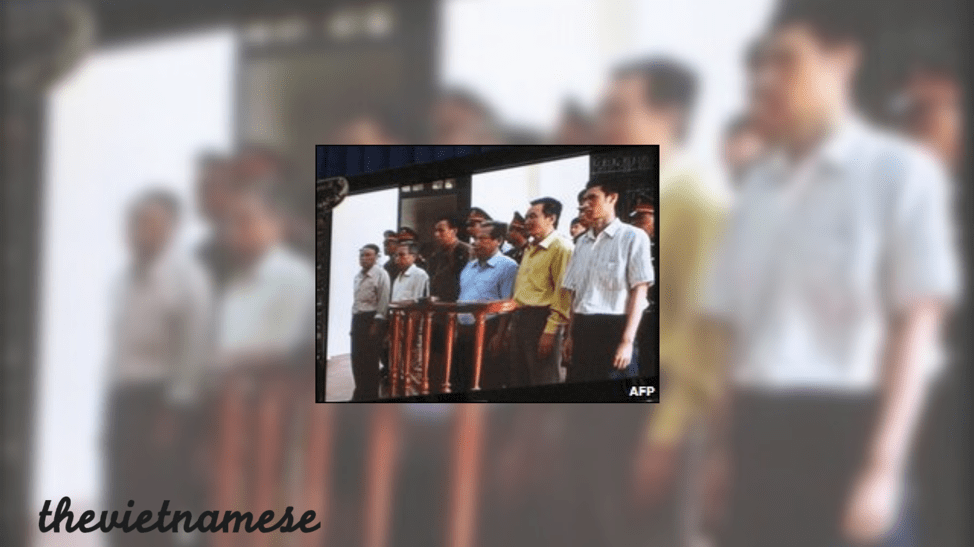
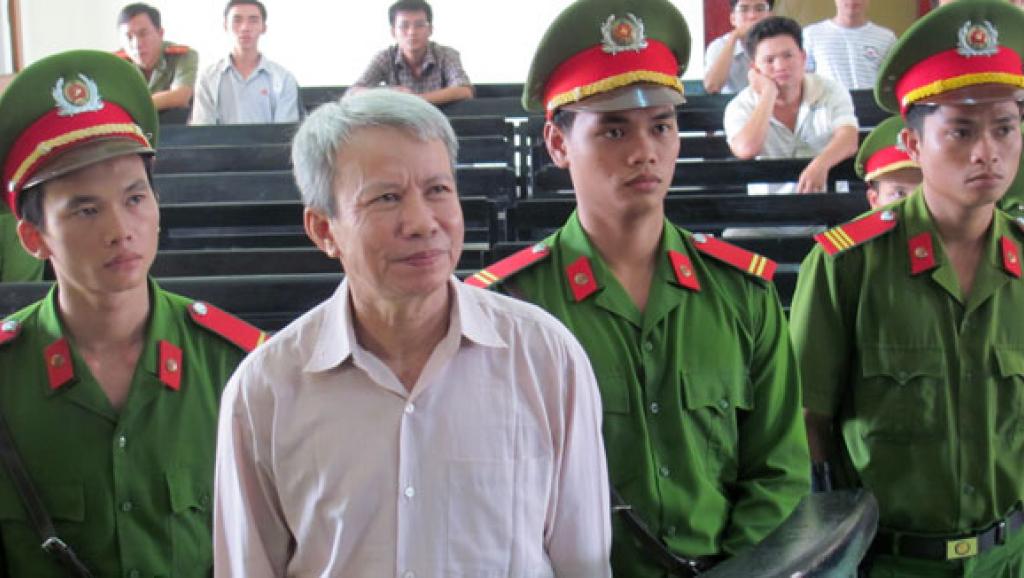
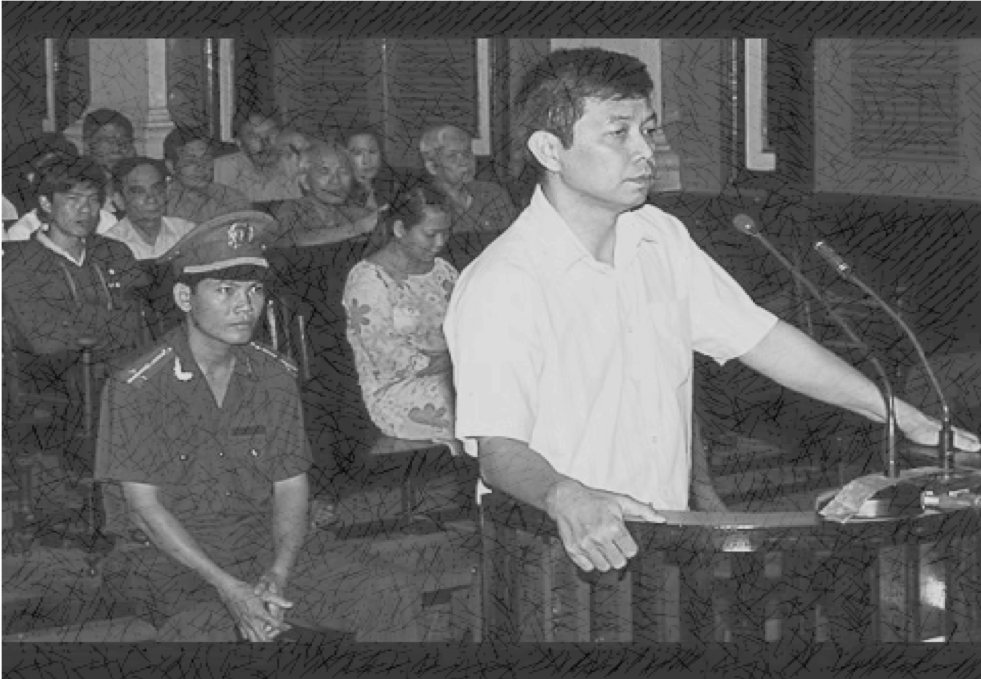
On this day, 12 years ago, a group of six democracy activists was sentenced to prison, with sentences ranging from two years to six years in prison, in addition to various months or years of house arrest. Their sentences prompted criticism from many international organizations, such as Human Rights Watch and Reporters Without Borders.
These activists were arrested earlier in 2008 for hanging pro-democracy banners on a bridge along the Hanoi-Hai Phong Highway. The government accused them of “spreading propaganda against the government and Communist leaders” under Article 88 of the 1999 Penal Code. Article 88 was one of the most frequently used charges to silence political dissent in Vietnam during the last decades.
The group of six activists includes well-known activist and novelist Nguyen Xuan Nghia, activist Nguyen Van Tinh, land rights activist Nguyen Kim Nhan and Nguyen Van Tuc, ex-Communist member Nguyen Manh Son, and Ngo Quynh, a university student. Nghia and Tuc are alleged to be members of Bloc 8406, a pro-democracy organization that used to be prominent but was violently suppressed during the early 2010s. At the time of the arrests, most of the activists were already in their 60s, but Ngo Quynh was only 25 years old.
Following the trial of these activists, other democracy activists were also sentenced in 2010, including teacher Vu Hung, blogger Pham Thanh Nghien, and activist Pham Van Troi. According to the BBC Vietnamese, the intensified crackdown of pro-democracy activities was due to the approaching Communist Party Congress in 2011.
While it has been more than a decade since the sentencing of the above activists, it is essential to remember that the Vietnamese government continues to crack down on peaceful pro-democracy activists and give them unjust sentences for their political longevity.
Where are these activists now?
The six activists detained in 2009 were all subsequently released when their prison terms ended between 2011-2014.
However, Nguyen Kim Nhan was arrested again in 2011, almost immediately after he was released from prison upon completing his 2-year sentence; he received another nearly six years in prison.
Nguyen Van Tuc, released in 2012, is currently in prison after being accused of “aiming to overthrow the government” in 2018 under Article 79 of the 1999 Penal Code. Tuc received a sentence of imprisonment for 13 years, and his family members have spoken out about his deteriorating health behind bars.
Nguyen Xuan Nghia, the activist who received the longest sentence of six years in 2009, was again harassed by the police in 2018 for “storing banned books.”
Examining the life of the democratic activists who have served years in prison shows us that the government has never treated them with respect despite how peaceful, intellectual or patient. It is as if the government is sending a clear political message: you have to be on our side, or we will eliminate you.
While the article today is about the sentencing of activists from twelve years ago, we keep seeing similar treatment patterns with democracy activists or writers throughout recent years.
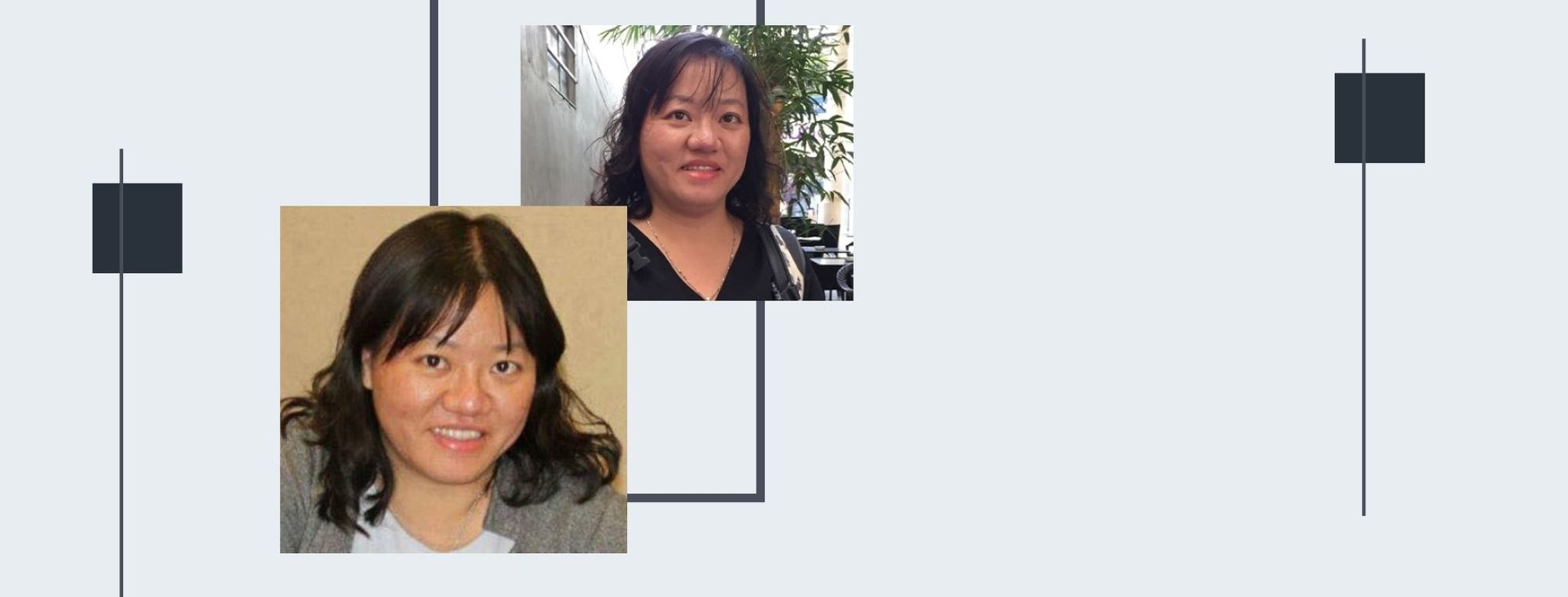
As I am writing this beginning line, my mind is flooded with memories of Pham Doan Trang. I also realize that it has been almost seven years since I said goodbye to her before she left the United States to return to Vietnam. We had become friends and spent seven months together in the United States, and I have not seen her since December 2014. I also have not been able to contact her or speak with her on the phone since October 6, 2020. Vietnamese police arrested her near midnight that day in Saigon. My last text message to her was “Trang, answer me,” which I sent the night she was detained.
Doan Trang can be classified as many things, depending on the person you speak with. She is a journalist, an activist, a teacher, a political person who opposes the Vietnamese Communist Party, a prominent figure of the democracy movement in Vietnam, and more. Yet, for me, Doan Trang is a friend, a very close friend, and that’s it. My only hope is to help set my friend free because she has not done anything wrong. She deserves to be free so that she can continue to write.
And yet, sadly, her writing is precisely the reason that has put her in prison in Vietnam.
In Vietnam, writing or producing verbal speech (YouTube, TikTok, etc.) can be a severe crime when you refuse to obey the government’s censorship system or self-censor on your own. If you look at the details of any political case in Vietnam, I guarantee that you will only find the alleged wrongdoings to be the uncensored writings and speeches produced by these defendants. It does not matter how the Vietnam government classifies their crimes as “abusing democratic rights” or “propagandizing against the state,” their crimes are always their writing and speech.
For Doan Trang, I can also think of another aspect in which she has irritated the Vietnamese authorities even more. She was not just a journalist; she was also trying to encourage more people to write and be more aware of politics in Vietnam. I was one of the people she inspired to take writing as a profession and focus more on Vietnam’s human rights and political affairs.
In my writing career, I have two people to be grateful for: my two co-founders of Legal Initiatives for Vietnam (LIV), Trinh Huu Long and Pham Doan Trang. If I had not met them in life, I don’t think I would have been confident enough to write in either Vietnamese or English, especially as a journalist.
I left Vietnam and came to the United States when I was 12-years-old. I was not too young to think of myself as a native speaker in English, but I was not too old to be confident in my ability to write in Vietnamese either. However, after meeting Trinh Huu Long and Pham Doan Trang in 2014, they changed my life as I believed in their cause and decided to co-found LIV. Starting from that point, I began to promote human rights, democracy, and the rule of law in Vietnam through journalism. Trinh Huu Long may be the first teacher in journalism for me, but Doan Trang is the inspiration for my decision to change my career from law to journalism.
Many people have asked me why I decided to quit my legal profession and started working for a non-profit organization that focuses on Vietnam. Maybe this career change was not advantageous for them and could be stepping down in life. But Doan Trang’s last words before she left the United States stuck with me throughout these years: “Every country needs a generation of young people who will sacrifice their lives to build a better society for others. If our generation refuses to take up this job for Vietnam, then who else will? Do we wait for the next generation to sacrifice for our country and choose an easier life now?”
Doan Trang chose to take up this task to promote human rights in Vietnam, and she left America to go back to Vietnam, knowing that she would be imprisoned in the future. Then, for me, the decision of giving up my life as a litigation lawyer to write about human rights and political issues in Vietnam seemed to be a much easier job when I compared myself with Doan Trang.
She’s inspired me, and we both have the same goal: to put Vietnam on the map for international audiences and encourage more Vietnamese people to care about human rights and democracy. To write about these issues should not be a crime in any nation because we only want to educate the public. What did we do so wrong that my friend Pham Doan Trang has spent one year incommunicado in Vietnam?
The Vietnamese government cannot explain away Pham Doan Trang’s case or any political cases that have sent hundreds of dissidents to decades in jail. However, I hope the international community and foreign governments can speak up louder and be more explicit against this injustice.
Journalism is not a crime; writing about politics and human rights is not a crime. Vietnam continues to suppress the free press and the freedom of speech much harder now, which is not an action the international community should condone. Please speak up for those imprisoned by the Vietnam government, such as Pham Doan Trang, because we are on the right side of history.
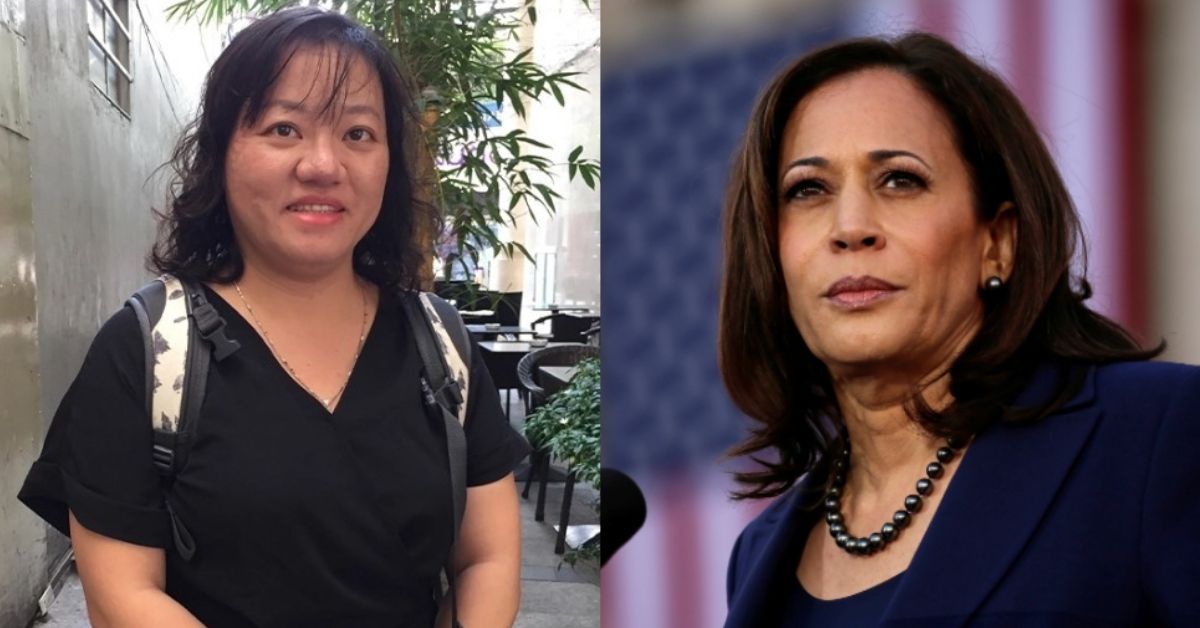
Legal Initiatives for Vietnam (LIV), a non-profit, non-partisan organization that works to build a truly democratic society in Vietnam through independent journalism, research, and education, released an open letter on August 21, 2021, addressed to the office of the United States Vice President, Kamala Harris.
On October 6, 2020, at 11:30 pm, Pham Doan Trang was arrested by Vietnamese state forces. She was subsequently charged with violating Article 88 of the 1999 Penal Code by “conducting propaganda against the Socialist Republic of Vietnam” and Article 117 of the 2015 Penal Code for “making, storing, spreading information, materials, items for the purpose of opposing the State of the Socialist Republic of Vietnam.”
Following her abduction, she has “been held incommunicado, denied visitation from her family and her lawyers, and she faces up to 20 years of imprisonment.”
Through their open letter, LIV hopes that Vice President Kamala Harris can help push the current state of Vietnamese media towards a freer and more inclusive environment where no journalist needs to fear oppression by their government.
On April 7, 2021, Reporters Without Borders (RSF) released a press statement condemning the arrest of jailed Vietnamese journalist Pham Doan Trang.
Phan Doan Trang, co-founder and editor of the online magazines The Vietnamese and Luât Khoa, and a recipient of the 2019 RSF Press Freedom Prize for Impact, was arrested at her home on the night of October 6, 2020. She was taken away by plainclothes policemen and has not been heard from since She has been denied access to a lawyer and her family has also been unable to contact her. Currently, she faces up to 20 years in prison under Article 117 of the Vietnamese Penal Code, under the charge of engaging in “anti-state propaganda”.
Daniel Bastard, the head of RSF’s Asia-Pacific desk, says: “The Vietnamese Communist Party’s current leadership… needs to understand that history will hold them to account for the crackdown on press freedom …. They can save face by freeing Pham Doan Trang and all of the other unjustly detained journalists.”
This is not the first time RSF has demanded her release. On October 7, 2020, just one day after her arrest, it published its first statement which echoes much of the same sentiments here. It has also launched an international awareness campaign to fight for her cause.
Support from Other RSF Laureates
Several other RSF awardees have called for Phan Doan Trang’s immediate and unconditional release. They have also released several videos in various social media outlets to show their support for her, and to help bring this situation to the attention of the international community.
Tomasz Piatek, a Polish journalist and an RSF prize recipient in 2017, addressed Vietnam’s leaders:, “I am asking you to release my friend from prison immediately and stop harassing and tormenting her for writing the truth. If you want to present yourself to the world as politicians and leaders of the Socialist Republic of Vietnam, you must immediately stop harassing your citizens and give your citizens the right to the truth.”
Swati Chaturvedi, an Indian journalist and Reporters Without Borders prize awardee in 2018, said, “RSF stands for the fight of all journalists. Please help and speak out for my colleague, my Vietnamese colleague Pham Doan Trang right now.”
Can Dündar, a Turkish journalist, documentary filmmaker and 2016 RSF laureate, similarly asked that the Vietnamese authorities release Phan Doan Trang and to respect the freedom of the media.
Inday Espina-Varona, a Filipina journalist and awardee of RSF’s Prize for Independence in 2018, stated that Pham Doan Trang “has been charged with disseminating information that opposed the state of Vietnam… [it is] every journalist and citizen’s obligation to criticise and when necessary to oppose policies and actions inimical to the welfare and rights of people… it is also the duty of journalists and citizens wherever we are in the world to stand up when those who seek to do the right thing are battered for their efforts.”
Statement from the Publication:
The Vietnamese joins Reporters Without Borders and our other international allies in demanding for the expedient release of Pham Doan Trang. The trumped-up charges against her are clearly false and the only thing she is guilty of is providing Vietnamese citizens with accurate and independent information free from the manipulation and misdirection of the Vietnamese government and its selfish misguided agenda.
The fight for freedom, democracy, and a better tomorrow for Vietnam continues and we at The Vietnamese will do our part to see this through till the end.
To show your support for this cause, kindly consider signing this petition for the swift release of our co-founder, colleague, and friend.
This article was published in Vietnamese by Luat Khoa Magazine on March 8, 2019. The translation was done by Will Nguyen.More than two years after the Vietnamese article was published, all three women in this article have been arrested and charged with national security laws in Vietnam. We do not want their stories to go in silence, so we translate them to tell the world about who these women are: the women of possibilities.
March 8, is International Women’s Day, and Vietnam celebrates this holiday wholeheartedly.
However, no mainstream newspapers will write about the three women in this article. No organizations will honor them. No solemn ceremony will have them as guests. And among those who “care” about them the most are usually…the Vietnamese police.
They say things few people say.
They do things few people do.
They’ve accepted risks that few people dare accept.
In actuality, they’re part of a world that few care about or dwell on; for these individuals, few are willing to stand by their side.
The women we speak of in this special piece represent the hidden aspirations, the beautiful reflections, the burning dreams of an entire nation. They’re singing for us a song of freedom, nurturing a better future for each and every one of us.
In February of 2016, a wave of independent candidates competed for seats in the National Assembly, setting off a movement that was the largest of its kind in post-1975 Vietnam. Approximately 30 candidates had signed up, only for the “consultation” process to remove them from the roster. Nguyen Thuy Hanh was among them.
Different from Party-nominated candidates, independent candidates announced their action plans. And different from nearly all independent candidates, Nguyen Thuy Hanh was the rare voice that included women’s rights in her platform. She called for stricter laws on violence against women and human trafficking, encouraged job creation, and pushed for education policies and legal support for women.
Born in 1963, Nguyen Thuy Hanh is a Hanoi woman whose soul is full of art and romance. She has participated in civil society struggles since the 2011 anti-China protests, when protesting was especially taboo not just in the minds of state officials but the vast majority of ordinary citizens.
Over nearly eight years, having participated in tens of protests and having been beaten and arrested many times, she has witnessed Vietnamese society slowly change, from opposing the right to protest to respecting and then supporting it. When boisterous, nationwide protests broke out on June 10th, 2018 and tens of thousands of people took to the streets to oppose the Special Economic Zones and Cybersecurity Laws, Nguyen Thuy Hanh was perhaps one of the most elated, for her contributions had normalized what had previously been one of the most “sensitive” acts in society.
However, Nguyen Thuy Hanh’s name is more often connected to the “50k Fund”, which she created to financially support prisoners of conscience and their families. The fund started at the beginning of 2018, originating from a brief, online fundraiser to help a number of activists on trial. Hanh had received several fold the amount requested and thus, the idea for a future fund to help activists at-risk unexpectedly came into being.
The 50k Fund aimed to help with difficult situations lesser known to the public, and its name was purposefully chosen to encourage people to donate small amounts, rather than >50,000 VND (~2.20 USD), popularly believed to be the minimum for charity. Such small amounts also assuaged donor fears of police harassment.
To this day, Nguyen Thuy Hanh’s 50k Fund has received thousands of donations, totaling many billions of VND (~hundreds of thousands of USD), all of which are documented in detail on her public Facebook account.
The 50k Fund’s meaningfulness goes beyond providing prisoners of conscience everyday material support. It also awakens the emotions of ordinary citizens, encouraging them to care more about politics and helping them overcome the intangible fear constraining their hearts and minds. The 50k Fund normalizes and makes concrete that which is considered “political” or “sensitive”, bringing to citizens the full splendor and meaning of civil society struggle.
A lover of beauty and romance, Nguyen Thuy Hanh draws a long, brilliant stroke for the Vietnamese democracy movement.
Can Thi Theu
Peasant leader Can Thi Theu. Photo: RFA. Graphic: Luat Khoa Magazine.
People normally think of peasant leaders as something from their history classes, as figures only found in textbooks. But Can Thi Theu is a real-life, flesh-and-blood peasant leader, a heart beating strongly within the body politic.
The life of this courageous woman is connected to the phrase “Duong Noi’s disenfranchised citizens”. Duong Noi is a ward in Ha Dong District. Prior to 2008, it was part of Ha Tay Province, but today, it has been incorporated into Hanoi. Can Thi Theu’s name is probably not mentioned very often in domestic or international press, and she doesn’t have her own English-language Wikipedia page. From 2007, she became one of thousands of disenfranchised citizens who lost their land when the government forcefully reclaimed agricultural and cemetery land in Duong Noi for new urban construction projects.
The “disenfranchisement” of farmers like Can Thi Theu lies in their complete exclusion from the process, from project planning all the way to land acquisition.
They were not consulted about compensation or relocation assistance, and the government did not provide them any kind of vocational training after taking away their livelihoods. Furthermore, the gravesites of their ancestors were leveled without notification of their displacement.
As a woman born in the year of the Tiger (1962), Can Thi Theu rose among the thousands of disenfranchised citizens to become leader, with her strategic mind, her ability to see in the short- and the long-term, and her skill in thwarting police tactics.
Her leadership skills also manifest in her ability to endure and sacrifice for others, forever taking the hit while protecting those in her care. She is patient and looks past the small, unimportant details to achieve the peasant movement’s longer-term goals. It must be remembered that these farmers lost their land 12 years ago; it’s not easy to keep Duong Noi a hot topic to this day.
The price that Can Thi Theu had to pay was not small. She was twice imprisoned (2014 – 2015 and 2016 – 2018) for a total of two years and 11 months, for obstruction of officials and disturbing public order.
From prison in the Central Highlands, she wrote a letter home to her fellow citizens before the 2017 Lunar New Year: “Fight to the end, to demand the return of our land, our right to live, and our rights as human beings, which the communist regime has stolen from my family and those who share our plight.”
You read that properly. Northern farmer Can Thi Theu is not afraid of calling out the “elephant in the room”, the direct perpetrators of the injustice that she and farmers like her have had to endure.
Can Thi Theu became the face of one of the greatest forms of injustice that Vietnamese citizens contend with, when she fell victim to the Vietnamese Communist Party’s larcenous land policy, which it has consistently carried out for decades.
She is also a living representative for those fighting to abolish “universal ownership” of land, seeking to establish legitimate, private land ownership rights for every individual. Every act in Vietnamese history has been intimately tied to land, and Can Thi Theu has placed herself center-stage for the next.
Pham Doan Trang
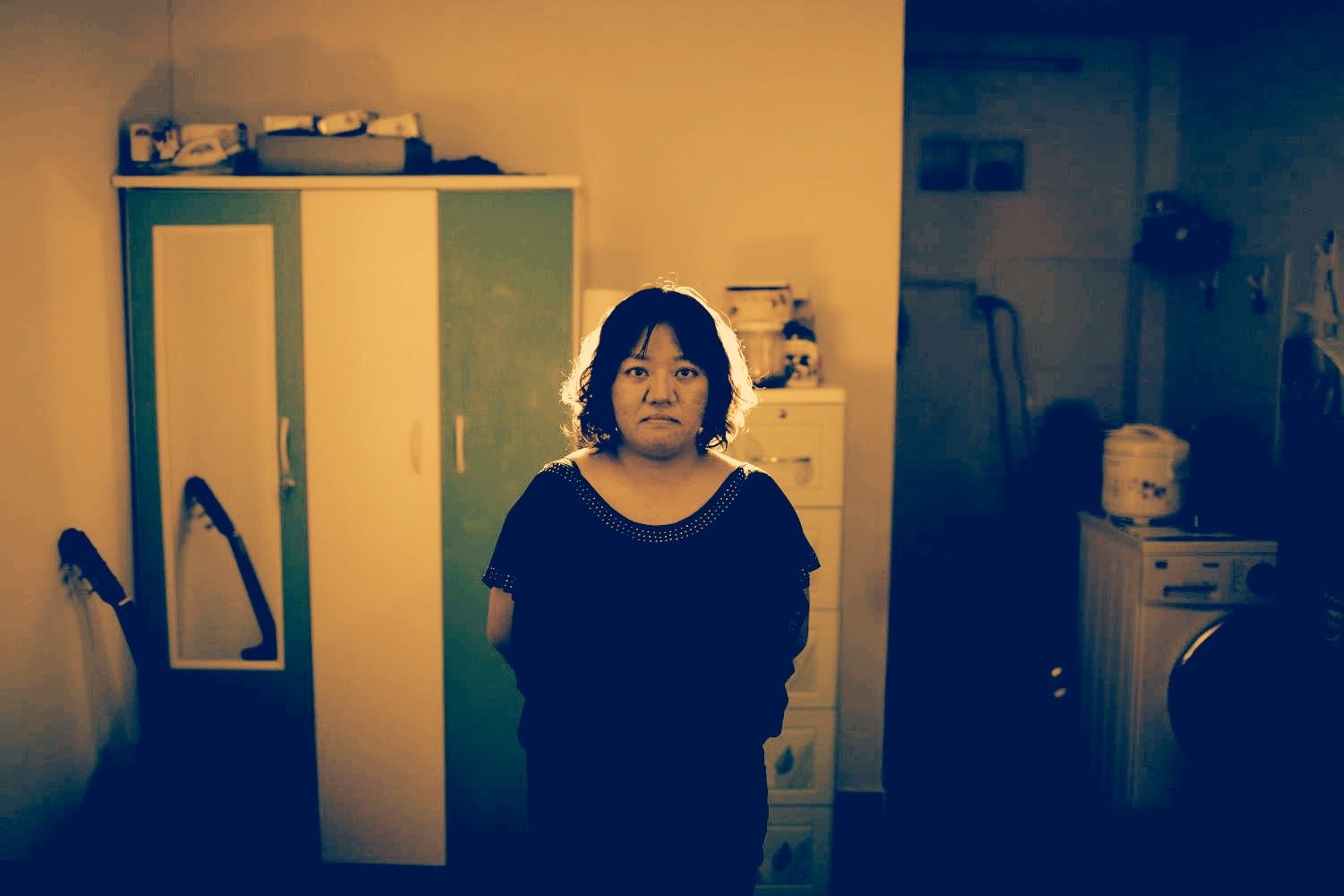
Activist Pham Doan Trang. Photo: Tri Dung. Graphic: Luat Khoa Magazine.
If someone believed that it was impossible to be a bona-fide journalist in Vietnam’s mainstream media environment, then Pham Doan Trang proves the opposite. She has 12 years of experience as a sterling journalist at VnExpress, VietNamNet, and Ho Chi Minh City Law, with reams of critical stories and excellent documentations.
If someone believed that journalists and intellectuals in Vietnam faced insurmountable political restrictions, then Pham Doan Trang proves the opposite.
She constantly embarks on endless explorations to (un)cover the most sensitive, most dangerous, most censored topics.
She also does not limit herself within the rigid confines of mainstream newspapers; instead, she uses all the tools at her disposal to write and publish. Independent newspapers, overseas newspapers, blogs, social media, samizdat—Doan Trang has adeptly utilized them all to convey information to her readers.
For Doan Trang, the concept of “hitting the ceiling” is completely foreign; she is forever someone who lifts those ceilings so that others may have more breathing room.
If someone believed that they were unable to surmount material, physical, and even spiritual difficulties, then Pham Doan Trang proves the opposite.
A small and frail woman with numerous scars and injuries, she has had to endure countless assaults by police, drifting through more than 35 different locations across the country over the past 20 months to escape police pursuit and continue her work.
She lives frugally, no different from those provincial students in the 90s, who left to study in the city, but people would see her write consistently and prolifically.
Politics for the Common People, Non-violent Resistance, and Studying Public Policy Through the Case of SEZs are just some of the many titles she’s penned over the years.
Born in 1978, Doan Trang belongs to the post-war generation and grew up when the country and the world were changing at dizzying speeds. Unsatisfied with the disorderly state of the country, people like Doan Trang saw it as their role to address these disorders. For her, there is always work to do, and she does so, without rest.
Doan Trang swears by a lifetime oath: to never leave Vietnam, not even for a day, while it remains without democracy.
Doan Trang personifies fierceness and does not compromise with evil or cowardice. But she is also full of romance and forever searches for beauty in the strums of a guitar.
She inspires people to stand up, to take steps and discover the beauty of politics. With knowledge and vigor, she represents for many the aspiration for a democratic Vietnam, the light of hope in the dark depths of despair, and the ability for oneself to embody that hope.
Doan Trang talks the talk and walks the walk, inspiring many with what could be; her life, simply put, is a powerful testament to what could be.
The three women in this piece embody the possibilities. They have defied political and gender stereotypes that weigh down their every step. The meaning of March 8th has never lain in flowers or gifts; it lies in the women who fight for what is right and just.
This March 8, we reserve flowers for women like Nguyen Thuy Hanh, Can Thi Theu, and Pham Doan Trang.
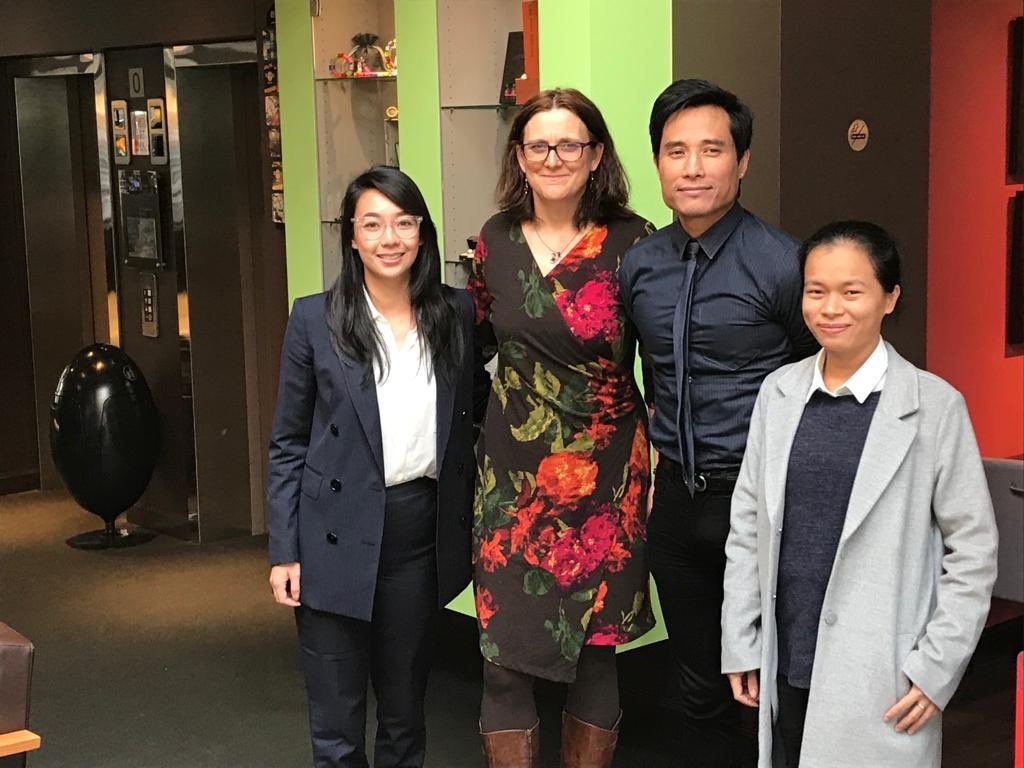
“The human rights situation in Vietnam is worrying,” according to Commissioner for Trade of the European Union, Cecilia Malmström, after her meeting with independent Vietnamese civil society organizations on March 14, 2019.
When announcing the adoption of the EU-Vietnam trade and investment agreements (EV-FTA) in October 2018, Commissioner Malmström had hoped that such agreements would “help spread European high standards and create possibilities for in-depth discussions on human rights and the protection of citizens.”
However, during recent months, the human rights situation in Vietnam did not improve.
Instead, it became more concerning.
Commissioner Malmström is not the only EU official who has expressed concerns over the worrying trend of suppression on human rights in Vietnam in recent months.
32 MEPs from across the political spectrum of the EU Parliament signed a letter back in September 2018, calling on the EU to demand specific human rights improvements from Vietnam before the ratification of the EV-FTA.
EU Spokesperson on Foreign Affairs and Foreign Policy, Maya Kocijancic, also confirmed in an interview with Radio Free Asia earlier this month, that during the 8th EU-Vietnam Human Rights Dialogue held in Brussels on March 4, 2019, the EU had addressed specific cases of prisoners of conscience with the Vietnamese delegation.
Ms. Kocijancic also stated during the same interview that the annual dialogue “raised a wide range of issues related to freedom of expression, cybersecurity, the death penalty, environmental and labor rights, cooperation within the United Nations framework.”
As of today, The 88 Project’s database documented 21 Vietnamese activists are held in pre-trial detention. There are 218 other activists currently serving a prison sentence; among them, 30 are female activists and 51 indigenous political prisoners.
According to VOICE (Vietnamese Overseas Initiative for Conscience Empowerment), one of the organizations attended the meeting with Commissioner Malmström, the unconditional and in-country release of Vietnamese prisoners of conscience must be the first human rights benchmark before the ratification of the EV-FTA.
On January 30, 2018, The Vietnamese received information that political prisoner Ngo Hao had suffered a minor stroke in prison. According to his wife, the prison’s center in An Diem, Quang Nam Province did not inform his family directly.
The family learned about his conditions on social media when the brother of Hoang Duc Binh, another prisoner of conscience, posted about it on Facebook.
During the last family visit on January 27, 2019, the family observed that “he was very sick and shaking a lot while walking.”
In January 2015, the government relocated him from Phu Yen Province – his hometown – to An Diem prison center in Quang Nam Province.
Relocation of political prisoners to prison centers hundreds of miles away from their hometowns is a common tactic used by the Vietnamese authorities, making visitations increasingly difficult for the family.
In Hao’s situation, his wife is also suffering from chronic disease, and the visitations have taken a toll on her health.
Ngo Hao was arrested in February 2013, tried and convicted in September 2013 under Article 79 of the 1999 Penal Code for “subverting against the people’s government.”
He was sentenced to 15-year-imprisonment and five-year probation thereafter.
His appeal was denied in December 2013 after less than two hours of hearing where neither his lawyer or Hao was allowed to fully state their defense.
He was held incommunicado prior to the hearing and his family was only notified of the appeal on the day it happened.
The government alleged that Hao received money from an overseas Vietnamese group to plot a Jasmine revolution-type in Vietnam to overturn the Vietnamese Communist Party.
The evidence produced by the prosecution consisted of writings he published online regarding using UN reporting mechanisms to assist political prisoners and contacting Human Rights Watch to report on human rights violations in Vietnam.
Hao did help 14 members of Hoa Hao Buddhist sect to send their communication about human rights violations to the UN.
Hao was an army officer of the former Republic of South Vietnam who was imprisoned from 1977 until 1997 – when he was released for medical reasons.
Article 79 of the 1999 Penal Code had been amended; the new code section for “subversion” now is Article 109 of the 2015 Penal Code.
Ngo Hao’s case could benefit from the same argument which the lawyer for Tran Huynh Duy Thuc has claimed, that under the new penal code, the acts committed by the defendant was only “in preparation to commit a crime” according to Section 3, Article 109. This argument, if suceeds, could reduce the maximum prison time to five years.
Notwithstanding the above legal argument, under international human rights law, the imprisonment of a person for the peaceful exercise of their individual rights – such as the freedom of expression – has been declared arbitrary arrest and detention.
Ngo Hao’s wife and son are asking the international community to pay attention to his case and demand an immediate and unconditional release.
Ngo Hao could be one of the oldest political prisoners serving a sentence in Vietnam right now. Born in 1948, he is turning 71 this year. Hao would now be in his sixth year of the 15-year-term.
They are afraid that Hao would not be able to make it until the end of his 15-year-imprisonment term after observing his deteriorating health conditions during the last visit earlier this month.
Nine years ago, on January 20, 2010, the People’s Court of Ho Chi Minh City convicted Tran Huynh Duy Thuc, Le Cong Dinh, Le Thang Long and Nguyen Tien Trung under Article 79 of the 1999 Penal Code for “subversion against the people’s government.”
Tran Huynh Duy Thuc was sentenced to 16 years in prison and five years probation which technically meant five more years under house arrest.
Thuc was arrested in May 2009, and for almost a decade, the unique case of a successful entrepreneur turned dissident continued to be the highest profile among the hundreds of political prisoners and dissidents in the country.
Article 79 has faced harsh criticisms from the international community.
During Vietnam’s 2nd UPR cycle in 2014, the Vietnamese government accepted the recommendations to amend this and other arbitrary penal codes under the “national security” section, to ensure they would not be used to infringe the people’s human rights.
However, in reality, the amended Penal Code of 2015 did not change the situation in any way. The crime “subversion against the state” remains as Article 109 under the new code.
Thuc’s indictment described his criminal conducts included the act of forming and persuading people to join the Chan research group, to write and publish online articles defaming the government, creating division among the Vietnamese Communist Party.
The prosecution further alleged that he had attempted to reach out and establish a relationship with leaders of the VCP, with the intent of re-shaping their political opinion to change the regime, and that he had planned to manufacture a document named “The Vietnam Path” to subvert against the State.
The Vietnamese government’s point of view on “subversion against the State” is often not shared by the international community, especially democratic nations in the West.
The heart of the problem lies in Section 1, Article 4 of Vietnam 2013 Constitution which states:
The Communist Party of Vietnam – the Vanguard of the Vietnamese working class, simultaneously the vanguard of labourers and of the Vietnamese nation, the faithful representative of the interests of the working class, labourers and the whole nation, acting upon the Marxist-Leninist doctrine and Ho Chi Minh’s thought, is the leading force of the State and society.
Because of this political monopoly, the VCP and the State of Vietnam became interchangeable in the mind of Hanoi’s regime.
The leaders of the VCP would not hesitate in sentencing people who hold a different political philosophy than theirs to prison for decades because questioning the ultimate leadership of the Party equates “overthrowing the government.”
This viewpoint effectively puts the VCP at odds with the universal values of human rights, in particular, the right to freedom of expression where holding a different political opinion, calling for pluralism and a multi-party system cannot be deemed criminal.
In Tran Huynh Duy Thuc’s case, the defendants were also found guilty because the government further alleged that they were members of the Democratic Party and had started to write a new constitution.
As one may correctly guess, organizing a political party in Vietnam – as in Thuc’s case – could also be construed as an act to “subvert the government.”
Vietnam, at press time, has only one political party.
Thuc has received the offer to be released into exile on numerous occasions, but he turned them down, stating that he would finish his full prison term instead of having to leave his home country indefinitely.
The offer to be released into exile to political prisoners in Vietnam is not a release.
It is more like a suspension of the sentence for either medical or humanitarian reasons. The released prisoners would not be able to come back to Vietnam, effectively being banned from their own country.
When the Penal Code was amended, Thuc’s attorney has argued that the government should release him according to Section 3 of Article 109. Because at most, the evidence provided by the prosecution could only show that the defendants were in “preparation” to commit a crime under Section 3, with the maximum sentence of five years.
His petition for a review of the case under the new Penal Code has gone unanswered.
On December 13, 2018, Julie Ward, a Member of the European Parliament representing the North West of England, sent a letter to the President of Vietnam – Nguyen Phu Trong – (who is also the leader of the VCP), calling for an unconditional, in-country release of Tran Huynh Duy Thuc. The letter addressed the concerns over allegations from his family that he had suffered abuse in prison.
A group of the EU Parliament’s MEPs, including Ms. Ward, has stated in more than one occasion that the release of prisoners of conscience like Tran Huynh Duy Thuc would be a critical condition for them to support the EU-Vietnam FTA.
On this 9th anniversary of his conviction, U.S. House Representative Zoe Lofgren also called for Tran Huynh Duy Thuc’s release and denounced the mistreatment of political prisoners by Vietnamese authorities.