Tag: freedom of religion

  • Religion Bulletin – September 2020: The Fate Of Independent Cao Dai Temples

    https://2xjs7y10oiyz26vqxu2hok6y-wpengine.netdna-ssl.com/wp-content/uploads/2020/10/Untitled-design-2-compressed.jpg

    The September 2020 Religion Bulletin focuses on the Cao Dai religion, with information on the seizures of independent Cao Dai temples in [The Government’s Reach]; the assault on the Phu My Cao Dai Temple practitioners eight years ago in [On This Day]; and we introduce the Cao Dai sects that are exempt from having to join one unified organization in [Did You Know?]. [Religion 360°] brings you information regarding the arrests and punishment endured by Falun Gong practitioners, along with other news.If you have any suggestions or would like to contribute reports to the Religion Bulletin, please email us at: tongiao@luatkhoa.org or editor@thevietnamese.org

    Religion Bulletin, September 2020:

    The Government’s Reach

    The fate of independent Cao Dai temples

    After a period of peaceful practice, Cao Dai practitioners are now facing harassment from state-backed Cao Dai groups who are attempting to take over their temples.

    The case of Phu Lam Cao Dai Temple

    Phu Lam Cao Dai Temple is located in Cluster 5 of Phu Lam Township, in the city of Tuy Hoa, Phu Yen Province. This temple was built in 1964 and restored in 1999.

    The authorities assert that this temple is under the management of the Tay Ninh Holy See of the Cao Dai Great Temple*, the largest Cao Dai organization recognized by the state (in 1997) and also known as “Sect 1997”.

    Phu Lam Temple overseer Cao Van Minh states that he and temple practitioners simply want to follow their own religious orthodoxy and that they do not accept the leadership of Sect 1997.

    https://2xjs7y10oiyz26vqxu2hok6y-wpengine.netdna-ssl.com/wp-content/uploads/2020/10/1.jpg
    Phu Lam Cao Dai Temple. Photo: Thanhthatcaodai.

    However, the Tay Ninh Holy See Cao Dai Great Temple stated that the Phu Lam Temple falls under its management and sent people to take over the temple with the backing of local authorities.

    How did the forceful seizure of Phu Lam Cao Dai Temple transpire?

    June 18, 2020:

    Event 1: Overseer Cao Van Minh was invited to the Phu Dong Ward People’s Committee one morning for questioning; the committee firmly requested him to be there at 8:30 AM sharp.

    Event 2: Local cadres and a group of the followers of the Tay Ninh Holy See, on orders from the Tay Ninh Holy See of the Cao Dai Great Temple, arrived to take over Phu Lam Temple.

    Event 3: Overseer Nguyen Ha of Nhon Ly Cao Dai Temple, another independent temple in Binh Dinh Province, arrived to support fellow practitioners at Phu Lam Temple.

    Event 4: A group of Phu Lam practitioners opposed the (Holy See’s) take-over order and closed the gates. The two sides engaged in heated arguments over the order.

    https://2xjs7y10oiyz26vqxu2hok6y-wpengine.netdna-ssl.com/wp-content/uploads/2020/10/2.jpg
    Sect 1997 followers arrive at Phu Lam Temple. Photo: RFA.

    July 28, 2020:

    Son Thanh Dong Commune police (Phu Yen Province) invited Mr. Truong Minh Le, a Phu Lam Temple follower, in for questioning on July 30, 2020 regarding the public disturbance on June 18, 2020.

    https://2xjs7y10oiyz26vqxu2hok6y-wpengine.netdna-ssl.com/wp-content/uploads/2020/10/3.jpg
    The invitation letter from the police sent to Mr. Truong Minh Le. Photo: Cao Dai Orthodox Preservation.

    July 30, 2020

    Son Thanh Dong Commune police (Phu Yen Province) continued to invite Phu Lam Temple practitioners in for questioning on August 4, 2020 regarding the public disturbance on June 18, 2020, including Mr. Huynh Tan Luc, Ms. Doan Thi Mieu, and Ms. Tran Thi Hong.

    It seems that no practitioners of Sect 1997 were called in for questioning regarding the disturbance.

    https://2xjs7y10oiyz26vqxu2hok6y-wpengine.netdna-ssl.com/wp-content/uploads/2020/10/4.jpg
    Invitation letters from the police sent to Huynh Tan Luc, Doan Thi Mieu, and Tran Thi Hong. Photo: Cao Dai Orthodox Preservation.

    August 20, 2020

    Overseer Nguyen Ha and fellow practitioner Nguyen Van Danh were invited in for questioning on August 21, 2020 by Quy Nhon city and Binh Dinh provincial police regarding their “religious activities.”

    https://2xjs7y10oiyz26vqxu2hok6y-wpengine.netdna-ssl.com/wp-content/uploads/2020/10/5.jpg
    Invitation letters from the police sent to Nguyen Ha and Nguyen Van Danh. Photo: Cao Dai Orthodox Preservation.

    August 21, 2020:

    Danh relayed that he was asked by police if he had accompanied Ha to Phu Lam Temple.  Danh confirmed that he did not, and the interrogation moved to whether he had accepted gifts from a supply delegation – a charity event carried out by Hua Phi, a Cao Dai follower, whom authorities view as anti-state and who is also joint chairman of the Interfaith Council of Vietnam.

    Ha said that police warned him not to come to Phu Lam Temple again, during Sect 1997’s next take-over attempt. Police also questioned him regarding his relationship with Hua Phi and the Venerable Thich Khong Tanh, a member of the Unified Buddhist Church of Vietnam and the Interfaith Council of Vietnam.

    September 1, 2020:

    Cao Van Minh receives an invitation letter from the Phu Dong Ward People’s Committee to come in for questioning on September 3, 2020.

    https://2xjs7y10oiyz26vqxu2hok6y-wpengine.netdna-ssl.com/wp-content/uploads/2020/10/6.jpg
    The invitation letter from the Phu Dong Ward People’s Committee sent Cao Van Minh to support Sect 1997’s takeover of Phu Lam Temple. Photo: Cao Dai Orthodox Preservation.

    September 3, 2020:

    Cao Van Minh arrives at the Phu Dong Ward People’s Committee for questioning with Tuy Hoa City representatives (from the Fatherland Front, Women’s Association, and Office of the Interior) and Phu Dong Ward People’s Committee representatives.

    The authorities state that Minh should accept the Holy See’s take-over order. Minh asserts that he will not organize any welcoming or acceptance of Sect 1997’s take-over order. Minh also asserts that his followers did not disturb public order on June 18, 2020, when Sect 1997 came to take over their temple.

    The interrogation

    Below is an excerpt from Nguyen Ha’s interrogation on August 21, 2020, as relayed by him personally:

    Binh Dinh Province police: Did you enter Phu Lam Temple in Phu Yen Province recently?

    Nguyen Ha: Yes.

    Police: To do what?
    Nguyen Ha: I came to emotionally support fellow practitioners, protect their beliefs and to close the gates to prevent a number of heretics from entering.

    Police: Are you aware that the Tay Ninh Cao Dai Great Temple ordered Mr. Pham Xuan Thanh to Phu Lam Temple to administer it?

    Nguyen Ha: Yes, that’s Thanh’s business. It has nothing to do with us.

    Police: Thanh is recognized by the state, unlike what you all are doing.

    Nguyen Ha: Whether the state recognizes us or not is the state’s business; I and fellow practitioners simply want to preserve the original teachings that God has laid out. The current Cao Dai religious organization, with state intervention, has destroyed the original teachings.

    Police: If in the future, the Great Temple puts forth someone else to administer Phu Lam Temple, would you still come to support temple practitioners?

    Nguyen Ha: Yes, I would.

    Police: Who is Mr. [Hua] Phi to you?
    Nguyen Ha: Mr. Phi and I are fellow practitioners who seek to protect the original teachings.

    Police: Have you and Phi established any organization?

    Nguyen Ha: We have not established any organization, only the Khoi Nhan Sanh Cao Dai Religious Committee to visit fellow practitioners around the country who have maintained the faith and to share among ourselves the difficulties of our spiritual practice. We also remind them to preserve the original teachings of Duc Chi Ton, and to not be swayed.

    Police: Were you aware of Abott [Thich] Khong Tanh’s life history when you allowed him to come to Nhon Ly Temple to distribute presents for people?

    Nguyen Ha: Venerable Thich Khong Tanh and I are fellow religious dignitaries; if he arrives at my temple, then naturally, I have to receive him.

    Police: Are you aware of whether his life history is good or bad?

    Nguyen Ha: Whether it’s good or bad is your business with him. As for me, I know he is a good person, which is why I have connected across religions with him. He always comes to Nhon Ly Temple with open arms, handing out presents for our older individuals both in and outside the temple. It is an act of great generosity, nothing unseemly for you all to oppose.

    Police: Mr. Khong Tanh opposes the state…

    Nguyen Ha: As soon as anyone disobeys the state, even if that person or their acts are good, it all becomes bad; you even try to accuse them of being anti-state so you can frame them. But if a person listens to the state, even if they are actually bad, they remain a “good person”.

    Look at Pham Xuan Thanh [who was sent to take-over Phu Lam Temple] for example. Do you check to see what kind of practitioner he is before you appoint or promote him? This is how religious values are lost. And then you force us to accept your decisions; what is the meaning of this?

    Police: Do you participate in the Interfaith Council of Vietnam?
    Nguyen Ha: No.

    Police: You do not participate now, but will you join in the future?
    Nguyen Ha: Whether I participate or not is my business.

    Police: We’re letting you know, if you enter Phu Lam Temple again and police handle you roughly, we won’t be able to help you. Don’t say we didn’t warn you.

    Nguyen Ha: This whole time you’ve only helped those carrying out your orders; when have I ever needed your help?

    The drive to eliminate all independent Cao Dai temples

    Phu Lam Temple is one of a number of Cao Dai temples standing separate from Sect 1997. These independent temples assert that the state has interfered with religious practices and that they thus desire to operate independently.

    When the religion was first established in 1926, Cao Dai practitioners all belonged to the Tay Ninh Holy See, but later in the 1930s and 1940s, the Cao Dai reigion splintered into different sects.

    https://2xjs7y10oiyz26vqxu2hok6y-wpengine.netdna-ssl.com/wp-content/uploads/2020/10/Untitled-design-5.jpg
    The Tay Ninh Holy See, headquarters of the Tay Ninh Holy See Cao Dai Church. Photo: Vashikaran Rajendrasingh.

    After 1975, the Cao Dai religion was forbidden to operate until the end of the 1980s. From 1995, the government began to recognize Cao Dai temples as religious organizations. Today, there are approximately 10 Cao Dai organizations that are legally recognized as temples. Besides these, there are approximately 20 other Cao Dai organizations that legally operate but are not considered as temples.

    In recent years, independent temples such as Phu Lam Temple have been pressured by the authorities and other churches to “reunite” and return to the administration of the churches from which they splintered. The purpose of this coercion is to control religious activities, what the state refers to as “reorganizing and regulating” religious activities. Currently, there are no precise numbers on how many temples have refused to “reunite”. In 2007, the Government Committee on Religious Affairs stated that the Ban Chinh Dao Cao Dai Temple had 40 temples that had not reunited.

    According to Mr. Cam Sinh, a Cao Dai practitioner of the Overseas Tay Ninh Holy See, beginning in 2013, the Vietnamese government enacted Resolution 92/2012/NĐ-CP regarding the Implementation of the 2004 Law on Faith, which led to many temple seizures and consolidations with state-recognized Cao Dai temples.

    In 2012, Ms. Nguyen Bach Phung, a Cao Dai practitioner well-known for actively fighting for the independence of temples, stated that the government was interfering in the internal affairs of the Cao Dai religion and causing conflicts.

    “This matter [of disputes has] occurred in many places, including Long Binh Temple in Go Cong, An Ninh Tay Temple in Long An Province, Phu My Temple in Binh Dinh Province, and An Nhon Temple. The state caused difficulties for practitioners when they went from house to house to pressure our people to join the state-approved Chuong Quan Council, Tuy Phuoc Temple in Binh Dinh, Phu Suong Temple in Phu Yen…”. Ms. Bach Phung stated that in a number of places, conflicts broke out between members of Cao Dai temples and independent temples.

    Mr. Nguyen Dinh Thang, director of the organization Boat People SOS, stated that since 1997, the Vietnamese government has helped Sect 1997 “occupy” approximately 300 Cao Dai temples.

    The take-over of these independent temples regularly met with opposition from the affected practitioners, opposition which police then used to frame practitioners for disturbing public order.

    Religion 360°

    Summarizing 25 years of state management of the Cao Dai religion

    On September 18, 2020, the Government Committee for Religious Affairs organized a conference to summarize 25 years of state management of the Cao Dai religion.

    Attending the conference were cadres from the relevant central committees and cadres from the 35 provinces that have Cao Dai practitioners, totaling approximately 200 cadres altogether.

    https://2xjs7y10oiyz26vqxu2hok6y-wpengine.netdna-ssl.com/wp-content/uploads/2020/10/7.jpg
    The conference was held by the Government Committee for Religious Affairs regarding 25 years of managing the Cao Dai religion. Photo: Government Committee for Religious Affairs.

    The Committee said that the state’s achievements in managing the Cao Dai religion had allowed Cao Dai establishments to renovate and build structures, practitioners to actively participate in charitable and purely religious activities, and prompted the majority of dignitaries, their activities, and Cao Dao practitioners to abide by the law.

    The Committee also acknowledged that some Cao Dai dignitaries were moving to separate from state-recognized temples and religious bodies, that some temples were facing conflicts, and that a number of religious activities violated the Law on Faith and Religion.

    The former head of the Committee, and currently deputy minister of the Ministry of the Interior, Mr. Vu Chien Thang, stated that in the future, the government needed to instruct state-recognized temples on the appointment of overseas Cao Dai dignitaries, increase research on Cao Dai management methods, and coordinate with other branches, such as propaganda, public relations, the Fatherland Front, the army, and the police to address the “complicated issues related to Cao Dai activities”.

    Cam My District, Dong Nai Province, prosecutes 6 Falun Gong proselytizers

    The Dong Nai Province People’s Committee news website reported that Cam My District recently prosecuted 6 Falun Gong practitioners for illegally spreading the faith.

    This news website also stated that these individuals would completely cover their faces when entering people’s homes in the district to promote Falun Gong. These individuals had been previously warned to cease their proselytizing activities and not drag others into the faith.

    Cam My District authorities stated that the Falun Gong movement was not yet recognized as a “faith or religious organization” and thus proselytizing activities were illegal.

    The city of Hai Phong suppresses Falun Gong proselytizing activities

    According to the People’s Public Security Newspaper, Hai Phong city authorities were closely monitoring groups of Falun Gong practitioners. The article stated that Hai Phong City Police Department had confirmed more than 10 groups, with approximately 160 individuals “practicing Falun Gong”.

    The article said that from the beginning of 2020 until now, the Hai Phong City Police Department had prosecuted seven cases related to “mobilizing and illegally spreading the Falun Gong movement.”

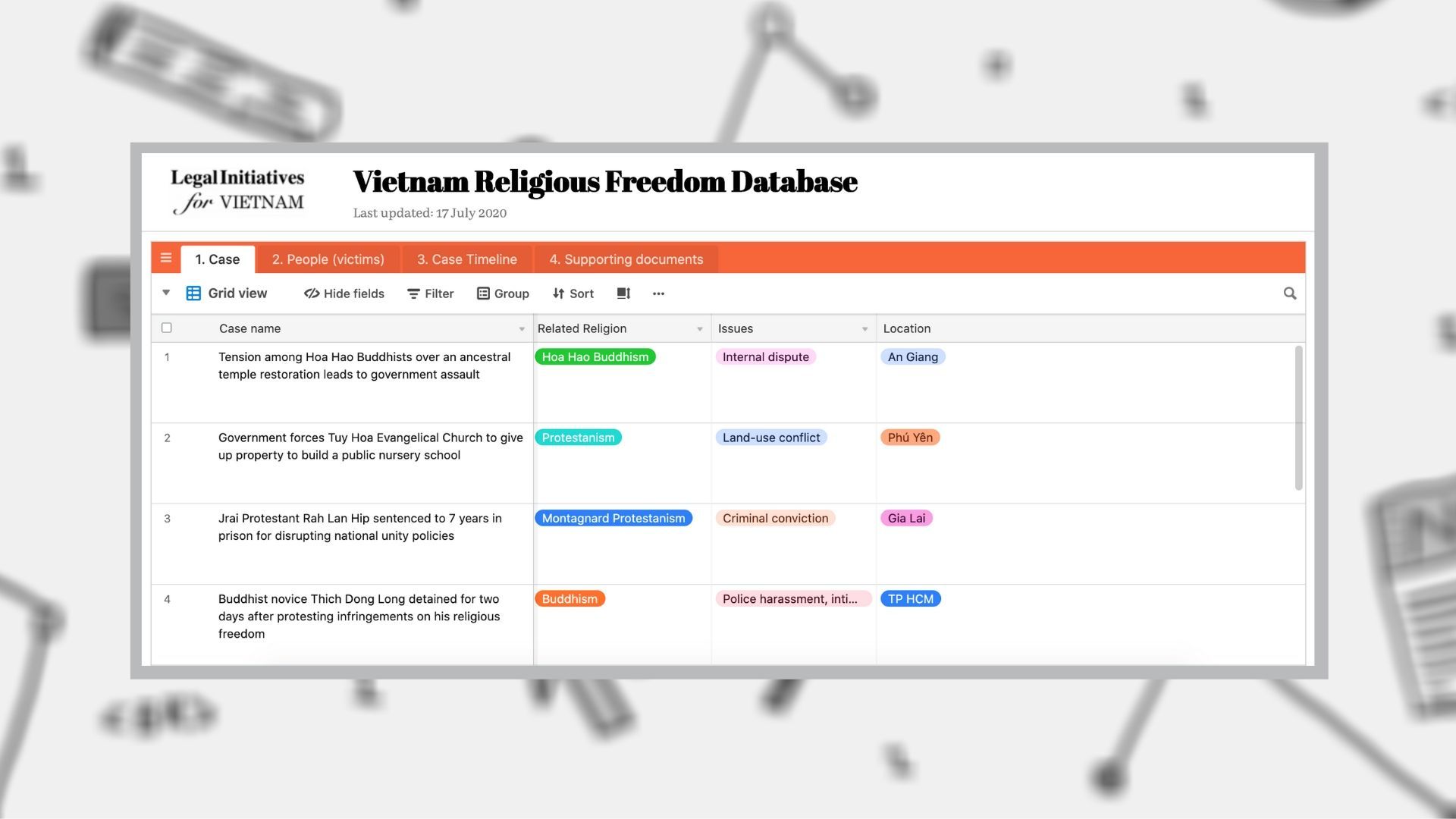
    Readers can find more details regarding the arrest and prosecution of Falun Gong proselytizers in our data regarding freedom of religion: https://airtable.com/shrYIDdMrohUbQztF

    Eleven years of “struggle” to eliminate the Ha Mon religion in Mang Yang District, Gia Lai Province

    In September 2020, the Mang Yang District People’s Committee of Gia Lai Province summarized the results of 11 years of struggle to eliminate the “Ha Mon heresy” that began in 2009.

    According to the summary, the district prosecuted 10 individuals who followed the Ha Mon religion for disrupting national unity. Furthermore, authorities arrested 71 individuals, “campaigned to voluntarily turn in” 55 individuals who absconded to the jungle, and eliminated 15 groups with more than 242 followers of the Ha Mon religion.

    According to the Vietnamese authorities, the Ha Mon religion operates in all of the Central Highland provinces and that Mang Yang District was merely one of many areas in which the religion operated. The authorities assert that the Ha Mon religion is heretical and is being used by members of FULRO to oppose the Vietnamese state.

    The government’s “war” against the Thuong ethnic minority’s religious freedom in the Central Highlands is currently directed at three religious groups: Dega Protestantism, the Ha Mon religion, and the Protestant Church of Christ.

    Pastor A Dao released from prison early

    On September 18, 2020, Vietnamese authorities released early from prison Pastor A Dao, who had served four years of his five-year sentence for organizing illegal border crossings.

    State journalists did not report on Pastor A Dao’s early release.

    https://2xjs7y10oiyz26vqxu2hok6y-wpengine.netdna-ssl.com/wp-content/uploads/2020/10/8.jpg

    Pastor A Dao. Photo: Unknown.

    Mr. A Dao, 39, is a well-known pastor among the ethnic Thuong refugees in Thailand. He was arrested on August 18, 2016 after returning home from a religious conference in East Timor. After he was arrested, he was held incommunicado for five days. Vietnamese police accused him of organizing illegal border crossings to Thailand for ethnic Thuong. Police stated that he coordinated with Mr. A Ga, a Protestant pastor, and at the time, a refugee in Thailand.  Mr. A Dao rejected the government’s accusations.

    On August 28, 2017, the Gia Lai Province People’s Court sentenced Pastor A Dao to five years in prison for organizing illegal border crossings. In January 2018, Mr. A Ga was arrested by Thai police and was extradited back to Vietnam, but the United States intervened and gave him and his family political asylum in the United States.

    On This Day

    Phu My Cao Dai Temple practitioners assaulted during a seizure in September 2012

    For years, practitioners of independent Cao Dai temples have lived in fear, under pressure from both the government and other Cao Dai churches to “consolidate”.

    On September 16, 2012, Phu My Cao Dai Temple practitioners in Binh Dinh Province publicly denounced the Tay Ninh Holy See Cao Dai Church (Sect 1997), accusing it of hiring thugs to attack them in their own temple. Mr. Nguyen Huu Khanh reported to RFA that a total of six practitioners of the Phu My Temple were assaulted that day.

    “Because practitioners here follow the Chon Truyen Orthodoxy, and not the Chuong Quan Council – that is, they don’t follow “state-run” Cao Dai organization –, they [Sect 1997] came to seize our personal property and the temple of the Bao Thu Chon Truyen. They’re using the Chuong Quan Council, which is backed by the government, to break in to our temple”, Mr. Khanh stated as he explained why and how Phu My Temple practitioners were attacked.

    Local police were on the scene during the scuffle but did not intervene and did not initiate an investigation or press charges.

    https://2xjs7y10oiyz26vqxu2hok6y-wpengine.netdna-ssl.com/wp-content/uploads/2020/10/9.jpg
    People sent by Sect 1997 assault Phu My Temple practitioners. Photo: DVOV/BPSOS.

    Mr. Nguyen Ha, an independent Cao Dai practitioner and staunch defender of independent churches, stated that previously Phu My Temple had been under the administration of Sect 1997’s Chuong Quan Council, but after seeing that it was controlled by the government, the temple seceded, suffering the consequences.

    Regarding the scuffle, the person who was in charge of Cao Dai affairs in the Government Committee for Religious Affairs stated to RFA: “They must resolve their own religion’s internal matters. The state merely guarantees order and security for them to carry out their religious protocols”.

    Did You Know?

    The Cao Dai religion in Vietnam has a number of different religious organizations, many of which are recognized by the state

    Among religions in Vietnam, the Cao Dai religion appears exempt from having to organize a “unified” structure, as other religions must do.

    Currently, the Cao Dai religion has approximately 10 religious organizations recognized by the state.

    Meanwhile, within Hoa Hao Buddhism there exists many religious organizations but the state only recognizes one. Buddhism also has two sects; the Unified Buddhist Sangha of Vietnam was established in 1964 and operates to this day, but the government only recognizes the Buddhist Sangha of Vietnam established in 1981.

    Not only are there 10 religious organizations recognized by the government but there are approximately 20 other Cao Dai organizations that operate legally and independent: Thuong De Cao Dai, Cao Thuong Temple, Nam Thanh Temple, Pho Thong Giao Ly Dai Dao Institution, Lien Hoa Cuu Cung Thien Dao Path of Study, Tan Minh Quang Temple, Huynh Quang Sac Temple, Thien Truoc Temple, and the Bau Sen Temple.

    These Cao Dai temples and organizations historically branched out because of disagreements over religious practices. However, despite the splintering, the state and its temples are pressuring (independent) temples to return to their original church.

    Below is information regarding the Cao Dai religious organizations and temples recognized by the Vietnamese government:

    https://2xjs7y10oiyz26vqxu2hok6y-wpengine.netdna-ssl.com/wp-content/uploads/2020/10/Untitled-design-5.jpg
    The Tay Ninh Holy See Cao Dai Temple, headquarters of the Tay Ninh Holy See Cao Dai Church. Photo: Vashikaran Rajendrasingh.

    1/10

    Tay Ninh Cao Dai Holy See

    Year established: 1926
    Current headquarters: Tay Ninh Holy See, Pham Ho Phap Highway, Long Hoa Ward, Hoa Thanh Township, Tay Ninh Province.
    Year recognized, post-1975: 1997
    Number of practitioners: 1,510,000 (2011)

    This is the earliest established, as well as the largest, Cao Dai organization today. The Cao Dai organizations that have emerged afterwards are all the result of internal disputes and splintering from the original Tay Ninh Holy See in the 1930s and 1940s.

    After 1975, the Tay Ninh Cao Dai Holy See  was seen as “heretical” and due to previous anti-communist activities, was forced to shut down. It was not until 1997 that the authorities officially recognized this organization. To this day, independent Cao Dai practitioners refer to it as “state-run Cao Dai”, to indicate that the entire organization is completely controlled by the state.

    https://2xjs7y10oiyz26vqxu2hok6y-wpengine.netdna-ssl.com/wp-content/uploads/2020/10/11.jpg
    The Ben Tre Holy See of the Ban Chinh Dao Cao Dai. Photo: Ban Chinh Dao Cao Dai

    2/10

    Ban Chinh Dao Cao Dai

    Year established: 1934
    Current headquarters: Ben Tre Holy See, 100c Truong Dinh, 6th Ward, Ben Tre Province.
    Year recognized, post-1975: 1997
    Number of practitioners: 971,000 (2011)
    Number of temples and shrines directly administered: 258 (2011)

    The Ban Chinh Dao Cao Dai split from the Tay Ninh Holy See in 1934, and then split further into the Ban Chinh Ben Tre Cao Dai and Ban Chinh Do Thanh Cao Dai. In 1994, these two blocs reunited to form the Ban Chinh Dao Cao Dai. The Vietnamese state recognized this organization in 1997.

    https://2xjs7y10oiyz26vqxu2hok6y-wpengine.netdna-ssl.com/wp-content/uploads/2020/10/12.jpg
    Chau Minh Holy See of Tien Thien Cao Dai. Photo: hvcd thuongtaothanh/Youtube.

    3/10

    Tien Thien Cao Dai

    Year established: after 1930
    Current headquarters: Chau Minh Holy See, T884 Road, Tien Thuy, Chau Thanh, Ben Tre Province.
    Year recognized, post-1975: 1995
    Number of practitioners: 79,000 (2011)
    Number of temples and shrines directly administered: 132 (2011)

    Tien Thien Cao Dai was established in My Tho after two dignitaries, Mr. Le Van Lich and Mr. Nguyen Huu Chinh, were ejected from Tay Ninh Cao Dai. After a period of changes, the Tien Thien Cao Dai split into two sects in 1963, Tien Thien Minh Duc and Tien Thien Chau Minh. In 1995, these two sects were “made whole again”, taking the name Tien Thien Cao Dai and receiving recognition from the Vietnamese government.

    https://2xjs7y10oiyz26vqxu2hok6y-wpengine.netdna-ssl.com/wp-content/uploads/2020/10/13.jpg
    Chon Ly Cao Dai Holy See. Photo: Chon Ly Cao Dai.

    4/10

    Chon Ly Cao Dai

    Year established: 1931
    Current headquarters: Chon Ly Cao Dai Holy See, 193 Nguyen Trung Truc, My An Hamlet, My Phong Commune, My Tho City, Tien Giang Province.
    Year recognized, post-1975: 2000
    Number of practitioners: 7,000 (2011), 14,000 (2017)
    Number of temples and shrines directly administered: 33 (2011)

    This is the earliest sect to separate from Tay Ninh Cao Dai. Due to a disagreement, Mr. Nguyen Van Ca, who at the time was equivalent to an archbishop in the Catholic church, returned to My Tho to practice his own religion. In 1932, he established the Minh Ly Dao Cao Dai, which he later changed to the Minh Chon Ly Cao Dai or Chon Ly Cao Dai.

    https://2xjs7y10oiyz26vqxu2hok6y-wpengine.netdna-ssl.com/wp-content/uploads/2020/10/14.jpg
    Ngoc Sac Holy See of the Minh Chon Dao Cao Dai. Photo: Huynh Lam.

    5/10

    Minh Chon Dao Cao Dai

    Year established: 1934
    Current headquarters: Ngoc Sac Holy See, Xom So Hamlet, Ho Thi Ky Commune, Thoi Binh District, Ca Mau Province.
    Year recognized, post-1975: 1996
    Number of practitioners: 30,500 (2011)
    Number of temples and shrines directly administered: 49 (2011)

    Minh Chon Dao Cao Dai was established by Mr. Tran Dao Quang after he split from Chon Ly Cao Dai over differences in religious practices. Quang, along with others, practiced independently in Bac Lieu, then founded Minh Chon Dao Cao Dai in 1934.

    https://2xjs7y10oiyz26vqxu2hok6y-wpengine.netdna-ssl.com/wp-content/uploads/2020/10/15.jpg
    Ngoc Kinh Holy See of Bach Y Lien Doan Chon Ly Cao Dai. Photo: Bach Y Lien Doan Chon Ly Cao Dai.

    6/10

    Bach Y Lien Doan Chon Ly Cao Dai

    Year established: 1936
    Current headquarters: Ngoc Kinh Holy See, #675, Hoa An Hamlet, Mong Tho Commune, Chau Thanh District, Kien Giang Province.
    Year recognized, post-1975: 1998
    Number of practitioners: 4,500 (2011)
    Number of temples and shrines directly administered: 13 (2011)

    When they saw that religious practices had deviated from the original forms, a number of Chon Ly Cao Dai practitioners broke off and established a separate sect called Bach Y Lien Doan Chon Ly Cao Dai. The phrase “Bach Y,” which means white clothes in Vietnamese, stems from the fact that dignitaries of this sect all wear white.

    https://2xjs7y10oiyz26vqxu2hok6y-wpengine.netdna-ssl.com/wp-content/uploads/2020/10/16.jpg
    Hoang Dao Heavenly Temple of Binh Duc Viet Nam Cao Dai. Photo: Viet Nam Cao Dai/Youtube.

    7/10

    Binh Duc Viet Nam Cao Dai

    Year established: 1960 (predecessor was Viet Nam Cao Dai)
    Current headquarters: Hoang Dao Heavenly Temple, Cho Hamlet, Area 4, Binh Duc Commune, Chau Thanh District, Tien Giang Province.
    Year recognized, post-1975: 2011
    Number of practitioners: 7,000
    Number of temples directly administered: 9 (2011)

    Viet Nam Cao Dai originally splintered from Chon Ly Cao Dai. At the beginning, Mr. Nguyen Van Nam and others split from Chon Ly Cao Dai and practiced separately in a place called Ben Tranh, after which they returned to Binh Duc Commune in My Tho Province to found Viet Nam Cao Dai – the Central Church in 1960. The majority of practitioners at the headquarters in Ben Tranh moved to the headquarters in Binh Duc, hence the two names Ben Tranh Viet Nam Cao Dai and Binh Duc Viet Nam Cao Dai. The Vietnamese government recognized the Binh Duc Viet Nam Cao Dai in 2011. Viet Nam Cao Dai has produced its own holy texts.

    https://2xjs7y10oiyz26vqxu2hok6y-wpengine.netdna-ssl.com/wp-content/uploads/2020/10/17.jpg
    Trung Hung Temple of Truyen Giao Cao Dai. Photo: Daderot.

    8/10

    Truyen Giao Cao Dai

    Year established: 1939
    Current headquarters: Trung Hung Temple, 63 Hai Phong, Thach Thang Ward, Hai Chau District, Da Nang City
    Year recognized, post-1975: 1996
    Number of practitioners: 47,000 (2011)
    Number of temples and shrines directly administered: 124 (2011)

    Truyen Giao Cao Dai mainly operates in central Vietnam. This sect was preceded by the Trung Ky Temple, established after efforts by the Tay Ninh Church to bring the religion to Vietnam’s central region. In 1956, after inaugurating Trung Hung Temple, the sect changed its name to Truyen Giao Cao Dai.

    https://2xjs7y10oiyz26vqxu2hok6y-wpengine.netdna-ssl.com/wp-content/uploads/2020/10/18.jpg
    The Central Holy See of Cau Kho Tam Quan Cao Dai. Photo: Cau Kho Tam Quan Cao Dai Church/Facebook.

    9/10

    Cau Kho Tam Quan Cao Dai

    Year established: 1937
    Current headquarters: Central Holy See, An Thai Hamlet, Tam Quan Township, Hoai Nhon District, Binh Dinh Province.
    Year recognized, post-1975: 2000
    Number of practitioners: 9,000 (2011)
    Number of temples and shrines directly administered: 33 (2011)

    Cau Kho Tam Quan Cao Dai took shape after a number of dissatisfied practitioners from Tay Ninh Cao Dai returned to Saigon to practice at Cau Kho Cao Dai Temple. In 1937, the Cau Kho Cao Dai sect, Viet Quang Center Church, was established. It is more commonly known as Cau Kho Tam Quan Cao Dai.

    https://2xjs7y10oiyz26vqxu2hok6y-wpengine.netdna-ssl.com/wp-content/uploads/2020/10/19.jpg
    The Long Chau Holy See of the Chieu Minh Long Chau Cao Dai. Photo: Thanhthatcaodai.org.

    10/10

    Cao Dai Chieu Minh Long Chau

    Year established: 1956
    Current headquarters: Long Chau Holy See, Thanh Loi Hamlet, Tan Phu Thanh Commune, Chau Thanh A District, Hau Giang Province.
    Year recognized, post-1975: 1996
    Number of practitioners: 5,500 (2005)
    Number of temples and shrines directly administered: 19

    Chieu Minh Long Chau Cao Dai was established by followers of Chieu Minh Cao Dai, a sect founded by Mr. Ngo Van Chieu and based on practices to escape the mortal realm. The organizational structure of Chieu Minh Long Chau Cao Dai is simpler and looser than other sects.
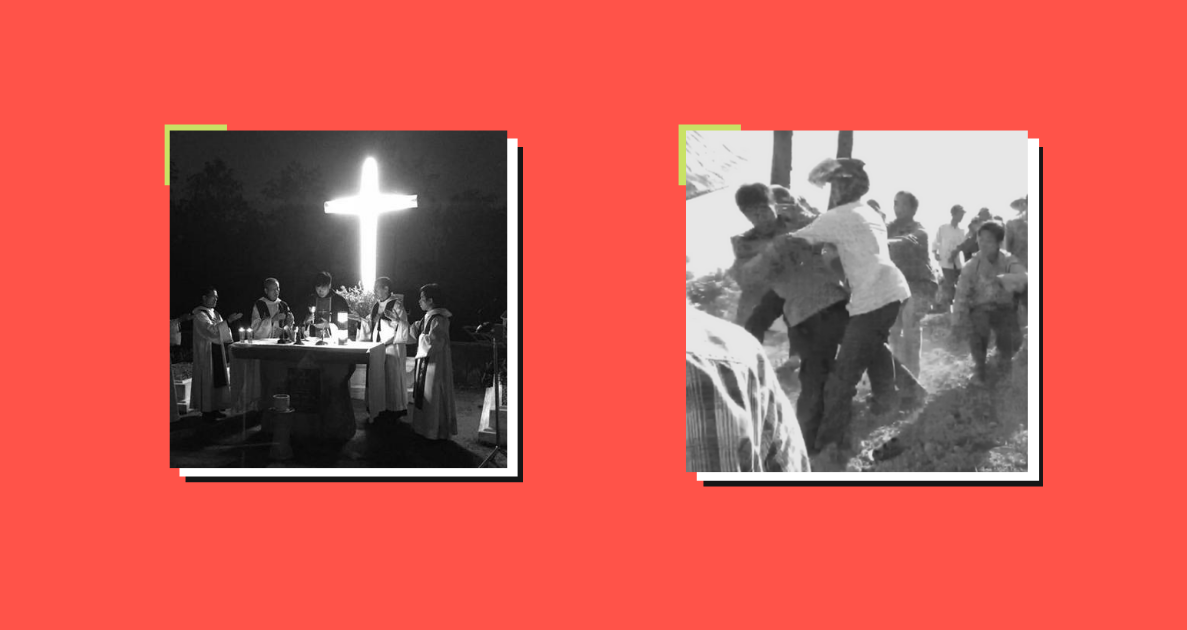
  • Thien An Abbey – 45 Years Under The Government’s Fist

    Thien An Abbey – 45 Years Under The Government’s Fist

    “Thien An” means “heavenly peace”, but the Catholic monks here have never lived in peace.

    In the 45 years since Saigon fell to the Communists in 1975, the monks of Thien An Abbey have only known hard labor and study, and resistance against forces hell-bent on taking their land by any and all means.

    Thien An Hill today is no longer covered by sweeping pine forests; under the government’s fist, the trees have all withered away. The authorities have coercively taken the land by using thugs. The monks defend themselves using the only weapon they have: prayer.

    Once sacred and picturesque, the area has now become anything but. How did this come to pass?

    Thien An Abbey is born on Thien An Hill

    1940 – 1943: The abbey comes into existence

    In 1940, Father Romain Guilauma, a French missionary, purchased a piece of land on today’s Thien An Hill. The place resembled a miniature Da Lat and was only about 10 km away from the center of Hue. Father Guilauma built a thatched cottage on the land to receive monks from the Order of Saint Benedict. The land is currently situated in Cu Chanh Village, Thua Thien – Hue Province.

    Antonin-Fernand Drapier, the French Resident Superior of the Holy See, said a celebratory mass upon the opening of the abbey on June 10, 1940. The abbey was given the name “Thien An”, meaning “heavenly peace”.

    https://2xjs7y10oiyz26vqxu2hok6y-wpengine.netdna-ssl.com/wp-content/uploads/2020/08/e6.jpg
    From 1940 to 1943, monks studied under the thatched roof of this cottage. They also dug lakes and planted orange groves. Source: Thien An Abbey.

    1943 – 1965: Digging Lake Thuy Tien, planting pine forests

    During this time, monks expanded the abbey’s footprint, building structures, cultivating the land, and raising livestock to achieve self-sufficiency.

    The abbey built a chapel and a three-story building with 28 rooms in 1943. In 1956, the abbey began construction on a second three-story building, with 38 rooms on the upper two floors.

    The pine forests on Thien An Hill were almost certainly planted by monks during this time period. Furthermore, according to the Hue Festival, monks also dug two large lakes (Upper and Lower Thuy Tien), which provided water for the entire area.

    From then on, these lakes and pine forests became one of Hue’s hidden getaways and the area began to be referred to as Thien An – Lake Thuy Tien.

    https://2xjs7y10oiyz26vqxu2hok6y-wpengine.netdna-ssl.com/wp-content/uploads/2020/08/e5.jpg
    Archbishop Philipphe Nguyen Kim Dien blessed the church cellar and the stone altars in 1965. Source: Thien An Abbey.

    1965 – 1975: Re-issuing a copy of  the “parcel map”

    In 1969, Abbot Thomas Chau Van Dang asked the Thua Thien provincial Land Office (under the Republic of  Vietnam) to reissue “copies of relevant land registers and maps”, lost after the violent Tet Offensive in 1968.

    The abbey stated that the Land Office provided it with “a copy of the parcel map”, that showed an area of 107 hectares.

    According to the map, abbey land bordered Upper Duong Xuan Village to the north, Bang Lang and Kim Son villages to the south, Minh Manh Road to the east, and Bara Dam and Cu Chanh villages to the west.

    Monks have stated that these 107 hectares of land are predominantly pine forests, punctuated by a fish farm, a dam, an elementary school, an orphanage, Duc Me (Mother Mary) Hill, and Thanh Gia (Cross) Hill.

    https://2xjs7y10oiyz26vqxu2hok6y-wpengine.netdna-ssl.com/wp-content/uploads/2020/08/3-compressed-2.jpg
    Monks of Thien An Abbey in 1966. Source: Ngy Thanh/PBase.

    Four decades of unrest

    1975 – 2000: Abbey land is turned into an amusement park and private villas are also built on the site

    After the Communist victory in 1975, religious establishments no longer had a voice. They had to follow the orders of the revolutionary government, no matter how backwards these orders were.

    In January 1976, the head of Hue’s Office of Agriculture and Forestry asked the abbey to “cede” a school it no longer used to house workers. The office began using the school before the abbey had agreed to cede the property.

    Afterwards, the abbey said, the government garrisoned troops on abbey land and asked the monks to hand over its dispensary, orphanage, and one hectare of land. The abbey faced with no choice and had to agree. A fish pond was also later requisitioned.

    https://2xjs7y10oiyz26vqxu2hok6y-wpengine.netdna-ssl.com/wp-content/uploads/2020/08/e4.jpg
    The front (above) and back (below) of the abbey’s elementary school before 1975. Source: Thien An Abbey.

    The land dispute over Thien An Hill took on another layer of complexity when the central government became involved.

    In November 1999, the People’s Committee of Thua Thien – Hue Province recommended that the government confiscate Thien An Hill to construct an amusement park. A month after, Vietnam’s prime minister decided to take over more than 49 hectares of the abbey’s land and rent it to the Ancient Capital Hue Travel Company (a state-run business) to build the Thuy Tien Lake and Thien An Hill Amusement Park.

    In the process of confiscating the abbey’s land, monks stated, the government wrongly used an order for uncultivated land, which meant the government could confiscate lands without providing the abbey with any compensation or advance notification; as such, the abbey was neither compensated nor notified that the land had been taken.

    The abbey petitioned the government regarding the wrongful confiscation of the land, stating that the government lacked jurisdiction according to the Land Law at the time.

    https://2xjs7y10oiyz26vqxu2hok6y-wpengine.netdna-ssl.com/wp-content/uploads/2020/08/e3.jpg
    Source: Thien An Abbey.

    Also in 1999, Boi Tran Villa, a restaurant and an exhibition hall for an individual, Ms. Phan Thi Van’s paintings, was constructed. The abbey said that the villa’s land was previously the abbey’s orange grove, which the Tien Phong Forestry School had partitioned off and sold.

    The forestry school later became the Tien Phong Forestry Company, owned by the People’s Committee of Thua Thien – Hue Province.

    2000 – 2010: The state “does not recognize” the 107 hectares of abbey land

    Before the abbey’s petition was even addressed, the Thuy Tien Lake amusement park opened in 2001, with more than 70 billion dong (US$3million) in investment.

    In 2002, Vietnam’s State Inspector General addressed the abbey’s petition, responding that: “The State does not recognize Thien An Abbey’s land usage rights for the 107 hectares of land and pine forest on Thien An Hill.”

    What’s even more strange is that while the State Inspector General pointed out that “the entirety of the land and pine forest on Thien An Hill” had been given to the Tien Phong Forestry School in 1976, the abbey was completely unaware of this.

    The abbey continued to oppose the Inspector General’s conclusion through more of its petitions to the government, stating that such conclusion did not focus on resolving the abbey’s disagreement according to the prime minister’s decision.

    The Thuy Tien Lake Amusement Park had begun admitting people from the public in the middle of 2004. However, by 2008, it was suffering heavy losses. The provincial People’s Committee later allowed another company to lease the amusement park.

    In December 2008, the government issued a directive for provinces and cities to review and return to religious organizations all properties that were not being used effectively; however, none of Thien An Abbey’s properties were returned.

    https://2xjs7y10oiyz26vqxu2hok6y-wpengine.netdna-ssl.com/wp-content/uploads/2020/08/e2.jpg
    A corner of the Thuy Tien Lake \Amusement Park, abandoned after only a few years of operation. Souce: Lolivi.

    2010 – 2015: Another villa in the “special-use forest”

    The government designated Thien An Hill a “special-use forest” but continued to build villas within it.

    In 2010, the Cat Tuong Quan Retreat was constructed. The business venture was pursued by another individual, Ms. Ta Thi Ngoc Thao, aiming to provide a space for rest, meditation, and Zen study. The abbey stated that the retreat’s land was previously the abbey’s orange grove that the Tien Phong Forestry School had partitioned off and sold.

    In 2011, the Thuy Tien Lake Amusement Park was closed down due to unprofitability.

    Thien An Abbey reported that in 2013, the Thua Thien – Hue Province People’s Committee issued papers certifying Tien Phong Forestry Company’s land usage rights, which included a number of the abbey’s structures, including an internal road, a chapel, a dormitory, and a building that the Hue Office of Agriculture and Forestry had borrowed since 1976.

    https://2xjs7y10oiyz26vqxu2hok6y-wpengine.netdna-ssl.com/wp-content/uploads/2020/08/7-compressed.jpg
    Cat Tuong Quan Retreat seen from above. Source: Tripadvisor.

    2015 – 2017: Conflict escalates, a statue of Jesus smashed

    From the beginning of 2015, peace was shattered on Thien An Hill as the gentle lands became anything but.

    The abbey said that beginning in January 2015, the government proposed multiple times that the abbey accept a measly 18 hectares of land so that their claims would be entered into the official registry. The abbey refused.

    In May 2015, monks discovered that a statue of Jesus belonging to the abbey had been smashed and scattered in the wilderness.

    At the beginning of 2016, a group that included police, cadres, employees of the Tien Phong Forestry Company, and reporters entered the abbey to investigate the chopping down of numerous pine trees. Afterwards, the monks were rounded up by investigators allegedly for the crime of deforestation. The monks stated that an article in the Vietnam Law Newspaper slandered the abbey, falsely accusing it of deforestation and obstructing officials.

    In March 2016, a statue of Jesus that had just been put up was pulled down by a group of women, civil defense officers, and cadres mobilized by the government.

    In the middle of 2016, the abbey reported that the Thuy Bang commune authorities led about 200 individuals accompanied by a large excavator to halt road construction linking the abbey to a partially-completed garden. The Thuy Bang Commune People’s Committee afterwards issued the abbey a form stating that it had trespassed on special-use forest land by constructing this road.

    In March 2017, authorities continued to mobilize people to prevent the abbey from leveling land in areas the abbey claimed.

    That same month, unknown persons carved large V’s into numerous pine trees near the abbey’s dam, causing them to slowly wither and die.

    https://2xjs7y10oiyz26vqxu2hok6y-wpengine.netdna-ssl.com/wp-content/uploads/2020/08/e.jpg
    Many of the abbey’s pine trees had deep V’s etched into their bark, causing them to slowly die. Source: Thien An Abbey.

    In May 2017, the government continued to allow numerous individuals to arrive at the abbey and disrupt renovation work on the abbey’s claimed land.

    At the end of June 2017, a statue of Jesus and the Holy Cross was resurrected only for the government to pull it down again. A number of monks were injured in the incident, but were unable to get to the hospital for treatment because police had set up traffic barriers blocking exit from the abbey.

    After that scuffle, the provincial People’s Committee met with abbey representatives, but the conflict remained unresolved. The committee stated that the prime minister’s statement in 1999 and the State Inspector General’s decision in 2002 were “faultless and should remain as is”.

    ***

    On July 25, 2017, the abbey reported that the provincial People’s Committee had responded to a number of the abbey’s grievances regarding the piney hill:

    First, the abbey’s school building was demolished according to the government’s 1976 Decision 188/CP because the school was a “remnant of land possession and colonial exploitation…”

    Second, the land which the Cat Tuong Quan Retreat sat on originally belonged to the Tien Phong Forestry School, which transferred it to a residential household in 1984; this entity then passed it onto another household, which then passed it onto the retreat.

    Third, the owner of the Boi Tran Villa purchased land for his/her villa by combining purchases from two different households: one from the household that passed the land to the Cat Tuong Quan retreat and the rest from another household.

    Fourth, regarding another household that was supposedly using abbey land, the committee stated that this household was sitting on land that the forestry school had granted to the family in 1984 to start a garden and build a house.

    The abbey argued that the committee’s explanations were not convincing, especially since land survey records remain conspicuously missing.

    ***

    On December 18, 2017, commune authorities blocked monks from setting up a Christmas welcome gate on an internal road leading into the abbey.

    Approximately one week later, the abbey reported that Phan Ngoc Tho, the vice-chairman of the Thua Thien – Hue Province People’s Committee, proposed that the Order of Saint Benedict and the Provincial Vietnamese Order of Saint Benedict no longer designate Father Nguyen Huyen Duc as the abbey superior and that he should be transferred out of the province.

    2018: Year of repeated forest fires

    In January 2018, Thuy Bang commune police asked the abbey to provide a list of individuals who resided at the abbey in any form to help with on-site corroboration.

    At the beginning of March 2018, after monks felled a tree to prevent a fire, police and traffic officers, forest management, and government cadres all joined forces to obstruct the felling, ultimately confiscating the pine tree. After this event, five incidences of forest fire occurred one after the other.

    On March 4, 2018, a portion of the abbey’s claimed pine forest caught fire. After the fire, four other forest fires occurred on May 10, May 22, May 23, and July 4, 2018.  The abbey claimed that the fires destroyed about 8 hectares of pine trees that were about 60 years old.

    The landscape of the fire on July 4, 2018, taken from the Abbey’s bell tower.

    In June 2018, Phan Ngoc Tho became the chairman of the Thua Thien – Hue Province People’s Committee after his predecessor retired early.

    On July 18, 2018, the abbey reported that a group of employees from the Tien Phong Forestry Company had entered the burned land on July 4 to plant pine trees but were stopped by the abbey.

    In December 2018, the abbey continued to demand the Tien Phong Forestry Company return the school it had borrowed from the abbey.

    2019 – 2020: Strains continue to worsen

    On the night of April 19, 2019, about three hectares of old pine trees that had grown for more than 60 years burned completely. According to the abbey, Tien Phong Forestry Company regularly claims that it manages the land but it did nothing to stop the burning.

    The fire happened on April 19, 2019. Source: Thien An Abbey Facebook.

    The abbey reported that this fire and the previous five fires were ignored by firefighters and that the government, which has released no public information about the events, failed to carry out an investigation into the damage.

    In May 2020, Thua Thien – Hue provincial authorities announced that they would transform the dilapidated Thuy Tien Lake Amusement Park into a “cultural park to serve the community, a state-of-the-art creative space, a sculpture garden.”

    About a month afterwards,  approximately one hectare of the abbey’s pine forest was hacked to pieces. Many large pine trees were sawed into, leaving deep scars that would kill the trees slowly without felling them.

    In July 2020, the abbey continued to send official documents asking for the return of the elementary school that the Tien Phong Forestry School borrowed from the abbey.

    ***

    Over three consecutive days, from August 10-12, 2020,  when the entirety of Thua Thien – Hue Province was on-guard against COVID-19, a crowd of approximately 40 people held up signs and shouted over loudspeakers at the site of a toppled statue of Jesus, demanding the abbots halt their work and return the land to them.

    Abbots recognized these individuals as committee cadres, members of the Thuy Bang commune women’s association, and familiar security and surveillance officers.

    Protests of this nature cannot be organized without the backing of local authorities. The ongoing dispute between the abbey and the government continues to escalate with no prospects of good results. We will continue to update the latest developments of this dispute in the coming months.

    Protest against Thien An Abbey on August 10, 2020. Source: Thien An Abbey Facebook.

    This article was written in Vietnamese by Thai Thanh and previously published on Luat Khoa Magazine. The translation is done by Will Nguyen.

  • Religion Bulletin – August 2020

    Discover the four common tactics the Vietnamese authorities use to suppress religious organizations in [The Government’s Reach]. In [Religion 360°], we continue coverage of the parishes resisting the government acquisition of schools borrowed after 1975, along with other news. Learn a bit about the Khmer Krom movement in [On This Day], where we discuss the arrest of a former Khmer temple head in Tra Vinh.

    If you have any suggestions or would like to join us in writing reports, please email us at: tongiao@luatkhoa.org or editor@thevietnamese.org

    [The Government’s Reach]

    Four tactics the Vietnamese authorities use to suppress religious organizations

    For years, the government has used multiple tactics to suppress religious organizations it does not agree with.  The authorities refer to their actions as “professional”, but in common parlance, these actions are more “cloak and dagger”. The following are the four most common tactics used by the government to suppress religious organizations.

    1. Organizing crowds to protest

    The land dispute at Thien An Abbey continued to escalate in August 2020. On August 10 and 11, a group of about 40 individuals organized a protest to speak out against Thien An Abbey for sitting on their and the government’s land. Protestors used large signs and loudspeakers to threaten and insult monks while standing on the disputed land. According to the  abbey, the crowd’s organizers were cadres of the Thuy Bang Commune People’s Committee, along with a number of police, as well as cadres from social organizations such as the Women’s Association.

    Crowds protest at Thien An Abbey on the afternoon of August 11, 2020. Source: Good News to the Poor.

    In May 2017, an enormous mobilized force of between 1,000 to 3,000 people organized a week-long protest to speak out against Father Dang Huu Nam, the head of Phu Yen Parish in Vinh Diocese. This force criticized the clergyman’s words against the government and his actions when he assisted parishioners in suing the Ha Tinh Formosa Co. a year after the company caused a marine environmental disaster in 2016.

    A protest opposing Father Dang Huu Nam in May 2017. Source: People’s Police

    In Vietnam, protests like these cannot be organized without the backing of the government. They’re put together to smear and lower the prestige of religious organizations that the government does not approve of.

    1. Using state media 

    The protests against the monks of Thien An Abbey were reported in detail by the Thua Thien – Hue Province state media. After the protests, Thua Thien – Hue newspapers published two articles on August 18, 2020 and August 26, 2020 accusing the monks of surreptitiously taking land and falsely slandering the authorities with accusations of oppression. Hue Radio-Television broadcast a report on the protests as well. State journalists have previously blamed the monks of Thien An Abbey for being “aggressive and uncooperative with the authorities”.

    The protests opposing Father Dang Huu Nam were also reported in-depth by scores of other state journalists. More significantly, Vietnam Television (VTV) conducted a live national broadcast on the evening of March 24, 2017, regarding priests in Phu Yen Parish. The VTV report accused the Phu Yen priests of disrupting order and security by inciting parishioners to submit litigation against the Ha Tinh Formosa Co..

    The Vietnamese state closely monitors media organizations, and journalists are not allowed to report on news that could adversely affect government interests. No independent television and radio stations are permitted to operate.

    Religious organizations today normally have to establish their own media channels or use social media to speak up for themselves. There are currently two Catholic websites actively operating: “Good News to the Poor” and “VietCatholic,” but both are blocked in Vietnam.  Independent media, such as VOA, RFA, BBC, and RFI, are also blocked in Vietnam.

    1. Using hired thugs

    According to the monks of Thien An Abbey, this land dispute has lasted more than 20 years and has always involved unidentified, aggressive individuals who assault the monks. Over many years, Thien An Abbey has faced numerous aggressive acts, including glass shards strewn across the football field, pine trees being cut down, statues of Christ being stolen and smashed, stalking, and threats—none of which are investigated by local authorities.

    An attack on monks in July 2017, which the authorities did not investigate. Source: Good News to the Poor.

    The Vietnamese authorities are well-versed in using hired agents to create physical scuffles in order for police to then respond with violence.

    On February 14, 2017, according to VOA, police infiltrated a group of people who were mobilizing to sue the Formosa Co. These infiltrators threw rocks in the direction of riot police and instigated violence, giving police a pretext to suppress the movement, injuring about 50 parishioners. Police also instigate and/or stage scenes of violence in order for state media to record negative images.

    Hired agents who were not part of the contingent hurled rocks in the direction of riot police in order to instigate violence.  Source: VTV.

    In October 2019, six independent Hoa Hao Buddhists were stopped by a mob blocking the road and were severely beaten as they were on their way to An Hoa Temple to stop the re-tiling of that temple’s original roof. The matter was not investigated by the police.

    The government use of hired thugs to instigate violence and threaten activists and religious groups is commonplace in Vietnam—and a serious problem.

    1. Harassment using administrative regulations unrelated to religion

    In 2018, Thuy Bang Commune police asked Thien An Abbey to provide a list of individuals who lived at the abbey in order for police to carry out direct inspections and corroborations.

    In June 2017, Thua Thien – Hue provincial police set up a traffic blockade to prevent parishioners and monks from entering Thien An Abbey. Simultaneously, a large scuffle broke out at the abbey itself, injuring many monks who were unable to get to a hospital because of the traffic blockade.

    This administrative harassment may seem insignificant but sometimes it is part of a larger trap to ensnare religious organizations and activists.

    In February 2018, six Hoa Hao Buddhists were sentenced to between two years of probation and six years in prison for interfering with traffic police who had prevented residents from attending the death anniversary of a fellow follower. The six were convicted of obstructing officials and disturbing public order when they protested and argued with traffic police who were purposefully checking the papers and confiscating the vehicles of those attending the anniversary.

    Local authorities regularly misuse administrative regulations as tools to punish and entrap religious organizations and to hinder activities. Authorities in a number of locations in the Central Highlands refuse to issue paperwork to independent worshippers, such as identity cards, passports, marriage licenses, and land use deeds, as punishment.

    [Religion 360°]

    Thi Nghe Parish asks for help as the authorities unilaterally change the usage rights of a parish school

    In August 2020, Thi Nghe Parish in Ho Chi Minh City asked citizens for support in demanding the return of their school, which the authorities had initially borrowed and later permanently altered the usage rights to.

    Phuoc An – Thi Nghe Private School before 1975. Source: Ogden Williams Collection.

    Vietnam does not recognize the right to land ownership. Land belongs to the state and citizens are granted usage rights.

    Before 1975, Thi Nghe Parish contributed money to build Phuoc An Private School for approximately 4,000 students. After 1975, when private schools were abolished, the parish lent the state two three-story structures and another single-story building to function as a school (named Phu Dong Elementary School).

    In 2019, when the parish was conducting a survey to build an underground parking structure for parishioners, it discovered that the authorities had granted usage rights to Phu Dong Elementary School in 2013; for six years, the parish was unaware that the school structures no longer belonged to them.

    After more than a year of petitioning, in July 2020, Binh Thanh District authorities responded, stating: “Phu Dong Elementary School, including border walls, are state property to be managed by Phu Dong School.”

    Land policy from the 2000s granted local authorities the ability to delineate to themselves the (continued) usage of religious grounds already being used by the state. If the state continues to use these religious grounds for public purposes, then religious organizations cannot ask for the return of their properties.

    Da Minh Tam Hiep congregation demands the return of a school building it lent to the authorities

    At some point in the last 44 years, the Da Minh Tam Hiep congregation’s Giuse School became a Dong Nai Province medical center.

    Nuns in the congregation stated that before 1975, 1,000 students came to study at the school every year, at both the elementary and middle school levels. In 1976, the congregation lent the school to the authorities for five years to train cadres.

    After five years, not only did the authorities refuse to return the school to the congregation, they further borrowed two rowed structures and a 6.482 square meter plot of land. These grounds were handed over to Bien Hoa General Hospital, which was then granted usage rights in 2004.

    St. Giuse School, currently of Da Minh Tam Hiep congregation. Photo source: Da Minh Tam Hiep congregation.

    Recently, the Da Minh Tam Hiep congregation is in need of activity grounds for newly-joined nuns and as senior facilities for older nuns, hence it has asked for the return of the school building it lent to the government. But similar to the situation in Thi Nghe Parish, such returns are difficult to achieve if the authorities do not voluntarily choose to do so.

    Dak Nong Province announces that it must “deal with” many new religions in the region

    In August 2020, the Dak Nong Newspaper, belonging to the Dak Nong Province Communist Party, reported that many new religions were operating illegally in the region.

    These new religions are referred to as “strange” or “heretical” religions. According to the Dak Nong Newspaper, approximately 10 of these “strange, heretical religions” have penetrated the province. Among them, the Gie Sua religion has the most followers, with 232; Falun Gong has 96; Hoang Thien Long 71; the World Mission Society Church of God 53; and the Tien Thien religion 24.

    The Dak Nong Newspaper reported that the government will resolutely eliminate these “strange, heretical religions” from the province, and will ask residents to denounce anyone following or spreading these unsanctioned religions.

    State journalists report that the Gie Sua religion was founded by an ethnic Hmong in the United States, who changed Protestant rites, such as worshipping on Sunday instead of Saturday, not recognizing the lord Jesus’ name, and not celebrating Christmas or Easter.

    According to Nghe An Newspaper, the Hoang Thien Long religion involves the spiritual worship of martyrs and “Uncle Ho” to treat diseases.

    The Khanh Hoa Newspaper states that the World Mission Society Church of God was a religion based on the tenets of Protestantism and was introduced from South Korea into Vietnam in the 2000s.

    The Tien Thien religion has yet to be reported on by state media. Information available online indicates that this religion is based on the teachings of Daoism.

    Individual punished for spreading Falun Gong beliefs

    State media reported that at least one person has been punished for spreading Falun Gong practices in August 2020.

    According to the People’s Police Newspaper,  Hai Duong provincial police arrested Ms. Le Thi Thoa, 61, as she was “illicitly spreading Falun Gong” in an alleyway in the city of Hai Duong. She was fined 300,000 dong (US$13).

    Ms. Le Thi Thoa was arrested by investigators and punished administratively. Source: People’s Police.

    Though the government has not made any formal pronouncements about Falun Gong, local authorities uniformly see it as heretical and forbid people from promoting the  movement.

    A number of religious prisoners unable to receive foodstuffs, medicine, and supplies due to COVID-19

    Hua Phi, Cao Dai leader and member of the Inter-religious Council of Vietnam, told RFA that the authorities were not allowing religious prisoners to receive foodstuffs, medicine, and supplies due to COVID-19.

    Near the end of July 2020, COVID-19 resurged in a number of cities in Vietnam, and detention centers and prisons temporarily discontinued outside visits. These detention centers became disease hotspots, such as in Da Nang, where outside visits and deliveries for prisoners were temporarily halted.

    However, in other cities and provinces, a number of families of non-political and non-religious prisoners were still able to send in medicine and supplies.

    Current regulations allow these detention centers autonomy in determining visitation and outside delivery policies. There’s a high possibility that these centers are using COVID-19 as a pretense to punish religious prisoners.

    Authorities finally recognize Lai Chau Parish as a religious organization after more than 13 years of applying

    On August 21, 2020, the Lai Chau Province People’s Committee permitted the Hung Hoa Diocese to establish the Lai Chau Parish as a legal religious organization.

    According to Father Phero Pham Thanh Binh the Epsicopal See of Hung Hoa Diocese had been requesting that the authorities recognize Lai Chau Parish as a legal religious entity since 2007, a request that has only just now been accepted.

    The 2016 Law on Faith and Religion stipulates that an organization granted a certificate of registration must operate for at least five years and meet a number of other requirements before it is officially recognized as a religious organization. In actuality, however, the authorities often drag their feet in granting legal status to any religious organization.

    Hung Hoa Diocese manages parts of the north of Vietnam, including the entirety of Phu Tho, Yen Bai, Lao Cai, Lai Chau, Dien Bien, and Son La provinces, a portion of Hoa Hinh, Ha Giang, and Tuyen Quang provinces, as well as the city of Hanoi.

    According to the head of the Hanoi Episcopal See, Giuse Vu Van Thien, Hung Hoa Diocese has faced many difficulties, because the religious policies are different from province to province: “Some policies are relaxed, but some others are difficult. Some of the policies have limited government interference, but some are overbearing. And there are others that even have cadres announcing white zones which means there are no religions in that locality at all”.

    [On This Day]

    The imprisonment of a Khmer temple’s former head and the Khmer Krom Movement

    At the end of July 2010, Tra Vinh provincial police imprisoned Thach Sophon, the former head of a Khmer temple, after investigating him for a case that occurred in April 2010.

    Thach Sophon was arrested July 29, 2010, two days after he left the priesthood. The government stated that his arrest stemmed from an incident in April of that same year, in which the temple he headed held a suspected burglar in captivity for a night before bringing him to police. More than a month after his arrest, he was  still not  allowed to see his family or any lawyers.

    According to RFA, the human rights group Khmers Kampuchea-Krom Federation (KKF), which advocates for the rights of Khmer living in Vietnam’s Mekong Delta region, raised objections to Thach Sophon’s detention. The federation stated that he was arrested because the government suspected he was linked to the Khmer Krom movement. In 2006, the federation said, a disciple of his was accused of anti-state propaganda but was able to escape to Thailand before being detained. Another disciple confirmed that Thach Sophon had been monitored by the authorities since 2005.

    In September 2010, Thach Sophon was sentenced to nine months of probation for illegally detaining another person.

    These events pushed many human rights groups to suspect that the authorities intentionally arrested Thach Sophon to interrogate him about the Khmer Krom movement. When this proved unsuccessful, they framed him with a case that occurred three months earlier.

    The Khmer Krom Movement

    The Khmer Krom movement picked up strength during the 2000s and still operates, though it no longer draws as much attention. It is a movement that peacefully advocates for the rights of local Khmer living in Vietnam, including Khmer monks. Many Khmer Krom organizations participate in the movement, but the predominant one is the The Khmers Kampuchea-Krom Federation (KKF), whose website is currently blocked in Vietnam.

    The Khmer Krom movement advocates for human rights in Vietnam for the Khmer ethnicity, including their freedom of religion, freedom of association, freedom of expression, freedom of information and the press, land rights. It also includes medical right, the environment, and local culture.

    However, the Vietnamese authorities still see the movement as a seditious one that unites Cambodian citizens and Khmer living in the Mekong Delta against the government. In August 2010, Vietnam requested that Cambodia resolutely shut down this movement. In 2014, many large protests broke out demanding human rights for Khmer living in Vietnam.

    The temporary confiscation of a Khmer monk’s passport after an alleged violation of the Cybersecurity Law in February 2020

    In February 2020, Long Phu district police in the province of Soc Trang interrogated a 36-year-old Khmer monk of Cambodian citizenship named Seun Ty, confiscating his passport for two weeks.

    “They interrogated me and pressured me to confess to violating Vietnam’s Cybersecurity Law after I shared a Radio Free Asia (RFA) interview with Mr. Tran Manrinh, a representative of KKF,” Seun Ty told Voice of America. ‘They used this action to accuse me of violating the Cybersecurity Law.”

    Long Phu district police had threatened to bar him from entering Vietnam or fine him 30 million dong (US$1,298). After human rights organizations forcefully spoke up, his passport was returned after two weeks.

  • Vietnam: What Does The Government Committee For Religious Affairs Do With More Than 64 Billion Dong Every Year?

    Vietnam: What Does The Government Committee For Religious Affairs Do With More Than 64 Billion Dong Every Year?

    This article was first published on 06/21/2020 in Vietnamese by Luat Khoa Magazine with Thái Thanh as the author. The English translation was first published by the US-Vietnam Research Center at the University of Oregon.

    ***

    In simplest terms, the Government Committee for Religious Affairs is the “church” of all churches in Vietnam.

    As you read this article, the Government Committee for Religious Affairs is burning through its 64.9 billion dong (US$2.8 million). Though details of its budget are not made public, we know only 60.7 billion dong are used for committee activities.

    At the local level, Luat Khoa has read through all 2020 budget estimates for Vietnamese provinces and cities, but only 14 provinces have enumerated the amounts distributed to their provincial and municipal religious committees.

    In 2020, the religious committees of these 14 provinces and municipalities were provided 33.965 billion dong. If this number is extrapolated to include all 63 cities and provinces, the approximate total would reach more than 152.840 billion, equivalent to about 60 percent of the 2020 budget for Vietnam Television (VTV).

    Phu Tho Province has earmarked 600 million dong of a budgeted 1.885 billion dong (~78,000 USD) to celebrate festivities and welcome religious dignitaries.

    In Thanh Hoa, the provincial religious committee is allotted 5.14 billion dong, five times the amount given to the province’s SOS Children’s Village; what this money is used for, however, is not publicly disclosed.

    (Source: estimated 2020 provincial budgets; Unit: million dong”)

    The numbers above do not include the budgets provided for hundreds of religious affairs offices at the urban district, district, and provincial city levels.

    But what do the Government Committee for Religious Affairs and local religious offices do anyway, and are they worthy of taxpayer money?

    Back then, back then…

    According to the Government Committee on Religious Affairs, the forerunner to the committee was established in 1955 as the “Central Committee on Religion”, directly responsible to the prime minister’s office.

    At the time, the task of this committee was to: “Network with religions, and in particular, implement their abilities to mobilize”.

    But given the partition of the country at the time, in what ways did this committee “network” with and “mobilize” religions?

    Zen master Thich Nhat Hanh has written in The History of Vietnamese Buddhism that in the north, no Buddhist periodicals were allowed to be published, no Buddhist institutes were allowed to accept disciples, no prayer books were printed, orphanages were shuttered, monks under the age of 30 had to give up their robes and don army fatigues or peasant garb to produce (for the state), churches no longer had anything with which to practice and their land had to be “donated” to the state in order to build socialism. [1]

    Monks who disagreed with the government were quickly isolated until their deaths, as happened with the Venerable Thich To Lien, Venerable Thich Vinh Tuong, and Venerable Thich Tri Hai.

    In 1975, this northern tradition of controlling and subjugating religion was applied to the south. Scores of self-immolations by monks and nuns occurred to protest the discriminatory religious policies of the new government. Arrested monks were sent to re-education camps, tortured, and some even died in prison, such as the Venerable Thich Thien Minh. Others were confined to wheelchairs after their time behind bars, such as Venerable Thich Tri Quang.

    Up until the late 1980s, the government saw religion and popular faiths as impediments on the path to socialism. Hoa Hao Buddhism and the Cao Dai religion were seen as “heresies”, tools of foreign countries.

    It was not until the 90s that the Communist Party of Vietnam began to accept that religious morality was compatible with “Doi Moi” policies.

    The Government Committee on Religious Affairs at the time had the dual task of controlling and utilizing the power of religion; ancestor worship was no longer seen as superstition. Boat people were called to return home to pay respects and send foreign currency to relatives.

    By the late 1990s, the Cao Dai religion and Hoa Hao Buddhism were both begrudgingly accepted by the state after millions of followers had suffered more than 20 years of government discrimination.

    And now, and now…

    Three recent activities carried out by the Government Committee on Religious Affairs give us a good overview of what the body does currently, outside of its tasks of issuing regulations and controlling the publication of religious works.

    The first has to do with Dinh Quang Tien, the head of Cao Dai Affairs, meeting with the Tien Thien Cao Dai Church to prepare for the All-sect Congress of Nhon Sanh Representatives.

    According to the Government Committee on Religious Affairs, during this meeting, Mr. Tien directed the church’s internal affairs, “building regulations regarding public dignitaries and functionaries and regulations resolving petitions and complaints; and publicly electing dignitaries with sufficient qualifications for the Church’s Senate, Standing Committee, and Chambers.”

    The second concerns deputy head Tran Thi Minh Nga chairing a seminar on “Deviance within Religious Activities in Vietnam Today”, with the participation of the Fatherland Front, the Ministry of Public Security, and the Ministry of Culture, Sports, and Travel.

    Not only does it control religions within the country, but the Government Committee on Religious Affairs also extends its arm overseas.

    On June 18, 2020, leaders of the Government Committee on Religious Affairs and the State Committee on Overseas Vietnamese held a meeting regarding the religious activities of the five million Vietnamese living overseas.

    During this meeting, the Committee confirmed that the latter organizes annual trips overseas to “meet with communities, understand their sentiments and aspirations, exchange views with local authorities, and suggest ways to help Vietnamese communities with religious and spiritual activities”.

    On the Committee  website, its regularly-posted activities include organizing conferences and visiting local and overseas locations to conduct business with religions and the relevant city and provincial authorities. However, this committee does not publicize its budget as other bodies do.

    In its 2020 budget estimate, this committee is the only body in the Ministry of the Interior to provide 1 billion dong for environmental protection activities. A portion of this money appears to be earmarked for the “National Conference on the Role of Religion in Protecting the Environment and Responding to Climate Change”.

    Today, the Government Committee on Religious Affairs has become the “Church” of all churches in Vietnam, at once interfering in the internal affairs of religions while also trying to determine the “religious standards” for society.

    Different from democratic countries, where religious organizations operate independently, religious organizations in Vietnam that want official recognition must operate as though they were a government body. On that front, the Government Committee on Religious Affairs functions as an intermediary for the state to control religious activities.

    Laudable “achievements” that have yet to be lauded

    The Government Committee on Religious Affairs also has its share of achievements which have not been shared on its website.

    Currently, in Thailand, there are more than 1,000 Montagnards who are religious refugees. They fled their villages in the Central Highlands with their  families and went to Thailand after being harassed and oppressed, and some were even jailed for many years for wanting to practice their religions freely or demanding the return of land to locals. Some went separately with their families, while others traveled together in large groups; some even had the misfortune of falling victim to human trafficking networks.

    In Dien Bien, the authorities forced residents to sign a pledge renouncing the “Gie Sua” religion. A lieutenant colonel from a provincial border guard post stated that he went from house to house, rationalizing the reasons, and then asked residents to sign a pledge renouncing the religion.

    The Unified Buddhist Church of Vietnam,established in 1964, was no longer recognized by the government in 1975. Leading members of the church were closely monitored; Venerable Thich Quang Do was under surveillance until his death, and Buddhist temples regularly faced harassment from the authorities.

    In An Giang Province, independent Hoa Hao Buddhists organize every year to mark the day the religion’s founder disappeared from his home. Many scuffles have broken out between independent Hoa Hao Buddhists and police, with many followers handed lengthy jail sentences  for “obstruction of officials”.

    Independent Cao Dai followers are struggling with “state-run Cao Dai” to protect the former’s remaining temples. On June 18, 2020, in the city of Tuy Hoa, Phu Yen Province, “State-run Cao Dai” tried to confiscate the Hieu Xuong Temple, which belonged to independent followers.

    From 2009 to 2019, the number of followers of the Cao Dai religion and Hoa Hao Buddhism has decreased dramatically.

    The Cao Dai religion has lost approximately 76 percent of its followers. Of approximately 2.4 million followers in 2009, only 556,234 remain, according to the 2019 Census.

    Hoa Hao Buddhism has lost nearly a third of its followers compared to numbers from 2009. Follower count has decreased from 1,433,252 in 2009 to 983,079. During his return to Vietnam in 2007, Zen master Thich Nhat Hanh suggested that the state dissolve both the Government Committee on Religious Affairs and the police division overseeing religion because they did more harm for religion than good.

    He stated that this police division and the Government Committee on Religious Affairs were erroneous emulations from China and lamented that the Vietnamese government still held onto them.

    Reference:
    [1] Việt Nam Phật giáo Sử Luận (Translated: The History of Vietnamese Buddhism), Nguyễn Lang (pen name of Thich Nhat Hanh), p. 744.

    ***

    The original Vietnamese version of this article is on Luat Khoa Tap chi. Translated by Will Nguyen.

  • Religion Bulletin – July 2020

    Religion Bulletin – July 2020

    The Report on Religious Freedom in Vietnam is published each month. If you would like to contribute information to the report, please send it to tongiao@luatkhoa.org or editor@thevietnamese.org.

    In the [The Government Hand] and [On This Day] we explore why religions are not able to grow in the face of strict government discriminatory policies regarding land rights. In the section [Religion 360°] read about how the government continues to harass Falun Gong proselytizers, about four religious rights activists in the Central Highlands who were interrogated and other monthly news. The [Did You Know?] section may surprise you with the news that there are four religions that have suffered as much as a 90 percent loss of followers.

    The Government’s Hand

    Land Rights Disputes and Discriminatory Governmental Policies to control the growth and development of religious organizations

    For more than 45 years after the fall of Saigon, religious organizations continued to demand that the government return their lands and real properties which the authorities had “confiscated or borrowed”. A few of these real properties were turned into restaurants or hotels, while some others had been turned into hospitals and government buildings during the last four decades.

    The long wait to for the return of land and real properties that the government “borrowed”

    On July 18, 2020, Thien An Monastery submitted a petition to the People’s Commission of Thua Thien – Hue Province and the Tien Phong Forestry Company to demand the return of St. Mary’s School, which the government had “borrowed” (in reality, it was a forced extortion) in 1976. Tien Phong Forestry Company is owned by the People’s Commission of Thua Thien – Hue Province.

    From the allegations in the above-referenced petition, the government transferred the right to use St. Mary’s School and its related real property and land in close proximity to Tien Phong Forestry Company. Thien An Monastery alleged that the Tien Phong Forestry Company had sold or given these real properties to people and businesses to build personal villas and restaurants.

    Petition dated July 18, 2020. Photo courtesy: Thien An Monastery 

    After 1975, the new regime interfered with the land rights of religious organizations in the south of Vietnam. The government extorted the lands of “unrecognized” religious organizations such as Hoa Hao Buddhism, Cao Dai, and the Baha’i Faith. For the “recognized” and larger religions, such as Catholicism and Buddhism, the government “borrowed” real properties and land from them.

    Until the 2000’s, land disputes between the Catholic Church and the Vietnamese government continued to be tense as the regime began to permanently transform the land and real properties it had taken from religious organizations into development projects for both private enterprises and government businesses.

    In 2013, the Archdiocese of Hanoi announced that there were 95 homes and real properties of the archdiocese currently being extorted by the government. In Ho Chi Minh City, about 400 homes and lands of the Catholic Church were confiscated by the government after 1975.

    At the end of 2008, the government issued Decision 1940/CT-TTg to direct local authorities to review the lands and real properties which used to belong to religious organizations that the government confiscated or borrowed since 1975. In that decision, the government advised the local authorities to reassess how the lands and real properties that belonged to the religious organizations had been used so that they could decide if they would continue their use, return them to the organizations, or give the organizations other real properties to replace the ones that had been taken.

    The details of how Decision 1940/CT-TTg was carried out in reality were not widely publicized. But we have found a report from the Government Committee for Religious Affairs in 2011 that summarized the results of over 2 years in compliance with Decision 1940/CT-TTg. The government stated that 7,102 religious structures in 33 provinces received the right to use land.

    However, in 2015, Vietnam’s Ministry of Construction disclosed that the petitions and litigations regarding land rights involving buildings and real properties of religious organizations continued to increase and had become more complicated. These buildings and real properties all belonged to the category in which the Vietnamese government had borrowed or confiscated them.

    Following the national election in 2016, it is almost certain that the government stopped discussing this decision in Vietnam.

    At present, the land dispute between religious organizations and the government is mostly focused on the large and organized religions that have sufficient power to stand up to the government, such as the Catholic Church and the Protestant.

    The other religions, such as the Buddhist Sangha of Vietnam, Hoa Hao Buddhism, Baha’i, Cao Dai, etc., seem to have accepted the government’s arrangement, or else do not actively make public the land rights problem between them and the government.

    Religious organizations face danger when their lands and real properties are located in high-price areas that are part of the government’s planning scheme

    During the history of religious development in Vietnam, many of the real properties belonging to religious organizations were located in the highest priced lands around the country. Furthermore, with the fast economic development in Vietnam, many provincial governments have developed planning schemes for their cities which include lands belonging to religious organizations.

    In 2015, the Redemptorist Church of Nha Trang strongly protested the decision of the government to lease an abbey located in one of the highest priced lands in the city. The government confiscated this abbey from the Redemptorists Church of Nha Trang in 1978. The church petitioned many times for the return of the abbey in 1996, 2006, and 2008, but these demands yielded no results. At present,, the government has leased this abbey to a private enterprise until 2062 for the construction of a commercial building and a hotel.

    In the picture above, the abbey belonging to the Redemptorist Church of Nha Trang was confiscated by the government in 1978 (Smaller inset photo courtesy of the  459 Signal Battalion) and later became the Hai Yen Hotel. In 2015, the government continued to lease this land to build a commercial building and 40-story hotel. (Larger photo courtesy of Beau Rivage Nha Trang).

    On the location beside the Saigon River next to District One – the financial center and the local government’s headquarters of Ho Chi Minh City – the government has been trying to gradually reduce the land and real properties once belonging to the Thu Thiem Congregation of the Holy Cross Lovers.

    According to a RFA report, after 1975, the new regime “borrowed” a few schools operated by the Thu Thiem Congregation to build new public schools. In 2016, the government ordered the closure and abandonment of a cemetery belonging to the congregation. In 2018, the Ho Chi Minh City government ordered the relocation of the Thu Thiem Church to build new roads along the riverside. However, because of public outrage over that decision, one year later, the government agreed to not relocate the church, but that other real properties belonging to the church would be closed to accommodate the road building project.

    The Carmelite Church in Hanoi also faced the same dispute with the government as the Thu Thiem Congregation, but was a lot less fortunate. From 2012 to 2016, the government started to demolish churches and monasteries that belonged to the Carmelite Church located at 72 Nguyen Thai Hoc Street, Hanoi, to build a new section of Saint Paul’s (Xanh Pôn) Hospital. The government has since completely demolished the churches and the monasteries of the Carmelite Church.

    According to the Archdiocese of Hanoi, it had never authorized the transfer or donating of these lands and real properties to the government. In addition, the government is currently using four other locations belonging to the Archdiocese to run a hospital. The Archdiocese of Hanoi stated that the church and monastery of the Carmelite Church should not be demolished.

    Land policies especially designed for religious organizations

    Religious organizations in Vietnam  suffered tremendous losses when their lands and real properties were confiscated by the regime after 1975. More than that, the land policies during the last decades greatly hampered the ability of religions to grow and develop.

    The government has established and maintained land policies designed to discriminate against religious groups.

    In Vietnam, while the land theoretically belongs to all of the people, in reality, entrepreneurs and individual citizens can buy and sell land as the law allows people to “transfer and receive land usage rights.” However, religious organizations are not allowed to practice this right because they have to follow rules and regulations that only apply to religious groups.

    Vietnam’s current Land Law 2013 specifies that religious organizations may only have land when the provincial government allows them to do so. Religious organizations recognized by the government have to petition provincial governments when they want to expand their real properties and land. The provincial government will decide whether to approve a petition or not. If people want to donate land to a religious organization, then the government will need to approve the request by a religious group to receive such land. The government then will receive the title of the lands and transfer it to the religious organization.

    This policy has in fact limited the expansion of religious groups in Vietnam. Even when religious organizations gather enough money, they cannot freely buy land to expand their operations without government approval.

    In 2014, the Baha’i Faith petitioned the government and requested that their lands and real properties that were confiscated after 1975 be returned to them. The Vietnamese government recognized the Baha’i Faith as a religion in 2008, but up until 2014, it still could not operate because it did not have any locations to build structures for their religion. As a result, six years after the religion was officially recognized by the government, the Baha’i Faith still has not received any of its former land or real properties to practice their faith. Compared to before 1975 when the group owned hundreds of locations to practice their religion, nowadays, the Baha’i Faith only has two locations. One is in Ho Chi Minh City and the other is in Danang.

    Another issue with the government’s land policy is that these religious organizations have often gotten into trouble with the government.

    One example is a case that happened in June 2020 in Ninh Binh Province. After receiving land from 12 individual households who wanted to donate them to the Dong Dinh Parish, the provincial government did not give the land to the parish. Instead, it announced that it will use the land between the parish and the 12 lots that these individuals wanted to donate to build a river-bank dike.

    Dong Dinh Parish stated that the white curve in the photograph marks the donated land on which the government announced it would build a dike. Photo courtesy: Dong Dinh Parish.

    The government often announced that it had provided sufficient assistance to religious organizations to obtain lands because it did not charge any administrative fee for land rights transfers. However, in reality, this land policy has prevented the development of religions in Vietnam. Religious organizations cannot develop and expand if they cannot freely engage in transferring land usage rights like any other individual or entity in Vietnam.

    This land policy also created significant difficulty for religions that are not recognized by the government. It is illegal to practice religion on personal property in Vietnam. Therefore, religions like Hoa Hao Buddhism, CaoDaism, and the Unified Buddhist Sangha of Vietnam face the risk of being in conflict with the government.

    Religion 360°

    Police in Ha Tinh broke into the private practicing place of 28 Falun Gong proselytizers

    According to Ha Tinh Newspaper, at 3 pm on July 18, 2020, the police of Cam Vinh Ward, Cam Xuyen District, Ha Tinh Province, reported that they had disbursed a gathering of 28 people who were practicing Falun Gong exercises at someone’s residence in that area.

    A video of the incident recorded by the police showed 28 middle-aged people sitting together in front of a television, watching and practicing Falun Gong exercises.

    Lieutenant Dang The Long, the head of the Cam Vinh Ward police, stated that the gathering of people to practice Falun Gong, which is not a religion recognized by the government, was unlawful and could disturb the peace in the area.

    At present, Falun Gong practitioners often gather in public parks and on beaches to practice. So far, there have not been any reports that police were intervening in the practice of Falun Gong. However, the government does not allow people to gather in large groups in a private residence to practice Falun Gong.

    From March to May 2020, the police of Ha Tinh Province fined at least five individuals for disseminating materials about Falun Gong.

    Twenty-eight Falun Gong proselytizers in a home where the Ha Tinh Police conducted an investigation. (Top photo courtesy: Ha Tinh News). A group of Falun Gong practitioners practice at a beachside in Danang. (Bottom photo courtesy: Youtube/Nguyen Trong The).

    An Announcer of Ha Tinh Radio and Broadcasting was temporarily suspended from his job for disseminating Falun Gong materials

    On July 24, 2020, Nguoi Viet Daily News, citing information from social media, reported a disciplinary decision by Ha Tinh Radio and Broadcasting to discipline an announcer because he had disseminated Falun Gong materials.

    According to the news report, the announcer disseminated information about Falun Gong on his social media account. This conduct was found to be a violation of his company’s  “policies and internal regulations.” The order also stated that formal disciplinary action will be decided after the matter has been thoroughly investigated.

    In June 2020, a principal of a high school in Quang Tri Province was disciplined after he gathered a group of people to practice Falun Gong at his house.

    Four religious rights activists were investigated by the police after meeting with a group from America about the freedom of religion in Vietnam

    Independent journalist Vo Ngoc Luc reported that on July 17, 2020, Pastor Nguyen Ngoc Khanh was interrogated by the police of Buon Me Thuot City, Dak Lak Province. The police stated that the interrogation was related to a “meeting with foreign individuals and organizations.” Prior to his interrogation, Pastor Nguyen Ngoc Khanh had met with a group from the United States to discuss freedom of religion.

    Similarly, Mr. Y Kuan E Ban (often referred to as Ama Sim) was also interrogated by the police of Cuor Dang Ward, Cu M’gar District, Dak Lak Province. The local authorities came to his house during the night of July 15, 2020 and asked him to cooperate with them. The local government  investigated him at his home and stated Y Kuan E Ban “had practiced Protestantism unlawfully” with 40 other people and asked him to go to the People’s Committee Office of the ward the next day. The next day, Y Kuan was interrogated by the local authorities about his meeting with the American group about freedom of religion.

    On the left, the invitation to Pastor Nguyen Ngoc Khanh; on the right, the investigative report of Y Kuan E Ban. Photo courtesy: Vo Ngoc Luc 

    Another case was reported by Human Rights and Justice for Indigenous People of Vietnam. Specifically, the Cu Kuin District police invited Mr. Y Quy Bdap and Pastor Y Khen Bdap to their station on July 23, 2020 to discuss “how to work together to ensure public safety in that location.”

    The invitations were sent by the police of Cu Kuin District to Pastor Y Khen Bdap and Y Quy Bdap on July 22, 2020. Photo courtesy: Human Rights and Justice for Indigenous People of Vietnam. 

    However, during the interrogation on the morning of July 23, 2020, both men were only asked about their meeting with the American group to discuss freedom of religion. The police accused them of participating in human rights work and alleged that they had made  false statements about Vietnam. Both men reported that they were threatened and verbally abused by the police during the interrogation.

    After the interrogation, the police requested that the two men  continue to be interrogated in the afternoon, but they both refused citing health reasons. In the evening, after they failed to return to the police station, the police sent seven security police to their houses and forced them to go to the station. The family of Y Qui Bdap protested and prevented the police from forcing him to go.

    Human rights activists and religious rights activists are often interrogated by the police after they meet with groups from foreign countries. The government uses this tactic to investigate the content of meetings and to also prevent activists from criticizing Vietnam when speaking with foreign officials.

    Police in Gia Lai Province publicly criticize a Montagnard in a community meeting because he was found to be involved with De Ga Protestantism

    According to the  Gia Lai Police Department Newspaper, on July 4, 2020, the police of Ia Grai District, Gia Lai Province brought a Montagnard, Puih Hong, 40, to a public criticism session at Cham Village, Grand Ward.

    Puih Hong at the public criticism session on July 4, 2020. Photo courtesy: Gia Lai Police 

    A public criticism session is a method that the police frequently use to intimidate people in the Central Highlands. The subject of the criticism session has to stand in front of his neighbors and admit to crimes he has been alleged to have committed.

    At this public criticism session, Puih was accused of distributing information about De Ga Protestantism and it was alleged that he had “defamed the religion laws and the great unity of the government.” Puih was also accused of illegally escaping to Cambodia between June 2017 to May 2020 after which the  Cambodian government deported him back to Vietnam.

    The police of Dak Lak Province allege that the Montagnard Evangelical Church Of Christ is anti-government

    On July 24, 2020, a report accused the Montagnard Evangelical Church of Christ of being anti-government and of mobilizing people to secede from Vietnam to form an autonomous region in the Central Highlands. This report was broadcasted on the Security Police Television under the Ministry of Public Security.

    In this report, the Senior Lieutenant Colonel Truong Hong Quy, who is the head of the Domestic Security Police Bureau of the Dak Lak Province Police Department, stated that a few individuals had used religion to mobilize and propagandize the people to secede and become opposed to the Vietnamese government. In this specific case, the Montagnard Evangelical Church of Christ was cited.

    Quy also said that the Montagnard Evangelical Church of Christ received financial resources from overseas to mobilize people to be anti-government.

    Colonel Nguyen The Luc, the deputy director of the Dak Lak Province Police Department, also stated that the group had used religion to engage in anti-government conduct and that it now used the Montagnard Evangelical Church of Christ. According to the police, before that, practicing De Ga Protestantism was used to mobilize people.

    This report also alleged that members of the Montagnard Evangelical Church of Christ were former members of FULRO, that they had participated in anti-government protests and were being imprisoned at re-education camps. The arrested included Y Jol Bkrong, Ksor Sun, Y Kou Bya, Y Nia Ayun, Y Nuen Ayun, and Y Nguyet Bkrong.

    Throughout this report, one can see that the Dak Lak Province Police Department has a firm belief about the character of the Montagnard Evangelical Church of Christ and that the department will try its best to dissolve the religious group.

    The Administrative Council of Hoa Hao Buddhism prevented from entering a religious location to conduct rituals

    The Administrative Council of Hoa Hao Buddhism announced that it was prevented from entering its temporary religious site in Long Giang Ward, Cho Moi District, An Giang Province from July 6-8, 2020.

    On the evening of July 8, 2020, the Administrative Council was allowed to enter the site to perform rituals to commemorate the day Founder – Master Huynh Phu So – established Hoa Hao as a religion.

    In previous years, during big celebrations to commemorate certain events and anniversaries of Hoa Hao Buddhism, its followers faced harassment and were prevented by the government from practicing their beliefs. The security police often set up posts to control followers going to their religious sites.

    On This Day

    The demolition and forced evacuation of real properties and lands of religious organizations in Thu Thiem

    According to Tuoi Tre News, as of July 2016, 22 religious sites were willing to relocate from their current locations to new places. These 22 religious sites were originally located in the area that had been assigned for the construction of the new urban compound at Thu Thiem, District Two, Ho Chi Minh City.

    The article strongly emphasized that these religious organizations agreed to transfer their lands to the government and to be moved to other locations. However, it also targeted the Lien Tri Temple and spread news that the temple was not willing to relocate like others. However, Lien Tri Temple belongs to the Unified Buddhist Sangha of Vietnam, which was organized and founded before 1975, and  it is not recognized as a religion by the current government.

    Thich Khong Tanh, the abbot of the Lien Tri Temple at the time, stated that other religious organizations were willing to relocate because they received compensation and were given lands with higher prices. At the same time, the Lien Tri Temple did not receive similar equal treatment.

    The government announced that it would demolish the temple in July 2016. On September 8, 2016, when it could not reach an agreement regarding the compensation with Lien Tri Temple, the government sent its forces to occupy and demolish the structure.

    The monks who used to live at Lien Tri Temple disbursed themselves and were allowed to live in other temples; the government has yet to compensate them.

    Thich Khong Tanh, abbot of Lien Tri Temple, sits on the grounds of the collapsed temple after the government forced its demolition. Photo courtesy: Quang Duc 

    Did You Know?

    The followers of four religions decreased by more than 90 percent

    The national census of 2019 showed that a lot of religions suffered significant decreases in the numbers of their followers, including four religions which saw a decline of more than 90 percent.

    Three of the religions, which include Ta Lon Dutiful and Loyal Buddhism, Vietnam Pure Land Buddhist Association, and Southern Buddhism Minh Su Faith, suffered more than a 90 percent decrease in the number of their followers in the past decade. The Baha’i Faith also suffered a loss of 90 percent of its followers since 1975.

    In a report published in 2017 by the Government Committee for Religious Affairs, it was reported that Ta Lon Dutiful and Loyal Buddhism had 6,500 followers. But only after two years, the Census of 2019 showed that the number of followers had fallen to just 401. Ta Lon Dutiful and Loyal Buddhism was founded in 1915 in Kien Giang Province with beliefs in Buddhism and Confucianism.

    Among the Buddhist sects in Vietnam, the Vietnam Pure Land Buddhist Association was viewed as the sect that had the most followers. The Government Committee for Religious Affairs reported that it had about 1.5 million followers and 350,000 members in 2010. Nevertheless, in 2019, the number of followers of this sect had decreased to 2,306 followers.

    The Census of 2019 also reported that the Southern Buddhism Minh Su Faith only had 260 followers. In 2010, the Government Committee for Religious Affairs reported that the group had 11,224 followers.

    The Baha’i Faith has waited 33 years for the government to recognize it as an official religion which happened in 2008. In 2010, it had about 7,200 followers. At present, the current number of followers of the Baha’i Faith is about 2,153, a 90 percent decline compared to the 200,000 followers it had before 1975.

    Furthermore, seven other religions suffered a loss of 50-80 percent in the number of their followers. Those religions include Caodaism, Tu An Hieu Nghia, Giao hoi Co Doc Phuc Lam, and Hoa Hao Buddhism. A few other religions also suffered a loss in followers during the last decade, including Buu Son Ky Huong, and Hoi thanh Minh Ly Dao – Tam Tong Mieu.

  • The Tumultuous Lives of Three Monks:  Thich Nhat Hanh, Thich Tri Quang,  and Thich Quang Do

    The Tumultuous Lives of Three Monks: Thich Nhat Hanh, Thich Tri Quang, and Thich Quang Do

    Long ago, there lived three monks: Thich Nhat Hanh, Thich Tri Quang, and Thich Quang Do. All three were well-versed in the Buddhist Dharma. Nhat Hanh spoke eloquently and wrote well. Tri Quang had talent for leadership and was trusted by the masses. Quang Dao was well-studied and excelled in foreign languages.

    Long ago, there lived three monks.

    When Ngo Dinh Diem’s regime cracked down on Buddhism, these three combined forces to fight back. Nhat Hanh campaigned overseas, calling for peace and religious freedom in Vietnam. Tri Quang led tens of thousands of monks and Buddhist adherents as they protested in Saigon. And Quang Do, the youngest of the trio, stood side-by-side with these Buddhists as they marched on the streets.

    Long ago, there lived three monks.

    When the communists arrived, the paths of these three diverged. Nhat Hanh became world-famous with his Plum Village Monastery. Tri Quang was imprisoned and refrained from speaking about politics again. Quang Do continued the struggle for religious freedom and human rights, ultimately serving the longest period of house arrest of any monk in Vietnam.

    1997

    One day in October of 1997, in a theater in Berkeley, California, approximately 3,500 people, who paid US$20 a ticket to meet their most beloved monk, sat in silence.

    A ringing bell echoed across the theater, and a monk’s voice loudly called out: “All rise!”. Zen Master Nhat Hanh, draped in a deep brown robe, lead 35 monks and nuns as they slowly spread out across the stage.

    Many in the audience clasped their hands before their chests and directed their eyes towards the stage. Sitting on a high podium next to a large, bronze bell and an arrangement of giant sunflowers, Zen Master Nhat Hanh began expounding on mindfulness. “Learn how to stop running,” he advised his audience. “Many of us have been running all our lives.”

    “Society is very individualistic, selfish, with people thinking about himself or herself alone. Each for himself, each for herself alone. But in fact even if you have the desire, the intention, to help others, it would still be difficult for you to do so, because when you are not in peace with yourself, it’s very difficult to relate to people in a peaceful way in order to help them,” he stated to reporter Don Lattin of the San Francisco Chronicle.

    By that point, Zen Master Nhat Hanh had become internationally renowned for this talks on mindfulness and world peace. After 1975, he stopped speaking to the international media about human rights in Vietnam, even though Buddhism there was suffering through hardship.

    At the same time, in a prison cell thousands of miles away from America, Venerable Quang Do was compiling a Buddhist dictionary. He was sentenced to five years in prison in 1995 for helping flood victims in the Mekong Delta. Ten years before that, he witnessed his mother pass away in hunger and poverty after the government exiled both to Thai Binh.

    In 1997, Venerable Tri Quang grew accustomed to his comfortable life. He no longer spoke about politics or peaceful resistance.

    After 1975, he was confined to a wheelchair to heal his feet, which had atrophied after government torture, according to a monk who was imprisoned with him at the time. From the 1980s onwards, the international media stopped mentioning him and the tragedies of Buddhism in the south.

    Childhood in chaos

    Born during the tumult of French and Japanese fighting over control of the country, the three monks were all witness to the historical crises of that era.

    One day in Diem Dien Village, Quang Binh Province, the mother of Tri Quang met two monks who left a deep impression on her, he relayed in his autobiography. Upon returning home, she told her husband that the family should have someone join the monastery, as the two monks had. Thus, on the eve of the lunar new year in 1938, Tri Quang shaved his head and entered the monastery at Pho Minh Pagoda; he was only 15 years old. The next year, he was transferred to Hue to study for another six years. When he was put in charge of the Quang Binh Province Buddhist Committee for National Salvation (seen as a part of the Viet Minh Front), he saw many of his classmates sacrifice their lives in the resistance war against the French.

    https://www.luatkhoa.org/wp-content/uploads/2020/04/01-Thich-Nhat-Hanh-at-16-PHOTO-PVCEB-729x1024-1.jpg
    Zen Master Thich Nhat Hanh, in Hue, when he was 16 years old. Source: Plum Village.

    In Hue, Nhat Hanh grew up the son of a man who worked for Emperor Bao Dai’s government. Nhat Hanh stated the seed of the Great Buddha blossomed within him from when he was very young. Responding to reporter Don Lattin about his childhood, he stated that while he was studying at the village school, he and his friends would go door-to-door begging for bowls of rice to give to those dying of hunger. He relayed that the kids had to decide early on who would get to eat and who wouldn’t because there simply wasn’t enough rice to go around. In 1942, Zen Master Nhat Hanh left his family and entered the monastery at Tu Hieu Temple in Hue. He was only 16.

    In the same year, a 15-year old teenager in Thai Binh traveled to Ha Dong province (today’s Hanoi) to enter the monastery at Thanh Lam Temple. He took on the Buddhist name Quang Do. He recalled, only three years after he left his family, he witnessed his master tied up and brought out to the village courtyard like a criminal, after the Viet Minh suspected him of being a traitor. His master was then denounced and executed by three bullet rounds. It was then the young 18-year old swore to himself that he would use Buddhism’s mercy, forgiveness, and non-violence to fight against fanatics and the unforgiving.

    A united sense of purpose

    After the tragedy at Thanh Lam Temple, Thich Quang Do went to study in Hanoi. During this time, Tri Quang and Nhat Hanh likely met one another in Hue.

    At the time, the Bao Quoc Buddhist Institute had just been established in Hue in 1947. A year later, Tri Quang became a teacher there, and Nhat Hanh a student.

    In 1950, Tri Quang went to Saigon for the first time, concurrent with Nhat Hanh. In Saigon, Tri Quang, along with some other monks, unified three Buddhist institutes into one, locating it at An Quang Temple. Nhat Hanh began teaching here.

    Both Nhat Hanh and Tri Quang had a common desire to unify Buddhism and develop it into a national religion [1]. Both pursued this desire through journalism.

    After the Geneva Accords were signed in 1954 and the country was temporarily divided in two, Tri Quang became the editor-in-chief of the Vien Am paper. A year later, Nhat Hanh was made editor-in-chief of Vietnamese Buddhism, but after two years, he was forced to suspend the paper after pushing for Buddhist unification too vociferously.

    During this time period, both individuals suffered enormous mental anguish. Nhat Hanh was completely “defanged” in his struggle and afterward temporarily withdrew from the limelight, retreating to a solitary location with allies in Lam Dong. Tri Quang, haunted by images of his mother being publicly denounced in 1956, wandered to Nha Trang before returning to Hue in 1960. Buddhism’s suppression (by Ngo Dinh Diem’s government) would add an extra layer of pressure on top of his mother’s tragedy.

    In 1958, Quang Do returned to Saigon after studying abroad in Sri Lanka and India. Under Ngo Dinh Diem’s religiously discriminatory regime, and the conflict brewing between the Nationalists and the Communists hanging over their heads, young Nhat Hanh and Quang Do were not able to accomplish much in the way of big tasks. But it seems all three were able to sense impending disaster for Buddhism in the south.

    In his book Intention’s Road Home, Zen Master Thich Nhat Hanh explained that in 1961, when he and his friends’ place of residence was raided, he had to retreat to Saigon for safety. During this difficult time period, he traveled to the United States, where he conducted research on Buddhism at Princeton University and then taught at Columbia University.

    https://www.luatkhoa.org/wp-content/uploads/2020/04/Untitled-design-3-1024x551.jpg
    Pictures of Zen Master Thich Nhat Hanh, Venerable Thich Tri Quang, and Venerable Thich Quang Do, taken in 1960. Source: PVCEB, AP, and Vietnamese Buddhists.

    Days of struggle

    On the night of May 8, 1963, as Venerable Tri Quang, head of central Vietnam’s Buddhist Association, stepped into Hue’s radio station together with the provincial leader to resolve ongoing protests as gunfire rang out among the Buddhist crowds surrounding the station. That night, Hue Radio did not broadcast as promised the program celebrating Vesak, recorded earlier that morning. Compounding popular anger was the fact that the government had prevented the flying of Buddhist flags. The crowds did not disperse until two in the morning. That night, many were seriously injured, resulting in eight deaths.

    In the gloom of the next morning, as Venerable Tri Quang was  resting, roiling crowds of young people began filling the streets, holding Buddhist flags. That same day, Buddhists in Saigon decided to establish the Inter-party Committee to Protest Buddhism (abbreviated as the “Inter-party”), confirming a drawn-out struggle. Venerable Tri Quang sat on the Advisory Board, while Venerable Quang Do worked as assistant to the public relations committee of the Inter-party.

    The objective of the Inter-party was to get the government to respond to five demands: withdraw the decree banning the flying of Buddhist flags, put Buddhism on equal footing with Catholicism, end the suppression of Buddhist followers, grant Buddhist monks and nuns the freedom to proselytize, and compensate for the deaths caused (during the crisis) and punish those responsible.

    In the two days following the incident at the Hue radio station, Buddhists protested spontaneously, but thereafter, they gained a sense of order and organization with Venerable Tri Quang’s direction, the monk recounted in an autobiographical short story. He also found ways for Buddhists to come to Tu Dam Temple to pray each week for those who had passed away. In Saigon, monks organized spiritual processions from one temple to the next, as well as protests and hunger strikes.

    The government only ramped up its repression; many temples in Hue were blockaded, and monks and nuns were publicly attacked. It wasn’t until Venerable Thich Quang Duc, 73, immolated himself on June 11th, 1963 that the situation improved in any meaningful way. Tri Quang traveled from Hue to Saigon to enter into discussions with the government.

    In the weeks and months that followed Venerable Quang Duc’s self-immolation, the Inter-party signed a joint communiqué with the government responding to Buddhism’s five demands. However, the government never implemented the communiqué, greatly angering monks, nuns, and the general population.

    According to Thich Nhat Hanh, at the time he was in America campaigning for religious freedom and a cessation of war in his own homeland. He appeared on television, met journalists, translated materials detailing the human rights violations in Vietnam, and pushed international organizations, including the United Nations, to intervene in the increasingly volatile situation in South Vietnam.

    As Thich Tri Quang relayed in his autobiography, on the morning of July 17, 1963, Venerable Quang Do was unable to deliver translated international press updates to Xa Loi Pagoda. That day, countless Buddhists poured into Giac Minh Temple, where the monks were on a hunger strike. These crowds quickly morphed into an enormous protest. As the Buddhist adherents tried to approach Giac Minh Temple, they were blocked by police. Venerable Quang Do was among them, directing the protests to struggle not only against the police barricade but for Buddhism itself. In his book History of the Vietnamese Buddhist Struggle, Monk Tue Giac writes that after 10 am that morning, the protests had devolved into a fighting match with police. Venerable Quang Do suffered a head injury, blood pouring down his face. Any Buddhist who had not been arrested by police returned to Giac Minh Temple, resisting as barbed wire fencing kept more than 600 monks, nuns, and adherents barricaded for 54 hours.

    https://www.luatkhoa.org/wp-content/uploads/2020/04/Xung-dot-phat-giao-1963-1024x672.jpg
    Thich Quang Do (circled) directs a protest on the streets of Saigon, July 17h 1963. Source: HORST FAAS/AFP.

    By August 20, 1963, Ngo Dinh Diem’s government was determined to restore order. A day after martial law was imposed, monks were arrested and adherents attacked. Venerable Quang Do was apprehended. Venerable Tri Quang went to the American Embassy to apply for amnesty.

    From that point until President Ngo Dinh Diem’s assassination on November 2, 1963, the struggle raged between Buddhists, the Army, and international pressure.

    In December 1963, after the struggle had succeeded, Venerable Tri Quang along with other monks established the Unified Buddhist Church, Venerable Quang Do went overseas for medical treatment, and Venerable Nhat Hanh returned to Saigon.

    While Venerable Tri Quang mobilized Buddhist adherents, monks, and nuns to continue the political struggle, Nhat Hanh was able to fulfill his wish of establishing several campuses, including the La Boi Publishing House, Van Hanh University, the Youth School for Social Services, and the Tiep Hien Congregation (a congregation centered on the full integration of Buddhism into daily life).

    https://www.luatkhoa.org/wp-content/uploads/2020/04/6206336914_6d4295429e_o-1024x707.jpg
    Thich Tri Quang walks among South Vietnamese soldiers in Danang, January 1965. Source: Christian Simonpietri/Sygma/CORBIS.

    In May 1966, Thich Nhat Hanh headed to the US to campaign for an end to the war in Vietnam. After three months, the South Vietnamese government refused to let him return home. At the time, Thich Nhat Hanh began becoming world-renowned as the face for peace in Vietnam. The next year, Reverend Martin Luther King nominated him for the Nobel Peace Prize.

    https://www.luatkhoa.org/wp-content/uploads/2020/04/06-Thich-Nhat-Hanh-at-an-airport-PHOTO-PVCEB.jpg
    Thich Nhat Hanh on his way to the United States to campaign for the end of war in Vietnam. His trip was originally planned to span three months, but after he left, the South Vietnamese government refused to let him return home again. Source: PVCEB.

    A road diverged three ways

    At the beginning of 2005, as the people proudly and warmly greeted his arrival, Zen Master Nhat Hanh was finally able to return home after more than 40 years away, accompanied by a Sangha of approximately 200 adherents. He conducted talks with audiences that included party members in Ho Chi Minh City, Hue, and Hanoi.

    Meanwhile, Venerable Quang Do lived in solitary confinement, locked in a room at Thanh Minh Zen Monastery in Ho Chi Minh City. Across the street were police whose only job was to keep an eye on him day and night.

    During his trip, Zen Master Nhat was able to visit Venerable Tri Quang but not Venerable Quang Do.

    In the eyes of the Vietnamese media, Zen Master Nhat Hanh was someone to be immensely proud of, he was “flesh and blood” who had returned to his homeland to further contribute to the people’s well being. Venerable Quang Do, on the other hand, was a boil that the government tried every means to remove. But back then, both monks were cut from the same cloth, up until the day Saigon fell.

    After 1975, as Zen Master Nhat Hanh set up his Plum Village Monastery in France, Venerable Tri Quang was imprisoned for a year and a half in a hole the size of a coffin, which he was only allowed to leave for 15 minutes each day to wash up. From then on, people no longer saw him calling for protests or making demands for Buddhism; the international media was never able to make direct contact with him again for as long as he lived.

    After the war, Venerable Quang Do along with a number of other monks fought for those who had self-immolated in the name of religious freedom and in protest of the new regime’s intention to eliminate the Unified Buddhist Church of Vietnam. In a country with no international media, no independent courts, and no freedom of association, these efforts would be in vain, the number of immolated corpses perhaps outnumbering that of the old regime. He was never able to reach a compromise with the government, up until the day he died.

    Long ago, there lived three monks: Nhat Hanh, Tri Quang, and Quang Do. When the communists arrived, the lives of these three diverged completely.

    Correction (April 12, 2020): in a version of this article, we had written that Zen Master Thich Nhat Hanh had entered the monastery at Tu Dam Temple. We wish to correct this to Tu Hieu Temple, in Hue.

    Footnote:
    [1] See numbers 2 to 28 in Buddhism Magazine, and Intention’s Road Home (Zen Master Thich Nhat Hanh).

    References:

    This article was written by Tran Phuong and published by Luat Khoat magazine on April 12, 2020. It was translated by Will A. Nguyen.

  • Religion Bulletin – June 2020

    Followers return home from the jungle, land disputes, Vietnam objects to US report.

    Many religion-related events transpired in June 2020, including a dispute between an independent Cao Dai temple and registered Cao Dai followers, and a land dispute between a Catholic parish and a Buddhist abbey and local authorities, all covered along with other news in [Religion 360°]. Find out how independent Cao Dai temples have been bullied in past years in [Did you know?].

    We welcome your suggestions and collaboration on reports. Email us at tongiao@luatkhoa.org or editor@thevietnamese.org.

    [Religion 360°]

    Three ethnic Bana arrested, but not prosecuted, for following the Ha Mon religion, after nine years of hiding in the jungle.

    Three ethnic Bana: Ju, 56, Lup, 50; and Kunh, 32, were arrested on March 19, 2020, after nine years of hiding in the jungle. Authorities allowed them to return home and did not press any charges against them.

    https://www.luatkhoa.org/wp-content/uploads/2020/07/image4-1-1024x655.jpg
    From left: Kunh (second), Ju (third), and Lup (fifth). Photo: TTXVN.

    All three were allowed to return home to “draw from experience and educate themselves before the people” in their home villages on June 3, 2020. This method is commonly used to deter residents in areas that the authorities deem susceptible to religion.

    State journalists published a flurry of articles describing the Vietnamese state’s lenient policy towards those who repent after joining religious groups not approved by the government.

    Newspapers that published stories regarding the return of these three include: Public Security, Vietnam News Agency, and Vietnam Plus.

    According to the above reports, the three were not involved in any anti-state activities or foreign organizations, but had hid in the jungle for nine consecutive years because they feared punishment from the authorities for following the Ha Mon religion.

    Independent religious practitioners in the Central Highlands often abscond to the jungle to avoid being hunted down by police. Many then proceed to contact relatives while in hiding to bring them over to Thailand or Cambodia as refugees. Services transporting people across borders are commonplace among independent religious practitioners in the Central Highlands.

    Vietnamese journalists mobilized to oppose 2019 international report on religion authored by the United States

    On June 11, 2020, many newspapers in Vietnam published articles related to a 2019 international report on religion authored by the United States.

    The articles could be divided into two categories. The first simply conveyed the Foreign Ministry’s opposition. The second asserted the American report was inaccurate and distorted the religious situation in Vietnam.

    Nation and Development, an extension of the National Committee – Forum of Compatriots for Vietnam’s Ethnic Groups, said the report was slander and contained false information regarding the religious situation in Vietnam. The paper stated that these kinds of reports serve to help “hostile forces” overthrow the state.

    The Times, a publication of the People’s Daily, stated that the United States “lacked logic” by putting out this report instead of focusing on the COVID-19 pandemic raging across the country and the “equally negative turmoil regarding African-American George Floyd”.

    The article in The Times also asserted that the American report was unable to differentiate between “those who genuinely practiced their faith or religion and those who used faith or religion to propagate superstitions and anti-government sentiments”.

    An independent Cao Dai temple in Phu Yen Province falls victim to bullying

    According to RFA, on the morning of June 18, 2020, independent followers of Hieu Xuong Temple in Tuy Hoa City, Phu Yen Province, attempted to protect the institution from their state-registered counterparts, who planned to seize the building.

    https://www.luatkhoa.org/wp-content/uploads/2020/07/3a1803c3-0abd-4b80-b5bb-4640b06c21f5.jpeg
    A dispute at Hieu Xuong Temple on June 18, 2020. Photo: Công Danhboy’s Facebook account.

    The independent Cao Dai followers told RFA that approximately 60 registered followers came with police to their temple, which was built in 1964.

    RFA quoted Hieu Xuong Temple overseer Nguyen Ha as stating that the registered followers brought an administrative order to confiscate the temple.

    Hieu Xuong Temple followers closed the gates to prevent the confiscation until 11 am that day, when the registered group dispersed.

    Overseer Cao Van Minh, who is currently managing the temple, told RFA that he simply wanted the institution to be able to practice independently.

    Hieu Xuong Temple is among a number of temples that remained independent after 1975, refusing to join the state-sanctioned Cao Dai bloc. These independent temples regularly face harassment from the authorities and the state-sanctioned Cao Dai bloc. Currently, there are no statistics on the number of independent Cao Dai temples operating.

    High school principal stripped of all party positions after practicing Falun Gong with others at his home

    At the end of June 2020, Vietnamese journalists reported on Tran Huu Duc, a 41-year-old principal of a school in Quang Tri Province, due to his affiliation with the Falun Gong.

    https://www.luatkhoa.org/wp-content/uploads/2020/07/image3-2.jpg
    Tran Huu Duc. Photo: Cua Tung High School.

    According to Traffic Newspaper, Quang Tri provincial police reported him to the Vinh Linh suburban district committee after discovering that he was propagating and practicing Falun Gong with others at his home.

    Afterward, the suburban district standing committee requested that he cease congregating people in his home and stop distributing Falun Gong materials.

    On May 15, 2020, Duc tore up the forms he had completed with the Vinh Linh suburban district committee. Shortly after, Duc also returned to them the form for party members who showed signs of infringement. After Duc’s defiant acts, the suburban district committee decided to strip him of all party positions in the 2020-2025 term, and also suggested that the Office of Education and Training discipline him.

    In March 2020, the Government Committee For Religious Affairs announced that all localities should be on strict guard for those who might try to take advantage of the COVID-19 pandemic to conduct illegal religious proselytizing. As of May 2020, local police had arrested at least 23 people for spreading Falun Gong.

    State newspapers warn against the activities of two unregistered sects

    At the start of June 2020, Voice of Vietnam’s news page reported there were currently many Protestant sects illegally operating in Vietnam.

    The article focused on two sects with South Korean origins, the Shincheonji Church of Jesus and the World Mission Society Church of God. It reported that these two religious organizations were operating surreptitiously, disrupting social order in Vietnam, and destroying familial and societal traditions.

    The article also warned residents not to participate in the activities of these two sects.

    Nguyễn Hồng Phong, vice director of the Internal Security Bureau (Ministry of Public Security) stated that Vietnam currently had approximately 70 unregistered Protestant organizations, with around 200,000 followers.

    Land dispute between Dong Dinh Parish and Ninh Binh provincial authorities

    At the end of May and beginning of June 2020, the members of Dong Dinh Parish, in Nho Quan suburban district, Ninh Binh Province, stated that they had been deceived by local and provincial authorities, who had taken their land but not returned it as agreed.

    According to information from Dong Dinh Parish, at the beginning of 2019, the parish had a back-and-forth with local authorities about the need to expand parish land.

    In April 2019, 12 households with land bordering the parish agreed to donate 4.5 hectares of agricultural land and merge it with the church.

    https://www.luatkhoa.org/wp-content/uploads/2020/07/image7-1024x669.jpg
    The large piece of land outlined in red is the 4,569 square meter piece of land that the 12 households donated to the Dong Dinh Parish in order to expand the church land outlined in orange. Photo: Dong Dinh Parish.

    On May 22, Dong Dinh Parish submitted an application to expand its parish to include the land that the 12 households had donated to the Ninh Binh Province People’s Committee, the Nho Quan Suburban District People’s Committee, and the Huu Thuong Commune People’s Committee.

    In September, representatives of the Nho Quan Religious Front guided the 12 houses in filling out the application to return the land to the government so that provincial authorities could then confer the land back to Dong Dinh Parish.

    On May 28, 2020, Huu Thuong commune authorities allowed workers onto the land that the 12 households donated to conduct measurements and announce the construction of a dyke between current parish land and the donated land to prevent flooding.

    https://www.luatkhoa.org/wp-content/uploads/2020/07/image6-1-1024x716.jpg
    The red line indicates the position of the dyke commune authorities planned to build to prevent flooding. Photo: Dong Dinh Parish.

    On May 29, parishioners decided to cordon off the donated land with wire mesh, placing seven holy statues in different places to prevent trespassing.

    Afterwards, the government, Dong Dinh Parish, and parishioners had a dialogue but were unable to reach an agreement.

    Unknown persons trespass upon Thien An Monastery’s forests

    On June 12, 2020, Thien An Monastery announced that individuals had trespassed upon the monastery’s pine forests to cut down trees.

    https://www.luatkhoa.org/wp-content/uploads/2020/07/image1-1-1024x582.png
    Bamboo groves on monastery land were surreptitiously chopped down. Photo: Thien An Monastery.

    The abbots were able to prevent the would-be choppers but do not know who organized the action. Many older-aged trees within a one-square-hectare space were cut into but not felled, so that they would die slowly of natural causes.

    https://www.luatkhoa.org/wp-content/uploads/2020/07/image2.png
    A pine tree which the abbey estimated to be more than 60 years old was deeply sawed into, ensuring its death. Photo: Thien An Monastery.

    Thien An Monastery was officially constructed in 1943 on land which today includes approximately 107 hectares of land, homes, and pine forests owned by the monastery. It is located in Thuy Bang Commune, Huong Thuy Suburban District, Thua Thien–Hue Province.

    In the past 20 years, Thien An Monastery and Thua Thien–Hue provincial authorities have butted heads over how to use the monastery’s land. Events such as forest burnings, trespassings, and authorities harassing abbots have occurred repeatedly in past years.

    In April 2019, more than 10 hectares of the monastery’s pine forests were burned in one night. According to the abbey, the area burned was only 200 meters away from the Tien Phong Arboretum but no alerts were issued.

    Did you know?

    Independent Cao Dai temples continue to be bullied over the years

    For many decades, independent Cao Dai temples have operated under duress, unsure of when their temple would be repossessed by “state-sanctioned Cao Dai”.

    The Cao Dai religion has been recognized by the state since 1997. At that time, a new sect called Sect 1997, or “state-sanctioned Cao Dai,” was established to control the religion, a move which independent Cao Dai followers inside and outside the country have criticized.

    The incident at Hieu Xuong Temple above is but one of many conflicts that have occurred over the years as Sect 1997 and local cadres try to expropriate independent Cao Dai temples.

    At the beginning of 2020, as an independent Cao Dai temple in Ben Tre Province was carrying out its normal rituals, local cadres and authorities came to “conduct work”. The independent adherents saw this as harassment and refused to cooperate.

    In 2017, the independent adherents of Hoai Nhon Temple in Binh Dinh Province were harassed by the authorities as they were preparing to carry out a ritual. That same year, Dong Thap provincial authorities harassed independent followers in Tam Nong Suburban District and repossessed their temple to give to Sect 1997. The followers in Tam Nong were then convinced by the authorities to conform to Sect 1997.

    In 2015, an independent Cao Dai family in Tay Ninh Province told RFA they were assaulted by a member of Sect 1997 when they organized a gathering at their home with other independent adherents. The family alerted the authorities, who did not intervene.

    In 2012, according to RFA, independent Cao Dai followers of Phu My Temple in Binh Dinh Province were assaulted by “state-sanctioned” adherents, injuring six people. According to the independent followers, police were present but did not intervene.

    https://www.luatkhoa.org/wp-content/uploads/2020/07/image5.png
    Photo of the scuffle that broke out between followers of the Phu My Temple and “state-organized” followers in Binh Dinh Province on September 16, 2012. Photo: DVOV/BPSOS.

    According to BPSOS, these disputes are part of plans by Sect 1997 to increase control over independent Cao Dai followers and push them to conform to the sect.

    Currently, there are no accurate and updated statistics regarding the number of independent Cao Dai temples nor any news regarding the current dispute with Sect 1997. We hope to gather more information regarding the independent Cao Dai temples in the near future. Please send any information you have to tongiao@luatkhoa.org or editor@the vietnamese.org.

  • LIV Launches Database on Religious Freedom in Vietnam

    LIV Launches Database on Religious Freedom in Vietnam

    On July 17, 2020, Legal Initiatives for Vietnam (LIV) launched its Database on Religious Freedom in Vietnam.

    LIV is a non-profit organization based in California (United States) and is the organization that oversees both Luat Khoa Magazine and The Vietnamese. You can find more information about LIV and the reason the organization is based in the United States (and not Vietnam) here.

    With this regularly-updated data, LIV hopes to begin documenting cases related to religious freedom, both past and present.

    It could be an issue related to the land dispute between the Tuy Hoa Protestant Church and Phu Yen provincial authorities. It could be the trial of an ethnic minority member from the Central Highlands who practiced Dega Protestantism or trials for those who promoted Falun Gong.

    It could also be the conflict between Hoa Hao Buddhists in An Giang Province regarding the restoration of the An Hoa Tu Temple or the scuffles between unaffiliated Hoa Hao Buddhists and local police.

    Currently, when you access this data, you will see 19 cases (among them, more than 20 events involving Falun Gong practitioners have been combined into one case), with more than 91 victims or persons directly involved. Other cases are still being updated.

    To expand the number of readers, this data content will be presented in English. After consulting the Q&A information below, you can access data regarding freedom of religion here: www.liv.ngo/data

    Why did LIV put together this database?

    The multi-faceted religions of Vietnam are a national point of pride, and the strength of religion and faith has contributed to the ability of Vietnamese to persevere through difficult periods in history.

    After April 30, 1975, however, many people became victims of the Vietnamese state’s harsh religious policies.

    Although the strict control of religion has gradually decreased over time, the state still maintains a tight spiritual grip on religion. Activities that lay outside government control or that allegedly do not support the government’s efforts to build “national unity” are all seen as illegal.

    As an organization that primarily conducts journalism, LIV has encountered many difficulties in evaluating the situation regarding freedom of religion and faith in Vietnam. Unlike cases involving freedom of speech or other political cases, those involving religion are generally not known or else fall into obscurity. For cases that are known, information is spotty and lacking. We believe that other press and human rights organizations also encounter similar problems.

    Because of this, our initial data is created by compiling information regarding cases related to religious freedom in a systematic way. We hope this data can be a useful source of information for journalists, activists, as well as readers who care about the right to freedom of religion.

    How was the data compiled?

    The compiled data is based on information coming from sources such as local and foreign journalists, as well as from human rights organizations.

    Furthermore, where such arrangements can be made, LIV will directly gather information from the people involved.

    Database information only includes cases reported by journalists and those people directly involved. We will not provide our own viewpoints regarding these cases.

    We hope readers will contribute information about cases that they are familiar with. For directions on how to contact us, please see the section “How Can I Provide Information?”

    How do I read information from the data table?

    Readers can view the data using the Air Table tool. This is an interactive spreadsheet tool that makes it easy to find information without having to switch tables.

    When you open the link www.liv.ngo/data, you will see four tables: 1. Case, 2. People (victims), 3. Case Timeline, and 4. Supporting Documents.

    https://www.luatkhoa.org/wp-content/uploads/2020/07/vrfd-2-1024x448.png
    Photo Courtesy: Luat Khoa magazine

    For information about each case, you only need to read Table 1. All information in the other, remaining tables are connected to this first one.

    In Table 1, you’ll see the name of each case in the first column, with the relevant information added across rows.

    In the next four columns, you can filter cases according to more detailed information: Related religion, Issues, Location, and Status, by pressing the “Filter” button and entering the information you want filtered.

    For example: if you want to find cases that occurred in An Giang Province, press “Filter”, choose “Location”, and pick the province of “An Giang”.

    In the three columns near the end of Table 1, including People, Case Timeline, and Supporting Documents, you can see that the information here is colored. With these three columns, you can click on the phrases in each cell to view more detailed information.

    For example, if you want to read more information about individuals related to the case of Rlan Hip, an ethnic Jrai sentenced to seven years in prison for disrupting national unity, you can press on his name in People (victims) in Table 1. Information about the victim, Rlan Hip, will appear as follows:

    https://www.luatkhoa.org/wp-content/uploads/2020/07/image1-2.png
    Photo Courtesy: Luat Khoa magazine

    The People section includes the personal information of relevant individuals, such as birthdate, ethnicity, identifying photographs, gender, and activity timelines.

    Case Timeline provides chronological summaries of cases based on information from  sources that we have quoted in the penultimate column of Table 1.

    Supporting documents can be videos, photographs, or any materials related to each case.

    Similarly, you can also filter data by Table 2. People (victims) to look at information according to gender, ethnicity, religion, and criminal prosecution.

    How can I provide information?

    We hope you can contribute to this religious freedom database as much as possible. Tell us about cases involving religious freedom that you know about or are directly involved in.

    Readers can send us information through this link: bit.ly/vuviectongiao. We’ll reach out to you as soon as possible to gather more information. You can also provide us information anonymously. Information provided will only be used for this religious freedom database and will not be given to any third party.

    As we compile and present data, it will be difficult to avoid errors, and we hope readers can take a little time to contribute their thoughts. Email us at tongiao@luatkhoa.org or religion@liv.ngo.

  • Religion Bulletin – May 2020

    The Report on Religious Freedom in Vietnam is published on the second Monday of each month. If you would like to contribute information to the report, please send it to tongiao@luatkhoa.org or editor@thevietnamese.org.

    This report will provide information on other legal provisions outside of the Code on Religion that also limit the right to freely practice religion in Vietnam, such as the regulations regarding publication as stated in the section [The Government’s Hand]. As in previous reports, you can read prominent news regarding religious freedom in [Religion 360°], in which a few followers of Falun Gong were fined when they passed out flyers that the government deemed to be illegal. [On This Day] retells the story of Vietnamese Montagnards escaping to Cambodia in 2015. Under [Did You Know?], you can also learn about the dramatic decrease of the number of people who follow Hoa Hao Buddhism and Cao Daism during the past 10 years.

    The Government’s Hand

    Imagine that you were in a photocopy shop to print some flyers about religion such as advising people to believe in Christ, or even simpler, promoting fasting and meditation under a religion that you trust.

    You have printed the flyers and will pass them out to your relatives, neighbors, friends, and even strangers who sit in the park. A few minutes later, the police come and detain you. They even take you to the police station to interrogate you, and if you voluntarily performed those acts, the police will confiscate all of your flyers and cite you for an administrative violation.

    That is what has happened to Falun Gong proselytizers who were arrested and fined when they passed out flyers that the government had not approved. From March to May 2020, there were at least 22 Falun Gong adherents who were arrested because they possessed and passed out flyers promoting their religion (find the detailed story in the [Religion 360°] section).

    This is the method that the Vietnamese government uses to control the publishing of religious materials.

    Regulations Regarding Publication under Vietnam Laws Contributed to a Tightening of the Freedom of Religion

    Under the Law on Publication 2012, Vietnam does not allow independent publishers to register and operate. Publication can only be done by those who hold permits that were issued to governmental departments, civil society organizations, and associations controlled by the Vietnamese Communist Party.

    In practice, publishing houses in Vietnam often obtain permits for book stores and book companies. Even though we can say that publication activities are getting easier in Vietnam, it is not the same situation with sensitive topics such as politics and religion.

    The Law on Publication 2012 did try to open up the regulations about providing permits for materials that are “given, gifted, or lent” (Article 4), which were not clarified in the previous code of 2004.

    The materials that were being deemed as “given, gifted, or lent ” all had to be permitted to be published. If not, the publisher could be fined for violating Article 27 for publishing and disseminating materials that were not allowed under Decree 159/2013/NĐ-CP.

    The Law on Publication 2012 also stipulates that the government forbids “publishing, printing, and disseminating” any materials that are deemed to be “superstitious” (Article 10). At the same time, only governmental departments regulating culture and religion may decide whether a material is superstitious or not. As a result, the label of “superstitious” is being applied to almost all of the new religions and beliefs in Vietnam.

    Concurrently, the government also regulated that the Committee for Religious Affairs has the sole authority to “publish Bibles, prayer books and mantras, religious teachings, fiction and religious readings produced by religions that are allowed to be practiced in Vietnam”.

    Individuals Do Not Have the Right to Publish Religious Materials

    The recent arrests and administrative fines given to Falun Gong proselytizers have been widely published in the state-owned media and serve as a warning to individual citizens that they do not have the right to distribute materials without the state’s consent, especially religious materials.

    On the other hand, the Law on Publication 2012 also stipulates that besides governmental departments and organizations belonging to the Communist Party, only businesses and entrepreneurs may apply for permits to distribute published materials (Article 36). Distribution also includes materials that could be “given, gifted, or lent”. This regulation allows the government to administratively fine individuals who distribute materials, including even those that were already permitted.

    Therefore, if an individual person wants to print, sell, or just distribute freely a published material, then he or she could be fined administratively or could be prosecuted under the Penal Code. For example, the government could deem such material as information that opposes the regime.

    Facing strict government rules and regulations regarding publishing, the new religions are continuously finding different ways to publicize their beliefs while being classified as “cults” by the regime.

    Being forbidden to distribute materials, new religious groups have found other ways to disseminate their beliefs, with social media being the most common method.

    Phap Mon Dieu Am (in Vietnamese), a new religion founded by Master Ruma, has been rising in popularity over the past few years, and has a YouTube channel with more than 24,000 subscribers and over 9 million views. People who want to follow Master Ruma can fill in an online form and wait for a “messenger” of this sect to meet with them in person and instruct them on how to practice their religion.

    [Religion 360°]

    At Least 22 Falun Gong Proselytizers Arrested

    From March to May 2020, there were at least 22 Falun Gong proselytizers detained and fined administratively in 12 provinces and cities throughout Vietnam.

    These people were arrested because they possessed flyers with information about Falun Gong and also content accusing the Chinese government of suppressing this spiritual movement.

    There was an increase in the number of arrests after the Committee for Religious Affairs announced to all provinces and cities that “cults and extremist religions” have taken advantage of COVID-19 to promote their beliefs.

    However, a few Falun Gong practitioners that we interviewed told us that practicing and promoting Falun Gong were just a voluntary act.

    According to news reports in Vietnam, these arrests were made because the people had passed out flyers without government consent, according to the Decree involving news media and publication.

    After they were arrested, each person had to pay a fine according to their own conduct and based on the flyers and the other materials that they had used to promote their beliefs. In Ha Tinh Province, a man was fined 25 million dong when he was found to be in possession of several boxes of Falun Gong materials. In Vinh Long Province, a 41-year-old woman was fined 4 million dong after she was found to have passed out four books containing information on Falun Gong at a bank.

    The central government of Vietnam has yet to decide on whether to  consider Falun Gong as a religion in the country. However, in a few provinces, the local authorities have already deemed Falun Gong a cult and so not authorized to practice in Vietnam.

    There are still no statistics specifying the number of Falun Gong proselytizers in Vietnam, but some of the members believe that their population is rising.

    However, the news media in Vietnam describes the Falun Gong with skepticism, asserting that the Falun Gong movement is illegal and also against science so the media  continues to publish propaganda to discourage people from following it.

    The number of Falun Gong adherents arrested in provinces and cities:

    Province Name Number of arrests
    1 Dien Bien 1
    2 Quang Ninh 1
    3 Thai Binh 1
    4 Nghe An 4
    5 Ha Tinh 5
    6 Quang Ngai 2
    7 Binh Thuan 1
    8 Ho Chi Minh City 1
    9 Binh Phuoc 2
    10 Dong Nai 2
    11 Vinh Long 1
    12 Ba Ria – Vung Tau 1
    Estimated Total 22

    The Government Refusal to Issue a Passport to a Catholic Priest

    On May 29, 2020, Father Nguyen Van Toan wrote on his Facebook page that he received a notice from the government rejecting his application for a new passport.

    Father Toan stated that he accidentally found out that the government refused to provide him with a passport because the Hanoi police accused him of conducting activities against the State.

    Father Nguyen Van Toan is a 40-year-old priest of the Redemptorist Church, Thai Ha Parish, Hanoi. He often criticized the government publicly at his masses and he was once arrested when he protested in Hanoi.

    The Family of a Prisoner of Conscience Ho Duc Hoa: The Nam Ha Prison Reduced Hoa’s Prayer Time to just Once a Week

    The Association to Protect Freedom of Religion said on May 25, 2020, that the family of prisoner of conscience Ho Duc Hoa informed them during a telephone call from prison that the Nam Ha Prison in Ha Nam Province, had reduced his time to read his Bible and pray. He is now only allowed to pray once a week, compared to before when the prison allowed him to pray every day.

    Ho Duc Hoa, 46, was tried in the beginning of 2013 with 13 other young activists who were either Catholics or Protestants for subversion against the state. While his co-defendants were sentenced to between two and four years in prison, Ho Duc Hoa was handed a harsh 13-year sentence.

    RFA reported in August 2019 that Ho Duc Hoa’s family received a letter from him in which he complained about his deteriorating health,  complaining about a stomach problem, an enlarged intestine, as well as  high blood pressure, hemorrhoids, and also vertebrae problems. Between May and August 2019, Nam Ha Prison denied Ho Duc Hoa’s request to go to a hospital for a medical examination.

    Restrictions on the time to read the Bible or other religious books are often reported by prisoners of conscience in Vietnam.

    [On This Day]

    Vietnamese Montagnards Who Fled Vietnam to Cambodia Rejected for Political Asylum

    In May 2015, the representative of the Vietnam Border Defence Force in Dak Lak Province confirmed that many Montagnards had fled from the Central Highlands to Cambodia.

    Colonel Nguyen Luong Hoa, the political commissar of the Border Defence Force in Dak Lak Province, claimed that Vietnamese Montagnards were being lured to Cambodia to fight against the Vietnamese government.

    According to human rights organizations LICADHO and Human Rights Watch, in March 2015, the Cambodian government confirmed that it had recognized 13 Montagnards from Vietnam as political asylum seekers at the end of 2014. However, Cambodia rejected about 100 other Montagnards who also fled from Vietnam,  including 54 people who were forced to return to Vietnam during the early months of 2015.

    In January 2015, a representative from a local human rights organization in Cambodia informed AFP that about 13 Montagnards crossed the border from Vietnam. These refugees stated that they ran away from Vietnam to Cambodia because they were fleeing oppression at home.

    In May 2015, a group representing Ratanakiri Province of Cambodia, which shares a border with Gia Lai Province of Vietnam, traveled to discuss some issues with the provincial governments of Central Highlands. During this meeting, the two sides also talked about regulating the number of Montagnards fleeing from Vietnam to Cambodia.

    The Montagnards are an indigenous people living mainly in the Central Highlands among  20 ethnicities. Beginning in the 2000s, Montagnards continuously crossed borders to flee Vietnam and escaped to Cambodia and Thailand for political asylum.

    These Vietnamese refugees stated that they were suffering a lot of oppression from the government with regard to their religious rights, land rights, poverty and racial discrimination. If they raised their voices to object, they would be persecuted. However, the Vietnamese government said that the refugees fled the country because they were lured into an anti-state scheme or because of economic hardship.

    The Central Highlands is a dangerous mountainous area and so the government has tried to isolate the people in that region from the rest of the population in the country. Until this day, independent journalists and human rights defenders could hardly contact the people who live in the Central Highlands due to these above-stated reasons.

    [Did You Know?]

    Cao Daism and Hoa Hao Buddhism Have A Lot Less Followers Nowadays

    Both of these religions were established during the time the French colonized the south of Vietnam, and they attracted many followers for decades up until 1975.

    Cao Daism Suffered a 76 Percent Decline in Followers During the Last 10 Years

    In 1930, the Cao Dai religion had about 500,000 to 1 million followers when the entire population of the south of Vietnam was about 4 to 4.5 million, according to the records collected by Jayne Susan Werner and sent to the Governor-General of French Indochina on December 14, 1934.

    According to the Committee for Religious Affairs, from 1930 to 1975, followers of the Cao Dai religion grew steadily to about 2 million.

    However, based on  an article in the Los Angeles Times, probably using information collected prior to 1975, there may be as many as 4 million Cao Dai followers. This number seems to be correct if one looks at all of the Cao Dai temples from the south to the central provinces of Vietnam.

    Yet in 2009, the Committee for Religious Affairs estimated that Cao Dai followers in Vietnam numbered only 2.4 million people.

    From the census in 2019, the population of Cao Dai followers has fallen to 556,234 people,  a 76 percent reduction since 2009.

    Hoa Hao Buddhism Suffered a 31 Percent Reduction of Followers in the Last Decade

    Just like Cao Daism, Hoa Hao Buddhism has suffered a reduction of the number of its followers during the last 10 years.

    In 2009, the Bureau for Religious Affairs of Can Tho City confirmed that there were 1.43 million Hoa Hao Buddhists in Vietnam. However, in 2019, the number of Hoa Hao Buddhists had fallen to 983,079 people, a 31 percent drop from the year 2009.

    Before 1975, there were 2 million Hoa Hao Buddhists living in the west of South Vietnam, concentrated in An Giang and Chau Doc provinces.

    What Caused the Reduction of Followers?

    We could not find any report that offered reasons relating to the drastic reduction of the followers for these two religions. We believe the reason for this reduction could be as follows:

    1. The harsh government control over these two religions

    After 1975, the new regime tried to erase these two religions but it was forced to recognize Cao Daism and Hoa Hao Buddhism after it failed to eradicate them. The government recognized Cao Daism in 1997 and Hoa Hao Buddhism in 1999.

    The independent followers of these two religions often stated that the regime only allowed the followers that  obeyed  government instructions and controls to become the leaders of the two “official” and “recognized” associations for Cao Daism and Hoa Hao Buddhism.

    After 1975, the activities of these two major religions were significantly restricted  by the government. Followers could no longer conduct charity work and education and missionary work were also forbidden, preventing the two religions from being practiced as freely as before.

    More than that, the government implemented strict punishment of any followers who opposed the government’s handling of religions, such as applying the Penal Code or suppressing and harassing critics on a daily basis.

    After the government recognized these two religions at the end of the 1990s, it also clarified how it would keep them from expanding. The religious practices of these two religions were once celebrated widely in the south of Vietnam, but are now restricted locally with strict controls by the government.

    2. Young People Distance Themselves from Religion

    The education system in Vietnam has always discouraged the discussion of religions and religious activities in society.

    Educational books often teach children about loyalty to the Communist Party and to follow the law, but they rarely discuss traditional values and religious beliefs within the community.

    The mass media is controlled by the State and newspapers, television and radio also do not discuss religion.

    We do not have statistics on the number of followers of these two religions during different times, but the current government policy is to try to stop them from developing through the enactment of a numbers of drastic rules and regulations to control religious practices.

    3. Identification Cards Are the Only Method for Counting Followers of Specific Religions

    All identification cards in Vietnam specify a person’s religious affiliation.

    In reality, to reduce potential problems involving religion, such as being discriminated against in recruitment to some governmental departments or joining the Communist Party, many families may declare that they are not members of any religion even though they actually follow a religion.

    On the other hand, some police officers put down “no religion” when processing identification cards for people, possibly  to reduce the number of followers of a religion or to reduce its influence.

  • Religion Bulletin – April 2020

    The Report on Religious Freedom in Vietnam is published on the first Monday of each month. If you would like to contribute information to the report, please send it to tongiao@luatkhoa.org or editor@thevietnamese.org.

    April’s [Religion 360°] will cover the month’s main religious developments, including the arrest of three ethnic Bahnar followers of the Ha Mon religion, the arrests of numerous Falun Gong proselytizers, and a number of other stories. We look back at the April 2004 protests over land and religious freedom in the Central Highlands in [On This Day]. And finally, [Did you know?] will discuss the custom of ancestral worship, which was almost wiped out after 1975.

    Religion 360°

    Three ethnic Bahnar arrested in March 2020 with no connection to FULRO

    According to Health & Life newspaper, three ethnic Bahnar, Ju,56, Lup, 50, and Kunh, 32 were arrested by Gia Lai provincial police on March 19, 2020, in a matter unrelated to FULRO (Front United Front for the Liberation of Oppressed Races) operations.

    Kunh revealed to investigators that he was not directed or supported by FULRO forces, and that he had only kept in contact with an individual named Y Khoet, who was a follower of the Ha Mon religion in Kontum Province.

    According to the above article, beginning in July 2012, the three arrested men would hide deep in the jungle during the day and then sneak into the village at night to talk to young people about the Ha Mon religion. On March 19, 2020, police arranged the capture of all three.

    (From left) Lup and Ju were arrested by Gia Lai provincial police on March 19, 2020. Source: D.A.

    Many arrested for propagating Falun Gong after the Government Committee for Religious Affairs warned that “new religions may take advantage of the COVID-19 pandemic”

    At the beginning of April, the website of the Government Committee for Religious Affairs announced its request to all provinces and cities to be on-guard for and prevent “extremist religious sects” from taking advantage of the COVID-19 pandemic to “assemble and incite large gatherings of people”.

    The announcement also stated that provinces and cities needed to prevent people from transforming their residences into houses of worship, as well as organizing illegal collections of money for religious sects.

    According to Procuracy, the online newspaper of the Supreme People’s Procuracy, at the end of March and beginning of April, Ha Tinh provincial police arrested and administratively punished four women and one man for illegally propagating Falun Gong as they distributed masks and religious pamphlets to residents.

    Nghe An Newspaper also reported that three women were arrested and administratively punished at the end of March for illegally propagating Falun Gong.

    Two of the five individuals arrested by Ha Tinh provincial police at the beginning of April 2020 for illegally propagating Falun Gong in Ha Tinh. Source: Procuracy Newspaper.

    In mid-April, provinces and cities made announcements regarding the supervision and prevention of activities by new religious sects, which they referred to as “strange religions” and “heresies” on their websites.

    Similar to Khanh Hoa Province, Dak Lak provincial authorities reported that the “strange religions” in the region were: the “Supreme Master Ching Hai organization, Falun Gong, and the activities of extremist Protestant religious sects (such as the “Church of God and Heavenly Mother”, “Saving Grace”, “The Graceful Path”, “New Heaven and Earth” and otheres).” Besides these new religious groups, Binh Thuan provincial authorities also identified a number of others, such as the Buddhists of Miraculous Sound, Religion of Consistence, and the Supreme Order of Dragon & Flower.

    Authorities of Hoa Binh Province in northern Vietnam announced that they are assigning the provincial Bureau of Internal Affairs the task of determining which illegal religious activities are those of “religious groups”, “assemblies”, and “religious organizations”.

    Venerable Thich Tue Sy to lead the Unified Buddhist Church of Vietnam

    On April 18, the Unified Buddhist Church of Vietnam announced the decision of the former Fifth Patriarch Thich Quang Do regarding the transfer of full church leadership powers to the Venerable Thich Tue Sy.

    According to this decision, once Venerable Thich Tue Sy meets the requirements, he will convene an extraordinary assembly on behalf of the Patriarchal Institute to elect all positions in Hoa Dao Pagoda.

    The Venerable Thich Quang Do signed the decision on May 24, 2019, before he passed away February 22, 2020. The signing ceremony was recorded, and Venerable Thich Tue Sy was present with many others.

    Venerable Thich Tue Sy

    Birth name: Pham Van Thuong

    Birthdate: February 15, 1943

    Entered monastery: 1950

    Age: 77
    Native region: Quang Binh Province

    According to the Lotus Library, Venerable Thich Tue Sy is an erudite scholar of philosophy and Buddhism. He is fluent in many foreign languages and has contributed to the translation of many foreign books.

    Before 1975, he participated in teaching and management at Van Hanh University. In 1984, he was arrested along with other monks while protecting the university after the authorities confiscated the property to turn it into Su Pham University. He was imprisoned until 1988, when he was sentenced to death for attempting to overthrow the state and establish a revolutionary organization. In 1998, his sentence was reduced, and he was released. According to RFA, he was kept under very strict house arrest until 2004.

    7 Catholic priests punished for violating COVID-19 social distancing orders

    According to VnExpress, on April 16, 2020, Ha Tinh Province decided to administratively punish seven Catholic priests for assembling parishioners for prayers during the government-ordered social distancing period.

    The authorities stated that on April 4 and 5, six parishes in Ha Tinh organized prayer sessions for hundreds during church ceremonies.

    Each priest was fined from 5 to 7.5 million dong (US$216 to US$325).

    Government social-distancing orders were in effect from March 28, to April 22, 2020. During this time, religious activities and assemblies were greatly restricted; many instead took place on social media.

    On This Day

    Large protests in the Central Highlands, April 2004

    In April 2004, Vietnamese journalists reported that protests had broken out on April 10–11 in the three Central Highland provinces of Dak Lak, Gia Lai, and Dak Nong.

    According to VnExpress, approximately 10,000 people participated in the protests on those two days.

    The VnExpress article, along with other state newspapers, reported that local residents rode farm vehicles and motorcycles carrying deadly hunting weapons, swords, sticks, crossbows, and rock. The protestors caused riots by destroying property and stealing food items along the protest path.

    The chairman of the Dak Lak Province People’s Committee, Nguyen Van Lang, asserted that these riots were organized by FULRO forces demanding the establishment of a separate, autonomous state.

    However, according to Human Rights Watch (HRW), the primary reasons for the riots were harsh religious policies, unjust land policies, and government failure to guarantee social welfare in the Central Highlands. After protests in 2000, police launched several large waves of suppression against locals who wanted to practice independent religions.

    Describing the method of suppression, the chairman of the Dak Lak Province People’s Committee stated: “In the latest event, we simply used the riot police and self-defense militia to restore order. After we gathered the women and children together, we explained to them that we had directed buses here to drive them directly back to their villages, so they could return to their normal lives.”

    However, according to HRW, police used excessive force, killing 8 local people on the streets, while many others died behind bars.

    The authorities did not announce the number of arrests after these protests. Nevertheless, an article in Vanguard Newspaper reported that in the last two months of 2004 alone, Gia Lai provincial police had arrested 146 local people with alleged ties to FULRO.

    Siu Wiu, an ethnic Jrai, was forced to undergo extrajudicial re-education for participating in the 2004 protests. He stated to us that he went through re-education with 180 residents of Gia Lai. They had to labor heavily from morning to night while lacking sufficient food and shelter.

    After the protests in 2004, the Central Highlands remained the site of many other protests by locals demanding religious freedom and the right to own land.

    Did You Know?

    Ancestral worship was abolished by the state after 1975 but was later revived as a national tradition

    After the Saigon government fell in 1975, folk religious activities in the South were seen as “meaningless ceremonies”, “superstitions”, or “old-fashioned customs”. Ancestral worship was one of many activities that the state tried to abolish.

    In the North, spiritual activities began to be abolished in 1940 after the Communist Party began to control a number of northern areas. In 1994, a study showed that for every 35 Vietnamese families surveyed (including those of cadres), only one family worshipped its ancestors. [12]

    Research has revealed a number of reasons why the state limited or prohibited many religious activities after 1975:

    • It believed religious activities were “superstitious”, “backwards”, and limited human capability by convincing people to believe in the mystical.
    • It saw the worship of dead people as a “meaningless ceremony”.
    • It believed religious activities were a tool of the feudal class to exploit the people.
    • It believed faith and religious activities were tools used by foreigners to take advantage of the masses and control the country, because ultimately, religions and faith practices in Vietnam all originated from overseas: Catholicism and Protestantism are both from the West, and Buddhism, Confucianism, and Daoism entered Vietnam from China.

    According to Professor Philip Taylor, though they were prohibited, folk religious activities continued on in multi-faceted fashion, especially when the government opened up its doors to enact “Doi Moi” (economic and political reform in the mid-1980s).

    In the late 1990s, government policy regarding faith and religion began to be researched for carrying out reform. The following reasons convinced the government to place religious and faith activities under its strict control:

    • The ideology behind proletarian revolution was no longer effective in the era of globalization, especially as Communism collapsed across the world.
    • The Vietnamese economy cratered when the government tried to centralize it.
    • Vietnamese state researchers pointed out that faith and spiritual activities contributed effectively to building nationalism, especially ancestor worship.
    • Ancestor worship had also been used to maintain the legitimacy of the Communist Party, such as to “give thanks” to “revolutionary heroes” who sacrificed themselves for national independence.
    • The desire to attract overseas Vietnamese back to their homeland to re-invest and support relatives. Ancestral worship activities were encouraged to draw overseas Vietnamese back to their homeland.

    In 2004, after nearly 30 years of abolishing customs and ceremonial offerings, the state officially recognized faith activities, but through a different lens.

    According to the National Assembly’s 2004 Decree #21 regarding religion and faith: “Faith activities are activities that express the worship of ancestors; commemorating and honoring those who have served the country, the community….” Article 5 of this Decree affirms that ancestral worship is a national tradition.
    See more: Vietnam after April 30th, 1975: how “superstition” became “national character” – Part 2