Tag: freedom of religion

  • The Collision Of Religion And The Vietnamese State

    The Collision Of Religion And The Vietnamese State

    The Separation of Church and State is a concept that has been accepted and promulgated by several democratic countries in the modern era. While the seeds of this idea were planted during the late Middle Ages and the Reformation, it was only during the early years of the establishment of the United States of America that this idea started to blossom.

    While this concept is often construed to simply mean that religion should not intertwine with politics, the more comprehensive meaning is as follows: “it is the right to practice any faith, or to have no faith [at all].” As such, the state has no right to interject, interfere, or hinder an individual’s practice of his or her beliefs; ideally, no laws or statutes will be passed that will limit a person’s free exercise of his or her faith.

    The Vietnamese Communist Party, however, has chosen to take a radically different approach towards religion.

    Legal Initiatives For Vietnam (LIV) released its legal research in September 2020, penned by Vo Quoc Hung Thinh, in which the author presented the many difficulties, challenges, and hurdles that religious organizations face when they deal with the Vietnamese state.

    The writer also highlights the existing institutionalized discrimination against religions in Vietnam and gives us a glimpse into how the state’s direct interference affects believers as well.

    Faith and Law

    Several documents and resolutions have been passed by the VCP that perfectly illustrate its stance towards religious organizations.

    Vo Quoc Hung Thinh noted in his research that in its Resolution 297/CP Concerning Policy on Religion (1976), the Vietnamese government, at least on paper, claimed to acknowledge the right of freedom of religion and supposedly guaranteed equality under the law.

    However, it also emphasized, “that religions shall not be ‘exploited’ to bring harm to the Socialist State.” This resolution then states that the faithful “shall be educated to ensure the spirit of socialist patriotism” and that “ ‘[r]eactionary’ elements hiding inside religions shall be eradicated.”

    This resolution seems to assume that religious organizations are going to be used to subvert state authority. And while it is possible for this to happen, this is not something specific for religion itself; any coalition or gathering of people can fulfill this role just as well or even better than a Sunday Bible Study group; to focus on religion is discriminatory and goes against the concept of equality under the law.

    Vo Quoc Hung Thinh also noted in his legal research that Resolution 40 –NQ/TW, which focused on religion management in the new situation (October 1, 1981), mentioned several religions that existed in the former Republic of Vietnam (1955-1975) and discussed the “state of socialist enlightenment” among practitioners who belonged to them.

    For instance, regarding the Catholic Church that existed in the former Republic of Vietnam, the current Vietnamese government believed that the followers of this religion were “vulnerable to anti-communist propaganda.”

    Another example would be that of the Unified Buddhist Sangha of Vietnam (UBSV). The resolution stated that the leaders of this religion were already somewhat “re-educated” but that the party needed “to abolish UBSV and unify Buddhism in Vietnam under the supervision of the Communist Party.”

    While this resolution document is quite outdated and old, through it, we can catch a glimpse of how the VCP deals with religious groups.

    The Communist Party monitors both followers and spiritual leaders in Vietnam, gathers data about them, and directly interferes in the teachings and belief systems of religion. This runs contrary to the right of freedom of religion and the separation of church and state.

    Vo also noted that Resolution 25 – NQ/TW, which focused on the National Central Committee on Religion Management (2003), was drafted after the Doi Moi era when Vietnam wanted to join the World Trade Organization.

    This resolution, therefore, removed most of the aggressive language used in prior legislation but kept several “core principles” intact. This particular document stated that “any religion must be recognized by the State and religious activities shall be subject to [the] State’s regulations and supervision.” It also maintained that there were still “reactionary elements” hiding in various religious groups and that the government shall prepare to defeat any of them.

    All three of these resolutions illustrate, that despite the passage of time, not much has changed in the way the VCP thinks about religious organizations. They are still seen as threats to the Party’s power, and as such, have to be destroyed or controlled. And despite what the VCP might claim, the Party does not respect freedom of belief nor provide these groups equal protection under the law.

    Faith and Red Tape

    For religions to be formally recognized in Vietnam, and for them to also have some semblance of protection against state forces, they have to register and be approved by the government.

    Human Rights Watch reported in October 2020 that failure to do so can lead to the arrest, imprisonment, interrogation, and torture of the leaders or followers of these religions. Hence, for the sake of self-preservation, it is in their best interest to comply.

    However, this process is far from convenient.

    In order to be recognized, religious groups in Vietnam first need to obtain a Certificate of Religion Operation. Five years later, they then need to formally apply for official recognition. Only upon completion of these two requirements are they, at least on paper, afforded all the rights, benefits, and protections that they should have been given 10 years earlier.

    This process, which is explained in detail in Vietnam’s Law on Religions and Beliefs 02/2016/QH14 (LBB), passed on November 18, 2016, is also vulnerable to abuse by the Vietnamese authorities.

    LIV’s research paper also highlights the case of the religious group An Dan Dai Dao (ADDD), which was established in 1969. It is a sect of Buddhism which had a network of 14 temples and thousands of followers before 1975. After Saigon fell on April 30, 1975, the new ruling Vietnamese Communist Party accused ADDD of working with the Central Intelligence Agency.

    ADDD was also not granted registration, which led to its properties being taken away by the government; their followers were also forced into hiding.

    In 2003, adherents tried to jumpstart their religion once more due to the perceived reforms going on in Vietnam. However, they were once again persecuted by the state.

    Phan Van Thu of ADDD. Picture: The 88 Project.

    In 2013, Phan Van Thu, the leader of ADDD, was sentenced to life imprisonment while 21 other leaders were sentenced to a collective total of 299 years in prison and 105 years of house arrest. To this day, the ADDD situation holds the record of having the highest sentence ever imposed in a political-religious case in Vietnam.

    Those incarcerated are currently dealing with abuse and maltreatment, and are faced with the very real possibility of death.

    In denying the ADDD sect the right to register, the Vietnamese state branded the group as criminals and treated them as such despite ADDD’s lack of involvement in any political activities.

    The followers of this religion have faced persecution for more than 40 years for simply practicing their faith and holding firm to a belief they deem essential to their human existence. This situation casts a bright light on the black bleeding heart of the VCP and exposes the lengths the government is willing to go to destroy its own people.

    Faith and Freedom

    Even state-approved religious organizations have to constantly deal with the ever-watchful eye of the VCP.

    LIV research also states that these organizations are required to get the state’s permission and approval for various things such as hosting religious events whether inside or outside their designated place of worship or for something as simple as a change in leadership within their organizations.

    The locations where religious structures can be built also require the state’s consent. In effect, rather than portraying strength, the VCP presents itself as being unhealthily obsessed with religious groups, their leaders, and the many people who are part of them.

    This is not at all surprising; as Marx, the father of the hammer and sickle, once stated “religion is the opium of the people.”

    In Communism, religion is seen as something undesirable, as something taboo, and as something that must be purged. We’ve seen this in the history of many Eastern and Central European countries when they were under the rule of the former Soviet Union.

    Vietnam is going through the same motions. Yet, we’ve also seen that after the fall of the USSR, religion never truly went away.

    In religion, people find hope; people find something greater than themselves that they aspire to attain, whether it may be the afterlife, heaven, nirvana, or enlightenment. In faith, they find purpose; they find direction and guidance to help them navigate the tumultuous sea of life with the company of those who choose to travel the same path.

    In belief, they find freedom.

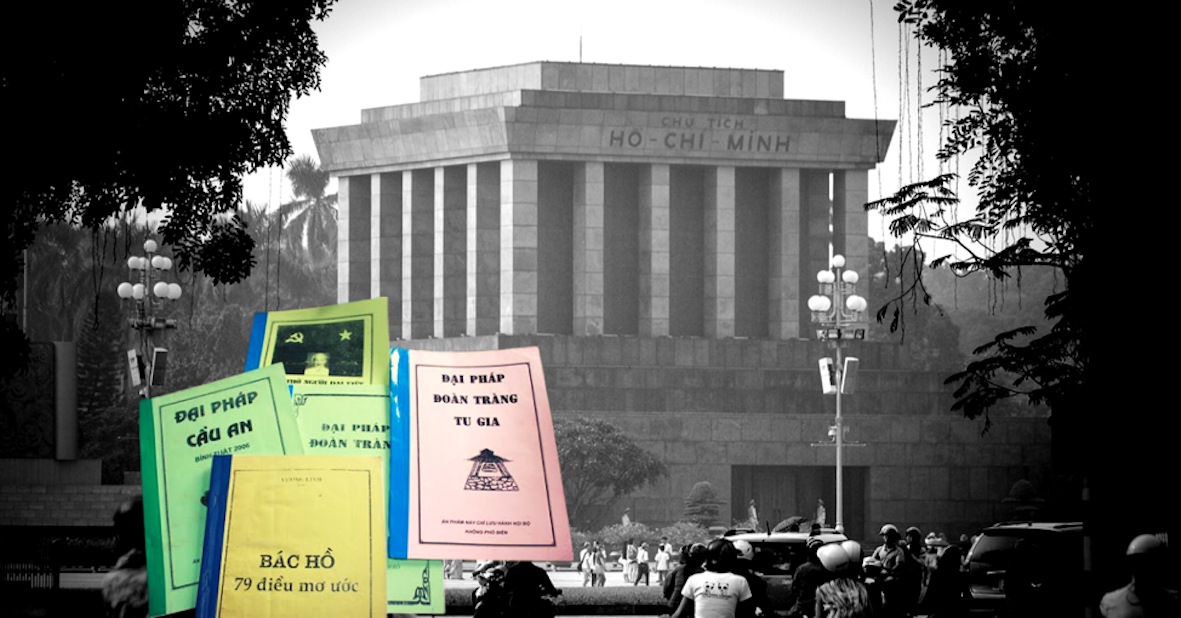
    And this is what the VCP fears the most: that the people will no longer be dependent on them for subsistence and survival. They fear for a time when their countrymen start to dream or come to know of a world outside the Party’s tiny dictatorship. They fear a populace that holds another being in higher regard than the crumbling corpse of Ho Chi Minh.

    The VCP fears becoming obsolete. Yet in the end, that is exactly what it fated to be.

    Long after Vietnam has risen above the shackles of authoritarianism and long after it has reached a future of true and genuine democracy, the Party will be gone.

    But religion will be there to stay.
  • Ho Chi Minh – From Political Monument To God Of Prayers – Part 2

    Ho Chi Minh – From Political Monument To God Of Prayers – Part 2

    This article was written in Vietnamese by Vo Van Quan and was previously published in the Luat Khoa Magazine on February 1, 2021.


    The religion Way of Uncle Ho aims to start a spiritual revolution in order to save the nation from foreign enemies, both past and present. This revolution also aspires to harmonize the balance between the worlds found in this religion’s metaphysical framework. These worlds include the Heavenly realm, the Buddha’s realm, the Earthly realm, and the Yin realm.

    “A spiritual heavenly revolution.

    Replace the old, change to the new. This religion will bring the people and our country up and we will no longer be slaves of others.

    From now on there will be a new order. By the law of God, by the demand of our ancestors.”

    According to the teachings of this religion, the Heavenly realm rules over the other three realms. However, the blasphemous behavior, attitude, and way of worship in the Earthly realm destabilizes the harmony of the other worlds.

    This religion espouses that, because of Ho Chi Minh’s achievements, the purity of his soul, and his moral conduct on earth, his soul was “elected” to become the leader of the Heavenly Palace upon passing away. Henceforth, he leads the spiritual revolution which claims to promote the right path to reach heaven in the material world.

    https://2xjs7y10oiyz26vqxu2hok6y-wpengine.netdna-ssl.com/wp-content/uploads/2021/02/image-1024x812.jpeg
    Photo: Hochiminh.vn.

    In Chapter 4 of “New Religions and State’s Response to Religious Diversification in Contemporary Vietnam,” the author Hoang Van Chung summarizes the eight issues that this revolution wants to address:

    1. A mistaken understanding of the origins of the Vietnamese people and the their neglect of ancestor worship;

    2. The overuse of joss paper and objects;

    3. The incorrect performance of traditional rituals to the Mother Goddess;

    4. A mistake in dating the death anniversary of Ho Chi Minh;

    5. The invalidity of rituals of spiritual possession;

    6. The pervasive worship of foreign spirits and gods, such as the Indian Buddha, Jesus Christ, and Chinese spiritual figures (Guan Yin or Bodhisattva);

    7. Disrespect for heroic martyrs; and

    8. Making mistakes in medical diagnosis and the treatment of illnesses caused by spiritual entities.

    The religious texts of the Peace Society state:

    “In the twenty-first century

    The first Vietnamese Buddha was born.”

    Monism has since become the motto of Ho Chi Minh’s religion. This religion states that the Vietnamese people can only worship the Vietnamese Buddha: “Uncle Ho.” Worship of any other foreign power also goes against their tenets and beliefs.

    “Do not worship foreign gods

    We worship our own Buddha in our country.”

    Most importantly, Vietnam is seen as the leader of the entire revolutionary process that determines the future of mankind; this demonstrates a somewhat extreme form of nationalism.

    “Vietnam is the eldest son of the Emperor.

    Born first in the Earthly world.”

    If people disobey the Jade Buddha’s commands, natural disasters, epidemics, wars, and social disorder will befall human society. This punishment is therefore not limited to  just one nation or to one group of people, but extends to the entire world.

    What is the Way of Uncle Ho’s religious practice?

    The Ho Chi Minh religion has its own form of exorcism and this practice, in general, is very popular in the north. However, Madam Xoan believed that those who perform this act, if they come from the Mother Goddess religion or other popular sects, would often lose their cognitive abilities. On the contrary, Madam Xoan claimed she was a disciple of the Jade Buddha, so she could hear and preach the voice of the Jade Buddha without losing her reason.

    As for worship, adherents of this religion are guided to worship Ho Chi Minh at home.

    These worshipers have an altar that includes a statue or photo of Ho Chi Minh, the Communist Party’s version of the Vietnamese flag, and a bowl of incense. This altar should also be higher than all other altars in the house. Each day believers are required to offer fresh flowers, cakes, or fruits. Prayer is optional, but burning joss paper and other objects is prohibited. Their holidays also follow the official Vietnamese national holiday calendar which somewhat shows the religion takes a political stance.

    One of the Ho Chi Minh Shrines in Ben Tre. Photo: The Vietnamese.

    With respect to mass religious gatherings, the Peace Society spends most of its time performing activities such as the annual ancestral worship ceremony, which obviously includes Ho Chi Minh and the martyrs. They also provide magic spells and incantations.

    It is also quite interesting to note that the Way of Uncle Ho has a very high anti-Chinese sentiment.

    According to the leaders of the Peace Society, evil spirits are the wandering souls of the Chinese invaders who died years ago. They still haunt Vietnam, harm the people’s health, and negatively influence the future of the nation.

    “Don’t listen to evil spirits. In the past, they were the enemy who deceived us and harmed us.

    They admired evil and always wanted to invade our country.”

    When the Hai Duong 981 drilling rig entered Vietnamese territorial waters in 2014, Madam Xoan and 400 other followers gathered, prayed, and condemned the behavior of the enemy in the north, the Chinese.

    “I pray to Uncle Ho, he will pour out the safe water

    […] So that he could protect our sovereignty over seas and islands

    from being  invaded, in heaven and on earth.”


    Madam Xoan has repeatedly tried to register this religion with the Vietnamese government, but the answer from officials is usually to wait for a decision from their superiors. She is also believed to have close connections with more than 30 figures in the central government, including scientists working in state agencies, ministry officials, and intellectuals interested in studying and learning about this religion.

    According to research estimates, there are believed to be more than 10,000 official followers of the Way of Uncle Ho, and major ceremonies take place with more or less a thousand believers in attendance. This is a significant figure if you consider the fact that other domestic religions are slowly dying.

    In addition, although not officially recognized, the followers of Ho Chi Minh’s religions, such as the Jade Buddha, receive approval from the government, along with the ability to exercise their freedom of religion easier than others.

    However, these were the study’s conclusions up to the time of publication (2017).

    In more recent times, the Way of Uncle Ho as the Jade Buddha has also fallen under the close scrutiny of local authorities. For example, the People’s Public Security newspaper published an article that claimed the Way of Uncle Ho had used Ho Chi Minh’s image with “misguided claims,” such as alleging that it “received Uncle Ho’s blessings” and its leaders offered some medicinal leaves to cure all diseases of the people. The authorities of some provinces, such as Vinh Phuc, also warned that this religion was an act of “illegal” religious activities.

    The Vietnamese government is now in a dilemma. Should it maintain the treatment of Uncle Ho as a well-loved political figure and expect all Vietnamese citizens to continue worshiping his life? Or will the authorities rein in the Way of Uncle Ho and other cults and illegal religions involving Ho Chi Minh, and deal with these religious activities as it has often dealt with other different religions in the country? Only time will tell us how the authoritarian government of Vietnam will act on this issue.

  • Ho Chi Minh – From Political Monument To God Of Prayers – Part 1

    This article was written in Vietnamese by Vo Van Quan and was previously published in the Luat Khoa Magazine on January 31, 2021.


    “The nation of Vietnam will stand forever

    with Jade Buddha – Chí Minh – Ái Quốc”

    (A quote from a 2010 prayer)

    The process of globalization in Vietnam has made major religions such as Buddhism and Christianity overshadow the silent development of local belief systems. However, overlooking them would be a mistake.

    In a certain sense, these domestic religions most accurately and clearly reflect the dynamics of religious beliefs among the masses, and they can also show some of the implications of development in Vietnam’s societal relationships.

    The religion called “Way of Ho Chi Minh as the Jade Buddha” (referred to as the Way of Uncle Ho in this article) is one significant example we can use to learn about how religion is practiced or how it is imbibed by the Vietnamese people. Up till now, there has not been an official study, or even an official government statement, on this strange and peculiar religion.

    In the development framework of the research program “Boundaries of Religious Freedom: Regulating Religion in Diverse Societies,” Dr. Hoang Van Chung gives us a clearer and deeper look at the development of Ho Chi Minh’s religion in Chapter 4 of “New Religions and the State’s Response to Religious Diversification in Contemporary Vietnam.”

    Dr. Chung is currently the head of the Department for Research on Policy and Law on Religion at the Institute for Religious Studies, under the Vietnam Academy of Social Sciences. He obtained his Ph.D. in Sociology from La Trobe University (Australia) in 2014, and was a scholar with the ISEAS-Yusof Ishak Institute (Singapore).

    It is important to note that even though his book was published in 2017, the accompanying data in the study of Ho Chi Minh City was collected from 2011 to 2012. Therefore, there is a gap between the information provided by the author and the present state of this religion.

    Một hình ảnh được cho là điện thờ Hồ Chí Minh của tín đồ đạo Hồ Chí Minh. Ảnh: Blog Tìm tòi và Lượm lặt.
    Ho Chi Minh statue is worshipped at the Ho Chi Minh Shrine. Photo: Search and Gathering Blog.

    How was the “Way of Uncle Ho” formed?

    According to a research by Dr. Chung published in 2016, a Madam Xoan founded the Way of Uncle Ho at the Peace Shrine (now called the Peace Temple) on January 1, 2001.

    Madam Xoan, 73, experienced a miserable childhood in Nam Dinh Province. She lost her mother at a young age, had to live with her father and stepmother, and began working at the age of just 15. She also attempted suicide many times. At the age of 19, she married a notary public and had four children.

    Everything changed when she became seriously ill just before she turned 30. It was reported that Xoan was unconscious and that the pain she felt in one finger was so intense that it had to be completely amputated.

    Meanwhile, doctors could not find the reason for her illness nor determine the cause of the disease. One day while she was waiting to be treated in Hanoi, she heard a strange voice telling her that she was not sick but that this was just a test to see if she was qualified to serve a higher purpose. This voice also affirmed that Mrs. Xoan had spiritual inclinations.

    She immediately quit her factory job and became a humble merchant buying and selling joss paper. During the next 5 years, Mrs. Xoan continued to be guided by this voice and her financial situation gradually improved. By the time she was able to clearly hear and fully communicate with this voice, she gave up her small business to study the supernatural.

    In 1989, Mrs. Xoan heard the voice again commending her for being the first person chosen by the Heavenly Palace to complete her assigned mission.

    From politicians to gods

    Since the 2000s, the stories of individuals who have achieved great success and have become rich for relying on the help of Ho Chi Minh’s Jade Buddha have been compiled by the Peace Society of Heavenly Mediums (the religious leaders of the religion “Way of Uncle Ho”). These stories were then spread among the followers of this belief system.

    For instance, there is also a similar story about an entrepreneur who worked in the construction industry. The story claims that he became very rich because of his obedience to “Uncle Ho.” To show his sincerity, he donated 200 million dong to the Peace Temple. This amount was then used to upgrade and renovate  this place of worship.

    Ho Chi Minh’s image has come a long way in the last century, morphing from a simple politician who was close to the people, to a god capable of interfering in and controlling the lives, happiness, and success of everyone who lives on Earth.

    What happened?

    Tổng Bí thư, Chủ tịch nước Nguyễn Phú Trọng dâng hương cúng bái Chủ tịch Hồ Chí Minh tại Hà Nội năm 2019. Ảnh: TTXVN.
    General Secretary cum State President Nguyen Phu Trong offers incense to worship President Ho Chi Minh in Hanoi in 2019. Photo: VNA.
    Đoàn đại biểu của Đảng Cộng sản Việt Nam và người dân Cao Bằng dâng hương, dâng hoa tại Đền thờ Chủ tịch Hồ Chí Minh tại Cao Bằng. Ảnh: pacbo.vn.
    The delegation of the VCP and the people of Cao Bang offer incense and flowers at the Ho Chi Minh Temple in Cao Bang. Photo: pacbo.vn.

    Clearly, the deification of Ho Chi Minh did not begin with Vietnamese civilians.

    Dr. Chung’s research indicated that numerous other studies have linked Ho Chi Minh’s death with the Vietnam Communist Party’s (VCP) own propaganda campaign. The State has intervened in directing or encouraging the remembrances of Ho Chi Minh. This has turned a mere ritual into the worship of the late leader.

    Dr. Chung also concluded that many other researchers also pointed out that the VCP had a very clear goal of building a cult of personality around Ho Chi Minh. From promoting Uncle Ho’s supposed divine moral qualities to building up various myths about him, the VCP wants to make this version of Ho Chi Minh the formal history.

    However, the most interesting point that Dr. Chung stated was that the VCP only expected to limit this phenomenon about Uncle Ho as a personal cult within the realms of the “ancestor worship” belief model. By doing that, the VCP wanted to connect the history of Vietnam’s national democracy movement and its communist movement, leading it to national success in the future. Once they establish this basis, the VCP, a political conglomerate founded by Uncle Ho, would have solidified more of its legitimacy.

    The author emphasizes that the goals of the VCP and the desires of the masses in worshiping Ho Chi Minh are different.

    The VCP’s model of worship of Ho Chi Minh is considered less religious and less superstitious. Therefore, Dr. Chung asserts that the religions associated with this political leader, such as the Way of Uncle Ho as the Jade Buddha, were “undesirable consequences” of state policy. The government’s efforts regarding the remaking of Ho Chi Minh’s image, if compared to people’s beliefs, are heterogeneous.

    There are a lot of questions for Dr. Chung when he stated this argument.

    It is because in Vietnam, we are seeing a common phenomenon that state agencies regularly promote the worship of Uncle Ho. The government placed Ho Chi Minh statues and photographs in many temples in the north of Vietnam, and offered incense to commemorate Ho Chi Minh during big national holidays, and the like.

    If we follow Dr. Chung’s reasoning and assumption that the state did not want, or at least did not foresee, the formation of a religion centered around Ho Chi Minh, I think his argument is a bit unpersuasive.

    In the context that the Vietnamese economy had just opened up and the practice of worship had just reformed since the 1990s, the nature of the people’s curiosity and experimentation for new religions and beliefs is obviously evident. Therefore, it is fairly certain to foresee that the people will eagerly want to join a new religion like the Way of Uncle Ho as the Jade Buddha if it is offered.

    (To be continued)

  • Religion Bulletin, February 2021: German Parliament To Hold Hearing On Religious Freedom In Vietnam

    A police colonel takes charge of religion as the German Parliament takes note of Vietnam.

    https://2xjs7y10oiyz26vqxu2hok6y-wpengine.netdna-ssl.com/wp-content/uploads/2021/03/image5-jpg.jpg
    The German Parliament expects to have a hearing on religious freedom in Vietnam on April 14, 2021. Left: Markus Grubel, German Federal Government Commissioner for Global Freedom of Religion (Source: Janine Schmitz/photothek.net). Right: Police prepare to demolish a funeral home belonging to the Duong Van Minh religion in 2013. (Source: Youtube Thanh Phạm, as cited by BPSOS).

    Religion Bulletin, February 2021:

    • [Religion 360*]
      • German Parliament to release report on religious freedom in Vietnam and other countries
      • Family asks for intervention as prisoner of conscience Phan Van Thu’s health deteriorates
      • Dak Lak provincial police prevent members of the Protestant Church of Christ from conducting religious activities
      • An ethnic Thuong Protestant is arrested as he takes his child to school
      • Deputy head of the Internal Security Bureau becomes deputy head of the Government Committee for Religious Affairs 
    • [On This Day]
      • 12 proposals Zen Master Thich Nhat Hanh made to the Vietnamese government regarding Buddhism and religious freedom
    • [Did You Know?]
      • The Hmong Duong Van Minh religion under the government’s hand


    [Religion 360*]

    German Parliament will hold a hearing on religious freedom in Vietnam and other countries

    In past years, Vietnam has encountered a number of issues with Germany. There may be one more to add to the pile as the German Parliament prepares to release a report on international religious freedom April 14, 2021. The report details the dire situation regarding religious freedom in Vietnam.

    Germany takes this year’s congressional hearing particularly seriously.

    In a press release on the report on international religious freedom in 2020, Dr. Gerd Müller, German development minister, stated: “In countries where no progress is made on this over long periods, we do not simply continue our government-to-government cooperation but, instead, shift our focus to strengthening civil society and supporting the humanitarian work carried out by the churches [in those countries].”

    Dr. Müller used Myanmar as an example to demonstrate that Germany keeps its word. He stated that Germany had cut off ties with the Myanmar government, transferring direct aid to Muslim Rohingya refugees who had fled to Bangladesh to escape the Myanmar Army’s ethnic genocide.

    https://2xjs7y10oiyz26vqxu2hok6y-wpengine.netdna-ssl.com/wp-content/uploads/2021/03/image-15.jpeg
    Dr. Gerd Müller, German development minister. Photo: AFP.

    For decades, international organizations have stated that the Vietnamese government has not made any noteworthy improvements on religious freedom.

    The report on international religious freedom was ratified by the German cabinet on October 28, 2020. In it, Vietnam was accused of engaging in serious and systematic suppression of religious practitioners, including those of the Duong Van Minh religion in the northeast, Protestants in the Central Highlands, and those of the Cao Dai, Hoa Hao, and Catholic religions, who seek independence in their activities.

    The report also stated that the Catholic Church in Vietnam had faced difficulties for years due to ambiguous laws and regulations, established to manage the non-profit and charitable activities of religious communities.

    The fact that religious practitioners faced heavy punishment was also highlighted by the report’s confirmation that followers continued to endure multiple forms of violence.

    Family asks for intervention as prisoner of conscience Phan Van Thu’s health deteriorates

    Prisoner of conscience Phan Van Thu, 73, who received the heaviest sentence in the case of the Bia Son Public Justice Council, is currently suffering health setbacks and is in dire need of medical care.

    Thu’s wife, Vo Thi Thanh Thuy, stated that ever since he transferred prisons in 2017, his health has steadily declined. Thu had a history of illness before he was arrested in 2012, including: diabetes, heart failure, high blood pressure, and rheumatoid arthritis. Doctors have confirmed Thu is in need of regular medical treatment at a hospital.

    https://2xjs7y10oiyz26vqxu2hok6y-wpengine.netdna-ssl.com/wp-content/uploads/2021/03/image-16.jpeg
    Phan Van Thu in 2013. Photo: Free Journalists Club.

    In an official form sent to Gia Trung Prison in Binh Dinh Province requesting medical care for her husband, Phan Van Thu’s wife recalled that he had to go to the emergency room while serving his sentence in 2018.

    She requested that the prison give him a complete check-up as soon as possible, along with a specific treatment plan.

    The case of the Bia Son Public Justice Council went to trial for the first time in February 2013 and is most likely the religious freedom-related case with the highest number of defendants in the history of Vietnamese law. Twenty-two members of this council received heavy sentences, from 10 years to life in prison. Phan Van Thu, who led the organization, received a life sentence.

    According to state media, the court convicted the members of acting to overthrow the people’s government. One member asserted, on the contrary, that their activities were strictly religious in nature.

    Dak Lak provincial police prevent members of the Protestant Church of Christ from conducting religious activities

    What would you do if you wanted to conduct religious activities legally, but the commune authorities refused to accept your registration form? According to the Ethnic Thuong for Justice webpage, on February 20, 2021, members of the Protestant Church of Christ in Dak Lak Province were forbidden by police from conducting religious activities.

    In a one-minute and thirty-second video posted on social media, two police officers are seen filling out a form citing church members’ “unlawful religious activities”.

    According to the 2016 Law on Faith and Religion, individuals who seek to organize religious assemblies must register with commune authorities. Religious groups who gather without registering are seen by police as being in violation of the law.

    However, authorities openly discriminate against the Protestant Church of Christ. A member of the church stated that commune authorities refused to issue a permit for their religious gathering.

    An ethnic Thuong Protestant is arrested as he takes his child to school

    The webpage Ethnic Thuong for Justice reported that an ethnic Thuong Protestant was suddenly arrested by police as he was taking his child to school on February 26, 2021.

    https://2xjs7y10oiyz26vqxu2hok6y-wpengine.netdna-ssl.com/wp-content/uploads/2021/03/image-17.jpeg
    Y Thinh Nie holding a self-made banner celebrating International Human Rights Day, December 10, 2020. Photo: Ethnic Thuong for Justice.

    The arrested individual is reportedly Y Thinh Nie, 42, a resident of Drai Si Highland Village, Ea Tar Commune, Cu Mgar District, in Dak Lak Province.

    Two days prior to his arrest, police had arrived at his residence to invite him to the station for questioning. He refused citing a lack of paperwork.

    The webpage also reported that Nie’s arrest had to do with his taking pictures to mark the International Day Commemorating the Victims of Acts of Violence Based on Religion or Belief (August 22, 2020) and International Human Rights Day (December 10, 2020).

    Deputy head of the Internal Security Bureau becomes deputy head of the Government Committee for Religious Affairs

    On February 3, 2021, the Government Committee for Religious Affairs added a new deputy head. However, all state channels which reported on the assumption of office avoided discussing the cadre’s background.

    https://2xjs7y10oiyz26vqxu2hok6y-wpengine.netdna-ssl.com/wp-content/uploads/2021/03/image-18.jpeg
    Nguyen Tien Trong, the new deputy head of the Government Committee for Religious Affairs, (left) receives his appointment. Photo: Ministry of the Interior.

    The new deputy head of the Government Committee for Religious Affairs (GCRA) is police colonel Nguyen Tien Trong. Before being appointed to the GCRA, Trong was deputy head of the Ministry of Public Security’s Internal Security Bureau.

    The Internal Security Bureau is the bureau responsible for combatting alleged reactionaries, terrorists, and threats to security, including those of a religious nature.

    As with other leaders of the GCRA, there were not many details on Trong’s background. GCRA simply reported that Trong is an ethnic Kinh, non-religious, from Bac Giang, and a graduate with a bachelor’s degree in security reconnaissance. GCRA did not disclose Trong’s previous positions and work units.


    [On This Day]

    12 proposals Zen Master Thich Nhat Hanh made to the Vietnamese government regarding Buddhism and religious freedom

    https://2xjs7y10oiyz26vqxu2hok6y-wpengine.netdna-ssl.com/wp-content/uploads/2021/03/image-19.jpeg
    Thich Nhat Hanh and the followers at Plum Village held a procession along Hoan Kiem Lake in 2005. Photo: PVCEB.

    In February 2010, Zen Master Thich Nhat Hanh – one of a number of monks highly respected by the Vietnamese public – issued 12 proposals to the government on the millennial anniversary of Hanoi.

    Among these 12 proposals two were related to freedom of religion.

    First, he petitioned the government to grant prisoners amnesty, including those prisoners who were charged just because they were “contributing ideas of improvement to the government; calling for pluralism, multiple political parties, and multiple churches; and calling for freedom of religion and freedom of speech.”

    Second, he asked that Buddhist dignitaries both in- and outside the country to combine forces to “establish a single, private Buddhist church, one that stands completely outside of politics.”

    Zen Master Thich Nhat Hanh was forbidden from returning home to Vietnam after an anti-war advocacy tour he conducted in 1966. It was not until 2005 that he was permitted to return. After returning home, his books began to be published in Vietnam, with the exception of those that touched upon freedom of religion or politics.

    On his return home, Hanh has made proposals to the Vietnamese government to enact political and religious reforms that he felt were necessary, but to this day, the authorities continue to use strict policies to control religion. According to human rights organization The 88 Project, the Vietnamese government currently holds approximately 73 individuals as prisoner for their religious activities and for fighting for religious freedom.


    [Did You Know?]

    The Hmong’s Duong Van Minh religion under the government’s hand

    In March 2014, an ethnic Hmong named Hoang Van Sang was sentenced by the Yen Son District People’s Court, Tuyen Quang Province, to 18 months in prison, in accordance with Article 2258 of the Penal Code, for abusing democratic freedoms to infringe upon the interests of the State and the legitimate rights and interests of organizations and/or citizens.

    Tran Thu Nam, Sang’s defense attorney, uniformly rejected the court’s decision, stating that Sang could not be convicted according to Article 258 based on the activities he conducted with a number of other Hmong.

    According to Nam, Sang and a number of other Hmong practitioners of the Duong Van Minh religion had agreed to pool money to build a morgue. Sang took on responsibility for purchasing the construction materials. For merely doing that, he was sentenced to 18 months in prison.

    A week after Sang’s trial, another trial involving three ethnic Hmong practitioners of the Duong Van Minh religion began in Ham Yen District, Tuyen Quang Province.

    According to RFA, that morning, police blocked intersections connecting the court to villages with Duong Van Minh practitioners. But police were unable to block all unpaved paths to the court; approximately 150 ethnic Hmong took a shortcut in the four-hour preceding to protest the trial.

    Similar to Sang, the three defendants were also convicted according to Article 258, with each receiving a different sentence: 24 months, 18 months, and 15 months in prison, respectively.

    Six years have passed and ethnic Hmong still resolutely follow the Duong Van Minh religion, despite the government’s heavy-handed oppression of the group.

    According to the German Foreign Ministry, in October 2018, practitioners of the Ha Mon religion in 68 residential neighborhoods issued an SOS to the United Nations, the European Union, and the United States.

    A report by the US State Department on religion stated that in 2019, Vietnamese police used electric rods and automatic rifles to attack a group of Duong Van Minh practitioners who were organizing festivities for Tet. The incident occurred in Na Heng Hamlet, Nam Quang Commune, Bao Lam District, Cao Bang Province.

    https://2xjs7y10oiyz26vqxu2hok6y-wpengine.netdna-ssl.com/wp-content/uploads/2021/03/image-20.jpeg
    Duong Van Minh, founder of the religion which carries his name. Photo taken in 2015 in Hanoi. Source: JB Nguyen Huu Vinh.

    According to the overseas Vietnamese-language press (RFI, Nguoi Viet), the Duong Van Minh religion appeared during the 1980s. Its main objective is to make  Hmong faith customs surrounding funerals and marriages more progressive and hygienic. The religion was founded by Mr. Duong Van Minh, who currently resides in Tuyen Quang Province.

    Important in the religion is the construction of small housing structures that are used as “funeral homes.” In these structures are a number of items, including holy crosses and wooden toads and swallows that are used during ceremonies.

    These structures have been destroyed by the Vietnamese authorities for being built without a permit and for propagating a “false religion.” The government and state media both assert that the Duong Van Minh religion is a false one, arguing that the religion discourages people from work and study, disrupts traditional customs, and leads people to form groups that disobey the government’s religious and social policies.

    https://2xjs7y10oiyz26vqxu2hok6y-wpengine.netdna-ssl.com/wp-content/uploads/2021/03/image6-jpeg-1024x598.jpg
    Police destroy a “funeral home” belonging to the Duong Van Minh religion in 2013. (Source: Youtube Thanh Phạm, as cited by BPSOS).

    Practitioners of the Duong Van Minh religion, however, have told the overseas media that they work to alter the rituals by which they worship the dead.

    A 2020 radio report by the People’s Ministry of Public Security Communications Bureau stated that there were approximately 8,000 ethnic Hmong practitioners of the Duong Van Minh religion, in four provinces (Tuyen Quang, Bac Can, Cao Bang, and Thai Nguyen).

  • Religion Bulletin, January 2021: Criticism Session In The Dark Of Night

    The Protestant Church of Christ faces threat of heavy government repression.

    Five ethnic Thuong, pictured left, endured a government criticism session in front of residents on the night of January 15, 2021. Photo: MSFJ News.

    [The Government’s Reach]

    Phu Yen provincial authorities suppress the Protestant Church of Christ: Criticism session in the dark of night

    Three years ago, an ethnic Thuong from the Central Highlands was arrested by Thai police. He expected to be deported back to Vietnam according to an extradition order from Vietnamese police. The man was named A Ga, and he was a follower of the Protestant Church of Christ.

    When he was arrested in Thailand, A Ga had been a refugee in Bangkok for six years with his wife and children. He lived in an area with hundreds of ethnic Thuong refugees who had fled the Central Highlands. Similar to A Ga, a significant number of them were wanted by Vietnamese police for organizing illegal border crossings. A large portion of these crossings were for their own family members, with the remaining consisting of fellow Protestants.

    While in a Thai prison, A Ga prayed to avoid deportation to Vietnam. Three months later, he was sitting on a plane with his wife and children; the destination was not Vietnam, but rather, the Philippines. The US State Department had intervened in his case. After they spent a period of time in the Philippines, A Ga’s family was resettled in the U.S.

    On January 15, 2021, A Ga’s name appeared during a government criticism session of five ethnic Thuong in Ia Lam Commune, Song Hinh District, Phu Yen Province.

    Video source: MSFJ News.

    In the darkness, his name echoed along with those of five other ethnic Thuong standing in front of police, local leaders, and villagers. The scene resembled a trial. Villagers were forced to sit and listen to the government’s charges against the five for participating in the Protestant Church of Christ.

    The five simultaneously criticized were Mr. Nay Y Blang, Mr. Nay Y Loi, Mr. Ksor Y Blang, Mr. Hwing Y Nuk, and Mr. Ro Da. Police stated that there were two other ethnic Thuong who were also subject to criticism but were not present at the meeting.

    “Unauthorized prayers”

    At the start of the criticism session, the authorities stated that the five named individuals had taken advantage of ethnic and religious issues to disrupt national unity, conspired to participate in the United Front for the Liberation of Oppressed Races, better known by its acronym FULRO, and distorted the policies of the party and the state.

    However, the government failed to present any evidence showing how the five had violated the law as charged.

    Mr. Nay Y Blang, 50, was accused by the government of holding a key role in the activities of the Protestant Church of Christ in Phu Yen Province.

    Authorities asserted that Y Blang disrupted stability, security, and order by allowing his home to be used for public religious activities. Blang was said to have connected with former inmate friends—members of FULRO—and locals to participate in the Protestant Church of Christ, where they listened to A Ga and others overseas spread false propaganda about a lack of human rights and religious freedom in Vietnam.

    Blang was also accused of organizing “unauthorized prayers,” including a service on August 19, 2020 to mark the “International Day Commemorating the Victims of Acts of Violence Based on Religion or Belief,” an international holiday designated by the United Nations. Even Blang’s sharing of pictures of church activities was deemed by the government to be illegal.

    Pressured to renounce the church

    Pastor A Dao, a member of the Protestant Church of Christ’s Management Board, told RFA that the five members were pressured to renounce the church during the criticism session.

    “The government forced them to renounce the Protestant Church of Christ, declaring that the state could not accept opposition; they were made to sign paperwork renouncing the church. But a number of our brothers remained resolute,” A Dao stated to RFA.

    RFA quoted Mr. Y Krek Bya, who described the criticism sessions as lasting from 6 pm to past 9 pm; Bya stated that the sessions failed to get all five people to publicly declare their abandonment of the church.

    “When the session let out, they said that if the men refused to renounce the church, and if protests broke out in any form, then the men would be imprisoned, where they would be met with a heavy hand or even killed,” Bya told RFA.

    “Criticism before the people”

    Criticism sessions related to religion and conducted in front of residents have been known in the Central Highlands since the 2000s. That was when religious movements combined with the struggle for human rights began to bloom in the region.

    During these sessions, authorities would bring residents in to witness and listen to the “improper activities” of those being criticized. The objective was to force those such people to cease their religious activities and to discourage anyone else from participating in activities not supported by the state.

    These criticism sessions are seldom covered in the state press. The clip of the criticism session above was surreptitiously recorded by a resident.

    On one rare occasion, on July 4, 2020, Gia Lai provincial police reported their criticism session of a 50-year-old ethnic Thuong. The subject of the criticism was Mr. Puih Hong, a resident of Ia Grang Commune in Ia Grai District, Gia Lai Province. Authorities asserted that he had crossed the border to Cambodia many times and that he had misrepresented policies in Vietnam regarding religion and national unity.

    https://2xjs7y10oiyz26vqxu2hok6y-wpengine.netdna-ssl.com/wp-content/uploads/2021/02/image-8.png
    Mr. Puih Hong standing before residents and the authorities during a criticism session organized by the government on July 4, 2020. Photo: Gia Lai provincial police.

    Currently, Vietnamese law does not contain any regulations related to public criticism sessions. The state, however, most likely considers such sessions as a type of propaganda tool that it can use to convey the law to the people.

    International organizations have long considered criticism sessions to be an affront to human dignity.

    The precarious fate of the Protestant Church of Christ

    For religious organizations in Vietnam, it is not enough that their activities be purely religious. These groups must also express full support for state policies to receive permission to operate.

    Before he became a refugee in Thailand, A Ga had on many occasions submitted forms to his commune people’s committee to register religious activities, only to be uniformly rejected.

    The Law on Faith and Religion contains a regulation regarding “the registration of organized religious activities,” but it also contains another regulation that denies permission to anyone violating Article 5.

    Article 5 of the Law on Faith and Religion stipulates behaviors that are forbidden. In Paragraph 4 of the article, subsection ‘a’ forbids actions that “violate national defense, security, national sovereignty, order, societal safety, the environment,” while subsection ‘d’ forbids “ethnic divisions; religious divides, including between those who follow a religion and those who do not, and between those of different faiths and religions.”

    There are no specific definitions for “violations of national defense, security, order, societal safety” and “ethnic divisions, religious divides.” These regulations become useful barriers the government can use to forbid religious activities it does not agree with.

    The Protestant Church of Christ was established in 2006. In 2016, the church announced that it had more than 1,500 members.

    The Protestant Church of Christ has been suppressed by the government for more than a decade. However, the organization is not spoken of in the state press nearly as much as those religious groups described as anti-government, such as Dega Protestantism, and the Ha Mon religion.

    Recently, as the above religions have been nearly wiped out, the Protestant Church of Christ appears to be the government’s next target.

    https://2xjs7y10oiyz26vqxu2hok6y-wpengine.netdna-ssl.com/wp-content/uploads/2021/02/image-9.png
    A member of the Protestant Church of Christ being interrogated by police. Photo: Security TV.

    In July 2020, Security TV, an information channel run by the Ministry of Public Security, aired a report accusing the Protestant Church of Christ of using overseas funds to oppose the Vietnamese governments.

    Colonel Nguyen The Luc, deputy director of Dak Lak provincial police, stated that the anti-government religious activities in the Central Highlands had both been found in the Dega Protestantism and the Protestant Church of Christ.

    The government stated that the church had 27 operating locations in five provinces and cities (Kon Tum, Dak Lak, Binh Phuoc, Lam Dong, and Tra Vinh). Phu Yen is likely a newer area for the group.

    The Protestant Church of Christ includes both native and overseas members; among them are former prisoners that remain under government watch, as well as current refugees in Thailand. With members having such diverse origins, and a government haunted by enormous protests in the Central Highlands during the 2000s, this religious organization will undoubtedly face heavy-handed suppression.

    [Religion 360*]

    Pledges to “voluntarily renounce false religions” in Dien Bien

    https://2xjs7y10oiyz26vqxu2hok6y-wpengine.netdna-ssl.com/wp-content/uploads/2021/02/image-13.png
    Half of a form “pledging voluntary renouncement of false religion” in Dien Bien Province. Photo: Dien Bien Phu Newspaper. 

    A report by the Dien Bien Phu Newspaper, a publication run by the provincial government, revealed portions of a form requesting that residents pledge not to follow religions unrecognized by the state.

    The article stated that troops at the Nam Ke border defense post, in Muong Nhe District of Dien Bien Province, had advocated that residents not practice illegal religions. Signing “pledges to voluntarily renounce false religions” was one of the many solutions advocated in the effort to convince people not to practice such religions.

    The photograph above shows that the pledges come pre-written by the government; the person signing the pledge merely has to sign his or her  name, declare that they are renouncing the false religion, and agree to carry out the government’s requests.

    The article confirms that the government continues to actively block the spread of new religions in Dien Bien Province.

    Commemorative banner at Phuoc Buu Temple spray-painted black

    https://2xjs7y10oiyz26vqxu2hok6y-wpengine.netdna-ssl.com/wp-content/uploads/2021/02/image-10.png
    A banner belonging to the Phuoc Buu Temple was spray-painted black. Photo: Phuoc Buu’s Facebook page.

    On January 18, 2021, Phuoc Buu Temple’s Facebook page posted a photograph of a temple banner that was spray-painted black. The temple is located in Xuyen Moc District of Ba Ria – Vung Tau Province. The temple belongs to the Unified Buddhist Sangha of Vietnam.

    Printed on the banner was: “Paying respectful remembrance – mourning the late Venerable Thich Thanh Tinh, Sangha member of the Unified Buddhist Sangha of Vietnam.”

    A large X was spray-painted in the middle of the banner, and the word “unified” was completely obscured.

    The Phuoc Buu Temple is regularly harassed by local authorities for following the Unified Buddhist Sangha of Vietnam. In 2019, the government set up cameras pointing straight at the temple gates to monitor the temple’s religious activities.

    Vietnam has 8,000 Falun Gong practitioners, with 600 locations of practice

    https://2xjs7y10oiyz26vqxu2hok6y-wpengine.netdna-ssl.com/wp-content/uploads/2021/02/image-11.png
    Falun Gong practitioners in Hanoi in 2018. Photo: Southeast Asia Globe.

    On January 19, 2021, in a live seminar on new religions in Vietnam, Ms. Nguyen Thi Dieu Thuy, a cadre from the Government Committee for Religious Affairs, confirmed that currently in Vietnam there are approximately 8,000 Falun Gong practitioners, with 600 locations of practice in the country’s cities and provinces.

    In the same seminar, Assistant Professor Ngo Duc Thao, deputy chairman of the Advisory Council on Ethnicity and Religion (belonging to the Fatherland Front Central Committee), stated that new religions that desired permission to operate must help the state achieve socialism and national unity and must proselytize according to Vietnamese law.

    Thao also stated that Vietnam would be hard-pressed to recognize Falun Gong, as the religion had a political past in which it demanded democracy and human rights in China.

    In past years, numerous Falun Gong practitioners have been prevented by police from spreading the religion in many provinces and cities.

    Hanoi police demand to see man’s family separation form to recognize him as a Buddhist

    https://2xjs7y10oiyz26vqxu2hok6y-wpengine.netdna-ssl.com/wp-content/uploads/2021/02/image-12.png
    The article in Giac Ngo Newspaper regarding police demanding to see an individual’s family separation form to confirm his declaration as a Buddhist. Photo: Screenshot.

    On January 22, 2021, journalist Chu Minh Khoi of Giac Ngo Newspaper publicly expressed doubts regarding the official number of Buddhists in Vietnam.

    The issue started when the author arrived at the Police Department’s Office of Administration and Social Order in Hanoi to request a re-issue of his ID card indicating his religious affiliation. The cadre there requested that Khoi present his family separation acknowledgement to prove he was a Buddhist, as he had written on his reissuance application.

    Khoi explained that he was not separated from his family (as a monk or nun would be), but that he was a Buddhist (in practice). He also stated that he had a certificate confirming his refuge, practicing in a home provided for by a temple. He wanted to put his religion as Buddhist on his new ID.

    According to Khoi, the cadre however responded: “Seeing that your head isn’t shaved and that you aren’t wearing a robe obviously means you haven’t separated from your family! But, your certificate confirming your refuge doesn’t verify your status as a Buddhist. You have to have the family separation acknowledgment issued by the Buddhist Church of Vietnam.”

    A number of Giac Ngo’s readers confirmed that they were also asked by police to provide their family separation acknowledgements to confirm their Buddhist status if they wanted to put it down as their religion on their ID.

    Luat Khoa sought to verify this information with a number of other Buddhists. However, individuals that the magazine spoke to stated that their local authorities accepted their declarations as Buddhists without any need for a family separation acknowledgement.

    Police in different provinces and cities appear to apply different standards towards religious declarations. Many people suspect that the state’s count of Buddhist followers is inaccurate because of these inconsistent standards.

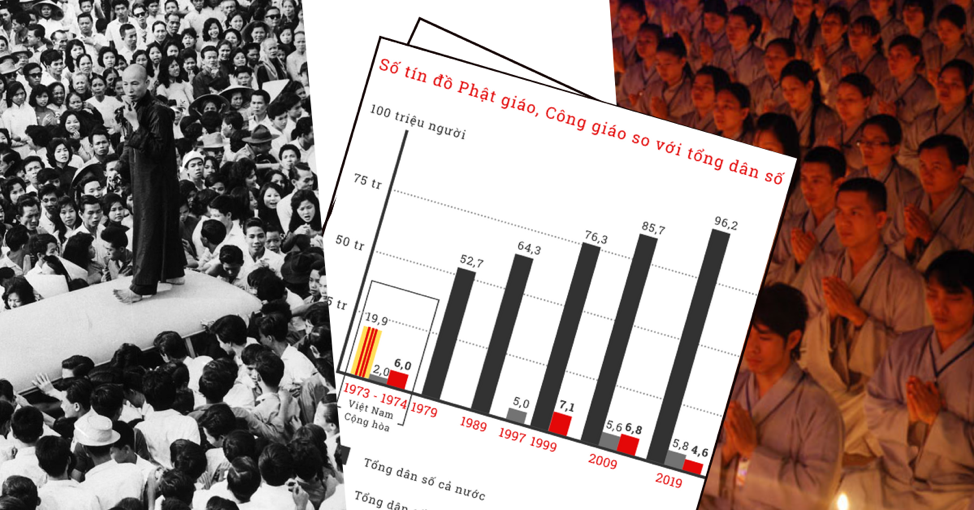
    According to data from the first census that recorded the number of religious practitioners in 1999, Vietnam had 7.1 million Buddhists. In 2019, the General Bureau of Statistics announced that the number of Buddhists had dropped to 4.6 million. As such, Buddhism is no longer the largest religion in Vietnam.

    [On This Day]

    Law on Faith and Religion: three years in effect

    https://2xjs7y10oiyz26vqxu2hok6y-wpengine.netdna-ssl.com/wp-content/uploads/2021/02/image-14.png
    The Vietnamese National Assembly as it passed the Law on Faith and Religion in 2016. Photo: National Assembly Newspaper.

    On January 1, 2018, the new Law on Faith and Religion took effect. The law was passed by the National Assembly in 2016, replacing Legal Directive 21/2004/PL-UBTVQH11 and Decree 92/2012/NĐ-CP regarding religion.

    Contradicting the state’s declaration that the law would protect and enact freedom of religion, the Law on Faith and Religion has in reality become a tool for the government to stifle religious activities in Vietnam.

    After three years of enforcement, unrecognized religious organizations remain unable to pass through the government’s filter. The Unified Buddhist Church of Vietnam, though it has been in operation longer than the Buddhist Church of Vietnam, is still seen as an illegal organization.

    New religions in the northwest and the Central Highlands are unable to register organized religious activities due to the regulations.

    The government is growing ever more obvious in its discriminatory treatment. It appears religious organizations are divided into two categories: positive (absolute support for state policies), and negative (conducting purely religious activities, fighting for human rights, or operating free from state control).

    Religious organizations are still banned from providing education to the public, such as running schools and universities. Many religions have participated in public education in the south before 1975 and the north before 1954. Nowadays, these religious organizations are banned from running schools.

    The government maintains complete decision-making power over land belonging to religious organizations, including construction on and renovation of religious grounds.

    Education within religious organizations also faces interference. Two subjects, history and Vietnamese law, must be taught according to the Government Committee for Religious Affairs’ syllabus.

    Regulations within this law allow the government to easily interfere in the internal affairs of religious organizations. For example, in 2020, a representative of the Government Committee for Religious Affairs demanded that the Tien Thien Cao Dai Church carry out instructions as if they were internally issued: “Establish regulations for public dignitaries and rankings; establish regulations to resolve complaints and grievances; elect dignitaries of adequate standards for the Church’s Upper House, Standing Committee, and Lower House”. Another example of government interference includes the land dispute with the Phu Lam Cao Dai Temple in Phu Yen province.

    The 2016 Law on Faith and Religion and the process by which the law is enforced reveal that the government sees these religious organizations more as state bodies than as civil ones.

  • Vietnam Officially Announces National Decline In The Number Of Buddhist Followers, Shocking Its Buddhist Sangha

    Vietnam Officially Announces National Decline In The Number Of Buddhist Followers, Shocking Its Buddhist Sangha

    According to Vietnam’s official statistics, in 2019, the religion with the largest number of followers in the country is Catholics with 5.9 million people. The number of followers of Buddhism is 4.6 million, ranking second. However, the numbers reported by this census contradict statistics from other state agencies, leading religious leaders and followers in Vietnam to question its accuracy.

    The Giac Ngo Newspaper – a Buddhist media – reported that this news “shocked” some monks, and that some  believers “burst into tears” when they heard the news. Many people naturally assumed that Vietnam would have more Buddhists than any other religious group.

    However, over the years, followers, monks and as well as senior sangha officials in Vietnam, have gone from one disappointment to another because the number of Buddhists has fallen dramatically in state statistics.

    The number of Buddhists in the 2009 Population and Housing Census was 6.8 million, a decrease of about 300,000 compared to 1999. Even so, Buddhism remained the religion with the largest number of followers in Vietnam.

    The situation only changed with the 2019 census results.

    In that year, the government announced that the number of Buddhists decreased by 30 percent compared to 2009. From 2019, Buddhism has lost its top position in the number of followers in Vietnam according to the State census.

    Over the past 50 years, Vietnam’s general population increased, but the number of Buddhist followers decreased

    Buddhism – a religion of about 2,000 years of development in Vietnam – now has only 4.6 million followers, accounting for about 4.78 percent of the total population.

    Meanwhile, the number of people who claimed to be Buddhist in the Republic of Vietnam (which only consisted of the south of Vietnam and a portion of the center) in 1963 was 9 to 11 million, accounting for 70 percent to 80 percent of the south’s total population as stated in the estimates that the US Central Intelligence Agency (CIA) compiled that year.

    The current figure of 4.6 million Buddhists is also less than the number of followers identified by the CIA as active Buddhists in the Republic of Vietnam in 1974, which was about 5-6 million.

    After 1975, the vibrant religious culture in the south suffered a period of “government watch” for more than 15 years. During that time period, major religions were restricted in their practices and the smaller religions were completely banned.

    According to State Magazine, a research journal of the Ministry of Home Affairs, in the first two censuses of 1979 and 1989, Vietnam did not record the number of religious followers.

    By the early 1990s, Vietnam began to officially recognize the religions that were previously popular in the South but which were banned after 1975, such as Hoa Hao and Cao Dai Buddhism. In 1999, the government started to keep statistics on the number of religious followers in the country.

    Nevertheless, as more statistics were completed, it was observed that the number of Buddhist followers were reported as having fallen. Throughout the three censuses (in 1999, 2009, and 2019), the number of Buddhists decreased by 35 percent while the national population increased by about 26 percent

    Graphics from Luat Khoa Magazine based on the data sources below.

    The Vietnam Buddhist Sangha refutes the state figures, but also does not publicize its own membership numbers

    Looking back, in 2012, the Buddhist Sangha of Vietnam opined about the number of Buddhists in Vietnam after the 2009 census results were published.

    Although Most Venerable Thich Bao Nghiem, vice chairman of the board of directors and head of the Board of the Dharma Preaching of the Central Vietnam Buddhist Sangha, acknowledged the 2009 census is quite “large, serious, and objective,” he also said at the time: “The statistical results …. about Buddhism are not accurate for many different reasons.” He explained that in Vietnam, apart from those who claim to follow other religions, the rest are really “followers of Buddhism, who love Buddhism and are influenced by Buddhism”. If one accepts Thich Bao Nghiem’s reasoning, then the number of followers of Buddhism in Vietnam could have been about 78 million in 2009 – which is the number we get when we subtract all people who declared themselves to have a different religion than Buddhism from the national population at that time.

    However, in 2019, the Vietnam Buddhist Sangha was again surprised when the State census stated that the number of Buddhist followers declined further and that Buddhism was no longer the religion with the most followers in Vietnam.

    Despite this continuing disappointment, over the years, the Vietnam Buddhist Sangha – with nearly 40 years of operation and the only state-recognized Buddhist organization in the country – still has not published the number of its own followers. The only official figure for Buddhists in Vietnam comes from state statistics.

    Meanwhile, other religions have tallied and announced the numbers of their own followers. For example, in 2018, the Vietnam Catholic Bishops’ Council announced that the whole country had about 7 million Catholics (Vietnam’s state statistics put the number at just about 5.86 million). Overseas branches of Hoa Hao Buddhism also stated that there were about 3 million Hoa Hao Buddhists in 2010 (state statistics in 2009 said just 1.3 million).

    Figures for the number of Buddhist followers from other state agencies are also inconsistent

    Unable or unwilling to declare the number of its own Buddhist believers, the Buddhist Sangha currently uses statistics from the Government Committee for Religious Affairs.

    Accordingly, the Sangha often uses the estimate given by Tran Thi Minh Nga that she used when she wrote an article in 2014 on the website of the Government Committee for Religious Affairs. Nga said that up to June 2010, Buddhism had had about 10 million followers in Vietnam.

    Meanwhile, the number of Buddhists in 2009 announced by the General Statistics Office was only 6.8 million.

    Nga did not cite the data source that she mentioned in her article at that time. In 2014, she was the deputy director of the Buddhist Department of the Government Committee for Religious Affairs. Currently, she is serving as the deputy head of the Government Committee for Religious Affairs.

    In a report on religious freedom in Vietnam in 2019, the US Department of State also used data from the Government Committee for Religious Affairs, which in January 2018 stated that about 14.9 percent of the total population was Buddhist. If applying this ratio to the total population in 2019, the number of Buddhists would have been about 14.3 million.

    According to Associate Professor Hoang Thu Huong of the University of Social Sciences and Humanities, the National University of Hanoi, Buddhist monks believe that Buddhists must include both 1) those believers who take refuge in the Three Jewels or Triple Gem (also known as the “Three Refuges”), and also 2) those who identify themselves as being influenced under Buddhism. Dr. Huong also said that because the criteria for inclined towards Buddhism could not be included in statistics survey questions, and that could be why the number of Buddhist followers differs among different state agencies.

    However, during the period of the Republic of Vietnam, the CIA recorded both of these statistics, including active believers (possibly including the Three Refuges) and self-proclaimed and sympathetic Buddhists.


    (*) Data sources for the chart listed above.


    This article was written in Vietnamese by Thai Thanh and previously published in Luat Khoa Magazine on February 18, 2021. The translation was done by Luu Ly.

  • Religion Bulletin, December 2020: Falun Gong Encounters Troubles With The Authorities

    Kon Tum provincial police formally express the government’s position on Falun Gong.

    To our readers:

    In 2020, we began to publish monthly bulletins on religion in Vietnamese on Luat Khoa and in English on The Vietnamese in order to record events affecting freedom of religion and faith in Vietnam.

    In addition to these religion bulletins, Luat Khoa also regularly publishes articles on freedom of religion and it has also created an English-language database on the same topic.

    Luat Khoa’s efforts in 2020 on freedom of religion remain modest. To prepare content for 2021, we hope readers will contribute suggestions for religious topics at tongiao@luatkhoa.org or editor@thevietnamese.org.


    [Religion 360*]

    Authorities accuse Falun Gong of intending to establish an opposition political force

    In December 2020, provincial and municipal authorities continued to block the spread of Falun Gong.

    Police and the state-run press have asked citizens not to spread Falun Gong, not to share information regarding the religion on social media, and to report to police anyone “propagandizing” the religion.

    Information drawn from the state press indicates that in 2020, the authorities confiscated materials to spread Falun Gong from at least 71 people.

    These people were normally stopped as they were individually handing out flyers and gifting keychains and books. No reports indicate that these people spread Falun Gong in any organized manner.

    Provincial and municipal authorities have consistently blocked the spread of Falun Gong by citing that the state had yet to permit the distribution of the religion’s flyers.

    However, in December 2020, Kon Tum provincial police took this policy one step further in expressing the government’s position on Falun Gong.

    Kon Tum provincial police stated that Falun Gong uses its focus on health and exercise as a cover to lure people into joining the religion. They also accused Falun Gong adherents of asking the government for legal recognition in order to form an opposition political force in Vietnam.

    Below are the cities and provinces that have investigated and confiscated materials from Falun Gong practitioners in December 2020.

    Hai Duong Province: Keychains with propaganda content confiscated from two people

    According to VTC Newspaper, Thanh Mien district police in Hai Duong Province investigated a 61-year-old woman for promoting  Falun Gong among students on December 2, 2020.

    The woman was investigated by police for handing out keychains containing a link to a Falun Gong website for students. Police confiscated 190 of the woman’s keychains.

    https://2xjs7y10oiyz26vqxu2hok6y-wpengine.netdna-ssl.com/wp-content/uploads/2021/01/1-1.png
    Confiscated keychains containing messages promoting Falun Gong. Photo: Hai Duong Newspaper.

    Also in Hai Duong Province, police confiscated 10 greeting cards and 24 keychains belonging to a 26-year-old woman who was handing out materials promoting Falun Gong on December 23, 2020.

    Quang Ninh: Falun Gong books and flyers confiscated prior to distribution

    On December 29, 2020, Tien Yen district police in Quang Ninh Province reported that they had requested a woman turn in Falun Gong materials that she was storing at her residence. Police confiscated 40 books, 6 flyers, and 10 keychains containing Falun Gong content from the woman.

    https://2xjs7y10oiyz26vqxu2hok6y-wpengine.netdna-ssl.com/wp-content/uploads/2021/01/2-1.png
    Photo: Quang Ninh provincial police.

    The items were confiscated for containing material promoting Falun Gong, a religion not yet permitted by the state.

    Bac Ninh Province: Two Falun Gong students prevented from proselytizing by police

    A number of unsourced photographs and videos shared on social media showed two Falun Gong students in Bac Ninh encountering difficulties with police on the night of December 22, 2020.

    https://2xjs7y10oiyz26vqxu2hok6y-wpengine.netdna-ssl.com/wp-content/uploads/2021/01/3-2.png
    Photo: Vietnamese History Forum.

    According to the photographs and video, a man and a woman dressed in Santa costumes on the occasion of Christmas spread Falun Gong materials in a public area.

    The police officer in the clip stated that a number of Catholics were “upset” at the pair’s actions and reported them. Police ordered the two to the police station for questioning.

    State journalists have yet to report on this case.


    Head of Pure Hoa Hao Buddhism’s Central Oversight Committee prevented from attending prayer ceremony

    On December 15-16, 2020, Can Tho city police prevented Mr. Nguyen Van Dien, head of the Pure Hoa Hao Buddhism’s Central Oversight Committee, from attending a prayer ceremony.

    According to the Pure Hoa Hao Buddhism, on the afternoon of December 15, 2020, a group of plainclothes individuals from Can Tho city police arrived at Dien’s residence to demand that he not attend an important prayer ceremony at its temple.

    On the morning of December 16, 2020, police continued to demand that a driver not take Dien to the ceremony.

    https://2xjs7y10oiyz26vqxu2hok6y-wpengine.netdna-ssl.com/wp-content/uploads/2021/01/5.png
    Two Can Tho city police officers sit opposite Dien. Photo: Pure Hoa Hao Buddhism.

    The organization’s website stated that police stopped Dien by using COVID-19 and the ban on assemblies as a pretense. However, only Dien was prevented from attending the ceremony. Moreover, other ceremonies in the area were allowed to carry on as normal.

    Pure Hoa Hao Buddhism is not recognized by the state. Members of this organization are regularly obstructed at gatherings and events.


    Ho Chi Minh City authorities return five religious properties to the Saigon Archdiocese

    According to the Ho Chi Minh City Party Committee website, municipal authorities  “gifted” five religious properties to the Saigon Archdiocese on December 21, 2020. The reason for this “gift” was not provided.

    The Saigon Archdiocese confirmed the return of the religious properties belonging to five parishes: Tan Lap Parish, Cong Thanh Parish (District 2), Tan My Parish (Hoc Mon), Tan Hiep Parish (Hoc Mon), and Binh An Parish (District 8).

    The Archdiocese website confirmed that the government had “returned” the properties to them.

    According to Archbishop Nguyen Nang’s statement during a meeting, these were religious properties that the parishes had lent to the state after 1975 to serve as schools. He stated further that the archdiocese was “delighted to receive back the properties, in order to provide necessary services for parishioners” and that he hoped the other properties would also be returned if the city was able to build new schools.

    https://2xjs7y10oiyz26vqxu2hok6y-wpengine.netdna-ssl.com/wp-content/uploads/2021/01/4-1.png
    A meeting between the Saigon Archdiocese and the Ho Chi Minh City authorities on December 2t, 2020. Photo: Saigon Archdiocese.

    After 1975, Catholic organizations in southern Vietnam lent many properties to the state for educational purposes.

    To this day, the number of properties lent has not been precisely established. Conflicts between the state and the Catholic church continue to occur.


    Thien An Abbey’s shrine to the Virgin Mary vandalized

    In December 2020, the area around Thien An Abbey that was dedicated as the shrine to the Virgin Mary (Thua Thien – Hue Province) was trespassed upon by strangers many times.

    The monks stated that many stone benches and greenery in the area were vandalized and that the grounds of the shrine were sullied with dirt. The abbey has reported the incident to the authorities, but the area around the shrine continues to be vandalized.

    https://2xjs7y10oiyz26vqxu2hok6y-wpengine.netdna-ssl.com/wp-content/uploads/2021/01/7.png
    Pictures of the vandalized shrine were taken by Thien An Abbey.

    For more than 20 years, Thien An Abbey has been in limbo due to a land dispute between the abbey and local residents and Thua Thien – Hue provincial authorities.

    Events indicate that the authorities and local households have teamed up in their land disputes with the abbey.


    Government prevents the Unified Buddhist Sangha from distributing free aid

    According to the Unified Buddhist Sangha, Huong Tra commune authorities in Thua Thien – Hue Province prevented the church from distributing free aid to flood victims at the end of December 2020.

    Afterwards, authorities confiscated all gift vouchers and prevented residents from coming to Long Quang Monastery to receive free aid.

    The reason authorities gave for the obstruction was that as the Unified Buddhist Sangha was not recognized by the state, and therefore distributing free aid was illegal.


    [On This Day]

    Letter from the House of Representatives on freedom of religion in Vietnam

    https://2xjs7y10oiyz26vqxu2hok6y-wpengine.netdna-ssl.com/wp-content/uploads/2021/01/6.png
    Chair of the House Committee on Foreign Relations, Edward R. Royce, and U.S. Ambassador to Vietnam, Daniel J. Kritenbrink. Photo: CFUS News (left), AFP (right).

    In December 2017, Mr. Edward R. Royce, chair of the House Committee on Foreign Relations, sent a letter to Mr.  Daniel J. Kritenbrink, US ambassador to Vietnam, to express his concerns about freedom of religion in the country.

    In the letter, Royce expressed his concerns about the new Law on Faith and Religion, which was set to go into effect on January 1, 2018.

    “I fear that this new law will form the basis for continued mistreatment of those who seek to practice their faith in Vietnam,” he wrote.

    Royce’s fears have become a reality.

    In the past three years, state organizations have taken advantage of the law’s nebulous regulations to control religious activities.

    Most recently, the Vietnamese Protestant Church (Southern branch) had to postpone its clerical congress for not sufficiently meeting the requirements of the Law on Faith and Religion. Specifically, they had not sent the roster of candidates to the Government Committee for Religious Affairs prior to the congress.

    Royce’s fears about the Vietnamese government using ambiguous national security concerns as pretext to suppress religious activities also proved to be true.

    In a number of areas in the northwest, authorities have tightly controlled religious activities. The Protestant Church of Christ in the Central Highlands is even seen as a threat to national security.


    If you have any suggestions or would like to join us in writing reports, please email us at: tongiao@luatkhoa.org or editor@thevietnamese.org

  • Religion Bulletin, November 2020: The Saigon Archdiocese Sues The Ho Chi Minh City Authorities

    The municipal government is being sued for borrowing a church’s school and not returning it, along with other news.

    You’re reading the November 2020 Religion Bulletin.

    Religion 360* includes noteworthy stories such as: the Ho Chi Minh City People’s Committee recently being sued by the Saigon Archdiocese, the Vietnamese Protestant Church (Southern region) being unable to hold its congress due to the Government Committee for Religious Affairs’ desire to check the church’s roster of candidates, and state media implicitly confirming that the committee limits proselytizing activities in areas of Dien Bien Province.

    On This Day highlights the story of Hoang Duc Oanh, the bishop of Kon Tum Diocese, who was repeatedly prevented from holding mass at parishioners’ residences. Did You Know introduces  the case of the “Barnyard” Protestant Church.

    [Religion 360*]

    More than 40 years after Thi Nghe Parish lent the school to the state, usage rights of the Phuoc An – Thi Nghe Private School today belong to Phu Dong Elementary School. Photo: Ho Chi Minh City Office of Education – Training.

    The Saigon Archdiocese sues the Ho Chi Minh City People’s Committee, demands the return of the Phuoc An – Thi Nghe School

    On November 30, 2020, the Saigon Archdiocese granted Father Phero Nguyen Thanh Tung, head of Thi Nghe parish, the authority to file suit against the Ho Chi Minh City People’s Committee for granting usage rights of two of the church’s school grounds to another entity.

    The suit was sent to the Ho Chi Minh City People’s Court.

    Prior to 1975, these two school grounds were the site of the Phuoc An – Thi Nghe Private School, managed by Thi Nghe Parish.

    After 1975, the parish executed a form handing the two school grounds over to the state for use as a public school, today known as Phu Dong Elementary School, at 22B Xo Viet Nghe Tinh St., 19th Ward, Binh Thanh District, Ho Chi Minh City.

    However, in July 2020, the Binh Thanh District People’s Committee notified Thi Nghe Parish that the Ho Chi Minh City People’s Committee granted Phu Dong Elementary School the usage rights to these two school grounds in 2013.

    After receiving the notice, the parish stated that although it lent the schools to the state, it still owned them outright, based on a 1975 agreement between the Ho Chi Minh City Office of Education and the Vietnamese Catholic Education Contact Committee.

    In the lawsuit, the parish proposed that the court strike down the decision granting usage rights of the two school grounds to Phu Dong Elementary School and re-confirm the parish’s ownership of them.

    We will continue to provide updates regarding this case.

    The Vietnamese Protestant Church (Southern region) postpones its congress due to the Government Committee for Religious Affairs’ demand to see the church’s roster of candidates

    Photo: The Vietnamese Protestant Church (Southern region).

    On November 25, 2020, the Greater Federation of the Vietnamese Protestant Church (Southern region) postponed its congress of the clergy due to a lack of a permit from the Government Committee for Religious Affairs.

    Afterwards, the Government Committee for Religious Affairs requested the church abide by Article 34 of the Law on Faith and Religion. According to the article, a church must provide the Government Committee for Religious Affairs the roster of candidates for the clergy. Only when this roster is approved by the government committee can the congress can be organized.

    The church stated that its clergy selections, organized according to its own constitution, were always recognized by the state, that it had always tended the list of winning candidates to the government after the selections.

    Currently, the church still has not received any word regarding the upcoming congress.

    This case reveals the extent to which the Law on Faith and Religion (2016) exercises control over religious organizations. The state does not treat religious organizations in Vietnam as civil entities. Recently, the Government Committee for Religious Affairs even sought to control the religious activities of Vietnamese residing overseas.

    Did the government establish no-proselytizing zones in Muong Nhe District?

    Public Security agents advising residents not to follow new religions. Photo: VOV.

    Throughout the past year, state journalists have regularly reported on the religious situation in the northwest, a treacherous, mountain area populated by local ethnic minorities.

    In a Voice of Vietnam (VOV) web article published November 20, 2020 on religious activities in the Muong Nhe District of Dien Bien Province, an ethnic minority villager stated: “I studied to become a pastor in Ho Chi Minh City, so I understand religion. I only propagate among groups (religious activities) permitted by the state; if the state does not grant permission, then I won’t propagate.”

    In the same article, Mr. Vui Van Nguyen, chairman of the Muong Nhe District People’s Committee, stated that the authorities were closely monitoring “18 groups yet to receive permission to conduct religious activities.” The government sends cadres and police down to the groups regularly to ascertain their histories and activities.

    Furthermore, the religious groups must register their syllabi every year.  Religious activities such as Christmas and Lunar New Year must receive government permission.

    The article reveals that the government seems to be establishing areas in which it limits the transmission of religion, applying rather strict controls over Muong Nhe District.

    The northwest region is an area religious activists have difficulty accessing, partly due to the government’s strict controls, but also partly due to the religious community’s relative isolation from activists. News of religious conflicts in the area rarely made it to the general public.

    German parliamentarian sponsors Hoa Hao Buddhist currently serving prison sentence

    German parliamentarian Martin Patzelt and Hoa Hao Buddhist Bui Van Tham. Photo: WELT (left), RFA (right).

    On November 26th, 2020, German parliamentarian Martin Patzelt announced that he was sponsoring a Hoa Hao Buddhist prisoner of conscience, Bui Van Tham, 3), currently serving a six-year prison sentence.

    Tham was arrested in June 2017, and he was later sentenced to six years in prison for disturbing public order and obstruction of officials. Five others were sentenced in the same case, including Tham’s parents and older sister. Currently, Tham’s father and sister are still serving their sentences.

    Martin stated to the RFA that he sought to galvanize prisoners of conscience with this sponsorship and that he also hoped that his action might improve the  treatment of people behind bars. He said further that he hoped his  act would also show the Vietnamese government that the international community was carefully following Hanoi’s incarceration of prisoners of conscience.

    Tham’s case began on April 19, 2017, when police prevented individuals from attending a death anniversary at Tham’s residence. Traffic police handed out administrative fines and confiscated the vehicles of those in attendance. Immediately afterwards, Tham’s family along with two other practitioners organized a protest directly in traffic to oppose the authorities’ suppression of religion.

    Using traffic police to obstruct religious practitioners from congregating is a well-worn government tactic. Tham’s family is one of many Hoa Hao Buddhist families who have been oppressed in An Giang Province. Prior to this case, Tham and his father had previously served time in jail for allegedly disturbing public order.

    Prisoner of conscience in the case of the “Bia Son Public Justice Council” released early

    Ms. Do Thi Hong (left), who was released early, and Mr. Le Trong Cu, another defendant in the case. Photo: People’s Public Security Daily.

    On November 2t, 2020, the human rights organization BPSOS reported  that a practitioner of the An Dan religion, Do Thi Hong, 63, was released four years and three months early from prison. In 2013, Hong was sentenced to 13 years in prison for allegedly acting to overthrow the state.

    According to Tuoi Tre newspaper, Hong was charged with this crime after participating in the Bia Son Public Justice Council, an organization that the government stated was using religious activities and ecological travel to overthrow the state. However, state journalists did not specify Hong’s role in the case.

    Before he was held in pre-trial detention, Mr. Nguyen Thai Binh, another defendant in the case, told RFA that the Bia Son Public Justice Council was simply a religious organization where its members also had a travel business. Binh was sentenced to 12 years in prison.

    Twenty others were sentenced in the same case; one was given probation, 18 were sentenced from 12 to 17 years in prison, and the last was sentenced to 10 years in prison.

    [On This Day]

    Authorities prevent Bishop Hoang Duc Oanh of Kon Tum Diocese from holding mass at parishioners’ residences

    Bishop Hoang Duc Oanh when he served as the Bishop at Kon Tum Diocese. Photo: Kon Tum Diocese.

    In November 2010, Hoang Duc Oanh, bishop of Kon Tum Diocese, relayed the story of how Gia Lai provincial authorities prevented him from holding mass at parishioners’ residences.

    The story could very well have taken place hundreds of years ago, when Catholicism was ruthlessly persecuted in Vietnam.

    In September 2010, Bishop Hoang Duc Oanh sent a letter to the chairman of the Gia Lai Province People’s Committee recounting how provincial police harassed parishioners.

    After a mass was held at the house of a Kon Chro District resident, police invited the resident in for questioning several days in a row. Police forced this individual to sign a form acknowledging illegal assembly and pledging to no longer allow mass to be held in his residence. In K’Bang district, the bishop stated that residents were so terrified that no one dared to offer their house for mass.

    In the letter, the bishop also requested the authorities allow the construction of a church in each district so that residents would have a place to practice their faith.

    After two months of no response regarding the construction of churches, Bishop Oanh continued to travel to say masses. After mass was over at a residence in Kon Chro District, police arrived to issue a warning to the homeowner. Police issued reprimand reports to the next two houses. Upon arriving in K’Bang district, Bishop Oanh’s 16-member entourage was blocked by civil defense, who awaited further instructions from commune authorities. After receiving no response from commune authorities, the entire entourage returned home.

    The next day, two families that had organized the mass were invited in for questioning by the Commune People’s Committee. They were accused of illegally holding a mass and had to sign forms promising not to repeat the offense.

    The Central Highlands is among the most religiously restrictive areas in Vietnam.  Bishop Oanh stated that there were districts in the area called “white districts”, where there was no religion; anyone who chose to live or work in the area either had to give up their religion or practice no religion at all.

    [Did You Know]

    Case of the “Barnyard” Protestant Church

    Ten years ago, in the 28th Ward of Binh Thanh District (Ho Chi Minh City), there was a Protestant church that operated in a dilapidated shed, a shed that was once a barnyard.

    The founder of the church was a tailor who had unjustly lost his land. In turn, he helped others sue for their land, and he even served two years in prison after he was charged with insulting the district chairman in 2004.

    In 2007, he founded a Protestant church in a friend’s barnyard. The barnyard was also the place he, his disabled wife, and their son stayed after their home was cleared away by the authorities.

    That man was Pastor Duong Kim Khai of the Vietnamese Mennonite Church. After operating the church for three years, the number of attendees grew to about 20. Pastor Khai even established the “Barnyard” Protestant Church in Ben Tre Province. Many of this church’s attendees were residents who had unjustly lost their land.

    In 2010, the church was rocked by an event that nearly destroyed it.

    A religious gathering at the “Barnyard” Protestant Church. Photo: VPEF.

    In August 2010, Pastor Khai was arrested and charged with “acting to overthrow the people’s government.” In May 2011, Khai was tried along with six others, including four who belonged to his church in Ben Tre Province.

    Afterwards, Khai and two other defendants were accused of participating in Viet Tan, an overseas political party which has been categorized as a terrorist group and banned in Vietnam. Viet Tan, at that time, also subsequently confirmed this fact.

    The preliminary trial in Ben Tre Province sentenced Khai to six years in prison. Three of the other six defendants were sentenced to five, seven, and eight years. The remaining three were sentenced to two years in prison for the same crime of “acting to overthrow the people’s government”.

    Lawyer Huynh Van Dong, who defended Khai and the other defendants, stated that none of his clients violated either Vietnamese law or international law.

    After the initial trial, Dong was expelled from the Dak Lak Lawyers Association for not respecting the tribunal, not paying dues, and not participating in trials assigned by the association.

    The initial trial was virtually closed to the public. Victims of injustice and practitioners of the “Barnyard” Protestant Church had police show up on their doorstep and demand they not come to the trial. Security was tight around the courthouse. The American diplomatic mission from its embassy in Vietnam requested to attend the trial but was denied permission.

    In August 2011, during the appellate trial in Ho Chi Minh City, Pastor Khai’s sentence was reduced to five years in prison.

    Pastor Khai completed his sentence in August 2015. His wife had passed away three years before. The barnyard no longer remained, and he and his son were forced to stay at the house of a fellow pastor.

    Pastor Duong Kim Khai before and after serving his sentence. He left prison in 2015. Photo: RFI (left), Dan Luan (right).
  • 2020: 10 Religious Problems That The Vietnamese Government Doesn’t Want You To Know About

    2020: 10 Religious Problems That The Vietnamese Government Doesn’t Want You To Know About

    Vietnam makes no progress with freedom of religion, which remains tightly controlled.

    Vietnam is among countries with the greatest diversity of religions, but it is also among those that suppress freedom of religion most heavily.

    In 2020, ethnic Thuong in the Central Highlands, Hoa Hao Buddhists, independent Cao Dai practitioners, and followers of new religions in the northwest all had to pay the price for exercising their freedom of religion.


    1. No place for new religions

    https://2xjs7y10oiyz26vqxu2hok6y-wpengine.netdna-ssl.com/wp-content/uploads/2020/10/38-1024x683.jpg
    Muong Nhe District police in Dien Bien Province urge residents not to follow new religions. Photo: Dienbientv.vn.

    Vietnam possesses a great diversity of religions, but the government is quite strict with new ones.

    Recently, a woman introduced me to Phap Mon Dieu Am. She advised me to eat vegetarian and call a phone number to receive “messages that will be imprinted on your heart”.

    Phap Mon Dieu Am is a new religion, and the Vietnamese government prohibits spreading it.

    Authorities worry that new religions will destabilize security and spur anti-government activities. All new religions are referred to generally as “heresies.”

    In the northwest region, especially Dien Bien Province, two new religions have sprouted, known as the Gie Sua and the Ba Co Do religions.

    The province has initiated criminal proceedings against three people for “acting to overthrow the people’s administration” and “harboring criminals” in relation to the Gie Sua religion.

    Dien Bien police also acknowledged that it has pressured residents to sign forms giving up their new religions.

    “We went from house to house, explaining things to the residents and asking them to sign pledges giving up the Gie Sua religion, to not believe in the propaganda about establishing “the Mong Kingdom,” Major Vu Van Hanh told the Dien Bien Phu Paper in February 2020.

    “As of today, the Na Co Sa border defense post has gotten 55 households/325 individuals to sign pledges giving up their heresies”, he said.

    Despite the government’s threats, other new religions continue to silently operate across the country.

    The Government Committee For Religious Affairs stated in 2015 that there were approximately 60 instances of new religions in Vietnam.

    And yet, throughout Vietnam, people could sometimes unexpectedly hear information about these strange, new religions like Phap Mon Dieu Am, Thanh Hai Vo Thuong Su, Gie Sua, Ba Co Do, Hoang Thien Long, Phap Mon Di Lac, Buu Toa Tam Giao, or Hoi Thanh Duc Chua Troi Me…

    2. Ethnic Thuong living under strict religious policies

    https://2xjs7y10oiyz26vqxu2hok6y-wpengine.netdna-ssl.com/wp-content/uploads/2020/10/39-1024x683.jpg
    Two of the three ethnic Ba-Na individuals arrested on March 19, 2020 for practicing the Ha Mon religion. Photo: Tran Hieu. 

    Since 1975, the Thuong ethnic group has been beleaguered as they have never been in their history.

    After the government forced them to give up their traditional faiths, many converted to Catholicism and Protestantism. However, the Thuong have not been able to escape government harassment and are not allowed to freely organize their religious activities.

    Peaceful civil activities such as gatherings and protests are all seen as linked to heresies.

    Dega Protestantism, Ha Mon, and the Protestant Church of Christ are all seen as heresies that mislead the masses.

    In March 2020, three Ba Na followers of the Ha Mon religion that had absconded into the jungle for seven years were arrested on suspicion of spreading anti-state propaganda.  In June, rather than being charged, the three underwent criticism sessions before the people.

    In July, another ethnic Thuong underwent a public criticism session for illegally crossing the border to Cambodia many times, propagating “heresy”, and distorting state policies.

    Thuong refugees in Thailand have stated that members of their ethnic group from the Central Highlands escape across the Vietnamese border every month. Currently, there are a little over 500 Thuong refugees in Thailand.

    3. Interfering in the internal affairs of religious organizations

    The arms of the state reach deep into the internal affairs of religions.

    In June 2020, the Government Committee For Religious Affairs ordered the Tien Thien Cao Dai Temple to “create regulations for active dignitaries and functionaries, as well as regulations to resolve letters of petition and grievance, and the selection of dignitaries to be applied to its followers”. These regulations should be the internal matters that the religious organizations voluntarily manage, but the government is directing them to comply with specific instructions.

    In Phu Yen Province, local authorities and the Tay Ninh Holy See Cao Dai Great Temple, Vietnam’s largest Cao Dai organization, tried to take over the independent Phu Lam Cao Dai temple in June 2020.

    In a conference marking 25 years of state management of the Cao Dai religion, “the church of churches,” i.e. the Government Committee For Religious Affairs, stated that it will increase its research to study more closely the Cao Dai religion and to manage this religion, preventing it from further splintering and having internal conflicts between the religion’s own organizations.

    In June 2020, the Diocese of Vinh decided to retire Dang Huu Nam, a clergyman well-known for his civil society activities.  After the decision, the People’s Daily and many anonymous pro-government web pages stated that the removal was well-deserved because of Nam’s anti-government activities.

    4. Arresting Falun Gong practitioners

    https://2xjs7y10oiyz26vqxu2hok6y-wpengine.netdna-ssl.com/wp-content/uploads/2020/10/40-1024x683.jpg
    The two women arrested by Ha Tinh Province police at the beginning of April 2020 for illegally spreading Falun Gong. Photo: Kiem Sat Newspaper.

    As of October 2020, at least 66 Falun Gong practitioners have been arrested and punished administratively for storing or distributing flyers regarding the religion. You may yourself see in public spaces a number of people practicing Falun Gong, numbers which are growing by the day in Vietnam.

    However, distributing flyers or practicing Falun Gong with others at home are considered violations of the law.  In Quang Tri, a high school principle was harshly disciplined for inviting a large number of people to his home to practice Falun Gong.

    In July 2020, police arrested 28 people for attending a lecture on Falun Gong at a residence in Ha Tinh Province.

    Local authorities state that spreading Falun Gong violates the law because the religion has yet to be recognized by the state.

    But Falun Gong practitioners disagree with this.

    “Our connections are very loose,” a Falun Gong practitioner stated in an interview with Luat Khoa. “We don’t organize into associations or anything like Catholicism or Buddhism.”

    LIV, the organization that manages Luat Khoa magazine, has archived information regarding Falun Gong practitioners that have been arrested. This list is a part of a database on freedom of religion in Vietnam, which can be found at: https://www.liv.ngo/data/

    Readers can also check out a number of other Luat Khoa articles to find out more about the Falun Gong: Is practicing Falun Gong legal?…, and our Religion Bulletins from May, June, and September.

    5. Controlling publishing

    Arrested Falun Gong practitioners have been administratively punished based on a decree regarding publishing. Specifically, they were punished for distributing flyers without government approval.

    Publication policies are particularly strict when it comes to religion or politics.

    In 2012, the government stipulated that the borrowing or gifting of publications between citizens requires government permission.

    The Government Committee For Religious Affairs manages the Religion Publishing House and is the department in charge of censorship for religious publications.

    Control of publishing certainly exercises a heavy influence on the development of religions, and it is impossible to avoid the idea that the government censors with a heavy hand to purposefully limit this development.

    6. Punishing individuals

    https://2xjs7y10oiyz26vqxu2hok6y-wpengine.netdna-ssl.com/wp-content/uploads/2020/10/41-1024x683.jpg
    Venerable Thich Quang Do. Photo: AFP.

    In February 2020, Vietnam’s longest imprisoned monk Venerable Thich Quang Do passed away.

    Before 1975, Venerable Quang Do actively mobilized for the Unified Buddhist Church of Vietnam. After 1975, he continued to lead this delegation, despite fierce government suppression that continued until his death.

    Many other religious dignitaries remain subject to the government’s control and punishment.

    In January 2020, the head of Song Ngoc Parish Father Nguyen Dinh Thuc stated that he was banned from holding mass beginning in August 2019. Father Thuc is widely known by the public for his civil society activities among central Vietnamese fishermen after the Formosa environmental disaster. Between 2017 and 2019, the government banned him from traveling overseas twice.

    In February 2020, a Khmer monk named Seun Ty had his passport confiscated for two weeks, with the government threatening that he had violated Vietnam’s Cybersecurity Law. In May 2020, authorities refused to issue a passport to Nguyen Van Toan, a clergyman that often publicly criticized the government.

    After issuing complaints about discriminatory treatment, including instances of torture, families of a number of imprisoned religious activists stated that they had lost touch with their loved ones behind bars.

    The government disapproves of religious activists linking with diplomatic missions of their own accord.

    The authorities ordered four religious activists in the Central Highlands, Pastors Nguyen Ngoc Khanh, Y Kuan E Ban, Y Quy Bdap, and Y Khen Bdap to come in for questioning after they met with an American delegation regarding religious freedom.

    7. Obstructing freedom of association

    In 2020, the Unified Buddhist Church of Vietnam and the Pure Hoa Hao Buddhist Church continued to operate without legal recognition. As in previous years, members of the group were prevented by police from conducting ceremonies at their headquarters in March and July.

    A number of members of the Unified Buddhist Church of Vietnam stated that the government interfered in the February 2020 funeral of Venerable Thich Quang Do, stripping them of the right to manage the event. The attempted seizure of the Phu Lam Cao Dai Temple also demonstrates that the government does not accept the idea of practitioners there operating independently.

    8. Seizing property and possessions

    https://2xjs7y10oiyz26vqxu2hok6y-wpengine.netdna-ssl.com/wp-content/uploads/2020/10/42-2-1024x683.jpg
    St. Joseph School, which is part of the Da Minh Tam Hiep Parish, is currently a medical facility within the Dong Nai General Hospital. Photo: The Dominican Sisters of St. Catherine Siena Tam Hiep.

    The government has moved from seizing religious properties after 1975 to now “re-appropriating” them.

    In 2020, Thi Nghe Parish in Ho Chi Minh City and the Dominican Sisters of St. Catherine Siena Tam Hiep in Dong Nai Province stated that the usage rights for two schools that the government previously borrowed were quietly transferred to state entities.

    Policies from 2003 related to land and properties of religious organizations  helped local authorities gain usage rights over religious properties  that they were “borrowing.”

    Currently, religious organizations do not have the legal grounds to demand their properties back if the government refuses to return them.

    Religious organizations that possess large pieces of land can also become targets of harassment.

    In Thua Thien – Hue Province, Thien An Abbey and provincial authorities are in conflict over the abbey’s land and property. The abbey’s 107 hectares of land has been continually chipped away by the government since 1975, without notification nor compensation.

    In June 2020, Thien An Abbey’s forests were attacked by individuals who cut down trees and sawed deeply into the roots of many conifers.

    On August 13, 2020, an area household mobilized a group of men to hammer down stakes and put up barbed wire on a part of Thien An Abbey’s land.

    Another problem is that religious organizations are not allowed to sell or purchase land and must wait on the government to provide it.

    In Ninh Binh Province, members of the Dong Dinh Parish were extremely upset when local authorities refused to give their land to their church. After the parishioners had donated the land to the government to pass to the church in accordance with the law, commune cadres announced that they would not turn the land over to the church but instead, would build a flood-prevention dyke between the current church land and the land parishioners had given to the government.

    9. Religious organizations hit with reprisals

    https://2xjs7y10oiyz26vqxu2hok6y-wpengine.netdna-ssl.com/wp-content/uploads/2020/10/44-1-1024x683.jpg

    Letters police sent to members of Phu Lam Temple inviting them in for questioning. Photo: Cao Dai Orthodox Preservation.

    In August 2020, a crowd that included residents and commune cadres protested for two days on land disputed by Thien An Abbey, local households, and the government.  The crowd hung up banners and used loudspeakers to decry the monks “taking their land.”

    In Phu Yen Province, after supporting the unsuccessful takeover of Phu Lam Temple, provincial authorities invited five members of the temple in for questioning. Authorities threatened these members, telling them that they had to accept the government’s takeover order.

    In 2020, Central Highland provincial authorities accused the Protestant Church of Christ of using religious activities to incite people to oppose the government. Many members of this church were taken in for interrogation.

    10. Controlling the press

    The Vietnamese government maintains a monopoly over all official media. With regard to religious issues, Vietnam’s journalists present information according to government instruction. In February 2020, Tuoi Tre Newspaper had to remove an article about Venerable Thich Quang Do’s career.

    In June 2020, many publications simultaneously posted articles rejecting accusations in a 2019 international report regarding religion issued by the United States. In August 2020, the monks of Thien An Abbey issued a rebuttal to a report by Thua Thien – Hue Radio and Television, stating that it was untruthful and smeared the monks.

    In recent years, all official newspapers in Vietnam have criticized the Falun Gong movement and its ‘impropriety.” These publications have only conveyed government views rather than the views of its adherents.

    Two Catholic webpages, Good News To The Poor and VietCatholic, remain blocked in Vietnam, as are many press organizations that speak up for religious freedom, such as VOA, RFA, BBC, RFI, and Luat Khoa Magazine.

    There are no private television or radio stations that operate freely in Vietnam.

  • Religion Bulletin – October 2020: Authorities Forbid Thien An Abbey Clergyman From Returning Home

    Religious activists in Vietnam are paying a heavy price, sometimes putting their lives on the line.

    https://2xjs7y10oiyz26vqxu2hok6y-wpengine.netdna-ssl.com/wp-content/uploads/2020/11/Untitled-design-19.png

    The former head of Thien An Abbey has been prevented from returning home after traveling to Europe to treat a suspected poisoning. Check out [The Government’s Reach] to find out how the government punishes religious activists. For the first time, figures for the number of Falun Gong practitioners in Vietnam are available; see them in [Religion 360*]. In [On This Day], a reminder of how the government installs surveillance cameras in many temples, and how the assault of six Hoa Hao Buddhist practitioners last year remains uninvestigated.

    If you have any suggestions or would like to join us in writing reports, please email us at: tongiao@luatkhoa.org or editor@thevietnamese.org.


    Religion Bulletin, October 2020:

    The Government’s Reach: A history of punishing religious activists

    Clergyman prevented from returning home to Vietnam after treatment for suspected poisoning

    The former head of Thien An Abbey – Father Anthony Nguyen Huyen Duc – is still waiting for the Vietnamese government to allow him to return home.

    After a period of leading Thien An Abbey’s resistance against the government’s land reclamation attempts, Father Duc traveled to Europe to seek medical treatment after a suspected poisoning.

    After his second medical treatment in Germany, he returned to Vietnam in September 2019, only to be told by police to return to Europe.

    “Right when I returned to Hanoi, I was questioned by police. High-level officers asked that I return to Europe because they could not ensure my safety or my life if I stayed in Vietnam, that it would be extremely adverse for the Thien An community if I stayed at the abbey,” the organization BPSOS reported, quoting from a letter Father Duc sent to leaders of the Order of St. Benedict.

    On October 16, 2020, the German diocese’s Committee for Justice and Peace sent a letter to Vietnam’s Justice Committee requesting they allow Father Duc to return to Vietnam.

    The German committee requested that the Vietnamese government return the abbey’s confiscated property, cease its violence, protect and respect sacred religious objects, and uphold the right to freedom of religion.

    https://2xjs7y10oiyz26vqxu2hok6y-wpengine.netdna-ssl.com/wp-content/uploads/2020/11/1.jpg
    Father Nguyen Huynh Duc’s health conditions after a suspected poisoning. Photo: Good News To [sic] The Poor

    BPSOS quoted Father Duc who stated that doctors in Europe also believe he had been poisoned.

    Duc believes he was poisoned during the 2016 Lunar New Year at Thien An Abbey, when a person invited him to drink their tea and coffee.

    “Right after the person left, I immediately felt sharp pains in my neck and head, aches down to my bones, my jaw became extremely sensitive and teeth came loose, I was unable to walk… a large (3 cm diameter) patch of my hair fell out…. Afterwards, I asked the sitting head Father Bruno for permission to travel to Europe,” BPSOS published, quoting from a letter written by Father Duc in August 2020.

    Father Nguyen Huyen Duc was the head of Thien An Abbey from 2014 to 2017. The abbey is known for its heated and long-running land dispute with Thua Thien – Hue provincial authorities.

    Thua Thien – Hue Province rejects Father Duc as head of Thien An Abbey

    In past years, Thua Thien – Hue provincial authorities did not accept Father Duc’s presence at Thien An Abbey.

    In December 2017, they requested leaders of the Order of St. Benedict to remove him as head of the abbey.

    The authorities stated that Father Duc had allowed many unauthorized construction projects on disputed land, organized clergy appointments without permission, and obstructed government work.

    After the government’s requesting letter, Father Duc took time off to travel to Europe for medical treatment. Leadership of the abbey was passed to another person.

    In May 2019, as Father Duc was preparing to resume his position as head of Thien An Abbey, provincial authorities continued to insist that he should not take up the position.

    In a May 2019 document, provincial authorities accused Father Duc of “distorting the situation, and inciting ethnic hatred and opposition against the Socialist Republic of Vietnam” while he was getting medical treatment overseas.

    Methods used to suppress religious activists

    Religious activists like Father Duc have long endured many forms of harassment and suppression. Below are the systematic methods in which religious activists are suppressed, methods which are sometimes openly carried out by police, and at other times, by anonymous individuals.

    • Smear tactics

    In February 2018, many anonymous pro-state web pages published information alleging that  Father Duc had entered a hotel with a woman.

    According to the Catholic webpage Good News To The Poor, Father Duc’s stay at the hotel occurred in September 2017

    Accordingly, Father Duc had arranged to meet with a group of overseas Vietnamese from Canada at the hotel in Ho Chi Minh City. This meeting was facilitated by a woman who was acquainted with both sides.

    When Father Duc checked into his hotel room, approximately 100 plainclothes and uniformed police officers poured into the hotel in a prostitution raid. Father Duc was interrogated in a room. Police ultimately forced the woman to sit next to Father Duc and took a picture of them together.

    Rumors intended to smear individuals are regularly posted on anonymous pro-state websites and shared with the public. The source of these rumors is one big question mark.

    There are reasons to believe that Vietnamese police are directly involved. In 2008, after Zen master Thich Nhat Hanh’s Letter #31 spoke of religious freedom and politics in Vietnam, the first students of Hanh’s Plum Village met with difficulties.

    In August 2008, Plum Village students were expelled from Bat Nha Monastery and continuously harassed in a variety of ways.

    During the Bat Nha Monastery affair, the People’s Public Security Daily — the official mouthpiece for police — published an article citing a number of anonymous sources regarding the romantic relationship between Zen Master Nhat Hanh and Nun Chan Khong, as well as the dictatorial way in which Nun Chan Khong controlled Plum Village.

    The article was published precisely when Plum Village was receiving public support in the Bat Nha Monastery affair.

    https://2xjs7y10oiyz26vqxu2hok6y-wpengine.netdna-ssl.com/wp-content/uploads/2020/11/2.jpg
    Screenshot of the article published by the People’s Public Security Daily, regarding Nun Chan Khong and Zen Master Nhat Hanh.
    • Assault

    According to the webpage Good News To The Poor, in September 2017, a car driving Father Duc’s delegation was purposefully rammed by a pick-up truck after they visited Father Dang Huu Nam – who advocated parishioners sue the company Formosa for polluting the central Vietnamese coast. Father Nam stated that this same pick-up truck had purposefully rammed his vehicle many times.

    In October 2019, six independent Hoa Hao Buddhists were ambushed and attacked by a group of people on the road to An Hoa Temple. These six practitioners were planning to prevent a roof re-tiling at the temple but were attacked before arriving.  A practitioner threatened to cut his own throat and set himself on fire as they were being attacked by unidentified individuals.

    https://2xjs7y10oiyz26vqxu2hok6y-wpengine.netdna-ssl.com/wp-content/uploads/2020/11/3.jpg
    The six Hoa Hao Buddhists after the night of the assault (Photo: RFA) and the temple roof being re-tiled (Photo: Hoa Hao Buddhist Church).

    The individuals who assault religious activists are often unidentified plainclothes people, and police normally do not pursue any kind of investigation after such incidents are reported.

    In December 2015, Father Dang Huu Nam stated with Good News To The Poor that his vehicle was blocked by a group of 20 individuals, who pressured him to get out of the car and then proceeded to surround him and beat him.

    “As the crowd of thugs beat me, the police chief of An Hoa Commune stood by on the side of the road and did nothing,” Father Nam told Good News To The Poor.

    In June 2018, according to a Cali Today article, Mr. Hua Phi, an independent Cao Dai dignitary in Lam Dong, was beaten and his beard shaved. He stated that an individual identifying himself as police brought in dozens of others who entered his residence, “covering his head and beating” him repeatedly. The incident occurred just three days before he was to have a dialogue with the Australian Embassy regarding human rights issues.

    • Accusations of disturbing public order

    Religious activists in Vietnam must be very careful in their conflicts with the authorities.  Five out of six Hoa Hao Buddhists are in jail because of their clash with traffic police in April 2017.

    These six practitioners, four of whom are from the same family, had opposed the traffic police confiscating the vehicles of those arriving at their house for a death anniversary.  The tug-of-war between the two sides quickly turned into a case of disturbing public order and obstruction of officials.

    In recent years, many social activists have been charged with disturbing public order in their conflicts with police.

    • Travel bans

    Being prevented from returning home, as discussed at the beginning of the article with the case of Thien An Abbey’s clergyman, is rare. More frequently, religious activists are forbidden from traveling overseas; either the government confiscates their passports or they are not issued one at all.

    In May 2020, Father Nguyen Van Toan was denied the issuance of a passport; he is a frequent and public government critic.

    In February 2020, a Khmer monk named Seun Ty had his passport confiscated for two weeks. Police accused Mr. Seun Ty of violating the Cybersecurity Law.

    https://2xjs7y10oiyz26vqxu2hok6y-wpengine.netdna-ssl.com/wp-content/uploads/2020/11/4.jpg
    Monk Seun Ty has his passport confiscated by Soc Trang province police for two weeks. Photo: VOA.

    In 2017 and 2019, authorities refused to allow Father Nguyen Dinh Thuc, head of Song Ngoc parish, to travel overseas.

    The issue of travel bans on religious and social activists remains unresolved.

    Religion 360*

    Dien Bien Province continues to pressure residents to give up new religions

    From the end of September to the beginning of October 2020, many state newspapers reported on the Gie-sua and Ba Co Do religions “raging in Dien Bien Province”.

    The Voice of Vietnam (VOV) newspaper, a government mouthpiece, stated that in Dien Bien Province, 112 individuals returned to the Gie-sua religion after giving it up previously, while 294 others were currently following the Ba Co Do religion in Muong Nhe district.

    https://2xjs7y10oiyz26vqxu2hok6y-wpengine.netdna-ssl.com/wp-content/uploads/2020/11/5.jpg
    Two so-called “propaganda” sessions regarding heretical religions in Dien Bien Province in 2019 (above) and September 2020. Photo: Dien Bien Phu Daily, People’s Public Security Daily. 

    Ms. Nguyen Thanh Huyen, vice-chair of the Public Relations Commission of the Dien Bien Provincial Committee stated that the government would push people who followed unrecognized faiths to give up their religion.

    “A number of mountain villages have regulations and conventions, one of which states that anyone who participates in these religions [Gie-sua, Ba Co Do,…] will not receive [the benefits] of the regime and its policies”, Ms. Huyen stated to VOV.

    Dien Bien provincial authorities reported that the Gie-sua and Ba Co Do religions operate differently from one another but shared the same goal of establishing an autonomous Mong state.

    Muong Nhe district police chief Major Vu Van Hung added that authorities were using Protestant dignitaries to push people to give up these “heretic religions”.

    “We’ve organized groups penetrating into households that follow these religions, courting group leaders and putting Protestant dignitaries in influential areas so that villagers will give up their religions. But the most economical method must be us using our resources to prevent unauthorized proselytizing online. Only then will we be effective,” Major Hung stated to VOV.

    Two people in Ca Mau arrested and punished administratively for spreading Falun Gong

    Vietnamese police continue to arrest practitioners of Falun Gong for spreading the religion.

    The Ca Mau Daily reported that Ca Mau city police administratively punished two individuals on October 1, 2020 for distributing Falun Gong flyers without permission.

    https://2xjs7y10oiyz26vqxu2hok6y-wpengine.netdna-ssl.com/wp-content/uploads/2020/11/6.jpg
    The Falun Gong flyers that city police confiscated from two arrestees. Photo: Ca Mau Daily

    Two individuals with the initials N.T.G and N.T.H were arrested on September 21, 2020 after distributing approximately 65 flyers to parents and students in front of a school’s gate. Police confiscated from the two 177 flyers and 30 books on Falun Gong.

    According to statistics from Luat Khoa, at least 66 Falun Gong practitioners have been arrested and administratively punished for spreading the religion since the beginning of 2020.

    Lam Dong Province television: More than 8,300 Falun Gong practitioners in Vietnam

    On October 22, 2020, Lam Dong Radio and Television broadcast a report stating that across the country, there were more than 8,300 Falun Gong practitioners. Lam Dong Province, in particular, has about 110 practitioners.

    The news was particularly noteworthy, as up to this point, no one had an accurate count of Falun Gong practitioners in Vietnam. However, Lam Dong Radio and Television did not cite the source of this figure.

    https://2xjs7y10oiyz26vqxu2hok6y-wpengine.netdna-ssl.com/wp-content/uploads/2020/11/7.jpg
    A Falun Gong practitioner during her interview with the Lam Dong Provincial Police. Photo: Luat Khoa Magazine.

    According to the report, Lam Dong Province had a number of party members, veterans, and teachers who practiced and spread Falun Gong. Among them was a deputy commune head.

    The report stated that spreading the practice in Lam Dong Province was both illegal and harmed the people.

    “Falun Gong is a religion that opposes science, convincing people that you can treat sickness without going to the hospital, it distracts people from finding livelihoods”, Lam Dong Radio’s reporters noted.

    Provincial radio and television stated that those spreading Falun Gong in Lam Dong were being sent materials from other provinces.

    Government Committee for Religious Affairs acknowledges some Cao Dai organizations “operate independently” and “splinter in resistance”

    On October 27, 2020, the Government Committee For Religious Affairs acknowledged that there were “Cao Dai organizations that operate independently and splinter in resistance” during a conference on religious management in Ben Tre Province.

    https://2xjs7y10oiyz26vqxu2hok6y-wpengine.netdna-ssl.com/wp-content/uploads/2020/11/8.jpg
    The Government Committee For Religious Affairs’ Conference on Cao Dai in Ben Tre (Photo on right: Government Committee For Religious Affairs). The unsuccessful seizure of Phu Lam independent temple by the government-supported Tay Ninh Holy See Cao Dai Church in June 2020 (Photo: RFA).

    However, the article described the conference without going into detail about the splintering or independent activities of the Cao Dai organizations.

    As covered in Luat Khoa’s  September 2020 Religion Bulletin, a number of independent Cao Dai temples are currently being pressured to merge with those temples being recognized by the government.

    In recent years, the government has been helping state-recognized temples “take over” independent Cao Dai temples.

    Although nearly all independent Cao Dai temples operate in a purely religious manner, the government views their independence as a security risk.

    “Familiarizing the law” to religious practitioners

    From the end of September through all of October 2020, the Government Committee For Religious Affairs organized conferences on “advocating the law to religious practitioners” in many locations: Hai Phong, Kon Tum, Gia Lai, Binh Dinh, and Bac Giang.

    These conferences sought to familiarize Vietnam’s practitioners with the state’s strict religious management regulations. Furthermore, conferences in a number of provinces and cities also held exchanges on the teaching of two subjects, Vietnamese history and Vietnamese law, on the premises of religious organizations.

    This is one way in which the state controls the people’s views over religions in Vietnam. Religious practitioners had to pay attention not just to legal regulations but also to the ways state bodies treat them.

    Similar conferences are expected to take place across many other provinces and cities.

    On This Day

    Government installs camera in front of temple gates

    In October 2019, numerous monks raised objections to the government’s installation of a surveillance camera pointing directly at their temple’s front gates.

    In Ba Ria – Vung Tau Province, Venerable Thich Vinh Phuoc stated that authorities had installed a camera in front of Phuoc Buu Temple before he had left for the United States to advocate for religious freedom.

    “It’s been more than just Phuoc Buu Temple; for over a year, they’ve installed many cameras in Xuyen Moc District, as well as the whole Ba Ria – Vung Tau Province,” Venerable Vinh Phuoc told RFA.

    The government also installed a surveillance camera at another temple in Ho Chi Minh City.

    “Since 2000, there have been many difficulties because Thien Quang Temple refuses to abide by the Buddhist Church of Vietnam (BCV). Their [BCV’s] management has been unbearable, stifling”, Venerable Thich Thien Thuan told RFA regarding the reason for the surveillance cameras.

    Also in Ho Chi Minh City is Venerable Thich Khong Tanh. He is temporarily residing at Giac Hoa Temple, which also had surveillance cameras installed.

    “When I asked, they explained that the cameras were simply fulfilling a responsibility to monitor,” Venerable Khong Tanh told RFA. “These surveillance cameras deter democracy allies and friends from coming.”

    In recent years, the government has installed surveillance cameras to monitor all kinds of activists.

    These activists have stated that the government wants to monitor who comes and goes from their residences, as well as the activists’ own routines. During special occasions such as visits from foreign delegations, security forces will prevent activists from leaving their homes.

    After a year, police still have not investigated the assault of six Hoa Hao Buddhists

    This October marks one year since the roof of Hoa Hao Buddhism’s An Hoa Temple was re-tiled. It also marks one year since six independent Hoa Hao Buddhists were beaten on the way to prevent this re-tiling.

    The scuffle occurred on October 7, 2019, at the Thuan Giang ferry pier, about 1.7 kilometers away from An Hoa Temple.

    The independent Hoa Hao Buddhists had all along opposed plans to re-tile the An Hoa Temple roof. However, the state-recognized Hoa Hao Buddhist Church moved forward with the plans anyway, ignoring the opposition.

    The six independent Hoa Hao Buddhists involved include Vo Van Thanh Liem, Le Thanh Thuc, Nguyen Thanh Tung, Vo Thi Thu Ba, To Van Manh, and Le Thanh Truc.

    Mr. Thanh Liem stated to RFA: “When we arrived at Thuan Giang ferry, there were about 40-50 people blocking us; they beat Mr. To Van Manh, Mr. Le Thanh Thuc, and Nguyen Thi My Trieu, and my granddaughter, Vo Thi Thu Ba, had her phone smashed.  I saw that they were about to beat me so I poured gasoline on myself to threaten self-immolate, attempting to cut my own throat, and they ran off. They used long sticks and beat people so hard that the sticks were smashed to pieces”.

    Today, more than one year after the scuffle, police still have not initiated an investigation into the matter.