Tag: free press

  • State-Owned Media Features Police Brutality With Neutral Headline, Sparks Debate

    State-Owned Media Features Police Brutality With Neutral Headline, Sparks Debate

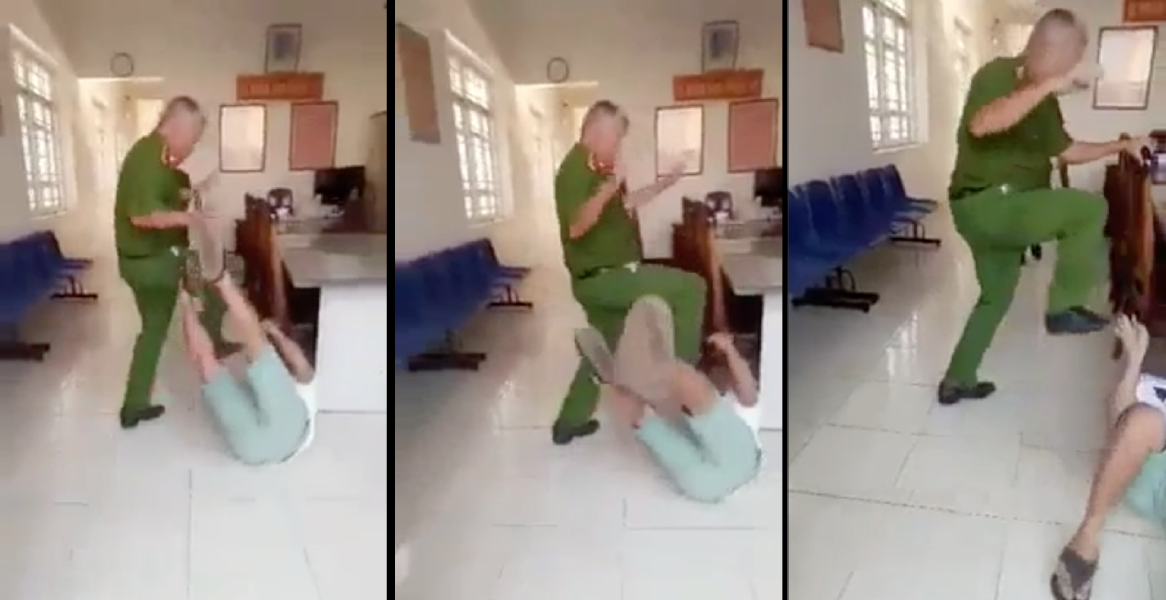
    Yesterday evening, January 29, 2019, Facebookers in Vietnam were circulating a video clip showing a gentleman lying on the ground while another, older man in police uniform was stomping on him, hitting him on the face, head and chest area.

    By the afternoon of January 30, 30219, the story got featured on Tuoi Tre online – one of the largest newspapers in Vietnam. It was one of the rarer times where one could find stories of police’s misconducts featured quickly on state-owned news right after making waves on social media.

    While Tuoi Tre was able to confirm the story and interviewed a supervisor of the police officers involved in the incident, many netizens became very critical of its headline which states: “Temporary Suspension of Deputy Ward Police Officer Using Feet to ‘Take Action’ on Witness.”

    The criticisms targeted the headline for de-escalating an incident of police brutality into something a lot less severe by using vague and ambiguous language like “take action.”

    The term “take action” was actually used by the Head of Tuy Hoa Police Department, Nguyen Van Dung, in his interview with Tuoi Tre regarding the incident.

    Some freelance journalists believed that Tuoi Tre practiced too much self-censorship and that in this situation, they could have used the word “stomp” and would not face any disciplinary action from the Central Committee of Propaganda. Later in the day, another online newspaper, Phap Luat of Ho Chi Minh City also published the same story and used the word “stomp” in the headline.

    Tuoi Tre was slammed with an order to pay a total fine of VND220 million (close to USD10,000) in July 2018 along with a 90 days suspension.

    Back then, the government issued such order after finding that Tuoi Tre had reported news that was “untrue” and causing “severe impacts” when it published an inaccurate story about the late President Tran Dai Quang’s comment on the Law on Demonstration and failed to remove a “nationally divisive” comment left by a reader on another article.

    However, with this story, some readers did come to the defense of Tuoi Tre, stating that it was a clever way of playing with words to get the people’s attention. Also, it should be okay for Tuoi Tre to quote a word used by a person they have interviewed.

    To these people, what more important was the fact that Tuoi Tre dared to swiftly report the incident at length, letting the victim provided a detailed description of the events.

    The victim in the incident was Le Huu Quoc, a resident of Phu Thanh Ward, Tuy Hoa City, Phu Yen Province. Quoc was a witness in an altercation between two other men.

    According to Quoc, he and another person were trying to break up the fight of two others, and the local police have asked all of them to come to the station.

    At the police station of the local ward, Quoc was physically assaulted – as seen in the video clip – by the deputy chief Huynh Minh Le.

    Quoc told Tuoi Tre that when he was at the police station, officer Le started yelling at him, strangled his neck, pushed him to the ground and used his feet to stomp on Quoc. Another officer came and stopped Le.

    After Quoc came home from the station, the police officers – who were fully armed – also arrived at his house later that night, asking him to go back and provide more statement. Quoc refused because he was scared from the treatment he received earlier.

    Quoc said: “I was only a witness, but they had to call a fully armed police force to come and get me like a criminal, causing damage to my reputation. Further, I already came to the station earlier and got beaten up by the deputy chief so I would not go again.”

    Confirming with Tuoi Tre, the Head of Tuy Hoa City Police Department, Nguyen Van Dung, acknowledged the incident and informed the public that the involved officer had been put on leave.

    Vietnam faced increasing public complaints regarding police brutality in recent years. After its first review under UN’s Convention Against Torture in 2018, the government is due to elucidate about five individual cases of death while in police custody by December 7, 2019.

    The debate about Tuoi Tre’s decision to publish the story and its use of certain language for its headline could be continued in the days to come regarding the practice of state’s censorship and self-censorship.

    In the meanwhile, the fact that the story of Le Huu Quoc quickly made the headlines shows the inconvenient truth about police brutality in Vietnam: it continues to happen around the country at an alarming rate, causing detrimental effects on the people and society as a whole.

  • Vietnam Rings In 2019 with More Restrictions on Citizens’ Freedoms

    Vietnam Rings In 2019 with More Restrictions on Citizens’ Freedoms

    During the last week of December 2018, Vietnam’s state-owned newspapers flooded the country’s social media with articles on rules and tips for writing and blogging in a new era of internet usage, all in preparation for the 2018 Cybersecurity Law taking effect on New Year’s Day.

    In the days leading to the country’s cyber D-day, on December 30, 2018, with the headlines “How to Write to Express your Political Opinion on the Internet without Violating the Law?” Tuoi Tre online newspaper essentially summarized the ultimate paradox for people living under one of the most repressive countries around the world.

    While the article elicits opinions from a wide range of interviewees, from intellects and heads of certain IT firms to regular social media users, they all repeat the same government’s mantra: practice self-censorship and avoid criticism of the Party and the state, so that you can have the right to express yourself.

    Like the headlines itself, the “opinion” of the group of people interviewed in this article seems to be blissfully ignorant of the international standards for freedom of expression, in particular, Article 19 of the International Covenant on Civil and Political Rights, where a government not only cannot criminalize people for stating their political opinions but is also not allowed to censor them.

    It is not surprising that the article of Tuoi Tre did not consider critical opinions of the government to be worthy of political opinions and instead endorsed the same old government’s propaganda which had been recycled throughout the past seven decades, that one could have an opinion about anything in Vietnam, except those that criticize the Party and the government. After all, all newspapers in the country are considered to be the arms and legs of that propaganda machine.

    Another leading newspaper in Vietnam, Thanh Nien, also published an article on December 29, 2018, warning people to steer clear of “The 14 Ways to Violate the New Cybersecurity Law” with the first paragraph declaring the use of social media “to gather and call on other people to incite disorder” among the prohibited acts. The language of this paragraph is nothing new; it is the same as Decree 38 which has been used for regulating public gatherings in Vietnam, an ordinance that legal experts in the country have repeatedly questioned its constitutionality since its issuance in 2005.

    Praising the accomplishments of the Party and the state, as well as reciting their propaganda, are not only welcome but also considered to be parts of the Vietnamese journalists’ obligations according to the “Code of Conduct” published by the Vietnamese Journalists Association (VJA).

    The VJA, however, is an organization formed by the government according to its Media and Press Law of 2016 (link in Vietnamese), and these obligations are statutory. The Vietnamese authorities may think that by legislating journalists’ conducts, it would give them the appearance of a society that respects the rule of law. However, in reality, perhaps the only thing such laws could further demonstrate would probably be the systematic abuse of press freedom in the country.

    Nevertheless, the Vietnamese government is now ready to roll out the “code of model behaviors” for people who use social media in the new year, and the VJA has taken an extra step this past week with the announcement of its “Eight Rules for Journalists to Behave on Social Media” on December 25, 2018.

    Among others, most notably is the requirement that journalists are not to “post any news, articles, pictures, or audio recordings on social media or repost speech and opinions in opposition to the way, policy, and guideline of the Party or the State.”

    Not stopping at that, the new rules for journalists according to the VJA also require that while online, they are not going to “comment, give an opinion or share any information which contains the purpose of inciting or engaging others to react negatively, as well as those issues that are political, economic, cultural, societal, relating to defense security, and external affairs,…with complexity and sensitivity which need consensus as well as positive and constructive observation and behaviors for society”.

    Effectively, the new arbitrarily worded regulations for journalists, when being applied together with the new cybersecurity bill, could mean that the sharing of any information considered to be critical of a proposed law, such as the still pending draft bill on the Special Economic Zones which ignited the nationwide protests in June 2018 for example, may be deemed illegal and criminal by the government starting in 2019.

    At the same time, state-owned media in Vietnam also welcomed the news of the CP-TPP (Comprehensive and Progressive Agreement for Trans-Pacific Partnership) taking effect at the end of December 2018. In the new year, Vietnam continues to push for the EU-Vietnam Free Trade Agreement to be ratified by the EU Parliament in March 2019. Both of these trade agreements demand serious improvement on the human rights situation in Vietnam, directly and indirectly.

    However, in 2018, The 88 Project reported:

    – Vietnam arrested 103 people (up from 43 in 2017)
    – 120 activists were tried
    – At least 22 of those who tried were females
    – 35 had known religious affiliations
    – 11 were sentenced to between 10 and 14 years
    – Two received the sentence of between 15 and 19 years
    – One person, Le Dinh Luong, was sentenced to 20 years

    In total, 210 people are serving jail sentences for their peaceful activism in Vietnam with 19 more await trial.

    Whether the Vietnamese government will yield to international pressure and improve its human rights records, or follows through and starts enforcing the new suppressive law on bloggers and journalists in 2019, the message from the activists’ community is unanimous: they will continue to write and express their opinions regardless. Before the Cybersecurity Law of 2018, Vietnam already has enough penal codes to send their political dissidents to prison for a long time.

  • “Minds” over Facebook: Vietnamese Netizens’ Great Cyber Exodus?

    “Minds” over Facebook: Vietnamese Netizens’ Great Cyber Exodus?

    In the past two days, the “F-Generation” of Vietnam started what seems to be an online exodus when many well-known Facebookers announced that they are moving on to Minds.com – an alternate platform for social media.

    The “F” in F-Generation stands for “Facebook” as the online social media giant has a dominant presence in the country where some statistics raised the number of users to be between 50 to 60 million.

    For about two months, people had been protesting both online and offline against the latest Cybersecurity law which was passed by an overwhelming 86.86% of the National Assembly.

    The law raised concerns over Internet users’ privacy, people’s freedom of expression, and their right to access the Internet.

    Brad Adams, Asia director at Human Rights Watch, declared: “This bill, which squarely targets free expression and access to information, will provide yet one more weapon for the government against dissenting voices. It is no coincidence that it was drafted by the country’s Ministry of Public Security, notorious for human rights violations.”

    In less than two days, some of the prominent Facebookers have received thousands of subscribers over at their freshly minted Minds accounts.

    In the same time, reports of pages and personal accounts have been taken down by Facebook also surfaced.

    Trương Thị Hà, a victim of police brutality during the last “Black Sundays” protest, announced on Minds this morning that her account has been deactivated by Facebook.

    After she posted a letter to her university professor, asking him to explain why he stood there while the police brutalized her during her detention after the protest, that very post was deleted for “violating Facebook community standards” at about 8:30 a.m. Then, her entire account seemed to have disappeared by 10:40 a.m.

    According to author Claire Bernish who wrote about Minds back in June 2015, Facebook could finally meet its match. Minds gives users the familiarity with many features they have already accustomed to on Facebook while commits to protecting their privacy.

    “Minds takes the government’s eyes out of the equation by encrypting private messages and using open-source code that any programmer can check,” Bernish explained.

    “We are a free and open-source platform to launch your digital brand, social network, and mobile app. We are also a social network ourselves. It is a global social network of social networks,” the Minds team declared.

    The hacker collective Anonymous also backed Minds, citing the fact that the founders of the new online social media shared the same vision of those who use the Internet for activism.

    According to the Wired UK: “Two of those on the Minds team – Bill Ottman and Lori Fena – have strong backgrounds dealing with privacy and freedom of expression issues and are both known for their internet-related activism. It is likely these are the type of people that the company is hoping to attract – those with a cause, who want to build something and share it openly with others who may also have a cause.”

    President Trần Đại Quang signed the Cybersecurity bill into law on June 25, 2018, although some 27,000.00 signatures of citizens who had expressed their objection to the proposal of the law, were delivered to his office during the prior weekend.

    It seems as if the activists and human rights defenders from Vietnam might have found a friend in Minds because the reason they chose Facebook in the first place, was to use the platform as a tool to advance a cause: promoting human rights and democracy in the country.

    While not all of them agreed to the solution of leaving Facebook and saw that as a sign of defeat, the silence from Facebook during the last two months as the Cybersecurity law stormed the nation could force many activists to reconsider whether to continue to use it as their primary platform. Most are still using both platforms, but all seemed to agree that if Facebook agreed to comply with the new Cybersecurity, then it could mean they will have to leave for good.

    Vietnamese netizens are no strangers to such online “resettlement.” Back in 2009, when Yahoo 360 blog closed down its operation, Facebook quickly became the next best choice in the country.

    Almost ten years later, while Facebook could still enjoy its reign in the country as the most used online social media platform, the power of Vietnamese users should not be underestimated by anyone.

    Afterall, Vietnamese are a group of people whose contemporary history entwined with mass migration and exodus. They have a lot of experience with starting over, yet again, and they will not be afraid to do so.

  • Phạm Đoan Trang – The Humming Guitar Before Rainstorm Falls

    Phạm Đoan Trang – The Humming Guitar Before Rainstorm Falls

    “I’m so very tired. How long can they keep continue doing this? They’ve cut electricity yesterday. Today it’s the Internet.”

    That was the last message I received from Đoan Trang in the afternoon on the 9th day of the Vietnamese New Year celebration, Tết. Less than an hour later, I messaged her. There was no reply until midnight.

    Trang’s family later told me that two strangers came to their residential home in the afternoon and took Trang with them. Their reasons? Her book – Politics for the Masses – which Trang wrote and published late last year.

    Discovering the forbidden zones

    Đoan Trang was once considered one of the best journalists in the country, representing the mainstream, ‘orthodox’ majority of the Vietnamese press.

    Even though she started her career at VnExpress – one of Vietnam’s first online newspapers – back in 2001, it was at Vietnamnet, another prominent e-newspaper, that Đoan Trang first made her break into the news business. After that came the much renowned and critically acclaimed feature writings and commentaries, which she produced while working for the Pháp luật Thành phố Hồ Chí Minh (The Law in Ho Chi Minh city newspaper).

    From 2007 to 2008, Trang wrote a series of articles exploring the Spratlys and Paracels Islands conflict on Vietnamnet. The series brought to her both professional glory and hardships in perhaps, equal measure.

    It was the first time since Vietnam and China normalized their relationship in the 1990s, that the South China Sea (or East Sea from Vietnam’s point of view) conflict was analyzed on a mainstream newspaper, and in a quite direct and candid manner, with an abundance of research. Despite the normalization, the East Sea conflict was then still a forbidden subject in Vietnam: an area very much known to many, but rarely touched upon by the Vietnamese mainstream journalists.

    Đoan Trang’s writing career is indeed a journey to discover these unknown lands. Before she became a household name with her political writings on Vietnamnet, Trang co-authored with Hoang Nguyen the book “Bóng” (Shadow), the first published autobiography of a homosexual person in Vietnam. However, the story with the East Sea was different. To land one’s foot in such an area is to place oneself a step further into a jail cell.

    As it turned out, Đoan Trang soon found both of her feet ended up inside a government’s prison cell. She was arrested and detained for nine whole days at a police station from the end of August to early September in 2009. On the same occasion, two other bloggers with dissident views were also arrested: Bùi Thanh Hiếu ( blogger Người Buôn Gió), and Nguyễn Ngọc Như Quỳnh (blogger Mother Mushroom).

    “To this day, I still don’t know what they arrested me for,” Trang said.

    After her nine-day detention, Trang lost her job at Vietnamnet. It only took nine days for her to go from a well-respected journalist into a “subject” who threatened Vietnam’s “national security”. With such a label, she also faced an infinite prospect of unemployment. However, she soon found a job at The Law in Ho Chi Minh city newspaper’s branch office in Hanoi. Nam Đồng, the veteran editor-in-chief of the paper, specifically invited Trang to work for them and assured her that she would be able to work normally as a journalist.

    If the Vietnamese police thought that nine days in a cell were enough to smack Trang around, they were dead wrong. The incident pushed Trang to march even further down on her chosen path. She got involved in democracy activism and continued to write stories other mainstream journalists still hadn’t found the courage to tell.

    On her personal blog at www.phamdoantrang.com, Trang began to discuss some of the most politically sensitive matters in the country: the one-party system, the police state, the public demonstrations and the resulting oppression, the arrests of political activists, etc.

    Trang turned up at the demonstrations against China’s aggression in the East Sea in 2011 and 2012. She joined the demonstrators protesting the government’s plan to cut down a large number of trees in Hanoi in March 2015. Her face and voice soon were sought after by different human rights delegations from Europe and the United States.

    Trang has thus stepped into the darkest of forests and the deadliest swamps in Vietnam. The areas in which the Vietnamese communist security apparatus have always guarded carefully.

    Of course, the sword of the State never shows mercy for such a “rogue” as that is how they see her.

    The Cat and Mouse game

    At 2.39 A.M. on a day back in 2016, Đoan Trang was awakened by the doorbell.

    She was staying temporarily at a friend’s home while still on her way to escape the pursuit of the Vietnamese police. The place was an apartment room inside a building with 24-hour security service. No strangers are supposed to be allowed into the main access, let alone coming straight to the door and ring the bell.

    “The bells were definitely tolling for me”, Trang recollected.

    “I heard clearly chit-chatting sounds from a group of people outside my door. There was no other way to explain their appearances at such ungodly hour, except that they have uncovered my tracks”.

    Hearing no noise from inside, the group of strangers left. Đoan Trang was left unscathed on that occasion.

    Going “dạt vòm” (Vietnamese slang which literally means “sleeping rough” and is used by activists to describe situations where they have to deflect secret police’s surveillance by leaving home) has become something that Trang is well-accustomed to.

    Before any demonstrations or meetings with foreign officials, this tiny lady must get herself to a hidden place at least a day prior. This is to evade being cordoned off by the government’s security force because the Vietnamese police always try to prevent Trang from turning up at such events.

    Once in a while, Trang came to stay at a friend’s place; other times, she either had to book a room at a hotel or stay at a construction site – where those living on the margins of society usually assemble.

    But escaping the police is never easy.

    Once back in 2015, not long after she came back to Vietnam after a one-year fellowship at the University of Southern California, U.S., Đoan Trang was abducted right at the Hồ Gươm (Sword Lake) in central Hanoi in broad daylight. She was on her way to the L’Espace Center to interpret in a meeting between a representative of the New Zealand embassy and the families of two wrongful death-row inmates, Ho Duy Hai and Nguyen Van Chuong.

    A police car stopped right next to the pavement and Trang was forced into it. She was taken to the nearest police station. They only released her after successfully breaking off the meeting.

    “Every time things like that happened, friends and relatives rushed to look for me. It is such an annoyance. And the thing about being abducted that frequently is that: if you are not mentally tough, you start getting paranoid, you start to see security people everywhere”, Trang revealed.

    But it was apparently still not enough cloak-and-dagger for some people.

    On 24 May 2016, the then US President, Barack Obama, planned to meet several representatives of the Vietnamese civil society communities in Hanoi. Đoan Trang was invited. At the time, she was still recuperating from a recent operation on both of her knees in Saigon (Ho Chi Minh City).

    Knowing full well that the security folks would follow her and prevent her from attending the meeting, a secret road trip to Hanoi was arranged with help from two drivers who are Trang’s friends.

    The road trip was smooth. They reached Ninh Binh in the late evening of the 23rd of May, one day before the meeting. They had a private and well-secluded hostel reserved for them, giving them the hope for a safe night without police surveillance.

    But the secret police were sleeker than what was thought of them. Early morning the next day, Trang saw several people in the hostel’s foyer, carefully dissecting her with their eyes. Then a female security officer with her own entourage marched into Trang’s room, bringing with them strange equipment and winners’ sniggers.

    “I felt like a hunted animal,” Trang recalled.

    Trang and her friends could not make it to Hanoi for the meeting with Obama. Instead, they were kept inside the hostel for the entire day.

    “In literature, there is this novel, The Seventh Cross, which is about the loneliness of the German people who were fleeing the Nazis. Now I understand how they felt. Occasionally, I walked across a huge city full of cars and people, but there was no place for me to stay. There is no hostel or hotel that would be safe enough.”

    “They do not consider us humans. To them, each and every one of us is simply a project in the name from which they could mooch off the national budget. So don’t expect to have a dialogue with the security people. We can only have a dialogue with those who respect us.”

    It may sound negative for many, but such an insight comes from a person who has been forced to have a “dialogue” with the Vietnamese security officers hundreds of time.

    The hidden audience

    “You used to sing this song, which goes ‘Let me go home’ or something? It was damn sad.”

    I received that message from Đoan Trang in an afternoon when she was on the run from another police’s pursuit.

    “I wanna go home”, she wrote in English to me, borrowing from the song Home by Michael Bublé.

    Trang likes to take care of her home. She said that she “misses the flower vase, the table, the painting, and especially longs for her guitar”.

    Not many people know about Trang’s passion for the guitar. It has been more than one occasion, in which Trang confided in me how she doesn’t really have any true passion for politics or the struggle for democracy like people usually assume. The only thing she cannot live without is her guitar.

    “I love the guitar very much. I miss it ceaselessly whenever I am away. I just want to hug it when I come home, and to kiss it and caress it with my fingers,” she said.

    If you are ever so lucky, you can sit down and hear Trang’s renditions of Mozart’s The Magic Flute, or the ballads If by Bread, I Kiss Your Memories by the Bees Gees, or Love Me with All of Your Heart (Ray Charles version).

    Trang has been teaching herself to compose music, and therefore the “dạt vòm” days are full of sufferings for her. She cannot play the guitar normally like others. Thus, she usually plays the guitar as if she won’t be able to play it tomorrow.

    People have countless reasons to fear the idea of having to go to prison. For Trang, she fears that she will not be able to play the guitar anymore. Prisons in Vietnam seldom let prisoners play guitars. It is usually with close supervision if they are allowed to play at all. The guitar strings can be used for many things, including committing suicide.

    One thing Trang has never been able to tell for sure is whether her home was bugged. Many people say with certainty, that such a “notorious dissident” like Trang, has to be bugged somehow. In the former Soviet and East European states, many people only found out that their homes were bugged after the communist regimes collapsed.

    Trang always has this feeling that even though she plays her guitar alone, there is somebody else listening.

    “I never thought I would play my guitar in such a circumstance. On the ‘other end’ of the line, if somebody is listening, what are they thinking? Maybe they think I am such a crazy woman”. Trang said, half-jokingly.

    Writing for the Mass

    On the past 9th February, the newspaper Tin Tức (The News) of the Vietnamese Press Association announced something unusual: The Danang City’s customs officers confiscated several parcels of politically-sensitive books.

    Amongst the four parcels of books “with politically-sensitive contents” which were confiscated, two parcels consist of several copies of Politics for the Mass, a book that Trang wrote.

    Politics for the Mass, written in Vietnamese and talks mostly about Vietnam and for the Vietnamese people. One would think such a book should have been able to publish in Vietnam, and not having to be ordered from abroad like that. More than 20 years ago, I dug around in my parents’ old stack of books and found the textbook Elementary Politics, published by the Vietnamese communist government. It was a short, yellowed book. I read it in one go. The clear and simple language of the book allowed my 12-year-old self to thoroughly understand and get mesmerized by Marxism-Leninism.

    But the right to publish this kind of book only belongs to the government.

    Many years later, I read another political book. This one perhaps is most famous for this oft-quoted sentence: “All animals are equal, but some animals are more equal than others”.

    Animal Farm by George Orwell somehow managed to escape the Vietnamese government’s censors and got published for a short period of time before they ordered the confiscation of all copies and listed it as a banned book in Vietnam.

    Politics for the Mass by Đoan Trang does not have such luck. She has no other way to get it published in the first place, except by relying on a “foreign force”: the tech-giant Amazon.

    Trang is the type of journalist who is especially concerned with those who have yet to know a lot of things. While many people sigh in dejection whenever “popular literacy” or “people’s intellectual level” is touched upon, Trang always reaches out to the people who are still strangers to the most basic concepts in politics and law.

    “I still remember very clearly how in 2009 when I was first arrested, I was totally naive. I did not know anything about law, or about how to behave with the police. When we went to demonstrate against China in 2011, the whole group was still none the wiser. We got bullied by the police a lot”, Trang recalled.

    “It was only in 2013 when I started to explore politics, law, democracy, human rights, etc. So when I write, I imagine that I am writing for this girl, Đoan Trang pre-2013”.

    The idea of a book for the common folks emerged when Trang read the preface to the Vietnamese translation of The Undercover Economist by Tim Harford. It was written by Nguyen Duc Thanh, a prominent Vietnamese economist, who said that Vietnam needs intellectual heralds who can help bringing complex, academic knowledge to the general public.

    After nearly 20 years working in the news business, Trang has the insight that “the Vietnamese newspapers and media fail to do such a thing. Don’t blame it on the people’s low intellectual level, or that they don’t like to read. It is us who are still not willing to help the people read, explore, discover”.

    “I don’t write a book so that it will become a legacy or get included in some canon somewhere. I don’t mind if the book grabs the public attention only for a few years if that can help the people become less ignorant about politics and inspire others to write better books on politics. We must write more so that the people become less fearful.”

    So said so done, Trang wrote Politics for the Mass, Non-violent resistance, and she is now writing several other books.

    When Politics for the Mass was published, some readers complained that Trang was too hurried in her writing and made a number of errors which could have been easily avoided.

    “Hurried”.

    Đoan Trang has always been in a hurry. Always urging. Always kicking other people into immediate actions.

    She cannot wait. Because she never knows when they will arrive: the uniforms and the handcuffs.

    “We cannot give up”

    Not many people know this, but Đoan Trang did have an opportunity to seek political asylum when she finished her nine-month course at the University of Southern California back in 2014. At least three organizations, government departments had offered Trang their assistance in applying for asylum because they were concerned about her safety when she decided to return to Vietnam.

    But Trang has never had any intention to stay abroad.

    “Many people look at your life and only see a weirdo who does strange stuff and invites misfortunes upon herself. Do you feel miserable?”, I once asked Trang.

    40-year-old, no husband, no kids, living on the run, for her greatest asset is her uncertain future. Yet not many people understand that Trang is rather happy, and not at all miserable like they imagine.

    “Many people prioritize stability, they want family, children, peaceful life. There is nothing wrong or right to argue about it because that is their own life. But for myself, if I haven’t got involved in activism, I would never have been able to experience the adoration that people have for me”, Trang said.

    Indeed. Occasionally Trang told me about such experiences, showing gratitude and pride in equal measure. Like this one time when a hotel owner told Trang to leave immediately because a police officer just came by to ask for her. That owner even showed her which way to run. When she had her knees operation, many people came to assist her, many of whom she had never met.

    “Sometimes they came to visit me in the hospital. They pushed some money into my hands, then cried and ran away. And there were old friends – who had not been in touch for some time – suddenly reappeared to help me with this and that”, Trang recalled.

    “Some people actually recognize me on the streets. I am especially elated to find young people who recognize me and talked about my writings. There was this one time in a restaurant in Saigon, the owner kept smiling at me, then he came near and asked if I am Đoan Trang. Once I said yes, he served me the meal himself, slashed the bill for me, and gave me some gifts at the end.”

    Trang said, “it is a wonderful treasure. What can you possibly trade to receive such sentiments? We cannot give up because there are still people like those in life.”

    Of all the songs she has sung, Đoan Trang loves “Fernando” by ABBA the most, the band that her 1970’s generation grew up with.

    The song’s lyrics are about two old Mexican Revolution veterans reminiscing their younger years fighting for freedom.

    The song ends with an inspiring chorus:

    …If I had to do the same again I would, my friend, Fernando…

    Maybe right at this moment, on the “other end” of the line, inside the Vietnamese Ministry of Public Security’s office, an unnamed police officer is listening to the gentle sound of a humming guitar softly weaving the melodies of “Fernando”, as if it cares not when the storm comes.

    …If I had to do the same again I would, my friend, Fernando…

    ________________

    In March 2018, Đoan Trang was honored by People In Need from the Czech Republic with the Homo Homini award for her tireless works on promoting and advancing human rights in Vietnam.

    This article was originally written in Vietnamese and published by Luật Khoa tạp chí on February 25, 2018, entitles, Đàn reo trước bão.

  • Vietnam: Increasing Cyber Attacks on Activists Portray A Shrinking Internet Freedom

    Vietnam: Increasing Cyber Attacks on Activists Portray A Shrinking Internet Freedom

    During the last week of November and in early December 2017, many of the independent media websites in Vietnam reported that access to their sites had been blocked. This includes The Vietnamese. Readers confirmed they could not access the attacked sites unless they installed VPN to get over the firewalls.

    Another independent news project also runs by The Vietnamese’s editorial board, Luat Khoa online legal magazine, was also blocked in Vietnam starting around December 4, 2017. Luat Khoa has been in operation for the past three years with over 90k likes on Facebook and an average of 500,000 pageviews per month. This is the first time Luat Khoa gets blocked in the country.

    In a more severe case, on December 5, 2017, Dan Luan – another well-known independent site – shared on Facebook that their website was under DDoS attack for about a week in late November. A DDos attack is defined as “an attempt to make an online service unavailable by overwhelming it with traffic from multiple sources”.

    Earlier last month, there were also failed attempts trying to inject Dan Luan’s website with malicious scripts via Cross-Site Scripting (XSS). Dan Luan frequently suffered cyber attacks, which they believed were the works of government-controlled hackers.

    Also in November 2017, a handful of popular Facebookers lost access to their accounts because they were reported by anonymous users to Facebook for violations of community standards. Among them was blogger Nguoi Buon Gio, who now lives in exile in Germany.

    It seems quite likely that the Vietnamese government would rely on cyber attacks as an important tactic for oppression in recent years when the numbers of Internet and social media users increased dramatically in the country.

    In July 2017, We Are Social, a social media marketing and advertising reported Vietnam had surpassed Thailand to become the 7th country with the most Facebook users worldwide.

    The government has not exactly been shy in expressing the desire to tighten their grip on controlling the virtual world. As previously reported, Vietnam claimed to have worked with Facebook and Google to remove thousands of videos and accounts that allegedly contained anti-state materials.

    Earlier this year, in May 2017, Gen. Nguyen Danh Cong of the Ministry of Public Security stated during an intra-departmental meeting, that the MPS had successfully blocked thousands of websites which they deemed to be anti-state and reactionary contents.

    Four years before that, on May 5, 2010, Gen. Vu Hai Trieu, the then Deputy Director of the MPS, announced: “Our technical departments have destroyed 300 Internet web pages and blogs posting unsuitable contents.”

    Coincidentally, it was in early November 2017 that the Washington D.C.-based cybersecurity firm, Volexity, issued a report, confirming it has been – since May 2017 – monitoring an active operation of mass surveillance and cyber attacks operating out of Vietnam.

    This operation includes the maintenance of an active group of hackers whose mission is to target Vietnamese activists and dissidents, as well as foreign citizens, corporations, and governments with interests in Vietnam.

    It was not the first time that the international cybersecurity community had warned about hackers who seemed to have had a close tie with the Vietnamese government. In the past three years, besides Volexity, at least two other organizations, Electronic Frontier Foundation and FireEye, had issued similar reports.

    Vietnam’s government is believed to have been maintaining a cyber espionage group calls OceanLotus since at least 2014. OceanLotus (or SeaLotus) is also known as APT-C-00 or APT32 according to these organizations.

    There was also other information leading people to believe that OceanLotus was related to the hacker group Sinh Tu Lenh.

    Sinh Tu Lenh became famous among Vietnamese cyber community about a decade ago when it was named as the party responsible for the numerous cyber attacks, aiming at dissidents, activists, and independent news sites, including Dan Luan, Talawas, Xcafevn, Anh Ba Sam, and Mother Mushroom.

    Also recently, on November 14, 2017, Freedom House issued its Freedom on the Net report and named 30 countries where the government paid commentators and political bots to spread government propaganda. Vietnam was one of them.

    According to Michael J. Abramowitz, president of Freedom House: “The effects of these rapidly spreading techniques on democracy and civic activism are potentially devastating.”

    The report also quoted Sanjia Kelly, director of the Freedom on the Net project: “Governments are now using social media to suppress dissent and advance an anti-democratic agenda.”

    “Not only is this manipulation difficult to detect, it is more difficult to combat than other types of censorship, such as website blocking because it’s dispersed and because of the sheer number of people and bots deployed to do it.”

    But activists in Vietnam are not new to this form of government’s suppression. Back in 2014, our editorial board’s member, Pham Doan Trang, had met with Google and Facebook representatives in the U.S. where she forwarned them about the daily attacks these “paid opinion shapers” had fired at activists and bloggers in Vietnam and how such conducts affected democracy movement.

    During the summer of 2014 alone, over 40 accounts of activists were reported, and in turn, got shut down by Facebook.

    Calling themselves the government’s “cyber army forces”, these online bots repeatedly reported activists and bloggers’ Facebook accounts, effectively causing their shut-downs.

    Taking advantages of Facebook’s loosely defined rules and standards of conducts for the users’ community, the troop of “opinion shapers” would abuse the Facebook’s “Report Abuse Button” with thousands of reports a day on a specifically targeted activist’s account.

    Yet, to date, it seems that the activists and the democracy movement have proven their potential sustainability in Vietnam, because people are still actively promoting their causes and Facebook continues to be the main platform for advancing social changes, despite all odds.

    Back in March 2015, facing the city government’s immediate decision to cut down some 6,700 trees in Hanoi, activists created a Facebook group and organized people for peaceful protests. They were able to mobilize residents of Hanoi and successfully stopped the city government from going forward with the plan.

    In 2016, Facebook again proved its effectiveness, as it was one of the best platforms for informing the public about the Formosa environmental disaster in Central Vietnam. During the height of the weeks-long protests against Formosa Ha Tinh Steel Plant – the company responsible for causing the pollution – access to Facebook was blocked on a few weekends. But its popularity among the general public had caused the government to undo such decision almost immediately.

    This year, in the recent months, drivers who were passing through a BOT toll in Cai Lay Ward, Tien Giang Province have been protesting the improper location of said toll. Their acts of civil disobedience – through various forms of slowing down the process of paying toll fees and causing the toll to close down – were followed closely by the public on Facebook and other social media platforms.

    To protect themselves and fight back, Vietnamese activists have received technical assistance from organizations, such as Access Now, when they got reported by the government’s bots on Facebook or got struck by some other forms of cyber attacks.

    In the meanwhile, the Draft Law on Cybersecurity – which mirrored that of China – is now waiting for the National Assembly’s approval.

    And as such, the battle in the cyber world continues.

  • Vietnam: Free Press is Not Free

    Vietnam: Free Press is Not Free

    Vietnam always boasts an impressive record of having over 800 newspapers, thousands of publications, tens of thousands of journalists, a national news agency, hundreds of TV channels and broadcasting channels, as well as hundreds of online newspapers and magazines, as evidence that there is a free press in the country.

    Yet at the same time, it remains one of the top countries that practice the tightest Internet surveillance and censorship as evaluated by Freedom House in 2017 and has also been named one of the top five state enemies of the Internet around the world by Reporter Sans Frontiers.

    Obviously, the government and its supporters have frequently complained that the international human rights associations were biased with their reports and not treating Vietnam fairly.

    So, is Vietnam’s free press free, as claimed by its government?

    One of the latest administrative decisions from the country’s Ministry of Information and Communications (MIC) on November 14, 2017, could shed some light on the answer.

    The MIC-issued order effectively prohibited the online magazine Nguoi Quan Ly (The Manager), from engaging in any and all publication activities for three months, due to an article it had published in relation to the anti-corruption campaign in Binh Phuoc Province dated August 21, 2017. Further, the magazine was also fined 40 million VND (approximately 1,800.00 USD) for this piece and had to immediately and permanently remove such article.

    The offending article is entitled “Binh Phuoc: Newspapers are standing on the sidelines of the campaign to prevent and fight against corruption?”

    Given the fact that Secretary General Nguyen Phu Trong of the Vietnamese Communist Party (VCP) has long been tooting his image as a leader with a staunch stand on fighting corruption, it could be a bit confusing for some in trying to understand as to why Nguoi Quan Ly received quite a harsh fine for that particular article.

    But it is also this very call to fight corruption from the VCP that apparently had caused Nguoi Quan Ly such an agonizing fate.

    Corruption is one of the more sensitive issues to the Vietnamese government because it could carry the most detrimental effect on the VCP’s legitimacy. And in Vietnam, it is the VCP’s leadership that counts, not the civic government. Thus, the VCP has to defend its own legitimacy at any costs, and writings on the topic of corruption must be strictly monitored. In other words, the press should write about corruption as being directed by the VCP’s orders.

    Understanding the Party’s ultimate goal of keeping an impeccable image in the eyes and minds of its people, would further help us understand why the press in Vietnam cannot be free, as long as the VCP retains its leadership role.

    With plenty of traditional newspapers, as well as online magazines and news sites in Vietnam, none of them could really be free to write as they please. Instead, all of them are only allowed to write as instructed by the directives and missives they receive from the VCP’s Central Propaganda Department, not just on sensitive issues like corruption but apparently all issues.

    It has been an old joke in the country that Vietnam has many newspapers, but only one editor-in-chief, the Chief of the VCP’s Central Propaganda Department.

    Nguoi Quan Ly online magazine was shut down for three months and had to pay a hefty fine because the published article could probably be construed as a direct attack on the Central Propaganda Department’s authorities.

    In the offending article, the magazine criticized the Binh Phuoc’s Provincial Office of the Central Propaganda Department for hindering the media and journalists’ efforts in covering stories about corruption in the area, in particular, by the issuance of Missive No. 598-CV/BTGTU.

    According to Nguoi Quan Ly’s article, Missive No. 598-CV/BTGTU effectively ordered all media in the area to write only about “positive” results of the VCP’s fight against corruption. In other words, they were supposed to report only on how great the government had been in carrying out those anti-graft campaigns.

    The article further stated, if one was to follow Missive No. 598-CV/BTGTU, then it would mean he/she would not be able to raise any potential issues regarding the probable government’s wrongdoings, any incidents of corruption in the area, or present their investigation on the potentially corrupted officials. Instead, they could only praise the government and its officials on a great job that they had done with the anti-graft campaign. Therefore, the article continued to argue, the missive was in direct conflict with the VCP’s own anti-corruption mission as detailed by the Politburo.

    The article did not state any other information, except quoting and analyzing the contents of Missive No. 598-CV/BTGTU. But that was enough for the MIC to penalize it with a high fine and shut it down for three months.

    Speaking to BBC-Vietnamese edition, journalist Mai Quoc An said he could not understand why Nguoi Quan Ly was penalized so harshly for this particular article, as they were just reporting the correct contents of Missive No. 598-CV/BTGTU. On his Facebook account, An also published a photograph of the very missive, so that netizens could see its contents themselves and compared to what Nguoi Quan Ly had written.

    From An’s Facebook account, we also learned that the entire editorial board, writers, and staff of Nguoi Quan Ly had resigned from their positions on November 16, 2017, two days after the administrative sanction became public. That, however, is a rare form of defiance from Vietnam’s mainstream media in situations like this.

    What more often seen is that when faced with an administrative order penalizing them for exercising their rights under freedom of the press, none of the newspapers or their writers would fight back. They all rather accepted the sanctions, paid the fines, and lived with the reality that their publication may very well be closed indefinitely after the sanctioning period due to the competitive nature of the field.

    An also told BBC that he believed no one had ever challenged the validity of these administrative decisions in court. An is no stranger to this method of controlling the press in Vietnam. He used to work for Sai Gon Tiep Thi, a popular magazine that was forced to close its operation in early 2014 after 19 years of publication. Many suspected that Sai Gon Tiep Thi was closed down because it was deemed to have gotten too close to the VCP’s comfort in writing more and more about issues, which the Party considered to be, highly sensitive political matters.

    While the decision to fine Nguoi Quan Ly obviously did not spell out the exact reasons and instead stated that the offending article “contained misleading information which led to serious consequences”, once we compared the contents of the offending article to that of Missive No. 598-CV/BTGTU, the MIC seemed to have failed at their reasoning.

    If anything, this latest round of investigating and monetary fining publications (along with Nguoi Quan Ly, at least two other newspapers were fined for their articles) by the MIC indirectly reaffirmed the fact that free press in Vietnam after all, does not stand a chance to be free. One is only free to write as long as he or she keeps in line with the orders and missives of the Central Propaganda Department and the VCP.

    It is the so-called centralized democracy which operates the VCP, that also dictates an absolute obedience to the Party in many aspects of society, especially those that related to the news and media. And as such, newspapers like Nguoi Quan Ly was penalized not because their articles contain untruths or misleading information, but because they showed the slightest sight of disobeying the orders of the VCP and its Central Propaganda Department.

    Vietnamese journalists and reporters, after all, does have a duty to “protect the platforms, ideology, and policies of the Party,” according to the country’s Press Law 2016, which took effect on January 1, 2017.