Tag: free press

  • Vietnamese Vision Of A “Clean Newspaper” And The Government’s Intolerance To Press Freedom

    Vietnamese Vision Of A “Clean Newspaper” And The Government’s Intolerance To Press Freedom

    This year as the world triumphs the importance of free speech with the award of the Nobel Peace Prize to two journalists, Maria Ressa and Dmitry Muratov, for their “efforts to safeguard freedom of expression,” Vietnam has taken a step backward in its respect for press freedom by arresting and imprisoning independent journalists.

    On October 26, the local Court of Can Tho City began to try five members of the Bao Sach (Clean Newspaper) group, a Facebook-based journalism project, for allegedly “abusing the rights to freedom and democracy” that the government deemed “threatening” to state interests and security. Two days later, on October 28, five members of Bao Sach were sentenced to a total of 14 years and six months in prison.

    Meanwhile, the Court of Hanoi City is also expected to try prominent journalist Pham Doan Trang for “propagandizing against the Socialist Republic of Vietnam;” the evidence used to prosecute Doan Trang includes her written reports and assessment regarding environmental issues, the human rights situation, and religious freedom in Vietnam.

    In some ways, when we congratulate the two journalists who were awarded the prestigious Nobel Peace Prize in 2021, Maria Ressa of the Philippines and Dmitry Muratov of Russia, we also feel saddened to think about the Bao Sach members and Pham Doan Trang. These Vietnamese journalists have been facing never-ending hurdles reporting the truth under the repressive hands of authoritarian leaders.

    Vision for a better journalistic environment in Vietnam

    Established in 2019, Bao Sach started off as a Facebook-based project which investigated and reported on the alleged corruption and misconduct of Vietnamese government officials and state-owned companies. Corruption and mismanagement are ubiquitous in Vietnam’s governance system. The project quickly attracted a substantial number of followers in its fan page on Facebook, as the role of the social network in Vietnam is similar to its neighbor, the Philippines, where it is essentially viewed as the Internet.[1]

    The journalistic group’s name, Clean Newspaper, refers to its commitment to journalism ethics by truth and impartiality rather than becoming another mouthpiece of the Communist government. Bao Sach gained popularity through its fact-based and accurate reporting that helped expose and provide insights into the many social issues to which the Vietnamese public pay attention, most notably the case of Ho Duy Hai, who was given the death penalty in an unfair trial.

    However, being a vocal critic in a tightly controlled media environment comes with a cost. Not much different from what Rappler Founder Maria Ressa [2] faced as a journalist in the Philippines, independent journalists, and human rights activists in Vietnam also live in constant fear of harassment by government-funded online trolls and arbitrary arrests and charges under vague laws, which have no purpose other than to curb freedom of expression.
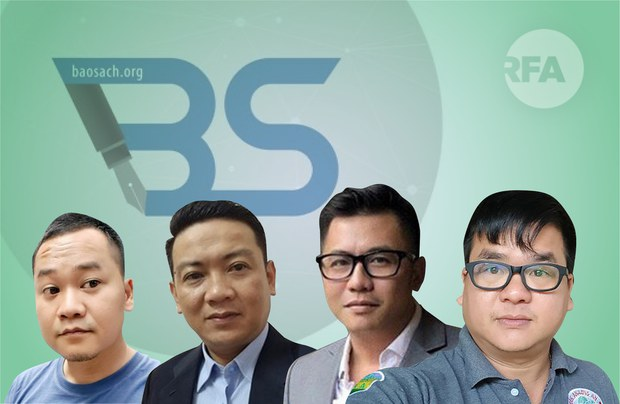
    Bao Sach’s (Clean Newspaper) members. Photo: RFA.

    Late last year, Truong Chau Huu Danh, one of the co-founders of Bao Sach, was arrested by the police, which marked the end of one of the promising independent media projects in Vietnam. Bao Sach’s Facebook page was shortly suspended after Danh’s apprehension; three members were arrested earlier in April this year.

    Subsequently, they were charged with “abusing the rights to freedom and democracy to infringe on state interests” under Article 331 of Vietnam’s 2015 Penal Code, which has been strongly criticized [3] by the international community and legal authorities for its vagueness and lack of clear definitions of the actual conduct.

    Similarly, Doan Trang’s vision [4] of a journalism project to provide Vietnamese people with an understanding of law, politics, and human rights also led to her arrest and detention. She was charged with “propagandizing against the State,” another criminal charge commonly used by the Vietnamese government to suppress dissenting opinions in the country.

    The Vietnamese government’s intolerance to press freedom

    Nevertheless, the Bao Sach members and Doan Trang are among dozens of independent reporters, journalists, and broadcasters constantly harassed or detained by the Communist authorities. Critical reporting of online bloggers and live-streamers also meets with increasing censorship as Facebook, Vietnam’s most popular social media site has in recent years reportedly complied with the government to remove “anti-state” posts. According to local activists and free-speech advocates, [5] the tech giant’s compliance is giving the Vietnamese authorities “near-total control over the platform.”

    Despite the Vietnamese Communist Party trying to boast and propagandize [6] about its state of press freedom and its respect for human rights, Vietnam scores poorly on almost every international ranking regarding press freedom and fundamental civil rights.

    Vietnam ranks [7] at 175th out of 180 countries on the 2021 World Press Freedom Index from Reporters Without Borders in terms of free press. It is also among those countries with the highest number of detained journalists, according to figures [8] compiled by the Committee to Protect Journalists (CPJ) in 2020.
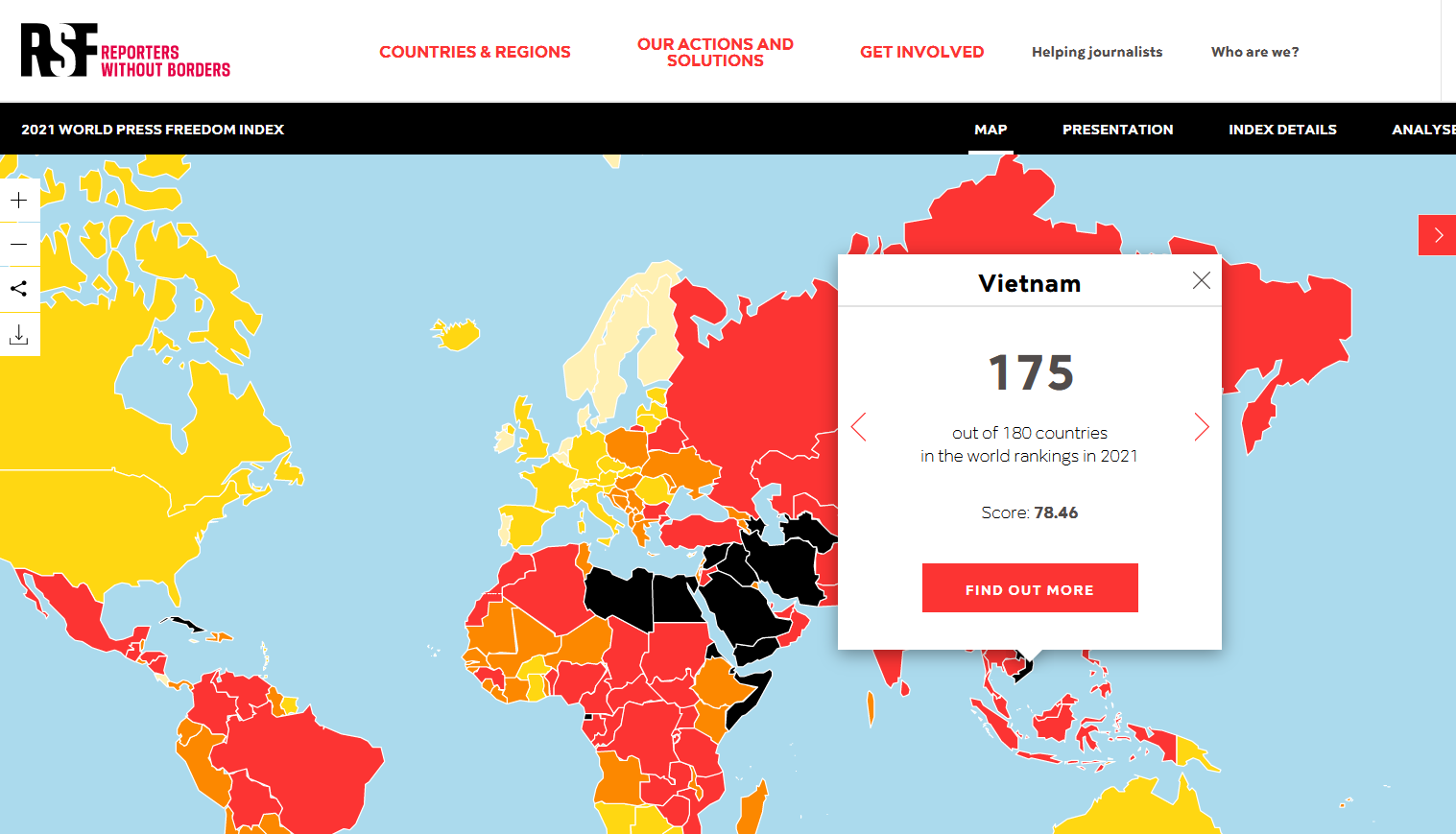
    Vietnam ranks 175th out of 180 countries in terms of press freedom. Photo: screenshot/ Reporters Without Borders.

    On civil rights, Freedom House, a non-partisan organization working to promote freedom and democracy, declared that Vietnam was “not free” when it comes to internet freedom. The Vietnamese government later criticized the results, allegedly requesting Freedom House to “stop making groundless assessments” [9] on the situation of internet freedom in the country. However, the government failed to provide concrete evidence to explain its alleged repression of internet users’ rights, other than a few fragmented pieces of information bragging about the country’s growth in internet users and its Human Development Index.

    The journey to a truly free, progressive, and independent media environment in Vietnam is still long and arduous, given the arbitrary arrests of independent journalists in recent years and an increasingly restricted social media space. However, if Prime Minister Pham Minh Chinh wants to realize his pledge [10] to “listen to dissenting opinions [and] debates,” then Vietnam must respect freedom of the press and allow journalists to express their viewpoints freely. It would also contribute to the long-term development of both Vietnam as a country and its journalistic environment.

    References:

    1. Vick, K. (2021, October 8). “It Is a Battle for Facts.” What Nobel Peace Prize Winner Maria Ressa Understands About Why She Was Chosen. Time. https://time.com/6105407/maria-ressa-nobel-prize-interview/
    2. Andrew Yeo, Enrico Gloria. (2021, October 21). In a first, the Nobel Peace Prize went to a Filipina. Her government isn’t happy. The Washington Post. https://www.washingtonpost.com/politics/2021/10/21/first-nobel-peace-prize-went-filipina-her-government-isnt-happy/
    3. The Vietnamese Magazine. (2021, October 26). Statement On The Upcoming Trial Of Bao Sach (Clean Newspaper). The Vietnamese Magazine. https://www.thevietnamese.org/2021/10/statement-on-the-upcoming-trial-of-bao-sach-clean-newspaper/
    4. Tran Phuong, Will Nguyen. (2021, February 14). Who Is Pham Doan Trang? The Vietnamese Magazine. https://www.thevietnamese.org/2021/02/who-is-pham-doan-trang/
    5. Elizabeth Dwoskin, Tory Newmyer, Shibani Mahtani. (2021, October 25). The case against Mark Zuckerberg: Insiders say Facebook’s CEO chose growth over safety. The Washington Post. https://www.washingtonpost.com/technology/2021/10/25/mark-zuckerberg-facebook-whistleblower/
    6. Đối diện: Nhân quyền. (2021, October 27). VTV. https://vtv.vn/video/doi-dien-nhan-quyen-527961.htm
    7. Vietnam – Reporters Without Borders. (n.d.). Reporters Without Borders. Retrieved October 28, 2021, from https://rsf.org/en/vietnam
    8. Record number of journalists jailed worldwide. (2020, December 15). Committee to Protect Journalists. https://cpj.org/reports/2020/12/record-number-journalists-jailed-imprisoned/
    9. VNA, (2021, September 29). Freedom House should stop making groundless assessments on internet freedom in Vietnam. VietnamPlus. https://en.vietnamplus.vn/freedom-house-should-stop-making-groundless-assessments-on-internet-freedom-in-vietnam/208842.vnp
    10. Tuan, V. (2021, April 15). Thủ tướng Phạm Minh Chính: “Chính phủ phải lắng nghe ý kiến phản biện.” VnExpress. https://vnexpress.net/thu-tuong-pham-minh-chinh-chinh-phu-phai-lang-nghe-y-kien-phan-bien-4263570.html
  • Pham Doan Trang’s Trial Postponed While UN Working Group On Arbitrary Detention Called For Her Immediate Release

    Pham Doan Trang’s Trial Postponed While UN Working Group On Arbitrary Detention Called For Her Immediate Release

    Vietnam arrested Pham Doan Trang on October 7, 2020, and charged her under Article 88 of its 1999 Penal Code for allegedly “making, storing, distributing or disseminating information, documents, and items against the Socialist Republic of Vietnam.” Her trial was originally scheduled to take place on November 4, 2021, but the court postponed her trial due to the prosecutors having come into contact with COVID-19.

    However, on October 25, 2021, the United Nations Working Group on Arbitrary Detention (WGAD), a team of five independent experts tasked with investigating “cases of deprivation of liberty imposed arbitrarily or inconsistently with the international standards set forth in the Universal Declaration of Human Rights,” released their opinions regarding the arrest, detention, and treatment by the Vietnamese state of internationally recognized independent journalist and human rights defender Pham Doan Trang.

    In this document, WGAD scrutinizes the formal statements given by the side of Doan Trang and that of the Vietnamese government in order to verify the authenticity of the claims regarding her situation in custody and to provide recommendations for the Vietnamese government.

    WGAD also stated that even though the Vietnamese government vehemently rejects the accusations alleged by the side of Doan Trang and that “[the Vietnamese government] cannot provide detailed information regarding this case to the press and other irrelevant parties,” WGAD will still continue with its investigation as part of its mandate “to serve the needs of victims of arbitrary arrest and detention worldwide.”

    WGAD concluded that “the deprivation of liberty of Pham Doan Trang, being in contravention of articles 2, 6, 7, 8, 9, 11, 19, 20 and 21 of the Universal Declaration of Human Rights and articles 2, 9, 14, 15, 16, 19, 21, 22, 25 and 26 of the International Covenant on Civil and Political Rights, is arbitrary and falls within categories I, II, III, and V.”

    Regarding Doan Trang’s arrest by state forces, WGAD believes that the Vietnamese authorities failed to present a warrant for her arrest and that Doan Trang was not informed of the charges lodged against her. She was also never brought before an independent judicial authority in order to challenge her detention.

    Likewise, WGAD upholds that Doan Trang was put under Incommunicado Detention which “is an environment conducive to torture and cruel inhumane treatment, as it may be used to coerce the individual to confess to the commission of the alleged crimes and admit guilt.” Furthermore, WGAD states that the initial charge under Article 117 of the Vietnamese Criminal Code is “so vague that it is impossible to invoke a legal basis for her detention.” Hence, WGAD concludes that the Vietnamese government failed to establish a legal basis for Doan Trang’s arrest and detention.

    WGAD also believed that she was detained for “peacefully exercising her rights to freedom of opinion, expression, and association.”. As such, it has referred this case to the Special Rapporteur on the promotion and protection of the right to freedom of opinion and expression and to the Special Rapporteur on the rights to freedom of peaceful assembly and of association.

    WGAD also stated that because Doan Trang was not allowed to speak to her defense lawyers until recently, and was denied legal counsel, her right to a fair and just trial has been violated.

    Likewise, WGAD found that Doan Trang was “deprived of her liberty on discriminatory grounds” due to her being a vocal human rights defender and because of her political stance and opinions.

    In light of all the information presented, WGAD requests that the Vietnamese government take all the necessary steps needed in order to remedy Doan Trang’s situation in order to “bring it into conformity with the relevant international norms.”

    WGAD believes that the best remedy would be to urgently and immediately release Doan Trang and compensate her in accordance with international law. WGAD also urges the Vietnamese government to ensure a “full and independent investigation” of Doan Trang’s arbitrary detention and to “take appropriate measures against those responsible for the violation of her rights.”


    The UN WGAD’s full statement can be found here

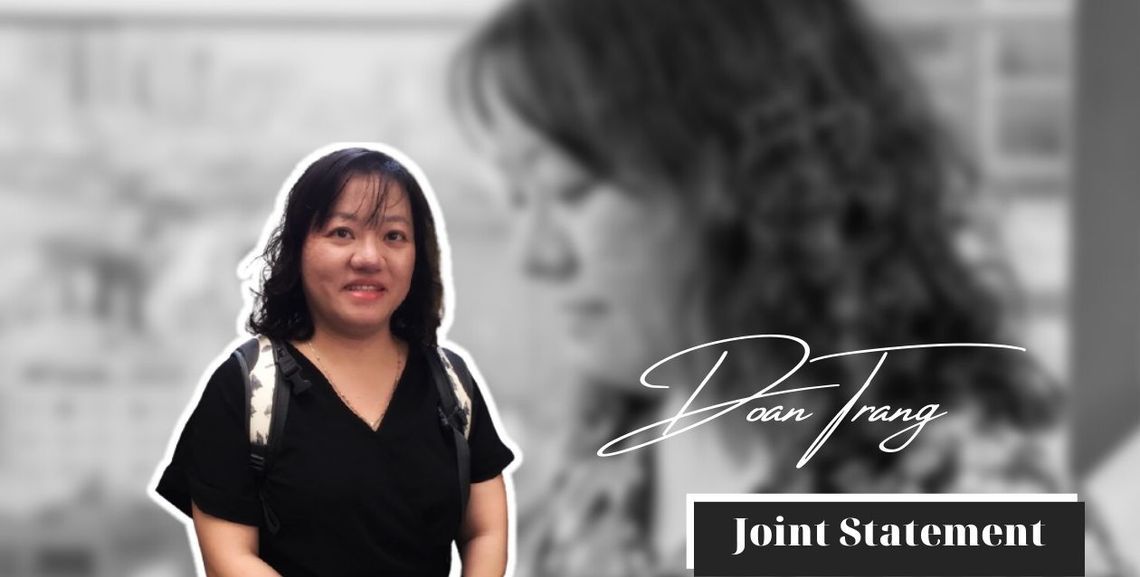
  • LIV Joins 27 Other NGOs In Issuing A Joint Statement Demanding The Immediate Release Of Pham Doan Trang

    LIV Joins 27 Other NGOs In Issuing A Joint Statement Demanding The Immediate Release Of Pham Doan Trang

    OCT 26 2021– Legal Initiatives for Vietnam (LIV), alongside 27 other non-governmental organizations (NGOs) released a joint statement calling for the immediate release of independent journalist and human rights advocate, Pham Doan Trang. Trang, one of the “best-known independent writers in Vietnamese civil society” who is also “recognized internationally for her human rights advocacy,” was arrested at her home in Ho Chi Minh City on October 7, 2020. She is currently being charged under Article 88 of the 1999 Penal Code which criminalizes ‘making, storing, distributing or disseminating information, documents, and items against the Socialist Republic of Vietnam.’

    The statement comes ahead of Trang’s upcoming trial which is scheduled to take place on November 4, 2021. However, information about her trial was only made public on October 18, 2021, more than a year after her arrest.

    The joint statement claims that Pham Doan Trang’s persecution is due to her “long-standing work as an independent journalist, book publisher, and human rights defender, known for writing about topics ranging from environmental rights to police violence, as well as for her advocacy for press freedom.”

    Since her arrest, she has also been held incommunicado and has been denied contact with her family and her lawyers, only being allowed to get in touch with them on October 19, 2021, a day after the public announcement of her trial. Trang’s lawyer also notes that his client’s legs, which were broken in the past by the police in 2015, were in greater pain due to Trang being denied adequate medical care during her detention; she has also lost a lot of weight and has not been allowed to see any doctors to treat her other pre-existing medical conditions.

    In light of this information, LIV and its allies unanimously call for the Vietnamese government to:

    • Immediately and unconditionally release and drop all charges against Pham Doan Trang and all other human rights defenders currently imprisoned solely for the peaceful exercise of their human rights and fundamental freedoms;
    • Pending her immediate and unconditional release, guarantee humane treatment and conditions, and ensure prompt access to medical attention;
    • Guarantee Doan Trang unrestricted access to and regular communication with her family and confidential access to legal assistance of her choosing;
    • Ensure that her chosen lawyers are promptly provided with timely access to all relevant legal documentation and granted unrestricted communication and access in confidentiality with Doan Trang and adequate time and facilities to prepare for her defense;
    • Ensure the trial is open to the public, including diplomatic and human rights civil society observers and the media, and refrain from any arbitrary restriction on travel or interference of trial observers, media, and civil society preceding and during the trial;
    • Repeal or substantially amend the Penal Code and other non-human rights compliant legislation, used to harass and imprison individuals—including independent journalists and human rights defenders—for the exercise of their fundamental rights, and bring them in conformity with the International Covenant on Civil and Political Rights to which Vietnam has been a State Party since 1982, and other applicable international law and standards.

    ———-

    The full English text for the joint statement can be found here.

    The Vietnamese language version can be found here.

  • Statement On The Upcoming Trial Of Bao Sach (Clean Newspaper)

    Statement On The Upcoming Trial Of Bao Sach (Clean Newspaper)

    Legal Initiatives for Vietnam (LIV) – the operator of Luat Khoa Magazine and The Vietnamese Magazine – strongly condemns the Vietnamese government for criminalizing the activities of Bao Sach (Clean Newspaper) and the five members of the group.

    Vietnam prosecuted the Bao Sach group members under Article 331 of the 2015 Penal Code (the revision of Article 258 of the 1999 Penal Code). The international community and legal authorities have strongly criticized these two penal codes because they arbitrarily criminalize the act of “abusing democratic freedoms to infringe upon the interests of the State, lawful rights and interests of organizations and/or citizens” without defining the actual conduct of the offense. Previous cases being prosecuted under Articles 331/258 – including this Bao Sach case – illustrate that Vietnam criminalizes certain acts and conduct that should have been in the jurisdiction of the civil court system.

    We declare that the investigation, arrest, and prosecution of the members of Bao Sach show that Vietnam violates its citizens’ freedom of speech, free press, and economic freedoms. When we read the formal indictment against Bao Sach members, we can clearly see that even if these members have infringed upon the interests of the State, another individual, or another entity, the legal issue should be under the civil court system or a judicial arbitration rather than prosecuting them criminally.

    A person being silenced, a newspaper, or a media organization being closed down arbitrarily is a danger for any society. As a non-profit organization that works in journalism, LIV strongly condemns these violations that Vietnam commits and demands that the government release immediately and unconditionally all of the Bao Sach members and cease all of the criminal allegations against them.

    We also call on other journalists and the public in general to join with us and support the rights and freedoms of all of the Bao Sach group members and demand Vietnam abolish Article 331 of the 2015 Penal Code.

    Trinh Huu Long, Co-Director

    Tran Quynh Vi, Co-Director

  • Vietnam Says It Is Promoting And Defending Human Rights, But The Reality Proves Otherwise

    Vietnam Says It Is Promoting And Defending Human Rights, But The Reality Proves Otherwise

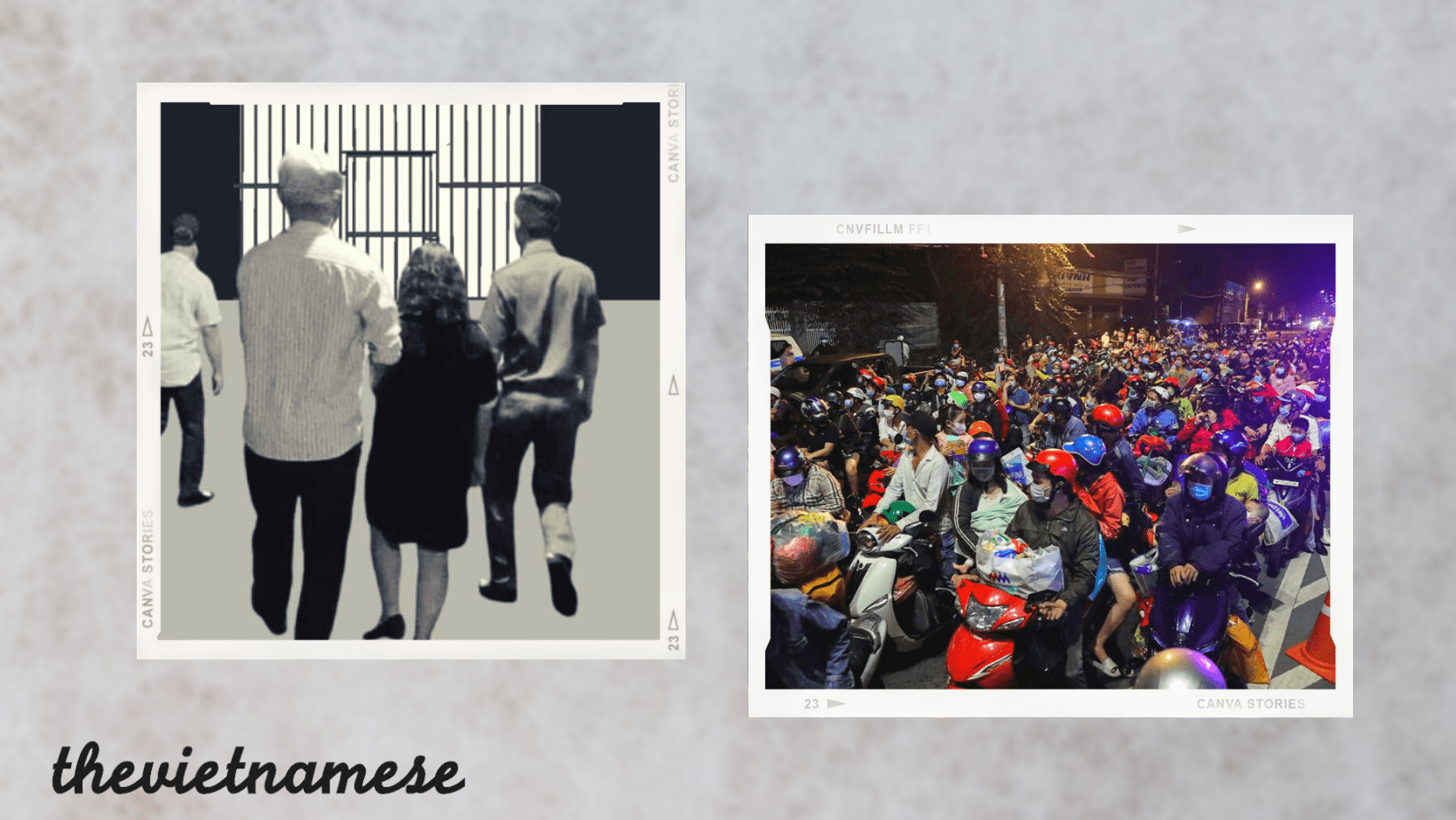
    In Vietnam, the beginning of this October marks two significant events that challenge and reflect upon the country’s actual circumstance over its commitment to uphold human rights values: the one year anniversary of the arrest of journalist Pham Doan Trang and the mass exodus of migrant workers who have had to use all sorts of means to return to their hometowns due to the lack of help from the government.

    Earlier, in March, Vietnam also announced its candidacy for the United Nations Human Rights Council (UNHRC) for the agency’s 2023-2025 term. This announcement has astonished many local pro-democracy activists and critics, who have expressed their opposition to such a move.

    According to the UNHRC’s membership requirements [1], member states running for the seats need to fulfill their “contribution to the promotion and protection of human rights,” and once they gain the council’s membership, the members must bear the responsibility to “uphold high human rights standards.”

    However, given the one-party Communist state’s poor human rights record and its consistently oppressive policies and actions in curtailing the people’s fundamental civil and political rights, Vietnam’s legitimacy to become a member of the UNHRC should remain out of the question [2].

    On the one hand, Vietnam’s state-controlled media has been seen praising [3] the country’s efforts in securing a seat at the United Nations body, betting on its early successful containment of COVID-19 and the donations of masks and medical equipment to other countries. From the government’s reasoning, keeping people safe and protecting their daily livelihoods are crucial to the promotion of human rights. “The country has tackled the pandemic head-on, putting the people at the center of all its efforts,” state media quoted Vietnamese Foreign Minister Pham Binh Minh as saying at the UNHRC’s 46th Regular Session.

    On the other hand, the apprehension of journalist Pham Doan Trang and the dire situation of Vietnamese migrant workers during the fourth wave of the COVID-19 pandemic in the country provide us with a contrasting narrative. Those unparalleled stories vividly portray an authoritarian government that shows virtually no tolerance for dissenting opinions, in addition to highlighting its disregard for the most basic human rights, which are recognized in the U.N.’s Universal Declaration of Human Rights and the country’s own Constitution.

    Pham Doan Trang and her freedom of speech

    Pham Doan Trang was arrested by the Vietnamese authorities at around midnight on October 6, 2020, and she has been held incommunicado since her detainment. Her arrest came only hours after officials from Vietnam and the United States held a video conference for the two countries’ 24th annual Human Rights Dialogue. However, Doan Trang, her friends and colleagues, and also the readers of her books, had long been anticipating her arrest.

    As a dedicated journalist and a prominent writer, Pham Doan Trang has devoted her career to documenting and writing about controversial social issues and human rights violations committed by the Vietnamese government. She also publishes books popularizing general knowledge about politics, laws, and human rights for the Vietnamese people.

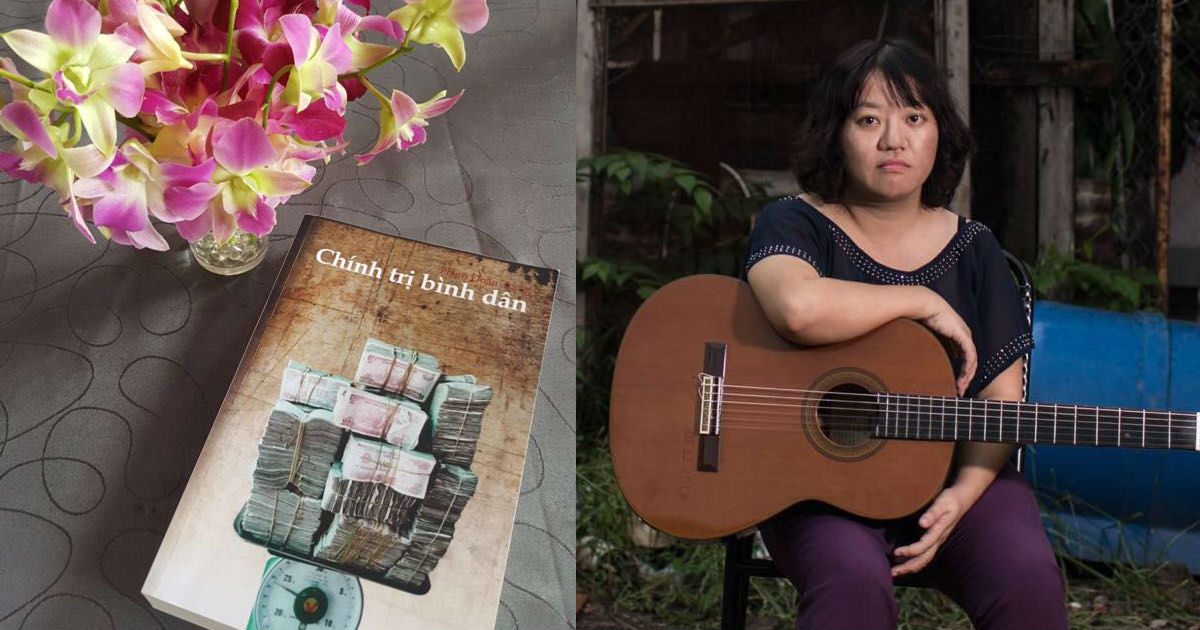
    Pham Doan Trang and her book “Politics for The Masses.” Photo: Luat Khoa Magazine.

    In theory, the Vietnamese Communist Party (VCP) has consistently trumpeted[4] its respect for the people’s right to freedom of speech, right to access to information, and press freedom, which were promised to its citizens under the Constitution. But in reality, the VCP has systematically harassed and detained independent journalists and activists [5], restricted access [6] to critical online newspapers and blogs, including The Vietnamese Magazine and Luat Khoa Magazine, and tracked down and intimidated [7] anyone who disagrees with its political doctrine.

    To the international community and admirers of her work, Doan Trang has only done what a journalist should be doing: report truthfully and inform the global audience about alleged human rights abuses by the VCP. What the Vietnamese government has been doing to silence opposition critics and dissidents like her only exposes the country’s serious violations of basic human rights and its lack of commitment to steadfastly protect those fundamental rights of its citizens.

    The homebound journeys of Vietnamese migrant workers

    Also at the beginning of October, heartrending photos and video footage of thousands of migrant workers rushing to return to their hometowns were widely shared on Vietnamese social media. These migrant workers decided to flee big cities en masse due to financial difficulties that affected them as a result of COVID control measures and the lack of help from the government. “We are tired,” one migrant worker said [8].

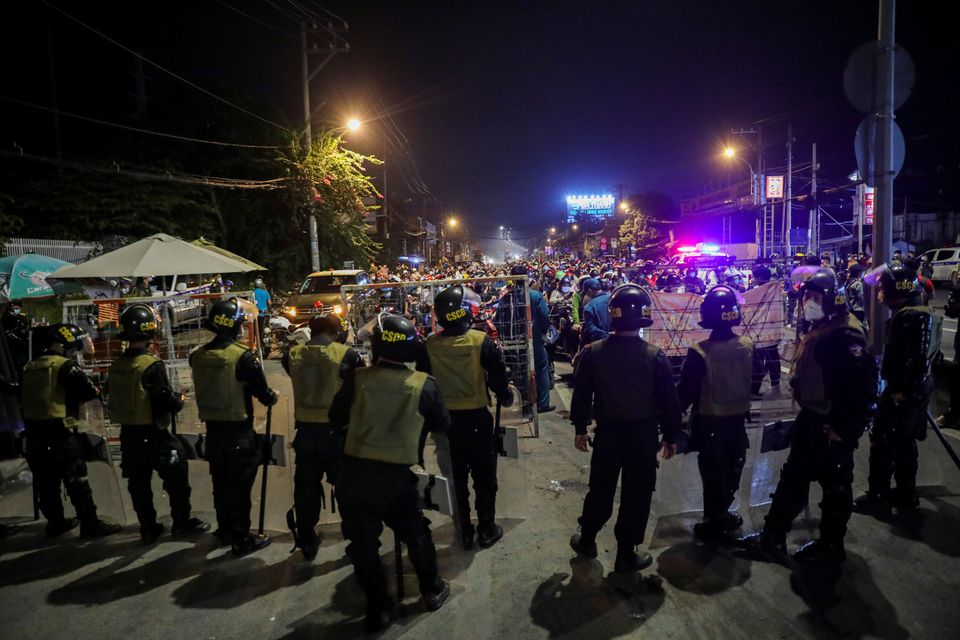
    On their way home, many of the laborers were seen breaking through the barricades at checkpoints set up by local authorities, with many beaten by security forces and some even seen begging the officers to let them through. According to the government, these methods were to prevent the wave of mass migrations that resulted from concerns about the transmission of the coronavirus. Despite facing many hurdles and uncertainty during their homebound journeys, those migrant workers hardly had any other choice.

    Police and security forces guard a checkpoint in Ho Chi Minh City as people, who are mostly migrant workers, attempt to return to their hometowns. The photo was taken on September 30, 2021, by Reuters/ Stringer.

    This abrupt and large-scale migration wave was a result of Vietnam’s months-long abusive lockdown mandates [9], which largely excluded human rights matters from its protocols, and the negligence of the government regarding the well-being, and more importantly, the dignity of workers.

    As written in the Universal Declaration of Human Rights, the Vietnamese people in general, and migrant laborers in particular, have the right to freedom of movement and residence within their own country; they also have the right to be treated with dignity and to seek their own security of life. Those allegedly unlawful actions by the Vietnamese government are clearly blatant violations of universal human rights, which are ironically the key conditions that the VCP must meet to gain its seat at the UNHRC.

    Steward Rees, an advocacy associate with The 88 Project, a non-profit organization that promotes free speech in Vietnam, suggests [10] that if Vietnam is genuinely serious about contributing to the development of global human rights, unconditionally releasing Pham Doan Trang would be a good place to start.

    References:

    1. Membership of the Human Rights Council. (2020). United Nations Human Rights Council. https://www.ohchr.org/en/hrbodies/hrc/pages/membership.aspx
    2. Jamal, U. (2021, March 17). Should Vietnam become a member of the UN Human Rights Council? ASEAN Today. https://www.aseantoday.com/2021/03/should-vietnam-become-a-member-of-the-un-human-rights-council/
    3. VNA. (2021, March 15). Vietnam stands for election to UNHRC in 2023–2025 tenure. VietnamPlus. https://en.vietnamplus.vn/vietnam-stands-for-election-to-unhrc-in-20232025-tenure/197570.vnp
    4. VNA. (2021b, July 8). Press freedom in Vietnam – Undeniable objective reality. VietnamPlus. https://en.vietnamplus.vn/press-freedom-in-vietnam-undeniable-objective-reality/204350.vnp
    5. Database of persecuted activists in Vietnam. (n.d.). The 88 Project. Retrieved October 6, 2021, from https://the88project.org/database/
    6. Freedom House. (2021, September). Freedom on The Net 2021 (Vietnam). https://freedomhouse.org/country/vietnam/freedom-net/2021
    7. Human Rights Watch. (2021). World Report 2021: Vietnam. https://www.hrw.org/world-report/2021/country-chapters/vietnam
    8. Reuters. (2021, October 4). “We are tired”: Workers flee Vietnam’s largest city as long lockdown eases. Reuters. https://www.reuters.com/world/the-great-reboot/we-are-tired-workers-flee-vietnams-largest-city-long-lockdown-eases-2021-10-04/
    9. Nguyen, J. (2021, July 21). How The Latest Outbreak Reveals The Darker Side Of Vietnam’s Anti-Coronavirus Strategy. The Vietnamese Magazine. https://www.thevietnamese.org/2021/07/how-the-latest-outbreak-reveals-the-darker-side-of-vietnams-anti-coronavirus-strategy/
    10. Rees, S. (2021, October 5). Vietnamese rights activist marks first year in jail. Asia Times. https://asiatimes.com/2021/10/vietnamese-rights-activist-marks-first-year-in-jail/
  • Pham Doan Trang Is A Journalist, Her Profession Is Not A Crime

    Pham Doan Trang Is A Journalist, Her Profession Is Not A Crime

    As I am writing this beginning line, my mind is flooded with memories of Pham Doan Trang. I also realize that it has been almost seven years since I said goodbye to her before she left the United States to return to Vietnam. We had become friends and spent seven months together in the United States, and I have not seen her since December 2014. I also have not been able to contact her or speak with her on the phone since October 6, 2020. Vietnamese police arrested her near midnight that day in Saigon. My last text message to her was “Trang, answer me,” which I sent the night she was detained.

    Doan Trang can be classified as many things, depending on the person you speak with. She is a journalist, an activist, a teacher, a political person who opposes the Vietnamese Communist Party, a prominent figure of the democracy movement in Vietnam, and more. Yet, for me, Doan Trang is a friend, a very close friend, and that’s it. My only hope is to help set my friend free because she has not done anything wrong. She deserves to be free so that she can continue to write.

    And yet, sadly, her writing is precisely the reason that has put her in prison in Vietnam.

    In Vietnam, writing or producing verbal speech (YouTube, TikTok, etc.) can be a severe crime when you refuse to obey the government’s censorship system or self-censor on your own. If you look at the details of any political case in Vietnam, I guarantee that you will only find the alleged wrongdoings to be the uncensored writings and speeches produced by these defendants. It does not matter how the Vietnam government classifies their crimes as “abusing democratic rights” or “propagandizing against the state,” their crimes are always their writing and speech.

    For Doan Trang, I can also think of another aspect in which she has irritated the Vietnamese authorities even more. She was not just a journalist; she was also trying to encourage more people to write and be more aware of politics in Vietnam. I was one of the people she inspired to take writing as a profession and focus more on Vietnam’s human rights and political affairs.

    In my writing career, I have two people to be grateful for: my two co-founders of Legal Initiatives for Vietnam (LIV), Trinh Huu Long and Pham Doan Trang. If I had not met them in life, I don’t think I would have been confident enough to write in either Vietnamese or English, especially as a journalist.

    I left Vietnam and came to the United States when I was 12-years-old. I was not too young to think of myself as a native speaker in English, but I was not too old to be confident in my ability to write in Vietnamese either. However, after meeting Trinh Huu Long and Pham Doan Trang in 2014, they changed my life as I believed in their cause and decided to co-found LIV. Starting from that point, I began to promote human rights, democracy, and the rule of law in Vietnam through journalism. Trinh Huu Long may be the first teacher in journalism for me, but Doan Trang is the inspiration for my decision to change my career from law to journalism.

    Many people have asked me why I decided to quit my legal profession and started working for a non-profit organization that focuses on Vietnam. Maybe this career change was not advantageous for them and could be stepping down in life. But Doan Trang’s last words before she left the United States stuck with me throughout these years: “Every country needs a generation of young people who will sacrifice their lives to build a better society for others. If our generation refuses to take up this job for Vietnam, then who else will? Do we wait for the next generation to sacrifice for our country and choose an easier life now?”

    Doan Trang chose to take up this task to promote human rights in Vietnam, and she left America to go back to Vietnam, knowing that she would be imprisoned in the future. Then, for me, the decision of giving up my life as a litigation lawyer to write about human rights and political issues in Vietnam seemed to be a much easier job when I compared myself with Doan Trang.

    She’s inspired me, and we both have the same goal: to put Vietnam on the map for international audiences and encourage more Vietnamese people to care about human rights and democracy. To write about these issues should not be a crime in any nation because we only want to educate the public. What did we do so wrong that my friend Pham Doan Trang has spent one year incommunicado in Vietnam?

    The Vietnamese government cannot explain away Pham Doan Trang’s case or any political cases that have sent hundreds of dissidents to decades in jail. However, I hope the international community and foreign governments can speak up louder and be more explicit against this injustice.

    Journalism is not a crime; writing about politics and human rights is not a crime. Vietnam continues to suppress the free press and the freedom of speech much harder now, which is not an action the international community should condone. Please speak up for those imprisoned by the Vietnam government, such as Pham Doan Trang, because we are on the right side of history.

  • Statement On The First Anniversary Of The Arrest Of Journalist Pham Doan Trang

    Statement On The First Anniversary Of The Arrest Of Journalist Pham Doan Trang

    October 7, 2021 marks the first anniversary of the arrest of journalist Pham Doan Trang by the Vietnamese authorities. She was taken into custody that day and was subsequently charged with “conducting propaganda against the Socialist Republic of Vietnam” under Article 88 of 1999 Penal Code and “making, storing, spreading information, materials, items for the purpose of opposing the State of the Socialist Republic of Vietnam” under Article 117 of 2015 Penal Code.

    (Previous reports say she was arrested near midnight of October 6, 2020.)

    Since then, she has been held incommunicado. Neither family visitation nor legal representation is granted, her family and lawyer confirmed with LIV. In late August 2021, Hanoi’s Bureau of Security Investigation informed Doan Trang’s lawyer that the state’s investigation against her had concluded and that they had recommended a formal indictment based on Article 88, indicating that the Article 117 charge had been dropped. She now faces a possible 20-year prison sentence.

    As a journalist, Pham Doan Trang has dedicated her career to documenting and shedding light on the many atrocities and human rights violations committed by the Vietnamese government, despite the constant threat to her life and safety. Her work has been appreciated by Vietnamese people inside and outside of Vietnam, and has granted her international acclaim. She has also helped bring the attention of the global community towards the abuses of the Vietnamese Communist Party.

    Legal Initiatives for Vietnam, Luat Khoa Magazine, and The Vietnamese Magazine stand firm on our condemnation of the actions committed by the Vietnamese government against our co-founder, Pham Doan Trang. The constant harassment she faced from the state, coupled with her arrest and detention, are clear and blatant violations of her right to free speech. Likewise, they constitute a direct attack against the free press and independent unbiased journalism. In the words of our Co-director and Editor-in-Chief of The Vietnamese Magazine, Tran Quynh Vi, “A journalist should be allowed to report and a writer must be able to publish her books in every corner of this world. Journalism is not a crime and journalists should not be treated as criminals. The suppression of these basic human rights should be treated as a crime.”

    We once again call on our friends and colleagues to demand the unconditional and immediate release of Pham Doan Trang, as well as the dropping of all bogus criminal charges lobbed against her. We will continue to push for what is right and just until she is given her freedom.

    DOWNLOAD (PDF)

    Legal Initiatives for Vietnam

    Luat Khoa Magazine

    The Vietnamese Magazine

  • Journalist Pham Doan Trang Can Still Be Freed In Vietnam. And The US Could Help Win Her Release.

    Journalist Pham Doan Trang Can Still Be Freed In Vietnam. And The US Could Help Win Her Release.

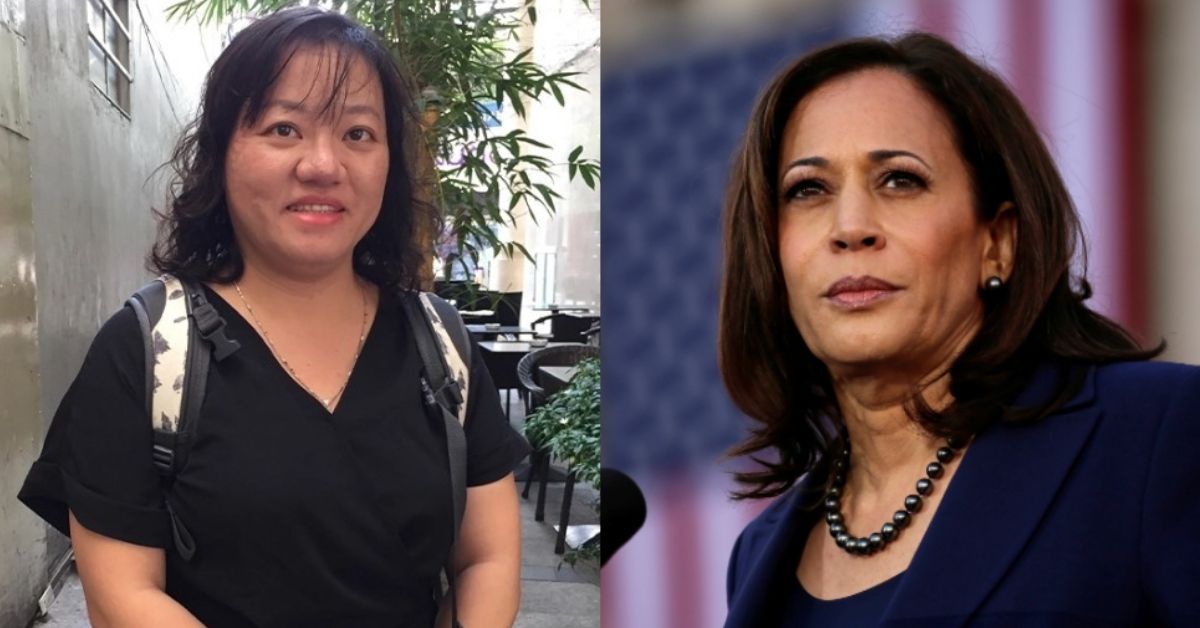
    While in Vietnam, Vice President Kamala Harris has significant leverage to make a change: free one of the most prominent journalists and democracy activists in the country.

    For the Vietnamese Communist Party, political prisoners are bargaining chips in international negotiations. They sell their own citizens to gain a trade deal or a more favorable security treaty. That’s because they know human rights are the soft spot of major powers, such as the United States and the European Union.

    Thus, they release political prisoners in exchange for economic and political gains. The problem is the prisoners are released conditionally: they are expelled from the country. Most of them settle in the United States.

    But journalist Pham Doan Trang, one of Vietnam’s most respected journalists, is a different case. Unlike other political prisoners, she has not been indicted or convicted yet; she is a detainee under investigation and still has a chance to be released in Vietnam.

    Once the police have determined that an accused person did commit a crime, there is absolutely no way that person can avoid conviction and sentencing. The only option left is to negotiate a settlement in another country, as had happened with some other political prisoners.

    Of course, the investigators have now gathered more than enough evidence to make a case against Trang and put her away for up to 20 years. Chances are, the Communist Party has not decided yet on how to move forward with her case to maximize its own interests. All options are still on the table.

    Doan Trang has insisted that she doesn’t want to leave the country until it becomes a democracy. As a close friend and colleague of hers for over a decade, I know how painful it is for her to be forced out of her only home, her beloved Vietnam.

    As one of the most prominent and talented journalists and democracy activists in Vietnam since the end of the Vietnam War in 1975, she has always aimed at breaking down the censorship curtain that puts the country at the bottom of Reporters Without Borders’ Press Freedom Index. Her writings and activism include various samizdat political books, two independent magazines (Luat Khoa and The Vietnamese), many protest movements, and international advocacy campaigns.

    As a result, she was awarded the Homo Homini Prize from People in Need (Czech Republic) in 2017 and the Press Freedom Award by Reporters Without Borders (France) in 2019. But more importantly, Doan Trang’s way of working and living inspires other Vietnamese to stand up for their rights and a better, kinder country.

    No authoritarian regime would tolerate her. After years of cat-and-mouse games with the authorities, and many physical assaults, the police have detained Doan Trang since October 7, 2020, charging her with spreading propaganda against the state. The criminal provision has been widely condemned by human rights groups as a way the government silences critics – a clear violation of free speech protected by the Constitution and legally binding international treaties.

    Doan Trang was on her way to meet then-president Barack Obama in May 2016 in Hanoi before the police kidnapped her and detained her for the rest of the day. Vice President Harris may not be able to meet Trang in the detention center, but she can surely do a lot to free her in Vietnam.

    The trade relations, especially the semiconductor supply chain and strategic partnership are believed to be the reasons Vice President Harris is paying a visit to Vietnam.

    In such circumstances, I believe that the United States, and Vice President Harris, in particular, have an excellent chance to push for Doan Trang’s release right in Vietnam while the case is still undecided. And there is a precedent for that.

    In June 2007, Vietnam released attorney and democracy advocate Le Quoc Quan after three months of temporary detention and two days before Chairman Nguyen Minh Triet visited the United States. Attorney Le Quoc Quan had not been indicted yet, and a major reason he was freed was a mountain of pressure from the United States government and civil society, such as the National Endowment for Democracy, where Quan did a fellowship before his return to Vietnam.

    It is now urgent to push for Doan Trang’s release, before it’s too late.

  • LIV’s Petitions The Aid Of U.S Vice President Kamala Harris In The Release of Pham Doan Trang

    LIV’s Petitions The Aid Of U.S Vice President Kamala Harris In The Release of Pham Doan Trang

    Legal Initiatives for Vietnam (LIV), a non-profit, non-partisan organization that works to build a truly democratic society in Vietnam through independent journalism, research, and education, released an open letter on August 21, 2021, addressed to the office of the United States Vice President, Kamala Harris.

    Following the publication of the 88 Project’s own correspondence with the Vice President, LIV urges her to bring up these additional issues with Vietnamese leaders during her planned visits to Singapore and Vietnam:

    • the unconditional release of several illegally detained and imprisoned journalists, including LIV’s co-founder, Pham Doan Trang and;
    • the unblocking of independent news websites, such as luatkhoa.org and thevietnamese.org

    On October 6, 2020, at 11:30 pm, Pham Doan Trang was arrested by Vietnamese state forces. She was subsequently charged with violating Article 88 of the 1999 Penal Code by “conducting propaganda against the Socialist Republic of Vietnam” and Article 117 of the 2015 Penal Code for “making, storing, spreading information, materials, items for the purpose of opposing the State of the Socialist Republic of Vietnam.”

    Following her abduction, she has “been held incommunicado, denied visitation from her family and her lawyers, and she faces up to 20 years of imprisonment.”

    Through their open letter, LIV hopes that Vice President Kamala Harris can help push the current state of Vietnamese media towards a freer and more inclusive environment where no journalist needs to fear oppression by their government.


    LIV’s open letter on Pham Doan Trang, click here

    For more information about Pham Doan Trang, click here

    For news about the 88 Project’s open letter, click here.

    To show your support for Pham Doan Trang, please consider signing this petition.