Tag: COVID-19

  • The Intertwining Of Science, Politics, And Ideology In Vietnam’s COVID-19 Crisis

    The Intertwining Of Science, Politics, And Ideology In Vietnam’s COVID-19 Crisis

    Amidst the COVID-19 crisis, a moment for science

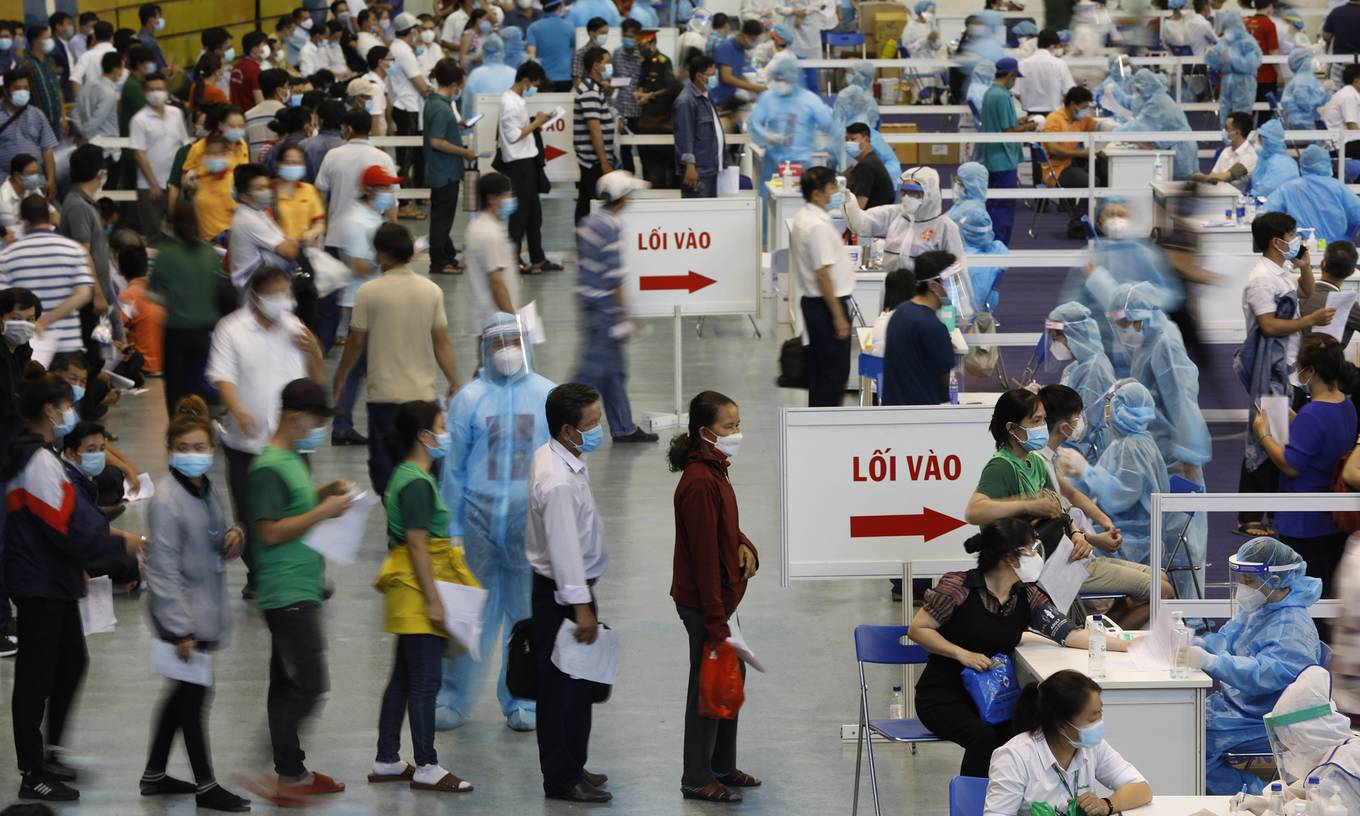
    The escalation of COVID-19 in Vietnam, especially in Saigon (officially known as Ho Chi Minh City), is sending millions of people into crisis. They have struggled on multiple fronts, from healthcare and making sense of varying isolation requirements to obtaining food and necessities amidst strict yet incoherent travel bans and supply shortages.

    The double target of trying to contain COVID-19 while simultaneously continuing economic activities that the government persistently defended and adhered to since the start of the pandemic has been abandoned. This is indicative of how serious the situation has become. Over the past few weeks, Saigonese have experienced life in a way they could never have imagined.

    In this grim picture, Tuoi Tre Online reported on July 10, 2021, that Ho Chi Minh City’s Party Committee Secretary Nguyen Van Nen is now looking to scientists for advice.[1] The secretary’s words were quoted widely in the news:

    I feel that we need to consult the scientists…. At any time, I want specialists and scientists to see flaws in our strategy to fight the pandemic and contact me; I will consider their advice and respond timely.

    A Facebook influencer reacted to this news with a sense of irony and bitterness:[2]

    So what expertise have you relied on to fight the pandemic? Anything but science? Have you been kidding your citizens all along? For one and a half years now, have you been playing with the life and death of millions of people? So, after all, is it true that the tools you have taken to fight a pandemic are simply government decrees and [the manpower of] the Communist Youth League? I feel so ashamed of being led by national leaders who are both blind and arrogant.

    It is rather apparent that in a pandemic, one had better look to the scientists. So, why is a government official only bringing them to the table now? The next question is, how critical can scientists be, with a government that does not like criticism? At the highest level, one must wonder where science and scientists are in the decision-making concerning public matters in non-democratic Vietnam? A look into the Vietnamese Communist Party’s (VCP) ideology that it has followed and its practices could explain this conundrum.

    In ideology: the suppression of civil society and communicative rationality

    In the United Kingdom, at the start of the pandemic, the Scientific Advisory Group for Emergencies was activated. Since then, it has been working closely with the government as an external body to advise on making appropriate decisions regarding COVID-19 in the country. The importance and weight of scientific advice cannot be underestimated; UK scientists successfully convinced Prime Minister Boris Johnson and his cabinet to abandon their herd immunity strategy and adopt a nationwide lockdown in March 2020.

    Without this lockdown, the United Kingdom could have seen 80 percent of its people infected and 500,000 deaths.[3] On the other side of the Atlantic Ocean, the physician-scientist and immunologist Anthony Fauci, in his role as the chief medical advisor to the US president, has been a pillar in handling COVID-19 in the United States.

    Liberal democracy entails the practice of taking advice from scientists and not restraining those who deliver honest yet uncomfortable truths to people in positions of power. The two hallmarks of liberal democracy that shape this practice are civil society and communicative rationality.[4]

    Civil society in a liberal democracy comprises actors and institutions that are supposed to be independent of the state and who act to balance state power. Therefore, universities and the myriad of civil associations in democratic countries are autonomous and can freely critique the conduct of the government or oppose laws and policies they view as problematic without fear of punishment.

    On the other hand, communicative rationality, an ideal of liberal democracy, means that people arrive at a collective agreement about something via genuine, intelligible conversations. Thus parliamentary debate and rebuttal in classroom discussions are part and parcel of a healthy democratic life and politics.

    Nowhere in the ideological textbook of the VCP can one find any sign of friendliness towards the idea of an autonomous, independent civil society, nor communicative rationality in the way the state relates to other estates in society. The Vietnamese government condemns independent civil society as a strategy of ‘hostile forces’ to undermine political stability.[5] Following the Marxist-Leninist ideology, the Communist leaders control civil society and use civil society organizations, such as the press, schools, and mass associations, to garner consent from the people for its rule.[6] Likewise, the Party believes in ‘self-criticism,’ rather than opposition or open, genuine debate in the National Assembly or in other venues where the state and citizens can talk to each other.[7]

    In practice: the strategic mobilization of scientists while confining them within governable spaces

    Since 1975, the Vietnamese State could be described as developmental. In the pursuit of economic growth and technological and social development, the state needs the expertise of scientists and intellectuals. This is evidenced by the existence of a wide range of research and scientific centers and institutions funded by the State that operate within the scope prescribed for them by the government. However, the system ensures that scientists and intellectuals employed in these research centres do not threaten the state.[8]

    Despite these state-employed scientists and intellectuals, the Vietnamese government rarely describes its style of governance as “evidence/science-based.” This suggests that the VCP still aspires to be a good disciple of Marxism-Leninism when it comes to organizing the political system and governance. “The Party knows best” is apparently its motto. In other words, the Party sees itself as the supreme source of authority and expertise. This also makes Vietnam’s developmentalism different from, for example, Japan’s.  Japan’s developmentalism is based on rationality, whereas Vietnam’s is based on ideology.[9]

    Speaking of rationality, communicative rationality still has no place in Vietnam’s politics nor in the civil sphere. The National Assembly has shown little sign of becoming a place for open, genuine debate about public matters. Critical thinking is still lacking in the way students are educated. The free press is still a wild dream for Vietnam.

    I interviewed the head of Luat Khoa Tap Chi not long ago. He described the prominent culture in Vietnam as a “culture of obedience and singular thinking” rather than critical thinking and genuine, intelligible debate. Last but not least, we shall not forget that in 2007, when the Institute of Development Studies was established by renowned intellectuals and scientists of the country to speak truth to power, it went into so much trouble with the government and was eventually disbanded.[10]

    Prospects of the VCP democratizing itself?

    Not so much. In Saigon, what the Party Committee Secretary Nguyen Van Nen said about consulting scientists is most likely just a moment of him forgetting the Party’s line he should be toeing. Indeed, just a week after his statement, a Facebook influencer reposted on his Facebook page a VNExpress interview with Vu Thanh Tu Anh of Fulbright University Vietnam, which reportedly was removed from VNExpress’s website immediately after it was posted.[11] In this interview, Tu Anh discusses some failures in the government’s strategy to contain COVID-19.[12]

    In conclusion, for scientists to speak truth to power, or at least to save Vietnam from this deadly pandemic, they require a change in both ideology and politics, which the VCP seems to be neither willing nor ready to take.

    Bibliography:

    1. Bí thư Thành ủy TP.HCM gặp gỡ các chuyên gia, nhà khoa học cùng bàn cách chống dịch COVID-19, 10 July 2021. Tuổi Trẻ Online. Available at: https://tuoitre.vn/bi-thu-thanh-uy-tp-hcm-gap-go-cac-chuyen-gia-nha-khoa-hoc-cung-ban-cach-chong-dich-covid-19-20210710120636333.htm
    2. Thai Hao’s Facebook page, 10 July 2021. The full post is available at: https://www.facebook.com/permalink.php?story_fbid=1029231357886052&id=100023975920044
    3. Grey, Stephen & MacAskill, Andrew, 7 April 2020. Special Report: Johnson listened to his scientists about coronavirus – but they were slow to sound the alarm. Reuters. Available at: https://www.reuters.com/article/us-health-coronavirus-britain-path-speci-idUSKBN21P1VF
    4. The background of my understanding of liberal democracy in this paragraph comes from Alexis de Tocqueville (on civil society) and Jurgen Habermas (on communicative rationality).
    5. See, for example, an article in Cong an Nhan dan, available at: http://cand.com.vn/Chong-dien-bien-hoa-binh/Canh-giac-thu-doan-loi-dung-xa-hoi-dan-su-de-chong-pha-che-do-581991/; another one in Nhan dan, available at: https://nhandan.vn/tin-tuc-su-kien/xa-hoi-dan-su-mot-thu-doan-cua-dien-bien-hoa-binh-392081/
    6. The reality of ‘state-led civil society’ in Vietnam, most prominent before the late 1980s, is discussed widely in the academic literature. For example, I suggest Landau, I. (2008). Law and civil society in Cambodia and Vietnam: A Gramscian perspective. Journal of Contemporary Asia, 38(2), 244–258; and Salemink, O. (2006). Translating, interpreting, and practicing civil society in Vietnam: A tale of calculated misunderstanding. In D. Lewis & D. Mosse (Eds.), Development Brokers and Translators: The Ethnography of Aid and Agencies (pp. 101–126). Kumarian Press.
    7. See, for example, a discussion session organized by a mass organization, in Tortosa, A. (2012). Grassroots democracy in rural Vietnam: A Gramscian analysis. Socialism and Democracy, 26(1), 103–126. https://doi.org/10.1080/08854300.2011.645661
    8. See Morris-Jung, J. (2017). Reflections on governable spaces of activism and expertise in Vietnam. Critical Asian Studies, 49(3), 441–443. https://doi.org/10.1080/14672715.2017.1339448
    9. For more on developmentalism and plan-rationality versus plan-ideology, see Johnson, C. (1993). The Japanese miracle. In MITI and the Japanese miracle: The growth of industrial policy, 1925-1975 (pp. 1–34). Stanford University Press; and Woo-Cumings, M. (Ed.). (1999). Introduction: Chalmers Johnson and the politics of nationalism and development. In The developmental state (pp. 1–31). Cornell University Press.
    10. Morris-Jung, J. (2015). The Vietnamese bauxite controversy: Towards a more oppositional politics. Journal of Vietnamese Studies, 10(1), 63–109.
    11. Thanh Nguyen’s Facebook post, 17 July 2021. Available at: https://www.facebook.com/paulothanhnguyen/posts/4395856270458582
    12. On 20 July 2021, another scientist, Vu Hong Nguyen, also shared on his Facebook page that his contribution to a TV program in Vietnam about COVID-19 vaccines was abruptly removed. He explains that his skeptical view of the Chinese vaccine Sinopharm, which he planned to talk about in the TV program, was not welcome. He titles this post on his Facebook page as ‘Do not let politics interfere with science’. Nguyen’s Facebook post is available at: https://www.facebook.com/vu.nguyen.758/posts/4726456800701987
  • How The Latest Outbreak Reveals The Darker Side Of Vietnam’s Anti-Coronavirus Strategy

    How The Latest Outbreak Reveals The Darker Side Of Vietnam’s Anti-Coronavirus Strategy

    Last year, when the novel coronavirus Covid-19 ravaged the healthcare system and economy of even the most developed countries in the world, Vietnam’s early success in containing infections and keeping the death toll low drew praise and even admiration from the international media and community.

    “Fighting the pandemic as if we are fighting an enemy,” the country’s anti-coronavirus slogan declared.

    Vietnam’s early successful anti-coronavirus protocols primarily focused on isolating infected areas, facilitating rapid contact tracing, mandatory hospitalization of infected patients and their close contacts, as well as imposing fines on those who broke the social distancing rules.

    Though efficient as these protocols might seem, as experts point out [1], only a few countries possess control structures that Vietnam has in order to deal with the pandemic, let alone being willing to carry them out under actual circumstances.

    Since the control playbook helped the country get through the very first waves of Covid-19 infections, the most recent outbreak has revealed the darker sides of how Vietnam handles the pandemic in its rigid and yet abusive nature.

    When “collective benefits” dwarf human rights

    In Vietnam, the need to curb the pandemic seems to have outmatched other substantial matters, such as upholding certain human rights [2] and looking after people’s livelihoods.

    As the Southeast Asian country witnessed [3] its highest surge of Covid-19 cases in recent days, more measures, including strict lockdown and movement restrictions, have been put in place. Ho Chi Minh City [4] and the entire southern region [5] remain under lockdown while adopting Directive 16 of the government, an anti-coronavirus protocol, to curb the spread of Covid-19.

    Directive 16 [6] requires all citizens to follow disease control guidelines and stay at home, except for “necessary duties,” while restricting gatherings of more than two people in public places, halting all means of transportation, and so on.

    Although not legally binding [7], the new ordinance raises public concerns about whether the authorities’ policies for “curbing the pandemic” interfere with fundamental human rights, such as the freedom of movement and speech.

    People can be coerced into compliance or fined if they go outside without a “reasonable purpose”[8] or post content deemed to be “false information”[9] on social media.

    These terms, “reasonable,” “necessary,” or “false,” of course, are arbitrarily defined by local authorities.

    Barbed wire fences were set up in a quarantine area in District 3, Ho Chi Minh City (July 2021). Photo: Sy Dong/ Thanh Nien Online.

    Since Ho Chi Minh City has undergone a citywide lockdown, there have been over 12,000 cases [10] in which people were fined for “violating anti-coronavirus regulations.” That would include more than 2,000 cases [11] where people were fined for going outside, despite reports that they were properly wearing masks and keeping a safe distance. More ironically, the authorities even set a daily quota [12] for how many people to be fined.

    Besides its legal ambiguity, Directive 16 is also being abused [13] by police officers and security forces to serve their interests in the name of containing the coronavirus. Petty corruption and alleged misconduct are commonplace.

    Multiple personal experiences, videos, and short clips circulating on social media show the truth behind the curtain of the “ideal anti-coronavirus model,” [14] about which Vietnamese authorities brag so enthusiastically.

    In one video, policemen and security guards were seen entering a house and grappling with a local family, allegedly accusing them of violating social distancing measures for selling essential produce. The security forces later confiscated all the produce, and they then dragged the homeowner into their vehicle.

    This woman was seen being dragged to a police car by security forces. Photo: Screenshot/Thanh Nien Online.

    The lack of independent oversight of the power of law enforcement, along with the absence of transparency on Covid-19 stimulus and relief policies, is nurturing an environment where abuse of power [15] and corruption [16] flourish.

    Other similar videos and Facebook posts showing police taking advantage of anti-coronavirus measures to harass passers-by, arbitrarily fine people, penalize street vendors, or implicitly ask for bribes are not difficult to find on social media.

    Behind the successful anti-coronavirus model

    The “effective” methods that helped Vietnam overcome the first three waves of Covid-19 infections, in reality, are not immune to shortcomings and inefficiency.

    “Tracing, mapping and quelling the virus,”[17] the strategy which operates on the principle of tracing infected patients, isolating residential areas, and administering treatment, although appearing to be successful at first, comes at the cost of hurting the Vietnamese economy and causing many to be unemployed. Furthermore, the procedure of providing financial assistance to affected families is often long and bureaucratic.

    Meanwhile, the effectiveness of centralized quarantine camps, where Covid-19 patients and their direct contacts are compulsorily held while awaiting testing and treatment, remains still a big question.

    The so-called quarantine camps were hailed by state media [18] as “effectively functioning” to curb the coronavirus outbreaks, and therefore should remain “a top priority method.”

    Young children were isolated inside a quarantine camp in Phu Yen Province. Photo courtesy: Soha.vn

    Nevertheless, the surge in cases in recent weeks, which overloaded the capacity [19] of those camps, coupled with their poor and unsanitary conditions, put both asymptomatic patients and healthy people at risk of being mutually infected. Also, since the quarantine requirements are applied to everyone regardless of age, children were subject to isolation and staying away from their parents, whereas home quarantine could be a more feasible option.

    While too focused on the idea of “fighting the virus,” Vietnam also trails behind [20] other neighboring Southeast Asian countries in securing a vaccination supply, as well as ramping up inoculation programs. As of now, only above 0.3 percent [21] of Vietnam’s population is fully vaccinated.

    Only around 0.3 percent of Vietnam’s population is fully vaccinated (July 19th). Source: Our World in Data/screenshot.

    Meanwhile, as the government asks its citizens [22] to donate to the ‘vaccine fund’ as cases spike, questions [23] regarding the transparency of the fund, along with promises of equal access to Covid-19 vaccines [24] for all citizens, remain unanswered.


    Last June, the New York Times published an article [25] warning Vietnam to brace itself for a fresh wave of Covid-19 infections while suggesting the country’s luck in containing the disease might be “running out” this time.

    The Vietnamese government, facing the shortcomings and challenges of its anti-coronavirus strategy, rather than admitting the faults, consulting experts’ advice, and making appropriate adjustments to improve the situation, continues to defend its mistakes. The government has perpetually shifted the blame to “reactionary forces” for spreading “distorted information”[26] or the New York Times for a “biased evaluation” [27] in claiming that the country’s success in containing previous infections was based on luck.

    Whether Vietnam was lucky in its past Covid-19 handling is still unclear; however, we can ostensibly see the secret behind the success of the Communist regime’s strategy: its anti-coronavirus playbook only works at the expense of the well-being of ordinary citizens.

    Bibliography:

    1. Bill Hayton, Tro Ly Ngheo. (2020, May 12). Vietnam’s Coronavirus Success Is Built on Repression. Foreign Policy. https://foreignpolicy.com/2020/05/12/vietnam-coronavirus-pandemic-success-repression/
    2. H.R.W. (2020, March 19). Human Rights Dimensions of COVID-19 Response. Human Rights Watch. https://www.hrw.org/news/2020/03/19/human-rights-dimensions-covid-19-response
    3. Reuters. (2021, July 9). Vietnam sees record coronavirus cases as curbs tighten. Reuters. https://www.reuters.com/world/asia-pacific/vietnam-sets-covid-19-vaccination-targets-new-curbs-unrolled-2021-07-09/
    4. BBC. (2021, July 7). TP HCM giãn cách xã hội “quyết liệt” theo Chỉ thị 16 từ 0h 9/7. BBC Tiếng Việt. https://www.bbc.com/vietnamese/vietnam-57750819
    5. Associated Press. (2021, July 18). Vietnam puts southern region in lockdown as surge grows. AP News. https://apnews.com/article/asia-pacific-world-news-health-coronavirus-pandemic-vietnam-958c8f737c497b2330f1af69c84bae18
    6. Cong, H. (2021, July 7). TP HCM giãn cách xã hội theo Chỉ thị 16. VnExpress. https://vnexpress.net/tp-hcm-gian-cach-xa-hoi-theo-chi-thi-16-4296651.html
    7. Percy, N. (2020, April 4). Chỉ thị 16 có giá trị pháp lý không? – Không. Luật Khoa Tạp Chí. https://www.luatkhoa.org/2020/04/chi-thi-16-co-gia-tri-phap-ly-khong-khong/
    8. Son, T. (2021, July 14). Xử phạt dân ra đường: vừa không hợp tình vừa thiếu cơ sở pháp lý! Đài Á Châu Tự Do. https://www.rfa.org/vietnamese/in_depth/punishing-people-leaving-their-houses-in-lockdown-time-is-ruthless-and-lack-of-legal-base-07142021094348.html
    9. RFA. (2021c, July 2). Lâm Đồng phạt 30 triệu đồng ba người đưa tin sai về dịch COVID-19 trên mạng xã hội. Đài Á Châu Tự Do. https://www.rfa.org/vietnamese/news/vietnamnews/lam-dong-fined-three-people-vnd-30-million-for-spreading-false-information-about-covid-19-07022021082827.html
    10. An, D. (2021, March 17). TPHCM: Phạt hơn 12.000 vụ vi phạm Chỉ thị 16 với số tiền 3,3 tỷ đồng. Công an TP.Hồ Chí Minh. https://congan.com.vn/doi-song/tphcm-phat-hon-12000-vu-vi-pham-chi-thi-16-voi-so-tien-33-ty-dong_116102.html
    11. Ibid., [8]
    12. Phuong, V. (2021, July 13). Phường ở TP.HCM giao chỉ tiêu phạt người vi phạm Chỉ thị 16: Quận chấn chỉnh ngay. Thanh Niên Online. https://thanhnien.vn/doi-song/phuong-o-tphcm-giao-chi-tieu-phat-nguoi-vi-pham-chi-thi-16-quan-chan-chinh-ngay-1413746.html
    13. Chan, Y. (2021, July 15). Con virus không gây ra bệnh lộng quyền, nó chỉ làm lộ rõ bản chất của các “đầy tớ.” Luật Khoa Tạp Chí. https://www.luatkhoa.org/2021/07/con-virus-khong-gay-ra-benh-long-quyen-no-chi-lam-lo-ro-ban-chat-cua-cac-day-to/
    14. Van, N. (2021, July 6). Việt Nam – mô hình lý tưởng trong phòng chống dịch COVID-19. Sức Khỏe & Đời Sống. https://suckhoedoisong.vn/viet-nam-mo-hinh-ly-tuong-trong-phong-chong-dich-covid-19-n196626.html
    15. RFA. (2021d, July 19). Giám đốc Hợp tác xã cấp khống giấy thông hành cho con gái bị phạt 7,5 triệu đồng. Đài Á Châu Tự Do. https://www.rfa.org/vietnamese/news/vietnamnews/director-of-cooperation-determine-control-travel-warrants-granted-to-his-daughter-received-a-7-million-07192021090444.html
    16. Hoang, T. (2020, December 10). Xét xử cựu giám đốc CDC Hà Nội và đồng phạm nâng giá máy xét nghiệm COVID-19. Tuổi Trẻ Online. https://tuoitre.vn/xet-xu-cuu-giam-doc-cdc-ha-noi-va-dong-pham-nang-gia-may-xet-nghiem-covid-19-2020120922563448.htm
    17. Hai, S. (2021, June 11). Khẩn trương truy vết, khoanh vùng dập dịch triệt để nhằm khống chế các chuỗi lây bệnh. Trang Tin Điện Tử Đảng Bộ Thành Phố Hồ Chí Minh. https://www.hcmcpv.org.vn/tin-tuc/khan-truong-truy-vet-khoanh-vung-dap-dich-triet-de-nham-khong-che-cac-chuoi-lay-benh-1491879154
    18. Yen, N. (2021, June 2). Cách ly tập trung vẫn là biện pháp quan trọng hàng đầu. Báo Công an Nhân Dân. http://cand.com.vn/Su-kien-Binh-luan-thoi-su/Cach-ly-tap-trung-van-la-bien-phap-quan-trong-hang-dau-644093/
    19. Tien, V. (2021, June 27). Tình hình Covid-19 hôm nay 27.6: Khu cách ly quá tải, TP.HCM sắp cho “tự quản” F1 tại nhà. Thanh Niên Online. https://thanhnien.vn/thoi-su/tinh-hinh-covid-19-hom-nay-276-khu-cach-ly-qua-tai-tphcm-sap-cho-tu-quan-f1-tai-nha-1405218.html
    20. Tomoya Onishi. (2021, June 25). Vietnam backpedals on COVID-19 vaccination targets. Nikkei Asia. https://asia.nikkei.com/Spotlight/Coronavirus/COVID-vaccines/Vietnam-backpedals-on-COVID-19-vaccination-targets2
    21. Share of people vaccinated against COVID-19, Jul 19, 2021. (n.d.). Our World in Data. https://ourworldindata.org/covid-vaccinations?country=VNM
    22. AFP. (2021, June 8). Vietnam begs public for “vaccine fund” donations after virus surge. Yahoo News. https://sg.news.yahoo.com/vietnam-begs-public-vaccine-fund-091017383.html
    23. Chinh, Y. K. (2021, July 13). 4 câu hỏi về chiến dịch tiêm vaccine COVID-19 của Việt Nam. Luật Khoa Tạp Chí. https://www.luatkhoa.org/2021/07/4-cau-hoi-ve-chien-dich-tiem-vaccine-covid-19-cua-viet-nam/
    24. Tuan, V. (2021, July 10). Thủ tướng: “Mọi người bình đẳng trong tiếp cận vaccine.” VnExpress. https://vnexpress.net/thu-tuong-moi-nguoi-binh-dang-trong-tiep-can-vaccine-4307457.html
    25. Richard C. Paddock, Chau Doan. (2021, June 2). Spared for Months, Vietnam Faces a Wave of New Infections. The New York Times. https://www.nytimes.com/2021/06/02/world/asia/vietnam-covid-ho-chi-minh.html
    26. Department Of News. (2021, July 19). Bác bỏ luận điệu xuyên tạc về công cuộc chống dịch COVID-19 của Việt Nam. VTV. https://vtv.vn/xa-hoi/bac-bo-luan-dieu-xuyen-tac-ve-cong-cuoc-chong-dich-covid-19-cua-viet-nam-20210719192125814.htm
    27. Quan, M. (2021, June 24). Nói Việt Nam ‘may mắn’ trong chống dịch Covid-19 là thiếu khách quan. Báo Thế Giới và Việt Nam. https://baoquocte.vn/noi-viet-nam-may-man-trong-chong-dich-covid-19-la-thieu-khach-quan-149357.html
  • Vietnam Briefing: COVID-19 Nationwide Crisis; Country’s Map May Be Redrawn

    Vietnam Briefing: COVID-19 Nationwide Crisis; Country’s Map May Be Redrawn

    The Vietnam Briefing, which is released every Monday morning Vietnam time, looks at Vietnam’s political developments of the past week.


    COVID-19 in Vietnam

    • Movement restrictions across Vietnam amidst outbreaks: Sixteen southern provinces are expected to undergo two-week movement restrictions as three-quarters of new cases were in the south, particularly in Saigon. In the north, Hanoi is also entertaining more restrictions. People are advised to stay at home, and non-essential establishments are closed.
    • The Vietnamese government said Pfizer would provide the country with 20 million more doses of the COVID-19 vaccine, which would be used primarily for children of 12-18 years old, and Pfizer may consider transferring the vaccine technology to Vietnam. Vietnam also said that the Pfizer dose would be offered to people vaccinated with AstraZeneca in the first dose.
    • Vietnam is imprisoning people on COVID-19 related charges: Last week, on July 16, a man was charged with 18 months in prison for “breaking strict Covid-19 quarantine rules, spreading the virus to others and causing financial damage to the authorities.” However, this was not the first time a Vietnam Airline flight attendant also received similar charges and was sentenced to a two-year suspended jail time in late March.

    Vietnamese hospital cremates body of Korean virus patient without notice

    From Korea Times:

    • A hospital in Ho Chi Minh city, Vietnam, has cremated the body of a Korean national who died from COVID-19 there, without giving prior notice to the bereaved family members in Korea, provoking protests from them and the Korean Consulate General in the city. According to the Ministry of Foreign Affairs, Sunday, a Korean man in his 50s died in the hospital after undergoing medical treatment for about 10 days following him testing positive for the virus in early July.

    The Vietnamese government is tightening free speech

    • According to Nikkei Asia, the government proposes a new draft decree that contains new regulations specifically targeting live-streaming activities on social media platforms, including Facebook, Youtube, and Tiktok.
    • This new draft decree is forcing international social media platforms to hand over to the government the information of popular individuals who live streaming with more than 10,000 followers or subscribers. The government also wants to tax those making money from these platforms.
    • Meanwhile, concern has been raised over Vietnam’s purchase of Israeli company Cellebrite’s phone-hacking technology. Attorney Eitay Mack, who conducted the investigation into the Israeli company, protested the company’s and the Israeli Defense Ministry’s decision to sell such technology to Vietnam’s Ministry of Public Security, citing concerns over crackdowns on journalists and pro-democracy and human rights activists.

    Incoming National Assembly’s first meeting since the 2021 election

    • Next week, on July 20, the 15th National Assembly will hold its first meeting session after the 2021 election ended in late May.
    • Originally, the first session was held from July 20 to August 5, but the session was shortened to end on July 31 due to complications of COVID-19 outbreaks in Vietnam.
    • In this first session, the representatives in the National Assembly will confirm 50 important officials who will hold the positions over the next five years, such as the chairperson of the Assembly, the president, the prime minister and his deputies, chief justice, chief of the Procuracy, etc. The identity of these leaders is already known at this point, and confirmation is largely just procedural. Vietnam conducted a similar event in April to elect the same individuals to the same positions. It has made the whole process of election, nomination, and confirmation started in May highly confusing to even the Vietnamese public, not to mention international observers.
    • The first session will also discuss financial and economic issues related to public investment for the next term.
    • It is also reported that 435 out of 499 National Assembly representatives have been vaccinated against COVID-19. It is unclear whether they have been fully vaccinated or only vaccinated with one dose. It is also unclear which types of vaccines were used for the National Assembly representatives.

    EU Domestic Advisory Group (DAG) denounces Vietnam’s arrest of civil society leaders

    • Two weeks ago, journalist Mai Phan Loi and lawyer Dang Dinh Bach were arrested for alleged tax evasion. They were both involved in registered civil society organizations in Vietnam and were both board members of the VNGO-EVFTA Network, which aims to raise awareness about civil society’s involvement in the EU-Vietnam Free Trade Agreement.
    • Last week, on July 15, the EU DAG denounced the arrests of the two individuals, citing concerns that the Vietnamese government is actively silencing those who try to raise human rights concerns.
    • Earlier this year in January, the EU DAG already affirmed that “civil society engagement and scrutiny of the EVFTA is not an optional element of the agreement,” and urged the European Commission to ensure that this element is fully implemented.

    US ambassador to Vietnam nominee promises to press Vietnam on human rights

    From Reuters:

    • In a US Senate hearing on July 13, Marc Knapper, the Biden administration’s nominee to become the new US ambassador to Vietnam, vowed to press the Vietnamese government “to respect the freedoms of expression, association, peaceful assembly, and religion or belief.”

    South Korea requests Vietnam’s involvement in North Korean dialogue

    From United Press International:

    • Last week, on July 15, during a phone call with the Vietnamese Communist Party’s Secretary General Nguyen Phu Trong, South Korean President Moon Jae-in asked Vietnam to “play a role in promptly resuming dialogue with North Korea,” according to South Korea’s Blue House.
    • In response to Moon’s request, Trong reportedly said that Vietnam “supports the denuclearization of the Korean Peninsula and dialogues for peaceful consultations.”
    • Moon also asked for Vietnam’s opinion on the situation of pro-democracy crackdowns in Myanmar, to which Trong replied that Vietnam will “continue to work for the restoration of peace and stability in Myanmar.”

    Will the Vietnam map be redrawn?

    • According to the state-controlled Tuoi Tre News, 20 Vietnamese provinces might be merged into other provinces due to their limited population or acreage.
    • Some of the provinces include Da Nang, Ha Nam, Vinh Phuc, Hung Yen, Nam Dinh, Bac Kan, Cao Bang, Kon Tum, Ninh Thuan, and Lao Cai, among a list of twentieth provinces.
    • Vietnam’s administrative provincial boundaries have been adjusted repeatedly over the past 50 years. By the end of the Vietnam War in April 1975, the country had 72 provincial units. A massive merging process was implemented shortly after that and the number of provincial units reduced to 38 in 1976. However, many provinces have started to be split since 1978 while a few others have been merged to other entities, making the number of provinces 63 in 2008.

    Learn more about Vietnam

    New research: The South Vietnamese Flag and Shifting Representations of the Vietnamese American Experience

    Tuan Hoang/Rising Asia Journal/July 13, 2021

    “The sight of the South Vietnamese flag in Washington, DC on January 6, 2021, has aroused curiosity and criticism. Missing in the commentaries, however, is the multiplicity of its symbolism to Vietnamese Americans who had come to the United States as refugees or immigrants. Although its visual symbolism is forever tied to the history of the former Republic of Vietnam, its underlying meaning has changed to reflect the experience of Vietnamese after the fall of Saigon, not before.”

    New research: A Multi-level Approach to Vietnam Foreign Policy: From Security Preoccupation to Middle Power Role

    Le Dinh Tinh/Strategic Analysis/June 13, 2021

    “Prior to 1995 when Vietnam joined ASEAN and normalized relationship with the United States, the overriding concern was security as could be well explained by realism. Vietnam has made several critical, strategic moves since 1995 and by 2030 the country may be able to act internationally as an emerging middle power. Taking a multi-level approach and empirical evidences of 35 years of Doi Moi (renovation), this article attempts to clarify as to how Vietnam has been in a better position to ensure the security goal by embarking on an ambitious development strategy and expanding its international role.”

    New research: Vietnam’s Foreign Policy in an Era of Rising Sino-US Competition and Increasing Domestic Political Influence

    Carlyle A. Thayer/Asian Security/July 31, 2017

    “This article examines the dramatic shifts that Vietnam’s foreign policy has undergone over time, from a country tightly allied with Socialist partners like China and the Soviet Union to one that has diversified its strategic partners and forsworn alliances in order to protect its strategic autonomy…. As public opinion and elite factionalism play an increasing role in Vietnam’s foreign policy, managing Vietnam’s external ties has become increasingly difficult. This article concludes that public opinion regarding relations with China has become so toxic that it poses a serious challenge to the political legitimacy of Vietnam’s one-party regime should it fail to deter Chinese assertiveness in the South China Sea.”

    Bittersweet: Vietnam’s Mixed Progress on E-Government During COVID-19

    Truong Thuy Quynh and Pham Thi Thuy Duong/The Diplomat/July 16, 2021

    “The government is in fact taking steps to remedy the system’s shortcomings, from timely adoption of more advanced technologies to smoothing the way for government-private sector collaboration.

    On July 11, Ho Chi Minh City introduced a new system that allows facial recognition and location tracking via smartphones to supervise self-quarantine, hoping to ease the pressure on centralized quarantine venues. The city is also using STAYHOME and HCMCovidSafe, smart wristbands produced collaboratively by governmental agencies, tech corporations, and scientists. Such cooperation has sparked the hope for a synergy in ICT capacity building in Vietnam in the near future.

    Nevertheless, problems like a lack of coordination within the governmental apparatus, digital inequality, an immature digital culture, and a dearth of ICT-qualified personnel within the public sector may remain pressing in the aftermath of COVID-19. All the experts we spoke to agreed that these issues should now rise to the top of the policy agenda, alongside infrastructure building and technological upgrades.”

    Vietnam to pilot virtual currency as crypto thrives in gray zone

    Lien Hoang/Nikkei Asia/July 12, 2021

    “After years of warning its citizens not to “gamble” on virtual money, the Vietnamese government has decided to explore creating its own digital currency.

    The surprise policy move came buried near the bottom of Prime Minister Decision 942, which lays out a strategy for digitizing the government by 2030. Released last month, it directs the State Bank of Vietnam to research, “develop, and pilot the use of virtual currency based on blockchain technology.”

    Why we should care about fate of the Mekong

    An Pich Hatda/Nikkei Asia/ July 12, 2021

    “More than 70 million people rely on the river, partly or entirely, for their livelihood, and its central role in the economies of the Lower Basin countries cannot be understated. Taken together, Cambodia, Laos, Thailand, and Vietnam represent around half the Mekong region’s entire production of rice and fish, a third of tourism, and a large percentage of the region’s energy demands, according to a recent study by the Mekong River Commission (MRC).

    But the Mekong’s enduring role as a source of life and livelihoods is facing multiple threats. These threats have been compounded by the COVID pandemic that has created unprecedented economic hardship and worsened environmental degradation.”

  • Vietnam Briefing: More Writers And Activists Silenced While The Country Struggles With Record COVID-19 Cases

    Vietnam Briefing: More Writers And Activists Silenced While The Country Struggles With Record COVID-19 Cases

    The Vietnam Briefing, which is released every Monday morning Vietnam time, looks at Vietnam’s political developments of the past week.


    Pro-democracy writers and activists persecuted

    Last week, multiple pro-democracy writers and activists were charged, and some were also convicted under Article 117 of the 2015 Penal Code, which prohibits “anti-state” writings, and Article 331, which criminalizes “abusing social media in order to erode the state’s rights.” The list includes the conviction of Pham Chi Thanh, a satirical writer, the arrest of Do Nam Trung, a human rights activist, and the charge filed against Le The Thang, a member of an independent journalism platform called Bao Sach (Clean Newspaper).

    Who are these writers and activists?
    • Pham Chi Thanh is a satirical writer who frequently criticizes Vietnamese political leaders through his online medium, a blog and a Facebook page, and books. He used to be the deputy editor of the state-controlled platform Voice for Vietnam but lost this position in 2007 when he wrote an article criticizing China. Human Rights Watch reports that he has been in a bad health condition since his arrest in 2020. On July 9, he was sentenced to five years and 6 months in prison, and five years of probation.
    • Do Nam Trung is a frontline human rights activist who focuses on democracy advocacy. In 2014, he was arrested and sentenced to 14 months in prison for anti-China and anti-authoritarian activism. Upon his release in 2015, Trung continued his activism, which led to harassment and serious threats from the government. In the early morning of July 6, he was arrested again. Under Article 117, which is “making, storing, distributing or disseminating information, documents and items against the Socialist Republic of Vietnam,” one can be sentenced to between five to 20 years in prison.
    • Le The Thang is a photographer and a filmmaker of the independent journalism platform Bao Sach. He was charged along with four other members of Bao Sach, Truong Chau Huu Danh, Nguyen Thanh Nha, Nguyen Phuoc Trung Bao, and Doan Kien Giang under Article 331 of the 2015 Penal Code. Article 331, which prohibits “abusing democratic freedoms to infringe the interests of the State,” stipulates prison sentences between six months to three years or probation of up to three years.
    What are the writers and activists’ lawyers saying?
    • So far, only Ha Huy Son, Pham Chi Thanh’s lawyer, has talked to the press.
    • The lawyer argues that Article 117 cannot be applied to Pham Chi Thanh as he was only criticizing Nguyen Phu Trong, the then-president and secretary-general of the Vietnamese Communist Party (VCP), while Article 117 covers “anti-state” writings.
    • The lawyer further argues that law enforcement cannot equate an individual with the state, even if such individual is the president or secretary-general of the VCP.

    Meanwhile, Vietnam continues to deny any violations of press freedom. Last week, Vietnam Plus, a state-controlled media platform, said that press freedom in Vietnam is an “undeniable objective reality” in response to Reporters Without Borders (RSF) ‘s ranking on freedom of the press.

    • In its 2021 ranking, RSF ranks Vietnam 175 out of 180 countries, only ahead of a few countries, like China and North Korea.
    • The state-controlled media is calling RSF’s classification “biased, unobjective, and completely groundless.”
    • The state-controlled media defends Vietnam’s press freedom by citing “diverse types and content of the press,” the fact that international media outlets can operate within the country, as well as the fact that Vietnam has widespread internet usage.
    • However, they completely ignored the fact that independent journalists and writers are being arrested and have been charged almost every week since late last year with questionable charges, that there are no independent journalists and journalism platforms allowed to operate in Vietnam, and that non-state platforms such as BBC Vietnamese or our own Luat Khoa Magazine and The Vietnamese Magazine are largely blocked out of internet access in Vietnam.

    New draft regulations on the Internet awaiting public consultation

    According to Baker Mckenzie, Vietnam’s Ministry of Information and Communications just released a draft amendment of the well-known Decree 72, which is the main set of regulations concerning the internet, social networks, and gaming services.

    The Ministry is awaiting public recommendations before officially enacting the decree amendment. This period of public consultation lasts for two months, with a deadline of September 9, 2021.

    Here are some important points about Decree 72, according to Baker Mckenzie:

    • The new set of obligations specifically for offshore social network services;
    • Broader scopes of illegal content under Article 5.1 that are subject to content takedown mechanism;
    • New regulations on the provision of data center service and cloud service;
    • New regulations on live-streaming services; and
    • New obligations for social network providers regarding child protection (e.g., age verification, content filter, and takedown).”

    COVID-19 in Vietnam

    • In total, as of last week, the country has 28,470 confirmed cases and 112 deaths, according to Johns Hopkins University. While the number seems modest, Vietnam has only fully vaccinated 0.28 percent of the population.
    • Vietnam received 2 million doses of COVID-19 vaccine Moderna from the United States under the Coalition for Epidemic Preparedness Innovations (COVAX), an initiative of the World Health Organization to ensure access to vaccines for every country in the world. The Moderna doses that Vietnam just received reportedly came from the United States as a part of 80 million vaccine doses being sent out to foreign countries under the Biden administration.
    • So far, Vietnam possesses four types of COVID-19 vaccine: AstraZeneca (5.8 million doses), Sputnik V (2000 doses), Sinopharm (500 thousand doses), and Pfizer (90 thousand doses). Moderna would be the fifth vaccine to be administered after the government approved Moderna two weeks ago.

    Learn more about Vietnam

    Important date: It has been 26 years since Vietnam and the United States normalized their relations on July 12, 1995 (Vietnam time).

    The US Military Should Return to Vietnam

    Charles K. Djou and Matthew B.Powell/Defense One/July 08, 2021

    “As a part of the Vietnam War effort, the United States built several major military facilities in Vietnam in the 1960s; all are strategically positioned to deter China’s aggression in the South China Sea and assure regional U.S. allies. The U.S. and Vietnam should consider the return of American military forces to these facilities in the next 5 to 10 years; such a move would also bolster Vietnam’s ability to resist coercion from China. After a series of high level diplomatic overtures in the last decade, the U.S. and Vietnam should now engage in more active and detailed staff level discussions about a return of U.S. forces to Vietnam.”

    How Vietnam’s ‘influencer’ army wages information warfare on Facebook

    James Pearson/Reuters/July 09, 2021

    “Force 47, as the Vietnamese army’s online information warfare unit is known, consists of thousands of soldiers who, in addition to their normal duties, are tasked with setting up, moderating and posting on pro-state Facebook groups, to correct “wrong views” online.

    According to a Reuters review of provincial-level state media reports and broadcasts by the army’s official television station, Force 47 has since its inception in 2016 set up hundreds of Facebook groups and pages, and published thousands of pro-government articles and posts.”

    Vietnam learns to exploit nationalist rage over Chinese maps

    Dien Luong/Nikkei Asia/July 09, 2021

    “Over the years, Vietnamese authorities have become well aware that any move to repress nationalism, anti-China sentiment in particular, only alienates the very audience whose support they need to shore up. In that context, Vietnamese authorities have displayed an acute sensitivity to nationalist sentiments expressed online, often using them to serve their own agenda.”

    U.S. Considers Whether to Take Step Toward Tariffs on Vietnam

    Eric Martin, John Boudreau, and Saleha Mohsin/ Bloomberg/ July 07, 2021

    “During the closing days of President Donald Trump’s administration in January, the U.S. labeled Vietnam’s currency actions unreasonable and restrictive to American businesses, but refrained from hitting the nation with punitive tariffs.

    The trade investigation remains open, however, and if the U.S. decides to formally propose levies on goods imported from Vietnam, it would need to allow time for public comments and hearings. That means that the initial step of publishing a proposed product list would need to happen in the next several weeks, according to trade experts.”

    Do Cambodia’s Human Rights Groups Ignore Ethnic Vietnamese?

    David Hutt/The Diplomat/July 06, 2021

    “The issue of ethnic Vietnamese in Cambodia is complex. For more than a century, Vietnam has been the bete noire of Cambodian nationalists (of which more later). According to official census data from 2013, there are around 63,000 ethnic-Vietnamese people in Cambodia, but the true number may be much higher. One organization puts it between 400,000 and 700,000. While some ethnic Vietnamese in Cambodia today are new migrants, many have lived in the country for generations. Yet official discrimination means that a significant number are unable to claim citizenship or proper legal documents – around 90 percent, according to the Phnom Penh-based Minority Rights Organisation. This means they are denied the rights of voting, land ownership, and even access to schools, and so are essentially stateless.”

  • Vietnam’s Unprecedented COVID-19 Challenge Compounded By A Deficit Of Trust In The Government

    Vietnam’s Unprecedented COVID-19 Challenge Compounded By A Deficit Of Trust In The Government

    Vietnamese people are no strangers to natural disasters or political calamities that demand personal sacrifice and collective effort. Yet, why is the government’s‘COVID-19 Vaccine Fund’ being met with so much public backlash? A closer look into these criticisms reveals a deficit of trust in the government, in more ways than one, with nobody taking the initiative to deal with this problem.


    June 2021 saw Vietnam facing a massive COVID-19 outbreak, especially in Saigon (Ho Chi Minh City). By the end of the month, the number of cases remained relatively high. The implications of the government’s difficulty in containing COVID-19 in Saigon are considerable.

    First, it is the largest city in Vietnam and the economic flagship of the country. Thus, placing the entire city of Saigon under lockdown is arguably not an option the government would want to entertain. This is evidenced by government officials still stubbornly clinging to their “double target” goal [1] of attempting to suppress COVID-19 while at the same time maintaining economic activities. Time will tell if Vietnam will pull through or if this “double target” will turn into a “double failure.”

    Second, the bitter history between Saigon, South Vietnam’s former capital during Vietnam War, and the Communists from Hanoi often resurfaces at times like this. This has cultivated a persistent lack of trust between many Saigonese and government leaders in Hanoi. Thus, it is not surprising to see many angry comparisons by Saigonese. They speak of the government’s unfair treatment of Saigon, as they perceive that less support has been given to the city to cope with the outbreak than was the case with northern provinces. When economic and political concerns are put together, they believe that Saigon is merely seen by the government as a cash cow – heavily milked yet poorly treated by Hanoi leaders.

    However, this troubled past between the north and south regions is far from being the only reason for the lack of trust between the state and the people in Vietnam. With the unprecedented high number of daily cases and deaths, the Vietnamese finally realize the urgency of acquiring vaccines. Yet, the government’s COVID-19 Vaccine Fund, which calls for voluntary donations from individual citizens and the corporate sector to buy vaccines from overseas, has been met with strong criticism.

    As expressed on social media, these objections seem to boil down to “I can’t trust the government with my money” or “I don’t trust the government to act in my best interest.” This lack of faith in the state is situated against a backdrop of multiple corruption scandals and a lack of transparency throughout the 2010s and taxpayers’ increasing scrutiny of public spending in recent years, which has resulted in their frustration.

    To wit, the government announced in late June its plans to build more public statues, with the one in Thanh Hoa province alone costing approximately 255 billion dong (US$11 million).[2] The government could not have chosen a better time, or a better way, to add fuel to the fire.[3]

    In a country where anti-China sentiment runs high, the government’s approval of the Sinopharm vaccine and putting it into use only worsens the situation.[4] Skeptics of the VCP and China have every reason to be worried about the money in the COVID-19 Vaccine Fund being used to purchase only the Sinopharm vaccine.

    With this perfect opportunity for public intellectuals to speak truth to power, economists Vu Thanh Tu Anh (from the Fulbright School of Public Policy and Management) and Vu Tu Thanh (deputy regional managing director and Vietnam representative for the US-ASEAN Business Council), regrettably miss the point. Tu Anh’s Facebook post on June 8 rightly explained that the COVID-19 Vaccine Fund is a way to correct “government failure.” [5]

    However, he mainly focused on the technical workings of the government’s budgeting related to COVID-19. Likewise, Tu Thanh’s post on his own Facebook page, posted on the same day, defends the COVID-19 Vaccine Fund, stating that no vaccine manufacturer in the world can sell its vaccines to non-state actors at the moment and that the government is still responsible for the lion’s share of the amount used to purchase them.[6]

    Mistaking politics for policy, both Tu Anh and Tu Thanh fail to address the issues underlying the criticisms of the COVID-19 Vaccine Fund, which are the deficit of trust between Saigon and the north, the lack of confidence of the Vietnamese people towards their government, the bitter irony of billions of Vietnamese dong going to statue-building amidst a pandemic, and concerns about China’s vaccine. They also miss how the government should be held accountable for the “failure” Tu Anh mentioned, a failure of the government’s own making. While these issues are not dealt with, the deficit of trust remains and could worsen over time.

    June 2021 has seen Saigon’s neighbourhoods barricaded, one after another, as more and more new cases emerged. A local man poetically, but sadly, called the city, “Thương thành” (City of Pain).[7] Meanwhile, other cities and provinces are nervously watching. The shortage of vaccines alone is challenging to deal with. Yet this summer sees the Vietnamese government running short of both vaccines and the trust of many of its people.

    Bibliography:

    [1] T.H. (2021, June 3). Sáng tạo trong thực hiện “‘nhiệm vụ kép.’” Hanoi Moi. https://hanoimoi.com.vn/tin-tuc/Doanh-nghiep/1001503/sang-tao-trong-thuc-hien-nhiem-vu-kep

    [2] L.H. (2021a, June 25). Thanh Hóa chọn mẫu xây tượng đài, khu lưu niệm 255 tỷ đồng. VNExpress. https://vnexpress.net/thanh-hoa-chon-mau-xay-tuong-dai-khu-luu-niem-255-ty-dong-4299756.html

    [3] Facebook user’s criticism of the government’s handling of COVID-19 in Saigon, including its spending on building statues amidst. (2021, June 25). [Status]. Facebook. https://www.facebook.com/manhcuongvu/posts/10208783322656000

    [4] Facebook user’s criticism of the Ministry of Health’s approval of the Sinopharm vaccine. (2021, June 4). [Status]. Facebook. https://www.facebook.com/photo?fbid=4596848240329511&set=a.121001917914188

    [5] Có nên lập quỹ vaccine phòng covid-19. (2021, June 7). [Status]. Facebook. https://www.facebook.com/permalink.php?story_fbid=5787526994651583&id=100001830205620

    [6] Hiểu đúng về Quỹ vắc xin phòng chống COVID-19. (2021, June 8). [Status]. Facebook. https://www.facebook.com/vututhanh/posts/10222662130960010

    [7] Thương Thành (2021, June 13). [Status]. Facebook. https://www.facebook.com/le.h.lam/posts/10220397389070232

  • Vietnam Briefing: Vietnam Refuses To Admit Human Rights Violations

    Vietnam Briefing: Vietnam Refuses To Admit Human Rights Violations

    The Vietnam Briefing, which is released every Monday morning Vietnam time, looks at Vietnam’s political developments of the past week.


    Ministry of Foreign Affairs: “Vietnam wholeheartedly respects and protects human rights”

    Last week, the spokeswoman of the Ministry of Foreign Affairs, Le Thi Thu Hang, said that Vietnam “always cares about advancing basic human rights” and that the country has “freedom of speech, freedom of press and freedom of information” because “the press in Vietnam is very diverse and more than 70 percent of the population has access to the internet.”

    This was in response to the European Union’s Annual Reports on Human Rights and Democracy in 2020, which Vietnam said was “lacking objectivity”.

    In a meeting last week of the United Nations Human Rights High Commissioner, Ambassador Le Thi Tuyet Mai also affirmed “Vietnam’s consistent policy on promoting and protecting human rights.”

    Such claims from the Ministry of Foreign Affairs are outrageous lies, deceptions and fabrications of the human rights reality in Vietnam. Though not surprising, the claims made by Vietnamese foreign affairs officials show that the country has continued to deny the state’s oppression of basic human rights principles, particularly freedom of speech.

    These claims were released in a rather ironic timing, as the country tried to tighten speech control on the internet by releasing a national conduct code just less than two weeks ago.

    There are countless examples of the government’s oppression of freedom of speech. For example, Pham Doan Trang, our co-founder and an internationally recognized pro-democracy journalist was imprisoned solely based on charges associated with her critical writings. Unfortunately, she was not the only non-violent writer or activist whom the state arrested. Those who follow The Vietnamese Magazine’s weekly Vietnam Briefing would remember that since the National Assembly election started to kick-off, there have been new cases of arrests and charges against independent journalists, bloggers and activists almost every week.

    Additionally, it is absolutely false to equate access to the internet with access to information and even more deceiving to equate the former with freedom of speech. While Vietnam is reportedly the seventh-largest user base in the world for Facebook, the company was pressured by the government to censor content upon the government’s request on the platform. In an article published last week on Revolutionary Press Day, The Vietnamese Magazine also documents how independent or non-state journalism such as ours is heavily censored in the country.

    While the government might declare that it is concerned about human rights and climate change, The Vietnamese Magazine also documents various human rights and environmental violations, from the outrageous Formosa case to the labor and environmental damages in Cameroon.


    Updates on COVID-19 in Vietnam

    China complains about Vietnam’s vaccination: Last week, after the Sinopharm vaccines that China donated to Vietnam arrived, the Chinese Embassy complained that Vietnam failed to honor the agreement to prioritize “Chinese nationals, people who need to travel to China for work, and people who live in border areas.”

    So far, Vietnam has yet to update its vaccination priorities and has yet to comment on the Chinese Embassy’s claim, which reportedly spurred a nationalistic outrage in Chinese social media. However, it is known that 500,000 doses of the Sinopharm vaccine have arrived in Vietnam.

    Vaccination priority in Vietnam: So far, access to vaccines in Vietnam is extremely limited. According to Tuoi Tre, a state-controlled media, vaccination priority in the country is mostly prioritizing frontline health workers, police officers, soldiers, and diplomats and diplomatic delegations. Some new vaccination priorities include teachers and staff at educational facilities, people 65 years old and older, and poor people.

    The country is also rushing to produce its own vaccine, particularly NanoCovax. This vaccine is “expected to be as good as foreign vaccines,” accord to one state media outlet.

    Good news: People who are fully vaccinated only have to fulfil a mandatory quarantine of seven days, a much shorter time than the previous 21-day quarantine, according to a new announcement last week. So far, it is still unclear when this new quarantine law will be implemented. Additionally, it is unclear whether this new requirement will be enforced in the entire country or only in a few locations.

    According to state media, Vietnam is also reportedly considering receiving visitors from countries it deems to have “managed COVID-19 outbreaks well, including those that have achieved herd immunity thanks to their vaccination programs.” It is, however, still unclear which countries will be qualified and whether this program will actually be put in place.

    This move is seen as a way to boost tourism and the number of foreign visitors. A month ago, the American Chamber of Commerce in Vietnam complained to the government that the lengthy quarantine restrictions discouraged foreign businesspeople from entering the country.

    Meanwhile, Vietnam is reportedly strengthening surveillance at the border with Cambodia due to COVID-19 fears, according to Khmer Times. Vietnamese border patrols have been increasingly preventing trespassing over the border in an effort to curtail domestic outbreaks.


    Learn more about Vietnam

    Vietnam: LGBTQ+ Pride in the Time of Coronavirus

    Hugh Bohane/The Diplomat/June 24, 2021

    “Khanh confided about having a “rough time” in high school, where he was sometimes bullied for feminine mannerisms and underwent what he referred to as a form of “psychological trauma.” He went on to say that he isn’t ready to come out to his parents but said he will soon. Even today in Vietnam, it isn’t uncommon for parents to send their children to see a doctor if they think they are gay or lesbian.

    A 2020 Human Rights Watch report outlining details of homophobia and stigma in Vietnam concluded with the need for necessary changes to occur. “The first steps will include correcting the persistent widespread notion that homosexuality is an illness and needs a cure,” the report stated.

    Even more disturbing is the prevalence of suicide within Vietnam’s LGBTQ+ community. ‘One of my lesbian friends tried to commit suicide… not long ago because of the family and societal pressure she was under,’ Khanh said.”

    Delta variants create roadblock on Asia’s path toward normalcy

    Akane Okutsu/Nikkei Asia/June 21, 2021

    “Virus expert Yong Poovorawan, of Chulalongkorn University, said new confirmed Delta cases are expected to rise substantially higher in the near future, which meant the efficiency of vaccines and protection measures could drop because the strain can resist some vaccines.”

    In Vietnam, Monsanto is guilty until proven innocent

    Dien Luong/Nikkei Asia/June 22, 2021

    “For nearly half a century, Vietnamese victims of Agent Orange have been fighting a losing battle against multinationals that manufactured the toxic defoliant. Their plights have been ignored, their lawsuits dismissed and their voices drowned out.”

    Vietnam Formulates Nationwide Code of Conduct for Social Media

    Sebastian Strangio/The Diplomat/June 21, 2021

    “Late last week, Reuters reported that Vietnam’s government had introduced a new national social media “code of conduct,” which encourages its people to post positive content about the country and prohibits anything that violates the law or affects “the interests of the state.”

    According to Reuters, which cited a June 17 document from the Ministry of Information and Communications, the code applies to state organizations, social media companies, and all of their Vietnamese users. It states that social media users “are encouraged to promote the beauty of Vietnam’s scenery, people and culture, and spread good stories about good people.”

    New research: “A virus and viral content: The Vietnam government’s use of TikTok for public health messages during the COVID-19 pandemic”

    Kylie P. Torres/Public Relations and Online Engagement/June 25, 2021

    “This chapter examines the Vietnam government’s use of TikTok, the world’s fastest-growing app, as a tool to spread public health messages during the COVID-19 pandemic. Although most creators of TikTok content are general users, the application is growing in popularity with brands and organizations. However, the potential of usefulness of the app for broader public relations efforts has yet to be explored. The researcher analyzes the Vietnam government’s COVID-19 TikTok influencer campaign in the context of the Structural Virality of Online Diffusion.”

    Events to watch:

    Webinar: “Consumer Finance and Credit Risk in Vietnam: Shifting Uncertainty to Family and Social Networks”

    ISEAS Yusof Ishak Institute/June 28, 2021

    Webinar: “Old Neighbourhoods and New Towns: Real Estate and Urban Policy in the Greater Saigon Region”

    ISEAS Yusof Ishak Institute/June 29, 2021

  • Vietnam Briefing: COVID-19 Is Surging Again While The Government Is Trying To Tighten Internet Control

    Vietnam Briefing: COVID-19 Is Surging Again While The Government Is Trying To Tighten Internet Control

    The Vietnam Briefing, which is released every Monday morning Vietnam time, looks at Vietnam’s political developments of the past week.


    While the situations in the US and Europe are rapidly reaching a state of normalcy, COVID-19 cases are, once again, surging in Vietnam

    It is unclear if the biggest story last week was the new surge of COVID-19 or the national football team’s journey in the World Cup qualifying round. Football seems to be a religion in Vietnam where one of the most circulated newspapers praised the team’s victories as a vaccine for the nation. But here we go, stories about COVID-19:

    • According to John Hopkins University’s data, the number of cases has reached an all-time high with 470 new cases on June 19, increasing the total number of cases to 13,117 and 64 deaths.
    • Ho Chi Minh city has been under lockdown since the beginning of May 2021.
    • Vietnam has received 500,000 Sinopharm vaccine doses donated by China. Naturally, this raises concerns among the public about the safety of the shots.
    • A few days earlier, nearly one million AstraZeneca vaccines were shipped to Vietnam as a donation from the Japanese government. The Vietnamese public warmly welcomed this.

    Read more about this topic:


    A national code of conduct for social media

    The pandemic has been a time of tightening internet controls in Vietnam, especially regarding social media. The Minister of Information and Communications issued a national code of conduct for social media on June 17 to push for what they call a “healthy” internet environment. This is what it says:

    • Users should behave appropriately under the good moral, cultural, and traditional values of the Vietnamese nation.
    • Users should provide their real identity and should only share news from trusted and mainstream sources of information.
    • Users are encouraged to share positive information about Vietnam.
    • Social networks should make their platforms safe and healthy by cooperating with the government to address law violations.
    • State employees should behave according to the code of conduct.

    However, this document is not legally binding as explained by The Vietnamese.


    World Refugees Day and the memory of Vietnamese boat people

    It was World Refugees Day on June 20, and it is significant to remember that a large part of Vietnamese people in the world are refugees or former refugees.

    After Vietnam’s own civil war, which is more known as the Vietnam War, the country’s name quickly became associated with a humanitarian crisis: the plight of the Vietnamese boat people. From the late 1970s to the mid-1990s, over a million people in Southern Vietnam and some from the North crossed the South China Sea, the Gulf of Thailand, and land borders to seek freedom in the Philippines, Malaysia, Indonesia, Thailand, and Hong Kong.

    Most of them later resettled in the United States, Canada, Australia, and some European countries; they eventually formed Vietnamese communities in their new homes. They now number in the millions and are vocal in criticising the communist regime in Vietnam. However, some of them, especially those who landed in Hong Kong, got sent back to Vietnam.

    It is worth mentioning that some Vietnamese people attempted to cross the sea recently, and their target destinations were Australia and Taiwan.


    Learn more about Vietnam

    Ho Chi Minh City looks to get its own back

    David Brown/ Asia Sentinel/ June 19

    “The city, has 10 percent of Vietnam’s population but generates 22 percent of Vietnam’s GDP. It is not just the nation’s financial and entrepreneurial dynamo, it’s also the still-not-entirely-reconciled former capital of anti-Communist “South Vietnam.” Since liberation, the sprawling city has sent most of its tax revenues to the central government for redistribution to poorer parts of Vietnam. Over the years, the city authorities seem to have considered it reasonable that they, not officials in Hanoi, should have the deciding voice in how to spend the fraction of locally generated revenues that it is allowed to keep.”

    Human trafficking in Vietnam on the rise amid Covid

    DW/Hugh Bohane/ VnExpress/ June 14

    “A surge in Covid-19 cases in Vietnam has prompted a spike in human trafficking and smuggling as people become more financially desperate, rights organizations have warned.  Despite Vietnam’s closed borders amid the pandemic, traffickers and smugglers have found new ways to transport people not only within the country but also across borders, they added.”

  • Vietnam Briefing: The Election Results Are In. Here Comes 5 More Years Of Party Domination

    Vietnam Briefing: The Election Results Are In. Here Comes 5 More Years Of Party Domination

    The Vietnam Briefing, which is released every Monday morning Vietnam time, looks at Vietnam’s political developments of the past week.


    The 2021 National Assembly Election Results Are Here

    Last week, the election results for the 15th National Assembly were finally released. The list includes 499 elected officials to the legislative assembly out of a list of 866 nominees in the competition pool. The members of this National Assembly will serve five-year terms until 2026.

    There are supposed to be 500 seats, but one elected candidate was reportedly disqualified due to health issues.

    A performative election? The highlight of the election was the election of “star candidates” – the well-known, high-ranking candidates of the Party who hold the most critical leadership positions in the Politburo.

    Notably, the “four pillars” of the Politburo have an extremely high number of votes, ranging from around 93 to almost 100 percent. The “four pillars” include President Nguyen Xuan Phuc, Prime Minister Pham Minh Chinh, Parath Secretary-General Nguyen Phu Trong, and the Chairman of the National Assembly Vuong Dinh Hue.

    Other Politburo members also have a very high number of votes of  at least 90 percent, with only one exception of about 75 percent.

    This was expected because elections in Vietnam are not democratic but rather a chance for the Vietnamese Communist Party (VCP) to demonstrate that its most important members are famously beloved by the people.

    As expected, the election resulted in Party domination: Out of the 499 elected officials, only four were self-nominated candidates.

    The list includes Hoang Van Cuong, vice-president of the public National Economics University; Nguyen Anh Tri, president of the state-controlled National Institute of Hematology and Blood Transfusion; Truong Trong Nghia, deputy chairman of the Ho Chi Minh City Bar Association, and Khuong Thi Mai, managing director of Namsung Aluminum Co., Ltd., a company established in 2014 with full funding from the state.

    All of the self-nominated candidates elected are members of the VCP. This is not surprising, considering the 2016 National Assembly election, in which only two self-nominated candidates were elected, both also Party members. The self-nominated candidates in this year’s election accounted for less than 1 percent of the entire legislative assembly.

    Originally, there were 75 self-nominated candidates, but only nine candidates made it to the final ballot after a rigorous process of elimination, which is known for filtering out dissidents.

    Additionally, it is reported that there are 14 non-party nominees who were elected. However, these non-party candidates were nominated by VCP organizations, making them still tied to the Party. The number of non-party officials only account for 2.8 percent of the whole Assembly.

    According to the state-controlled Vietnam News Agency, the election had a turnout rate of 99.6 percent. The turnout rate  in Vietnam has always been extremely high, and has always been used by the regime to argue that elections are democratic and representative of the people’s will.

    The state also reports that 30 percent of the new National Assembly are women, and around 17 percent are people of ethnic minorities. While this was supposed to illustrate how progressive and representative the new National Assembly is, this is mostly just performative. Since these officials are still tied to the Party one way or another, their independent decision-making power is extremely limited.

    Only less than 10 percent of the new members are people under the age of 40.

    Unfortunate, but not surprising: Luong The Huy, the first openly gay candidate to run in the National Assembly and the People’s Committee election in Vietnam, did not make it in either election. This was expected as Huy was not only a young candidate from a minority background; he was also not affiliated with the VCP and was not endorsed by any VCP organizations.

    To ensure its power in the legislative branch, the VCP has a history of vote manipulation against non-party, independent self-nominated candidates. The election system itself is also known to be rigged against non-VCP candidates.

    Read more on The Vietnamese Magazine’s coverage of Luong The Huy in this election here.


    Another Free Speech Crackdown

    For the past month, since the 2021 elections started to take shape in Vietnam, there has been at least one new case of the regime cracking down on political dissidents every week.

    Last week was no exception: Dang Hoang Minh, an ordinary Facebook user, was sentenced to seven years in prison under the charge of “making, storing, distributing or disseminating information, documents, and items” against the state. This is Article 117 of the Penal Code, commonly used by the regime to crack down on free speech. Just two weeks ago, the same charge was brought against Le Dung Vova, an independent blogger now wanted by the police.

    According to the state-controlled media, Dang Hoang Minh was arrested and charged for uploading to Facebook “information which falsely accused and insulted the leadership credibility of the Party…” Though the state media did not specify what Dang Hoang Minh was accusing the Party of, he was also said to be “insulting the great leader Ho Chi Minh.”

    Since the beginning of this year, at least 21 Vietnamese citizens have been arrested and imprisoned due to their activities on social media, according to Radio Free Asia. All of the dissidents in these cases were charged with Article 117.


    The Situation in the South China Sea

    Last week, Vietnam’s Ministry of Foreign Affairs was busy denouncing actions in the contested Paracel and Spratly islands (known in Vietnamese as Truong Sa and Hoang Sa islands).

    While these denunciations usually concern China, the actions last week came from the Philippines and Taiwan, though the Vietnamese official communication channels generally regard Taiwan as a part of China.

    Derek Grossman, a senior defense analyst of the RAND Corporation, wrote on his social media that the situation in the South China Sea last week was a “useful reminder that China isn’t the only maritime counterclaimant Vietnam is concerned about.”


    COVID-19 in Vietnam

    The Covid-19 situation has not evolved much since the last briefing. The only notable development was perhaps the US putting Vietnam into the “safest for travel” category, although the situation in Vietnam has been rather messy for the past couple of weeks.

    For more information on the general COVID-19 situation in Vietnam, see here.


    Learn more about Vietnam

    China moves forward in soft power struggle for Southeast Asia

    Mark Valencia/Asia Times/ June 10, 2021

    “Remarkably, the US has failed to take full advantage of China’s diplomatic “own goals” – its incursions into Indonesia’s EEZ, its massing of fishing boats in the Philippines’ EEZ, and its maritime provocations of Malaysia and Vietnam in their claimed waters.

    To regain and retain its moral leadership, the US needs to demonstrate that its values and system of government are the best of all for all and that it can and will maintain a competitive edge with China economically and technologically, not just militarily.”

    Why Vietnam Needs to Adopt a Biological Defense Strategy

    Phuong Pham/The Diplomat/June 07, 2021

    “Once regarded as a role model for its successful containment of COVID-19, Vietnam is now in the midst of its fourth wave, its worst since the beginning of the pandemic. Even worse, the stringent measures that previously helped Vietnam put the virus under control have been relatively ineffective, illustrated by the surge in infections since the end of April. This raises a great concern for Vietnam not only with regard to COVID-19 but also on its ability to counter biological threats writ large. With this in mind, Vietnam should establish a national strategy on biological defense in order to help it counter biological threats more effectively, given the current inadequacy of the country’s biological defense capabilities.”

    Vietnam Approves Chinese COVID-19 Vaccine, Reluctantly

    Sebastian Strangio/The Diplomat/June 09, 2021

    “Vietnam’s communist leadership has shown great caution in becoming further indebted to a nation that many Vietnamese – including many within the party and government – view with suspicion.”


    Events to watch this week:

    Webinar: Southeast Asia, the United States and China: Stumbling into the New World Order

    Date: June 18, 2021

    Organizer: ISEAS-Yusof Ishak Institute

  • Vietnam Briefing: Busy With The Pandemic, But The Government Still Cracks Down On Free Speech

    Vietnam Briefing: Busy With The Pandemic, But The Government Still Cracks Down On Free Speech

    COVID-19 in Vietnam: From Panicking to Pointing Fingers

    For the past two weeks, Vietnam has been in a panic as it supposedly discovered a new COVID-19 variant in the country, which is the mixture of the variants found in the United Kingdom and India. As it turns out, the World Health Organization (WHO) declared that the virus found in Vietnam is not a “new hybrid variant” but rather a part of the existing strain found in India, according to Nikkei Asia.

    WHO’s representative in Vietnam, Kidong Park, said that more observation and monitoring are needed for the next few weeks. For now, the WHO does not alert a new strain of COVID-19 in Vietnam.

    How is the vaccination situation in Vietnam? As mentioned in previous briefings, Vietnam only has the AstraZeneca vaccine widely available in the country. It has been talking to Pfizer and Moderna to either import the vaccines or produce them domestically. Vietnam is also said to be producing the Russian vaccine Sputnik V, and the country is developing its own vaccine. Despite this effort, the country has a meager vaccination rate of only roughly 1 percent of the population so far. Most of those vaccinated have been health workers, diplomats, and the police and military.

    New vaccination developments last week: After resisting China’s vaccine diplomacy for a while, the Chinese vaccine Sinopharm was approved for emergency use by the Ministry of Health this past week. However, public opinion, filled with anti-China sentiment, seems to be resisting the Chinese vaccine. In contrast, people prefer Western developed vaccines and Vietnam’s homegrown NanoCovax vaccine, which is still in trial.

    This move by the Vietnamese government could be seen as a desperate effort to curtail the rising COVID-19 cases in Vietnam and expand the number of vaccinations done in the country. With the anti-China public opinion, however, the government will have a hard time popularizing the Sinopharm option for the Vietnamese people.

    The Vietnamese government has also set up a COVID-19 fund to manage financial resources for buying and producing COVID-19 vaccines. The government aims to reach a $1.1 billion benchmark for the fund to either acquire or make at least 150 million vaccine doses for the country of 100 million people. The government has been fund-raising from people inside as well as outside the country. So far, this fund has received around 200 million dollars (6,600 billion dong) in direct donations and donation guarantees.

    A new pandemic scapegoat? Since the outbreak in Vietnam became worse, a group of Vietnamese Christian missionaries has been at the target of accusations by the Vietnamese state media. The Protestant group, known as the Revival Ekklesia Mission (Hội thánh Truyền giáo Phục hưng), has been associated with at least 145 cases of COVID-19 infections. The Vietnamese state press reported that the group did not impose social distancing and failed to use masks in its gatherings.

    With some inconclusive details, the state media and public opinion have been extremely harsh on the group, with people posting hateful comments all over the group’s social media. The situation leaves many wondering whether the state-controlled press was scapegoating the religious group as an easy target to blame for the new outbreaks, considering Vietnam’s stigmas surrounding non-Buddhist religious activities.

    Vietnam has now banned gatherings of more than 10 people. This move is seen as a response to the religious group’s new infections.


    The government is cracking down on another blogger

    Last week, the Vietnamese government issued a warrant to search for blogger Le Van Dung, also known as  Le Dung Vova, under the charge of “making, storing, distributing or disseminating information, documents, and items against the Socialist Republic of Vietnam,” according to Article 117 of the Penal Code.

    Le Dung Vova is a blogger who uses his independent platform CHTV to broadcast critical opinions about the government on social media. Previously, in 2019, he was detained by the government when he was live-streaming about the US-North Korea summit in Hanoi. He was detained again later in 2019 when he and his colleagues in CHTV were attending a workshop on the South China Sea. The blogger was eventually released on both occasions.

    Recently, in late May, the police tried to arrest him again under the same charge but failed. The police are said to have gone to his residence to arrest him, but only met his wife and children. According to a report published by BBC Vietnamese, the police confiscated a laptop and two smartphones in his house.

    Article 117 of the Penal Code is one of the typical charges that the regime uses against bloggers and political dissidents. Some other charges include “disrupting security” (Article 118), “abusing democratic freedoms” (Article 331), and “resisting officers in the performance of their official duties” (Article 330).


    The Communist Party celebrates 110 years since Ho Chi Minh’s departure to “seek national liberation”

    Occupied with the COVID-19 pandemic and cracking down on free speech, the government did not forget to continue its propaganda work. Last week, the state-controlled news in Vietnam was flooded with stories about Ho Chi Minh in foreign countries (France, China, Hong Kong, and Russia).

    110 years ago, Ho Chi Minh was said to have left Vietnam to embark on a journey to other countries in order to find a way to liberate the nation. Saigon, now named Ho Chi Minh City, also held a ceremony in the Ho Chi Minh Museum to celebrate “110 years since the late leader’s start on a journey to look for ways to save the country from the colonial yoke,” according to the state-controlled Vietnam News Agency.

    Ho Chi Minh, seen as the founding father of the socialist state and the nation’s liberator, has always been a prominent political figure used by the Communist Party for its propaganda efforts in order to retain power. The Vietnamese Magazine’s series on Ho Chi Minh and how his figure has been worshipped and utilized by the Communist Party can be found here and here.


    Learn more about Vietnam

    Coronavirus: Vietnam approves Sinopharm’s vaccine, but will people take it?

    South China Morning Post/Sen Nguyen/June 05, 2021

    “The news that theWHO has approved China’s Sinovac and Sinopharm vaccines for emergency use, allowing them to be included in the global vaccine-sharing Covax initiative, did little to ease the resistance against Chinese-made vaccines in Vietnam.”

    No Trade-Off: Biden Can Both Deepen U.S.-Vietnam Ties and Promote Human Rights

    Center for Strategic & International Studies (CSIS)/Bich T. Tran/June 03, 2021

    “To improve trust with Vietnam, U.S. policymakers should differentiate revisionist states like China from status-quo communist regimes like Vietnam. A revisionist state seeks to undermine the established international order for the purpose of increasing its relative power in the system. The concept, therefore, concerns a state’s behavior in international affairs. Meanwhile, a communist regime is a matter of domestic politics. China’s excessive claims, reclamation, and militarization of disputed features in the South China Sea; bullying of other claimants, including Vietnam; and engagement in unfair predatory economic practices are signs of a revisionist state. They are not necessarily characteristics of a communist regime. This distinction will help define and develop the U.S.-Vietnam relationship. Furthermore, the Biden administration should reaffirm its respect for Vietnam’s political system.”

    Keeping Strategic Anxieties at Bay: Growing Japan-Vietnam Bonhomie

    The Diplomat/Rahul Mishra/June 4, 2021

    “As one of the fastest emerging regional economies, Vietnam holds a key position in the emerging Indo-Pacific dynamic. A robust and long-term trade and investment partnership with Japan is significant in that context. Both countries are according greater importance to each other, which is manifested in recent initiatives taken by Japan’s Prime Minister Suga Yoshihide. For one, his first foreign visit as Japan’s prime minister was to Vietnam (and then Indonesia) in October 2020, which is a testimony to Japan’s commitment to Vietnam (and the wider ASEAN region). Diplomatic exchanges between the two countries had become regular and more institutionalized under former Japanese Prime Minister Abe Shinzo.”

    Research: Anglo–Vietnamese diplomatic relationship in the seventeenth century: the case of the English East India Company

    International Journal of Asian Studies (Cambridge University Press)/Ngoc Dung Tran/June 02, 2021

    “Drawing on primary materials from the English East India Company (EIC) archives in the British Library (London, UK), this article investigates the early diplomatic encounters between England and Vietnam (Tonkin and Cochinchina) in the seventeenth century. Previous studies have mostly focused on the English trade in Vietnam in that period and their diplomatic missions from the late eighteenth century to 1858 but partly neglected their diplomacy in their first connections with Vietnam (1614–1705). This article thus investigates how the EIC adapted its gift-giving diplomacy to the diverse and shifting political landscape of the Tonkin and Cochinchina kingdoms. While the Trịnh Lords in Tonkin severely limited diplomatic and trade exchanges with EIC agents and other European traders, the Nguyễn Lords in Cochinchina welcomed relations with EIC representatives as it served their ambition to facilitate trade and establish military alliances with other powerful actors in the region.”

  • Vietnam Briefing: Tet, COVID-19, Journalists, And The South China Sea

    Vietnam Briefing: Tet, COVID-19, Journalists, And The South China Sea

    COVID-19

    The COVID-19 situation continued to worsen throughout the Lunar New Year and serious measures have been put in place.

    • Hanoi has decided to temporarily close coffee shops, street restaurants, and historical sites from midnight, February 16.
    • Students in Hanoi will have to study online until February 28, following similar decisions by Hai Duong, Binh Thuan, Thanh Hoa, Binh Dong, and Binh Phuoc provinces.
    • Ho Chi Minh City’s students will continue to study online until February 28.
    • The chairperson of the Hanoi People’s Committee proposed that Prime Minister Nguyen Xuan Phuc close universities located in the capital until the end of February. These universities are under the authority of the central government, and not the local government.
    • Hai Duong, a northern province near Hanoi, will be locked down from February 16 for 15 days and citizens have been ordered to stay home. Only essential movements and businesses are allowed. Schools are closed until at least February 28.

    Vietnam – one of Asia’s top-performing economies during the pandemic

    Report from CNBC on February 10:

    “Vietnam was one of Asia’s top-performing economies in 2020 and among the few countries that managed to record growth last year as authorities globally scrambled in their battle against the coronavirus pandemic. It saw 2.9 percent growth in 2020, narrowly edged out by the Taiwan economy’s 2.98 percent growth.”


    A state-owned media journalist arrested for defaming provincial officials

    It’s not unusual hearing news stories about journalists being arrested in Vietnam. Mr. Pham Bui Bao Thy (Phạm Bùi Bảo Thy) – the head of the representative office of Giáo dục và Thời đại (Education and Era) newspaper in central Vietnam – was arrested and charged by Quang Tri provincial police with “abusing democratic and freedom rights to infringe on the State’s interests and rights and the interests of organizations and individuals” under Article 331 of the Penal Code, according to Tuoi Tre and the Vietnam News Agency.

    The provincial police have accused him of using anonymous Facebook accounts to spread baseless information and to defame some top government officials in the province.

    The police have put him under a two-month detention order.

    Another person named Le Anh Dung (Lê Anh Dũng) was also arrested in the same case. Voice of Vietnam (VOV) reported that Mr. Dung, 56, lived in Ho Chi Minh city and he is accused of administering the accounts.

    Article 331, previously Article 258 of the Penal Code, is widely condemned by rights groups such as Amnesty International and Human Rights Watch. Several human rights defenders and dissidents have been arrested and convicted of the crime, including well-known journalists such as Nguyen Huu Vinh, also known as Anh Ba Sam (2014), and Truong Chau Huu Danh (2020).


    Is a government-backed hacking group targeting dissidents?

    The lotus is seen as a symbol of Vietnam. Look at the national flagship airline’s logo and you will see it. And now, technology experts believe that a hacking group named OceanLotus, potentially linked to the Vietnamese government, is targeting dissidents and human rights organizations.

    The Committee to Protect Journalists, an international rights group, released an interview with Steven Adair, president and co-founder of Volexity, a US-based cybersecurity company that has studied OceanLotus, on February 1. Below is a part of the interview:

    “Question: Is it possible to say whether state actors are behind OceanLotus?

    Answer: We definitely believe it’s out of Vietnam, but whether it’s a government agency, a contractor working for them, or something else, we don’t claim that we know that. We look at the immense level of effort and resources to maintain all the infrastructure and identify the victims. It’s not something anyone’s going to do in their spare time.”


    Human Rights Watch: Vietnam among countries using COVID-19 to justify free speech violations

    A report released on February 11 by Human Rights Watch lists Vietnam among countries taking advantage of the COVID-19 pandemic to advance the governments’ agenda of suppressing human rights, especially the right of free speech.

    Quote:

    “Authorities in at least seven countries have blocked individual news reports or ordered online media or social media users to remove or edit Covid-19 related content. Vietnamese authorities summoned 650 Facebook users between January and March to question them about publishing false information relating to the pandemic, forced all of them to remove their posts, and fined over 160 of them. Vietnamese law does not only target incorrect information, but information that is deemed to defame or insult others’ reputation or honor.”


    France’s nuclear attack submarine patrols in the South China Sea

    On February 17, a lot of Vietnamese people inside and outside of Vietnam, as well as the state-owned media, will be speaking about the border war with China that started exactly 42 years ago. Anti-China sentiment has been strong in Vietnam, and many people wanted to see world superpowers harshly confront China on issues such as trade, human rights, security, and so on. Territorial disputes in the South China Sea are among them. Vietnamese people are desperate to see the United States and other countries on their side. Last week, France seemed to make a strong statement on the issue.

    Quoted from AFP:

    “The French nuclear attack submarine SNA Emeraude recently conducted a patrol in the South China Sea, Defence Minister Florence Parly announced this week, sparking questions over the timing and tensions in Asia’s hotly contested waters.”


    Xi Jinping urges Vietnam to “stand against the instigation of external forces” on the South China Sea issue

    It was Lunar New Year in Vietnam and China last week. The two countries’ top leaders, Nguyen Phu Trong of Vietnam and Xi Jinping of China, had a phone conversation on February 8 to exchange wishes and to discuss various issues, according to Xinhuanet, China’s state-owned media agency. Here are a few things to note from this conversation.

    Quote:

    “China, Xi added, is willing to work with Vietnam to accelerate the synergy of the Belt and Road Initiative with the ‘Two Corridors, One Economic Belt,’ promote the construction of cross-border economic cooperation zones between the two countries, and explore exchanges and cooperation in such fields as healthcare, digital economy and humanities.

    The two sides should strengthen coordination and cooperation on international and regional issues, firmly uphold the international system with the United Nations at its core, oppose protectionism and unilateralism, and support a fast entry into force of the Regional Comprehensive Economic Partnership agreement, Xi noted.

    China and Vietnam, he said, should properly manage the maritime differences and stand against the instigation of external forces to promote the development of regional peace and stability.”

    Vietnam’s major mainstream media outlets, such as The Government’s Portal, Nhan Dan, VOV, and Tuoi Tre, didn’t report the above-mentioned points of the conversation.