Tag: Blocked Facebook

  • Vietnam: The New Code Of Conduct On Social Media Is Not Legally Binding

    Vietnam: The New Code Of Conduct On Social Media Is Not Legally Binding

    On June 17, 2021, Reuters reported that Vietnam announced a national code of conduct for social media. This new code would be the national guidelines on social media behavior in Vietnam, where users are encouraged to post positive content about the country. There are certain prohibitions for social media users and companies, requiring that social media providers in Vietnam follow Vietnamese law when “requested by authorities to remove content from their platforms.”

    This national code of conduct is Decision 847/QĐ-BTTTT (Decision 847), and it was issued by the Ministry of Information and Communications (MIC).

    There are specific prohibitions throughout this decision, and it also lists the individuals and entities that are subject to the regulations. Yet, at the same time, the extent to which it is a legally binding document and how the government will enforce it is still ambiguous.

    Nevertheless, we can safely conclude that right now, under Vietnamese law, Decision 847 is NOT a legally binding document.

    Why is it not legally binding?

    This so-called national code of conduct on social media was issued as a decision from the minister of the MIC. These kinds of decisions in Vietnam are not legally binding documents under the Law on Promulgation of Legislative Documents 2015,

    Under its Article 3.1, the Law on Promulgation of Legislative Documents 2015 requires that legally binding documents should be “general rules of conduct, commonly binding, and applied repeatedly to agencies, organizations and individuals nationwide or within a certain administrative division, promulgated by the regulatory agencies and competent persons in this Law, the implementation of which is ensured by the State.”

    A minister of any ministry is deemed incompetent to promulgate legal documents if he or she issues only a decision, such as this Decision 847. Only a circular or a joint circular issued by a minister will be deemed legally binding documents. Therefore, Decision 847 cannot be treated as a legally binding document under Vietnamese law.

    Decision 847 cannot regulate social media users and providers.

    Technically, only binding legal documents can regulate its subjects, but Decision 847 is quite ambiguous.

    Article 2 of Decision 847 clearly defines the subjects that are being regulated, including official departments, state employees and officials who use social media. It also states that organizations and individuals who use social media and social media providers are all subjected to its regulations.

    Yet, under Article 8, which sets the implementation of Decision 847, it states, “the social users and companies are encouraged to fully execute the content of this decision and propagandize it to other organizations and individuals who are also on social media.”

    If Decision 847 only encourages its subjects to follow and propagandize it, it completely defeats the purpose of regulating users and companies on social media in Vietnam. Moreover, the vagueness and ambiguity of this decision reaffirm that it should not be a legally binding government document.

    Does the MIC want to regulate all the people, companies, and other governmental agencies in Vietnam with Decision 847?

    Typically, a decision from a minister would only affect his or her ministry. However, in developing this national code of conduct on social media, is it the intent of the minister of MIC to instruct and direct how citizens and other government departments should act on social media according to his standards of positivity and morality? Is it his or the government’s duty to coach citizens on behaving in our everyday life?

    Who will regulate the ethical and cultural values for the entire Vietnam? This country already lacks an independent court system, and this decision does not have any judicial oversight. So who will get to decide what ethics and culture are if Decision 847 is enforced? Is it the government’s decision to dictate good ethics, and what is a positive culture for Vietnam on social media? What will be the meaning of our freedom of expression if we actually behave and live like this?

  • Vietnamese Activists React to Facebook Taking Down “Anti-state” Posts

    Vietnamese Activists React to Facebook Taking Down “Anti-state” Posts

    In mid-April, Reuters broke the news that Facebook agreed to censor so-called “anti-state” posts after the Vietnamese government put pressure on the social networking site and took local servers offline, slowing down traffic. Since the news broke, the activist and politically-engaged community in Vietnam has been determined to jump over another hurdle in its struggle for freedom of expression.

    Thao Dinh, an activist in Hanoi who formerly worked as director of communications for VOICE, a Vietnamese human rights NGO, said she has used Facebook much less since learning about the content restrictions and has switched to other platforms.

    “Diversity is important,” Dinh said. “The worst scenario is one platform becoming a monopoly. So I would recommend people use as many services as they want depending on their needs, such as Twitter, YouTube, Facebook, Blogs, LinkedIn, Reddit, Quora, Telegram, except the platforms spying on us for the government.”

    Additionally, Vietnamese activists are urging their fellow countrymen, if they choose to use Facebook, to be wary about sharing sensitive and personal information on the platform. Hoang Dung advised his network on Facebook to adjust their settings and clear their  “Off-Facebook Activity” which is a summary of activity that businesses and organizations share about your interactions, such as visiting their apps or websites.

    Vi Yen Nguyen, the training manager at VOICE, shared on her profile three other alternatives to Facebook: Signal, Telegram, and Wire.

    Vi Yen wrote, “Facebook was faced with pressure by the Vietnamese government and gave up. It is no longer a reliable platform. Although admittedly, in this censorship case, Facebook is only a victim.”

    (Vi Yen Nguyen’s quote was in Vietnamese: “Facebook đã chào thua trước áp lực của chính quyền Việt Nam. Nó không còn là một nơi đáng tin cậy. Dù phải thừa nhận rằng, trong vụ kiểm duyệt này, Facebook cũng chỉ là một nạn nhân.”)

    Human Rights Watch said that Facebook should have resisted.

    “Facebook has set a terrible precedent by caving to the government of Vietnam’s extortion,” said John Sifton, Asia advocacy director at Human Rights Watch. “Now other countries know how to get what they want from the company, to make them complicit in violating the right to free speech. The government of Vietnam shouldn’t have throttled the platform’s traffic in the first place, but Facebook shouldn’t have agreed to its demands.”

    In a statement, a Facebook spokesperson said that the Vietnamese government “has instructed us to restrict access to content which it has deemed to be illegal in Vietnam. We believe freedom of expression is a fundamental human right, and work hard to protect and defend this important civil liberty around the world. However, we have taken this action to ensure our services remain available and usable for millions of people in Vietnam, who rely on them every day.”

    The UN’s Guiding Principles on Business and Human Rights require businesses such as Facebook to “respect human rights,” including avoiding infringements and addressing adverse impacts in which they are involved. As a member of the Global Network Initiative, Facebook has pledged that it will protect the human rights of users when they are confronted with government demands inconsistent with international human rights standards.

    “It’s hard to see how Facebook can live up to its human rights obligations when it’s helping Vietnam censor free speech,” Sifton said.

    The pressure on Facebook coincides with a new decree by the Vietnamese government implementing monetary fines for people and internet companies for posting or publishing a sweeping range of items with “forbidden contents”, materials that promote “reactionary ideas”, “have not been allowed for circulation, have been prohibited for circulation or have been confiscated.”

    The United States and other countries should have better utilized their diplomatic leverage to support Facebook in their stance against pressure from the government of Vietnam, Human Rights Watch said. Other businesses and business groups should have stood more publicly with the company to prevent the government’s strong-arm tactics.

    The reluctance of Vietnamese activists to continue using Facebook has created new market opportunities for other social networks. Dinh recently got her Twitter profile officially verified.

    “Since #Facebook is lowering its standards to protect human rights in #Vietnam, Twitter and other platforms are having a great opportunity for growing in [the] Vietnam market,” she tweeted.

  • Vietnam: Putting Up with Facebook

    Vietnam: Putting Up with Facebook

    This article was originally published in SEAPA.org on June 3, 2019. As Facebook recently announced that it would agree to significantly increase censorship of “anti-state” posts for Vietnamese users, according to Reuters, we would think this article is providing a glimpse of how life is for an independent news media in Vietnam while we have to deal with both Facebook and the government for our right to publish stories. Please note that the stories and incidents provided in here happened in 2018 and 2019.

    ***

    “No, no. I think Facebook is worse than your communist government.”

    That was a retort from a friend of mine, a foreign researcher on international laws on human rights, after hearing me comparing Facebook’s handling of its content restriction policies to the authoritarian ruling style of the Vietnamese regime.

    “At least,” my friend continued, “Vietnam will charge an activist with a specific Penal Code, 117, 109, 331, or whatever, for writing stories that it disapproves of. From what you are saying, you don’t even know why Facebook deleted your articles. That is even more arbitrary.”

    He made his comments as a joke. But he actually may have a point — a good one at that.

    We had been talking on the phone, and I was venting that Facebook had decided to unilaterally delete four articles from the fan page of Luat Khoamagazine, an online publication that I manage with Trinh Huu Long, another Vietnamese activist. The reason? According to Facebook, the stories have violated its “community standards.”

    No explanation was offered, our appeal was swiftly denied, and the decision was final. All four articles were gone a day after we posted them on Facebook.

    How did we manage to offend the “community” on Facebook that it had to delete our stories that quick?

    I wish that Facebook would care enough to explain to us why writing about the US-China trade war, Donald Trump’s life before he became president of the United States, and the border dispute between Vietnam and Cambodia, would be considered offensive.

    The fourth and last “offending” piece, however, was a long, detailed analysis of different “isms” and why people choose certain ideologies to follow. Its removal, in particular, has caused me to believe that the requests to delete our stories must have come from the Vietnamese government. After all, discussing these issues — especially dancing around the idea that people can choose different ideologies for themselves — could only be “offending” to a regime controlled by the Communist Party in Hanoi. The one that penned a constitutional clause to designate its own political party to be the only leadership force in Vietnam’s government and society.

    To add insult to injury, during the same time, Facebook allowed a comment from an Internet troll to remain on the review session of our page. The troll called us “animals that betrayed (the country and) not worth anyone’s attention.” Our report on this troll has remained unanswered to date; the hateful comment is still there, mocking us every day.

    I have had to use a lot of my own speculations in piecing together what was going behind the scenes between Facebook and our government in this past year because Facebook has been keeping secret everything about its operation in Vietnam.

    To start with, we do not have a country’s representative from Facebook to deal directly with civil society and independent media. Also, besides not telling the users which community standard a removed post has violated, the names of third-party firms that conduct fact-checking for Facebook in Vietnam are not disclosed. These entities, which hold such high authority to review and decide which content can be allowed and what should be deleted, function totally in the dark.

    That is why dealing with Facebook this past year, at times, has felt worse than writing and publishing in defiance of an authoritarian state like Vietnam: Because we have no idea who is on the side of Facebook.

    With the new cybersecurity law passed in 2018 — which took effect earlier this year, in January — I would expect that in 2019, the compliance rate from Facebook to remove contents in Vietnam will increase more drastically. Now the Vietnamese government can just say that requests that may well compromise privacy as well as freedom of expression are all supported by its “legal process” under the new law. Under the new legislation, the law enforcement’s power to make requests to service providers such as Facebook has become potentially boundless. As soon as they open an investigation, the police could start making requests for data, private and otherwise, without any warrant and without any judicial oversight.

    People outside of Vietnam may wonder, why do you still use Facebook?

    It is a legitimate question. My reply is, if it is solely for personal leisure, I will not use it.

    But we must put Facebook and its social-media platform in the context of a country like Vietnam. In Vietnam, we do not have a real-time civic space. People cannot organize or assemble peacefully on the streets without risking arrest and imprisonment. Independent media like our Luat Khoa magazine is slandered as a product of “reactionary forces” by state publications, such as the People’s Armed Forces online news site. Our website has been blocked by the government. If we attempt to open and operate from a brick-and-mortar office, it probably will get shut down by the police within 10 minutes.

    The Vietnamese government could not even tolerate the political satire stirred up by Kim Jong-un impersonator Howard X, swiftly deporting him days ahead of the summit between the North Korean leader and U.S. President Donald Trump in Hanoi in February 2019. It certainly would never allow the flourishing of an independent press.

    And so both the activists and the public in Vietnam have turned to online activism and utilized cyberspace as our civic space. Since the first mass protests broke out in the summer of 2011 (and lasted for three months), protests have been organized on Facebook. Incidents of corruption, social problems such as child abuse, sexual harassment — these stories and more have been reported first on social media. Usually, they then become viral and then get coverage in regular news.

    The online civic-space movement needs to continue and not lose its momentum. Until the day that we find another, more suitable solution, Vietnamese activists will have to engage with the people and with one another on this platform that now has over 50 million users. Yet while we continue to use Facebook, we also push for it to be transparent about its policies and business practices. We are not asking Facebook to help us with our work. We ask that it be frank and up front with us.

    “Secretive,” “non-transparent,” and “unaccountable” — these are words we often use to describe our government functions. We certainly do not want to start using them for Facebook.

  • Vietnamese Police Continue Questioning People Over Facebook Activities

    Vietnamese Police Continue Questioning People Over Facebook Activities

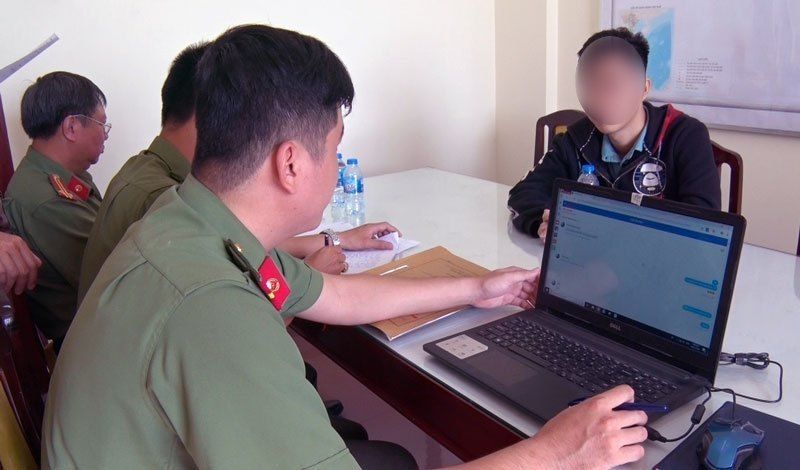
    The police force in Ben Tre Province, Vietnam seemed to have been quite busy in the last few months, going after people’s postings on Facebook.

    In January 2019, their Domestic Security Bureau took a university student in and questioned him over his Facebook’s usage, including whether he had joined a group calls “Liking BBC Vietnamese” (Thích BBC Tiếng Việt) – which the police classified as “politically hostile.”

    On February 13, 2019, Vietnamnet newspaper reported that Ben Tre provincial police conducted an investigation and interrogated a 35-year-old man, Phan Chi Toan, about his Facebook’s activities under the username “Phan Rio.”

    Police alleged that the Facebook account calls Phan Rio was conducting “subversion against the people’s government.”

    How did he do it according to the authorities?

    He did so by joining numerous groups, allegedly “politically hostile” towards the Vietnamese Communist Party (VCP) and the State, posting, sharing, and commenting on contents that incited demonstrations, as well as propagating to defame the policies, guidelines, and directions of the VCP and the government.

    The police had not formally charged Toan with a crime but did declare that they would proceed with the case according to the regular procedures.

    The same Vietnamnet’s article further mentioned that the People’s Committee of Mo Cay Bac District, also in Ben Tre Province, had fined a 55-year-old man – Dang Tri Thuc – under Government’s Decree 174/2013/ND-CP, Article 64, Section 4, for using his Facebook account to incite public demonstration in December 2018.

    Accordingly, Thuc, a driver, was accused of using the live-stream feature on Facebook to make video clips, calling on others to protest on a few major road intersections on December 22 and 28. He allegedly admitted guilt, confessed and promised he would not repeat the offense, so the authorities fined him with 15M VND or approximately 650 USD.

    Decree 174/2013/ND-CP, Article 64: Violations against regulations on websites/ news websites

    Section 4. A fine ranging from VND 30,000,000 to VND 50,000,000 shall be imposed for any of the following violations:

    a) Propagating information against the Socialist Republic of Vietnam; sabotaging the bloc of great national unity at a degree of severity which is still not liable to criminal prosecutions;

    b) Propagating information with the aims of inciting war of aggression, causing hatred between ethnic groups or people of countries, inciting violence or propagating reactionary thought at a degree of severity which is still not liable to criminal prosecutions;

    c) Distorting history, denying the revolutionary achievements or offending the nation, people or national heroes at a degree of severity which is still not liable to criminal prosecutions.

    While the right to demonstrate is constitutionally protected in Vietnam, the government had routinely violated this right by applying their Decree 38/2005/NĐ-CP – to regulate “public gatherings – during protests to arrest the participants.

    Since the nationwide mass protests broke out in June 2018 against the draft bills on the cybersecurity law and the development of three special economic zones, the security police have continued to track down those who had participated and made arrests in different cities and provinces.

    The family of a woman names Doan Thi Hong from Binh Thuan Province has recently made a public plea on social media, alleging that Hong was taken into police custody by a group of plainclothes police on September 2, 2018. She was a participant in the same June 2018 protest mentioned above.

    Although she has a young child under 36-month-old at the time of the arrest, which under Vietnam’s laws is a factor to consider against pre-trial detention, her sister claimed that Hong had been arbitrarily kept incommunicado since September of last year.

    According to her sister, Hong was not a dissident and only exercised her right to protest that one time.

    It seems that the police’s recent investigations targetting Facebook’s activities and usage in Vietnam also focus primarily on the average users and not necessarily the more well-known bloggers and dissidents.

  • Vietnamese Police Questioned University Student Over Facebook Postings

    Vietnamese Police Questioned University Student Over Facebook Postings

    On February 1, 2019, the Domestic Security Bureau of Ben Tre Province interviewed Tran Ngoc Phuc, a 21-year-old student of Ton Duc Thang University in Ho Chi Minh City at their station.

    Dong Khoi online newspaper, a publication of the VCP’s Provincial Committee in Ben Tre, published the story on the same day.

    According to the article, the police accused Phuc, a resident of Tan Phu Commune, Chau Thanh District, Ben Tre Province, of using his personal account to propagandizing against the Vietnamese Communist Party and the State.

    Namely, Phuc was using Facebook under the name “Ngoc Phuc” to join several “politically hostile” groups. Among them, was “The South of Vietnam” (Miền Nam Việt Nam), Fanclub of Saigon Capital (Đô thành Sài Gòn Fanclub), and  “Liking BBC Vietnamese” (Thích BBC Vietnamese).

    Phuc also allegedly admitted to the police that he was indeed the Facebooker Ngoc Phuc and that he had posted, shared, and commented on specific contents.

    The police had deemed these contents as materials which “propagandized, sabotaged the thoughts, distorted the direction, objectives, and policy of the VCP, the laws of the State and distorted (the image of) the leader Ho Chi Minh.”

    Formal charges against Phuc had not been filed, but the police indicated that they would continue to build the case and follow the regular legal procedures in this case.

    During the first month since the new Cybersecurity Law took effect in Vietnam on January 1, 2019, there were several reports that the police had questioned and detained some Facebookers.

    Rights groups, online campaigners, bloggers, activists, and dissidents continuously criticize the new law for further curtailing freedom of speech and shrinking the online civic space in Vietnam.

  • Facebook’s Community Standards Continue to Hinder Activism in Vietnam

    Facebook’s Community Standards Continue to Hinder Activism in Vietnam

    For almost two months, a group of drivers in Vietnam continuously protested against a BOT (Build-Operate-Transfer) toll booth near Ho Chi Minh City for collecting illegal fees after its contractual time had expired.

    According to the group, BOT An Suong was collecting fees illegally when their contract with the government for the placement of the booth had ended about 32 months ago.

    The owner of the BOT claimed that they had built other transport projects in the area, and hence received the right to continue to collect fees.

    Regardless of who is right and who is wrong about BOT An Suong, the drivers should be allowed to protest and used social media to broadcast their campaign.

    However, an unlikely aide came to the BOT’s owner’s defense: Facebook.

    This is not anything new.

    In Vietnam, Facebook has faced allegations coming from activists that it repeatedly upheld requests (most likely by anonymous users and suspected government’s hired trolls) to shut down or suspend Vietnamese users’ accounts at the request of the authorities to suppress free speech.

    One of the latest casualties was Facebooker Huynh Long who became well known in the past year and a half as someone leading the protests against wrongful BOTs, including the latest one, BOT An Suong.

    The tactics used by Long and his fellow drivers have always been peaceful.

    They just refused to pay when they were driving by BOT An Suong and demanded evidence proving that it could still collect toll fees. They would often live-stream and broadcast the encounters so that others could watch and show support.

    During many of these encounters, it was the community’s support that kept the drivers safe when the BOT hired towing trucks and unknown groups of masked men to intimidate Long and his companions.

    But last night, Facebook informed Long that his account would be suspended for 30 days.

    He joined the increasingly long list of journalists, bloggers, and activists whose accounts have been either shut down or suspended by Facebook in the last six months.

    Activist Hoang Dung’s account has been suspended so regularly that it became a known fact among the activists’ community that Facebook took action against him every time his account disappeared.

    Freelance journalists who published misconducts committed by government’s officials like Le Nguyen Huong Tra and Truong Chau Huu Danh were also among the victims.

    Tra’s account received a blue badge for verification, but that did not help when her account was suspended twice in September 2018.

    What has caused the most frustration to the Vietnamese Facebook users probably is the fact that Facebook would only give out notice of suspension for violating its community standards without any further explanation.

    The users would never know which “standard” they might have violated even when they appealed their cases.

    Moreover, no one knows what the standards that Facebook is using in Vietnam are, or who is the third party’s fact-checker for them inside the country.

    Attempts from the activists’ community to get these answers from Facebook had gone nowhere. At most, they received some evasive responses from Facebook that did not resolve the problem.

    Unlike its neighbor, the Phillippines, where an independent newspaper – Rappler – is one of Facebook’s fact-checkers, the identities of fact-checkers in Vietnam remain a secret.

    In the meanwhile, living in a country like Vietnam where there are already a handful of arbitrary and vague laws that could put one in prison for exercising their freedom of expression, the secretive and non-transparent conduct of Facebook easily angered the community.

    It was not a coincidence that during July 2018, over one hundred thousand Facebook users in Vietnam were signing up on Minds – another social media platform – in just one weekend to make their point to Facebook.

    With the new cybersecurity law enacted and took effect already in Vietnam, Facebook does face pressure from both the government and the 60 million users’ community.

    Vietnam’s Minister of Information and Communications Nguyen Manh Hung had been quite upfront about the government’s desire to build Vietnam’s own social media platform, one that could compete and win over the market from Facebook.

    Part of the main reason that many Vietnamese still rely on Facebook instead of Vietnam’s own Zalo or any other platform is the fact that it is an American product.

    While it may surprise some foreigners, the preference for American made products is a known fact in Vietnam – the country that ranked No. 1 in finding the United States favorable in one PEW’s research in 2017.

    Facebook is also benefiting from the U.S’ rule of law and its Bill of Rights where individual rights, including their right to privacy and free speech, are protected.

    Whether Facebook will uphold these values is crucial to Vietnamese users.

    Failing to demonstrate that it does and will continue to adhere to these democratic values and human rights, Facebook will no longer be attractive in Vietnam.

  • Vietnam: Increasing Cyber Attacks on Activists Portray A Shrinking Internet Freedom

    Vietnam: Increasing Cyber Attacks on Activists Portray A Shrinking Internet Freedom

    During the last week of November and in early December 2017, many of the independent media websites in Vietnam reported that access to their sites had been blocked. This includes The Vietnamese. Readers confirmed they could not access the attacked sites unless they installed VPN to get over the firewalls.

    Another independent news project also runs by The Vietnamese’s editorial board, Luat Khoa online legal magazine, was also blocked in Vietnam starting around December 4, 2017. Luat Khoa has been in operation for the past three years with over 90k likes on Facebook and an average of 500,000 pageviews per month. This is the first time Luat Khoa gets blocked in the country.

    In a more severe case, on December 5, 2017, Dan Luan – another well-known independent site – shared on Facebook that their website was under DDoS attack for about a week in late November. A DDos attack is defined as “an attempt to make an online service unavailable by overwhelming it with traffic from multiple sources”.

    Earlier last month, there were also failed attempts trying to inject Dan Luan’s website with malicious scripts via Cross-Site Scripting (XSS). Dan Luan frequently suffered cyber attacks, which they believed were the works of government-controlled hackers.

    Also in November 2017, a handful of popular Facebookers lost access to their accounts because they were reported by anonymous users to Facebook for violations of community standards. Among them was blogger Nguoi Buon Gio, who now lives in exile in Germany.

    It seems quite likely that the Vietnamese government would rely on cyber attacks as an important tactic for oppression in recent years when the numbers of Internet and social media users increased dramatically in the country.

    In July 2017, We Are Social, a social media marketing and advertising reported Vietnam had surpassed Thailand to become the 7th country with the most Facebook users worldwide.

    The government has not exactly been shy in expressing the desire to tighten their grip on controlling the virtual world. As previously reported, Vietnam claimed to have worked with Facebook and Google to remove thousands of videos and accounts that allegedly contained anti-state materials.

    Earlier this year, in May 2017, Gen. Nguyen Danh Cong of the Ministry of Public Security stated during an intra-departmental meeting, that the MPS had successfully blocked thousands of websites which they deemed to be anti-state and reactionary contents.

    Four years before that, on May 5, 2010, Gen. Vu Hai Trieu, the then Deputy Director of the MPS, announced: “Our technical departments have destroyed 300 Internet web pages and blogs posting unsuitable contents.”

    Coincidentally, it was in early November 2017 that the Washington D.C.-based cybersecurity firm, Volexity, issued a report, confirming it has been – since May 2017 – monitoring an active operation of mass surveillance and cyber attacks operating out of Vietnam.

    This operation includes the maintenance of an active group of hackers whose mission is to target Vietnamese activists and dissidents, as well as foreign citizens, corporations, and governments with interests in Vietnam.

    It was not the first time that the international cybersecurity community had warned about hackers who seemed to have had a close tie with the Vietnamese government. In the past three years, besides Volexity, at least two other organizations, Electronic Frontier Foundation and FireEye, had issued similar reports.

    Vietnam’s government is believed to have been maintaining a cyber espionage group calls OceanLotus since at least 2014. OceanLotus (or SeaLotus) is also known as APT-C-00 or APT32 according to these organizations.

    There was also other information leading people to believe that OceanLotus was related to the hacker group Sinh Tu Lenh.

    Sinh Tu Lenh became famous among Vietnamese cyber community about a decade ago when it was named as the party responsible for the numerous cyber attacks, aiming at dissidents, activists, and independent news sites, including Dan Luan, Talawas, Xcafevn, Anh Ba Sam, and Mother Mushroom.

    Also recently, on November 14, 2017, Freedom House issued its Freedom on the Net report and named 30 countries where the government paid commentators and political bots to spread government propaganda. Vietnam was one of them.

    According to Michael J. Abramowitz, president of Freedom House: “The effects of these rapidly spreading techniques on democracy and civic activism are potentially devastating.”

    The report also quoted Sanjia Kelly, director of the Freedom on the Net project: “Governments are now using social media to suppress dissent and advance an anti-democratic agenda.”

    “Not only is this manipulation difficult to detect, it is more difficult to combat than other types of censorship, such as website blocking because it’s dispersed and because of the sheer number of people and bots deployed to do it.”

    But activists in Vietnam are not new to this form of government’s suppression. Back in 2014, our editorial board’s member, Pham Doan Trang, had met with Google and Facebook representatives in the U.S. where she forwarned them about the daily attacks these “paid opinion shapers” had fired at activists and bloggers in Vietnam and how such conducts affected democracy movement.

    During the summer of 2014 alone, over 40 accounts of activists were reported, and in turn, got shut down by Facebook.

    Calling themselves the government’s “cyber army forces”, these online bots repeatedly reported activists and bloggers’ Facebook accounts, effectively causing their shut-downs.

    Taking advantages of Facebook’s loosely defined rules and standards of conducts for the users’ community, the troop of “opinion shapers” would abuse the Facebook’s “Report Abuse Button” with thousands of reports a day on a specifically targeted activist’s account.

    Yet, to date, it seems that the activists and the democracy movement have proven their potential sustainability in Vietnam, because people are still actively promoting their causes and Facebook continues to be the main platform for advancing social changes, despite all odds.

    Back in March 2015, facing the city government’s immediate decision to cut down some 6,700 trees in Hanoi, activists created a Facebook group and organized people for peaceful protests. They were able to mobilize residents of Hanoi and successfully stopped the city government from going forward with the plan.

    In 2016, Facebook again proved its effectiveness, as it was one of the best platforms for informing the public about the Formosa environmental disaster in Central Vietnam. During the height of the weeks-long protests against Formosa Ha Tinh Steel Plant – the company responsible for causing the pollution – access to Facebook was blocked on a few weekends. But its popularity among the general public had caused the government to undo such decision almost immediately.

    This year, in the recent months, drivers who were passing through a BOT toll in Cai Lay Ward, Tien Giang Province have been protesting the improper location of said toll. Their acts of civil disobedience – through various forms of slowing down the process of paying toll fees and causing the toll to close down – were followed closely by the public on Facebook and other social media platforms.

    To protect themselves and fight back, Vietnamese activists have received technical assistance from organizations, such as Access Now, when they got reported by the government’s bots on Facebook or got struck by some other forms of cyber attacks.

    In the meanwhile, the Draft Law on Cybersecurity – which mirrored that of China – is now waiting for the National Assembly’s approval.

    And as such, the battle in the cyber world continues.