Tag: Bao Sach

  • Vietnamese Vision Of A “Clean Newspaper” And The Government’s Intolerance To Press Freedom

    Vietnamese Vision Of A “Clean Newspaper” And The Government’s Intolerance To Press Freedom

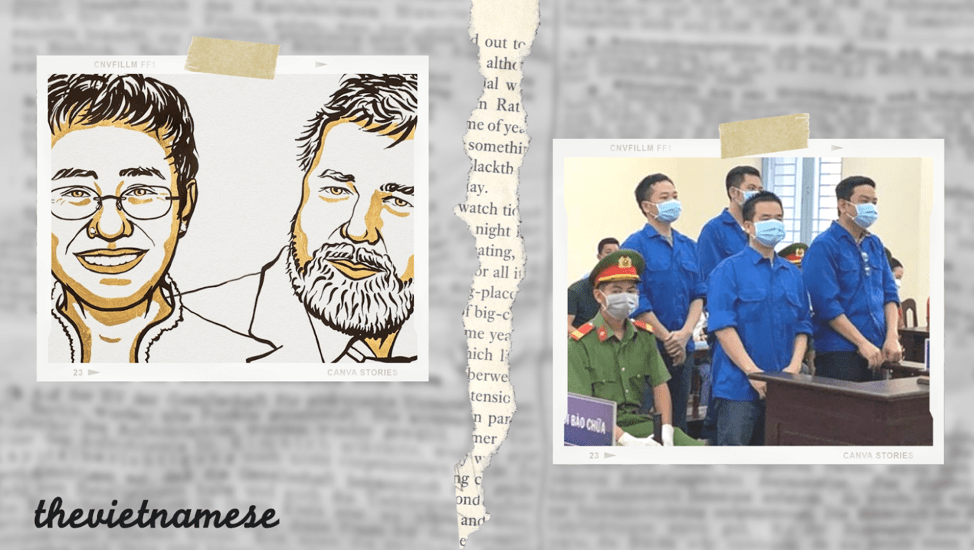
    This year as the world triumphs the importance of free speech with the award of the Nobel Peace Prize to two journalists, Maria Ressa and Dmitry Muratov, for their “efforts to safeguard freedom of expression,” Vietnam has taken a step backward in its respect for press freedom by arresting and imprisoning independent journalists.

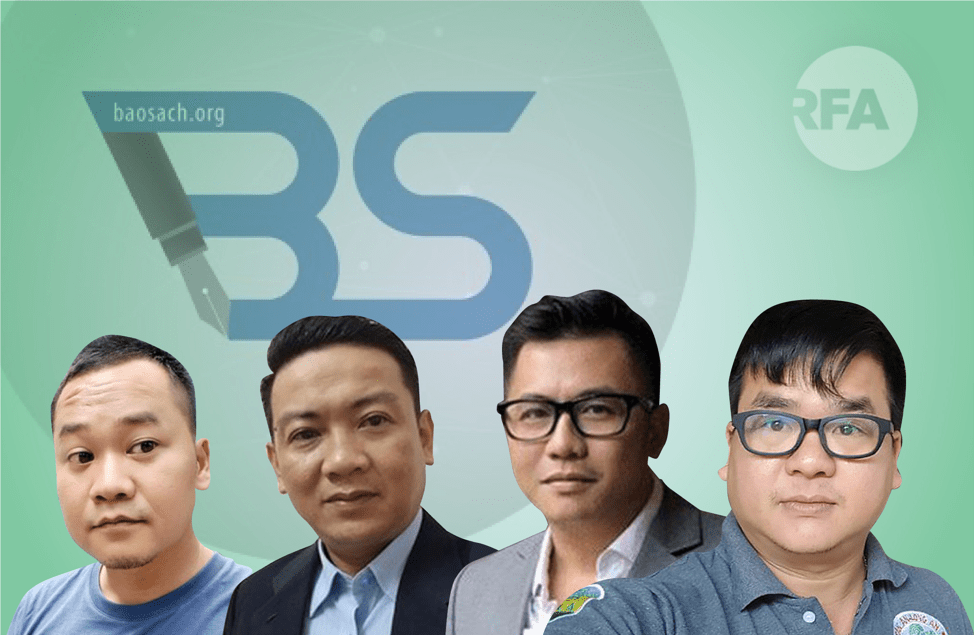
    On October 26, the local Court of Can Tho City began to try five members of the Bao Sach (Clean Newspaper) group, a Facebook-based journalism project, for allegedly “abusing the rights to freedom and democracy” that the government deemed “threatening” to state interests and security. Two days later, on October 28, five members of Bao Sach were sentenced to a total of 14 years and six months in prison.

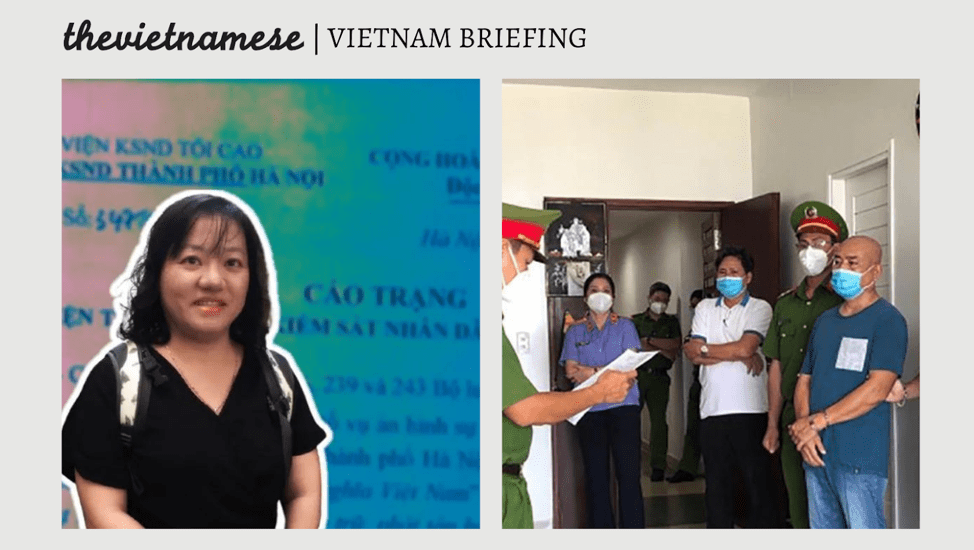
    Meanwhile, the Court of Hanoi City is also expected to try prominent journalist Pham Doan Trang for “propagandizing against the Socialist Republic of Vietnam;” the evidence used to prosecute Doan Trang includes her written reports and assessment regarding environmental issues, the human rights situation, and religious freedom in Vietnam.

    In some ways, when we congratulate the two journalists who were awarded the prestigious Nobel Peace Prize in 2021, Maria Ressa of the Philippines and Dmitry Muratov of Russia, we also feel saddened to think about the Bao Sach members and Pham Doan Trang. These Vietnamese journalists have been facing never-ending hurdles reporting the truth under the repressive hands of authoritarian leaders.

    Vision for a better journalistic environment in Vietnam

    Established in 2019, Bao Sach started off as a Facebook-based project which investigated and reported on the alleged corruption and misconduct of Vietnamese government officials and state-owned companies. Corruption and mismanagement are ubiquitous in Vietnam’s governance system. The project quickly attracted a substantial number of followers in its fan page on Facebook, as the role of the social network in Vietnam is similar to its neighbor, the Philippines, where it is essentially viewed as the Internet.[1]

    The journalistic group’s name, Clean Newspaper, refers to its commitment to journalism ethics by truth and impartiality rather than becoming another mouthpiece of the Communist government. Bao Sach gained popularity through its fact-based and accurate reporting that helped expose and provide insights into the many social issues to which the Vietnamese public pay attention, most notably the case of Ho Duy Hai, who was given the death penalty in an unfair trial.

    However, being a vocal critic in a tightly controlled media environment comes with a cost. Not much different from what Rappler Founder Maria Ressa [2] faced as a journalist in the Philippines, independent journalists, and human rights activists in Vietnam also live in constant fear of harassment by government-funded online trolls and arbitrary arrests and charges under vague laws, which have no purpose other than to curb freedom of expression.
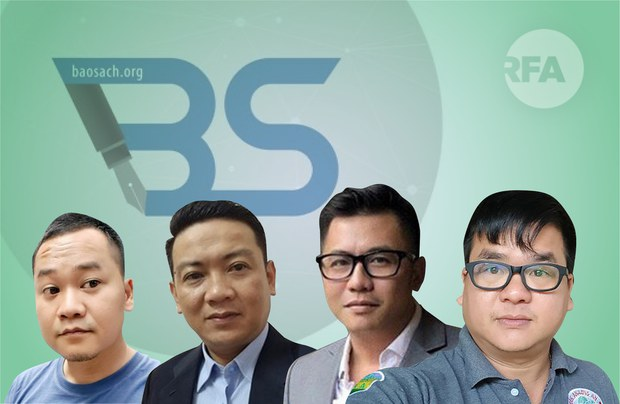
    Bao Sach’s (Clean Newspaper) members. Photo: RFA.

    Late last year, Truong Chau Huu Danh, one of the co-founders of Bao Sach, was arrested by the police, which marked the end of one of the promising independent media projects in Vietnam. Bao Sach’s Facebook page was shortly suspended after Danh’s apprehension; three members were arrested earlier in April this year.

    Subsequently, they were charged with “abusing the rights to freedom and democracy to infringe on state interests” under Article 331 of Vietnam’s 2015 Penal Code, which has been strongly criticized [3] by the international community and legal authorities for its vagueness and lack of clear definitions of the actual conduct.

    Similarly, Doan Trang’s vision [4] of a journalism project to provide Vietnamese people with an understanding of law, politics, and human rights also led to her arrest and detention. She was charged with “propagandizing against the State,” another criminal charge commonly used by the Vietnamese government to suppress dissenting opinions in the country.

    The Vietnamese government’s intolerance to press freedom

    Nevertheless, the Bao Sach members and Doan Trang are among dozens of independent reporters, journalists, and broadcasters constantly harassed or detained by the Communist authorities. Critical reporting of online bloggers and live-streamers also meets with increasing censorship as Facebook, Vietnam’s most popular social media site has in recent years reportedly complied with the government to remove “anti-state” posts. According to local activists and free-speech advocates, [5] the tech giant’s compliance is giving the Vietnamese authorities “near-total control over the platform.”

    Despite the Vietnamese Communist Party trying to boast and propagandize [6] about its state of press freedom and its respect for human rights, Vietnam scores poorly on almost every international ranking regarding press freedom and fundamental civil rights.

    Vietnam ranks [7] at 175th out of 180 countries on the 2021 World Press Freedom Index from Reporters Without Borders in terms of free press. It is also among those countries with the highest number of detained journalists, according to figures [8] compiled by the Committee to Protect Journalists (CPJ) in 2020.
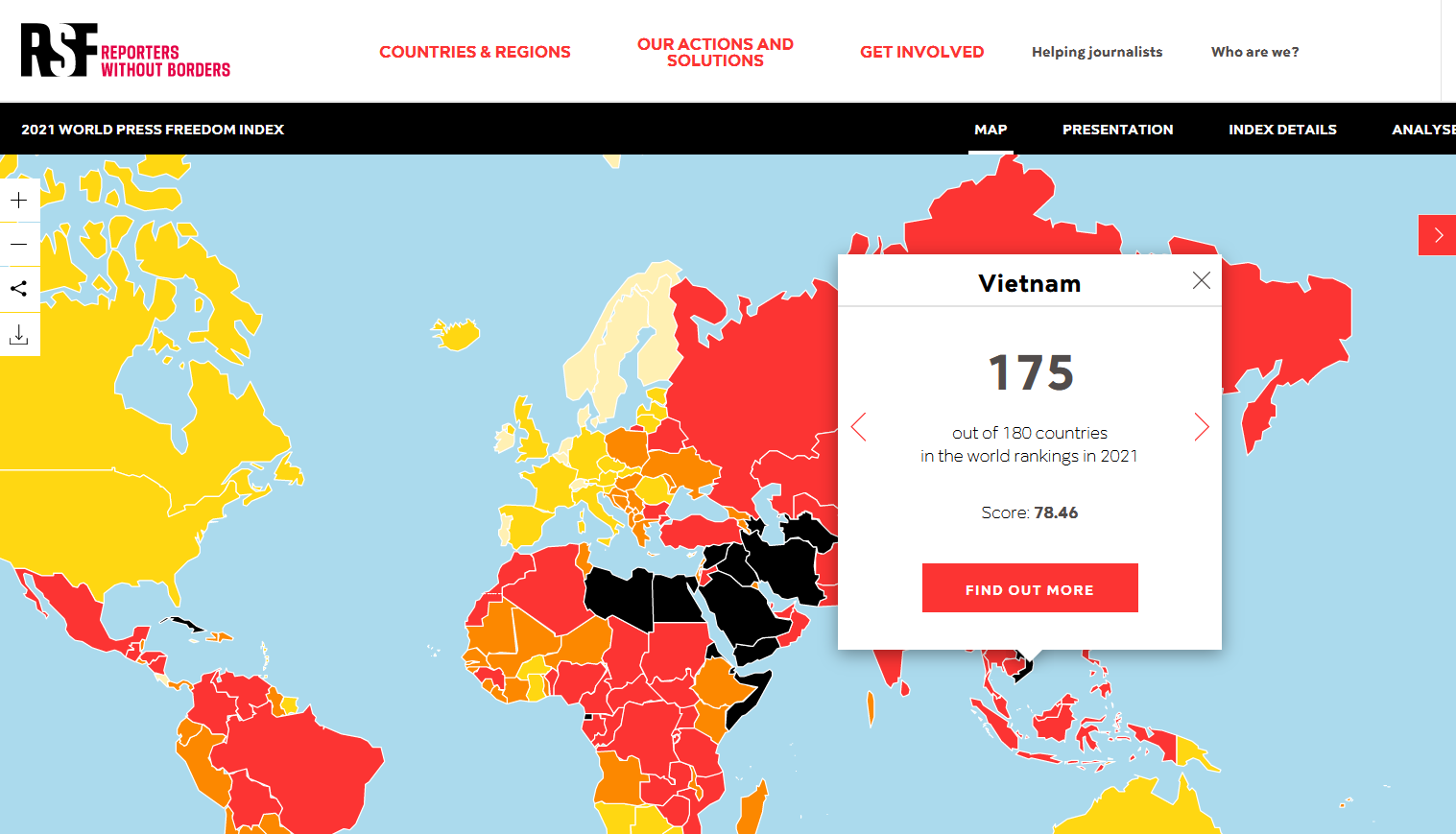
    Vietnam ranks 175th out of 180 countries in terms of press freedom. Photo: screenshot/ Reporters Without Borders.

    On civil rights, Freedom House, a non-partisan organization working to promote freedom and democracy, declared that Vietnam was “not free” when it comes to internet freedom. The Vietnamese government later criticized the results, allegedly requesting Freedom House to “stop making groundless assessments” [9] on the situation of internet freedom in the country. However, the government failed to provide concrete evidence to explain its alleged repression of internet users’ rights, other than a few fragmented pieces of information bragging about the country’s growth in internet users and its Human Development Index.

    The journey to a truly free, progressive, and independent media environment in Vietnam is still long and arduous, given the arbitrary arrests of independent journalists in recent years and an increasingly restricted social media space. However, if Prime Minister Pham Minh Chinh wants to realize his pledge [10] to “listen to dissenting opinions [and] debates,” then Vietnam must respect freedom of the press and allow journalists to express their viewpoints freely. It would also contribute to the long-term development of both Vietnam as a country and its journalistic environment.

    References:

    1. Vick, K. (2021, October 8). “It Is a Battle for Facts.” What Nobel Peace Prize Winner Maria Ressa Understands About Why She Was Chosen. Time. https://time.com/6105407/maria-ressa-nobel-prize-interview/
    2. Andrew Yeo, Enrico Gloria. (2021, October 21). In a first, the Nobel Peace Prize went to a Filipina. Her government isn’t happy. The Washington Post. https://www.washingtonpost.com/politics/2021/10/21/first-nobel-peace-prize-went-filipina-her-government-isnt-happy/
    3. The Vietnamese Magazine. (2021, October 26). Statement On The Upcoming Trial Of Bao Sach (Clean Newspaper). The Vietnamese Magazine. https://www.thevietnamese.org/2021/10/statement-on-the-upcoming-trial-of-bao-sach-clean-newspaper/
    4. Tran Phuong, Will Nguyen. (2021, February 14). Who Is Pham Doan Trang? The Vietnamese Magazine. https://www.thevietnamese.org/2021/02/who-is-pham-doan-trang/
    5. Elizabeth Dwoskin, Tory Newmyer, Shibani Mahtani. (2021, October 25). The case against Mark Zuckerberg: Insiders say Facebook’s CEO chose growth over safety. The Washington Post. https://www.washingtonpost.com/technology/2021/10/25/mark-zuckerberg-facebook-whistleblower/
    6. Đối diện: Nhân quyền. (2021, October 27). VTV. https://vtv.vn/video/doi-dien-nhan-quyen-527961.htm
    7. Vietnam – Reporters Without Borders. (n.d.). Reporters Without Borders. Retrieved October 28, 2021, from https://rsf.org/en/vietnam
    8. Record number of journalists jailed worldwide. (2020, December 15). Committee to Protect Journalists. https://cpj.org/reports/2020/12/record-number-journalists-jailed-imprisoned/
    9. VNA, (2021, September 29). Freedom House should stop making groundless assessments on internet freedom in Vietnam. VietnamPlus. https://en.vietnamplus.vn/freedom-house-should-stop-making-groundless-assessments-on-internet-freedom-in-vietnam/208842.vnp
    10. Tuan, V. (2021, April 15). Thủ tướng Phạm Minh Chính: “Chính phủ phải lắng nghe ý kiến phản biện.” VnExpress. https://vnexpress.net/thu-tuong-pham-minh-chinh-chinh-phu-phai-lang-nghe-y-kien-phan-bien-4263570.html
  • Statement On The Upcoming Trial Of Bao Sach (Clean Newspaper)

    Statement On The Upcoming Trial Of Bao Sach (Clean Newspaper)

    Legal Initiatives for Vietnam (LIV) – the operator of Luat Khoa Magazine and The Vietnamese Magazine – strongly condemns the Vietnamese government for criminalizing the activities of Bao Sach (Clean Newspaper) and the five members of the group.

    Vietnam prosecuted the Bao Sach group members under Article 331 of the 2015 Penal Code (the revision of Article 258 of the 1999 Penal Code). The international community and legal authorities have strongly criticized these two penal codes because they arbitrarily criminalize the act of “abusing democratic freedoms to infringe upon the interests of the State, lawful rights and interests of organizations and/or citizens” without defining the actual conduct of the offense. Previous cases being prosecuted under Articles 331/258 – including this Bao Sach case – illustrate that Vietnam criminalizes certain acts and conduct that should have been in the jurisdiction of the civil court system.

    We declare that the investigation, arrest, and prosecution of the members of Bao Sach show that Vietnam violates its citizens’ freedom of speech, free press, and economic freedoms. When we read the formal indictment against Bao Sach members, we can clearly see that even if these members have infringed upon the interests of the State, another individual, or another entity, the legal issue should be under the civil court system or a judicial arbitration rather than prosecuting them criminally.

    A person being silenced, a newspaper, or a media organization being closed down arbitrarily is a danger for any society. As a non-profit organization that works in journalism, LIV strongly condemns these violations that Vietnam commits and demands that the government release immediately and unconditionally all of the Bao Sach members and cease all of the criminal allegations against them.

    We also call on other journalists and the public in general to join with us and support the rights and freedoms of all of the Bao Sach group members and demand Vietnam abolish Article 331 of the 2015 Penal Code.

    Trinh Huu Long, Co-Director

    Tran Quynh Vi, Co-Director

  • Vietnam Briefing: Indictment Against Journalist Pham Doan Trang Made Available; Vietnam Arrests Another Facebook User For Criticizing Its COVID-19 Policy

    Vietnam Briefing: Indictment Against Journalist Pham Doan Trang Made Available; Vietnam Arrests Another Facebook User For Criticizing Its COVID-19 Policy

    The formal indictment against journalist Pham Doan Trang made available for public, reports The Vietnamese Magazine

    Main points:

    • According to the indictment, the investigation was done between September 22, 2016 and October 7, 2020, which was also the day that the authorities arrested Doan Trang.
    • Doan Trang refused to provide the police with her laptop password and so the police could not access its data. She also refused to acknowledge her possession of the Facebook account named “Pham Doan Trang,” and therefore the investigative unit could not charge her in connection with the information posted via that account on social media.
    • Doan Trang acknowledged that she was one of the authors of the “Report Assessment of the 2016 Law on Belief and Religion in Relation to the Exercise of Freedom of Religion and Belief in Vietnam” in both English and Vietnamese. This report was published on the website of Luat Khoa Magazine.
    • As of the conclusion of the investigation into Doan Trang’s case on August 26, 2021, the authorities had not yet found any evidence to reduce her punishment.
    • The indictment stated that both the 1999 Penal Code and the 2015 Penal Code (which took effect on January 1, 2018) could be used to prosecute Doan Trang since she continued her unlawful conduct from 2017 to 2019. However, the government dropped charges under Article 117 and only prosecuted Doan Trang under Article 88 because it stated that Doan Trang did not provide any statement during her interrogations.
    • The 1999 Penal Code would be more beneficial to the defendant since Article 88 of that penal code starts the sentence at 3 years imprisonment versus 5 years imprisonment under Article 117 of the 2015 Penal Code.

    Evidence and final indictment:

    • English documents titled “A brief report on marine life disasters in Vietnam” and “General Assessment of the human rights situation in Vietnam;”
    • English and Vietnamese versions of the “Report Assessment of the 2016 Law on Belief and Religion in Relation to the Exercise of the Right to Freedom of Religion and Belief in Vietnam;”
    • Two interviews with Pham Doan Trang by BBC News Vietnamese and Radio Free Asia – Vietnamese (RFA) in 2018.
    • The Hanoi People’s Procuracy Office prosecuted Doan Trang under Article 88, Section 1, subsections a, b, and c for “propagandizing against the Socialist Republic of Vietnam” of the 1999 Penal Code. The sentencing for this crime will be three to 12 years imprisonment.

    Pham Doan Trang’s lawyers and family raise concerns over the deterioration of her health while in custody

    • On October 19, 2021, Le Van Luan, one of Pham Doan Trang’s defending attorneys, announced on social media that he had a formal meeting with his client and subsequently raised concerns about her deteriorating health conditions after a year of detention while pending trial. However, he said that she still maintains an optimistic and percipient mentality.
    • In his Facebook post, Luan shared that Doan Trang had lost 10 kilograms (around 22 pounds) over the past year due to suffering ovarian cysts and menorrhagia, a condition which has caused her periods to last as long as 15 days. The long periods and her low blood pressure have resulted in constant fatigue. According to Trang, the changing cold weather also made her legs feel painful; her legs were broken when she was attacked by security forces a few years ago. Trang said she had not received proper medical checkups or treatment while in custody.
    • On October 20, 2021, Doan Trang’s lawyers co-wrote a petition that they sent to the Hanoi authorities, requesting that they confirm the state of her declining health conditions and assist her with proper medical checkups and treatment. On October 22, Pham Chinh Truc, Doan Trang’s brother, sent an urgent petition regarding her health issues to the detention facility, demanding the officials in charge provide her with urgent medical care as well as improve her conditions in detention. Truc also requested the Hanoi authorities allow her a family visitation this October, followed by regular visitations every two weeks afterwards.

    Trinh Ba Phuong’s wife could not have visitation with him

    As we have previously published, the trial of two Duong Noi farmers, Trinh Ba Phuong and Nguyen Thi Tam, will be on November 3, 2021. They are both charged under Article 117 of the 2015 Penal Code for “propagandizing against the Socialist Republic of Vietnam.” The 88 Project reported on October 25, 2021, that Trinh Ba Phuong’s wife, Thu Do, could not have visitation with him even the Hanoi’s People Court had allowed her.

    Accordingly, Thu Do received a letter from the Hanoi’s People Court informing her that she could visit her husband on October 21. “But when she got to the prison, she was turned away by prison officials who told her she could not see him due to COVID-19. When she asked to see the official paperwork with that decision, they produced an old order from April. They also refused to give her an explanation on paper. She has sent a complaint to the Court and the Ministry of Public Security about this and vowed to return next week,” The 88 Project stated.


    Detained blogger Bui Van Thuan’s family expresses concerns over his possible torture in detention

    RFA reports:

    • On October 15, Trinh Thi Nhung, Bui Van Thuan’s wife, received a notice from Thanh Hoa Province detention center, where Thuan is being held, regarding her husband’s health. The authorities informed Nhung that her husband had been admitted to a hospital for treatment of possible development of gout, liver infection and plantar fasciitis.
    • However, Nhung expressed concerns that Thuan might have been tortured while in custody since her husband has always had good health. The detention center officials declined to provide further information.
    • Bui Van Thuan was arrested on August 30, 2021 by Thanh Hoa Province police, just after U.S. Vice President Kamala Harris’ visit to Vietnam, where she raised concerns about human rights issues in the country. He was charged with “storing publications and materials against the Socialist Republic of Vietnam” under Article 117 of Vietnam’s Penal Code.

    Vietnamese Facebook user arrested for posting “distorted information on COVID-19 policy”

    VOA Vietnamese reports:

    • Vietnamese police in the city of Vung Tau arrested a Facebook user on October 21 for posting and sharing “false information on COVID-19 prevention policy” on his social media account.
    • Nguyen Thien Nghia, 50, was allegedly accused by the local public security department of posting “fabricated, false and distorted information on the government’s COVID-19 prevention policy.” His posts were seen criticizing the Ho Chi Minh City authorities’ coronavirus policies and the activities of Vietnamese Fatherland Front, a state-controlled political mass organization, for its fiscal misconduct and lack of support for the citizens financially affected by the COVID-19 pandemic.
    • He was detained and prosecuted under Article 179 of the Penal Code for “illegally transferring or utilizing information of computer and telecommunications networks.” Nghia is among dozens of people who were fined or prosecuted for criticizing the Vietnamese government regarding its controversial coronavirus policies.

    Bao Sach (Clean Newspaper) group’s trial is expected to begin on October 26

    • Last week, several state-run news outlets, including the military-owned People’s Army Newspaper, reported that the trial against the Bao Sach group, an independent journalism project, was expected to begin on October 26. Previously, the trial was due on October 12, but was subsequently postponed due to Vietnam’s COVID-19 pandemic situation.
    • Bao Sach members, including the former state journalist Truong Chau Huu Danh, were indicted last September by the People’s Procuracy of Can Tho City on charges of “abusing the rights to freedom and democracy to infringe on state interests” under Article 331 of Vietnam’s 2015 Penal Code.

    COVID-19 situation in Vietnam

    • Vietnamese prime minister promises economic revival after the COVID-19 pandemic, reports Reuters. On October 20, Prime Minister Pham Minh Chinh told the National Assembly that Vietnam’s economy would rebound after the pandemic ended, with exports expected to rise 10.7 percent in 2021 and with annual inflation expected to fall below 4 percent. His statement came as a fast-spreading outbreak of the Delta variant led to mass lockdowns in the country’s key industrial provinces, causing disruptions in supply chains and labor shortages.
    • Vietnam resorts to China’s vaccine diplomacy supplies to ease COVID-19 infections in Ho Chi Minh City, despite reluctance from residents, writes Nikkei Asia: “China has announced donations of 5.7 million doses of its Sinopharm vaccine. The shot is not the preferred one for many Vietnamese, but it is helping to fill local supply gaps and is playing an increasing role in Vietnam’s inoculation campaign, which started later than those in some other countries.”
    • Vietnam’s labor paradox: Manufacturing industry caught in labor shortage problem after COVID-19 restrictions force workers to rush back to their hometowns, writes Nikkei Asia: “The summer brought pandemic-driven lockdowns to much of the country, which had forced workers to sleep at factories and prevented travel between provinces. As soon as officials pulled the barricades and barbed wire off the roads, tens of thousands of migrants rushed back to their hometowns.”
    • The 2021 Southeast Asian Games (SEA Games), which were planned to be held in Vietnam in November, have been postponed until 2022 due to the spread of COVID-19, reports the South China Morning Post. The biennial multi-sport event will be held in Hanoi during an unspecified two-week period in May, 2020.

    Satellite imagery shows Vietnam’s construction and land-filling in disputed Spratly islands

    RFA reports:

    • Commercial satellite imagery shows that Vietnam appears to be doing new construction and land-filling on the remote Pearson Reef, which it has occupied since 1978, and which it had previously reclaimed about six acres of land there.
    • The imagery, which was taken by Planet Labs on Friday, shows new work has been underway at the southern tip of the northern part of the reef when compared with a picture from March. The difference is even clearer when compared with an image from June 2020.
    • Pearson Reef is classified by the Washington D.C.-based Asia Maritime Transparency Initiative (AMTI) as a rock, 300 nautical miles east of Cam Ranh in central Vietnam. In Vietnamese, it bears the name of Phan Vinh, after Nguyen Phan Vinh, a hero soldier who died in 1968 during the Vietnam War.
    • On October 21, state media quoted a Vietnamese Ministry of Foreign Affairs spokeswoman as saying that Vietnam adheres to international law and principles of peace, stability and cooperation regarding the South China Sea disputes. The statement came after Chinese state media CGTN publicly released footage on October 19 showing its military exercises in the disputed waters between two countries.

    Vietnam Insight: Learn more about Vietnam

    What’s Next for Indonesia-Vietnam Defense Relations?

    The Diplomat/ Prashanth Parameswaran/ October 20

    “Both countries [Indonesia and Vietnam] also addressed the future issues that they should prioritize in advancing their defense ties. According to the official account of the deliberations, these included areas such as technical cooperation between their coast guards, the development of military medicine amid the continued challenge of COVID-19, and other training exercises and high-level delegation exchanges. Indonesia’s defense ministry also highlighted the participation of defense industry companies in the virtual meeting, spotlighting an aspect that Jakarta has emphasized previously in defense ties.”

    Vietnam’s Economic Reopening: Finding the Right Balance

    Fulcrum/ Tuan Ho/ October 18

    “This presents Vietnam with the challenging task of ‘finding the right balance’ in its economic reopening process. On the one hand, Vietnam needs to ease social distancing measures as much as possible to revitalise the economy, which has been hard hit by the fourth wave of Covid-19 since late April.  Vietnam’s GDP contracted 6.2 percent in the third quarter, the largest quarterly decline recorded since 2000. The Asian Development Bank (ADB) has lowered Vietnam’s GDP growth forecast to 3.8 percent in 2021, a drop of 2 percentage points from a previous estimate made in July. Nguyen Kim Anh, the deputy governor of the State Bank of Vietnam, has warned that banks’ non-performing loans could reach between 7.1 and 7.7 percent of total outstanding loans, almost twice the estimate of 3.8 percent at the end of 2020. Further delays to full reopening will impede economic recovery and put further stress on the banking system.”

    Pacific Nations Have an Interest in Challenging China’s Expansive Maritime Claims

    The Diplomat/ Phuong Vu/ October 18

    “This is where small and non-claimant states, which benefit the most from a law-based international order in general and UNCLOS in particular, matter.  If they fail to form a consensus that views the South China Sea disputes and China’s interpretation of the law as a national threat, the repercussions will not stop at the water’s edge of current claimants such as Vietnam, the Philippines, Indonesia, Malaysia or Brunei. Small coastal and archipelagic states will incur expensive long-term costs for inaction. Through inaction, small states can effectively pave the way for a future where China will interpret the law for them.”

  • Vietnam Briefing: Prosecutions Against Bao Sach Journalists; Beijing Seeks To Reaffirm Its Influence In The South China Sea

    Vietnam Briefing: Prosecutions Against Bao Sach Journalists; Beijing Seeks To Reaffirm Its Influence In The South China Sea

    Prosecutions against members of online-based Bao Sach (Clean Newspaper) outlet

    RFA reports:

    • On Wednesday, September 8, Vietnamese authorities indicted five journalists from the Bao Sach group, an independent journalism project, on charges of “abusing democracy and freedom to infringe on state interests.”
    • According to the indictment issued by the Procuracy of Thoi Lai District, Can Tho City, the Bao Sach journalists posted “reactionary information and videos” and delved into information that was “inappropriate, distorting, against the country’s interests, and slanderous of the people’s administration,” in violation of Article 331 of Vietnam’s Penal Code.
    • The five indicted journalists are: Truong Chau Huu Danh, Nguyen Thanh Nha, Doan Kien Giang, Nguyen Phuong Trung Bao, and Le The Thang. Thang remains under house arrest, while the other four members have been arrested and detained.
    • According to state media, the indictment also states that the group’s members have allegedly “taken advantage of the freedom of speech and press” to write and upload “unverified, negative, biased and false” information on their Facebook fan page, Facebook group, and YouTube channel.
    • In the Freedom in the World 2021 report by Washington D.C.-based Freedom House, Vietnam scored three out of 40 in political rights, and 16 out of 60 in civil liberties. The Vietnamese Communist Party has consistently shown little tolerance for dissident and opposition voices, while many independent journalists and publishers in the country have continually faced harassment, arrests, or even imprisonment.

    Former vice president of the Vietnam Independent Journalism Association (IJAVN) denied citizenship rights

    RFA reports:

    • Vietnamese authorities have rejected petition letters calling for an investigation into legal proceedings against detained blogger Nguyen Tuong Thuy, a former vice president of IJAVN, who is currently serving an 11-year jail term for “making, storing, and disseminating documents and materials for anti-state purposes” under Article 117 of Vietnam’s Penal Code.
    • According to Nguyen Thi Lan, Thuy’s wife, her husband had called home from the An Phuoc Detention Center, Binh Duong Province, telling her that he had asked the detention center to send his petition letters to the procuracy and other agencies. However, the central authorities responded by saying that he did not have citizenship rights, which is ridiculous and unreasonable, Lan told RFA Vietnamese.
    • “The authorities did, however, suggest that he request an appeal to reconsider the court decision if he did not agree with it,” Lan added. “They said his petition was not valid because he no longer had necessary citizen rights to file it.”
    • Nguyen Tuong Thuy was indicted along with two other IJAVN members, Pham Chi Dung and Le Huu Minh Tuan, on November 10, 2020, for “making, storing, and disseminating documents and materials for anti-state purposes” under Article 117 of Vietnam’s Penal Code. He was sentenced to 11 years in prison along with Tuan, while Dung was given 15 years.

    Another member of the U.S.-based Provisional Government of Vietnam was charged for “carrying out activities to overthrow the government”

    RFA reports:

    • On Friday, September 10, Vietnamese authorities arrested and charged a woman with “carrying out activities to overthrow the government,” making her the third person this year detained for joining the Provisional Government of Vietnam, an exile Vietnamese opposition group based in Orange County, California.
    • Le Thi Kim Phi, 62, used a Facebook profile under the name “Phi Kim” to connect with members of the organization, said the investigation division of the An Giang Police.
    • The Vietnamese government designated the group a terrorist organization in January 2018 after members were charged with a plot to attack Ho Chi Minh City’s Tan Son Nhat International Airport with petrol bombs ahead of a major holiday the year before.

    COVID-19 situation in Vietnam

    • Overall, Vietnam has surpassed 600,000 confirmed COVID-19 cases with more than 15,000 deaths recorded. As of now, less than 5 percent of the country’s population has been fully vaccinated.
    • Vietnam sentenced a man to five years in jail for “spreading coronavirus,” reports The New York Times: “The man, Le Van Tri, 28, was convicted of “spreading dangerous infectious diseases” to eight people, one of whom died from virus complications. His sentence for failing to comply with Covid-19 quarantine restrictions also included a fine of 20 million dong, around $880.”
    • Hunger became a reality for tens of thousands of Vietnamese during the COVID-19 pandemic, writes The Guardian. “The government promised to feed everyone and enlisted the military to help deliver supplies to those in need, but vast swaths of the population have received nothing. Last week, Vietnamese media reported that more than 100 people in one district had protested over the lack of help.”
    • Standing at 4.95 percent, Ho Chi Minh City has the highest COVID death rate in Southeast Asia, reports Nikkei Asia: “The city’s death rate stands out in the region. The short-term fatality rate in neighboring Cambodia stood at 2.38% while Thailand’s was 1.34% although the kingdom is battling its worst outbreak of the virus so far, with around 15,000 new cases a day, according to Our World in Data.”
    • The Hayat-Vax coronavirus vaccine has been approved for emergency use in Vietnam, reports Reuters. The vaccine, which is manufactured in China and packaged in the United Arab Emirates, is the seventh vaccine to be endorsed in the Southeast Asian country.
    • European investors are considering relocating their operations in Vietnam over harsh COVID-19 restrictions, reports Reuters. “A sharp rise in coronavirus cases since late April has seen movement restrictions imposed widely, affecting workers and forcing many companies to suspend operations, which resulted in falls in August exports, industrial output and retail sales.”

    Chinese Foreign Minister Wang Yi’s trip to Vietnam

    • On Friday, September 10, Chinese Foreign Minister Wang Yi arrived in Vietnam for a three-day visit, with a goal of reasserting Beijing’s influence in the country following high-profile visits by U.S. Vice President Kamala Harris and U.S. Defense Secretary Lloyd Austin.
    • In an official statement, Wang warned Vietnam of interference from “regional outsiders” in the South China Sea issue, urging the country to “treasure the hard-won peace and stability” and refrain from unilateral moves that could “complicate the conditions” or “magnify conflicts” over territorial disputes between the two countries. “[We should] send a positive message to the international community that the people of China and Vietnam have the wisdom to manage conflicts, and further expand areas of cooperation,” he added.
    • China also offered Vietnam an additional three million vaccine doses during Wang’s visit, raising the number of vaccines donated from China to the country to 5.7 million doses.
    • Meanwhile, Japan’s Defense Minister Nobuo Kishi was also in Vietnam on Saturday, where he signed a deal allowing the transfer of defense equipment and technology from Japan to Vietnam amid China’s growing military influence, reports Associated Press. Minister Kishi said the signed deal elevates their defense partnership “to a new level” and that Japan plans to deepen defense ties between Vietnam and Japan through “multinational joint exercises” among other things.

    Vietnam Insight: Learn more about Vietnam

    US, China dueling for power on the Mekong

    Asia Times/ Bertil Lintner/ September 5

    “While in Singapore, Harris said that ‘our partnerships in Singapore, in Southeast Asia, and throughout the Indo-Pacific are a top priority for the United States.’ She also spoke against China’s excessive claims in the South China Sea, a message she repeated during her subsequent trip to Vietnam.

    But the odds are arguably stacked against Washington on the Mekong. China is moving ahead faster and with more determination than the US in asserting its influence on Mekong River nations.

    Because China sits at the river’s headwaters and has shown its power to turn it off at will, the MRC, Mekong-US Partnership, and Japan’s initiatives seem destined to become sideshows in another rising contest for regional influence.”

    Washington’s Challenge in Southeast Asia: The View From Vietnam

    The Diplomat/ Ngo Minh Tri/ September 8

    “If the U.S. wants stronger support and closer partnership with Vietnam and other Southeast Asian countries, it must change the approach, rebalancing its focus away from security to focus on the economic cooperation that is central to the future prosperity of Vietnam and other ASEAN members. Geographic proximity and economic interdependence mean that Southeast Asian nations are reluctant to treat China as a hostile adversary.”

    Vietnam in pragmatic balancing act between China, US

    Asia Times/ Hai Hong Nguyen/ September 10

    “Overall, the main purpose of Wang’s trip to Hanoi is to pull Vietnam back from getting closer to the US and at the same time floating a message to the US that China’s ties with Vietnam are unbreakable.

    Vietnam has been successful and greatly benefited from maintaining the balance in its relationship with both the United States and China. However, Vietnam’s approach is more pragmatic than it once was. It will not be dragged into the competition or rivalry between the two major powers.”