A discussion with some students in my Theory on State and Law class back in 2020 led me to a surprising revelation: over 50 percent of them have visited Taiwan. They could remember and name their favourite tourist attractions, either Sun Moon Lake near Taichung, the “Spirited Away” Jiufen to the country’s northwest, or the vibrant streets of Ximending in Taipei. For them, Taiwan seemed to be a lively place – an exemplar of modernity, politeness, and peacefulness.
Not only that, many of them had paid a visit to the Chiang Kai-Shek Memorial Hall and took pictures with his infamous Lincoln-like statue. Most unexpectedly, they knew that Taiwan was not China, or at least Mainland China. One student mentioned that her Chinese visa was useless for visiting Taiwan, and she suggested that the Taiwanese visa application process was more straightforward. And Chiang Kai-Shek, as they described, could be someone akin to their “Uncle Ho” in Vietnam.
For a country where the youth hardly know the Vietnamese heads of state – the president, the prime minister, or the general secretary – their knowledge of Taiwan was astonishing.
***
I have come to realize that the depiction of Taiwan in Vietnam has changed dramatically over the past 20 years.
During the 90s, Taiwan was infamously known in Vietnam for the poor and old Taiwanese farmers who could not get married in their hometowns, wandering the most disenfranchised areas of Vietnam’s rural areas to look for brides.
Nowadays, Taiwan is considered a cultural, economic, and intellectual hub of the region – a place worth living in, especially in the eyes of Vietnamese youth. What has caused this distinct shift in perspective? Perhaps it is the billions of US dollars worth of investments pouring into Vietnam from Taiwan since the 1990s.
Dubbed by Professor Samuel C. Y. Ku as the “Southward Policy” of Taiwan, at the beginning of 1993, Taiwanese presidents started to privately visit and form business ties with Southeast Asian countries that had no formal diplomatic relations with the Republic of China (ROC) before.
The objectives on the surface were clear: (1) expanding two-way economic, trade, and investment relations with these countries; and (2) expanding the production size of Taiwanese enterprises, while at the same time reducing the trade and human resource dependence on mainland China.
More importantly, Taiwanese leadership hoped that such a close connection between economies would strengthen substantive relations between governments, allowing them to participate in other international and regional commercial and political activities.
In Vietnam, Taiwan succeeded in certain aspects. Taiwan has a decisive say in the contemporary economic stability of Vietnam. Taiwanese enterprises ownroughly 2,500 projects, and they have invested over US$30 billion in the country. Bilateral trade between Vietnam and Taiwan has just exceeded US$16 billion, and most of Vietnam’s exported labor is directed towards Taiwan. Any political instability or economic issues that are not in favor of this arrangement will impact Vietnam’s performance.
On the other hand, China continues to be seen as a taboo in Vietnamese cultural and intellectual discussions. The recent promotion of the Chinese propaganda military drama named Ace Troops (Chinese: 王牌部队; Vietnamese: Vương bài) has again sparked debates and serious boycotts in Vietnam. Focusing on stories about the establishment and the development of the Chinese People’s Liberation Army, Ace Troops glorifies the Sino-Vietnam War of 1979 and the continuous border/maritime skirmishes during the 80s. By praising the conflicts that led to hundreds of thousands of Vietnamese casualties as heroic and patriotic wars, it can be seen why this drama infuriates China’s southern neighbour.
Even though Taiwan has the same claims as to the People’s Republic of China regarding the South China Sea, it appears to be a much milder, friendlier, and negotiable partner to the Vietnamese public.
***
One week after China expressed its desire to be a part of the Comprehensive and Progressive Agreement for Trans-Pacific Partnership (CPTPP), Taiwan also formally applied for a seat in this organisation.
Taiwan has reasons to hasten its membership in this organization. If it fails to secure a seat in time, it would have to go through the consultation process with all the signatories, which would, at this point, include China, and then protect its interests before a CPTPP Council where Beijing would already hold a seat.
Taiwan had experienced this kind of stubbornness and tantrum-throwing behaviour of China when it dealt with the WTO. During the 2000s, Beijing had repeatedly refused to attend any dispute resolution proceedings between themselves and Taiwan, justifying this on the grounds that these issues were solely the internal affairs of China.
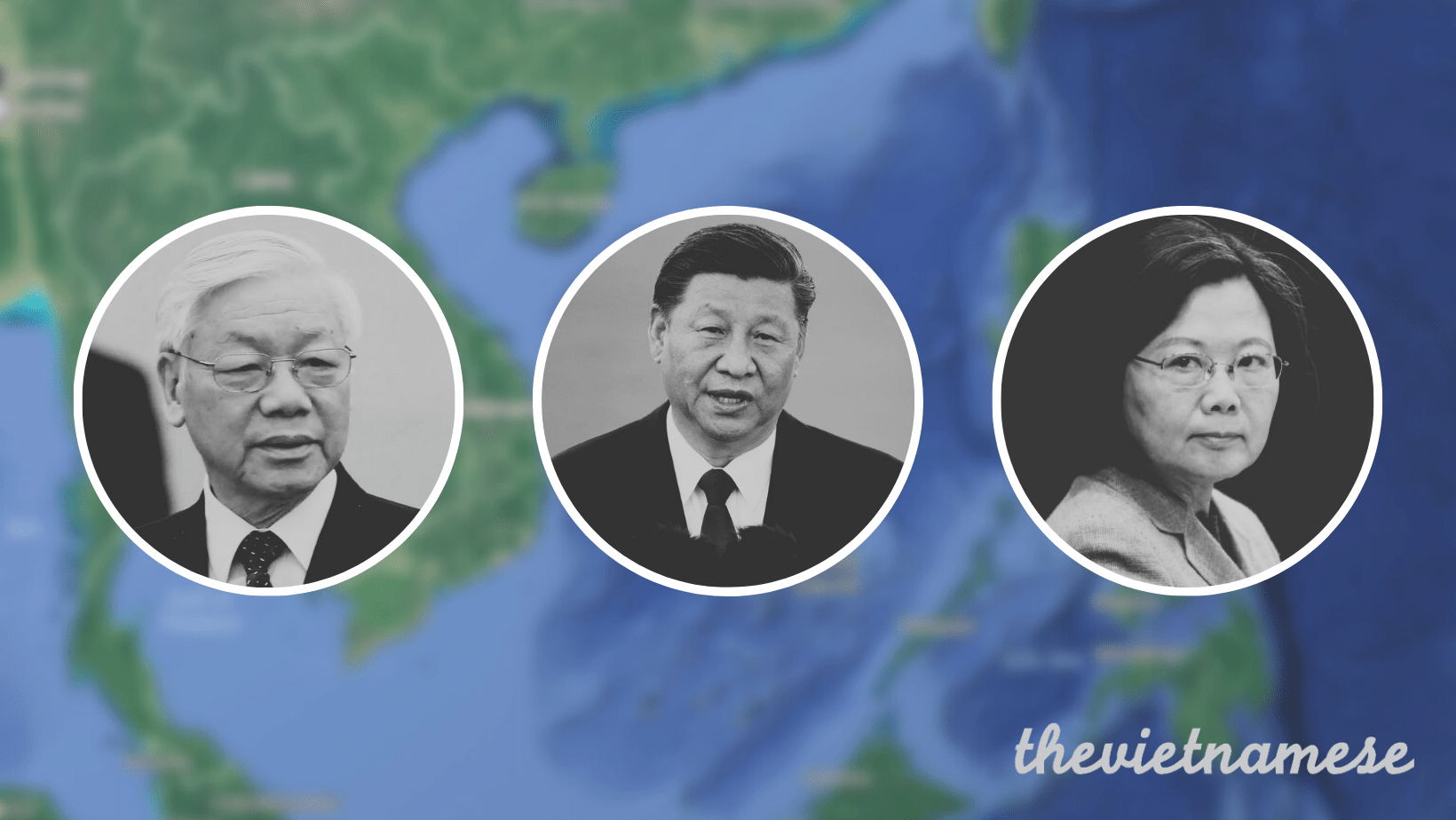
A couple of days after China’s and Taiwan’s announcements on the CPTPP, President Xi Jinping had a phone call with General Secretary Nguyen Phu Trong. This action raised some questions on whether Vietnam would act as an agent of China inside the CPTPP to prevent the accession effort of Taiwan.
If it has to, the Vietnamese government is very unlikely to side with Taiwan; no country has ever dared to, including the United States.
But upon understanding the socioeconomic situation between Vietnam, Taiwan, and China, it is also reasonable to argue that Vietnam gains nothing by explicitly objecting to Taiwan’s membership in the CPTPP. The economic ties between Taiwan and Vietnam are too significant to be sacrificed.
Moreover, such an effort requires fierce political commitment and diplomatic loyalty to mainland China, and Vietnam rarely exhibits this in the international arena. Recently, at the 48th session of the Human Rights Council, a declaration of 65 countries denounced the interference in China’s internal affairs by several actors under the pretext of human rights. Vietnam, however, did not participate. Vietnam’s action is a bit cold for two socialist neighbouring countries that claim to have a golden friendship.
Yet, this action illustrates one essential facet of Vietnam’s diplomatic playbook: pragmatism. Taiwan has been a beneficial friend to the Vietnamese government and remains hopeful for the country’s economic recovery and internal stability after the pandemic.
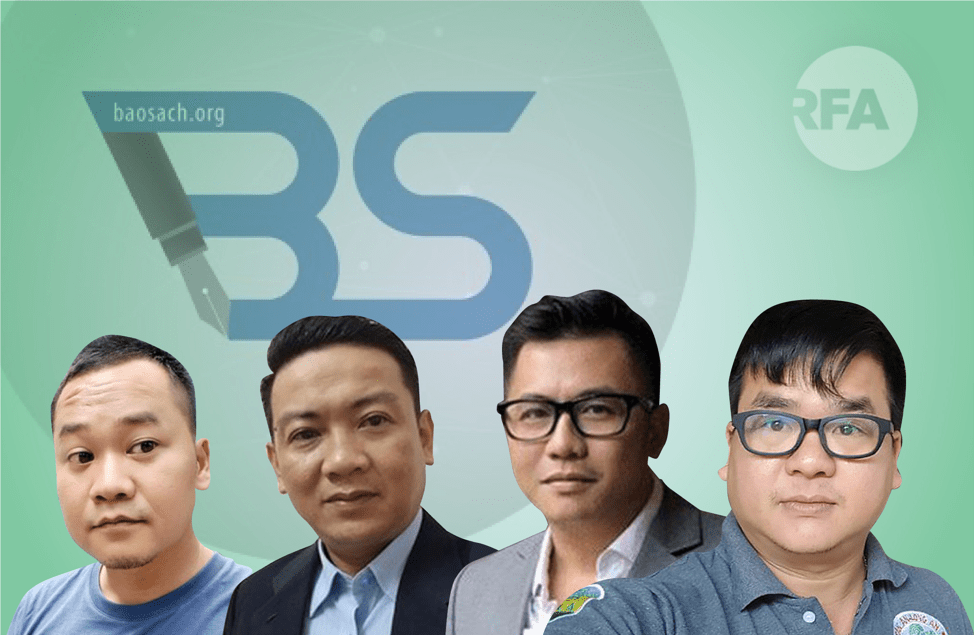
On Wednesday, September 8, Vietnamese authorities indicted five journalists from the Bao Sach group, an independent journalism project, on charges of “abusing democracy and freedom to infringe on state interests.”
According to the indictment issued by the Procuracy of Thoi Lai District, Can Tho City, the Bao Sach journalists posted “reactionary information and videos” and delved into information that was “inappropriate, distorting, against the country’s interests, and slanderous of the people’s administration,” in violation of Article 331 of Vietnam’s Penal Code.
The five indicted journalists are: Truong Chau Huu Danh, Nguyen Thanh Nha, Doan Kien Giang, Nguyen Phuong Trung Bao, and Le The Thang. Thang remains under house arrest, while the other four members have been arrested and detained.
According to state media, the indictment also states that the group’s members have allegedly “taken advantage of the freedom of speech and press” to write and upload “unverified, negative, biased and false” information on their Facebook fan page, Facebook group, and YouTube channel.
In the Freedom in the World 2021 report by Washington D.C.-based Freedom House, Vietnam scored three out of 40 in political rights, and 16 out of 60 in civil liberties. The Vietnamese Communist Party has consistently shown little tolerance for dissident and opposition voices, while many independent journalists and publishers in the country have continually faced harassment, arrests, or even imprisonment.
Former vice president of the Vietnam Independent Journalism Association (IJAVN) denied citizenship rights
Vietnamese authorities have rejected petition letters calling for an investigation into legal proceedings against detained blogger Nguyen Tuong Thuy, a former vice president of IJAVN, who is currently serving an 11-year jail term for “making, storing, and disseminating documents and materials for anti-state purposes” under Article 117 of Vietnam’s Penal Code.
According to Nguyen Thi Lan, Thuy’s wife, her husband had called home from the An Phuoc Detention Center, Binh Duong Province, telling her that he had asked the detention center to send his petition letters to the procuracy and other agencies. However, the central authorities responded by saying that he did not have citizenship rights, which is ridiculous and unreasonable, Lan told RFA Vietnamese.
“The authorities did, however, suggest that he request an appeal to reconsider the court decision if he did not agree with it,” Lan added. “They said his petition was not valid because he no longer had necessary citizen rights to file it.”
Nguyen Tuong Thuy was indicted along with two other IJAVN members, Pham Chi Dung and Le Huu Minh Tuan, on November 10, 2020, for “making, storing, and disseminating documents and materials for anti-state purposes” under Article 117 of Vietnam’s Penal Code. He was sentenced to 11 years in prison along with Tuan, while Dung was given 15 years.
Another member of the U.S.-based Provisional Government of Vietnam was charged for “carrying out activities to overthrow the government”
On Friday, September 10, Vietnamese authorities arrested and charged a woman with “carrying out activities to overthrow the government,” making her the third person this year detained for joining the Provisional Government of Vietnam, an exile Vietnamese opposition group based in Orange County, California.
Le Thi Kim Phi, 62, used a Facebook profile under the name “Phi Kim” to connect with members of the organization, said the investigation division of the An Giang Police.
The Vietnamese government designated the group a terrorist organization in January 2018 after members were charged with a plot to attack Ho Chi Minh City’s Tan Son Nhat International Airport with petrol bombs ahead of a major holiday the year before.
COVID-19 situation in Vietnam
Overall, Vietnam has surpassed 600,000 confirmed COVID-19 cases with more than 15,000 deaths recorded. As of now, less than 5 percent of the country’s population has been fully vaccinated.
Vietnam sentenced a man to five years in jail for “spreading coronavirus,” reports The New York Times: “The man, Le Van Tri, 28, was convicted of “spreading dangerous infectious diseases” to eight people, one of whom died from virus complications. His sentence for failing to comply with Covid-19 quarantine restrictions also included a fine of 20 million dong, around $880.”
Hunger became a reality for tens of thousands of Vietnamese during the COVID-19 pandemic, writes The Guardian. “The government promised to feed everyone and enlisted the military to help deliver supplies to those in need, but vast swaths of the population have received nothing. Last week, Vietnamese media reported that more than 100 people in one district had protested over the lack of help.”
Standing at 4.95 percent, Ho Chi Minh City has the highest COVID death rate in Southeast Asia, reports Nikkei Asia: “The city’s death rate stands out in the region. The short-term fatality rate in neighboring Cambodia stood at 2.38% while Thailand’s was 1.34% although the kingdom is battling its worst outbreak of the virus so far, with around 15,000 new cases a day, according to Our World in Data.”
The Hayat-Vax coronavirus vaccine has been approved for emergency use in Vietnam, reports Reuters. The vaccine, which is manufactured in China and packaged in the United Arab Emirates, is the seventh vaccine to be endorsed in the Southeast Asian country.
European investors are considering relocating their operations in Vietnam over harsh COVID-19 restrictions, reports Reuters. “A sharp rise in coronavirus cases since late April has seen movement restrictions imposed widely, affecting workers and forcing many companies to suspend operations, which resulted in falls in August exports, industrial output and retail sales.”
Chinese Foreign Minister Wang Yi’s trip to Vietnam
On Friday, September 10, Chinese Foreign Minister Wang Yi arrived in Vietnam for a three-day visit, with a goal of reasserting Beijing’s influence in the country following high-profile visits by U.S. Vice President Kamala Harris and U.S. Defense Secretary Lloyd Austin.
In an official statement, Wang warned Vietnam of interference from “regional outsiders” in the South China Sea issue, urging the country to “treasure the hard-won peace and stability” and refrain from unilateral moves that could “complicate the conditions” or “magnify conflicts” over territorial disputes between the two countries. “[We should] send a positive message to the international community that the people of China and Vietnam have the wisdom to manage conflicts, and further expand areas of cooperation,” he added.
China also offered Vietnam an additional three million vaccine doses during Wang’s visit, raising the number of vaccines donated from China to the country to 5.7 million doses.
Meanwhile, Japan’s Defense Minister Nobuo Kishi was also in Vietnam on Saturday, where he signed a deal allowing the transfer of defense equipment and technology from Japan to Vietnam amid China’s growing military influence, reports Associated Press. Minister Kishi said the signed deal elevates their defense partnership “to a new level” and that Japan plans to deepen defense ties between Vietnam and Japan through “multinational joint exercises” among other things.
“While in Singapore, Harris said that ‘our partnerships in Singapore, in Southeast Asia, and throughout the Indo-Pacific are a top priority for the United States.’ She also spoke against China’s excessive claims in the South China Sea, a message she repeated during her subsequent trip to Vietnam.
But the odds are arguably stacked against Washington on the Mekong. China is moving ahead faster and with more determination than the US in asserting its influence on Mekong River nations.
Because China sits at the river’s headwaters and has shown its power to turn it off at will, the MRC, Mekong-US Partnership, and Japan’s initiatives seem destined to become sideshows in another rising contest for regional influence.”
“If the U.S. wants stronger support and closer partnership with Vietnam and other Southeast Asian countries, it must change the approach, rebalancing its focus away from security to focus on the economic cooperation that is central to the future prosperity of Vietnam and other ASEAN members. Geographic proximity and economic interdependence mean that Southeast Asian nations are reluctant to treat China as a hostile adversary.”
“Overall, the main purpose of Wang’s trip to Hanoi is to pull Vietnam back from getting closer to the US and at the same time floating a message to the US that China’s ties with Vietnam are unbreakable.
Vietnam has been successful and greatly benefited from maintaining the balance in its relationship with both the United States and China. However, Vietnam’s approach is more pragmatic than it once was. It will not be dragged into the competition or rivalry between the two major powers.”
The case of journalist Pham Doan Trang: Investigation process completed, leading to her indictment
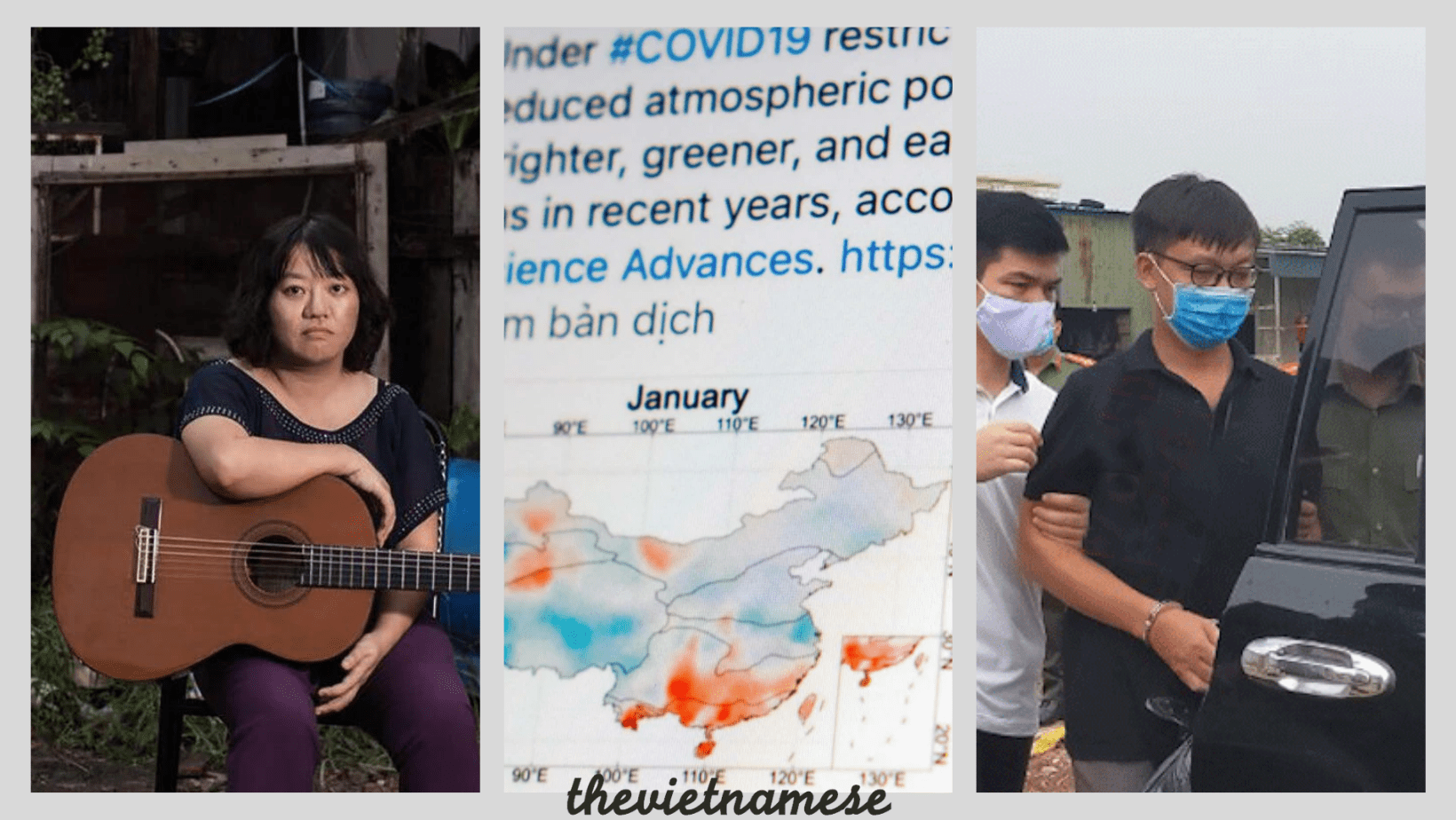
On Aug 26, 2021, Hanoi Police announced that they had completed the investigations into Pham Doan Trang on the allegation of “spreading information against the State.” The government is now allowing lawyers to defend her for the first time since she was arrested last October.
Last year, on October 6, Pham Doan Trang was arrested by Vietnamese state security and she was subsequently charged with “conducting propaganda against the Socialist Republic of Vietnam” under Article 88 of the 1999 Penal Code and “making, storing, spreading information, materials, items for the purpose of opposing the State of the Socialist Republic of Vietnam” under Article 117 of the 2015 Penal Code. Since then, Trang has been held incommunicado and denied visits from her family and lawyers.
Trinh Huu Long, a personal representative of Pham Doan Trang, claimedthat her arrest was “completely unconstitutional, [and] in violation of the law.” Pham Doan Trang is a prominent journalist and democracy activist, famously known for her political books written for general readers and articles with sharp criticisms against Vietnam’s Communist government. “The authorities would do better to respect Doan Trang’s work rather than punish her,” Long concluded.
Pham Doan Trang could face up to 20 years in prison if found guilty.
Vietnamese police disguised as health workers arrest a dissident blogger
On Aug 30, Vietnamese police arrested Bui Van Thuan, a dissident Facebook user, for criticizing the government in his online posts, especially his comments on the Dong Tam land dispute incident.
After cutting power to Thuan’s house in Nghi Son Town, Thanh Hoa Province, police officers, disguised as medical workers, asked his wife to let them in to take a health statement. “They said they were in a hurry and urged me to open the door quickly so that they could go to see others, so I invited them to come into the living room,” Thuan’s wife, Trinh Thi Nhung, said.
After getting into the house, a male officer “broke into the bedroom and restrained and handcuffed my husband just as he had woken up and was about to come out,” she said. The police then carried out a search of the house, handcuffing both the blogger and his wife, and confisticating a jar of lime-flavored honey, despite opposition from the family, and a copy of “The Handbook for Families of Prisoners” published by Pham Doan Trang as they left, according to Nhung.
Thuan was later formally prosecuted for “storing publications and materials against the Socialist Republic of Vietnam under Article 117 of Vietnam’s Criminal Code,” according to police documents reviewed by VOA. His arrest came just after the U.S. Vice President Kamala Harris’ visit to Vietnam, where she raised concerns about human rights issues.
Last year, when the dissident blogger was interviewed by the Los Angeles Times, he expressed concerns about Facebook’s compliance with Vietnamese authorities to suppress free speech by suspending dissidents’ accounts and censoring critical voices against the government.
Australia continues to urge Vietnam to release Vietnamese-Australian political prisoner Chau Van Kham
On Aug 30, Australian Minister for Foreign Affairs Marise Payne sent a letter to MP Chris Hayes, advocating for the release of political prisoner Chau Van Kham.
Chau Van Kham was arrested in Jan 2019 in Ho Chi Minh City; he was later sentenced to 12 years in prison for alleged “terrorist activities against the People’s government.” Kham is a member of Viet Tan, a democracy and human rights organization regarded as a “terrorist group” by the Vietnamese government. However, the United Nations considers Viet Tan a “peaceful organization advocating for democratic reform.”
Meanwhile, Chau Van Kham’s family has spent more than two years advocating for his vaccination against COVID-19 once it is made available as the coronavirus situation began to deteriorate in Vietnam, especially with recent outbreaks in many prisons. “My husband is 72 years old, it’s easy for him to get COVID and die there. That’s why I want a vaccine for my husband,” said Trang Chau, his wife.
He was not among those released under an amnesty annually granted on Vietnamese Independence day on September 2.
COVID-19 situation in Vietnam
Quick take: Vietnam has recorded over 520,000 confirmed COVID-19 cases with more than 13,000 deaths. Fully vaccinated people only account for under 3 percent of the country’s population.
Vietnamese Prime Minister Pham Minh Chinh warns of a lengthy battle against COVID-19, reports Reuters. “We cannot resort to quarantine and lockdown measures forever, as it will cause difficulty for the people and the economy,” he said during a meeting with an antivirus committee last Wednesday. The highly transmissive Delta variant has shattered Vietnam’s early success in containing COVID-19 infections.
Ho Chi Minh City, Vietnam’s coronavirus epicenter, is considering a plan to reopen its economic activities from September 15, shifting from the “zero COVID-19” strategy to “living with the virus” policy, reports Reuters. The city has been gripped by a recent sharp rise of coronavirus infections and has remained under stringent lockdown since. So far, half of Vietnam’s confirmed cases, and 80 percent of its fatalities, have been recorded in Ho Chi Minh City.
Vietnam ranked bottom in Nikkei Asia’s Covid Recovery Index, mostly due to the country’s surge in COVID-19 cases, slow vaccination rates and rigid social distancing measures, which caused disruptions in the supply chain. The Nikkei chart ranks more than 120 countries and regions around the world on the assessment of infection management, vaccine rollouts and social mobility. This is the second time Vietnam is listed at the bottom.
Hanoi will send over 1,200 city residents from its largest COVID-19 cluster to a centralized quarantine facility on the city’s outskirts, reports VnExpress. The affected neighborhood, which is located in Thanh Xuan District, has reported more than 300 coronavirus cases since August 23. At the same time, Hanoi authorities are also set to extend lockdown measures until September 21, while maintaining strict COVID-19 restrictions in high risk areas.
Vietnam to receive an additional two million AstraZeneca vaccine doses, reports VnExpress: “Three batches of 2,016,460 AstraZeneca COVID-19 vaccine doses have arrived in Ho Chi Minh City this week. The batches, part of a 30 million dose contract between AstraZeneca and the Vietnam Vaccine JSC (VNVC), arrived on Tuesday and Wednesday.”
Ho Chi Minh City faces a food delivery crisis, reports Nikkei Asia: “The government-led delivery operation became overwhelmed during the first week, prompting the city to issue a written request to local supermarkets and online platforms to participate in delivery services. The move followed an announcement from the city on August 28, allowing as many as 25,000 shippers to join the delivery rollout. However, involving local businesses has done little to improve the situation.”
Ministry of Foreign Affairs spokeswoman makes statement on China’s revised Maritime Traffic Safety Law
On September 1, Ministry of Foreign Affairs spokeswoman Le Thi Thu Hang made a statement on China’s official enforcement of its revised Maritime Traffic Safety Law, reports state-run VietnamPlus: “Vietnam resolutely and persistently safeguards its sovereignty, sovereign rights and jurisdiction over its waters determined in line with the provisions of the 1982 UN Convention on the Law of the Sea (UNCLOS 1982),” said Hang.
On August 27, China’s Maritime Safety Administration announced that foreign vessels entering its “territorial waters,” which refers to its unlawful nine-dash line, must “report ship and cargo information to China’s maritime administrations,” according to the South China Morning Post (SCMP).
The revised Maritime Traffic Safety Law, which took effect on September 1, “comes amid escalating tension between China and rival claimants, as well as Western nations led by the US and its expanded military presence in the region,” writes the SCMP.
One day later, on August 28, Science Advances magazine took down a Facebook post of an attached scientific research showing China’s nine-dash line map after Vietnam’s social media users flooded its comment section with opposition and criticisms. Despite its effectiveness this time, the aggressive strategy utilized by Vietnamese social media users, or its “public opinion shapers,” has also been deployed to attack pro-democracy activists and foreign ambassadors’ social network accounts in Vietnam, particularly when they raise concerns about the country’s poor human rights record.
The Diplomat/ Le Vinh Trien and Kris Hartley/ September 1
“Anti-epidemic measures developed without collaboration fail to reflect the voices of diverse communities. When the political power among these communities is imbalanced, policy inconsistencies arise and a chain reaction emerges. Case counts rise as people resist restrictive behavior protocols, straining health care capacity and imperiling vulnerable groups. Ultimately, mixed messaging at the policy level widens the trust gap between government and citizens.”
“There is no moral equivalence between North Vietnamese forces and the Taliban. During World War II, the Viet Minh actually supported the United States and its allies by serving as the only Vietnamese force resisting Japan’s invasion of Indochina. This preamble for conflict hardly compares to the Taliban militia, which massacred minority Hazara communities and forced Hindus to carry yellow badges to set them apart from Afghan Muslims—like Jews in Nazi Germany.”
“The Afghans solved their problem by valiantly fighting the Soviet Union forces that invaded their country, and the Vietnamese benefited from the eventual dissolution of the USSR. Little to none of the economic reform that made Vietnam’s economy a vibrant one would likely have happened had the Soviet Union still been around.”
Since the beginning of its history, the Vietnamese Communist Party (VCP) has been portraying itself as a group of nationalists who liberated the country from foreign intervention. History textbooks, propaganda, and official VCP narratives were all dedicated to showing that the VCP is the true heir of Vietnam and that the path to socialism is the destined path of the country.
However, this nationalistic sentiment contrasts with the Party’s cherished Marxist-Leninist Communist ideology, which states that nationalism is a bourgeoise illusion[1] that distracts people from their struggle with the bourgeoisie and that only international class struggle matters.[2] Such an ideological paradox is even more puzzling as we examine the regime’s responses to the rise of contemporary anti-China nationalism in Vietnam.
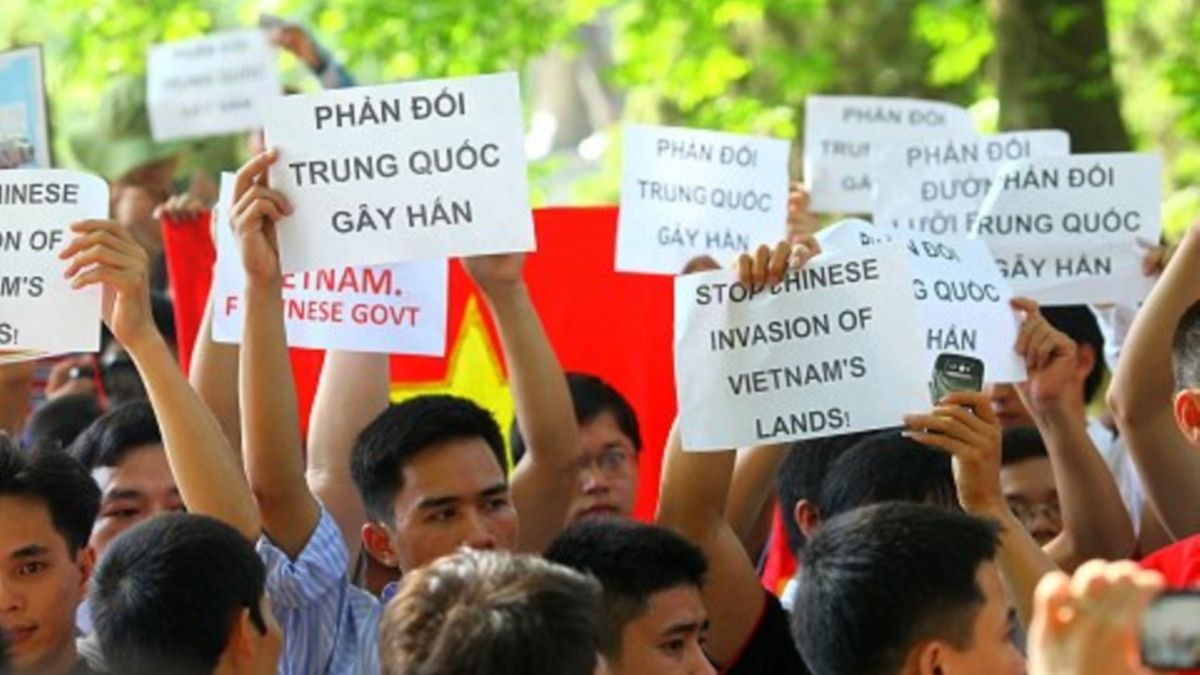
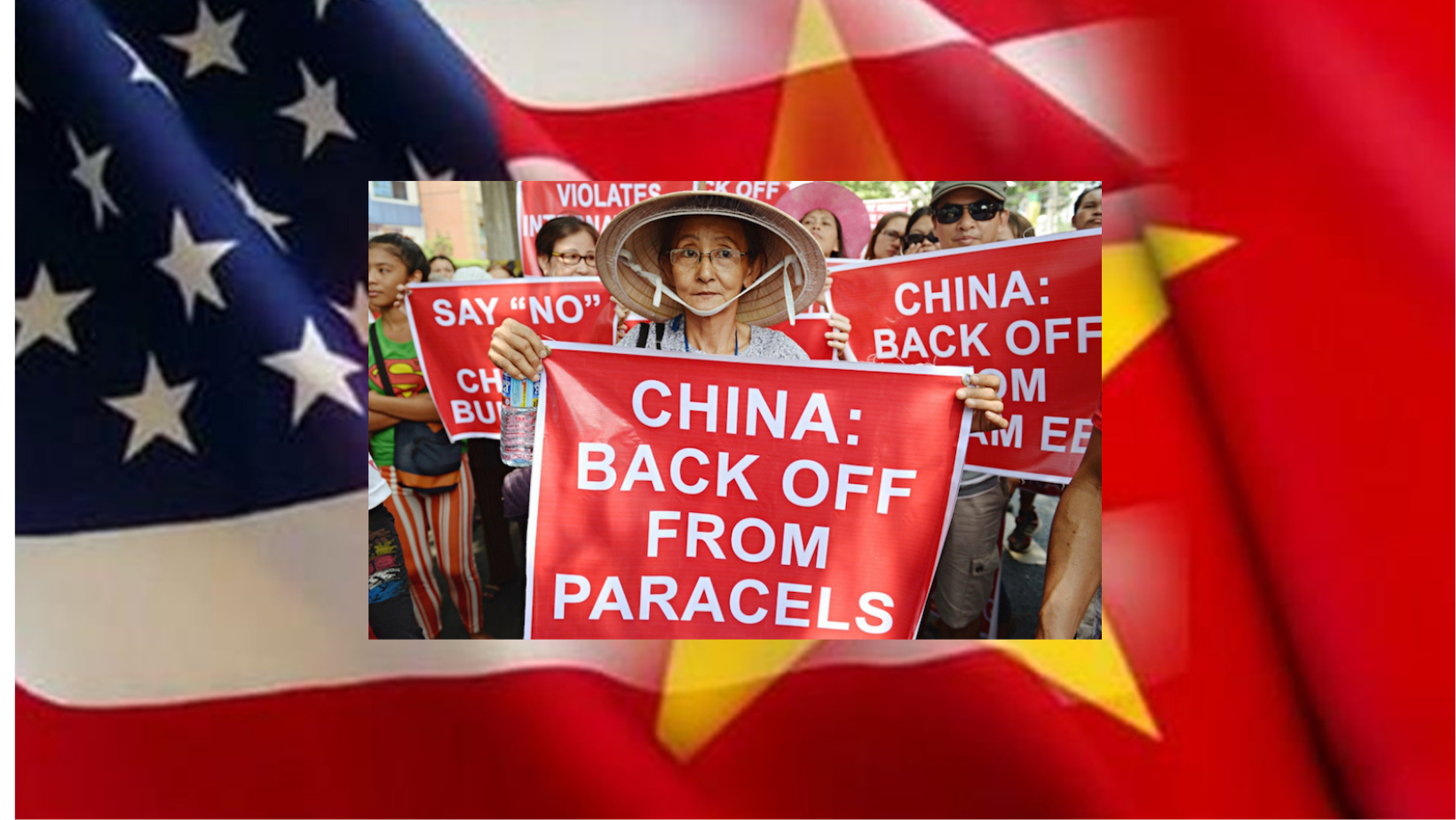
Anti-China nationalist sentiments have been rampant in Vietnam since the late 2000s, as expressed through various protests, demonstrations, and online debates. These sentiments are popular among the anti-communist Vietnamese diaspora and among the people residing in the country who were enraged by China’s territorial claims in the South China Sea. Since 1947, the Chinese Communist Party (CCP) has established an eleven-dash line map (now the nine-dash line map), claiming various islands in the South China Sea, including the Paracel and Spratly islands – or in Vietnamese, the Hoang Sa and Truong Sa islands.[3]
For years, the CCP has not relinquished claims to what Vietnamese nationalists insist are Vietnam’s rightful territories. Ten years ago, in 2011, anti-China nationalism manifested itself in the form of demonstrations, when hundreds of Vietnamese people protested in front of the Chinese Embassy in Hanoi, demanding China stay out of the Paracel and Spratly islands.[4] However, these demonstrations were met with repression from the Vietnamese regime.[5]
On the one hand, the VCP faces widespread nationalist criticism from its citizens for depending on China. Such criticism presented a considerable threat for the regime’s long-established narrative as nationalists fighting foreign influence and as the only legitimate ruler of the country.
On the other hand, the VCP faces the CCP, whom they have relied on for ideological and policy guidance and economic and military aid during wartime. Distancing itself from the CCP would also betray Marxism-Leninism’s internationalist agenda.
In a research essay, political scientist Tuong Vu, professor at the University of Oregon, examines contemporary anti-China nationalism in Vietnam as well as the Vietnamese regime’s responses. In a research essay titled “The Party v. the People: Anti-China Nationalism in Contemporary Vietnam,” Professor Vu argues that the suppression of anti-China nationalism is in line with the VCP’s international communist ideology, despite the Party’s nationalist image.[6] This article focuses on explaining the VCP’s repressive actions by analyzing their understanding of communism and nationalism.
Tuong Vu is a professor and head of the Political Science department at the University of Oregon. His research focuses on state formation, nationalism, ideology, and revolutions in East Asia.
The Construction of Communist Nationalism
In order to understand why the VCP suppressed anti-China nationalism, we must first grasp the VCP’s understanding of nationalism itself. The VCP sees nationalism as communism, with an emphasis on communist internationalism that promotes solidarity among socialist states. This suggests that opposition to other socialist states – in this case, China – is not seen as nationalism.
Since its foundation during the French colonial period, the VCP has always pursued two goals simultaneously: achieving national independence, which concerned the French and other foreign intervention, and carrying out a socialist revolution in the country.
To achieve the former goal, the VCP has always portrayed itself as a nationalist faction. Even foreign scholars seem to push the popular narrative that VCP leaders like Ho Chi Minh were nationalists first and communists second and that communism was a mere tool for them to achieve national liberation.[7]
However, Tuong Vu disagrees with this narrative. He thinks that the VCP has always been devoted to communism, even when it pushes a nationalist propaganda. But how did the VCP reconcile being both nationalist and communist, since being the latter means condemning nationalism?
Tuong Vu offers a simple explanation. Communism has always been portrayed as the best path to achieve liberation as well as decolonization for Vietnam. It was not just regarded as a tool for nationalism, but instead both the means to achieve independence, as well as the end goal for building the nation. Therefore, anyone who does not support communism is deemed unpatriotic.
In other words, the VCP ties nationalism or patriotism with being loyal to its own causes. This was demonstrated by the former Prime Minister Pham Van Dong, who declared that “to be patriotic is to build socialism.”[8]
As Le Hong Phong and Ha Huy Tap, leaders of the Indochinese Communist Party, the predecessor of the VCP, explained in 1936: “We believe in internationalism, not nationalism, but…we should raise the spirit for national liberation while tying it to the interests of the working masses….”
So nationalism for the VCP is communism. The VCP’s nationalism is particularly tied to its belief in internationalism, which says that “socialist brothers” around the world should find solidarity together instead of fighting each other like capitalist countries.
Additionally, the VCP also distinguished communist-nationalist movements from the other nationalist movements that it deemed to be bourgeoisie, and as a result it prioritized the former.
For instance, the VCP endorsed China in the Sino-Indian border war in 1962, even though the Communist Party of India criticized China and supported the Indian government. The VCP saw the Communist Party of India as having “sunken deeply in the bourgeois nationalist mud by colluding with the Indian bourgeoisie to slander a brother communist party,” based on archival materials collected by Tuong Vu.
This is important because it marks the VCP’s tactic when confronted with a reality that does not fit into their view of communist internationalism.
The VCP’s actions of justifying reality by creating more theoretical arguments to support its action do not stop there, as its idea of nationalism based on communist internationalism was further challenged by the fact of infighting among communist states the Sino-Soviet split (1956-1966), in which China was at odds with the Soviet Union, and the Sino-Vietnamese border war in 1979, in which China assaulted Vietnam’s border after Vietnam attacked the China-backed Khmer Rouge regime.
Justifying Reality
Accommodating reality, the VCP shifted its own narrative on nationalism by focusing more on domestic communist propaganda. Nevertheless, this new narrative still links Vietnamese nationalism with communism and internationalism. This shows that even when Vietnam was threatened by China, the VCP was still following communist internationalism instead of endorsing a more nationalist approach.
This is evident in the way the VCP has never acknowledged the Sino-Vietnamese border war as a war between socialist brothers. Just as when it justified endorsing China over India in 1962, the VCP argues that the border war was not about communist infighting. The conflict, argues the VCP, was “a fierce struggle between national independence and socialism on the one hand and aggression, expansionism, and chauvinism on the other, between Marxism-Leninism on the one hand and Maoism on the other.” This denial of reality demonstrates a deeply rooted ideological loyalty to Marxism-Leninism.
In order to demonstrate how the VCP justified the Sino-Soviet split, Tuong Vu looked into the VCP’s construction of historical narratives through the most basic and widespread document: the First-Grade Reader (Tập Đọc Lớp Một), a textbook used to teach first-grade children to read. He compared the two editions of the textbook, the one published in 1956, which was before the Sino-Soviet split, with the one published in 1972, after the split.
Data by Tuong Vu. Graphic by The Vietnamese Magazine.
Firstly, there was significantly more content on communist heroes and less content on other socialist countries in the latter edition. This was due to the prolonged war, which produced more “heroes”, and because the VCP seemed to focus more on glorifying internal communist mobilization after the Sino-Soviet split. Additionally, these communist heroes were portrayed as both nationalist and communist – their struggle was seen as both contributing to the country and the international construction of communism worldwide.
Secondly, the content on non-communist heroes and patriotism not linked to the VCP was consistently low in both editions, and particularly low compared to the amount of content on communist heroes.
This reaffirms that the VCP constructed nationalism not based on ethnic lines but rather on political ideology, which suggests that the Party is more likely to align with a foreign communist force than to align with Vietnamese nationalists who reject communism.
Protests and Deconstruction of Communist Nationalism
The VCP’s loyalty to communist internationalism as a part of its nationalism was fiercely challenged by the wave of anti-China nationalism in 21st Century Vietnam due to China’s territorial claims in the South China Sea.
Anti-China opposition in Vietnam is expressed through two main channels: protests and debates on alternative understandings of nationalism. Both of these channels pose significant threats to the VCP’s legitimacy.
Ten years ago, in 2011, massive anti-China protests broke out on the streets of Hanoi and Ho Chi Minh City, especially in the areas where the Chinese embassy and consulate were located, to protest China’s harassment of Vietnamese fishermen in the Spratly and Paracel islands.[10]
The protests did not happen just once, but rather multiple times throughout the summer of 2011 for almost three consecutive months. While these protests were significant, they were not the first. In 2008, many democracy activists and bloggers were also arrested or detained for protesting China’s claims in the South China Sea.[11]
Alongside the protests, many Vietnamese intellectuals started to question the legitimacy of the VCP as Vietnam’s only ruling party and its construction of communist nationalism. Many retired, high-ranking government officials joined in these debates.
For example, Tong Van Cong, former editor of the state-controlled newspaper Lao Dong, argued that the true wish of the late Ho Chi Minh was to establish democracy for Vietnam rather than achieving socialism at any cost, thus questioning the Party’s nationalism based on ideology, as well as its refusal to institutionalize democracy.[12]
While he joined the communist movement during wartime due to his love for his country, Dang argued that the VCP had failed to pay back the debt it owed the Vietnamese people after they fought for and supported the Party. This debt was piled on to the Party’s failed policies based on China’s policy advice, resulting in misery for many Vietnamese people. In contrast, he argued that the VCP owes China nothing. This argument contradicted the Party’s narrative that the country owed China for its generous support for Vietnam in wartime.
Joshua Kurlantzick, senior fellow on Southeast Asia for the Council on Foreign Relations, believes that the protests did not merely demonstrate anti-China sentiments, but also showed the protesters’ frustration with the government’s repressive actions towards dissents over the years, and the government’s failure to deliver democracy.[14]
This further explains why the VCP oppressed anti-China protests and saw the protesters as a threat. These protests were seen as opposing a foreign regime and opposing the VCP, the only “legitimate” ruling body in Vietnam.
Further Problems for the VCP
Currently, the VCP’s policies towards China are once again being challenged, this time by the COVID-19 pandemic, especially when it comes to vaccines. After resisting China’s vaccine diplomacy for a while, the government has recently approved the Chinese Sinopharm vaccine, and it was met with opposition and hesitation from a lot of Vietnamese people.[15] The VCP’s late approval was either because of its distrust of China’s vaccine diplomacy, or because the public opinion in Vietnam has been strongly anti-China.
In a survey conducted by the ISEAS-Yusof Ishak Institute in 2021, individuals from Vietnam are the most disapproving of China’s leadership in the pandemic among 10 ASEAN countries, significantly more disapproving than others.[16] In contrast, Vietnam is the most approving of US leadership in the pandemic among these countries, much more so than the average ASEAN country.
Vietnam is the most disapproving of China among the 10 nations. Data by the ISEAS-Yusof Ishak Institute. Graphic by The Vietnamese Magazine.Vietnam is the most approving of the US among the 10 nations. Data by the ISEAS-Yusof Ishak Institute. Graphic by The Vietnamese Magazine.
When it comes to the South China Sea, Vietnam also shows the most concern with China’s actions – its encroachment and military activities – rather than the US military presence or an escalation of the situation between the US and China.
Once again, this is a rather ironic situation, as the ideological doctrine of the VCP has been consistently promoting solidarity with other socialist countries while condemning capitalist and imperialist states such as the United States.
Data by the ISEAS-Yusof Ishak Institute. Graphic by Son Nguyen/The Vietnamese.
This shows that the VCP’s communist internationalism is not working. Arguably, it is even backfiring because Vietnamese public opinion is shifting towards supporting the United States – a capitalist and imperialist superpower according to Vietnam’s propaganda – instead of supporting China – a socialist brother.
Conclusion
On the surface, increasing anti-China sentiments among the Vietnamese people seem to be in the VCP’s favor, as it hopes to reclaim the Paracel and Spratly islands.
However, this anti-China nationalism also presents a great threat to the VCP establishment that is loyal to communist ideology which promotes solidarity among socialist states. It also presents a deeper ideological threat to the VCP, as Vietnamese nationalists begin to question the VCP’s version of nationalism that correlates being a patriot to being a communist.
The anti-China protests and data on popular opinions suggest that despite the VCP’s efforts, the Vietnamese people are feeling more and more detached from the socialist solidarity with China that the VCP has consistently promoted.
If the VCP continues to refuse to change its ideological approach to China, and if it continues to repress anti-China nationalism, it runs a grave risk of getting its own Marxist-Leninist legitimacy further questioned and challenged.
Bibliography
[1] Crawford, T. (1923, August 15). Bourgeois Nationalism. Marxists Internet Archive. https://www.marxists.org/archive/roy/1923/08/15a.htm
[2] McLellan, D. T. (1998, July 20). Marxism – Class Struggle. Encyclopedia Britannica. https://www.britannica.com/topic/Marxism/Class-struggle
[3] Xu, B. (2020, July 15). China’s Maritime Disputes. Council on Foreign Relations. https://www.cfr.org/timeline/chinas-maritime-disputes
[4] Ide, B. B., & Orendain, B. S. (2011, June 4). Hundreds of Vietnamese Stage Anti-China Protest. Voice of America. https://www.voanews.com/east-asia/hundreds-vietnamese-stage-anti-china-protest
[5] Vietnam breaks up anti-China protests. (2012, December 9). The Guardian. https://www.theguardian.com/world/2012/dec/09/vietnam-breaks-up-anti-china-protests
[6] Vu, T. (2014). The Party v. the People: Anti-China Nationalism in Contemporary Vietnam. Journal of Vietnamese Studies, 9(4), 33–66. https://doi.org/10.1525/vs.2014.9.4.33
[8] Le, H. N. (2016, February 29). Phạm Văn Đồng – Nhà Chính trị, Nhà Văn hóa lớn của Đảng và Dân tộc. Báo Nhân Dân. https://nhandan.vn/tin-tuc-su-kien/pham-van-dong-nha-chinh-tri-nha-van-hoa-lon-cua-dang-va-dan-toc-256438
[9] Nguyen, C. T. (2018, July 31). Tư tưởng Hồ Chí Minh Về Tinh Thần Yêu Nước. Tạp Chí Quốc Phòng Toàn Dân. http://m.tapchiqptd.vn/vi/theo-guong-bac/tu-tuong-ho-chi-minh-ve-tinh-than-yeu-nuoc-12158.html
[10] Vandenbrink, R., & Nguyen, A. (2011, June 5). Anti-China Protests in Vietnam. Radio Free Asia. https://www.rfa.org/english/news/vietnam/protests-06052011165059.html
[11] Human Rights Watch. (2020, October 28). Vietnam: New Round of Arrests Target Democracy Activists. https://www.hrw.org/news/2008/09/12/vietnam-new-round-arrests-target-democracy-activists
[12] Tong, V. C. (n.d.). Nhân Ngày sinh lần thứ 120 Chủ tịch Hồ Chí Minh: Vì Sao Hồ Chí Minh Đặt Dân Chủ Trước Giàu Mạnh? Bauxite Vietnam. Retrieved June 11, 2021, from https://boxitvn.blogspot.com/2010/05/nhan-ngay-sinh-lan-thu-120-chu-tich-ho_19.html
[13] Le, H. D. (n.d.). Suy Nghĩ Trong Những Ngày Nằm Bịnh. . .. Bauxite Vietnam. Retrieved June 11, 2021, from https://boxitvn.blogspot.com/2013/08/suy-nghi-trong-nhung-ngay-nam-binh.html
[14] Kurlantzick, J. (2014, May 16). Vietnam Protests: More Than Just Anti-China Sentiment. Council on Foreign Relations. https://www.cfr.org/blog/vietnam-protests-more-just-anti-china-sentiment
[15] Nguyen, S. (2021, June 7). Vietnam Briefing: Busy With The Pandemic, But The Government Still Cracks Down On Free Speech. The Vietnamese Magazine. /2021/06/vietnam-briefing-busy-with-the-pandemic-but-the-government-still-cracks-down-on-free-speech/
[16] Seah, S., Hoang, T. H., Martinus, M., & Pham, T. P. T. (2021, February). The State of Southeast Asia: 2021 Survey Report. ISEAS-Yusof Ishak Institute. https://www.iseas.edu.sg/articles-commentaries/state-of-southeast-asia-survey/the-state-of-southeast-asia-2021-survey-report/
Our newest section on The Vietnamese Magazine, the “On This Day” series, aims to introduce contemporary Vietnamese history of the twentieth and twenty-first centuries by explaining political events that occurred today in the past.
What happened on June 5, 2011?
Public demonstrations and protests are sporadic in Vietnam. But on this day, 10 years ago in 2011, it was the beginning of the longest anti-China protest movement in Vietnam after 1975.
For almost three months of the summer of that year, a total of 11 protests happened across Vietnam every Sunday, primarily conducted in Hanoi and Saigon, where the Chinese embassy and consulate were placed. Many people call this movement “The Flaming Summer” (Mùa Hè Đỏ Lửa).
Why were people protesting on that day?
Since China established the eleven-dash line map (now the nine-dash line map) claiming sovereignty of various regions in the South China Sea, the Vietnamese people have always been angered by China’s claims to the Paracel and Spratly islands, known as the Truong Sa and Hoang Sa islands by the Vietnamese.
In the summer of 2011, people especially felt provoked by the actions of Chinese vessels in the contested sea. In late May, the news reported that the Chinese vessels were harassing Vietnamese survey vessels and disrupting the Vietnamese vessels’ activities. Later in early June, Chinese ships once again harassed Vietnamese survey ships.
What was the regime’s response to the protests?
After supposedly tolerating the protests for a short period of time, the regime nevertheless decided to crack down on the protestors. In late August, the police began to detain people who participated in the protests, forcing 40 protestors onto two buses right after the last rally started on August 21. It was confirmed that at least 47 protestors were arrested. The Hanoi local government warned people against protesting any further.
What is the legacy of the protests during that summer?
The waves of anti-China protests in 2011 were not the first nor the last. Earlier in 2007 and 2008, there were also anti-China protests by many bloggers and pro-democracy activists, which also resulted in the government’s crackdown. Later in 2014 and 2018, there were also new anti-China protests.
However, the protests in 2011 were significant because of their duration, scope, and effect on Vietnam’s pro-democracy discourse. In many ways, it was an unprecedented movement.
Compared to other anti-China protests, the 2011 protest movement had the most prolonged duration, lasting the entire summer. The demonstrations were also massive compared to others, with the participation of hundreds of people. Some of the rallies were estimated to have around a thousand people. This fact is exceptionally significant for a country infamously known for repressing protests.
Although the government repressed the protests, they still demonstrated to the Vietnamese government that the people could disagree with the government and willingly show it. Additionally, the protests also sowed the seeds of government criticism among the people. The movement provoked many intellectuals and highly-credited ex-government officers to speak out against the Communist Party and demand democracy.
Many participants of these protests, such as The Vietnamese Magazine’s co-founder and editor Trinh Huu Long, would later become pro-democracy activists.
The protests in 2011 were the beginning of “a prolonged civil society movement that still exists nowadays,” said Long.
The Vietnam War is a stain upon the fabric of recent human history. This bloody and violent conflict, fought on the premise of conflicting ideals and against the intangible boogeyman of Marx and Engels, resulted in the deaths of more than 3 million Vietnamese, the majority of which were civilian casualties. It has likewise led to the diaspora of more than 2 million other Vietnamese people and to the initial political and economic isolation of Vietnam from the rest of the world.
Nearly five decades after the end of the fighting, the scars of the conflict still remain fresh in the eyes of those who lived through the war. For those fortunate enough to have been born after the war, these scars are but whispers at the back of their minds – almost silent and unobtrusive.
However, these scars are always lingering somewhere in the corner of their minds. One would assume that both parties to the fighting, Vietnam and the United States, would have deep-seated animosity towards each other due to their entanglement in this conflict. However, this doesn’t seem to be the case. Diplomatic and economic ties between the US and Vietnam were reestablished in 1995, just two decades after the end of the Vietnam War.
A report by the US Congressional Research Service, published on February 16, 2021, details several key components regarding current US-Vietnam relations. To date, the United States is Vietnam’s 2nd largest trading partner, only trailing behind China. Growing Chinese hegemony in the region has also led to stronger bonds between the US and Vietnam in matters of security and sovereignty.
While it appears that the connection between these two nations is forged out of practicality and necessity more than anything else, with the United States needing allies in the Southeast Asian frontier and with Vietnam needing the commerce and trade to strengthen its economy, the two countries have been able to create and maintain several mutually beneficial arrangements with each other, despite their shared and bloody history of fighting and conflict.
Yet, there still remain several issues which continue to hinder these relations from developing at a much quicker pace. One is the uneasy three-way tension among the United States, Vietnam, and China.
China, as mentioned earlier, continues to remain Vietnam’s number one partner in trade. Likewise, both countries share similar political systems, which the US Congressional report stated provides “a party-to-party channel for communication” and also contributes to “often similar official world-views.” Being two of only a handful of nations led by Communist parties, there is a strange sense of kinship and familiarity that exists between the two sides. However, recent events have put a drastic strain on Sino-Vietnamese relations as well.
For more than a decade, China has been claiming most of the South China Sea as part of its sovereign jurisdiction using its controversial and fraudulent Nine-Dash Line myth to support its expansion. It has also been illegally encroaching into the territories of Vietnam and the other Southeast Asian nations for its own personal gain.
Mainland China has harassed and sunk many maritime vessels from several Southeast Asian countries, illegally harvested fish and other natural resources from these contested waters, and has been building several artificial islands to solidify its hold in this corner of the world. The Mainland’s aggressive, bullish, egoistic, and selfish actions have not only negatively impacted the people and governments of Southeast Asia, but have also caused drastic and irreparable damage to the environment.
In response, Vietnam has made several international protests regarding China’s actions and has also increased its visibility in the region by expanding its offshore energy exploration program and by implementing its own land reclamation projects. It has also fostered better relations with other maritime powers such as Japan, India, and, of course, the United States, in an attempt to intimidate China and force it to rethink some of its expansionist policies and actions.
Because of the increased security collaboration between the US and Vietnam, the Obama administration removed all restrictions on selling Vietnam lethal weapons in 2016. Donald Trump’s presidency continued this show of goodwill by providing Vietnam with 24 new coast guard patrol vessels, aerial drones, coastal radar, and two decommissioned US Coast Guard Hamilton-class cutters.
Yet, Vietnam rarely joins the United States in undertaking large scale diplomatic actions without taking into consideration how China will react. Vietnam’s protests against the Mainland regarding the South China Sea also seem to have minimal effect in the region; in fact, China’s presence has even increased in recent years.
Despite the tangible support of the United States and the backing of most of the international community, Vietnam’s condemnations and actions have merely been a form of lip service: all bark and no bite. The Vietnamese government’s crackdown on those critical of its policies against China isn’t doing it any favors either.
In effect, Vietnam finds itself in a bind and is caught between the whims and desires of two irreconcilable world powers.
On the one hand, you have the United States: a significant trading partner with links to the rest of the free world, but also the cause of much destruction and death in Vietnam’s recent history. On the other, you have China: Vietnam’s largest trading partner and a source of much revenue for the government, but whose expansionist policies are currently threatening and challenging its sovereignty.
At the moment, Vietnam seems content to play both world powers off against each other in an attempt to squeeze as many benefits as it can from the United States and China. However, the longer the Vietnamese government tries to appease both sides, the more it stands to lose in the long run; the longer Vietnam wears the mantle of neutrality and passivity, the more citizens that will lose faith and trust in the Party. And a government without the backing and support of its citizens, is a complete and utter failure.
So, should Vietnam pick a side? Should it finally choose between Uncle Sam and Chairman Mao? Is Vietnam even currently in a position to make such a polarizing decision?
Granted, the economic backlash of this choice has the potential to be quite severe; cutting ties with either your first or second largest trading partner is more than enough to destabilize Vietnam’s growing economy. There is little to no guarantee that China will stop expanding into contested waters if Vietnam decides to fully comply with all of China’s demands. There is also no telling what the United States will do either. With so many variables to consider and so many unknowns, perhaps the most prudent and wisest decision would be to maintain the status quo.
The answers to these questions may best be left to economists and experts and we will only know in retrospect if Vietnam ends up making the right decision.
Whatever the Vietnamese government decides to do regarding the enemy of its past and the enemy of its present will no doubt benefit the Party first, with the country and its people being merely afterthoughts in the Party’s grand scheme. And perhaps this is the greatest tragedy of it all.
This article was written in Vietnamese by Bui Cong Truc and previously published in Luat Khoa Magazine on January 20, 2021. The translation was done by Luu Ly.
* * *
How is the VCP “more democratic” than the CCP?
Most of the active communist parties today are more or less based on the Soviet Communist Party model.
The system originated with the majority power of the Party National Congress. This congress elects a minority group called the Communist Party Central Executive Committee (the Central Committee, for short).
Theoretically, the Central Committee is the governing body that decides most of the important issues in terms of policies and personnel in the Communist Party organization. However, the organs elected by this body have certain privileges, and can completely surpass the power of the Central Committee itself, depending on the time period.
These agencies include the Political Bureau (aka the Politburo), the Secretariats, or a typical body of the Soviet Union Communist Party, the Organizational Bureau.
So are the power structures of both Communist parties similar? How has the individual history of each party, the Chinese Communist Party of China (CCP) and the Vietnamese Communist Party (VCP), affected each country’s economic and social development? This article will provide readers with more information about the fundamental differences between these two Communist brothers.
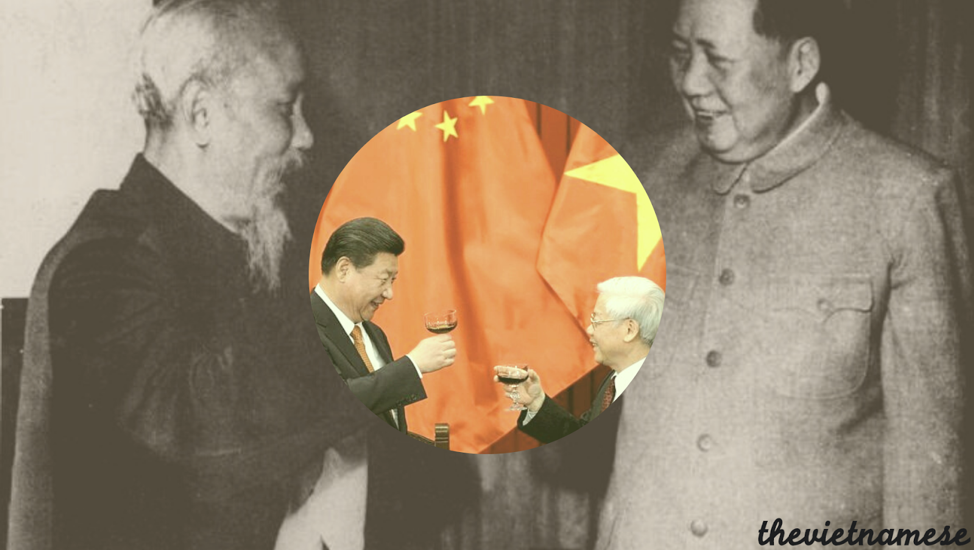
Two leaders of the two Communist parties, Xi Jinping and Nguyen Phu Trong. Photo taken during Nguyen Phu Trong’s visit to China in 2017. Photo: Xinhua News Agency.
Conflicts between the Central Committee and the Politburo
Many people accept, as common sense, that the Politburo is the central power for both the VCP and the CCP. However, the party rules of these two brothers have many differences.
The first notable point is that the Central Committee of the CCP has only been required to meet once a year since Deng Xiaoping reformed and re-institutionalized the political apparatus. Many Chinese observers assert that this was an intentional effort to limit the frequency of the CCP Central Committee’s meetings so that the authority of the body would be reduced as much as possible.
The pressure to democratize within this Party is not insignificant and not recent, but for many reasons, these proposals have been unsuccessful. Arguably, the CCP’s Central Committee only plays a behind-the-scenes role, compared to the main playerr, the Politburo.
Regulations in Vietnam are different. According to Article 16 of the VCP Charter, the Central Committee of the Party must meet at least twice a year.
The fact that the Central Committee of the VCP meets more than once a year does not seem to say much about the different power structures of the two parties. However, in reality, the most important issues require a decision of this body. If we compare the total number of meetings and resolutions of the Party’s central organs in the two countries, especially since Deng Xiaoping’s faction took power, the VCP’s Central Committee has twice as many meetings as its Chinese counterpart.
For example, only in 2016 did the VCP Central Committee convene the conference four times, with important contents including redefining the working regulations of the Central Committee, the Politburo, and the Secretariats; the working regulations of the Central Inspection Committee; regulations on the implementation of the Party Charter; and the regulations on the inspection, supervision and discipline of the Party. These were all important meetings to help Nguyen Phu Trong’s political coalition gain the upper hand. Once he was the leader of the control group within the VCP, his famous “anti-corruption” campaign followed and it has been the most controversial issue in Vietnam in recent years.
Another feature that is also noticed by many international commentators when comparing the two parties is the number of times that resolutions of a party’s central body are referred to in official legal documents.
According to statistics cited by three experts, Regina Abrami (Harvard), Edmund Malesky (Chicago), and Yu Zheng (Connecticut), the percentage of legal normative documents promulgated by competent state agencies that cited Central Committee resolutions by the VCP Central Committee was quite high, averaging 23 percent. Meanwhile, this rate in China was only 5.5 percent.
This statistic shows the direct influence of the VCP’s Central Committee on the policy making process. The difference of more than 17 percentage points is also an indication that the VCP’s Central Committee plays a greater role than its Chinese counterpart, at least on a legislative basis.
This table compares the powers of the CCP and VCP Central Committees through two criteria: the number of meetings and the proportion of legal documents that quote the agency’s resolutions (Abrami, Malesky, & Zheng, 2008).
The differences in the real power of the Central Committee of the CCP and the VCP are not limited to the numbers. In some specific political events, the power of the VCP’s Central Committee is also more clearly shown.
For example, in 1997, when General Secretary Do Muoi decided to retire before the end of his term, his replacement Le Kha Phieu, was selected after an unusual meeting of the entire Central Committee.
This approach is in stark contrast to the cases of Hu Yaobang and Zhao Ziyang in China. Finding replacements for these two to take the seat of general secretary was a private matter decided in Politburo secret meetings. In these meetings, there were also many retired “revolutionary elders” who did not have a role in deciding the next generation of leaders, according to the Party Charter.
Not only that, in 2001, the Central Committee of the VCP even vetoed the Politburo’s request to allow Le Kha Phieu to continue holding the position of general secretary. Instead, the Central Committee elected Nong Duc Manh, who was the president of Vietnamese National Assembly at that time, to fill the most powerful seat.
In 2006, former Prime Minister Vo Van Kiet also wrote an open letter to the Politburo requesting it to respect collective intelligence and the democratic decision of the Party’s Central Committee, and not make the Politburo the “superior” body.
On the Chinese side, there has never been any case where the Central Committee directly and flatly opposed a proposal by the Politburo.
So far, many people have questioned whether the VCP’s Central Committee still has real power over the Politburo, as well as if it has followed in the footsteps of it’s elder brother in the north.
There is still reason to believe that the traditional competition between the 176 members representing various factions and schools within the Central Committee of the Communist Party still exists.
The historical path of the two political parties
So what is the reason for the difference between the VCP and the CCP? Many scholars often point to the history of the two political parties.
For China, although Mao Zedong was seen as the CCP’s supreme leader for a long time, the power rivalry between factions within the party remained fierce, until Deng Xiaoping restored order according to his wishes.
First, the policies of political and economic reform after the dire consequences left behind by Mao were enacted from the top down, and specifically from the Politburo. In a time when the Party’s political bodies were mostly ragged and lost across China, the top-down orientation seemed to make things easier to manage. This increased the legitimacy of a few powerful individuals in the Politburo.
Not only that, but the Tiananmen Incident in 1989 created more controversy between the groups of “hard players” and “soft players” towards the protesters. The controversy further fueled the desire of Deng Xiaoping and the elites to concentrate more power, and to limit the mass discussions, of the Central Committee – which they saw as an impediment to the process of fast decision making and effective policy enforcement.
Mao Zedong and Deng Xiaoping in 1959. Photo: Kyodo News/ Associated Press.
With Deng Xiaoping officially succeeding in selecting the general secretary without the consent of the Party’s Central Committee (a serious violation of the Party’s Charter), the few minorities in China gradually took control of political power.
Since 1989, the three positions of the troika in the power structure of the socialist state of China have been the general secretary of the Communist Party, president of the State, and chairman of the Chinese Central Military Commission, all traditionally held by one person, which have been Jiang Zemin, Hu Jintao, and now Xi Jinping respectively.
Prior to the 7th Party Congress in 1991, it can be said that the troika model in Vietnam was not much different from the Soviet Union. The general secretary had a central position in the Party with an important influence on its political policy and direction, while the chairperson of the Council of Ministers was the head of the executive branch with the obligation to enforce and guarantee the Party’s orientation. And finally, there was the president of the State, but that position often just has a symbolic meaning.
However, the three titles of general secretary, prime minister, and president are the real “three-pillars” of power in the contemporary Vietnamese political apparatus.
What happened?
Some researchers point out that after the period of bad experiments with macroeconomic and microeconomic policies, chaos emerged in Vietnam’s society. Some senior leaders within the Party, such as Nguyen Van Linh and Vo Van Kiet, wished to promote more key reforms to revitalize Vietnam. One of the first things they did was to diversify and turn the Central Committee into a more authoritative institution, which they hoped in the future would be the point of consensus for the new reforms they proposed.
Their first success was the increase in the number of members of this body. Starting in 1986, during the 6th National Congress, leaders in the Party’s provincial committees began to be elected to the Central Committee, thereby displaying a large force supporting economic and political reforms.
By the 7th Congress, Vo Van Kiet successfully persuaded the Party to allow local representatives to get nominated and elected as official members of the Central Committee. With that change, the voting power of local leaders was strengthened, making them a majority group within the Party.
Vo Van Kiet, who was the advocate of empowering the Party’s Central Committee. Photo courtesy: VNA.
Obviously, the reformists’ wishes could only be fulfilled quite smoothly after the remaining four symbols of the Communist Party’s anti-colonial era, including Le Duan, Le Duc Tho, Pham Hung, and Truong Chinh, had passed away. After their deaths, the Party was left with a power vacuum, which created opportunities for the resurgence of the reform faction.
According to many studies, before the 7th Congress of the VCP, two factions arose and became rival forces in the Party.
The first group was made up of former central leaders, or the Marx theorists, who had found a common voice under the leadership of general secretary Do Muoi.
The second group, as previously mentioned, was the technocratic leaders, who tended to modernize and came from the grassroots level, such as Vo Van Kiet and his ally in the south, Phan Van Khai.
By 1990, another group wanted to participate in defining the power model, and it was led by Le Duc Anh. Le Duc Anh was the commander-in-chief of the Vietnamese armed forces on the Cambodian battlefield, and he had just returned home. He wanted to strengthen the military’s role in governance, and he favored economic reform, but he also wanted to control its pace.
During the 7th Congress, after these three groups compromised with one another, the VCP’s new tradition of power was formed. All three factions would have power and this was codified in the 1992 Constitution – which could be the most important outcome of the compromise. Do Muoi continued to hold the post of general secretary, Vo Van Kiet became prime minister and General Le Duc Anh succeeded to the presidency.
* * *
In 1996, Le Kha Phieu was expecting to hold both the presidency and the position of general secretary, with a goal of unifying state power in a way that would be similar to China’s model. Nevertheless, this effort was unsuccessful. In 2018, when Nguyen Phu Trong concurrently held both of the aforementioned titles after President Tran Dai Quang died, people began to worry that a Chinese power structure model was being formed in Vietnam. That concern is not without foundation.
Besides, there is not enough information to significantly compare whether the Vietnamese “three-pillars” model or the Chinese “monopoly” model is better. Some scholars argued that decision-making through a majority of a large body – such as the Party’s Central Committee – would reduce extremization and give highly compromising decisions. However, some other experts would argue that these compromising decisions only showed the lack of a definite direction from the Party’s central authority. It could deem that the Party only served a few politicians’ self-interests, considering the one-party and authoritarian political environment in Vietnam.
When we examine whether the VCP or CCP can be deemed more “democratic,” it must be pointed out that neither system includes “the people” in their decision-making process. The members in both of these parties are still more concerned with their own power within their respective parties.
The Vietnamese Magazine would like to thank the Asia Democracy Chronicles under the Asia Democracy Network for kindly giving us the permission to re-publish this article.
Why Vietnam strongly supports the former British colony’s fight for freedom
Many Vietnamese citizens hold Hong Kong freedom fighters Joshua Wong, Nathan Law, and Agnes Chow Ting in high regard. The Vietnamese cheer when a government expresses support for the former British colony’s fight for freedom. And they mourn whenever there is a crackdown—or a pro-democracy activist gets arrested or dies.
Many Vietnamese consider Hong Kong’s young activists (from left to right) Nathan Law, Joshua Wong, and Agnes Chow Ting as icons of democracy.
One might ask, why does Vietnam support Hong Kong’s pro-democracy movement? The answer lies in the two country’s shared history and similar political movements.
Bloody battles
Vietnam’s long history of battling China spans more than 2,000 years. It’s fair to say that the country’s history is basically one of surviving next to China. After all, Vietnam was colonized by China for about 1,000 years before it finally gained its independence in 938 AD. Most national heroes worshipped as gods in Vietnam today are those who fought China over the past 200 decades, such as Hai Ba Trung (1st century, fought the Han dynasty), Ba Trieu (3rd century, fought the Eastern Wu dynasty), Ly Nam De (6th century, fought the Liang administration), Phung Hung (8th century, fought the Tang dynasty), Ngo Quyen (10th century, fought the Southern Han dynasty, ended China’s 1,000-year domination over Vietnam), Ly Thuong Kiet (11th century, fought the Song dynasty), Tran Hung Dao (13th century, fought the Yuan dynasty), Le Loi and Nguyen Trai (15th century, fought the Ming empire, ended a 20-year domination over Vietnam), Nguyen Hue and Bui Thi Xuan (18th century, fought the Qing dynasty).
Today, some of the most central and important avenues in major cities of Vietnam are named after these national heroes.
In 1979, Chinese troops invaded Vietnam, waging a two-month bloody strike along the 600-kilometer border that the two nations share. This was followed by battles along the borders for another 10 years. Not many countries in the world have had such a long and complicated history with China as Vietnam does. As a result, the anti-Chinese sentiment seems to be deeply rooted in Vietnam’s culture.
Fast forward to today: The territorial dispute over the South China Sea—which also involves Taiwan, the Philippines, Malaysia, and Brunei—is also a factor behind this sentiment. China claims almost all of the area bounded by its nine-dash line. Vietnam claims sovereignty over islands in the Paracel Islands and Spratly Islands, as well as an exclusive economic zone that overlaps with China’s claims.
In 1988, China and Vietnam clashed in the South China Sea when China’s warships attacked and killed 64 Vietnamese soldiers and seized the Johnson Reef. Another battle in recent history was in 1974, when South Vietnam’s navy lost some islands in the Paracel Islands to China’s hands after a bloody battle that left 74 casualties and dozens of others injured. Skirmishes still break out between the two countries, something the Vietnamese frown on.
Vietnam’s long history of battling China spans more than 2,000 years. Its ongoing territorial dispute with the latter over the South China Sea also explains the Southeast Asian nation’s anti-China sentiment and partly accounts for its support for Hong Kong’s pro-democracy movement.
Amid territorial disputes over these islands, Vietnamese people bear the brunt of China’s economic activity in their country. Poor-quality products from China (electronics, clothes, food, etc.) are being sold in Vietnam, and while people complain about shoddy goods from the mainland, they have not found a way to stop the sales of these goods within their borders. More than 91,500 Chinese workers were also living across the country as of January 2020, sometimes making up China towns and clashing with local people.
A Chinese-built section of Hanoi’s new urban railway “has come under fire after reports of deferred deadlines, cost overruns, and dangers to passers-by from falling materials,” reports the Financial Times. Given these trouble at sea, some people even suspect China of wanting to destroy Vietnam’s economy.
Pro-democracy sentiment
Although Vietnam is no longer a communist country and has a market-driven economy, the Communist Party remains the only legal political party. The party requires all Vietnamese to study communism and to worship communist leaders such as Ho Chi Minh, Karl Marx, and Vladimir Lenin.
The society created by the communist regime is marked by corruption and inequality. Yet by an ironic twist of fate, it saved the Vietnamese people from the starvation that the party itself created before it began an economic reform program called Doi Moi in 1986. It abandoned the centrally planned economy model to open up the country to private businesses and foreign investments – a system which it eventually called the “socialist-oriented market economy”. Although Vietnamese people acknowledge that the country has improved significantly economically, severe corruption and deep inequality are among the biggest threats to the regime’s legitimacy. Vietnamese people are well aware that bad governance is the root cause of a slew of major challenges afflicting their lives such as unsafe food, land disputes, low wages, heavy pollution, low-quality education and healthcare, poor infrastructure, wrongful convictions, and a wide range of other human rights abuses.
The state of public governance in Vietnam is similar to China’s – a combination of a communist one-party rule that suppresses human rights and a party-controlled market economy that favors members and sympathizers of the party. It is a system that puts a premium on economic development at the expense of fundamental freedoms.
But while the pro-democracy bias may seem to overlap with the anti-communist sentiment, these are not exactly the same for Vietnamese people. Some of them oppose the communist regime but embrace other authoritarians at the same time. Many Vietnamese admire South Korean dictator Park Chung-hee, Chinese nationalist leader Chiang Kai-shek, and Singapore’s founding father Lee Kuan Yew, who was known for his authoritarian leadership style. This, while they lean toward democratization and support democratic movements such as the ones in Hong Kong, Burma, and Venezuela.
Mass movements
Mass protests introduced a radical change in a repressive regime like Vietnam. More than 30 years after the Vietnam War, joining a mass protest had been taboo in Vietnam, with the attendant risk of going to jail for decades. Few people dared to gather in the streets. Society had been frozen by fear.”
However, reports that China established administrative units in disputed areas in the South China Sea in late 2007 angered the Vietnamese public. Suddenly, mass protests against the Chinese government broke out in the capital city, Hanoi. More protests followed in Ho Chi Minh City in early 2008.
This confused the Communist Party. They had dealt with protests before, but those involved economic issues. These protests were about protecting the country’s territorial integrity, which was at the core of the nationalism that the party had spent its whole history building. Decades of fighting—from the independence struggle with the French before 1945, the Dien Bien Phu victory in 1954, the Vietnam war with the United States, and 10 years of conflict with China starting in 1979—helped build the communist party’s legitimacy.
Eventually, the party cracked down on the protests. Party members could not tolerate any form of social mobilization that could potentially challenge their power.
However, the lamp of freedom had already been lit in the hearts of many Vietnamese. They realized that they must have the right to demonstrate, the right to speech, the right to participate in politics to protect their country, all of which are being suppressed by the Communist Party. For the first time in the country’s history since 1975, Vietnam saw a protest movement in 2011, which lasted for almost three months, from June to August.
In 2014, more anti-China protests flared up across the country, involving not only activists but also workers, farmers, and students, due to China’s deployment of the Haiyang Shiyou 981 oil rig to Vietnamese waters. A similar mass movement happened in June 2018 when the Parliament attempted to pass a special economic zones bill that were seen to open up three strategic areas in Vietnam for China.
In 2014, Vietnamese people took to the streets to protest China’s deployment of an oil rig in the disputed South China Sea.
It is significant to note that most of the mass protests in Vietnam for at least the last decade have been anti-China. All protests have been severely suppressed by the government.
Movie magic
The silver screen has also influenced Vietnam’s perspective on Hong Kong. Hong Kong films have been overwhelmingly popular in Vietnam for decades. These include “The Legend of Condor Heroes” (1994), “Detective Investigation” (1995), “Demi-Gods and Semi-Devils” (1997), “Triumph in the Skies” (2003), among others. It’s not easy to find a Vietnamese over 30 years old that has never watched a Hong Kong film or is unfamiliar with Hong Kong film stars.
Beyond movies, Hong Kong is also a popular tourist destination among Vietnamese, especially during summer and New Year’s holiday.
Until the late 1980s, Hong Kong played the role of a “port of first refuge” for Vietnamese people fleeing political persecutions and abject poverty in their country following the end of the Vietnam War. In 1989 alone, more than 300 Vietnamese boat people landed in Hong Kong daily. The peak of the migration wave was when Hong Kong became home to 200,000 Vietnamese asylum seekers.
Supporting the democratic movement in Hong Kong came naturally to these refugees, who feel forever indebted to the now beleaguered city.
Hong Kong served as the “port of first refuge” for Vietnamese people fleeing political persecutions after the Vietnam War.
There’s no doubt that Hong Kong pro-democracy movement fits perfectly into the Vietnamese people’s worldview, which has been shaped by the latter’s long and complicated history of dealing with China and communism, as well as nationalist and anti-government fervor.