The “On This Day” series aims to introduce contemporary Vietnamese history of the twentieth and twenty-first centuries by explaining political events that occurred on this day in the past.
What happened?
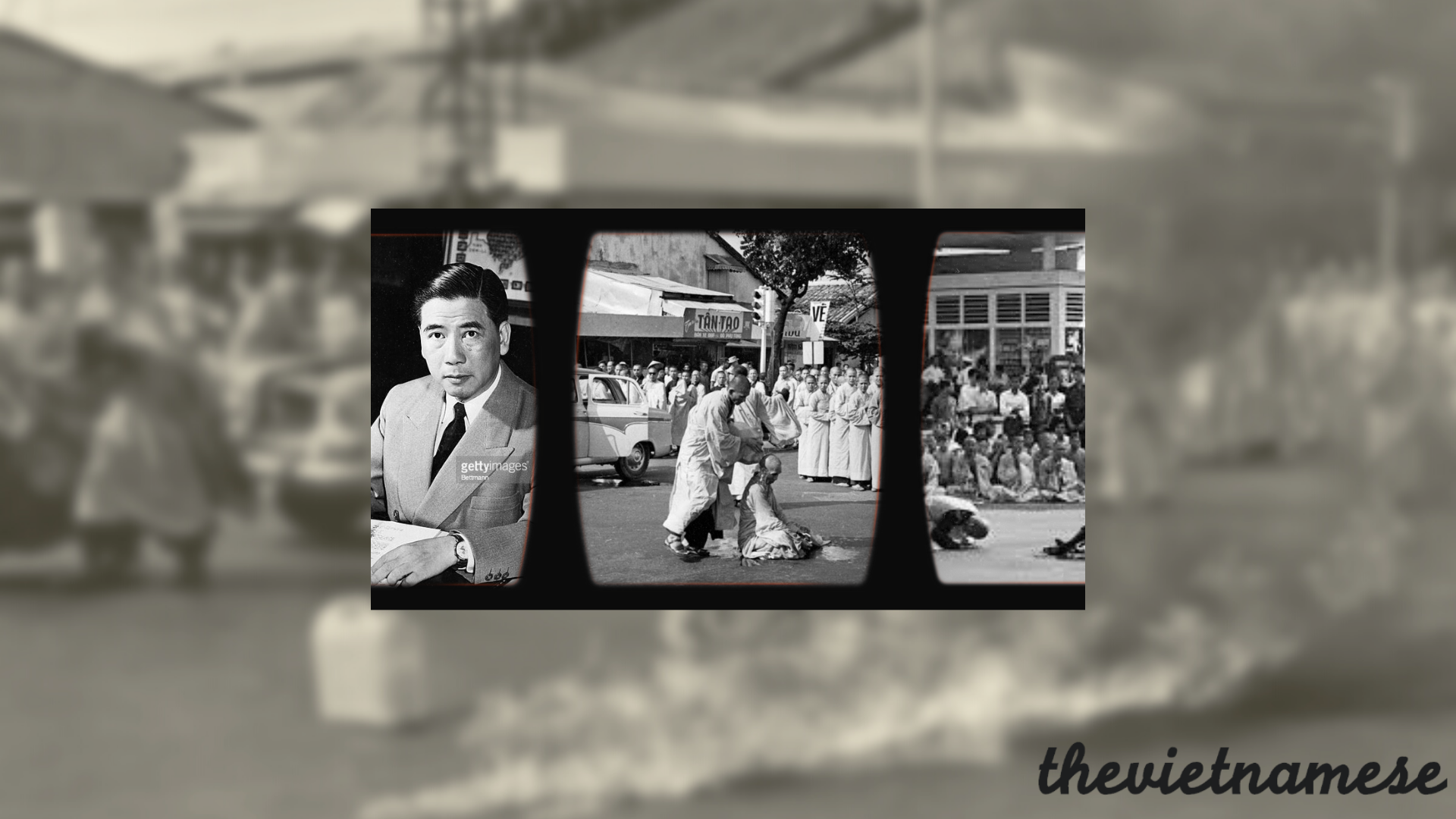
On the morning of June 11, 1963, an elder Buddhist monk emerged from more than 300 monks protesting on a busy street of Saigon.[1] As the monks formed a circle around him, the elder monk, whose Buddhist name was Thich Quang Duc, stepped forward and sat down in a lotus position. The other monks poured gasoline on him, and one monk handed some matches to Quang Duc.
Moments later, in a horrifying scene, the elder monk was consumed by fire.
The onlookers were horrified, and the police present on the street tried to call fire trucks, but the accompanying monks collectively blocked the trucks. Without a doubt, Quang Duc’s self-immolation was a part of a coordinated protest by South Vietnam’s Buddhist monks.
In the following months after Thich Quang Duc’s self-immolation, at least five other Buddhists committed suicide by burning themselves. His self-immolation also inspired many other Buddhists and bonzes in South Vietnam to do so in the following years.
As Thich Quang Duc committed suicide publicly, Associated Press photojournalist Malcolm Browne captured the moment. The picture of the burning monk became one of the most circulated and haunting images of the Vietnam War.[2]
The conventional interpretation from the current Vietnamese Communist state sees the self-immolation as an act of protest against the South Vietnamese government, at the time headed by President Ngo Dinh Diem.[3] Though the leaders expressed some empathy with the Buddhists’ frustration, the South Vietnamese government and its supporters mostly saw them as misled by the Communists.[4] The international public saw the act as protesting the ongoing Vietnam War and the American intervention.
It is undeniable that the series of Buddhist protests in 1963 in South Vietnam were triggered by the Ngo DinhDiem regime’s mishandling of religious issues, which made the Buddhists feel like they were discriminated against while their Christian counterparts were given many more benefits.[5]
However, all of these narratives ignore the fact that the self-immolation and the series of Buddhist protests were a part of the more significant Buddhist crisis ongoing in South Vietnam throughout 1963, motivated by frustration and a unique political ideology.
According to historian Edward Miller of Dartmouth College, the crisis was the result of not only the regime’s mishandling of religious issues but also because of the Buddhists’ own vision of nation-building for Vietnam, which happened to clash with both the regime in the South as well as the Communists in the North.[6]
Their political beliefs were neither pro-North Vietnam nor anti-South Vietnam but instead purely Buddhist. They were a part of a more significant movement called Buddhist revival (Chấn Hưng Phật Giáo) that got started in Vietnam at the beginning of the twentieth century.
Under the belief of Buddhist revival, many monks and Buddhists subscribed to a particular Vietnamese-Buddhist nationalism, which saw Buddhism as the national religion and the only path to Vietnam’s future prosperity.
Followers of Buddhist revival had a distinctive historical narrative that saw Buddhism as the source of the prosperity of the ancient kingdom Dai Viet, the predecessor of modern Vietnam that flourished around the 10th to the 13th century. The followers of Buddhist revival thought that Vietnam was only weakened and became corrupted due to Chinese colonization and its import of philosophy, from Confucianism to Taoism. Similarly, they viewed both Communism and Ngo Dinh Diem’s Personalist Revolution[7] as Western-imported ideologies that were also unsuitable for Vietnam.
Thich Quang Duc was a part of this movement. According to Miller, when he came up with the idea of burning himself, Quang Duc understood it as an act of promoting Buddhist reforms and defending his Buddhist revival ideals.
Therefore, to call the self-immolation of Thich Quang Duc either pro-Communist, anti-Ngo Dinh Diem, or anti-American intervention would be insufficient. His self-immolation was highly political and was meant to express more than just opposition to any regime.
Bibliography
[1] Miller, E. (2014). Religious Revival and the Politics of Nation Building: Reinterpreting the 1963 ‘Buddhist crisis’ in South Vietnam. Modern Asian Studies, 49(6), 1903–1962. https://doi.org/10.1017/s0026749x12000935
[2] Lindsay, J. M. (2012, June 11). TWE Remembers: Thich Quang Duc’s Self-Immolation. Council on Foreign Relations. https://www.cfr.org/blog/twe-remembers-thich-quang-ducs-self-immolation
[3] Tưởng niệm 50 năm Hòa thượng Thích Quảng Đức tự thiêu. (2013, May 28). vov.vn. https://vov.vn/doi-song/tuong-niem-50-nam-hoa-thuong-thich-quang-duc-tu-thieu-263846.vov
[4] Vietnam’s Faiths Underlie Rising; Buddhist‐Catholic Disputes Sharpened Under Diem. (1964, September 14). The New York Times. https://www.nytimes.com/1964/09/14/archives/vietnams-faiths-underlie-rising-buddhistcatholic-disputes-sharpened.html
[5] Joiner, C. A. (1964). South Vietnam’s Buddhist Crisis: Organization for Charity, Dissidence, and Unity. Asian Survey, 4(7), 915–928. https://doi.org/10.1525/as.1964.4.7.01p1727l
[6] Miller, Religious Revival, 1903–1962.
[7] Hollingsworth, E. (n.d.). The Church of Ngo: Ngo Dinh Diem’s Personalist Revolution and the Making of Alternative Nationalisms in the Republic of Vietnam, 1954–1963 | MA/MSc in International and World History. Columbia University. Retrieved June 10, 2021, from https://worldhistory.columbia.edu/content/church-ngo-ngo-dinh-diems-personalist-revolution-and-making-alternative-nationalisms
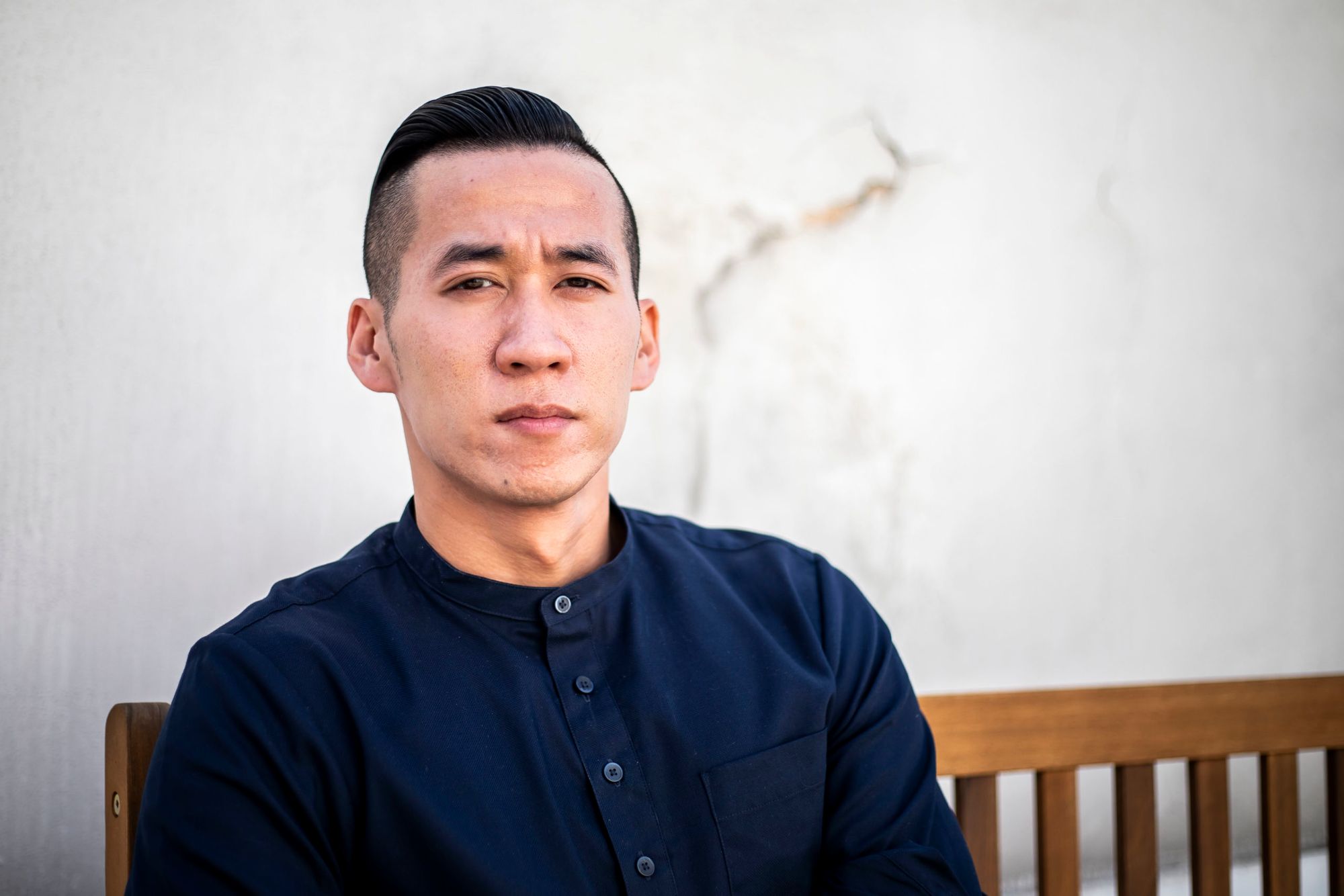
Will Nguyen (age 34) is a Vietnamese-American public policy specialist and an activist for the Vietnamese democracy movement. He was born in Houston, Texas to a refugee family from South Vietnam. He graduated with a Bachelor in East Asian Studies from Yale University and a Master in Public Public Policy from the National University of Singapore. Last June, for participating in an anti- government protest, he was imprisoned in Vietnam; after international pressure, he was released one month later and deported from the country. Photo: Gabriel Kuchta, Deník N.
Wikipedia says the Vietnam War started November 1st, 1955. Of course, that’s according to the Americans. The Vietnamese know well that the long, hellish days lasted much longer than the 20 years before Saigon fell (1975). How could it be otherwise – after all, the vast majority of lives lost in this war were Vietnamese. “In America, the Vietnam War is seen as a strictly American affair. I’d like to remedy that,” Will Nguyen, activist and descendent of South Vietnamese refugees, says in an extended interview with Deník N.
A passage in Michael Herr’s Dispatches reads: “We took a huge collective nervous breakdown, it was the compression and heat of heavy contact generated out until every American in Vietnam got a taste. Vietnam was a dark room full of deadly objects, the VC were everywhere all at once like spider cancer, and instead of losing the war in little pieces over years we lost it fast in under a week. After that, we were like the character in pop grunt mythology, dead but too dumb to lie down. Our worst dread of yellow peril became realized; we saw them now dying by the thousands all over the country, yet they didn’t seem depleted…”
The book written by Herr, an American military reporter, has become symbolic. It cuts like a knife, and it is hard to come by another work that describes as sharply what the Americans experienced in the Vietnam War.
But what did the Vietnamese experience? After all, it was their country. Unfortunately, for nearly its entirety, few saw the war as belonging to the Vietnamese, to their loss. And to this day, the wounds have not healed.
Will Nguyen knows this all too well. He was born in the United States to a woman who fled the communists—a South Vietnamese woman, to be more precise. Except Will doesn’t agree with black-and-white divides, even in his direct experiences with the Vietnamese Communist Party: last year, he was arrested for participating in protests in Ho Chi Minh City. Or is it Saigon? They’re the same city, with two different names; one was used before the communists took over, the other is the name used today. Current maps clearly label the city Ho Chi Minh City, but try using that name with South Vietnamese refugees!
So which is it: Ho Chi Minh City or Saigon?
Nguyen: (Laughs) You tell me. I grew up with Saigon; it wasn’t until later that I found out on-paper, it was Ho Chi Minh City. I currently use both, depending on whom I’m talking to. With southern Vietnamese, I’ll use Saigon; in other contexts, Ho Chi Minh City is more appropriate. For me, either name is fine; I let the person across from me decide.
Yellow star, red stripes
You were born in Houston, as part of the South Vietnamese diaspora – you didn’t spend your childhood in Saigon, right?
When I was young, I didn’t really pay attention to politics. The first time politics hit me in the face, however, when I was doing a school report on my country of origin. I didn’t know what the flag of Vietnam looked like, so I opened up an encyclopedia and drew a pretty red flag with a yellow star. My mother saw it and immediately told me that flag wasn’t the “correct” one! I had to then draw the yellow flag with three red stripes, the one that Vietnamese in the US still use, the flag of South Vietnam.
A combination of the flags of the Democratic Republic of Vietnam (North Vietnam, left) and the Republic of Vietnam (South Vietnam). Photos: Wikimedia Commons, image created by Deník N.
It was until later that I began slowly putting together the pieces of the puzzle. I learned how my aunt fled Saigon on April 29th, 1975, a day before the city fell to the communists; how after she arrived in the States, she helped my mother escape when war broke out between China and Vietnam in 1979. During that time, Vietnam was expelling all those of Chinese origin, so my aunt was able to sponsor my mother and helped her find forged papers claiming Chinese ancestry. My mother reached a refugee camp in Indonesia and from there, traveled to Houston.
In Texas, how did you put together the fragments of war? Americans, and the West by way of the Americans, tend to see the war as a nightmare for themselves. Oftentimes, the Vietnamese are seen as mere accessories, like decoration on military garb, or puppets in the hands of their masters.
I read whatever I could find around me. And the more I read, the more I understood that the majority of books I could find were written by Americans, about Americans; regarding South Vietnamese and the difficulties they faced during the war, you’d be hard pressed to find anything. So I began searching for books written by South Vietnamese. There aren’t very many [in English] and they aren’t very easy to find.
Luckily, I was fortunate enough to study at Yale, with its excellent libraries–whatever books they didn’t have, you could request by order. I read at least 20 or so books written by South Vietnamese authors – government figures, refugees, memoirs of life in South Vietnam before and after the revolution (1975). Similarly, I began researching sources of information from North Vietnam. Generals, spies, and figures in the North Vietnamese politburo.
Because you hit the nail on the head. In America, the Vietnam War is seen strictly as an American affair. Whatever the Americans carried out…
… would have to be suffered.
Exactly! Americans lost about 60,000 lives in Vietnam, a terrible number, but on the Vietnamese side, deaths numbered several million, and this disproportionality is never mentioned. American lives lost is still center-stage. I would like to remedy this. And I believe the first step is researching the war thoroughly from all sides, in order to shed this problematic “black-and-white” framework.
“After Saigon fell, my mother escaped to America. By good fortune, I was born in the States, where I was provided better opportunities. I recognize that my upbringing was ultimately a privilege—one which I want to pay forward by helping native Vietnamese fight for their own freedom and independence of thought. This doesn’t necessarily mean slandering communists.” Photo: Gabriel Kuchta, Deník N.
You know, it’s not just the Americans who are guilty of black-and-white thinking. We Vietnamese have a similar tendency. It’s north or south—nothing in between. But its hard to be surprised at such an ideological divide, solidified as it was by a devastating civil war. It’s still a sensitive topic. Moreover, this north-south division has historical roots. Hanoi, in the north, is seen as the cradle of Vienamese culture; as you go further south, its influence weakens. This is still true today; the Vietnamese Communist Party has a stronger base and more faithful party members in the north.
It’s like with the two Koreas, especially in the older generations. The division between right and wrong, good and bad. And sometimes even in the Czech Republic: in the north the evil communists; the
south, the righteous democrats. But South Korea had a period of authoritarianism, and in Vietnam, communism went hand-in-hand with the anti-colonial struggle for independence.
The interesting thing is the communists weren’t always the only players in Vietnam. Especially in the south, there was a strong nationalist movement spearheaded by non-communists. And in the 1940s, they worked with the communists for the sake of a common goal (Under the leadership of Ho Chi Minh and the Indochinese Communist Party, the Viet Minh – a coalition of northern and southern nationalists formed during the second half of the 1930s in Nanjing, China, was officially re-established in Vietnam in 1941).
Only, the communists had their own vision of an independent Vietnam. They had greater numbers, were better organized, and were more ruthless, so in the end, they swallowed whole the other nationalists, completely obliterated them. Vietnam in the 40s and early 50s was a tumultuous time. French rule followed by the Japanese invasion, famine, then the First Indochina War, then the Viet Minh defeated France in 1954 and the French withdrew. The struggle between Vietnamese communists and Vietnamese non-communists played out against this backdrop and continued through the Cold War era—and it would be this civil struggle that would ultimately determine Vietnam’s fate.
A heavy-handed government
When peace talks began in Geneva in April 1954, Vietnam was de-facto divided: the Democratic Republic of Vietnam declared by Ho Chi Minh in September 1945 ruled the north; the State of Vietnam, aligned with the French, ruled the south. Both Vietnamese states saw themselves as the only legitimate government; the Geneva Accords de-jure recognized this division, establishing a border at the 17th parallel.
Yes, with a plan for nationwide elections in 1956 to determine Vietnam’s fate and unify the country. But the south, led by prime minister Ngo Dinh Diem, knew that they could not win the election. And because the south technically did not sign the Geneva Accords, they refused to hold the elections, claiming that the elections would be rigged by the communists. Instead of the general election, the south held a referendum declaring the establishment of the Republic of Vietnam, with Diem elected president (with a spectacular 98.2% of the vote. In Saigon, President Diem received 600,000 votes out of a total 450,000 registered, according to reports). In Geneva, the US also refrained from signing the accords, which Ngo Dinh Diem counted on.
November 1955: President Diem speaks with standard-bearing members of the Civil Guard during a ceremony marking a denunciation of communism. On November 1st, 1955, America officially begins participating in the conflict in Vietnam by establishing the Military Assistance Advisory Group (MAAG). Photo: PhotoQuest / Getty Images, Flickr, CB BY 2.0.
In the north during that time, the Chinese had convinced Ho Chi Minh to abandon plans for military action in the south and to wait for the election to resolve the big questions. The communists conducted a land reform campaign that killed thousands, while the south pursued its own brutal anti-communist campaign. The CIA embarked on a psychological war, sowing fear and panic among Catholics in the north, convincing perhaps more than a million to flee south.
The Americans encountered the South Vietnamese at the right time. They helped the South Vietnamese in many respects, most obvious of all, financially. I would assert that despite all this assistance, there was one decisive factor: the South Vietnamese had no idea what it meant to be a good citizen in a functioning democracy. To the majority of Vietnamese, the ideals of democracy were in reality, something completely unfamiliar, and as the Vietnamese tried to advance towards democracy…
In short, it was like a circus. Corruption was endemic, clientelism, and on top of that, war with the north. Imagine trying to build a healthy democracy in that environment! The South Vietnamese government was quite heavy-handed and far from resembling any kind of democracy; it was closer to autocracy. During the second republic at the end of the 1960s, after several coup d’etats, things calmed down a bit, elections were conducted properly, and prospects for democracy were looking up. If there was no war, who knows how far it would have progressed. You mentioned South Korea – the path to democracy for them took several decades. Same with Taiwan.
But in South Vietnam, Ngo Dinh Diem’s heavy-handed government only lasted until 1963, when the opposition assassinated him. How were the Americans involved?
Formally, Ngo Dinh Diem was President, but in actuality, he was a dictator. He was a symbol of everything we discussed earlier: authoritarianism, corruption, and nepotism. He came from a well-known family, and his relatives held many high positions of power in a type of oligarchy. There was nothing surprising about him facing powerful opposition.
In the end, a group of South Vietnamese generals decided to test the waters with the Americans. If we wanted to get rid of Diem’s government, the generals probed in a meeting with the CIA, would you support us? Kennedy’s administration gave the green light. But my god! The generals got rid of President Diem in such an awful manner. The Americans didn’t imagine it that way. They thought Diem would live a life in exile, and the government would proceed to reform.
On the Saigon River, Viet Cong take turns on the lookout, October 1966. Photo: Manhai, Flickr, CB BY 2.0.
Instead, President Diem’s assassination opened up Pandora’s box. The ironic thing is some of Kennedy’s advisors warned about this very outcome: while Diem was a dictator and corruption was rampant, there existed no viable alternative to him. And it was true; the country was wracked with one coup d’etat after another. South Vietnam not only became enfeebled, but it endured continuous pressure from North Vietnam and communist insurgents in its own territory. The country’s ability to deliver its people from northern communism weakened by the day.
Up until April 30th, 1975, when Saigon was taken over by the communists. To North Vietnamese, that event was a “liberation”, but for Southerners, it was a “fall”. Is this still true?
Definitely. In the memoirs of South Vietnamese diaspora, they remember April 30th, 1975 and the “Fall of Saigon” with anguish, and not just figures from the older generations, but the majority of the diaspora’s descendents also see the event as an invasion.
And in Vietnam, where the communists have ruled for 45 years now?
The current propaganda is powerful. I believe many Vietnamese see April 30th in a positive way, a victory over colonialism, a liberation, a unification of the country. But the interesting thing is, in the south, when you speak with older people—and obviously this doesn’t happen right away because there are dangers in doing so—but when they trust you enough… my mother and I would often encounter more “sensitive” views when we were traveling around southern Vietnam. For example, taxi drivers would often reminisce positively about what life was like before 1975, as they drove us around the city.
Rosy history
In your travels around Vietnam, you were able to absorb a lot of literature and messaging, especially propaganda posters. These displays tap a lot into the past, right?
Most of them do. But that’s logical because the Vietnamese Communist Party derives its legitimacy from history and regularly reminds the people what it has achieved—1945 and the [August] Revolution, the defeat of the French, Ho Chi Minh, and of course, the greatest achievement of all: the liberation and unification of the country in 1975 [the latter technically occurring in 1976]. It’s like a broken record-player, stuck repeating myths.
A propaganda poster marking 60 years since Hanoi threw off the yoke of French colonialism. Photo: Vuong Tri Binh, Wikimedia CC BY-SA 4.0
And because these pages of history bear the hallmarks of the communist party, most people don’t pay it any heed. Is it a heroic story with a fortunate ending, or is it a happy lie? For some, either case is better than the sad truth. More easily stated, one way or another, many people realize the history is suspiciously rosy. But to find the truth, one must put in the work. It takes effort, and most people simply don’t feel the need.
Why?
Because they’ve directly experienced in their daily lives that the regime they live under doesn’t give them a voice. So the result is political apathy. This is especially true with young people, who have their whole lives ahead of them. They have no desire to rehash the past; they desire a comfortable future, with a high standard of living.
But of course, not all young people are like this; I’ve gotten to know quite a few young activists from Vietnam who feel the truth is worth pursuing. A lot of it has to do with the fact that it’s easier now to find information online. It only takes a little research to reveal why the yellow flag with three red stripes is banned in Vietnam. And why the Vietnamese diaspora numbers millions across the world.
To search for truth, to absorb information and then decide for oneself – that is true independence. Not the propaganda that the regime mouth-feeds the people to maintain its grip on power. Protecting the regime is the government’s number one goal. The Party has to make sure the boat doesn’t rock too much under its feet, and along with propaganda, it must also ensure that the economy develops while it conducts a balancing act between opposing China and allowing Chinese influence.
How are relations between the Vietnamese Communist Party and the Chinese Communist Party?
Very close, in an existential way. Vietnamese communists owe much to their Chinese counterparts, but at the same time, they have to be extremely careful not to be seen as Chinese puppets. This demands sufficiently independent behavior, opposing China in moderation, and at the same time, making sure not to offend their Chinese patrons.
Are they really patrons?
You know, Vietnamese leaders are slowly realizing they’re skating on the thinnest of ice. While I was imprisoned in Saigon, I spoke with police investigators about the situation in the South China Sea, and it was hard to miss the frustration written on their faces. They have to oppose China because that’s part of the Vietnamese national mythology: China is our hereditary enemy, and it’s forever finding ways to swallow Vietnam. If they don’t oppose China, then they face the danger of public opposition. That’s why Hanoi tries to find international support in their case against Chinese aggression. But it’s all one big act. No vociferous pronouncements will change the fact that China currently has the upper-hand in the South China Sea. China is several times larger and stronger than Vietnam, and Hanoi is fully cognizant of this, as well as the fact that Vietnam is economically dependent on China. And besides, the Vietnamese Communist Party imitates the Chinese Communist Party on a fundamental level. Their historic consolidation of power, their land reforms, and more recently, the cybersecurity laws.
And the general secretary? The similarities between Xi Jinping and Nguyen Phu Trong, the head of the Vietnamese Communist Party, can’t be ignored: a strong, hard-line leader, pursuing an anti-corruption campaign.
Of course; if you observe down to a minute-enough level, you’ll always find differences, but the truth is the Vietnamese and Chinese models of rule are quite similar – including the issue of Trong becoming both General Secretary and President. Though for most of its history, the Vietnamese Communist Party has followed the path of collective leadership, Trong has spearheaded an anti-corruption campaign very similar to that of Xi: sure, you’re cleaning up the ranks, but you’re also inserting your own allies into positions of power.
The two parties [and their historical trajectories] are not exact replicas. But there are more than enough similarities to remind us of Mark Twain’s observation: “history doesn’t repeat itself, but it does rhyme.”
Prison bars and television screens
You actually mentioned something I wanted to ask you about: last year, you were incarcerated in Vietnam. You went straight to prison after an anti-government protest in Saigon, right?
I had graduated [from my master’s program] in May and after that, had flown to Vietnam. When I found out [a few days prior] that there would be protests, I decided to attend because I also believed the two proposed laws were harmful to the Vietnamese people.
I walked the streets with protestors, cell phone in hand, recording as much as I could and uploading it immediately onto social media. It wasn’t an easy thing to do because the internet was slowed. The government often finds ways to prevent the spread of information. After a couple of hours, we ran up against a formation of police officers who stopped us and tried to get us to turn away from the city center. But I could tell that the officers were ill-at-ease; they were young, and looked just as worried and fearful as the protestors. It seemed like all it would take was one person to push through to break the line.
So I did it, and they ultimately let us through. But after a few intersections, the police parked a row of pick-up trucks across the road to block it. I wanted to help the people cross the barrier – I knew I could take on a little more risk because I wasn’t a Vietnamese citizen and I didn’t face as serious of punishment as they did. I knew I could be arrested, but to be beaten in the middle of the streets was definitely something I did not expect.
How many people were there around you?
Hard to say, but the streets were impassable, surging with people. They charged me not only with “disturbing public order” but added on the aggravating factor “causing serious traffic congestion”. They blamed me for making 14 people miss their flights.
And what were you facing?
Up to 7 years in prison.
At least you confessed on TV! And that’s yet another similarity between China and Vietnam: a recorded confession broadcast on national television…
It was all for show. In order to maintain their hold on power, the Party choreographs one performance after another and forced televised confessions are just one part of it. I had known about this “song-and-dance” prior to being captured, so I wasn’t surprised when they made me participate. But mostly, nobody was particularly enthusiastic about doing it. It was all pretty tiring: the security officers and I didn’t want to do it, but because the orders were coming from above, we wanted to just get it out of the way.
And you participated?
If I didn’t, it would only complicate things. Not just for me, but also for the investigators, the people who were in charge of (processing) my case. They treated me well enough, though obviously I knew it was related to the fact that I was American and that my case was receiving widespread international attention.
Moreover, I refused to lie. When they wanted me to apologize for causing traffic congestion or for making my friends and family worry, that wasn’t a big deal. But there was a part where they said I tried to flip a police truck and other things. I refused to read that. They accepted it and moved on.
As in there was a script?
The whole thing was so surreal. First, I wasn’t wearing the appropriate clothing, because I was a prisoner, so one of the police officers gave me the button-down shirt off his back to wear. Then, they styled my hair and had me sit down in front of the camera – we did around 5 takes, until I read the script convincingly enough.
The banality of evil
It all sounds like a joke, but in actuality, it’s nothing to laugh at right? Especially those with Vietnamese and not American citizenship.
Exactly. Suddenly, I had fallen into the belly of this oppressive regime I had researched for so many years; it was there that I was able to fully realize that the system ran on fear. It doesn’t have to be the kind of fear that stops your heart or takes your breath away. But as long as that fear becomes an abided part of your life, like an old coat, mundane and commonplace, then the system remains in place.
Like Hannah Arendt has written of, it’s all about the diffusion of responsibility: “I was just following orders!” You’re sitting behind bars, observing how police officers observe you. And you realize that they’re just cogs in the machine. But it’s precisely all of these small cogs that keep the machine going. If they weren’t there, the entire system would collapse. At the same time, they’re all just normal people. Outside of work hours, when they weren’t interrogating me, we would talking to one another like normal people.
With the small detail that you were behind bars and the police officers were in front.
Of course. You know, dehumanizing the other side doesn’t help anyone; don’t even get me started on caricaturing them as demons. I grew up in an environment where people spoke of communists as man-eating devils, and dissident propaganda often depicts Ho Chi Minh with horns. What is this good for? The more you put pressure on them in this way, the more they will dig in their heels in siege mentality. And that mentality leads to an increasingly oppressive regime. I believe in doing the opposite. Jettison the black-and-white paradigm and fracture an otherwise monolithic ideology.
How?
By treating these individuals like human beings. By convincing them that those who want to reform the system are not their enemies. As long as overseas Vietnamese communities across the world continue to demonize the communists as they do, then nothing will change. The banality of evil works both ways: people mold the system, but the system also molds the people. We have to work to fill the gap between the two sides, or at the very least, build some kind of bridge. I’m purposefully avoiding the word “reconciliation” because the communists used it after 1975, and then ultimately sent southerners to re-education camps.
This reminds me of the situation in the Czech Republic after the Velvet Revolution. It’s a shame how the party and corruption went hand-in-hand, but enough people were able to “change outfits” after the transition [to continue their behavior]; some didn’t even bother to change. What’s going to happen if the same people are able to survive reform efforts in Vietnam?
I believe the Vietnamese Communist Party has a right to exist – this is something anti-communists have excluded me for saying, even accusing me of Stockholm Syndrome. But then there are anti-communists who are impressed with Trump and openly support him, and that’s something that’s completely absurd to me.
But most importantly: the Vietnamese Communist Party has four million party members. Their numbers are decreasing, and the Party itself is purifying in an ideological sense, getting smaller and older. But four million is still a lot. What are we going to do with them? Vietnam has suffered several decades of war. Millions have lost their lives, several more million have had to flee their homeland, and hundreds of thousands have lain their corpses at sea in pursuit of freedom… is this not enough? I understand your question, and I can’t say it doesn’t worry me. But what other way do we have to pursue reform but this?
I’m not so naïve as to think that we only need dialogue to reform a totalitarian regime. Obviously you can extend your hand across the table, but if the other side is not willing, then there has to be something to push them to the table. The people must speak up for themselves; they have to march if need be. Reform can’t be achieved without it. And in a similar vein, I also hope that young people reconsider joining the Party.
The economy plays a huge role: Vietnam’s labor productivity is quite low because the regime robs people of their initiative. Those with enough drive, those who can overcome the apathy find happiness overseas, where they go to work or study. But a number return with open eyes. For others, the internet opens their eyes. And people are slowly realizing, it doesn’t pay to be politically apathetic – if you don’t want to decide politics, then someone else will decide for you.
The Vietnamese would like to thank the author, Mr. Will Nguyen, who has given us permission to republish his article, North/South, which was first published in New Naratif.
April 30, 2018|I’ve always been into the idea of counterparts—“separate but equal”, to borrow the politically dangerous phrase. Captain Planet, Sailor Moon, The Mighty Morphin’ Power Rangers—these shows were always particular favourites of mine as a child because each contained an episode or arc where analogues to the good guys arose: Captain Pollution and his team of toxic “planeteers”, the Four Sisters of the Black Moon, or the Dark Rangers. I find the inherent sense of balance in counterparts intensely satisfying, like yin-yang writ large.
As I’ve grown older, this affinity for correlates extended to international politics, in particular, ideologically-opposed, directionally-split countries, i.e. North and South Korea, or East and West Germany.
The time when the modern Vietnamese nation-state existed as two separate entities naturally possesses a particular gravity in my mind, as I’m sure it does in the minds of many overseas Vietnamese. After all, that pair’s existence, its mutual antagonism, and one’s annihilation of the other is single-handedly responsible for the dispersal of Vietnamese people across the globe, a burst of human photons in one of many collisions between communism and anti-communism.
I was born in America; unbeknownst to me at the time, all the Vietnamese I ever encountered were former citizens of the Republic of Vietnam (i.e. South Vietnam) or as I’d known it, Vietnam. There was no alternative, no other. The yellow flag with three red stripes were ubiquitous and the only representation of Vietnam I knew.
The “right” and “wrong” anthem
Encarta Encyclopedia 97 provided me the first hint of another truth, of another “Vietnam” – the “evil” one, I would quickly learn. I remember doing a project in fifth grade which required us to produce a “country profile” on a nation of our choosing. I referred to the CD-ROM encyclopedia and, without giving it much thought, copied out the red flag with yellow star, Vietnam’s official flag as listed within the country’s entry.
My grandmother was the first to “correct” me, scolding me as Encarta played “Tiến Quân Ca”, the national anthem of North Vietnam from 1945-1975, and after the war, the official one of all Vietnam. That was not the “real” anthem, she told me. The information in that article was “wrong”. When I asked her what the real anthem was, she hummed “Tiếng Gọi Công Dân” – the national anthem of South Vietnam from 1948–1975 – a tune I was much more familiar with.
As I finished up my project, I asked my mother to look over my work. What she did, whether intentional or not, resounds with me to this day. Rather than make me remove my drawing of the yellow-starred red flag, she had me draw South Vietnam’s red-striped yellow flag next to it, presenting both flags as equally valid.
It took me at least another two decades to realise this, but my mother’s simple gesture was both an extremely powerful teaching moment and a representation of my intellectual angst with the overseas Vietnamese identity. It was my first taste of the concept of contradictory but co-existing truths.
Growing up, I never gave that distant land of Vietnam too much thought; the framework for that place and its people had been set up for me. We (the southerners) were the good guys; they (the northerners) were the bad. Everything we said was true; everything they said was lies. I never wondered why we were the ones living in another country.
College, membership in an active Vietnamese student association, and a kind-hearted Vietnamese professor ushered in a new era of knowledge for me. I began taking my first steps toward balance, and further steps towards the truth… or rather, truths.
North to South
In Vietnam, “nam tiến”, literally meaning “march to the south”, refers to the expansion of Vietnam southwards, from the Red River Delta down to the Mekong River Delta. This development shapes Vietnam’s long-standing stereotypes between northerners and southerners. Contrary to people who like to compare the shape of Vietnam to a bamboo yoke or the letter ‘S’, I like to think of the state in more metaphysical terms: a past-oriented north that flows to a future-oriented south.
Photo courtesy: Wikipedia. /
The Red River Delta is held up as the “birthplace” of Vietnam, the traditional seat of culture and politics. The northern region and its people are perceived as conservative, ascetic, and prone to resource and food shortages. This has bred a northern character that prizes resilience, indirect communication, the concept of “face” (linked to the concept of one’s honour and prestige), and a muted cuisine that uses fewer herbs and spices.
As the state advanced into Cham and Khmer territory, a separate centre of power began developing in the south, attracting those drawn to “frontier” life and a multi-cultured existence. By virtue of self-selection, Vietnam’s expansion south drew the free-wheeling, the forward-looking, the liberal, the cosmopolitan. The south was more abundant in food and resources; Saigon – formerly known by its Khmer name Prey Nokor and currently by its Sino-Vietnamese name Ho Chi Minh City – drew traders from the world over, and life was on the whole, easier and more prosperous.
These historical circumstances have defined what it means to be a southerner: we speak with a relaxed drawl and in a straightforward manner, we cook flavourful, vivacious, eclectic dishes, and we possess a progressive, open outlook that embraces global trends. It was no surprise that the south Vietnamese eagerly adopted American dress, customs, and culture during the 1950s – 1970s.
But it isn’t just a matter of character traits and cuisine; regionalism in its extreme form has repeatedly led to Vietnamese killing Vietnamese. Historian Huy Duc describes Vietnam as a home “whose walls are made of flesh and blood”. It’s not just a metaphor.
North versus South
A civil war in the 17th century proved to be an eerie foreshadowing of events three centuries later. The north and the south were split into two separate polities: “Đàng Ngoài” and “Đàng Trong”, literally the “outside” and the “inside”. The Trinh lords ruled over the north, the Nguyen lords the south. In 1802, the southern Nguyen lords ultimately triumphed over their northern Trinh rivals, uniting the country under its Southern aegis. Inklings of this contentious period still remain in our language: to this day, Vietnamese still say they are going “out” to Hanoi and “into” Saigon.
The 20th-century civil war between North and South was a reverse iteration. The 1954 Geneva Accords split Vietnam into directional counterparts once more – a communist north versus a democratic south – with nationwide elections set to unify the country in two years’ time. Ho Chi Minh was predicted to win. Knowing this, Ngo Dinh Diem declared the formation of an independent southern republic that technically was not signatory to the Geneva Accords and thus un-beholden. The United States supported the non-communist South Vietnamese government, pouring in financial aid. The northern victory in the Vietnam War in 1975 unified the country once more, but different perspectives persist. Depending on who you talk to, 30 April 1975 – the day the People’s Army of Vietnam and the Viet Cong captured Saigon – is described either as a liberation or an invasion.
Depending on who you talk to, 30 April 1975 is described either as a liberation or an invasion
My mother regularly reminds me I’m from the south. When I first began taking Vietnamese language classes in college and started pronouncing my v’s, qu’s, and final consonant n’s, she and my eldest aunt jested that I’d “become a northerner”. In class, I quickly learned that much of the Vietnamese I spoke at home was heavily marked by southern vocabulary used pre-1975. The enormous amount of South Vietnamese who had transplanted themselves in the 1970s and 1980s had led to the creation of communities that were essentially living time capsules.
The southernness of my spoken Vietnamese comes and goes depending on how inebriated I am, but the pride is palpable. On the first day of my advanced Vietnamese class at the College of Humanities and Social Sciences in Ho Chi Minh City in 2012, the professor asked me where I was from – “Will là người gì?”
Without thinking, I responded, “Will là người nam (I’m a Southerner).”
Taken aback but pleasantly surprised, the professor said that, in her 30 years of teaching, she’d never heard such a response from a “foreign-born”. I quickly corrected myself – “Will là người Mỹ gốc Việt (I’m a Vietnamese-American)” – but the identity ambiguity persists.
Conversations
My investigation of the history between the north and south often involved prodding fellow southerners with sensitive topics. Once, I asked my Vietnamese professor in college in the United States about one of the war’s alternate names in Vietnam – “Chiến tranh chống Mỹ cứu nước (The war to resist America and save the nation)” – which heavily implied that we southern Vietnamese were imperialist collaborators. (For the record, the first South Vietnamese president, Ngo Dinh Diem, and his brother, Ngo Dinh Nhu, were both assassinated with tacit American support for not being compliant enough.) It was a mind-blowing experience to later see the phrase in propaganda posters on the streets of Saigon.
I had, of course, to thoroughly research the other side as well; I read numerous books and watched countless interviews from individuals on the Communist side, both those based in Hanoi as well as those hidden away in the jungles of South Vietnam.
On my first trip to Vietnam in the summer of 2007, I took liberties during my research project on gay culture in Saigon to randomly ask locals their thoughts on the war, on life post-1975, on their current government.
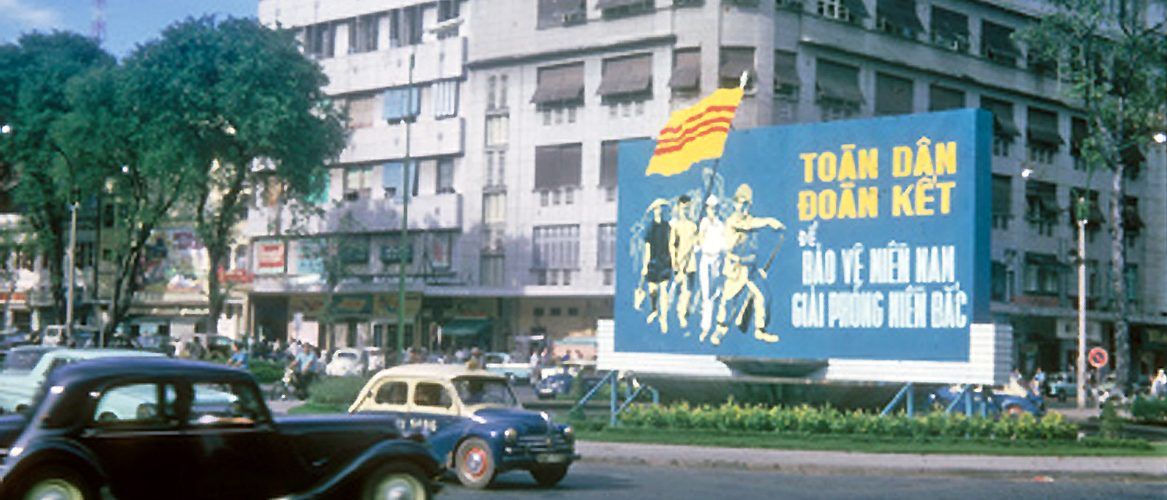
A propaganda poster displayed in Da Nang. Similar posters can be found in Ho Chi Minh City and other Vietnamese cities. By Dragfyre [CC BY-SA 3.0 (https://creativecommons.org/licenses/by-sa/3.0)], from Wikimedia Commons /
“These colorful billboards… on every corner. They’re so strange, aren’t they?” That was how I broached the topic with the motorcycle drivers. Casual. Open-ended. The propaganda signs, with their blocky, solid-colored, Soviet-style imagery, were a genuine curiosity to me. They were government-sanctioned, overtly political signs, exalting the Communist Party’s leadership in history, in the South’s “liberation”, in developing a “modern”, civilised Vietnam. And they were literally everywhere. As we drove by the myriad signs peppered around the city, I would use the occasion to ask the moto-drivers their opinions of the political status quo.
“They’re a bunch of liars.”
“They don’t really care about the people.”
As one driver zoomed past a particularly large mansion, he told me that it was the residence of a prominent Communist Party member. There was a consistent sense of cynicism among these working class motorists.
An older, southern woman’s story was particularly interesting, as she was old enough to have experienced the “liberation” and the years that followed. I met her through a family friend of my mother’s. (My mother had been terrified for my safety; I was the first family member to return to Vietnam since they fled, and I would be traveling completely alone as the child of a “collaborating” family.)
Upon arriving at the house, I was impressed by how large and modern it was. It had granite countertops, hardwood floors, and classic, imposing cherrywood furniture. This was luxury by Vietnamese standards; with at least four motorcycles sitting in the spacious courtyard, it was clear this family was relatively well off.
Auntie and I were sitting in the living room having a casual chat about our families, when the conversation turned to what life was like immediately after 30 April 1975.
At this point, she got up to close all the doors and windows, drawing the curtains. She whispered for the rest of the conversation. Her family had been businesspeople during the Republican era, accumulating a good deal of wealth. After the Communists came to town, local party members, aware of the family’s affluence, found an excuse to confiscate the house. It was impossible to dispute the move, so the family decided to work within the new system, establishing enough political connections to eventually reclaim the house within a decade or so. There was a healthy dose of disdain for the powers-that-be in her stories, but her family’s resilience, tenacity, and resourcefulness overshadowed all else for me. It was an injustice corrected through cunning manipulation of an alien political system. That she was still paranoid about being overheard 20 years later speaks volumes of the pervasive and oppressive surveillance state the Vietnamese live under.
A different perspective came in the form of a Northern shopkeep at a propaganda poster shop. She’d noticed my many visits to her shop, and figuring out that I was Việt Kiều (overseas Vietnamese), took the initiative to engage me in conversation about history and politics.
I was taken aback but excited by her friendliness and eagerness to help me understand Vietnam. She told me to ask her anything I wanted. Aware that I was part of a Southern family that had fled after the war, she knew I’d been served a healthy dose of skepticism regarding Communism and the current political regime, and tried her best to argue for the other side. She’d moved to Ho Chi Minh City, she said, after its liberation.
“When you work against the victors, you are naturally apprehensive when they arrive”
I got straight to the prickly issues. Why had so many people from the South fled? What of the re-education camps? How can the powers-that-be call the current system “democratic” when there’s only one party in charge?
“People fled because they feared retribution,” she said. “When you work against the victors, you are naturally apprehensive when they arrive.”
The re-education camps, she went to on say, were not all that bad: “The ones I visited even had nice gardens and flower beds. And in any case, you have to understand the situation that the new government was in. You had an entire population grow up under an enemy’s regime. When you come to power, you have to make sure this group cooperates, you have to make sure this group is educated in the ways of the new regime.”
Her answers started to waver, though, when it came to the current “democratic” system. “We have elections. We have voting. We have representatives who form a national assembly,” she said.
“Yeah, but all that stuff doesn’t really matter when you can only pick representatives from one party,” I argued back. “If everyone is forced to follow the same ideology, the same ideas, choice is a moot point. True democracy involves multiple parties.” She disagreed, insisting that because the organs existed, democracy existed in Vietnam.
Conviction and democracy
To be sure, truth is a sensitive topic on both sides; I’d had just grown up entrenched in the anti-communist camp rather than the anti-capitalist one. Various attempts to remedy the situation have led to some rather awkward moments. I remember a conversation between my aunt and my mother where my mother said she had to give credit to the Communist government for keeping the country together and growing the economy at an appreciable clip, but my aunt quickly retorted that my uncle – who had served in the South Vietnamese army – would have maimed her if he heard her talking like that.
I’m still researching today, adopting a less polarised, more nuanced approach to the war and its competing ideologies than perhaps my mother would like. During a BBC interview, southerner Nguyen Thi Binh, former foreign minister of the Provisional Revolutionary Government of the Republic of South Vietnam and prominent Communist figure at the Paris Peace Accords, was asked for her thoughts on Vietnamese dissidents and their desire for a better nation. She retorted: “How are they any different from me?”
The dichotomy of “good versus evil” had been so deeply ingrained in the narratives of north and south that, until I heard that comment, I’d never really thought of it that way. These people, these Communists, laid down their lives for their ideals, for their country, and perhaps most meaningfully, for their countrymen. Can, or should, we cynically believe that those who fought on the northern side sacrificed the spring of their lives, and sometimes their lives altogether, simply to gain power at the expense of their fellow Vietnamese?
What, on the other hand, was the South fighting for? Trudging through American history books, one would be hard-pressed to find any real, fleshed-out answer beyond “the domino theory”, a theory that argued that the fall of one country to Communism would lead to a domino effect among its neighbours. Reading such material, it was hard not to buy into the (Hanoian) idea that South Vietnam was a propped-up American creation. In fact, the more I researched, the more I realised that it was a deep sense of ambivalence among the southern population that lead to South Vietnam’s embarrassingly quick demise.
When asked why they were fighting and what they were fighting for, South Vietnamese soldiers often turned out not to be very firm believers in their own cause. Boots and uniforms stripped off and abandoned in place by soldiers deserting on 30 April 1975 testify to that fact.
The wartime South Vietnamese population might not have been able to answer the question of “what are we fighting for?”, but the next few decades of economic mismanagement and political oppression after unification would provide a resounding answer, especially for those not able to escape the country.
By the early 2010s, after nearly a decade of research and reading, my viewpoint had matured from “acknowledge that our side may have been ‘wrong’, and then find out what happened on both sides” to “never lose sight of the fact that democracy as the South attempted to espouse it trumps the totalitarian communism adopted by the North.” Both were foreign, imposed ideologies, and the fact that one conquered the other has no bearing on virtue. As the Vietnamese author and political dissident Duong Thu Huong so eloquently put it: “Beauty does not always triumph.”
Though film and media are thoroughly dominated by northerners, southern defiance is coming to the surface. “We only learn how to cherish things when we’ve already lost them,” the 2017 trailer of Cô Ba Sài Gòn (The Tailor) begins. The southern voiceover is immediately followed by a close-up of Saigon’s city hall, with the camera focused squarely on the flagpole – there the flag of South Vietnam flutters. Yellow with three red stripes. It is subtle but perceivable for those who look for it.
But of course, if that is too subtle for you, you can always rewind a few seconds and there staring you in the face from the very moment the trailer starts is the flag on the áo dài. The tailor’s hand gently caresses a swath of yellow with three red stripes. Genuinely ask yourself if this is all coincidence. Of all the patterns in the world that the filmmakers could have featured on the dress, why this one? And why does the voiceover make the statements she does as this pattern is displayed?
A slow zoom-out, followed by shots of economic prosperity and vibrant displays of traditional áo dài to emphasise the blossoming of Vietnamese culture under a “fascist”, “puppet” regime. That these scenes managed to make it onto the big screen directly undermines the communist narrative of Saigon needing to be “liberated”. A particularly salient question asked among dissidents, both in and outside the country, is “who liberated whom?” Did the impoverished North really liberate the wealthier South? Or was it the other way around? Moreover, what exactly did the South need liberating from? A comfortable, prosperous, peaceful life?
The film champions the preservation of the áo dài – the traditional Vietnamese outfit – over Western fashions in 1960s Saigon, but the subversive message, wrapped in the garb of an innocent movie about fashion, is unmistakable. For South Vietnam, the loss is more political than cultural: no longer do citizens possess freedom, democracy, and a vibrant civil society. Even if imperfectly practised in South Vietnam, greater freedom of expression brought prosperity and a society of better quality than what Vietnam has today. Many Vietnamese, unable to express dissatisfaction with the status quo at the ballot box, vote with their feet. Leaving the country is the dream for those who have means to do so; Hanoi readily acknowledges that Vietnam suffers from brain drain.
Even so, it must be acknowledged that the war was a manifestation of North and South both wanting the best for the Vietnamese people while choosing drastically different paths. It would be unforgivably cynical to believe otherwise, to view either government as monolithic entities not made of Vietnamese individuals who loved their country. The root of the conflict stemmed from both sides competing to be the only good. Both the North and the South had causes they believed to be just – a fact which native and overseas Vietnamese have yet to fully accept.
On paper and in diplomatic circles, there is only one “true” Vietnam. Although the Republic of Vietnam ceased to exist after 30 April 1975, it lives on in the hearts and minds of millions of Vietnamese who abhor communist totalitarianism. It lives on in its enforced absence within Vietnam’s national discourse. A silent, de facto ban of the yellow flag with three red stripes, of any positive mention of the southern republic, of anything related to the former state is, in a way, perpetuating South Vietnam’s existence. And if history is any indication, the South remembers.
About the Author:
WILL NGUYEN
Will Nguyen considers himself a “Schrödinger’s cat” of East and West. He is Vietnamese or American, depending on who’s looking. Will graduated from Yale University in 2008, with a Bachelor’s in East Asian Studies. He is currently completing his Master in Public Policy at the Lee Kuan Yew School of Public Policy (NUS), where he has pursued topics of Vietnamese history, culture, and politics.




 WILL NGUYEN