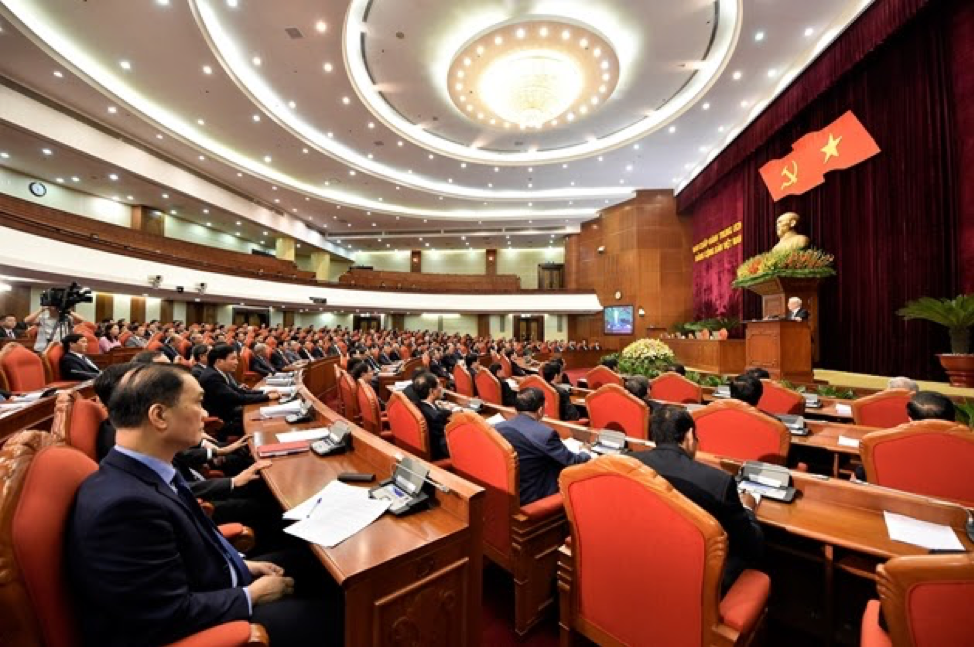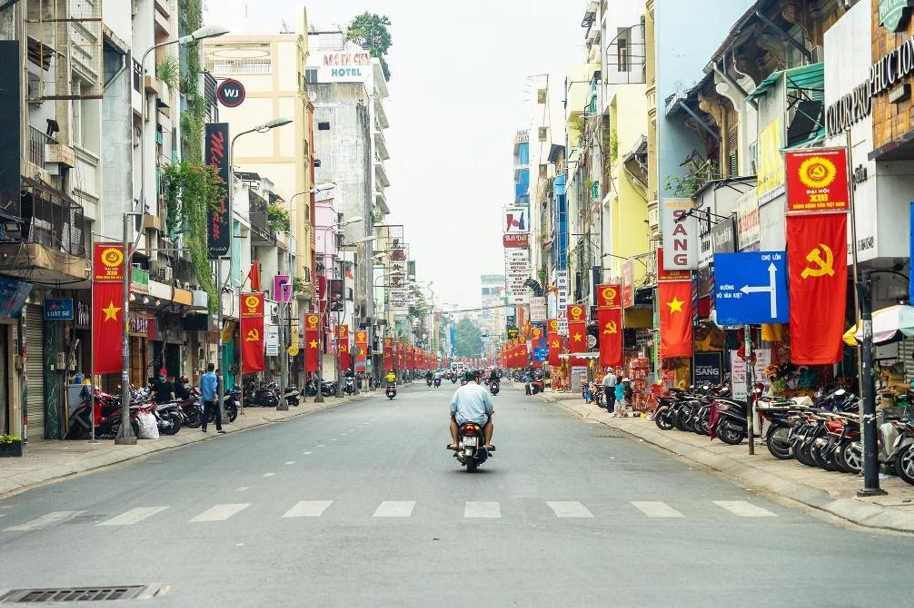
The panorama of flags
Foreigners visiting Vietnam can hardly miss the abundance of flags, posters, statues, and slogans that remind them of who is leading Vietnam and of the Communists’ “glorious” struggle against the French, Americans, and the South Vietnam regime throughout the last century.
However, isn’t it a bit too archaic to still flash the symbol of the hammer and sickle these days, when the means of production and the economy no longer rely on these tools? Farmers and factory workers neither drive nor fuel modern-day politics as well. Likewise, what is the point of having the statues of Ho Chi Minh, Karl Marx, and Lenin in public parks and in the meeting rooms of schools, universities, and governmental departments? Do ordinary people who showcase the red and yellow flag in front of their houses every April 30 cherish the fact that the country was “reunited” in 1975?[1] Do police officers–who check and remind households that fail to do so–love the flag so much and wholeheartedly believe in the cause? In essence, what is the significance of this panorama of symbols?
Vaclav Havel, the dissident intellectual of communist Czechoslovakia and later president of post-communist Czechoslovakia/the Czech Republic,[2] can point us to the answer.
The panorama of lies
Following the end of World War II, Czechoslovakia was ruled by the Communists. The iron fist of Communist rule drove dissidents out of the country and clamped down on those who remained. Other than the Prague Spring of 1968, an unsuccessful effort to steer Czechoslovakia back towards democracy, there was hardly any resistance.
However, communist Czechoslovakia was not just about who held the government; life itself had to adjust in a way that fit the current political climate. Vaclav Havel (1936-2011), who is arguably one of the most respected dissidents in the history of Czechoslovakia, lived most of his life under Communist rule. He grew up to become a playwright, and at the same time, he established himself as a prominent and well-loved politician. A high point of Havel’s dissident writing, The Power of the Powerless, [3] does not concern itself with formal politics; rather, it deals with the “hearts and minds” of the people.
A significant character in The Power of the Powerless is the greengrocer who puts the slogan “Workers of the World Unite!” in his front window every day, along with his vegetables. He is neither passionate nor concerned about whether or not the workers of the world unite, but he does this anyway. This irony reminds me of my family who obediently and diligently displays the Vietnamese flag at times in the year when they should, but remains so apathetic that they do not even care if the flag is hanging upside down. There also seems to be other households quite similar to my own which led to the government’s legal guidelines (3420/HD-BVHTTDL) that specifically address this violation.[4]
The greengrocer’s act is the observable tip of the iceberg of how the hearts and minds of the people work in communist Czechoslovakia; they want to avoid trouble with those who have power. By displaying the slogan, the greengrocer implies:
I, greengrocer XY, live here and I know what I must do. I behave in the manner expected of me. I can be depended upon and am beyond reproach. I am obedient and therefore I have the right to be left in peace. (Havel, 1978, p. 6)
I am once again reminded of my family. I recall that every time my father was late in hanging the flag, my mother would berate him. She would constantly tell him to do it now because she didn’t want the hassle of dealing with the police. When I asked my parents about this, they said that they just wanted to be “left in peace” (yên thân). Likewise, if you ask teachers, students, or employees of governmental departments about the statues of Ho Chi Minh and Karl Marx in their buildings, they would probably tell you something similar.
But, why do the authorities punish such a trivial thing? Whether or not the greengrocer displays the slogan would certainly have little to no effect on the workers’ movement, nor does it pose any tangible threat to the existence of a government that possesses the hard power of the courts, the military, and the police. The greengrocer does not even replace the slogan with another one that is critical about the regime.
To address this question, Havel points out that, in fact, people would ignore the greengrocer’s slogan, but they do so precisely because such sayings are everywhere – in other shop windows, on lampposts, bulletins, and buildings. The key here is that while they ignore individual slogans, the people are well aware of the panorama of these slogans as a whole. The existence of this panorama tells people that dishonesty goes hand-in-hand with obedience here; this is normal, everyone does it, and so must you. In the same vein, transgressions must be punished because “anything which leads people to overstep their predetermined roles is regarded by the system as an attack upon itself” (Havel, 1978, p. 8).
Therefore, if a Vietnamese policeman, school administrator, or government official reproaches someone who questions the phrase: “Live, fight, work, and study like our great Uncle Ho” (Sống, chiến đấu, lao động, và học tập theo gương bác Hồ vĩ đại), it is extremely likely that this policeman/school administrator/government official himself has also questioned, albeit in private, the very same slogan! Yet, they also believe that nobody should disrupt the rules of the game and that everyone should blindly follow what the system demands.
My next question is, how do people live with themselves when their existence is surrounded by so many lies, ironies, contradictions, and hypocrisies, including those of their own making? Would they feel embarrassed and ashamed of themselves for being so afraid and thus becoming unquestionably obedient? These questions, Havel argues, boil down to man’s dignity and authentic identity. To be able to live in lies, the greengrocer deludes himself into believing that there is nothing wrong with the workers of the world unite; he separates the part of himself that questions the slogan from the other half that accepts the excuse. Living in a world of lies and deceit for so long warps our perspective and this bastardized reality becomes our “new normal;” the greengrocer becomes accustomed to the state of his compromised dignity and comes to accept the deception and inauthenticity of the system as part and parcel of life. In effect, he loses his authentic self.
On the question of dignity and identity, it is interesting that the slogan “Sacrifice for the country and serve the people” (Vì nước quên thân, vì dân phục vụ) is hung in every police station, in a country where police, alongside tax officials, are seen as the most corrupt group (Towards Transparency and Transparency International, 2017). A few years ago, when I passed by one of Vietnam’s border checkpoints, I was baffled by the contradiction between the arrogance of the border control officer and the fact that he was sitting right under a “serve the people” banner. My subsequent conversations with poor Vietnamese migrants who often cross the border for work revealed that this was how they were always treated; they often bribed these arrogant officers and kept their heads down to avoid trouble.
As I listened to these migrants and recalled my own experience, I wondered how these officers could look at themselves in the mirror. They see the “serve the people” banner in their office every day but shamelessly extend their hand through the small window of the checkpoint to receive bribes from the people they look at with disdain – the “lowly” people they are supposed to serve. On the other hand, the migrants are left with little choice but to comply and are forced to accept being treated with less than half the dignity they should be afforded by the simple virtue of being alive.
Furthermore, Havel argues that the panorama of lies is internally solid, for there is a “metaphysical order binding all its components together,” thus “guarantee[ing] the inner coherence of the totalitarian power structure” (Havel, 1978, p. 10). Through all the examples I have provided, isn’t there a sense of such order emanating from Vietnam’s panorama of (pseudo) symbols? The checkpoint officers and those who bribe them, my parents’ disinterested flag-hanging, the equally disinterested policeman who checks the flags, and the people who put the statues of Ho and Marx in their meeting rooms are all parts of a system that everyone who lives or has lived in Vietnam knows all too well; it is a system where “the working class is enslaved in the name of the working class, [where] the complete degradation of the individual is presented as his ultimate liberation, […] [and where] the arbitrary abuse of power is called observing the legal code” (Havel, 1978, p. 10).
In fact, one of my interviewees [5] told me that before he left Vietnam and started to look at the country from a distance, life there was quite “smooth” for him, because “things hung together…everything I heard in school, in the newspaper, in the street etc. was in harmony with each other…I didn’t feel the urge to question things.” This “harmony” is the glue that holds the panorama of lies together. Secondly, as my interviewee’s response also points out, this panorama is solid because those who lack the individual will and instead excel in the use of empty phrases are the ones who thrive (Havel, 1978, p. 13).
Havel thus concludes that “individuals confirm the system, fulfill the system, make the system, are the system” (Havel, 1978, p. 9). This conclusion runs contrary to what many intellectuals and laymen alike often think about authoritarianism as entailing an evil ruler and people who are controlled against their will, or a class that oppresses all other classes, and where the line of struggle is between the oppressor and the oppressed. The concept of “the panorama of lies” goes beyond such binary definitions and shows that the line of struggle “runs de facto through each person, for everyone in his own way is both a victim and a supporter of the system” (Havel, 1978, p. 16-17).
Conclusion
I work with and observe a wide range of activists who work tirelessly and voice their opinions hoping to one day make Vietnam a liveable country for ALL and not just for those with unearned privileges and unchecked power. They pursue different paths of change; some try to run for seats in the National Assembly, others focus on analysing the actions of the government, and there are those who try to nurture a different kind of Vietnamese. For them, a different kind of Vietnamese means Vietnamese citizens who feel anger when their own dignity, or the dignity of others,’ is negated; they are those who strive for “what should be,” instead of settling for “what is.” They are those who are honest with themselves about right versus wrong, instead of surrendering their own judgement, mindlessly obeying the state and condemning those who do not conform.
Vaclav Havel and his people saw the end of Communist rule in Czechoslovakia in 1989, but the democratic miracle did not immediately follow. Havel, then in the position of president, argued that democratic politics and the market economy, both carrying the promise of a good life, cannot happen in the face of “post-communist morass” (Havel, 1997). The ghost that kept haunting post-communist Czechoslovakia/the Czech Republic was called out in Havel’s speech before Parliament in 1997:
Many people believe that democracy or no democracy, the people in power are again people who cannot be trusted and who are more concerned about helping themselves than about the greater good….The prevalent opinion is that it pays off in this country to lie and to steal; that many politicians and civil servants are corruptible; that political parties – though they all declare honest intentions in lofty words – are covertly manipulated by suspicious financial groupings.(Havel, 1997)
I understand that the different paths of change I mentioned above ultimately feed into each other. However, with the lesson from Czechoslovakia/the Czech Republic and Havel’s thoughts, I cannot help but wonder how best to prioritise these tasks and decide when to pursue which.
I would also like to believe that Havel’s thoughts give Vietnamese activists hope, especially during the present time when a relentless crackdown makes revolutionary change seem like an utterly unreachable dream. After reading Havel’s work, I see the sparks of our own “Vietnam Spring” starting not in the places representing the power of the system – the National Assembly, the election, state-owned media, or the police – but in the very hearts and minds of ordinary Vietnamese people. The revolutionary Vietnamese of the present day are those who dare to live in truth.
Bibliography:
- On April 30, 1975, North Vietnam forces entered Saigon and officially ended the existence of the Republic of Vietnam as a nation. North Vietnam and South Vietnam were then joined and ruled by the Vietnamese Communist Party (VCP), and Hanoi became the capital of the whole of Vietnam. In the narrative of the VCP, April 30 is called reunification day and a cause to celebrate, whereas people who sided with South Vietnam call it ‘Black April,’ amongst other names that convey pain and sadness for the loss of their country.
- Czechoslovakia split into the Czech Republic and Slovakia in 1992-1993. Vaclav Havel’s presidency was from 1989 to 2003, with some intervals in between.
- To be fair to this great work of Havel, I should be clear that the panorama of lies is only a small part of it. I focus particularly on this concept in order to unpack the omnipresence of (pseudo-) symbols in Vietnam.
- I am not saying that all Vietnamese display the red and yellow flag in the same disinterested way as Havel’s greengrocer. We will not know unless we ask every single Vietnamese. However, we can always make an educated guess. In Vietnam, there are pockets of the population who resent or distrust the regime for many good reasons, from the historic 1975 event and family members lost at sea during the Boat People exodus to forced evictions and rampant corruption. Growing inequality and poverty drive young people from rural areas to cities or overseas, and also expose even more the lies about the socialist utopia which the VCP claims it pursues and which it trumpets with slogans and posters in public places.
- This interview is part of my PhD research on activism under authoritarian rule in the 2010-2019 period in Vietnam.
References
Havel, V. (1979). The Power of the Powerless. Available at: https://www.nonviolent-conflict.org/resource/the-power-of-the-powerless/
Havel, V. (1997). Address to the Czech Parliament. Available at: https://www.rferl.org/a/1087560.html
Towards Transparency & Transparency International (2017). 2017 Global Corruption Barometer: Vietnam. Hong Duc Publishing House.