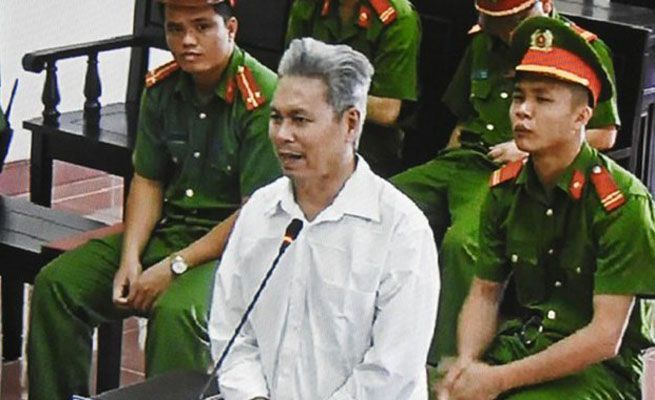
Retired elementary school teacher Dao Quang Thuc passed away December 10 while serving time at Prison Camp #6, his son recently confirmed with Radio Free Asia. He was 58.
Prison authorities in the north-central province of Nghe An claim Thuc suffered a stroke and died from a combination of brain hemorrhaging and bronchitis. Officials have denied the family’s request to return the body for burial and are currently holding it to perform an autopsy. Standard procedure dictates that Thuc will be buried at the prison cemetery, and the family will only be able to retrieve Thuc’s remains after three years.
Prison Camp #6, in Nghe An province. Photos: Google Maps
Thuc was arrested October 5, 2017 and convicted September 19, 2018 under Article 79 of the 1999 Penal Code for “attempting to overthrow the state”. He was serving his second year of a 13-year sentence and had previously staged hunger strikes in June and July of 2019 to protest poor prison conditions. Family and friends were brutally attacked by government-hired thugs for showing support.
During his pre-trial imprisonment, Thuc himself had been tortured, beaten, and deprived of food, suffering a mental breakdown and high blood pressure, according to his daughter.
Thuc was taken to Nghe An Friendship General Hospital on December 3rd after showing worsening symptoms; his family claims that prior to his time in prison, Thuc did not suffer from any health issues.
“While we cannot say for sure what happened to Dao Quang Thuc, his death raises many questions that must be answered by the government,” Phil Robertson of Human Rights Watch has stated.
Thuc had previously taught at Trieu Phuc Lich primary school in his home province of Hoa Binh, southwest of Hanoi. He often made Facebook posts critical of the government and had previously participated in protests against environmental degradation and Chinese territorial encroachment.
Although freedom of speech and freedom of assembly are guaranteed by Article 25 of the 2013 Vietnamese Constitution, Communist Vietnam is a one-party, authoritarian state that does not tolerate challenges to its power. It stifles political pluralism and regularly punishes individuals who do not conform to sanctioned historical or political narratives.
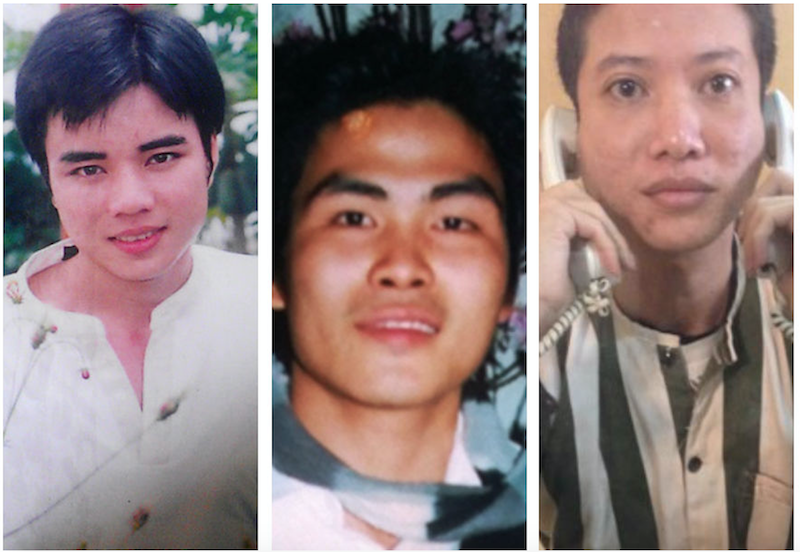
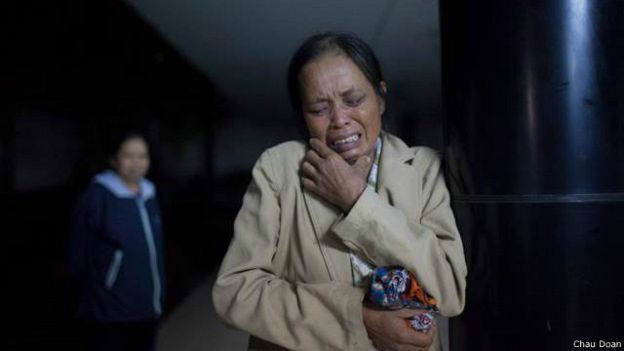
Mrs. Loan began to cry softly as she spoke to me one afternoon in late March, when I called to ask if there were any updates on her son Ho Duy Hai, who is sitting on death row in Long An province on a wrongful conviction.
“He is so young, and yet already has suffered over a decade of imprisonment,” she told me over the phone. “I want him to come back home and live a normal life. I want him to get married, and have a child. Sometimes, I just really wish to have a paternal grandchild and that both of my children could live with me like in those happy days before.”
I have been in contact with the Hai family for the past four years, since I first joined the community of Vietnamese bloggers and activists calling for the suspension of Hai’s execution in December 2014, after then President Truong Tan Sang issued an order to stop his execution. It was then that I began studying his case a bit more and learned that the evidence submitted for his conviction was invalid, and quite frankly, illegal.
For example, the local authorities wanted to ensure Hai was found guilty and so they purchased a knife at a market and marked it as “similar” to the weapon that they alleged Hai had used in committing the robbery and murder of two women. And with such “evidence,” Hai was convicted and sentenced to death in 2008, when he was a recent college graduate, and just 23-years-old.
Throughout these years, I have also gotten closer to two more families of Vietnamese who have been handed wrongful death penalties. Those include the families of Nguyen Van Chuong and Le Van Manh. These two men also were convicted and sentenced to death in their 20s with no evidence and following alleged torture by police officers. These three groups of parents meet every month in Hanoi and go together to petition the government to overturn the wrongful conviction of their sons. Each month, if they saved enough money to buy supplies, they will also visit their sons in prison. All of the men were convicted and have been kept behind bars for more than a decade.
Yet, visiting their sons is not quite an easy task because of the financial strain on these families. The words of Le Van Manh’s mother – Mrs. Viet – broke my heart during our most recent telephone call, also in March this year. “If I manage to earn enough money, then I will go to see my son, but making money to support my family is quite difficult given my age,” she told me. “So for some months, I have not been able to see Manh.”
My colleague based in Vietnam told me that catching fish and other aquatic creatures at the river near Mrs. Viet’s house was the main source of her income. Yet, her determination to fight against his unjust conviction has been so powerful.
I asked her if she was able to talk about his case when she visited him in jail. “The officers don’t like me to talk about it, but I tell Manh anyways,” she said. “Manh needs hope and the information that people have not forgotten him and are fighting for him gives him hope.”
Mr. Chinh, Nguyen Van Chuong’s father, also has the same fighting spirit. He sends me documents and updates me on Facebook about his son’s case. This year, Mr. Chinh shared with me that the Supreme People’s Procuracy Office in Hanoi contacted him and invited him to go see them. The office told Mr. Chinh that they had sent a request for a trial for cassation in Nguyen Van Chuong’s case. However, the Supreme People’s Court of Vietnam denied such a request without giving any apparent reason. The Procuracy Office used that excuse and the denial to tell Mr. Chinh to stop contacting them. However, that was not a legally sound argument. First, the office recognized that the case needed to be reviewed. Second, the law allows the office to continue sending their request, even after the denial. In fact, the Procuracy Office should continue to submit their requests for Nguyen Van Chuong and not tell his father to forget about the case.
The cost for discussing the details of their cases with their family members during visitations has been quite severe for Nguyen Van Chuong and Le Van Manh. Both of them claimed that they were shackled 24 hours a day a few times. Nguyen Van Chuong’s father also told me that Chuong was being beaten up by other inmates in his prison and being forced to sign a letter for the local authorities confessing to the murder he was convicted of. Yet, the families and the inmates did not yield in front of these pressures and they kept on petitioning for a review of their cases.
Different than Ho Duy Hai, both Chuong and Manh already had children before their conviction. But their wives could not withstand the pressure of having a spouse that was given a death penalty conviction and so they left their children to be raised by Chuong’s and Manh’s parents. The responsibility to raise the children while still trying to exonerate the two men greatly added to the burden of the two families, who are already straining to survive. The grandparents are elderly and cannot find jobs that provide a fair and reasonable income. But at the same time, they have to provide support for a lot of people in their families.
In Vietnam, there is no organization that really focuses on the issue of the anti-death penalty or that assists people with wrongful convictions. And even though I work on this issue, my non-profit organization is not recognized by the Vietnamese government and our work is classified as “reactionary” conduct. More than that, none of the death row inmates would be allowed visitations by an organization or non-family persons, not even the International Committee of the Red Cross. The inmates are shut off from society entirely and can not have any contact with people and organizations that care about their cases. In fact, visitations by independent organizations working on behalf of inmates, including those sitting on death row, was a request made by the Committee Against Torture in its concluding observations for Vietnam in 2018.
As the person who has brought these three cases before the different international law reviews, such as the Committee Against Torture and the Universal Periodic Review of Vietnam, where specific inquiries were asked about them, it is very frustrating for me that international law – such as the International Covenant on Civil and Political Rights (ICCPR) – had not been used for the benefit of the wrongfully-accused inmates. The Human Rights Committee (a body of independent experts that monitors implementation of the ICCPR) sadly acknowledged the fact that the covenant could not actually be implemented by the people of Vietnam in its third periodic report on Vietnam early in 2019.
The families of Hai, Chuong, and Manh don’t really have support from the public or civil society organizations that operate in Vietnam. They are almost alone during their monthly petitioning to the authorities in Hanoi. They need to find some financial resources to buy supplies to visit their sons each month. More than that, no one actually assists them with funds to buy paper and pay postage fees to send their monthly petitions. And yet, none of the parents will call for financial support from the public for their families when I spoke to them. Instead, they all told me that they just want a review of the cases in an independent court of law.
Their determination and belief in justice and rule of law always encourages and inspires me to continue to bring their cases to more people, which I will do until the day that these cases are fairly reviewed and rightfully settled.
An inmate who was diagnosed with a brain hemorrhage in January 2019 told his family that he did not get proper treatment and was sent back to prison after about a month in the hospital.
34-year-old Ha Van Truong is currently serving a nine-year-sentence for manslaughter in the case resulting from a land dispute between farmer Dang Van Hien and Long Son Commercial and Investment Company (Long Son), a private company in Dak Nong Province in October 2016.
On March 31, 2019, Truong was, again, admitted to the hospital with the same diagnosis. But his family informed us last night that his conditions have gotten worse. They also stated that during both of his stay in the hospital, he was subjected to shackling – a practice which international human rights law defines as torture.
Last year, the trial of Dang Van Hien and Ha Van Truong received extensive news coverage due to an unusually heightened public sympathy for the defendants, who were perceived as victims of land-grabbing. In Vietnam, land-grabbing has become an increasingly urgent social and political issue that the whole nation often paid close attention to.
After Dang Van Hien was sentenced to death for homicide, more than 3,000 people signed an online petition, asking the president of Vietnam to commute his sentence. Earlier this year, in February 2019, Hien’s case was proceeding towards a trial for cassation – a review of both the law and facts that could give him a second chance at life.
Truong was initially sentenced to 12-year-imprisonment, but an appellate court in Ho Chi Minh City reduced the term to 9 years which again showed the impact of public support on the case.
However, Truong has been a victim of police brutality and torture, and he also did not receive adequate medical care. His family told us that Truong suspected his brain hemorrhage was a result of the injuries he received from police beating during his pre-trial detention. Since then, he has been suffering from a chronic headache, but the prison’s medical clinic only gave him pain reliever medication. He did not receive a proper diagnosis until he fainted and was admitted to the hospital in January 2019.
During his first admission, the authorities waited for two days before informing his family without any specific reasons. Truong was left alone in the hospital with no one to care for him. He was unable to eat solid food, but the police fed him with only rice and pork. The families of other patients had to give him some milk to drink until his family found out about his whereabouts and visited him.
Truong’s current prognosis is not looking too positive. His family said that his body has been frail so he would need assistance to move around and that he often passed out.
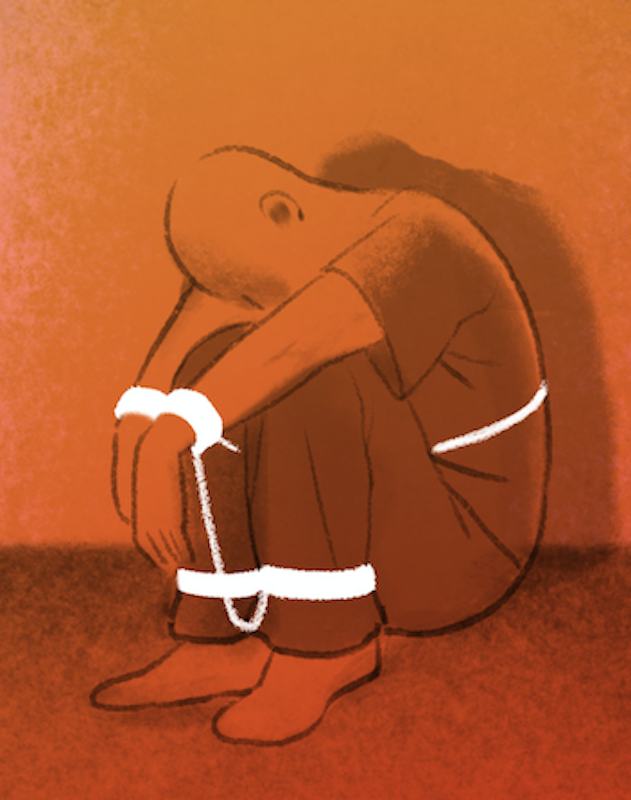
In such dire conditions, Truong is still subjected to shackle 24/7 even when he is lying on the hospital bed. Initially, the police chained both Truong’s hands and feet, but now, they only applied such treatment to his feet. The use of shackle on inmates is a violation of the UN’s Nelson Mandela Rules on the treatment of prisoners.
Truong’s situation is not the exception but rather a depiction of the overall picture of prison conditions in Vietnam.
Families of prisoners of conscience and political dissidents, over the years, repeatedly made allegations about the substandard conditions of Vietnamese prison centers and the mistreatment of prisoners, especially those who needed medical care.
In 2014, prisoner of conscience Dinh Dang Dinh, a teacher, passed away shortly after his release from prison. Dinh maintained his innocence until the day he died. He was collecting signatures of residents in his hometown to protest the government’s plan to mine bauxite in the Highlands of Central Vietnam. Dinh was arrested in 2011 and sentenced to 6-year-imprisonment in 2013 for propagandizing against the state. When his health deteriorated, he received a pardon and an immediate release, but it was too late.
His family alleged that the lack of proper medical care and the continued refusal to hospitalize Dinh during his incarceration contributed to his untimely passing.
In March 2019, the UN Human Rights Committee expressed its concerns about the country’s prison conditions, finding that there were: “consistent reports of poor conditions of detention, including overcrowding, use of prolonged solitary confinement, shackling, abuses by other prisoners at the instigation of prison officials, and non-separation of healthy prisoners from those with contagious diseases, intentional exposure of prisoners to HIV infection, denial of medical care; and punitive transfer of prisoners”.
Ha Van Truong remains in critical conditions today, but he has been transferred to Cho Ray Hospital in Ho Chi Minh City – one of the top medical facilities in the country. His family continues to hope and pray for a speedy recovery. But at the same time, they also ask: why didn’t he receive adequate medical treatment during his first hospital admission two months ago?
Vietnam soon faces the UN’s review compliance on the implementation of the 1984 United Nations Convention against Torture and Other Cruel, Inhuman or Degrading Treatment or Punishment (UNCAT), which it became the 81st signatory on November 7, 2013.
Despite a showing of strong commitment from the Vietnamese Ambassador to the UN at the time of signing, Le Hong Trung, who condemned all “acts of torture and cruel, inhuman or degrading treatment of persons and to better protect and promote fundamental human rights”, police brutality and death in police detention remain some of the most urgent social issues in the country today.
Less than a year since the Vietnam’s National Assembly ratified UNCAT in November 2014 and submitted the ratification to UN on February 5, 2015, 17-year old Do Dang Du died from injuries to the head and body while being held in police custody at Chuong My District, Hanoi on October 10, 2015. His death shocked the nation.
Police records showed Do Dang Du was taken to Bach Mai hospital in early October 2015, where died from head injuries two days after. Photo credits: Anh Ba Sam blog
14 lawyers immediately petitioned to the Minister of Ministry of Public Security (MPS), the Chief Procurator of the Supreme People’s Procuracy, and the Chief of Hanoi Police Department to get the details of his arrest and detention.
As it turned out, Du’s death might have been avoided because he was not supposed to be detained at all.
According to some of the lawyers from this group of 14 who petitioned to review his case, under Section 2 of Article 303 of Vietnam’s Code of Criminal Procedures, a minor being alleged to have committed a “less serious” crime, such as theft, was supposed to be released on his own recognizance. Du’s mother confirmed that he was arrested in August 2015 for stealing two million VND (about 90 USD) from a neighbor and taken into police detention, where he was held until taken to the hospital due to injuries from a physical assault in early October 2015.
Yet, Chuong My District Police stood by and continued to affirm that their detention of Du for some two months was done according to laws. However, other facts surrounding this case compelled people to question police’s involvement in Du’s death and demanded more answers.
First, while Du’s three teenager cellmates were arrested and charged with the assault and battery which caused his death, their reasons for getting into an altercation with Du failed to convince the public and Du’s family. The main perpetrator, Vu Anh Binh, also 17-year old, confessed that he had assigned Du to wash their dishes, but because Du did not wash them well enough, leaving them still dirty, Binh got angry and beat him up.
Attorneys for Do Dang Du’s family after being assaulted. Photo credits: Tuoi Tre newspaper.
Du’s family then retained two attorneys, Le Luan and Tran Thu Nam, from the group of 14 to represent them in the matter of their son’s death, but the lawyers soon became victims of physical violence as well. On November 3, 2015, attorneys Luan and Nam were assaulted by a group of eight thugs on their way to visit Du’s mother. The victims identified one of the perpetrators to be Chuong My District police officer Cuu, and they also told the media that they believed the police had followed them since they agreed to represent Du’s family.
Speaking to BBC News – Vietnamese edition at the time, Attorney Tran Quoc Thuan, former Deputy Director for the Office of the National Assembly, demanded that an independent investigation unit should have been convened to invest the police officers of Chuong My District to avoid conflict of interest. Attorney Thuan also mentioned to BBC that some 226 people had died in police custody in recent years.
Attorney Thuan’s claim was based on Vietnam MPS’ own representation to his former employment, the Office of the National Assembly, in 2015 regarding deaths in police custody from 2011-2014, which curiously was not mentioned by the Vietnamese government in their report submitted in July 2017 to the UN regarding the first year of implementing UNCAT from 2015-2016.
However, in the report to the UN, the government did admit deaths and other incidents of police brutality indeed happened. But the numbers from the government, of course, are nowhere near 226. In fact, it is difficult to decipher the exact number from the 51-page report, which also did not include any allegations of death in police detention that Vietnamese newspapers and social media had reported in 2015 and 2016.
What more disturbing is the fact that the report from the Vietnamese government delineates the reality that police brutality often goes unpunished. Impunity is at the heart of this problem, and the government has yet to demonstrate they have dealt with it efficiently.
For example, Paragraph 100 of the report stated: “From 2010 to 2015, People’s Courts had not handled any cases regarding the obtainment of testimony by duress and bribing or forcing another person to give false testimony or provide false documents”.
Further, it provided that in the same five-year period, the Vietnamese courts “only handled and tried 10 cases with the total 26 defendants who committed torture offenses”. Eight out of those 10 cases involved police officers and prison’s guards. (In Vietnam, prison’s guards are also police officers because according to the laws, the MPS has direct control over all prisons in the country).
The family of a victim in one the newest deaths in police detention in Vietnam took his body to the streets to demand justice in July 2017. Police of Ninh Thuan, Phan Rang Province claimed Nguyen Hong De (26-year-old) had hung himself in the temporary holding cell.
Even when police officers were prosecuted and tried for having committed torture of suspects and/or prisoners, they often received very light sentence. Take for example the case of four police officers of Dak Trung prison in Dak Lak Province, listed in Annex 11 of the Vietnamese government’s report to the UN, none of the police officers involved in a prisoner’s death while in their custody was handed actual prison terms.
These four police officers admitted to using “corporal punishment” on a prisoner, Truong Thanh Tuan, during the morning of September 23, 2010. Tuan died on the way to the hospital the very same evening from “respiratory distress syndrome and cardiovascular collapse”. The officers were tried and convicted of “using corporal punishment” under Article 298 of Vietnam’s Penal Code, and their sentence was the minimum “penalty of warning”, which translated into “no jail time”.
Paragraph 45 of the report, the government acknowledged that their laws allow for many other penal code provisions to prosecute criminal acts that carry “torture nature”, some are specifically applicable to police officers, such as “causing death to people in the performance of official duties” (Article 97), “inflicting injury on or causing harm to the health of other persons while performing official duty” (Article 107), “ill-treating other persons” (Article 110), humiliating other persons (Article 121). Vietnam’s laws also allowed for charging perpetrators with multiple offenses for committing the same criminal conducts.
But in reality, the same report also showed that Vietnam’s justice system had not prosecuted any of the listed perpetrators with multiple charges, even when their laws allow for it. In all of the reported cases, the police officers were charged and tried for only one crime, “using corporal punishment” under Article 298.
Taking into consideration the facts and the applicable laws, people have to ask why the offending police officers were not charged with any other crimes besides “corporal punishment” and thus always received just a slap on the wrists for causing serious injuries and even death to suspects and prisoners?
The difference between only charging the offenders with one crime instead of multiple crimes in Vietnam is quite large, and we could see it by studying the facts in one of the most talked about cases involving police brutality in the past five years, the case of Ngo Thanh Kieu of Phu Yen Province.
According to the government report, the 20-year-old Kieu was arrested for theft in the morning of May 13, 2012. He was then interrogated by several police officers of Tuy Hoa District, Phu Yen Province that day, where he was handcuffed and beaten. He was interrogated multiple times on the same day and continued to be interrogated even after showing obvious signs of physical assault. By 5:40 pm, Kieu died on the way to the hospital from injuries to the head which had caused drama to his skull.
The police officers defendants in Ngo Thanh Kieu’s case at trial. Photo credits: Zing news.
While the involved officers were tried and sentenced to prison from nine months to eight years, they were charged, again, only with “applying corporal punishment” under Article 298. Moreover, the highest-ranking officer involved, Le Duc Hoan, Deputy Head of the Investigation Agency of Tuy Hoa District Police, was only charged with “negligence, causing serious consequences” while carrying out official tasks.
It was Hoan who had ordered the other police officers to conduct the interrogation of the victim even after Kieu had shown signs of suffering rounds of physical assault during the first questioning. Yet in the end, it was also Hoan that received the lightest sentence of nine months and was allowed to serve it on probation, meaning he did not have to spend a single day in jail.
The government’s report to the UN also failed to mention that two of the five defendants appealed and got their sentences reduced sufficiently in September 2016. Nguyen Than Thao Thanh was sentenced to eight-year imprisonment but got reduced to five years, while Nguyen Tan Quang’s two-year imprisonment became two-year probation.
Had they been charged with all of the criminal provisions applicable to their illegal conducts, the offending police officers who caused the death of Ngo Thanh Kieu could have faced up to 30 year-imprisonment on a combined sentencing under Article 50 of the Penal Code if convicted.
The story of Ngo Thanh Kieu is not the last to tell about torture and police brutality in Vietnam. In 2017, I have documented nine cases where people died in police detention from January 2016 to September 2017. To date, no one had yet been prosecuted in relation to these cases.
As long as the problem with impunity continues to be as serious as police brutality in Vietnam, it seems that there is still a long way to go for UN CAT to be effectively implemented. At the very least, however, Vietnam should begin aggressively investigating, prosecuting, and trying the perpetrators according to the standards of their current laws, where multiple charges should be filed against those who committed such horrendous crimes against the victims’ basic human rights and took away their most sacred one, their right to life.