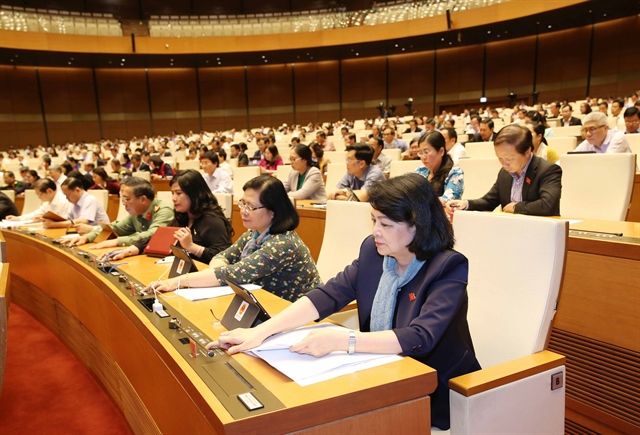
In June 2018, many were shocked to witness the largest demonstration in Vietnam since the end of the war in 1975, where thousands of people marched on the streets of several major cities. One of the reasons that compelled the Vietnamese people to protest was because of the proposed Special Economic Zones Law, which their National Assembly’s members were going to pass.
Despite the fact that under public pressure, the draft bill was ultimately announced to be halted until the next National Assembly’s meeting in October 2018, people still protested against it. Their reason? They feared that they were going to lose essential portions of their country to foreign investors, namely, the Chinese. The government of Vietnam, on the contrary, continued to insist on the passing of this law, citing economic development and jobs opportunities for hundreds of thousands.
Which side is right?
1. What Is A Special Economic Zone?
A Special Economic Zone (SEZ) is defined as an area in which business and trade laws are different from the rest of the country.
Theoretically, an SEZ can attract foreign investment, expand production, create jobs, and boost export-import. However, that would only happen if a set of conditions is met: the rule of law, together with clearly defined laws and regulations that both facilitate production and business activities, which are binding on all investors and able to adjust market failures, as well as other public issues.
In practice, and in the particular case of Vietnam, the government has yet to make available any information regarding the conditions under which the proposed SEZs will operate.
Can the SEZs create real jobs for the Vietnamese people? Can they boost production and trade? If they fail, and the nation falling into debts, who would be held accountable, and how? What are the punishments against them? Alternatively, will they say, “It’s none of your concern; it’s the Party and the State’s business”?
The above questions remain unanswered.
2. What Is The SEZ Project?
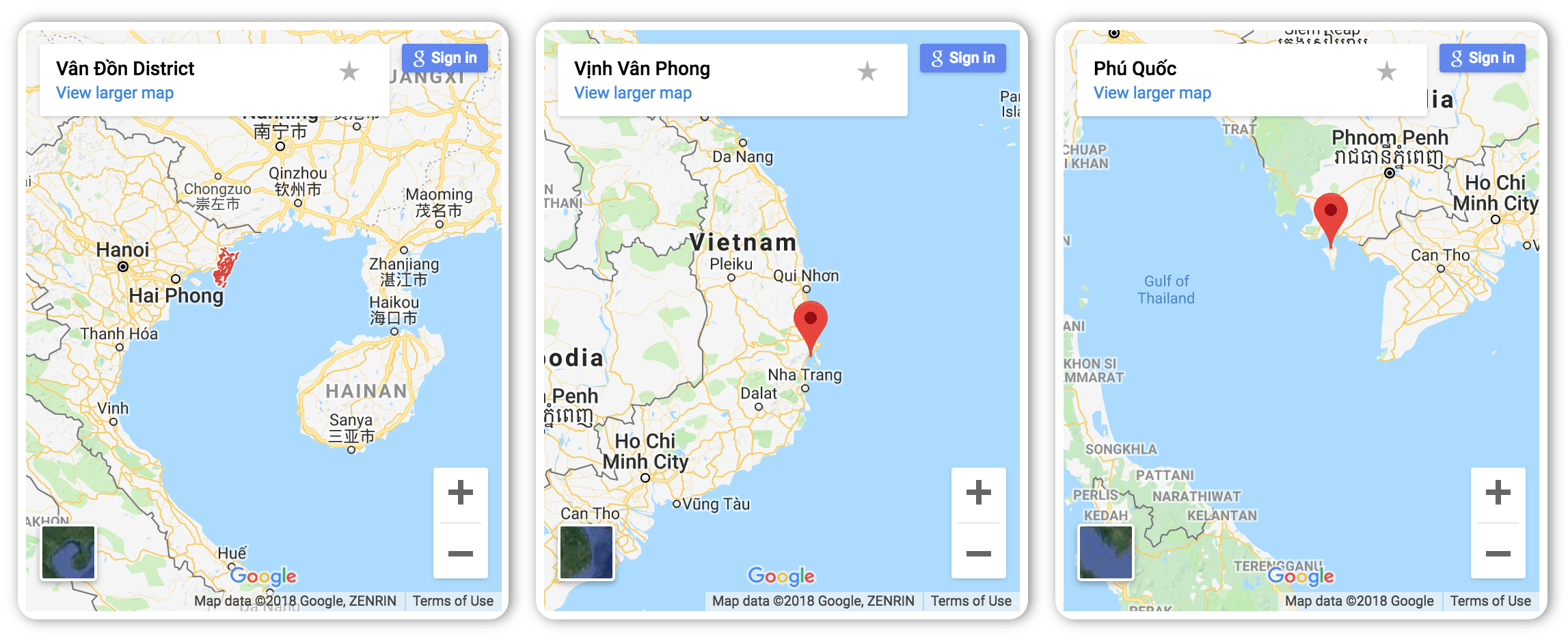
The SEZ project is a “grand policy” of the Politburo of the Vietnamese Communist Party (VCP), to establish three special economic zones in Van Don (a district in the Northeastern Province, Quang Ninh), Bac Van Phong (of Khanh Hoa Province), and Phu Quoc (of Kien Giang Province) as shown in the picture above. Foreign investors shall be granted special favors in these areas, for example, the 99-year land lease.
This project is codified in the proposed SEZ Law or the “Law on the Special Administrative-Economic Units”. Traditionally, and as in this time, the government of Vietnam does not publicize the names of the lawmakers concerned in any lawmaking process, so no one knows the architects behind the SEZ Law.
In case this SEZ Law is found to have contained some defects, or its enforcement would lead to severe consequences, no one, especially Party’s officials, shall be held responsible due to the lack of transparency and accountability in the country.
3. What Is “Special” About These Three Zones?
Overall, conditions in Van Don, Bac Van Phong, and Phu Quoc are not favorable for development. These include infrastructure, skills of the labor force, science and technologies, and financial-economic facilities.
Regarding geographic location, however, all the three districts are located in critically strategic sites of Vietnam, and they hold a crucial implication for national security. To make matters worse, Vietnam’s northern giant neighbor, China, where most of the potential investors would come from, has for centuries been known to keep an ambitious dream of becoming a hegemonic superpower.
China pays particular attention to Van Don and to Vietnam in general, whom she considers being the “buffer zone” for her to “move southward” to the geo-strategic South China Sea. For this reason, even when the SEZ law does not mention China but only refers to “foreign countries,” obviously China is the only nation the Vietnamese people are concerned about.
4. What Are The Goals Of The SEZ Project?
The SEZ project revolves around these promises: the three SEZs shall be where new institutions are tested and adopted with more freedom and less control, where innovation is stimulated, where more jobs are created, and more incomes are generated for local people. In short, the SEZs shall boost production and commerce, and lead to economic growth.
However, all of those promises remain vague and unfounded. Van Don, Bac Van Phong, and Phu Quo as stated, do not have favorable conditions to establish SEZs, because of poor infrastructure and technological bases and an unskilled labor market.
Most importantly, no political leader, no official of the VCP and the State shall bear any responsibility if those promises become unfulfilled. If the project fails, or if it causes any adverse consequences for the people and Vietnam, the victims would have no meaningful recourse.
5. What Are the Potential Consequences Of The SEZs That Vietnamese People Fear?
5.1. Territorial concession
By stipulating a land lease of up to 99 years and granting other special privileges to potential Chinese investors, the SEZ Law is paving the way for China to infiltrate Vietnam under her “salami-slicing” strategy.
Salami slicing is a strategy that the communist Chinese government has used since 1949 to take over territories in the South China Sea and the Himalayan region, in a gradual, step-by-step manner. The tactics were to open the door for Chinese immigrants to settle, do business, set up Chinese language schools, establish their own administrative system, and promote Chinese culture and customs in foreign lands. By doing that, they have legitimized China’s presence and power in the area and gradually built up Chinese autonomy inside Vietnam. If and when the time comes, this group with absolute autonomy could “rise” to demand sovereignty or for the Chinese-controlled area to “exit Vietnam and come back to merge into the motherland of China.”
5.2. A dumping ground for China’s waste
The SEZs may face the risk of failing to absorb advanced technologies and management skills, but that’s not it, after all. They are likely to become a market for low-quality products made in China and a dumping ground for her waste, most seriously toxic and e-waste.
5.3. The conflict between local people and Chinese immigrants
Overpopulation in China has led to high rates of unemployment and illegal immigration into neighboring countries, especially in Vietnam, where the government with its lousy governance fails to take control of the issue. As a result, bitter conflicts have arisen between local people and Chinese immigrants, which remain unresolved. In recent years, incidents of violent clashes have occurred between Chinese immigrants and the local Vietnamese community in Hai Phong, Quang Ninh, Thanh Hoa, Ha Tinh, as well as other provinces in Vietnam.
For example, in Quang Ninh in the mid-2000s, Chinese immigrants had thrown stones at Vietnamese people. In Thanh Hoa and Ha Tinh, drunken Chinese workers even falsely imprisoned a few local people after collectively assaulted them.
5.4. Economic loss
Accordingly, once the SEZ Law is passed, $70 billion USD shall be invested in the three SEZs, and that is like gambling ours and our children’s future on an uncertain race. Besides, with special favors granted to investors (mostly foreign) who could hardly be controlled, the government would definitely take the risk of substantial tax losses and budget deficits.
Many precedents can be found for this decision like this. One among them is the bauxite mining project in Tay Nguyen (Vietnam’s Central Highlands), which is also another grand policy of the VCP and the State. It was implemented despite public demonstration, notably the fierce protest from the late military general, Vo Nguyen Giap, and 4,000 Vietnamese intellectuals, domestic and overseas. The grand project lost almost US$170 million between 2013 and 2016. No one among those who made the promises for economic development and job opportunities for the locals were to take any responsibility for this loss.
With the government’s current institutions and management capacity, the SEZ project cannot and will not ensure economic success. The issue confronting the state is that if it fails like the Tay Nguyen bauxite mining project, no political leader shall bear any responsibility. Worse, if the SEZ project leads to territorial concessions, then it does not matter which leader or official of the VCP and the State takes responsibility, Vietnamese citizens would still suffer the irreversible consequences.
6. Why Does the VCP Insist On Implementing The Project?
The answer lies in the entrenchment of crony capitalism, with interest groups collaborating closely with the corrupt central and provincial governments, seeking to gain in grand projects in the name of “development.”
Also, “the obvious answer is ‘casinos and red-light districts,’ as these SEZs are the only places in Vietnam where these people can do business freely…. another reason that many people are aware of but still reluctant to spell out (for ‘political sensitivity’) is ‘the China factor.’ Otherwise, there is nothing else there” (Nguyen Quang Dy, 2018).
7. Is There Any Alternative Solution To The SEZ Project?
Experts point out that the SEZ idea was something that belongs to the last century, that it has become out of date, and that the SEZs are not relevant to the current circumstances of Vietnam. Instead, the urgent thing to do now is to launch a fundamental and comprehensive institutional reform in the nation, focusing on:
– setting the private sector as the basic economic sector, contracting the state sector to its minimum;
– recognizing and protecting private ownership of land;
– establishing democracy, and protecting and promoting freedom rights to mobilize the citizenry for the development cause of the nation.