Tag: social media

  • Vietnam: The New Code Of Conduct On Social Media Is Not Legally Binding

    Vietnam: The New Code Of Conduct On Social Media Is Not Legally Binding

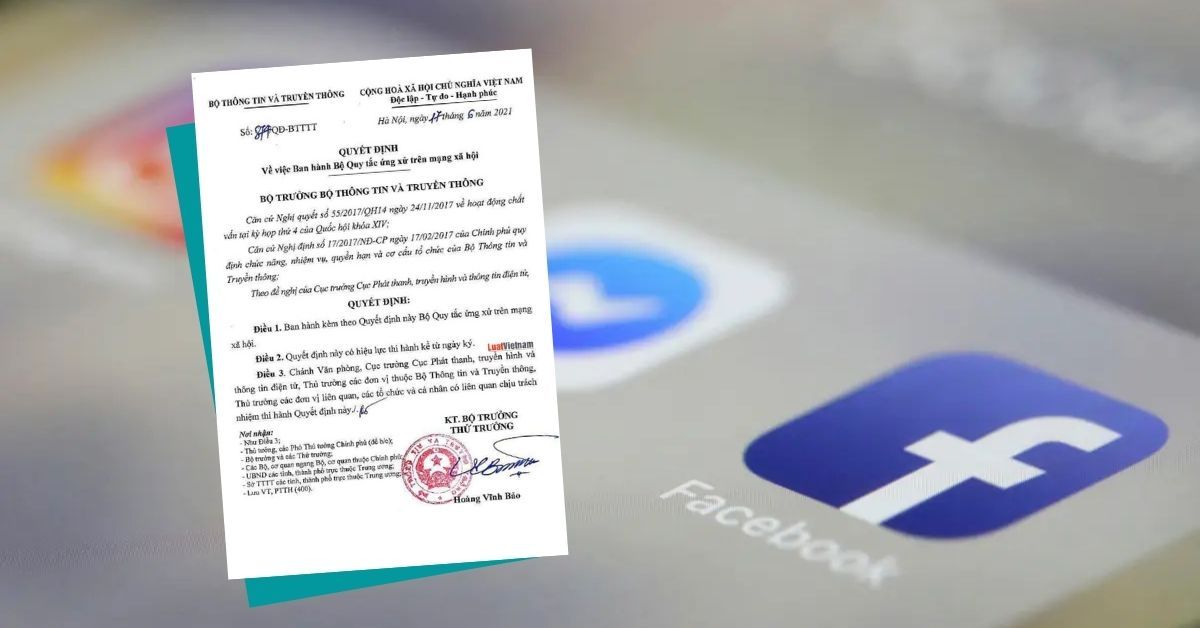
    On June 17, 2021, Reuters reported that Vietnam announced a national code of conduct for social media. This new code would be the national guidelines on social media behavior in Vietnam, where users are encouraged to post positive content about the country. There are certain prohibitions for social media users and companies, requiring that social media providers in Vietnam follow Vietnamese law when “requested by authorities to remove content from their platforms.”

    This national code of conduct is Decision 847/QĐ-BTTTT (Decision 847), and it was issued by the Ministry of Information and Communications (MIC).

    There are specific prohibitions throughout this decision, and it also lists the individuals and entities that are subject to the regulations. Yet, at the same time, the extent to which it is a legally binding document and how the government will enforce it is still ambiguous.

    Nevertheless, we can safely conclude that right now, under Vietnamese law, Decision 847 is NOT a legally binding document.

    Why is it not legally binding?

    This so-called national code of conduct on social media was issued as a decision from the minister of the MIC. These kinds of decisions in Vietnam are not legally binding documents under the Law on Promulgation of Legislative Documents 2015,

    Under its Article 3.1, the Law on Promulgation of Legislative Documents 2015 requires that legally binding documents should be “general rules of conduct, commonly binding, and applied repeatedly to agencies, organizations and individuals nationwide or within a certain administrative division, promulgated by the regulatory agencies and competent persons in this Law, the implementation of which is ensured by the State.”

    A minister of any ministry is deemed incompetent to promulgate legal documents if he or she issues only a decision, such as this Decision 847. Only a circular or a joint circular issued by a minister will be deemed legally binding documents. Therefore, Decision 847 cannot be treated as a legally binding document under Vietnamese law.

    Decision 847 cannot regulate social media users and providers.

    Technically, only binding legal documents can regulate its subjects, but Decision 847 is quite ambiguous.

    Article 2 of Decision 847 clearly defines the subjects that are being regulated, including official departments, state employees and officials who use social media. It also states that organizations and individuals who use social media and social media providers are all subjected to its regulations.

    Yet, under Article 8, which sets the implementation of Decision 847, it states, “the social users and companies are encouraged to fully execute the content of this decision and propagandize it to other organizations and individuals who are also on social media.”

    If Decision 847 only encourages its subjects to follow and propagandize it, it completely defeats the purpose of regulating users and companies on social media in Vietnam. Moreover, the vagueness and ambiguity of this decision reaffirm that it should not be a legally binding government document.

    Does the MIC want to regulate all the people, companies, and other governmental agencies in Vietnam with Decision 847?

    Typically, a decision from a minister would only affect his or her ministry. However, in developing this national code of conduct on social media, is it the intent of the minister of MIC to instruct and direct how citizens and other government departments should act on social media according to his standards of positivity and morality? Is it his or the government’s duty to coach citizens on behaving in our everyday life?

    Who will regulate the ethical and cultural values for the entire Vietnam? This country already lacks an independent court system, and this decision does not have any judicial oversight. So who will get to decide what ethics and culture are if Decision 847 is enforced? Is it the government’s decision to dictate good ethics, and what is a positive culture for Vietnam on social media? What will be the meaning of our freedom of expression if we actually behave and live like this?

  • Vietnam: The Communist Party Declared Internet “A Battlefield”

    Vietnam: The Communist Party Declared Internet “A Battlefield”

    The Head of the Vietnamese Communist Party’s Central Propaganda Committee – Vo Van Thuong – declared, during his concluding remarks at the committee’s year-end congress on December 29, 2018, that “the internet (in Vietnam) has become a new battlefield” for the Party in the fields of politics, thoughts, and culture.

    A day earlier, Thuong also made another remark at a different congress held explicitly by and for the press, telling journalists in the country to overcome having “vague political thoughts” as news reporters, especially when it comes to posting on social media.

    For non-Vietnamese, Mr. Thuong’s position seems to be quite intrigued and puzzling. Why would he get invited to speak to the journalists in the country at their year-end congress? What does his message to the media representatives even mean?

    On the other hand, for some over 800 editors-in-chief of all newspapers in Vietnam, however, Mr. Thuong’s words equate to an ultimatum as he is the chief of all of them. They would write as his committee directs, and take down those articles when the same committee disapproves.

    The Central Propaganda Committee is part of the VCP’s cord internal structure, with a mission to establish “direction for political thoughts in the field propaganda, news media, publishing, arts, and culture” for the Party. In reality, this committee’s job is not only to control the political thinking and shape the ideology of the four million VCP members but also the society in Vietnam as a whole.

    Its job is so essential for the survival of an authoritarian regime which is to ensure that there would only be one political doctrine for every single citizen to follow: communism. Anyone dares to propose other ideas for a different political philosophy, in many cases, face prosecution and long jail time. Any sign of dissent would be deemed as not accepting the ultimate leadership of the VCP in the country, and is a criminal act.

    However, for more than a decade, the VCP has failed to take control of the internet and social media in Vietnam. As the result, the people indeed took such opportunity to create a vibrant online civic space where they openly criticized officials, exposed wrongdoings, and even organized themselves.

    While the government repeatedly applied draconian and vague penal codes to arrest and imprison dissidents and activists for “propagandizing against the State” and “abusing democratic freedoms”, social media – especially Facebook and Youtube – continues to play a vital role in disseminating information which the VCP may disapprove of, such as reporting on human rights abuses and calling for democratization in the country.

    The new cybersecurity law of 2018 is the latest attempt from the government to practice absolute control over the internet in Vietnam. It is then not a surprise for us to hear strong and determining words from the Head of the Central Propaganda Committee, declaring war on bloggers and freelancers on social media.

    However, in the first few days of the year since the cybersecurity law took effect, the discussions on social media in Vietnam remain active and critical of the government.

    The most recent “battle” between Vietnamese netizens and Mr. Thuong’s Central Propaganda Committee happened last week, concerning the news that the VCP’s Politburo has approved more money to fund the development project for a metro system in Ho Chi Minh City.

    On January 4, 2019, most of the major newspapers in Vietnam published one same article online, stating that the Politburo has approved more than 50 billion VND for the construction of two metro lines in Ho Chi Minh City. Immediately, prominent bloggers and dissidents on social media like attorney Le Cong Dinh[1], questioned the legality of that decision.

    In Vietnam, the power to approve funding of similar projects supposedly belongs to the most powerful governmental body – the National Assembly. However, in reality, the Politburo would be the ultimate decision maker.

    In April 2018, when the people of Vietnam questioned the National Assembly’s reasons to pass the Special Economic Zone draft bill, the Chairwoman responded: “the Politburo has already decided, and the draft bill is not unconstitutional. We have to discuss and come up with the bill.”

    Nevertheless, this time, the Politburo seems to have to forego a “battle” on social media. By the end of the day, all of the articles about the funding of the metro project were taken down, probably at the order of the Central Propaganda Committee.

    ***

    [1] Le Cong Dinh was tried together with Tran Huynh Duy Thuc for subversion against the state in January 2010 where he was sentenced to five years imprisonment and three more years under house arrest.