Tag: right to assembly and protest

  • June 5, 2011 – The Beginning Of The Longest Anti-China Protest Movement In Vietnam

    June 5, 2011 – The Beginning Of The Longest Anti-China Protest Movement In Vietnam

    Our newest section on The Vietnamese Magazine, the “On This Day” series, aims to introduce contemporary Vietnamese history of the twentieth and twenty-first centuries by explaining political events that occurred today in the past.


    What happened on June 5, 2011?

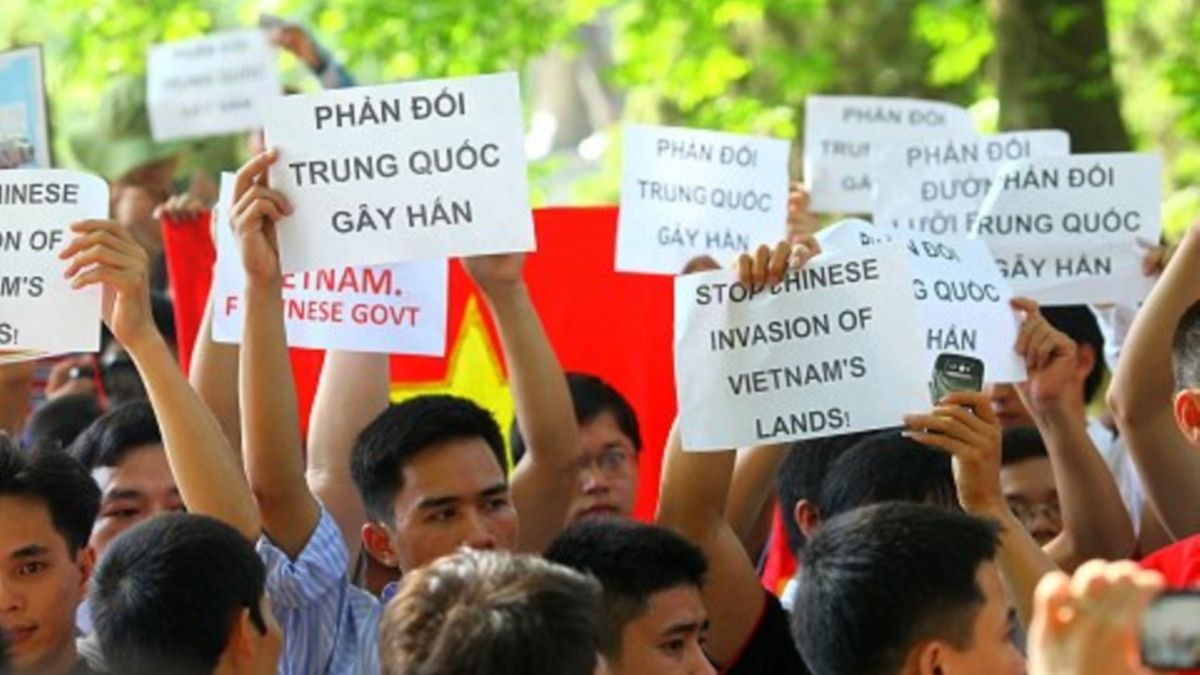
    Public demonstrations and protests are sporadic in Vietnam. But on this day, 10 years ago in 2011, it was the beginning of the longest anti-China protest movement in Vietnam after 1975.

    For almost three months of the summer of that year, a total of 11 protests happened across Vietnam every Sunday, primarily conducted in Hanoi and Saigon, where the Chinese embassy and consulate were placed. Many people call this movement “The Flaming Summer” (Mùa Hè Đỏ Lửa).

    Why were people protesting on that day?

    Since China established the eleven-dash line map (now the nine-dash line map) claiming sovereignty of various regions in the South China Sea, the Vietnamese people have always been angered by China’s claims to the Paracel and Spratly islands, known as the Truong Sa and Hoang Sa islands by the Vietnamese.

    In the summer of 2011, people especially felt provoked by the actions of Chinese vessels in the contested sea. In late May, the news reported that the Chinese vessels were harassing Vietnamese survey vessels and disrupting the Vietnamese vessels’ activities. Later in early June, Chinese ships once again harassed Vietnamese survey ships.

    What was the regime’s response to the protests?

    After supposedly tolerating the protests for a short period of time, the regime nevertheless decided to crack down on the protestors. In late August, the police began to detain people who participated in the protests, forcing 40 protestors onto two buses right after the last rally started on August 21. It was confirmed that at least 47 protestors were arrested. The Hanoi local government warned people against protesting any further.

    What is the legacy of the protests during that summer?

    The waves of anti-China protests in 2011 were not the first nor the last. Earlier in 2007 and 2008, there were also anti-China protests by many bloggers and pro-democracy activists, which also resulted in the government’s crackdown. Later in 2014 and 2018, there were also new anti-China protests.

    However, the protests in 2011 were significant because of their duration, scope, and effect on Vietnam’s pro-democracy discourse. In many ways, it was an unprecedented movement.

    Compared to other anti-China protests, the 2011 protest movement had the most prolonged duration, lasting the entire summer. The demonstrations were also massive compared to others, with the participation of hundreds of people. Some of the rallies were estimated to have around a thousand people. This fact is exceptionally significant for a country infamously known for repressing protests.

    Although the government repressed the protests, they still demonstrated to the Vietnamese government that the people could disagree with the government and willingly show it. Additionally, the protests also sowed the seeds of government criticism among the people. The movement provoked many intellectuals and highly-credited ex-government officers to speak out against the Communist Party and demand democracy.

    Many participants of these protests, such as The Vietnamese Magazine’s co-founder and editor Trinh Huu Long, would later become pro-democracy activists.

    The protests in 2011 were the beginning of “a prolonged civil society movement that still exists nowadays,” said Long.
  • Vietnamese Government Celebrates National Day By Violating Its Own Constitution

    Vietnamese Government Celebrates National Day By Violating Its Own Constitution

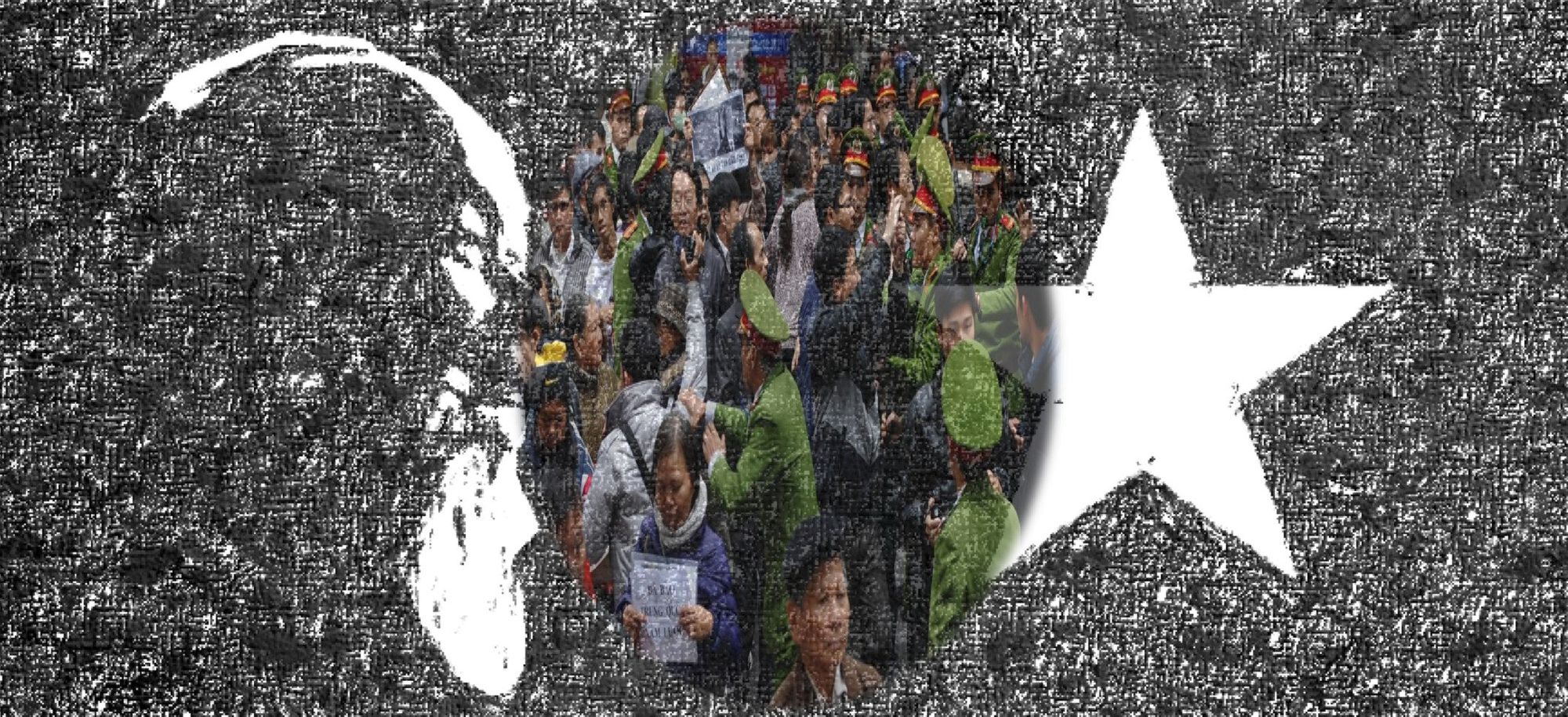
    Today| marks the 73rd year since Ho Chi Minh stood at Ba Dinh Square on September 2, 1945, and proclaimed that all people shall enjoy their natural rights in the pursuit of happiness. Thus, it is quite hard to imagine that the current regime – who is supposedly following Ho Chi Minh’s teachings – has decided to mark such an auspicious occasion with a stern, yet illegal, warning to all citizens: do not go out and protest.

    But that is precisely how the Vietnamese authorities have decided to honor the birth of their nation this year, by loudly ordering the people not to participate in any form of public demonstration on Vietnam’s Independence Day.

    Throughout August, high-ranking officials in the Vietnamese Communist Party have taken turns assaulting the human right to assembly, a right enshrined in Vietnam’s 2013 Constitution.

    First, it was To Lam, head of the Ministry of Public Security (in charge of the national police force). Lam assured the Standing Committee of the National Assembly on August 13, 2018, that the police would take all possible measures to prevent people from participating in protests after he was admonished by Committee members for the mass protests that took place in June.

    A few weeks later, Hanoi city leader and high-ranking police official Nguyen Duc Chung also vowed that he would not allow “any crowds to publicly gather” under his watch during Independence Day weekend.

    Several state-owned media outlets during the past week “coincidentally” published articles condemning both the June 10th protestors and the call on social media accounts for a nationwide protest on September 2nd. The government seems to blame overseas groups, some of which have been declared “terrorist organizations” in recent years by Vietnamese authorities.

    News has also surfaced both on social media and on official news agencies that the police have arrested a small number of individuals disseminating information “against the state”, including one who was caught trying to enter Vietnam through Cambodia with several weapons.

    Minister To Lam has publicly congratulated the police forces of Binh Dinh and Phu Yen provinces for arresting the armed individual whom the government believes to be a member of Viet Tan, one of the aforementioned overseas groups. Viet Tan denied this accusation on the same day the individual was arrested.

    While no protest broke out today, the political sphere remains tense, and Vietnam is not in much of a celebrating mood compared to previous years.

    The Special Economic Zones draft bill is still dangling over citizens’ heads. The people are continuously wary of their country becoming ever more dependent on China.

    The government is not exactly helping, with the national bank announcing last Thursday that the Chinese renminbi could soon be used in trading activities along the country’s northern border, starting in October.

    There were also reports of the internet being down – again – due to cable issues during the last week of August (the fourth time in 2018 thus far). In Vietnam, internet outages often “coincide” with periods of social and political turmoil, as was observed when Vietnamese protested the Taiwanese steel mill, Formosa Ha Tinh, back in May 2016.

    Earlier this month, activists were also brutally assaulted by police officers for simply gathering at a small concert in a Ho Chi Minh City cafe. Many of these activists were also placed under surveillance this holiday weekend.

    Are the reactions from the Vietnamese government in August just overblown paranoia or do they have reason to fear the people?

    It is difficult to say.

    However, we do know from the writings of several state-owned newspapers that the government is extremely wary of anything remotely resembling the “color revolutions” or the Arab Spring in Vietnam. They prefer to take pre-emptive measures, using all means to prevent demonstrations, even if doing so would mean breaking their own laws and constitution.

    Moreover, the Vietnamese government does not distinguish between peaceful dissidents and those who call for a violent overthrow of the government, and the case of one of their most famous political prisoners, Tran Huynh Duy Thuc, is the best example.

    Thuc was sentenced to 16 years imprisonment back in 2009 for “subversion against the state,” and the evidence used to uphold the conviction included his writings pleading with the government to take rapid and immediate action to preserve economic growth and avoid over-dependence on China.

    Before his arrest, Tran Huynh Duy Thuc was one of Vietnam’s most successful entrepreneurs, with the government unable to find any evidence of wrongdoing within his multi-million dollar business after raids. Western countries have offered Thuc political asylum on multiple occasions, but he refuses to leave his country to live in exile.

    His latest defiant act—a hunger strike—protesting what he calls “an unjust judicial system,” again put the Vietnamese government in a predicament: they could not justify his imprisonment to the increasingly informed public. September 2, 2018 marks the 20th day of Thuc’s hunger strike.

    Up until last month, Thuc had received the longest sentence for a political prisoner: 16 years imprisonment, followed by 5 years of house arrest.

    In August, the record was surpassed by Le Dinh Luong, who was sentenced to 20 years imprisonment, again for “subversion against the state.” Luong was known by his peers as an activist who campaigned against the environmental destruction caused by corporations and development projects.

    The VCP has managed – especially in recent years – to ensure that its human rights records rival that of its big Communist brother, China, with more suppression and harsher sentences against activists.

    But will more suppression lead to a stable and peaceful society as the VCP hopes for, or will blurring “peaceful dissent” with “subversion against the state” further chip away at the government’s legitimacy? The answer remains unclear.

    What we do know, however, is that history has never been on the side of regimes that refuse to engage in dialogue with dissenters, that refuses to heed the people’s discontent. One need only look at Vietnam’s own history to see this fact in action.

  • Vietnam, A Step Closer to Democracy With The Latest Nationwide Protests?

    Vietnam, A Step Closer to Democracy With The Latest Nationwide Protests?

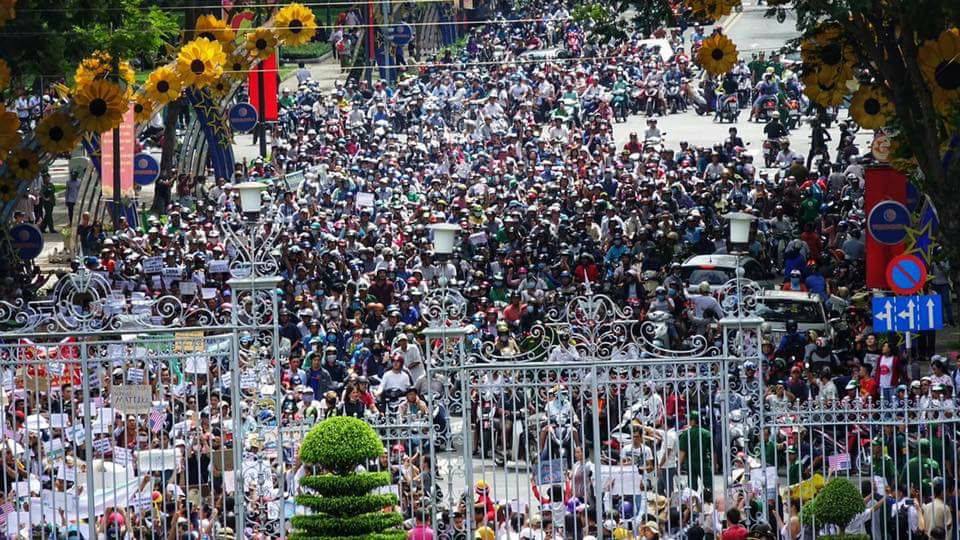
    June 10, 2018| Nationwide protests broke out in several major cities in Vietnam in the morning and lasted well into the afternoon. As of press time, the demonstrations are still ongoing with reports of several arrests and incidents of police assaulting protestors while observers mostly described the participants as peaceful.

    This time, the protests seemed to have not been organized by any groups, and the more well-known dissidents and activists were not leading the crowd. However, it was the small groups of concerned citizens coming together with substantial knowledge on their right to assemble and protest that made June 10, 2018, both memorable and surprising to people.

    People were gathering and rallying in several cities this morning, Hanoi, Saigon, Nha Trang, Da Nang, and even smaller areas such as My Tho – Tien Giang, Ho Nai – Dong Nai and a few Catholics parishes in Nghe An Province.

    But it may very well be the turn of events in Saigon – Hochiminh City today that has shown a level of political awakening that many observers have not seen before.

    People started to gather at around 8:30 a.m. local time, coming to several areas in Saigon, from the Notre Dame Cathedral Basilica in District One, walking district Nguyen Hue, in front of the U.S. Consulate, to Hoang Van Thu park near Tan Son Nhat airport. From around 500 people at one area to thousands more at another spot.

    The participants have used the Livestream feature on Facebook to record the protests where they showed how knowledgeable the regular persons could be when it comes to their rights as citizens.

    People at one location, while demanding that the police released those who were arrested, have questioned them:

    “Have you read the Constitution. Do you know what Article 25 is? Do you know that arresting protestors is unconstitutional?”

    Even when faced with assaults from police and security forces, the videos showed people were trying to tell each other to remain calm, to document the incidents with photos and videos, and do not fear because: “We did not do anything wrong!”

    In Hanoi, the security forces acted swiftly in rounding up protestors and broke up the rallies. But in Saigon, thousands of people were on the streets, and by the afternoon, it seemed as if the demonstration has become unstoppable even with the police started their crackdown.

    An online call to protest against the draft law creating three Special Economic Zones (SEZ) received over 160,000.00 shares on Facebook this past week. The government acted and postponed the SEZ draft law on early Saturday morning when the probability that the people will take to the streets started looming, but such efforts seemed to be futile.

    The SEZ draft law was not the only bill that the citizens find problematic.

    The people have a major concern regarding the SEZ draft law is because of the China factor. Anti-China rallies are nothing new in Vietnam, and for the past decades, it was the most common reason for the people to let go of their fears and gather on the streets protesting.

    This time, many fear that their government has sold them short to the Chinese investors and that the SEZs will turn into mini China(s) inside Vietnam once the law goes into effect.

    However, there is also the Cybersecurity draft bill pending for a vote on June 12, 2018, where Vietnam attempts to place all of its people under Big Brother’s watch, criminalizing many online activities, from misrepresenting historical facts to merely speaking unfondly of the government.

    Thus, efforts were also made by several civil society groups leading by Hate Change, calling on people to also protest against the Cybersecurity draft law.


    Protestors on motorbikes in Saigon, denouncing the SEZ draft law. Photo Courtesy: Nguyen Nu Phuong Dung’s Facebook.

    One of the groups that showed up early at the Notre Dame Cathedral Basilica in District 1, Saigon, protesting against both draft laws, SEZ and Cybersecurity. Photo Courtesy: Nguyen Nu Phuong Dung’s Facebook.

    The crowd at one spot near Hoang Van Thu park, Saigon. Photo Courtesy: Nguyen Nu Phuong Dung’s Facebook.

    Crowd near Tan Son Nhat airport. Photo Courtesy: Nguyen Nu Phuong Dung’s Facebook.

    People gathered in front of Reunification Palace aka Independence Palace in Saigon. Photo Courtesy: Nguyen Nu Phuong Dung’s Facebook.

    Another group of protestors on motorbikes in Saigon. Photo Courtesy: Nguyen Nu Phuong Dung’s Facebook.

    One protestor being assaulted by the security forces. Photo courtesy: Will Nguyen’s Twitter.

    Security forces arrested people in Hanoi. Photo courtesy: Hien Trinh’s Facebook.

    Security forces arrested people in Hanoi. Photo courtesy: Hien Trinh’s Facebook.

    Protestors against Cybersecurity draft law in Saigon. Photo courtesy: Vi Yen Nguyen

    Young people raised banner against Cybersecurity draft law in Saigon. Photo courtesy: Vi Yen Nguyen

    The pictures above are from today’s protests in Hanoi and Saigon-Hochiminh City. The Vietnamese thanks the owners of these pictures for their courtesy, and please contact us for photo credits because we have received them from a few sources on Facebook and Twitter.