Tag: religion bulletin

  • Religion Bulletin, July 2021: Government Discusses Religious Resources In The Realm Of Social Welfare

    Religion Bulletin, July 2021: Government Discusses Religious Resources In The Realm Of Social Welfare

    https://2xjs7y10oiyz26vqxu2hok6y-wpengine.netdna-ssl.com/wp-content/uploads/2021/08/image-7.jpeg
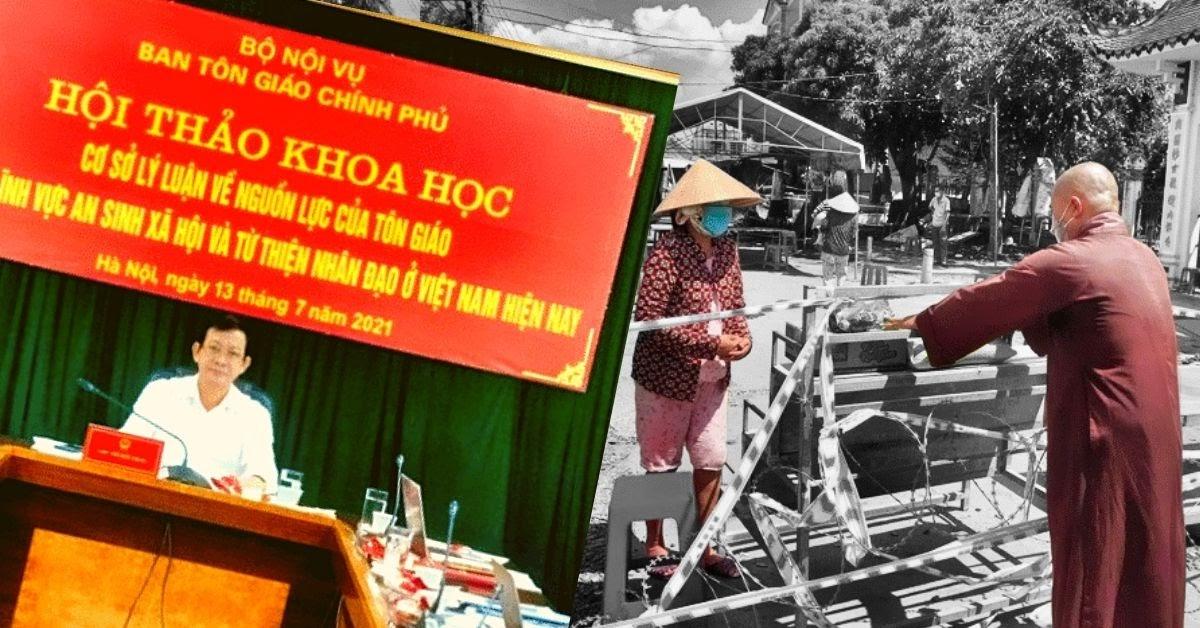
    Photo: Government Committee for Religious Affairs (left), Giac Ngo Newspaper.

    Dear readers,

    We know you and your loved ones may be experiencing difficult days as the pandemic rages on. We hope you all remain safe and healthy.

    As all of Vietnam faces down the fourth wave of COVID-19, religious activities, as with other activities involving gatherings of people, carry the risk of spreading disease. This fact has caused the public to become more or less averse to religion.

    We should not forget that religious organizations have been a sizeable resource in helping the community through difficult times.

    Over the past few weeks, Ho Chi Minh City has faced a crisis in social welfare, and religious organizations have stepped up to support the people. However, compared to other countries in the region and with the south before 1975, religious, philanthropic activities nowadays encounter many obstacles.

    This July, the Government Committee for Religious Affairs organized a seminar on religious organizations’ resources and their relationship to social welfare. When will these religious organizations be able to conduct charity independently and without hindrance?

    The Government’s Reach

    The Government Committee for Religious Affairs discusses religious resources in the realm of social welfare

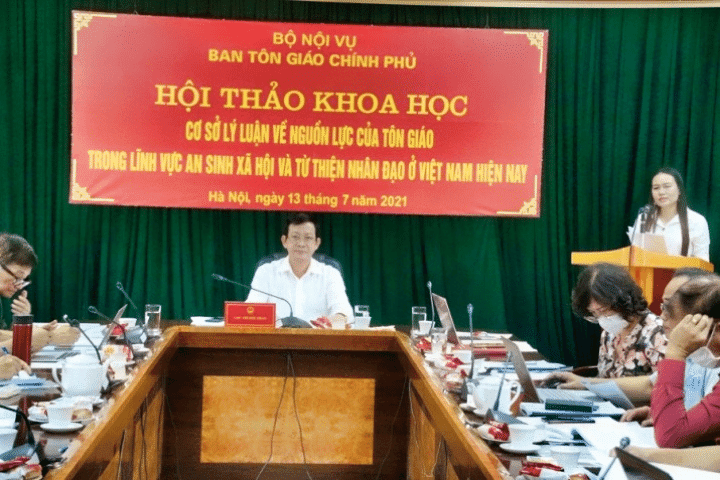
    On July 13, 2021, the Government Committee for Religious Affairs convened a seminar with some researchers, religious dignitaries, and representatives of central ministries and branches to take stock of the resources religious organizations possess for social welfare and philanthropic activities. [1]

    The seminar was organized as Ho Chi Minh City (HCMC) faced a severe social welfare crisis due to the government’s tightening of social distancing guidelines to contain a COVID-19 outbreak.

    The Government Committee for Religious Affairs stated that the seminar aimed to evaluate the ability of religious organizations to function as independent entities in charity and social welfare activities.

    Nguyen Anh Chuc, deputy head of the committee, stated that these religious organizations’ activities were still unorganized and spontaneous.

    “Because of this, there needs to be a clear and transparent legal corridor in social welfare work, as well as increased coordination between the Fatherland Front and religious organizations,” Chuc declared.
    https://2xjs7y10oiyz26vqxu2hok6y-wpengine.netdna-ssl.com/wp-content/uploads/2021/08/image-1.png
    Scene from a seminar organized by the Government Committee for Religious Affairs. Photo: Government Committee for Religious Affairs.

    After 1975, social welfare and philanthropic activities conducted by religions were disrupted. Many facilities, such as schools, hospitals, relief organizations, and orphanages, were confiscated by the government and banned from operating.

    Today, religious organizations are allowed to operate in preschool education (kindergarten) and vocational training, but only to a minimal degree. They have not yet been allowed to resume general education activities.

    For nearly five decades, the government has asserted that religious organizations must focus strictly on religion and help the state implement policies establishing national unity. This view has led to policies that precisely control the participation of religious organizations in other areas.

    Article 55 of the 2016 Law on Faith and Religion permits religious organizations “to participate in educational, training, medical, social welfare, philanthropic, and humanitarian activities in accordance with relevant laws.”

    However, the 2016 law and other codes and legal documents do not regulate specific charitable and social welfare activities, nor the level or conditions of participation for religious organizations. The legal recognition of religious organizations is still minimal, and they are not allowed to set up their organizations for charitable activities.

    Furthermore, the state strictly controls the resources of religious organizations in charity and social welfare activities. For example, religions seeking to fundraise domestically or accept foreign aid must undergo very complicated procedures.

    In reality, charity and humanitarian activities are the core values of many religions. Currently, religious organizations still maintain a few charitable activities but only on a small scale. Current policy does not allow them to operate on a larger or more professional scale, as before 1975.

    Read more: After five decades of prohibition, will the doors to professional charity by religions be opened?

    Central Propaganda Department issues instructions for propaganda regarding ethnic groups and religions

    The articles you read and the television programs you watch about religion may be part of a state propaganda campaign.

    On July 19, 2021, the Central Propaganda Department issued guidelines for state agencies and press organizations on propaganda about ethnicity and religion. [2]

    According to the guidelines, propaganda about ethnic groups and religions will focus on cadres, party members, and residents in areas deemed “complicated and sensitive” (remote, upland, and border areas with many religious practitioners). The substance of the propaganda will include the state’s policies and achievements in matters of religion and ethnicity and its rebuttals to the accusations of independent press and human rights organizations regarding religious and ethnic issues.

    The propaganda will be issued comprehensively overall mass media, in newspapers, on social media, in the streets, and even during religious sessions.
    https://2xjs7y10oiyz26vqxu2hok6y-wpengine.netdna-ssl.com/wp-content/uploads/2021/08/image-2.png
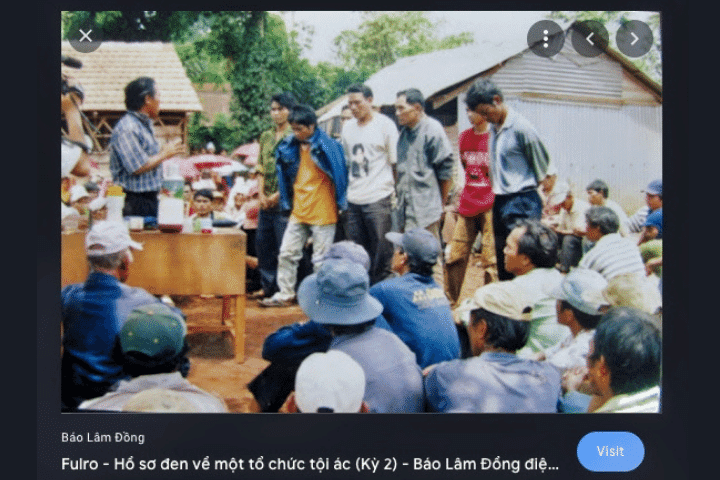
    An article from Lam Dong Newspaper with the headline “Fulro – the black record of a criminal organization.” It is one of the many propaganda articles on ethnicity and religion that were published in April 2021. Photo: screenshot.

    The guidelines also state the Ministry of Information and Communication has the task of controlling mass media on ethnic and religious issues and must strictly punish those who provide incendiary or false information.

    The Ministry of Education and Training is responsible for inserting propaganda on ethnicity and religion into the educational curriculum at every level of study.

    The guidelines assert that it is necessary to fight against and criticize activities that “propagate false religions, incite practitioners to oppose the regime, […] practice superstitions, […] and distort the truth on democracy, ethnic equality, and freedom of belief and religion in Vietnam.”

    The Vietnamese government maintains complete control over ethnic and religious affairs. Upland areas with large ethnic minority populations are subject to more stringent rules than urban areas. Even though the government recognizes the religious activities of ethnic minorities, they must be reported and are closely monitored.

    Religion 360*

    Risk of COVID-19 infection for prisoners of conscience in prisons and temporary detention centers

    According to The 88 Project, Vietnam currently holds in its custody 179 prisoners of conscience. Another 37 are in temporary detention, waiting to be tried for “crimes” related to their political activities or freedom of speech. Among those serving their sentences or in temporary detention, 59 cases have to do with freedom of religion. [3]

    As COVID-19 rapidly spreads across many locations, prisons and temporary detention centers also face a high risk of infections. The most recent example involves an outbreak among detainees at the Chi Hoa Detention Center in HCMC; on July 7, 2021, the HCMC Department of Health reported 81 cases of COVID-19 there, including 45 cadres and 36 inmates. [4]

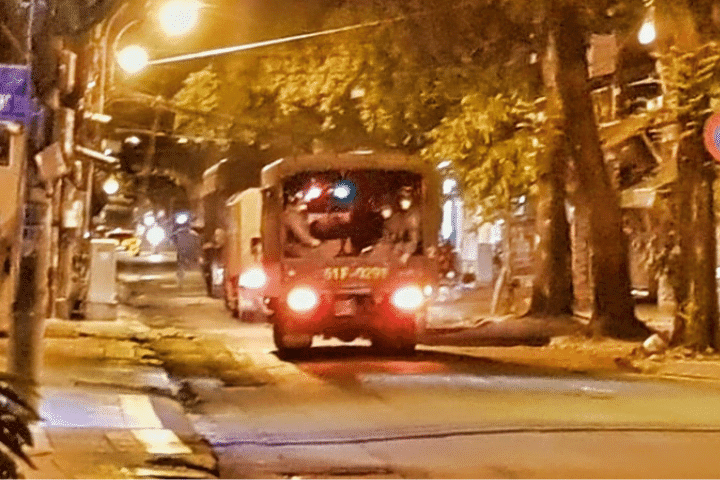
    Before that, on the evening of July 6, the press had reported a prison riot at the same detention center. [5] According to information provided by the government, the riot was caused by an inmate who created a scene while the detention center was conducting COVID-19 screening. The press reported that riot police were mobilized to the detention center to handle the disturbance and that people in the surrounding area heard gunshots coming from the detention center.
    https://2xjs7y10oiyz26vqxu2hok6y-wpengine.netdna-ssl.com/wp-content/uploads/2021/08/image-3.png
    A regiment of riot police leave the Chi Hoa Detention Center on the night of July 6, 2021. Photo: Dinh Van / HCMC Municipal Committee.

    On July 7, some inmates were transferred to the T30 Detention Center in Cu Chi Suburban District to implement social distancing. [6] However, the authorities have not released any further information on the COVID-19 situation at the Chi Hoa Detention Center.

    The government has stated that prisons and detention centers across the country were strictly implementing COVID-19 prevention measures. [7] Nonetheless, the disease has spread throughout Hanoi, HCMC, and the Mekong Delta, bringing with it concerns of infection in areas of dense incarceration, particularly given that more than 500 suspected cases of infection were discovered at the Bo La Drug Rehabilitation Facility in Binh Duong Province at the end of July 2021. [8]

    The government has not made any announcements on vaccinating criminals or prisoners. Currently, all temporary detention centers and prisons have stopped inmate visitations.

    More than 1,000 practitioners, monks, and nuns volunteer to look after COVID-19 patients in Ho Chi Minh City

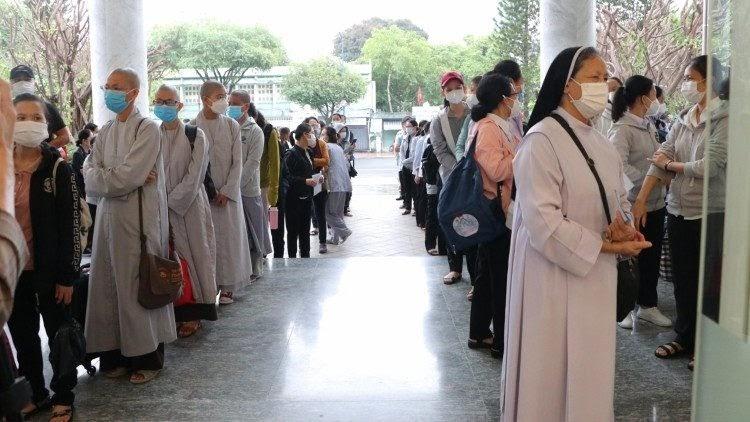
    As of July 20, 2021, more than 1,000 practitioners, monks, and nuns of Buddhism, Catholicism, and Protestantism have volunteered to serve at field hospitals in HCMC. [9] This number continues to grow.

    On July 22, about 300 more volunteers of different religions set out to COVID-19 treatment hospitals in the city of Thu Duc to support patient care.
    https://2xjs7y10oiyz26vqxu2hok6y-wpengine.netdna-ssl.com/wp-content/uploads/2021/08/image-8.jpeg
    On July 7, 2021, 299 more volunteers of different religious organizations began spreading themselves out across three field hospitals in HCMC. Photo: Vatican News.

    Before this, the Vietnamese Fatherland Front Committee in HCMC had called on “all classes of people, religious organizations, and compatriots” to support the fight against the COVID-19 pandemic, [10] marking a rare occasion where the government officially sought the support of religious organizations.

    The COVID-19 pandemic still rages in HCMC. The current number of infected persons has exceeded 100,000 and continues to increase. According to the Ministry of Health, as of August 6, 2021, more than 2,000 people have died.

    New Religions

    You may not have heard of the activities of new religions, but that does not mean these religions don’t exist. New religions are developing all over Vietnam. Before judging their activities, we should first understand how they suffer daily harassment from the state and the press.

    7 Falun Gong practitioners punished for gathering during lockdown

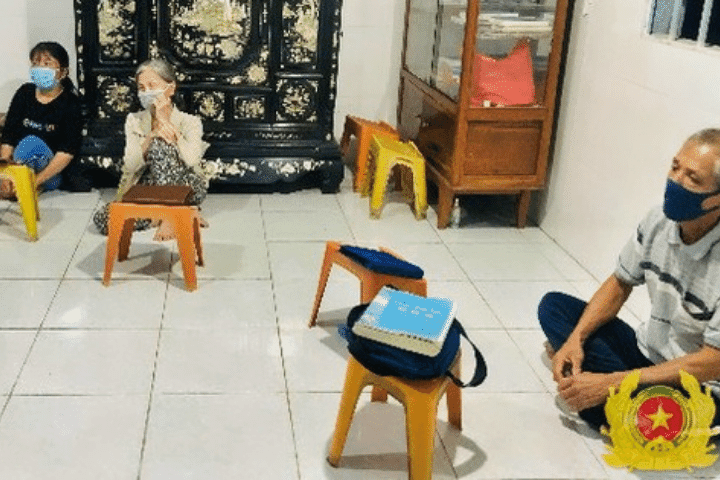
    On July 7, 2021, Tuoi Tre News reported that seven Falun Gong practitioners were administratively punished by the authorities of Tan Hung Commune, Cai Be Suburban District, Tien Giang Province, for gathering while the province was implementing social distancing. [11]

    According to the article, on June 24, 2021, six people gathered at a household in the commune to practice Falun Gong together. Each person was fined 7.5 million dong ($328) for violating local pandemic regulations.

    The sanction of this Falun Gong group was not an isolated incident. In 2020, when pandemic regulations were not applicable, the government continuously banned this group from operating and sanctioned them for various other reasons. [12]

    Local authorities and the press heavily condemn the Falun Gong movement, and they have seen it as a “false religion” that gravely affects people’s health. However, the religion has developed across many provinces and cities, and many practitioners claim that they benefit from its practice.
    https://2xjs7y10oiyz26vqxu2hok6y-wpengine.netdna-ssl.com/wp-content/uploads/2021/08/image-4.png
    Three of the seven Falun Gong practitioners were administratively punished on June 24, 2021, in Tien Giang. Photo: provided by police.

    Since the beginning of 2021, the government’s obstruction of Falun Gong activities has not appeared in media as much as in 2020. Reasons may include the government’s increased propaganda activities hindering the religion’s practice and the complications surrounding the COVID-19 pandemic.

    At the end of May 2021, the press heavily covered the case of infections at the Phuc Hung Missionary Church in HCMC. On May 29, 2021, Go Vap District police issued a decision to move ahead with prosecution for the crime of “spreading a dangerous and infectious disease to others.” [13] As of the end of July 2021, police have not released more information about this case.

    Chairman of Mang Yang Suburban District, Gia Lai Province: no followers of the Ha Mon religion remain

    If you’ve been following previous religious news, you’re probably familiar with the fact that the government considers the Ha Mon religion in the Central Highlands a “false” one. The religion is currently facing extinction in Gia Lai Province.

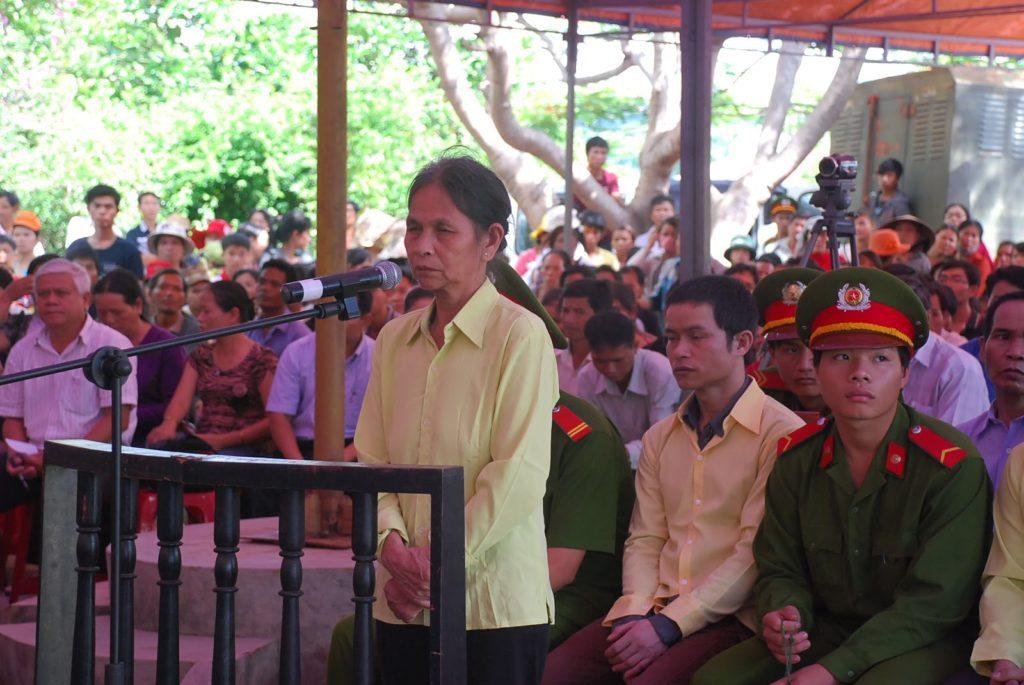
    In July 2021, a Mang Yang Suburban District representative told Dan Vietnewspaper that the district no longer had anyone who followed the Ha Mon religion. According to Le Trong, chairman of the suburban district’s People’s Committee, “those who were lured and deceived into following the false Ha Mon religion were educated and mobilized to return to their families” and received local support “to reintegrate into the community.” [14]

    Trong also revealed how the government propagandizes and mobilizes, including “evaluating impoverished and borderline-impoverished households.”

    According to Trong, villagers will “evaluate impoverished and borderline-impoverished households (those who previously followed the false religion in particular, and the entire population in general)” according to the principles of democracy and fairness. From there, the locality will come up with “suitable approaches,” such as bank loans and participation in agricultural expansion programs and models, etc.

    The statement indicates that the Mang Yang Suburban District government has used the household poverty line to force families to give up the Ha Mon religion. This act is contrary to official regulations. [15] The household poverty line is based on per capita income and deprivation in accessing essential social services.
    https://2xjs7y10oiyz26vqxu2hok6y-wpengine.netdna-ssl.com/wp-content/uploads/2021/08/image-9-1024x685.jpeg
    Y Gyin, the founder of the Ha Mon religion, was sentenced to 3 years in prison during a May 2013 preliminary trial held in mobile court. Photo: Quang Hoi/ Border DefenseNewspaper.

    Over the years, many Central Highland Montagnards who belong to unrecognized religious groups have attested that the local authorities punish them economically by not approving impoverished household designations and bank loan applications, stripping them of social welfare benefits, or refusing to provide administrative services such as ID card provisions and marriage registrations.

    The Mang Yang Suburban District People’s Committee chairman has also stated that the government has encouraged the children of families who follow the Ha Mon religion to continue going to school.

    Several witnesses have told Luat Khoa that local authorities in the Central Highlands increase tuition fees for families who belong to unrecognized religious groups as a form of punishment.

    In July 2021, the People’s Army Newspaper also reported that “the Ha Mon religion no longer existed on Gia Lai land.” [16] The Ha Mon religion uses Catholic teachings as life precepts; practitioners do not go to church but practice rituals at home. In 2011, the religion had 1,357 followers in Mang Yang Suburban District.

    New religions in Dak Nong

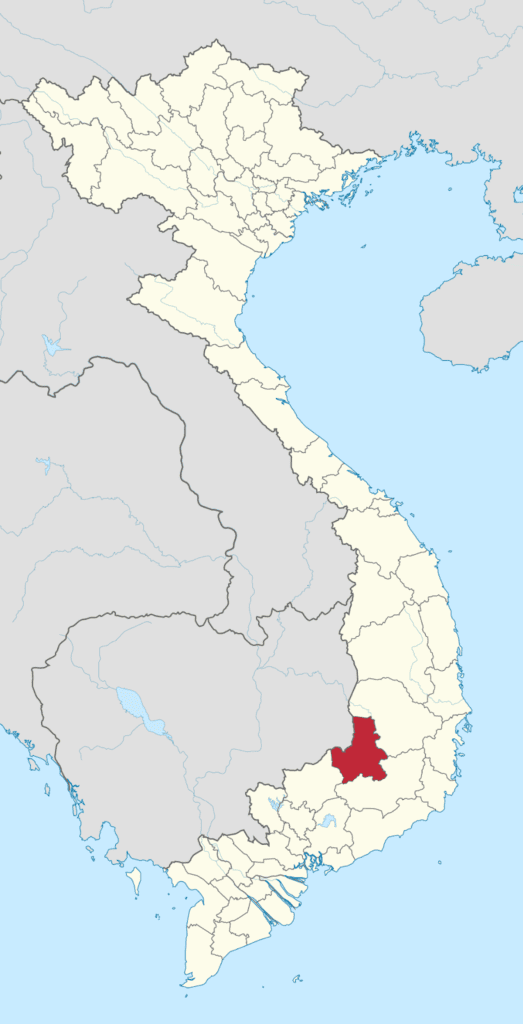
    The Dak Nong News reported that the province saw numerous activities carried out by new religions and that provincial authorities were tackling these religious groups. [17]
    https://2xjs7y10oiyz26vqxu2hok6y-wpengine.netdna-ssl.com/wp-content/uploads/2021/08/image-5-523x1024.png
    Dak Nong province is shaded red on this map of Vietnam. Photo: TUBS.

    Religious activities considered illegal in the province include “building structures for the purpose of unauthorized religious activities; improperly using the name of the ‘Vietnamese Protestant Church’ for associations and groups, and causing difficulties in the state’s management of religion.”

    The newspaper cited two cases in the Dak Nia Commune, Gia Nghia Suburban District, accused of conducting for-profit religious activities but did not provide any evidence. In both cases, it was alleged that temples were built without government permission.

    Furthermore, the provincial Religious Affairs Committee reported that land was being illegally donated and transferred to build religious facilities, that religious activities were being self-organized without the participation of a state-recognized sangha, and that group religious activities were unregistered with local authorities.

    People following new religions are becoming increasingly common in Vietnam. However, it is challenging for these religions to meet the strict government requirements for recognition according to the Law on Faith and Religion.

    Tuyen Quang police: alerting the people not to follow “religion seeking to firmly establish the rule of law at its heart”

    After Hai Duong Province, Tuyen Quang provincial police also alerted people to the activities of the “religion seeking to establish the rule of law at its heart firmly.” [18]

    Police reported that the religion attracted participants through live videos on social media, including content that criticized political, social, and religious situations.

    Like Hai Duong provincial police, Tuyen Quang provincial police on social media urged people not to listen to the shared information and invitations to join the religion. Police claim the religion’s statements violate state laws, propagate superstitions, and take advantage of beliefs for personal gain.

    “Subjects of the ‘religion seeking to establish the rule of law at its heart’ firmly have taken advantage of the right to freedom, democracy, and freedom of speech, as well as taken advantage of belief and religion to operate illegally,” the Capital Security Newspaper said, citing the announcement by Tuyen Quang provincial police.

    Information on this religion has been removed from popular social media platforms in Vietnam, such as Youtube and Facebook.
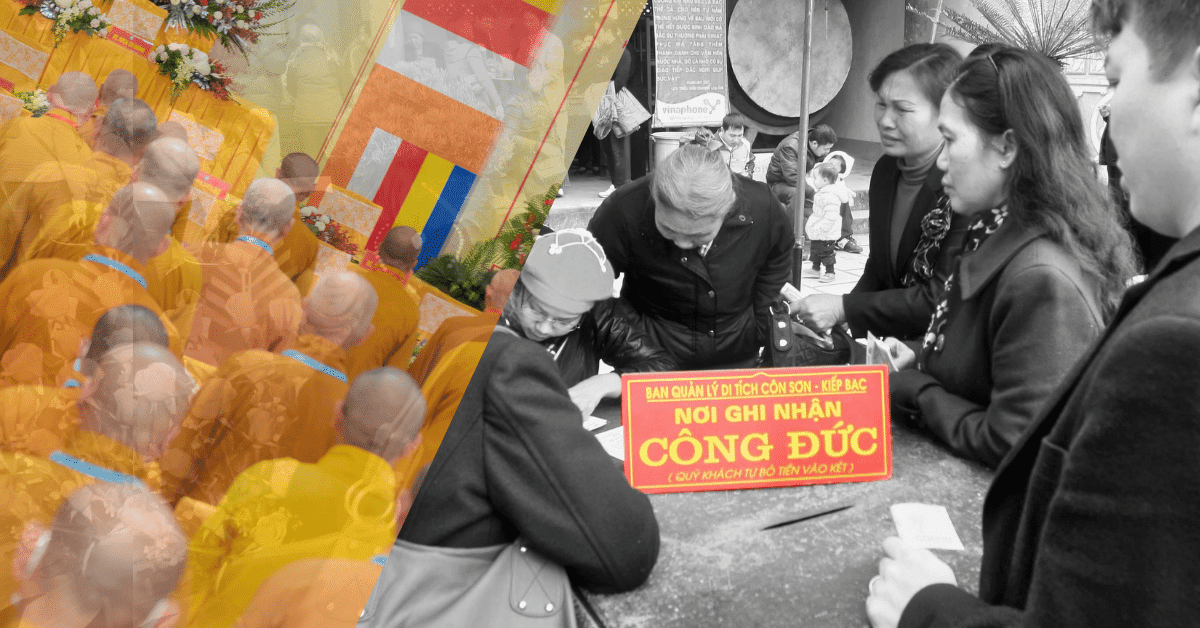
  • Religion Bulletin, June 2021: The Vietnamese Buddhist Church Fiercely Guards Its Merit Donations

    Religion Bulletin, June 2021: The Vietnamese Buddhist Church Fiercely Guards Its Merit Donations

    https://2xjs7y10oiyz26vqxu2hok6y-wpengine.netdna-ssl.com/wp-content/uploads/2021/07/image.png
    Photo: Vietnamese Buddhists (left), Financial Times. Photo processing: Luat Khoa.

    [Religion 360*]

    Buddhists, Vietnamese Buddhist Church oppose Ministry of Finance’s draft circular on merit donations

    The Ministry of Finance’s draft circular, published on April 28, 2021, and related to the management of merit donations, has met unexpected and fierce opposition from Buddhists and the Vietnamese Buddhist Church (VBC). [1]

    The draft is intended to guide the management of income and expenditures, funds for organizing festivals, merit donations, and sponsorships for religious relics.

    The two most disputed parts of the draft have to do with merit donations, specifically (1) the ban on private ownership of merit donations and (2) interference in financial management matters (mandating those religious organizations to open accounts, regulate income and expenditure items, and requiring that organizations submit reports to the state regarding financial matters related to merit donations).

    Many Buddhists have given feedback on the draft directly on the Ministry of Finance’s webpage. [2] They assert that donations, funds, and property contribute to places of worship and monasteries is their right. They do not consent to allow any third party to interfere in using and managing such contributions.

    https://2xjs7y10oiyz26vqxu2hok6y-wpengine.netdna-ssl.com/wp-content/uploads/2021/07/image-1.png
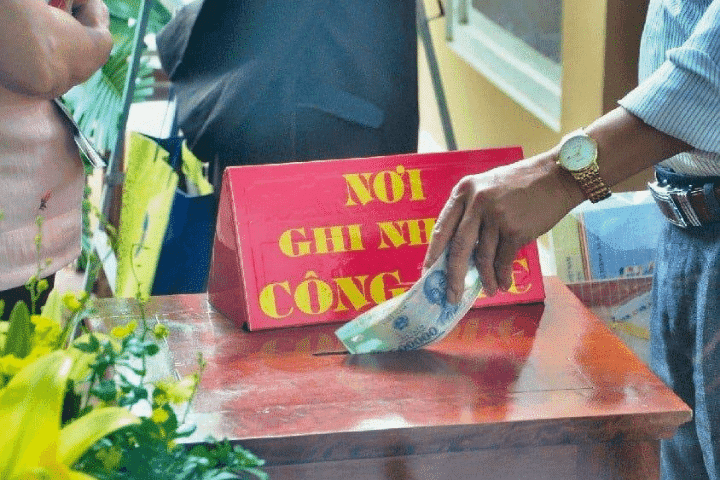
    A temple-goer deposits money into a merit donation bin. Photo: VBC.

    The VBC’s Management Board reported that the Ministry of Finance did not consult them before issuing the draft.

    In a petition on June 17, 2021, the VBC stated that the draft’s contents were unconstitutional, illegal, and did not protect ownership rights. Furthermore, the draft “does not [even] guarantee the equality of all religions before the law” by using the phrase “merit donations,” which is a term common only in Buddhism. [3]

    The VBC asserted that merit donations were the private property of churches and the monasteries belonging to those churches.

    The church recommended that the state eliminate the entirety of its regulations on income, expenditures, and merit donations, or at the very least, clarify the rules on merit donations, while also vowing not to manage such donations, which belong to the VBC’s organizations, religious institutions, and monasteries.

    In a meeting with the Government Committee for Religious Affairs on June 30, the Ministry of Finance stated that its draft was under the provisions of relevant legislation and that it did not intend to interfere in the internal affairs of religious organizations and institutions. [4]

    Online conference held on mechanisms for management and use of land for religious purposes

    On June 3, in a meeting with the Central Economic Committee and the Ministry of Natural Resources and the Environment, the Government Committee for Religious Affairs reported that land issues were becoming more complicated by the day and that new policies were needed. [5]

    According to the Government Committee for Religious Affairs’ report, the 2013 Land Law still contained numerous issues and inadequacies regarding religious organizations and land management. Among them were questions surrounding the land allocation process, the issuance of land usage rights certificates, the usage of land for welfare activities, the construction of spiritual tourism areas, and the resolution of land conflicts.

    The report conceded that current land policies “are not going to resolve religious land issues and that because the tendency of religion is towards development, the land demand for religious purposes is real.”

    https://2xjs7y10oiyz26vqxu2hok6y-wpengine.netdna-ssl.com/wp-content/uploads/2021/07/image-2.png
    A clash related to a land dispute at Thien An Abbey in 2017. Photo: Thien An Abbey.

    According to the Government Committee for Religious Affairs, there are approximately 29,801 religious institutions today, increasing 5,801 since 2008; however, the reserve of land for religious purposes has not increased.

    The 2016 Law on Faith and Religion and the 2013 Land Law are both in their final stages. This is an opportunity to reform land policy for religious organizations.

    Land policies are among the greatest sources of conflict when it comes to religious freedom in Vietnam. Although there have been many changes in land policy, the government still maintains discriminatory practices against religious organizations.

    See more: Four land issues that have caused injustices for religious organizations.

    Anniversary of the founding of Hoa Hao Buddhism: Police continue to set up security checkpoints at temple headquarters

    On June 26, Le Quang Hien, a dignitary of the Pure Hoa Hao Buddhist Church, reported that police continued to set up security checkpoints as they have every year, to prevent people from reaching temple headquarters at Long Xa Commune (Cho Moi Suburban District, An Giang Province) for the anniversary of the religion’s founding. [6]

    https://2xjs7y10oiyz26vqxu2hok6y-wpengine.netdna-ssl.com/wp-content/uploads/2021/07/Untitled-design5-1024x576.jpg
    Pictures were taken of the checkpoints in front of the Pure Hoa Hao Buddhism headquarters. Photo: Le Quang Hien’s Facebook profile.

    There has yet to be any report on the police harassment that Pure Hoa Hao Buddhists have faced.

    Police set up checkpoints at the Pure Hoa Hao Buddhism headquarters regularly during the religion’s major holidays to prevent followers from gathering.

    Security forces regularly obstruct religious activities at churches and independent Hoa Hao Buddhist institutions and followers’ private residences. The government sees these groups as illegal religious organizations and therefore does not permit them to conduct religious gatherings.

    Tuyen Quang provincial police: Mobilizing people not to follow the “heretical” Duong Van Minh religion

    At the beginning of June 2021, Tuyen Quang provincial police reported that they had made a concerted effort to convince 80 Hmong households in Cao Duong Hamlet, Yen Thuan Commune, Ham Yen Suburban District not to follow the “heretical” Duong Van Minh religion. [7]

    Provincial police stated that Vietnam respected freedom of faith and religion but would deal harshly with fanatical activities, those that threaten national security, and those who incite the masses to oppose the socialist government.

    https://2xjs7y10oiyz26vqxu2hok6y-wpengine.netdna-ssl.com/wp-content/uploads/2021/07/image-3.png
    A meeting in which residents are discouraged from following “false religions”. Photo: Tuyen Quang provincial police.

    The Duong Van Minh religion came into existence in the 1980s, mainly aiming to reform the Hmong people’s traditional rituals progressively.

    The religion regularly appears in international reports on religious freedom in Vietnam; followers have been harassed and attacked by police, receiving jail sentences, and their religious grounds have been dismantled.

    According to the U.S. State Department’s 2020 Report on International Religious Freedom, the Duong Van Minh religion leaders reported that the authorities had permitted them to use some “don houses” to store funeral supplies. [8] “Don house” is a term used to describe one of the religion’s several sites of practice that the government was once determined to demolish. More than 19 of these houses were dismantled in 2019.

    However, the article by Tuyen Quang provincial police reveals that the government firmly opposes the Duong Van Minh religion. The article calls the religion a “false” one, a hostile force, and an illegal organization that is determined to prevent residents from participating in this religion.

    This approach is applied to the Duong Van Minh religion and the many new religions that are currently surging across Vietnam.

    BPSOS: Parishioners of Con Dau Parish finally live in peace after 10 years of struggle

    After 10 years of agonizing struggle, the parishioners of Con Dau Parish (Da Nang) have been permitted by the government to live in peace in the area surrounding the church, as they’ve desired. [9]

    The human rights organization BPSOS (Boat People SOS) reported that at the beginning of the year, the authorities set aside 170 lots of land surrounding the church to house those who had fought, allowing them to live in peace as they had desired. Approximately 100 lots of land were distributed to 50 households.

    https://2xjs7y10oiyz26vqxu2hok6y-wpengine.netdna-ssl.com/wp-content/uploads/2021/07/image-4.png
    A strip of houses is being constructed for parishioners around the Con Dau Church, May 21, 2021. Photo: Mach Song Media.

    The Con Dau Parish uprising occurred in 2010 when the Da Nang municipal authorities were determined to clear 4 hamlets in Hoa Xuan Commune, Cam Le District, which included the Con Dau Catholic village, to construct an ecological travel zone. [10]

    The clearance decision was not agreed upon by parishioners, who disputed details of both compensation and relocation, leading to a conflict between hundreds of households and the government.

    Throughout 10 years of petitions, the government organized numerous episodes of suppression and coercion, causing many to flee the border as refugees. Violent clashes with police have led some residents to suffer injuries and jail sentences, while others lived in perpetual states of unrest.

    In 2017, municipal authorities finally agreed to repurpose the area around Con Dau Church into a resettlement area for parish households. [11]

    A group of individuals arrested in relation to a “false religion” and “defaming the government”

    At the beginning of June 2021, the Kinh Mon Township (Hai Duong Province) website reported that the Ministry of Public Security had arrested a group allegedly believed to be practicing a false religion and defaming leaders, the party, and the state. [12]

    The article stated that the group was arrested under Article 331 of the Penal Code – abusing democratic freedoms to infringe upon the interests of the State and the legal rights and interests of organizations and individuals. However, the article did not specify how many were arrested or their identities.

    The article reported that the group had the name “Pháph môn cần khaii vữngh trụ luậth làm trính tâm” (roughly “the Dharma discipline needs to establish the rule of law at its heart firmly”), created and controlled by a Facebook account named “Mẹ Báich Nhiên.” The page included spiritual activities such as group initiation, worship, and prayers.

    In particular, members were alleged to have used many social media accounts (Facebook and YouTube) to spread video clips criticizing leaders, the party, and the state; in these clips, members would write the government’s crimes on pieces of paper and then shred them with scissors or knives, sprinkle salt on photographs, or cast curses.

    The Ministry of Public Security website has yet to announce the arrests formally.

    New religions are thriving in Vietnam in many different forms. These groups normally operate through social media or under the radar to avoid government interference.

    [Did You Know?]

    What are “strange religions”? How many “strange religions” does Vietnam have?

    In June 2021, the Government Committee for Religious Affairs reported that as of April 2021, Vietnam had 85 “strange religions.” [13]

    These “strange religions” are also called “false religions,” the two terms the government reserves for religious groups and organizations that operate “illegally.”

    https://2xjs7y10oiyz26vqxu2hok6y-wpengine.netdna-ssl.com/wp-content/uploads/2021/07/image-5.png
    Materials related to the Supreme Master Ching Hai religious sect, which the government considers a “false religion.” Photo: People’s Public Security Newspaper.

    They could be religious organizations that spread to Vietnam from overseas, such as Supreme Master Ching Hai or the World Mission Society Church of God, or they could be homegrown, like the Vietnam Protestant Church of Christ in the Central Highlands or the Duong Van Minh religion in the northern mountainous regions.

    These “strange religions” are but one part of new religious phenomena appearing in Vietnam, which the authorities see negatively.

    The Vietnamese government has yet to define what a “false” or “strange religion” is. Reasons used to punish these groups are often subjectively applied.

    The government and the press propagandize against “strange religions” in lockstep, based on the following four primary characteristics:

    First, these groups’ religious activities are conducted surreptitiously and are unregistered by the local authorities. The government portrays this secrecy as an evasion of the law to carry out deceptive and harmful acts. In actuality, groups and organizations are seen as “false religions” cannot register their religious activities with local authorities. They must operate secretly to avoid police repression.

    Second, the government sees these groups’ activities as flimsy or intentionally destructive to national traditions, most common among them being the non-worship of ancestors. In addition, their activities are seen as affecting security and order, with their “illegal” gatherings and “anti-state” behavior.

    Third, to deny the legitimacy of these “strange religions,” the government propagandizes that these groups and organizations borrow, combine, and modify the doctrines of orthodox religions and claim them as their own rather than create their own.

    Fourth, the government and the press vigorously spread propaganda on the negative consequences of participating in new religions and have effectively caused the public to develop a negative view. The most common method is using an exceptional case to stress the severe consequences of participating on health, wealth, and spirit.

    In summary, the Vietnamese government does not see religious activities as civil ones. In their eyes, religious organizations walk the line between civil and political groups; they have a responsibility to help the state maintain security and order and mobilize the people to implement policies. As such, all religious activities must be conducted openly and under government supervision (which is why they don’t allow religious activities to be conducted in private residences).

    People participating in new religions is not a recent phenomenon. Hoa Hao Buddhism and Cao Daiism were both completely new religions at the beginning of the 20th Century.

  • Religion Bulletin, May 2021: A Protestant Church Was Accused Of Spreading COVID-19

    Religion Bulletin, May 2021: A Protestant Church Was Accused Of Spreading COVID-19

    Samples are taken for testing at the alleyway in which the Phuc Hung Missionary Church organizes weekly religious activities. Photo: Doc Lap/Thanh Nien Newspaper.

    [Religion 360*]

    COVID-19’s effect on religious activities: Criminal proceedings brought against a Protestant church

    The May 2021 resurgence of COVID-19 in many provinces and cities around Vietnam has affected religious activities to a large degree.

    On May 26, 2021, Ho Chi Minh City (HCMC) discovered positive cases among the Phuc Hung Missionary Church members. [1]

    One day later, Nguyen Duy Tan, head of the municipal Religious Committee, stated that this Protestant church had been permitted to hold religious gatherings at a private residence, with 28 members registered. [2]

    According to Tan, the church conducted four sessions in May, all according to proper municipal social distancing guidelines and with 20 participants each; however, the site was possibly limited in space. The source of the outbreak has yet to be confirmed.

    https://2xjs7y10oiyz26vqxu2hok6y-wpengine.netdna-ssl.com/wp-content/uploads/2021/06/image-15.jpeg
    Phuc Hung Missionary Church in Go Vap District, HCMC. Photo: Doc Lap/Thanh Nien.

    It was not until May 30 that Go Vap district police in HCMC charged the Phuc Hung Missionary Church with “spreading infectious disease.” [3]

    Police stated that church members did not properly comply with COVID guidelines and made incomplete declarations.

    A day before police initiated criminal proceedings, the HCMC Center for Disease Control accused church representatives of misreporting the actual number of church members. [4] Many church members made no declarations until they showed signs of illness.

    The Vietnamese press rapidly reported on the number of infections originating from the Phuc Hung Missionary Church [5], to whom the Ministry of Home Affairs attributed responsibility.

    Immediately after announcing criminal proceedings, the Ministry of Home Affairs proposed in a meeting regarding the COVID situation in HCMC that the city suspend the church’s activities, and pending the investigation results, possibly revoke its permit and eliminate its registration. [6]

    In addition to the situation involving the Phuc Hung Missionary Church, on May 26, 2021, provincial authorities in Bac Giang coerced an F1 member (someone who has been in contact with a Covid-19 positive person) of the World Mission Society Church of God into a quarantine zone. [7] The media published a video of the authorities using a construction crane to apprehend the individual forcibly.

    According to government sources, the woman purposefully avoided making a health declaration and tried to evade quarantine. Authorities stated that the individual was a member of the World Mission Society Church of God and accordingly had differing views on quarantine and health declarations.

    The World Mission Society Church of God is a religious group whose activities are not authorized by the state.

    At the beginning of May, the Ministry of Home Affairs promulgated an official document on the methods religious organizations should use to prevent and control the spread of COVID. [8] As a result, religious organizations have had to cease gatherings even in locations with zero cases unless the authorities deem a gathering necessary.

    On May 28, the Government Committee for Religious Affairs reported that the leaders of 43 religious organizations had vowed to the committee and the Ministry of Home Affairs to comply with disease control and prevention directives. [9] As such, religious organizations have restricted gatherings, declined clergy coming from overseas, practiced social distancing, worn masks, and used disinfectants.

    Vietnamese state media accuses the U.S. State Department’s 2020 Report on International Religious Freedom of misrepresentation, slander

    https://2xjs7y10oiyz26vqxu2hok6y-wpengine.netdna-ssl.com/wp-content/uploads/2021/06/image-1.png
    Articles (left to right) from VOV, People’s Public Security, and the People’s Livelihood criticizing the U.S. State Department’s Report on International Religious Freedom. Photo: screenshots.

    More than two weeks after the U.S. State Department announced its annual Report on International Religious Freedom, the Vietnamese state media began publishing a series of articles in response.

    Voice of Vietnam’s online newspaper criticized the U.S. State Department, stating that it was using inaccurate information provided by a human rights organization based in the United States, BPSOS (Boat People SOS). The newspaper stated that the United States continued to demonstrate a subjective view of the religious situation in Vietnam and that it was slandering the Vietnamese authorities by accusing them of suppressing religion. [10]

    The article stated: “Vietnam rejects the [U.S. State Department’s] one-sided, condemnatory, and subjective approach regarding faith and religion in the country”.

    Sharing the VOV’s views, the People’s Public Security Newspaper published an article titled “Exposing the false reports on freedom of belief and religion in Vietnam”. [11]

    The newspaper stated that the report’s accusations of repression and strict control of freedom of religion were “slanderous and lacking in objectivity; the U.S. State Department and the U.S. Commission on International Religious Freedom (USCIRF) are taking advantage of issues regarding freedom of faith and religion to disrupt national unity”.

    Similarly, the People’s Livelihood Newspaper, belonging to the Ministry of Labor, Invalids, and Social Affairs, also criticized the U.S. State Department’s report as lacking in objectivity and misrepresenting the situation regarding religious freedom in Vietnam. [12]

    The U.S. State Department’s Report on International Religious Freedom was released on May 12, 2021, published annually. [13]

    This year’s report contained several accusations regarding the Vietnamese government’s strict control over freedom of religion, its suppression of independent religious organizations, its punishment of religious activists, and its use of laws and administrative procedures to limit freedom of religion. According to the report, religious activities in the Central Highlands and the northern mountainous areas continue to be tightly controlled. Land disputes between religious organizations and the state were highlighted in detail.

    The Vietnamese state press’ vehement rebuttal of the United States’ Report on International Religious Freedom has become routine. USCIRF’s previous reports were met with a similar reaction.

    [The Government’s Reach]

    Religious training institutions must teach history and law according to the Government Committee for Religious Affairs’ curriculum

    In January 2021, the Government Committee for Religious Affairs began transferring lectures on Vietnamese history and Vietnamese law to religious training institutions in some provinces and cities, including Hanoi, [14] Nam Dinh, [15] Dong Nai, [16] An Giang, [17] and Bac Lieu. [18]

    According to Article 37 of the 2016 Law on Faith and Religion, religious organizations must teach Vietnamese history and Vietnamese law to establish a religious training institution.

    In February 2020, the Government Committee for Religious Affairs promulgated the teaching curriculum for these two subjects (Decision 35/QD-TGCP). It required their implementation in religious training institutions (including secondary schools, colleges, institutes, and major seminaries). [19]

    https://2xjs7y10oiyz26vqxu2hok6y-wpengine.netdna-ssl.com/wp-content/uploads/2021/06/image-2.png
    The Government Committee for Religious Affairs’ two books on history and law. Photo: Vietnamese Buddhist Church.

    Before this, the teaching of the two subjects was implemented by the religious training institutions themselves, with many different reference materials. We have observed large differences between the training objectives of the Government Committee for Religious Affairs and those of several religious training institutions.

    In the Government Committee for Religious Affairs’ curriculum, the training objectives of these two subjects are to induce religious leaders to abide by the state’s laws on religion and have them fulfill their obligations to the country.

    The Government Committee for Religious Affairs stipulates that all skills learned from studying history are “to serve as applied knowledge […] to live and work responsibly, and to carry out the rights and duties of citizens towards their homeland”.

    On the other hand, the training objectives for history at the Buddhism Institute in HCMC are to equip students with historical knowledge, research skills, and historical event analyses. [20]

    The Government Committee for Religious Affairs also stipulates how to teach these two subjects to develop compliant attitudes towards the state’s laws on faith and religion.

    Controlling the training activities of religious institutions is among the Government Committee for Religious Affairs’ ambitions. Requiring institutions to teach history and law according to their curriculum is a step in that direction.

    In January 2021, in an article published in State Organizations Magazine, [21] the vice minister of home affairs and the head of the Government Committee for Religious Affairs, Vu Chien Thang, highlighted one of the functions of the 2021 promulgation: “Review and evaluate the activities of religious training institutions; do not allow ‘unregulated’ training or travel overseas for illicit training”.

    Thang also confirmed in the article that in 2020, the Ministry of Home Affairs had succeeded in influencing religious organizations to choose church leaders who were close to the government.

    Party newspaper praises role of special civil force in controlling religious activities in the highlands

    At the end of April 2021, the Vietnamese Communist Party’s online newspaper published articles introducing the state’s special civil force. [22]

    According to the newspaper, the special civil force effectively provides information and advises the state in many goals, including controlling religions in the highlands. This civil force is deemed to have the “persons of prestige”.

    https://2xjs7y10oiyz26vqxu2hok6y-wpengine.netdna-ssl.com/wp-content/uploads/2021/06/image1-1.jpg
    General Secretary Nguyen Phu Trong meets with village elders, chiefs, dignitaries, and persons of prestige who participated in the program “Village Fulcrums” in 2018. Photo: Committee for Ethnic Minority Affairs.

    According to the Committee for Ethnic Minority Affairs, “persons of prestige” number 30,247 individuals in 52 provinces and cities in 2020. Provinces with numerous mountainous areas have the highest number of “persons of prestige.” [23]

    “Persons of prestige” appear in many of the state’s administrative occupations (the Fatherland Front, police, leaders of the ethnic minority, and religious positions, etc.). [24] Among their tasks is informing the state on noteworthy activities in their communities, including those to do with religion and security and order.

    Also, according to the Vietnamese Communist Party’s E-Newspaper, in past years, “persons of prestige” have made important contributions to eliminating false religions and obstructing illicit religious propaganda. [25]

    The criteria for choosing “persons of prestige” is stipulated in Decision #12/QD-TTg, issued by the prime minister on March 6, 2018. [26]

    According to the document, “persons of prestige” are normally cadres, civil servants, officials, members of the armed forces who have made many contributions and are no longer active, dignitaries, religious functionaries, village elders, heads of lineages, businessmen, professors, researchers, and individuals of economic standing who are respected by the community.

    Furthermore, requirements to become a “person of prestige” include consistently executing the state’s laws and regulations and carrying out activities of a communal nature, with notable comprehension of and influence within one’s community.

    The series of articles from the Vietnamese Communist Party E-Newspaper reveal that this special civil force will focus on development moving forward. They are seen as a force to help the state control civil activities that might affect national security, especially in mountainous areas.

    [Did You Know?]

    Protestantism has many independent churches: a perfectly ordinary fact

    The recent incident involving the Phuc Hung Missionary Church has raised public concerns about independent religious groups.

    Immediately after Vice Minister of Home Affairs, Vu Chien Thang, stated that the Phuc Hung Missionary Church was not a religious organization, newspapers emphasized this detail to attract readers, spreading incomplete information. For example, Thanh Nien Newspaper published the headline: “Breaking: ‘Phuc Hung Missionary Church’ was merely a gathering place, its head was not a pastor.” [27] In the same vein, the Ministry of Health’s news page reposted information from the Family Newspaper with the headline: “SHOCKING: Phuc Hung Missionary Church not a religious organization.” [28]

    The press’ incomplete information regarding the Phuc Hung Missionary Church’s type of organisation caused the public to develop unsympathetic views towards Protestant religious groups.

    According to the Government Committee for Religious Affairs, Protestantism advocates building independent churches with various organizational models, depending on the sect. It could be a centralized model with grassroots churches, like the Protestant Church of Vietnam (Southern branch). [29] Grassroots churches are imbued with the power to manage their own affairs in the spirit of independence, self-sustenance, and self-transmission. In particular, Protestantism does not prevent its followers from joining other sects or splintering off to operate independently.

    The HCMC Committee for Religious Affairs reported that the city had 145 groups that operated like the Phuc Hung Missionary Church. These groups were all legally registered with the local authorities as stipulated by the 2016 Law on Faith and Religion.

    Vietnam maintains a complex, multi-step process for groups to be recognized as religious organizations. Currently, there are only nine Protestant religious organizations recognized by the state, all of which operate using a centralized model with grassroots churches. [30]

    Protestant churches not yet recognized by the state can still operate by registering their places of assembly and religious activities.

    In 2018, there were approximately 70 Protestant organizations yet to be recognized as religious organizations by the state due to their failure to meet the requirements set out by the Law on Faith and Religion. [31] These organizations have about 79,000 followers, 75.9 percent of whom are in Binh Phuoc Province, the Central Highlands, and the northern mountainous regions.

    Furthermore, the government has deemed illegal some Protestant organizations, such as the Vietnam Church of Christ in the Central Highlands, regularly obstructing their activities and suppressing their members.

  • Religion Bulletin, April 2021: The United States Proposes Putting Vietnam On The List Of Countries Of “Particular Concern.”

    The Vietnamese government is found to have systematically violated freedom of religion.

    https://2xjs7y10oiyz26vqxu2hok6y-wpengine.netdna-ssl.com/wp-content/uploads/2021/05/image9.jpg
    Illustration: Luat Khoa

    [Religion 360*]

    United States Commission on International Religious Freedom: Proposal to put Vietnam on the list of countries of particular concern

    In its latest report on religious freedom, the United States Commission on International Religious Freedom (USCIRF) proposed reinstating Vietnam onto the list of countries of particular concern (CPC).

    Governments that engage in or tolerate severe violations of religious freedom are placed on the list of CPC. For countries on this list, the U.S. Congress will introduce non-economic policies before taking economic measures to stop violations.

    USCIRF assessed that Vietnam’s religious freedom conditions in 2020 were as bleak as those in 2019. This is because the Vietnamese government enforces its Law on Faith and Religion, which contravenes international human rights standards and systematically violates religious freedom.

    The organization listed numerous suppression and obstruction of religious freedom in Vietnam in 2020 involving independent religious groups and those recognised by the government.

    Ethnic minority groups in mountainous areas that follow new religions and sects, Buddhist dignitaries, independent Cao Dai adherents, Protestants, Catholic clergy members, and prisoners of conscience are victims of the Vietnamese government’s strict religious policies.

    https://2xjs7y10oiyz26vqxu2hok6y-wpengine.netdna-ssl.com/wp-content/uploads/2021/05/image-11.jpeg
    The USCIRF’s 2021 report on religious freedom. Photo: USCIRF.

    Specific instances of religious suppression in 2020 that USCIRF cited:

    • Suppressing religious activities conducted by ethnic minorities Hmong and Montagnard in the Central Highlands.
    • Limiting the religious activities of independent Hoa Hao Buddhists.
    • Interfering in the funeral of Venerable Thich Quang Do, the fourth patriarch of the Unified Buddhist Church.
    • Obstructing the Unified Buddhist Church’s relief efforts in Thua Thien – Hue Province.
    • Harassing independent Cao Dai followers, attempting to take over their temples, and forcing them to unite with state-recognized churches.
    • Harassing and attacking clergy members of Thien An Abbey over a land dispute.
    • Subjecting prisoner of conscience Nguyen Bac Truyen to poor prison conditions and limiting his access to medical care; refusing to provide the prisoner of conscience Le Dinh Luong a Bible.
    • Using Article 34 of the Law on Faith and Religion to interfere in the election affairs of a state-recognized religion.

    Deputy Minister of Home Affairs: “False religions” must be stopped

    At the beginning of April 2021, Vu Chien Thang, deputy minister of the Ministry of Home Affairs and head of the Government Committee for Religious Affairs, affirmed the need to stop “false religions” from illegally operating and affecting social life.

    https://2xjs7y10oiyz26vqxu2hok6y-wpengine.netdna-ssl.com/wp-content/uploads/2021/05/image-3.png
    Deputy Minister of the Ministry of Home Affairs and head of the Government Committee for Religious Affairs, Vu Chien Thang, talks about stopping “false religions”. Photo: Xuan Thu / TTXVN.

    The Ministry of Home Affairs deputy minister stated that factions, sects, and illegal religious phenomena had appeared in many locations.

    Afterwards, the head of the Government Committee for Religious Affairs presented two solutions to deal with new religions.

    First, local religious committees have to coordinate with other organizations, such as the police, to stop illegal religious activities in a timely manner.

    Second, state-recognized religions have a responsibility to direct citizens towards their organizations.

    That there is no place for new religions in Vietnam has been the government’s consistent message for many years.

    In April 2021, Tuyen Quang Newspaper also reported that Tuyen Quang Province was currently seeing many new religious activities of a superstitious nature. These religious activities were being used to oppose the government.

    The activities of new religions are never presented from multiple viewpoints. Instead, the press covers these religious phenomena from the government’s vantage, which predominantly opposes religious activities not recognized by the state.

    New religions are multiplying in Vietnam by the day, but the government’s hardline view pushes many followers to practice surreptitiously and without legal registration.

    Vietnam has regulations regarding the registration of religious activities, but the majority of them are dependent on the subjective views of the government and their acceptance of the religion.

    The government asserts three reasons for the abandonment of new religions. First, new religions contain superstitious activities. Second, new religions have different tenets and conceptions from state-recognized religions, ruining customs and distorting culture. And third, new religions (such as Falun Gong) have a political agenda.

    Greater Unity Newspaper: Investigate party members and state cadres that participated in the Humanity Club

    In April 2021, the state press continued to investigate the activities of the Humanity Club (HC), a spiritual organization operating as a private enterprise.

    We summarized notable events related to this organization in a recent bulletin. The Government Committee accused the HC of Religious Affairs and other state organizations of propagating superstitions and defrauding members.

    This time, the Greater Unity Newspaper (which belongs to the Vietnamese Fatherland Front and aligned with the Vietnamese Communist Party) confirmed that some Party members and low-level and high-level state cadres were members of this club.

    “Information obtained by Greater Unity reveals that the list of HC participants includes the former vice chairman of Hanoi city and even leaders who currently hold important government positions,” the Greater Unity Newspaper claimed.

    Furthermore, the paper stated that some lecturers and cadres (without naming specific individuals) from a roster of universities, academies, and schools have participated in the club.

    The paper also asked that Party and State organizations “quickly deal with offenders” who had participated in and had propagated a superstitious organization.

    https://2xjs7y10oiyz26vqxu2hok6y-wpengine.netdna-ssl.com/wp-content/uploads/2021/05/image-12.jpeg
    A meeting of the Humanity Club. Photo: Greater Unity Newspaper.

    Followers of the Ba-ni religion protest their merge with Islam

    At the end of April 2021, the Ba-ni religious community strongly protested on social media the requirement that they list their religion to be Islam or “other” when applying for new ID cards.

    The Ba-ni religion is not recognized by the state as Buddhism and Catholicism are. Those who follow the religion are lumped together by the State with those who follow Islam.

    Ba-ni religious followers are ethnic Cham, a long-standing indigenous group in Vietnam. Cham Ba-ni practitioners state that their practices and rituals are different from those of Muslims. Thus, they do not accept the merging of their religion with Islam.

    https://2xjs7y10oiyz26vqxu2hok6y-wpengine.netdna-ssl.com/wp-content/uploads/2021/05/image-13.jpeg
    Two Cham Ba-ni clergymen prepare betel leaves to place at the foot of a gravestone in a gravesite cleansing ritual. Photo: Ninh Thuan Newspaper.

    Government vague in requiring faith certifications when citizens declare their religion on new ID cards

    Vietnam’s new identity cards do not indicate the religions of their owners. However, the government is requiring that people declare their religion on their ID applications.

    At the beginning of 2021, the government began issuing citizens new ID cards fitted with chips. Police in several provinces and cities have mandated that citizens present their faith certifications when they declare their religions.

    This mandate has alarmed many religious followers, who practice their religion without faith certifications.

    On April 24, 2021, Ho Chi Minh City authorities announced that citizens could declare their religions when applying for new ID cards without faith certifications.

    At present, other provinces have yet to make similar announcements.

    https://2xjs7y10oiyz26vqxu2hok6y-wpengine.netdna-ssl.com/wp-content/uploads/2021/05/image-4.png
    Citizens apply for new ID cards in Hai Ba Trung District in Hanoi on March 9, 2021. Photo: VnExpress.

    Nguyen Phuc Nguyen, head of the Buddhist Department under the Government Committee for Religious Affairs, stated to  Giac Ngo Newspaper at the end of March 2021: “There is nothing troublesome about requiring Buddhist faith certifications.”

    On April 14, 2021, the Government Committee for Religious Affairs confirmed that different locations had different requirements for religious declarations and new ID cards.

    Nghe An: Government blocks two groups from the World Mission Society Church of God from operating

    On April 12, 2021, Nghe An provincial authorities reported to the Government Committee for Religious Affairs that religious activities were still being exploited to oppose the government in the province.

    The information above was brought up during a summary conference in Nghe An, marking three years since implementing the Law on Faith and Religion and its attendant 2017 decree.

    Provincial authorities stated that the state’s management of religion was not tight enough, allowing some individuals to exploit religious activities to oppose the government.

    The statement did not identify any religion in particular, but the situation on the ground reveals that the authorities were alluding to the dignitaries and followers of Catholicism.

    In 2020, Father Dang Huu Nam was transferred out of My Khanh Parish, and his pastoral duties were stopped. Father Nam is known for leading parishioners to sue the Hung Nghiep Formosa Ha Tinh Steel Company after the central coast environmental disaster. Authorities had long demanded his transfer and the cessation of his pastoral duties.

    On April 7, 2021, VOV Newspaper reported that Anh Son suburban district police in Nghe An Province had obstructed proselytizing activities at a private residence in Phuc Son Commune. The activities involved six adults and six children from the World Mission Society Church of God, a religion the government fiercely suppresses. Police dispersed the meeting and confiscated exhibits, computers, and proselytizing materials.

    https://2xjs7y10oiyz26vqxu2hok6y-wpengine.netdna-ssl.com/wp-content/uploads/2021/05/image-14.jpeg
    The children and adults of the World Mission Society Church of God blocked by police from proselytizing in Phuc Son Commune, Anh Son Suburban District, Nghe An Province. Photo: VOV Newspaper.

    On April 19, 2021, the authorities blocked another group from the World Mission Society Church of God from conducting religious activities in an apartment in the city of Vinh. The People’s Public Security Newspaper reported that the police had brought approximately 11 adults and five children to the Hung Dung Ward police station for investigation. Religious documents and objects were confiscated, and local authorities were instructed by police to “supervise and educate” those involved.

    https://2xjs7y10oiyz26vqxu2hok6y-wpengine.netdna-ssl.com/wp-content/uploads/2021/05/image-15.jpeg
    Followers of the World Mission Society Church of God were blocked from conducting religious activities on April 19, 2021, in the city of Vinh. Photo: People’s Public Security Newspaper.

    This year’s commemoration of “Virtuous Master’s Disappearance Day” again interrupted by the authorities

    In 2020, the Pure Hoa Hao Buddhist Church reported that An Giang provincial authorities once again prevented followers from congregating to mark “Virtuous Master’s Disappearance Day”.

    Beginning on April 4, 2021, authorities set up two checkpoints on the road leading to the headquarters of the Central Directors Committee of the Pure Hoa Hao Buddhist Church in Long Giang Commune, Cho Moi Suburban District, An Giang Province.

    https://2xjs7y10oiyz26vqxu2hok6y-wpengine.netdna-ssl.com/wp-content/uploads/2021/04/image-1.png
    On April 5, 2021, police set up a checkpoint on the road leading to the Pure Hoa Hao Buddhist Church’s commemoration site, one day before the event. Photo: Le Quang Hien.

    After being blocked from their headquarters, many of the church’s dignitaries moved the prayer site to another location.

    Furthermore, on April 5, 2021, the Pure Hoa Hao Buddhist Church’s Communications Department reported that security forces had tailed the church’s directors.

    Other Hoa Hao Buddhists celebrated at home by setting up altars and hanging flags and banners. There have yet to be any reports of police harassment and obstruction at private residences during this year’s commemoration.

    The Hoa Hao Buddhist Church, the only Hoa Hao Buddhist organization recognized by the government, has never organized for this holiday, which is among three major holidays for Hoa Hao Buddhists.

    [Did You Know?]

    The difference between the Ba-ni Cham and the Islamic Cham

    According to researcher Inrasara, Islam began to influence the Champa kingdom in the 16th Century. During that time, Islam arrived by way of wealthy Arab merchants who had left China to spread the religion southward.

    As it made its way into the kingdom, Islam entered into large and persistent conflict with indigenous Cham inhabitants who followed Hinduism. By the time of King Po Rome’s reign (1627 – 1651), Islam had indigenized to become the Ba-ni religion.

    https://2xjs7y10oiyz26vqxu2hok6y-wpengine.netdna-ssl.com/wp-content/uploads/2021/05/image-6.png
    The attire of Ba-ni Cham women (left) and Islamic Cham women. Photo (from left): Inra Jaya, Lam Vien Nui Cam.

    Today, Cham people who follow Islam in the areas of An Giang, Tay Ninh, and Ho Chi Minh City; Cham people who follow Ba-la-mon (a Hindu religion) and the Ba-ni religion mainly reside in the two provinces of Ninh Thuan and Binh Thuan.

    The 2019 census only recorded the number of followers of Islam and Ba-la-mon, providing no figures for the Ba-ni Cham.

    According to statistics from April 1, 1999, Vietnam had a total of 152,132 ethnic Cham. [1] Among them, Ninh Thuan had 61,000 people; Binh Thuan 29,312; An Giang 30,000; Binh Dinh and Phu Yen 20,000; Ho Chi Minh City 5,000; Dong Nai 3,000; Tay Ninh 3,000; and Binh Phuoc and Binh Duong 1,000. According to the Nation and Development Newspaper, the mouthpiece of the Committee for Ethnic Minority Affairs, there were approximately 31,000 Ba-ni Cham in 2018.

    Ba-ni Cham has different religious activities from Islamic Cham. They believe in Allah, but they also worship the gods of rain, the seas, and the mountains, as well as their ancestors. They have lost the tradition of going on the pilgrimage to Mecca. Vegetarianism and daily prayer are carried out in September and only by laypeople. The influence of matriarchy has caused Ba-ni Cham to focus more on the karơh ceremony for women than the katat ceremony for men (both are initiation ceremonies the Ba-ni religion reserves for boys and girls when they reach puberty).[2]


    References:

    [1] Inrasara, Journeys and Home, page 16, Writers Association Publishing House.

    [2] Inrasara, Cham Wisdom, page 106, Knowledge Publishing House.

  • Religion Bulletin, March 2021: More Ethnic Montagnards Under Scrutiny For Religious Activities In Phu Yen

    [Religion Flashpoints]

    Map and data source: Phu Yen Province People’s Committee

    Phu Yen police: “Where are the papers certifying this group site?”

    In March 2021, the Youtube page DAK LAK NEWS published a clip showing the authorities and commune police arriving to stop the religious activities of Montagnards in Khit Village, Ia Lam Commune, Song Hinh District, Phu Yen Province.

    More than 10 ethnic Montagnards, including seniors, women, and children, sat and listened to the allegations as police prepared to file a report against them.

    Source: DAK LAK NEWS.

    Based on a government representative’s recitation of the document, the incident occurred at an unspecified date. Police vehemently objected to a phone user recording the meeting.

    Police repeatedly and loudly asked: “Where are the papers certifying this group site?”.

    This is likely a case of the police and the authorities attempting to prevent religious activities at “unauthorized” congregation sites, in accordance with the 2016 Law on Religion and Faith.

    According to this law, when registering group religious activities, registrants must declare to local authorities the religious activities and festivals to be organized. The local authorities can then either approve or deny the permit for group religious activities.

    In January 2021, Phu Yen provincial authorities organized a public interrogation of five ethnic Montagnard people for following the Protestant Church of Christ (UMCC) in Ia Lam Commune, Song Hinh District.

    That was not the only interrogation session ethnic Montagnard Protestants have faced in Phu Yen.

    Another group of Protestants under scrutiny in Phu Yen Province

    At the beginning of April 2021, Public Security News reported that Phu Yen provincial police and Song Hinh district police put detained four ethnic Montagnard for public interrogation following UMCC. The public interrogation took place in Song Hinh village or, Song Hinh district.

    https://2xjs7y10oiyz26vqxu2hok6y-wpengine.netdna-ssl.com/wp-content/uploads/2021/04/image-20.jpeg
    From left: Ma Lang, Ma Sing, Ma Duyen, and Ma Phep during their public interrogation in Song Hinh Village, Song Hinh District. Photo: People’s Public Security Newspaper.

    According to the article, Ma Lang, Ma Sing, Ma Duyen, and Ma Phep were accused of following UMCC, connecting with individuals overseas to carry out unauthorized religious activities, and providing information on social issues in order to lower Vietnam’s reputation before the international community.

    During the public interrogation session, Ma Lang stated that he would leave UMCC.

    The article also accused the human rights organization BPSOS of “spreading propaganda, developing armed forces, and enticing” numerous ethnic Montagnards into following UMCC. Currently, there is no information on any other form of punishment meted out to the four ethnic Montagnards.

    Phu Yen will likely be a religious flashpoint in 2021. The recent suppressive activities demonstrate that the government is putting pressure on ethnic Montagnard Protestants, especially followers of the Protestant Church of Christ.

    [Religion 360*]

    A Hanoi club accused of spreading superstitions

    On March 23, 2021, Greater Unity Newspaper (Báo Đại Đoàn Kết), an organization of the Vietnamese Fatherland Front, launched a series of articles on a club that the newspaper asserted was spreading superstitions and deceiving its members.

    The reported club, named the Humanity Club (HC), has operated in Hanoi since July 2019. The club is legally registered as a limited liability company.

    Greater Unity Newspaper accused the Humanity Club of spreading superstitions regarding spirits, collecting and modifying the teachings of other religions to propagate to members, and forcing members to raise money for charity.

    Greater Unity Newspaper also cited former members who now opposed to the club.

    https://2xjs7y10oiyz26vqxu2hok6y-wpengine.netdna-ssl.com/wp-content/uploads/2021/04/image-16.jpeg
    A meeting of the Humanity Club. Photo: Humanity Club.

    After Greater Unity Newspaper’s series on the Humanity Club, state organizations began intervening. Below is the official timeline of events:

    • March 23, 2021: Greater Unity Newspaper launches reports on the Humanity Club.
    • March 27, 2021: Secretary of the Hanoi Party Committee demands the Hanoi People’s Committee begin an investigation to clarify and verify the information. 
    • March 29, 2021:
      • The Government Committee For Religious Affairs confirms that the Humanity Club’s activities spread superstitions. 
      • The Office of Publishing, Printing, and Distribution suspends publication of the book “God Bestows upon Mankind an Intellectual Foundation” (book of Dharma) used by the Humanity Club.
    • March 30, 2021: The Government Committee For Religious Affairs confirms that the book of Dharma has elements of superstition, causes fear and confusion among readers, and negatively impacts citizen morale.
    • March 31, 2021: the Ministry of Public Security announces an investigation of the Humanity Club.
    • April 1, 2021: The Humanity Club announces a temporary suspension of operations and moves out of its headquarters.
    • April 2, 2021: The Hanoi Committee For Religious Affairs announces that it will conduct an interdisciplinary inspection of the Humanity Club.

    According to Vietnamnet – a state-owned newspaper – a club member stated that the club had, of its own volition, returned all money it had received from the individual on April 7, 2021, including dues and other donations.

    The club’s website and Facebook page announced a temporary suspension of operations in order to find a new venue. It has yet to publish any response to the accusations of Greater Unity Newspaper and other government bodies.

    Bac Kan: Two groups from the World Mission Society Church of God prevented from practicing religion

    According to Youth Newspaper, on March 27, 2021, Bac Kan city police blocked two groups of the World Mission Society Church of God from carrying out religious activities and confiscated a number of religious materials.

    The first group consisted of six people and operated at a private residence in the Tong Neng Cluster, Huyen Tung Ward, Bac Kan City. The second group included five people and operated from a hostel in Duc Xuan Ward, Bac Kan City.

    https://2xjs7y10oiyz26vqxu2hok6y-wpengine.netdna-ssl.com/wp-content/uploads/2021/04/image-17.jpeg
    The first group of the World Mission Society Church of God prevented by Bac Kan city police from operating. Photo: Quoc Huy / Youth Newspaper.

    Bac Kan city police stated that this church was not recognized by the government. It accused the church of organizing group religious activities, “complicating social order and muddling the religious lives of citizens.”

    According to VietCatholic News, the World Mission Society Church of God was established in South Korea and arrived in Vietnam in 2001.

    In 2018, the state press and the Vietnamese government began paying attention to the organization, putting pressure on the church’s operating groups. The Vietnamese government sees the World Mission Society Church of God as a cult.

    An Hoa Parish: Pray for the land seized by the state

    On March 29, 2021, An Hoa Parish (in the city of Da Nang) organized a prayer session for a piece of parish land that the government was partitioning and selling.

    According to Thai Ha Media, the piece of land is owned by An Hoa Parish. Before 1975, it was the parish’s Gioan XXIII School.

    An Hoa Parish was established in 1960, and the majority of parishioners are northerners who moved south in 1954.

    After 1975, the Gioan XXIII School, along with other parish structures, including a printing press and a livestock farm, were requisitioned by the government. For years, the school was left abandoned, and the land on which it sits is now being partitioned and sold.

    https://2xjs7y10oiyz26vqxu2hok6y-wpengine.netdna-ssl.com/wp-content/uploads/2021/04/image-18-1024x576.jpeg
    This piece of land was previously the site of An Hoa Parish’s Gioan XXIII School. Photo: An Hoa Parish.

    An Hoa Parish stated that it had sent 12 complaints to Da Nang authorities from May 23, 2019, to January 16, 2021, but never received any kind of response. On January 16, 2021, An Hoa Parish reported that it rejected the Da Nang Office of Natural Resources and the Environment’s proposal regarding the parish’s complaints. The parish did not elaborate on the content of the proposal.

    Pure Hoa Hao Buddhist Church: Determined to celebrate “Virtuous Master Huynh’s Disappearance Day”

    The Pure Hoa Hao Buddhist Church announced that it would, by all means, celebrate “Virtuous Master Huynh’s Disappearance Day” this year, even if it meant facing government suppression.

    “Virtuous Master Huynh’s Disappearance Day,” also called “Virtuous Master’s Disappearance Day,” is a holiday to commemorate the work of Huynh Phu So, the founder of Hoa Hao Buddhism, and his disappearance after a meeting with the Viet Minh on February 25, 1947. To this day, no one knows what actually happened to him.

    After April 30, 1975, Hoa Hao Buddhism was banned. It was not until 1999 that the government allowed the religion to operate again, through a newly-formed church tightly controlled by the state. This new church has never celebrated “Virtuous Master’s Disappearance Day”.

    Hoa Hao Buddhists still do not know when the state will allow them to openly celebrate this important holiday.

    In years past, the Pure Hoa Hao Buddhist Church still celebrated the holiday, though under tight supervision. Activities had to be limited as much as possible.

    Practitioners were allowed to hang up signs and set up altars, but only in their private residences. Other Buddhist holidays, however, are allowed by the government to be celebrated publicly on the streets and with large gatherings.

    Ministry of Home Affairs: the government is paying special attention to the religious activities of indigenous peoples

    The year 2021 will remain a difficult one for indigenous peoples, as the government remains highly concerned about their religious activities.

    https://2xjs7y10oiyz26vqxu2hok6y-wpengine.netdna-ssl.com/wp-content/uploads/2021/04/image-19.jpeg
    A meeting of the Ministry of Home Affairs regarding the religious activities of ethnic minorities. Photo: Government Committee For Religious Affairs.

    The Ministry of Home Affairs reported that currently, there are approximately 2.8 million indigenous people who are religious. Among them, the majority follow Buddhism (mainly Khmer) and Protestantism.

    In a conference on the religious activities of indigenous peoples, the Ministry confirmed that the government was paying particular attention to the topic.

    The Ministry of Home Affairs stated that there remained activities that took advantage of religion to incite protests and destabilize security and order, and also noted the emergence and operation of many new religious phenomena in a number of ethnic minority areas.

    In the conference, Vu Chien Thang, deputy head of the Ministry of Home Affairs and head of the Government Committee For Religious Affairs, stated that moving forward, the Government Committee For Religious Affairs would maintain closer cooperation with the National Assembly’s Committee For Ethnic Minority Affairs regarding the religious activities of indigenous groups.

    Without participating in state-controlled religious organizations, the indigenous community has almost no other way to engage in religious activities. The government continues to see those outside their control as threats to national security.

  • Religion Bulletin, February 2021: German Parliament To Hold Hearing On Religious Freedom In Vietnam

    A police colonel takes charge of religion as the German Parliament takes note of Vietnam.

    https://2xjs7y10oiyz26vqxu2hok6y-wpengine.netdna-ssl.com/wp-content/uploads/2021/03/image5-jpg.jpg
    The German Parliament expects to have a hearing on religious freedom in Vietnam on April 14, 2021. Left: Markus Grubel, German Federal Government Commissioner for Global Freedom of Religion (Source: Janine Schmitz/photothek.net). Right: Police prepare to demolish a funeral home belonging to the Duong Van Minh religion in 2013. (Source: Youtube Thanh Phạm, as cited by BPSOS).

    Religion Bulletin, February 2021:

    • [Religion 360*]
      • German Parliament to release report on religious freedom in Vietnam and other countries
      • Family asks for intervention as prisoner of conscience Phan Van Thu’s health deteriorates
      • Dak Lak provincial police prevent members of the Protestant Church of Christ from conducting religious activities
      • An ethnic Thuong Protestant is arrested as he takes his child to school
      • Deputy head of the Internal Security Bureau becomes deputy head of the Government Committee for Religious Affairs 
    • [On This Day]
      • 12 proposals Zen Master Thich Nhat Hanh made to the Vietnamese government regarding Buddhism and religious freedom
    • [Did You Know?]
      • The Hmong Duong Van Minh religion under the government’s hand


    [Religion 360*]

    German Parliament will hold a hearing on religious freedom in Vietnam and other countries

    In past years, Vietnam has encountered a number of issues with Germany. There may be one more to add to the pile as the German Parliament prepares to release a report on international religious freedom April 14, 2021. The report details the dire situation regarding religious freedom in Vietnam.

    Germany takes this year’s congressional hearing particularly seriously.

    In a press release on the report on international religious freedom in 2020, Dr. Gerd Müller, German development minister, stated: “In countries where no progress is made on this over long periods, we do not simply continue our government-to-government cooperation but, instead, shift our focus to strengthening civil society and supporting the humanitarian work carried out by the churches [in those countries].”

    Dr. Müller used Myanmar as an example to demonstrate that Germany keeps its word. He stated that Germany had cut off ties with the Myanmar government, transferring direct aid to Muslim Rohingya refugees who had fled to Bangladesh to escape the Myanmar Army’s ethnic genocide.

    https://2xjs7y10oiyz26vqxu2hok6y-wpengine.netdna-ssl.com/wp-content/uploads/2021/03/image-15.jpeg
    Dr. Gerd Müller, German development minister. Photo: AFP.

    For decades, international organizations have stated that the Vietnamese government has not made any noteworthy improvements on religious freedom.

    The report on international religious freedom was ratified by the German cabinet on October 28, 2020. In it, Vietnam was accused of engaging in serious and systematic suppression of religious practitioners, including those of the Duong Van Minh religion in the northeast, Protestants in the Central Highlands, and those of the Cao Dai, Hoa Hao, and Catholic religions, who seek independence in their activities.

    The report also stated that the Catholic Church in Vietnam had faced difficulties for years due to ambiguous laws and regulations, established to manage the non-profit and charitable activities of religious communities.

    The fact that religious practitioners faced heavy punishment was also highlighted by the report’s confirmation that followers continued to endure multiple forms of violence.

    Family asks for intervention as prisoner of conscience Phan Van Thu’s health deteriorates

    Prisoner of conscience Phan Van Thu, 73, who received the heaviest sentence in the case of the Bia Son Public Justice Council, is currently suffering health setbacks and is in dire need of medical care.

    Thu’s wife, Vo Thi Thanh Thuy, stated that ever since he transferred prisons in 2017, his health has steadily declined. Thu had a history of illness before he was arrested in 2012, including: diabetes, heart failure, high blood pressure, and rheumatoid arthritis. Doctors have confirmed Thu is in need of regular medical treatment at a hospital.

    https://2xjs7y10oiyz26vqxu2hok6y-wpengine.netdna-ssl.com/wp-content/uploads/2021/03/image-16.jpeg
    Phan Van Thu in 2013. Photo: Free Journalists Club.

    In an official form sent to Gia Trung Prison in Binh Dinh Province requesting medical care for her husband, Phan Van Thu’s wife recalled that he had to go to the emergency room while serving his sentence in 2018.

    She requested that the prison give him a complete check-up as soon as possible, along with a specific treatment plan.

    The case of the Bia Son Public Justice Council went to trial for the first time in February 2013 and is most likely the religious freedom-related case with the highest number of defendants in the history of Vietnamese law. Twenty-two members of this council received heavy sentences, from 10 years to life in prison. Phan Van Thu, who led the organization, received a life sentence.

    According to state media, the court convicted the members of acting to overthrow the people’s government. One member asserted, on the contrary, that their activities were strictly religious in nature.

    Dak Lak provincial police prevent members of the Protestant Church of Christ from conducting religious activities

    What would you do if you wanted to conduct religious activities legally, but the commune authorities refused to accept your registration form? According to the Ethnic Thuong for Justice webpage, on February 20, 2021, members of the Protestant Church of Christ in Dak Lak Province were forbidden by police from conducting religious activities.

    In a one-minute and thirty-second video posted on social media, two police officers are seen filling out a form citing church members’ “unlawful religious activities”.

    According to the 2016 Law on Faith and Religion, individuals who seek to organize religious assemblies must register with commune authorities. Religious groups who gather without registering are seen by police as being in violation of the law.

    However, authorities openly discriminate against the Protestant Church of Christ. A member of the church stated that commune authorities refused to issue a permit for their religious gathering.

    An ethnic Thuong Protestant is arrested as he takes his child to school

    The webpage Ethnic Thuong for Justice reported that an ethnic Thuong Protestant was suddenly arrested by police as he was taking his child to school on February 26, 2021.

    https://2xjs7y10oiyz26vqxu2hok6y-wpengine.netdna-ssl.com/wp-content/uploads/2021/03/image-17.jpeg
    Y Thinh Nie holding a self-made banner celebrating International Human Rights Day, December 10, 2020. Photo: Ethnic Thuong for Justice.

    The arrested individual is reportedly Y Thinh Nie, 42, a resident of Drai Si Highland Village, Ea Tar Commune, Cu Mgar District, in Dak Lak Province.

    Two days prior to his arrest, police had arrived at his residence to invite him to the station for questioning. He refused citing a lack of paperwork.

    The webpage also reported that Nie’s arrest had to do with his taking pictures to mark the International Day Commemorating the Victims of Acts of Violence Based on Religion or Belief (August 22, 2020) and International Human Rights Day (December 10, 2020).

    Deputy head of the Internal Security Bureau becomes deputy head of the Government Committee for Religious Affairs

    On February 3, 2021, the Government Committee for Religious Affairs added a new deputy head. However, all state channels which reported on the assumption of office avoided discussing the cadre’s background.

    https://2xjs7y10oiyz26vqxu2hok6y-wpengine.netdna-ssl.com/wp-content/uploads/2021/03/image-18.jpeg
    Nguyen Tien Trong, the new deputy head of the Government Committee for Religious Affairs, (left) receives his appointment. Photo: Ministry of the Interior.

    The new deputy head of the Government Committee for Religious Affairs (GCRA) is police colonel Nguyen Tien Trong. Before being appointed to the GCRA, Trong was deputy head of the Ministry of Public Security’s Internal Security Bureau.

    The Internal Security Bureau is the bureau responsible for combatting alleged reactionaries, terrorists, and threats to security, including those of a religious nature.

    As with other leaders of the GCRA, there were not many details on Trong’s background. GCRA simply reported that Trong is an ethnic Kinh, non-religious, from Bac Giang, and a graduate with a bachelor’s degree in security reconnaissance. GCRA did not disclose Trong’s previous positions and work units.


    [On This Day]

    12 proposals Zen Master Thich Nhat Hanh made to the Vietnamese government regarding Buddhism and religious freedom

    https://2xjs7y10oiyz26vqxu2hok6y-wpengine.netdna-ssl.com/wp-content/uploads/2021/03/image-19.jpeg
    Thich Nhat Hanh and the followers at Plum Village held a procession along Hoan Kiem Lake in 2005. Photo: PVCEB.

    In February 2010, Zen Master Thich Nhat Hanh – one of a number of monks highly respected by the Vietnamese public – issued 12 proposals to the government on the millennial anniversary of Hanoi.

    Among these 12 proposals two were related to freedom of religion.

    First, he petitioned the government to grant prisoners amnesty, including those prisoners who were charged just because they were “contributing ideas of improvement to the government; calling for pluralism, multiple political parties, and multiple churches; and calling for freedom of religion and freedom of speech.”

    Second, he asked that Buddhist dignitaries both in- and outside the country to combine forces to “establish a single, private Buddhist church, one that stands completely outside of politics.”

    Zen Master Thich Nhat Hanh was forbidden from returning home to Vietnam after an anti-war advocacy tour he conducted in 1966. It was not until 2005 that he was permitted to return. After returning home, his books began to be published in Vietnam, with the exception of those that touched upon freedom of religion or politics.

    On his return home, Hanh has made proposals to the Vietnamese government to enact political and religious reforms that he felt were necessary, but to this day, the authorities continue to use strict policies to control religion. According to human rights organization The 88 Project, the Vietnamese government currently holds approximately 73 individuals as prisoner for their religious activities and for fighting for religious freedom.


    [Did You Know?]

    The Hmong’s Duong Van Minh religion under the government’s hand

    In March 2014, an ethnic Hmong named Hoang Van Sang was sentenced by the Yen Son District People’s Court, Tuyen Quang Province, to 18 months in prison, in accordance with Article 2258 of the Penal Code, for abusing democratic freedoms to infringe upon the interests of the State and the legitimate rights and interests of organizations and/or citizens.

    Tran Thu Nam, Sang’s defense attorney, uniformly rejected the court’s decision, stating that Sang could not be convicted according to Article 258 based on the activities he conducted with a number of other Hmong.

    According to Nam, Sang and a number of other Hmong practitioners of the Duong Van Minh religion had agreed to pool money to build a morgue. Sang took on responsibility for purchasing the construction materials. For merely doing that, he was sentenced to 18 months in prison.

    A week after Sang’s trial, another trial involving three ethnic Hmong practitioners of the Duong Van Minh religion began in Ham Yen District, Tuyen Quang Province.

    According to RFA, that morning, police blocked intersections connecting the court to villages with Duong Van Minh practitioners. But police were unable to block all unpaved paths to the court; approximately 150 ethnic Hmong took a shortcut in the four-hour preceding to protest the trial.

    Similar to Sang, the three defendants were also convicted according to Article 258, with each receiving a different sentence: 24 months, 18 months, and 15 months in prison, respectively.

    Six years have passed and ethnic Hmong still resolutely follow the Duong Van Minh religion, despite the government’s heavy-handed oppression of the group.

    According to the German Foreign Ministry, in October 2018, practitioners of the Ha Mon religion in 68 residential neighborhoods issued an SOS to the United Nations, the European Union, and the United States.

    A report by the US State Department on religion stated that in 2019, Vietnamese police used electric rods and automatic rifles to attack a group of Duong Van Minh practitioners who were organizing festivities for Tet. The incident occurred in Na Heng Hamlet, Nam Quang Commune, Bao Lam District, Cao Bang Province.

    https://2xjs7y10oiyz26vqxu2hok6y-wpengine.netdna-ssl.com/wp-content/uploads/2021/03/image-20.jpeg
    Duong Van Minh, founder of the religion which carries his name. Photo taken in 2015 in Hanoi. Source: JB Nguyen Huu Vinh.

    According to the overseas Vietnamese-language press (RFI, Nguoi Viet), the Duong Van Minh religion appeared during the 1980s. Its main objective is to make  Hmong faith customs surrounding funerals and marriages more progressive and hygienic. The religion was founded by Mr. Duong Van Minh, who currently resides in Tuyen Quang Province.

    Important in the religion is the construction of small housing structures that are used as “funeral homes.” In these structures are a number of items, including holy crosses and wooden toads and swallows that are used during ceremonies.

    These structures have been destroyed by the Vietnamese authorities for being built without a permit and for propagating a “false religion.” The government and state media both assert that the Duong Van Minh religion is a false one, arguing that the religion discourages people from work and study, disrupts traditional customs, and leads people to form groups that disobey the government’s religious and social policies.

    https://2xjs7y10oiyz26vqxu2hok6y-wpengine.netdna-ssl.com/wp-content/uploads/2021/03/image6-jpeg-1024x598.jpg
    Police destroy a “funeral home” belonging to the Duong Van Minh religion in 2013. (Source: Youtube Thanh Phạm, as cited by BPSOS).

    Practitioners of the Duong Van Minh religion, however, have told the overseas media that they work to alter the rituals by which they worship the dead.

    A 2020 radio report by the People’s Ministry of Public Security Communications Bureau stated that there were approximately 8,000 ethnic Hmong practitioners of the Duong Van Minh religion, in four provinces (Tuyen Quang, Bac Can, Cao Bang, and Thai Nguyen).

  • Religion Bulletin, January 2021: Criticism Session In The Dark Of Night

    The Protestant Church of Christ faces threat of heavy government repression.

    Five ethnic Thuong, pictured left, endured a government criticism session in front of residents on the night of January 15, 2021. Photo: MSFJ News.

    [The Government’s Reach]

    Phu Yen provincial authorities suppress the Protestant Church of Christ: Criticism session in the dark of night

    Three years ago, an ethnic Thuong from the Central Highlands was arrested by Thai police. He expected to be deported back to Vietnam according to an extradition order from Vietnamese police. The man was named A Ga, and he was a follower of the Protestant Church of Christ.

    When he was arrested in Thailand, A Ga had been a refugee in Bangkok for six years with his wife and children. He lived in an area with hundreds of ethnic Thuong refugees who had fled the Central Highlands. Similar to A Ga, a significant number of them were wanted by Vietnamese police for organizing illegal border crossings. A large portion of these crossings were for their own family members, with the remaining consisting of fellow Protestants.

    While in a Thai prison, A Ga prayed to avoid deportation to Vietnam. Three months later, he was sitting on a plane with his wife and children; the destination was not Vietnam, but rather, the Philippines. The US State Department had intervened in his case. After they spent a period of time in the Philippines, A Ga’s family was resettled in the U.S.

    On January 15, 2021, A Ga’s name appeared during a government criticism session of five ethnic Thuong in Ia Lam Commune, Song Hinh District, Phu Yen Province.

    Video source: MSFJ News.

    In the darkness, his name echoed along with those of five other ethnic Thuong standing in front of police, local leaders, and villagers. The scene resembled a trial. Villagers were forced to sit and listen to the government’s charges against the five for participating in the Protestant Church of Christ.

    The five simultaneously criticized were Mr. Nay Y Blang, Mr. Nay Y Loi, Mr. Ksor Y Blang, Mr. Hwing Y Nuk, and Mr. Ro Da. Police stated that there were two other ethnic Thuong who were also subject to criticism but were not present at the meeting.

    “Unauthorized prayers”

    At the start of the criticism session, the authorities stated that the five named individuals had taken advantage of ethnic and religious issues to disrupt national unity, conspired to participate in the United Front for the Liberation of Oppressed Races, better known by its acronym FULRO, and distorted the policies of the party and the state.

    However, the government failed to present any evidence showing how the five had violated the law as charged.

    Mr. Nay Y Blang, 50, was accused by the government of holding a key role in the activities of the Protestant Church of Christ in Phu Yen Province.

    Authorities asserted that Y Blang disrupted stability, security, and order by allowing his home to be used for public religious activities. Blang was said to have connected with former inmate friends—members of FULRO—and locals to participate in the Protestant Church of Christ, where they listened to A Ga and others overseas spread false propaganda about a lack of human rights and religious freedom in Vietnam.

    Blang was also accused of organizing “unauthorized prayers,” including a service on August 19, 2020 to mark the “International Day Commemorating the Victims of Acts of Violence Based on Religion or Belief,” an international holiday designated by the United Nations. Even Blang’s sharing of pictures of church activities was deemed by the government to be illegal.

    Pressured to renounce the church

    Pastor A Dao, a member of the Protestant Church of Christ’s Management Board, told RFA that the five members were pressured to renounce the church during the criticism session.

    “The government forced them to renounce the Protestant Church of Christ, declaring that the state could not accept opposition; they were made to sign paperwork renouncing the church. But a number of our brothers remained resolute,” A Dao stated to RFA.

    RFA quoted Mr. Y Krek Bya, who described the criticism sessions as lasting from 6 pm to past 9 pm; Bya stated that the sessions failed to get all five people to publicly declare their abandonment of the church.

    “When the session let out, they said that if the men refused to renounce the church, and if protests broke out in any form, then the men would be imprisoned, where they would be met with a heavy hand or even killed,” Bya told RFA.

    “Criticism before the people”

    Criticism sessions related to religion and conducted in front of residents have been known in the Central Highlands since the 2000s. That was when religious movements combined with the struggle for human rights began to bloom in the region.

    During these sessions, authorities would bring residents in to witness and listen to the “improper activities” of those being criticized. The objective was to force those such people to cease their religious activities and to discourage anyone else from participating in activities not supported by the state.

    These criticism sessions are seldom covered in the state press. The clip of the criticism session above was surreptitiously recorded by a resident.

    On one rare occasion, on July 4, 2020, Gia Lai provincial police reported their criticism session of a 50-year-old ethnic Thuong. The subject of the criticism was Mr. Puih Hong, a resident of Ia Grang Commune in Ia Grai District, Gia Lai Province. Authorities asserted that he had crossed the border to Cambodia many times and that he had misrepresented policies in Vietnam regarding religion and national unity.

    https://2xjs7y10oiyz26vqxu2hok6y-wpengine.netdna-ssl.com/wp-content/uploads/2021/02/image-8.png
    Mr. Puih Hong standing before residents and the authorities during a criticism session organized by the government on July 4, 2020. Photo: Gia Lai provincial police.

    Currently, Vietnamese law does not contain any regulations related to public criticism sessions. The state, however, most likely considers such sessions as a type of propaganda tool that it can use to convey the law to the people.

    International organizations have long considered criticism sessions to be an affront to human dignity.

    The precarious fate of the Protestant Church of Christ

    For religious organizations in Vietnam, it is not enough that their activities be purely religious. These groups must also express full support for state policies to receive permission to operate.

    Before he became a refugee in Thailand, A Ga had on many occasions submitted forms to his commune people’s committee to register religious activities, only to be uniformly rejected.

    The Law on Faith and Religion contains a regulation regarding “the registration of organized religious activities,” but it also contains another regulation that denies permission to anyone violating Article 5.

    Article 5 of the Law on Faith and Religion stipulates behaviors that are forbidden. In Paragraph 4 of the article, subsection ‘a’ forbids actions that “violate national defense, security, national sovereignty, order, societal safety, the environment,” while subsection ‘d’ forbids “ethnic divisions; religious divides, including between those who follow a religion and those who do not, and between those of different faiths and religions.”

    There are no specific definitions for “violations of national defense, security, order, societal safety” and “ethnic divisions, religious divides.” These regulations become useful barriers the government can use to forbid religious activities it does not agree with.

    The Protestant Church of Christ was established in 2006. In 2016, the church announced that it had more than 1,500 members.

    The Protestant Church of Christ has been suppressed by the government for more than a decade. However, the organization is not spoken of in the state press nearly as much as those religious groups described as anti-government, such as Dega Protestantism, and the Ha Mon religion.

    Recently, as the above religions have been nearly wiped out, the Protestant Church of Christ appears to be the government’s next target.

    https://2xjs7y10oiyz26vqxu2hok6y-wpengine.netdna-ssl.com/wp-content/uploads/2021/02/image-9.png
    A member of the Protestant Church of Christ being interrogated by police. Photo: Security TV.

    In July 2020, Security TV, an information channel run by the Ministry of Public Security, aired a report accusing the Protestant Church of Christ of using overseas funds to oppose the Vietnamese governments.

    Colonel Nguyen The Luc, deputy director of Dak Lak provincial police, stated that the anti-government religious activities in the Central Highlands had both been found in the Dega Protestantism and the Protestant Church of Christ.

    The government stated that the church had 27 operating locations in five provinces and cities (Kon Tum, Dak Lak, Binh Phuoc, Lam Dong, and Tra Vinh). Phu Yen is likely a newer area for the group.

    The Protestant Church of Christ includes both native and overseas members; among them are former prisoners that remain under government watch, as well as current refugees in Thailand. With members having such diverse origins, and a government haunted by enormous protests in the Central Highlands during the 2000s, this religious organization will undoubtedly face heavy-handed suppression.

    [Religion 360*]

    Pledges to “voluntarily renounce false religions” in Dien Bien

    https://2xjs7y10oiyz26vqxu2hok6y-wpengine.netdna-ssl.com/wp-content/uploads/2021/02/image-13.png
    Half of a form “pledging voluntary renouncement of false religion” in Dien Bien Province. Photo: Dien Bien Phu Newspaper. 

    A report by the Dien Bien Phu Newspaper, a publication run by the provincial government, revealed portions of a form requesting that residents pledge not to follow religions unrecognized by the state.

    The article stated that troops at the Nam Ke border defense post, in Muong Nhe District of Dien Bien Province, had advocated that residents not practice illegal religions. Signing “pledges to voluntarily renounce false religions” was one of the many solutions advocated in the effort to convince people not to practice such religions.

    The photograph above shows that the pledges come pre-written by the government; the person signing the pledge merely has to sign his or her  name, declare that they are renouncing the false religion, and agree to carry out the government’s requests.

    The article confirms that the government continues to actively block the spread of new religions in Dien Bien Province.

    Commemorative banner at Phuoc Buu Temple spray-painted black

    https://2xjs7y10oiyz26vqxu2hok6y-wpengine.netdna-ssl.com/wp-content/uploads/2021/02/image-10.png
    A banner belonging to the Phuoc Buu Temple was spray-painted black. Photo: Phuoc Buu’s Facebook page.

    On January 18, 2021, Phuoc Buu Temple’s Facebook page posted a photograph of a temple banner that was spray-painted black. The temple is located in Xuyen Moc District of Ba Ria – Vung Tau Province. The temple belongs to the Unified Buddhist Sangha of Vietnam.

    Printed on the banner was: “Paying respectful remembrance – mourning the late Venerable Thich Thanh Tinh, Sangha member of the Unified Buddhist Sangha of Vietnam.”

    A large X was spray-painted in the middle of the banner, and the word “unified” was completely obscured.

    The Phuoc Buu Temple is regularly harassed by local authorities for following the Unified Buddhist Sangha of Vietnam. In 2019, the government set up cameras pointing straight at the temple gates to monitor the temple’s religious activities.

    Vietnam has 8,000 Falun Gong practitioners, with 600 locations of practice

    https://2xjs7y10oiyz26vqxu2hok6y-wpengine.netdna-ssl.com/wp-content/uploads/2021/02/image-11.png
    Falun Gong practitioners in Hanoi in 2018. Photo: Southeast Asia Globe.

    On January 19, 2021, in a live seminar on new religions in Vietnam, Ms. Nguyen Thi Dieu Thuy, a cadre from the Government Committee for Religious Affairs, confirmed that currently in Vietnam there are approximately 8,000 Falun Gong practitioners, with 600 locations of practice in the country’s cities and provinces.

    In the same seminar, Assistant Professor Ngo Duc Thao, deputy chairman of the Advisory Council on Ethnicity and Religion (belonging to the Fatherland Front Central Committee), stated that new religions that desired permission to operate must help the state achieve socialism and national unity and must proselytize according to Vietnamese law.

    Thao also stated that Vietnam would be hard-pressed to recognize Falun Gong, as the religion had a political past in which it demanded democracy and human rights in China.

    In past years, numerous Falun Gong practitioners have been prevented by police from spreading the religion in many provinces and cities.

    Hanoi police demand to see man’s family separation form to recognize him as a Buddhist

    https://2xjs7y10oiyz26vqxu2hok6y-wpengine.netdna-ssl.com/wp-content/uploads/2021/02/image-12.png
    The article in Giac Ngo Newspaper regarding police demanding to see an individual’s family separation form to confirm his declaration as a Buddhist. Photo: Screenshot.

    On January 22, 2021, journalist Chu Minh Khoi of Giac Ngo Newspaper publicly expressed doubts regarding the official number of Buddhists in Vietnam.

    The issue started when the author arrived at the Police Department’s Office of Administration and Social Order in Hanoi to request a re-issue of his ID card indicating his religious affiliation. The cadre there requested that Khoi present his family separation acknowledgement to prove he was a Buddhist, as he had written on his reissuance application.

    Khoi explained that he was not separated from his family (as a monk or nun would be), but that he was a Buddhist (in practice). He also stated that he had a certificate confirming his refuge, practicing in a home provided for by a temple. He wanted to put his religion as Buddhist on his new ID.

    According to Khoi, the cadre however responded: “Seeing that your head isn’t shaved and that you aren’t wearing a robe obviously means you haven’t separated from your family! But, your certificate confirming your refuge doesn’t verify your status as a Buddhist. You have to have the family separation acknowledgment issued by the Buddhist Church of Vietnam.”

    A number of Giac Ngo’s readers confirmed that they were also asked by police to provide their family separation acknowledgements to confirm their Buddhist status if they wanted to put it down as their religion on their ID.

    Luat Khoa sought to verify this information with a number of other Buddhists. However, individuals that the magazine spoke to stated that their local authorities accepted their declarations as Buddhists without any need for a family separation acknowledgement.

    Police in different provinces and cities appear to apply different standards towards religious declarations. Many people suspect that the state’s count of Buddhist followers is inaccurate because of these inconsistent standards.

    According to data from the first census that recorded the number of religious practitioners in 1999, Vietnam had 7.1 million Buddhists. In 2019, the General Bureau of Statistics announced that the number of Buddhists had dropped to 4.6 million. As such, Buddhism is no longer the largest religion in Vietnam.

    [On This Day]

    Law on Faith and Religion: three years in effect

    https://2xjs7y10oiyz26vqxu2hok6y-wpengine.netdna-ssl.com/wp-content/uploads/2021/02/image-14.png
    The Vietnamese National Assembly as it passed the Law on Faith and Religion in 2016. Photo: National Assembly Newspaper.

    On January 1, 2018, the new Law on Faith and Religion took effect. The law was passed by the National Assembly in 2016, replacing Legal Directive 21/2004/PL-UBTVQH11 and Decree 92/2012/NĐ-CP regarding religion.

    Contradicting the state’s declaration that the law would protect and enact freedom of religion, the Law on Faith and Religion has in reality become a tool for the government to stifle religious activities in Vietnam.

    After three years of enforcement, unrecognized religious organizations remain unable to pass through the government’s filter. The Unified Buddhist Church of Vietnam, though it has been in operation longer than the Buddhist Church of Vietnam, is still seen as an illegal organization.

    New religions in the northwest and the Central Highlands are unable to register organized religious activities due to the regulations.

    The government is growing ever more obvious in its discriminatory treatment. It appears religious organizations are divided into two categories: positive (absolute support for state policies), and negative (conducting purely religious activities, fighting for human rights, or operating free from state control).

    Religious organizations are still banned from providing education to the public, such as running schools and universities. Many religions have participated in public education in the south before 1975 and the north before 1954. Nowadays, these religious organizations are banned from running schools.

    The government maintains complete decision-making power over land belonging to religious organizations, including construction on and renovation of religious grounds.

    Education within religious organizations also faces interference. Two subjects, history and Vietnamese law, must be taught according to the Government Committee for Religious Affairs’ syllabus.

    Regulations within this law allow the government to easily interfere in the internal affairs of religious organizations. For example, in 2020, a representative of the Government Committee for Religious Affairs demanded that the Tien Thien Cao Dai Church carry out instructions as if they were internally issued: “Establish regulations for public dignitaries and rankings; establish regulations to resolve complaints and grievances; elect dignitaries of adequate standards for the Church’s Upper House, Standing Committee, and Lower House”. Another example of government interference includes the land dispute with the Phu Lam Cao Dai Temple in Phu Yen province.

    The 2016 Law on Faith and Religion and the process by which the law is enforced reveal that the government sees these religious organizations more as state bodies than as civil ones.

  • Religion Bulletin, December 2020: Falun Gong Encounters Troubles With The Authorities

    Kon Tum provincial police formally express the government’s position on Falun Gong.

    To our readers:

    In 2020, we began to publish monthly bulletins on religion in Vietnamese on Luat Khoa and in English on The Vietnamese in order to record events affecting freedom of religion and faith in Vietnam.

    In addition to these religion bulletins, Luat Khoa also regularly publishes articles on freedom of religion and it has also created an English-language database on the same topic.

    Luat Khoa’s efforts in 2020 on freedom of religion remain modest. To prepare content for 2021, we hope readers will contribute suggestions for religious topics at tongiao@luatkhoa.org or editor@thevietnamese.org.


    [Religion 360*]

    Authorities accuse Falun Gong of intending to establish an opposition political force

    In December 2020, provincial and municipal authorities continued to block the spread of Falun Gong.

    Police and the state-run press have asked citizens not to spread Falun Gong, not to share information regarding the religion on social media, and to report to police anyone “propagandizing” the religion.

    Information drawn from the state press indicates that in 2020, the authorities confiscated materials to spread Falun Gong from at least 71 people.

    These people were normally stopped as they were individually handing out flyers and gifting keychains and books. No reports indicate that these people spread Falun Gong in any organized manner.

    Provincial and municipal authorities have consistently blocked the spread of Falun Gong by citing that the state had yet to permit the distribution of the religion’s flyers.

    However, in December 2020, Kon Tum provincial police took this policy one step further in expressing the government’s position on Falun Gong.

    Kon Tum provincial police stated that Falun Gong uses its focus on health and exercise as a cover to lure people into joining the religion. They also accused Falun Gong adherents of asking the government for legal recognition in order to form an opposition political force in Vietnam.

    Below are the cities and provinces that have investigated and confiscated materials from Falun Gong practitioners in December 2020.

    Hai Duong Province: Keychains with propaganda content confiscated from two people

    According to VTC Newspaper, Thanh Mien district police in Hai Duong Province investigated a 61-year-old woman for promoting  Falun Gong among students on December 2, 2020.

    The woman was investigated by police for handing out keychains containing a link to a Falun Gong website for students. Police confiscated 190 of the woman’s keychains.

    https://2xjs7y10oiyz26vqxu2hok6y-wpengine.netdna-ssl.com/wp-content/uploads/2021/01/1-1.png
    Confiscated keychains containing messages promoting Falun Gong. Photo: Hai Duong Newspaper.

    Also in Hai Duong Province, police confiscated 10 greeting cards and 24 keychains belonging to a 26-year-old woman who was handing out materials promoting Falun Gong on December 23, 2020.

    Quang Ninh: Falun Gong books and flyers confiscated prior to distribution

    On December 29, 2020, Tien Yen district police in Quang Ninh Province reported that they had requested a woman turn in Falun Gong materials that she was storing at her residence. Police confiscated 40 books, 6 flyers, and 10 keychains containing Falun Gong content from the woman.

    https://2xjs7y10oiyz26vqxu2hok6y-wpengine.netdna-ssl.com/wp-content/uploads/2021/01/2-1.png
    Photo: Quang Ninh provincial police.

    The items were confiscated for containing material promoting Falun Gong, a religion not yet permitted by the state.

    Bac Ninh Province: Two Falun Gong students prevented from proselytizing by police

    A number of unsourced photographs and videos shared on social media showed two Falun Gong students in Bac Ninh encountering difficulties with police on the night of December 22, 2020.

    https://2xjs7y10oiyz26vqxu2hok6y-wpengine.netdna-ssl.com/wp-content/uploads/2021/01/3-2.png
    Photo: Vietnamese History Forum.

    According to the photographs and video, a man and a woman dressed in Santa costumes on the occasion of Christmas spread Falun Gong materials in a public area.

    The police officer in the clip stated that a number of Catholics were “upset” at the pair’s actions and reported them. Police ordered the two to the police station for questioning.

    State journalists have yet to report on this case.


    Head of Pure Hoa Hao Buddhism’s Central Oversight Committee prevented from attending prayer ceremony

    On December 15-16, 2020, Can Tho city police prevented Mr. Nguyen Van Dien, head of the Pure Hoa Hao Buddhism’s Central Oversight Committee, from attending a prayer ceremony.

    According to the Pure Hoa Hao Buddhism, on the afternoon of December 15, 2020, a group of plainclothes individuals from Can Tho city police arrived at Dien’s residence to demand that he not attend an important prayer ceremony at its temple.

    On the morning of December 16, 2020, police continued to demand that a driver not take Dien to the ceremony.

    https://2xjs7y10oiyz26vqxu2hok6y-wpengine.netdna-ssl.com/wp-content/uploads/2021/01/5.png
    Two Can Tho city police officers sit opposite Dien. Photo: Pure Hoa Hao Buddhism.

    The organization’s website stated that police stopped Dien by using COVID-19 and the ban on assemblies as a pretense. However, only Dien was prevented from attending the ceremony. Moreover, other ceremonies in the area were allowed to carry on as normal.

    Pure Hoa Hao Buddhism is not recognized by the state. Members of this organization are regularly obstructed at gatherings and events.


    Ho Chi Minh City authorities return five religious properties to the Saigon Archdiocese

    According to the Ho Chi Minh City Party Committee website, municipal authorities  “gifted” five religious properties to the Saigon Archdiocese on December 21, 2020. The reason for this “gift” was not provided.

    The Saigon Archdiocese confirmed the return of the religious properties belonging to five parishes: Tan Lap Parish, Cong Thanh Parish (District 2), Tan My Parish (Hoc Mon), Tan Hiep Parish (Hoc Mon), and Binh An Parish (District 8).

    The Archdiocese website confirmed that the government had “returned” the properties to them.

    According to Archbishop Nguyen Nang’s statement during a meeting, these were religious properties that the parishes had lent to the state after 1975 to serve as schools. He stated further that the archdiocese was “delighted to receive back the properties, in order to provide necessary services for parishioners” and that he hoped the other properties would also be returned if the city was able to build new schools.

    https://2xjs7y10oiyz26vqxu2hok6y-wpengine.netdna-ssl.com/wp-content/uploads/2021/01/4-1.png
    A meeting between the Saigon Archdiocese and the Ho Chi Minh City authorities on December 2t, 2020. Photo: Saigon Archdiocese.

    After 1975, Catholic organizations in southern Vietnam lent many properties to the state for educational purposes.

    To this day, the number of properties lent has not been precisely established. Conflicts between the state and the Catholic church continue to occur.


    Thien An Abbey’s shrine to the Virgin Mary vandalized

    In December 2020, the area around Thien An Abbey that was dedicated as the shrine to the Virgin Mary (Thua Thien – Hue Province) was trespassed upon by strangers many times.

    The monks stated that many stone benches and greenery in the area were vandalized and that the grounds of the shrine were sullied with dirt. The abbey has reported the incident to the authorities, but the area around the shrine continues to be vandalized.

    https://2xjs7y10oiyz26vqxu2hok6y-wpengine.netdna-ssl.com/wp-content/uploads/2021/01/7.png
    Pictures of the vandalized shrine were taken by Thien An Abbey.

    For more than 20 years, Thien An Abbey has been in limbo due to a land dispute between the abbey and local residents and Thua Thien – Hue provincial authorities.

    Events indicate that the authorities and local households have teamed up in their land disputes with the abbey.


    Government prevents the Unified Buddhist Sangha from distributing free aid

    According to the Unified Buddhist Sangha, Huong Tra commune authorities in Thua Thien – Hue Province prevented the church from distributing free aid to flood victims at the end of December 2020.

    Afterwards, authorities confiscated all gift vouchers and prevented residents from coming to Long Quang Monastery to receive free aid.

    The reason authorities gave for the obstruction was that as the Unified Buddhist Sangha was not recognized by the state, and therefore distributing free aid was illegal.


    [On This Day]

    Letter from the House of Representatives on freedom of religion in Vietnam

    https://2xjs7y10oiyz26vqxu2hok6y-wpengine.netdna-ssl.com/wp-content/uploads/2021/01/6.png
    Chair of the House Committee on Foreign Relations, Edward R. Royce, and U.S. Ambassador to Vietnam, Daniel J. Kritenbrink. Photo: CFUS News (left), AFP (right).

    In December 2017, Mr. Edward R. Royce, chair of the House Committee on Foreign Relations, sent a letter to Mr.  Daniel J. Kritenbrink, US ambassador to Vietnam, to express his concerns about freedom of religion in the country.

    In the letter, Royce expressed his concerns about the new Law on Faith and Religion, which was set to go into effect on January 1, 2018.

    “I fear that this new law will form the basis for continued mistreatment of those who seek to practice their faith in Vietnam,” he wrote.

    Royce’s fears have become a reality.

    In the past three years, state organizations have taken advantage of the law’s nebulous regulations to control religious activities.

    Most recently, the Vietnamese Protestant Church (Southern branch) had to postpone its clerical congress for not sufficiently meeting the requirements of the Law on Faith and Religion. Specifically, they had not sent the roster of candidates to the Government Committee for Religious Affairs prior to the congress.

    Royce’s fears about the Vietnamese government using ambiguous national security concerns as pretext to suppress religious activities also proved to be true.

    In a number of areas in the northwest, authorities have tightly controlled religious activities. The Protestant Church of Christ in the Central Highlands is even seen as a threat to national security.


    If you have any suggestions or would like to join us in writing reports, please email us at: tongiao@luatkhoa.org or editor@thevietnamese.org

  • Religion Bulletin, November 2020: The Saigon Archdiocese Sues The Ho Chi Minh City Authorities

    The municipal government is being sued for borrowing a church’s school and not returning it, along with other news.

    You’re reading the November 2020 Religion Bulletin.

    Religion 360* includes noteworthy stories such as: the Ho Chi Minh City People’s Committee recently being sued by the Saigon Archdiocese, the Vietnamese Protestant Church (Southern region) being unable to hold its congress due to the Government Committee for Religious Affairs’ desire to check the church’s roster of candidates, and state media implicitly confirming that the committee limits proselytizing activities in areas of Dien Bien Province.

    On This Day highlights the story of Hoang Duc Oanh, the bishop of Kon Tum Diocese, who was repeatedly prevented from holding mass at parishioners’ residences. Did You Know introduces  the case of the “Barnyard” Protestant Church.

    [Religion 360*]

    More than 40 years after Thi Nghe Parish lent the school to the state, usage rights of the Phuoc An – Thi Nghe Private School today belong to Phu Dong Elementary School. Photo: Ho Chi Minh City Office of Education – Training.

    The Saigon Archdiocese sues the Ho Chi Minh City People’s Committee, demands the return of the Phuoc An – Thi Nghe School

    On November 30, 2020, the Saigon Archdiocese granted Father Phero Nguyen Thanh Tung, head of Thi Nghe parish, the authority to file suit against the Ho Chi Minh City People’s Committee for granting usage rights of two of the church’s school grounds to another entity.

    The suit was sent to the Ho Chi Minh City People’s Court.

    Prior to 1975, these two school grounds were the site of the Phuoc An – Thi Nghe Private School, managed by Thi Nghe Parish.

    After 1975, the parish executed a form handing the two school grounds over to the state for use as a public school, today known as Phu Dong Elementary School, at 22B Xo Viet Nghe Tinh St., 19th Ward, Binh Thanh District, Ho Chi Minh City.

    However, in July 2020, the Binh Thanh District People’s Committee notified Thi Nghe Parish that the Ho Chi Minh City People’s Committee granted Phu Dong Elementary School the usage rights to these two school grounds in 2013.

    After receiving the notice, the parish stated that although it lent the schools to the state, it still owned them outright, based on a 1975 agreement between the Ho Chi Minh City Office of Education and the Vietnamese Catholic Education Contact Committee.

    In the lawsuit, the parish proposed that the court strike down the decision granting usage rights of the two school grounds to Phu Dong Elementary School and re-confirm the parish’s ownership of them.

    We will continue to provide updates regarding this case.

    The Vietnamese Protestant Church (Southern region) postpones its congress due to the Government Committee for Religious Affairs’ demand to see the church’s roster of candidates

    Photo: The Vietnamese Protestant Church (Southern region).

    On November 25, 2020, the Greater Federation of the Vietnamese Protestant Church (Southern region) postponed its congress of the clergy due to a lack of a permit from the Government Committee for Religious Affairs.

    Afterwards, the Government Committee for Religious Affairs requested the church abide by Article 34 of the Law on Faith and Religion. According to the article, a church must provide the Government Committee for Religious Affairs the roster of candidates for the clergy. Only when this roster is approved by the government committee can the congress can be organized.

    The church stated that its clergy selections, organized according to its own constitution, were always recognized by the state, that it had always tended the list of winning candidates to the government after the selections.

    Currently, the church still has not received any word regarding the upcoming congress.

    This case reveals the extent to which the Law on Faith and Religion (2016) exercises control over religious organizations. The state does not treat religious organizations in Vietnam as civil entities. Recently, the Government Committee for Religious Affairs even sought to control the religious activities of Vietnamese residing overseas.

    Did the government establish no-proselytizing zones in Muong Nhe District?

    Public Security agents advising residents not to follow new religions. Photo: VOV.

    Throughout the past year, state journalists have regularly reported on the religious situation in the northwest, a treacherous, mountain area populated by local ethnic minorities.

    In a Voice of Vietnam (VOV) web article published November 20, 2020 on religious activities in the Muong Nhe District of Dien Bien Province, an ethnic minority villager stated: “I studied to become a pastor in Ho Chi Minh City, so I understand religion. I only propagate among groups (religious activities) permitted by the state; if the state does not grant permission, then I won’t propagate.”

    In the same article, Mr. Vui Van Nguyen, chairman of the Muong Nhe District People’s Committee, stated that the authorities were closely monitoring “18 groups yet to receive permission to conduct religious activities.” The government sends cadres and police down to the groups regularly to ascertain their histories and activities.

    Furthermore, the religious groups must register their syllabi every year.  Religious activities such as Christmas and Lunar New Year must receive government permission.

    The article reveals that the government seems to be establishing areas in which it limits the transmission of religion, applying rather strict controls over Muong Nhe District.

    The northwest region is an area religious activists have difficulty accessing, partly due to the government’s strict controls, but also partly due to the religious community’s relative isolation from activists. News of religious conflicts in the area rarely made it to the general public.

    German parliamentarian sponsors Hoa Hao Buddhist currently serving prison sentence

    German parliamentarian Martin Patzelt and Hoa Hao Buddhist Bui Van Tham. Photo: WELT (left), RFA (right).

    On November 26th, 2020, German parliamentarian Martin Patzelt announced that he was sponsoring a Hoa Hao Buddhist prisoner of conscience, Bui Van Tham, 3), currently serving a six-year prison sentence.

    Tham was arrested in June 2017, and he was later sentenced to six years in prison for disturbing public order and obstruction of officials. Five others were sentenced in the same case, including Tham’s parents and older sister. Currently, Tham’s father and sister are still serving their sentences.

    Martin stated to the RFA that he sought to galvanize prisoners of conscience with this sponsorship and that he also hoped that his action might improve the  treatment of people behind bars. He said further that he hoped his  act would also show the Vietnamese government that the international community was carefully following Hanoi’s incarceration of prisoners of conscience.

    Tham’s case began on April 19, 2017, when police prevented individuals from attending a death anniversary at Tham’s residence. Traffic police handed out administrative fines and confiscated the vehicles of those in attendance. Immediately afterwards, Tham’s family along with two other practitioners organized a protest directly in traffic to oppose the authorities’ suppression of religion.

    Using traffic police to obstruct religious practitioners from congregating is a well-worn government tactic. Tham’s family is one of many Hoa Hao Buddhist families who have been oppressed in An Giang Province. Prior to this case, Tham and his father had previously served time in jail for allegedly disturbing public order.

    Prisoner of conscience in the case of the “Bia Son Public Justice Council” released early

    Ms. Do Thi Hong (left), who was released early, and Mr. Le Trong Cu, another defendant in the case. Photo: People’s Public Security Daily.

    On November 2t, 2020, the human rights organization BPSOS reported  that a practitioner of the An Dan religion, Do Thi Hong, 63, was released four years and three months early from prison. In 2013, Hong was sentenced to 13 years in prison for allegedly acting to overthrow the state.

    According to Tuoi Tre newspaper, Hong was charged with this crime after participating in the Bia Son Public Justice Council, an organization that the government stated was using religious activities and ecological travel to overthrow the state. However, state journalists did not specify Hong’s role in the case.

    Before he was held in pre-trial detention, Mr. Nguyen Thai Binh, another defendant in the case, told RFA that the Bia Son Public Justice Council was simply a religious organization where its members also had a travel business. Binh was sentenced to 12 years in prison.

    Twenty others were sentenced in the same case; one was given probation, 18 were sentenced from 12 to 17 years in prison, and the last was sentenced to 10 years in prison.

    [On This Day]

    Authorities prevent Bishop Hoang Duc Oanh of Kon Tum Diocese from holding mass at parishioners’ residences

    Bishop Hoang Duc Oanh when he served as the Bishop at Kon Tum Diocese. Photo: Kon Tum Diocese.

    In November 2010, Hoang Duc Oanh, bishop of Kon Tum Diocese, relayed the story of how Gia Lai provincial authorities prevented him from holding mass at parishioners’ residences.

    The story could very well have taken place hundreds of years ago, when Catholicism was ruthlessly persecuted in Vietnam.

    In September 2010, Bishop Hoang Duc Oanh sent a letter to the chairman of the Gia Lai Province People’s Committee recounting how provincial police harassed parishioners.

    After a mass was held at the house of a Kon Chro District resident, police invited the resident in for questioning several days in a row. Police forced this individual to sign a form acknowledging illegal assembly and pledging to no longer allow mass to be held in his residence. In K’Bang district, the bishop stated that residents were so terrified that no one dared to offer their house for mass.

    In the letter, the bishop also requested the authorities allow the construction of a church in each district so that residents would have a place to practice their faith.

    After two months of no response regarding the construction of churches, Bishop Oanh continued to travel to say masses. After mass was over at a residence in Kon Chro District, police arrived to issue a warning to the homeowner. Police issued reprimand reports to the next two houses. Upon arriving in K’Bang district, Bishop Oanh’s 16-member entourage was blocked by civil defense, who awaited further instructions from commune authorities. After receiving no response from commune authorities, the entire entourage returned home.

    The next day, two families that had organized the mass were invited in for questioning by the Commune People’s Committee. They were accused of illegally holding a mass and had to sign forms promising not to repeat the offense.

    The Central Highlands is among the most religiously restrictive areas in Vietnam.  Bishop Oanh stated that there were districts in the area called “white districts”, where there was no religion; anyone who chose to live or work in the area either had to give up their religion or practice no religion at all.

    [Did You Know]

    Case of the “Barnyard” Protestant Church

    Ten years ago, in the 28th Ward of Binh Thanh District (Ho Chi Minh City), there was a Protestant church that operated in a dilapidated shed, a shed that was once a barnyard.

    The founder of the church was a tailor who had unjustly lost his land. In turn, he helped others sue for their land, and he even served two years in prison after he was charged with insulting the district chairman in 2004.

    In 2007, he founded a Protestant church in a friend’s barnyard. The barnyard was also the place he, his disabled wife, and their son stayed after their home was cleared away by the authorities.

    That man was Pastor Duong Kim Khai of the Vietnamese Mennonite Church. After operating the church for three years, the number of attendees grew to about 20. Pastor Khai even established the “Barnyard” Protestant Church in Ben Tre Province. Many of this church’s attendees were residents who had unjustly lost their land.

    In 2010, the church was rocked by an event that nearly destroyed it.

    A religious gathering at the “Barnyard” Protestant Church. Photo: VPEF.

    In August 2010, Pastor Khai was arrested and charged with “acting to overthrow the people’s government.” In May 2011, Khai was tried along with six others, including four who belonged to his church in Ben Tre Province.

    Afterwards, Khai and two other defendants were accused of participating in Viet Tan, an overseas political party which has been categorized as a terrorist group and banned in Vietnam. Viet Tan, at that time, also subsequently confirmed this fact.

    The preliminary trial in Ben Tre Province sentenced Khai to six years in prison. Three of the other six defendants were sentenced to five, seven, and eight years. The remaining three were sentenced to two years in prison for the same crime of “acting to overthrow the people’s government”.

    Lawyer Huynh Van Dong, who defended Khai and the other defendants, stated that none of his clients violated either Vietnamese law or international law.

    After the initial trial, Dong was expelled from the Dak Lak Lawyers Association for not respecting the tribunal, not paying dues, and not participating in trials assigned by the association.

    The initial trial was virtually closed to the public. Victims of injustice and practitioners of the “Barnyard” Protestant Church had police show up on their doorstep and demand they not come to the trial. Security was tight around the courthouse. The American diplomatic mission from its embassy in Vietnam requested to attend the trial but was denied permission.

    In August 2011, during the appellate trial in Ho Chi Minh City, Pastor Khai’s sentence was reduced to five years in prison.

    Pastor Khai completed his sentence in August 2015. His wife had passed away three years before. The barnyard no longer remained, and he and his son were forced to stay at the house of a fellow pastor.

    Pastor Duong Kim Khai before and after serving his sentence. He left prison in 2015. Photo: RFI (left), Dan Luan (right).
  • Religion Bulletin – October 2020: Authorities Forbid Thien An Abbey Clergyman From Returning Home

    Religious activists in Vietnam are paying a heavy price, sometimes putting their lives on the line.

    https://2xjs7y10oiyz26vqxu2hok6y-wpengine.netdna-ssl.com/wp-content/uploads/2020/11/Untitled-design-19.png

    The former head of Thien An Abbey has been prevented from returning home after traveling to Europe to treat a suspected poisoning. Check out [The Government’s Reach] to find out how the government punishes religious activists. For the first time, figures for the number of Falun Gong practitioners in Vietnam are available; see them in [Religion 360*]. In [On This Day], a reminder of how the government installs surveillance cameras in many temples, and how the assault of six Hoa Hao Buddhist practitioners last year remains uninvestigated.

    If you have any suggestions or would like to join us in writing reports, please email us at: tongiao@luatkhoa.org or editor@thevietnamese.org.


    Religion Bulletin, October 2020:

    The Government’s Reach: A history of punishing religious activists

    Clergyman prevented from returning home to Vietnam after treatment for suspected poisoning

    The former head of Thien An Abbey – Father Anthony Nguyen Huyen Duc – is still waiting for the Vietnamese government to allow him to return home.

    After a period of leading Thien An Abbey’s resistance against the government’s land reclamation attempts, Father Duc traveled to Europe to seek medical treatment after a suspected poisoning.

    After his second medical treatment in Germany, he returned to Vietnam in September 2019, only to be told by police to return to Europe.

    “Right when I returned to Hanoi, I was questioned by police. High-level officers asked that I return to Europe because they could not ensure my safety or my life if I stayed in Vietnam, that it would be extremely adverse for the Thien An community if I stayed at the abbey,” the organization BPSOS reported, quoting from a letter Father Duc sent to leaders of the Order of St. Benedict.

    On October 16, 2020, the German diocese’s Committee for Justice and Peace sent a letter to Vietnam’s Justice Committee requesting they allow Father Duc to return to Vietnam.

    The German committee requested that the Vietnamese government return the abbey’s confiscated property, cease its violence, protect and respect sacred religious objects, and uphold the right to freedom of religion.

    https://2xjs7y10oiyz26vqxu2hok6y-wpengine.netdna-ssl.com/wp-content/uploads/2020/11/1.jpg
    Father Nguyen Huynh Duc’s health conditions after a suspected poisoning. Photo: Good News To [sic] The Poor

    BPSOS quoted Father Duc who stated that doctors in Europe also believe he had been poisoned.

    Duc believes he was poisoned during the 2016 Lunar New Year at Thien An Abbey, when a person invited him to drink their tea and coffee.

    “Right after the person left, I immediately felt sharp pains in my neck and head, aches down to my bones, my jaw became extremely sensitive and teeth came loose, I was unable to walk… a large (3 cm diameter) patch of my hair fell out…. Afterwards, I asked the sitting head Father Bruno for permission to travel to Europe,” BPSOS published, quoting from a letter written by Father Duc in August 2020.

    Father Nguyen Huyen Duc was the head of Thien An Abbey from 2014 to 2017. The abbey is known for its heated and long-running land dispute with Thua Thien – Hue provincial authorities.

    Thua Thien – Hue Province rejects Father Duc as head of Thien An Abbey

    In past years, Thua Thien – Hue provincial authorities did not accept Father Duc’s presence at Thien An Abbey.

    In December 2017, they requested leaders of the Order of St. Benedict to remove him as head of the abbey.

    The authorities stated that Father Duc had allowed many unauthorized construction projects on disputed land, organized clergy appointments without permission, and obstructed government work.

    After the government’s requesting letter, Father Duc took time off to travel to Europe for medical treatment. Leadership of the abbey was passed to another person.

    In May 2019, as Father Duc was preparing to resume his position as head of Thien An Abbey, provincial authorities continued to insist that he should not take up the position.

    In a May 2019 document, provincial authorities accused Father Duc of “distorting the situation, and inciting ethnic hatred and opposition against the Socialist Republic of Vietnam” while he was getting medical treatment overseas.

    Methods used to suppress religious activists

    Religious activists like Father Duc have long endured many forms of harassment and suppression. Below are the systematic methods in which religious activists are suppressed, methods which are sometimes openly carried out by police, and at other times, by anonymous individuals.

    • Smear tactics

    In February 2018, many anonymous pro-state web pages published information alleging that  Father Duc had entered a hotel with a woman.

    According to the Catholic webpage Good News To The Poor, Father Duc’s stay at the hotel occurred in September 2017

    Accordingly, Father Duc had arranged to meet with a group of overseas Vietnamese from Canada at the hotel in Ho Chi Minh City. This meeting was facilitated by a woman who was acquainted with both sides.

    When Father Duc checked into his hotel room, approximately 100 plainclothes and uniformed police officers poured into the hotel in a prostitution raid. Father Duc was interrogated in a room. Police ultimately forced the woman to sit next to Father Duc and took a picture of them together.

    Rumors intended to smear individuals are regularly posted on anonymous pro-state websites and shared with the public. The source of these rumors is one big question mark.

    There are reasons to believe that Vietnamese police are directly involved. In 2008, after Zen master Thich Nhat Hanh’s Letter #31 spoke of religious freedom and politics in Vietnam, the first students of Hanh’s Plum Village met with difficulties.

    In August 2008, Plum Village students were expelled from Bat Nha Monastery and continuously harassed in a variety of ways.

    During the Bat Nha Monastery affair, the People’s Public Security Daily — the official mouthpiece for police — published an article citing a number of anonymous sources regarding the romantic relationship between Zen Master Nhat Hanh and Nun Chan Khong, as well as the dictatorial way in which Nun Chan Khong controlled Plum Village.

    The article was published precisely when Plum Village was receiving public support in the Bat Nha Monastery affair.

    https://2xjs7y10oiyz26vqxu2hok6y-wpengine.netdna-ssl.com/wp-content/uploads/2020/11/2.jpg
    Screenshot of the article published by the People’s Public Security Daily, regarding Nun Chan Khong and Zen Master Nhat Hanh.
    • Assault

    According to the webpage Good News To The Poor, in September 2017, a car driving Father Duc’s delegation was purposefully rammed by a pick-up truck after they visited Father Dang Huu Nam – who advocated parishioners sue the company Formosa for polluting the central Vietnamese coast. Father Nam stated that this same pick-up truck had purposefully rammed his vehicle many times.

    In October 2019, six independent Hoa Hao Buddhists were ambushed and attacked by a group of people on the road to An Hoa Temple. These six practitioners were planning to prevent a roof re-tiling at the temple but were attacked before arriving.  A practitioner threatened to cut his own throat and set himself on fire as they were being attacked by unidentified individuals.

    https://2xjs7y10oiyz26vqxu2hok6y-wpengine.netdna-ssl.com/wp-content/uploads/2020/11/3.jpg
    The six Hoa Hao Buddhists after the night of the assault (Photo: RFA) and the temple roof being re-tiled (Photo: Hoa Hao Buddhist Church).

    The individuals who assault religious activists are often unidentified plainclothes people, and police normally do not pursue any kind of investigation after such incidents are reported.

    In December 2015, Father Dang Huu Nam stated with Good News To The Poor that his vehicle was blocked by a group of 20 individuals, who pressured him to get out of the car and then proceeded to surround him and beat him.

    “As the crowd of thugs beat me, the police chief of An Hoa Commune stood by on the side of the road and did nothing,” Father Nam told Good News To The Poor.

    In June 2018, according to a Cali Today article, Mr. Hua Phi, an independent Cao Dai dignitary in Lam Dong, was beaten and his beard shaved. He stated that an individual identifying himself as police brought in dozens of others who entered his residence, “covering his head and beating” him repeatedly. The incident occurred just three days before he was to have a dialogue with the Australian Embassy regarding human rights issues.

    • Accusations of disturbing public order

    Religious activists in Vietnam must be very careful in their conflicts with the authorities.  Five out of six Hoa Hao Buddhists are in jail because of their clash with traffic police in April 2017.

    These six practitioners, four of whom are from the same family, had opposed the traffic police confiscating the vehicles of those arriving at their house for a death anniversary.  The tug-of-war between the two sides quickly turned into a case of disturbing public order and obstruction of officials.

    In recent years, many social activists have been charged with disturbing public order in their conflicts with police.

    • Travel bans

    Being prevented from returning home, as discussed at the beginning of the article with the case of Thien An Abbey’s clergyman, is rare. More frequently, religious activists are forbidden from traveling overseas; either the government confiscates their passports or they are not issued one at all.

    In May 2020, Father Nguyen Van Toan was denied the issuance of a passport; he is a frequent and public government critic.

    In February 2020, a Khmer monk named Seun Ty had his passport confiscated for two weeks. Police accused Mr. Seun Ty of violating the Cybersecurity Law.

    https://2xjs7y10oiyz26vqxu2hok6y-wpengine.netdna-ssl.com/wp-content/uploads/2020/11/4.jpg
    Monk Seun Ty has his passport confiscated by Soc Trang province police for two weeks. Photo: VOA.

    In 2017 and 2019, authorities refused to allow Father Nguyen Dinh Thuc, head of Song Ngoc parish, to travel overseas.

    The issue of travel bans on religious and social activists remains unresolved.

    Religion 360*

    Dien Bien Province continues to pressure residents to give up new religions

    From the end of September to the beginning of October 2020, many state newspapers reported on the Gie-sua and Ba Co Do religions “raging in Dien Bien Province”.

    The Voice of Vietnam (VOV) newspaper, a government mouthpiece, stated that in Dien Bien Province, 112 individuals returned to the Gie-sua religion after giving it up previously, while 294 others were currently following the Ba Co Do religion in Muong Nhe district.

    https://2xjs7y10oiyz26vqxu2hok6y-wpengine.netdna-ssl.com/wp-content/uploads/2020/11/5.jpg
    Two so-called “propaganda” sessions regarding heretical religions in Dien Bien Province in 2019 (above) and September 2020. Photo: Dien Bien Phu Daily, People’s Public Security Daily. 

    Ms. Nguyen Thanh Huyen, vice-chair of the Public Relations Commission of the Dien Bien Provincial Committee stated that the government would push people who followed unrecognized faiths to give up their religion.

    “A number of mountain villages have regulations and conventions, one of which states that anyone who participates in these religions [Gie-sua, Ba Co Do,…] will not receive [the benefits] of the regime and its policies”, Ms. Huyen stated to VOV.

    Dien Bien provincial authorities reported that the Gie-sua and Ba Co Do religions operate differently from one another but shared the same goal of establishing an autonomous Mong state.

    Muong Nhe district police chief Major Vu Van Hung added that authorities were using Protestant dignitaries to push people to give up these “heretic religions”.

    “We’ve organized groups penetrating into households that follow these religions, courting group leaders and putting Protestant dignitaries in influential areas so that villagers will give up their religions. But the most economical method must be us using our resources to prevent unauthorized proselytizing online. Only then will we be effective,” Major Hung stated to VOV.

    Two people in Ca Mau arrested and punished administratively for spreading Falun Gong

    Vietnamese police continue to arrest practitioners of Falun Gong for spreading the religion.

    The Ca Mau Daily reported that Ca Mau city police administratively punished two individuals on October 1, 2020 for distributing Falun Gong flyers without permission.

    https://2xjs7y10oiyz26vqxu2hok6y-wpengine.netdna-ssl.com/wp-content/uploads/2020/11/6.jpg
    The Falun Gong flyers that city police confiscated from two arrestees. Photo: Ca Mau Daily

    Two individuals with the initials N.T.G and N.T.H were arrested on September 21, 2020 after distributing approximately 65 flyers to parents and students in front of a school’s gate. Police confiscated from the two 177 flyers and 30 books on Falun Gong.

    According to statistics from Luat Khoa, at least 66 Falun Gong practitioners have been arrested and administratively punished for spreading the religion since the beginning of 2020.

    Lam Dong Province television: More than 8,300 Falun Gong practitioners in Vietnam

    On October 22, 2020, Lam Dong Radio and Television broadcast a report stating that across the country, there were more than 8,300 Falun Gong practitioners. Lam Dong Province, in particular, has about 110 practitioners.

    The news was particularly noteworthy, as up to this point, no one had an accurate count of Falun Gong practitioners in Vietnam. However, Lam Dong Radio and Television did not cite the source of this figure.

    https://2xjs7y10oiyz26vqxu2hok6y-wpengine.netdna-ssl.com/wp-content/uploads/2020/11/7.jpg
    A Falun Gong practitioner during her interview with the Lam Dong Provincial Police. Photo: Luat Khoa Magazine.

    According to the report, Lam Dong Province had a number of party members, veterans, and teachers who practiced and spread Falun Gong. Among them was a deputy commune head.

    The report stated that spreading the practice in Lam Dong Province was both illegal and harmed the people.

    “Falun Gong is a religion that opposes science, convincing people that you can treat sickness without going to the hospital, it distracts people from finding livelihoods”, Lam Dong Radio’s reporters noted.

    Provincial radio and television stated that those spreading Falun Gong in Lam Dong were being sent materials from other provinces.

    Government Committee for Religious Affairs acknowledges some Cao Dai organizations “operate independently” and “splinter in resistance”

    On October 27, 2020, the Government Committee For Religious Affairs acknowledged that there were “Cao Dai organizations that operate independently and splinter in resistance” during a conference on religious management in Ben Tre Province.

    https://2xjs7y10oiyz26vqxu2hok6y-wpengine.netdna-ssl.com/wp-content/uploads/2020/11/8.jpg
    The Government Committee For Religious Affairs’ Conference on Cao Dai in Ben Tre (Photo on right: Government Committee For Religious Affairs). The unsuccessful seizure of Phu Lam independent temple by the government-supported Tay Ninh Holy See Cao Dai Church in June 2020 (Photo: RFA).

    However, the article described the conference without going into detail about the splintering or independent activities of the Cao Dai organizations.

    As covered in Luat Khoa’s  September 2020 Religion Bulletin, a number of independent Cao Dai temples are currently being pressured to merge with those temples being recognized by the government.

    In recent years, the government has been helping state-recognized temples “take over” independent Cao Dai temples.

    Although nearly all independent Cao Dai temples operate in a purely religious manner, the government views their independence as a security risk.

    “Familiarizing the law” to religious practitioners

    From the end of September through all of October 2020, the Government Committee For Religious Affairs organized conferences on “advocating the law to religious practitioners” in many locations: Hai Phong, Kon Tum, Gia Lai, Binh Dinh, and Bac Giang.

    These conferences sought to familiarize Vietnam’s practitioners with the state’s strict religious management regulations. Furthermore, conferences in a number of provinces and cities also held exchanges on the teaching of two subjects, Vietnamese history and Vietnamese law, on the premises of religious organizations.

    This is one way in which the state controls the people’s views over religions in Vietnam. Religious practitioners had to pay attention not just to legal regulations but also to the ways state bodies treat them.

    Similar conferences are expected to take place across many other provinces and cities.

    On This Day

    Government installs camera in front of temple gates

    In October 2019, numerous monks raised objections to the government’s installation of a surveillance camera pointing directly at their temple’s front gates.

    In Ba Ria – Vung Tau Province, Venerable Thich Vinh Phuoc stated that authorities had installed a camera in front of Phuoc Buu Temple before he had left for the United States to advocate for religious freedom.

    “It’s been more than just Phuoc Buu Temple; for over a year, they’ve installed many cameras in Xuyen Moc District, as well as the whole Ba Ria – Vung Tau Province,” Venerable Vinh Phuoc told RFA.

    The government also installed a surveillance camera at another temple in Ho Chi Minh City.

    “Since 2000, there have been many difficulties because Thien Quang Temple refuses to abide by the Buddhist Church of Vietnam (BCV). Their [BCV’s] management has been unbearable, stifling”, Venerable Thich Thien Thuan told RFA regarding the reason for the surveillance cameras.

    Also in Ho Chi Minh City is Venerable Thich Khong Tanh. He is temporarily residing at Giac Hoa Temple, which also had surveillance cameras installed.

    “When I asked, they explained that the cameras were simply fulfilling a responsibility to monitor,” Venerable Khong Tanh told RFA. “These surveillance cameras deter democracy allies and friends from coming.”

    In recent years, the government has installed surveillance cameras to monitor all kinds of activists.

    These activists have stated that the government wants to monitor who comes and goes from their residences, as well as the activists’ own routines. During special occasions such as visits from foreign delegations, security forces will prevent activists from leaving their homes.

    After a year, police still have not investigated the assault of six Hoa Hao Buddhists

    This October marks one year since the roof of Hoa Hao Buddhism’s An Hoa Temple was re-tiled. It also marks one year since six independent Hoa Hao Buddhists were beaten on the way to prevent this re-tiling.

    The scuffle occurred on October 7, 2019, at the Thuan Giang ferry pier, about 1.7 kilometers away from An Hoa Temple.

    The independent Hoa Hao Buddhists had all along opposed plans to re-tile the An Hoa Temple roof. However, the state-recognized Hoa Hao Buddhist Church moved forward with the plans anyway, ignoring the opposition.

    The six independent Hoa Hao Buddhists involved include Vo Van Thanh Liem, Le Thanh Thuc, Nguyen Thanh Tung, Vo Thi Thu Ba, To Van Manh, and Le Thanh Truc.

    Mr. Thanh Liem stated to RFA: “When we arrived at Thuan Giang ferry, there were about 40-50 people blocking us; they beat Mr. To Van Manh, Mr. Le Thanh Thuc, and Nguyen Thi My Trieu, and my granddaughter, Vo Thi Thu Ba, had her phone smashed.  I saw that they were about to beat me so I poured gasoline on myself to threaten self-immolate, attempting to cut my own throat, and they ran off. They used long sticks and beat people so hard that the sticks were smashed to pieces”.

    Today, more than one year after the scuffle, police still have not initiated an investigation into the matter.