Tag: protest

  • June 5, 2011 – The Beginning Of The Longest Anti-China Protest Movement In Vietnam

    June 5, 2011 – The Beginning Of The Longest Anti-China Protest Movement In Vietnam

    Our newest section on The Vietnamese Magazine, the “On This Day” series, aims to introduce contemporary Vietnamese history of the twentieth and twenty-first centuries by explaining political events that occurred today in the past.


    What happened on June 5, 2011?

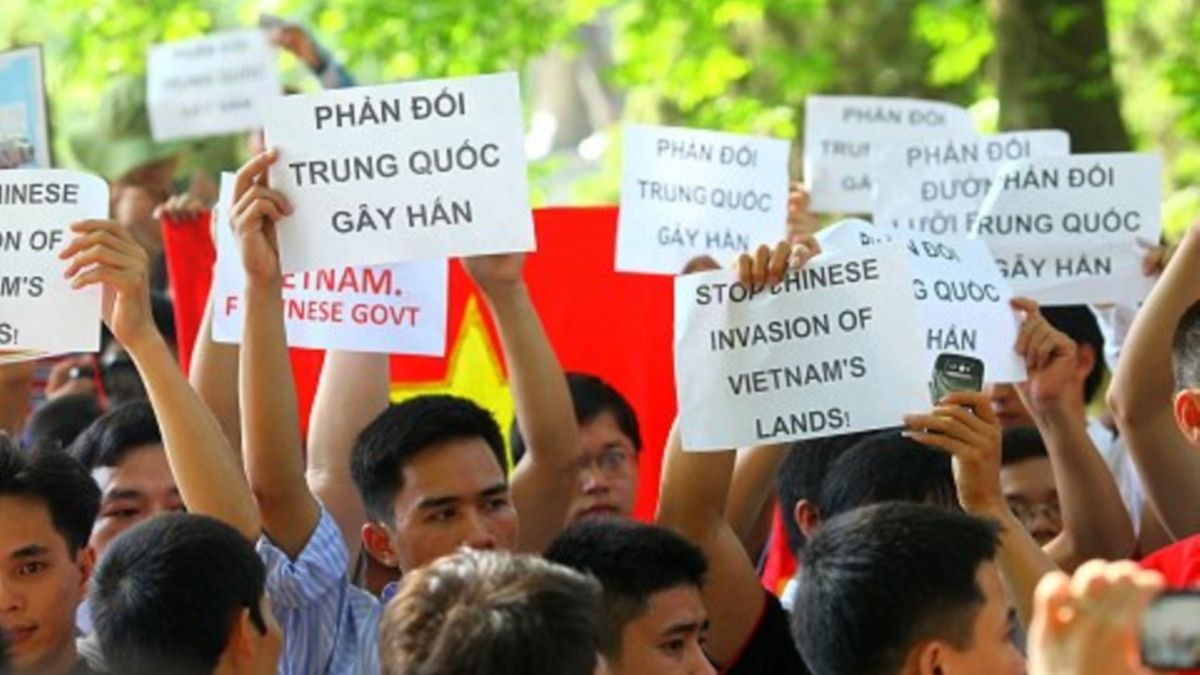
    Public demonstrations and protests are sporadic in Vietnam. But on this day, 10 years ago in 2011, it was the beginning of the longest anti-China protest movement in Vietnam after 1975.

    For almost three months of the summer of that year, a total of 11 protests happened across Vietnam every Sunday, primarily conducted in Hanoi and Saigon, where the Chinese embassy and consulate were placed. Many people call this movement “The Flaming Summer” (Mùa Hè Đỏ Lửa).

    Why were people protesting on that day?

    Since China established the eleven-dash line map (now the nine-dash line map) claiming sovereignty of various regions in the South China Sea, the Vietnamese people have always been angered by China’s claims to the Paracel and Spratly islands, known as the Truong Sa and Hoang Sa islands by the Vietnamese.

    In the summer of 2011, people especially felt provoked by the actions of Chinese vessels in the contested sea. In late May, the news reported that the Chinese vessels were harassing Vietnamese survey vessels and disrupting the Vietnamese vessels’ activities. Later in early June, Chinese ships once again harassed Vietnamese survey ships.

    What was the regime’s response to the protests?

    After supposedly tolerating the protests for a short period of time, the regime nevertheless decided to crack down on the protestors. In late August, the police began to detain people who participated in the protests, forcing 40 protestors onto two buses right after the last rally started on August 21. It was confirmed that at least 47 protestors were arrested. The Hanoi local government warned people against protesting any further.

    What is the legacy of the protests during that summer?

    The waves of anti-China protests in 2011 were not the first nor the last. Earlier in 2007 and 2008, there were also anti-China protests by many bloggers and pro-democracy activists, which also resulted in the government’s crackdown. Later in 2014 and 2018, there were also new anti-China protests.

    However, the protests in 2011 were significant because of their duration, scope, and effect on Vietnam’s pro-democracy discourse. In many ways, it was an unprecedented movement.

    Compared to other anti-China protests, the 2011 protest movement had the most prolonged duration, lasting the entire summer. The demonstrations were also massive compared to others, with the participation of hundreds of people. Some of the rallies were estimated to have around a thousand people. This fact is exceptionally significant for a country infamously known for repressing protests.

    Although the government repressed the protests, they still demonstrated to the Vietnamese government that the people could disagree with the government and willingly show it. Additionally, the protests also sowed the seeds of government criticism among the people. The movement provoked many intellectuals and highly-credited ex-government officers to speak out against the Communist Party and demand democracy.

    Many participants of these protests, such as The Vietnamese Magazine’s co-founder and editor Trinh Huu Long, would later become pro-democracy activists.

    The protests in 2011 were the beginning of “a prolonged civil society movement that still exists nowadays,” said Long.

  • FAQs About The Special Economic Zones and Vietnam’s SEZ Draft Bill

    FAQs About The Special Economic Zones and Vietnam’s SEZ Draft Bill

    In June 2018, many were shocked to witness the largest demonstration in Vietnam since the end of the war in 1975, where thousands of people marched on the streets of several major cities. One of the reasons that compelled the Vietnamese people to protest was because of the proposed Special Economic Zones Law, which their National Assembly’s members were going to pass.

    Despite the fact that under public pressure, the draft bill was ultimately announced to be halted until the next National Assembly’s meeting in October 2018, people still protested against it. Their reason? They feared that they were going to lose essential portions of their country to foreign investors, namely, the Chinese. The government of Vietnam, on the contrary, continued to insist on the passing of this law, citing economic development and jobs opportunities for hundreds of thousands.

    Which side is right?

    1. What Is A Special Economic Zone?

    A Special Economic Zone (SEZ) is defined as an area in which business and trade laws are different from the rest of the country.

    Theoretically, an SEZ can attract foreign investment, expand production, create jobs, and boost export-import. However, that would only happen if a set of conditions is met: the rule of law, together with clearly defined laws and regulations that both facilitate production and business activities, which are binding on all investors and able to adjust market failures, as well as other public issues.

    In practice, and in the particular case of Vietnam, the government has yet to make available any information regarding the conditions under which the proposed SEZs will operate.

    Can the SEZs create real jobs for the Vietnamese people? Can they boost production and trade? If they fail, and the nation falling into debts, who would be held accountable, and how? What are the punishments against them? Alternatively, will they say, “It’s none of your concern; it’s the Party and the State’s business”?

    The above questions remain unanswered.

    2. What Is The SEZ Project?

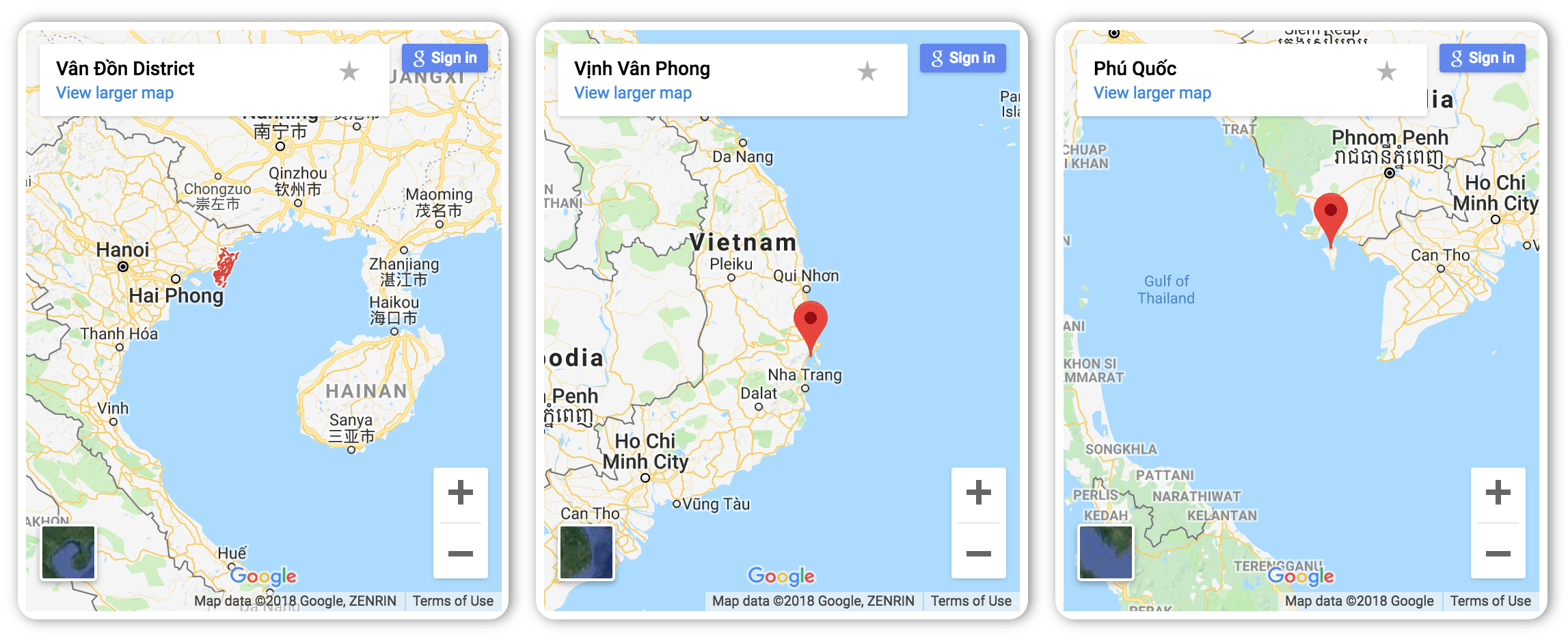
    The SEZ project is a “grand policy” of the Politburo of the Vietnamese Communist Party (VCP), to establish three special economic zones in Van Don (a district in the Northeastern Province, Quang Ninh), Bac Van Phong (of Khanh Hoa Province), and Phu Quoc (of Kien Giang Province) as shown in the picture above. Foreign investors shall be granted special favors in these areas, for example, the 99-year land lease.

    This project is codified in the proposed SEZ Law or the “Law on the Special Administrative-Economic Units”. Traditionally, and as in this time, the government of Vietnam does not publicize the names of the lawmakers concerned in any lawmaking process, so no one knows the architects behind the SEZ Law.

    In case this SEZ Law is found to have contained some defects, or its enforcement would lead to severe consequences, no one, especially Party’s officials, shall be held responsible due to the lack of transparency and accountability in the country.

    3. What Is “Special” About These Three Zones?

    Overall, conditions in Van Don, Bac Van Phong, and Phu Quoc are not favorable for development. These include infrastructure, skills of the labor force, science and technologies, and financial-economic facilities.

    Regarding geographic location, however, all the three districts are located in critically strategic sites of Vietnam, and they hold a crucial implication for national security. To make matters worse, Vietnam’s northern giant neighbor, China, where most of the potential investors would come from, has for centuries been known to keep an ambitious dream of becoming a hegemonic superpower.

    China pays particular attention to Van Don and to Vietnam in general, whom she considers being the “buffer zone” for her to “move southward” to the geo-strategic South China Sea. For this reason, even when the SEZ law does not mention China but only refers to “foreign countries,” obviously China is the only nation the Vietnamese people are concerned about.

    4. What Are The Goals Of The SEZ Project?

    The SEZ project revolves around these promises: the three SEZs shall be where new institutions are tested and adopted with more freedom and less control, where innovation is stimulated, where more jobs are created, and more incomes are generated for local people. In short, the SEZs shall boost production and commerce, and lead to economic growth.

    However, all of those promises remain vague and unfounded. Van Don, Bac Van Phong, and Phu Quo as stated, do not have favorable conditions to establish SEZs, because of poor infrastructure and technological bases and an unskilled labor market.

    Most importantly, no political leader, no official of the VCP and the State shall bear any responsibility if those promises become unfulfilled. If the project fails, or if it causes any adverse consequences for the people and Vietnam, the victims would have no meaningful recourse.

    5. What Are the Potential Consequences Of The SEZs That Vietnamese People Fear?

    5.1. Territorial concession

    By stipulating a land lease of up to 99 years and granting other special privileges to potential Chinese investors, the SEZ Law is paving the way for China to infiltrate Vietnam under her “salami-slicing” strategy.

    Salami slicing is a strategy that the communist Chinese government has used since 1949 to take over territories in the South China Sea and the Himalayan region, in a gradual, step-by-step manner. The tactics were to open the door for Chinese immigrants to settle, do business, set up Chinese language schools, establish their own administrative system, and promote Chinese culture and customs in foreign lands. By doing that, they have legitimized China’s presence and power in the area and gradually built up Chinese autonomy inside Vietnam. If and when the time comes, this group with absolute autonomy could “rise” to demand sovereignty or for the Chinese-controlled area to “exit Vietnam and come back to merge into the motherland of China.”

    5.2. A dumping ground for China’s waste

    The SEZs may face the risk of failing to absorb advanced technologies and management skills, but that’s not it, after all. They are likely to become a market for low-quality products made in China and a dumping ground for her waste, most seriously toxic and e-waste.

    5.3. The conflict between local people and Chinese immigrants

    Overpopulation in China has led to high rates of unemployment and illegal immigration into neighboring countries, especially in Vietnam, where the government with its lousy governance fails to take control of the issue. As a result, bitter conflicts have arisen between local people and Chinese immigrants, which remain unresolved. In recent years, incidents of violent clashes have occurred between Chinese immigrants and the local Vietnamese community in Hai Phong, Quang Ninh, Thanh Hoa, Ha Tinh, as well as other provinces in Vietnam.

    For example, in Quang Ninh in the mid-2000s, Chinese immigrants had thrown stones at Vietnamese people. In Thanh Hoa and Ha Tinh, drunken Chinese workers even falsely imprisoned a few local people after collectively assaulted them.

    5.4. Economic loss

    Accordingly, once the SEZ Law is passed, $70 billion USD shall be invested in the three SEZs, and that is like gambling ours and our children’s future on an uncertain race. Besides, with special favors granted to investors (mostly foreign) who could hardly be controlled, the government would definitely take the risk of substantial tax losses and budget deficits.

    Many precedents can be found for this decision like this. One among them is the bauxite mining project in Tay Nguyen (Vietnam’s Central Highlands), which is also another grand policy of the VCP and the State. It was implemented despite public demonstration, notably the fierce protest from the late military general, Vo Nguyen Giap, and 4,000 Vietnamese intellectuals, domestic and overseas. The grand project lost almost US$170 million between 2013 and 2016. No one among those who made the promises for economic development and job opportunities for the locals were to take any responsibility for this loss.

    With the government’s current institutions and management capacity, the SEZ project cannot and will not ensure economic success. The issue confronting the state is that if it fails like the Tay Nguyen bauxite mining project, no political leader shall bear any responsibility. Worse, if the SEZ project leads to territorial concessions, then it does not matter which leader or official of the VCP and the State takes responsibility, Vietnamese citizens would still suffer the irreversible consequences.

    6. Why Does the VCP Insist On Implementing The Project?

    The answer lies in the entrenchment of crony capitalism, with interest groups collaborating closely with the corrupt central and provincial governments, seeking to gain in grand projects in the name of “development.”

    Also, “the obvious answer is ‘casinos and red-light districts,’ as these SEZs are the only places in Vietnam where these people can do business freely…. another reason that many people are aware of but still reluctant to spell out (for ‘political sensitivity’) is ‘the China factor.’ Otherwise, there is nothing else there” (Nguyen Quang Dy, 2018).

    7. Is There Any Alternative Solution To The SEZ Project?

    Experts point out that the SEZ idea was something that belongs to the last century, that it has become out of date, and that the SEZs are not relevant to the current circumstances of Vietnam. Instead, the urgent thing to do now is to launch a fundamental and comprehensive institutional reform in the nation, focusing on:

    – setting the private sector as the basic economic sector, contracting the state sector to its minimum;
    – recognizing and protecting private ownership of land;
    – establishing democracy, and protecting and promoting freedom rights to mobilize the citizenry for the development cause of the nation.
  • Black Sundays Report: Vietnamese People’s Response To Police Brutality During June 2018 Protests

    Black Sundays Report: Vietnamese People’s Response To Police Brutality During June 2018 Protests

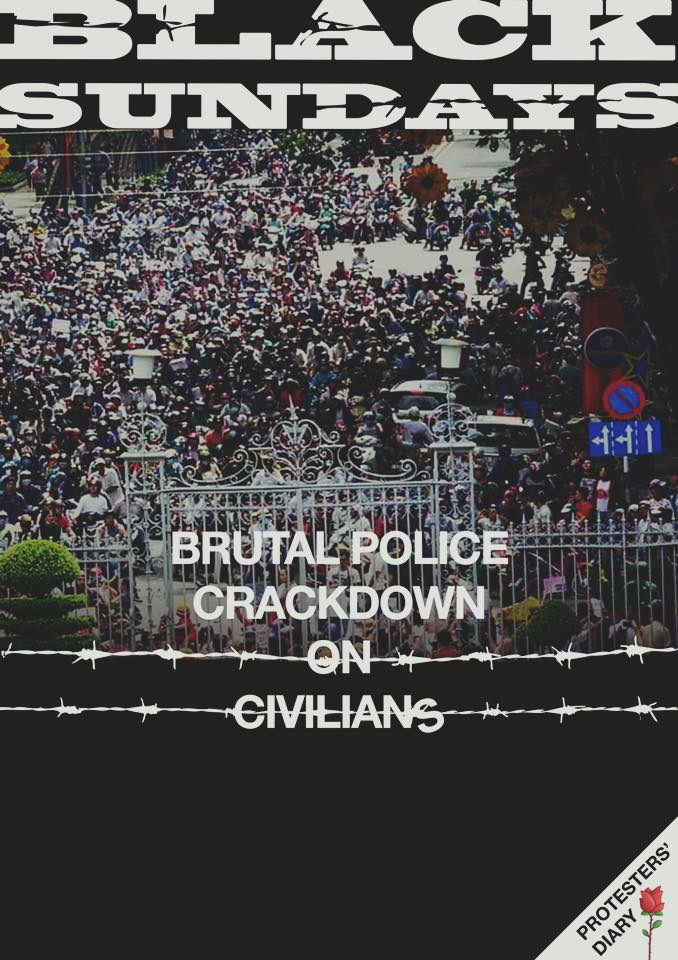
    Civilians, victims of police brutality and arbitrary detention, academics, activists, researchers, and a lot more people from all walks of life inside and outside of Vietnam got together and produced a report on the two “Black Sundays” of June 10 and June 17, 2018.

    It is the Vietnamese people’s unified and firm response to the vicious repression by the government during the latest rounds of protest in the country.

    According to the Facebook page of Nhật Ký Biểu Tình (Protestors’ Diary), copies of the report have been delivered to the UN OHCHR, other international NGOs working on human rights as well as various foreign embassies.

    The full report can be downloaded here.

  • Saigon Is Under De-facto Martial Law

    Saigon Is Under De-facto Martial Law

    June 17, 2018| Hundreds of people were stopped, detained, searched, and later taken to a temporary holding center set up in the heart of Saigon (aka Ho Chi Minh City) for apparently no reasons.

    The government, this time, did not even announce that there were any “illegal” public gatherings as in the previous weekend where thousands of people protested against the cybersecurity and Special Economic Zones draft laws.

    What they have done instead, was to preemptively take a strike at all of the citizens who were happened to be in those hot spots of last week’s protest. Some did go out to the streets with the intent to participate in a demonstration, but they could not even start.

    From the early morning, all types of police, secret police, and security forces have filled up various areas in Saigon. Many coffee shops near the Notre Dame Cathedral Basilica were asked to close by the authorities.

    One witness reported that police were arresting people at a McDonald’s nearby. The only group that acted provocatively was the police and other security forces, this person wrote on Facebook.

    The security forces watched every single bystander, people who happened to pass through the area. Anyone who looked “suspicious” to them would get stopped, asked for identification, searched, and demanded to show their phones where any pictures that were taken would get deleted.

    All were done without any probable cause and of course, without a warrant.

    It seemed as if the law no longer existed there. The city was under siege by its police force, and the people lived under martial law.

    Worse, there would likely be no recourse in a court of law for the victims, even if some of them could gather enough courage to file a complaint against the authorities.

    One person who was arrested while working near Nguyễn Văn Bình Books Street and detained until that evening said on Facebook, that she felt the experience eerily reminded her with words from Anne Frank’s Diary.

    She also recalled that others were taken into separate rooms and some got beaten up by the police. The beatings must be very violent because everyone at that detention center could hear the screams. When they tried to run towards the room to help, the police stopped them with threats of physical violence, recalled by another witness.

    The victim – who later got identified as Trinh Toan – was taken to the hospital for head injuries and reported to be in a coma since.

    Those who got released were cited for “disrupting public disorder,” ironically.

    Another witness live-streamed to tell her story after her release. She described how she and other Catholics got picked up by the police on their way to church. They were taken to that very same detention center in Tao Dan Park and later were both beaten and abused verbally.

    A Vietnamese overseas detailed how the security forces physically subdued him and assaulted him while he was strolling near his house close to Hoang Van Thu Park. The police only released him after he screamed out some profanity in English and revealed his foreign nationality.

    Some other people were already taken into police custody with no warrant a few days before last Sunday.

    One of them was Nguyen Tin. He described the police physically assaulted him, smacking his face repeatedly when he refused to speak and answer questions while in custody. The right to remain silent does exist in Vietnam, but in this case, it failed to protect the citizen.

    Almost all of the pro-democracy activists in Vietnam had plainclothes officers surveilled their homes this past week to prevent them from leaving the house and joined the protest.

    On social media, many more people were reported missing in the past 48 hours, and efforts by civil society groups are ongoing to document and identify those who were arrested, detained and/or suffered abuse.

    Phil Robertson from Human Rights Watch tweeted today:

    “Brutality of #Vietnam authorities attacking activists opposed to new internet surveillance law is really off the charts! Time for #Hanoi to be called out by U.N. Human Rights Council, U.N. General Assembly for their rights crimes!”

    From the June 10, 2018 protest, the authorities might have arrested about 300 people in Saigon alone. One of them was an American citizen, Will Anh Nguyen, whose story made headlines internationally. Vietnam police filed charges against Nguyen for “disturbing public order” on June 15, 2018, and continued to hold him in detention.

    This past weekend, Saigon was the city that got suppressed the hardest. It is estimated that over 100 people arrested and detained and the number of injuries caused by police brutality is still being counted.

  • The Right to Protest In Vietnam Is Not Only Legal, It’s Constitutional

    The Right to Protest In Vietnam Is Not Only Legal, It’s Constitutional

    On June 14, 2018, AFP reported, the spokesperson of Vietnam’s Ministry of Foreign Affairs, Le Thi Thu Hang, told reporters that Vietnam was holding an American citizen of Vietnamese descent, Will Anh Nguyen, under the suspicion of “disrupting public order.”

    Online video clips showed Nguyen being dragged away by several men with his head covered in blood, and that he was thrown into the back of a police car. Later that day, news surfaced on Vietnam’s social media that he was arrested for being part of the demonstration.

    One probably would stop and wonder: Is protesting illegal in this country?

    Simply put, the right to protest is not only legal in Vietnam, but it is also the people’s constitutional right.

    Article 25 of Vietnam’s 2013 Constitution prescribes:

    The citizen shall enjoy the right to freedom of opinion and speech, freedom of the
    press, of access to information, to assemble, form associations and hold
    demonstrations. The practice of these rights shall be provided by the law.

    Not only that, Article 166 of the 2015 Penal Code makes it a crime to infringe upon the human rights of others with the maximum sentence of up to five years in prison.

    Nguyen very likely did not violate any law when participating in a march in Ho Chi Minh City while on vacation; the problem was: he had exercised his universal human rights in the wrong country.

    His arrest is now making international headlines where most of the major media outlets have covered the story, and it also brings many people’s attention to the right to protest in Vietnam.

    As in all of the protests that happened before, this time, again there were allegations that the police used excessive force to suppress the peaceful demonstrators.

    Yes, in one province – Binh Thuan – riots broke out between the protestors and the police, but everywhere else, they were mostly peaceful, including the one that Will participated.

    The UN Human Rights Office for South-East Asia stated on June 14, 2018: “We are particularly concerned about allegations that some protesters were beaten by law enforcement authorities.”

    Any seasoned pro-democracy activists and human rights defenders will tell you what has happened to Will Anh Nguyen this past weekend is the same routine violation of human rights in Vietnam when people dare to exercise the right to demonstrate.

    First, Vietnam still has no law providing for the practice of any of the rights stated in Article 25 of the Constitution.

    While the legislative body of the nation kept delaying passing such a law, the government in March 2005 issued Decree 38/2005/NĐ-CP to regulate “public gatherings”.

    Accordingly, a public gathering of more than five people must be approved by the Provincial People’s Committee, unless it was organized by the government or social and/or political organizations belong to the government.

    This Decree has been quite effectively used by the government to wrongfully break up protests and to arrest people in the past. Nevertheless, its language has been denounced by both legal experts in Vietnam and the international community because of human rights violations.

    It is worth noting that the Decree does not mention the word “demonstration” anywhere, so it can be argued that legally, it cannot be used to regulate protests.

    Thus, in 2011, during the height of another wave of protests across the country, a group of activists and lawyers petitioned the National Assembly’s Standing Committee for a review of Decree 38.

    Vietnam does not have a constitutional court. Instead, the National Assembly has the power to interpret the Constitution, but to date, they have not responded to the petition filed back in 2011.

    In fact, the National Assembly of Vietnam has never exercised this power to interpret the law.

    In a nutshell, the law on the practice of demonstration seems to have been strategically delayed while an allegedly unconstitutional government’s decree will act as the only official tool to round up peaceful protesters and arresting them.

    The nation-wide protests broke out in Vietnam last Sunday, June 10, 2018, against the proposed Special Economic Zones (SEZ) and the cybersecurity draft laws, were estimated to have had thousands of people marching.

    Some sources believed around 300 people were later arrested in Ho Chi Minh City alone, and one of them was Will Anh Nguyen.

    Since his detention on Sunday afternoon, his family has been actively working with the U.S embassy to get him released.

  • Vietnam, A Step Closer to Democracy With The Latest Nationwide Protests?

    Vietnam, A Step Closer to Democracy With The Latest Nationwide Protests?

    June 10, 2018| Nationwide protests broke out in several major cities in Vietnam in the morning and lasted well into the afternoon. As of press time, the demonstrations are still ongoing with reports of several arrests and incidents of police assaulting protestors while observers mostly described the participants as peaceful.

    This time, the protests seemed to have not been organized by any groups, and the more well-known dissidents and activists were not leading the crowd. However, it was the small groups of concerned citizens coming together with substantial knowledge on their right to assemble and protest that made June 10, 2018, both memorable and surprising to people.

    People were gathering and rallying in several cities this morning, Hanoi, Saigon, Nha Trang, Da Nang, and even smaller areas such as My Tho – Tien Giang, Ho Nai – Dong Nai and a few Catholics parishes in Nghe An Province.

    But it may very well be the turn of events in Saigon – Hochiminh City today that has shown a level of political awakening that many observers have not seen before.

    People started to gather at around 8:30 a.m. local time, coming to several areas in Saigon, from the Notre Dame Cathedral Basilica in District One, walking district Nguyen Hue, in front of the U.S. Consulate, to Hoang Van Thu park near Tan Son Nhat airport. From around 500 people at one area to thousands more at another spot.

    The participants have used the Livestream feature on Facebook to record the protests where they showed how knowledgeable the regular persons could be when it comes to their rights as citizens.

    People at one location, while demanding that the police released those who were arrested, have questioned them:

    “Have you read the Constitution. Do you know what Article 25 is? Do you know that arresting protestors is unconstitutional?”

    Even when faced with assaults from police and security forces, the videos showed people were trying to tell each other to remain calm, to document the incidents with photos and videos, and do not fear because: “We did not do anything wrong!”

    In Hanoi, the security forces acted swiftly in rounding up protestors and broke up the rallies. But in Saigon, thousands of people were on the streets, and by the afternoon, it seemed as if the demonstration has become unstoppable even with the police started their crackdown.

    An online call to protest against the draft law creating three Special Economic Zones (SEZ) received over 160,000.00 shares on Facebook this past week. The government acted and postponed the SEZ draft law on early Saturday morning when the probability that the people will take to the streets started looming, but such efforts seemed to be futile.

    The SEZ draft law was not the only bill that the citizens find problematic.

    The people have a major concern regarding the SEZ draft law is because of the China factor. Anti-China rallies are nothing new in Vietnam, and for the past decades, it was the most common reason for the people to let go of their fears and gather on the streets protesting.

    This time, many fear that their government has sold them short to the Chinese investors and that the SEZs will turn into mini China(s) inside Vietnam once the law goes into effect.

    However, there is also the Cybersecurity draft bill pending for a vote on June 12, 2018, where Vietnam attempts to place all of its people under Big Brother’s watch, criminalizing many online activities, from misrepresenting historical facts to merely speaking unfondly of the government.

    Thus, efforts were also made by several civil society groups leading by Hate Change, calling on people to also protest against the Cybersecurity draft law.


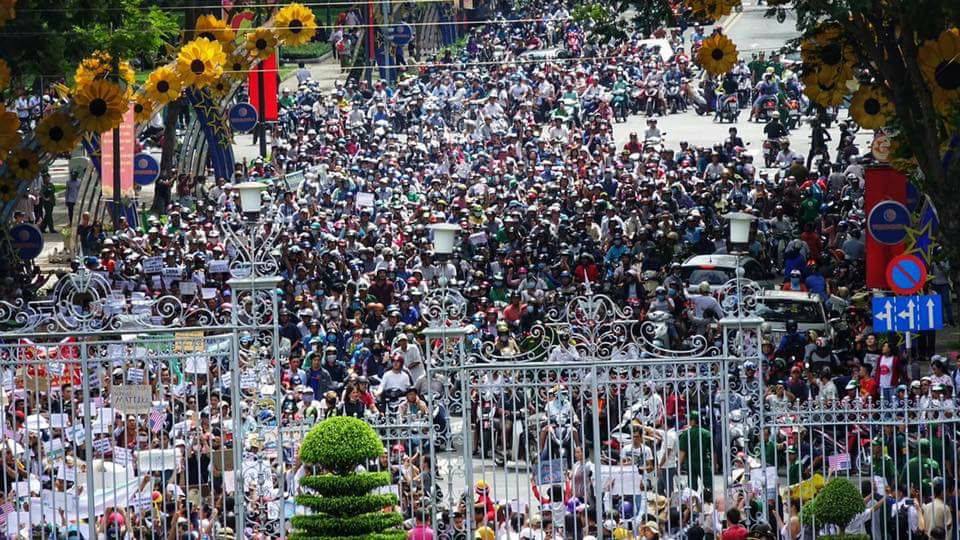
    Protestors on motorbikes in Saigon, denouncing the SEZ draft law. Photo Courtesy: Nguyen Nu Phuong Dung’s Facebook.

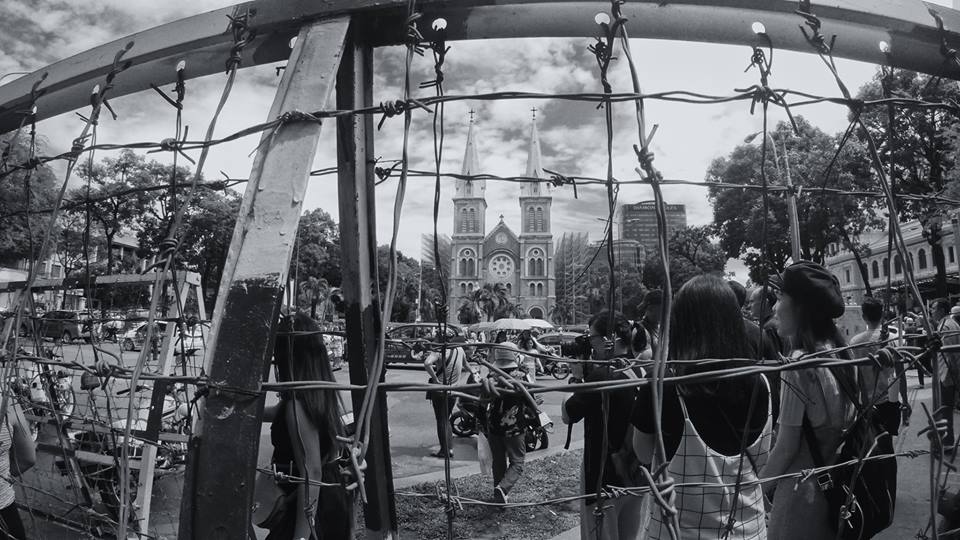
    One of the groups that showed up early at the Notre Dame Cathedral Basilica in District 1, Saigon, protesting against both draft laws, SEZ and Cybersecurity. Photo Courtesy: Nguyen Nu Phuong Dung’s Facebook.

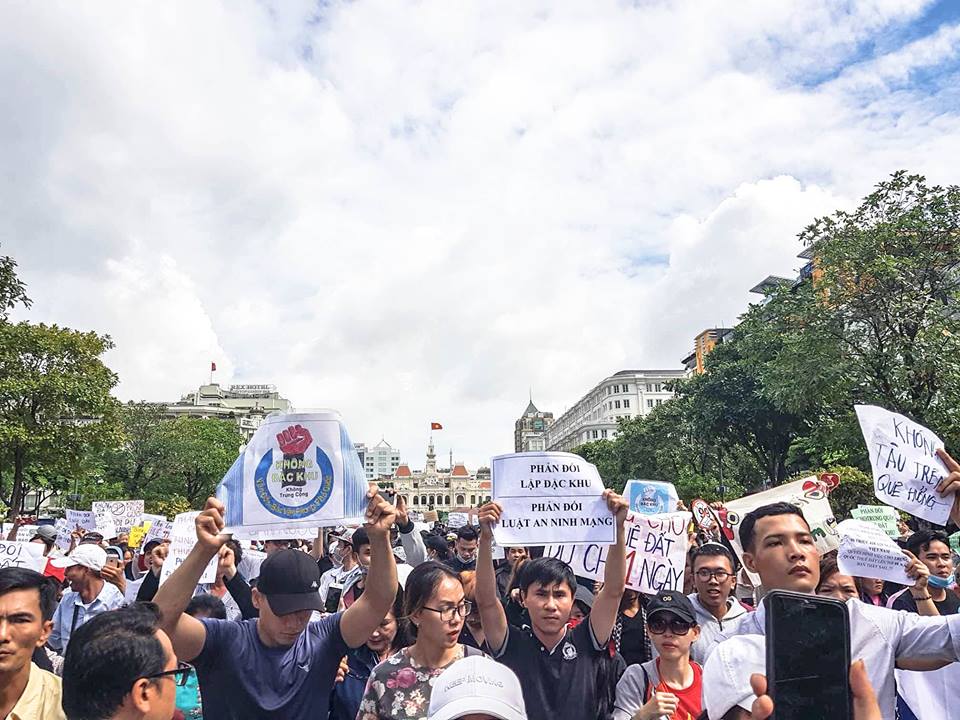
    The crowd at one spot near Hoang Van Thu park, Saigon. Photo Courtesy: Nguyen Nu Phuong Dung’s Facebook.

    Crowd near Tan Son Nhat airport. Photo Courtesy: Nguyen Nu Phuong Dung’s Facebook.

    People gathered in front of Reunification Palace aka Independence Palace in Saigon. Photo Courtesy: Nguyen Nu Phuong Dung’s Facebook.

    Another group of protestors on motorbikes in Saigon. Photo Courtesy: Nguyen Nu Phuong Dung’s Facebook.

    One protestor being assaulted by the security forces. Photo courtesy: Will Nguyen’s Twitter.

    Security forces arrested people in Hanoi. Photo courtesy: Hien Trinh’s Facebook.

    Security forces arrested people in Hanoi. Photo courtesy: Hien Trinh’s Facebook.

    Protestors against Cybersecurity draft law in Saigon. Photo courtesy: Vi Yen Nguyen

    Young people raised banner against Cybersecurity draft law in Saigon. Photo courtesy: Vi Yen Nguyen

    The pictures above are from today’s protests in Hanoi and Saigon-Hochiminh City. The Vietnamese thanks the owners of these pictures for their courtesy, and please contact us for photo credits because we have received them from a few sources on Facebook and Twitter.

  • “Piss on Trump” Opens Up Much Needed Debates on Individual Rights Among Vietnamese

    “Piss on Trump” Opens Up Much Needed Debates on Individual Rights Among Vietnamese

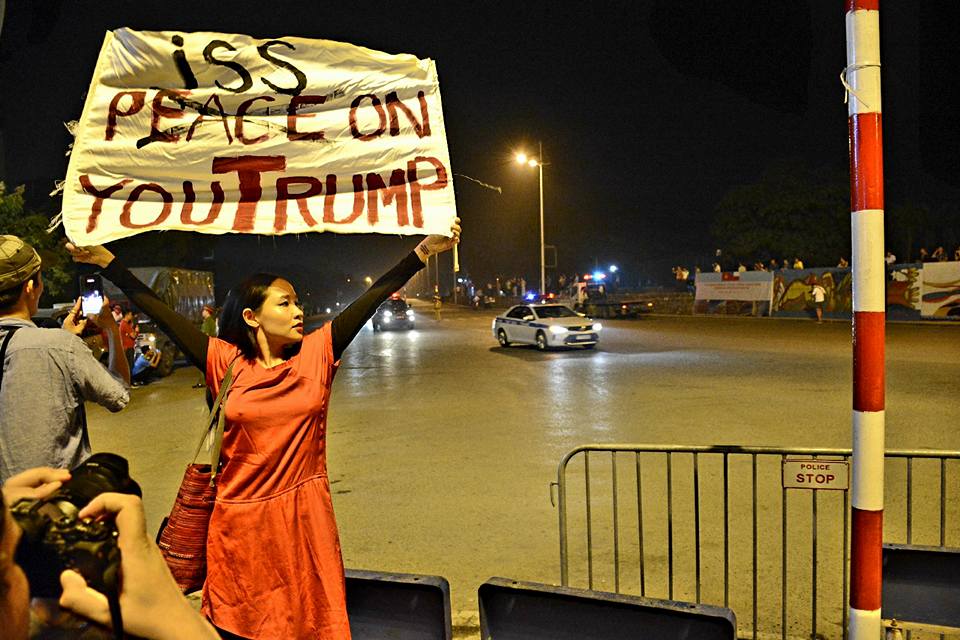
    In the late night of November 11, 2017, I saw the picture of Vietnamese singer Mai Khoi, a pro-democracy artist who has been dubbed “the Vietnamese Lady Gaga” by Western media in the past two years, holding a sign saying, “Piss on you, Trump” where the word “peace” was crossed out and written over by “piss”.

    She was protesting President Trump, who, in her words, was “a misogynistic man”, and unlike his predecessor Barack Obama, had failed to mention the critical conditions of human rights defenders in Vietnam during his trip for the APEC 2017 meetings.

    2017 marks the year that the pro-democracy movement there has experienced some of the worst crackdowns in recent times. During Trump’s visit, activists reported that they were being followed and that police guarded their houses, many also had to take refuge from their homes temporarily. Even before the trip, rumors have been circulating around that more arrests were to be made in the coming days, which worried many observers.

    Yet, for Mai Khoi’s one-person protest, I did not think much of it at first. I chuckled at her sign, and then because of the report on Twitter by American journalist Bennett Murray, who works for German media, that police had started to harass her, I became a bit worried. But still, I went to bed hoping she would not get into too many troubles with the government. She is a public figure, the police would have been a bit more careful, I thought.

    What I would never expect was to wake up the next day and found out not only that she was still being harassed by the police, but a backlash against Mai Khoi on social media in Vietnam also began. Even more perplexed was the fact that the critics not only were members of the general public or the government’s Internet trolls but also from some of the pro-democracy and pro-human rights camps inside and outside the country. And there were so many arguments being thrown around from everyone, myself included.

    Mai Khoi was criticized for protesting against Trump instead of Xi Jinping who also in Hanoi at the same time because some thought Xi is the bigger enemy of all Vietnamese. Afterall, it was China that went after our sea waters, not the U.S.

    There were people who complained that her message was too crude, or that it was not good manners to treat Trump that way. People even suspected that the Vietnamese government had allowed her to protest to make the U.S. president to “lose face.” Had she replaced the word Trump with Xi, she would have been beaten up right then and there by the Vietnamese authorities, some said.

    The worst criticism probably was about her choice of fashion. Mai Khoi was also scolded for not wearing a bra. No proper woman would dress like that, so she did not deserve the right to protest, was the explanation of one critic. Many people demanded that she must give a reason to protest Trump. Not liking Trump or just hating his guts was not good enough, they argued, we hated Xi Jinping because the Chinese took our islands, but why did you have to hate Trump? What did Trump ever do to Vietnam and Vietnamese people?

    Those who supported her simply stated that it was her right to protest and that it did not matter what her reasons were. Mai Khoi had the right to choose whom to protest against, and she did not have to offer a reason for why she picked Trump and not Xi.

    So you can see how one could come to tear her hair out, trying to understand the phenomenon, like I was. And as the events unfolding before my own eyes, with each and every Facebook status and comment of people debating over Mai Khoi’s conduct, it started to dawn on me. We, the current generation of Vietnamese, have all been scrambling for pieces of information on human rights and individual freedoms without any guiding light for so long. And as such, each person was trying to scratch the architecture of those concepts based on his or her own understanding, which may or may not be in line with the already existed international standards.

    And because the difference in understanding the very same concepts among us was so large that it seems as if everyone was fighting with each other, one way or another, about whether Mai Khoi had the right to protest the way she did. It was then that I could see why our thoughts and arguments were so different from each other, or why we had spent so much time to debate.

    But who could blame us for wanting to go through such lengthy debates to get to the bottom of our arguments with one another? We were born and raised in an extremely closed society for such a long time. And for about half of our population, it has also been two, three generations living under a one party’s rule, one way of life, where individualism was banished from society to give space to communal and collective living.

    Today, we are still living in a society that values uniformity and conformity over diversity, because our totalitarian political system controls our every single move. Worse, our ancestors also preserved a culture of obedience and filial piety and passed it on to us, where individual expressions were neither encouraged nor welcomed.

    Not only that none of us was taught about human rights and freedom in school, books on these subjects were not that easy to get printed and sold in Vietnam. We also have not experienced using suitable platforms to engage in meaningful debates or learn how to agree to disagree. Engaging in political debates was not something that we could claim we were particularly trained for.

    We had no experience living with different political views and diverse ways of life. In other words, we all thought we wanted to live in pluralistic society while in fact, we had no idea what it meant.

    The Internet was the miracle that arrived and took many of us to a different world when it introduced us to new, and at the time could have been somewhat strange to some, concepts.

    Nevertheless, instinctively, many of us knew that we wanted to experience living with the values of liberty, freedom, and individual rights. With every single aspect of our life, from our homes to our schools, from our bedrooms to our classrooms, from family life to society, being kept under a tight control, the pressure to take off the lid was unstoppable.

    And with that, in the past twenty years since the Internet was first introduced in Vietnam, each of us had slowly learned – mostly by ourselves – how to push up that lid, so that we could reach the definition of human rights and liberty that many societies had long been established as universal and common values.

    And though these values could have tasted like fresh dews in the early morning to us when we first had them, we also need to learn how not to choke on them.

    The Mai Khoi’s incident was just another example of us still learning how to best apply the definitions of individual rights and freedom in our everyday’s life. Pro-democracy activist Paulo Nguyễn Hồ Nhật Thành wrote on his Facebook this morning: “Mai Khoi (unintentionally) created a debate where both sides, for and against her, had to utilize all that they had learned in order to create their best arguments, while members of the public could watch and learn … Only by having more debatable incidents like this, could us then, as a society, truly absorb the concepts of individual rights and freedom”.

    I happen to agree with Paulo. As painful and uncomfortable as we are in having to debate with other people, including our dear friends who do not agree with us, we must continue this practice. At least, we are doing something that the generations before us were not afforded the opportunity to do so, and that is to open up dialogues and to engage each other in discussing our individual rights with our social issues as the backdrop.

    Only through practice then we can come to have a common, better, and more thorough understanding of the freedoms we are all fighting for. This, I believe, is something Vietnamese people and activists can agree on.

    We may disagree what freedom and individual rights mean, but nevertheless, we all want to have them and practice them. We may fight about what is the definition of pluralism, but there is no doubt that many of us do not want to continue living under the current one country-one leading party’s regime.