Why Should We Care About Non-Communist Discourse of Vietnamese Nationhood?
While issues on Vietnamese nationalism have been widely discussed in academia, the English scholarship on Vietnam’s politics and political history since the 1950s has remained ambivalent toward what constitutes the authenticity of modern Vietnamese nationalism.
The old historiography of the Vietnam War has mistakenly represented Marxist-Leninism as the authentic discourse of Vietnamese nationhood. Prominent Vietnam War historian William Duiker criticized the republican nationalism of Phan Boi Chau as theoretically immature and inherently gullible [1]. As a leading scholar of the new generation of Vietnam War historians, Tuong Vu notes that there was the tendency to allow “the Cần Vương, Đông Du and Việt Minh (the front organization for the Indochinese during the war years) to be lumped together.”[2]
Under the pervasive influence of party propaganda, the local historiography of Vietnamese nationhood has been dominated by the Marxist dialectical materialist interpretation of history in which republican nationalists are tainted by “bourgeois mentality.”[3]
For the past two decades, a small number of regime critics and democracy activists have turned to the republican thoughts for new ideas on the future model of Vietnam’s democratization and development.
In Ha Si Phu’s sophisticated critique of Marxism, Chia Tay Y Thuc He[Abandoning Ideology], the author argues that one crucial precondition for Vietnam transition to democracy is the “People’s Enlightenment” [Dan Tri], which as I will discuss later, is central to Phan Chau Trinh’s discourse of Vietnamese nationhood.
The idea has been echoed and elaborated in Nguyen Quang A’s Phan Chau Trinh va Thuyet Hien Dai Moi [Phan Chau Trinh and the New Modernization Theory] and Mai Thai Linh’s commentary on the meaning of the 2009’s Vietnamese Bauxite Mining Opposition, Tu Dan Tri Den Dan Khi [From the People’s Enlightenment to the People’s Will]. In contributing to the English and Vietnamese scholarships in Republican Nationalism, I will discuss and compare the political thoughts of Phan Boi Chau and Phan Chau Trinh in great depth.
Print-Capitalism and the Emergence of Early Modern Vietnamese Nationalism
French colonial rule was the reality of every Vietnamese person between the late 19th and early 20th centuries, regardless of who they were, what they did, and where they lived. It is more significant to uncover how the experience of living in such a colonial context inspired the development of Vietnamese nationalist thought. Related to this was the increasing access to books and other print materials in the second half of the 19th century.
During the pre-colonial period, Confucian literati did not have any reason to print their texts for mass consumption. Hence, their writings were only made accessible to a small number of people from the elite class. However, the spread of these writings, alongside many other newer texts, was crucial for the rise of modern Vietnamese nationalism.[4]
By the end of 1935, about 15 or 20 percent of all children between six and twelve were enrolled in public and private schools. Somewhere between 10 to 20 percent of the population were literate; these figures continued to increase.[5] Likewise, French censorship did not stop the influx of Western, Chinese, and Japanese ideas to Vietnam through the ports of Hai Phong, Hue, Saigon, and Hanoi.
It was through the translations of propaganda pamphlets, open letters to government officials, textbooks, political manifestos, newspaper columns, public proclamations, petitions to international agencies, translated philosophical and political works, and poems that local people and young Confucian intellectuals started to imagine what the Vietnamese nation could be.[6]
Inspired by the idea of reforming colonial Vietnam, the young Confucian literati played a vital role in the emergence of modern nationalism through their writings on colonial policies and social reforms. They were a small group of young intellectuals who, after receiving French education at home or studying overseas in Japan or France, became disillusioned with the corrupt and decadent Vietnamese monarchy. They were also enraged by the pervasive socioeconomic inequality between the wealthy landowners and the peasants, the power asymmetry between the mandarins and the people, and the French colonizers’ brutal exploitation of the indigenous people.
Understanding Republican Nationalism in Phan Boi Chau and Phan Chau Trinh’s Political Theory
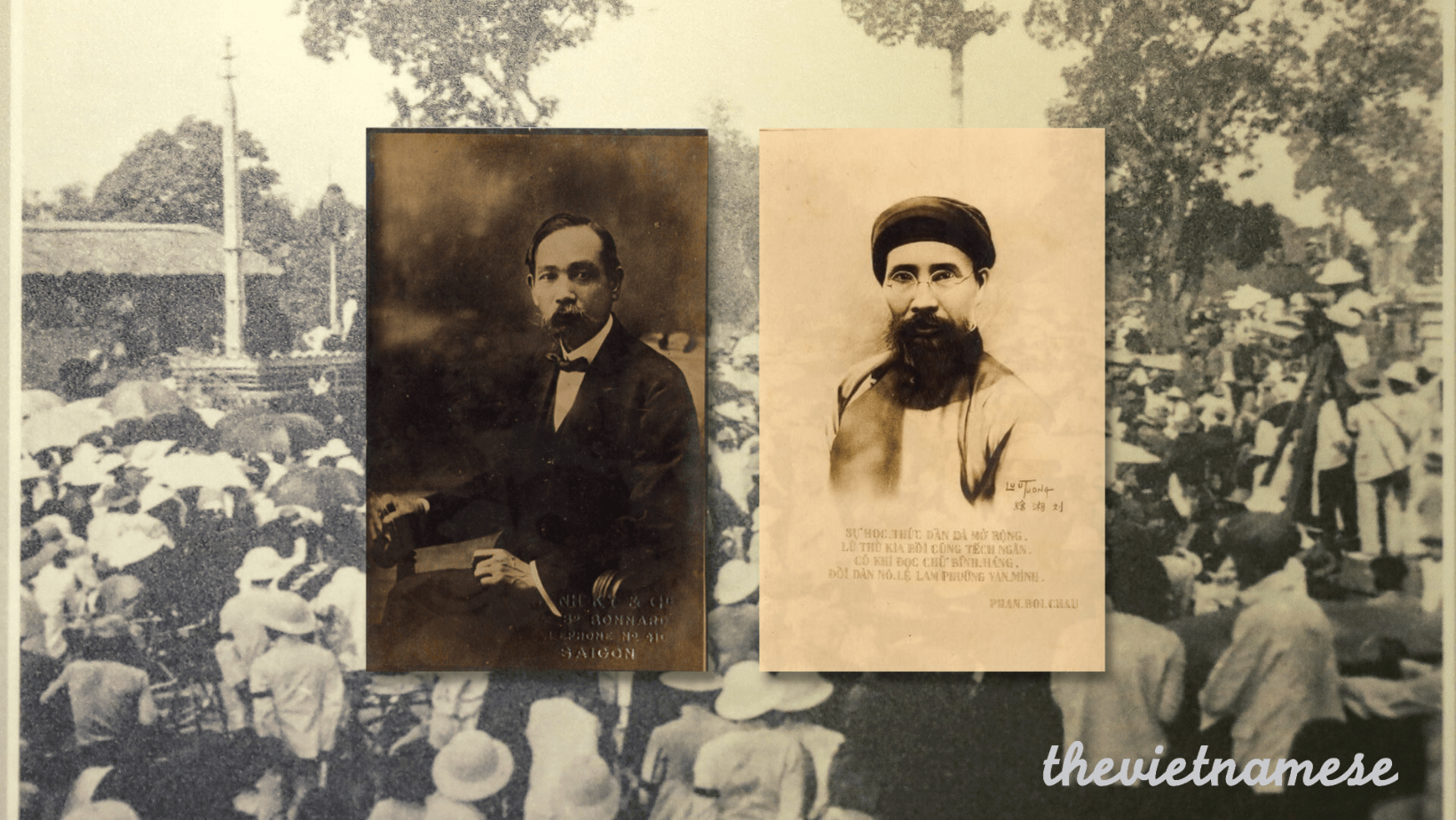
The writings of Phan Boi Chau and Phan Chau Trinh can be seen as the “Yin and Yang” of early Vietnamese nationalism. They can be divided into two distinct discourses: conservative and radical nationalist. [7] Chau was a prominent champion of radical nationalism, while Trinh was a staunch proponent of the Franco-Vietnam alliance.
Chau and Trinh were the leaders of the Dong Du and the Duy Tan movements respectively and enjoyed several years of friendship. [8] However, Chau’s fixation on taking back the country from the French via borrowing Japanese military support and Trinh’s desire for building a free Vietnam through education and peaceful diplomacy led to much tension between them, and eventually, their friendship ended.
Some of the significant contributions of their discourse are pointing out the distinction between the king and the nation and the moral decay of the Vietnamese monarchical system, which had been perpetuating false Confucian teachings by the old generation of Vietnamese literati. Vietnamese people had been taught to blindly revere their king without questioning his qualities and policies.[9]
In the History of Vietnam’s Loss [Vietnam Vong Quoc Su], Phan Boi Chau attributes the loss of Vietnam partially to the corruption and puppetry of the Nguyen Dynasty. He asserts that the “monarchy is a poisonous autocratic regime that sucks the blood of all the Vietnamese people…[and] the people are so ignorant, [that] they fail to seize their own rights [dan quyen] and the fate of the nation [quoc menh] … [from] these poisonous men.” [10] The corrupt monarchy is the reason why popular rights and patriotism have never been realized in Vietnam because the king’s personal desires often go against the public interest.[11]
Phan Chau Trinh links popular rights with the ethics of a nation, which was non-existent in Vietnamese society at that time since the people’s love for their nation and their duty to protect it were dwarfed by their love for their king and their duty to serve him as his subjects. Trinh continues, “the people are therefore not aware of the distinction between king and country” and of the legacy their ancestors had left behind.[12]
Chau’s critique of the monarchical system is a combination of the Confucian (Mencius) vision of democracy, which centers on the idea that the government is responsible for the physical and moral well-being of its people, and the Republican concept of popular sovereignty in which the government is established to serve the interests of the people. [13] In his conception of the nation, the monarch must be treated as part of the government or state rather than above it, and patriotism means being loyal to the people rather than the king.
Both radical and conservative variants of the discourse on Vietnamese nationhood share the pessimistic view that Vietnamese people were born into a culture that perpetuated this vicious asymmetrical relationship. [14] The social ethics of the nation were lost under the monarchy. Vietnamese people lost their sense of solidarity and the public interest because the mandarins, who were “thirsty for glory bestowed by imperial dynasties,” created “laws that broke down the solidarity among the people” to protect their wealth and power. In other words, the selfishness of the king and mandarins led to their neglect of the public good.
Conservative and radical nationalists differ in their modus operandi of freeing the nation from French colonialism. The conservatives proposed a non-violent approach towards building an independent Vietnam; they believed that deepening Franco-Vietnam collaboration and peaceful diplomatic relations could salvage the country from its socioeconomic regression and the decay of traditional education and cultural practices.
They maintained that social, economic, cultural, and political reform require Vietnamese people to learn from Western (particularly French) education, philosophy, and modernization. This idea is predicated upon the belief that the French would, at some point, give Vietnam autonomy and that after a period of modernization, the Vietnamese people would develop intellectually and would have enough material resources for self-rule.
The “people’s enlightenment [intellectual understanding],” the “improvement of their resources,” and the establishment of modern socio-economic institutions (e.g., academia, public spheres, and commercial enterprises) take precedence over the right to self-determination given the social, economic, political and cultural backwardness of the Vietnamese people.
The conservatives believed that emphasis on social and economic rights did not come at the expense of failing to protect other civil and political rights. Rather, they held that Vietnamese society’s intellectual and socio-economic modernization was necessary for the development of political freedom. Violence would not be able to achieve true independence without the participation of well-informed and well-educated people. Pushing for immediate self-rule without these preconditions was seen as precarious and futile to Vietnam’s long-term survival. They believed that the genuine independence of the Vietnamese people would not only stem from their freedom to exercise their popular rights but from their capacity to understand how to use these rights to serve both their interests and those of the nation.
The radical nationalists, by contrast, sought to convince their compatriots of the humiliating situation Vietnam found itself in. Their plan for nation-building involved leading the whole native population to expel the “evil French” out of Vietnam through military means, followed by building a new republican state governed by the people. This “penchant” for raising an armed revolution against the French to achieve national independence rested on Chau’s political doctrine on national independence, which held that a nation was made up of three parts: people, land, and sovereignty. Out of these three, Chau viewed the people as being the most important and the “soul” of the nation. For Phan Boi Chau, a nation is free only if its people are free:
According to the established national law, a nation [nuoc] must be constituted by three elements: people [nhan dan], land [dat dai], and sovereignty [chu quyen]. Any nation lacking these three components is not considered a nation. Of those three, the people are the most important. Without the people, the land will be left uncultivated and national sovereignty will be lost. The nation survives when the people survive; the nation collapses when the people perish. [15]
Yet how does one know if a person is free? For Chau, the Vietnamese people are free only if they are free to exercise “dân quyền,” or popular rights:
In order to determine whether the people exist, one must see whether the rights of the people exist. If these rights are honored, then the people will be respected, and the nation will get strong. If such rights are violated, then people will be held in contempt and the nation will become weak. If such rights are completely lost, then we lose the people and the nation too.[16]
When the Vietnamese people’s ability to exercise their popular rights was taken away by the French, Vietnam was no longer a free nation, even if territorial sovereignty and the people’s ownership of the land were kept intact.
Among these popular rights, Chau heavily emphasized the right to non-interference and non-domination from the French and the right to establish a government elected by Vietnamese people under the rule of law. He associated national liberty with the survival of the Vietnamese people and with their freedom to exercise the right to self-rule.
Specifically, Chau argued that the right to self-determination consisted of the right to be free from the domination and exploitation of the oppressor — the French. An independent Vietnam existed only if the Vietnamese people were free of the master-slave relationship with the French.[17]
To this end, Chau believed that the demise of the French government in Vietnam marked the birth of a Vietnamese sovereign, whose primary responsibility was to serve the interests of the citizens and to guarantee their freedom to exercise their rights. Each citizen, in return, had the obligation to serve the interests of the national community. The interests of the sovereign and its people were intertwined.
Phan Boi Chau and Phan Chu Trinh were the Yin and Yang of Vietnamese nationalist discourse. From a cursory look, their ideas may stand in contrast to each other. Nonetheless, a close comparison of their political thought has shown that their visions for Vietnamese nation-building were complementary; one was incomplete without the other.
Trinh criticized Chau for being impetuous and irrational in his solution for securing the country’s independence, arguing that relying on the French did not necessarily mean that Vietnam would regain its autonomy. Chau may also have been naïve in his belief that Japan would have been willing to help Vietnam defeat France with little political costs, since by the turn of the 20thcentury, Japan had turned into another hungry and ruthless colonizer.
However, Chau’s writings on popular rights reflected the horrid conditions of France’s brutal exploitation of the native population, something which is understated in Trinh’s own discourse. Chau may have been an avid proponent for human rights protection in colonial Vietnam, yet these rights may not have been respected nor protected if the people failed to understand the significance of these rights in the context of the nation. Trinh maintained that the comprehension of human rights can only happen if the people are educated in Western science and philosophy.
Trinh could also be said to have been too idealistic in his belief that it would be rational for the French not to have helped in building a strong Vietnam, for doing so would have threatened its colonial rule. Trinh’s conceptions of morality and ethics needed further theorizing and conceptual clarification since he never explained how Confucian teaching could be made compatible with Western theories on national and social ethics. In other words, Trinh had not examined the extent to which the five basic human virtues of Confucianism could be applied to Western philosophical thought.
In the early 1900s, Vietnamese anti-colonial theory was still in its infancy partly because local scholars still lacked access to the original texts of Western political philosophers. Nevertheless, the writings of Phan Chau Trinh and Phan Boi Chau had a substantial impact on the crystallization of the early Vietnamese national consciousness by elaborating on the concepts of patriotism and popular rights, which were nonexistent in a monarchical Vietnam where the people’s love and duty for their nation were second to their public reverence for the emperor and his family. However, it may be that their thoughts, once again, will find their ways to be beneficial to the democratization and nation-building of Vietnam in this century.
Bibliography:
- William Duiker, The Rise of Vietnamese Nationalism (Ithaca, NY: Cornell University Press, 2008), 9
- Tuong Vu, “Vietnamese Political Studies and Debates on Vietnamese Nationalism,” Journal of Vietnamese Studies,Vol. 2, Issue 1 (2007): 191-192.
- Patricia Pelley, Postcolonial Vietnam: New Histories of the National Past (Durham, NC: Duke University Press, 2002).
- Shawn Frederick McHale, Print and Power: Confucianism, Communism, and Buddhism in the Making of Modern Vietnam, New edition (Honolulu: University of Hawaii Press, 2008), 33.
- David G. Marr, Vietnamese Tradition on Trial, 1920-1945 (Univ of California Press, 1981), 34.
- Truong Buu Lam, Colonialism Experienced: Vietnamese Writings on Colonialism, 1900-1931 (University of Michigan Press, 2000).
- The labeling is used for the purpose of categorization and based on Hue-Tam Ho Tai, Radicalism and the Origins of the Vietnamese Revolution (Harvard University Press, 1996), in which the author labels the anti-colonial activists in the early 1900s who advocated military means of resistance as “radical nationalist.” Thus, the terms “radical” and “conservative” refer to the strategy of resistance rather than their traditional meaning that is often understood as a person’s ideological position. The term “republican” is based on the labeling in Christopher Goscha, The Penguin History of Modern Vietnam: A History (Penguin UK, 2016). For this paper, my interpretations of these discourses are mostly based on their most influential and well-developed representatives, Phan Boi Chau and Phan Chu Trinh for two reasons. First, their texts have influenced Marxist-Leninist discourse and other nationalist discourses. Phan Boi Chau’s militant ideas and his model of democracy influenced Viet Nam Quoc Dan Dang (VNQDD) organizational and revolutionary theory.
- In Western tradition, it is the norm to reference authors by their last name. Nonetheless, in Vietnamese culture it is considered formal and polite to address professors, writers, and authors by their first name. Moreover, because the thinkers’ last names are identical, referencing their last name would confuse readers. For the rest of the article, when referencing Phan Chau Trinh and Phan Boi Chau in their full name, I will simply write Trinh and Chau respectively.
- Phan, Phan Chau Trinh And His Political Writings, 108. For more criticisms of the monarchy, see Phan Chau Trinh, “Viet Nam Quoc Dan Phan Chau Trinh ky thu Viet Nam Duong Kim Hoang De” in Chuong Thau et. al, ed., Phan Chau Trinh Toan Tap[Complete Works by Phan Chau Trinh], v.3, 135-155.
- Phan Boi Chau, “Tan Viet Nam” in Chuong Thau, ed., Phan Boi Chau Toan Tap[Complete Works by Phan Boi Chau], v. 2, 255
- For a detailed argument, see Phan Chau Trinh, “Quan Tri Chu Nghia va Dan Tri Chu Nghia” in Chuong Thau et. al, ed., Phan Chau Trinh Toan Tap [Complete Works by Phan Chau Trinh], v.3, 266-283.
- Chu Trinh Phan, Phan Châu Trinh and His Political Writings, vol. 49 (SEAP Publications, 2009), 110.
- Chau states that: “In this life, without Mencius the notion that “the people as the most important element” [in a nation] would not be realized; without Rosseau, the flag of “popular rights” would not be raised…Those who love themselves definitely love their compatriots, those who love their compatriots love their country, and those who love their country are willing to sacrifice their individual interests to protect their country. This is the true meaning of patriotism. See Phan Chau Trinh, Complete Works, vol .4, (Hue: Thuan Hoa Publishing House, 1990), 32-55.
- In Quan Tri Chu Nghia va Dan Tri Chu Nghia, Phan Chau Trinh used the sentence “lot long me da chiu cai nghia vua toi” (p274).
- Phan Boi Chau, Complete Works by Phan Boi Chau, v.2, 386
- Ibid.
- It is difficult to trace the philosophical root of Chau’s conception of liberty, but the following quote shows that that his proposition is a combination of Mencius’s limited version of democracy, which centers on the ideas of the responsibility of government for the physical and moral well-being of the people, and Rosseau’s conception of popular sovereignty in which a government is established from a social contract to serve the interests of the people.