Less than a day after the Human Rights Dialogue between the European Union and Vietnam on March 4, 2019, was conducted, the Vietnamese police continue to commit blatant violations of the people’s rights.
Two hours ago, the police came and arrested one of the active members of a group consisting of concerned citizens who have been fighting against what they alleged as illegal activities associated with the BOT (Build-Operate-Transfer) toll booths across Vietnam.
Ha Van Nam, the victim, posted on Facebook that the police came and searched his house. Later, other Facebookers cited his wife’s statement to confirm his arrest.
Ha Van Nam was viciously beaten up by men in plainclothes back in January 2019 whom he alleged that they were plainclothes officers. He suffered two broken ribs and other injuries. The perpetrators later threw him at the front gate of Dan Phuong hospital in Hanoi.
Today, his last post on Facebook stated that the police came to his house and alleged that he committed the crime of “inciting public disorder.”
“Inciting public disorder” is a crime that has been routinely used against activists and protestors in Vietnam in the most arbitrary manner.
Often, the government would accuse anyone of committing this crime when they participate in any civil disobedience act.
Journalist Pham Doan Trang wrote on her Facebook this morning after the incident went viral on social media:
“Upon the arrest today of driver Ha Van Nam for ‘disrupting peace,’ once again, we highlight that it is time the Vietnamese government immediately decriminalizes and depoliticize civil affairs. We firmly believe that government-endorsed violence with impunity can only lead to more violence in society.”
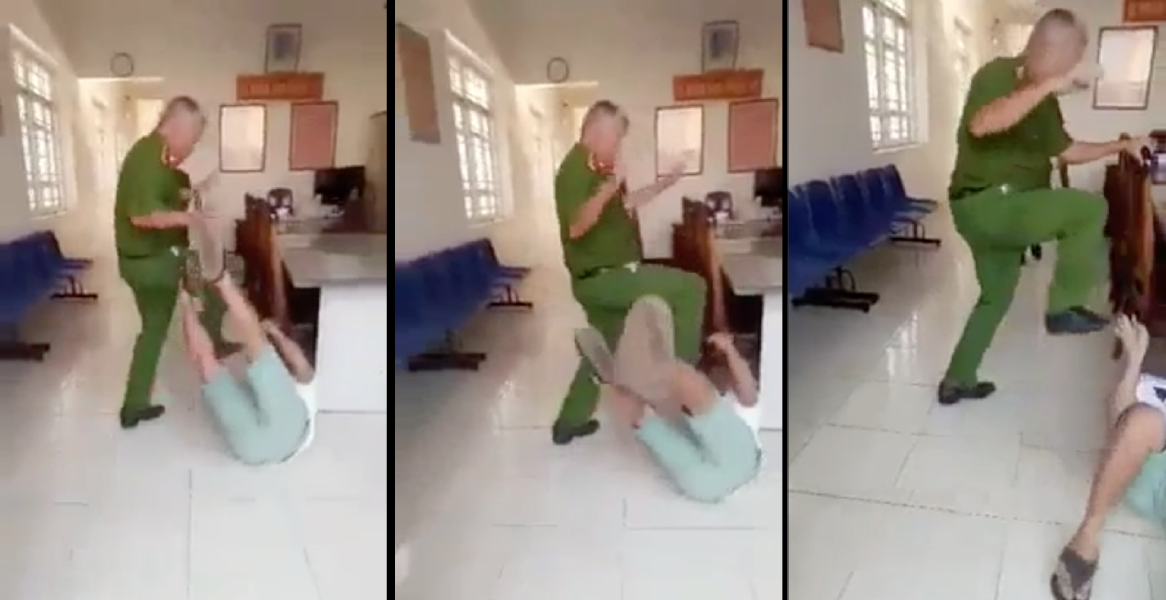
Yesterday evening, January 29, 2019, Facebookers in Vietnam were circulating a video clip showing a gentleman lying on the ground while another, older man in police uniform was stomping on him, hitting him on the face, head and chest area.
By the afternoon of January 30, 30219, the story got featured on Tuoi Tre online – one of the largest newspapers in Vietnam. It was one of the rarer times where one could find stories of police’s misconducts featured quickly on state-owned news right after making waves on social media.
While Tuoi Tre was able to confirm the story and interviewed a supervisor of the police officers involved in the incident, many netizens became very critical of its headline which states: “Temporary Suspension of Deputy Ward Police Officer Using Feet to ‘Take Action’ on Witness.”
The criticisms targeted the headline for de-escalating an incident of police brutality into something a lot less severe by using vague and ambiguous language like “take action.”
The term “take action” was actually used by the Head of Tuy Hoa Police Department, Nguyen Van Dung, in his interview with Tuoi Tre regarding the incident.
Some freelance journalists believed that Tuoi Tre practiced too much self-censorship and that in this situation, they could have used the word “stomp” and would not face any disciplinary action from the Central Committee of Propaganda. Later in the day, another online newspaper, Phap Luat of Ho Chi Minh City also published the same story and used the word “stomp” in the headline.
Tuoi Tre was slammed with an order to pay a total fine of VND220 million (close to USD10,000) in July 2018 along with a 90 days suspension.
Back then, the government issued such order after finding that Tuoi Tre had reported news that was “untrue” and causing “severe impacts” when it published an inaccurate story about the late President Tran Dai Quang’s comment on the Law on Demonstration and failed to remove a “nationally divisive” comment left by a reader on another article.
However, with this story, some readers did come to the defense of Tuoi Tre, stating that it was a clever way of playing with words to get the people’s attention. Also, it should be okay for Tuoi Tre to quote a word used by a person they have interviewed.
To these people, what more important was the fact that Tuoi Tre dared to swiftly report the incident at length, letting the victim provided a detailed description of the events.
The victim in the incident was Le Huu Quoc, a resident of Phu Thanh Ward, Tuy Hoa City, Phu Yen Province. Quoc was a witness in an altercation between two other men.
According to Quoc, he and another person were trying to break up the fight of two others, and the local police have asked all of them to come to the station.
At the police station of the local ward, Quoc was physically assaulted – as seen in the video clip – by the deputy chief Huynh Minh Le.
Quoc told Tuoi Tre that when he was at the police station, officer Le started yelling at him, strangled his neck, pushed him to the ground and used his feet to stomp on Quoc. Another officer came and stopped Le.
After Quoc came home from the station, the police officers – who were fully armed – also arrived at his house later that night, asking him to go back and provide more statement. Quoc refused because he was scared from the treatment he received earlier.
Quoc said: “I was only a witness, but they had to call a fully armed police force to come and get me like a criminal, causing damage to my reputation. Further, I already came to the station earlier and got beaten up by the deputy chief so I would not go again.”
Confirming with Tuoi Tre, the Head of Tuy Hoa City Police Department, Nguyen Van Dung, acknowledged the incident and informed the public that the involved officer had been put on leave.
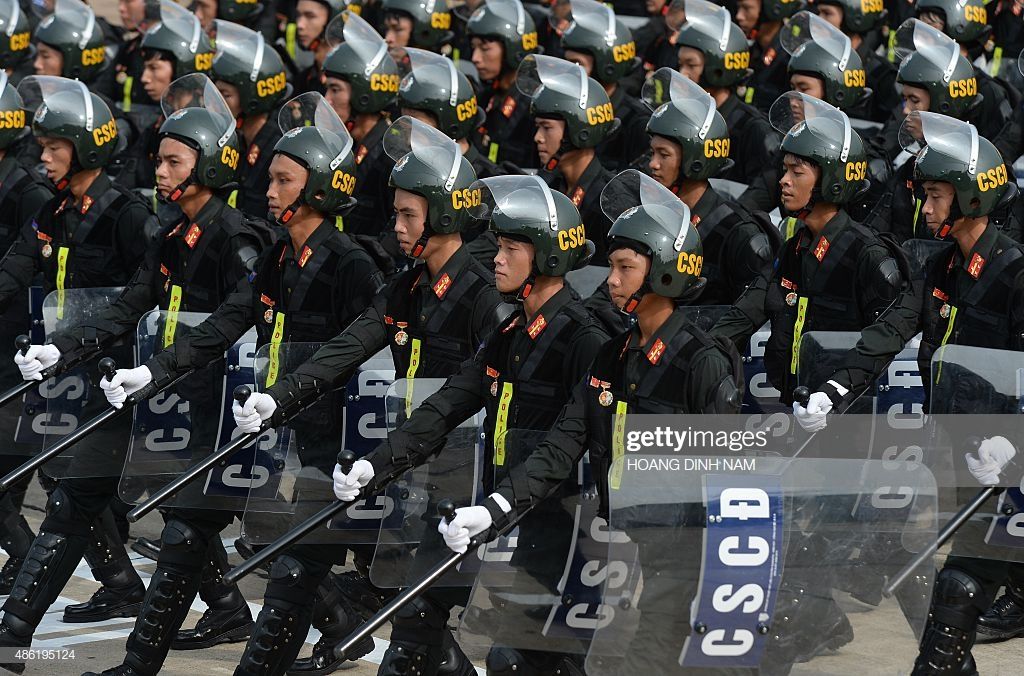
Vietnam faced increasing public complaints regarding police brutality in recent years. After its first review under UN’s Convention Against Torture in 2018, the government is due to elucidate about five individual cases of death while in police custody by December 7, 2019.
The debate about Tuoi Tre’s decision to publish the story and its use of certain language for its headline could be continued in the days to come regarding the practice of state’s censorship and self-censorship.
In the meanwhile, the fact that the story of Le Huu Quoc quickly made the headlines shows the inconvenient truth about police brutality in Vietnam: it continues to happen around the country at an alarming rate, causing detrimental effects on the people and society as a whole.
Today, January 28, 2019, a driver in Hanoi who was supportive of the movement to fight against illegal BOT (Build-Operate-Transfer) toll booths in Vietnam, Ha Van Nam, was kidnapped by allegedly plainclothes police.
Nam alleged that he was brutally assaulted, resulting in two broken ribs and other injuries. The perpetrators later threw him at the front gate of Dan Phuong hospital in Hanoi.
Ha Van Nam and his injuries. Photo courtesy: Truong Chau Huu Danh’s Facebook.
In recent days, friends and supporters of the protest against “dirty” BOTs in Vietnam have asserted that there are corrupt individuals from the police force who act in concert with thugs and BOT An Suong’s owner to suppress those who challenge the BOT’s legal merits to collect toll money.
On January 24, 2019, a man named Ngo Cong Tuan from Hanoi was visiting friends in Ho Chi Minh City happened to pass by BOT An Suong and got picked up by the local police of Tan Tao Ward.
He alleged that he was physically beaten by the police right after he was arrested and the beating continued during the car ride to the station. He was then detained with no criminal charge for two days, from 24-26 January.
Ngo Van Tuan being taken to the hospital. Photo courtesy: Truong Chau Huu Danh’s Facebook.
Tuan further alleged the police officers continued to beat him during the detention, ordered him to take off his clothes, and also starved him during the two-day-detention.
He was released on January 26, 2019, with no investigative report. Almost immediately after his release, Tuan went back to the same police station to report the assault and file a statement, but the police officers tried to close their door on him.
All of this was captured on a live-stream video posted on Facebook. In the end, Tuan was able to make the report, but he also had to be admitted to a hospital for a check-up.
Tuan was not part of the BOT protest; he was only a passerby.
In an unrelated event happened in a different province, on January 28, 2018, while working on location, reporter Ngoc Thanh was involved in a physical altercation with police officers from Ward 4, Vinh Long Province. Thanh received injuries and had to be admitted to the hospital on the same day.
Reporter Ngoc Thanh in hospital. Photo courtesy: Truong Chau Huu Danh’s Facebook.
In November 2018, Vietnam underwent its first review under the UN-Convention Against Torture which the country had ratified in 2015.
In December 2018, the Committee Against Torture issued its concluding observations on the initial report of Viet Nam with specific recommendations to the government.
Portions of these recommendations specifically raised concerns over allegations of police brutality and death in police custody/detention (Paragraphs 20-23).
The Committee specifically requested that the State of Vietnam elucidates and informs the Committee about the outcome of the deaths in police custody of the following individuals by December 7, 2019:
Do Dang Du, a 17-year-old minor, who reportedly died in custody on 5 February 2015 as a result of severe injuries to the head and body while in police custody in Chuong My district, Hanoi;Nguyen Huu Tan, a Buddhist who was detained and whom the police alleged had committed suicide while in custody. No independent investigation of the death was carried out, and the detainee’s family was subjected to reprisals from the local police after complaining to the authorities;Ma Seo Sung, a Hmong Christian who was arrested and detained by the police and allegedly committed suicide by hanging and whose family also received threats of reprisals;Ksor Xiem of the Montagnard Evangelical Church, who died of injuries sustained in police custody, andY Ku Knul a Montagnard Christian who died while under arrest and whose body showed signs of electric shocks.
Among the above, the case of Do Dang Du shocked the nation when it happened in October 2015, partly because it involved a minor who was detained illegally by the police in Hanoi – the Capital city of Vietnam.
However, after his family’s attorneys also got physically assaulted by thugs and one police officer in plain clothes, it seemed that information had stopped coming forward.
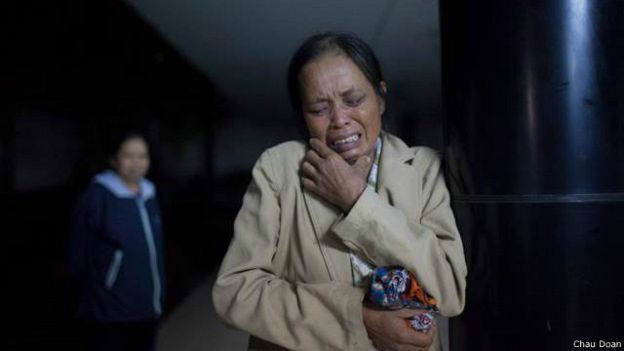
Mrs. Nguyen Thi Mai, the mother of Do Dang Du, the most shocking case in the last three years involving deaths in police detention in Vietnam. Photo Courtesy: Chau Doan.
Neither Du’s family or the public in Vietnam was satisfied with the explanation given by the authorities that he was beaten to death by a cellmate over “dirty dishes.”
The UN-Committee Against Torture seemed to agree with them when it asked the State to report back to the committee with further details later in 2019.
However, in reality, the police forces in some 63 provinces all over Vietnam probably did not get informed about the UN-CAT’s findings and recommendations because allegations of police brutality continued to grow in the first month of the new year.
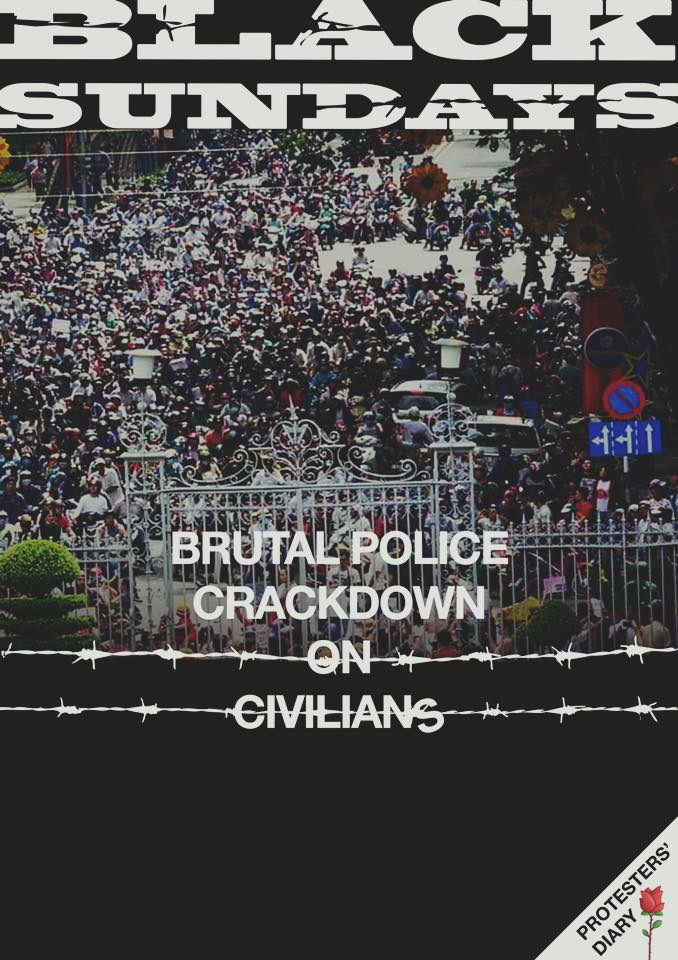
Civilians, victims of police brutality and arbitrary detention, academics, activists, researchers, and a lot more people from all walks of life inside and outside of Vietnam got together and produced a report on the two “Black Sundays” of June 10 and June 17, 2018.
It is the Vietnamese people’s unified and firm response to the vicious repression by the government during the latest rounds of protest in the country.
According to the Facebook page of Nhật Ký Biểu Tình (Protestors’ Diary), copies of the report have been delivered to the UN OHCHR, other international NGOs working on human rights as well as various foreign embassies.
June 17, 2018| Hundreds of people were stopped, detained, searched, and later taken to a temporary holding center set up in the heart of Saigon (aka Ho Chi Minh City) for apparently no reasons.
The government, this time, did not even announce that there were any “illegal” public gatherings as in the previous weekend where thousands of people protested against the cybersecurity and Special Economic Zones draft laws.
What they have done instead, was to preemptively take a strike at all of the citizens who were happened to be in those hot spots of last week’s protest. Some did go out to the streets with the intent to participate in a demonstration, but they could not even start.
From the early morning, all types of police, secret police, and security forces have filled up various areas in Saigon. Many coffee shops near the Notre Dame Cathedral Basilica were asked to close by the authorities.
One witness reported that police were arresting people at a McDonald’s nearby. The only group that acted provocatively was the police and other security forces, this person wrote on Facebook.
The security forces watched every single bystander, people who happened to pass through the area. Anyone who looked “suspicious” to them would get stopped, asked for identification, searched, and demanded to show their phones where any pictures that were taken would get deleted.
All were done without any probable cause and of course, without a warrant.
It seemed as if the law no longer existed there. The city was under siege by its police force, and the people lived under martial law.
Worse, there would likely be no recourse in a court of law for the victims, even if some of them could gather enough courage to file a complaint against the authorities.
One person who was arrested while working near Nguyễn Văn Bình Books Street and detained until that evening said on Facebook, that she felt the experience eerily reminded her with words from Anne Frank’s Diary.
She also recalled that others were taken into separate rooms and some got beaten up by the police. The beatings must be very violent because everyone at that detention center could hear the screams. When they tried to run towards the room to help, the police stopped them with threats of physical violence, recalled by another witness.
The victim – who later got identified as Trinh Toan – was taken to the hospital for head injuries and reported to be in a coma since.
Those who got released were cited for “disrupting public disorder,” ironically.
Another witness live-streamed to tell her story after her release. She described how she and other Catholics got picked up by the police on their way to church. They were taken to that very same detention center in Tao Dan Park and later were both beaten and abused verbally.
A Vietnamese overseas detailed how the security forces physically subdued him and assaulted him while he was strolling near his house close to Hoang Van Thu Park. The police only released him after he screamed out some profanity in English and revealed his foreign nationality.
Some other people were already taken into police custody with no warrant a few days before last Sunday.
One of them was Nguyen Tin. He described the police physically assaulted him, smacking his face repeatedly when he refused to speak and answer questions while in custody. The right to remain silent does exist in Vietnam, but in this case, it failed to protect the citizen.
Almost all of the pro-democracy activists in Vietnam had plainclothes officers surveilled their homes this past week to prevent them from leaving the house and joined the protest.
On social media, many more people were reported missing in the past 48 hours, and efforts by civil society groups are ongoing to document and identify those who were arrested, detained and/or suffered abuse.
Phil Robertson from Human Rights Watch tweeted today:
“Brutality of #Vietnam authorities attacking activists opposed to new internet surveillance law is really off the charts! Time for #Hanoi to be called out by U.N. Human Rights Council, U.N. General Assembly for their rights crimes!”
From the June 10, 2018 protest, the authorities might have arrested about 300 people in Saigon alone. One of them was an American citizen, Will Anh Nguyen, whose story made headlines internationally. Vietnam police filed charges against Nguyen for “disturbing public order” on June 15, 2018, and continued to hold him in detention.
This past weekend, Saigon was the city that got suppressed the hardest. It is estimated that over 100 people arrested and detained and the number of injuries caused by police brutality is still being counted.
Vietnam soon faces the UN’s review compliance on the implementation of the 1984 United Nations Convention against Torture and Other Cruel, Inhuman or Degrading Treatment or Punishment (UNCAT), which it became the 81st signatory on November 7, 2013.
Despite a showing of strong commitment from the Vietnamese Ambassador to the UN at the time of signing, Le Hong Trung, who condemned all “acts of torture and cruel, inhuman or degrading treatment of persons and to better protect and promote fundamental human rights”, police brutality and death in police detention remain some of the most urgent social issues in the country today.
Less than a year since the Vietnam’s National Assembly ratified UNCAT in November 2014 and submitted the ratification to UN on February 5, 2015, 17-year old Do Dang Du died from injuries to the head and body while being held in police custody at Chuong My District, Hanoi on October 10, 2015. His death shocked the nation.
Police records showed Do Dang Du was taken to Bach Mai hospital in early October 2015, where died from head injuries two days after. Photo credits: Anh Ba Sam blog
14 lawyers immediately petitioned to the Minister of Ministry of Public Security (MPS), the Chief Procurator of the Supreme People’s Procuracy, and the Chief of Hanoi Police Department to get the details of his arrest and detention.
As it turned out, Du’s death might have been avoided because he was not supposed to be detained at all.
According to some of the lawyers from this group of 14 who petitioned to review his case, under Section 2 of Article 303 of Vietnam’s Code of Criminal Procedures, a minor being alleged to have committed a “less serious” crime, such as theft, was supposed to be released on his own recognizance. Du’s mother confirmed that he was arrested in August 2015 for stealing two million VND (about 90 USD) from a neighbor and taken into police detention, where he was held until taken to the hospital due to injuries from a physical assault in early October 2015.
Yet, Chuong My District Police stood by and continued to affirm that their detention of Du for some two months was done according to laws. However, other facts surrounding this case compelled people to question police’s involvement in Du’s death and demanded more answers.
First, while Du’s three teenager cellmates were arrested and charged with the assault and battery which caused his death, their reasons for getting into an altercation with Du failed to convince the public and Du’s family. The main perpetrator, Vu Anh Binh, also 17-year old, confessed that he had assigned Du to wash their dishes, but because Du did not wash them well enough, leaving them still dirty, Binh got angry and beat him up.
Attorneys for Do Dang Du’s family after being assaulted. Photo credits: Tuoi Tre newspaper.
Du’s family then retained two attorneys, Le Luan and Tran Thu Nam, from the group of 14 to represent them in the matter of their son’s death, but the lawyers soon became victims of physical violence as well. On November 3, 2015, attorneys Luan and Nam were assaulted by a group of eight thugs on their way to visit Du’s mother. The victims identified one of the perpetrators to be Chuong My District police officer Cuu, and they also told the media that they believed the police had followed them since they agreed to represent Du’s family.
Speaking to BBC News – Vietnamese edition at the time, Attorney Tran Quoc Thuan, former Deputy Director for the Office of the National Assembly, demanded that an independent investigation unit should have been convened to invest the police officers of Chuong My District to avoid conflict of interest. Attorney Thuan also mentioned to BBC that some 226 people had died in police custody in recent years.
Attorney Thuan’s claim was based on Vietnam MPS’ own representation to his former employment, the Office of the National Assembly, in 2015 regarding deaths in police custody from 2011-2014, which curiously was not mentioned by the Vietnamese government in their report submitted in July 2017 to the UN regarding the first year of implementing UNCAT from 2015-2016.
However, in the report to the UN, the government did admit deaths and other incidents of police brutality indeed happened. But the numbers from the government, of course, are nowhere near 226. In fact, it is difficult to decipher the exact number from the 51-page report, which also did not include any allegations of death in police detention that Vietnamese newspapers and social media had reported in 2015 and 2016.
What more disturbing is the fact that the report from the Vietnamese government delineates the reality that police brutality often goes unpunished. Impunity is at the heart of this problem, and the government has yet to demonstrate they have dealt with it efficiently.
For example, Paragraph 100 of the report stated: “From 2010 to 2015, People’s Courts had not handled any cases regarding the obtainment of testimony by duress and bribing or forcing another person to give false testimony or provide false documents”.
Further, it provided that in the same five-year period, the Vietnamese courts “only handled and tried 10 cases with the total 26 defendants who committed torture offenses”. Eight out of those 10 cases involved police officers and prison’s guards. (In Vietnam, prison’s guards are also police officers because according to the laws, the MPS has direct control over all prisons in the country).
The family of a victim in one the newest deaths in police detention in Vietnam took his body to the streets to demand justice in July 2017. Police of Ninh Thuan, Phan Rang Province claimed Nguyen Hong De (26-year-old) had hung himself in the temporary holding cell.
Even when police officers were prosecuted and tried for having committed torture of suspects and/or prisoners, they often received very light sentence. Take for example the case of four police officers of Dak Trung prison in Dak Lak Province, listed in Annex 11 of the Vietnamese government’s report to the UN, none of the police officers involved in a prisoner’s death while in their custody was handed actual prison terms.
These four police officers admitted to using “corporal punishment” on a prisoner, Truong Thanh Tuan, during the morning of September 23, 2010. Tuan died on the way to the hospital the very same evening from “respiratory distress syndrome and cardiovascular collapse”. The officers were tried and convicted of “using corporal punishment” under Article 298 of Vietnam’s Penal Code, and their sentence was the minimum “penalty of warning”, which translated into “no jail time”.
Paragraph 45 of the report, the government acknowledged that their laws allow for many other penal code provisions to prosecute criminal acts that carry “torture nature”, some are specifically applicable to police officers, such as “causing death to people in the performance of official duties” (Article 97), “inflicting injury on or causing harm to the health of other persons while performing official duty” (Article 107), “ill-treating other persons” (Article 110), humiliating other persons (Article 121). Vietnam’s laws also allowed for charging perpetrators with multiple offenses for committing the same criminal conducts.
But in reality, the same report also showed that Vietnam’s justice system had not prosecuted any of the listed perpetrators with multiple charges, even when their laws allow for it. In all of the reported cases, the police officers were charged and tried for only one crime, “using corporal punishment” under Article 298.
Taking into consideration the facts and the applicable laws, people have to ask why the offending police officers were not charged with any other crimes besides “corporal punishment” and thus always received just a slap on the wrists for causing serious injuries and even death to suspects and prisoners?
The difference between only charging the offenders with one crime instead of multiple crimes in Vietnam is quite large, and we could see it by studying the facts in one of the most talked about cases involving police brutality in the past five years, the case of Ngo Thanh Kieu of Phu Yen Province.
According to the government report, the 20-year-old Kieu was arrested for theft in the morning of May 13, 2012. He was then interrogated by several police officers of Tuy Hoa District, Phu Yen Province that day, where he was handcuffed and beaten. He was interrogated multiple times on the same day and continued to be interrogated even after showing obvious signs of physical assault. By 5:40 pm, Kieu died on the way to the hospital from injuries to the head which had caused drama to his skull.
The police officers defendants in Ngo Thanh Kieu’s case at trial. Photo credits: Zing news.
While the involved officers were tried and sentenced to prison from nine months to eight years, they were charged, again, only with “applying corporal punishment” under Article 298. Moreover, the highest-ranking officer involved, Le Duc Hoan, Deputy Head of the Investigation Agency of Tuy Hoa District Police, was only charged with “negligence, causing serious consequences” while carrying out official tasks.
It was Hoan who had ordered the other police officers to conduct the interrogation of the victim even after Kieu had shown signs of suffering rounds of physical assault during the first questioning. Yet in the end, it was also Hoan that received the lightest sentence of nine months and was allowed to serve it on probation, meaning he did not have to spend a single day in jail.
The government’s report to the UN also failed to mention that two of the five defendants appealed and got their sentences reduced sufficiently in September 2016. Nguyen Than Thao Thanh was sentenced to eight-year imprisonment but got reduced to five years, while Nguyen Tan Quang’s two-year imprisonment became two-year probation.
Had they been charged with all of the criminal provisions applicable to their illegal conducts, the offending police officers who caused the death of Ngo Thanh Kieu could have faced up to 30 year-imprisonment on a combined sentencing under Article 50 of the Penal Code if convicted.
The story of Ngo Thanh Kieu is not the last to tell about torture and police brutality in Vietnam. In 2017, I have documented nine cases where people died in police detention from January 2016 to September 2017. To date, no one had yet been prosecuted in relation to these cases.
As long as the problem with impunity continues to be as serious as police brutality in Vietnam, it seems that there is still a long way to go for UN CAT to be effectively implemented. At the very least, however, Vietnam should begin aggressively investigating, prosecuting, and trying the perpetrators according to the standards of their current laws, where multiple charges should be filed against those who committed such horrendous crimes against the victims’ basic human rights and took away their most sacred one, their right to life.