Tag: Nguyen Thuy Hanh

  • Vietnam Briefing: VCP Has Finalized The List Of Candidates In The Very Election They Are Running For

    Vietnam Briefing: VCP Has Finalized The List Of Candidates In The Very Election They Are Running For

    We release the Vietnam Briefing every Monday morning, Vietnam time.


    The Vietnamese Communist Party is finalizing the list of eligible candidates for the  upcoming general election

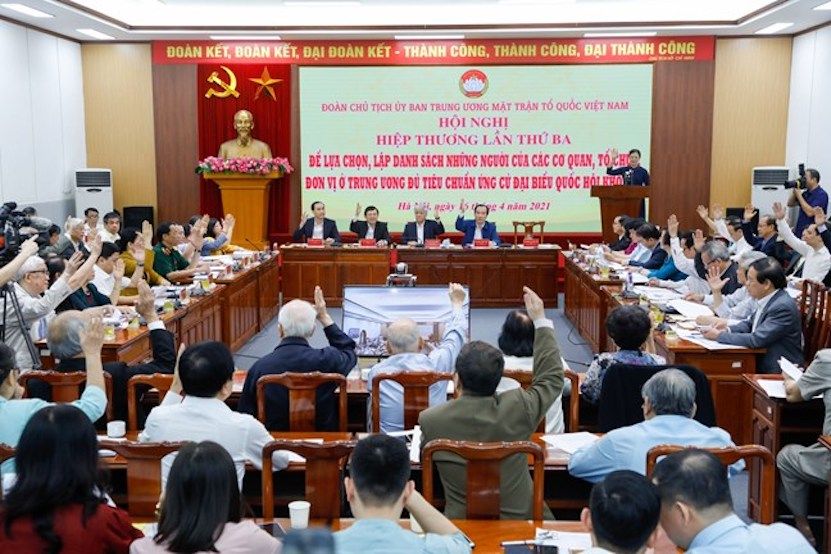
    The way elections in Vietnam work is to pre-determine the results, and the way to achieve that is to determine the list of candidates.

    Vietnamese citizens can’t just register themselves as candidates and expect their names will go straight to the candidate listings on the ballots. If they want to be candidates, they have to go through a vetting process called hiệp thương, which is conducted by the Vietnam Fatherland Front, the extended political arm of the Vietnamese Communist Party (VCP). After the third and final round of hiệp thương, the list of candidates will be released and voters can vote for only these candidates.

    The Fatherland Front’s local committees of Hanoi and Ho Chi Minh city did exactly that just last week. Similar events were held in other provinces as well.

    Context:

    • At least two independent candidates have been arrested before the third round of hiệp thương.
    • Dozens of candidates in Hanoi withdrew before the final list was adopted.
    • Almost no dissidents or activists are running for election this year. This is a major change compared to the last election in 2016, when at least 30 of them ran (and failed to make it to the final list).

    A prominent activist, Nguyen Thuy Hanh, was arrested

    Quote from VietnamPlus:

    “Hanoi’s police have taken a woman into custody as they investigate allegations of ‘making, storing, distributing, or disseminating information, documents, and items against the State of the Socialist Republic of Vietnam’ under Article 117 of the 2015 Penal Code.

    The Investigation Security Agency under the municipal Department of Public Security said on April 8 they had arrested Nguyen Thuy Hanh, born in 1963 and living in Thuong Dinh ward, Thanh Xuan district.”

    Context:

    • Nguyen Thuy Hanh has been a prominent advocate for democracy and human rights in Vietnam since 2011. She also participated in several anti-China movements.
    • Hanh ran for election in 2016 as an independent candidate but failed to make it through the VCP’s vetting process.
    • She founded and managed a well-known charity called the 50k Fund (Quy 50k) to assist family members of political prisoners financially for several years before shutting it down in late 2020.

    Read her profile in The 88 Project’s database and an op-ed about her.


    Vietnam unveils tools for taxing and tracking big tech

    Quote from Nikkei Asia:

    “Vietnam is proposing a pair of regulations that would compel global tech players such as Alibaba and Google to hand over more taxes and data, in a move to increase government oversight in one of the world’s fastest-growing digital markets.”


    US stops short of branding Vietnam a currency manipulator

    Quote from Reuters:

    “The U.S. Treasury Department on Friday said Vietnam, Switzerland and Taiwan tripped its thresholds for possible currency manipulation under a 2015 U.S. trade law, but refrained from formally branding them as manipulators.”


    US names new ambassador to Vietnam

    Quote from VnExpress:

    “U.S. President Joe Biden on Thursday nominated Marc Evans Knapper as the new ambassador to Vietnam.

    The Senior Foreign Service member, who will succeed Daniel J. Kritenbrink, is currently serving as the deputy assistant secretary for Japan and Korea in the State Department.

    He has previously served in the U.S. embassies in Seoul, South Korea, Baghdad, Iraq, and Tokyo, Japan, and the State Department’s Office of India Affairs and Office of Japanese Affairs.”


    What’s special about April for Vietnamese?

    April is a special month not only in Vietnam but also in Vietnamese overseas communities. It marks the end of the Vietnam War on April 30, 1975. The event widely divides Vietnamese people around the world with the winning side, which is the ruling Communist Party, celebrates and the losing side mourns. The losing side is millions of people in the South and Vietnamese former refugees as well as their families now settled in countries such as the United States, Canada, and Australia. Discussing the loss of the losing side and the nature of the fall of Saigon is still largely taboo in Vietnam.

    However, this day is not only about the war, it is also the end of the first and the only Vietnamese democracy in history thus far, the Republic of Vietnam.

    Curious about it? Here are the books you might be interested in:


    Learn more about Vietnam

    Why the #MilkTeaAlliance movement has little appeal to Vietnamese youth

    Dien Nguyen An Luong/South China Morning Post | April 16, 2021

    “Against that backdrop, outsiders may wonder why Vietnam’s internet-savvy youth have remained an outlier in the #MilkTeaAlliance. How have Vietnam’s leaders afforded to stave off such a movement? Will anti-government sentiment materialise any time soon in the country? A closer look at how social media and geopolitics have become increasingly interwoven provides some clues.  While some observers have talked up its role, there has been a growing body of evidence that social media alone could not have fanned the likes of Arab Spring-style uprisings.”

    Vietnam’s Great Debate Over Democracy

    Trien Vinh Le/The Diplomat | April 15, 2021

    “Inspired by the development stories of East Asian countries that have experienced the benefits of embracing democratic principles, there are official and informal opinions that Vietnam needs a second Doi Moi centered around political reform. If new political institutions and practices are allowed to emerge and lead to new ways of governing and fresh policy ideas, the economy can pivot to more open and more innovative activities based on science and technology. It is appropriate to ask how the current government system can usher in a new era of economic transformation when so many at the top benefit from the old model based on exploitation of labor and natural resources.”

    Vietnam restores regional balance to top leadership

    Le Hong Hiep/Nikkei Asia | April 14, 2021

    “In an attempt to address southern politicians’ grievances, the party appears to be taking steps to gradually restore the regional balance.  Soon after the 13th congress, the party installed Vo Van Thuong, a politician from the southern province of Vinh Long, as the standing member of its secretariat, the No. 5 position in the party’s hierarchy. Last week, the National Assembly also elected three southerners into senior state and government positions, including Vo Thi Anh Xuan from An Giang Province as vice president, Tran Thanh Man from Can Tho city as deputy chair of the National Assembly, and Le Minh Khai from Bac Lieu Province as one of the deputy prime ministers.”

    How a Vietnam-Malaysia Fishing MOU Could Ease the Wider South China Sea Dispute

    Ralph Jennings/VOA News | April 16, 2021

    “Malaysia and Vietnam intend to sign a memorandum of understanding that experts say could eventually help ease a decades-old, six-party dispute over sovereignty in the resource-rich South China Sea.  Maritime law enforcement agencies from the two Southeast Asian countries aim to sign the memo this year and resolve at least 15 years of trouble over the movement of Vietnamese fishing vessels, the official Bernama news agency in Malaysia reported in early April. Bernama quoted the Malaysian Maritime Enforcement Agency director-general saying he’s confident the deal, now in its final stages, will solve the issue of Vietnamese fishing boats that enter Malaysian-claimed waters.”

  • The Women Of Possibilities

    The Women Of Possibilities

    This article was published in Vietnamese by Luat Khoa Magazine on March 8, 2019. The translation was done by Will Nguyen. More than two years after the Vietnamese article was published, all three women in this article have been arrested and charged with national security laws in Vietnam. We do not want their stories to go in silence, so we translate them to tell the world about who these women are: the women of possibilities.


    March 8, is International Women’s Day, and Vietnam celebrates this holiday wholeheartedly.

    However, no mainstream newspapers will write about the three women in this article. No organizations will honor them. No solemn ceremony will have them as guests. And among those who “care” about them the most are usually…the Vietnamese police.

    They say things few people say.

    They do things few people do.

    They’ve accepted risks that few people dare accept.

    In actuality, they’re part of a world that few care about or dwell on; for these individuals, few are willing to stand by their side.

    The women we speak of in this special piece represent the hidden aspirations, the beautiful reflections, the burning dreams of an entire nation. They’re singing for us a song of freedom, nurturing a better future for each and every one of us.

    Nguyen Thuy Hanh

    https://2xjs7y10oiyz26vqxu2hok6y-wpengine.netdna-ssl.com/wp-content/uploads/2019/03/nguyen-thuy-hanh.jpg
    Activist Nguyen Thuy Hanh. Photo: Huynh Ngoc Chenh. Graphic: Luat Khoa Magazine.

    In February of 2016, a wave of independent candidates competed for seats in the National Assembly, setting off a movement that was the largest of its kind in post-1975 Vietnam. Approximately 30 candidates had signed up, only for the “consultation” process to remove them from the roster. Nguyen Thuy Hanh was among them.

    Different from Party-nominated candidates, independent candidates announced their action plans. And different from nearly all independent candidates, Nguyen Thuy Hanh was the rare voice that included women’s rights in her platform. She called for stricter laws on violence against women and human trafficking, encouraged job creation, and pushed for education policies and legal support for women.

    Born in 1963, Nguyen Thuy Hanh is a Hanoi woman whose soul is full of art and romance. She has participated in civil society struggles since the 2011 anti-China protests, when protesting was especially taboo not just in the minds of state officials but the vast majority of ordinary citizens.

    Over nearly eight years, having participated in tens of protests and having been beaten and arrested many times, she has witnessed Vietnamese society slowly change, from opposing the right to protest to respecting and then supporting it. When boisterous, nationwide protests broke out on June 10th, 2018 and tens of thousands of people took to the streets to oppose the Special Economic Zones and Cybersecurity Laws, Nguyen Thuy Hanh was perhaps one of the most elated, for her contributions had normalized what had previously been one of the most “sensitive” acts in society.

    However, Nguyen Thuy Hanh’s name is more often connected to the “50k Fund”, which she created to financially support prisoners of conscience and their families.  The fund started at the beginning of 2018, originating from a brief, online fundraiser to help a number of activists on trial. Hanh had received several fold the amount requested and thus, the idea for a future fund to help activists at-risk unexpectedly came into being.

    The 50k Fund aimed to help with difficult situations lesser known to the public, and its name was purposefully chosen to encourage people to donate small amounts, rather than >50,000 VND (~2.20 USD), popularly believed to be the minimum for charity. Such small amounts also assuaged donor fears of police harassment.

    To this day, Nguyen Thuy Hanh’s 50k Fund has received thousands of donations, totaling many billions of VND (~hundreds of thousands of USD), all of which are documented in detail on her public Facebook account.

    The 50k Fund’s meaningfulness goes beyond providing prisoners of conscience everyday material support. It also awakens the emotions of ordinary citizens, encouraging them to care more about politics and helping them overcome the intangible fear constraining their hearts and minds. The 50k Fund normalizes and makes concrete that which is considered “political” or “sensitive”, bringing to citizens the full splendor and meaning of civil society struggle.

    A lover of beauty and romance, Nguyen Thuy Hanh draws a long, brilliant stroke for the Vietnamese democracy movement.

    Can Thi Theu

    https://2xjs7y10oiyz26vqxu2hok6y-wpengine.netdna-ssl.com/wp-content/uploads/2019/03/can-thi-theu-2.jpg
    Peasant leader Can Thi Theu. Photo: RFA. Graphic: Luat Khoa Magazine.

    People normally think of peasant leaders as something from their history classes, as figures only found in textbooks. But Can Thi Theu is a real-life, flesh-and-blood peasant leader, a heart beating strongly within the body politic.

    The life of this courageous woman is connected to the phrase “Duong Noi’s disenfranchised citizens”. Duong Noi is a ward in Ha Dong District. Prior to 2008, it was part of Ha Tay Province, but today, it has been incorporated into Hanoi. Can Thi Theu’s name is probably not mentioned very often in domestic or international press, and she doesn’t have her own English-language Wikipedia page. From 2007, she became one of thousands of disenfranchised citizens who lost their land when the government forcefully reclaimed agricultural and cemetery land in Duong Noi for new urban construction projects.

    The “disenfranchisement” of farmers like Can Thi Theu lies in their complete exclusion from the process, from project planning all the way to land acquisition.

    They were not consulted about compensation or relocation assistance, and the government did not provide them any kind of vocational training after taking away their livelihoods. Furthermore, the gravesites of their ancestors were leveled without notification of their displacement.

    As a woman born in the year of the Tiger (1962), Can Thi Theu rose among the thousands of disenfranchised citizens to become leader, with her strategic mind, her ability to see in the short- and the long-term, and her skill in thwarting police tactics.

    Her leadership skills also manifest in her ability to endure and sacrifice for others, forever taking the hit while protecting those in her care. She is patient and looks past the small, unimportant details to achieve the peasant movement’s longer-term goals. It must be remembered that these farmers lost their land 12 years ago; it’s not easy to keep Duong Noi a hot topic to this day.

    The price that Can Thi Theu had to pay was not small. She was twice imprisoned (2014 – 2015 and 2016 – 2018) for a total of two years and 11 months, for obstruction of officials and disturbing public order.

    From prison in the Central Highlands, she wrote a letter home to her fellow citizens before the 2017 Lunar New Year: “Fight to the end, to demand the return of our land, our right to live, and our rights as human beings, which the communist regime has stolen from my family and those who share our plight.”

    You read that properly. Northern farmer Can Thi Theu is not afraid of calling out the “elephant in the room”, the direct perpetrators of the injustice that she and farmers like her have had to endure.

    Can Thi Theu became the face of one of the greatest forms of injustice that Vietnamese citizens contend with, when she fell victim to the Vietnamese Communist Party’s larcenous land policy, which it has consistently carried out for decades.

    She is also a living representative for those fighting to abolish “universal ownership” of land, seeking to establish legitimate, private land ownership rights for every individual. Every act in Vietnamese history has been intimately tied to land, and Can Thi Theu has placed herself center-stage for the next.

    Pham Doan Trang

    https://2xjs7y10oiyz26vqxu2hok6y-wpengine.netdna-ssl.com/wp-content/uploads/2019/03/pham-doan-trang.jpg
    Activist Pham Doan Trang. Photo: Tri Dung. Graphic: Luat Khoa Magazine.

    If someone believed that it was impossible to be a bona-fide journalist in Vietnam’s mainstream media environment, then Pham Doan Trang proves the opposite. She has 12 years of experience as a sterling journalist at VnExpress, VietNamNet, and Ho Chi Minh City Law, with reams of critical stories and excellent documentations.

    If someone believed that journalists and intellectuals in Vietnam faced insurmountable political restrictions, then Pham Doan Trang proves the opposite.

    She constantly embarks on endless explorations to (un)cover the most sensitive, most dangerous, most censored topics.

    She also does not limit herself within the rigid confines of mainstream newspapers; instead, she uses all the tools at her disposal to write and publish. Independent newspapers, overseas newspapers, blogs, social media, samizdat—Doan Trang has adeptly utilized them all to convey information to her readers.

    For Doan Trang, the concept of “hitting the ceiling” is completely foreign; she is forever someone who lifts those ceilings so that others may have more breathing room.

    If someone believed that they were unable to surmount material, physical, and even spiritual difficulties, then Pham Doan Trang proves the opposite.

    A small and frail woman with numerous scars and injuries, she has had to endure countless assaults by police, drifting through more than 35 different locations across the country over the past 20 months to escape police pursuit and continue her work.

    She lives frugally, no different from those provincial students in the 90s, who left to study in the city, but people would see her write consistently and prolifically.

    Politics for the Common People, Non-violent Resistance, and Studying Public Policy Through the Case of SEZs are just some of the many titles she’s penned over the years.

    Born in 1978, Doan Trang belongs to the post-war generation and grew up when the country and the world were changing at dizzying speeds. Unsatisfied with the disorderly state of the country, people like Doan Trang saw it as their role to address these disorders. For her, there is always work to do, and she does so, without rest.

    Doan Trang swears by a lifetime oath: to never leave Vietnam, not even for a day, while it remains without democracy.

    Doan Trang personifies fierceness and does not compromise with evil or cowardice. But she is also full of romance and forever searches for beauty in the strums of a guitar.

    She inspires people to stand up, to take steps and discover the beauty of politics. With knowledge and vigor, she represents for many the aspiration for a democratic Vietnam, the light of hope in the dark depths of despair, and the ability for oneself to embody that hope.

    Doan Trang talks the talk and walks the walk, inspiring many with what could be; her life, simply put, is a powerful testament to what could be.


    The three women in this piece embody the possibilities. They have defied political and gender stereotypes that weigh down their every step. The meaning of March 8th has never lain in flowers or gifts; it lies in the women who fight for what is right and just.

    This March 8, we reserve flowers for women like Nguyen Thuy Hanh, Can Thi Theu, and Pham Doan Trang.