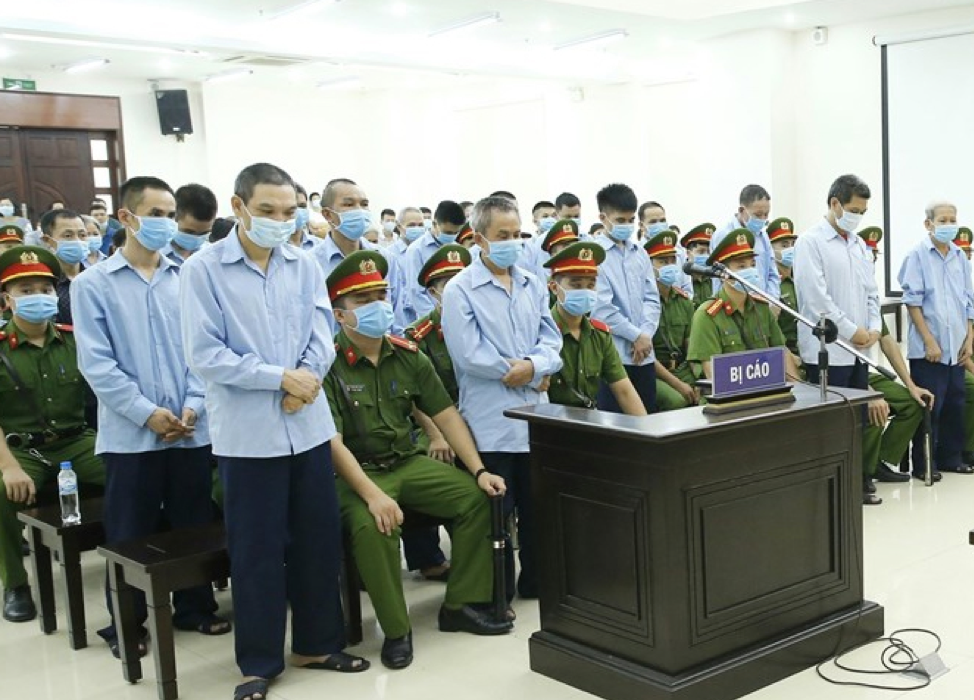
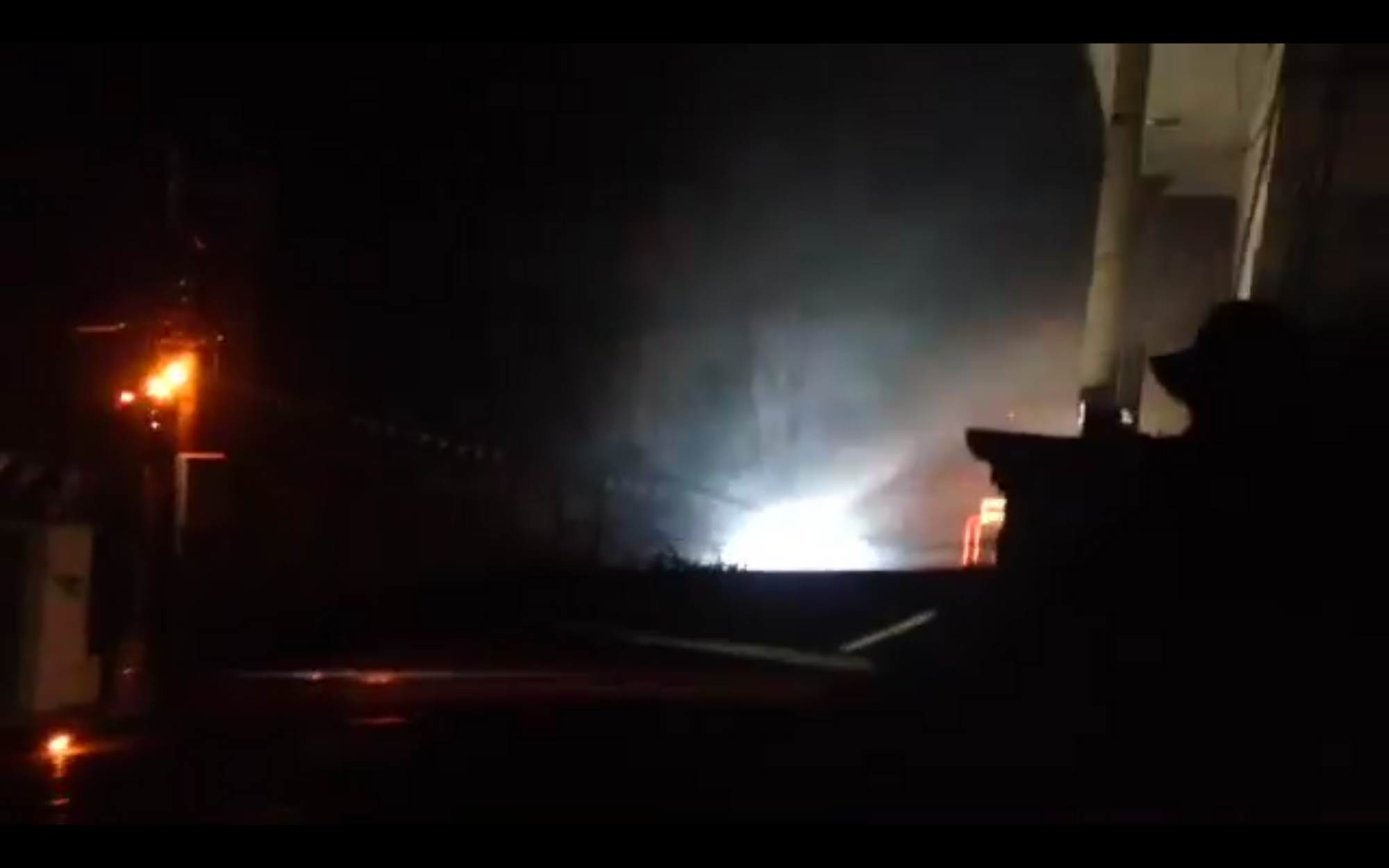
As reported earlier, after four days of a predicted 10-day trial, the Hanoi People’s Tribunal took a recess beginning on the afternoon of September 10 to deliberate. At 3 pm on September 14, 2020, an initial verdict was announced.
These are the details of the sentencing and the developments surrounding them:
The range of initial sentences
The Tribunal sentenced Le Dinh Cong and Le Dinh Chuc to death for the crime of murder.
Also prosecuted for murder was Le Dinh Doanh, who was sentenced to life in prison. Three other defendants who were charged with murder received prison sentences ranging from 12 to 16 years.
The 23 remaining defendants were prosecuted for obstruction of officials. Among them, nine received prison sentences ranging from three to six years, and the remaining 14 were sentenced to between 15 to 36 months of probation.
Compared to the recommendations by the Hanoi People’s Procuracy, the Tribunal’s sentencing only differed in granting 7 defendants probation instead of prison time.
Noteworthy is that while nearly all of the defendants received sentences equal to or lesser than the Procuracy’s recommendations, Bui Thi Noi received a heavier sentence than what was recommended.
The Procuracy recommended 4 to 5 years of prison for Bui Thi Noi. The Tribunal sentenced her to 6.
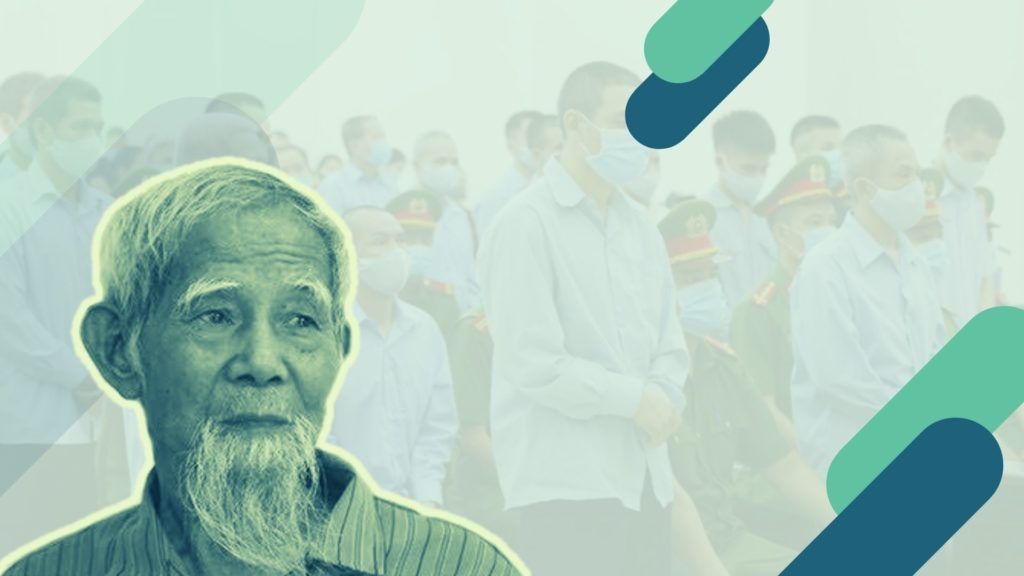
Bui Thi Noi, adopted daughter of Mr. Le Dinh Kinh, who died in the early morning attack on January 9, directly challenged the Tribunal during questioning on the second day of the trial, asking: “We have laws, but why are they not carried out? Why was my father (Le Dinh Kinh) lured out to a field and his leg broken, instead of being arrested properly…?”
When the presiding judge asked Noi three times why she bought gasoline, Noi responded “I bought gasoline to burn the corrupt!”
The court’s determinations
As reported by Thanh Nien, the Tribunal determined “This was a serious criminal case that [was] particularly dangerous, denigrating the law and human life.” Judges assessed that “the defendants’ behaviors were extremely barbaric, cruel, and inhumane.”
According to information from Zing, the Tribunal also required the ring-leading defendants to compensate each victim’s family 116 million dong (US$5000) and provide child support to the deceased police officers’ children until they all reach the age of 18.
Responses from lawyers and relatives of the defendants
Speaking with RFA, Mrs. Nguyen Thi Duyen, Le Dinh Kinh’s granddaughter-in-law, stated: “To be honest, I’m not very surprised and had already mentally prepared myself. I knew for certain they would keep the sentencing as is.”
“The next steps must be taken gradually; there’s simply no way to change [the government’s] hearts or minds,” she continued. “It will most certainly force [those] Dong Tam residents to suffer through long prison sentences.”
Lawyer Nguyen Van Mieng, on the other hand, asserted: “There is not enough evidence to conclude that those three [police officers] died because of Chuc, Cong, and the others. Handing out two death sentences and a life imprisonment is completely unreasonable!”
Mieng shared the view that all four deaths must be re-investigated.
Appeals and future developments
Le Dinh Cong and Le Dinh Chuc, who were both sentenced to death, stated that they would appeal.
We have provided an analysis here regarding the next possible developments in this case.
If at any point, a defendant, victim, or his or her representative appeals, the case will be forced into retrial. The entire case will be presented and re-tried in a higher court, which in this instance is the People’s Supreme Court in Hanoi.
According to the law, the deadline for retrial ranges approximately from December 2020 to January 2021.
In the meantime, the Procuracy, defendants, and lawyers have the right to provide additional evidence.
Lawyers and relatives still have the right to see the defendants. Other individuals and organizations (journalists, social organizations, international organizations) are also able to submit requests to see the defendants.
***
This article was written in Vietnamese by Y Chan and previously published on Luat Khoa Magazine. The translation is done by Will Nguyen.
On September 14, 2020, the Hanoi People’s Court delivered the judgments in the trial of the Dong Tam case.
What will happen next?
First of all, we need to understand this is a first-instance trial and the judgments have not yet come into force. The enforcement of criminal judgments therefore is not yet initiated.
Appeal
Within 15 days of the first-instance trial’s verdict, which is from September 14-29, 2020, there are two possible scenarios.
(Note: According to the instruction from the Supreme People’s Court, the time limit for appeal is calculated from the day after the verdict is delivered, which is September 15, 2020.)
1. If the rulings are not appealed, they will automatically come into force on the 16th day after the verdict was delivered, which will be on September 30, 2020. The sentence enforcement procedure will also be initiated on that day.
2. If the rulings are appealed:
Appeal by the defendants: If any of the defendants, victims or their representatives appeal against the rulings, the case will move into the appellate trial phase. The whole trial will be restarted. In this case, the time limit for making an appeal is September 29, 2020.
If an appeal is filed beyond the 15-day limit, the appellate court can still consider it permissible “on condition that the appellant has been obstructed by force majeure or objective obstacles from lodging an appeal within the time limit as defined by this Law.” (Article 335, 2015 Criminal Procedure Code)
Appeal by the Procuracy: If the Hanoi People’s Procuracy appeals against all or parts of the judgments, the case will also move into the appellate trial phase.
Appeal by the Supreme People’s Procuracy in Hanoi: according to law, they have a 30-day limit to appeal the rulings after the verdict was delivered.
What is an appellate trial?
According to Article 330, 2015 Criminal Procedure Code, “Appellate trial means that the immediate superior Court re-tries a case or re-considers the decisions passed by the first instance trial, whose judgments and rulings pronounced for the case are appealed before coming into force.”
In other words, all or parts of the rulings will be re-considered by the immediate superior court.
What is the superior court in this case?
The People’s High Court in Hanoi
When will the appellate trial take place?
At the moment, there is no detailed instruction document on how to calculate the time frame to open the appellate trial, but based on the 2015 Criminal Procedure Code, we can estimate a number of markers for what happens next:
Within 75 days upon the admission of a case, the People’s High Court in Hanoi has to issue a decision to hear the appellate case. Therefore, we can estimate in case of appeal, that the last day to issue the decision will be December 13, 2020 (Sunday). Since it is a non-working day, the time limit can be extended to December 14, 2020 (Monday).
Within 15 days upon issuing the decision to hear the appellate case, the court has to start the appellate trial. Therefore, we can estimate in case of appeal the last day to start the appellate trial will be December 29, 2020 (Monday).
Within 10 days upon issuing the decision to hear the appellate case, the court has to send this decision to the Procuracy–which is on an equal level of hierarchy–and to the defense counsels, crime victims, litigants and protectors of legitimate rights and benefits of crime victims, litigants, appellants, persons incurring interests and duties from the appeal. The last day of this time frame will be December 23, 2020 (Monday).
The court can delay the appellate trial for no more than 30 days, which means the last day in this case could be on January 28, 2021 (Wednesday).
In practice, however, the court can violate the time limit regulations. The appellate trial therefore can be delayed to a much later time than the above estimated number of days.
While awaiting the appellate trial, what can happen?
The People’s High Court can make decisions on changing or terminating preventive measures such as detention. Although practically, there is no possibility some defendants will be released on bail awaiting the appellate trial, yet it is still an available legal option.
If the appellants withdraw the appeals, the court will suspend the appellant trial. In practice, this is also unlikely.
The Procuracy, the defendants and their lawyers can submit additional evidence.
The lawyers and family members are entitled to meet the defendants. Other individuals, organizations (the media, social organizations, international organization, etc.) can file proposals to meet with the defendants.
What are the possible outcomes of the appellate trial?
According to Article 355, 2015 Criminal Procedure Code, the possible outcomes of an appellate trial could be:
Reject appeals and sustain the first-instance court’s judgments;
Alter the first-instance trial’s judgments;
Annul the first-instance court’s judgment and send the case back for re-investigation or retrial;
Annul the first-instance trial’s judgments and dismiss the case;
Terminate the appellate trial if the appellants withdraw their appeals.
In case of altering the first-instance trial’s judgments, if the appeals are filed by the defendants, the appellate court cannot deliver a harsher sentence than what has already been given to the defendants.
In case of altering the first-instance trial’s judgments, if the appeals are filed by the procuracy or the crime victims, the appellate court can deliver rulings that are disadvantageous to the defendants.
What may happen after the appellate trial?
The rulings from the appellate trial will come into force immediately.
If the appellate court sustains the first-instance trial’s judgments, or alters the judgments but sustains the sentences, the enforcement procedure will be initiated. The defendants become convicts (serve jail sentences, face death penalties). In this case, one must study thoroughly the Law on execution of criminal judgments.
The convicts with death sentences still have a chance to file pardon petition for commutation of death sentence with the state president (within 7 days after the appellate rulings were delivered), petition for a cassation trial, or file for a retrial of the case.
If the appellate court chooses to delivers other outcomes, then there are corresponding legal options for each scenario.
***
This article was written in Vietnamese by Tran Ha Linh and previously published on Luat Khoa Magazine. The translation is done by Y Chan.
Hoanh Village, a few days before the historic Dong Tam trial, is a place where the green rice fields are flowing beside country roads under the hot autumn sun. Vietnam’s national flag and banners commemorating the 75th anniversary of its National Day crowd the village gate.
I equipped myself quite well before I arrived in Hoanh Village, in both my mind and my technological tools.
“That place has many security police. Be careful!” – I was warned in a text message.
I have wanted to go to Hoanh Village during these days to be a journalist and practice the most basic ethical responsibility of our profession. I wanted to report the complete story about a historical event that will happen soon. I wanted to learn about the defendants’ families and what they yearned for, besides justice.
The village welcomed me with the typical peaceful beauty that many northern rural villages offer: a traditional market, big old banyan trees, rice fields, and winding roads. It was as calm as if it had never gone through the recent chaos it had experienced. There were no skeptical eyes staring at a stranger when I accidentally met villagers, or when they wholeheartedly showed me the directions to Mr. Kinh’s house.
They whispered to me, “So pitiful that house now, with only women and children left.”
There were no security police there; at least that was how I saw it. Yet, there were a few surveillance cameras placed on the awnings of opposite houses, which surprised me a little.
I met Mrs. Du Thi Thanh, the wife of Mr. Le Dinh Kinh, and Mrs. Le Thi Thoa, the fourth daughter of the couple, and their group of little grandchildren. In the house, which was pockmarked by police bullets, they told me stories about their father and husband. My questions were overwhelmed by their memories. The wife and daughter, and at times, both of them, unwittingly reliving stories about their husband and father as a man from their past. They told me the stories in tears, and there were moments of silence, and even some smiles. Before the attack, there were the peaceful times they had spent in the village.
The wall is used to hang Mr. Le Dinh Kinh’s portrait and his medals, as well as the evidence of bullet fire. Photo courtesy: May/Luat Khoa Magazine.
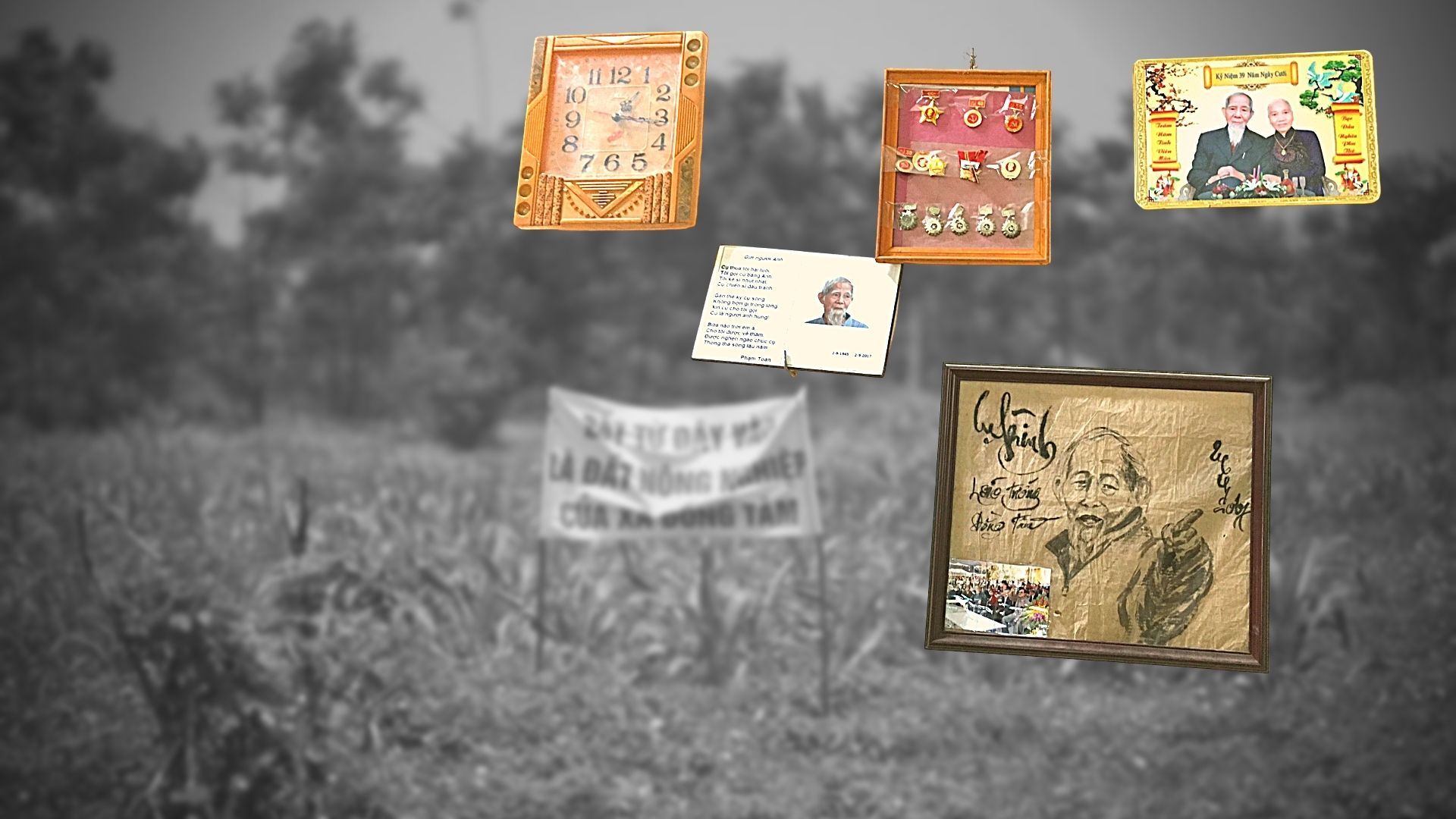
Mr. Le Dinh Kinh’s portrait and the medals that the government and the Vietnamese Communist Party awarded to him were hung on the wall opposite the main door. The same wall was marked by bullet holes, evidence of the attack one dawn last winter.
“These things, when he was alive, he treasured them so much,” Mrs. Thanh said, looking up at the medals. “He was given an award when he reached his 55th year as a Communist Party member.”
“What are your memories of him?” I asked the two women.
Du Thi Thanh:
Our house always needed a lot of upkeep, but he always forced me to take him to attend the Communist Party meetings in our ward. Before, he could go by himself, but starting in 2017, after his leg was broken during an assault by the police, he had to use a wheelchair. The first wheelchair was a gift from Mr. Chung (Nguyen Duc Chung – the former chairman of the Hanoi People’s Committee). Later, the Disabilities Association gave him another wheelchair. I remember when he tested out the second wheelchair, which he praised: ‘This one is smoother, my wife,’ he told me. ‘The first wheelchair came from Chung, I heard it was expensive, but the wheels were wobbly.’
I used the wheelchair to take him to his meetings, waited for him, and we would go back home together. People kept talking, one after another, which made me anxious because I could not know when the meeting would be adjourned.
More than that, the people did not obey any rules because when one person spoke, another would go outside to chat with others. It was just like the chatting done in the market. But it was only my husband and a few others who were thorough. I remember that he proposed to do roll calls to make sure the Communist Party’s meetings in our ward would have sound principles.
When we got home I was annoyed, and I told him if the Communist Party’s meetings were just like that, we should not go because we just sat there and did not benefit from anything. I told him that we were old and we should stay home to rest. However, he was angry with me. He said: ‘Why would you say that? I do not care if there were improper people there. I came because I want to be proper and exemplary.’
If you offer comments about his Communist Party carelessly, then you are bound to be berated.. From then on, if he asked me to take him to such meetings, I would go with him, and I stopped asking him to stay home.
Le Thi Thoa:
There are now only regrets…. Our father-daughter relationship had so many fights …. (She cried.)
I was never close to my father when he was alive. Among his children, I was the child that had so many opposite perspectives from him. I could not sit down and have a proper talk with him without us having a clash of opinions because we would fight right away after exchanging a few sentences. My father whole-heartedly trusted the Communist Party, and he believed in the Communist Party’s Secretary General Nguyen Phu Trong without condition. I warned him and told him: ‘Father, many officials nowadays have become corrupt.’ But my father scolded me and said we can’t tar the whole brush because the corrupt officials were only a small group and that they were the lower officials that covered their faults and smeared the Party.
I had wanted him to let go of the land dispute everytime I witnessed my father face grave danger. I cried and told him that I was scared. I stated that the Party had too many factions, and they could turn against each other to eliminate the opposition. My father responded to me that he was doing the right thing so he should not be afraid. He said the land of Senh field, where we had disputes with the government, belonged to the people of this ward. He also assured me that if he already made a mistake, the Party would have kicked him out a long time ago.
When he was in the hospital in 2017, some people gave him money when they visited him. He then gave the money to a policewoman and asked her to keep it for him. He always said: ‘(Nguyen Duc) Chung already said so (that the government would never prosecute Dong Tam villagers). Or, he would say ‘the people from the city had promised me already (to not prosecute),’ and that ‘things have to be reported to Mr. (Nguyen Phu) Trong because the Party would then be transparent.’ I was so mad, I stopped talking to him, ignoring the old man’s ideology.
From the time when he was still a local official right up until to his retirement, I saw him as a person who spent so much time volunteering for the community. I felt uneasy. He only cared about the ward and the village’s everyday issues, leaving my mother to take care of our household alone. As years passed , the Mieu Mon land dispute documents passed through the hands of many leaders , but he stored them all in his head. He memorized all of them, line by line, without fail, without a need to look at the papers.”
Mrs. Du Thi Thanh shows the bullet hole in the glass door. Photo courtesy: May/Luat Khoa Magazine.
Du Thi Thanh:
When he was an official, he only focused on his position and worked for the ward and the village. Even when his wife and kids suffered, he took no notice . When he retired, he began to farm the field. I guess he farmed to compensate his family because there had been so many years that he neglected us. The village people passed by our field and would tease him: ‘Oh, Mr. Kinh, Mr. Kinh. You were an official, why are you only now putting your head to the field?’
Le Thi Thoa:
Other people who were government officials had so much land. My father worked at the top positions in this ward, but my family didn’t even have a rice field when he retired. I remember that my parents would come to some undocumented land that nobody cared to claim . From dawn to dust, they would go there to work on that land, clearing, ploughing, digging, furrowing and cultivating the land till it was ready to be used for planting food crops. . They worked so hard and spent so much time on that field only to have their sweat and blood rewarded by a call from the government to donate all the cultivated land to the ward when harvesting time came. Is that reasonable? But then I have never heard my father blame the Party or curse the government. He only scolded me. (She smiled.)
I was irritated and slightly annoyed at the absurdity when I read online that people cast doubt on the source of money my father received from overseas, indicating it was from the reactionary forces. Truth be told, my father would forever continue believing in the Communist Party until his last dying breath.
If he truly believes that something is right and is not against his conscience, my father would fight to protect it till the very end. He used that mentality to protect the Senh field and the Communist Party.
Du Thi Thanh:
Until his last days, even after witnessing so many city officials do an about-face, he still believed in his Party. I worried for his safety, but he chided me: ‘You do not need to worry about me. I am a Communist Party member. A Party member must stand up and take care of the people. If we ignore the truth and don’t speak up, we are guilty in front of the people.’
I remember when he was young, he would pedal with only one leg, but he was incredibly fast. He would bike across the fields to go to the town center for a meeting. He was disabled in one leg, but he was talented so it helped him to become the head of the ward police force. He could only stand up on one leg, but he took care of all of the ward’s work thoroughly. The people in this ward respected and loved him.
Le Thi Thoa:
I recall that he told us he had played soccer when he was young and sprained his leg. Unfortunately, he did not receive proper treatment, which led to a permanent disability later on in life. My father was always so busy with work. When he was riding his Thong Nhat branded bicycle or when he got a ride on a motorbike to go to the district office, he always had to stretch out his disabled leg. Even having his meals or a cup of tea, he could not fold that leg. When he walked, it seemed as if he was dragging it along.
Du Thi Thanh:
But they shot and blasted his disabled leg.
Le Thi Thoa:
Dad died such an inconsolable death.. What is there left when all of the men in this house have been arrested. We can only pray to Heaven. We looked up at the sky and cried our hearts out about the injustice. When we fixed part of our home after the assault and repaired the damage caused by the police attack , our mother wept until she passed out because she was so heart-broken that our family now was left with only women and young children. My father’s belief caused all of that. If I knew in the end that our family would be this broken, I would have made more of an effort to stop my dad from disputing the land with the government. You should throw away everything, dad!” (Le Thi Thoa sobbed)
Mrs. Du Thi Thanh shows the bullet holes in the wall. Photo courtesy: May/Luat Khoa Magazine.Another bullet hole in the home of Mr. Le Dinh Kinh. Photo courtesy: May/Luat Khoa Magazine.
“We will walk (to court) from our village”
Du Thi Thanh:
My sons, my grandsons, are all in prison. It has been more than eight months, and our family did not receive any news about them. My son Chuc, did the wound on his head heal? Ten days after he was arrested, his wife gave birth to a son. His wife sent him a picture of the newborn baby, but the prison officials did not allow him to receive it. I believe that Doanh got shot in the arm, how is he now? Uy, and then Cong. My sons and my grandsons are all working people. They each have their own family . Their wives now have to raise their children alone and unsupported. If I knew this in advance, I’d rather kept my mouth shut . I would have forced all of them to be silent. How could any piece of land be more precious than having a peaceful family life?”
Le Thi Thoa:
The rental car company did not accept our reservation (or that of any of the villagers) to rent cars to go to the trial. The company told us that the police had forewarned them. An official in our ward advised us to stay home because we would not be allowed to enter the Hanoi courthouse. But regardless, we will go there. We will walk from our village to Hanoi and attend the trial. My mother wants to see her sons and grandsons. The young children in our house want to see their fathers; the wives want to see their husbands. No one should be able to prevent us from doing that.
Du Thi Thanh:
What do I expect at the trial? I just want to meet my sons and grandsons. I want them to issue a death certificate for my husband. He passed away more than eight months ago, but we have yet to receive the death certificate. The officials from our ward forced me to state the reason for his death as ‘died at home.’ No. That was not right. Mr. Le Dinh Kinh was shot to death at home. A bullet entered near his heart. Two bullets were fired into his head. His left knee was shattered. That was how my children’s father died. The bloodstain is still in our room, how could they lie like that?
The bloodstain is right here. It is very stubborn though, I could not wash it off.
“Just stay still here, I will go downstairs and get you a wet cloth to help you breathe better.” That was my last sentence to my husband. The fumes were so heavy. I was going back to his side when someone took my arms and dragged me away. When I came back home, the room was covered in blood. Our home was shattered. Can you see this door jamb protruding out? A bullet is stuck in it.
***
Mrs. Thanh relived the story as she walked me around her house.
I could see the remnants of bullets fired through their glass door. Their closets were also shot up, and the wall had a massive crack. There were areas of newly patched cement, but others were left untouched. Evidence of bullets was everywhere, substantial bullet holes, smaller holes, on the first floor and the second floor. They were also in the kitchen and the living room. There were also black stains on the floor, which Mrs. Thanh suspected it came from the tear gas.
She was walking with her hunched shoulder, her hair all white. Just like her daughter, she doesn’t believe in anyone because “only Heaven could help my sons and grandsons” during the trial starting next Monday. The two women did not say words like “justice”, “righteousness”, or “fairness” when they referred to the trial as I had imagined they might. They did not expect too much, just the simple wish to be able to see their loved ones and to somehow brush each other’s hands at the trial hearing.
I just wanted to write down their stories, documenting ordinary farmers who unfortunately have family members caught in the justice of law and now tried as defendants. Although I guaranteed that I would not write about the land dispute issues or give speculation on which side is right or wrong, not a single newspaper in Vietnam accepted to publish this article.
On September 7, 2020 when the Dong Tam trial begins, where would we see the faces of the mother, wives, and children of the 29 defendants from Hoanh Village and the Mit Village, both located in Dong Tam Ward? Broadcast on television? Captured on cameras or on the cover of newspapers? Would the state-owned media specifically describe these women as who they are and not as people from the reactionary force?
I hope that my imagination about their fate during the Dong Tam trial will not turn real. I also hope that there will be a place, a time to safely and freely tell their stories. Their voices have been silenced for so long.
***
The original article was written in Vietnamese by May and published in Luat Khoa Magazine. The English translation was done by Karie Nguyen.
As details and testimonies slowly emerge from Dong Tam after a surprise government raid early the morning of January 9, tensions between officials and civil society activists continue to mount as the two groups fight to clarify events that led to the deaths of 84-year-old village leader Le Dinh Kinh and three police officers, as well as the arrest of more than 30 villagers.
Compounding tensions is the fact that Vietnam is a one-party authoritarian state in which all official news, press, and media outlets are controlled by a single communist party. Citizen-journalists make ample use of social media to counter the systemic bias, as the general population struggles to establish the facts.
State media announcedyesterday that 22 individuals have been charged: 20 for murder, including two of Kinh’s sons, Le Dinh Chuc and Le Dinh Cong, as well as 2 others for obstruction of officials. Murder is among the most serious charges of the Vietnamese penal code, with punishment ranging up to and including the death penalty.
The clash in Dong Tam was the culmination of a land disputethat had been simmering for years over private farmland earmarked for a military airport (Mieu Mon). Experts statethat land disputes in Vietnam have become increasingly common, at Loc Hung garden in Ho Chi Minh City most recently, due to the ambiguous laws that the ostensibly “communist” country has enacted regarding land ownership.
According to villager testimonies, around 3 AM the morning of January 9, 2020, approximately 3,000 officers from the police, riot, and armed forces carrying clubs, sticks, guns, shields, and tear gas grenades poured into Dong Tam village (My Duc suburban district, Hanoi), targeting village leader Le Dinh Kinh’s house.
Collecting eyewitness accounts, citizen-journalist and activist Pham Doan Trang explained: “as violent skirmishes broke out, police used an explosive charge to blow a hole into village leader Kinh’s house, all while firing bullets and tear gas. Other officers tightly sealed off all the paths and alleyways in the village and used German shepherds to hunt down ‘culprits’. The villagers responded with rocks and Molotov cocktails. Police completely collapsed the roof of Le Dinh Kinh’s house and more than 30 members of his extended family were taken away.”
Trang reports that the Dong Tam area is currently under complete lockdown and no independent journalists have been allowed in, noting state media outlets simultaneously began reporting the same story January 9, citing a single source: Vietnam’s Ministry of Public Security. The brief statement from the ministry stated that a number of officers ‘sacrificed themselves’ in the line of duty, while one ‘hostile culprit’ died.
It was not until January 10 that state media identified the “hostile culprit” as village leader Le Dinh Kinh himself, who was accused of leading a mob of villagers to “obstruct officials” who were working on constructing a wall delineating Mieu Mon Airport. Officials did not explain why this work was being done at four in the morning, nor why 3000 officers were present in the village rather than closer to the Mieu Mon work site, a few kilometers away. Officials handed over Kinh’s body to villagers the same day (January 10).
Security footage showing numerous riot police marching through Dong Tam, early on the morning of January 9. Photo: Trinh Ba Tu
Luong Tam Quang, deputy head of the Ministry of Public Security, explained at a press conference January 14 that Kinh was shot because he was “holding a grenade” and posed a threat to security forces. Quang, however, confirmed that the Ministry of Public Security did not have an arrest warrant for anyone when police stormed Kinh’s private residence.
Kinh’s wife, Du Thi Thanh, told land rights activist Trinh Ba Tu that Kinh was shot right in front of her, twice in the head, once in the heart, and once in the left foot. A viral video of Kinh’s body on social media showed a single bullet hole near his heart, and an unexplained long surgical scar down his abdomen.
Kinh’s funeral was held January 13, but the area of Dong Tam remained under high security, with the internet cut. Little to no footage of the funeral is available, and supporters were largely prevented from attending.
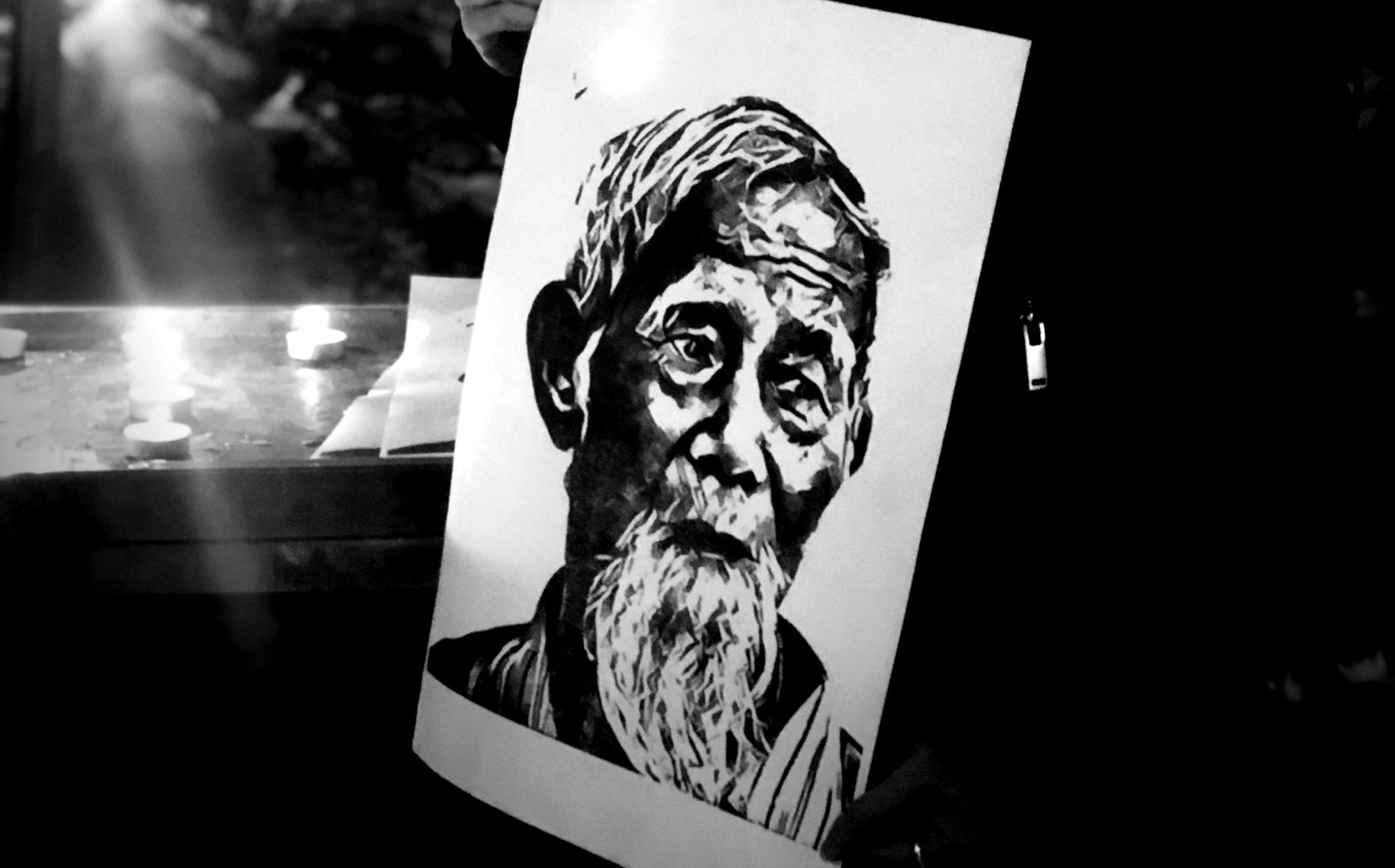
Public outpouringof support for Kinh has been swift on social media, with many seeing him as a exemplary moral leader who consistently fought for the weak. In his lifetime, Kinh was a peasant farmer, a revolutionary soldier who had fought against the Americans, a Communist Party member at 20, head of police in his village, and both party secretary and chairman of the village’s Party committee in the 1980s.
That the Vietnamese government has killed a model Party member has intellectuals commenting on the inherent symbolism, stating Kinh’s murder represented the communist regime “digging its own grave”.
Kinh’s wife, Du Thi Thanh, herself suffered harsh mistreatment from the authorities, and in a surreptitiously recorded video that has spread on social media, she details how police slapped and kicked her repeatedly to force her to falsely confess to using grenades and petrol bombs.
Kinh’s wife, Du Thi Thanh, explains how police repeatedly slapped and kicked her to force her to sign a false confession.
Her son Le Dinh Cong, adopted daughter Bui Thi Noi, and her grandchildren Le Dinh Doanh and Le Dinh Quang are also likely victims of forced confessions, as their battered images appeared on state television January 13, stoically confessing to making petrol bombs and other weapons to attack police. They admitted they had broken the law, even implicating prominent activist Nguyen Anh Tuan and blogger Le Dung Vova in encouraging “anti-state” activities.
Screenshots of the Le Dinh Cong, Bui Thi Noi, Le Dinh Quang, and Le Dinh Doanh under duress, as they are forced to confess on state television. Photo: Trinh Ba Tu
All four subjects were covered in scrapes, black eyes, bruises, and swellings, and looked down as they spoke during the entire recording, appearing to be reading from statements off-camera.
Forced scripted confessions, particularly those aired on state television, are common in authoritarian regimes, like Vietnam, China, and North Korea.
State media also reported that Le Dinh Chuc, Le Dinh Kinh’s second son, is laying in a hospital; his condition is unknown.
The January 14 press conference further identified the three police officers killed in the raid as: Colonel Nguyen Huy Thinh, Captain Pham Cong Huy, and Lieutenant Duong Duc Hoang Quan.
After days of state media reporting that the villagers attacked and killed the officers by grenades, knives and petrol bombs, deputy head Quang admitted that the three individuals had fallen down a four-meter skylight in Kinh’s residence while pursuing suspects. He alleges that Dong Tam residents, upon seeing the officers in the well, poured gasoline and lit them on fire.
All three officers have been given posthumous awards and the honorary title of “martyr” by President and Party General Secretary Nguyen Phu Trong for their service.
Vietnam has cracked down on those challenging the official narrative, and according to citizen-journalist Pham Doan Trang, the government has arrested people in Can Tho, Quang Ngai, and Dak Nong for posting online about the event. She also notes that land rights activists (and brothers) Trinh Ba Tu and Trinh Ba Phuong, who are in direct contact with the Dong Tam villagers and have worked to smuggle information out, are currently at high risk of arrest.
Facebook itself is now complicit in the oppression, activists say , as the government—using a cybersecurity law it passed in 2018—has succeeded in pressuring the company to remove videos and posts regarding the Dong Tam attack; Vietnam’s own online army has succeeded in bringing down some activists’ profiles through coordinated campaigns.
An example of a notification that users in Vietnam see for “banned” content. Photo: Dinh Thao
Vietnamese civil society organizations have responded accordingly, organizing several campaigns to bring awareness to the event, as well as pressure the Vietnamese government to address inconsistencies and unknowns in the government’s “evolving” narrative.
Luat Khoa Magazine, an independent journal that covers legal and political issues in Vietnam, has mailed a letter to To Lam, head of Vietnam’s Ministry of Public Security with a list of fundamental legal questions for Mr. Lam to answer (English translation here), while a nationwide, weeklong “Pray for Dong Tam” color campaign launched Sunday, Jan 12, calling for calm, mourning, and an objective investigation into what transpired January 9 (English translation here).
Perhaps most significantly, the “Dong Tam Task Force”, an ad hoc organization established by leading Vietnamese activists, launched January 13 to organize, coordinate, and facilitate fact-finding in the Dong Tam attack (English translation here). It also aims to protect the remaining village witnesses from further government harassment and arrest.
Amid sounds of explosions, screams, and gunfire, the villagers of Dong Tam, a rural commune 35 km southwest of Hanoi, clashed with Vietnamese police in the early morning hours of January 9, killing three police and one civilian, state-controlled media reported this afternoon.
According to the BBC, at 4 AM, police cordoned off Dong Tam in coordination with local ground forces and attacked villagers over a disputed piece of land. The villagers, who were never officially notified but had only heard through unofficial channels, declared in video recorded an hour before the attack that they would “fight to the death”.
In a message to fellow Vietnamese citizens, a villager of Dong Tam states that the government is shooting at them. He declares that the villagers will “fight to the death”. Nguyen Anh Tuan
The land had been earmarkedsince 1980 to form a part of the Mieu Mon military airfield, but in 2015, the plan was expanded to take up more nearby farming land and generalized to become an airport.
Citizen-blogger social media reports say police burst into the village with tear gas and grenades filled with plastic ball bearings, and descended upon village leader Le Dinh Kinh’s house, shooting and killing one individual, who remains unidentified as of this report.
Le Dinh Kinh and his son Le Dinh Cong have served as village representatives during repeated land disputes with the government. Media outlets have been unable to reach Le Dinh Cong for comment, but villagers say Cong’s family is in police custody and his father Kinh had gone into hiding a few days prior to the showdown. Prominent activist Anh Chi says those in custody include at least Cong’s daughter-in-law and two other family members.
Village leaders direct statements to the country and to the world at 3 AM, January 9, an hour before police descend on Dong Tam village, demanding justice and protection against government oppression. Nguyen Anh Tuan
Another witness describes “thousands of police officers rushing into the village” using flash grenades, firing tear gas, shooting rubber bullets, blocking off all pathways and alleys, and beating villagers indiscriminately, including women and old people. The witness stated that electricity to the village has not been cut, but the internet has.
According to state media, which quotes an official statement from the Ministry of Public Security, it was villagers who attacked police with “grenades, petrol bombs, and knives” as officials tried to erect a wall delineating Mieu Mon airport. The statement accuses villagers of obstructing official duties and “disturbing public order”, a catch-all often used to describe anti-government actions in Vietnam.
Dong Tam previously made international headlines in April 2017 when it held hostage 38 government officials and police officers in another land dispute with Viettel, a military-owned telecommunications company.
Accordingto VNExpress, 46 hectares were granted to Viettel in March of 2015, only for villagers to complain to the government in June of 2016 that the land was being taken away from farming. Villagers were able to successfully fight off land reclamation from late 2016 until February 2017.
The land dispute came to a head in April 2017 when villagers captured more than three dozen officials and police and held them hostage as leverage for government dialogue. All hostages were released by April 22, after the mayor of Hanoi, major-general Nguyen Duc Chung, came to negotiate with villagers personally.
The villagers of Dong Tam, in a past meeting regarding the land dispute. Le Dinh Cong sits in green, first row, farthest right. His father Le Dinh Kinh sits two seats to the left, in peach. BBC Vietnamese
Vietnamese activists and experts believethe central conundrum causing Vietnam’s land disputes lays in the country’s political regime: “how [does one] allocate land in a Communist country that allows quasi-private ownership rights but still considers all land to be state property”?
Accordingto the NYTimes, “[i]n 2013, Vietnam tweaked its land law in ways meant to introduce more transparency into eminent domain [i.e. government land reclamation] cases. […] But experts say land disputes continue, in part, because the 2013 revisions do not allow private ownership or set clear definitions of what qualifies as the public interest in eminent domain cases.”
Mike Ives of the NYTimes reports further: “[l]and disputes are common on the fringes of Vietnamese urban areas, where land values are often high; villagers are typically compensated at prices well below market rates for agricultural land that is later rezoned for other uses. John Gillespie, a professor at Monash University in Australia who is an expert on land reform in Vietnam, said in an interview that the disputes tended to be more violent when villagers perceived that business interests outweighed public ones.”
Dong Tam, with a population of around 9,000, continues to be under siege, according to social media reports. All parties involved remain on edge, with activist Anh Chi stating that “Tuan Ngo, one of lawyers helping the villagers, came to Dong Tam but was stopped outside. He was threatened to be arrested by a man in plainclothes with aggressive words.”
Images of one of the police officers killed in the clash have also begun circulating on social media, with those on both sides of the land dispute expressing sympathy. Nhu Quynh, whose 27-year old husband appears to have been involved at Dong Tam, inadvertently revealed in her caption that 3000 police officers were deployed. The image (screencaptured below) has since been taken down.
Translated post: “Oh, my husband!!! Of 3 thousand officers, why did it have to be you?” The Vietnamese
Le Dung Vova, a well-known activist and writer has stated of land disputes in Vietnam: “Things will not stop at Dong Tam. […] Similar incidents will keep happening everywhere [as in Loc Hung Garden], with different levels of intensity, especially as land resources become more scarce.”
Update: BBC News has reported that Dong Tam’s leader Le Dinh Kinh has passed away January 10, after clashing with government forces in the early morning hours of January 9.