Tag: Kamala Harris

  • Vietnam Briefing: Results From U.S. Vice President Kamala Harris’ Visit; Vaccine Donations To Arrive In Vietnam Amid Surge In COVID-19 Cases

    Vietnam Briefing: Results From U.S. Vice President Kamala Harris’ Visit; Vaccine Donations To Arrive In Vietnam Amid Surge In COVID-19 Cases

    U.S. Vice President Kamala Harris’ visit to Vietnam: Main takeaways

    • U.S. Vice President Kamala Harris and Vietnam’s top officials met on Wednesday, August 25, carrying out talks on several key areas, including the enhancement of maritime security, boosting economic cooperation, combating climate change and providing healthcare support, reports Reuters.
    • Earlier, on Tuesday, Harris’ flight from Singapore to Hanoi was delayed by more than three hours after the U.S. Embassy in Hanoi was made aware of an “anomalous health incident,” which referred to the mysterious Havana Syndrome.
    • Vietnamese Prime Minister Pham Minh Chinh held an unannounced meeting with Chinese Ambassador Xiong Bo, just before Harris’ arrival, affirming that “Vietnam does not align itself with one country against another.” Beijing also offered Vietnam an additional 2 million doses of Sinopharm vaccine during the meeting.
    • Vice President Harris made sharp criticism at China’s “bullying” in the South China Sea while urging Vietnam to join the United States against Beijing’s advances, reports Associated Press. “We need to find ways to pressure and raise the pressure, frankly, on Beijing to abide by the United Nations Convention on the Law of the Sea, and to challenge its bullying and excessive maritime claims,” Harris said at the opening of a meeting with Vietnamese President Nguyen Xuan Phuc.
    • The U.S. Embassy in Vietnam has signed an agreement with Hanoi authorities, in the presence of Vice President Harris, for a land lease to build a new $1.2 billion embassy campus in the city, reports VnExpress. The new embassy, which will be located in the Cau Giay District, is a project announced by Vietnam and the United States in 2019.
    • Vice President Harris announced that the United States would donateone million Pfizer-BioNTech vaccine doses to Vietnam, bringing the total number of vaccines donated by the United States to the country to six million doses. Meanwhile, a new regional office of the U.S. Centers for Disease Control and Prevention (CDC) will open in Hanoi, with a mission of “protecting Americans and people of the region” and “building key relationships to tackle shared health priorities,” according to the CDC press release.
    • “We’re not going to shy away from difficult conversations,” said Vice President Harris during her meeting with Vietnamese leaders regarding human rights abuses and political activism in Vietnam, according to Associated Press. However, the results of those discussions remain unclear. Overall, Vietnam is notoriously known for its crackdown on freedom of speech and the arrests of political dissidents.
    • Strengthening the U.S.-Vietnam Comprehensive Partnership, from the White House press release: “The Vice President’s travel to Vietnam signifies the United States’ deep commitment not only to the region but also to the U.S. – Vietnam relationship. In bilateral meetings with Vietnamese leaders, Vice President Harris reaffirmed the U.S. commitment to a strong, prosperous, and independent Vietnam, as well a free, open, healthy, and resilient Indo-Pacific region.”

    The Covid-19 situation in Vietnam

    • In total, Vietnam has recorded over 430,000 confirmed Covid-19 cases with more than 10,000 deaths as of Sunday, August 29, 2021.
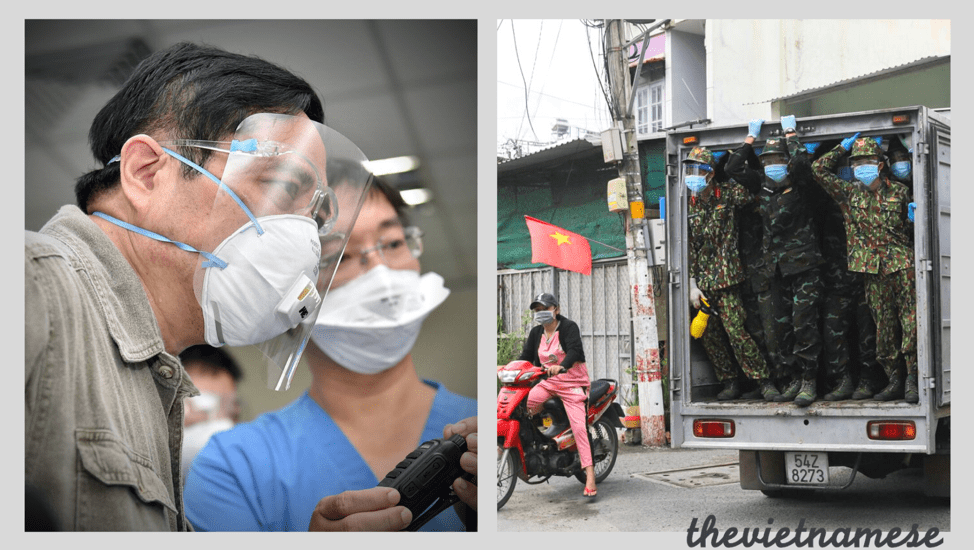
    • Vietnam to deploy troops to contain the surge of Covid-19 infections in Binh Duong Province, a major manufacturing hub, reports Reuters. The southern province, which is located nearby Ho Chi Minh City, is expected to record an additional 50,000 coronavirus cases over the next two weeks.
    • Vietnam’s Deputy Prime Minister Vu Duc Dam was replaced by Prime Minister Pham Minh Chinh as head of the National Steering Committee for Covid-19 prevention and control. The replacement decision came amid the worst coronavirus outbreak in the Southeast Asian nation.
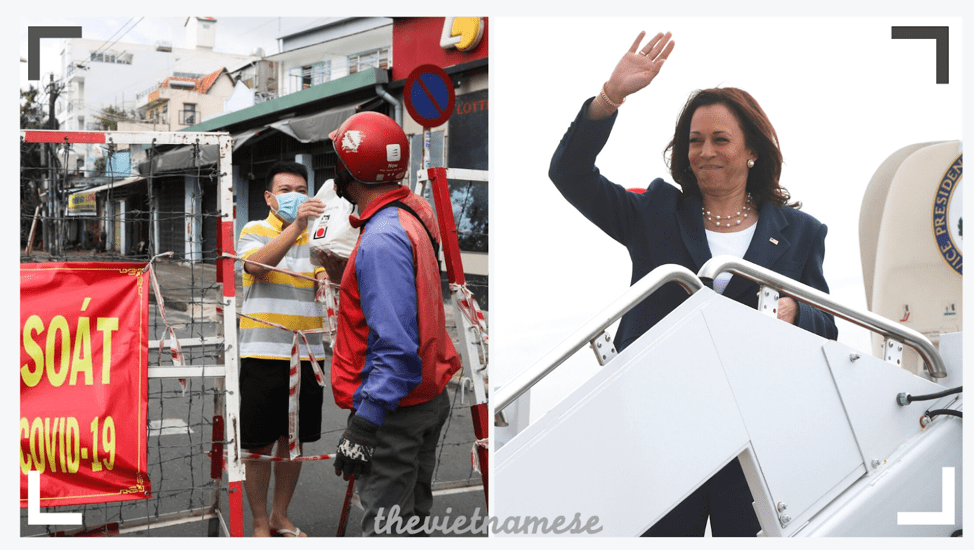
    • Ho Chi Minh City to resume delivery service operations in the city reports VnExpress. According to local authorities, delivery drivers, popularly known as “shippers” in Vietnam, will be allowed to operate in Covid-19 high-risk districts to relieve shopping demands among locals. Delivery drivers, along with temporary contractors and migrant workers, are among the most vulnerable groups during the Covid-19 pandemic in Vietnam.
    • Vietnam’s homegrown Covid-19 vaccine NanoCovax to be granted emergency use after being approved by The National Committee for Ethics in Biomedical Research, reports VietnamPlus: “The National Committee for Ethics in Biomedical Research under the Ministry of Health (MoH) has agreed that the mid-term results from Nano Covax’s phase 3 clinical trials will be submitted to the Advisory Council for the Registration of Circulation of Drugs and Medicinal Ingredients for considering the issuance of a registration certificate for the conditional circulation of the vaccine.”
    • Covid-19 vaccine donations to Vietnam: Australia donated to Vietnam a total of 403,000 AstraZeneca doses, as part of an “ongoing commitment to help Vietnam in its fight against the pandemic,” wrote the Australian Embassy in Vietnam. Meanwhile, on August 25, Italy also announced its donation of over 800,000 AstraZeneca doses to Vietnam via the COVAX Initiative, while over 500,000 vaccine doses, also made by AstraZeneca, arrived in Hanoi on August 23 as a donation from the Polish government.
    • The Vatican sends financial aid to help Vietnam deal with the Covid-19 pandemic, reports Reuters: “About $70,000 was sent to Bangladesh for continuing recovery assistance from Cyclone Yaas, which left tens of thousands of people homeless last May, and about 100,000 euros to Vietnam, where food supplies have been hit by the COVID-19 pandemic.”

    Vietnam Insight: Learn more about Vietnam

    China’s Wedge Strategy Towards the US-Vietnam Partnership

    The Diplomat/ Khang Vu/ August 25

    “Vietnam falls into a different category of Chinese wedge strategy, in which China seeks to reinforce Vietnamese neutrality, instead of de-aligning it, since Vietnam is not a formal U.S. ally. Hanoi considers itself a neutral country under its “four noes” policy, of “no military alliance, no affiliation with one country to counteract the other, no foreign military base in the Vietnamese territory to act against other countries, and no force or threatening to use force in international relations.” Such a policy is rooted in Hanoi’s search for a balance between ideological values and national security interests, which stipulates that Vietnam only allies with states that share both. Vietnam is officially neutral between the United States and China, since it only shares security interests with the former and ideological values with the latter (as well as strong economic ties to both.)”

    Who is winning the US-China battle for the hearts and minds of Vietnam’s cybersphere?

    South China Morning Post/ Dien Nguyen An Luong/ August 24

    “When both countries sought to burnish their vaccine diplomacy campaigns in Vietnamese cyberspace, the US beat China by a wide margin in terms of positive public reactions, reflecting the fact the Vietnamese public prizes US vaccines over Chinese ones. Such sentiments were reflected in an analysis of Facebook posts and their average engagements on vaccine diplomacy that were among the most engaged content between January and July.”

    Kamala Harris has a chance to stand up for democracy this week. She should take it.

    The Washington Post/ Will Nguyen/ August 23

    “One of the few socialist republics left in the world, Vietnam is an authoritarian state run by a nominally communist party, ruling over a population that is among the most pro-capitalist and pro-American on Earth. The precipitous fall of Afghanistan reveals that the United States cannot simply impose liberal democracy on other countries, even if they share such affinities. The desire for rights and reform must come from the people themselves. And in Vietnam, it is.”
  • Journalist Pham Doan Trang Can Still Be Freed In Vietnam. And The US Could Help Win Her Release.

    Journalist Pham Doan Trang Can Still Be Freed In Vietnam. And The US Could Help Win Her Release.

    While in Vietnam, Vice President Kamala Harris has significant leverage to make a change: free one of the most prominent journalists and democracy activists in the country.

    For the Vietnamese Communist Party, political prisoners are bargaining chips in international negotiations. They sell their own citizens to gain a trade deal or a more favorable security treaty. That’s because they know human rights are the soft spot of major powers, such as the United States and the European Union.

    Thus, they release political prisoners in exchange for economic and political gains. The problem is the prisoners are released conditionally: they are expelled from the country. Most of them settle in the United States.

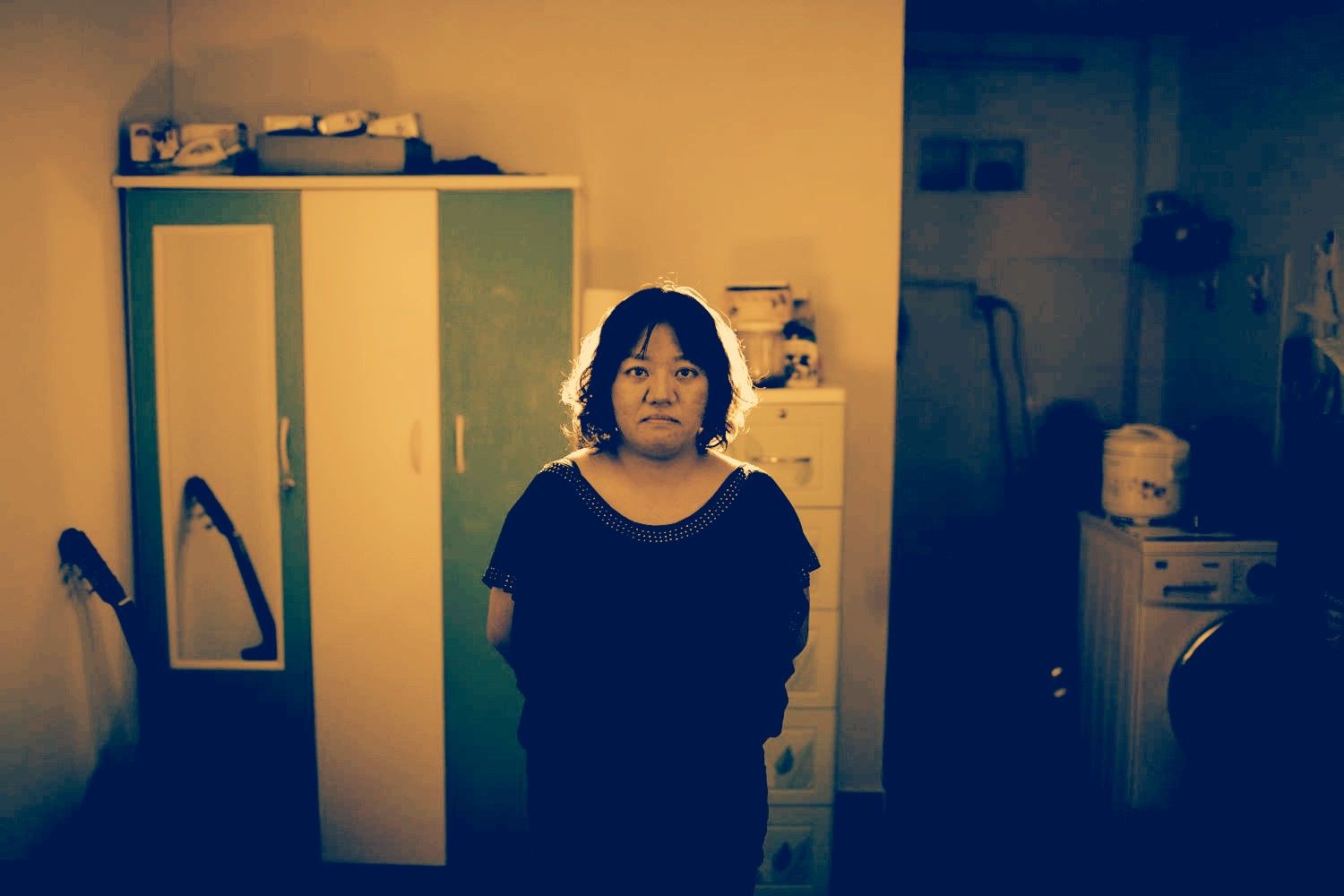
    But journalist Pham Doan Trang, one of Vietnam’s most respected journalists, is a different case. Unlike other political prisoners, she has not been indicted or convicted yet; she is a detainee under investigation and still has a chance to be released in Vietnam.

    Once the police have determined that an accused person did commit a crime, there is absolutely no way that person can avoid conviction and sentencing. The only option left is to negotiate a settlement in another country, as had happened with some other political prisoners.

    Of course, the investigators have now gathered more than enough evidence to make a case against Trang and put her away for up to 20 years. Chances are, the Communist Party has not decided yet on how to move forward with her case to maximize its own interests. All options are still on the table.

    Doan Trang has insisted that she doesn’t want to leave the country until it becomes a democracy. As a close friend and colleague of hers for over a decade, I know how painful it is for her to be forced out of her only home, her beloved Vietnam.

    As one of the most prominent and talented journalists and democracy activists in Vietnam since the end of the Vietnam War in 1975, she has always aimed at breaking down the censorship curtain that puts the country at the bottom of Reporters Without Borders’ Press Freedom Index. Her writings and activism include various samizdat political books, two independent magazines (Luat Khoa and The Vietnamese), many protest movements, and international advocacy campaigns.

    As a result, she was awarded the Homo Homini Prize from People in Need (Czech Republic) in 2017 and the Press Freedom Award by Reporters Without Borders (France) in 2019. But more importantly, Doan Trang’s way of working and living inspires other Vietnamese to stand up for their rights and a better, kinder country.

    No authoritarian regime would tolerate her. After years of cat-and-mouse games with the authorities, and many physical assaults, the police have detained Doan Trang since October 7, 2020, charging her with spreading propaganda against the state. The criminal provision has been widely condemned by human rights groups as a way the government silences critics – a clear violation of free speech protected by the Constitution and legally binding international treaties.

    Doan Trang was on her way to meet then-president Barack Obama in May 2016 in Hanoi before the police kidnapped her and detained her for the rest of the day. Vice President Harris may not be able to meet Trang in the detention center, but she can surely do a lot to free her in Vietnam.

    The trade relations, especially the semiconductor supply chain and strategic partnership are believed to be the reasons Vice President Harris is paying a visit to Vietnam.

    In such circumstances, I believe that the United States, and Vice President Harris, in particular, have an excellent chance to push for Doan Trang’s release right in Vietnam while the case is still undecided. And there is a precedent for that.

    In June 2007, Vietnam released attorney and democracy advocate Le Quoc Quan after three months of temporary detention and two days before Chairman Nguyen Minh Triet visited the United States. Attorney Le Quoc Quan had not been indicted yet, and a major reason he was freed was a mountain of pressure from the United States government and civil society, such as the National Endowment for Democracy, where Quan did a fellowship before his return to Vietnam.

    It is now urgent to push for Doan Trang’s release, before it’s too late.

  • Vietnam Briefing: Vietnam Records New COVID-19 Milestones; Human Rights And Regional Cooperation Become Key Issues During U.S. Vice President Kamala Harris’ Visit To Vietnam

    Vietnam Briefing: Vietnam Records New COVID-19 Milestones; Human Rights And Regional Cooperation Become Key Issues During U.S. Vice President Kamala Harris’ Visit To Vietnam

    COVID-19: Vietnam marked new daily infections and deaths record

    • Saturday, August 21, 2021, Vietnam confirmed a total of 13,417 Covid-19 cases, the highest tally since the country detected its first coronavirus infections. On Sunday, the country recorded 737 coronavirus-related deaths, the highest fatality number on any given single day.
    • Quick take: In total, Vietnam’s Covid-19 confirmed cases surpassed 340,000 with over 8,000 deaths. Ho Chi Minh City (HCMC) and other southern provinces remain the country’s largest coronavirus hotspots. As of now, only around 1.7 percent of the country’s population have been fully vaccinated.
    • Panic buying has been seen in HCMC as a result of the local authorities’ decision to impose a stringent lockdown, prohibiting residents from leaving their homes, according to Reuters. Meanwhile, chairman of the city’s People’s Committee, Nguyen Thanh Phong, was removed from his position by the Communist Party, possibly on account of his poor handling of Covid-19.
    • Starting this Monday, HCMC will deploy military troops to enforce the strict stay-at-home order for two weeks amid spiralling Covid-19 infections and deaths in the city, Reuters reports. “We are asking people to stay where they are, not to go outside. Each home, company, factory should be an antivirus fort,” said Pham Duc Hai, deputy head of the city’s coronavirus authority.
    • HCMC official: The city records an average of 240 coronavirus-related deaths every 24 hours. Meanwhile, there are “hundreds of acutely-ill patients and thousands of people wishing to flee the city,” he added.
    • Dr. Kidong Park, World Health Organization Representative in Vietnam: “[Vietnam’s] current healthcare system is under enormous pressure” due to the surge in Covid-19 cases. “There is still a lot of work to be done while the next few weeks are crucial […] to contain the recent outbreaks,” Dr. Park affirmed.
    • Vietnam calls for international support to deal with the pandemic: “We hope that other countries and international organizations would continue to share information, technology, finance, health services, and vaccines so that Vietnam can soon control and fight off this dangerous disease,” said Ms. Le Thi Thu Hang, Vietnam’s Foreign Ministry spokeswoman.
    • The Vietnamese government proposed a plan to distribute around 130,000 tons of rice to over 8.6 million Vietnamese people, who face food shortages because of Covid-19 pandemic effects. The food aid will be distributed to 24 provinces and municipalities in the country.
    • Covid-19 vaccine’s arrival in Vietnam, from VietnamPlus: “Vietnam received an additional 1,209,400 doses of AstraZeneca COVID-19 vaccine on August 19, according to the Vietnam Vaccine JSC (VNVC). This is the ninth batch delivered to Vietnam under the VNVC’s order of 30 million doses with AstraZeneca, which will be handed over to the Ministry of Health at a not-for-profit price.”

    U.S. Vice President Kamala Harris is set to visit Vietnam this Tuesday, human rights issues to be raised

    Families of several Vietnamese prisoners of conscience co-wrote an open letter to Vice President Kamala Harris, asking her to pressure Hanoi for the release of their family members.

    RFA reports:

    • The letter, signed by four prisoners’ wives, informs Harris that many prisoners of conscience are jailed for publicly disagreeing with the government, “which does not happen in a democratic country like the United States.”
    • They request the release of their family members “so the old mother may still see her son, the young wife can again cry on her husband’s shoulder, so the two-digit-prison-terms will not take away the life of one man and the livelihood of his whole family. All because they dare to speak the truth, a very normal action in any democratic nation,” the letter said.
    • The letter was signed by the wives of Truong Minh Duc, serving 12 years in prison for “attempting to overthrow the government;” Nguyen Nang Tinh, serving 11 years for his Facebook posts critical of the government; Luu Van Vinh, serving 15 years for spreading information about a 2016 toxic chemical spill at the Formosa steel plant; and Tran Duc Thach, an author serving 12 years for his writings that expose the corruption, injustice and human rights abuses of the Vietnamese government.
    • According to the California-based Vietnam Human Rights Network, Vietnam currently detains around 300 political prisoners.

    The 88 Project, a human rights advocacy project, along with other 12 human rights organizations, also released an open letter to Vice President Harris prior to her visit.

    The Vietnamese Magazine reports:

    • Released on Wednesday, August 18, 2021, the letter urges the vice president to “emphasize the importance of human rights with Vietnamese leaders” and also calls for specific action to be taken regarding the situation of Tran Huynh Duy Thuc, a prominent Vietnamese democracy activist whose health is slowly deteriorating due to his prolonged hunger strike.
    • In 2010, Thuc was sentenced to 16 years in prison for writing and publishing online articles calling for a multi-party democratic system in Vietnam.
    • Thuc’s imprisonment, detention, and subsequent treatment at the hands of Vietnamese authorities are blatant infringements of his right to a fair trial under the International Covenant on Civil and Political Rights, and the Vietnamese Constitution. He has also been subject to various forms of physical and mental duress which violate the international prohibition against torture.

    The full text of the open letter can be accessed here.

    The Vietnamese Magazine reports:

    • On October 6, 2020, at 11:30 pm, Pham Doan Trang was arrested by Vietnamese state forces and was subsequently charged with “conducting propaganda against the Socialist Republic of Vietnam” and “making, storing, spreading information, materials, items for the purpose of opposing the State of the Socialist Republic of Vietnam.”
    • LIV appeals to Vice President Kamala Harris to urge the Vietnamese government to unconditionally release illegally imprisoned journalists, including Pham Doan Trang, and push for a freer and more inclusive Vietnamese media environment, where “no journalist needs to fear oppression by their government.”

    LIV’s open letter to Vice President Harris can be accessed here.

    Vice President Kamala Harris seeks to “strengthen relationships with partners in the region,” reports CNN:

    • Officials say Harris will look to strengthen relationships with partners in Southeast Asia during her visit to Vietnam and Singapore. She will also engage with members of the private sector and civil society leaders.
    • The vice president will also seek to share the Biden administration’s vision for a free and open Indo-Pacific when she meets with Vietnamese government officials, her office said, and she will raise security issues, including in the South China Sea.

    A member of the ‘Provisional Government of Vietnam’ sentenced to a three-year prison term under Article 109 of the penal code

    RFA reports:

    • A court in central Vietnam’s Nghe An Province last Monday sentenced a member of a U.S.-based political opposition group to three years in prison for alleged activities aimed at overthrowing the country’s one-party Communist government.
    • Tran Huu Duc, born in 1964 and a resident of Nghe An Province, was accused by prosecutors of using Facebook to connect with other members of the so-called Provisional Government of Vietnam, headquartered in Orange County, California, from June 2020 to January 2021.
    • The Provisional Government of Vietnam was founded in 1991 by former soldiers and refugees loyal to the South Vietnamese government that existed before the country’s takeover by North Vietnam in 1975.
    • In its Freedom in the World 2021 report, Washington D.C.-based Freedom House gave Vietnam an overall score of 19 out of a possible 100, a one-point decrease from last year’s rating. Vietnam scored three out of 40 in political rights, and 16 out of 60 in civil liberties.

    Vietnam Insight: Learn more about Vietnam

    Will Vietnam Be America’s Next Strategic Partner?

    The Diplomat/ Alexander L. Vuving/ August 21

    “The relationship between Washington and Hanoi is one of the most delicate and most subtle in the world. Historical memories, ideological differences, and domestic concerns often make things unspeakable in this growing relationship. But the largest factor of all that renders the U.S.-Vietnam relationship so delicate and so subtle is China. It is also the critical factor that makes and unmakes the strategic aspect of U.S.-Vietnam ties.”

    I Can’t Forget the Lessons of Vietnam. Neither Should You.

    The New York Times/ Viet Thanh Nguyen/ August 19

    “History is happening again, and again as tragedy and farce. The wars in Vietnam and Afghanistan happened as a result of American hubris, and in both cases, Americans mostly focused on the political costs of war for them. But in each case, the Vietnamese (and Laotians, Cambodians and Hmong), and now the Afghans, have paid the much greater toll in human suffering. In April 1975, the United States recognized its moral responsibility and evacuated about 130,000 Vietnamese people, and then accepted hundreds of thousands more from Vietnam, Laos and Cambodia in subsequent decades. This is what must happen now, and anything short of such a vision of responsibility and hospitality will compound the American failure in Afghanistan.”

    Afghanistan and the Real Vietnam Analogy

    The Diplomat/ Andrew Gawthorpe/ August 18

    “In South Vietnam, as in Afghanistan, this U.S. inability to impose its will on local political realities ultimately led to the failure of nation-building and defeat in war. The specific ways in which Afghanistan has collapsed highlight the primacy of the local.”