On June 24, 2021, Attorney Tran Hong Phong, the lawyer for Ho Duy Hai and his family in their petition for his wrongful death penalty case, published a letter on his Facebook account, providing a new alibi regarding the case. Five lawyers (including Phong), two journalists working for a law newspaper, and Ho Duy Hai’s family jointly signed the letter.
The letter, which had been previously sent to the Procurator of Supreme People’s Procuracy of Vietnam and the Vietnamese authorities, provides convincing proof [1] to demonstrate that Ho Duy Hai was not the murderer of two post office workers in Long An Province in 2008.
Alternatively, the new evidence shows that on the evening of January 13, 2008, Ho Duy Hai actually did not go to Cau Voi Post Office, where the murder took place, but rather attended the funeral of Ho Chi, also known as Tu Lan, a neighbor who lived just 500 meters from Hai’s house.
Furthermore, the new evidence also shows that Ho Duy Hai was at the funeral from 7:50 pm until 9 pm, which coincides with the time the Long An Police investigative agency alleged he had entered the Cau Voi Post Office, at around 7:30 pm, to murder the two victims at around 8:30 pm allegedly. Seven witnesses, who also attended the funeral, including the deceased’s wife, have confirmed this fact.[2]
Ho Duy Hai received a death penalty for his convictions of homicide and robbery, despite “serious procedural shortcomings”[3] and violations of the defendant’s right to a fair trial.
Although the presumption of innocence has been recognized [7] in its 2015 Criminal Procedures Code, Vietnam has fallen short of actually practicing this principle in its criminal proceedings. Quite commonly, the number of cases and the speed at which a case must be solved dwarf the importance of proper due process to uphold a fair and just trial.
A local lawyer explained [8] that investigative agencies could deploy “professional” methods to extract forced confessions from people since these agencies “often hold prejudices” against the accused. Also, earlier this month, the People’s Court of Dak Song District, in Dak Nong Province, held [9] nearly 60 “pretend” trials, to meet its quota for a local judge to be reappointed, without any real defendants or victims.
However, the new evidence provided by his attorney might prove that Ho Duy Hai was wrongfully convicted, which would be a spark of hope for both the defendant and his family as the possibility of retrial could be high.
To strengthen the validity of the new proof, Attorney Phong confirmed that all seven witnesses “voluntarily provided the information and confirmation letters to affirm that their testimonies are true and vowed to take full responsibility under the law […].”
In their letter, the attorney and the signees demanded Vietnamese government officials expeditiously verify the evidence, review the cassation decision, release defendant Ho Duy Hai on bail while awaiting verification; and review and resolve their previous petitions and demands.
The case of Ho Duy Hai has drawn wide attention from both national and international audiences, as he was convicted of murder and later sentenced to death via an opaque and unfair trial.
Bibliography:
[1] RFA. (2021, June 25). Vụ án Hồ Duy Hải: Luật sư cung cấp bằng chứng ngoại phạm mới. Đài Á Châu Tự Do. https://www.rfa.org/vietnamese/news/vietnamnews/ho-duy-hai-case-lawyer-provides-new-proof-06252021081856.html
[2] HCMC Reporters. (2021, June 25). Vụ án tử tù Hồ Duy Hải: Luật sư cung cấp tình tiết bất ngờ. Dân Việt. https://danviet.vn/vu-an-tu-tu-ho-duy-hai-luat-su-cung-cap-tinh-tiet-bat-ngo-2021062515064789.htm
[3] Will, N. (2019, December 3). After Decade of Petitions, Vietnam to Re-consider Case of Death Row Inmate Ho Duy Hai. The Vietnamese Magazine. /2019/12/after-decade-of-petitions/
[4] Vi, T. Q. (2019, September 29). Wrongful Death Penalty Cases And The Families That The Inmates Left Behind. The Vietnamese Magazine. /2019/09/wrongful-death-penalty-cases-and-the-families-that-the-inmates-left-behind/
[5] Thereporter. (2020a, May 7). Ho Duy Hai’s Cassation Trial. The Vietnamese Magazine. /2020/05/ho-duy-hais-cassation-trial/
[6] Thereporter. (2020b, May 9). Ho Duy Hai’s Case Reaffirmed, Sentenced to Death Again. The Vietnamese Magazine. /2020/05/ho-duy-hais-case-reaffirmed-sentenced-to-death-again/
[7] V.L.L.F. (2018, June 1). Legal experts discuss presumption of innocence, due process principles in criminal proceedings. Vietnam Law and Legal Forum. https://vietnamlawmagazine.vn/legal-experts-discuss-presumption-of-innocence-due-process-principles-in-criminal-proceedings-6244.html
[8] Thi, D. (2021, June 25). Liệu có tái thẩm vụ án Hồ Duy Hải với chứng cứ ngoại phạm mới? Đài Á Châu Tự Do. https://www.rfa.org/vietnamese/in_depth/will-the-ho-duy-hai-case-be-retrial-with-new-alibi-dt-06252021114054.html
[9] Duong, D. (2021, June 6). Tòa huyện lập gần 60 vụ án “ảo” để. . . một thẩm phán được bổ nhiệm lại? Dan Tri. https://dantri.com.vn/xa-hoi/toa-huyen-lap-gan-60-vu-an-ao-de-mot-tham-phan-duoc-bo-nhiem-lai-20210606162322706.htm
On May 8, 2020, around 15:30 Hanoi’s time, the 17 members-committee of the Supreme People’s Court of Vietnam reaffirmed Ho Duy Hai’s lower courts’ decisions and again sentenced him to death. They have also denied the petition for a cassation trial from the Supreme People’s Procuracy of Vietnam.
Hai’s death sentence has been affirmed
In its statement denying the petition from the Judicial Committee of the Supreme People’s Procuracy of Vietnam, the committee even though agreed there were prosecutorial mistakes. Still, its members believed those mistakes did not change the character of the case. Accordingly, the Judicial Committee of the highest court believed that the lower courts have duly convicted Hai and sentenced him to death. Therefore, they affirmed the lower courts’ decisions, effectively sentenced Hai to death again.
Ho Duy Hai’s family and his lawyer after the decision was announced. Photo courtesy: Nguyen Xuan Dien
The Judicial Committee of the Supreme People’s Court believed these prosecutorial mistakes did not change the character of the case. Yet, if we look at them from an international law perspective, they might have violated the defendant’s right to a fair trial. The errors admitted by the government were among the followings:
No murder weapons. The alleged “weapons” were purchased at a market by the police.
Hai’s DNA, fingerprints were not found at the crime scene.
Hai also was convicted of ‘robbery’ in the same case, but the police could not find any of the items alleged to be robbed by him.
No eyewitness identified Hai at the crime scene.
Technically, there was no physical evidence. The only evidence in the case was Hai’s confession. Under Vietnam’s laws, the confession could not be the sole evidence used to convict defendants.
Would Hai’s life be saved under Vietnam’s laws?
The cassation trial is the highest court’s proceeding in a case in Vietnam. But Hai still has three options (link is in Vietnamese) under Vietnam’s laws to save his life.
The National Assembly could intervene and request the Judicial Committee of the Supreme People’s Court to conduct a meeting to review the cassation trial’s decision.
The Head of the Supreme People’s Procuracy of Vietnam petitioned, or the Chief Justice of the Supreme People’s Court requested the Judicial Committee to review their decision in the cassation trial.
The President of Vietnam pardons the death sentence.
The cassation trial of Ho Duy Hai during the past three days has created a lot of public discussion in Vietnam. People have discussed the case because many of them saw the injustice of Ho Duy Hai’s judgment during the last twelve years.
Representative Le Thanh Van at the National Assembly. Photo courtesy: Bao Moi
One of the National Assembly’s members, Mr. Le Thanh Van, a representative Ca Mau province, has also expressed his opinion on his Facebook account. Mr. Le said that he would do all that he could to push for Vietnam’s Congress to intervene with this case. He stated that the decision of the cassation trial is unconvincing and not persuasive enough.
Numerous attorneys and journalists also expressed on social media that the decision of the cassation trial’s decision was not fair. They believed that Ho Duy Hai should have been released. One of them was Huy Duc, the author of the book The Winning Side (Ben Thang Cuoc).
After more than 10 years of petitioning the Vietnamese government, Nguyen Thi Loan (pictured above) says a huge weight has been lifted off her shoulders. Her son, Ho Duy Hai, who had been found guilty of murder in 2008 and was sitting on Vietnam’s death row for eleven years, now has another chance at life.
As such, the SPP has requested that Vietnam’s Supreme Court toss out all previous rulings, including the original 2008 conviction by a Long An provincial court, as well as a 2009 appellate judgment by the Ho Chi Minh City Supreme Court of Appeals which upheld the death sentence. The SPP’s latest request also supersedes its own October 2011 refusal to halt the sentence after repeated petitions from Loan.
Ho Duy Hai’s 2008 case involves the murder of two sisters, Nguyen Thi Thu Van, 22, and Nguyen Thi Anh Hong, 24, who were killed at Cau Voi Post Office in Long An province, which borders Ho Chi Minh City to the southwest. The women, who both lived and worked at the post office, were found at the foot of a set of stairs, two meters apart, with their necks slit and their heads showing signs of blunt force trauma. The robbery and double murders occurred on the evening of January 14, 2008, about 4.5 kilometers from Hai’s house. It was not until two months later that Hai was implicated. He had known the two employees and could not provide an alibi the night of the murders. Police subsequently arrested him and charged him with murder on March 21, 2008.
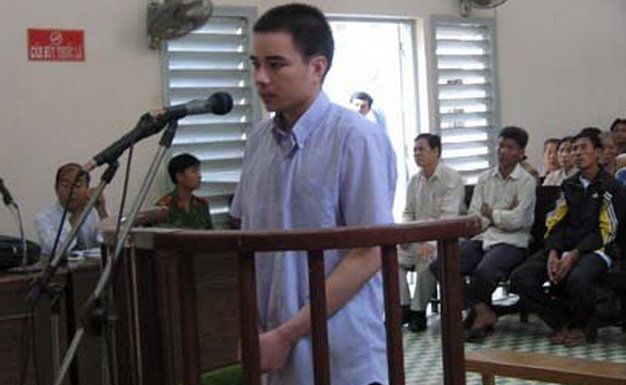
Ho Duy Hai during his trial on December 1, 2008. Photo: Hoang Phuong / Thanh Nien.
Hai was only 23 when he was sentenced to death on December 1, 2008, but both he and his mother have consistently proclaimed his innocence. Though Hai could not remember clearly what he was doing the night of the murders, he claimed police beat and tortured him into falsely confessing.
Other cited shortcomings in the investigation included a lack of fingerprints at the scene of the crime to corroborate Hai’s “confession”, an inability to confirm the murder weapon(s), purchased items used to replace “lost” evidence at the scene of the crime, inconsistent witness testimonies, and a lack of time of death for the two victims to corroborate Hai being at the scene, among others.
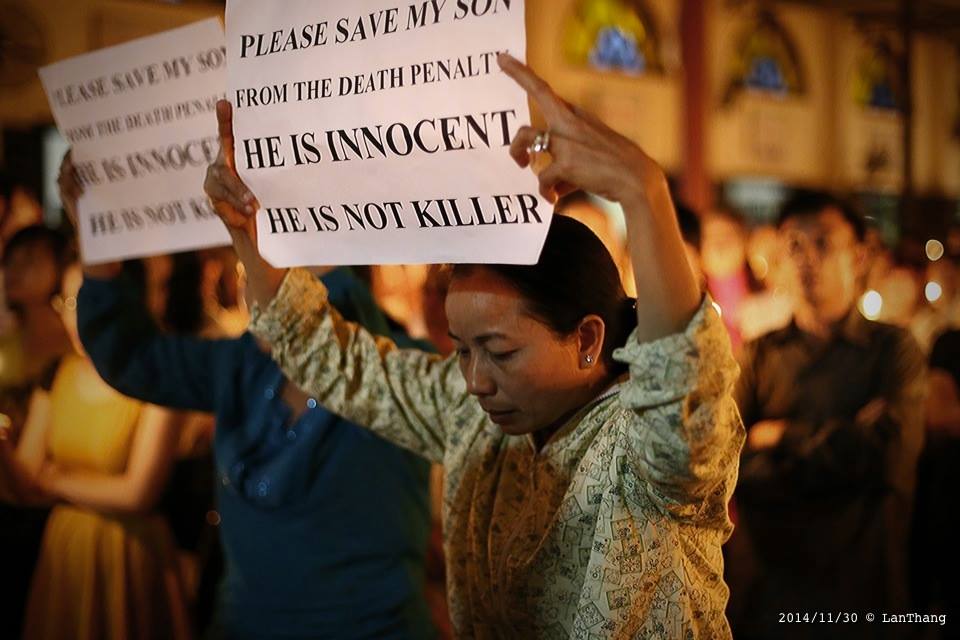
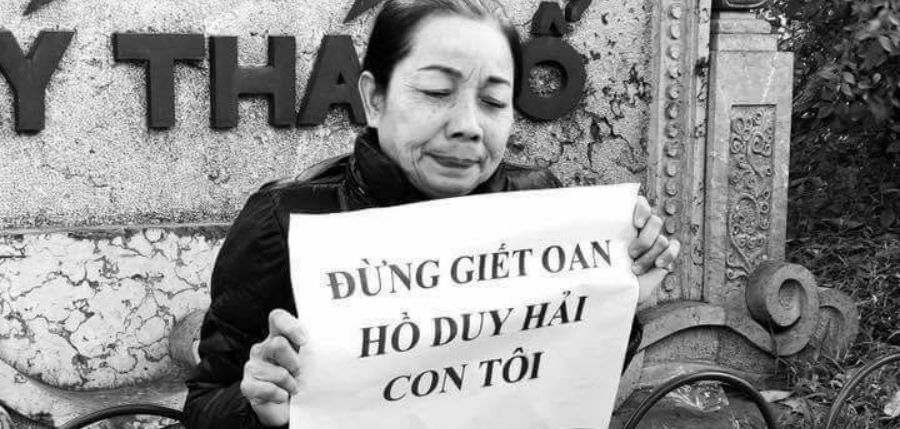
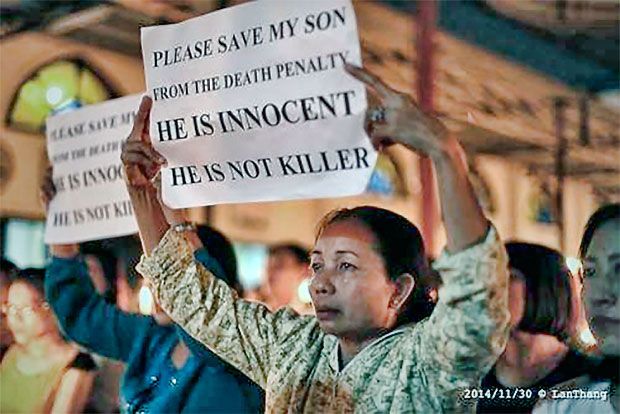
For more than a decade, Hai’s mother petitioned all levels of government to intercede in her son’s case, even holding banners in front of the General Secretary, Prime Minister, and the President’s offices. She also enlisted the help of activists, dissidents, and human rights groups on social media to spread awareness. In December 2014, when Hai was only a day away from lethal injection, the Long An provincial court decided to temporarily suspend his sentence due to uproar over the nagging inconsistences in Hai’s case.
The case became so high-profile that National Assembly (NA) representative Le Thi Nga, who was the deputy head of the NA’s Judicial Committee at the time, became involved. She personally investigated the case’s inconsistencies, confirming that “there were serious violations committed by the police and prosecution in Hai’s case.” Her tenacity, attention to detail, and personal care for Hai’s mother has earned her praise on social media, who have held her up as a model NA representative.
Ms. Le Thi Nga, National Assembly representative, and deputy head of the NA’s Judicial Committee from 2007-2016. She is currently head of the Judicial Committee. Photo: Hoang Long / Vietbao
If the Vietnamese Supreme Court accepts this latest SPP request, then there are two possible outcomes for Hai: his case will either be suspended and all charges dropped or he will be re-investigated and re-tried.
If the Supreme Court decides the former, then Hai will walk away from death row a free man. If it decides the latter, then Hai’s case is essentially back to square-one, as if he had just been arrested. Hai would remain in police custody (i.e. virtually imprisoned, as is Vietnamese custom for those who have been arrested but not yet charged with a crime). The murders for which he was convicted would be re-investigated by police, after which the Long An prosecutor’s office would decide whether to charge Hai with a crime. If they do, then the trial, sentencing, and appeals process would repeat itself. If they don’t, then Hai has yet another path to freedom.
Regardless of the outcome, Hai’s mother is all gratitude for what has been achieved so far: “I want to thank every soul, both inside and outside the country, for caring so deeply for Hai. I will be grateful to you all for the rest of my life, for supporting my family and walking together with us on this long path.”
During these last days of 2017, be it rain or shine, people in Ha Noi, Vietnam, could often spot a frail, weary middle-aged woman holding up a sign “Do Not Kill My Innocent Son, Ho Duy Hai” near the government’s headquarters.
She is death-row inmate Ho Duy Hai’s mother, Nguyen Thi Loan.
Since Hai’s conviction in 2008, Ms. Loan has begun her own crusade to petition for his release. In the past few years, she especially traveled more often to Ha Noi where the central government is located to raise awareness of Hai’s case because time might be running out for him.
Ho Duy Hai’s execution was halted once in December 2014 due to public outcry, but recently, local authorities had expressed their impatience for having to continue keeping him on death row.
On December 7, 2017, at a meeting of the People’s Committee of Long An Province, Dinh Van Sang – Prosecutorial General of the People’s Procuracy of Long An Province had suggested that the execution of Ho Duy Hai should be carried out as soon as possible because “the imprisonment of this kind (of prisoners) would be too burdensome (for the government).”
Ho Duy Hai and his sister in a family picture. Photo credits: Kienthuc.net.
It often goes without exception in the majority of jurisdiction, that one shall not be convicted based solely on his or her confessions.
The criminal law principle of corpus delicti requires a higher burden of evidence from the prosecution and provides that a defendant’s confession – on its own – is not enough for a conviction.
Having credible physical evidence from the prosecution then becomes the determining factor in convincing a jury or a judge, that the government has satisfied the burden of proof and that they have proved the defendant was, in fact, guilty of the crime charged.
Vietnam follows this general rule in prosecuting criminal cases.
Yet, such a rule only exists in law books and legal codes.
In practice, people not only got convicted solely on their confessions but very often, they confessed because they were beaten and tortured by the investigating officers.
Ho Duy Hai was one of them.
In March 2008, Hai – a then 23-year-old recent graduate from Long An Province located in the Mekong Delta south of Sai Gon – was arrested, charged and convicted of double homicide and sentenced to death.
The only evidence used to convict him was practically his confession, which he later recanted and revealed that he was forced to confess by the police during his detention.
The prosecution not only did not offer any credible physical evidence, they even committed basic prosecutorial mistakes.
The time of death was never established for the two victims, making it impossible for the defendant to come up with an alibi.
The murder weapons were “lost” by the forensic team and other items were later “purchased” a local market by witnesses who vouched for their similarities if compared to the real ones.
None of the fingerprints found at the crime scene matched Ho Duy Hai’s.
A special team of legal experts set up by the Vietnamese National Assembly and led by the current Commissioner of the National Assembly’s Judiciary Committee – Le Thi Nga – visited Hai in the end of December 2014 after his family successfully used social media campaign to halt his execution (which was set to be carried out earlier that month).
The report signed by Ms. Le Thi Nga in February 2015, found that Hai’s case was riddled with irregularities and prosecutorial mistakes and that the prosecution did not present sufficient evidence to support a conviction. It also called for a trial of cassation for Hai.
2018 will be three years since the government’s legal experts concluded that Hai’s case deserved a review and ten years since Hai’s life as a free man ceased to exist, yet it seems as if the legal obstacles have stacked even higher against him.
Hai remains in prison, his youthful years waste away with each day spent on death row.
With the assistance of a local artist, Thinh Nguyen, Ms. Loan and other parents of wrongfully convicted death-row inmates appeared in several video clips to raise public awareness on the reality of forced confessions and prosecutorial irregularities in Vietnam’s criminal cases.
And even though the videos are well-received, it seems as if these efforts are to no avail, at least for the time being.
His mother has also written thousands of petitions pleading the government to not kill her innocent son, and she would talk to anyone – be it the personnel from foreign embassies or just about any passerby on the streets – whoever would spare a few minutes listening to her telling the story of Hai’s wrongful conviction.
Her hope is that one day, not only the people will stop and listen to her, but so will government officials and that they will take up Hai’s case and declare him a free man.
Wrongful convictions almost always share a few disturbingly similar characteristics in Vietnam. First, they mostly happened in rural areas. And second, the majority of the people involved, be it the victims, witnesses, or alleged perpetrators, are often poor, and some even have little or little education.
In any case, the defendants quickly found themselves victims of police brutality and thus were coerced to confess. Most of the time, no effective legal counsel would be available. Worse of it, it would be certain that the court will convict with little or close to zero credible evidence and hastily sentence them to the maximum terms. There have been many cases where defendants were sentenced to death based on almost nothing but the very confession that the police had beaten them into giving up.
Therefore, the country’s need for criminal justice reform is real and urgent. And the death penalty cases below, featuring the stories of three young men in their twenties, all convicted, sentenced, and incarcerated to await their executions during the past decade, would convince even the toughest critics.
Ho Duy Hai:
Ho Duy Hai at one of his court hearings. Photo credit: Thanh Nien Newspaper.
Hai was a 23-year-old recent college graduate, eagerly waiting to start his new life when he got convicted of double homicide and robbery in 2008.
Social media in Vietnam came to know of Hai’s case when his younger sister, Thuy, created a Facebook group in November 2014 to raise awareness about his conviction and plead for his life. At that time, Hai’s family had just received notice from the Long An Province Police Department that they would execute him on December 5, 2014.
Devastated by the news, his family then desperately turned to social media, the dissidents, and various independent human rights groups to save Hai’s life. Vietnamese people began to learn about one of Vietnam’s most peculiar death penalty cases. Due to pressure from both the public in Vietnam and international organizations, on December 4, 2014, then-President Truong Tan Sang personally ordered a halt of his execution – which would have been carried out the next day.
Despite the fact that a special team of jurists and legislative members was set up to investigate wrongful convictions in 2014 and 2015 and that the Deputy Commissioner of the National Assembly’s Judiciary Committee at the time – Le Thi Nga – already reported to Congress, there were serious violations committed by the police and prosecution in Hai’s case, he had yet been granted a review and remained incarcerated.
By next March, it would have been ten years since the day his life as a free man was abruptly ended. And as flimsy as they are, the so-called evidence that sent Hai to the firing squad still soundly stands.
The case dates back to the night of January 14, 2008, when two young women were killed at the Cau Voi Post Office in Thu Thua District, Long An Province. According to the case file, the victims’ throats were cut, and one of them received blow injuries to the head while another one was almost decapitated. The perpetrator allegedly took some 1,400,000 VND (approximately 70 USD), mobile phones, and pieces of jewelry from the scene.
On March 22, 2008, Hai was arrested and tried for the double murder even when none of the fingerprints left at the scene matched his, there was no physical evidence to tie him to the case, and there were testimonies that other men were seen at the crime scene during the night of the murders.
Even more disastrous, according to the indictment, one of the prosecution’s witnesses, Nguyen Van Thu, laterpurchased a knife at a local market and gave it to the police, vowing that it would have matched the size and shape of the knife from the scene. That was enough for the police to conclude that they had sufficiently determined the murder weapon. What happened next was more bizarre; this very “purchased” weapon was indeed admitted into evidence as part of the case file that convicted Ho Duy Hai of double murder and sentenced him to death in December 2008.
During their visitation, Hai told his mother and aunt that he was beaten up by the police and tortured during his pre-trial detention to confess to the crimes. Also, according to his family, Hai’s appeal process began immediately after the conviction, but the court system repeatedly denied review.
With his family, including his mother, aunt, and younger sister, on his side, Hai continues on what seems to be an indefinite journey to fight for justice.
Le Van Manh:
Le Van Manh. Photo credit: Cong an Nhan dan Newspaper.
Approximately one year after the campaign to save Ho Duy Hai appeared on Vietnam’s social media in October 2015, people again learned of the facts in yet another irregular wrongful death penalty case.
On October 16, 2015, the family of death-row inmate Le Van Manh received a written notice from the People’s Court of Thanh Hoa Province, informing them about procedures to pick up and bury his body after execution, which was scheduled for October 26, 2015. Le Van Manh was convicted of robbery, rape, and murder of a 14-year-old girl in July 2005.
On October 25, 2015, Amnesty International issued a statement on behalf of Le Van Manh, urging the Vietnamese government to spare his life and investigate allegations that he was tortured in police custody. Like Ho Duy Hai, Manh’s execution was halted due to domestic and international pressure. And also, like Hai, Manh continued to be incarcerated since then, with little progress in his plea for justice.
From 2005-2008, Le Van Manh underwent a total of seven court hearings, including three trials, three appeals, and one cassation trial. In all of his court hearings, Manh vehemently denied all of the charges and retracted his earlier confessions, alleging that he had to confess after being beaten by both the police officers investigating his case and his cellmates who were acting under police’s instructions.
According to the case’s official records, the victim, Hoang Thi Loan, whose date of birth was August 15, 1991, was raped and murdered in Yen Thinh Ward, Yen Dinh District, Thanh Hoa Province, in March 2005. The authorities believed that Loan went to the bank of the Cau Chay River within the Yen Thinh Ward to use the bathroom on March 21, 2005. By nightfall, her family realized that she had disappeared. The family organized a search for her but to no avail. By the 13:00 hour on March 22, 2005, Loan’s body turned up at the bank of Cau Chay River within Xuan Minh Ward, Tho Xuan District, also in Thanh Hoa Province.
On March 30, 2005, the Thanh Hoa Province’s Forensics Office concluded that Hoang Thi Loan died from strangulation with signs of water asphyxia and that the victim was raped before she was killed.
On April 20, 2005, Le Van Manh, who was 23-year old at the time, was arrested pursuant to a temporary arrest warrant issued by the investigative police unit of Dong Nai Province for an entirely different matter, suspected robbery and attempting to flee criminal custody, earlier that month.
However, according to the criminal complaint, just three days later, by April 23, 2005, a confession letter, claimed to be written by Le Van Manh while in police detention addressed to his father, had surfaced, admitting guilt to the rape and murder of Hoang Thi Loan. The police were in time to confiscate this letter and used it to prove Manh’s guilt. The criminal complaint further showed that the investigation relied on the testimony of a 9-year-old child – who had limited education and was interviewed by the police without parental permission – for leads.
As in Ho Duy Hai’s case, there was no physical evidence to tie Manh to the alleged rape and murder. The only evidence presented by the prosecution was Manh’s confession letter, which he already retracted. Nevertheless, Le Van Manh was charged with the rape and murder of Hoang Thi Loan, tried, and sentenced to death.
Nguyen Van Chuong:
Nguyen Van Chuong. Photo credit: Giaoduc.net.vn.
Nguyen Van Chuong’s official case file reveals that it could probably be the strongest one among these three to demonstrate how police brutality affected criminal investigation in Vietnam because the suspects and witnesses also fell victim to such cruel practice.
The only evidence used to convict Chuong was his and his co-defendants’ confessions. These confessions, again, were alleged by the defendants that the police obtained them through torture.
His parents recalled how Chuong had described the police would handcuff him so that he was hanging and only the tips of his toes would touch the floor, then they would beat him repeatedly until he confessed.
Court’s dockets confirmed that Chuong and other defendants had all petitioned for review after the appellate court confirmed their convictions in November 2008. From prison, on April 7, 2009, Chuong sent his mother a t-shirt where he had used bamboo toothpicks to sew on his plea of innocence.
Not only the defendants alleged that they were tortured by the police during the investigation to confess, but Chuong’s alibi witnesses had also come forward and alleged they were physically abused by the authorities.
According to the police’s investigation file, on the night of July 14, 2007, around 21:00 hour, a high-ranking police officer, Nguyen Van Sinh, of the Hai An District, Hai Phong City, was attacked by knives and suffered severe injuries. Officer Sinh died at 8:00 A.M. the next morning from the wounds he received during the attack.
By August 3, 2007, police arrested Nguyen Van Chuong, who was born in 1983 and a resident of Trung Tuyen village, Binh Dan Ward, Kim Thanh District, Hai Duong Province. At the time of his arrest, Chuong was a factory worker in Hai Phong, married, and had no criminal records. Chuong was also the owner of Thien Than coffee shop in Hai An District, Hai Phong City. Together with Chuong, two other men, Do Van Hoang and Vu Toan Trung, were also arrested.
On August 4, 2007, Chuong’s 20-year-old younger brother – Nguyen Trong Doan – obtained written declarations from various witnesses who swore under oath that they had met with Chuong in his hometown, in Kim Thanh District of Hai Duong City at the time Officer Sinh was attacked in Hai Phong City, which is some 40 km away. In other words, Chuong had an alibi and witnesses to support it.
But instead of investigating the validity of his alibi, the police arrested Chuong’s brother, Doan, alleging that Doan manipulated evidence and witnesses to help Chuong conceal his crimes. Ironically, Doan was arrested at the police station in Hai Phong City when he came to provide the police with testimonies from witnesses who were with his brother during the night of the alleged crime.
One of Chuong’s alibi witnesses was Tran Quang Tuat, who later told Tien Phong newspaper in November 2007 that the police had intimidated him into changing his testimony about Chuong’s whereabouts while Officer Sinh was attacked.
Another person, Trinh Xuan Truong, petitioned to the People’s Supreme Procuracy Office on September 10, 2013, and claimed that the police had beaten him up, burnt him with cigarettes, threatened to arrest him, and ordered him to change his testimony from being with Chuong in a different city during the night of the attack to did not see Chuong that night.
By January 27, 2008, the Hai Phong City Police Department finalized their investigation and concluded in their criminal complaint that Chuong, along with two co-conspirators, Trung and Hoang, had confessed to using a knife to rob Officer Sinh for money to buy heroin, resulting in his death from knife injuries the morning after.
On June 12, 2008, Chuong and his co-defendants were tried for murder, and he was given the death penalty while the other two received a life sentence and 20 years imprisonment, respectively. It is worth noticing that Trung, the defendant who received the 20-year imprisonment, was the grandson of a woman who received an outstanding medal from the regime in the past; thus, the law allows him a lighter sentence.
Nguyen Trong Doan, Chuong’s younger brother, was also sentenced to two years imprisonment for “concealing criminals” because he was trying to bring Chuong’s alibi witnesses forward.
Like Ho Duy Hai and Le Van Manh, Chuong has been incarcerated since his arrest, and his execution could happen anytime. And also, like the other two families, Chuong’s parents, especially his father, became his strongest and most outspoken advocates on Facebook. During a teleconference with us in early 2016, Chuong’s dad, Nguyen Truong Chinh, disclosed that he had left their home to come to Hanoi to petition for a review of Chuong’s case. With all of their valuables sold to pay for Chuong’s legal case and appeals, his father had lived among land-grabs victims’ community and worked as a motorbiker for hire to earn a meager salary.
Yet, the future looks bleak when courts refuse to grant review, and legal options are running out for Ho Duy Hai, Le Van Manh, Nguyen Van Chuong, and other death-row mates, unless major reforms regarding criminal procedures occur in Vietnam. Until then and there, their lives could only depend on other people’s mercy and how much and how often the international community exerted pressure on the Vietnamese government.