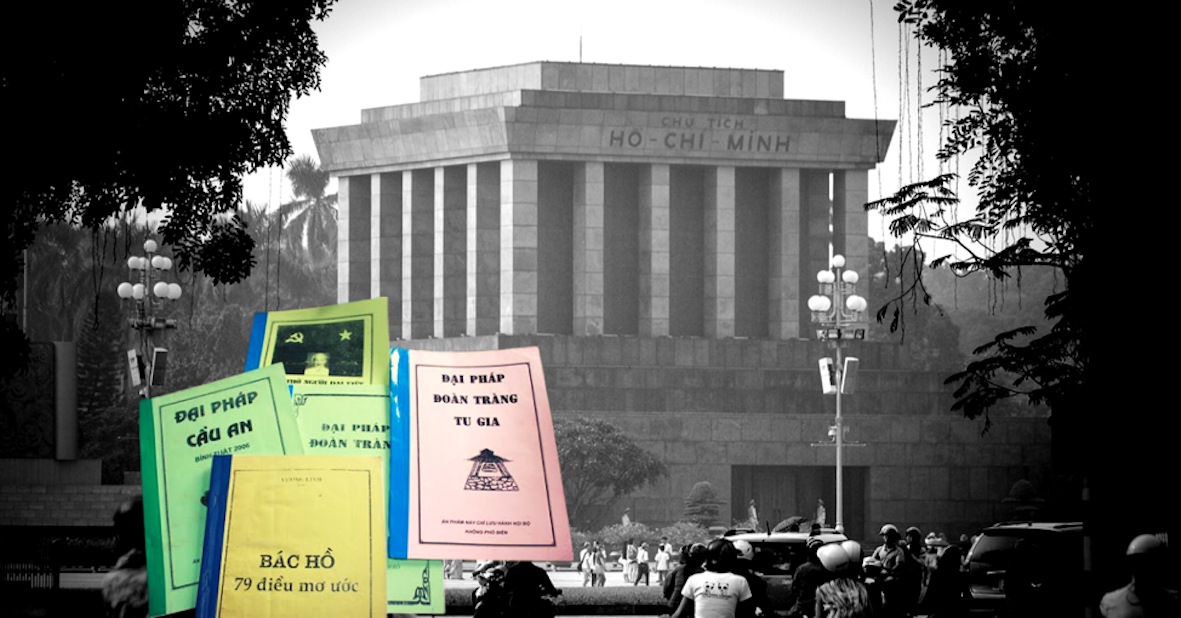
Tag: Ho Chi Minh

  • Ho Chi Minh – From Political Monument To God Of Prayers – Part 2

    Ho Chi Minh – From Political Monument To God Of Prayers – Part 2

    This article was written in Vietnamese by Vo Van Quan and was previously published in the Luat Khoa Magazine on February 1, 2021.


    The religion Way of Uncle Ho aims to start a spiritual revolution in order to save the nation from foreign enemies, both past and present. This revolution also aspires to harmonize the balance between the worlds found in this religion’s metaphysical framework. These worlds include the Heavenly realm, the Buddha’s realm, the Earthly realm, and the Yin realm.

    “A spiritual heavenly revolution.

    Replace the old, change to the new. This religion will bring the people and our country up and we will no longer be slaves of others.

    From now on there will be a new order. By the law of God, by the demand of our ancestors.”

    According to the teachings of this religion, the Heavenly realm rules over the other three realms. However, the blasphemous behavior, attitude, and way of worship in the Earthly realm destabilizes the harmony of the other worlds.

    This religion espouses that, because of Ho Chi Minh’s achievements, the purity of his soul, and his moral conduct on earth, his soul was “elected” to become the leader of the Heavenly Palace upon passing away. Henceforth, he leads the spiritual revolution which claims to promote the right path to reach heaven in the material world.

    https://2xjs7y10oiyz26vqxu2hok6y-wpengine.netdna-ssl.com/wp-content/uploads/2021/02/image-1024x812.jpeg
    Photo: Hochiminh.vn.

    In Chapter 4 of “New Religions and State’s Response to Religious Diversification in Contemporary Vietnam,” the author Hoang Van Chung summarizes the eight issues that this revolution wants to address:

    1. A mistaken understanding of the origins of the Vietnamese people and the their neglect of ancestor worship;

    2. The overuse of joss paper and objects;

    3. The incorrect performance of traditional rituals to the Mother Goddess;

    4. A mistake in dating the death anniversary of Ho Chi Minh;

    5. The invalidity of rituals of spiritual possession;

    6. The pervasive worship of foreign spirits and gods, such as the Indian Buddha, Jesus Christ, and Chinese spiritual figures (Guan Yin or Bodhisattva);

    7. Disrespect for heroic martyrs; and

    8. Making mistakes in medical diagnosis and the treatment of illnesses caused by spiritual entities.

    The religious texts of the Peace Society state:

    “In the twenty-first century

    The first Vietnamese Buddha was born.”

    Monism has since become the motto of Ho Chi Minh’s religion. This religion states that the Vietnamese people can only worship the Vietnamese Buddha: “Uncle Ho.” Worship of any other foreign power also goes against their tenets and beliefs.

    “Do not worship foreign gods

    We worship our own Buddha in our country.”

    Most importantly, Vietnam is seen as the leader of the entire revolutionary process that determines the future of mankind; this demonstrates a somewhat extreme form of nationalism.

    “Vietnam is the eldest son of the Emperor.

    Born first in the Earthly world.”

    If people disobey the Jade Buddha’s commands, natural disasters, epidemics, wars, and social disorder will befall human society. This punishment is therefore not limited to  just one nation or to one group of people, but extends to the entire world.

    What is the Way of Uncle Ho’s religious practice?

    The Ho Chi Minh religion has its own form of exorcism and this practice, in general, is very popular in the north. However, Madam Xoan believed that those who perform this act, if they come from the Mother Goddess religion or other popular sects, would often lose their cognitive abilities. On the contrary, Madam Xoan claimed she was a disciple of the Jade Buddha, so she could hear and preach the voice of the Jade Buddha without losing her reason.

    As for worship, adherents of this religion are guided to worship Ho Chi Minh at home.

    These worshipers have an altar that includes a statue or photo of Ho Chi Minh, the Communist Party’s version of the Vietnamese flag, and a bowl of incense. This altar should also be higher than all other altars in the house. Each day believers are required to offer fresh flowers, cakes, or fruits. Prayer is optional, but burning joss paper and other objects is prohibited. Their holidays also follow the official Vietnamese national holiday calendar which somewhat shows the religion takes a political stance.

    One of the Ho Chi Minh Shrines in Ben Tre. Photo: The Vietnamese.

    With respect to mass religious gatherings, the Peace Society spends most of its time performing activities such as the annual ancestral worship ceremony, which obviously includes Ho Chi Minh and the martyrs. They also provide magic spells and incantations.

    It is also quite interesting to note that the Way of Uncle Ho has a very high anti-Chinese sentiment.

    According to the leaders of the Peace Society, evil spirits are the wandering souls of the Chinese invaders who died years ago. They still haunt Vietnam, harm the people’s health, and negatively influence the future of the nation.

    “Don’t listen to evil spirits. In the past, they were the enemy who deceived us and harmed us.

    They admired evil and always wanted to invade our country.”

    When the Hai Duong 981 drilling rig entered Vietnamese territorial waters in 2014, Madam Xoan and 400 other followers gathered, prayed, and condemned the behavior of the enemy in the north, the Chinese.

    “I pray to Uncle Ho, he will pour out the safe water

    […] So that he could protect our sovereignty over seas and islands

    from being  invaded, in heaven and on earth.”


    Madam Xoan has repeatedly tried to register this religion with the Vietnamese government, but the answer from officials is usually to wait for a decision from their superiors. She is also believed to have close connections with more than 30 figures in the central government, including scientists working in state agencies, ministry officials, and intellectuals interested in studying and learning about this religion.

    According to research estimates, there are believed to be more than 10,000 official followers of the Way of Uncle Ho, and major ceremonies take place with more or less a thousand believers in attendance. This is a significant figure if you consider the fact that other domestic religions are slowly dying.

    In addition, although not officially recognized, the followers of Ho Chi Minh’s religions, such as the Jade Buddha, receive approval from the government, along with the ability to exercise their freedom of religion easier than others.

    However, these were the study’s conclusions up to the time of publication (2017).

    In more recent times, the Way of Uncle Ho as the Jade Buddha has also fallen under the close scrutiny of local authorities. For example, the People’s Public Security newspaper published an article that claimed the Way of Uncle Ho had used Ho Chi Minh’s image with “misguided claims,” such as alleging that it “received Uncle Ho’s blessings” and its leaders offered some medicinal leaves to cure all diseases of the people. The authorities of some provinces, such as Vinh Phuc, also warned that this religion was an act of “illegal” religious activities.

    The Vietnamese government is now in a dilemma. Should it maintain the treatment of Uncle Ho as a well-loved political figure and expect all Vietnamese citizens to continue worshiping his life? Or will the authorities rein in the Way of Uncle Ho and other cults and illegal religions involving Ho Chi Minh, and deal with these religious activities as it has often dealt with other different religions in the country? Only time will tell us how the authoritarian government of Vietnam will act on this issue.

  • Ho Chi Minh – From Political Monument To God Of Prayers – Part 1

    This article was written in Vietnamese by Vo Van Quan and was previously published in the Luat Khoa Magazine on January 31, 2021.


    “The nation of Vietnam will stand forever

    with Jade Buddha – Chí Minh – Ái Quốc”

    (A quote from a 2010 prayer)

    The process of globalization in Vietnam has made major religions such as Buddhism and Christianity overshadow the silent development of local belief systems. However, overlooking them would be a mistake.

    In a certain sense, these domestic religions most accurately and clearly reflect the dynamics of religious beliefs among the masses, and they can also show some of the implications of development in Vietnam’s societal relationships.

    The religion called “Way of Ho Chi Minh as the Jade Buddha” (referred to as the Way of Uncle Ho in this article) is one significant example we can use to learn about how religion is practiced or how it is imbibed by the Vietnamese people. Up till now, there has not been an official study, or even an official government statement, on this strange and peculiar religion.

    In the development framework of the research program “Boundaries of Religious Freedom: Regulating Religion in Diverse Societies,” Dr. Hoang Van Chung gives us a clearer and deeper look at the development of Ho Chi Minh’s religion in Chapter 4 of “New Religions and the State’s Response to Religious Diversification in Contemporary Vietnam.”

    Dr. Chung is currently the head of the Department for Research on Policy and Law on Religion at the Institute for Religious Studies, under the Vietnam Academy of Social Sciences. He obtained his Ph.D. in Sociology from La Trobe University (Australia) in 2014, and was a scholar with the ISEAS-Yusof Ishak Institute (Singapore).

    It is important to note that even though his book was published in 2017, the accompanying data in the study of Ho Chi Minh City was collected from 2011 to 2012. Therefore, there is a gap between the information provided by the author and the present state of this religion.

    Một hình ảnh được cho là điện thờ Hồ Chí Minh của tín đồ đạo Hồ Chí Minh. Ảnh: Blog Tìm tòi và Lượm lặt.
    Ho Chi Minh statue is worshipped at the Ho Chi Minh Shrine. Photo: Search and Gathering Blog.

    How was the “Way of Uncle Ho” formed?

    According to a research by Dr. Chung published in 2016, a Madam Xoan founded the Way of Uncle Ho at the Peace Shrine (now called the Peace Temple) on January 1, 2001.

    Madam Xoan, 73, experienced a miserable childhood in Nam Dinh Province. She lost her mother at a young age, had to live with her father and stepmother, and began working at the age of just 15. She also attempted suicide many times. At the age of 19, she married a notary public and had four children.

    Everything changed when she became seriously ill just before she turned 30. It was reported that Xoan was unconscious and that the pain she felt in one finger was so intense that it had to be completely amputated.

    Meanwhile, doctors could not find the reason for her illness nor determine the cause of the disease. One day while she was waiting to be treated in Hanoi, she heard a strange voice telling her that she was not sick but that this was just a test to see if she was qualified to serve a higher purpose. This voice also affirmed that Mrs. Xoan had spiritual inclinations.

    She immediately quit her factory job and became a humble merchant buying and selling joss paper. During the next 5 years, Mrs. Xoan continued to be guided by this voice and her financial situation gradually improved. By the time she was able to clearly hear and fully communicate with this voice, she gave up her small business to study the supernatural.

    In 1989, Mrs. Xoan heard the voice again commending her for being the first person chosen by the Heavenly Palace to complete her assigned mission.

    From politicians to gods

    Since the 2000s, the stories of individuals who have achieved great success and have become rich for relying on the help of Ho Chi Minh’s Jade Buddha have been compiled by the Peace Society of Heavenly Mediums (the religious leaders of the religion “Way of Uncle Ho”). These stories were then spread among the followers of this belief system.

    For instance, there is also a similar story about an entrepreneur who worked in the construction industry. The story claims that he became very rich because of his obedience to “Uncle Ho.” To show his sincerity, he donated 200 million dong to the Peace Temple. This amount was then used to upgrade and renovate  this place of worship.

    Ho Chi Minh’s image has come a long way in the last century, morphing from a simple politician who was close to the people, to a god capable of interfering in and controlling the lives, happiness, and success of everyone who lives on Earth.

    What happened?

    Tổng Bí thư, Chủ tịch nước Nguyễn Phú Trọng dâng hương cúng bái Chủ tịch Hồ Chí Minh tại Hà Nội năm 2019. Ảnh: TTXVN.
    General Secretary cum State President Nguyen Phu Trong offers incense to worship President Ho Chi Minh in Hanoi in 2019. Photo: VNA.
    Đoàn đại biểu của Đảng Cộng sản Việt Nam và người dân Cao Bằng dâng hương, dâng hoa tại Đền thờ Chủ tịch Hồ Chí Minh tại Cao Bằng. Ảnh: pacbo.vn.
    The delegation of the VCP and the people of Cao Bang offer incense and flowers at the Ho Chi Minh Temple in Cao Bang. Photo: pacbo.vn.

    Clearly, the deification of Ho Chi Minh did not begin with Vietnamese civilians.

    Dr. Chung’s research indicated that numerous other studies have linked Ho Chi Minh’s death with the Vietnam Communist Party’s (VCP) own propaganda campaign. The State has intervened in directing or encouraging the remembrances of Ho Chi Minh. This has turned a mere ritual into the worship of the late leader.

    Dr. Chung also concluded that many other researchers also pointed out that the VCP had a very clear goal of building a cult of personality around Ho Chi Minh. From promoting Uncle Ho’s supposed divine moral qualities to building up various myths about him, the VCP wants to make this version of Ho Chi Minh the formal history.

    However, the most interesting point that Dr. Chung stated was that the VCP only expected to limit this phenomenon about Uncle Ho as a personal cult within the realms of the “ancestor worship” belief model. By doing that, the VCP wanted to connect the history of Vietnam’s national democracy movement and its communist movement, leading it to national success in the future. Once they establish this basis, the VCP, a political conglomerate founded by Uncle Ho, would have solidified more of its legitimacy.

    The author emphasizes that the goals of the VCP and the desires of the masses in worshiping Ho Chi Minh are different.

    The VCP’s model of worship of Ho Chi Minh is considered less religious and less superstitious. Therefore, Dr. Chung asserts that the religions associated with this political leader, such as the Way of Uncle Ho as the Jade Buddha, were “undesirable consequences” of state policy. The government’s efforts regarding the remaking of Ho Chi Minh’s image, if compared to people’s beliefs, are heterogeneous.

    There are a lot of questions for Dr. Chung when he stated this argument.

    It is because in Vietnam, we are seeing a common phenomenon that state agencies regularly promote the worship of Uncle Ho. The government placed Ho Chi Minh statues and photographs in many temples in the north of Vietnam, and offered incense to commemorate Ho Chi Minh during big national holidays, and the like.

    If we follow Dr. Chung’s reasoning and assumption that the state did not want, or at least did not foresee, the formation of a religion centered around Ho Chi Minh, I think his argument is a bit unpersuasive.

    In the context that the Vietnamese economy had just opened up and the practice of worship had just reformed since the 1990s, the nature of the people’s curiosity and experimentation for new religions and beliefs is obviously evident. Therefore, it is fairly certain to foresee that the people will eagerly want to join a new religion like the Way of Uncle Ho as the Jade Buddha if it is offered.

    (To be continued)