In ASEAN, there are still stories of the independent media that will give us inspiration and encouragement. Here are the two examples of those stories.
First story
Two years ago, a tuk-tuk took a group of international journalists along alleys full of twists and turns in Chiang Mai, Thailand, before stopping in front of a private radio station.
Uncle Sangmuang Mangkorn, the colleague and guide, then gave the journalists a tour around the radio station and showed us the facilities of MAP Radio.
MAP stands for the Migrant Assistance Programme, and it is a foundation that runs several community radio stations in support of migrant workers in Chiang Mai and Mae Sot.
Most people have a preconception of radio stations being quite large and full of modern equipment and technology. Yet, the MAP Radio office is far from this ideal. Inside were just two small transmitting rooms and two employees working on a live program. This was all they had.
Warmly referred to as “Uncle” Sangmuang, he and some of his close friends founded MAP Radio in 1966 when an influx of Myanmar migrants came to Chiang Mai to work at construction sites. Myanmar workers frequently got into trouble in Thailand, and they had no avenues available to access information that would be essential for the duration of their stay. MAP Radio operates both as a radio station focusing on labor rights, health, education and an organization to help and campaign for migrant workers. MAP Radio also broadcasts in some of the workers’ mother tongues.
A recording room at MAP Radio – Migrant Assistance Programme. Photo: MAP Radio/Facebook
Second Story
In 2018, Malaysiakini, a 4-language online newspaper in Malaysia, issued a publication concerning deaths in police stations. The paper discovered that only one-fourth of these deaths captured public attention. Hence, the paper created a separate web page to gather information about these deaths, teach basic ways to protect oneself from abuse by authorities, and share the experiences of victims under arrest.
In 2021, Malaysiakini was fined RP $500,000 (more than USD $120,000) by a court in Malaysia on charges that readers’ comments on its website resulted in a decline of public trust in the judiciary system. Immediately after the court’s ruling, Malaysiakini called on its readers to make donations to help it pay the fine. Within a few hours, they had collected more than the amount needed.
Compared to the rest of Southeast Asia and the world, freedom of speech and free press in Vietnam has a quite different fate.
Vietnam: When the government acts as the big boss
In 2018, a Vietnamese activist, Nguyen Ngoc Nhu Quynh, was sentenced to 10 years in prison for collecting information about unexplained deaths in police stations. After spending two years in jail, she was exiled to the United States for political reasons.
Fast forward towards the year 2020, it was a terrible one for the press in Vietnam as mainstream media continued to operate under government control.
Vietnam’s independent press development has taken a step backward during the past two years. We now do not have Bao Sach (The Clean Newspaper) anymore because its founding members have been arrested in late 2020 and early 2021.
Three members of the Independent Journalists Association of Vietnam, journalist Pham Doan Trang, land rights activist Can Thi Theu, and her two sons, together with many others, were also detained in 2020 and 2021. At some of their trials, heavy sentences were handed out.
Vietnam imprisoned all of them for speaking out against abuses by the government and participating in activities that displeased the authorities.
In a few months, Chung Hoang Chuong, the owner of a SIM card shop in Ninh Kieu Town, Can Tho, will complete his 18-month sentence. He was arrested in early 2020 for posting comments concerning the Dong Tam incident. The final post on his Facebook account attracted around 1,400 comments, many of which criticized him for his daring anti-state viewpoints.
The government uses penal charges against people who exercise their right of freedom of speech in Vietnam when it feels that that such speech negatively affects the interests of the Vietnamese Communist Party. In these charges, the authorities always regarded the Party’s interests as the people’s; when the Party’s interests are compromised, so are the people’s.
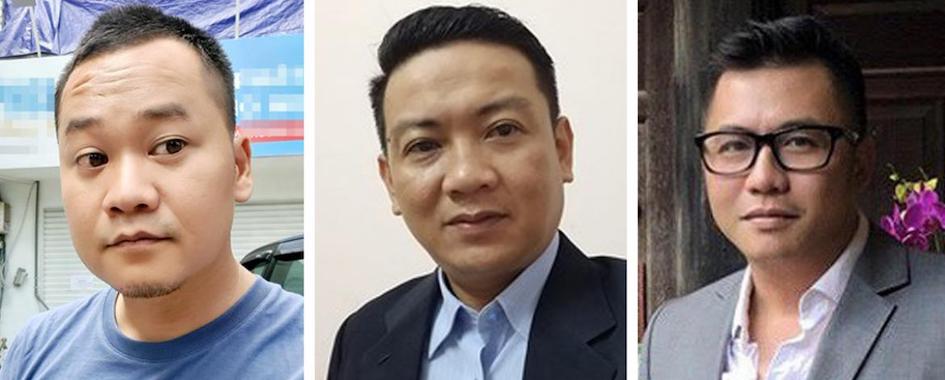
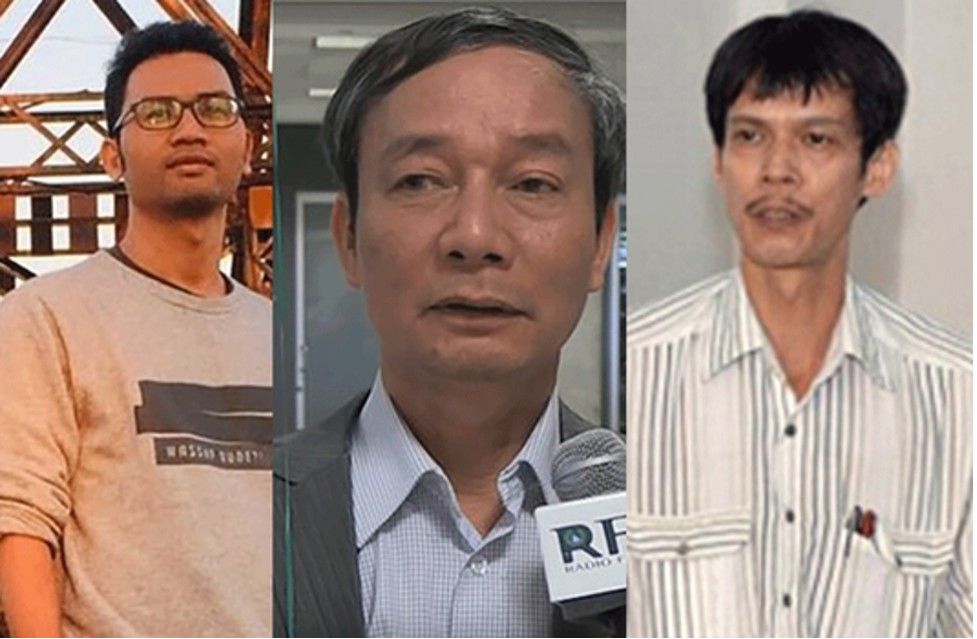
From left, Pham Chi Dung, Nguyen Tuong Thuy, and Le Huu Minh Tuan – three members of the Vietnamese Independent Journalists Association of Vietnam, convicted according to Article 117 of the Penal Code. Photo: Luat Khoa.
The VCP always regurgitates the idea that the people are masters of Vietnam. But in reality, the Party and the government behave like they are the bosses of the people. At a moment’s notice, they are ready to punish a particular civilian if he/she criticizes them. Here, the VCP shows its true colors; party leaders are the true masters of the land and not a government whose primary responsibility is to serve the people.
In a particular business, the owner has the right to punish or dismiss some workers since he holds ownership of the company. However, Vietnam is not owned by the Party; ownership of this land belongs to us, the people.
In Myanmar, the military regime has controlled the country for a long time. Following the transfer to a civilian government, the military, by default, accounts for 25 percent of seats in the National Assembly. Nonetheless, the central and local governments should be run by civilian leaders.
The political system in Vietnam is similar, if not worse, than the situation in Myanmar; replace the term “Myanmar junta” with “one-party regime” to see these similarities. The National Assembly, the courts, the People’s Procuracy, and the central and local authorities are under the control of VCP members. Even in elections, the Party handpicks candidates to ensure the Party’s continued existence and dominance. Such an administration leaves the people with no other option than obedience.
Side effects of controlling the press
Have you ever wondered how one gets daily news and information about Vietnam? He or she may listen to the radio in the morning, reads online papers in the afternoon, and watches TV or follows social media after work in the evening. In Vietnam, except for social media platforms, all other sources of information are controlled by the State.
A civilian reads a Party newspaper in Hanoi. Photo: AFP.
Imagine for a moment that you live in a neighborhood where residents can buy groceries at only one store. Whatever the store is selling will decide what you eat each day. If the commodities are plentiful and diverse, your family can be assured that they will receive proper nutrition. However, if what is being sold is neither nutritious nor varied, you are left with no other choice than to accept what the store has available. In other words, your family’s health and yours depend entirely on what the store owner has for sale.
Now, let’s visualize that there are lots of stores in your neighborhood. In case you dislike what’s available in one, you can go to another instead. Better products will be available to you since competition exists among the stores to provide the best goods and services. They respect your demands because satisfying their customers’ needs means they get more enormous profits.
Controlling the press is similar to allowing people to do their shopping at only one store. For decades, Vietnamese authorities have dictated what people should know and what they should not; they have decided which media outlets are permitted to operate, how they should function, and which types of news are not allowed to be released. This whole mechanism determines what information you can get and how you can obtain it.
Thus, the responsibility falls on an independent press to become the best way for information to reach the people. An ordinary civilian has no time to look into matters that don’t personally affect his or her life. Take, for example, the suspicious construction of toll booths, a stretch of forest cleared and made into a golf course, the sale of counterfeit medicines, corrupt government officials, the misallocation of the national budget, and the troubles in reforming the education system. For all these things to reach the ears of the masses, we need the involvement of the free press. Only when journalists are free from the risk of persecution and imprisonment can they provide this critical information.
Regrettably, each of us has been forced to do our shopping at the only one store for a tremendously long time. Even worse, we dare not speak about our need for information because it is too dangerous. Some of us do not even know what information we need in the first place.
Without proper access to information, the people are robbed of their right to make counter-arguments, and they become increasingly less and less able to make their voices heard. Eventually, they relinquish their own land’s mastership and become puppets of those who hold the strings.
This article was written in Vietnamese by Tan Thanh and was previously published in the Luat Khoa Magazine on April 24, 2021.
“Police in southern Vietnam’s Can Tho City on Tuesday arrested three independent journalists connected with the publishing of articles online last year criticizing toll booths set up under a controversial infrastructure funding program, state media sources said.
Nguyen Thanh Nha, Doan Kien Giang, and Nguyen Phuoc Trung Bao—all writers for the popular Facebook page Clean Newspaper, which discusses Vietnamese social issues—were taken into custody in connection with an investigation into the activities of journalist Truong Chau Huu Danh, who was arrested in December.”
Vietnamese journalist gets eight years for ‘anti-state’ writings
“A court in Vietnam sentenced a journalist to eight years Friday for writing anti-state stories and sharing them on social media, her lawyer told RFA.
The People’s Court in the south-central coastal province of Phu Yen convicted Tran Thi Tuyet Dieu of violating article 117 of the Vietnamese penal code for ‘creating, storing and disseminating information and materials against the Socialist Republic of Vietnam.’”
Vietnamese Facebook user jailed for two years for ‘abusing democratic rights’
“A court in southern Vietnam’s Can Tho City on Thursday sentenced a Facebook user to two years in prison for posting articles and livestream videos criticizing Vietnam’s communist government online, family members and media sources said.
Le Thi Binh, born in 1976, was arrested in December and charged with ‘abusing the rights to freedom and democracy to threaten the interests of the state’ under Article 331 of Vietnam’s 2015 Penal Code. Her elder brother, Le Minh The, had completed a two-year jail term on the same charge in July.”
International Commission of Jurists (ICJ) filed new submission to the UN, detailing the government’s use of laws to suppress freedom of expression
“The ICJ highlighted in particular how new laws have been enacted in response to the COVID-19 pandemic that aim at or can be used by State authorities to control information about the pandemic. These laws contain provisions incompatible with human rights law and standards as their vague language makes them prone to abuses. In addition, some prescribe excessive sanctions, including severe criminal penalties, which are incompatible with the principles of necessity and proportionality.”
PM wraps up working trip to attend ASEAN Leaders’ Meeting (April 25): “On the Myanmar situation, Chinh affirmed that Vietnam, as a non-permanent member of the UN Security Council for 2020-2021. and the Council’s president for April 2021, has worked to create favorable conditions for the ASEAN member nations to collaborate closely at UN forums in mobilizing support for the bloc’s efforts in approaching and finding suitable solutions to the Myanmar issue.”
Vietnamese President chairs UNSC’s high-level open debate (April 19): “In his capacity as President of the United Nations Security Council in April 2021, Vietnamese President Nguyen Xuan Phuc on April 19 chaired a High-level Open Debate on ‘Cooperation between the UN and regional organizations in enhancing confidence-building and dialogue in conflict prevention and resolution’, which was held in both online and in-person formats.”
Japan targets Vietnam for first ASEAN oil-sharing deal(April 21): “The deal is part of Japan’s attempt to build oil-sharing arrangements with Associations of Southeast Asian Nations members. Under one proposal, each participant would build up individual reserves of crude oil, along with gasoline, diesel fuel and other petroleum products, to prepare for disruptions in supplies.”
A busy week of the South China Sea issue, too
Vietnamese, Chinese defence ministers hold talks in Hanoi(April 25): “ Both sides agreed that the year of 2020 witnessed complicated developments in the world and regional situation with great risks of instability, creating new challenges to the trend of peace, cooperation and development and greatly impacting the security and development environment of all countries.”
Vietnam building up its maritime militia (April 25): “Vietnam is building up its maritime militia in the South China Sea in an apparent challenge to Chinese efforts to dominate the disputed waterway, according to a Chinese military magazine.”
Indonesia, Vietnam renew calls to finish EEZ negotiations (April 25): “Indonesia and Vietnam have renewed calls to finish ongoing negotiations on the delimitation of the maritime boundary between their exclusive economic zones (EEZ) near the South China Sea to provide clarity and avoid incidents in the waters.”
Japanese destroyer in Vietnam on friendly visit (April 20): “The visit is part of efforts to boost defense and security cooperation between Vietnam and Japan and maintain the countries’ strategic partnership, officials said.”
On April 7, 2021, Reporters Without Borders (RSF) released a press statement condemning the arrest of jailed Vietnamese journalist Pham Doan Trang.
Phan Doan Trang, co-founder and editor of the online magazines The Vietnamese and Luât Khoa, and a recipient of the 2019 RSF Press Freedom Prize for Impact, was arrested at her home on the night of October 6, 2020. She was taken away by plainclothes policemen and has not been heard from since She has been denied access to a lawyer and her family has also been unable to contact her. Currently, she faces up to 20 years in prison under Article 117 of the Vietnamese Penal Code, under the charge of engaging in “anti-state propaganda”.
Daniel Bastard, the head of RSF’s Asia-Pacific desk, says: “The Vietnamese Communist Party’s current leadership… needs to understand that history will hold them to account for the crackdown on press freedom …. They can save face by freeing Pham Doan Trang and all of the other unjustly detained journalists.”
This is not the first time RSF has demanded her release. On October 7, 2020, just one day after her arrest, it published its first statement which echoes much of the same sentiments here. It has also launched an international awareness campaign to fight for her cause.
Support from Other RSF Laureates
Several other RSF awardees have called for Phan Doan Trang’s immediate and unconditional release. They have also released several videos in various social media outlets to show their support for her, and to help bring this situation to the attention of the international community.
Tomasz Piatek, a Polish journalist and an RSF prize recipient in 2017, addressed Vietnam’s leaders:, “I am asking you to release my friend from prison immediately and stop harassing and tormenting her for writing the truth. If you want to present yourself to the world as politicians and leaders of the Socialist Republic of Vietnam, you must immediately stop harassing your citizens and give your citizens the right to the truth.”
Swati Chaturvedi, an Indian journalist and Reporters Without Borders prize awardee in 2018, said, “RSF stands for the fight of all journalists. Please help and speak out for my colleague, my Vietnamese colleague Pham Doan Trang right now.”
Can Dündar, a Turkish journalist, documentary filmmaker and 2016 RSF laureate, similarly asked that the Vietnamese authorities release Phan Doan Trang and to respect the freedom of the media.
Inday Espina-Varona, a Filipina journalist and awardee of RSF’s Prize for Independence in 2018, stated that Pham Doan Trang “has been charged with disseminating information that opposed the state of Vietnam… [it is] every journalist and citizen’s obligation to criticise and when necessary to oppose policies and actions inimical to the welfare and rights of people… it is also the duty of journalists and citizens wherever we are in the world to stand up when those who seek to do the right thing are battered for their efforts.”
Statement from the Publication:
The Vietnamese joins Reporters Without Borders and our other international allies in demanding for the expedient release of Pham Doan Trang. The trumped-up charges against her are clearly false and the only thing she is guilty of is providing Vietnamese citizens with accurate and independent information free from the manipulation and misdirection of the Vietnamese government and its selfish misguided agenda.
The fight for freedom, democracy, and a better tomorrow for Vietnam continues and we at The Vietnamese will do our part to see this through till the end.
To show your support for this cause, kindly consider signing this petition for the swift release of our co-founder, colleague, and friend.
“I believe my life is firmly tied to the nation’s.”
For at least the past 12 years, Pham Doan Trang has been one of the most prominent names in Vietnamese politics, and her arrest on October 6, 2020, has her staring down 20 years in prison.
So, who is Pham Doan Trang?
Pham Doan Trang
Birth name: Pham Thi Doan Trang Birthdate: May 27, 1978 Birthplace: Hanoi Profession: Democracy activist, journalist Location: Currently being held in Temporary Detention Camp #1, Alley 702, Phuc Dien Ward, Nam Tu Liem District, Hanoi. Quotations without citations are taken from writings on Doan Trang’s blog: phamdoantrang.com.
Growing up with the music of the Beatles
Hanoi youth in the 1970s. Photo: ngoisao.net.
Pham Doan Trang is the youngest child in a family of teachers. Her grandparents taught history and math at Hang Ken School, and her mother and father were also teachers. During the subsidy period, Doan Trang grew up in a poor residential area in southern Hanoi. Shewrote about her childhood in her blog:
Like many other children, I was scared of ghosts. This fear only grew when we had to sleep amidst blackouts so dark we couldn’t see our own fingers. Looking out the window, the alleyways were pitch black. There was a burned-out house whose gray walls were charred black. The owner of the house had died in a fire long ago, and no one lived there anymore. There was another house in which the husband and wife died in an accident, and the children lived with the grandparents; no one dared go there either.
In 2nd grade, a neighbor’s cassette player strongly stirred little Doan Trang’s curiosity as it played Beatles’ songs one after the other. Her soul was set aflutter with these hits. From that point on, she began studying English so she could sing Beatles songs.
“In 7th grade, I began struggling with my neighbor’s cassette player to listen to and transcribe the songs where I tried my best to record the lyrics,” she said. “I started borrowing my friends’ personal songbooks where they had the lyrics written out to transcribe the Beatles songs, complete with incorrect English spellings and spotty grammar…. I grew up with the music of the Beatles”.
In college
Doan Trang during her freshman year at Hanoi Foreign Trade University in 1996. Photo: Pham Doan Trang’s Facebook profile.
From 1996-2000, Doan Trang studied at Hanoi Foreign Trade University, majoring in international economics. It was during this time that she and her classmates first connected to the internet. In her blog, she described her college years in Vietnam:
Back then, the internet was only barely establishing itself in Vietnam, and students were quite shy and cautious when surfing online…. We didn’t have books, but we could already see the events in reality were not really accurately described in those books anyway. Moreover, who would let the students just willy-nilly visit the companies and large organizations to find out the truth…. Because of that, students of my time especially focused on studying the one resource that was most useful: online economic articles, either written or translated by journalists. Countless generations of economics students got their education through these articles.
Baby steps towards journalism
Doan Trang interviewing Ms. Hoang Thi Minh Ho (1914-2017), wife of businessman Trinh Van Bo, in 2010. Photo: Pham Doan Trang’s Facebook profile.
In the winter of 2000, after graduating from university, Doan Trang began a stint at the e-newspaper VnExpress, which had just been established. She wrote about that time in her blog:
I remember fondly the winter of 2000, those days and months when I was just starting out in journalism. Sometimes when I think back, I picture myself as a child, dazed and naïve, scared of everything and everyone. I was scared of many things, but most of all, I was scared of miswriting.
After a period of time as newsroom secretary at VnExpress, Doan Trang switched over to television at the digital TV channel VTC (Vietnam Television Corporation).
During her journalism career, Doan Trang has stated that with the exception of sports, she wrote about all sorts of topics—including those which couldn’t be published in the media.
“Trang the Ridiculous”
Doan Trang’s blog. Photo: screenshot.
In August 2006, Doan Trang established her blog phamdoantrang.org, which helped her connect with friends in and outside the country, as well as providing her with a platform with which to write about things that could not be published in the media. The blog remains to this day.
When writing her blog, she used the name “Trang the Ridiculous”.
“I started my blog … originally and purely as a means to practice writing in English,” she wrote. “As such, you can see right away that Trang the Ridiculous’ blog became a gathering place for the ridiculous and the recalcitrant.”
After a number of years, Doan Trang’s blog moved beyond its original purpose.
Sympathizing with the weak
One of the many things that haunted Doan Trang was the fate of the weak around her.
When I was young and living with my parents in a poor neighborhood in southern Hanoi, I remember the women who shouted to themselves, hoarse out of fear and hopelessness, “my child, oh my child….” I remember the tired faces of those struggling to survive, working countless jobs with no names: pedaling cyclos and bicycles, repairing shoes, carving chopsticks, etc. I remember asking myself why so many people around me died young; I once asked my friend, why is human life here worth so little, and he responded: “Whose life? You think your life is worth something?”
“If I had the power to change anything in Vietnam,” she wrote, “I would say that the country lacks an environment where human beings are respected.”
Speaking up is tied to the nation
Journalist Pham Doan Trang when she was working for state newspapers. Photo: Tuoi Tre Online.
Doan Trang once wrote on her blog that life would be so much easier if we closed our eyes to the suffering around us.
She has said that the first reason most people don’t say what they think is innate fear, fear of being blamed, fear of responsibility, fear of isolation. The second reason is, perhaps, that people are not perceptive enough to see the problem or their self-interest in the problem. Even worse, they may only see the penalty in speaking up, believing that speaking up won’t change anything anyway; maybe they feel that the problem is not even relevant to them.
I’ve worked in a number of organizations, and I recognize that people will speak up, and only speak up, when they see themselves as part of the organization. People only strongly attach themselves to the nation when they feel they have shared visions for the future; only then will they feel inspired to turn these visions into reality.
Quitting VTC Television
In March 2007, Doan Trang announced that she would step down from VTC and move to the e-newspaper VietNamNet.
I was like many of us: obsessed with working in television, to the point of madness. I brought (just a portion of) the flame I had from when I was 12 or13 and 19 or 20 to my time working as a visual journalist at VietNamNet TV. I was fortunate that I didn’t pour my whole self into it, otherwise I would have lost even more than I did those 10 years. One day, the pragmatic voice inside of me cried out: “Trang, is it worth it?”.
Mobilizing for LGBT rights
The cover of Bóng – a biography of LGBT figure Nguyen Van Dung, written by authors Hoang Nguyen and Doan Trang. Photo: Global Span (“Nhịp Cầu Thế Giới”).
In 2007, a man named Nguyen Van Dung recounted his life and the LGBT world he inhabited in a trailblazing book called Glass – Biography of a Gay Man, authored by Doan Trang and Hoang Nguyen.
The biography shook society, revealing for the first time the world of LGBT in Vietnam.
Nguyen Van Dung became a popular figure and one of Doan Trang’s friends, and the book, which was used to mobilize for LGBT rights, became a bestseller.
Working as a state journalist
Doan Trang worked for the e-newspaper VietNamNet when Nguyen Anh Tuan was still editor-in-chief. Photo: thongtincongnghe.com.
In 2008-2009, Doan Trang became the first Vietnamese journalist to write an in-depth analysis on Sino-Vietnamese relations. The articles resonated strongly among Vietnamees when they appeared in Vietnam Weekly, a specialty page of VietNamNet.
Prior to that, at the end of 2007, bloggers in Hanoi and Ho Chi Minh City organized ground-breaking protests to oppose China’s establishment of Tam Sa (Sansha) City, an island in the disputed area of the sea, which Vietnam also claims sovereignty over.
In 2007, Doan Trang wrote extensively about her experiences as a journalist in Vietnam.
I like being around those who are different from me, especially those who are quirky or even eccentric. I crave novelty. So, I rarely regret spending too much time or energy on work. I don’t think you can excel at something if you don’t love it. And if you love it and you do it well, in turn, it will change you in positive ways. Obviously, [overworking] can still ruin your life, but unhappiness can spring even from one’s happiness.
However, never will I be an effective journalist if I feel unhappiness weighing down on my heart.
If you’re a Vietnamese journalist, you’ll have many more reasons to feel sad. Whether this sadness is worthwhile depends on you. But if you sincerely want peace, perhaps you shouldn’t become a journalist.
Detained for nine days
Journalist Doan Trang in 2009. Photo: Pham Doan Trang’s Facebook profile.
In 2009, an unexpected event caused Doan Trang’s life to veer in a different direction.
On August 27, 2009, blogger Wind Trader, whose real name is Bui Thanh Hieu, was arrested. The next day, Doan Trang was also arrested, and then blogger Mother Mushroom, whose real name is Nguyen Ngoc Nhu Quynh, was arrested a few days after that.
Police stated that all three individuals had infringed upon national security by printing t-shirts opposing the establishment of bauxite mines in the Central Highlands.
All three individuals were released one after the other after nine days in detention. At the time, Doan Trang was a reporter for Vietnam Weekly (VietnamNet). She wrote about her detention in her blog:
Among the three bloggers, I was perhaps the most ‘unjustly’ arrested; I didn’t participate in the t-shirt printing at all, had never laid eyes on the shirts, or even been consulted about them. Now, when I occasionally think back to that event, it’s of one sad thought: I didn’t even get to wear my shirt, not even once….
Fired by VietnamNet
Doan Trang during an award ceremony held by the publication Ho Chi Minh City Law. Photo: Pham Doan Trang’s Facebook profile.
After her arrest and detention in 2009, Doan Trang was fired by VietnamNet; no reason was given.
During the dark, depressing winter days of 2009, [Professor Dang Phong] remained one of three individuals who helped me keep the flame alive. I couldn’t give in to their rottenness. I couldn’t.
During the dark, depressing winter days of 2009, [Professor Dang Phong] remained one of three individuals who helped me keep the flame alive. I couldn’t give in to their rottenness. I couldn’t.
After that upheaval, Doan Trang went to work for the Ho Chi Minh City Law newspaper.
I was lucky to cross paths with Ho Chi Minh City Law newspaper during those difficult days, when the lingering effects of my time in detention remained serious, when I lived under constant suspicion and when I myself couldn’t trust anyone.
“A history of Vietnamese blogs”
Doan Trang in a protest against Chinese antagonism on June 5t, 2011. Photo: Lan Thang.
In June 2012, Doan Trang released “A History of Vietnamese Blogs” on her personal blog to mark the 7th anniversary of Yahoo! 360°’s arrival in Vietnam. Yahoo! 360° opened up a world of information for Vietnamese citizens. It became the online literary movement and provided social and political commentaries.
In addition to working for Ho Chi Minh City Law newspaper, Doan Trang also wrote articles for other publications, including Tia Sang (Ray of Light), Nhip Cau The Gioi (Global Span – a Vietnamese newspaper in Hungary), and a number of other publications.
During this period, Doan Trang continued to write in-depth analyses on Sino-Vietnamese relations. She was the first journalist in Vietnam to write about the Vietnam-China dispute over the South China Sea, which was a very politically sensitive issue in the country that the government just started to lift up its censorship in the past five years.
On the morning of August 5, 2012, Doan Trang was arrested when she participated in an anti-China protest in Hanoi. This arrest led Doan Trang to become more involved with human rights activities and began her works as a Human Rights Defender in Vietnam.
Pham Doan Trang became a Human Rights Defender
In 2012, Doan Trang became one of the first Vietnamese journalists to report on human rights violations occurring inside the country to the outside world.
That same year, Scrap Paper (Giay Vun) Publishing House published Doan Trang’s book And the Fourth Power, as well as a number of other works of which she was co-author, including The F Generation. In the same year, Knowledge Publishing House published Vietnam and the East SeaDispute, which Doan Trang co-authored.
In March 2013, as the Vietnamese government was seeking citizen feedback on its new draft of the Constitution, Doan Trang began writing a series of articles called What I Tell Myself and Others, which sought to disseminate basic knowledge about politics and human rights where she wrote:
Isn’t this an amazing opportunity for us to learn about our Constitution, the law, constitutionality, human rights and citizens’ rights…? This writer asks for even more: this is an occasion to push all of us Vietnamese citizens, especially young people, to try caring about politics a bit more. How about it?
Moving away from state journalism
Doan Trang during a 2012 press conference held by state-owned Oil and Gas Group regarding East Sea issues. Photo: Pham Doan Trang’s Facebook profile.
In 2013, Doan Trang announced that she was leaving Ho Chi Minh City Law. By this point, she had worked for more than 10 different state media outlets. She then made the decision to go overseas and participate in international advocacy.
The next year, Doan Trang traveled to the United States at the invitation of Villa Aurora, a prestigious artists’ residence, and the University of Southern California.
Human rights advocacy for Vietnam
Doan Trang and a number of other activists in front of the UN Headquarters in New York, January 24, 2014. Photo: Doan Trang’s blog.
From the end of 2013, Doan Trang embarked on many trips to the United States, Europe, and Thailand to advocate for human rights in Vietnam. In particular, Doan Trang was part of a delegation of civil society advocates during a number of international events, including the Universal Periodic Review session on human rights at the UN in February 2014 and the Canadian Senate hearings on human rights in Vietnam in April 2014.
Co-founding Luat Khoa Magazine
Three of the four co-founders of Luat Khoa Magazine. Photo: liv.ngo.
On November 5, 2014, readers first laid eyes on Luat Khoa Magazine, a publication dedicated to law, politics, and human rights and founded by Doan Trang and a number of others.
In her blog, she introduced Luat Khoa:
I understand the fear of not knowing anything about the law, of not knowing even where to begin to escape that immense jungle. I understand how overwhelming these things can be, and I know (in part) what it’s like to be involved in matters related to “courts” with a voice too weak to have any say, not knowing what to do or who to believe, never mind using the law to defend oneself….
Broadly speaking, discovering the law and studying jurisprudence are the first steps on the road to building a state governed by rule of law.
Police retaliation upon returning home
Doan Trang in a meeting with US senators visiting Vietnam in May 2015. Photo: Pham Doan Trang’s Facebook profile.
On January 26, 2015, Doan Trang returned to Vietnam. She was detained at the airport for 15 hours and was closely monitored after returning home. Afterwards, she was arbitrarily arrested by police when she served as a translator for the families of death row inmates Ho Duy Hai and Nguyen Van Chuong in an advocacy meeting with the New Zealand Embassy in Hanoi.
Two weeks after she returned to Vietnam, police disseminated explicit pictures of Doan Trang taken from her computer, which they had confiscated six years earlier.
In March 2015, police poured glue into the locks of Doan Trang’s home, preventing her from attending a meeting at the German Embassy in Hanoi.
Assaulted by police during protests against felling trees in Hanoi
Doan Trang, carrying a backpack, was dragged by police during protests on April 26h, 2015. Photo: Phan Tat Thanh.
On the morning of April 26, 2015, the group For a Green Hanoi organized a march to prevent the Hanoi authorities from cutting down trees in the city. During the protest, police strong-armed Doan Trang and many other protestors onto buses. Doan Trang recalled the incident:
After the march was disrupted on Sunday, when everyone was gathered in front of the Long Bien district police station, Mr. La Viet Dung checked in on me: “You were dragged over a manhole this morning, weren’t you?” he asked.
I remember I was lost in the middle of the crowd, images rushing past in a blur, but I recall seeing a stretch of green sky and a sea of undulating faces, young and old, of both the citizens and police.
Demanding the release of individuals at the police station
Doan Trang together with activists Dinh Thao and Luu Van Minh on the night of September 23, 2015. Photo: Le Anh Hung.
Doan Trang participated in many attempts to free those arbitrarily held at police stations.
On the night of September 23, 2015, six young individuals of the channel Conscience TV were arbitrarily detained. That same day, Doan Trang and other activists arrived at the Hai Ba Trung District police station in Hanoi to demand their release. She and others organized a small protest in front of the station, where they were assaulted by the police.In December 2015, Doan Trang uploaded “Timeline of the capital’s tree-felling ‘campaign’” in both English and Vietnamese on her blog.
Arrested on the way to meet President Barack Obama
In May 2016, Doan Trang took a car from Saigon – where she had just undergone knee surgery – to Hanoi to meet American president Barack Obama. However, she was apprehended by police several hours south of Hanoi and held for 26 hours in Ninh Binh Province.
After being arbitrarily detained in Ninh Binh, she returned to Saigon and continued to be harassed by police at a friend’s residence where she was staying.
From this point onwards, up until her most recent arrest, Doan Trang was repeatedly harassed by police in all sorts of ways. Anytime a diplomatic delegation came to Hanoi, she would be put under house arrest for many weeks prior to its arrival.
Resumption of book and report writing on the environment, politics, and human rights
Doan Trang along with Ms. Le Thi Minh Ha, wife of blogger Nguyen Huu Vinh, during the release of Anh Ba Sam on March 23, 2016 in Hanoi. Photo: JB Nguyen Huu Vinh.
In 2016, Doan Trang participated in writing and editing the bilingual (English-Vietnamese) book Anh Ba Sam, about blogger Anh Ba Sam, whose real name is Nguyen Huu Vinh. The book was released on Amazon a week before Mr. Vinh’s preliminary trial in March 2016.
Beginning in February 2016, as the Vietnamese government was organizing elections for representatives of the National Assembly’s 14th term and of the People’s Councils at all levels, Doan Trang wrote a good deal about the processes on her blog.
The book Overview of Vietnam’s Marine Environmental Disaster. Photo: Liberal Publishing House.
In October 2016, the group Green Trees published the book Overview of Vietnam’s Marine Environmental Disasteron Amazon, with Doan Trang and other activists as co-authors. The book laid out the timeline of events during and after Hung Nghiep Formosa Ha Tinh’s polluting of beaches in mid-2016. Also in the same year, the book From Facebook Down to the Streets was published on Amazon.
Supporting other activists
Doan Trang standing with crutches to the right of Green Trees group members in a photo taken in 2016. Photo: Anh Ba Sam.
Few outsiders know that Doan Trang is more than just an activist; she also guides young people on how to become activists themselves. For these young people, she is a rare kind of teacher, imparting on them knowledge and skills that they can’t learn anywhere else.
The days writing Politics for the Common People
Doan Trang in 2017. Photo: Thinh Nguyen.
In 2017, Doan Trang wrote Politics for the Common People while she was under house arrest in Hanoi. In July 2017, she left Hanoi for Saigon in order to evade police harassment.
On September 22, 2017, Politics for the Common People was published by Scrap Paper Publishing House and Green Trees. The book aimed to spread basic political knowledge to everyday people, especially the young involved in social and human rights activism.
Cover of Politics for the Common People. Photo: Liberal Publishing House.
I wrote [Politics for the Common People] while under tight police supervision in Hanoi; I couldn’t do anything or go anywhere. I felt like I couldn’t breathe—literally…. Meanwhile, in some other location, their boss, sitting in an air-conditioned room, directed them to closely follow the ‘suspect’, research the suspect’s habits, her daily routine, her path to and from home, and how items are arranged in her house….
If I didn’t have my guitar by my side, I probably would’ve gone insane…. But, to me, all of that isn’t important; what’s important is that people read the book. The more people that read it, the better.
In 2017 and 2018, Doan Trang stated that at least 300 copies of Politics for the Common People were confiscated by Danang police as they were being transported from Poland to Vietnam.
Link to purchase the book: Amazon (print), Smashwords (digital).
Receiving the Homo Homini Award
Doan Trang in a documentary film shown at the Homo Homini Award ceremony in Prague, Czech Republic. Photo: People In Need.
In February 2018, People In Need, an internationally-renowned non-profit organization based in the Czech Republic, bestowed upon Doan Trang the Homo Homini Award, given annually to honor valiant political and human rights activists and journalists across the world. Doan Trang was unable to leave Vietnam to receive the award.
Days of horror
Photo: People In Need.
In February 2018, Doan Trang was kidnapped by police and interrogated about Politics for the Common People;upon returning home to Hanoi to celebrate the Lunar New Year with her family, she was put under house arrest.
At the beginning of March, police continued to hold her captive as she tried to find ways to escape Hanoi. Ultimately, Doan Trang was able to escape to Saigon, but her health was quite frail.
One day at the end of May, Doan Trang returned to Hanoi. As soon as she stepped off the bus in Hanoi, police were waiting for her. She was forced to resume house arrest because the authorities were afraid she would “instigate” the masses to protest two bills: the SEZ Law and the Cybersecurity Law.
With the help of friends and readers, Doan Trang escaped the Hanoi police one more time, traveling to Saigon. During this escape, she seriously injured her hands climbing over high walls, which she did in spite of her aching knees.
The next book
From left: Nguyen Anh Tuan, Pham Doan Trang, and Trinh Huu Long. Photo: Luat Khoa Magazine.
In June 2018, when protests against the two proposed laws broke out, Doan Trang joined hands with jurist Trinh Huu Long and activist Nguyen Anh Tuan to write Studying Public Policy through the Case of SEZs. In mid-December 2018, the book was published by Luat Khoa Magazine.
Admitted to the hospital after a brutal police assault
Doan Trang was admitted to the hospital after police broke up singer Nguyen Tin’s concert. Photo: Pham Doan Trang.
On August 15, 2018, Doan Trang was assaulted by plainclothes police while attending an evening concert by singer Nguyen Tin. The concert was broken up by police, who interrogated and beat both organizers and attendees.
Doan Trang recounted how six plainclothes police officers beat her with a motorcycle helmet and some custom-made weapons. Police confiscated her computer and I.D. documents during the event.
The next day, she was admitted to the hospital suffering a concussion. At the hospital, police kept an eye on her as though she were a criminal; no friends or readers were allowed to speak with her. She was bedridden for the next three weeks.
Only later did Doan Trang learn that the concert was disrupted by police because they suspected Doan Trang was going to use the event to distribute Politics for the Common People and other “anti-state” materials.
Homeless
Doan Trang’s living situation became increasingly precarious as she no longer had her identification papers and police scoured for her everywhere. Vietnam’s tenant registration system effectively worked to make life difficult for an independent journalist like her. She believes that police even forced her neighbors in Hanoi to sign pledges to immediately report her if they saw her.
In January 2019, Loc Hung Garden – where Doan Trang was living – was torn down by the authorities. From then on, half her time and energy was spent trying to find a place to live while on the run from police and while her hands and feet were seriously injured. Doan Trang was unable to walk more than a few hundred meters and could not ride a motorcycle.
Injured and exhausted, Doan Trang felt her journalism career was coming to a close in the face of relentless government pursuit.
Unable to live a normal life
Doan Trang and saxophonist Dang Vu Luong in Ky Anh District, Ha Tinh Province, March 2017. Photo: Pham Doan Trang’s Facebook profile.
For more than three years beginning in July 2017, Doan Trang lived in at least 60 different locations across Vietnam. She traveled for over three years on a pair of injured legs, weighed down by a pervasive fear, while being constantly beaten, assaulted, and beleaguered by police. She described her life in her blog:
Working as an independent journalist and author under a totalitarian regime means that you can be arrested and interrogated, even assaulted, at any time without any way to protect yourself and unable to freely move around the country….
One could also be placed under house arrest or become essentially homeless. You can’t go out and enjoy yourself or even walk down the street because someone could be following you, or even worse, a complete stranger could suddenly attack you from behind.
Your family is closely monitored, and police might make trouble for your friends and supporters .… You have to live with the perpetual feeling that you are an enemy of the state, deserving of punishment ….
You certainly won’t die, because they have no intention of killing you. But you can no longer live normally like other people or like you had before. Misery, depression, and mental breakdowns will all pile on to wreak havoc and slowly kill you.
Receiving the Press Freedom Award from Reporters Without Borders
Doan Trang received the Reporters Without Borders Press Freedom Award, September 12, 2019. Photo: Trinh Huu Long / Luat Khoa Magazine.
On September 12, 2019, Reporters Without Borders awarded Doan Trang the 2019 Press Freedom Award Prize for Impact.
Responding to BBC Vietnamese, Doan Trang spoke of her wishes after receiving the prize:
I hope that in the near future, more people in Vietnam will continue to strongly speak up, to express their views and political opinions on social and political matters.
I especially hope for the appearance of more writers, more independent journalists, more professional bloggers, and even more state journalists, who will participate in democratizing society through the media.”
Unable to live and unable to write
Doan Trang with musician Tuan Khanh and activist Pham Thanh Nghien. Photo: Tuan Khanh’s Facebook profile.
In her most trying days, Doan Trang was neither able to live nor to write.
In February 2019, she founded and became an editor for Liberal Publishing House.
In July 2020, Doan Trang and a number of translators announced that they would publish the book Fighting Impunity, translated from a work by Safeguard Defenders providing instructions on how to use Magnitsky Laws to sanction human rights violators. In addition, Liberal Publishing House also produced other works on human rights, politics, and democracy.
After Liberal Publishing House released a number of books and reports, police sought to disrupt its activities by any means possible. Many book distributors and recipients were followed, threatened, and assaulted by the authorities.
Report on the Dong Tam Village Incident
The cover of Fighting over Senh Field: A Report on the Dong Tam Village Attack. Photo: Liberal Publishing House.
In February 2020, a month after riot police shot at Dong Tam villagers in the middle of the night, Liberal Publishing House published a bilingual (English-Vietnamese) work called Fighting over Senh Field: A Report on the Dong Tam Village Attack.
Fighting over Senh Field had five authors, including: Doan Trang, activist Will Nguyen, and activists Can Thi Theu and her two sons Trinh Ba Phuong and Trinh Ba Tu. Ms. Theu and her two sons were arrested before the preliminary trial for murder and obstruction of officials in Dong Tam.
IPA honors Liberal Publishing House
Doan Trang in a documentary shown during her acceptance of the Prix Voltaire 2020 award. Photo: screenshot.
At the beginning of June 2020, the International Publishers Association (IPA), the world’s largest association of publishers, awarded Liberal Publishing House the Prix Voltaire 2020 Award. The award is given to publishing organizations around the world that best embody IPA’s spirit of independent publishing.
At the beginning of July 2020, Doan Trang announced her withdrawal from Liberal Publishing House, citing her “ailing health” and “security threats to members of LPH”.
A few weeks later, Liberal Publishing House became embroiled in a scandal after Doan Trang publicly accused a high-level manager in the organization of corruption. The spat dragged on, with the other side claiming that Doan Trang’s accusations were false. The matter remains to be settled, but the person whom Doan Trang accused also withdrew from Liberal Publishing House.
Arrested after the third report on Dong Tam
Ho Chi Minh City police lead Doan Trang from her home late on the night of October 6, 2020. Photo: Pham Doan Trang’s Facebook profile.
At 11:30 pm on the night of October 6, 2020, Ho Chi Minh City Police arrested Doan Trang, and extradited her to Hanoi the following day.
Police charged her with “propaganda against the state” as stipulated in Article 88 of the 1999 Penal Code and “making, storing, or distributing information, materials, and items to oppose the State” as stipulated in Article 117 of the 2015 Penal Code.
Police arrested Doan Trang on the very day Vietnam and the United States held their annual human rights dialogue, detaining her shortly after the event ended.
Doan Trang in a documentary about Liberal Publishing House, shown at the Frankfurt Book Fair. Photo: Screenshot/IPA.
Shortly before her arrest, Doan Trang and Will Nguyen had announced the release of the 3rd edition of the Dong Tam Report, in both English and Vietnamese.
Doan Trang introduced the report on Facebook: “On September 25, we released the 3rd and most complete edition of the Dong Tam Report to readers. It is bilingual and twice as thick as the February edition. Strangely, I was also able to break my own personal record: I lost 7 kg of body weight.”
Doan Trang’s arrest occurred before she was able to participate in a live discussion at the world’s most prestigious event for publishers – Frankfurt Bookfair – from October 14-18, 2020. In September 2020, IPA announced on its website that Doan Trang would be attending the event.
International response to her arrest
The Vietnamese government’s arrest and indictment of journalist Pham Doan Trang sparked a sweeping international backlash.
After her arrest, the Czech Republic’s foreign minister Tomáš Petříček recalled on his Twitter and Facebook accounts that Doan Trang had been bestowed the Homo Homini Award for her bravery and contributions to protecting human rights.
US Assistant Secretary of State for Democracy, Human Rights, and Labor, Robert A. Destro, wrote on Twitter that the United States condemned the arrest of activist Pham Doan Trang and called for her immediate release.
Doan Trang probably didn’t want to be detained, but she knew she would be arrested and sentenced one day. She had long prepared for it.
Right after Doan Trang’s arrest, her friends made public a letter that she had left behind. “Ideally, I’d like to be free (and allowed to stay in Vietnam instead of being expelled), with the goals achieved,” she wrote.
She touched upon three objectives that she hoped readers would leverage her imprisonment to achieve.
The first goal was to tie her imprisonment to advocacy for new laws to reform how Vietnam conducts elections and constitutes its National Assembly.
The second one was to encourage people to read her books.
And the third goal was for democracy activists to use her imprisonment to negotiate with the Vietnamese government, with a focus on new legislation for elections and National Assembly formation.
***
In 2011, Doan Trang was still affected by the repercussions of her 2009 arrest. Back then, Trang could have chosen a different path, one that led to a quieter life – but she didn’t.
In a 2011 post, she imagined asking her late grandfather:
“Oh grandfather, when you were alive, did you ever think that your grandchild would grow up to be a ‘disaffected’, ‘disruptive’, ‘danger to national security’, grandfather?” And then I would ask him: “Should people love their country, should they tie themselves to their nation, grandfather?”
Today, Doan Trang undoubtedly has an answer.
***
This article was written by Tran Phuong and previously published on Luat Khoa Magazine on October 25, 2020. The translation was done by Will Nguyen.
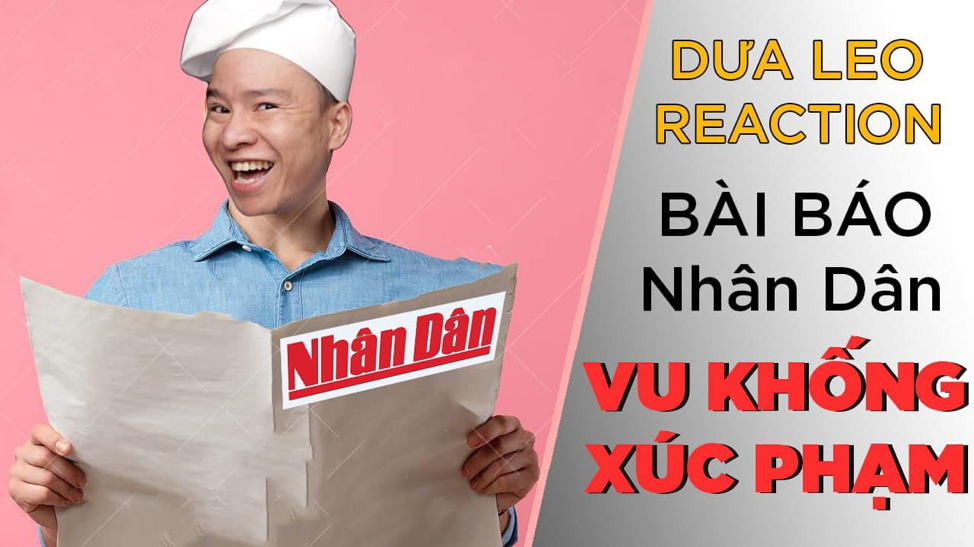
One week ago, followers of Dua Leo – one of Vietnam’s most prominent stand-up comedians – weren’t expecting him to release a “lawsuit reaction” video.
The incident resulted from an article published in Nhan Dan (The People), a Party mouthpiece, on January 8, 2021. The article, which was titled “Disguised as spreading knowledge to distort and undermine the nation’s image,” was by a writer named Viet Quang, and it targeted Dua Leo for his vlogs and videos published on his Youtube channel.
That article is seen as part of a campaign to delegitimize and clamp down on influential opposition voices as the Party ramps up for its 13th National Party Congress.
Mr. Nguyen Phuc Gia Huy, also known by his stage name Dua Leo, in one of his vlogs. Photo courtesy: nguoi-viet.com/ screenshot.
The stand-up comedian and his journey
Nguyen Phuc Gia Huy, commonly known by his stage name Dua Leo, which means cucumber in Vietnamese, is a Vietnamese stand-up comedian. He first came across stand-up comedy after watching one of Pablo Francisco’s videos; Francisco is an American stand-up comedian famous for his voice impersonating skills. Having graduated from the University of Economics with a bachelor’s degree in foreign trade, Mr. Huy had worked for several companies before deciding that he wanted to be a stand-up comedian.
Being a unique performer in a relatively new comedy field, there’s much room for this young talent to rise. But unlike his fellow counterparts, Dua Leo embarked on a different journey: using comedy as an alternative method to raise people’s awareness of social issues and tangible problems. He also created content for various topics, including history, science, politics, and even mental health. For that reason, Mr. Huy touted his role as being similar to that of a chef who cooks and serves people delicious meals, in his case, creating and spreading useful knowledge.
Dua Leo touted himself a “chef,” who “cooks and serves” useful knowledge to other people. Photo courtesy: nguoi-viet.com/ screenshot.
Funny, informative, and approachable, Dua Leo’s videos quickly drew a large number of viewers and subscribers, mostly young people who are aware of the current situation and who are eagerly pushing for systemic change in Vietnam. Currently, Dua Leo’s Facebook fanpage and Youtube channel have over one million followers and 700,000 subscribers, respectively.
No mercy for opposition voices
Despite being an influential icon for the young, Mr. Huy is not particularly favored by the authorities.
This is not the first time the comedian has provoked the ire of the government.
In 2016, he was first summoned by Ho Chi Minh city police after claiming in one of his videos that “there’s no freedom of speech in Vietnam.” After the incident, Mr. Huy made a video addressing his fans, under the stage name Dua Leo, reassuring them that nothing would stop him from doing what he is doing now. “I just want to deliver a simple message in this video: I’m just a comedian, as I always am, and my main goal is to gain [as many] views and likes for my videos [as possible],” he sarcastically joked. “[And] my secondary goal is as important as my main goal, [and that] is to make Vietnam a better country.”
Dua Leo raised concerns about the “National Cybersecurity Law”, which went into effect in 2019, expressing the fear that it would be used to suppress opposition voices. Photo courtesy: nguoi-viet.com/ screenshot.
The shaming in Nhan Dan is another warning from the government, aimed at those who refuse to follow Party guidelines when speaking on social media.
The author of the Nhan Dan article accused Mr. Huy of “faking the activity of spreading knowledge to obtain illegitimate donations with illicit intentions,” together with “colluding with overseas Vietnamese and foreign-based Vietnamese language news outlets – which have unfavorable views towards the Vietnamese Communist Party, government, and the people of Vietnam.”
On top of that, the writer also sourly slammed Mr. Huy for “being discontented” with the country’s current situation, accusing him of being “delusional of self abilities and knowledge,” or “dumb” and “child-minded.” Even worse, the author attempted to humiliate the comedian, claiming that “he’s popularly admired for his confident and eloquent manner, despite [his] physical disabilities.”
Notwithstanding being one of the biggest and fastest growing markets for social networks, there is little free space for dissenting opinions in Vietnam. Social networking sites such as Facebook and Youtube, which served mainly as “non-censored” platforms for local dissidents to voice their opinions in the country, are often under strict government scrutiny.
Standing up for justice
Nevertheless, in order to deal with the powerful Propaganda Department that sets its own rules, the only way to fight back is to play by their rules.
In one of his latest moves, Mr. Huy announced that he had hired a law firm to file a lawsuit for “defamation and humiliation,” demanding apologies from the newspaper as well as that the article be taken down.
The lawsuit concluded that the article was entirely based on personal assumptions without any concrete or fact-based evidence. Furthermore, it argued that the writer had falsely accused Mr. Huy of criminal wrongdoings, without any court judgement or going through any legal proceedings.
In his reaction video, Dua Leo constantly emphasized that this move was not a tit-for-tat response, but rather a so-called legal “case study” for people: everyone is equal under the law, therefore we should seek legal protections even when justice appears not to be on our side. And more importantly, he reaffirmed, everyone is innocent until proven guilty.
As of January 26th, Nhan Dan newspaper had further published two sequences, on January 23rd and 24th, respectively. These two articles, which threatened Mr. Huy to “turn back before it is too late,” are nothing if not a retaliation move after the comedian had decided to file a lawsuit against its smearing campaign.
One day after the publication, on January 25th, Dua Leo had released another reaction video, repeatedly condemning the newspaper for “groundless and unjustified accusations.” At the same time, the comedian also publicly released all the lawsuit papers on his Facebook fan page, as he carried on legal processes. And at the bottom of his post, Dua Leo did not forget to use the hashtag #JusticeWillPrevail.
Dua Leo publicly released the legal papers on his Facebook fan page. Photo courtesy: Dua Leo Facebook fan page/ screenshot.
As many activists, journalists, and prisoners of conscience are still being locked up in jail for defending human rights and freedom of speech, the fight for justice is not yet over in Vietnam.
And just like those brave people, Dua Leo is a stand-up comedian who is standing up for a good cause.
We, the undersigned media organizations, condemn the arrest, detention, and the upcoming trial of the three journalists, Pham Chi Dung, Nguyen Tuong Thuy, and Le Huu Minh Tuan. The Vietnamese government has charged them with Section 2, Article 117, of the 2015 Penal Code (revised in 2017) for “making, storing, spreading information, materials, items that contain distorted information about the people’s government.” The trial is expected to commence on January 5, 2021, at the People’s Court of Ho Chi Minh City.
The three journalists mentioned above have been active members of the Independent Journalists Association of Vietnam (IJAVN). Mr. Pham Chi Dung is the president, Mr. Nguyen Tuong Thuy is the vice-president, and Mr. Le Huu Minh Tuan is the editor. All three have also been journalists for the Vietnam Time newspaper, a media organization of the IJAVN.
These journalists are being persecuted and brought to trial because they have exercised their rights of free speech, free press, and the freedom of assembly. These are the fundamental human rights that both Vietnam’s Constitution and international law wholeheartedly recognized. The Vietnamese regime may use whichever propaganda to rationalize its decision, but it cannot change the facts and the reality of this case. The truth is that in Vietnam, the current regime has put itself in the same position as the feudal monarchies of the past and is sentencing people in a literacy inquisition.
We declare that we stand with Pham Chi Dung, Nguyen Tuong Thuy, Le Huu Minh Tuan, and the IJAVN to build a free media in Vietnam. We demand the Vietnamese government immediately and unconditionally release the three journalists.
As media organizations, Luat Khoa and The Vietnamese magazines vehemently denounce the three recent arrests of the three members of IJAVN: Le Huu Minh Tuan (detained on June 12, 2020), Nguyen Tuong Thuy (detained on May 23, 2020, and Pham Chi Dung (detained on November 21, 2019).
All of these three journalists were charged with the crime “publish, store, and disseminate or propagandize information, documentation, and products against the Social Republic of Vietnam” (Article 117 of Vietnam’s current Penal Code). This penal code has already been viewed as a blatant violation of people’s freedom of speech and free press by many human rights organizations.
IJAVN – together with running its Vietnam Thoi Bao newspaper – is a regular civil society organization formed under the right to associate, and it sets to implement the right for a free press and promote an independent and decent media for Vietnam.
Luat Khoa and The Vietnamese magazines share and support the values in which the IJAVN pursues.
As journalists, we ultimately care for the safety of our other colleagues. We consider the reality of a government trying to silence any journalist to be an imminent threat to us and anyone who practices free speech.
Silencing journalists is also a violation of the right to read free and independent media of the people.
We have realized that the call for the government of Vietnam to release immediately and unconditionally these three journalists of IJAVN would be unrealistic in the situation of Vietnam. However, that action is the only righteous conduct that the Vietnamese government could act right now, and therefore, we call on them to immediately do so.
We also call on all of the journalists, the activists, the public, the international organizations, and the foreign governments to jointly monitor and pressure the Vietnamese authorities to release the three journalists, Pham Chi Dung, Nguyen Tuong Thuy, and Le Huu Minh Tuan; and to call on the government to respect the Vietnamese people’s right for a free press and the freedom to form associations.
Amnesty International and Human Rights Watch have condemned the Vietnamese government for their escalating harassment of an independent publishing house.
Liberal Publishing House, established February 14th, 2019, seeks “to promote human rights and freedom of information in Vietnam by printing and publishing books without censorship from the Vietnamese government”, in a mode similar to samizdat operations in former communist countries of Eastern Europe.
In a statement issued November 27th, Amnesty International and Human Rights Watch stated that Vietnamese “police have harassed and intimidated dozens of people connected to the Liberal Publishing House […] in what appears to be a targeted campaign” against both the publishing house’s readers and workers.
The statement also describes a situation in which police “detained and allegedly tortured a man in custody on October 15 in Ho Chi Minh City, allegedly to force him to confess to working for the publisher. Police detained him for more than 12 hours, during which time he was repeatedly beaten until his nose bled. Since being released he has gone into hiding, fearful of re-arrest.”
The police harassment has been nationwide, striking the three major Vietnamese cities of Hanoi (north), Hue (center), and Ho Chi Minh City (south), as well as the central provinces of Quang Binh and Quang Tri, the south-central province of Phu Yen, and the southern province of Binh Duong. Readers have reportedly been called into police stations for questioning and forced to sign statements declaring they will no longer purchase books from Liberal Publishing House; workers have reportedly been ensnared in police traps while carrying out deliveries.
Liberal Publishing House has acknowledged the police harassment and issued to its readers a series of precautions to take when ordering books, as well as what and what not to say when confronted by police. It has also made available for free a digital copy of its book A Handbook for Families of Prisoners to inform readers of their rights and guide them through the legal process.
Liberal Publishing House’s other titles include Politics for the Common People, Non-Violent Resistance, and the English-language title Politics of a Police State. Dissident blogger Pham Doan Trang, who recently received the 2019 Press Freedom Prize for Impact from Reporters Without Borders in September, is one of the publishing house’s main contributors.
Although freedom of the press is guaranteed by Article 25 of the 2013 Vietnamese Constitution, the Socialist Republic of Vietnam is a one-party, authoritarian state that does not tolerate challenges to its power. It controls all official media and publishing houses in the country and regularly censors material that does not conform to sanctioned historical or political narratives.
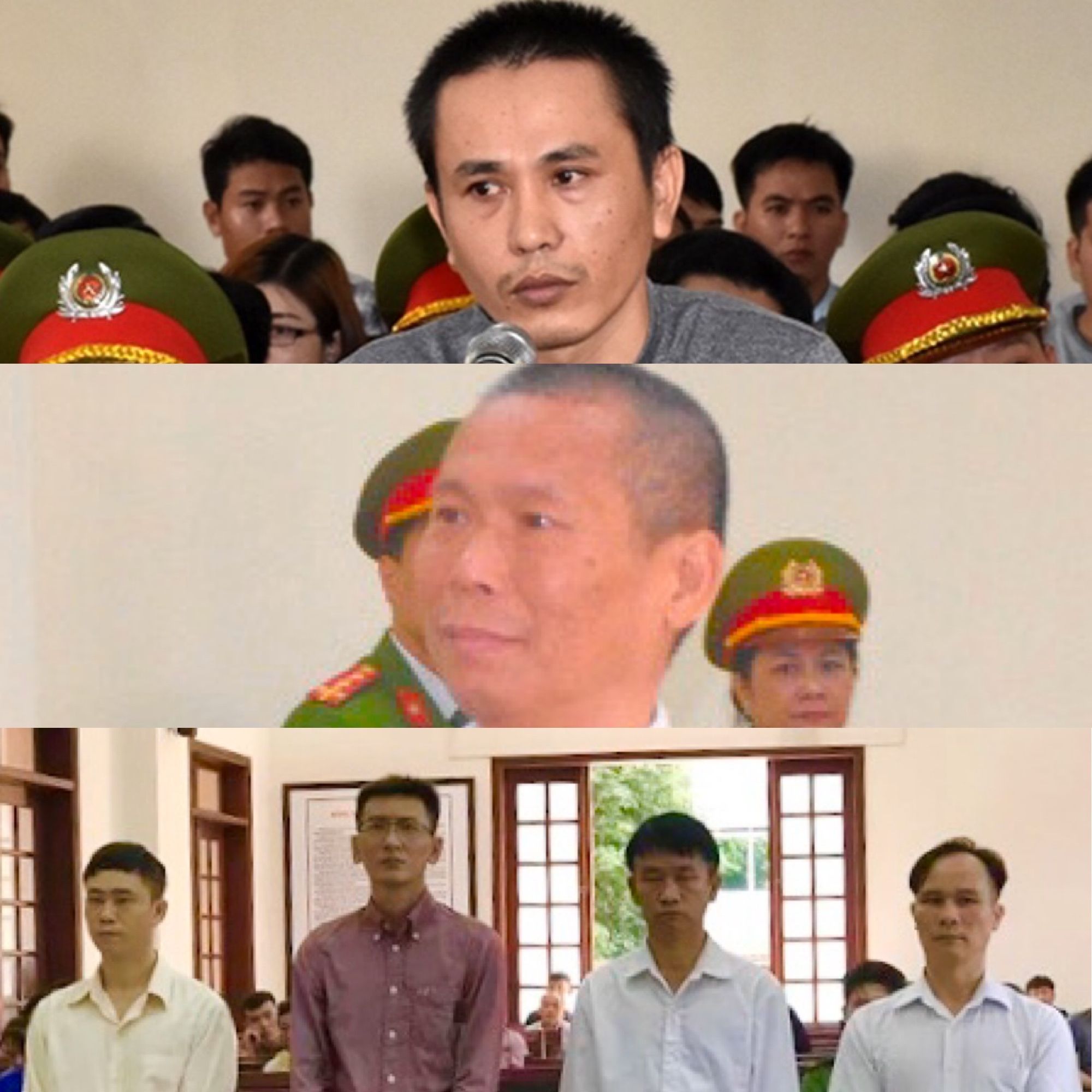
Nguyen Chi Vung (top), Pham Van Diep (middle), Vo Thuong Trung, Doan Viet Hoan, Ngo Xuan Thanh, and Nguyen Dinh Khue (bottom, left to right) . Photo sources: Kien Thuc, Binh An, and Nguoi Lao Dong newspaper, respectively. Composite photo created by Will Nguyen.
In a particularly damaging day for Vietnamese dissidents, six individuals were sentenced to a total of 26 years in prison for opposing the Vietnamese Communist Party (VCP) and the Socialist Republic of Vietnam (SRV). The convictions on November 26, 2019 bookend an active month for Vietnamese security forces, who have arrested and convicted numerous individuals for their on- and offline “anti-state” activities.
Nguyen Chi Vung, 38, was sentenced to six years in prison by a court in the southern Mekong Delta province of Bac Lieu. Vung was convicted under Article 117 of the 2015 Penal Code for “Making, storing, distributing or disseminating information, documents and articles against the SRV”. According to Reuters, Vung had “held 33 livestream sessions on Facebook ‘to share distorted information’ and ‘encourage people to participate in protests during national holidays’”.
Pham Van Diep, 54, was convicted under the same article, with a north-central Vietnamese court in Thanh Hoa sentencing him to nine years in prison and five years probation. His indictment stated that he had a nine-year history of expressing online dissent and that he made frequent Facebook posts criticizing the VCP leadership and SRV policies. According to Tuoi Tre newspaper, he had previously printed and distributed anti-SRV flyers in the Lao capital city of Vientiane. On June 28, 2016, Diep was arrested by Laotian authorities, tried in February of 2018, and sentenced to 21 months in prison for “using the territory of the Lao People’s Democratic Republic to oppose neighboring countries”. Lao authorities took him to the Vietnamese border one month after his trial, where he was allowed to re-enter Vietnam.
In Dong Nai, a province bordering the southern hub of Ho Chi Minh City, four individuals were convicted under Article 118 for “Disruption of security”. According to Vietnamese Human Rights Defenders, “[t]he four convicted were arrested on April 25, 2019, for their intention to participate in a peaceful demonstration scheduled on April 30 to mark the 34th anniversary of the fall of the US-backed Saigon regime”. Vo Thuong Trung, 42, and Doan Viet Hoan, 35, were each sentenced to three years in prison, while Ngo Xuan Thanh, 49, and Nguyen Dinh Khue, 41, each received 28 months.
The convictions of these six individuals in one day comes a little over a week after 43-year-old music teacher Nguyen Nang Tinh was sentenced to 11 years in prison and five years house arrest for violating Article 117. According to his lawyers, a Facebook account making anti-SRV posts used the same name as their client. However, they said the account did not, in fact, belong to him. Tinh was arrested May 29, 2019 and convicted on November 16 in the north-central province of Nghe An.
Last week also saw the high-profile arrest of Pham Chi Dung, a journalist with a doctorate in economics, and a founding chairman of the Independent Journalists Association of Vietnam. Dung, 53, is a former VCP member and is known for his incisive political and economic critiques of both the VCP and SRV. He has written for Voice of America, BBC, Radio Free Asia, NBC News, Nguoi Viet, and Asian Nikkei Review.
Dung’s arrest has been noted by the European Union and condemned by Reporters Without Borders, who hailed him as “an outspoken Vietnamese journalist and leading press freedom defender who for years has been trying to help create an open and informed civil society in Vietnam that is not controlled by its Communist Party.” He is currently being held at the Phan Dang Luu Detention Center in Ho Chi Minh City, one of two centers in the city where political dissidents are usually held while they are being investigated (the other being Chi Hoa Prison). He faces up to 12 years behind bars.
Although freedom of speech, press, and assembly are all guaranteed by Article 25 of the 2013 Vietnamese Constitution, the SRV is a one-party, authoritarian state that does not tolerate challenges to its power. It routinely arrests and convicts activists under Articles 117 and 118 of the penal code, as well as Article 331, which cites “Abusing democratic freedoms to infringe upon the interests of the State”. Such broadly defined articles are regularly used as a catch-all to target citizens who criticize the VCP or demand political reform. The SRV has long claimed that it does not jail prisoners of conscience, only individuals who violate the law. Human rights groups say the two are not mutually exclusive.
Addendum: On November 28, 2019, two more individuals in Dong Nai were convicted under Article 117. Huynh Minh Tam, 41, and his sister Huynh Thi To Nga, 36, were sentenced to nine and five years of prison, respectively, for making Facebook posts critical of the SRV.
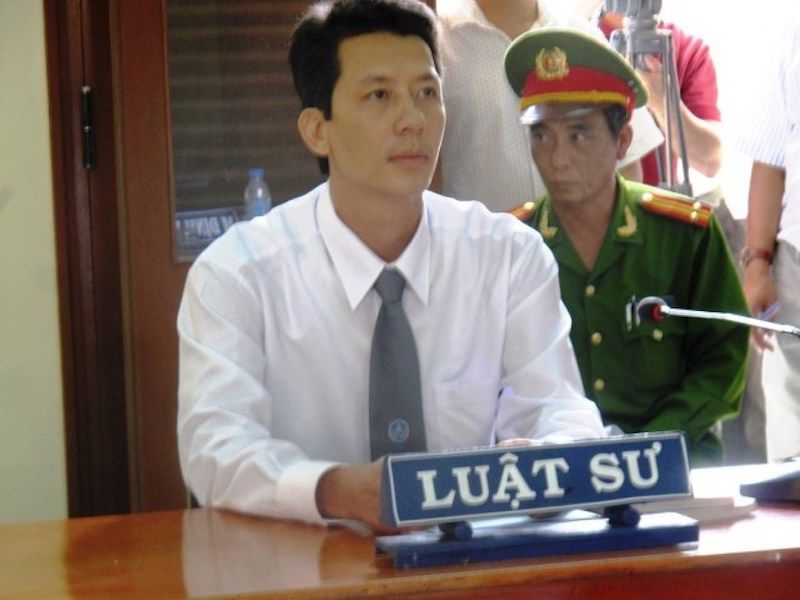
“I have lost my license to practice law forever, with no apparent recourse available,” Vo An Don, one of Vietnam’s most well-known lawyers in recent years, lamented on Facebook on April 9, 2019. Last week, a high court in Danang ruled that the minister of justice’s decision to affirm his disbarment in 2018 remained effective and final.
The 42-year-old lawyer from Phu Yen province, however, is widely recognized for his fierce advocacy. In the past five years, Don took on cases involving some of the more popular political dissidents, such as blogger Mother Mushroom. But he gained the most public attention when he represented the family of Ngo Thanh Kieu, a man who died while in custody after being beaten by the police in 2014. Don had demonstrated tireless efforts in bringing those who committed police brutality to justice in Kieu’s case. Yet on November 26, 2017, he was disciplined by his provincial bar association, and his bar license was taken away. In April 2019, the People’s High Court in Danang sided with the disciplinary decision and let the decision stayed.
According to Tuoi Tre newspaper, the reason for the disciplinary action was because of Don’s “abuse of democratic freedoms to write and to give interviews to foreign press and broadcasters to defame lawyers, the prosecutorial bodies, the (Communist) Party and the State of Vietnam with the intent to incite, propagandize, and misrepresent the truth which had negatively affected the reputation of the Party, the State, the prosecutorial bodies, and other Vietnamese lawyers.”
The Phu Yen Provincial Bar Association’s decision to disbar him came only a few days before the appeal trial of Mother Mushroom, which was on November 30, 2017. Don stated at the time in an interview with BBC-Vietnamese that such a decision was probably politically motivated.
It was not the first time, however, that his local bar association had attempted to discipline Vo An Don. In another interview with RFA in 2014, Don already disclosed that the Phu Yen Provincial Bar Association had tried, unsuccessfully, to disbar him a few times during his representation of the family of Ngo Thanh Kieu. But Don was unfazed and continued with the case, successfully bringing the offending officers to justice.
The case of Ngo Thanh Kieu was probably the first one in recent years where the court convicted a group of police officers for causing death to a suspect in custody. Public opinion, however, was split about the sentences handed down to the former police. Some people thought that the jail terms were too light as the longest one was only a five-year-imprisonment. At the same time, many people also saw Vo An Don as the lawyer who fought for the people’s rights and stood against what they perceived as a corrupt system.
The unintended popularity could be the root of the troubles that later followed the lawyer, who practiced law in one of the poorest areas in Vietnam. Don is often dubbed the “farmer lawyer” in social media because he still has to continue farming to support his family. Practicing law in an honest way, he said, cost him opportunities to “get rich” because he refused to be part of the widespread corruption in Vietnam’s judiciary. His popularity and his candid words about the profession together made him an unpopular person among his fellow attorneys. His allegation of corruption among lawyers was one of the statements that cost him his bar license, as reported by The Law newspaper in Ho Chi Minh City on May 24, 2018.
After the Phu Yen Provincial Bar Association issued its disciplinary decision on November 26, 2017, Vo An Don petitioned the Vietnam Bar Federation in December 2017 for a review. Over 100 Vietnamese lawyers signed a petition asking the Federation to stand by its member’s freedom of expression and stated that the disciplinary action would be a dangerous precedent for the law profession. The Federation still rejected his petition on May 21, 2018.
Don continued to appeal his case with the Ministry of Justice later last year, but the minister of justice also decided against him.
Finally, in December 2018, Don initiated a lawsuit against the administrative decision to uphold the disciplinary action by the minister of justice. But as stated, the court system also did not side with him and effectively allowed the disbarment to remain in effect. The high court in Danang agreed that the dismissal of Don’s case by a lower court was proper.
Both courts had reasoned that the minister of justice’s decision to uphold the disbarment was done within a professional and social organization – the Vietnam Bar Federation. Such a decision did not fall under the categories of subject matters that could be decided in a lawsuit against an administrative order.
At this time, even Vo An Don does not seem to think that there could be any other recourse for him. In the meantime, Don’s case has raised sufficient concerns about the freedom of expression of lawyers in Vietnam and whether their human rights will continue to be subjected to professional disciplinary actions.