Tag: Election

  • Vietnam: The True Victims Of Political Repression

    Vietnam: The True Victims Of Political Repression

    The Absence of Choice

    National elections in any part of the world are always interesting to observe. What occurs in them tends to range from comically hilarious, to shockingly horrifying, to essentially pivotal in the future progress and growth of a country. And as much as some people might say otherwise, whoever wins these elections matter; they are an important factor that determines the direction a nation will steer itself in over the coming few years.

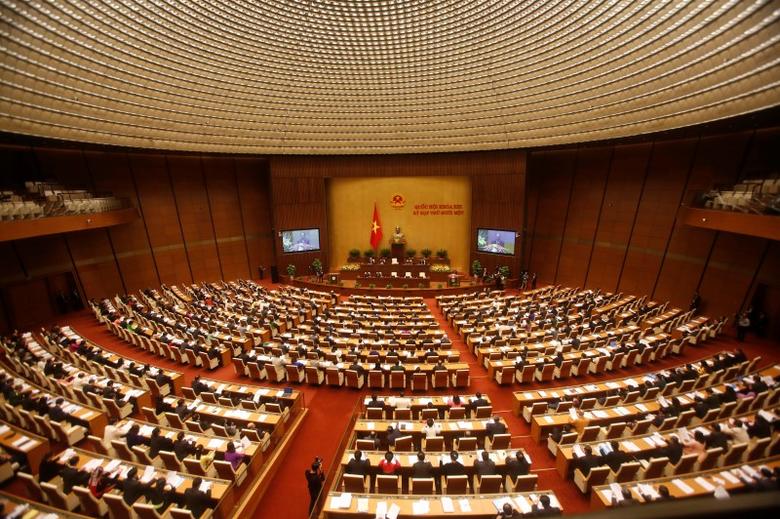
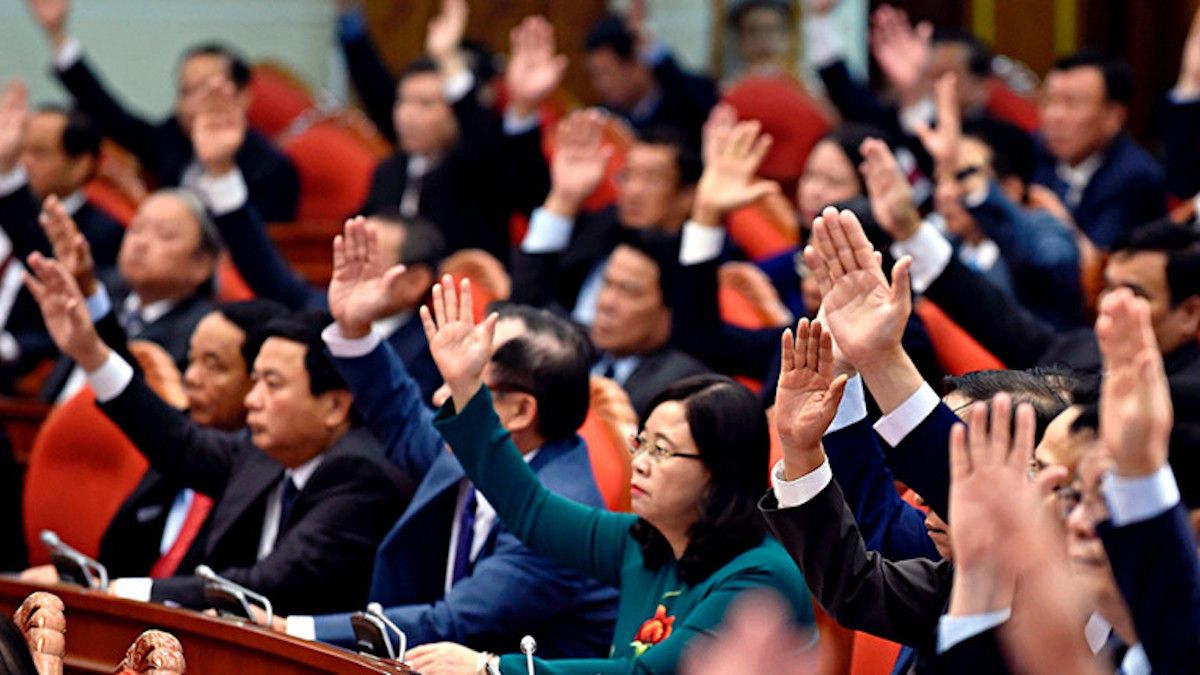
    Living in a Communist state, Vietnamese citizens do not get the same opportunity afforded to other people in democratic countries during their general election. The Vietnamese people do not get to choose the top elected officials in their own nation; such a decision is left to the Politburo.

    In effect, the direction in which the leaders of Vietnam steer the nation tends to be a one-way street with very few deviations to the plan and to the overall end goal.

    While there are indeed some benefits to this kind of system, a long hard look at the failures of communist states of the past tends to raise more than a few eyebrows.

    Hence, it should come as no surprise that a significant number of Vietnamese citizens do not approve of how their government handles elections, or how their leaders run the country.

    Faces in the Crowd

    CIVICUS, a global alliance of civil society organizations and activists dedicated to strengthening citizen action and civil society throughout the world, released a report on March 29, 2021 detailing how several activists in Vietnam were targeted, arrested, detained, or tortured by the government.

    CIVICUS noted that leading up to the conclusion of the 13th National Congress of the Vietnamese Communist Party (VCP) on February 2, 2021, the Vietnamese government and state security forces had been intensifying a crackdown on whoever they perceived to be critical of the regime.

    An alarming  number of Vietnamese citizens were arrested, detained, or even tortured on the basis of trumped-up charges and the overuse of vaguely defined Vietnamese penal laws.

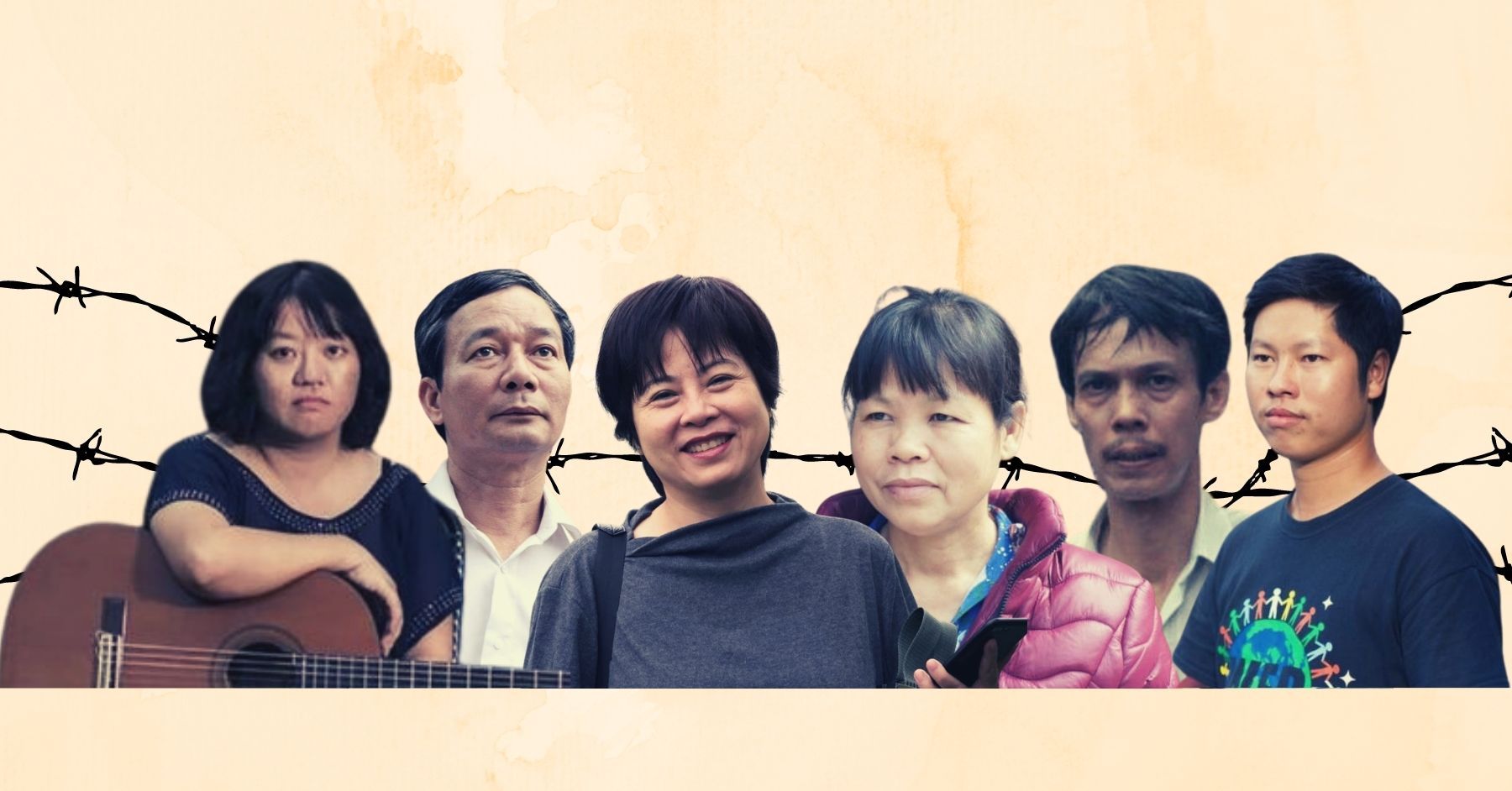
    Following are just some of the people mentioned in the CIVICUS report.

    Tran Duc Thach at his trial. Photo: Tuoi Tre

    Tran Duc Thach, an activist, writer, and co-founder of Vietnam’s Brotherhood for Democracy, was convicted on December 17, 2020. He was charged with subversion under Article 109 of the country’s criminal code and was sentenced to 12 years in prison and three years’ probation.

    State prosecutors claimed that his posts on Facebook “threatened social stability, encroached upon national independence and socialism, reduced people’s trust in the political institution of the state of Vietnam, and infringed upon national security and social safety and order.” On March 24, 2021, his appeal was denied and his sentence was upheld.

    In December 2020, Nguyen Dang Thuong, Huynh Anh Khoa, and Tran Trong Khai were sentenced to serve 18, 15, and 12 months in prison, respectively. The three were administrators of a Facebook political discussion group. They were arrested under Article 331 of the 2015 Penal Code for “abusing democratic freedom rights to infringe upon the benefits of other individuals and/or organisations.”

    Their Facebook group had a following of around 46,000 users before it was shut down.

    From left to right: Le Huu Minh Tuan, Nguyen Tuong Thuy, and Pham Chi Dung. Graphic: Luat Khoa Magazine

    On January 5, 2021, Pham Chi Dung, Nguyen Tuong Thuy, and Le Huu Minh Tuan were convicted for allegedly “making, storing, and disseminating documents and materials for anti-state purposes” under Article 117 of Vietnam’s Penal Code. The three men are all members of the Independent Journalists Association of Vietnam (IJAVN). They wrote blogs and articles critical of the Vietnamese government. Nguyen Tuong Thuy also testified in front of the US House of Representatives in 2014 regarding the lack of freedom in Vietnam.

    Dinh Thi Thu Thuy. Photo: The 88 Project.

    Dinh Thi Thu Thuy, an environmental activist, was jailed for seven years on January 20, 2021, after having been in police custody since April 2020. She was charged with “conducting propaganda against the state,” also under Article 117 of the Penal Code. Thu Thuy had made just a total of five social media posts that had garnered a total of 130 likes and 50 shares.

    Phan Bui Bao Thy and Le Anh Dung, two Vietnamese state media bloggers, were detained on February, 10, 2021, for publishing articles accusing provincial officials in Quang Tri Province of corruption. They were charged with “abusing press freedoms.” Phan Bui Bao Thy was the bureau chief of the online magazine Age and Education.

    More recently on March 9 2021, Tran Quoc Khanh was detained for “defaming the government and distorting its policies.” He had used his personal social media page to post about the state’s human rights abuses, corruption, and the South China Sea. He is currently held in pre-trial detention and if found guilty faces 12 years in prison.

    Tran Huynh Duy Thuc at his trial.

    Nguyen Van Hoa, a contributor for Radio Free Asia (RFA), and Tran Huynh Duy Thuc, an imprisoned blogger, started hunger strikes in protest against the appalling conditions in Vietnamese prisons. Hoa was arrested in the past for filming a toxic waste spill after the Formosa environmental disaster happened in Vietnam in 2016. Tran Huynh Duy Thuc has remained in prison since his arrest in May 2009.

    Nguyen Van Duc Do, an activist currently incarcerated for “carrying out activities aimed at overthrowing the people’s administration” under Article 79 of the 1999 PenalCode, has been in prison since October 5, 2018. Amnesty International reports that he has been in solitary confinement since May 2020 and has been subjected to various forms of torture. According to the human rights group, both his legs were bound by chains for 10 consecutive days. He was also fed food mixed with human excrement.

    The Measure of Their Reach

    These people are just a drop in the ocean compared to the total number of Vietnamese who are facing the ire of the government. In reality, it is difficult to ascertain how many people have been subjected to unjust prosecution by the Communist Party. Yet, the one thread that seems to be in common with all of them is that they were all very vocal in their criticisms.

    It would be easy to claim that only high profile individuals are the target of the ever watchful gaze of state authorities. Yet, Dinh Thi Thu Thuy only made five social posts and she was sentenced to 7 years in prison. Even members of the Vietnamese state media itself – like Phan Bui Bao Thy – were arrested.

    On social media, a person’s message can reach 10, a hundred, a thousand, or even a million people. However, the popularity of your posting hardly even matters in the eyes of the Vietnamese government. If the regime does not approve the message’s content, it will treat everyone equally, everyone as the same, because no one is above the VCP’s supreme authority. That would mean it will arrest and sentence anyone who dares to write in contradiction with its propaganda.

    Anyone is in danger, no one is secure, and even the slightest word critical of the government might be the last one you ever get to say.

    All the people mentioned above and the countless others like them are indeed victims of a government so thin-skinned that it responds to even the slightest whiff of dissent with arrests, coercion, and brute force. Yet, these journalists, activists, and human rights defenders account for just a tiny part of the whole. They are not the only casualties under the Communist regime.

    The actual victims of political repression are you, me, and everyone living and breathing under the iron heels of despots and dictators. And even though Vietnam always insists that it upholds and respects all of the human rights treaties it has entered into, in reality, all citizens are living in fear that one sentence or even one word may destroy our lives and the lives of those we love.

    We are not free, and we will never be truly free if we still condone this type of government Vietnam has.
  • Election in Vietnam: The Whims Of The Few Or The Will Of The Masses?

    Election in Vietnam: The Whims Of The Few Or The Will Of The Masses?

    This article was written in Vietnamese by Vo Van Quan and was previously published in the Luat Khoa Magazine on February 4, 2020.


    Regulation 214

    On February 2, 2002, Vietnam’s Politburo officially announced Regulation 214 on the Standard Framework for titles of cadres belonging to the Central Executive Committee, the Politburo, and the Secretariat.

    Accordingly, the Politburo amended and supplemented specific provisions on the required qualities and capabilities of important internal party positions.

    To put it simply, Regulation 214 is comparable to job descriptions and position requirements that we often see in job listings. As for members of the Party Central Committee, Regulation 214 requires them “to be a representative of political courage, ethical qualities and working ability; have the capacity to organize the successful implementation of the Party’s policies and duties.”

    If one is a member of the Politburo and the Secretariat, the candidate must be “an official member of the Central Committee for a full term or more; has experienced and completed essential tasks in key leadership positions at the provincial level.”

    However, it is worth mentioning that Regulation 214 does not set out specific criteria for certain titles such as the president, prime minister, or chairperson of the National Assembly, all of which are state positions. Theoretically, these are not party positions and are therefore outside the influence of the VCP’s internal politics.

    Regulation 214, however, dictates that the person in the position of State president is required to have “high prestige,” a “solidarity center”, and  “comprehensive, outstanding” talent; while the prime minister must “stand out comprehensively … in strategic planning for socio-economic development, national defense and security, [possess] sensitive thinking, [be] dynamic, decisive”.

    Obviously, it can be understood that the VCP was setting the criteria for its members to consider in order to have a basis for nominating, recommending, voting, and selecting “ideal” candidates for the National Assembly and the People’s Council in 2021.

    However, with the electoral mechanism in Vietnam, it is completely understandable that the Party’s Regulation 214 will be used to determine leading positions in the State. However, these regulations still have to be approved by a group of 17 members of the Politburo.

    So, are the above rules able to replace the popular vote? Are the Vietnamese people so incapable of choice that they must give authority to the elites (such as the VCP) to choose their leaders?

    Một cuộc họp của Bộ Chính trị - Đảng Cộng sản Việt Nam, tháng 5/2019. Ảnh: TTXVN.
    A meeting of the Politburo – Communist Party of Vietnam, May 2019. Photo: VNA.

    The political elite

    An argument exists to justify the Communist Party’s electoral mechanism. This argument is that the Vietnamese people are not well educated, are easily provoked, and are unsuitable for democratic elections. So, it is better for an elite minority to choose the country’s  leaders; this elite minority is now believed to be the VCP.

    Such an argument is found not only in Vietnam but in other parts of the world as well.

    For instance,  theories such as technocracy (a model of governance that believes that only experts in certain fields can be elected to corresponding positions in government related to their field of expertise) and epistocracy (a system that assumes only “qualified” citizens with enough information and political authority can vote or run for government) are not really new.

    The famous 19th century philosopher John Stuart Mill used to support an electoral system based on voters’ caste and professional work. Experts who have complex knowledge and skills get six votes, farmers and merchants get three or four, skilled workers two, and unskilled workers one ballot.

    More recently, Jason Brennan in his article The Case Against Democracy also promotes a political environment where only qualified and knowledgeable citizens should be allowed to vote or stand for office.

    He writes that most of the political questions in contemporary life have become too complex for common voters to understand; they are too fond of simple answers to complex questions. Worse, he argues that the common people are not only ignorant, but that they also believe that they know more than what they actually do; they even claim that they are right. He believes that this makes their political decisions ignorant and stupid.

    Brennan does not propose a voting model based on qualifications and educational levels like Mill, but rather recommends a test of voters’ political capacity before allowing them to vote.

    The rules of the VCP electoral mechanism seem to be loosely based on or inspired by these  two aforementioned technocratic and epistocratic theories:

    • Party members are considered “qualified” citizens who make the initial decisions regarding the formation of government through voting among themselves to elect members of the Party Central Committee. Then, the members of the Party Central Committee who are considered “high quality” citizens choose the “elite” members who will sit in the Politburo and the Secretariat seats, and also thoroughly become the state leaders, regardless of the outcome of local popular elections.
    • Meanwhile, the Politburo, which claims its membership to be the technocratic masters, sets the required standards for the new leaders, and then nominates and fills in the state positions for Vietnam.

    The VCP considers this a brilliant method to select the top leaders for the country. But is it?

    The defects of democratic elections

    Democratic elections are clearly not liked by everyone, and some even find them to be very disappointing. The election of former US President Donald Trump is a very fitting example.

    Ông Donald Trump và phu nhân đi bầu vào tháng 11/2016. Ảnh: Getty Images.
    Donald Trump and Melania Trump were at voting booths in November 2016. Photo: Getty Images.

    During the primaries in the 2016 US presidential election, as many as 50 Republican Party members openly voiced their disapproval of Donald Trump.

    Specifically, General Michael Hayden (a four-star general, and former director of the CIA and NSA) said that Trump did not have the right temperament to lead. More specifically, he said that Trump lacked the personality, patience, disposition, knowledge, curiosity, or even the willingness to learn. These qualities, according to Hayden, are needed by candidates to be deserving of the title of president of the United States.

    Using similar language, David French, a writer of The Dispatch, never concealed that he belonged to the “Anti-Trump” movement. He strongly affirmed that personality is essential in being a world leader. A person’s temperament, knowledge, and integrity will shape his or her behavior. And even though the democratic process and expert advisors can help shape and steer a president lacking in these qualities, mistakes can still happen, especially for someone as stubborn as Trump.

    In the end, with his victory in the 2016 election, Trump showed that he was well supported by a large number of American voters, regardless of how many critics said that he was not worthy enough or deserving of the US presidency. In fact, during the middle of his impeachment fiasco, Trump’s ratings were not only stable, they also increased.

    I will not go too deep in regards to Trump, because his assessment is still very controversial, even among the Vietnamese. However, this entire situation gives us this sliver of truth: people sometimes may vote for unworthy candidates.

    ajorities in many countries are dissatisfied with their democracy

    The above-listed statistics is rather a detailed study conducted by Pew Research on voter views of candidates for elected positions in the United States, which found that voters did not take into consideration the quality and competency of political candidates.

    Only 47 percent said that the quality of the candidates was good, and even less than 5 percent rated the quality and competence of the candidates as very good. The remaining 52 percent had a negative view. As for the presidency, 58 percent said they were not satisfied with the choices they had.

    Furthermore, according to Pew, people in democratic countries tend to be dissatisfied with the way their countries operate. The list includes centuries-old democracies such as the United States and Great Britain. In line with this, the people’s opinions of their elected officials are also not high.

    For instance, in Greece, up to 90 percent of the population believes that their elected officials do not care about the will, views, and aspirations of ordinary citizens.

    Also, more than 58 percent of the US population share this opinion about their own politicians. Even though the indicators of transparency and corruption in the United States have always been evaluated positively by independent organizations, up to 69 percent of respondents agree with the opinion that national politicians are both corrupt and decadent.

    In some African countries, democratic elections have turned into a game of those who can spend the most money to rile the mob.

    So then, why have most nations in the world still chosen to maintain a universal electoral system? Why has most of the world not surrendered political power to the elites who are allegedly more knowledgeable, educated, and are supposed to have leadership qualities that can help them steer and rule a country?

    There is much to discuss about leaders who are chosen by the people, and those chosen by the elite.

    The first misconception of those who oppose popular elections is that they think the majority will end up choosing the wrong candidates. In the same vein, they also believe that this choice should be left to the “elite.” They think that this small group of people can accurately decide without being influenced by interest groups, personal preferences, or other hidden agendas. These claims are utterly baseless.

    Even Mill himself realized that countries needed to build a system that fully reflected current attitudes in society, and the idea of an administration full of economists frightened him.

    For instance, why should a lawyer get three times the votes of a skilled worker when law is such a broad and diverse field? Politics and welfare issues are just small specializations in law and not all lawyers are knowledgeable enough to talk about them, let alone determine the best course of action in a field they may not be trained in.

    Regarding Jason Brennan’s voter-competency test model, David Runciman, a professor of politics at Cambridge University, identifies that this model just pushes his questions to the starting point and fails to answer any more.

    Who will be considered qualified to prepare this test model? College professors? They also have their own political interests and opinions. Economists? They may be talkative on a variety of market rules, but their predictions about the future of the market are often incorrect.

    And Brennan, himself a university lecturer, has probably also seen countless students cramming knowledge into their heads just to pass exams.

    Proponents of the “epistocracy” model also have to deal with the fact that the educated, and also the elites, are in fact influenced by the crowd and are biased just like everyone else in the world.

    As social scientists Larry Bartels and Christopher Achen pointed out: History shows that intellectual groups, elite or not, can be as deviated from political morality and political thinking as anyone else.

    There are shortcomings and problems in today’s modern electoral and representative democracy, but this does not mean that it is neither efficient nor just. As in marriage, anyone can choose the wrong partner, similar to how we can elect the wrong person. But with democracy, various checks and balances exist that can help ensure that the system can function as intended. As with marriage, we can get divorced and then marry again.

    And when the people’s decision-making power is taken away, words such as “ability,” “quality,” “elite,” “technocrat,” or “epistocratic” are just flimsy excuses for control.

  • Vietnam Briefing: 2021 Is Going To Be A Busy Year Of Elections

    Vietnam Briefing: 2021 Is Going To Be A Busy Year Of Elections

    We release the Vietnam Briefing every Monday, Vietnam time, with an emphasis on politics and foreign affairs. The briefing today is mainly about the different kinds of elections Vietnam is going to have this year.


    COVID-19:

    • COVID-19 vaccinations will be rolled out this month.
    • Hai Duong Province will end lockdown from March 3.
    • Hanoi’s closure order for street vendors, cafes and historical sites has remained unchanged, but just as we briefed last week, many places are still open.

    We are starting to know what the next National Assembly will look like

    It’s true. We don’t need to wait until the general election ends on May 23 or for the results to be released in June. The National Assembly’s Standing Committee revealed in early February and last week the “tentative proportion” or “tentative allocation,” of seats for Parliament’s next term (2021 – 2026).

    This means we can now see which government and Communist Party bodies will tentatively hold how many seats in the National Assembly.

    The tentative number of seats is officially stated in the Standing Committee’s Resolution 1185/NQ-UBTVQH14, which is dated February 5, 2021 and which was debated again last week during the committee’s session that ended on February 23.

    More details:

    • Approximately 95 members of the National Assembly are members of the Communist Party of Vietnam’s (CPV) Central Committee, including 12-14 members of the Politburo and the Central Secretariat.
    • Outside-of-the-party members: 25-50 (5-10 percent).
    • Members from the central government: 207 (41.4 percent).
    • Members from the military: 12 (excluding the minister of national defense).
    • Members from the police: 2 (excluding the minister of public security).
    • Other seats are also planned to be allocated to other government and party bodies.

    Context:

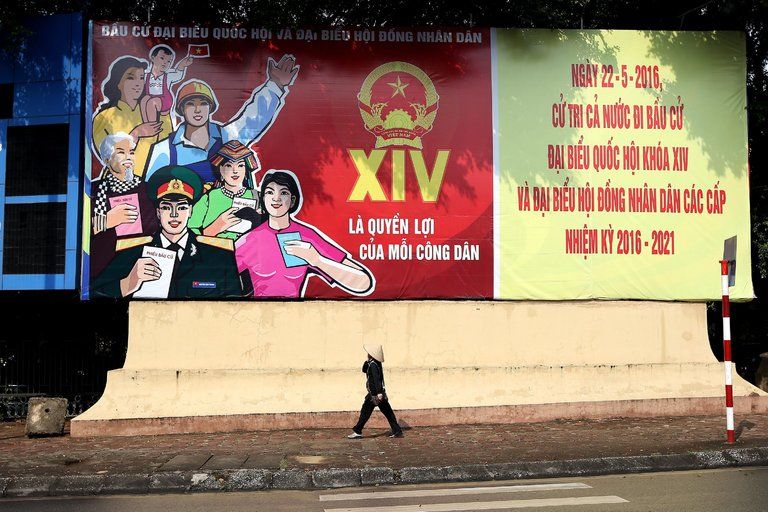
    • The general election will be held on May 23 for both the National Assembly and local legislative bodies at all three levels (province, district, and commune). The results are expected to be released in June. The first National Assembly session will be held in July, mainly to elect top officials of all three branches of the central government.
    • General elections are held every five years, shortly after the Communist Party congresses.
    • Free and fair elections? That’s what the government says, but it’s not the view of Freedom House, a human rights organization, in its 2020 report: “Elections to the National Assembly are tightly controlled by the CPV, which took 473 of the body’s 500 seats in the 2016 balloting. Candidates who were technically independent but vetted by the CPV took 21 seats. More than 100 independent candidates, including many young civil society activists, were barred from running in the elections.”

    Curious about how this election works? Pay close attention to two things: the role of the Fatherland Front – the Communist Party’s external arm – as a vetting agency and how the government deals with independent candidates.


    Vietnam to run for a seat at the United Nations’ Human Rights Council

    That’s what the Deputy Prime Minister announced last week before a United Nations’ session in Geneva, Switzerland.

    Vietnam apparently doesn’t have a good record on human rights. But just like other authoritarian states such as China, Cuba, and Saudi Arabia, it has a chance to win one out of 47 seats on the United Nations’ Human Rights Council’s 2023-2025 term.

    Context:

    • Vietnam was elected to the very council once in 2013, serving a two-year term from 2014 to 2016.
    • Government persecution targeting dissidents and human rights defenders has been increasingly harsh over the past five years, according to the data collected by The 88 Project.
    • Vietnam has consistently been categorized as a “Not free” country by the international rights group Freedom House.
    • Vietnam is currently a non-permanent member of the UN Security Council, and it will serve until the end of this year.

    Vietnamese ambassador runs for re-election to International Law Commission

    It seems Vietnam is actively seeking more influence on the international stage. Here is another election at the United Nations that Vietnam is campaigning for, according to VietnamPlus:

    “Vietnam’s permanent missions to the United Nations (UN) in New York and Geneva have recently sent diplomatic notes to the UN and member countries informing them of the candidacy of Ambassador Nguyen Hong Thao to the International Law Commission (ILC) for the 2023-2027 term, marking the official start of the Vietnamese candidate’s campaign for re-election to the UN’s important law organ.

    In 2016, Ambassador Thao became the first Vietnamese to be elected as an ILC member. During the 2017-2022 term, he actively promoted ILC’s research results, delivered speeches and joined discussions at the ILC.”


    The Dong Tam appellate trial will be held on March 8

    Remember the high-profile Dong Tam trial in September? The appellate trial opens on March 8 and will last until March 10.

    Six defendants have appealed their sentences to the People’s High Court in Hanoi.

    What should we expect?

    • The trial will very likely result in the affirmation of the lower court’s verdict with little or no adjustments to the defendants’ convictions and sentences.
    • Similar to the trial in September, the appellate trial is expected to be closed to the public, with no independent and international media, and no independent observers allowed to attend; even family members of the defendants may be refused permission to observe the trial.

    Learn more about the Dong Tam case:


    Amnesty International’s new investigation into hacking group Ocean Lotus

    Two weeks ago, we mentioned the hacking group Ocean Lotus in our briefing, indicating that the Vietnamese government is likely behind the effort to target dissidents and foreign entities.

    Last week, another report on the matter was released by Amnesty International. Here is what it says:

    “Our investigation was not able to attribute Ocean Lotus’ activities to any company or government entity. However, the extensive list of people and organizations targeted by Ocean Lotus over years shows that it has a clear focus on targeting human rights and media groups from Vietnam and neighbouring countries. This raises questions about whether Ocean Lotus is linked to Vietnamese state actors. The consistent evidence linking Ocean Lotus to Viet Nam should trigger the Vietnamese authorities to undertake an impartial, thorough and independent investigation into the group’s unlawful activities and human rights abuses.”

    Context:

    • The Vietnamese government has kept silent on the issue.
    • The Vietnamese government also has accused Amnesty International of “distorting Vietnam’s reality” and of “intervening in Vietnam’s internal affairs.”

    Read more about Vietnam:

    Where to now for Vietnam after Trong? (East Asia Forum – Feb 27): “Events over the past year have brought major long-term trends in Vietnam’s domestic and foreign policy to the surface. The country will be less aligned with China. In the next decade, it will likely have its first non-conservative leader since the Cold War’s end but its leaders continue to value the Leninist state model.”

    Vietnam’s unresolved leadership question (East Asia Forum, Feb 25): “Pham Minh Chinh emerged as a new star. […] Chinh is also a potential candidate to succeed General Secretary Trong when Trong vacates his position. In that case, Chinh will have reached a position his predecessors — Nguyen Tan Dung and Nguyen Xuan Phuc — wanted but did not get. The question is whether Trong wants and has enough time to groom Chinh to handle the roles of general secretary and state president.”

    Supply chain bottlenecks in Vietnam (Bangkok Post, Mar 1): “Vietnam’s economy has fared better than that of almost any other country except China during the Covid-19 crisis. It grew by 2.9% last year while most other countries fell into recession. One consequence of the crisis was that manufacturers realised the importance of diversifying supply chains, and many accelerated the China Plus One policies that they had initiated because of the US-China trade war. This led to a surge of investment in Vietnam from global manufacturers last year.”

    Capital meant for Myanmar may seek havens in Vietnam and Cambodia (Nikkei Asia, Feb 27): “The military coup in Myanmar has forced investors who had earmarked capital for the country to look for nearby alternatives. Delta Capital, Anthem Asia and other funds that have solely focused on Myanmar are adopting a wait-and-see approach, and those with a wider geographic footprint are funneling money to destinations like Cambodia and Vietnam. Vietnam is especially frothy.”

    Mitsubishi pulls out of Vinh Tan 3 coal project in Vietnam (Reuters, Feb 26): “Mitsubishi Corp has decided to pull out of the Vinh Tan 3 power plant in Vietnam, two sources familiar with the company’s thinking on the matter told Reuters, as it shifts away from carbon intensive businesses in the face of climate change. Mitsubishi’s move to exit the estimated $2 billion project shows how willing Japanese companies and financiers are to drop their once-strong support for coal amid pressure from shareholders and activists.”

  • Watching The US Presidential Election While Dreaming About Vietnam’s Free Election At The Commune Level

    Watching The US Presidential Election While Dreaming About Vietnam’s Free Election At The Commune Level

    This op-ed article was written in Vietnamese by Ly Minh and previously published in Luat Khoa Magazine on November 6, 2020. The translation was done by Jade NG.

    ***

    Although I am a Vietnamese citizen, I anxiously watched the US presidential election in November 2020. Many of my friends in Vietnam also did the same thing. We eagerly watched every turn of that election as if we were personally voting for our own head of state.

    The Vietnamese public’s interest in the US presidential election every four years can be seen through the headlines of our newspapers. The mainstream media updates many Vietnamese readers on every step of the thrilling race to the White House.

    Looking eagerly at the news every day about  the US presidential election, I cannot help but wonder whether or not the Vietnamese people earnestly wish to elect their own leaders.

    In the political context of Vietnam, I understand that this question is a taboo. Needless to say, everyone knows that the current political regime in Vietnam does not allow the Vietnamese to exercise their voting right as in the United States.

    Theoretically, the Vietnamese elect their National Assembly delegates through the National Assembly election once every five years. Then, on behalf of the Vietnamese people, the National Assembly delegates elect our national leaders.

    Thus, elections in Vietnam ironically have been going on smoothly, albeit with many predictable results. Surprises rarely happen in those elections. Throughout my own monitoring of the National Assembly elections in Vietnam, I found the saying “the Party selects, the People elect” a very reasonable way to explain the development and the results of elections in Vietnam.

    The secret desire of many Vietnamese people, including myself, is to have the freedom to make our decisions and to choose our state leaders, and even the National Assembly delegates who actually represent our voices when deciding the big decisions for the country.

    That desire is expressed indirectly by many people through monitoring and discussing the US presidential election, as if we were voting for our own state leaders. A friend of mine lamented on Facebook: “I look at the US election and all I  can feel is pain for the Vietnamese people.”

    It is impossible not to feel hurt.

    Governance is democratic when each vote of the citizens decides who the leaders will be. Every vote influences the final result. The thrill of the US election right up until the last minute was because those of us who watched the election’s progress could see the importance of each ballot cast by the American voters.

    Because each person’s vote is so important, the presidential candidates of the US must find ways to enlist the support of their voters, to specialize their campaigns for each state, to come up with policies that please local voters to gain support for the candidates, and even to try to entice the neutral voters.

    Meanwhile, looking back at the political situation in Vietnam, my country’s people have no decisive voice in deciding who will become our leaders. Therefore, in Vietnam, many people are not excited about politics and are not interested in who will become the general secretary, the president of the country, the president of the National Assembly, and the prime minister. It is simply because Vietnamese citizens do not have the right, through their votes to influence the selection of these above positions.

    Those who are knowledgeable about politics in Vietnam understand that the Party decides all the leadership positions in the country. Some three or four million members of the ruling Communist Party decide for almost 100 million Vietnamese people. Party members also decide all of the major issues of the country through their secret meetings, where the press is not allowed to cover any news. And the public? The public only knows about the results which are often announced by  Party officials after those meetings.

    This is the reality about the Vietnamese political situation that I, a Vietnamese citizen, am forced to accept. But I personally think that many people who also accept that reality do not comprehensively support it.

    Of course, I fully understand that some supporters of the current regime would argue that the Vietnamese people have the right to vote for the head of the country through the National Assembly delegates. However, I just want to ask two simple questions. First, do you remember who you voted for in a recent election? Second, do you feel happy when your delegate wins the election or sad when she or he fails?

    Having an election such as in the United States is a distant dream for the Vietnamese. Nevertheless, I have only a small dream, which is that our local people can one day elect the leaders of their wards or communes, free and fair, by themselves. Hopefully, my dream will come true soon so that in the future I can proudly tell my children and grandchildren that I have elected our ward president in a past election.

  • Is Vietnam Now A Country Without A Solid Leader?

    Is Vietnam Now A Country Without A Solid Leader?

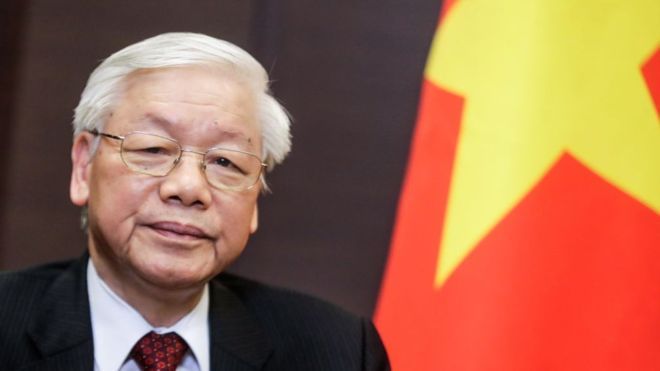
    For more than half a year, the health of Vietnam’s President Nguyen Phu Trong has remained a top secret while rumors and speculation about him continued to spread across social media. Trong was not able to visit the United States in October 2019 as planned, and that fact stirred up new discussion about his health. Surprisingly, the health of the man who currently holds the top positions as the president of Vietnam and general secretary of the Vietnamese Communist Party (VCP) remains a state secret in Vietnam.

    How is that possible?

    According to the new Law on the Protection of State Secrets (link inVietnamese), passed in November 2018, all information that “protects the health of the top leaders of the (Communist) Party and of the state” is a state secret.

    This law now appears to be coming under increasing public scrutiny as a result of growing  speculation regarding the current health condition of the most politically powerful man in Vietnam.

    Rumors about Nguyen Phu Trong’s health have consumed the entire nation since mid-April 2019, and effectively bumped his name to the top of Vietnam’s Google trends on the weekend of April 13, 2019, pushing it to the No. 2 slot that Sunday evening.

    It apparently all began with a Facebook post by freelance journalist Le Nguyen Huong Tra, which quickly went viral after she announced around 4pm on Sunday, April 14, that the 75-year-old Trong suddenly became ill while visiting Kien Giang province in the south. Helicopters were called to take him from the province back to Ho Chi Minh City for an emergency admission to Cho Ray Hospital.

    Later that evening, more rumors from social media pieced together the puzzle and alleged that Trong had suffered a brain hemorrhage, probably the result of a stroke, which affected the left side of his body. Some pictures, allegedly taken late Sunday afternoon at that hospital, also showed police officers surrounding the premises, leading more people to believe Trong was indeed admitted there for emergency treatment.

    As the country’s other top leaders remained completely silent, pro-government trolls on Facebook immediately went to work.

    Kien Giang province, however, has long been perceived by many Vietnamese as a “kingdom” that belongs to the family of Nguyen Tan Dung – Vietnam’s former prime minister,  a man who was also Trong’s old foe and his rival for the top Communist Party post in 2016. The place is Dung’s hometown, and where his power has taken firm root. In fact, Dung’s eldest son, Nguyen Thanh Nghi, currently holds the top leadership position in the Communist Party’s provincial committee there.

    The animosity between the two former rivals, Trong and Dung, is not believed to have ever ceased to exist. If anything, it has intensified with Trong’s anti-graft campaign in recent years, in  which most of the convicted corrupt officials were identified as Dung supporters in the past. As such, the rumor that Trong felt seriously ill in Kien Giang became even more of a tantalizing tale that the public failed to resist.

    Trong, as the leader of both the state and the Communist Party, has been enjoying an unprecedented power that has not been seen since Le Duan’s death in 1986. The possible downside of this setup, perhaps, would be that the country’s future hinges on his wellness. And in the worst case scenario, the Party will have to promptly fill two top positions at the same time to maintain stability until its next Party Congress. It would, then, seem to be a reasonable demand from the public to ask the government for an official account of Trong’s current condition.

    But with the current Law on Protection of State Secrets, however, the details of the health of a Vietnamese leader may never be disclosed, even when the public does have a legitimate reason to demand the facts, as in the case of President Trong.

    At the time this law was under debate in the National Assembly, one legislator, Bui Dang Dung, had questioned whether it was reasonable to classify leaders’ health as a state secret. Nevertheless, he was in the minority and the law was passed with a more than 91 percent approval.

    But why can’t the public in Vietnam be informed about the health of their top leaders and about their fitness for office?

    The answer probably would lie in the manner with which the Communist Party controls and decides elections, as well as its appointment of the top leadership in Vietnam. Despite having a law on elections, in reality, voting in Vietnam is essentially meaningless. Vietnamese people often joke that we don’t have free elections, but rather a selection. And it is a selection that takes place among the Communist Party’s factions, after all the infighting has settled.

    The Party Congress is the backdrop for spectators to watch which candidates will come out as winners, or may we say, rulers of the country. This was the reason for the world to pay attention to Vietnam’s last Party Congress in 2016, where Trong triumphed over Nguyen Tan Dung. The Party members formed alliances and voted accordingly to protect their interests during that meeting.

    As citizens the Vietnamese people are presented with ballots to elect their representatives from among the Party-approved candidates during the general election that follows the Party Congress. The people rubberstamp Party choices for National Assembly members, which consist of those who will, in turn, rubberstamp the Party’s choices for our nation’s top leaders and policy decisions.

    Every few years, however, rumors and unofficial accounts regarding the health of leaders mysteriously show up on social media in Vietnam. Sometimes, the rumors turned out to be true, as in the cases of Nguyen Ba Thanh (Head of the Internal Affairs of the party) or Tran Dai Quang (President). And at other times, the rumors turned out to be false, as with the story of the Minister of National Defense, General Phung Quang Thanh, back in 2015. Most of the time, the public would follow such news with keen interest, believing that they were getting a glimpse into the power struggle within the Communist Party. As the rumors have it, neither Nguyen Ba Thanh’s or Tran Dai Quang’s illnesses resulted from natural causes; instead they were likely poisoned by their political rivals.

    Regardless of whether such rumors contain any substance, negative information regarding a leader’s health can trigger factions within the Party to shuffle and change their alliances, causing the power paradigm to shift and create instability. For the Communist Party, it only makes sense that all information should be kept hidden and dealt with internally to avoid just that. The Party would, by all means, keep information away from the people’s scrutiny to avoid anything that could remotely affect its absolute political power in the country.

    After all, it does not matter how many factions there are in the Party and what they may fight about. Until now, Party members have always agreed, unanimously, that they must continue their political monopoly. With that, the culture of non-transparency and secrecy persists and continues, from the internal actions of the Communist Party to the governing functions of a state with no apparent distinction.

    The leadership of the Communist Party will be on full display in 2021 when their members meet for their Party Congress which will elect the next general secretary and the next group of leaders. During 2019, besides  Trong, the other two most powerful leaders of Vietnam,Nguyen Xuan Phuc and Nguyen Thi Kim Ngan, have both faced major controversies that could diminish their power in their next Party Congress. But the health of Trong remains the top story among the public.

    In October 2019, a video clip of less than 60 seconds showed Trong greeting Laotian leader Bounnhang Vorachith. In the video, viewers can see Trong’s frailty, probably due to an earlier stroke which left one side of his body extremely weak. His walking also showed problems and the question was once again raised among Vietnamese citizens: Is he well enough to lead his Party and the whole country?

    His failure to govern the country was exposed in the tragedy of the 39 Vietnamese citizens who froze to death in Essex, the United Kingdom, earlier this month. After the British and Vietnamese authorities confirmed the nationality of the victims, Prime Minister Nguyen Xuan Phuc extended his condolences to their families. At the same time, President Trong remained silent, even though someone in his position – according to the Constitution – should offer state condolences to the victims and their families.

    In Vietnam’s current regime, whether Trong is well enough to lead may not be a question that people may easily ask and have an answer for. Many people have assumed that it could very well be that within the Communist Party the infighting has already begun to choose the country’s next top leader. In the meantime, citizens can only pay attention to social media and non-governmental media outlets for news about the health of their leader and whether he is still be able to rule.

    For a bit over one year from now until 2021, VCP factions will continue to fight to select their leaders while close to 100 million Vietnamese citizens can only accept the party’s selection. How can this country have a solid leadership when the people do not have the right to elect their top leaders or to be informed about his or her ability to lead?