Tag: Cybersecurity

  • Vietnam: State-Owned People’s Army Newspaper Defamed Independent Media, Civil Society Organizations

    Vietnam: State-Owned People’s Army Newspaper Defamed Independent Media, Civil Society Organizations

    On March 25, 2019, in what could have been a classic libel case, the online newspaper of the Vietnamese Armed Forces defamed some independent newspapers, media, and civil society organizations, including our Vietnamese site – Luat Khoa magazine in an article written by author Nhat Minh.

    Vietnam’s national television VTV 1 also broadcasted the same article during its morning news on the same day.

    The article accused Luat Khoa magazine and its editor-in-chief, Trinh Huu Long, to have received support from Viet Tan, an overseas Vietnamese political party that has been classified as a “terrorist organization” by the regime.

    Among other things, it also alleged that independent newspapers, media, and civil society organizations such as Luat Khoa, Cong Hoa TV, Vietnam Path Movement, and so forth, were promoting “fake democracy,” and that the real intention of these organizations was to misrepresent information about the Vietnamese Communist Party and the government by portraying them in a negative light.

    According to the author, some forms of citizen journalism and blogging by individuals who exposed wrongdoings and injustice in society could be criminal conducts.

    Examples of bloggers recently imprisoned for exercising their freedom of expression, such as Phan Kim Khanh and Nguyen Van Hoa, were named in the article to support the writer’s position.

    The article, in many ways, reinforced the Vietnamese government’s view of independent media in the country. It was this very same view which probably had put Vietnam at number 176 out of 180 on the Reporters Without Border’s World Press Freedom Index in 2018.

    It may be a challenge for Vietnam to name one independent media from the list of over 800 news outlets it often uses to prove press freedom exists in the country.

    Nevertheless, the article suggested criminal prosecution against the activists and journalists operating these organizations. It also called for stronger and more effective collaboration from the tech companies – such as Facebook and Google – in compliance with the new cybersecurity law.

    The article reconfirmed what the Vietnamese government has continued claiming in the past one and a half years, that Facebook has already established a separate channel to resolve requests from Vietnam regarding any information deemed to have violated the country’s social media (rules).

    It also paraphrased an unnamed official from the Cybersecurity Bureau of the Ministry of Public Security (Vietnam’s National Police Department) and declared that “Google and Facebook both found Vietnam’s cybersecurity law is ‘suitable’ and will research on amending their policies to be in line with Vietnam’s law.”

    The article included a quote from Ann Lavin – Google’s Director of Public Policy and Government Affairs in Asia-Pacific – stating that “Google would respect and follow the domestic laws of host countries, including Vietnam.”

    However, the author failed to make it clear to the readers that Ms. Lavin’s quote was taken from a conversation she had with the then Minister of Information and Communication, Truong Minh Tuan, in January 2018 – almost one year before the new cybersecurity took effect. The fact that she is no longer working at Google was also left out.

    The article did provide statistics on the removals of contents allegedly done by Google and Facebook upon the government’s request.

    It stated that by “the end of June 2018, Google had removed 6,700/7,800 clips from YouTube – a Google’s product – including 300 clips carried subverting contents, inciting subversion against the VCP and the government and 6 YouTube channels got blocked completely.”

    It further claimed that “Facebook also removed 1,000 links (out of 5,000 requests) which were deemed to have violated Vietnam’s laws, 107 fake accounts, 137 accounts that defamed, misrepresented, and propagandized against the VCP and the government.”

    The information listed on the Google Transparency Report and Facebook’s Government Requests Report for 2018 does not seem to exactly collaborate the claims in the People’s Army Newspaper’s article.

    However, these companies’ reports did show a worrying trend of increasing content restrictions in Vietnam and the seeming willingness of tech giants to comply with the government’s requests.

    Among the four requests for contents removal from Vietnam listed by Google during the reporting period dated between January-June 2018, we found a particularly troubling one.

    Accordingly, the Authority of Broadcasting and Electronic Information, Ministry of Information and Communications in Vietnam had asked Google to remove “over 3,000 YouTube videos that mainly criticized the Communist Party and government officials.” Google admitted that they “restricted the majority of the videos from view in Vietnam, based on Decree 72.”

    Decree 72 is a controversial legal document, seeking to curtail the people’s ability to share information on the internet in Vietnam since 2013, half a decade before the cybersecurity law came into existence.

    As for Facebook, their reports indicated that the company had complied with a total of 265 content restrictions requests from the Vietnamese government during the first six months of 2018 compares to 22 requests from July-December 2017.

    Facebook also released some Vietnamese users’ data to the government upon requests under legal process and emergency requests.

    From January-June 2017, Facebook received four requests involving five accounts where they released some information to 25% of the requests. From July-December 2017, Facebook released information in response to 38% of the eight requests, affecting 12 user accounts.

    In the first six months of 2018, however, the Vietnamese government made a total of 12 requests which involved 26 accounts, but Facebook only released data in response to 17% of the requests.

    The above statistics showed a concerning trend because, before 2017, Facebook’s transparency report indicated that it had never released users’ data to the government under any circumstances.

    Reports from Vietnamese activists on the grounds in the past 12 months, however, also indicated a much larger number of accounts removal and content restrictions on Facebook.

  • English Speakers In Vietnam Got A Taste Of Censorship Over An Article On Pollution

    English Speakers In Vietnam Got A Taste Of Censorship Over An Article On Pollution

    February 20, 2019, a few foreigners living both inside and outside of Vietnam were sharing the news that an English article published on the site VN Express was taken down before they could read it.

    Some of them suspected that it was the state’s censorship or even the beginning of the enforcement of the new cybersecurity law.

    As of press time, still, the link is not working.

    The article was about the lone man’s trip across the country of a Vietnamese photographer, Nguyen Viet Hung, to raise awareness on marine pollution in Vietnam using what he knows best, photography.

    The story of Hung was becoming quite popular in Vietnam during recent days.

    He is a well-known photographer whose trip was published on social media and a few newspapers, including one that is under the ownership of the Ministry of Public Security, Cảnh Sát Toàn Cầu online (Global Police Force).

    The 3,260 km long journey, dubbed “The Green Journey” on social media, was documented by Hung and his photography skills

    He began his trip in August 2018.

    Along the way, he was documenting the danger of improper waste disposal, especially plastic waste, and its effects on the environment.

    There was an incident where Hung said he felt scared for his life when taking a picture of a truck dumping trash into the ocean because he thought the truck driver was calling more people to come over and intimidate him.

    The story was well-received by the public because it raised concerns over an urgent matter that all Vietnamese people face daily: how to deal with garbage disposal in the country.

    Marine pollution and pollution, in general, have gained more attention among the public because the amount of trash being disposed in Vietnam on a daily basis is quite alarming.

    In 2018, Vietnamese people became even more concerned when a report placed their country among the top five ocean polluters regarding plastic waste became viral.

    Like many other censored topics in Vietnam, we could never fully understand why an article suddenly becomes “unavailable” when the web link stops working.

    One may suspect that it was because the story placed equal responsibility on both the people and the state for marine pollution, where the failure of the garbage disposal system in Vietnam played a significant role.

    Hung said in one of the Vietnamese articles, that while at Sa Ky Harbor in Quang Ngai Province, it was impossible for him to find a garbage can. As the result, all local residents living in the area would dump their trash directly into the waters which they also use for bathing and consuming.

    Regardless of the reason, Nguyen Viet Hung’s photographs bring about a reality that both the Vietnamese people and their government must face: marine pollution in Vietnam is a code red issue where drastic measures, as well as immediate behavioral changes, must happen now.

    Hung had put this succinctly in the only paragraph left from the taken-down article:

    The farther I went, the more I realized that the environment in general and marine environment in particular of our country are being seriously destroyed. Most people are not aware of the scale of the problem, and this should change, Hung said.

    A few photographs from Nguyen Viet Hung’s trip:

    Plastic rubbish filled the land near a market place in Tuy Phong, Binh Thuan Province. Photo Courtesy: Nguyen Viet Hung.
    Lacking proper garbage disposal, people dumped their trash directly into the ocean. Photo courtesy: Nguyen Viet Hung.
    Children were playing near a creek filled with garbage. Photo courtesy: Nguyen Viet Hung.
    A child was picking up near the seashore. Photo courtesy: Nguyen Viet Hung.
  • Vietnamese Police Continue Questioning People Over Facebook Activities

    Vietnamese Police Continue Questioning People Over Facebook Activities

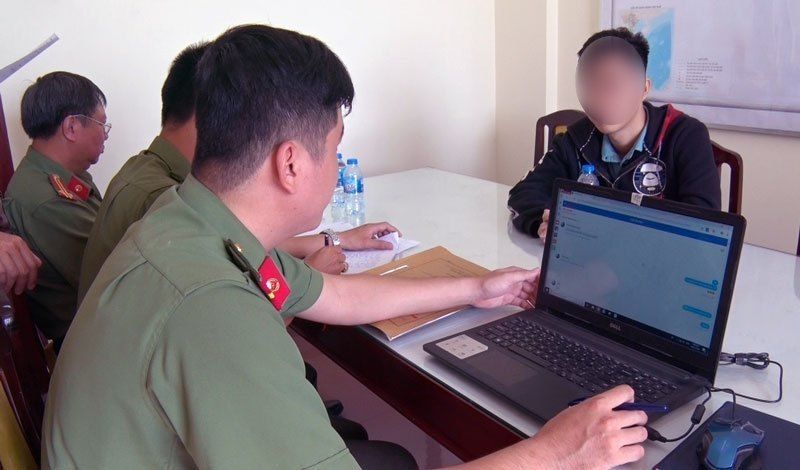
    The police force in Ben Tre Province, Vietnam seemed to have been quite busy in the last few months, going after people’s postings on Facebook.

    In January 2019, their Domestic Security Bureau took a university student in and questioned him over his Facebook’s usage, including whether he had joined a group calls “Liking BBC Vietnamese” (Thích BBC Tiếng Việt) – which the police classified as “politically hostile.”

    On February 13, 2019, Vietnamnet newspaper reported that Ben Tre provincial police conducted an investigation and interrogated a 35-year-old man, Phan Chi Toan, about his Facebook’s activities under the username “Phan Rio.”

    Police alleged that the Facebook account calls Phan Rio was conducting “subversion against the people’s government.”

    How did he do it according to the authorities?

    He did so by joining numerous groups, allegedly “politically hostile” towards the Vietnamese Communist Party (VCP) and the State, posting, sharing, and commenting on contents that incited demonstrations, as well as propagating to defame the policies, guidelines, and directions of the VCP and the government.

    The police had not formally charged Toan with a crime but did declare that they would proceed with the case according to the regular procedures.

    The same Vietnamnet’s article further mentioned that the People’s Committee of Mo Cay Bac District, also in Ben Tre Province, had fined a 55-year-old man – Dang Tri Thuc – under Government’s Decree 174/2013/ND-CP, Article 64, Section 4, for using his Facebook account to incite public demonstration in December 2018.

    Accordingly, Thuc, a driver, was accused of using the live-stream feature on Facebook to make video clips, calling on others to protest on a few major road intersections on December 22 and 28. He allegedly admitted guilt, confessed and promised he would not repeat the offense, so the authorities fined him with 15M VND or approximately 650 USD.

    Decree 174/2013/ND-CP, Article 64: Violations against regulations on websites/ news websites

    Section 4. A fine ranging from VND 30,000,000 to VND 50,000,000 shall be imposed for any of the following violations:

    a) Propagating information against the Socialist Republic of Vietnam; sabotaging the bloc of great national unity at a degree of severity which is still not liable to criminal prosecutions;

    b) Propagating information with the aims of inciting war of aggression, causing hatred between ethnic groups or people of countries, inciting violence or propagating reactionary thought at a degree of severity which is still not liable to criminal prosecutions;

    c) Distorting history, denying the revolutionary achievements or offending the nation, people or national heroes at a degree of severity which is still not liable to criminal prosecutions.

    While the right to demonstrate is constitutionally protected in Vietnam, the government had routinely violated this right by applying their Decree 38/2005/NĐ-CP – to regulate “public gatherings – during protests to arrest the participants.

    Since the nationwide mass protests broke out in June 2018 against the draft bills on the cybersecurity law and the development of three special economic zones, the security police have continued to track down those who had participated and made arrests in different cities and provinces.

    The family of a woman names Doan Thi Hong from Binh Thuan Province has recently made a public plea on social media, alleging that Hong was taken into police custody by a group of plainclothes police on September 2, 2018. She was a participant in the same June 2018 protest mentioned above.

    Although she has a young child under 36-month-old at the time of the arrest, which under Vietnam’s laws is a factor to consider against pre-trial detention, her sister claimed that Hong had been arbitrarily kept incommunicado since September of last year.

    According to her sister, Hong was not a dissident and only exercised her right to protest that one time.

    It seems that the police’s recent investigations targetting Facebook’s activities and usage in Vietnam also focus primarily on the average users and not necessarily the more well-known bloggers and dissidents.

  • Vietnamese Police Questioned University Student Over Facebook Postings

    Vietnamese Police Questioned University Student Over Facebook Postings

    On February 1, 2019, the Domestic Security Bureau of Ben Tre Province interviewed Tran Ngoc Phuc, a 21-year-old student of Ton Duc Thang University in Ho Chi Minh City at their station.

    Dong Khoi online newspaper, a publication of the VCP’s Provincial Committee in Ben Tre, published the story on the same day.

    According to the article, the police accused Phuc, a resident of Tan Phu Commune, Chau Thanh District, Ben Tre Province, of using his personal account to propagandizing against the Vietnamese Communist Party and the State.

    Namely, Phuc was using Facebook under the name “Ngoc Phuc” to join several “politically hostile” groups. Among them, was “The South of Vietnam” (Miền Nam Việt Nam), Fanclub of Saigon Capital (Đô thành Sài Gòn Fanclub), and  “Liking BBC Vietnamese” (Thích BBC Vietnamese).

    Phuc also allegedly admitted to the police that he was indeed the Facebooker Ngoc Phuc and that he had posted, shared, and commented on specific contents.

    The police had deemed these contents as materials which “propagandized, sabotaged the thoughts, distorted the direction, objectives, and policy of the VCP, the laws of the State and distorted (the image of) the leader Ho Chi Minh.”

    Formal charges against Phuc had not been filed, but the police indicated that they would continue to build the case and follow the regular legal procedures in this case.

    During the first month since the new Cybersecurity Law took effect in Vietnam on January 1, 2019, there were several reports that the police had questioned and detained some Facebookers.

    Rights groups, online campaigners, bloggers, activists, and dissidents continuously criticize the new law for further curtailing freedom of speech and shrinking the online civic space in Vietnam.

  • Vietnamese Police Wants to Control People’s Credit Information, Log Chat, and Political Opinions with New Cybersecurity Law

    Vietnamese Police Wants to Control People’s Credit Information, Log Chat, and Political Opinions with New Cybersecurity Law

    On or about October 3, 2018, the Ministry of Public Security of Vietnam quietly released their draft decree on the implementation of the country’s freshly minted Cybersecurity Law of 2018. As of press time, the MPS has yet to announce the draft decree to the public on its website. Instead, they only sent it to a few selected businesses and governmental agencies to collect feedbacks.

    It is expected that this draft will undergo a few revisions.

    We are highlighting a few critical points from the first version dated October 3, 2018, as follows:

    1. Police’s Administration Of People’s Credit Card’s Numbers, Personal Financial History, And Political Opinions

    The issue which generated the most public concern regarding the new Cybersecurity Law that was passed by Vietnam’s National Assembly on June 12, 2018, has centered around the definition of “Internet user’s personal data.” The new law summarily discussed the requirement for Internet providers to store users’ data in Vietnam and provide them to the authorities upon request. The draft decree now seeks to define this term, “personal data,” in details at Article 2, Section 2:

    “Personal data is information in the form of symbols, words, numbers, pictures, sounds, or any like forms to identify the accurate identity of an individual, including:

    1. Data concerning personal information: name and surname, date of birth, place of birth, nationality, profession, position, place of residence, contacting address, email address, telephone number, identification card number, personal identification number, passport number, social benefits insurance card number, credit card number, health conditions, medical history record, financial history record, interests, strengths, political opinions, ethnic origin, race, philosophical beliefs, societal position, biometrics;
    2. Data created by individuals: the content of personal interaction, usage function, realizing conduct, time, acting frequency, selected information chosen to be uploaded, synchronizing or importing from a device;
    3. Data concerning the individual’s relationships: friends, pages, accounts, keywords, groups that the users connected to or interacted with.”

    However, the above section does not constitute the entire list of all data which businesses are required to store and provide to the Bureau of Cybersecurity, Prevention and Opposing High Technology Crimes of the MPS.

    Under Article 54, the draft decree further adds: “information used to create a user’s account” and “data occurred during the use of services, including access history, information regarding the payment for services, IP address used for accessing services, search history habits, log chat, time of the transaction.”

    Moreover, the Bureau of Cybersecurity could also demand businesses to provide information concerning a user’s devices including “information about the device, attributes, activities, identification number, signal, data regarding the installation of the device, network and connectivity, cookie data.”

    2. Businesses Have To Permanently Store Users’ Data, With A Few Exceptions

    Regarding personal data and information used to initialize a user’s account, the draft decree explicitly

    demands 

    that businesses to permanently store the data, either according to the length of their operation or until they cease to provide services.

    For data which could only be generated later, such as IP address, log chat, search habits, they would have to be stored for 36 months.

    3. Governmental Agencies And Businesses Providing Services Will Have One Year From January 1, 2019, To Prepare For Compliance

    The final version of the decree and the Cybersecurity Law are both projected to take effect at the same time, which will be on January 1, 2019. Accordingly, governmental agencies, businesses, and related organizations will then have one year to bring themselves in compliance with such regulations concerning the storage of data, and providing them to Vietnamese authorities upon request, as well as establishing their representative offices or branches in Vietnam.

    It means foreign technology companies that have been providing services to Vietnamese users, such as Google and Facebook, would have to prepare their data center, the technology infrastructure for data storage, as well as registering and opening their offices in Vietnam before January 1, 2020. During the same 12-month period, the Bureau of Cybersecurity under the MPS would also establish their own data center to “store, manage data to be turned over from businesses,” according to Section 6, Article 58.

  • Enhanced Restrictions In Cybersecurity Bill Shows Vietnam Is NOT Ready To Commit To EU-FTA’s Human Rights Clause

    Enhanced Restrictions In Cybersecurity Bill Shows Vietnam Is NOT Ready To Commit To EU-FTA’s Human Rights Clause

    In recent days, the people in Vietnam, again and again, have proven that social media was the most effective platform to express their discontent with various social and political issues in the country.

    Around the first week of May 2018, people’s outpoured anger over an appellate court’s decision which reduced the sentence for a convicted child molester had forced the country’s top court – the court of cassation – to swiftly responded and reaffirmed the original sentence.

    And just this week, when citizens discovered that their National Assembly was going to pass a law to create three Special Economic Zones (SEZ) at Vân Đồn, Bắc Vân Phong, and Phú Quốc, they again took to Facebook to express their objection to the government’s plan. Then, they used the social media to organize the actual demonstration.

    The call for a nationwide protest on one Facebook page received more than 160,000.00 shares and close to 140,000.00 reactions within days.

    Social media has proven that it still is the most effective tool to disseminate information in Vietnam and to raise awareness on a variety of issues.

    It was precisely seven years ago this summer that a nationwide anti-China’s aggression in the South China Sea – Vietnam’s East Sea – broke out because of a call to protest on Facebook by the page Nhật Ký Yêu Nước – Patriotic Diary.

    Since 2011, social media has witnessed the emerging democracy movement in the country where it served as the birthplace of many independent civil society organizations, online newspapers, and media agencies.

    With some current 30 million Facebook users in a recent statistics, neither the government or its people would underestimate the power of social media and Facebook in Vietnam.

    In both of the recent incidents, the people’s power prevailed, at least for now.

    By the early morning of June 9, 2018, the Vietnamese government officially announced the SEZ bill would be postponed until the fall session of the National Assembly.

    However, it does not mean that the government is ready to throw in the towel.

    Another bill is pending for approval by the National Assembly on June 12, 2018, and it is what would become the infamous Cybersecurity law with at least seven strikingly similar provisions when compares to China’s laws.

    More concerning is the fact that these provisions are more than “copy and paste” paragraphs from China’s laws. They are in direct violation of international human rights standards.

    Explicitly, in 2016, the Human Rights Council passed a resolution without a vote, to include an addition to Article 19 of the Universal Declaration of Human Rights, recognizing the right to Internet access is a human right.

    The goals and objectives of this Cybersecurity bill will violate Article 19 because it gives the government and the police power to demand readily accessible information to all citizens’ Internet usage data whenever they want and without any due process.

    Internet service providers will act as informants for the government, voluntarily give up users’ activities to police.

    Foreign corporations such as Google, Facebook, Microsoft, Apple, and so forth, will most likely comply with Vietnam’s request to have their servers – which contain Vietnamese users’ data – to be stationed in Vietnam and must have an operating office located inside the country.

    It would mean all of these companies’ stored data within Vietnam’s national territory will have to be given up to police once they demand it.

    The European Union, its parliament, and its member countries should take careful notes of this Cybersecurity bill when they consider the ratification of the EU-Vietnam Free Trade Agreement (EU-FTA) in early 2019.

    As in all EU trade agreements, the human rights clause have been maintained by EU officials and politicians as an essential condition, and that they reserve the power to suspend the agreement if there are going to be gross violations.

    The Chair of the European Parliament’s Committee for International Trade, Bernd Lange, during his visit to Hanoi in September 2017, even declared that human rights and labor rights are at the center of the continued discussions about the FTA between Vietnam and EU.

    If this Cybersecurity bill is passed, it will very well be in contradictions with the human rights clause of the EU-FTA. The U.S. government, Amnesty International, and Human Rights Watch all seem to have taken this view.

    The U.S. Embassy in Hanoi urged Vietnam in their statement issued late June 8, 2018, not to pass this bill, citing concerns that such law “may not be consistent with Vietnam’s international trade commitments.”

    At the same time, Amnesty International and Human Rights Watch both declared that if the Cybersecurity bill is passed and goes into effect, it would violate Vietnamese people’s freedom of expression and their privacy.

    Some Vietnamese are worrying that they might have spent too much time and efforts on the SEZ bill and neglect the one on Cybersecurity, letting it slips through.

    Undoubtedly, the main reason that many Vietnamese were willing to take their anger from Facebook to the streets regarding the SEZ bill and in a certain extent, direct such outrage at their government this past week, was the China factor.

    The people believed that the law would give Chinese investors and corporations an advantage as to the future development in those three locations.

    Tensions between Vietnam and China are historical facts that no regime could re-write. It does not help either that in recent years, China’s rising aggression in the East Sea would continue to remind the younger generations in Vietnam that China has been, still is, and will be a threat to their nation’s sovereignty.

    “Bringing the elephants home to demolish your ancestors’ grave” – an idiom that has been recited over and over again online during the past week – is probably the image many Vietnamese have in mind when they protest the SEZ bill.

    If the Cybersecurity bill passes, the government can construe this very phrase (when use to object any of its decision – such as the SEZ bill this time) as “information which propagandizes, misrepresents, and defames the People’s government” according to its Article 15, and that will be the reason for people to find themselves in trouble with the laws.

  • Vietnam: Deputy PM’s Flip-Flopped Position Signaled Government Will Take Tough Measures on Cybersecurity Law?

    Vietnam: Deputy PM’s Flip-Flopped Position Signaled Government Will Take Tough Measures on Cybersecurity Law?

    Once regarded as the poster’s child for – what was hoped by some – the progressive faction within the Communist Party, Deputy Prime Minister Vu Duc Dam, had recently shown his allegiance to the Party’s hardlines, at least on the issue of cybersecurity.

    As the Vietnam’s National Assembly is currently reviewing the latest Draft Law on Cybersecurity, on November 17, 2017, the 54-year old Deputy PM Dam delivered a passionate speech defending why Vietnamese government must control social networks and limit the numbers of Internet users.

    Dam even praised China’s efforts on controlling social media through the use of an Intranet and heavy censorship on search contents.

    But just last year, in March 2016, it was also the same man, Deputy PM Dam, who spoke at a World Bank conference and praised technology, pledging his commitment to support an uncensored Internet in Vietnam.

    “I want to say that now is not the time to discuss the benefits of digital technology, but to affirm: Though digital technology itself has negative sides, this is not by its own faults but rather by those who use it. Thus, we cannot restrain it because of the negative impact, but must find all means to allow it to grow.”

    Would Mr. Dam’s recent change of heart on the issue of Cybersecurity demonstrate the impossibility for Party’s cadres to break free from its political ideology, namely those who are in the Politburo?

    Mr. Dam had long been trusted with the tasks of managing the field of Information and Communications in Vietnam. He has also been viewed as an official who’s more open and friendly with the IT community, given his background working at the National Central Bureau of Post Office and had served as the Deputy Minister of the Ministry of Post Office and Telecommunications.

    It was as recent as February this year, during a talk with FPT University’s students, Dam recalled how he had met with top technology personnel in the country and advised them that the World’s Fourth Industrial Revolution shall be defined by the term “connection”.

    And by connection, Dam meant, “the eight billion equipment which connects at every level, every angle, and does not limit itself to one university, one province, one country but is a global connection. This revolution would have an intimate relationship with technology.”

    So what had changed?

    What would make a man went from one who believed in the ability for people to have a global “connection” as the core element of the Fourth Industrial Revolution to a defender of government’s Internet censorship, and a supporter of an “Intranet” construction – identical to that of China?

    Because now, during his last presentation in front of the National Assembly, Dam also proposed using “technical measures to block, filter or slow down [information] when necessary.”

    The people wonder, who is then, the real Vu Duc Dam and what does he really believe in?

    If there were any hopes for a progressive faction within the Communist Party, Deputy PM Dam probably would be among the top runners to lead such group.

    He was a foreign-educated politician, graduated from university in Brussels, whose popularity rose among the younger population in Vietnam with his English abilities, his support for educational reforms, environmental protection, and his friendliness towards IT community and technology development.

    Yet, Dam’s latest speech on the National Assembly’s floor two Fridays ago showed where his true allegiance lies: The Party’s doctrine which values censorship and putting absolute restraints on free speech.

    Vietnam was a member of the Human Rights Council last year when a resolution was passed without a vote, to include an addition to Article 19 of the Universal Declaration of Human Rights, recognizing the right to Internet access is a human right.

    But that obviously did not stop the government to adamantly insist on tougher Cybersecurity Law, one that mirrored China’s laws. Mr. Dam apparently seems to have forgotten it as well during his latest speech, when he insisted that Vietnam would not break any international law standards with its tougher stand on social media and Internet management.

    The government has recently claimed boastful records in working with Google and Facebook to successfully remove thousands of content that were deemed to be “anti-State” materials during just this year alone.

    Since the Internet was first publicly introduced in Vietnam 20 years ago, now, social media networks have grown to become the main platforms for people to raise their concerns over a number of issues. Many of which would be deemed politically sensitive or even outright dissenting opinions.

    No one seems to deny that both the independent civil society movement and the emerging independent media in the country are the results of ordinary people having access to the Internet.

    As such, the need for an authoritarian government – like Vietnam – to censor and control the Internet and social media networks is real and urgent.

    Deputy PM Dam’s recent defense of the government’s use of technical measures to censor and control the Internet and social media – to some people – adds worries that Vietnam would – by all means – pass the proposed Cybersecurity Draft Law.

    To defend the government’s legitimacy and absolute power, the control over the media had never slipped off the Party’s grips. Deputy PM Dam’s stand on the issue of Cybersecurity could give glimpses of the Party’s unanimity on maintaining that control by expanding and strengthening Internet censorship in the country, regardless of how many factions within the Politburo we may think there are.